Space Western Comics: A Review

It’s tempting to look at pop culture trends in the 1950s and ‘60s in broad strokes, shaped by after-the-fact simplifications like Toy Story 2. In that film, classic cowboy Westerns were put out to pasture (heh) with the launch of Sputnik and the beginning of the Space Race, and almost overnight children’s imaginations turned to science fiction. In the long run, I suppose that did happen, but over decades rather than months or weeks. Throughout the 1950s and much of the ‘60s, Westerns (and related frontier and outdoorsman stories) remained popular with kids (and adults), and while sci-fi eventually overtook them in relevance, there were multiple attempts to combine the two popular flavors. Gene Roddenberry may have pitched Star Trek as “Wagon Train to the stars” and codified space as “the final frontier,” but he wasn’t the first to make the connection. Craig Yoe, prolific historian and anthologizer of comics, has produced a fun and informative volume in Space Western Comics, reprinting and contextualizing a run of adventure stories combining cowboys and aliens from the 1950s. It’s perfect reading for Vintage Science Fiction Month.

It’s worth noting that the term “space Western” was sometimes used (derogatorily) in sci-fi publishing and fan circles to describe stories that were just the same old formulaic good guys confronting bad guys dressed up in otherworldly verbiage, with rayguns replacing six-shooters and spaceships replacing horses. (Star Wars was attacked in the ‘70s by purists along exactly those lines, but at least Star Wars had considerable artistry on its side; in the ‘50s the white hats vs. black hats approach was strictly the domain of hacks.) But there were some literal space Westerns as well that combined the terminology and iconography of both genres into a single, (mostly) coherent story world. (I wrote about this weird subgenre several years ago and went into detail on the movie Cowboys & Aliens, at the time the most current example.)

Westerns in the first half of the twentieth century weren’t limited to the Old West. Real-life ranches and cowhands were enough of a reality that so-called “modern Westerns” could tell stories of pure-hearted (often singing) cowboys fighting cattle rustlers, land-grabbing oil or radium speculators, and other unscrupulous villains while using up-to-date technologies like automobiles, airplanes, and radio. While fanciful, these modern Westerns ostensibly took place in the “real world” of the 1930s, ‘40s, or ‘50s. Naturally, some of the same futuristic devices that were appearing in contemporary serials and comic books—miraculous rays, rockets, and the compelling but imperfectly-understood “television”—made appearances in the modern Western setting as MacGuffins or mysteries that needed to be unraveled. A cycle of “gadget Westerns” ran its course in the serials of the 1930s, but none of those involved actual space travel or alien visitors. The Phantom Empire, which famously sent Gene Autry underground to confront an ancient, advanced civilization miles beneath his ranch, stands out as an example of the Western exploring inner, not outer space.
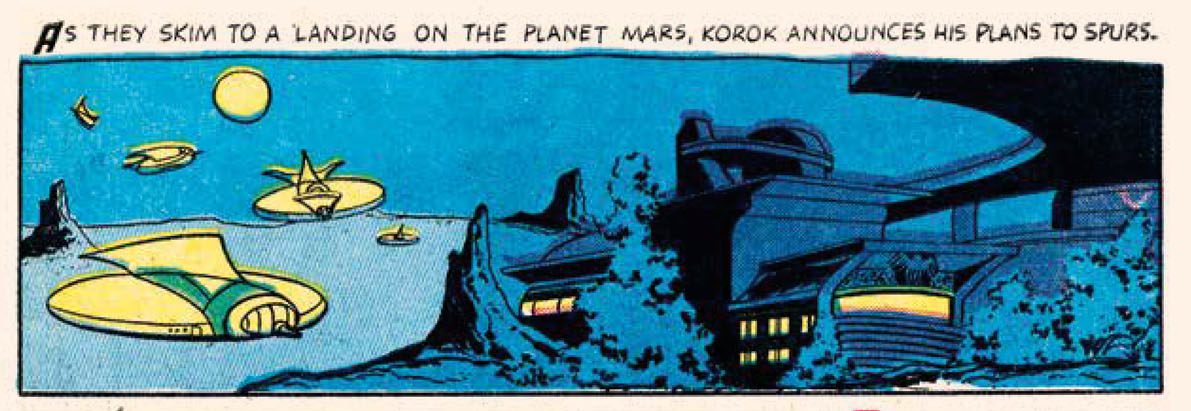
So it is perhaps not surprising that the still-popular Western genre, chasing after trends, would incorporate UFOs, space travel, and alien life in an attempt to hold fickle audiences’ attention. And it is even less surprising that comics—a business with low costs and quick turnaround compared to the movies—would be in a position to take advantage of the brief moment when cowboys and spacemen appeared to be on equal footing (at least with the allowance-spending children of America).

In 1952, based on a suggestion from Charlton co-publisher Ed Levy, the already-extant Cowboy Western Comics changed its title to Space Western Comics (a common practice: instead of starting a new series with issue number one, it was believed that high numbers were more attractive to newsstand buyers, as they suggested a successful track record). Walter P. Gibson, the prolific writer and magician who developed and ghost-wrote The Shadow for Street and Smith, among many other projects, wrote and edited the adventures of “Spurs” Jackson, a rancher and electrical engineer whose ranch becomes the center of zany outer space adventures. (Shades of Gene Autry!) Artists John Belfi and Stanley Glidden Campbell provided the illustrations. The book reverted to Cowboy Western after only six issues, but a couple of stories starring Jackson from later issues are included in Yoe’s volume for the sake of completeness, as are two space-themed stories from Buster Crabbe’s comic book. (Crabbe had, of course, played both Flash Gordon and Buck Rogers in addition to cowboy roles, so this made perfect sense.)
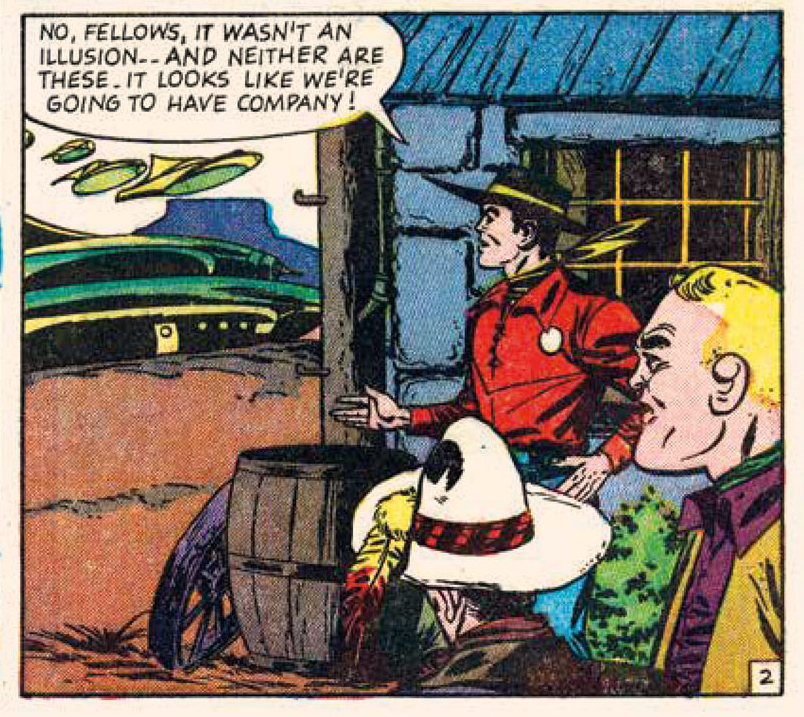
Space Western Comics begins with the Space Age already underway: flights to the moon have become routine, and a space station orbits the earth. “Spurs” Jackson is a character made to have adventures: unmarried and wealthy enough to occupy his free time inventing in his “secret lab,” the rancher-slash-engineer is charged with maintaining a 1000-foot-tall radar tower on his land (a government connection that serves to fuel several later stories), while leaving the day-to-day operations to his foreman, Hank Roper, and the Indian Strong Bow. The radar tower, which helps guide the lunar flights, attracts the attention of spaceships from Mars, who abduct the three men and take them to the red planet. There, they are presented as evidence that the Martians have conquered earth, a pretext that puts the scheming Korok on the throne of Mars instead of the rightful Queen Thula. This is classic space opera material straight out of Edgar Rice Burroughs, but the Western theme eventually pays off: Korok’s throne room is protected by a force field that prevents any metal from penetrating, so Martian weapons and the earthlings’ six-shooters are useless, but Jackson’s whip, Roper’s lariat, and Strong Bow’s bow and arrow, all non-metallic, win the day. For putting things right, Thula offers Jackson a position as her prime minister, but he can’t stay on Mars for long: ranching is an all-day job.

Some of the stories in this volume depend on the romance and exoticism of exploring other worlds, but in many of them the trouble is closer to home. Would-be alien invaders, Communist spies (sometimes disguised as aliens), criminal gangs, and even Nazis threaten the peace of the Bar-Z ranch. The desert makes for a compelling setting, full of isolated canyons and desolate flats, remote enough from civilization that no one in the cities would believe the stories but close to the Army’s testing ranges and bases so there are always plenty of troops and weapons ready to take charge of the surviving villains. As silly as the premises of these stories often are—rock men, plant men, and underground super-moles are among the aliens Jackson encounters—Gibson packs them with twists and clever problem-solving. Like a good engineer, “Spurs” Jackson out-thinks his opponents as much as he out-fights them (although he’s not above setting off an atomic bomb or two if that’s what it takes).

And frequently the twist is kept from the reader until the most dramatic moment, revealing that Jackson had his enemy’s number the whole time. In one of several text pieces, slavers from the planet Letos are foiled by a ship full of humanoid robots supplied by Jackson—“robots” who are actually humans in bullet-proof robot costumes. (Postal regulations required the text pages to secure favorable magazine rates; they were most often filled with editorials or letters columns, but short prose stories were not uncommon. The two-pagers Gibson provided for Space Western Comics are clever pulp miniatures, often written in the folksy voice of characters from around the Bar-Z. I think they would stand up well with the humorous sci-fi of Henry Kuttner and his contemporaries, should anyone think to mine comics’ text pages for anthologizing. Today, Alan Moore seems to be the only comics creator left with much affection for this archaic institution.)

Jackson isn’t the only savvy operator, either: Strong Bow is written as a more sophisticated and educated character than his Tonto-like dialogue might suggest. In more than one story, Indians appear to arrive from space, claiming to be heroes from the past or remnants of lost tribes, inviting the local Indians to overthrow the United States government. Of course, Strong Bow sees right through them, even if he might pretend to go along with the plan. (Although Space Western Comics predates the infamous Comics Code, it’s still as pro-government, pro-American, and pro-law and order as anything produced under the Code. The government and military in these stories are never less than righteous and upstanding, give or take a traitor or two in their midst, so nothing as subversive as suggesting Indian activists might have a point ever enters into the discussion.)

As I’ve alluded to in past articles, comics are a natural medium for the kind of mash-up represented by Space Western Comics: the visual shorthand that is a vital part of comics vocabulary lends itself to mixing and matching. Without attempting to catalog every example of the space Western from later comics, I’ll point to Terra-Man, a cowboy-themed villain from Superman comics. Abducted by space aliens as a child in the Old West, Terra-Man returned to earth with high-tech equivalents of the cowboy’s accessories and an alien winged horse. Current comics have embraced this kind of meta-referentiality with a vengeance, remixing popular iconographies of all kinds with kaleidoscopic variety. Sometimes it’s overwhelming, but I remind myself of being a comics reader in the 1980s, when the Big Two publishers seemed to be embarrassed by anything too “wacky,” and it was left to the independents to publish books like Marc Schultz’s Cadillacs and Dinosaurs (or for that matter, Teenage Mutant Ninja Turtles, as much a mash-up as a parody). I prefer the current acknowledgment of the medium’s silly roots, without the po-faced need to pretend that it’s all serious business.

By now, the proclamation that “comics are supposed to be FUN” is a tradition within comics that is up for grabs, just like every other past genre or practice that is ripe for revival, rehabilitation, or reinvention. Sometimes that means characters like Howard the Duck or Detective Chimp are given equal time with Iron Man or Wonder Woman; sometimes it means weaving disparate, contradictory threads into ambitious multi-layered story arcs that breathe new life into one-off concepts like the Green Team. Signifiers of “comics FUN” include (but are not limited to) ghosts, robots, dinosaurs, gorillas, and, of course, cowboys and rocket ships. Craig Yoe plays up how quaintly ridiculous the stories in Space Western Comics are, and is clear-eyed about the mercenary motives that led to its original creation. But he is equally up-front about how imaginative, breathlessly exciting, and yes, FUN, these stories are, and he has performed a valuable service by putting them together in a handsome and easily accessible package.

My 2023 in Books: Highlights

“If Blue were a scholar . . . she would catalogue, across all strands, a comprehensive study of the worlds in which Romeo and Juliet is a tragedy, and in which a comedy. It delights her, whenever visiting a new strand, to take in a performance not knowing how it will end.”

This Is How You Lose the Time War, Amal El-Mohtar and Max Gladstone

I don’t have a complete reading log to offer this year. I finally, after too long, upgraded to a new computer last summer, leaving behind the document I had started at the beginning of the year. That coincided with a severe reading drought over the summer and I didn’t keep up the log when I finally got back to reading in the fall. So it wasn’t the best year for reading books to begin with, but I do have some highlights worthy of mention.

Science Fiction

Two short science fiction novels made an impression on me. This Is How You Lose the Time War alternates chapters between the perspectives of its two leads, Red and Blue, champions of time- and space-spanning rival powers. The Agency, for whom Red works, represents a post-singularity technological future; the Garden, Blue’s home, is a biologically-engineered paradise. Neither force considers itself safe while the other exists, and the two empires battle across myriad parallel timelines, steering historical events toward their chosen future and cutting off the others’. In this context, Red and Blue are sworn enemies, but they respect each other at a distance like opponents across a chess board. Curious but unable to confront each other face to face, they leave cryptic messages for one another, and their similarities outnumber their differences. (It becomes clear that neither the Agency nor the Garden is the utopia it’s cracked up to be, and one of the prices of the war for Red and Blue is disillusionment.) This is an inventive and lyrical novel, full of poetic flights and extravagant with its language as the clandestine messages back and forth become overt love letters.
Landscape with Invisible Hand by M. T. Anderson is another short but evocative book. Each chapter illuminates a drawing or painting by the narrator, Adam, an aspiring teenage artist. But instead of the infinite worlds of Time War, Landscape focuses on characters with few choices and nowhere to go. In the years since an alien race called the vuvv arrived on Earth and offered membership in their “Interspecies Co-Prosperity Alliance” (red flag!), the gap between the haves and have-nots has grown even larger, and those left behind live in the shadows of the vuvv’s pollution-generating machinery, fighting over jobs in soup kitchens. Adam and his girlfriend Chloe livestream idyllic 1950s-style dates to an audience of fascinated vuvv subscribers, even after they begin to hate each other, an illustration of the way in which the vuvv presence distorts their human “partners,” turning them into caricatures of themselves to satisfy the economic demands of their colonizers. If many science fiction dystopias ask the question “What if white, middle-class people were treated the way minorities and the poor are routinely treated now?”, Landscape with Invisible Hand asks “What if modern, Western society went through the kind of economic and cultural colonization that indigenous people around the world have experienced?”

Another book on a similar theme is The True Meaning of Smekday by Adam Rex (the basis for the animated movie Home), which centers on an invading race called the Boov magnanimously herding all of America’s citizens into a single state reserved just for them (first Florida, but then, after the Boov decide they like Florida, Arizona). Rex is a versatile cartoonist and illustrator as well as a writer, so several sequences are rendered in comics format, purportedly drawn by the Boov main character to explain his world’s history and character. This one is written for a younger audience so it’s fairly whimsical and light, but it’s witty and entertaining and full of asides on human society as seen from an outsider’s perspective in the best science fiction tradition.

Axiom’s End by Lindsay Ellis is a much more grounded novel intended for adults, but it shares with The True Meaning of Smekday a focus on the difficulties of communication with different forms of intelligence and the impossibility of truly knowing another’s mind. Ellis has written that the idea for this novel (the first volume of a trilogy, still underway) sprang from her interest in the Transformers cartoon series, a kernel still present in the friendship between a human woman and an alien being who represents one side in a galactic war. Intriguingly, at least for me, the cohort of aliens who secretly made contact with the U.S. government in the 1970s are identified with Esperanto code names, a relic of the idealism and nerdiness of the group charged with handling them. Linguistic analysis and the ways in which language can channel thought are front and center, but within an action-packed thriller that doesn’t shy away from the gee-whiz tropes popularly associated with science fiction.

Romance

Romance as a genre is, in my opinion, at least partly a form of pulp. Now, before anyone gets defensive, and especially if this is your first time visiting Medleyana and you’re not familiar with my previous writings on pulp, that’s not meant as an insult or a comment on the genre’s readers. But the fact remains that, like the murder mystery, romance is one of the few genres that’s defined by its plot mechanics rather than theme or setting (do not bring a tragic love story without a “happily ever after” to a romance reader and call it a romance). There are established formulas and story beats (especially in the current obsession with tropes and hooks), and, however beautifully written, an emphasis on keeping the story rolling. Many of the romance novelists I explored in the last year were continuing in the tradition of Jane Austen (especially Georgette Heyer, the true parent of “Regency romance” as a publishing genre, and whose work I continued to explore), but there are as many subgenres of romance as there are genres outside it. Paranormal romance in particular overlaps with the fantasy, science fiction and horror that I was already reading.

I particularly enjoyed The Emperor’s New Clothes by Victoria Alexander, set in a small Wyoming town on the cusp of the twentieth century. An itinerant actress, gambler and con woman is mistaken for a visiting English Countess, and with the Countess’ trunks of clothing at her disposal, decides to make the best of it. The only thing confounding her plan to sell her bogus title for cash and move on is the Oxford-educated Mayor, the adopted son of the wealthy rancher who effectively runs things. Will the sparks of attraction between them convince her to go straight, and can he love her for who she is, not who she pretends to be? Well, see my comments on plotting in the paragraph above.

Comics

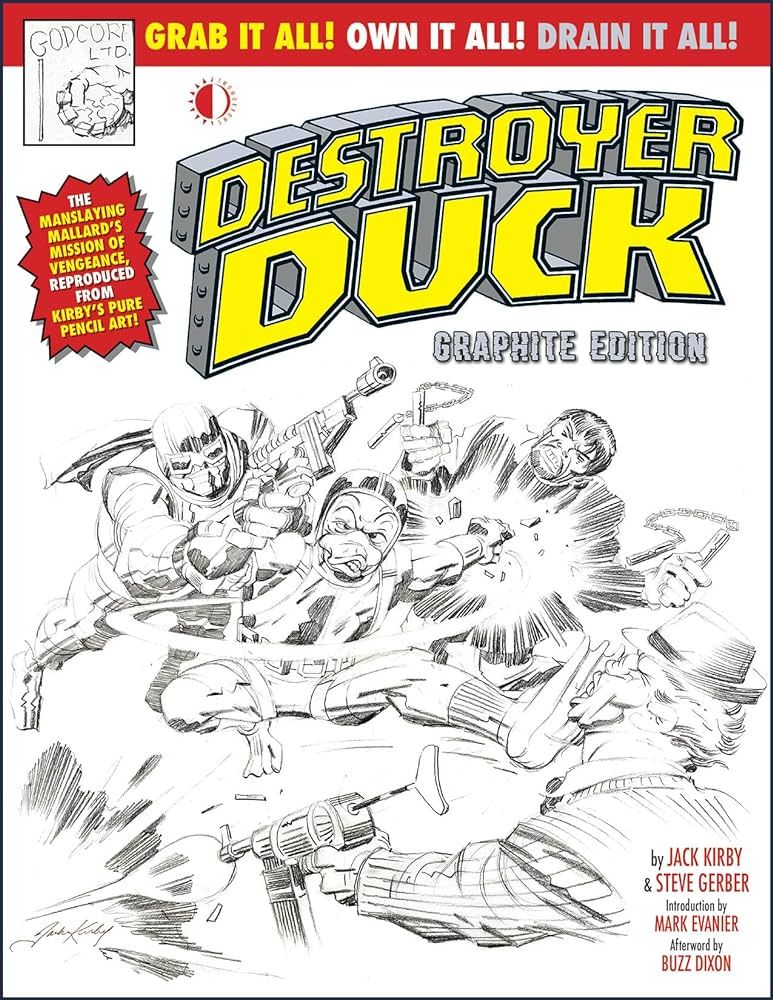
Although I continued to collect and read comics in the past year, I fell behind and didn’t match the amount I read in 2022. The most notable book I read in this format was Destroyer Duck: Graphite Edition, a trade collection of a series from the early 1980s. Destroyer Duck was an unusual collaboration between writer Steve Gerber, then fighting with Marvel over ownership of his creation Howard the Duck, and artist Jack Kirby, who had his own reasons to feel mistreated by Marvel. As such, the adventures of Duke “Destroyer” Duck, a macho, capable John Rambo among talking waterfowl, are marked by relentless action that would have been out of character for Howard’s acerbic social commentary and self-examination (read: navel-gazing). Of course, this is Gerber, so there are still plenty of axes to grind as Destroyer avenges his unnamed friend, “the little guy,” who was taken in, exploited, and abandoned by the sprawling Godcorp, an obvious stand-in for Marvel with characters based on editors or fellow artists whom Gerber felt mistreated him or picked the wrong side. (If that’s what Gerber thought of Marvel then, I can only imagine what he would make of its current Disney-owned incarnation and the dominance of the MCU.) The first issue of Destroyer Duck was published by independent Eclipse Comics as a fund-raiser for Gerber’s legal bills and continued as an ongoing series; the Graphite Edition collects the first five issues, the sum of Gerber’s and Kirby’s collaboration. (In the vein of currently popular “artist’s editions,” this book is a reproduction of Kirby’s original pencil art rather than a full reprint of the finished color comics, but knowing that readers like me might be encountering this material for the first time, they’ve kindly included word balloons with dialogue, which were usually added during the inking process.) A wealth of commentary and supplementary material rounds out the volume.

I read other stuff during the year as well, but I’ve run long enough and it’s already the second week of January. I have more year-end articles to get to, not to mention Ninjanuary and Vintage Science Fiction Month! Perhaps I’ll get to those before July. In the meantime, thanks for reading!

My 2022 in Books

Earlier this year, my son was watching me put comic books in protective bags and file them in a long box and he said, “Do you actually read comics or do you just collect them?” First of all, how dare you. Second . . . I’m working on it. I did spend more time on comics this year than some past years: I finally got them all in one place (some had been at my parents’ house since I graduated from high school) and put them in bags and boxes instead of random piles. The next step is to organize them and get series together so I know what I have and what holes I have to fill, a process already partially started as I attended a few comics conventions this year and found some new comics shops in town whose dollar bins I had to check out. Eventually, I would like to cull duplicate copies and other unwanted books and get my collection down to a manageable size (I don’t have an exact count, but I filled up twelve long boxes).

That, and just being busier, undoubtedly skewed my reading this year: I don’t keep track of every single issue I read, but even the list below includes a greater number of graphic novels and comics collections than previous years (marked with an asterisk). I actually prefer bound books for their convenience of access and storage, so my single-issue collecting has shifted toward series that are unlikely to be reprinted due to licensing issues (a large number of movie and toy tie-ins are in that situation).

Beyond comics, the books I read this year were mostly fiction, and a good portion of that was genre reading, continuing the “pulp” theme from last year. However, in addition to the usual science fiction and horror, I read more crime/mystery and romance (including an unusual sci-fi romance); concentrating on those areas led to me reading more female authors than I have in the past as well. A few longer novels were in the mix as well, but without much theme or connection; there were few series guiding my reading this year, and I guess it shows in my list.

January

The Best of Raymond Z. Gallun (for Vintage Science Fiction Month)

*Batman: The Jiro Kuwata Batmanga Volume 3, Jiro Kuwata

Space, Time and Nathaniel, Brian Aldiss

The Girl with the Deep Blue Eyes, Lawrence Block

February

Get Shorty, Elmore Leonard

The Tetris Effect: The Game That Hypnotized the World, Dan Ackerman

The Starlight Barking, Dodie Smith (the bizarre sequel to Smith’s better-known The Hundred and One Dalmations)

*Howard the Duck Vol. 2: Good Night, and Good Duck, Chip Zdarsky, Joe Quinones, et al

I Know What I Saw: Modern-Day Encounters with Monsters of New Urban Legend and Ancient Lore, Linda S. Godfrey

*Harvey Kurtzman’s Jungle Book

Once Upon a Time in Hollywood, Quentin Tarantino

March

The Nice Guys, Charles Ardai, based on a screenplay by Shane Black and Anthony Bagarozzi

It’s in His Kiss, Julia Quinn

Ben-Hur: A Tale of the Christ, Lew Wallace

April

*Archie Volume One, Mark Waid, Fiona Staples, et al

Treasure Island, Robert Louis Stevenson

*Jughead Volume One, Chip Zdarsky, Erica Henderson, et al

Fear of Flying, Erica Jong

*Kaiju No. 8 Volume 1, Naoya Matsumoto

Sweet Starfire, Jayne Ann Krentz

This is the sci-fi romance mentioned above. It’s a credible example of both genres, with a real Han-and-Leia dynamic between its rough-edged space pilot and disciplined aristocrat.

May

The Surreal Life of Leonora Carrington, Joanna Moorhead

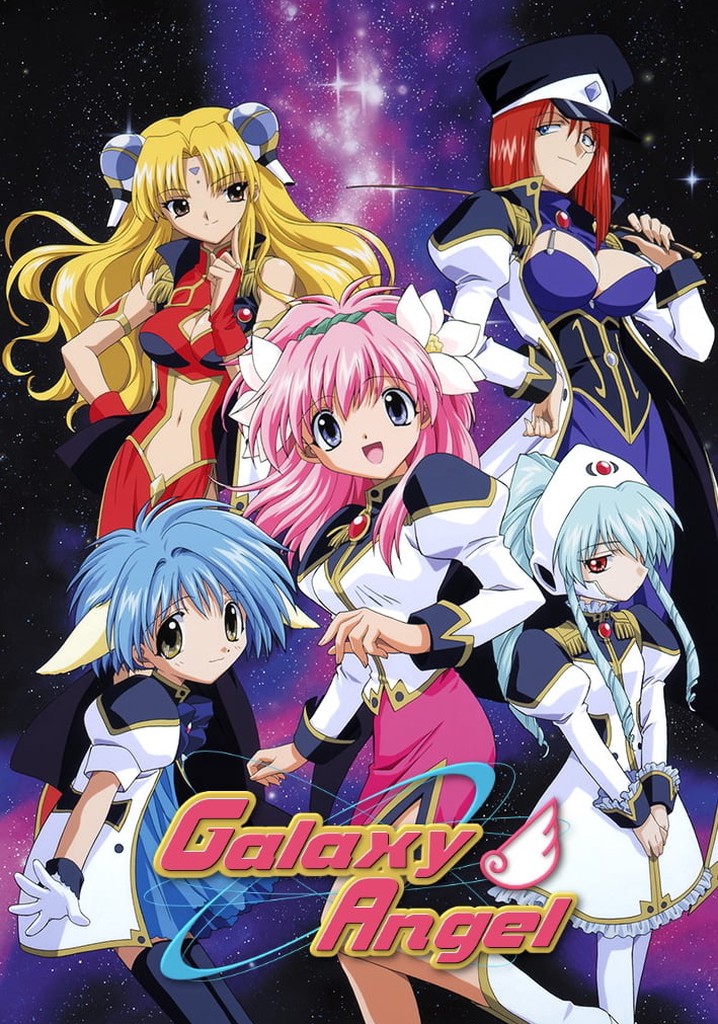
*Galaxy Angel Vol. 2, Kanan

The Galaxy Angel TV series was a pleasant discovery for me this year, but the show exists in a separate, looser continuity from the video games or manga that launched the property. I can’t say the manga blew me away.

June

Your Body Is Not Your Body, ed. Alex Woodroe with Matt Blairstone

Subtitled “A New Weird Horror Anthology to Benefit Trans Youth in Texas,” this includes work by non-gender-conforming authors and features themes of transformation, identity, and body horror.

The Beguiled, Thomas Cullinan

*Super Mario Adventures, Kentaro Takekuma and Charlie Nozawa

*Mr. Boop, Alec Robbins et al (the hardback collection of the biographical webcomic, ripping the veil from Robbins’ controversial marriage in real life to cartoon icon Betty Boop)

Of course

July

Eavesdropping on Jane Austen’s England, Roy & Lesley Adkins

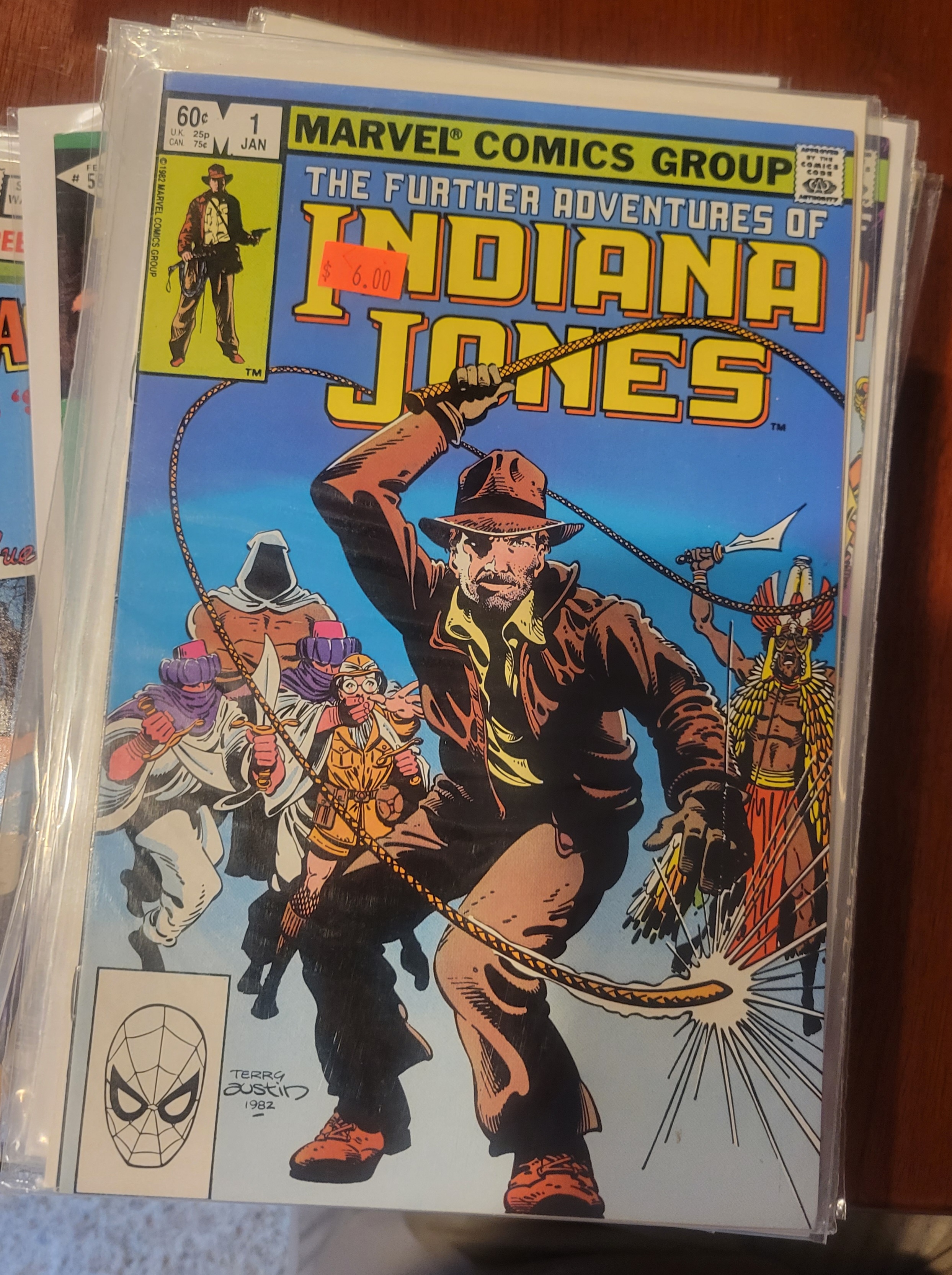
Raiders of the Lost Ark, Campbell Black, Adapted from the screenplay by Lawrence Kasdan, Based on a story by George Lucas and Philip Kaufman

*Star Wars: A Long Time Ago . . . Volume 1: Doomworld, Roy Thomas, Howard Chaykin, et al

*Star Wars: A Long Time Ago . . . Volume 2: Dark Encounters, Archie Goodwin, Carmine Infantino, et al

August

*Star Wars: A Long Time Ago . . . Volume 3: Resurrection of Evil, Archie Goodwin, Al Williamson, et al

I’ve written before about how formative Marvel’s Star Wars series was for my love of comics, so most of this was a reread. It still holds up.

The Gutter and the Grave, Ed McBain

Leave It to Cleavage, Wendy Wax

Cold Nose, Warm Heart, Mara Wells

September

The Dain Curse, Dashiell Hammett

Life and Death of the Wicked Lady Skelton, Magdalen King-Hall

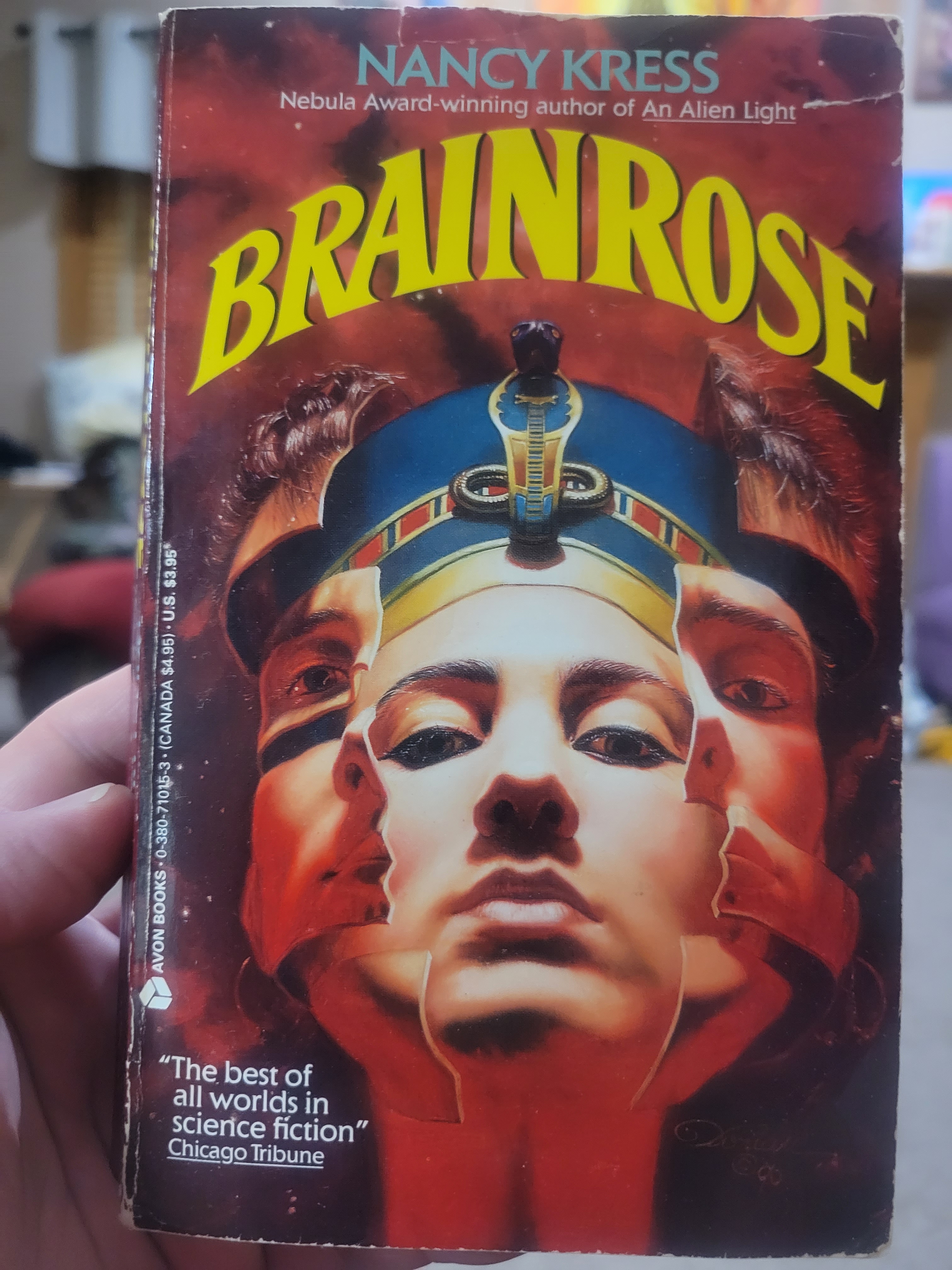
Brain Rose, Nancy Kress

A very interesting science fiction novel, published in 1990 but set in the far-off year 2022. The premise is a surgical procedure that unlocks memories of past lives in those who undergo it, and all the complications that arise from that, but there are a number of other predictions around the edges that make it interesting to look at from this vantage in time.

*Archie Volume Two, Mark Waid, Veronica Fish, et al

October

Han Solo at Stars’ End, Brian Daley

Han Solo’s Revenge, Brian Daley

Han Solo and the Lost Legacy, Brian Daley

*Under 17: 20 Cineful Comix, Gary Smith

I don’t know that Smith thinks of Under 17 as a webcomic, but I did read most of it on Facebook before ordering one of his occasional print editions. Under 17—as in “No one under 17 admitted without an adult”—focuses on Smith’s childhood and adolescent fascination with movies, and his attempts to see, by any means necessary, the forbidden films that fired his imagination. Through the hindsight of adulthood, these vignettes are by turns hilarious, wry, and poignant.

*In a Glass Grotesquely, Richard Sala

Sala passed away in 2020; this is a book from later in his career, ostensibly about the Fantomas-like master criminal Super-Enigmatix, but also something of a jeremiad, skewering the government, social media, modern superhero franchises, self-dramatizing narcissists, and (of course) phonies like you and me. It’s an unusually personal statement from the artist best known for his arch, artful remixes of pulp and noir imagery.

November

Bimbos of the Death Sun, Sharyn McCrumb

Zombies of the Gene Pool, Sharyn McCrumb

Both of these murder mysteries feature Jay Omega, engineering professor-turned science fiction author, and take place within the world of sci-fi fandom. They’re also both critical of the fan impulse and lives wasted in fantasy—apparently Bimbos caused a stir in the 1980s, but it’s even more jarring in the face of the current “poptimistic” celebration of fandom in popular culture—but Zombies was the stronger of the two, with characters who are at least deeper than cartoon “nerd” stereotypes.

Nightmare Alley, William Lindsay Gresham

I loved the 1947 movie version last year and caught up with Guillermo Del Toro’s adaptation at the beginning of this year—both versions have points to recommend—so it was inevitable that I would also read the original novel, and whadya know, it was great.

December

Bird Box, Josh Malerman

I haven’t seen the movie, but this was a pretty good read.

What We Talk About When We Talk About Love, Raymond Carver

*Jughead Volume Two, Chip Zdarsky, Ryan North, Derek Charm, et al

The Black Moth, Georgette Heyer

*graphic novel or comics collection

And that’s it! I’ve fallen behind on blogging, so my end-of-year movie wrap-up will arrive some time next week (I hope!). In the mean time, Happy New Year and have a great 2023! Thanks for reading!

Logan’s Run From Screen to Panel

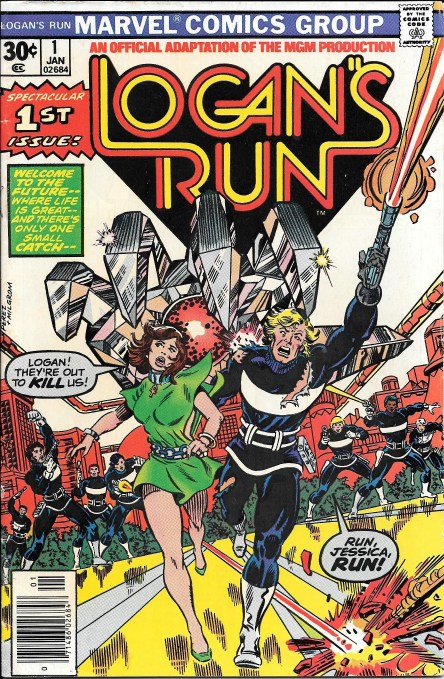
Beneath a starlit sky, the domes sprawl: large, larger than even Buckminster Fuller ever imagined, in those days when men first walked the moon . . . They dwarf the countryside, great gleaming half-spheres of light–and within the domes, the source of that light: the city. The city has no name, and needs none. It is simply–the city. The only city its people know–and perhaps, in a way, this explains what the city’s become. Perhaps it also explains–why the runners run. –Logan’s Run no. 1, cover dated January 1977

The 1976 film Logan’s Run is a classic of a certain era of science fiction (the last gasp of that era, some might say). Before it was an MGM movie, it was a 1967 novel by authors George Clayton Johnson and William F. Nolan, and for a few months after the movie came out it was a Marvel comic book, scripted by Gerry Conway in the first issue and David Alan Kraft in subsequent issues, with art by George Perez (pencils) and Klaus Janson (inks). Adaptations of science fiction films and novels were in Marvel’s wheelhouse in the 1970s: along with original sci-fi and fantasy titles, they were a continuous source of non-superhero action and thrills, even if that sometimes meant expanding on original works for “continuing adventures” or emphasizing thrills over the more cerebral source material. (Marvel also produced Jack Kirby’s mind-bending adaptation of 2001: A Space Odyssey; the rights to both 2001 and Logan’s Run were negotiated at the same time.) The following year, Star Wars would turn out to be the perfect vehicle for Marvel’s expansionist approach–in fact, the long-running Star Wars series is often given credit for keeping Marvel afloat in the late 1970s when the entire comics industry was suffering–but Logan’s Run was also part of the attempt to launch an open-ended adventure series on the back of a popular film.

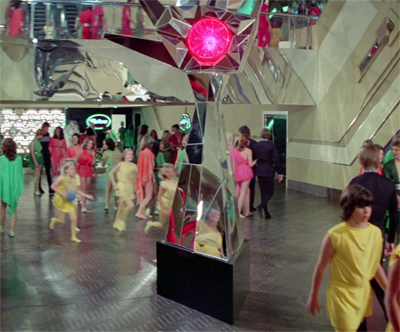
Logan’s Run is set in the twenty-third century, in a domed city sealed off from the outside world; the population of the dome lives a life of easy pleasure, regulated by a central computer and kept ignorant of both their history and the state of the world outside. There seems to not even be a concept of “outside,” although this is such a work of 1970s pessimism that even a futuristic utopia has areas of urban blight, such as the “personal risk zone” Cathedral, where feral children rule the territory as a gang. The surface perfection of the city comes at a price, including a strict form of population control: every citizen has a crystal embedded in his or her palm, and its color indicates both their phase of life and how much time they have left. In every public space, a crystalline hand sculpture reminds citizens of the central importance of this device. When a citizen reaches the age of thirty (twenty-one in the novel), the “life clock” begins to pulse, instructing them to report to Carrousel, a public ritual in which they will either be “renewed” and given more life, or “flame out” and die. Not everyone can accept the gamble of Carrousel, and some of them try to escape their fate. Logan-5 (played by Michael York in the film) is a “Sandman,” a specialized police officer whose sole duty is to track down and terminate these “runners” with his “sleeper gun” (a blaster).

Logan’s confidence in his profession (for which he was raised from childhood) begins to waver when he recovers a charm in the shape of an ankh, the Egyptian looped cross, from one of his latest targets. He holds on to it out of curiosity; later, browsing the “availability circuit” (the “hot singles in your area” of the twenty-third century, with the added perk of letting compatible partners beam directly into each other’s apartments), he meets a woman named Jessica (Jenny Agutter in the film) wearing the same symbol. Is there a connection? Nothing happens between the two–Jessica logged on to the availability circuit in a moment of weakness and regrets being chosen by a Sandman–but the girl and her strange attitudes sticks in Logan’s mind. It is when Logan is summoned to a one-on-one with the central computer and given the assignment to find and destroy the supposed “Sanctuary” represented by the runners’ ankh, and four of his remaining years are drained from his life clock, forcing him to become a runner himself, that his suppressed doubts come to the surface. Does anyone ever renew, or is it all a sham? Is there actually a Sanctuary outside the city? With Jessica’s help, he escapes the city, his former Sandman partner Francis (Richard Jordan) hot on their trail.

Compared to some adaptations, the comic book version of Logan’s Run is quite faithful to the film: the main differences are in pacing and emphasis rather than changes to the plot. The film’s elaborate Carrousel sequence is reduced to a couple of pages; a scene in which Logan and Jessica escape to the city’s underground through a service door hidden in a sex club is completely elided in the comics, but in other places the city’s ethos of free love is clearly implied. The Old Man they meet in the ruins of Washington D. C. (Peter Ustinov in the film) spends a lot less time muttering and quoting T. S. Eliot in the comics than he does in the movie (in both film and comics, however, his age, and the fact that he knew and was raised by his parents, are sources of wonder to Logan and Jessica). By contrast, fight scenes and other bits of action are extended, with at least one big set piece per issue, and most issues build up to a cliffhanger. (The covers are working overtime to sell this action-packed version of the story: the first issue’s cover shows the ubiquitous crystalline hand sculpture coming to life and chasing our heroes like the claw of a gigantic monster: of course that doesn’t literally happen in the movie or the comics, but it captures the theme of the story very well.)

The comics do explain one detail from the film’s shooting script that the finished film ended up cutting: during his confrontation with the juvenile delinquents who run wild in the Cathedral district, the “Cubs,” Logan is attacked by the oldest, Billy, who shoves a cloth in Logan’s face and says only one word, “muscle.” In issue no. 2 of the comic, we learn that “muscle” is the Cubs’ drug of choice. “It’s unauthorized. Speeds up your reflexes,” Logan explains to Jessica. “It’s no good for anyone over sixteen, though–it would shake you and me to pieces.”

In The Sci-Fi Movie Guide, Chris Barsanti notes “The f/x, thought impressive at the time, were made instantly obsolete with the release of Star Wars the following year.” I think that’s a little unfair: Logan’s Run is still a very good-looking film, with impressive production values, although the wide shots of the EPCOT-like cityscape are clearly miniatures reminiscent of Japanese tokusatsu or Italian space movies like Wild, Wild Planet. And while Logan’s Run has been lumped in with the other downbeat pre-Star Wars sci-fi of the ’70s, it isn’t particularly meditative: it’s a man-on-the-run film, like Minority Report or a science fiction The Fugitive, full of chases, fight scenes, suspenseful traps, and narrow escapes. True, things slow down once Logan and Jessica get out of the city, but it is nevertheless a popcorn movie through and through.

Of course, in comic book form there is no worry about expensive special effects, and the city’s geometric details stand out nicely. The art is generally good (like many Bronze Age books, it is rather heavily inked, and the combination of Perez and Janson looks quite a bit like Carmine Infantino’s work instead of the feathery detail Perez would become known for in the 1980s). Since the comics were published in the fall (the cover date indicated when comics were to be removed from news stands, so they generally came out a few weeks beforehand) after the film’s June release, the visuals are also more faithful to the finished film than is often the case, in stark contrast to the differences between the Star Wars comic (which was published in the spring to drum up interest in the movie) and film (which was being tinkered with by director George Lucas up to the last minute before its premiere).

Promotional art from issue no. 2

The perception is that Logan’s Run is grown-up science fiction and Star Wars is kid’s stuff, but clearly Logan’s Run had appeal to kids as well (what is more appealing to the adolescent than the allure of “mature” media?). With the passage of time it’s easier to see what Star Wars has in common with the science fiction of its time, most notably a blend of naturalistic acting and countercultural skepticism amidst the futuristic sets and costumes. What really divides Logan’s Run from Star Wars is its conceit of dealing with real-world concerns–overpopulation, sexual freedom, man’s relationship to the environment–in a fanciful way, as opposed to the heroic self-actualization of Luke Skywalker. For all its dazzling surface elements, Logan’s Run is in the social-commentary lineage of Planet of the Apes and Soylent Green, an approach that became unfashionable once Star Wars renewed interest in the space opera of Flash Gordon and Buck Rogers. One is reminded of Michael Moorcock’s rebuke of J. R. R. Tolkien: “Jailers love escapism. What they hate is escape.”

The sort of allegory represented by Logan’s Run, in which a society sealed off from external contact lives by one or two arbitrary rules, has never really died off either, even though it would be a few decades before such high concepts returned to big-budget filmmaking (the Divergent series is a recent, if ill-fated, example). In fact, I think the passage of time has been kind to Logan’s Run. Some of the cultural details that probably a seemed a little too on-the-nose in the ’70s–the city’s obsession with youth being a logical extension of the saying “never trust anyone over thirty,” or the 24/7 disco lifestyle–are now simply part of the fabric of its world: eccentric, perhaps, but all of a piece.

Logan and Jessica encounter the robot Box in issue no. 4

There are some obvious similarities to Brave New World, with a population lulled by drugs and sex, but I am also reminded of George Pal’s 1960 adaptation of The Time Machine: the citizens of Logan’s Run‘s twenty-third-century city are much like the childlike Eloi of H. G. Wells’ year 800,000, down to the brightly-colored toga-like wrappings they wear. In Pal’s version, the Eloi are conditioned to associate the arrival of the predatory Morlocks with blaring sirens, the racial memory of long-ago warnings of air raids and nuclear attacks. In Logan’s Run, the great insight of the dome’s designers, and the computer that runs the city, is that with enough conditioning the Eloi will offer themselves up for slaughter at the appointed time: no Morlocks required.

On the other hand, the heavy-handed symbolism of Jessica and Logan ending up in a ruined U. S. Capitol building, “the people’s house,” not to mention the final standoff between Logan and Francis, using a ragged American flag as a weapon, is very much in the style of post-Watergate science fiction; in the fallout of the turbulent 1960s, and with Vietnam still a raw, recent memory, it seems likely that many Americans in the Bicentennial year were wondering just what the future held. While the particular expression of those anxieties marks Logan’s Run as a film of its time, the continued use of American symbolism in horror and science fiction films like The Purge series indicates that those anxieties are still with us, unresolved.

As mentioned above, there was interest in continuing a Logan’s Run comics series beyond the events of the film, a practice that was not unusual. Although Gerry Conway’s editorial in issue no. 1 states that a four-issue adaptation was planned, ultimately it took five issues to adapt the movie. In the same editorial, Conway teases answers to questions like “Are there any other domes, besides Logan’s?” and “Is there a sanctuary somewhere, after all?” These are natural jumping-off points for the kind of “further adventures” readers had come to expect (Nolan would write a pair of sequels to the original novel, but not until after the film had been made). Two more issues were published, exploring the fallout of Logan’s decisions and the apparent destruction of the domed city at the end of Logan’s Run, but MGM felt that Marvel had overstepped the terms of their license and the book was abruptly cancelled, ending on a cliffhanger. (Issue no. 6 is notable for a backup story featuring a then lesser-known character named Thanos in his first solo adventure, an inclusion that inflated the value of the book, at least for a while.) Like its self-contained setting, the series exists now as a time capsule of the future as seen from the vantage of the mid-1970s.

My 2017 in Books

This year my reading fell into three broad categories: novels and short fiction, mostly in a popular vein; non-fiction; and graphic novels or collections of comics. As usual, this list doesn’t include single issues of comics, magazines, or other non-book reading (although I did read “Cat Person” like everyone else online; it was fine, but woefully short on lycanthropes). I didn’t read much in the way of new books, except for the books on Tupperware and the history of chicken as a dietary staple, both of which I borrowed from the library.

Austen

The best fiction I read this year was Pride and Prejudice: Jane Austen has been a blind spot for me for a long time, although I felt as though I knew her work by its film adaptations and by the impact her arch, slyly satiric tone has had in popular culture. The experience of reading her lived up to my expectations and confirmed a tendency to take a similar tack I have noticed in my own writing (not that I am executing anywhere near Austen’s level). I have more to read from her, but two novels in one month seemed like plenty.

Moondust

The best non-fiction I read this year was Moondust, an intriguing book by Andrew Smith detailing his attempts to track down and interview all of the remaining lunar astronauts. The questions these men had to ask themselves–“What do you do after you’ve walked on the moon?”–and the varied answers they came up with (including religion, art, teaching, business, and professional futurism) are vivid portraits of mid-life crisis and (for some of them) reinvention. Further, Smith’s quest has a personal dimension as he weaves his own memories of a space age childhood into his narration, essentially asking the same question for himself and America at large: what now? The notion that the moon race was (at least partly) a work of political theater, a brief flurry of activity that had few lasting effects (satellites and computers aside, there are no lunar colonies, no manned missions to Mars, etc.), is now commonplace, but as someone who grew up in the (relatively conservative) Space Shuttle era, it is still bracing to read these accounts of intense national purpose and the incredible drive it took to accomplish the moon launches. What sticks with me after this book, though, are the personalities (quite varied, even within the hyper-specific psychological and career profiling NASA used to choose its crews), the questions they asked themselves in the wake of their momentous voyages, and the different answers they came up with for themselves.

DCBombshells

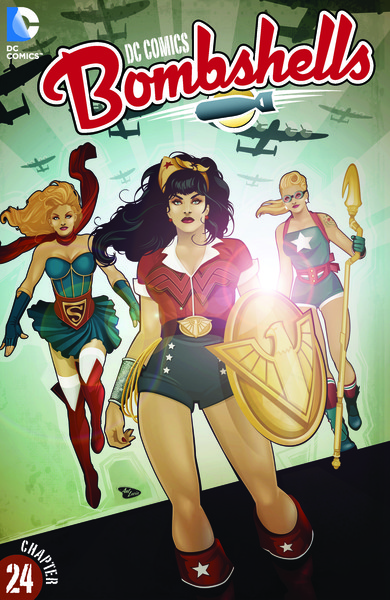
In comics, Bombshells was a pleasant discovery: writer Marguerite Bennett and artist Marguerite Sauvage create a compelling alternate World War II, one in which the female heroes and villains of DC Comics (Wonder Woman, Batwoman, Harley Quinn, et al) are the only superhumans (so no Superman, Batman, etc.–male characters like Steve Trevor are involved, but as supporting cast). Visually drawing on pinup art, propaganda posters, and commercial art of the 1940s, Bombshells presents a colorful, almost-familiar world while getting to the essence of these characters and remixing DC lore in inventive ways. It also taps into a spirit of optimism and compassion that suits the characters and the setting. The fact that the series was created as a spinoff from a popular series of pinup-style statues of DC characters isn’t surprising–that’s the biz–but the fact that it is so well executed, as if it had been conceived as a story all along, is. (I’ve only read the first two trade collections; I decided to wait for the whole series to be collected so I can read it in one go, so no spoilers please!)

Here’s the complete list, with some additional commentary:

January
The Dark Half, Stephen King
Tekkon Kinkreet: Black & White All in One, Taiyo Matsumoto
Song of Spider-Man: The Inside Story of the Most Controversial Musical in Broadway History, Glen Berger (“Before something can be brilliant, it first has to be competent.”)

February
Roadshow!: The Fall of Film Musicals in the 1960s, Matthew Kennedy (This book led me to watch Star!, the biopic in which Julie Andrews played music hall performer Gertrude Lawrence, when it aired on TCM. Star! was one of the worst movies I watched this year.)
The Rocketeer: The Complete Adventures, Dave Stevens
Mind MGMT Volume One: The Manager, Matt Kindt
Batman: The Jiro Kuwata Batmanga Volume 1, Jiro Kuwata
The Rocketeer: Hollywood Horror, Roger Langridge and J Bone

March
Bombshells Volume 1: Enlisted, Marguerite Bennett and Marguerite Sauvage et al
Bombshells Volume 2: Allies, Marguerite Bennett and Marguerite Sauvage et al
Batman: The Jiro Kuwata Batmanga Volume 2, Jiro Kuwata
The Complete Golden Age Airboy & Valkyrie, Fred Kida et al
Gotham City Sirens, Book One, Paul Dini, Guillem March et al
Hit or Myth, Robert Asprin

April
Gotham City Sirens, Book Two, Tony Bedard, Peter Calloway et al
Myth-ing Persons, Robert Asprin
Do Not Sell at Any Price: The Wild, Obsessive Hunt for the World’s Rarest 78 rpm Records, Amanda Petrusich
Rejected: Tales of the Failed, Dumped, and Canceled, ed. Jon Friedman

May
Nemo Trilogy (Heart of Ice, The Roses of Berlin, River of Ghosts), Alan Moore, Kevin O’Neill et al
Wylder’s Hand, J. Sheridan LeFanu
My Life as an Explorer, Sven Anders Hedin

June
Radio Free Albemuth, Philip K. Dick
Murder in Mesopotamia, Agatha Christie
Atomic Bomb Cinema, Jerome F. Shapiro
The Celebrated Cases of Dick Tracy 1931-1951, Chester Gould

Maybury.cover

July
The Brides of Bellenmore, Anne Maybury
Falcon’s Shadow, Anne Maybury
Superman: The Unauthorized Biography, Glen Weldon
Life of the Party: The Remarkable Story of How Brownie Wise Built, and Lost, a Tupperware Party Empire, Bob Kealing
Tastes Like Chicken: A History of America’s Favorite Bird, Emelyn Rude

August
Rocket Men: The Epic Story of the First Men on the Moon, Craig Nelson
Moondust: In Search of the Men Who Fell to Earth, Andrew Smith

Vault

In September I didn’t read any complete books at all, but as I mentioned then, I read some Advanced Dungeons & Dragons adventure modules cover to cover (more thoroughly than I read all but a few even when I was actively playing the game, I must confess). After a lucky find at my local comic store, I had a complete copy of one of the most famous series of published modules, the “GDQ” series (so called because it links three adventures against Giants, against the “dark elf” Drow, and against Lolth, the “Queen of the Demon-Web Pits”); I had wanted to read through these to see how well they really flowed as a single epic campaign, but I had forgotten just how much work the Dungeon Master had to do to flesh out these printed modules in order for them to work as adventures. Like most old-school modules, the bulk of the text simply describes the characters and items found in various rooms; it’s up to the Dungeon Master and players to provide the narrative sweep. Furthermore, the motivations of many characters are either only hinted at or are contingent upon the players’ actions. As I once read, an adventure (whether published or written by the DM for his own game) is not a story, but the promise of a story: only when it is inhabited by players and their characters is it brought to life. Reading the GDQ series was an interesting exercise, and it brought back memories of playing some of these adventures as a kid, but it wasn’t quite what I remembered. (These and other classic adventure modules inspired novelizations, as I found, but I haven’t read them; maybe I will some day.)

October
Sense and Sensibility, Jane Austen
Pride and Prejudice, Jane Austen

Drabble

November
The Pattern in the Carpet: A Personal History with Jigsaws, Margaret Drabble (Like Moondust, this was another book combining historical research with memoir; Drabble’s meditations on the appeal of the mosaic, on the reuniting of fragmented pieces, of the creation of images within images, are relevant to my own writing and composition, and I was astonished to recognize myself in some passages. The book was not exactly a dynamo of forward momentum, however, and like the act of assembling a puzzle itself, reading this book was a ruminative exercise, replete with long pauses for reassessment of the larger whole.)
Trish Trash: Rollergirl of Mars 1, Jessica Abel

Pulps.Goodstone

December
The Pulps, ed. Tony Goodstone (a collection of reprints from the Golden Age, the “real stuff”)
Chilling Tales of Horror: Dark Graphic Short Stories, Pedro Rodríguez
Constellation of Genius: 1922: Modernism and All That Jazz, Kevin Jackson

In 2008 I read Brian Eno’s A Year with Swollen Appendices, a sort of diary of the year 1995, on a day-by-day basis: since A Year starts with Eno’s decision to start a diary on January 1, I began reading it at the beginning of the year and read each entry on the corresponding date, over the course of that year. Eno didn’t write an entry for every single day, but it was close enough, and with the various appendices I had something to read from him almost every day: the book became a constant companion, almost a devotional, and absorbing it slowly, over the course of that year, made more of an impression than reading it quickly might have done (and frankly even the most interesting diaries are frequently mundane and repetitive enough that I wouldn’t read them straight through anyway).

Constellation.1922

After keeping an eye out for a similar book that covered a single year in the same way, I came across Constellation of Genius, a day-by-day record of events in 1922 (ranging from the publication of James Joyce’s Ulysses and T. S. Eliot’s The Waste Land to the opening of King Tut’s tomb and the founding of the Irish Free State) and saw an opportunity to read it in the same way. So that has been an ongoing project over the past year. During that year, I’ve been looking at the cover and seeing the blurb “Brilliantly erudite and very funny” attributed to reviewer Robert Macfarlane, and I confess myself mystified. The first part I cannot deny: author Kevin Jackson has brought together a wealth of material from diverse sources, and is an excellent guide in unfamiliar territory, briefly explaining what has been forgotten or needs to be translated, choosing illustrative anecdotes to stand in for the whole and providing multiple entryways for further exploration of his subjects. But “very funny”? Jackson is a dry wit, and many of the stories he shares are humorous, but I can’t recall busting a gut while reading this; perhaps it is the haunting similarity of the political perils he describes–acts of terrorism and war, the rise of fascism and Stalinism–to those of the present. The foreboding of the interwar period tends to overshadow the lives of the artists and writers, making their heroic feats seem small in the scale of the world’s events. On the other hand, the diary format shows how life goes on, and how the larger patterns of history are frequently invisible until viewed in the hindsight of years. There are about fifty pages of “aftermath” following the December 31 entry, describing the later lives and fates of the book’s major players; if I don’t get it finished tomorrow, I expect to soon enough, and it seemed silly not to include this in my 2017 reading on a technicality.

Kamandi Challenge no. 11

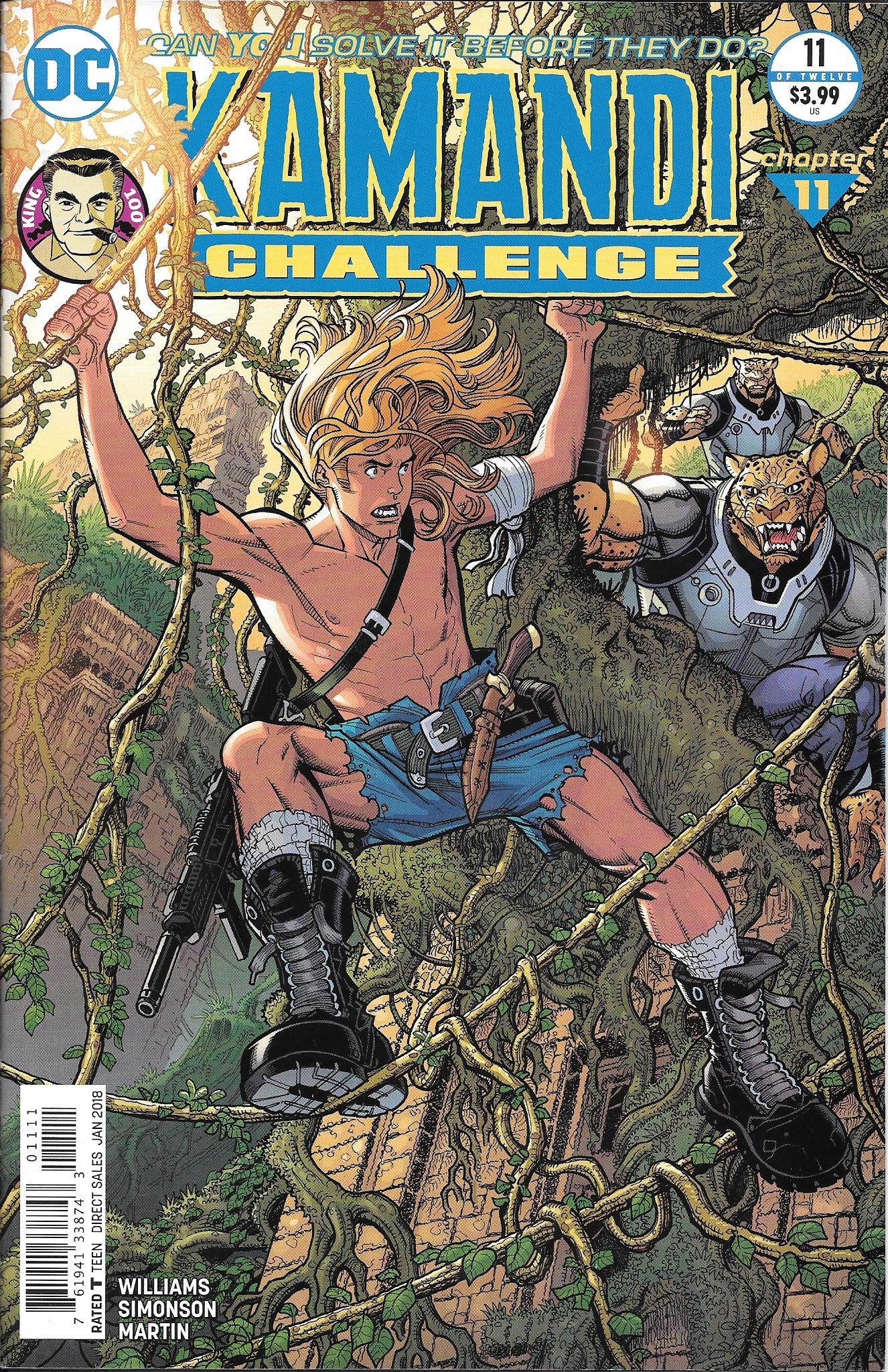
KC11.cover

Cover by Nick Bradshaw and Steve Buccellato

“Enter . . . the . . . Misfit!”
Writer: Rob Williams
Artist: Walter Simonson
Colorist: Laura Martin
Letterer: Clem Robins
Editors: Brittany Holzherr and Dan DiDio

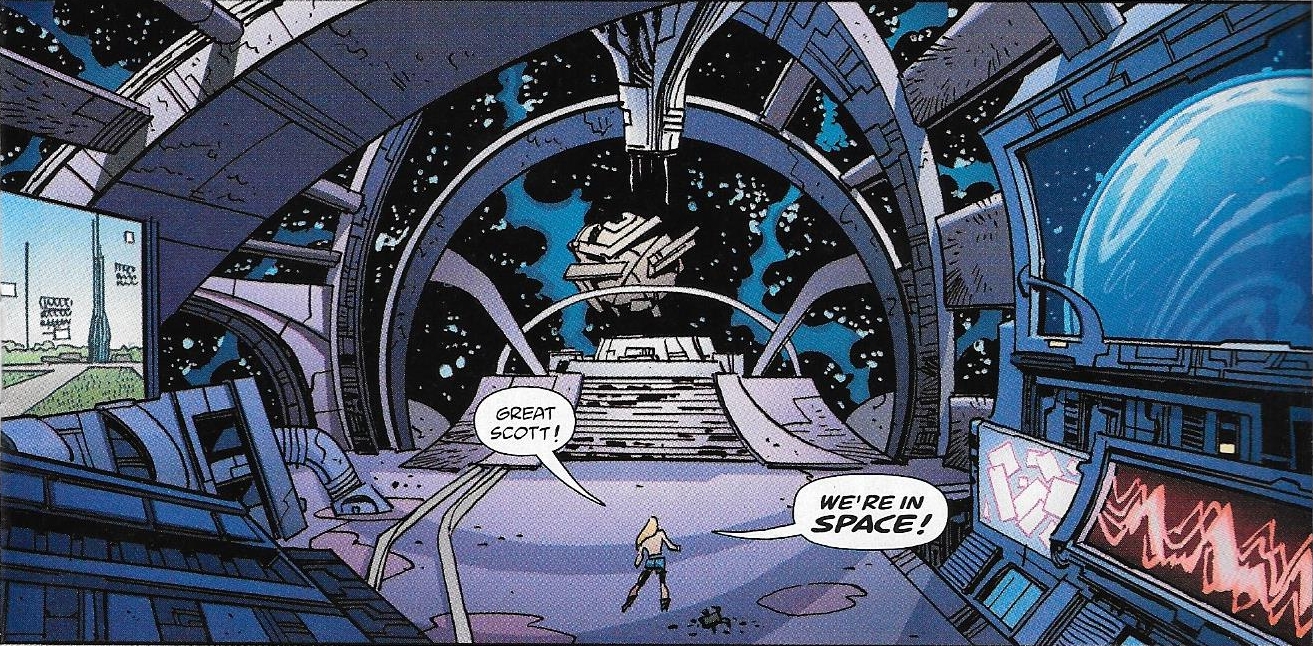
Things are coming to a head: after the Death Worshippers stormed the Tower and shot Kamandi’s mother (who turned out to be the Commander of the Tower and leader of the robot forces who are trying to wipe out all animal life) at the end of last issue, she dies trying to tell Kamandi something about his still-missing father. However, she turns out to be a robot (I knew it!) with a secondary mission. The Tower is not only a building, but an actual rocket, and as the Death Worshippers continue to fight with the robots, the rocket launches into space, taking Kamandi to a final confrontation with the true power behind-the-scenes.

Kamandi continues to fight the robots alongside the Death Worshippers, joined by the shark crew from last issue (now wearing jet-packs: ah, comics!). Although the fight goes against Kamandi and his comrades, he is given a jet-pack by one of the sharks and, after wiping out some more of the robots, makes his way to the control room of the rocket. There, protected from the robots, he sees his friends cut down and realizes that he is once again alone.

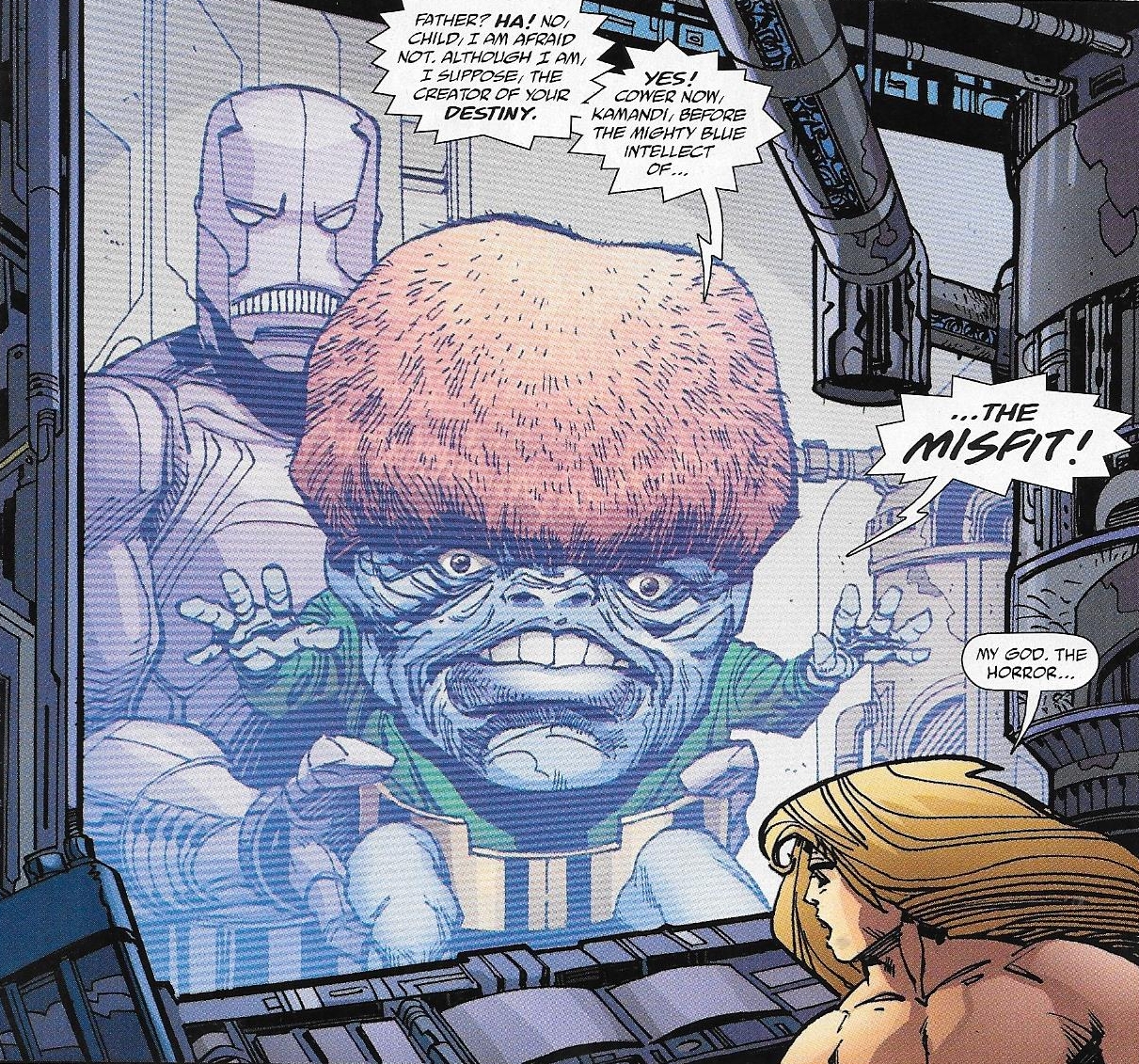
Until, that is, one of the screens in the control room comes to life and the true commander of the rocket reveals himself: the Misfit, a genetic freak with a brilliant intellect, who has summoned Kamandi in order to extract the secret that lies in Kamandi’s genetic code. The Misfit, enthroned on his “Tek-Moon,” an armed space station, plans to launch the Anti-Cortexin from space!

KC11.misfit

Examining a map, Kamandi sees that the ship is heading over an area marked “UFO activity” and hatches a plan: “Maybe if I press these controls I can somehow uncloak the ship so others below can see it and destroy it,” he says to himself. “A suicidal hope, but what other choice do I have?”

Soon after Kamandi disables the rocket’s cloaking device, a squadron of flying saucers attacks! Not only that, they are being flown by gorillas! (Sharks with jet-packs! Gorillas in flying saucers! Although Kamandi was a Bronze Age creation, there’s more than a little of the free-associative qualities of the Silver Age in this chapter.) The simian saucer pilots, led by the enormous ape Silverbeck, succeed in boarding the rocket with the intention of destroying the Tek-Moon once and for all. An orangutan named Royer (undoubtedly a nod to Jack Kirby’s long-time inker Mike Royer) discovers Kamandi and convinces Silverbeck not to kill him. Kamandi reveals the projected image of the Misfit to Silverbeck and Royer (“By the Severed Paw! What horror!”), who exchange threats.

The Tek-Moon opens fire on the rocket; when the Misfit lets slip that he could reunite Kamandi with his still-living father, Kamandi commandeers the rocket controls and prepares to ram into the Tek-Moon (suicide missions are a theme in both this chapter and the series as a whole), determined to find his father or die trying.

Fighting against the ape warriors who would pull him back, Kamandi flies directly into danger, set on learning the truth about his parents; but the Tek-Moon’s weaponry is too much for the rocket, and the bridge is blasted open and exposed to the vacuum of space just before it reaches the Tek-Moon. Kamandi is flung into space and the last shot we see is him tumbling toward the Earth below. To be continued?? (Yes, two question marks are needed to convey the uncertainty of this cliffhanger!)

KC11.space

“Enter . . . the . . . Misfit!” has a bit of a Star Wars vibe, at least visually: the command center of the rocket ship resembles the bridge of the Death Star in Return of the Jedi, and of course there is the armored space station, poised to rain death on an unsuspecting world below. Such doomsday weapons are a staple of science fiction, but the Death Star is the most obvious example. So, too, the Misfit (a Kirby creation who first appeared in Kamandi no. 9, with a similar germ warfare scheme) reminds me of Emperor Palpatine: a fitting antagonist to introduce at this point, warped physically and mentally, but holding out the tantalizing promise of solving the mystery of Kamandi’s origins and destiny. (Walter Simonson, the artist, worked on a number of science fiction comics over the years, including Marvel’s Star Wars adaptation, but he is best known for his long run on Thor, and the combination of far-out, alien places and weird characters is a good fit for him.)

The map that Kamandi studies aboard the rocket ship is, of course, modeled after the map that Jack Kirby provided during the early days of Kamandi, and which was fleshed out by later writers. Greg Pak, who wrote last month’s chapter, mentions in his afterword in this issue (in which he describes how he would have gotten Kamandi out of the cliffhanger if he had continued writing it) that he was assigned sections of the map to include in his chapter. I hadn’t realized that the challenge included specific territories, but in hindsight it explains the thoroughness with which Earth A.D. has been explored in this series. Some have been returns to places Kirby and his successors already visited in their series; others have been freshly revealed glimpses of places that were only names on the map up until now.

KC11.map

Over the course of this series, it has been interesting to observe how different writers treat the influence of Jack Kirby. Some have used Kirby’s characters and settings to tell stories more or less within their own style, while others have either emulated Kirby’s dynamic (some might say bombastic) manner or turned their stories into direct tributes (if Royer in this chapter is an homage to Kirby’s collaborator Mike Royer, does that make Silverbeck Kirby himself, I wonder?). In this chapter, writer Rob Williams seems to delight in some old-school comics techniques, most notably the use of play-by-play dialogue that describes things as they happen (“The talking human fights like a three-armed ape! We are wiping out the robot crew!”).

Nobody talks like this except comic book characters, and here it takes the place of verbose caption boxes, which otherwise appear only at the beginning and end of this chapter. It frequently turns toward the goofy (Kamandi says of the Misfit, “Indeed, he is truly a pumpkin-headed toad!”), but Silverbeck and the Misfit are especially prone to the kind of over-the-top rhetoric that Kirby deployed regularly (and which my regular readers know that I am powerless to resist). Whether it is the “Misfit majesty” giving orders to “Open fire with every weapon upon this bountiful and deadly Tek-Moon!” or the gorilla UFO commander calling Kamandi “a fool and not of the Silverbeck wisdom!”, “Enter . . . the . . . Misfit!” is, from its title on down, a story that oozes an affection for the comics medium and its more whimsical expressions.

KC11.kamandi

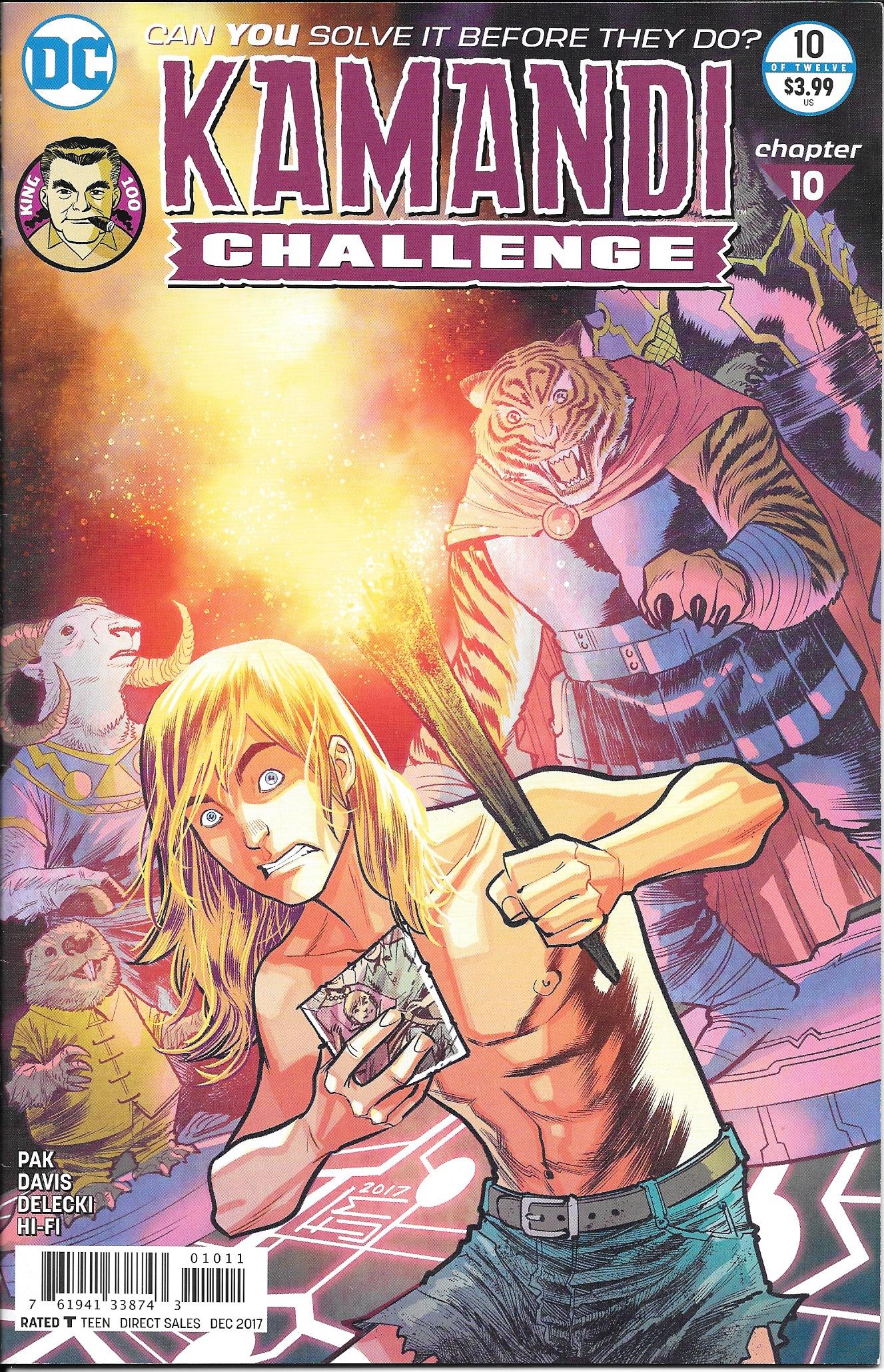
Kamandi Challenge no. 10

Cover by Francis Manapul

“Mother, May I?”
Writer: Greg Pak
Penciller: Shane Davis
Inker: Michelle Delecki
Colorist: Hi-Fi
Letterer: Clem Robins
Editors: Brittany Holzherr and Dan DiDio

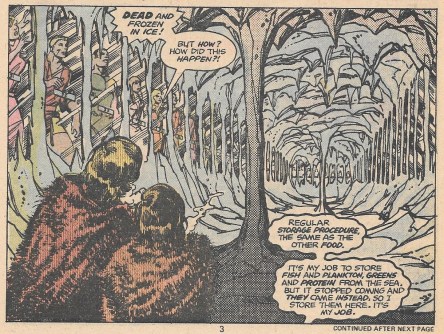
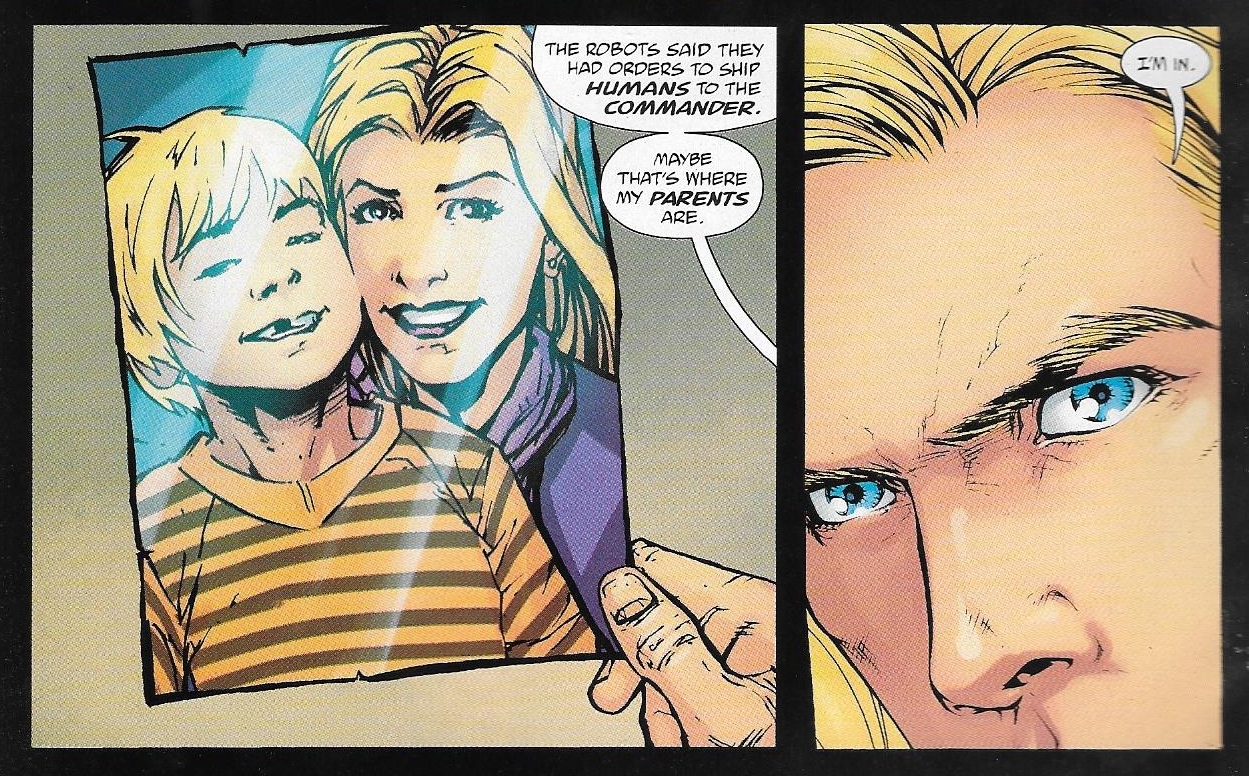
After the robot has dragged Kamandi from the waiting room (seen last issue), we see that the facility is a museum, the robots engaged in mounting displays of the humanoid animals that populate the earth. Other displays show the forgotten world of humans, and Kamandi sees a photograph of himself with his mother (remember, Kamandi has been searching for his missing parents since the attack on his home in issue no. 1). The robots, confused and agitated by the presence of a human (who are not supposed to be given the taxidermy treatment), prepare to take him to the Commander. Kamandi breaks free using a gun from the museum’s collection (how many times have we seen something like that happen?) and escapes to the ocean that surrounds the building.

While he jetskis away, he is attacked by a punk-looking gang of sharks with humanoid arms and machine guns. However, when the sharks discover that Kamandi isn’t a robot, they help him fight off his pursuers and escort him to shore. In exchange for sparing his life, they turn Kamandi over to a group of humanoid panthers, “death worshipers” who go by names like “Dead Woman” and “Dead Man” and refer to Kamandi as “Dead Boy.” Their fatalism is only a realistic appraisal of their chances: the area is ruled over by the Commander, controller of the robots, who lives at the top of a tower that overlooks the land. Sooner or later, death comes to all animal hybrids under such a reign. The panthers expect Kamandi to help invade the tower and kill the Commander.

After a graphic demonstration of the tower’s killing power, Kamandi decides to take the mysterious Commander on alone. Gaining entry by stealth, Kamandi spies containers of “Anti-Cortexin” (Cortexin being the chemical that originally gave sentience and upright posture to the animals of Kamandi’s world) and is attacked by more robots.

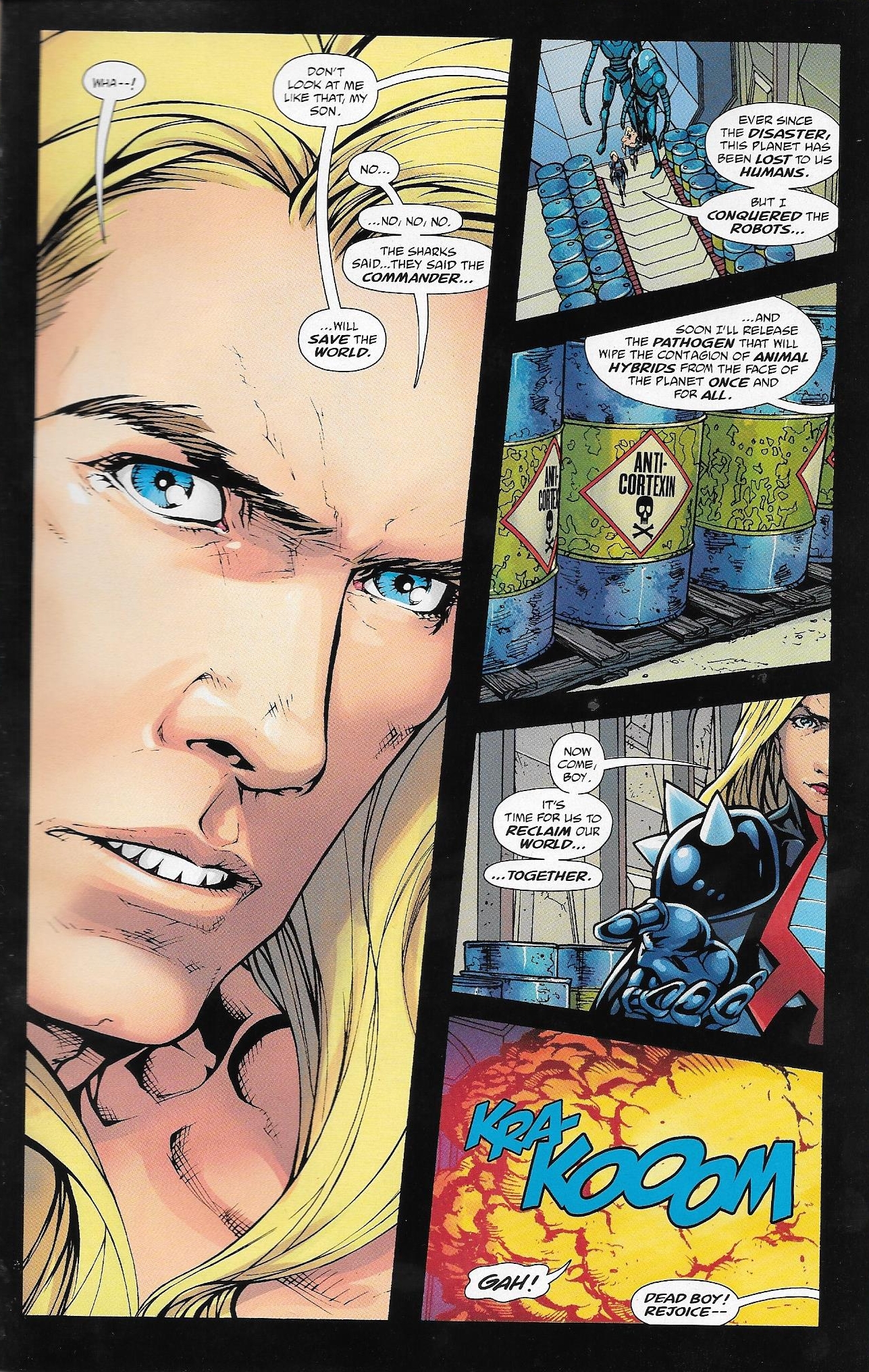
Kamandi is saved when a woman wearing power armor destroys the robots; Kamandi recognizes her as his long-sought mother. In the course of the reunion, she explains that she had hoped to keep him safe during the Android Wars by hiding him in the simulated small town in which he was raised, but upon returning she had found it destroyed. Now, after conquering the robots, she has but a single purpose in mind: she plans to use the Anti-Cortexin to return the world’s animals to their natural state, and make the world safe again for humans. Of course, it turns out, she is the Commander.

Kamandi barely has time to react to this news when an explosion rips the building apart: the death-worshiping cats have broken into the tower; in the last panel, Kamandi holds the body of his mother, who was injured in the explosion and may or may not be dead.

If the double-page sharks vs. robots spread doesn’t scream “COMICS!” to you, I don’t know what would. After the stark, existential meditation of Tom King and Kevin Eastman’s “Ain’t It a Drag?”, “Mother, May I?” is both a return to the bold four-color mayhem we have come to expect from Kamandi, and more importantly a turn towards a possible conclusion. As part 10 of a projected 12, Greg Pak and the writers who will follow him have their work cut out for them in fashioning an ending to this sprawling, multi-author story.

The reunion with Kamandi’s mother (unless the next installment undoes this by making her a robot or impostor, because comics) answers one of the central mysteries of the series, but leaves many unanswered: what happened to Kamandi’s father, for example? The Commander’s genocidal mission against the sentient animals is another: early on, when Kamandi first escaped the destruction of his home, he might have been expected to think the same way, that the humanoid animals are monstrous and that the natural order of things has been overturned. Yet if there is one consistent arc in this round-robin story, it is Kamandi’s growing understanding that intelligence, compassion, and friendship come in many forms. The varied relationships he has formed with characters such as Dr. Canus, Vila, Mack, and Sadie are testament to this enlarged sense of humanity, and a single panel shows in Kamandi’s facial expression that he is both surprised and aghast at his mother’s plan.

From a metafictional perspective, too, the reader doesn’t really expect such a plan to succeed, if success would undo what makes this fictional world attractive and interesting to begin with. For all its terrors, Earth After Disaster is full of wonders; in contrast to the resource-starved desert of the Mad Max films, it is teeming with life, and while Kamandi has sought others like himself in vain until now, he is long past seeking to wipe the slate clean.

Sometimes authors create tension by awareness of the character’s desire for circumstances that would foreclose narrative possibilities–Superman may wrestle with his desire to live as a normal man on an intact Krypton, even though it is his presence on Earth that gives him power and makes him a superhero–but in this case Kamandi’s journey has been one that brings him in line with the reader’s perspective, and I get the impression that he doesn’t want to erase the effects of the Great Disaster any more than the reader does.

On the other hand, there are only two chapters left in this saga, and unlike most open-ended comic book stories, there’s nothing stopping the last writer from blowing it all up. We shall see: if you’ll pardon the speculation, I suspect that we’ll find that either Kamandi’s mother isn’t actually dead, allowing this conflict to play out and form the climax of the series, or Kamandi’s father will enter the scene, either to continue her plan or as someone with a different set of priorities. We shall see.

Kamandi Challenge no. 8

Cover by Jim Lee, Scott Williams, and Alex Sinclair

“Not Quite the Odyssey”
Writer:
Keith Giffen
Artist: Steve Rude
Color: John Kalisz
Lettering: Clem Robins
Editors: Brittany Holzherr and Dan DiDio

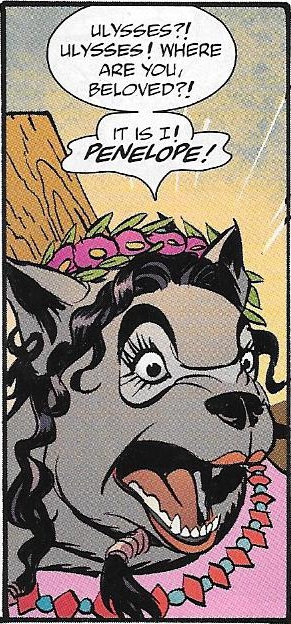
After parting with the Britannek Bulldogs last issue, Kamandi was hang-gliding over the ocean toward his next goal, following the track of his missing parents, when he was bitten by a Polar Parasite that had hitched a ride in his satchel. As Kamandi Challenge no. 8 continues the story, Kamandi is able to bring the glider in for a crash-landing in the surf, and succeeds in crushing the parasite against a rock before it can take control of his mind. While attempting to recover supplies from the wrecked glider, he is surprised by a band of humanoid goats and sheep in ancient Greek dress. Calling him “Odysseus,” they take him to be the returned hero of the Odyssey: he is human, like the illustrations in the “ancient texts” the goats have based their life on, and he can speak. He must be the one!

Nothing is ever quite that simple in Kamandi’s world, however, and the goats’ claim on Kamandi is challenged by a band of wolf people, the eternal enemies of the goats. To the wolves, Kamandi is “Ulysses,” the Roman name for Odysseus, and such hermeneutic differences are the stuff of which holy wars are made. Or perhaps it is simply the external manifestation of the two species’ age-old antagonism. The wolves attack, and the goats fight back, with Kamandi stuck in the middle and with no control over his own fate.

Once safe in the goats’ village, Kamandi learns a little about the feud, and that both sides expect him to be their champion, but he is also given to reflect on the bizarre experiences he has come through. As hinted at in previous chapters, Kamandi has been experiencing dreams of another life, a life which in the hints we are provided can be recognized as the original Kamandi series by Jack Kirby. This isn’t the first time Kamandi has been taken for a god, and his priority is escaping and getting on with his search. At the same time, both sides prepare for a final confrontation, their training marked by grisly reminders of the conflict: the wolves practice shooting arrows into sheep carcasses, and the goats play games with severed wolf heads.

Attempting to slip away in a small boat, Kamandi instead finds himself trapped between the fleets of the two warring factions; he briefly senses something else moving under the surface of the water, but is distracted from it by the outbreak of war. Too slow to escape being caught between the opposing fleets, Kamandi concentrates on simply surviving while staying out of the paws of wolf and sheep alike. Briefly submerged, he sees an ominous dark shape with glowing eyes. Later, adrift on a shield, he passes between the feet of an enormous statue that stands astride the harbor like the Colossus of Rhodes; on the pylon supporting one foot is carved the name “Odysseus,” on the other “Ulysses.” As we have seen through the snapshots of life in both communities, the religious mania of the high priests has no room for ambiguity: they would sooner die than compromise, and the last we see of the wolves and sheep are the flames consuming their ships and their villages. Only too late does Kamandi, alone at last, remember the creature he saw under the water, when he experiences another swell and a menacing sea serpent surfaces right in front of him!

Some chapters of Kamandi Challenge have sought to tweak or update the original series by questioning its assumptions or broadening its representation, but “Not Quite the Odyssey” is a comic book fable in the classic mode. With its literary references and overt indictment of religious mania, this story (written by Keith Giffen, who provided art for the series prologue in issue no. 1) would have fit very smoothly into Jack Kirby’s Kamandi. The artwork by Steve Rude (himself an iconic disciple of the Kirby manner) nicely combines Kirby’s energetic style (Rude’s Kamandi looks very much like Kirby’s, but with slightly more rendering and shading, and the heavily-inked backgrounds frequently look like they were pulled straight from a Bronze Age book) with varied panel layouts that keep scenes from being monotonous. Further, the touches from ancient Greek design in the goats’ city and the wolves’ Roman Legion dress gives them a specificity and deepens the thematic connection to the Iliad, with Kamandi escaping the final sea battle like the wanderer his captors take him to be.

On the other hand, the commitment to parable and the relative lack of distinct characters sometimes leaves this chapter feeling as two-dimensional as the Greek pottery art it references. After the quirky, loquacious characters presented by (especially) Jimmy Palmiotti, Bill Willingham, and Marguerite Bennett, the return to functional (at best) dialogue is a bit of a come-down. Most of it is purely expository, and both the goats and the wolves speak with the monotonous single-mindedness of the zealot: “He has returned! As foretold in the sacred book!” (A humorous exception is Kamandi’s face-to-face encounter with the “Penelope” who was waiting for his return, an appropriate punchline to the mistaken-identity plot and an effective bit of “what now?” escalation.)

To make up for it, Kamandi spends more time than usual talking to himself or adding wry asides to the conversation: this Kamandi is experienced enough to know how crazy this all is, and he even chastises himself for the choice words (rendered in grawlixes) he uses in response. Fables are about types rather than individuals, or perhaps that is the point of this particular fable: the loss of identity when one gives in to cultism. Kamandi, in this reading, is the lone individual, the Last Boy on Earth, just trying to keep his head down and survive as elemental social groupings collide. No wonder he doesn’t have much meaningful interaction with either side: they’ve largely given up listening and speak only to each other, choosing to live in their own echo chamber (heeeeey, maybe this isn’t only about ancient myth.)

My 2016 in Books

20160903_160515.jpg

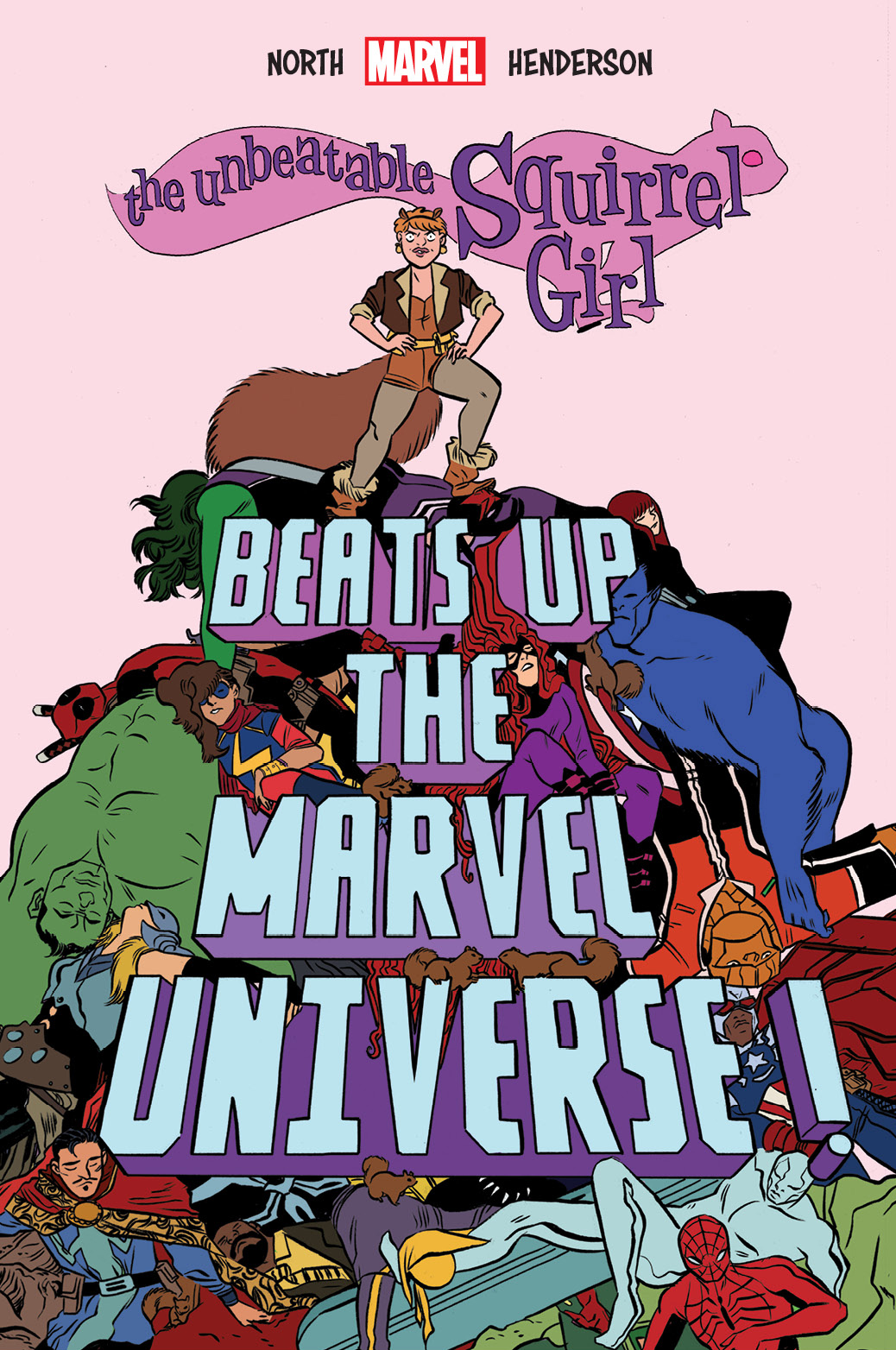
No, I haven’t read all the books in this pile; that’s my haul from one of several library sales I hit this year (I have read a couple of these, so far, though). I really can’t help it: this year I continued to collect books at a rate faster than I could read them (a common problem, I’m afraid), but I did make an effort to read books that were already on my shelf. Other books I got from the library when I could, including most of the graphic novels listed below. (I debated whether to include trade paperback collections of monthly comics, but in the case of Ryan North and Erica Henderson’s The Unbeatable Squirrel Girl, I decided what the heck: they’re some of the books I’ve enjoyed most in the last couple of months, and for the record The Unbeatable Squirrel Girl Beats Up the Marvel Universe! is a graphic novel in the traditional, standalone sense.)

squirrelgirl

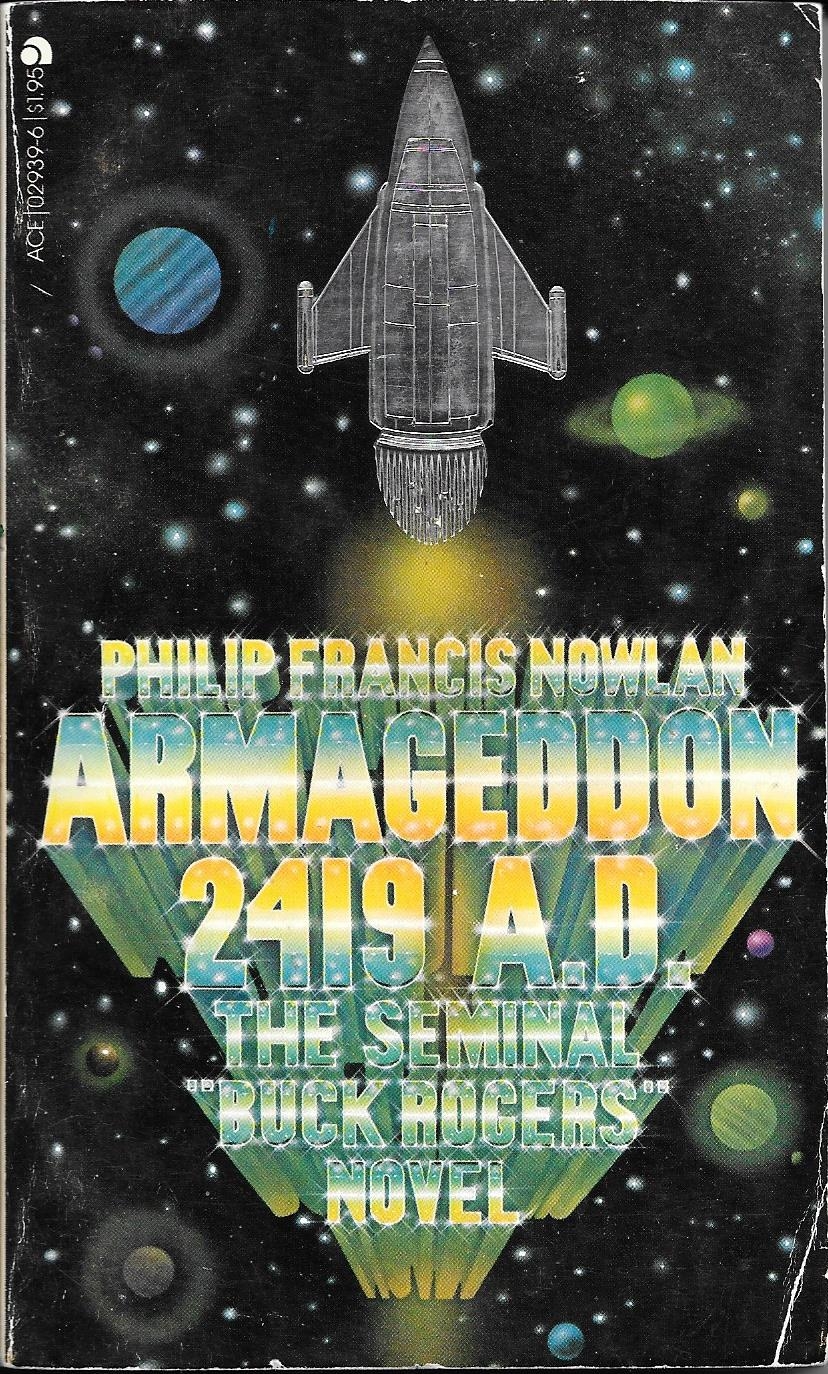
In addition to filling some gaps in my comics reading, I followed through on my promise from last year to read more of the pulp and genre novels that have been crowding my shelves for years. Most are quick reads, and some of them tied into other projects I was involved in. Reading Armageddon 2419 A.D. was part of my preparation to watch the Buck Rogers serial for a feature in The Solute last spring; novels by William MacLeod Raine and Zane Grey (my first Grey!) continued my exploration of the traditional Western.

buckrogers1

And what about those covers! I love the lush cover paintings Ballantine commissioned for its “Adult Fantasy” line back in the late ’60s, and Ron Walotsky’s cover for Fletcher Pratt’s The Blue Star in particular is a great example, intensely colorful and reminiscent of Weird Tales great Hannes Bok and Dungeons & Dragons icon Erol Otus. (The book itself was less psychedelic than the art might suggest, an early example of “parallel world” fantasy whose only speculative element was the presence of psychic witches. The Blue Star was originally published in 1952, early enough that Pratt included a prologue setting up the events of the novel as a dream, unable as he was to assume that contemporary audiences would automatically understand the concept of a secondary world.)

bluestar

Then there’s this one, an ironic bit of spy-fi, found in a used bookstore. I only recently found out that The Bamboo Saucer was made into a movie, but I haven’t seen it. The book was okay. (High Road to China, an aviation adventure set in the interwar years, is another one that was made into a movie; the copy I read is even a tie-in edition with a photo insert of star Tom Selleck, but I have absolutely no memory of the film.)

bamboo1

Other Highlights:

It was a good year for non-fiction for me, and the books on Gary Gygax, Nancy Drew, and Amazing Stories editor Ray Palmer were especially fascinating looks into the publishing industry and the creative process. (The Man From Mars also confirmed that the scientist alter ego of superhero The Atom was named after the Ray Palmer, something I had wondered about.) Another fascinating read was A Kim Jong-Il Production, about the kidnapping of South Korean director Shin Sang-Ok and his wife, actress Choi Eun-hee, who were pressed into service making movies for the North Korean dictator, a noted film buff.

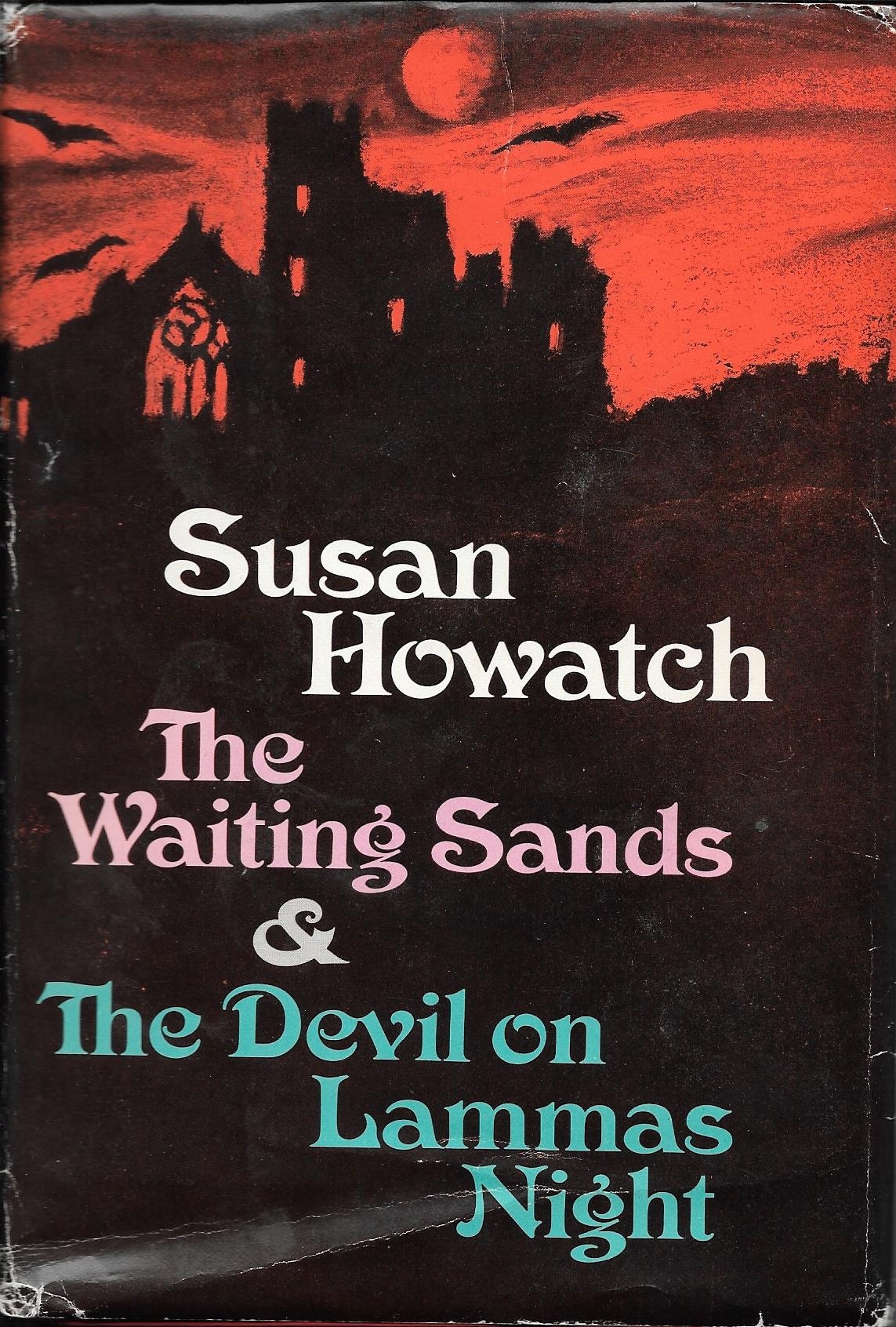
I also read quite a few (mostly short) novels, including books by Jack Vance, the last book of Lemony Snicket’s All the Wrong Questions (a series I enjoyed very much), and a pair of contemporary (ca. 1970) gothic romances by Susan Howatch (another library sale find: how could I resist a cover like this?).

howatch

Aside from The Unbeatable Squirrel Girl, comics and graphic novels that I found rewarding were Planetary (I had read the first few issues several years ago, but the Omnibus edition from the library caught me up on the entire series), All-Star Superman (as good as everyone says), and V for Vendetta (unfortunately timely).

Here’s the complete list:

January
Armageddon 2419 A.D., Philip Francis Nowlan
Ex Libris: Confessions of a Common Reader, Anne Fadiman
All the Wrong Questions: “Why Is This Night Different from All Other Nights?”, Lemony Snicket
A Kim Jong-Il Production: The Extraordinary True Story of a Kidnapped Filmmaker, His Star Actress, and a Young Dictator’s Rise to Power, Paul Fischer
League of Somebodies, Samuel Sattin

February
Techno-Orientalism: Imagining Asia in Speculative Fiction, History, and Media, ed. David S. Roh, Betsy Huang, and Greta A. Niu
Bulldog Drummond, Sapper
Halting State, Charles Stross

March
Mission to the Head-Hunters, Frank and Marie Drown
All-Star Superman, Grant Morrison and Frank Quitely
The Fighting Tenderfoot, William MacLeod Raine
Cowboys & Aliens, Fred Van Lente and Andrew Foley, et al
Al Williamson Adventures, Al Williamson et al
The Planetary Omnibus, Warren Ellis and John Cassaday

April
Heroes of Bear Creek, Robert E. Howard
Big Planet, Jack Vance
The Blue World, Jack Vance

May
The Dragon Masters & Other Stories, Jack Vance
The 6 Voyages of Lone Sloane, Philippe Druillet
Forust: A Tale of Magic Gone Wrong, Adam and Dustin Koski
Empire of Imagination: Gary Gygax and the Birth of Dungeons & Dragons, Michael Witwer

June
The Blue Star, Fletcher Pratt
Lone Sloane: Delirius, Jacques Lob and Philippe Druillet
Camelot 3000, Mike W. Barr and Brian Bolland
The Flight of the Bamboo Saucer, Fritz Gordon
Tales of the Enchanted Islands of the Atlantic, Thomas Wentworth Higginson

July
High Road to China, Jon Cleary
Three Weeks, Elinor Glyn
Last of the Duanes, Zane Grey
Marvelman Classic Vol. 2, Mick Anglo et al

August
Cowgirls: Women of the American West, Teresa Jordan
Harry Potter and the Cursed Child, J. K. Rowling, Jack Thorne

September
Girl Sleuth: Nancy Drew and the Women Who Created Her, Melanie Rehak
This Business of Bomfog, Madelaine Duke
Critical Mass, Frederik Pohl and C. M. Kornbluth
The Man From Mars: Ray Palmer’s Amazing Pulp Journey, Fred Nadis
A Field Guide to Kentucky Kaiju, Justin Stewart, Tressina Bowling and Shawn Pryor
The Man Called Brown Condor: The Forgotten History of an African American Fighter Pilot, Thomas E. Simmons

October
Monster, 1959, David Maine
Best “Thinking Machine” Detective Stories, Jacques Futrelle, ed. E. F. Bleiler
The Waiting Sands, Susan Howatch

November
The Devil on Lammas Night, Susan Howatch
The Unbeatable Squirrel Girl, Vol. One: Squirrel Power, Ryan North and Erica Henderson
The Unbeatable Squirrel Girl Beats Up the Marvel Universe!, North and Henderson
The Fine Art of Literary Mayhem (2nd ed.), Myrick Land
Howard the Duck Vol. 0: What the Duck, Chip Zdarsky, Joe Quinones et al
The Take Back of Lincoln Junior High, Roseanne Cheng
V for Vendetta, Alan Moore and David Lloyd

December
The Unbeatable Squirrel Girl, Vol. Two: Squirrel, You Know It’s True, North and Henderson
Delilah Dirk and the Turkish Lieutenant, Tony Cliff
The Unbeatable Squirrel Girl, Vol. Three: Squirrel, You Really Got Me Now, North and Henderson

Fates Worse Than Death: Captain America (1944)

CA44.title

A bizarre series of deaths, some accidental and some obvious suicides, strikes at wealthy and influential men. The only connection between them is their involvement in an expedition to Central America in search of Mayan ruins, and the jeweled scarabs found in the victims’ possession. The mastermind behind the deaths, revealed to the audience in the first chapter, is Dr. Maldor, a member of the expedition who feels cheated of the glory and wealth that others have claimed. As the Scarab, Maldor is determined to take down his rivals, one by one, all the while posing as the friendly and helpful director of the Drummond Museum of Arts and Sciences.

CA44.scarab

Maldor’s plan might very well succeed, but for the industrious District Attorney, Grant Gardner, and his assistant Gail Richards, who stand in Maldor’s way and get far too close to the truth in their investigations. Even worse, Maldor’s henchmen keep running afoul of the costumed crime fighter known only as Captain America. Could Gardner and Captain America be one and the same? The audience knows, but will the Scarab learn the truth, and what will he do with it?

CA44.Cap2

These days, when one reads about the 1944 Captain America serial, the focus is on its lack of fidelity to the comic books created by Joe Simon and Jack Kirby in 1941 and published by Timely (now Marvel) Comics. Instead of being Steve Rogers, a runty Army volunteer turned into a titan by the Super Soldier serum, the serial Captain America is Grant Gardner (played by Dick Purcell), a crusading district attorney who dons the costume to bring criminals to justice; no reference is made to his origin. Instead of wielding the iconic shield, Grant Gardner carries a gun, and he gets a lot of use out of it (in fact, considering how many bad guys Gardner kills in his civilian identity without anyone batting an eye, it’s not exactly clear why he needs to step outside of the law and put on a costume at all).

captainamerica1

This Captain America doesn’t even fight Nazis, all the more surprising considering the character’s explicitly patriotic concept and the serial’s wartime production. As in the 1949 Batman and Robin serial, Captain America’s foe follows the serial formula of a far-reaching (but apolitical) criminal mastermind: no Red Skull here, folks. Timely publisher Martin Goodman gave Republic the right to use the character for free (according to Marvel executive Tom Brevoort, speaking in the promotional documentary Captain America: 75 Heroic Years), likely expecting the film to boost sales of his comic books. Whether it had the desired effect, I don’t know, but one wonders what Simon and Kirby, not to mention their loyal readers, thought when they saw “Grant Gardner” going through the paces of a typical Republic adventure.

CA44.Gardner1

I was aware of all that before I watched the serial, but I tried to keep an open mind: although this is an extreme example, it wasn’t unusual for serial producers to change details of their source material to fit into their standard formula, and perhaps the serial would be a success on its own terms, even as it missed the mark as an adaptation. Unfortunately, I ultimately found it tedious and repetitive, even though it had some good performances and some individual chapters that worked well. Like many fifteen-chapter serials, Captain America can’t quite sustain its length, and might have been more effective cut down.

CA44.fight1

As both Gardner and Captain America, Dick Purcell has some personality and makes for an engaging central character, and there’s quite a bit of action (much of it supplied by longtime stunt man Dale van Sickel, who actually wore the costume for many of these sequences). He’s not really anything like what I think of as Captain America, being closer to a “cop who bends the rules” type rather than a boy scout, but free of other associations he held my attention. The sheer number of the Scarab’s henchmen that he blows away or throws out high windows, in either identity, would satisfy Charles Bronson.

CA44.Cap1

Even better is the supporting cast: played by Lorna Gray, Gail Richards is Grant Gardner’s capable assistant, and the only person who knows he’s Captain America. Although she sometimes ends up as the damsel in distress (the memorable cliffhanger in Chapter Five, “Blade of Wrath,” has her tied up and threatened with beheading by the guillotine-like blade of a paper-cutting machine), she also takes the initiative, and clearly takes after her boss. In one chapter, she catches someone tampering with Gardner’s car; when the man pulls a gun in an attempt to abduct her, she whips out her own heater and shoots him dead!

CA44.Gail1

As Dr. Maldor/The Scarab, Lionel Atwill is the very model of a plummy, cultured villain, complete with monocle. Using the “Purple Death,” he can make men do his bidding or drive them to suicide. Like most serial masterminds, he works through his disposable henchmen, keeping himself at a distance from the violence until the very end. His right-hand man (and also the most active in the field) is Matson (George Lewis), but John Davidson (whom we just saw in Tailspin Tommy) also lends his deep voice to the cause of evil as the henchman Gruber.

CA44.Maldor1

Maldor possesses a cutting wit, often directed at his bungling helpers. In one scene he sarcastically congratulates his henchmen: “You should be proud of yourself. Captain America has made a fool of you in every job you’ve attempted.” In a late chapter, when Maldor starts getting his hands dirty himself, he honest-to-God says “There are ways of making you talk” to the only man who knows how to decipher a Mayan treasure map, before flogging him with a cat-o-nine-tails.

CA44.Maldor2

Later in the same episode, when Maldor learns that Gardner is on his way to the Scarab’s farmhouse hideout, he uses an airplane to personally drop bombs on the house in the hopes of destroying evidence of his presence and (even better) killing his nemesis at the same time (it is in fact the fifth building destroyed directly or indirectly by the Scarab in this serial, a showcase of special effects masters Theodore and Howard Lydecker’s genius). It would be nit-picky to question the efficiency or timeliness of this method. Rather, it points to the ways in which Maldor exemplifies the criminal mastermind: the true master criminal works through others, keeping the dirty work at a distance, as long as necessary; he always has multiple escape routes and alibis; and most importantly, he has the resources and the will to do whatever it takes to remove any obstacle that keeps him from his goal. If that means getting in a plane and blowing up his own hideout, so be it.

CA44.explosion

The thread of Maldor’s vengeance against the members of the Mayan expedition is really the only thing that ties together the various episodes, giving the serial a somewhat choppy rhythm: in several chapters, Gardner/Captain America is charged with protecting or rescuing a scientist or executive whom the Scarab threatens. In some cases, that involves recovering or destroying a new invention that the Scarab wants for himself (a “vibrating engine” shakes apart a building in the first chapter; an “electronic fire bolt” allows the Scarab’s gang to cut open bank vaults to finance his operations in the next, and so on). Unfortunately, too much time is spent explaining and talking, or with anonymous henchmen setting up traps without much happening. When Purcell, Atwill, or Gray aren’t on screen, the film lags.

CA44.Firebolt

What I Watched: Captain America (Republic, 1944)

Where I Watched It: The serial is on YouTube in its entirety.

No. of Chapters: 15

Best Chapter Title: All the bases are covered by Captain America‘s chapter titles: from the poetic (“Blade of Wrath”; “The Toll of Doom”) to the bluntly literal (“Skyscraper Plunge”), the alliterative (“Triple Tragedy”; “Horror on the Highway”) and the lurid (“The Dead Man Returns”). But before Captain America was “The First Avenger,” there was “The Avenging Corpse” (Chapter Ten), my pick for Best Chapter Title.

Best Cliffhanger: Sometimes simple misdirection makes for the most effective cliffhanger. At the end of Chapter Eleven (“The Dead Man Returns”), Captain America has tracked the Scarab to an electrical laboratory, where Dr. Lyman’s Life Restoring Machine is to be used to revive Matson. As he fights with one of the Scarab’s henchmen, the two of them end up inside of the generator room, which generates the million volts necessary to charge up the machine. Another of the Scarab’s men, Dirk, throws the switch to turn it on: we see a shower of sparks and then the camera cuts to Dirk’s horrified face and we hear a chilling scream. (Of course at the beginning of the next chapter we see our hero leap out of the generator room just in time: the scream belongs to the other guy.)

CA44.generator

Sample Dialogue: “Mister Gardner is a brave man; I’d feel much happier if Captain America were with him.” –Professor Dodge, Chapter Three, “Scarlet Shroud”

What Others Have Said: “Sadly, Purcell died of a heart attack shortly after completing this serial at the age of 35. It was a tragic end for the man who originated the role of a nearly immortal hero (in the comics, Captain America’s died and come back to life at least three different times). Purcell’s Cap isn’t the strongest or most physically fit, but there’s something to be said for the human dimension he brought to the role.” –Matt Singer, The Complete History of Comic-Book Movies

What’s Next: Join me in two weeks as we get medieval with The Adventures of Sir Galahad!