Fates Worse Than Death: Flash Gordon (1936)

FGtitles

A strange planet is moving through the Solar system on a collision course with Earth, Velikovsky-style, bringing meteor showers and global panic with it.  Professor Gordon, stationed at an observatory, receives word that his son, Flash, has postponed his polo game so that he can take a transcontinental flight to return home before (presumably) the end of the world.  While on that flight, Flash (Buster Crabbe) and a female stranger (Jean Rogers) bail out at the same time, just before meteors cause the plane to crash.  They’ve landed near the rocket ship of Dr. Zarkov (Frank Shannon), a scientist (and former colleague of old Professor Gordon) whose plan is to fly to the invading planet and redirect it away from earth.  Needing an assistant, Zarkov coerces Gordon and the young woman, Dale Arden, into the ship.  The three blast off and soon arrive on the mysterious planet.

Zarkov

The planet Mongo, as it turns out to be, is ruled by Emperor Ming (Charles Middleton), to whom the three are taken as prisoners.  Upon seeing the beautiful Dale, Ming desires to take her for his bride; upon learning that Zarkov built the rocket ship that brought them there, Ming puts him to work in his own laboratory, in order to conquer the Earth instead of destroying it.  As for Flash, his attempts to free his friends awaken Ming’s ire; he has him thrown into the arena to battle three beast men.  Ming’s daughter, Princess Aura (Priscilla Lawson), however, has other ideas, and schemes to keep Flash alive for herself.

MongoLanding

Thus begins the epic, thirteen-episode Flash Gordon, which puts Flash and company into cliffhanging perils that include a flooding underwater palace, fights with fearsome beasts, torture, and even a machine that makes Flash disappear completely.  And did I mention the rays?  In addition to ray guns, there are gravity rays, melting rays, rays that restore health, and an invisibility ray (the explanation for Flash’s previous disappearance, of course).  Throughout the serial, our heroes encounter Shark Men, Lion Men, and Hawk Men, all with their own leaders and complex political relationships with Ming.  (Whatever its crimes against realism may be, you can’t accuse Mongo of being a monocultural “Planet of Hats” in the Star Trek vein.)  Beyond the physical threats, there are shifting alliances and treachery, and all the while Princess Aura plays both sides, helping Flash escape but working to keep him separate from Dale.

Alex Raymond’s comic strip had only been running for two years when Universal Pictures released its serial adaptation in 1936, scripted by Frederick Stephani, George Plympton, Basil Dickey, and Ella O’Neill, and directed by Stephani.  The producer was Henry MacRae, who had been a director of serials since the silent era and knew how to get the most bang for the buck. Although serials were known for their low budgets, Flash Gordon was lavish by comparison (the claim that it cost a million dollars has been disputed, but it is still easy to believe that it was more expensive than the average chapter play); it was the first serial to play in a Broadway movie theater and set the tone for much of the cinematic science fiction that followed.

rocketship

It would be damning with faint praise to say Flash Gordon looks good “for its time;” many of the shortcuts taken in its production—the use of stock footage, recycled sets and costumes, and a score cobbled together from previous Universal horror and adventure films—would have been more obvious to viewers at the time than they are now.  Three years after Willis O’Brien wowed audiences with the stop-motion in King Kong, the many monsters that Flash battles are either familiar animals with some outer space bling attached, or small animals filmed against miniature sets to make them appear gigantic—or both, like the dragon-sized finned iguanas that prowl the valley where Flash and his compatriots first land.  The exception is the bipedal papier-mâché dragon with lobster claws that inhabits the “Tunnel of Terror” in Chapter Two; with the addition of horns and a wall of flame, it doubles as the “Sacred Fire Dragon” in Chapter Nine.

dragon

None of that matters, however, as the story unfolds with a swiftness that encourages suspension of disbelief, and a game cast that takes the material only as seriously as it needs to be, but no more.  First among them is Buster Crabbe as the title character, and I think it’s fair to say that Crabbe is ideal for the part.  Like Tarzan (whom Crabbe had also played), Flash Gordon isn’t a role to be acted: it’s a role to be embodied, and Crabbe has the physique (he had been a champion Olympic swimmer, winning a Gold Medal in 1932) and movie-star looks (with hair bleached to match Gordon’s comic-strip appearance) to pull it off.  That’s not to impugn Crabbe’s acting: while he isn’t called on to chew the scenery like Middleton as Ming or John Lipson as the Hawk Men’s King Vultan, he has a natural, unaffected screen presence, perfect for the kind of all-American hero who finds himself at the center of all this craziness.  Crabbe is engaged with the material and never sounds like he’s reciting lines from a cue card (more than can be said of James Pierce as Prince Thun of the Lion Men).

Torture

Flash’s adversary, Ming the Merciless, is played by Charles Middleton, who long specialized in “heavies,” and brings a prickly grandiloquence to the role.  He’s the kind of seasoned actor who can deliver lines like, “Why did not the sacred gong sound the final note which completes the marriage ceremony?” and make it sound perfectly natural.  Ming is one of the great pulp villains, of course, and with his arched eyebrows, pointed beard and mustache, bald head, and long fingernails, he shares a great deal of DNA with that poster child of Yellow Peril racism, Fu Manchu. Like Sax Rohmer’s criminal mastermind, Ming is an invasive force, the perfect stand-in for overseas threats from Europe or Asia (before Pearl Harbor, the pulps and comics often replaced Japan and Germany with their own invented enemies, such as the “Purple Empire” that Operator #5 battled; sometimes such threats were even described as “Eurasian,” covering all the bases).  Hailing from outer space instead of a foreign country, however, Ming has a veneer of plausible deniability that has made it easier to keep him around in later decades. Opposing him, Flash Gordon is the ideal American of the 1930s who doesn’t start fights but isn’t afraid to finish them.

Ming2

Beyond his name and visual appearance, Ming embodies the stereotype of the “Oriental potentate,” cruel, decadent, and treacherous.  In the Universal production, Ming entertains himself watching combat in the arena and gaudy choreographic displays (courtesy of Universal’s library of stock footage); the costume of his empire is a mix of spage-age tunics, medieval robes, and Roman centurion armor for the men, and harem outfits for the women. The costumes (and most of the set dressing) are straight from Universal’s warehouses, but the mixture of styles isn’t that far off from Raymond’s comic strip design, which also borrowed freely from distant times and places from Earth’s history.  The question of how people on other planets might dress hadn’t really been settled: when Edgar Rice Burroughs (creator of Tarzan) sent John Carter to the planet Mars, he described the inhabitants as nude, or nearly so.  Artists illustrating his books preserved Earth standards of modesty by draping Dejah Thoris in Roman togas and other stylized garb.  While the comic strip Buck Rogers, which premiered in 1929, gave a more fantastical, futuristic appearance to its space travelers, Flash Gordon was mostly content to be Prince Valiant in space; despite the rocket ships and ray guns, Gordon was often shown fighting with a sword like John Carter.  It’s not for nothing that this genre became known as “space opera.”
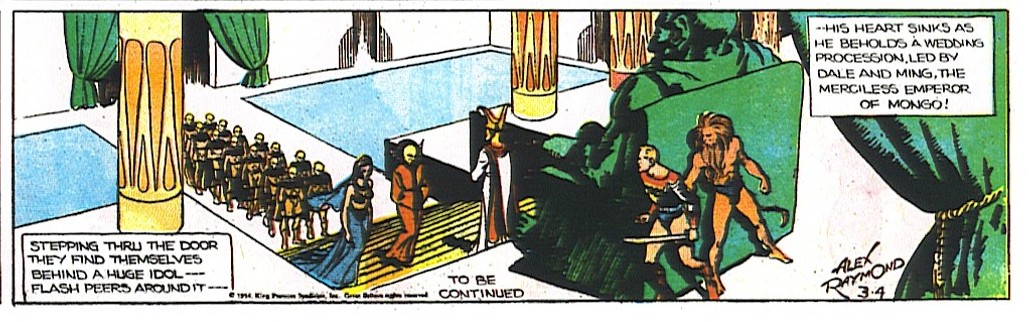
Flash_Gordon_Excerpt

No character in the 1936 production illustrates this better than King Vultan of the Hawk Men.  All the Hawk Men (there are no Hawk Women, near as I can tell) have enormous, feathery wings sprouting from their backs, and wear Viking horned helmets and armor.  With his boisterous laugh and enormous appetites, Vultan is clearly modeled after Henry VIII (he’s even shown feasting on the drumsticks of what I assume is some kind of space chicken, and mention is made of his numerous wives).  However, with his truly over-the-top headdress and the exaggerated pectorals of his breastplate, he looks like Luciano Pavarotti as Brünnhilde in a drag production of Die Walküre.

Vultan2

I like Vultan, though: unlike the humorless Ming and colorless Kala (King of the Shark Men, who can’t breathe water—I mean, where to even start?), Vultan is the only one who seems to really enjoy his villainy.  He is, however, a strong argument against those who feel that the 1980 feature version of Flash Gordon was too campy compared to the original.  Upon capturing Dale and (inevitably) deciding to wed her himself, he courts her by first terrifying her with his pet “Urso” (a bear painted with badger stripes) and then tries to entertain her by making shadow puppets on the wall.  This guy is all over the place; naturally, he becomes Flash’s ally by the end of the serial.
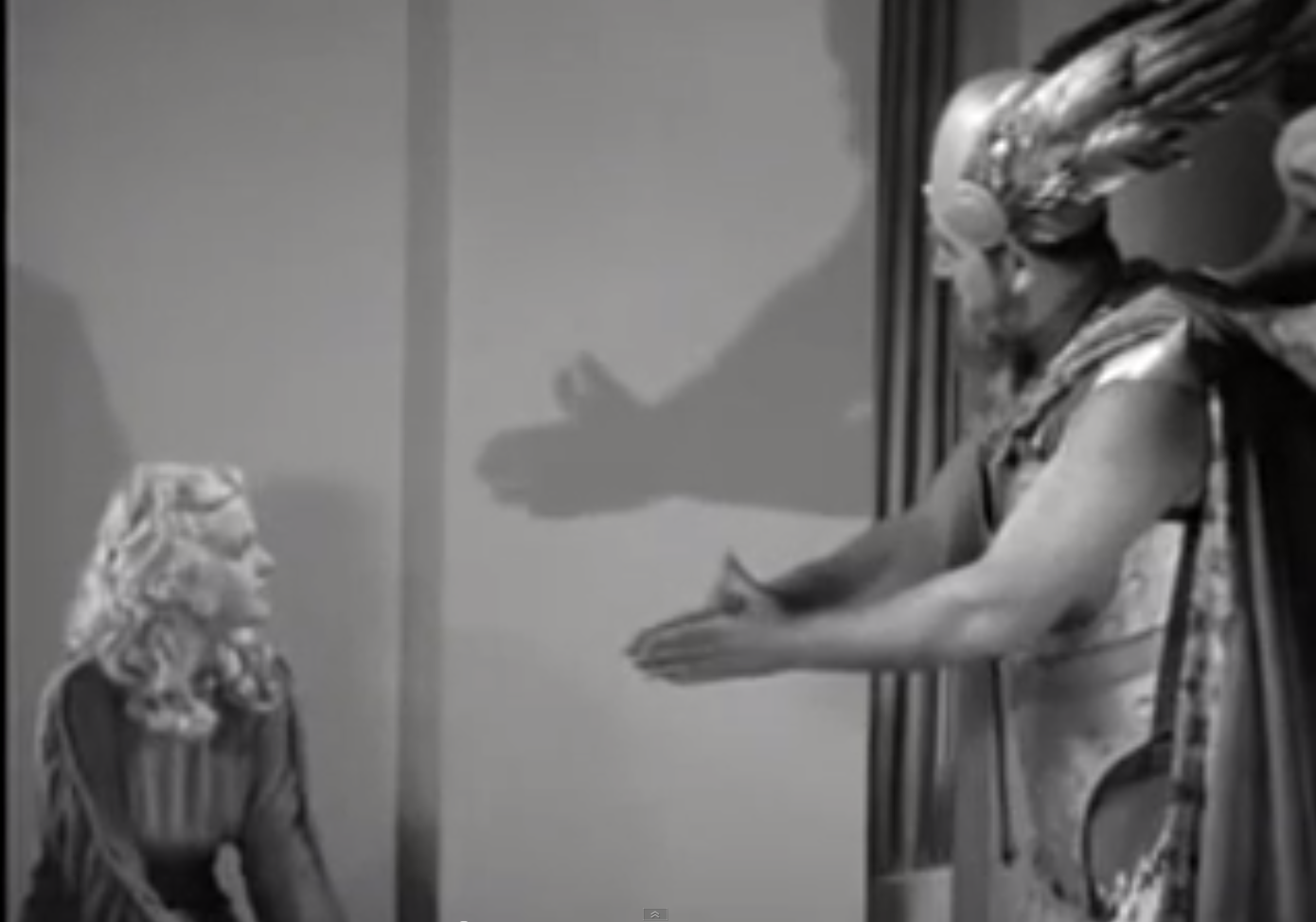
shadows

And who is Dale Arden but a classic “damsel in distress?”  She mostly screams and faints and exists to be rescued (interestingly, only one cliffhanger actually puts her in danger); she is subjected to mind games by Princess Aura, who convinces her that she must make Vultan believe she loves him, or else he will kill Flash.  The role isn’t the fault of Jean Rogers, who does as much as she can with it and looks great in the part.  In fact, between Rogers as Dale and Lawson as Aura fighting over Flash, it’s not hard to imagine a Depression-era boy at a Saturday matinee developing a sudden, unexpected interest in polo.
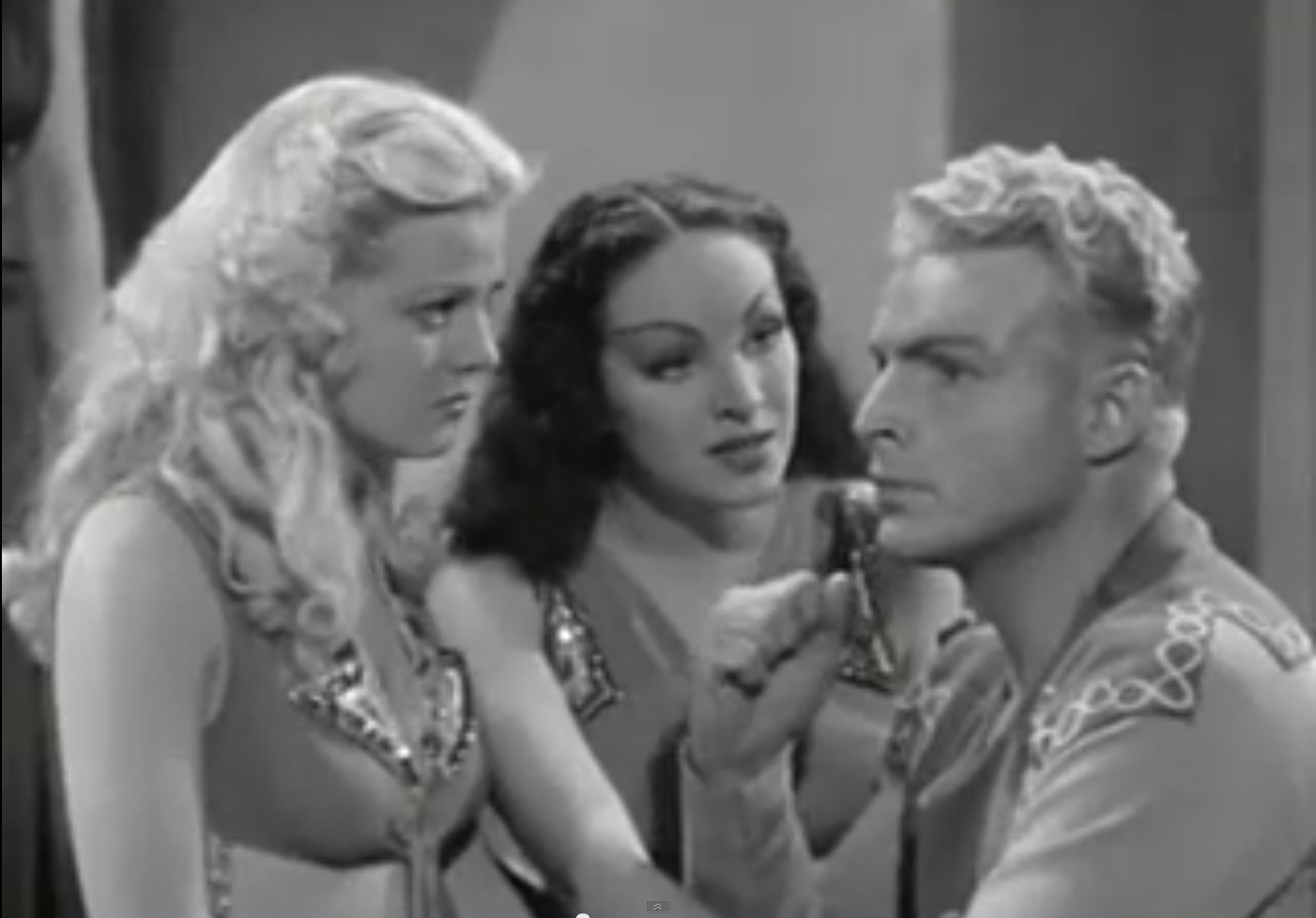
An amnesiac Flash Gordon tries to decide between Dale Arden and Princess Aura, the Betty and Veronica of outer space.

An amnesiac Flash Gordon tries to decide between Dale Arden and Princess Aura, the Betty and Veronica of outer space.

And it’s not only for the boys (and their dads): I mentioned Buster Crabbe’s physique, but I didn’t get to how often he appears without his shirt, slick with sweat or bound and tortured.  The sensuality and overt (but still PG) eroticism of the 1980 version weren’t invented from whole cloth.
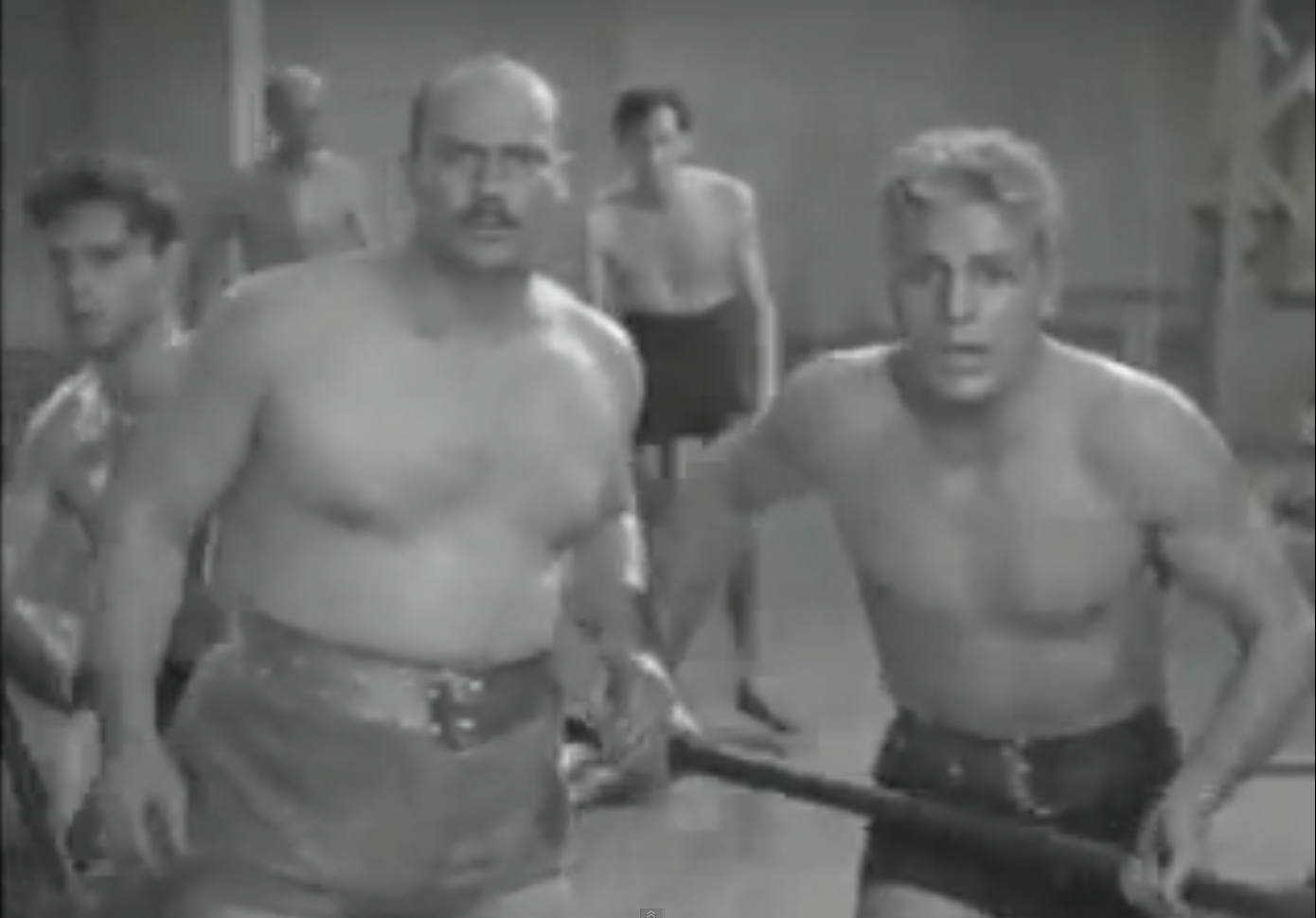
FlashBarin

When the plot isn’t being moved forward by Ming or one of the other rulers of Mongo, it’s often one of Princess Aura’s schemes that does the trick.  To my mind, she’s the real hero of the story, resourceful, determined, and intense.  No wonder she ends up on the throne at the end, paired up not with Flash but the loyal Prince Barin, who is so exciting and interesting that I didn’t even think to bring him up until now.

What I Watched: Flash Gordon (1936, Universal)

Where I Saw It: It’s on YouTube.  The first chapter is here.

No. of Chapters: 13

Best Chapter Title: “The Unseen Peril” (Chapter Ten)

Best Cliffhanger: “Shattering Doom” (Chapter Seven): Flash, enslaved in King Vultan’s atomic furnace room, has an electric wire attached to his wrist, to kill him instantly if he rebels.  Doctor Zarkov surreptitiously attaches the wire to the handle of Flash’s shovel and instructs him to throw the shovel into the furnace when the time for escape is right.  Flash orders the other slaves to duck behind the safety wall and makes his move, triggering a massive explosion.  Will he get to safety in time?

Sample Dialogue: “Is there no way a man can conquer the sacred orangopoid?” –Princess Aura, Chapter Nine

With a Dry, Cool Wit Like That: “Scared, huh?” –Flash, as he grabs Dale and pushes her out of the airplane in Chapter One

Cheapest Special Effect: As much as I’d like to, I can’t count King Vultan’s shadow puppets, which are certainly odd but aren’t meant to be taken for anything else. Instead, I choose this fellow, the terrifying giant lizard of Mongo:
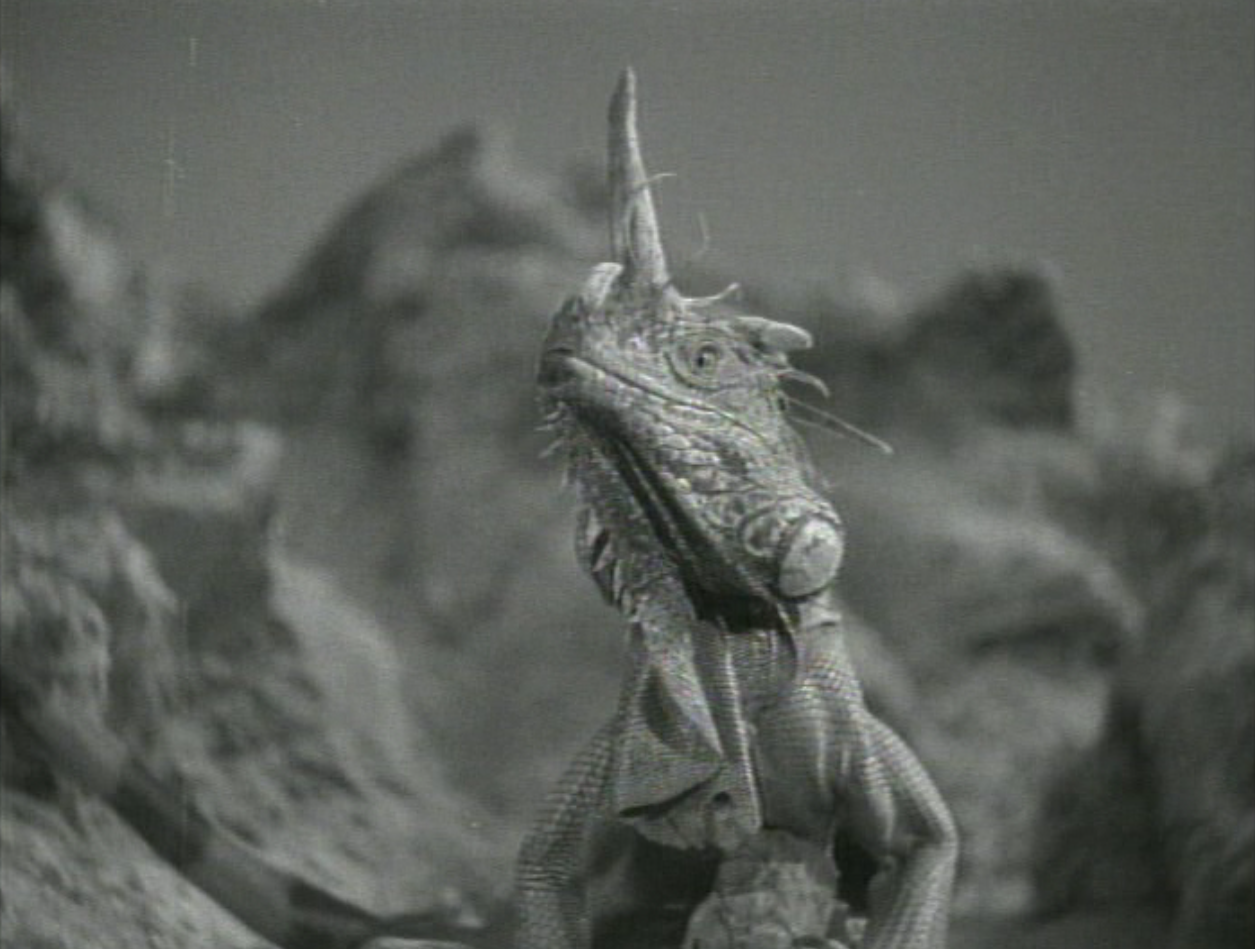
Lizard

Most Embarrassing Costume: I’ve already addressed the costumes in some detail, and while King Vultan’s appearance is certainly memorable, I think I’m going to award this honor to the Hawk Man servant who briefly makes an appearance in a full chef’s uniform in Chapter Six:

Chef

Biggest Cop-Out: Does anyone believe Ming is dead at the end of Flash Gordon?  Even without the knowledge that there would be two sequels, did anyone believe it in 1936?

What Others Have Said: “They were flying over and they were forced down where there was a rocket ready to take off—I mean, if you accept that, you have no problem with anything. If it bothers you that they happened to be flying over a rocket made by Dr. Zarkov, why then, this movie isn’t for you.” –Lorenzo Semple, Jr., screenwriter of the 1980 Flash Gordon feature film

What’s next: In two weeks, join me again for a look at Robinson Crusoe of Clipper Island.
Fates Worse Than Death: Exploring the Motion Picture Serials

Several years ago I was sitting in Century II Concert Hall before a Wichita Symphony pops concert; the day’s program was to include film music excerpts (some accompanying silent film clips), including selections from John Williams’ Star Wars score.  I don’t remember quite how the conversation started, but an older lady sitting next to me was blunt in her assessment: “People don’t realize it now,” she told me, “but Star Wars was a comedy.  The first time I saw it, I just laughed, because I had seen it all before.  Luke Skywalker swinging across the chasm on a rope? That’s Douglas Fairbanks.”

StarWars_Gouzee

I already knew that in a general way before this conversation, of course: not only had George Lucas acknowledged the inspiration he had taken from the adventure and science fiction movies of his youth, Star Wars’ debt to the weekly serials was a big point of discussion among fans and critics of the Star Wars saga.  Between 1913 and 1956, serials, or “chapter plays,” were a unique genre of motion picture: episodic, with a week-to-week continuity and boldly drawn, easy to follow stories that kept audiences coming back for more.  The serials developed in parallel with pulp magazines and comic books and shared many of the same story-telling conventions (and specific characters).  They were best known for the “cliffhangers” that ended each chapter with a character in peril, waiting until the beginning of the next chapter to show their escape.

Although the serials of the silent era were produced with an adult audience in mind, from the mid-‘30s onward, sound serials were increasingly geared to children.  Almost all were livened up with spectacular stunts: fist- and gunfights, chases, natural and man-made disasters.  Whether the story took place in the Old West, outer space, or the jungle, whether it was an adaptation of a classic novel or a story of (purportedly) true crime, the storytelling mode was the same, emphasizing action, adventure, and suspense.

Perilsofpauline

Serials of the sound era generally included between ten and fifteen chapters (by contrast, one silent serial, The Hazards of Helen, boasted over one hundred; it appears to have been an open-ended “continuing adventure” rather than a single narrative, however).  The first episode introduced the characters and set up future conflict (ending on a good cliffhanger to get the audience hooked!); episodes were around twenty minutes in length (with exceptions: sometimes the first episode would be a little longer, like the pilot of a television show).  Serial chapters were shown in conjunction with full-length features (along with newsreels, cartoons and other “shorts”), part of a weekly moviegoing experience that had little to do with the specific film being shown.

Although I tend to see Star Wars as more homage than parody, there’s no denying that it draws heavily on the language of the serials that were popular from the 1930s to the 1950s, before their thunder was stolen by television. Indeed, watching the 1977 original today with an awareness of serials like Flash Gordon and Buck Rogers, it’s easy to see just how much the characters and situations were based on very specific models: how, in Terry Gilliam’s words, Darth Vader is just “the cowboy with the black hat”—the “spearhead villain” in the terminology of the serials.

I had seen clips from the original serials, sometimes in conjunction with material from Star Wars (or Raiders of the Lost Ark, Lucas’ and Steven Spielberg’s other homage to the format).  As I mentioned in a previous essay, the pop culture of my childhood was marked by a major resurgence of the characters and formats popular in the 1930s and ‘40s: not just the movies, but also the comics, pulp magazines, and radio shows of the Depression and war years.  During the 1970s and 1980s, there were new movies, comics, and television shows based on characters such as Conan the Barbarian, Doc Savage, the Lone Ranger, Tarzan, Flash Gordon, Buck Rogers, and many others.  Some were revived in response to the success of Star Wars and Indiana Jones; others had been brought back as part of the “adult fantasy” wave that had also swept J. R. R. Tolkien and Dungeons & Dragons to cultural prominence in the early 1970s, and of which Star Wars was partially a product.  And some had never really gone away.

Still, it was rare for serials to be shown in their entirety on television when I was a kid: there had been a serial revival in the mid-1960s, coinciding with the popularity of the Batman TV series, but that was before I was born.  Many of the serials had been “featurized”—edited down to hundred-minute movies—for television broadcast, so I might have seen some without even realizing it, but it wasn’t until I was an adult that I was able to get the full, multi-chapter experience.  As much as I love the pulpy aesthetic of old movie posters and the juicy, crackling dialogue of the old-time villains, the serials themselves were something of a blind spot for me.

The goal of this series is to explore some of the classic serials, not necessarily as they were originally seen, but at least uncut and at full length.  Of the hundreds of serials that were made, not all have survived, but many are available on DVD and a large number can be seen on YouTube.  Without trying to be comprehensive, I will have plenty of material to examine.

serialsonDVD.jpg

In reading about the history of the serials, many names pop up frequently: the serials had their own stars, such as leading men Buster Crabbe, Tom Tyler, and Kirk Alyn; and leading ladies Pearl White (“Pauline” of The Perils of Pauline, the archetypal silent serial) and Linda Stirling.  (Stars such as Bela Lugosi and Boris Karloff also made appearances in serials, as did future star John Wayne and television’s Lone Ranger, Clayton Moore.)  Behind-the-scenes personnel made long careers out of the serials, such as stuntmen Tom Steele and Yakima Canutt, and directors Spencer G. Bennet and the team of William Witney and John English.  One also sees the name Sam Katzman frequently: the corner-cutting producer who, despite the tight budgets with which serials were typically made, was said to have never lost money on a production.

Finally, the name of Republic Pictures is nearly synonymous with the serial.  While other studios made serials as part of their output, Republic specialized in them, and one can hardly discuss the subject without acknowledging them.  After forming through the merger of Mascot (an established producer of serials) with Consolidated Film Laboratories and Monogram in 1933, Republic made sixty-six serials over the next two decades, almost to the end of the serial era.  Republic, along with Columbia, Universal, and a number of smaller studios, brought superheroes like Captain Marvel and the Phantom to the screen for the first time, and eventually created some of their own, such as Rocket Man.  In examining the serials, I intend to examine both the source material from which these characters were drawn and the serials’ lasting influence on the TV shows and movies that followed.

So much for the preliminaries.  I’ve decided to start with one of the most successful serials of all time: in two weeks, I’ll examine Universal’s 1936 production of Flash GordonI hope you’ll join me.

FlashGordon

The Force in Four Colors: Revisiting Marvel’s Star Wars

Recent news that the license to publish Star Wars comics would shift from Dark Horse to Marvel in 2015 probably didn’t come as a surprise to anyone: now that both Lucasfilm and Marvel are under the umbrella of Disney, it was only a matter of time before corporate synergy asserted itself.  Already, Disney-owned properties such as the Muppets, Darkwing Duck, and the Pixar characters have been withdrawn from licensee Kaboom! (not all of them to reappear at Marvel, at least so far).  It’s too bad: Kaboom! publishes some of the best comics for children around, and their books were clearly being written and drawn by creators with knowledge of and affection for the characters.  Still, it makes business sense for Disney to consolidate its holdings, now that it has film, animation, and comic book outlets at its disposal.  I don’t blame them at all; I’m sure it was part of their plan in acquiring those companies in the first place.

jaxxon

The news has stirred up memories of the often-wacky Marvel Star Wars line that ran from 1977 to 1986, and there have been a lot of jokes at Marvel’s expense.  Heck, I’ve sprinkled Twitter and WordPress with my share of comments about the Zeltrons, a race of pink-skinned empaths whose sexual openness was often a source of comic relief (and pinup-worthy cheesecake) in the series.  No one would deny that Marvel’s version of George Lucas’ science fantasy epic is more remembered for six-foot tall green rabbits, horny pink-skinned aliens, and a seriously off-model Jabba the Hutt than for its merits, especially in comparison to the more straight-faced Dark Horse run.

DaniMain3

Although some of Marvel’s contributions to the Star Wars canon have been picked up and used by others (including the Zeltrons, actually), its run was compromised by its publication alongside and in between the release of the original trilogy’s films.  Before Star Wars (sorry, A New Hope) was released, Marvel was already publishing its six-issue adaptation, including scenes that were cut from the final film: most notably Luke’s conversation with Biggs on Tatooine and Han Solo’s confrontation with a very different-looking Jabba the Hutt in Mos Eisley.  The yellow-skinned, humanoid version of Jabba would appear a couple of times in the comics, until he officially disappeared from existence, replaced by the slug-like Jabba of Return of the Jedi.

jabba-from-star-wars-adaptation-marvel

To be fair, it can’t have been easy for the writers (including Roy Thomas, Archie Goodwin, and Mary Jo Duffy, among others) to spin stories out of a saga that wasn’t completed yet: the challenge was to give readers more of what they loved in the movies without deviating too far from formula or accidentally contradicting or giving away plot twists planned for the sequels (plot twists that were generally secret–Marvel’s editors wouldn’t always know they had crossed the line until it was too late).  Particularly between The Empire Strikes Back and Return of the Jedi, writers were tasked with providing the illusion of change so familiar to readers of superhero comics: Han Solo could not be freed from his carbonite imprisonment, although many issues were dedicated to attempts to rescue him; Darth Vader was off the table, so there could be no answer to the question: was he Luke’s father?

Some of the weirdness in Marvel’s version was also due to the relationship between licensor and licensee at the time.  In those days there was simply not the expectation that film and comics be a seamless continuity: comics were exercises in brand extension, ancillary revenue streams, not sacred texts.  To a large degree, the comics’ writers and artists treated the Star Wars universe as just another sci-fi/fantasy playground to be filled with weird landscapes and monsters (one story arc was repurposed from unused John Carter, Warlord of Mars artwork).  Remember, this was from the same decade as Jack Kirby’s adaptation of 2001: A Space Odyssey and Whitman’s adaptation and continuation of The Black Hole.  Making up and adding material was thought of as giving good value to the reader.  Star Wars and its Expanded Universe would be a major influence in shaping fans’ expectations of continuity across all media, but that tighter approach didn’t emerge overnight.

Still, before I was a Marvel kid I was a Star Wars kid, and the latter was a big reason for the former.  I remember vividly the discovery that piqued my interest: in the box of comics I shared with my sister (about which I’ve written previously), I discovered a copy of Star Wars number 18, missing its cover.  This was the first issue of a major story arc in the early days of the series, the “Wheel” saga, named after a huge space station-bound casino that is the setting of the action.  I didn’t know that at the time (1982 or ’83, I would guess), and it would be a few years before I was able to read the “Wheel” arc in its entirety.  What captivated me was the idea that the characters I knew from the movies were having entirely separate adventures in these comics.  I tended to accept anything official-looking as gospel, so I had no trouble accepting the legitimacy of Marvel’s version (although Carmine Infantino’s square-jawed rendition of Luke Skywalker looked more like He-Man than Mark Hamill).

Mswc19cover

For the first time, I became a regular comic buyer, actively looking for new issues on the stands and seeking out back issues to fill in my collection.  Jumping into the series, there were many unfamiliar characters and references to previous adventures from the comics.  I had a lot of catching up to do.  I didn’t live anywhere near a dedicated comic book store, so I relied on trading with friends and mail order: the biggest comic book purchase of my childhood, in fact, was an order for all the Star Wars issues that were available from one of Mile High Comics’ summer sales. Mile High’s yellow two-page ads were once a common sight, and the summer sales were the best, unloading comics for 25 or 50 cents apiece.  It helped that, aside from the first few issues, Star Wars had never been terribly sought-after or valuable, and at most they were only a few years old.  The day the box arrived in the mail with forty issues or so—far from a complete run, but more than I had ever read at once and including many gems—I holed up in my room and immersed myself in “a galaxy far, far away.”  It would be the first of many long afternoons delving into another world through comics.

One of the things I liked about the comics, and which still holds up today, was the focus they were able to bring to individual characters.  Many issues were solo adventures, or featured groups of only two or three characters working together in ways that the epic scope of the films didn’t always have time for.  In the comics you could observe Princess Leia as a diplomat waging high-stakes games of cat-and-mouse with Darth Vader and the Empire (in “The Third Law”); Luke Skywalker’s role in the Rebellion’s space fleet could receive more attention; Han Solo, and later Lando Calrissian, could be shown in their element as smugglers, gamblers, and “scoundrels” (in flashback, of course).  In essence, the Star Wars universe could support stories of action-adventure, espionage, horror, romance, and even comedy, much as the Expanded Universe still does today.  It made sense: the movies were themselves indebted to many different genres, including the science fiction serials of the 1930s and ’40s; Westerns; World War II aerial dogfights; and the samurai films of Kurosawa.  It was only natural for the comic book adaptations to continue in that spirit and flesh out elements that could only be implied on film.  Not all of the stories worked, and not all of the original characters fit into the Star Wars aesthetic, but I still remember them fondly, from the “Wheel” saga to the the twisty, long-running story of Shira Brie, to the many, many attempts to rescue Han Solo.

Mswc65cover

After Return of the Jedi, the Marvel series continued without much apparent purpose, introducing its own villains (the Nagai) and tying up threads from the comics.  The writing was on the wall.  I was a faithful reader until the end, but I couldn’t disagree with the decision to cancel the series after 107 issues: it had become a shadow of its former self, and by that time I had gotten hooked on Marvel’s superhero offerings.

I didn’t spend much time reading the Dark Horse series–I guess I was still a Marvel kid at heart–but from what I could see the quality was good, and they made a lot of smart decisions.  Unlike the Marvel series’ focus on the main characters of the film trilogy (understandable, but ultimately limiting), Dark Horse was able to flesh out the Old Republic and other settings within the Star Wars universe.  They even obtained the rights to the Marvel run and released it in a handsome series of trade paperbacks, a fitting tribute to an imperfect but often richly entertaining saga, and a challenge to the assumption that everyone involved would rather forget it existed.  With the distance of time, new and old readers alike can approach these adaptations, see that there was more to it than green rabbits, and make up their own minds.

(Images from Wookieepedia, the Star Wars Wiki)

Points of Connection, Part Two: A is A . . . or is it?

What can one say about Watchmen that hasn’t already been said?  Since its initial publication in 1986-87, more ink has been spilled about the graphic novel by writer Alan Moore and artist Dave Gibbons than probably any other modern comic book narrative. It’s been named as one of the greatest (defined as most artistically accomplished, most influential, or most successful—take your pick) comic book projects in history, and even one of Time magazine’s Top 100 Novels, period.  Since the release of Zack Snyder’s 2009 film adaptation and DC’s decision to publish the Before Watchmen prequel books in 2012, there has been even more commentary and debate. I don’t intend to add more to the pile of Watchmen verbiage outside of the narrow scope I established in my last Medleyana post: the use of doppelganger characters.* Alan Moore’s influence on the mainstream has lessened as his projects have become increasingly idiosyncratic in recent years, but it is impossible to discuss the reworking of characters and the exploration of archetypes without bringing him up.

Watchmen is probably the best-known use of pastiche on a grand scale in comics. Originally, Moore meant to write his story about characters from the Charlton publishing company, which had been acquired by DC; after DC decided those characters could be profitably relaunched within DC’s established continuity, they were off the table, and Moore chose to create new characters along similar lines: the Blue Beetle became Nite Owl, the Question became Rorschach, and so forth.

Here’s where it gets interesting: as established previously, an intertextual double (a misprision, in poetic terms) follows the same broad outlines as the original, but is a character in itself, independent of its source.  Points of connection between the two are also points of departure: in other words, the double is only beholden to the original up to the threshold of reader recognition (for purposes of commentary) or satisfying the needs of a given character type (for narrative purposes); after that, they are effectively a blank slate, just like any other original character.  The difference between an effective analogue and a ripoff, then, has nothing to do with “originality” (a much overestimated quality, and especially meaningless in such a codified genre as the superhero), and everything to do with the creator’s success in infusing him or her with convincing motives and actions.  If a character would live, it must have the spark of life: nothing else matters.  (I’ve alluded to the writer’s role in crafting a convincing character, and that is just as true for “original” characters as doppelgangers, of course.)  For Moore, whose entire purpose was to establish a psychological realism to a degree that had only been spottily attempted in the superhero narrative previously, the inner life was a given, but for the achievement to have impact, the characters would also have to resonate as plausible superheroes.**  The Charlton stable were important models, but Moore and Gibbons also drew on the broader common property of superhero archetypes and the visual tropes of costume, accessories, and even the illustration styles of pulp novels, comic books, and advertising art in order to create a convincing, lifelike world, divergent from ours but believable nonetheless.

To cite an example from Watchmen, I had little familiarity with Steve Ditko’s severely moralistic vigilante the Question, or his follow-up character, the even more stringent Mr. A (whose uncompromising slogan, “A is A!” was taken directly from Ayn Rand’s Objectivism), when I first read the graphic novel.  Still, Rorschach is a clear enough character type: a vigilante with a moral code so strict that no one can live up to it, with equal contempt for criminals, their victims, and even other heroes if they aren’t willing to go as far as him.  The details that Moore invents for Walter Kovacs, Rorschach’s alter ego, speak to Watchmen’s interest in both the social problems and individual psychoses involved with superheroics: childhood sexual trauma, a connection to the infamous Kitty Genovese murder, and of course the horrific crimes that sped along Kovacs’ psychotic break.  One doesn’t need to know Ditko’s original characters to appreciate the drama, but it adds some intertextual depth (if anything, reading some of Mr. A’s cases show how little Moore had to exaggerate Rorschach’s ruthlessness and black-and-white morality).

The Question dons his mask; art by Steve Ditko

The Question dons his mask; art by Steve Ditko

Origin of Rorschach's mask; art by Dave Gibbons

Origin of Rorschach’s mask; art by Dave Gibbons

Likewise, I was familiar with the Blue Beetle from his introduction into DC continuity rather than his original Charlton adventures, but I didn’t immediately connect him to Nite Owl when reading Watchmen: he too is a familiar type, a “gadget hero” like Batman (or, to a lesser degree, Iron Man).  Within the narrative, Dan Dreiberg is actually the second Nite Owl, borrowing his name and persona from a Golden Age model, Hollis Mason (the first Nite Owl, representing both the ideals and the institutional memory of the original costumed heroes).  This pattern was true of the Blue Beetle, but also of characters such as Green Lantern and Hawkman who had very different Golden and Silver Age incarnations.

Watchmen also benefits from an important opportunity afforded by pastiche: the ability to replace the ad hoc jumble of origins and histories typical of established continuity with a streamlined history that both gives all the characters a common point of reference and allows for meaningful points of connection between them that goes beyond the simple “team-up.”  Although, as Geoff Klock points out, Moore has in many cases deliberately introduced the kind of contradictory history that plagues long-running comic book series into his original stories, in Watchmen he plays it straight, with his “real-life” costumed heroes taking inspiration from fictional comic book characters, and eventually supplanting them.  As for points of contact, in addition to the obvious shared history between them, there are subtle connections: the shape-shifting cloth which Rorschach wears as a mask, and from which he takes his name, is referred to as a spin-off of technologies introduced by Dr. Manhattan, the only truly superhuman character in the novel; other technologies and businesses mentioned are part of the empire of Adrian Veidt, the “self-made” superhero Ozymandias (and a major driver of the plot).

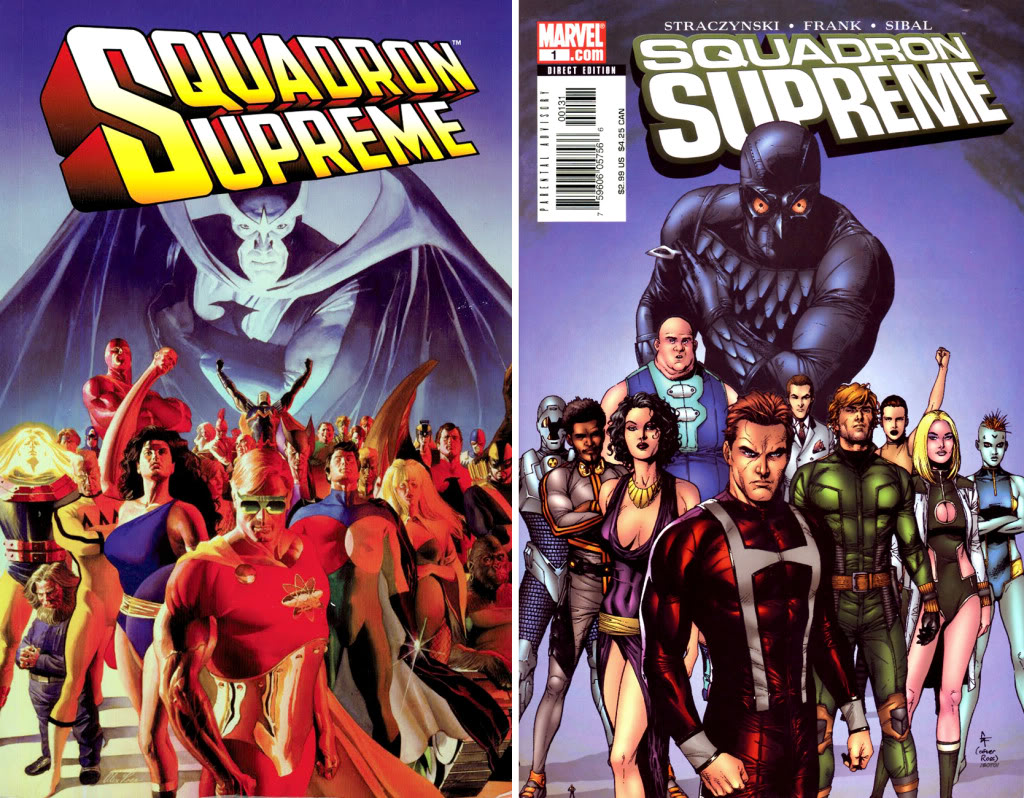
Film adaptations of superheroes often make connections where none exist in the comics in order to tighten up the plot, as for example the Joker/Jack Napier being identified as the killer of Bruce Wayne’s parents in Batman, or Ra’s al Ghul serving as both Wayne’s mentor and eventual antagonist in Batman Begins. Such circularity is more dramatically satisfying, and easier to establish, in a two-hour film or self-contained novel, although asserting such symmetries can be one function of rebooting or “retconning” an established series.  As an example from another narrative, when J. Michael Straczynski rebooted the Squadron Supreme for his 2003 series Supreme Power, he started from the ground up, effectively creating a “trope of a trope:” in Straczynski’s version, the escape pod that brought “Mark Milton” (Hyperion) to earth as an infant was part of an alien battle, the shrapnel from which also gave powers to the Blur (a trope of the Flash, replacing the original Squadron Supreme’s Whizzer, because really: the Whizzer?) and provided the “Power Prism” to Doctor Spectrum (a trope of Green Lantern, here reconceived as a special ops pilot nicknamed “Doctor” because of the surgical precision with which he executes his missions); some of the villains Hyperion faced were created through government experimentation with his own DNA.***  The reboot/misprision allowed Straczynski to focus on the elements that most concerned him: instead of the Squadron imposing its rule in the name of the greater good, as in Mark Gruenwald’s narrative, the Squadron are tools of a shadowy, not always benevolent government that doesn’t reveal its purposes to its super-military (as exemplified by Mark Milton’s upbringing by government operatives instead of Ma and Pa Kent), the expression of a twenty-first century anxiety that remains as relevant as ever.

The two incarnations of the Squadron Supreme by Alex Ross (l) and Gary Frank (r). Source: I love comic covers

The two incarnations of the Squadron Supreme by Alex Ross (l) and Gary Frank (r). Source: I love comic covers

Next time, I’ll examine a few examples from movies and television.

* But for the record, I liked Moore’s original “space squid” ending, and I think it could have worked on film if it had been reconceived in cinematic terms by a director more concerned with duplicating the feel than the look of the book.  How terrifying—and believable—could Peter Jackson or Sam Raimi have made that ending?

** Interestingly, Moore and Gibbons have stated that Mad‘s parody “Superduperman” was an influence on their approach, revealing depravity and greed beneath the slick costumes.  It’s not uncommon for transgressions that are comical to one generation to be taken seriously and developed in earnest by the next.

*** Marvel attempted something similar with its “New Universe” line in 1986, sort of the flip side of DC’s unification of its universe, and showing that it isn’t easy to build a compelling narrative world from scratch.

Points of Connection, Part One: the Many Children of Krypton

Hyperion.  Supreme.  The Sentry.  What do these characters have in common?  All are doppelgängers, or doubles, of Superman, and not just in the sense that all costumed heroes descend from the Big S, or in the debt they all owe to Philip Wylie’s Gladiator and Friedrich Nietzsche’s Übermensch, nor even in their monomythic relation to Joseph Campbell’s Hero With a Thousand Faces.  Rather, they are thinly veiled copies, different enough in detail to escape litigation (or avoid confusing readers) but readily recognized by key elements of their persona, history, and/or supporting cast.

The double, or pastiche, is a powerful fictional technique, in which an established character is effectively remade (and frequently repurposed); it’s especially common in comic books, where “copycatting” is an established (if not especially reputable) practice.  As an example, the core members of DC’s Justice League of America—Superman, Batman, Wonder Woman, et al—have been copied numerous times, individually and as a team.  It should be noted that I’m not speaking so much of identical twins or copies of the same characters inhabiting parallel universes, although those are equally common story-telling tropes. The doubling to which I refer is almost always intertextual, allowing a writer to tell a story including (a version of) a character owned by another publisher, or including story elements that would be unacceptable for a well-established (and ongoing) character.

Adhering to genre conventions is not enough: recall that National (DC’s parent company) sued Fawcett over alleged similarities between Superman and Captain Marvel, yet the elements the two characters have in common—super strength and other powers, colorful costumes, secret identities, and an ethos of doing good—are practically universal among Golden Age heroes, and in other specifics the characters are quite different.  Superman, orphaned son of the doomed planet Krypton, doesn’t have much in common with Billy Batson, who is given his powers by the wizard Shazam.  It is precisely those details that a writer can exploit, filling in the pastiche character’s backstory with variations that are functionally the same; sometimes it is as simple as changing a few names (Superman’s Krypton becomes Hyperion’s Argon), at other times a more thorough reworking is undertaken, but the connections are still apparent because of the overall dynamic of the story.  This goes beyond parody, although the line can be fuzzy: Mad’s “Superduperman” and “Captain Marbles” are clearly a joke, but one intended to reveal, among other things, the venality and absurdity hidden beneath the costumed hero’s civic-minded facade (“Once a creep, always a creep!”). Hyperion (from Marvel’s Squadron Supreme) and Alan Moore’s take on Marvelman/Miracleman (instantly recognizable as Superman and Captain Marvel, respectively) are largely dramatic in their treatment, but just as flawed.

The value of the double is summed up by Geoff Klock in his How to Read Superhero Comics and Why, a study that looks at the evolution of superhero narratives through the lens of Harold Bloom’s theory of the anxiety of influence:

The current character, though obviously in debt to its source, can often act as a powerful misprision [a reflection, or reinterpretation] of that original character, while the fact that it is not actually the original frees the writer from the constraints of copyright and continuity.

For example, earlier in his book, Klock argues that “Warren Ellis’s Four Voyagers [from the pages of Planetary] are a trope of Marvel’s Fantastic Four, which is to say that while the Four Voyagers are characters in themselves, they are also an interpretation/metaphor of characters that have come before” (emphasis added).

Such misprision is most useful when the writer has something to say beyond aping an already successful character: in Klock’s scheme, informed by Bloom’s statement that “the meaning of a poem can only be another poem,” well-known characters stand in for their creators, so that one generation of writers can exorcise or assimilate the influence of the preceding generation.  (And obviously, the technique of parody allows the writer to zero in on whatever element of the original character they wish to critique, exaggerating it, sometimes to the point of absurdity–see above.)  One doesn’t have to agree with all of Klock’s conclusions to see the value of this dialectic approach, and in fact the finest realization of a pastiche character isn’t always written by the person who first created it.  Alan Moore took over Supreme, a character created by Rob Liefeld, and transformed him into a meditation on Superman; the resemblance was already present, but Moore brought it into focus.  As another example, Mark Gruenwald used the Squadron Supreme, Marvel’s trope of the JLA (originally introduced by Roy Thomas), to examine the relationships of the characters to each other, bringing out unspoken subtext or real-world concerns (such as the tendency toward paternalistic fascism inherent in the concept of super-protectors; the alienation of super-beings’ human friends and family; and the finality of death, as opposed to comic book characters’ typical return from the grave for shock value, marketing purposes, or narrative convenience) that would halt an ongoing series in its tracks if acknowledged. (Another version of the Squadron, effectively a trope of a trope, was launched in 2003; more about that later.)

Such concerns, when addressed at all, used to be the domain of the parallel universe or “imaginary story:” What if the Justice League used their power to oppress humanity instead of protecting it?  One answer was Earth-3’s Crime Syndicate of America; another was the Squadron Sinister, created as part of an unofficial “Avengers vs. JLA” crossover (since by Comic Book Law, when two characters meet for the first time, they must test their powers against each other in battle; the Squadron Sinister later, of course, became the Squadron Supreme). Later, such projects as Frank Miller’s The Dark Knight Returns, Mark Waid’s Kingdom Come, and Darwyn Cooke’s DC: The New Frontier would address many of these subjects using flagship characters in speculative settings outside regular continuity, but Squadron Supreme (1985) predates the more critical approach to characterization kicked off by Alan Moore’s Watchmen, and by Miller himself, and the aforementioned projects benefited from the more fluid approach to continuity that became fashionable after the high water mark of Crisis on Infinite Earths’ obsessive attempt to keep things in fixed positions.

Time is short tonight, so I’ll save a discussion of Watchmen, one of the most prominent and influential reinventions of this type, for next time.

Everybody’s Looking for Some Action

There were big tables covered with comics standing upright in long rows.  A sign hanging from the ceiling said All Comics 5¢.  We began to flip through the comics.  Alan had a list with the titles and numbers of the comics he wanted.  It was slow work.  The only comic he found that was on his list of wants was a copy of Action Comics Number 1—but he didn’t buy it because there was a corner torn off the cover.  He said he only bought comics that were perfect.

That throwaway line, from Daniel Pinkwater’s young adult fantasy Alan Mendelsohn, the Boy from Mars, is played for irony, of course: even in 1979, when Alan Mendelsohn was first published, a copy of the first issue of Action Comics—the comic book in which Superman made his first appearance—was something the average collector could only dream of finding, in any condition.  It also establishes Mendelsohn’s character: exacting to the point of eccentricity, and confident enough to pass up the find of a lifetime because it’s not exactly what he’s looking for.  Later, Mendelsohn sells his comic book collection to finance the greater adventure he and Leonard (the narrator) are on: Mendelsohn remains cool while his buyer goes increasingly crazy for the rare finds Mendelsohn has.  By the end, Mendelsohn has the buyer eating out of his hand, and he and Leonard get the money they need, and then some:

 “The difference between that man and me,” Alan Mendelsohn said, “is that I am a connoisseur, and he is a fanatic.”

Both scenes play into powerful fantasies for young collectors: finding a holy grail—there have been more expensive comic books, but few that are as recognizable as Action Comics No. 1—and being able to leverage our finds down the road, using our connoisseurship to get one over on the drooling fanatics who’ll pay any price for what we have.

Action-Comics-No-1

Sadly, for most collectors, the fantasies remain just that.  For the past few days, the comics blogosphere has been chewing over an article in Businessweek pointing out that you’re probably not going to be able to retire on the proceeds from your comic book collection.  As an example, columnist Frank Santoro offers an anecdote that stands in for the general trend:

He recently had to break the bad news to a friend’s uncle, who was convinced his comic collection—about 3,000 books—was worth at least $23,000. “I told him it was probably more like $500,” Santoro says. “And a comic book store would probably only offer him $200.”

When I read this, my first reaction was: “Well, duh.”  While auction prices for “key” Golden Age issues have continued to rise, it should be obvious that there is a big difference between Action Comics No. 1 and Secret Wars II No. 1, and the collections owned by the forty-something men in the article are likely to be more laden with the latter than the former.  I know, because I’m one myself, with a collection of bagged and boarded comics in the basement, and I doubt I’ll ever get much out of it in monetary terms.  Sure, it was disillusioning the first time I realized I wouldn’t get what I thought something was worth out of it, but I’m willing to settle on a realistic price for anything; it’s just that “realistic” can look very different depending on whether one is buying or selling. I’ve encountered my share of junk shops, garage sales and Craigslist ads run by deluded souls convinced that they’re sitting on a gold mine.  I’ve seen scratched-up Beatles albums for $40 or $50 (and not the rare ones) and highly-promoted but far from rare comics from the ‘90s with high price tags.  Anyone who has collected anything, or even tried to buy a used car or piece of furniture, could tell similar stories.

The seller may have an inflated idea of the scarcity of their item, or they may have been swept up in the hype of ever-rising prices for collectibles in general; they may even have a price guide to back them up, which only proves that someone was willing to pay a premium for the item (in mint condition, which is usually not the case) at one time.  Still, something is really only “worth” what someone else is willing to pay for it, so I imagine those albums and comics are still sitting on the shelf, or were marked down or put into storage—or found a buyer as gullible as the seller (leading to the description of the back issue market as a “Ponzi scheme” in the Businessweek article).

But clearly, the idea that your old comic book collection would put your kids through college is an old one, an article of faith (or folklore) that predates the speculation boom of the 1990s.  As Alan Mendelsohn shows, it was already alive and well in the 1980s, when I was collecting, and it didn’t only come from the publishers and retailers who had a vested interest in promoting “collectability.”  The belief among collectors that we were stockpiling a monetary investment for the future had a “revenge of the nerds” quality, like the stories we told ourselves that we would all become successful inventors or entrepreneurs, getting the last laugh on the jocks, the bullies, the “normals” who got in our way.  I guess it worked out that way for a few people, but for the majority it was a self-serving myth (and for the record, Alan Mendelsohn got a hundred and eighty-five dollars and a brass potato for his collection; he didn’t become a millionaire).

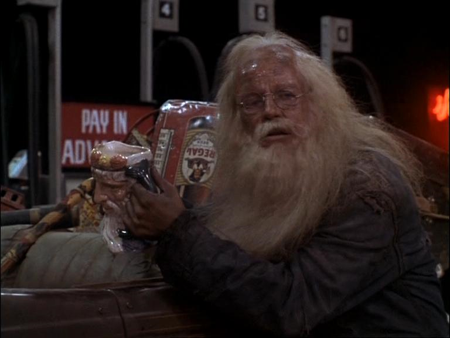
As an extreme example, consider “Gather Ye Acorns,” a 1986 episode of the anthology series Amazing Stories.  In it, Mark Hamill (in one of his few post-Luke Skywalker, pre-voice acting roles) plays Jonathan Quick, a dreamy young man growing up during the 1930s, obsessed with comic books, pulp magazines and toys.  Pushed by his parents, who urge him to “grow up” and cast off his childish belongings, Jonathan is approached by a mysterious, gnome-like figure, a folkloric wild man (played by David Rappaport), who encourages him to keep the things he loves, to hold onto the magic of childhood.  What the world needs, the troll tells him, “is a few more dreamers.”  Over the years, Jonathan turns down the prospect of a normal life, descending into poverty and eventually living in a pitiful shack with his shabby old car and all his old junk; just when he has lost faith, he encounters (at the “Last Chance” gas station!) a knowledgeable (and wealthy) collector.  It turns out that the world has come around, and his belongings, which for so long were precious only to him, are now highly collectible.  The owner of a comic book shop is shown going through his treasures in disbelief: why, that’s Action No. 1, the first appearance of Superman!  The episode ends with an auction of Jonathan Quick’s collection; now wealthy, he encounters the troll one last time, and while trying to thank him, makes the acquaintance of an attractive lady.  Perhaps it’s time for Jonathan Quick to finally settle down.

In the broadest sense, that of allegory, “Gather Ye Acorns” is a story of holding on to the magic of childhood, of not letting others define you or devalue your passions. But I doubt I was the only viewer who took the story’s moral literally, as a vindication of the collecting lifestyle: “See?  All that stuff had value, and he ended up rich!”  It’s probably also a middle finger to the parents of Baby Boomers (like Steven Spielberg, who produced the series, and whose story Stu Krieger’s teleplay is based upon) who threw out all their kids’ baseball cards and comic books, and who, like the overbearing parents in “Gather Ye Acorns,” probably never saw that junk as anything but a waste of money in the first place.

Looking back at actual history, however, there was more than just the ever-present Generation Gap at work: the social upheaval and increased mobility of the Depression and World War II made the maintenance of big collections an unlikely prospect, even for those who might have been so inclined.  It’s hard for us nowadays to imagine how few possessions most families had compared to the present (and forget about renting extra storage space, as so many of us do now!).  Remembering the adage “every move is like a fire,” it’s also likely that in the migrations of the war years (from the Dust Bowl to the West; from the deep South to the factories of the North; from rural areas to cities, and from cities to the suburbs), preserving ephemera like comics was simply not a high priority for most people.  Finally, the war effort included paper and shellac drives that undoubtedly consumed thousands of comics, magazines, and records.

It’s for all the above reasons that the “key” issues from the Golden Age command such high prices, and why, barring a similar national upheaval, later issues probably never will.  Even as a kid, it was obvious to me that if everyone was saving their comics (and baseball cards, and whatever else), they would never become as scarce as material from the 1930s and ‘40s (or ‘50s, when a great number of comics were destroyed as part of the moral panic that led to the creation of the Comics Code).  In some cases, it was now parents who enabled the preservationist instinct, Baby Boomers themselves who didn’t want to repeat the mistakes of their own parents.  And of course, scarcity is only part of the equation: it has to be something people want in the first place, or low supply will do nothing to drive up demand.  Even if all those variant-cover comics from the ‘90s disappeared, it’s unlikely they would ever be as sought-after as historically important issues like the first appearances of Superman or Batman.

Since we don’t know what will be scarce and desirable in the future, should we save everything, just in case? Interestingly, at the midpoint of “Gather Ye Acorns,” when Jonathan Quick is squatting in a shack in the desert, he resembles a figure that has become much more visible since this episode was broadcast: the hoarder.  His anger at the troll, his disgust with the “treasures” he’s spent his life hanging onto, and above all his despair—“I have nothing!” he howls—are the flip side of the usual narrative, and are a frighteningly real moment in a story that otherwise has the broad outlines of a fable.  Even with the happy ending, the story seems to stretch things when it suggests that his years of struggle were worth it, because he lived life on his own terms; this comes awfully close to romanticizing poverty, as if there were no middle ground between his parents’ rigid standards and life as a “bum.”  As writer Noel Murray asked when examining two current portraits of Americans’ relationship with our possessions, the TV shows American Pickers and Hoarders, “So which is it? Are we supposed to hang on to all of our old crap just in case it turns out to be valuable, or is that kind of packrattery the sign of a disordered mind?”

Mark Hamill as you, the reader

Mark Hamill as you, the reader, on Amazing Stories

Of course, you could still read your comics.  When I was a kid, I had a friend, Jason, who often came around to trade comics.  On the one hand, he was always interesting to talk to, and had a knack for digging up unusual books I’d never seen; on the other hand, he’d drive me crazy by going through my stacks, getting things out of order, and wanting to trade for issues that would break up continuous runs.  Condition didn’t matter much to him; it was the stories that were important.  Jason was a throwback, the kind of comic book reader who had supposedly disappeared with Leave it to Beaver: he didn’t bag his comics—he’d even roll them up to stick in his backpack, to my horror.  (In retrospect, I wasn’t much more careful, but I could be an awful snob.)

Despite my efforts to preserve my comics like a good investor, my best memories of being a comics reader in the 1980s are of getting together with friends to read and discuss comics, and even those marathon trading sessions that left me cleaning up and reordering my collection for the rest of the afternoon.  Similarly, some of the comics I most fondly remember finding at garage sales were reprints, some with the covers missing, of no monetary value at all.  I tried valiantly to be a connoisseur, but I guess I was really a fanatic all along.

The Pleasures of Anthology, Part Four

You can read Parts One, Two and Three here, here and here.

In the foreword to the trade paperback edition of her late husband’s magnum opus Squadron Supreme, Catherine Gruenwald writes,

Mark always liked when I read his work, and he waited until the exact right time to unleash this particular story upon me.  In 1993, I was conveniently laid up for a week recovering from a minor surgical procedure, and he quietly decided this was the perfect time.  It did make the most of my captive-audience status, but it also made the recuperating process more pleasant as I breezed through each issue, especially without the usual wait between installments experienced by readers who caught it the first time out.  I thought about all those kids who read through stacks of comic books as they suffered through weeks of broken-leg mending and measles bouts.  Mark saw to it that I came into fandom the way others of our generation had!

My version of that experience came when I was in seventh grade and contracted Legionnaire’s disease.  I was hospitalized for two weeks and was significantly weakened by the illness.  I couldn’t talk or laugh too much without suffering coughing fits, and even getting up to walk around left me winded.  In the hospital I was in an oxygen tent and took treatments by inhalation at regular intervals, even during the night. (Incidentally, whatever the phrase “night nurse” might suggest to you, my experience didn’t live up to it.)  Although I wouldn’t recommend that method of immersion, I have one fond memory of that period thanks to a timely gift from my grandparents: The Smithsonian Collection of Newspaper Comics, edited by Bill Blackbeard and Martin Williams, which I devoured between treatments and brief visits from friends.

Smithsonian.newspaper

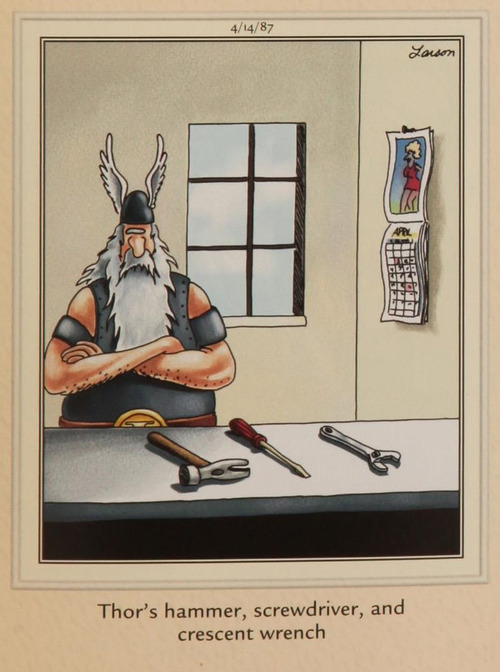
My mother’s parents had enabled my comics addiction quite a bit over the years: A Smithsonian Book of Comic-Book Comics had been a birthday gift the previous year (they lived in Arlington, Virginia, just outside Washington, D.C., so I received a lot of Smithsonian-themed gifts), and they always saved the color Sunday comics sections from the Washington Post for my sister and me to read when we visited.  The Post carried more and newer comic strips than my hometown paper, so I had the inside track on stuff like The Far Side and Calvin and Hobbes, and would try to describe these creative, mind-blowing works of art to my sometimes skeptical friends.  When those comics were picked up by the Pittsburg (Kansas) Morning Sun, their first daily installments invariably underwhelmed my friends.  The first Far Side to run in my hometown was, I think, the “Thor’s hammer, screwdriver, and crescent wrench” panel that even Gary Larson couldn’t explain.  Others, like Bloom County, were never carried in my hometown paper at all.

Gary Larson's plot to destroy my credibility, Exhibit A

Gary Larson’s plot to destroy my credibility, Exhibit A

The boundaries between newspaper comics and comic books were quite porous, both historically and in my experience.  I started off reading the newspaper strips from a young age, the kid-oriented ones like Winnie the Pooh at first, gradually expanding my range until I was even reading the soap-opera strips, grown-up adventures, and even the political cartoons on the editorial page.  I enjoyed the adventures of time-traveling caveman Alley Oop, and the globetrotting fisticuffs of Captain Easy, another legacy from the comic strips’ Depression-era golden age. Paperback collections of favorites like Peanuts, The Family Circus, and Garfield were among the first books I owned.  By seventh grade, I was serious about reading and collecting comic books, but I still read the newspaper strips and I was starting to think of myself as a student of the medium.  According to my parents, I even asked for the daily paper while I was in the hospital, so I could keep up (I don’t remember that, but I admit it sounds like me).

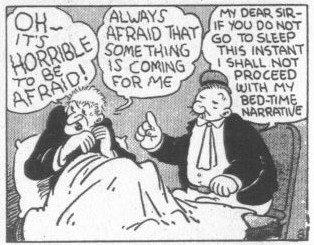
The best stories in the Smithsonian collection, adventures like the “Plunder Island” saga in Thimble Theatre (the home of Popeye), delivered the same combination of thrills, humor and pathos that I associated with movies like Star Wars and Raiders of the Lost Ark.  In hindsight it’s obvious why: George Lucas and Steven Spielberg were Baby Boomers, born in the mid-‘40s, rather than children of the Depression, but they obviously shared a love for movie serials and pulp novels and channeled the same sense of wonder and excitement into their original creations.  And they fit into a larger pattern: the years in which I grew up, the 1970s and ‘80s, were the crest of a wave of interest in the popular culture of the 1930s and ‘40s.  In addition to homages like Indiana Jones that hearkened back to the pulp era, the original characters from magazines, comic books and strips, radio shows, and serials were being repackaged for modern audiences or brought back to life in new formats: during my childhood there were big screen or TV adaptations of Conan the Barbarian, Popeye, Flash Gordon, Little Orphan Annie, and Buck Rogers, not to mention the ever-present superheroes whose roots went back to the same time period.  There was even a Doc Savage movie, although I’ll admit I haven’t seen it.

Whether I enjoyed the strips because I had been prepared by the resurgence of Depression-era culture or would have enjoyed them for their own sake without being primed is beside the point.  It was, I felt, material I needed to read, and that I encountered at the right time: it was the real stuff.  The Smithsonian Collection of Newspaper Comics fit my adolescent concept of reading as mastery perfectly: I was old enough to take the book seriously, reading it cover to cover, including the informative but not too academic prose accompanying the strips, but I was young and unoccupied enough to lose myself completely in the detailed artwork and the lengthy excerpts from Thimble Theatre, Mickey Mouse, and Dick Tracy.

Perhaps that’s the best explanation for the obsessions that grip us in the early teen years: what else did I have going on? Like those bedridden kids Catherine Gruenwald alludes to, I was in an ideal environment to be completely absorbed by my reading.  All my needs were taken care of.  Everything was new to me, so I had a greater tolerance for the lulls that beset any collection than I do now: back then, even the boring parts contributed to the overall design, set the baseline against which I judged the really superior stuff.  Now I have children of my own, and even when I have the time to read deeply it’s harder to access the state of complete absorption that I experienced then.  There are just too many other things occupying my mind; that’s the condition of adulthood.

thimbletheatre

The New Smithsonian Book of Comic Book Stories, edited by Bob Callahan, was published a few years ago, a follow-up to Barrier and Williams’ volume.  I eventually purchased it, but I haven’t read the whole thing.  In part it’s because I’m already more familiar with the territory it covers, from the 1960s to the present, and I’ve read more of the stories that it reprints.  It could be the mixed-up pages, an off-putting production error that makes the book less authoritative than was obviously hoped.  Perhaps the sheer variety of comics that have been created since the 1960s make it more difficult for any one book to be comprehensive.  But it’s also because of that difficulty of finding time and recapturing youthful engagement that I’ve alluded to.  I’ll pick it up, read a few pages, and put it back on the shelf.  Even if I read every page, it won’t be with the kind of rapt attention I gave the two previous Smithsonian books.  And that’s okay: one of the chief pleasures of the anthology, and one I haven’t put nearly enough focus on, is the freedom to browse, to pick and choose, to be selective.  It isn’t a novel or a textbook that needs to be read in sequence, even though I, like many youthful readers, would treat it that way.

I recall my mother sitting in the hospital room with me, keeping watch, and the realization of what my illness must have been like for my parents hits home in a way that didn’t even occur to me before I had kids (according to my parents, the scariest part was not having a diagnosis for the first week of my hospitalization).  My mother would read too, usually a mystery novel, along with crossword puzzles and cross-stitching: there wasn’t much else to do.  My father would come during visiting hours, but he confirmed that he, also, would read during his down time, sitting in our empty house.  It sounds lonely, and maybe a little scary, but it was actually comforting: that’s kind of the way it was at home when we were together anyway, separated by our different reading but joined by a common activity.  The books that comforted me weren’t the same as my parents’ books; I’ve encouraged my children to read, and to read comics, but I won’t insist that they read the same books I treasured.  I hope they will, but it’s more important that, like me, they find the books they need, when they need them.

(Continue to Part Five)

The Pleasures of Anthology, Part Three

You can read Parts One and Two here and here.

As far as shared worlds go, it doesn’t get much more eclectic than superhero comics: just as an example, the three most recognizable characters in DC’s universe are an alien from another planet, an Amazon warrior with ties to the Greek gods, and a self-made vigilante, illustrating nicely the superhero genre’s connections to science fiction, mythology and pulp adventure.  It helps to realize that Superman, Wonder Woman and Batman were not originally invented with the idea of coexisting in the same world, but grew organically in their own books, developing their own identities, casts of characters, themes, and locales before anyone thought of teaming them up.  It was only later that the tangles of continuity across different books had to be cleaned up and what were often spur-of-the-moment inventions rationalized and codified.

Beyond the editorial offices of DC and rival publisher Marvel (and to a lesser extent Charlton, Fawcett, and the other small publishers that would either fold or be absorbed by DC), the first serious considerations of comic book worlds and how they were put together were written by fans, for fans.  The comics fanzine Xero emerged in 1960, and more were to follow.  Fanzines and amateur press publications have largely moved online since the rise of the internet, but organized fandom used to leave quite a paper trail, spread by word of mouth and united by newsletters, fan clubs and conventions, often advertised in the comic books and science fiction magazines where like-minded readers would be most likely to find them.  Many of the fan writers would go on to work in the industry: Roy Thomas and Mark Gruenwald were both superfans who had in common an encyclopedic knowledge of characters and plot points that they would build on in their own stories for Marvel in the 1970s and ‘80s.  Gruenwald had even made his name with a self-published thesis on comic book universes and their interconnected nature.

Even when writing about comic books began to enter the mainstream, it was still written from the point of view of a comics reader rather than a disinterested outsider.  Jules Feiffer got the ball rolling with The Great Comic Book Heroes in 1965, a critical history of comic books in the 1930s and ‘40s mixed with Feiffer’s memories of reading comics as a child and working in the industry as a young adult; All in Color for a Dime, edited by Dick Lupoff and Don Thompson, was published in 1970, collecting a number of essays, including Lupoff’s own “The Big Red Cheese” (about Captain Marvel) from that first issue of Xero; and so on.

Feiffer, of course, was the long-running cartoonist in The Village Voice­ and had counter-cultural cachet; Lupoff would make his mark as a science fiction author and scholar of (among other subjects) Edgar Rice Burroughs; Thompson, with his wife Maggie, founded the influential Comics Buyer’s Guide.  Authoritative as their essays are, one of their chief values is in putting the reader in the shoes of a young kid encountering Superman or Captain Marvel for the first time, seeing the characters through their eyes and accepting them on their own terms.  But such is almost always the way, especially when pop culture subjects are involved: the first writing on jazz was descriptive, by journalists rather than musicologists, and the first jazz discographies were written by aficionados to aid fellow record collectors.  Scholarly writing would later lag behind journalists and fans of rock and hip-hop as well.

A Smithsonian Book of Comic-Book Comics, edited by Michael Barrier and Martin Williams, appeared in 1981, by which time scholars were taking note of comic books and it was more common for books on the subject to disentangle history and criticism from the personal and anecdotal.  A Smithsonian Book may not have been the definitive volume on the subject, but it certainly seemed so to me as a young teenage comic book reader encountering it for the first time.  Of course, more than the scholarly apparatus it was the reprints of comics from the “Golden Age” (up to 1954, the date of the adoption of the Comics Code by the industry) that made the book so valuable and enjoyable.  I had been collecting superhero comics for a couple of years, starting with reprints of Stan Lee’s and Steve Ditko’s Spider-Man in the pages of Marvel Tales and gradually getting into the current stuff from there; reading about the storied history of Marvel and the Distinguished Competition made me feel like a real newbie, but the truth was I had been reading comics most of my life.

smithsonian

Before middle school, when I was younger than ten, most of the comic books I read were licensed “funny animal” books starring the Looney Tunes or Disney characters, and were often more far-ranging and imaginative than you would expect: Did you know Goofy had a side career as a superhero?  If you read Super Goof you did!  Just as Floyd Gottfredson’s Mickey Mouse strips gave its title characters a sense of scope and adventure grander than what could be shown in the short animated cartoons, so the licensed Gold Key and Dell comics expanded my young mind by showing the “further adventures” of characters I already knew and loved.  And needless to say, I enjoyed the Uncle Scrooge comics of Carl Barks long before I knew who Barks was, having a particular fascination with the evil duck sorceress Magica de Spell: who was this vivid character whom I had never seen in an animated cartoon?  Why would Walt Disney (for of course I thought that’s who drew all the comics—he signed them, didn’t he?) create such a great villain and not use her in a movie?  Why did all the Disney characters have such complex, fulfilling lives offscreen?

Image

Oddly, when I graduated to more “mature” (or so I thought) comics, I completely discounted the funny animal comics I had cut my teeth on, and got rid of them completely.  This isn’t an unusual experience by any means: most of us go through at least one phase where we clean out all the “kid’s stuff,” only to regret it later.  What separated my later comics habit from my funny animal years wasn’t just the subject matter—there were some Twilight Zones, Archies, quite a few issues of Mad and Cracked, and even some superhero books mixed in with the comics I threw out—but my self-consciousness that I was collecting comics, that I had to keep them organized, follow a checklist, fill in gaps in my knowledge, and basically keep up: all the demands of fandom.  Before that, comics were acquired at random (sometimes brought home by my parents when my sister or I was sick), often in one of those packs of three miscellaneous comics in a plastic sleeve (you could see the covers of the two on the outside, but the one in the middle would be a mystery, and may or may not have anything to do with the other two).  That’s how we ended up with a bunch of Spire Comics’ gospel-themed Archie comics, basically church tracts starring the Riverdale gang.  Except for a few favorites, they were equally disposable, in the tradition of pop culture since the dawn of mass production, and the ones that didn’t completely disintegrate wound up unceremoniously dumped in a cardboard box, a sort of comics slush pile.

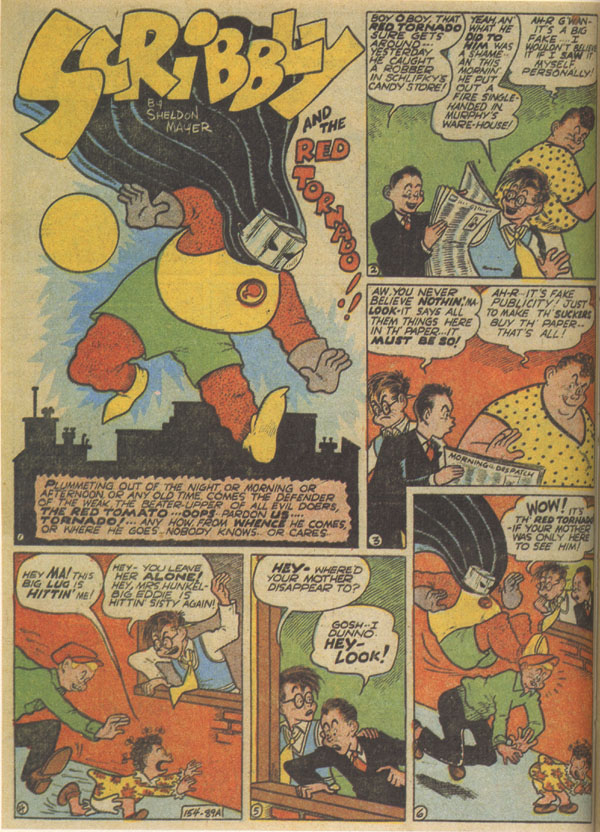
A Smithsonian Book of Comic-Book Comics helped me make connections between my undiscriminating childhood and my status-conscious adolescence.  It taught me Carl Barks’ name and helped show me that his talking duck characters weren’t just for little kids; it introduced me to the original version of Captain Marvel, before DC ensnared publisher Fawcett in a crippling lawsuit over his supposed similarities to Superman; it let me connect the name Basil Wolverton to the grotesque caricatures I had already seen occasionally in Mad; it introduced me to the ambitious and insightful work of Will Eisner in The Spirit and the breadth of E. C.’s output before the comics panic of the ‘50s and the Comics Code forced them to cancel everything but Mad; it made me unable to see Marvel’s parodic Forbush-Man without thinking of the similarly attired Red Tornado from Sheldon Mayer’s Scribbly.  It would even, much later on, form a foundation for me to understand what the heck was going on in the historically-informed comics of Tony Millionaire and Art Spiegelman.

ImageImage

Aside from giving me some ammunition if I’m ever cornered by Harlan Ellison, the Smithsonian book provided a great deal of entertainment and enriched my appreciation of the current books I was reading.  My adolescent comic book collecting in the 1980s coincided with a period of reassessment in the superhero world: Superman’s fiftieth anniversary would be celebrated in 1988, and (perhaps not coincidentally) fifty years of world-building and cross-referencing would be consolidated (or swept away, depending on your perspective) in 1985 by DC’s Crisis on Infinite Earths, clearing the decks for a “fresh start” for Superman and company in the first and biggest of many company-wide “reboots” to come.  The complexity of DC continuity included a number of parallel worlds, including separate universes for the Golden and Silver Age versions of characters, introduced to explain how Superman could fight saboteurs during World War II and still be a young man in the 1960s.  It was simple, really: there was an old Superman in one world and a young one in another, and sometimes they would break down the barriers between universes and team up.  Captain Marvel even came on board in the 1970s, at first in his own world (“Earth-S”) and later woven into the fabric of the DC universe as other characters had been before him (although he started going by the name Shazam to avoid confusion with that other comic book company).

The 1980s were also truly DC’s decade on screen, especially for Christopher Reeves’ iconic portrayal of Superman, but not overlooking Lynda Carter’s Wonder Woman on TV and the truly game-changing 1989 Batman directed by Tim Burton and starring Michael Keaton (many fans have cooled on Burton’s Batman in favor of Christopher Nolan’s grittier trilogy, but it’s hard to overstate what an event the 1989 film was at the time).  By comparison, Marvel’s best-received screen adaptation was The Incredible Hulk in the early ‘80s.

I don’t bring up Crisis or Burton’s Batman to make comparisons with DC’s New 52 or to point out Marvel’s current domination of the big screen.  The contrast speaks for itself, and more importantly the industry has changed greatly: one’s preference for a particular era of comics says as much about one’s age as it does about one’s taste.  I’m thankful I stopped collecting before the huge boom of the early ‘90s—otherwise I might be burdened by nostalgia for foil-stamped hologram covers, oversized guns, and costumes festooned with pouches!  Nor do I want to say things were better then just because I was younger: Crisis on Infinite Earths pissed off plenty of comics fans, myself included.  I liked the alphabet soup of parallel worlds and twisting timelines in the DC multiverse.  It irritated me to see whole settings and storylines erased from official existence.  On the other hand, if I were an editor or writer, chained to stories that had been written decades before, I might have felt differently.  Still, good writers had ways of getting around that, and a good story trumped pedantry any day.

And of course the characters who had been written out came back: Supergirl came back.  Titano the Super-Ape came back.  The Huntress came back.  Kamandi and OMAC and all the rest found ways back in, sometimes in different places and sometimes greatly changed, but eventually they came back.  And when Superman himself died, and it turned into a media frenzy, comics readers just nodded sagely to each other and knew it wouldn’t be permanent.  He’d be back.  Just ask Captain Marvel.

(Continue to Part Four)