Purple Prose, Purple Death

Cap.purpledeath

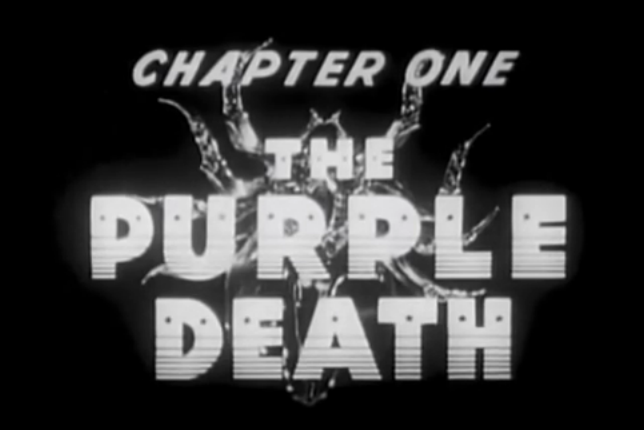
In watching the 1944 Captain America serial (for which I’ll have a full write-up next week), I was struck by the title of the first chapter, “The Purple Death,” a title shared by the first chapter of the 1940 serial Flash Gordon Conquers the Universe. In Captain America, the Purple Death refers to the extract of a rare orchid that makes its victims susceptible to hypnotic control (the “death” part comes when the victims are ordered to kill themselves, helpless to resist); in Flash Gordon, it’s a mysterious, fatal disease spread from Mongo to Earth that leaves its victims marked by a purple spot.

FG3.purpledeath

The pulps (as well as comic strips and serials) were known for lurid, vividly-drawn stories with larger-than-life heroes and impossibly wicked villains to match. Purple is an attention-getting color, to the point that we speak of “purple prose.” I was also reminded of the Purple Empire, one of the enemy nations that Operator #5 fought against in the 1930s. (I thought there might be some significance to that, but the Operator series included a rainbow of enemy nations, possibly influenced by the color-coded War Plans developed by the U. S. military during the 1920s and ’30s.)

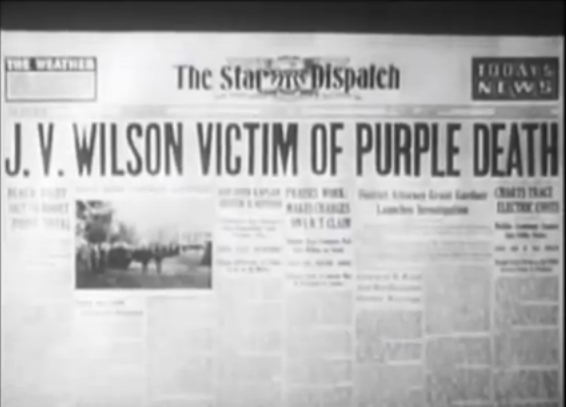
Cap.headline

In reading and watching stories from the 1930s and ’40s, I’ve encountered the phrase “purple death,” or uses of purple as a dangerous and dramatic color, enough times that I wondered if there was an underlying connection. So, in the spirit of Philip J. Reed’s Pop Questions, I’m asking: what’s the significance of the color purple in the pulps, and why particularly is death purple? Does it refer to the livid color of a bruise or the marks left by strangulation? Is it the association with royalty, by extension gaudy and powerful? I have a few leads that seem likely, but if anyone reading this has a specific answer, I’d love to hear it.

Cap.headline2

Purple is associated with death and mourning in many cultures, including the Victorians of the nineteenth century, for whom purple was the color of “demi-mourning,” to be worn after a period of wearing black. It was also the color of royalty, originally due to the rarity and high cost of purple dyes in the ancient world. It would certainly match both the dramatic style and frequent (if shallow) references to history and classic literature in the pulps if that were the reason. I don’t have statistics at hand, but my hunch is that as comic books became the dominant medium for pulp storytelling, more villains than heroes had purple uniforms or color schemes.

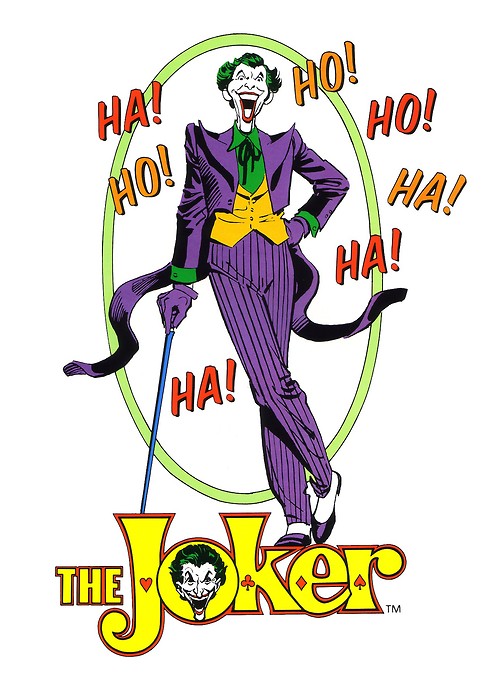
joker

However, the most likely answer goes back to the 1918 influenza epidemic: the disease killed quickly, and often left its victims purple in color as their lungs filled with blood and starved the body of oxygen. One book on the subject is even titled Purple Death. According to some estimates, as many as 50 million people worldwide died during from the disease. Just as pulp heroes were often veterans of the Great War, so the memory of the epidemic would have resonated with writers and readers in the decades that followed. In Flash Gordon, the Purple Death was also a disease, and the scenes of public panic and the scramble to find a cure hearken directly to the 1918 epidemic; by comparison, the use of the phrase in Captain America is almost poetic, but would likely have still induce a twinge of fear for those who remembered it. Even today, with no direct memory of the influenza epidemic, it sounds ominous.

iowa_flu2

So perhaps that’s the answer. If any readers have more details to offer, or facts to contradict my speculations, I’d love to hear them. Any other examples of purple as a color marking death or danger are, of course, welcome.

My 2014 in Books

As I’ve mentioned before, I’m not usually one to keep a list of everything I read or watch, but in 2014 I kept a list of books I had read, in part because I was conscious that I wasn’t reading as much as I used to. Although the number this year is relatively small, I’d say the mixture of non-fiction and genre fiction is fairly typical of my reading in the last few years. The list includes some graphic novels and collections of comics, but not single comic book issues (which I’ve also fallen way behind on). It’s also influenced by subjects I was writing about; however, it only includes books I read from cover to cover, not those I dipped into for reference. Finally, all but one was a first-time read, although I had read parts of some of them in the past.

wpid-20140720_141419.jpg

January
Batman: Odyssey, Neal Adams
King City, Brandon Graham

February
The Look of the Old West, William Foster-Harris

March
Inventing Kindergarten, Norman Brosterman
Great American Folklore, Kemp P. Battle

April
The Old Patagonian Express, Paul Theroux
The Great Movie Serials: Their Sound and Fury, Jim Harmon and Donald F. Glut

May
Cliffhanger: A Pictorial History of the Motion Picture Serial, Alan G. Barbour
Misery, Stephen King

June
The Lost Worlds of Power Vol. 0, ed. Philip J. Reed

July
Showcase Presents The Great Disaster Featuring the Atomic Knights, various

August
The American Book of the Dead, Stephen Billias (reread)

September
The Bloodhounds of Broadway, Damon Runyon
The Extraordinary Adventures of Adèle Blanc-Sec, Jacques Tardi

October
Showcase Presents Captain Carrot and His Amazing Zoo Crew, various
All The Wrong Questions: “Who Could That Be at This Hour?”, Lemony Snicket
The Maltese Falcon, Dashiell Hammett

December
The Lost Worlds of Power, ed. Philip J. Reed
All the Wrong Questions: “When Did You See Her Last?”, Lemony Snicket
Crab Monsters, Teenage Cavemen, and Candy Stripe Nurses: Roger Corman: King of the B Movie, Chris Nashawaty

Much of my thinking on what I read this year has already been included in the articles to which they are linked, and since most of what I read was published before 2014 and is in a diverse range of genres, ranking them seems pointless. I am struck, however, by how long ago some of the books I read in the spring seem to me; I might not have remembered that I read them this year at all without this list, instead consigning them to a hazy, indistinct “past,” even though I enjoyed many of them. To tell the truth, even September seems a long time ago from this vantage point. Such is the telescoping effect of the end-of-year holidays, I guess.

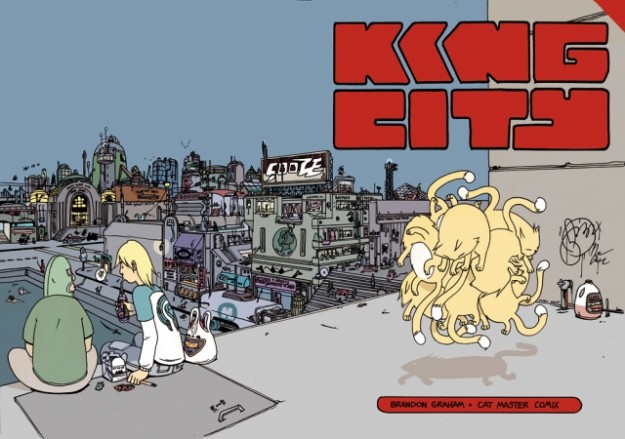
It strikes me, however, that I began and ended my year with two very different books that explored the rush of unbridled creativity in different formats. (Sorry, Batman: Odyssey, I don’t mean you, although you were memorable in many ways.) Brandon Graham’s King City is a graphic novel set in the futuristic metropolis of the title; its central character is a young man returning to his old stomping grounds after training with a mysterious group that uses multi-talented cats as weapons (yes, it is quite strange, but that description doesn’t even scratch the surface). In Graham’s notes (which I am paraphrasing, as I borrowed the book from the library and don’t have it in front of me), he said that King City‘s plot was guided by his desire to only draw things that were exciting to him: to not bore himself. Such an impulse could have led to disaster, but tied to a strong sense of craft, it makes for an immersive, invigorating read, with its weaponized cats, ultra-violent gangs, sexy girls, and graffiti-filled urban vistas that are part Moebius and part Mad magazine.

kingcity

At the other end (and just finished today, in fact) was Chris Nashawaty’s pictorial/oral history of influential director/producer Roger Corman’s career, from his days cranking out cheapies for the drive-in market to his nurturing of young (and affordable) talent, to his eventual recognition as a Hollywood elder statesman. The book includes reminiscences from such graduates of “Corman University” as Martin Scorsese, Joe Dante, and James Cameron, to name only a few. I was somewhat familiar with Corman’s career and working methods, and of course many of his films; Corman, and “mavericks” like him, continue to inspire because of their perseverance and determination to create in the face of low budgets, limited time, and (in many cases) lack of prestige. Corman and his crew made a virtue of such limitations, but the many anecdotes about making films show the value of committing to do one’s best work, whether on a pointed political statement like The Intruder or on the many monster, biker, and women-in-prison movies that Corman made on an assembly-line basis.

Tomorrow, I look back on the movies I watched this year.

In the Hall of Mirrors with Captain Carrot and His Amazing Zoo Crew

Somewhere between “funny-animal” comics and cartoons for children and the evolved animals of Planet of the Apes and other adult science fiction lies the semi-serious talking animal trend in comic books of the 1970s and ‘80s. Howard the Duck is a familiar example of a walking, talking humanoid animal interacting with mainstream costumed superheroes, but he was neither the first nor the last character of his type. I’ve always been intrigued by anthropomorphic animal characters: years ago I wrote a lengthy analysis of Howard and his creator, Steve Gerber, and if I can find it I might post it here.

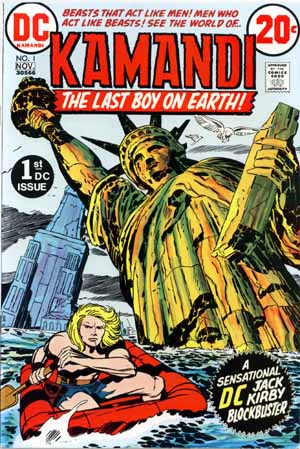
I was similarly drawn to Jack Kirby’s post-apocalyptic series Kamandi for its mixture of science fiction and talking animals. Last summer I wrote about DC’s Showcase Presents the Great Disaster, a “phone book” collection of material peripherally related to Kamandi and including a healthy selection of not-so-funny-animal stories; now DC has released another Showcase collecting the core run of another hybrid series, the superhero/funny-animal adventures of Captain Carrot and His Amazing Zoo Crew. Like Great Disaster, this volume was announced several years ago but was held up (reportedly by disputes over royalties) until now. In any case, it comes out at an opportune moment, as Captain Carrot has returned to comics as a main character in Grant Morrison’s The Multiversity, and the renewed popularity of the Teenage Mutant Ninja Turtles shows that there is still an audience for wise-cracking, butt-kicking humanoid animals.

CaptainCarrot

Most of the Captain Carrot stories were new to me, although the character has made brief appearances in DC books since his introduction in New Teen Titans no. 16 (included in this volume) in 1982. Created by prolific writer Roy Thomas and cartoonist/animator Scott Shaw! (yes, the exclamation point is part of his professional name), Captain Carrot and His Amazing Zoo Crew was tagged from the beginning as “Not just another funny-animal comic!” The tone is light and full of verbal humor and animal puns (Roger starts out in “Gnu York” and the team later moves to “Follywood, Califurnia”), but the adventures and conflicts between characters are firmly within the tradition of superhero comics.

Captain Carrot is the leader of the group: super-strong, tough, and blessed with super-hearing, as well as the ability to leap great distances (as with Superman, who could similarly “leap tall buildings in a single bound” in his early appearances, Captain Carrot would later be depicted as flying outright). Unlike his team, whose powers are constant, Captain Carrot gains his power from eating “cosmic carrots,” irradiated by the meteor that accompanied Superman when he visited from his own dimension. When the carrots’ effect has worn off, he reverts to his scrawny alter ego, cartoonist Roger (later Rodney) Rabbit, a secret identity with some resemblance to Clark Kent and Golden Age hero Hourman.

Rounding out the Zoo Crew are Rubberduck, who can stretch his form like Plastic Man; Yankee Poodle, a patriotic-themed heroine who can repel and attract matter via the stars and stripes she projects from her hands; Fastback, a turtle with super-speed; Pig-Iron, the tough guy; and Alley-Kat-Abra, a martial artist with mastery of magic, focused through her “Magic Wanda.” Each of these characters is an established type, and Thomas and Shaw! have made clear in commentary that they were conscious of the balance of personalities and powers that made up a good super-team, but none are outright copies of extant characters.*

Zoo_Crew

Most critically, Captain Carrot and his cohort are clearly established as living in one of the DC multiverse’s many parallel earths, a planet much like ours but inhabited by Saturday-morning-cartoon-style talking animals. The team’s origin is explicitly tied to Superman, who crosses from his own dimension to the funny-animal world, where he is viewed as a terrifying pink monster (with five fingers!): in Captain Carrot’s world, “men” are creatures of myth and legend. Changeling (aka Beast Boy) of the Titans and animal-themed villains Starro the Conqueror and Gorilla Grodd would also make appearances in the book, and many of the team’s subsequent appearances have been crossovers of one kind or another. Despite its obvious kid appeal, this isn’t segregated from DC continuity, as one might expect for a children’s title.

As noted, Captain Carrot and the other members of the Zoo Crew aren’t direct parodies of established superheroes. Although there are many winking references to human history and pop culture (particularly celebrities: Rubberduck’s civilian identity is movie star “Byrd Rentals,” and Yankee Poodle is gossip columnist “Rova Barkitt”—will readers younger than 40 even recognize the reference to Rona Barrett?), the Zoo Crew are unique individuals rather than being modeled after any specific character. This distinguishes Captain Carrot from Peter Porker, the Spectacular Spider-Ham, a similar parody of Marvel’s characters introduced in 1983 (a year after Captain Carrot’s first appearance).

In addition, master of minutia Roy Thomas built in many links to DC’s own funny-animal past: Pig-Iron was a transformed Peter Porkchops, a character who had appeared in DC’s Funny Stuff in the 1940s; Fastback was the nephew of another Golden Age funny-animal, McSnurtle the Turtle (who also moonlighted as a superhero, the “Terrific Whatzit”). Other characters from Funny Stuff were introduced as side characters, and in one story arc the team was split up and sent back in time to different eras, encountering characters such as Nero Fox (a jive-talking, jazz saxophone-playing funny-animal Roman emperor—in other words, a character who could only have been created during comics’ unselfconscious Golden Age) and the Three Mousketeers.

captain_carrot_009_full

Thomas’ obvious delight in making such connections and in capturing the essence of superheroic types brought to mind another creation of his: the Squadron Supreme, the analogue of DC’s Justice League of America that Thomas introduced in the pages of Avengers, and which has become a JLA stand-in in the Marvel multiverse. Intriguingly, while the Squadron very directly represents the JLA in the pages of Marvel Comics, the Zoo Crew actually strike me as a subtle reworking of Marvel’s character dynamic smuggled into a DC book. (Such are the differences between the two publishers that even parodying them requires a different approach: the Squadron Supreme is the JLA with a coat of paint, while the Zoo Crew mimics the contemporary soap opera feel of a Marvel book rather than specific characters.)

From the team’s first appearance, their stories are marked by squabbling and infighting, with the kind of character-based conflict that was a central ingredient in Fantastic Four, Avengers, and Uncanny X-Men. Captain Carrot is continually struggling to keep his allies focused on the mission, and nearly every issue includes one or more characters challenging his authority or the entire purpose of the group. Pig-Iron (most clearly modeled on FF’s Thing, pugnacious and blue-collar) wants to be left alone; Rubberduck and Yankee Poodle are accustomed to star treatment; Alley-Kat-Abra fights with Yankee Poodle over leadership roles and pines for the Captain’s affections. A great deal of the time, it’s not clear that the members of the team even like each other that much.

Consider another hero who is added later, the only member of the Zoo Crew to gain his powers through a source other than the meteor that entered their universe with Superman. Chester Cheese, a mouse, was a star basketball player whose father was a scientist working on the space program. Chester was approached by two goons working for a crime boss named Fatkat, who wanted him to throw a big game on which Fatkat had a lot of money riding. When Chester refused, his father was killed and Chester was locked in his laboratory. After eating a sample of lunar green cheese, he gained the power to shrink to small sizes, retaining his strength; calling himself “Little Cheese,” he enlists the Zoo Crew in an attempt to bring Fatkat to justice.

LittleCheese

On the surface, Little Cheese resembles other shrinking heroes like the Atom or Ant-Man, but his origin is a remix of Spider-Man’s, combining the drama of teenage life, super-science, and a parental figure whose tragic death leads him to use his powers for a higher purpose. (Not to mention that his nemesis, Fatkat, strongly resembles Marvel villain the Kingpin.) In short, Little Cheese’s story illustrates the Marvel habit of building stories around “little tragedies,” to borrow Chris Sims’ phrase. Tragic origins aren’t foreign to the DC universe, of course, but in combination with the personality conflicts and limitations placed on the Zoo Crew’s powers, it’s very much in line with Marvel’s modus operandi. In that light, Captain Carrot’s adventures are an overlooked example of what Sims calls “The Problem,” a decades-long desire on DC’s part to make itself more like Marvel.

It gets even more complicated when another funny-animal super-team is introduced, and this one is a direct parody: the Justa’ Lotta Animals, which starts out as the comic book that R. Rabbit illustrates as his day job, but which (naturally) turns out to be a real group from yet another parallel earth. The two-part crossover, “Crisis on Earth-C!” and “Crisis on Earth-C-Minus!”, parodies the annual Justice League/Justice Society crossovers in bringing the champions of two worlds together. This JLA consists of Super-Squirrel, Bat-Mouse, Wonder Wabbit, Green Lambkin, the Crash (a super-speedy turtle, showing there are only so many spins one can put on this kind of character, I guess), and Aquaduck (whom I almost forgot); when first encountered, only Captain Carrot is familiar with them, since he draws them for a living.

CptCt_14_GS

It’s a time-honored convention of comic books that when two or more superheroes meet for the first time, they fight each other (through confusion or a villain’s manipulation). The JLA/Zoo Crew match-up is no different, but even after getting the facts straight, inter-group rivalries persist. Captain Carrot has trouble adjusting to the idea that the fictional characters he draws are not only real, but have personalities and motives of their own, and both the Zoo Crew and JLA exhibit a territorial streak when it comes to another super-team in “their” world. A love triangle forms, as Super-Squirrel is immediately jealous and resentful of Wonder Wabbit’s interest in a fellow bunny (it’s really a love quadrangle, as Alley-Kat-Abra is also possessive of her Captain).

The “real” Superman and Wonder Woman weren’t romantically linked until recently, but this storyline uncovers subtext that was always present, if only in the minds of fans: just as Mark Gruenwald could have Hyperion and Power Princess consummate their love in the pages of Squadron Supreme, Super-Squirrel could give voice to feelings of jealousy and inadequacy that Superman would leave unspoken, if he felt them at all. (The Captain Carrot/Wonder Wabbit pairing can be read as a parody of all such “doomed romance” storylines, as they belong in two different worlds, but it isn’t treated as a joke: the story ends with Rodney drawing Wonder Wabbit for his comic book, ruefully acknowledging that he can’t even escape into his work to forget his loss.) As a fan of both funny-animals and pastiche characters, the whole thing is a fascinating chance to observe a diverse group of characters—some of whom stand in for entire mythologies**—bounce off each other. Captain Carrot isn’t just parody: it’s meta.

Jlanimals

* Behind-the-scenes commentary and information about the Zoo Crew’s creation is drawn from Alter Ego no. 72 (September 2007).

** Speaking of mythologies, I haven’t even gotten to the six-chapter Oz-Wonderland War, published as a three-issue miniseries in 1986, and a fitting culmination to the contents of the book, with more character development than most of the previous issues. The storyline draws the Zoo Crew into an interdimensional conflict based on the characters and settings of L. Frank Baum and Lewis Carroll (and includes a brief reunion with Wonder Wabbit), and includes some great artwork by Carol Lay, balancing the cartoon style of Shaw! with the illustrative styles of Denslow and Tenniel. It deserves a longer write-up, but as a blend of humor and reference (scripted by longtime DC writer and editor E. Nelson Bridwell, who had a reputation as a “continuity cop” himself) it’s a very pleasurable (if frequently downright weird) read.

Strange Games: Comic Books Confront the Apocalypse

Recently, DC Comics published a trade paperback collection under the unwieldy title Showcase Presents: The Great Disaster Featuring the Atomic Knights. I don’t intend this essay to be a review, but I will say up front that if mid-century visions of nuclear war are your bag, there’s no reason not to pick this up.  If you’ve read any volumes of Showcase (or Marvel’s similar Essential series) before, you know what to expect: more than 500 pages of black-and-white reprints (of stories from the 1960s through the 1980s in this case) on cheap paper at a low price.  They don’t call ‘em “phone books” for nothing.

GreatDisaster.cover

I was eager to get this volume (it had been previously announced several years ago and then delayed) for a few reasons.  First, I was a big fan of post-apocalyptic fiction when I was younger, and comic books were no different from other media in exploring that theme.  Second, although I had read some of the stories included, many were unfamiliar to me, and this would be a good way to fill in some gaps.  Finally, the focus on a central event (and one which had been interpreted many different ways by writers over the course of decades) makes this volume a little different from the typical Showcase that either follows a single character or collects completely unconnected stories (like the anthology title House of Mystery).  Some effort was made to arrange contradictory material into a single chronology, and that kind of editorial undertaking is always of interest to me.

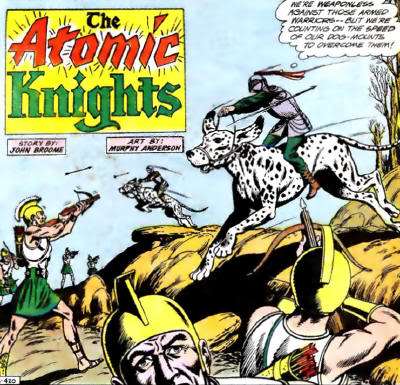
Does it succeed?  Eh, sort of.  On one hand, the title tells you a lot about what’s in the volume: several cycles of stories centered on the destruction of civilization as we know it.  The Atomic Knights, in a series of stories by writer John Broome and artist Murphy Anderson that began in 1960, travel the wastes of post-World War III America, surviving with the help of their suits of medieval armor (discovered in a museum and possessed of miraculous radiation-shielding properties).  The only other continuous series represented in this volume is Hercules Unbound, but there are a number of stand-alone stories (many under the umbrella title “The Day After Doomsday”) as well.

On the other hand, the Great Disaster doesn’t have the instant name recognition of a superhero, nor was it the title of an ongoing book (the Atomic Knights, for example, were found in the pages of Strange Adventures; I wouldn’t be surprised if they were added to the title of this book so that at least some character would be named on the front cover).  In fact, the Great Disaster isn’t even synonymous with World War III in DC continuity, but you have to dig pretty deeply into the book to figure that out.  The Great Disaster is (or was, pre-Crisis) a conveniently vague apocalypse in the background of Jack Kirby’s Kamandi, involving weapons of mass destruction as well as natural disasters, taking place at some point after WWIII.

(Not included in this volume)

(Not included in this volume)

The most distinctive legacy of the Great Disaster in the world “A.D.: After Disaster” was the release of a mind-altering chemical (“cortexin”) that caused ordinary animals to become intelligent, as well as gaining upright posture and opposable thumbs.  In the wake of the Great Disaster, most humans had become mute and animalistic.  Essentially, Kamandi’s world is one of reversed roles like Planet of the Apes, but with anthropomorphic dogs, tigers, and rats in addition to gorillas and other species (not to mention numerous mutant monsters and space aliens that defy categorization), all mixed up together in the ruins of a futuristic civilization.  The last point varied pretty widely: sometimes it seemed like the Great Disaster hit America in the 1970s, but it never stopped Kirby and his successors from throwing in robots, spaceships, and other high-tech devices left behind by the “ancients” if a story called for it.  (Eventually, Kamandi’s world was linked to “The World That’s Coming,” the setting of OMAC, a short-lived—and even weirder, but definitely futuristic—science fiction series Kirby had also created.)

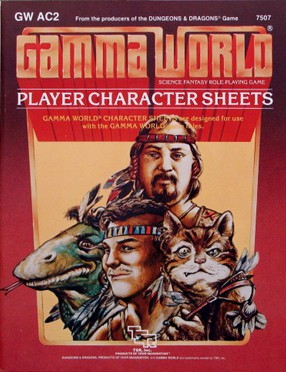
Aside from Planet of the Apes, the world of Kamandi bears a close resemblance to the campaign setting of Gamma World, a role-playing game from TSR, the makers of Dungeons & Dragons.  In transposing the adventuring-party model to a post-apocalyptic science fantasy setting, the game designers gave players the option of playing as a “pure strain” human, (humanoid) mutant, or mutated animal.  From one angle, the title character of Kamandi (“the last boy on Earth”) and his companions, the superhuman Ben Boxer and dog-man Dr. Canus, could be player characters in a Gamma World game, and their travels from one wonder to another, piecing together the fragmented history of their world and facing down monsters and villains, are not unlike an ongoing RPG campaign.

GammaWorld

Alas, Kamandi does not appear in Showcase Presents: The Great Disaster. The material reprinted from Kamandi #43-46 is a backup story focused on Urgall, a gorilla whose liberal ideas (extending respect not only to non-gorillas but to humans, and even female gorillas!) put him at odds with his tribe. (Another “tale of the Great Disaster” that appeared in Weird War Tales #51-52, featuring warring English and Scottish dog-men, is not included, which is too bad, as it is superior to the story of Urgall.)  I’ve gone into detail about Kamandi because I’m a fan, and having collected (I believe) all the pre-Crisis appearances of Kamandi and OMAC, it’s hard for me to not bring that context to the present book.  As of this writing, the only collected reprints of Kamandi are more lavish and expensive than the Showcase series, but the title is worth seeking out and is really more essential than anything in this book (but if you’re reading this, you already knew that, right?).

When I first read the Atomic Knights stories (about fifteen years ago), they struck me as more than a little silly: in addition to the conceit of medieval armor protecting against radiation, the stories were burdened with outdated gender roles (the “littlest knight,” Marene Herald, mostly stays out of the way, awaiting the day that team leader Gardner Grayle will propose to her) and too many convenient “scientific” solutions to problems.  Although the war is said to have occurred in October, 1986, the Atomic Knights’ roots in the early 1960s remain obvious.

Reading them again, however, I’m more sympathetic to the earnest tone: the Knights are at the vanguard of rebuilding democracy, and the stories often end on a didactic note, preaching the need for cooperation, compassion, and emphasizing reason and the rule of law.  Many of the menaces they face will be familiar to readers of post-apocalyptic fiction: problems of supplying food and energy when nothing will grow; human populations regressed to caveman-like savagery; would-be dictators such as the fascist “organizer” Kadey and the self-proclaimed King of New Orleans; and non-human threats either produced by radiation (a Triffid-like strain of mobile, intelligent plants) or opportunistically filling the void left by the collapse of humanity (a race of underground mole people who plan to permanently darken the sky so that they can take over the surface world; scavenging space aliens searching for precious metals).  That the Atomic Knights continue striving and are able to keep their humanity as they do so is, in its own way, optimistic.

strange_adventures#144

In fact, the suits of armor the Atomic Knights wear aren’t an anomalous detail: sometimes the comparison to knights of old is made explicit.  In the first story in Showcase Presents: The Great Disaster, “The Year 700 After the Bomb,” the post-war society resembles feudal Europe, right down to the Robin Hood-style costumes, royal titles, and pseudo-Old English dialect.  One could attribute these details to lazy writing, but it also reflects a view of history with definite evolutionary stages: just as civilization climbs upward over generations, it can also slide downward, and in such stories the image of a new “Dark Ages” is made literal.  (This can probably be laid at the doorstep of H. G. Wells, whose view was long enough to envision a day when humanity, too, is extinct, and whose film Things to Come, directed by William Cameron Menzies, portrayed a post-war English village ruled by a petty medieval warlord.)

It was when the Atomic Knights encountered warriors from the legendary island of Atlantis, time-warped into the future by their own scientific catastrophe, that I was able to put my finger on the story-telling mode. Replace “radiation” with “magic,” and a story in which armored knights battle Romanesque soldiers from an ancient island could be part of any fantasy novel from the last hundred years.  Specifically, the discovery of “Atlantides” (as the islanders are called in this story) fits neatly into the “lost world” genre: as practiced by H. Rider Haggard, A. Merritt, and Edgar Rice Burroughs, among others, there was always the possibility of a remote valley, cave, or island that history and evolution had passed by, leaving a population of dinosaurs, ancient Romans, or other living relics to be discovered.  The lost world genre was mostly finished off by World War II, as the empty, unknown spaces on the map were filled in; wiping the slate clean with a global catastrophe allowed writers to open those spaces up again, and fill them with mystery and adventure.  In these stories, the lost world was our own.

Perhaps that is one reason they continue to be popular: although seemingly pessimistic, this strain of post-apocalyptic fantasy, showing places and objects of the present through the eyes of later generations, provides for a kind of reenchantment of the everyday.  We gain perspective when we imagine a bustling city full of skyscrapers as empty and crumbling; more importantly, we can appreciate how marvelous our technology is when we picture later generations trying to make sense of it.  In the Gamma World game, there was a mechanism for player characters to puzzle out the use and meaning of “artifacts,” meant to prevent players from using out-of-game knowledge to identify, say, a rifle as a weapon rather than an emblem of office.  Similar misinterpretations are a staple of the genre: picture the subterranean mutants of Beneath the Planet of the Apes worshipping a nuclear missile as a god, or a young shaman trying to divine omens with a vinyl record in Mad Max Beyond Thunderdome. Likely inspired by real-life cargo cults, the projection of superstitious beliefs onto modern goods allows writers to remix old and new cultural symbols, comment on our relationship to technology, and—that standby of science fiction—map contemporary political concerns onto fantastical stories.

AtomicKnights

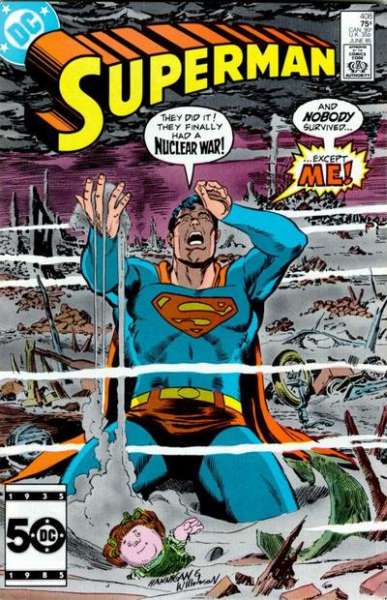
It should go without saying that the stories of Kamandi and the Atomic Knights don’t have anything to do with the likely horrors of a real nuclear war (or whatever the Great Disaster was supposed to be), and the longer their stories continued, the more fantastical and obviously escapist they became.  In the final story included in Showcase Presents: The Great Disaster, no less a DC eminence than Superman himself encounters the Atomic Knights, only to discover that their entire history is the dream of Gardner Grayle, placed in a sensory deprivation tank as part of a military experiment.  Grayle’s unconscious mind has taken over the computers running the simulation and threatens to launch an actual nuclear strike in order to make real the fantasies in which Grayle has played the hero for years.

The premise, and the lesson that Grayle imparts after awakening at the last minute (“The task before mankind isn’t to survive an atomic war! It’s to work in this world we’re living in to make certain such a war can never begin!”), owe much to WarGames and the similar lesson the supercomputer WOPR (“Joshua”) learns in that film (“A strange game: the only winning move is not to play”). “It was all a dream!” is obviously the king of lame cop-outs and, in cases like this, the last refuge of a writer whose story has gotten away from him.  I think it actually works, though: in 1983 the “survivable” nuclear war was an increasingly untenable premise, and the quaint early stories of the Atomic Knights had become hopelessly snarled with the continuity of Hercules and the world of the Great Disaster in the pages of Hercules Unbound.  (I haven’t commented on that series, but suffice to say that even the titular demigod couldn’t bear the burden of reconciling the combined histories of the Atomic Knights, Kamandi, and OMAC and telling his own story in an intelligible manner.)

I think it’s a little much to criticize escapism, however, when the target audience has so little power to change the situation from which they are escaping.  It’s one thing to indict military planners running simulations with potential real world consequences, another to criticize something as obviously fanciful as the Atomic Knights or Gamma World.  Speaking as a cold war baby who was ten years old in 1983 and absolutely terrified of nuclear war, the only other alternative was denial: I could hardly watch the news without having a panic attack, and I had no desire to subject myself to The Day After when it aired (I’m glad I didn’t know anything about the even grimmer Testament and Threads at the time).

Nuclear war was also frequently on Superman’s mind in the 1980s: most fans today remember Superman IV and the Man of Steel’s quest to rid Earth of nuclear weapons, but in the comics Superman often stood aside as an observer, willing to admonish mankind but not make the hard decisions for us.  Visions of humanity’s capacity for self-destruction haunt him: a Superman who does nothing to prevent a holocaust is not super in any way, but were he to take the choice out of our hands he would become a god rather than a man.  This version of Superman as advocate and guardian challenges the view of comic book readers as naïve simpletons waiting to be rescued.

(Also not included in this book)

(Also not included in this volume)

As I said initially, I eventually became an avid consumer of comics, games, books and movies that explored life after the bomb.  If you can’t beat ‘em, join ‘em, right? I don’t recall thinking it was realistic to expect survival in the event of a war, much less high adventure, but it was a comforting daydream. Certainly there was plenty to choose from, and I know there were a lot of guys in my generation who shared the same fantasy.  (One of the most believable details of last year’s The World’s End was that arrested adolescent Gary King would end up as a wandering gunslinger in the wasteland, loving every minute of it: for me it was a striking moment of recognition.)  Just about everything you need to know about this phase of 1980s masculinity can be found in the video for Tom Petty’s song “You Got Lucky.” It’s all there: guns, guitars, cowboy-chic dusters, and a sweet arcade in the middle of the desert.  (Petty obviously liked the milieu enough to make an appearance as himself in the 1997 film adaptation of David Brin’s post-apocalyptic novel The Postman.)

TomPetty

The focus in popular culture changed after the passing of the Cold War; although the apocalypse has never been far from our entertainment, the end of the world can come from almost any direction nowadays: terrorism, climate change, pandemic, just to name the more realistic possibilities.  Free-floating dread has replaced the pointed terror of “Mutually Assured Destruction;” chaos is more feared than ideology, and it’s reflected in the zombie hordes and rampaging kaiju of current film.  Still, the stories I grew up with haven’t been forgotten: perhaps it’s driven by ‘80s nostalgia, but remakes or reboots of Planet of the Apes, Mad Max, and even WarGames have either been made or are in production.  Gamma World has been through seven editions, the last in 2010, although I haven’t played in years.  The intoxicating cocktail of sword-and-sorcery among the ruins of modern civilization is still with us in such programs as Adventure Time.  Earth A. D. is still a place that many of us like to visit, even if we wouldn’t want to live there.

AdventureTime

Fates Worse Than Death: Batman (1943)

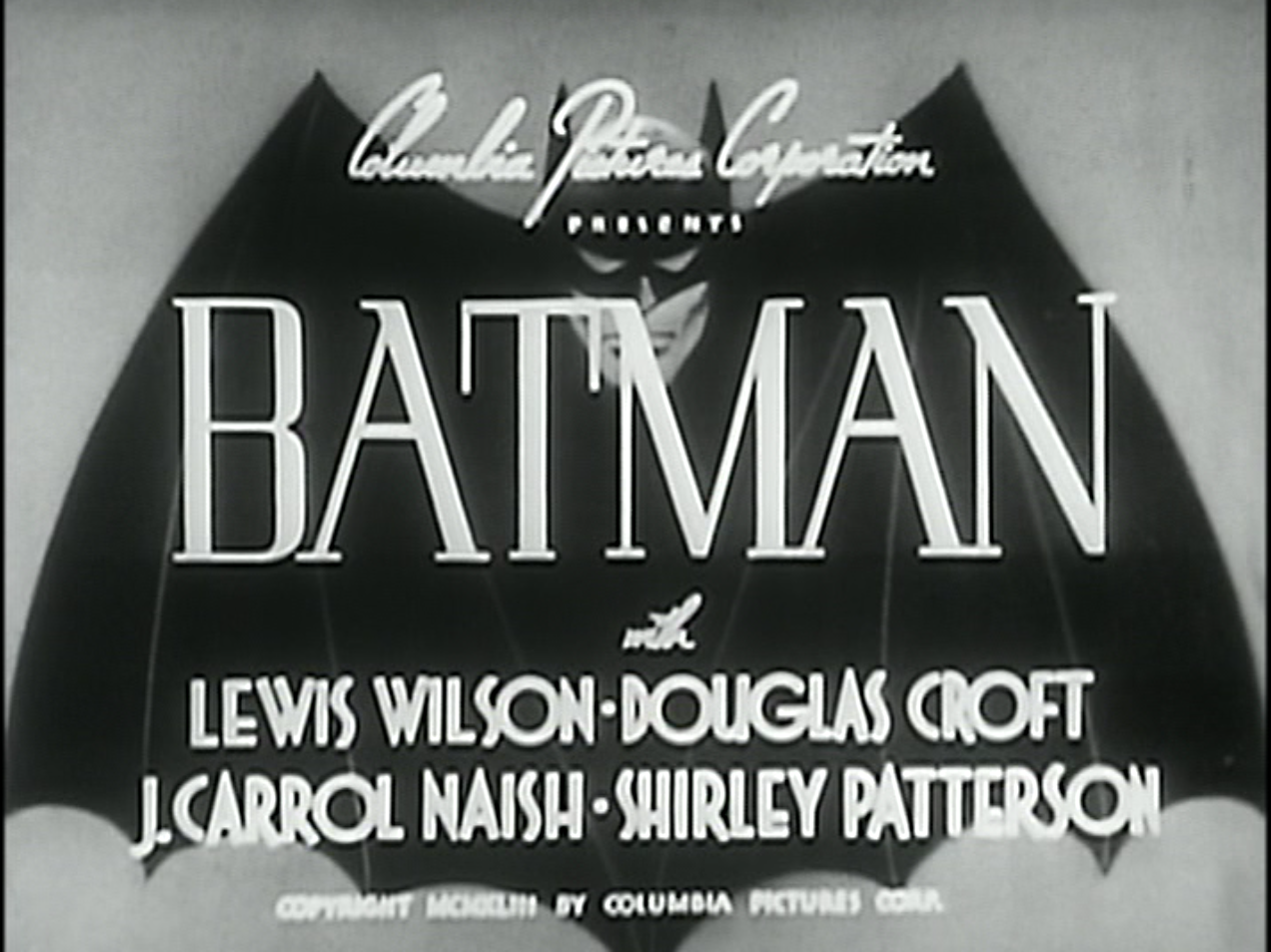
BatmanTitle

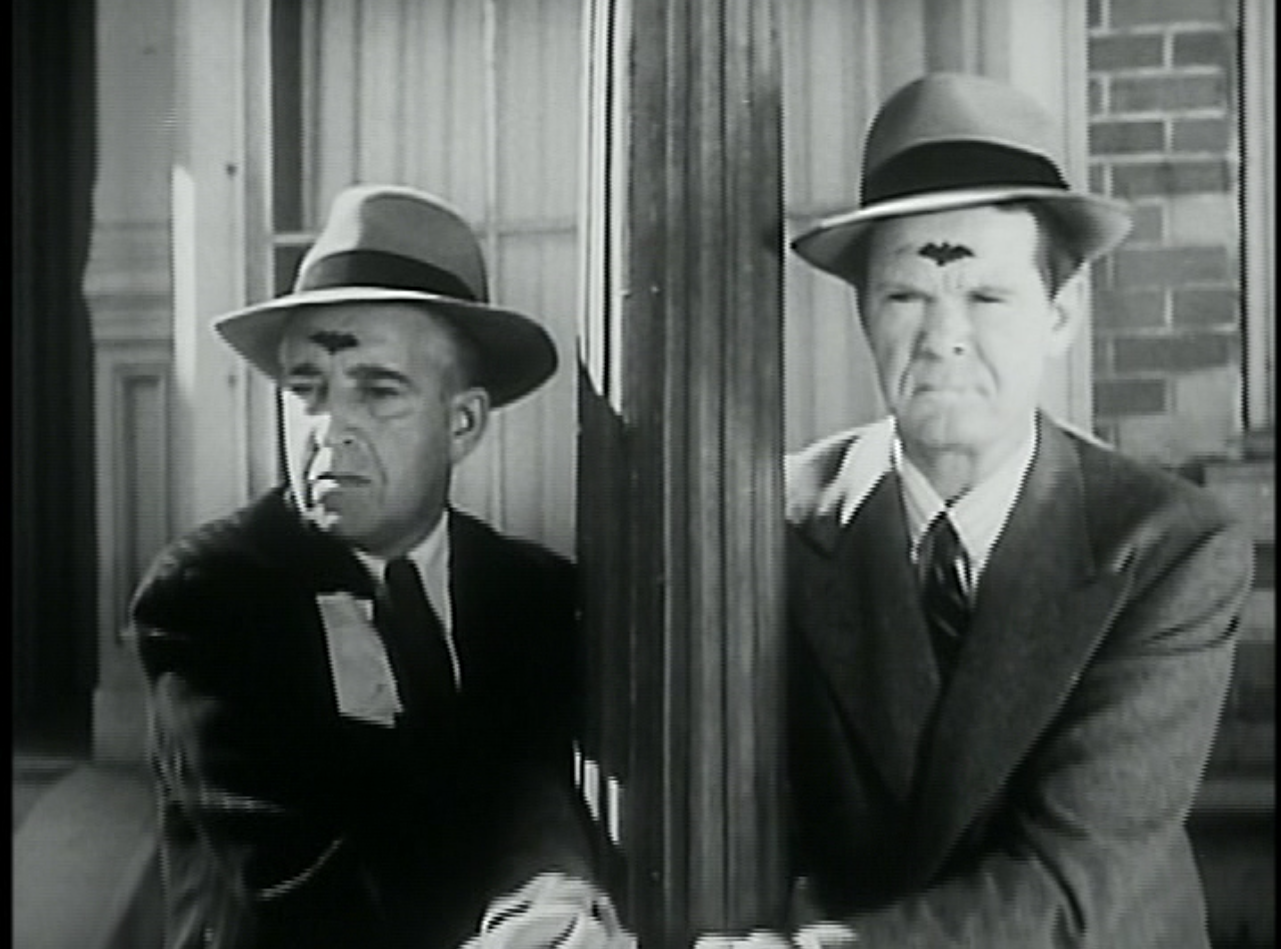
Industrialist Martin Warren, after serving his sentence for an unnamed crime, is about to be released from prison; his niece, Linda Page, asks (her boyfriend? fiancée?) playboy Bruce Wayne to accompany her to pick him up.  Although Wayne’s life of leisure doesn’t allow him to get out very early in the morning, he promises to accompany her.  But before they arrive, Warren is picked up by some other old acquaintances, who coerce him to meet their boss, Dr. Daka.  Daka is a Japanese spy striking at the United States from within, and if Warren doesn’t join Daka’s ring of “dishonored” engineers, bankers, and other professionals and agree to serve his “League of the New Order,” he’ll be turned into a mindless zombie by one of Daka’s inventions.  In the mean time, the costumed crimefighter known only as the Batman, with his sidekick Robin, leave a pair of crooks (complete with the “mark of the Bat” on their foreheads) for the police to pick up.  Who are Batman and Robin, and what do they have to do with Bruce Wayne and his young ward, Dick Grayson?

BatMark

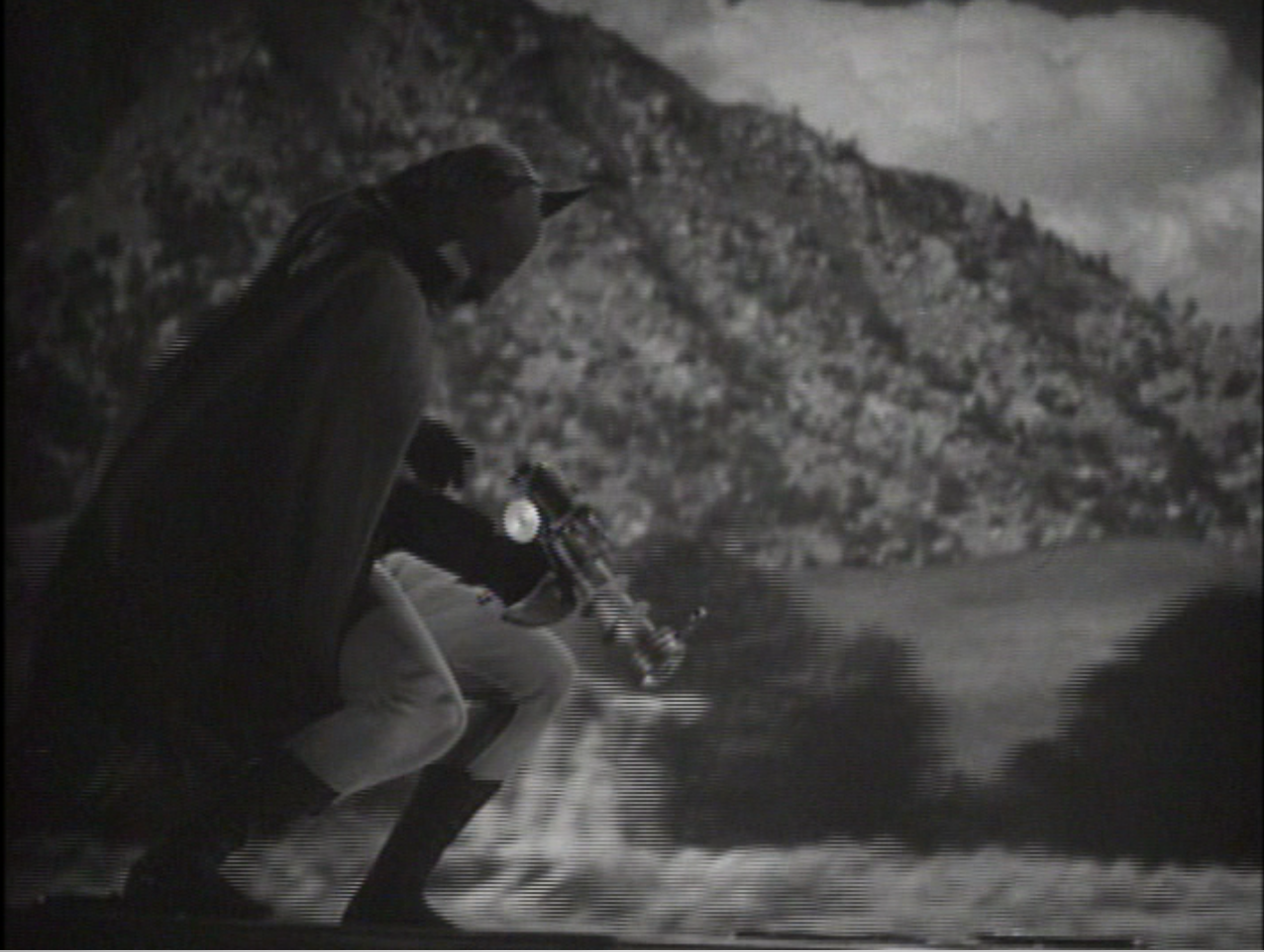
There can be hardly anyone reading this who isn’t aware that Bruce Wayne and the Batman are one and the same, of course, and the 1943 Batman serial wastes no time in letting the audience in on that information.  In making the leap from the comics to the screen, only the core trio of Bruce/Batman, Dick/Robin, and Alfred the butler were retained (Batman’s police contact is Captain Arnold, not Commissioner Gordon), but their characters and identities are recognizable to readers of the comic book (for the most part: Alfred is relegated to comic relief, skittish and easily flustered, but he still comes through when his services are needed).  None of Batman’s usual enemies like the Joker or Penguin are present (many of the most familiar villains weren’t created until later anyway); Batman was made during wartime, and the enemy he faces in Dr. Daka is a nationalistic one.

Batman_Robin

Even allowing for its wartime origin, it saddens me to report that Batman is incredibly racist.  As a cringe-inducing caricature of the effete, treacherous Oriental, Daka is grossly offensive, but if the serial stopped there Daka would fit in with the pseudo-exotic threats I’ve mentioned before (and he is, after all, supposed to be a villain).  But that isn’t enough: Daka’s lair is located on a street in “Little Tokyo,” which according to the enthusiastic narrator has been nearly empty “since a wise government rounded up the shifty-eyed Japs.”  That’s in the first chapter and it doesn’t get any better: even Daka’s own henchmen despise him and throw around racial slurs behind his back.  “I’m not afraid of him or any other squint-eye,” says one named Forrester before rebelling.  Forcing Daka to surrender, Forrester tells him “That’s the kind of answer that fits the color of your skin,” when he (briefly) has the advantage over him.  Subtle it is not. (Unsurprisingly, Daka was played by a heavily made-up white actor, J. Carrol Naish, a common practice in 1940’s Hollywood.)

Daka2

The wartime angle is also apparent in constant references to America’s fighting spirit and the important work being done by the armed forces and munitions manufacturers.  In a twist from the comics, Batman and Robin undertake secret missions for the U. S. government, receiving coded messages from contacts about threats to America’s intelligence and infrastructure.  (According to Jim Harmon and Donald F. Glut in The Great Movie Serials: Their Sound and Fury, rigid censorship ensured that serial heroes were never shown taking the law into their own hands.  Since being a vigilante is central to Batman’s identity, in the serial he remains independent from the police, taunting an exasperated Captain Arnold who nonetheless depends on the cases his “best agent” wraps up for him, but ultimately Batman gets his orders from Uncle Sam.)

After the generic “spy ring” of Robinson Crusoe of Clipper Island, Batman has a refreshing specificity: Daka plots to steal radium (both to fuel a superpowered “radium gun” and to build an even larger one), blow up a supply train, steal an experimental plane, jump a claim on a radium mine (truly a magical element that allowed screen writers to add a contemporary touch to the hoariest plots), and more.  The political context may have brought out some ugly, jingoistic racism, but there is also never a question of the time and place and what the stakes of the conflict are.

Batman.radium

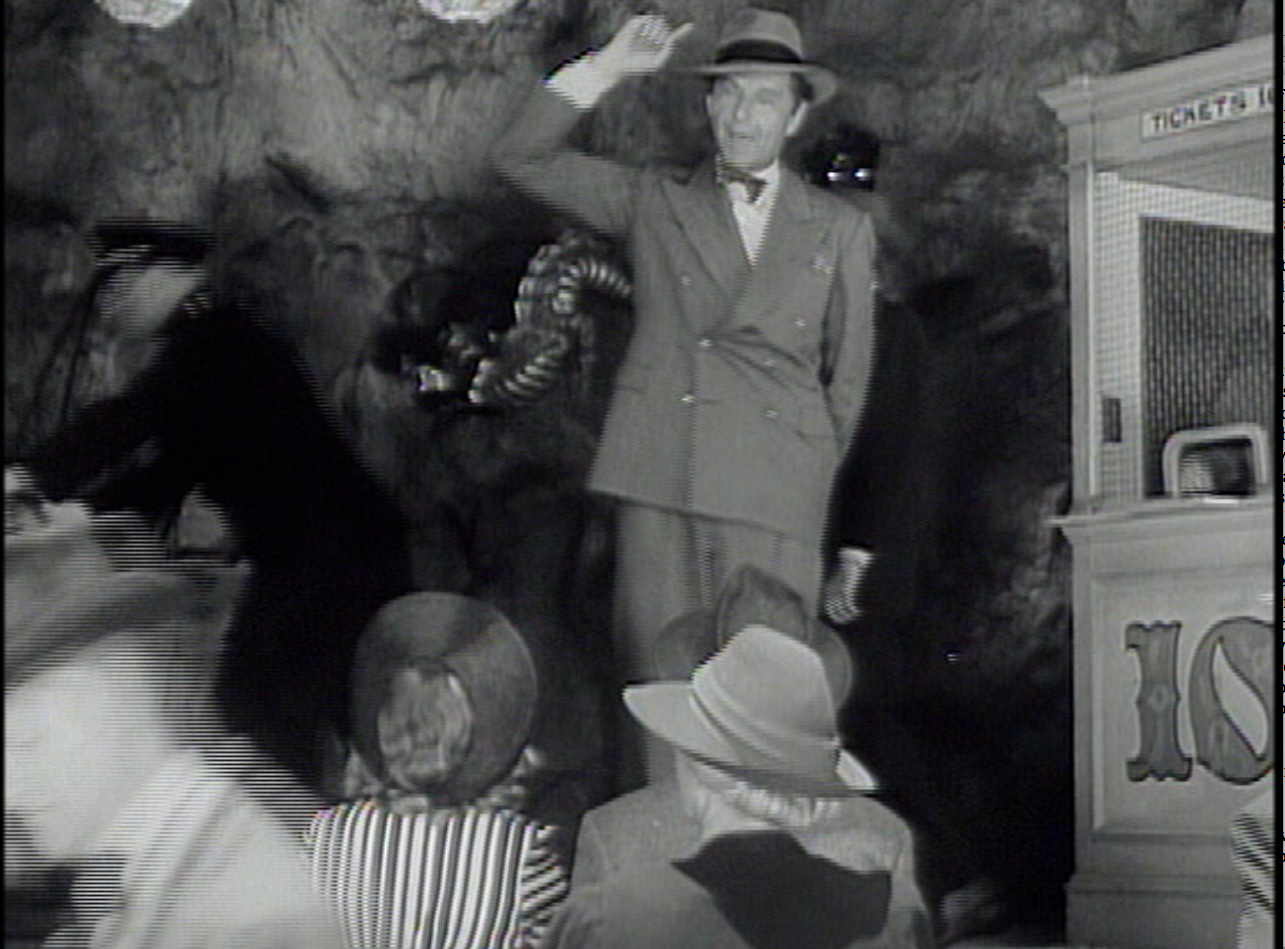
The oddest aspect of this propagandistic impulse is in the setup of Daka’s Little Tokyo hideout: the League of the New Order has its headquarters hidden in a “Japanese Cave of Horrors,” a wax museum primarily containing tableaux of Japanese war atrocities.  Every time the front of the business is shown, a carnival barker is pitching its importance to the war effort: “See the life-size models of the victims of our savage enemies! . . . See how they treat their prisoners. It’ll make your blood turn cold!”  It almost seems as if the filmmakers intend the barker’s words to represent the serial itself: “Come on in here and spend a dime, my friends, and wise yourself up. It’s not a circus, it’s not a carnival—this is a serious proposition!”  Yet the carnival barker is in league with Daka, sending his henchmen to the secret entrance and selecting victims to be brainwashed.  It’s either brilliantly self-referential, a commentary on the bottomless duplicity of the enemy, or just goofy.  Daka believes in hiding in plain sight, apparently.

barker

The seriousness of Japan’s Imperial ambition isn’t necessarily foreign to either the serial format or Batman as a character—both have featured their share of would-be world conquerors—but it is an odd fit with the tone of the 1943 production, which is frequently light, even whimsical.  Lewis Wilson as Batman and Douglas Croft as Robin appear to be having a ball whether in costume or out: this isn’t the grim, tortured Batman of Christian Bale, or even the reclusive weirdo Michael Keaton portrayed.  Even Naish as Daka gets to rub his hands gleefully and display a few moments of humor, like when he feeds raw meat to his pet alligators and briefly considers throwing a zombie to them as “something special.”  The actors and narrator embrace even the most absurd contrivances with gusto, and I’m not convinced this is entirely a case of straight-faced material only appearing funny in hindsight: comic relief was an essential component of the serial, and I daresay the funny parts are fresher and more entertaining than the repetitive fistfights and formulaic cliffhangers.  (It became very easy to predict what the cliffhanger would be in each episode, as the same beats were employed to set the stage each time. When, as in Chapter Six, a thug says, “Let’s get out of here before that chemical reaches those wires!” you know exactly what’s going to happen next.)

The 1943 Batman serial is likely to be of interest primarily to Batman completists, but I doubt it will satisfy any fan who would describe themselves as such.  It was rereleased to theaters in the 1960s as a camp film, where it influenced the next wave of Batman adaptations. Fans of the 1966 Adam West Batman TV show will recognize many elements: the deadpan acceptance of ridiculous situations, enthusiastic narrator, and even the two-part episodes with cliffhangers very much in the serial style.

Batman1

So what works?  For all the fistfights, Batman engages in quite a bit of detective work in this serial: not only does he find and analyze clues, he goes undercover (he disguises himself as a thug named “Chuck White,” and sends Alfred out in disguise a couple of times), gets information out of Daka’s henchmen through a variety of means, and even manages to turn their traps around on them, all while maintaining his secret identity.  Batman also delegates responsibility to Robin and Alfred, who several times come to the rescue.  The complexity of the puzzles is laughable and the level of thought isn’t that deep, but within the bounds established by the script, it’s easy to believe that Batman and Daka are waging a high-stakes chess game against each other, striking and counter-striking until the big confrontation.

I also liked Lewis Wilson as the title character more than I expected: to cover his real purposes, his Bruce Wayne is vapid and silly, and his excuses for not being around—he took Dick to a polo match or an amusement park; he doesn’t get moving until around noon—are amusingly flip.  He expects Linda to believe him, because what red-blooded man would use such indolence as an excuse unless it were the truth?  When one of Daka’s henchmen suggest that Wayne might be the costumed troublemaker, Daka sneers, “Don’t be absurd—that simpering idiot could never be the Batman!”

Bruce2

What I Watched: Batman (1943, Columbia)

Where I Saw It: I watched a Columbia Pictures DVD set, but it is on YouTube (in many parts) starting here.

No. of Chapters: 15

Best Chapter Title: Almost all the chapter titles are pretty great, with the kind of snappy immediacy and hint of exciting developments that all the best pulp titles have.  If forced to choose, I’ll go with Chapter Four, “Slaves of the Rising Sun” (balanced out by the fifteenth and final chapter, “The Doom of the Rising Sun”).

Best Cliffhanger: Chapter Thirteen, “Eight Steps Down,” ends with a double cliffhanger: Batman, trying to sneak into Daka’s lair, is threatened by the classic spiked-walls-closing-in trap, while at the same time, Linda Page is about to be turned into a zombie by Daka’s mind control device.  However will they escape?

Linda.zombie

Annie Wilkes Award for Most Blatant Cheat: Many of the escapes in Batman are of the kind that would infuriate Annie Wilkes: a train bears down on the hero, or an armored car plummets off a cliff and explodes, only to be revealed in the next chapter that Robin pushed Batman off the railroad trestle or Batman leapt from the armored car just in time, all shown from a different angle.  If any of those are cheats, then they all are.  However, I can’t say any of them explicitly undo the setup of the cliffhanger.

Actually, my favorite is the resolution to the cliffhanger of Chapter Fourteen (“The Executioner Strikes”), in which Batman, knocked out and placed in a coffin-sized wooden crate, is carried to Daka’s lair; the box, unopened, is dropped into Daka’s alligator pit.  At the beginning of Chapter Fifteen, it’s revealed that Batman had escaped before the crate was even brought to Daka’s lair, and it was Daka’s henchman Wallace in the box.  You can bet he didn’t get the benefit of a last-minute cheat.

Sample dialogue:

Bruce: “Well, we never got to the cave.  It was so hot out, we laid down by the side of the road and took a nap.”

Linda: “Asleep! Just when I needed you both so much.  If it hadn’t have been for the Batman I’d be dead in the cave!”

(Chapter Nine, “The Sign of the Sphinx”)

What Others Have Said: “Where could even a Japanese spy get enough ration stamps for all that meat?” Harmon and Glut, referring to the fodder for Daka’s pet alligators

What’s Next: Join me in two weeks as I vicariously travel the Western frontier through Fighting with Kit Carson.

Afterlife with Archie: “Escape from Riverdale”

“Sometimes dead is better,” witches Hilda and Zelda Spellman tell Jughead Jones after their magic is unable to save his dog Hot Dog from a fatal injury.  If only he had listened!  Struck by his obvious pain, their niece Sabrina (i.e., the Teenage Witch) uses forbidden magic from the Necronomicon to bring Hot Dog back to life.  Like the resurrections in “The Monkey’s Paw” and Pet Sematary, it doesn’t work out as planned: Hot Dog returns, but as a horrible undead monster with a bite that spreads a terrible infection.  Soon, the town of Riverdale (home of Archie, Betty, Veronica, and the rest) is at the center of a zombie epidemic straight out of Night of the Living Dead.

afterlife-archie1_00002

Since last fall, the first comic I read when I get it home from the store has been Afterlife with Archie, an unlikely hit from writer Roberto Aguirre-Sacasa and artist Francesco Francavilla.  The bimonthly book recently finished its first five-issue arc, “Escape from Riverdale,” and with the promise of big changes starting in the next issue, this seemed as good a time as any to examine the series (and encourage anyone who hasn’t tried it to give it a look: the first arc was just released in a collection last week).

As its name implies, Afterlife with Archie is a spin-off of Archie and the series with which it shares a universe (including Sabrina, Josie and the Pussycats, and more), with the familiar kid-friendly characters run through a George Romero- and Stephen King-style wringer.  As I wrote in my series on doppelgangers and copycat characters, writers often use thinly-veiled pastiches of familiar characters when they want to explore their darker sides; however, it is increasingly common for publishers to give writers free rein with out-of-continuity or alternate-universe stories starring their name-brand characters (Marvel has had a Marvel Zombies series for several years now, as an obvious example).

Marvel_Zombies_Vol_1_3

At least since the late 1980s, following the success of the dark, adult-themed comics work of Alan Moore and Frank Miller, it’s been known that “grim and gritty” sell.  Fashions change, but it seems like every few years there’s another round of “Comics aren’t just for kids anymore!” stories and another slew of comic anti-heroes committing rape, murder, or whatever transgression it takes to get the spotlight in a competitive field.  (I don’t have a problem with comics tackling adult themes, of course, but it’s often the titles that loudly insist on their “adult” status that seem the most adolescent.)  Even without resorting to graphic sex or violence, “going dark” is a giant cliché, and obviously zombies have been trendy for years now, so it would be easy to dismiss Afterlife with Archie as just another fad book.  Yet it’s become one of my favorites: what gives?

Why does Afterlife with Archie succeed where others fail?  For one thing, the affection the creators have for both the horror genre and Archie Comics is obvious and infectious.  Aguirre-Sacasa knows the characters of the Archie universe and respects them; the darkness isn’t something laid on top of the characters, it’s an artful drawing out of themes already present in their usual, more cartoonish depiction.  Archie Andrews is still good-hearted and willing to go out on a limb for his friends and family; Reggie Mantle is still a selfish snob; Betty and Veronica still fight over Archie while trying to remain “BFFs.”  Francavilla’s semi-realistic art, filled with expressionistic shadows and dramatic, off-kilter angles, is matched by dialogue that is by turns naturalistic—the teens don’t sound like overly-cool caricatures of high-schoolers—and appropriately heightened for the gothic excess of the book.  (Veronica’s father Hiram Lodge probably wouldn’t call Archie an “insolent whelp” in one of his regular appearances, but the dynamic of overbearing patriarch to a young, unwanted suitor isn’t a stretch.)

Even the more ghoulish elements are incorporated in ways that play with well-known character traits: it might seem like a cheap joke that the voracious Jughead is the first infected and becomes a flesh-devouring zombie, but it’s just as equally the kind of twist associated with the EC Comics that are another point of reference.  His first teen victim: “Big” Ethel Muggs, a character who has always made me cringe in the original comics with her slow-witted “hick” speech pattern and unrequited crush on Jughead.  (Ironically, as horrible as her death is in Afterlife, her brief appearance has more dignity than the regular version of the character has ever had.)

AWA_2-7-610x926

Flashbacks fill in the characters’ history, making them three-dimensional: in issue no. 4, the most emotional of the five, Archie is saved from the undead Hot Dog by his own dog Vegas, and then is confronted by his own father, now an infected zombie.  In both cases, the memories of happier times are intercut with the current struggle. (It’s the rare horror comic for which you’ll need a tissue!) Memory also weighs heavily on Hiram Lodge and his butler Smithers; it’s implied that Hiram was unfaithful to Veronica’s mother, and Smithers, as a second-generation servant of the Lodge family, is a discreet repository of all the town’s secrets.  Along with the incestuous relationship of Jason and Cheryl Blossom and the down-low lesbianism of Ginger Lopez and Nancy Woods (both interpretations that are original to this series, obviously), the constant web of secrets and lies make Afterlife’s version of Riverdale resemble Peyton Place, even before the supernatural elements are introduced.  The tone is very much like a contemporary teen soap opera.

AfterlifeWithArchie_04-7

The “Escape from Riverdale” arc ends with Archie leading the town’s survivors from the dwindling safety of Lodge Manor out of town.  Sabrina, who was banished to another dimension for her actions in the first issue, is scheduled to return to Riverdale in issue 6, presumably introducing a more cosmic angle to the ongoing horror, but who knows what other characters will show up?  Josie and the Pussycats are still out there, somewhere, so far unused, and I wouldn’t be surprised if Aguirre-Sacasa and Francavilla indulge in some deep cuts from the world of Archie: most of the weirdest Archie concepts are technically alternate universes, but so is Afterlife, and it’s clear the creative team know their stuff, so who knows? I’m hoping for Jughead’s Time Police, myself.

Or maybe they’ll take some inspiration from Spire Christian Comics (which licensed Archie characters to spread the Good News), and we’ll get the gritty reboot of The Gospel Blimp the world has been crying out for.  Or a grown-up Hansi, the Girl Who Loved the Swastika?  After the real-life horrors of that story, zombies should be no problem.

Hansi

All kidding aside, I do give Archie Comics a lot of credit for remaining a comics company first instead of a “media” company: although many of the attention-grabbing developments of recent years, such as Archie’s marriage and impending death in Life with Archie (the series which Afterlife with Archie sprang from, initially as a joke) and the introduction of openly gay character Kevin Keller, could be seen as publicity stunts, they’ve remained dedicated to a medium that the Big Two comics companies have increasingly turned into ancillaries of big budget movies and little else.  On the other hand: an Afterlife with Archie movie?  I can think of less likely properties to adapt for film.  In the mean time, I look forward to seeing what else Aguirre-Sacasa and Francavilla come up with.  (And I just found out that Sabrina will be appearing in another, “much darker” ongoing series following the success of Afterlife; “much darker” than what we’ve seen so far? Wow.)

The Force in Four Colors: Revisiting Marvel’s Star Wars

Recent news that the license to publish Star Wars comics would shift from Dark Horse to Marvel in 2015 probably didn’t come as a surprise to anyone: now that both Lucasfilm and Marvel are under the umbrella of Disney, it was only a matter of time before corporate synergy asserted itself.  Already, Disney-owned properties such as the Muppets, Darkwing Duck, and the Pixar characters have been withdrawn from licensee Kaboom! (not all of them to reappear at Marvel, at least so far).  It’s too bad: Kaboom! publishes some of the best comics for children around, and their books were clearly being written and drawn by creators with knowledge of and affection for the characters.  Still, it makes business sense for Disney to consolidate its holdings, now that it has film, animation, and comic book outlets at its disposal.  I don’t blame them at all; I’m sure it was part of their plan in acquiring those companies in the first place.

jaxxon

The news has stirred up memories of the often-wacky Marvel Star Wars line that ran from 1977 to 1986, and there have been a lot of jokes at Marvel’s expense.  Heck, I’ve sprinkled Twitter and WordPress with my share of comments about the Zeltrons, a race of pink-skinned empaths whose sexual openness was often a source of comic relief (and pinup-worthy cheesecake) in the series.  No one would deny that Marvel’s version of George Lucas’ science fantasy epic is more remembered for six-foot tall green rabbits, horny pink-skinned aliens, and a seriously off-model Jabba the Hutt than for its merits, especially in comparison to the more straight-faced Dark Horse run.

DaniMain3

Although some of Marvel’s contributions to the Star Wars canon have been picked up and used by others (including the Zeltrons, actually), its run was compromised by its publication alongside and in between the release of the original trilogy’s films.  Before Star Wars (sorry, A New Hope) was released, Marvel was already publishing its six-issue adaptation, including scenes that were cut from the final film: most notably Luke’s conversation with Biggs on Tatooine and Han Solo’s confrontation with a very different-looking Jabba the Hutt in Mos Eisley.  The yellow-skinned, humanoid version of Jabba would appear a couple of times in the comics, until he officially disappeared from existence, replaced by the slug-like Jabba of Return of the Jedi.

jabba-from-star-wars-adaptation-marvel

To be fair, it can’t have been easy for the writers (including Roy Thomas, Archie Goodwin, and Mary Jo Duffy, among others) to spin stories out of a saga that wasn’t completed yet: the challenge was to give readers more of what they loved in the movies without deviating too far from formula or accidentally contradicting or giving away plot twists planned for the sequels (plot twists that were generally secret–Marvel’s editors wouldn’t always know they had crossed the line until it was too late).  Particularly between The Empire Strikes Back and Return of the Jedi, writers were tasked with providing the illusion of change so familiar to readers of superhero comics: Han Solo could not be freed from his carbonite imprisonment, although many issues were dedicated to attempts to rescue him; Darth Vader was off the table, so there could be no answer to the question: was he Luke’s father?

Some of the weirdness in Marvel’s version was also due to the relationship between licensor and licensee at the time.  In those days there was simply not the expectation that film and comics be a seamless continuity: comics were exercises in brand extension, ancillary revenue streams, not sacred texts.  To a large degree, the comics’ writers and artists treated the Star Wars universe as just another sci-fi/fantasy playground to be filled with weird landscapes and monsters (one story arc was repurposed from unused John Carter, Warlord of Mars artwork).  Remember, this was from the same decade as Jack Kirby’s adaptation of 2001: A Space Odyssey and Whitman’s adaptation and continuation of The Black Hole.  Making up and adding material was thought of as giving good value to the reader.  Star Wars and its Expanded Universe would be a major influence in shaping fans’ expectations of continuity across all media, but that tighter approach didn’t emerge overnight.

Still, before I was a Marvel kid I was a Star Wars kid, and the latter was a big reason for the former.  I remember vividly the discovery that piqued my interest: in the box of comics I shared with my sister (about which I’ve written previously), I discovered a copy of Star Wars number 18, missing its cover.  This was the first issue of a major story arc in the early days of the series, the “Wheel” saga, named after a huge space station-bound casino that is the setting of the action.  I didn’t know that at the time (1982 or ’83, I would guess), and it would be a few years before I was able to read the “Wheel” arc in its entirety.  What captivated me was the idea that the characters I knew from the movies were having entirely separate adventures in these comics.  I tended to accept anything official-looking as gospel, so I had no trouble accepting the legitimacy of Marvel’s version (although Carmine Infantino’s square-jawed rendition of Luke Skywalker looked more like He-Man than Mark Hamill).

Mswc19cover

For the first time, I became a regular comic buyer, actively looking for new issues on the stands and seeking out back issues to fill in my collection.  Jumping into the series, there were many unfamiliar characters and references to previous adventures from the comics.  I had a lot of catching up to do.  I didn’t live anywhere near a dedicated comic book store, so I relied on trading with friends and mail order: the biggest comic book purchase of my childhood, in fact, was an order for all the Star Wars issues that were available from one of Mile High Comics’ summer sales. Mile High’s yellow two-page ads were once a common sight, and the summer sales were the best, unloading comics for 25 or 50 cents apiece.  It helped that, aside from the first few issues, Star Wars had never been terribly sought-after or valuable, and at most they were only a few years old.  The day the box arrived in the mail with forty issues or so—far from a complete run, but more than I had ever read at once and including many gems—I holed up in my room and immersed myself in “a galaxy far, far away.”  It would be the first of many long afternoons delving into another world through comics.

One of the things I liked about the comics, and which still holds up today, was the focus they were able to bring to individual characters.  Many issues were solo adventures, or featured groups of only two or three characters working together in ways that the epic scope of the films didn’t always have time for.  In the comics you could observe Princess Leia as a diplomat waging high-stakes games of cat-and-mouse with Darth Vader and the Empire (in “The Third Law”); Luke Skywalker’s role in the Rebellion’s space fleet could receive more attention; Han Solo, and later Lando Calrissian, could be shown in their element as smugglers, gamblers, and “scoundrels” (in flashback, of course).  In essence, the Star Wars universe could support stories of action-adventure, espionage, horror, romance, and even comedy, much as the Expanded Universe still does today.  It made sense: the movies were themselves indebted to many different genres, including the science fiction serials of the 1930s and ’40s; Westerns; World War II aerial dogfights; and the samurai films of Kurosawa.  It was only natural for the comic book adaptations to continue in that spirit and flesh out elements that could only be implied on film.  Not all of the stories worked, and not all of the original characters fit into the Star Wars aesthetic, but I still remember them fondly, from the “Wheel” saga to the the twisty, long-running story of Shira Brie, to the many, many attempts to rescue Han Solo.

Mswc65cover

After Return of the Jedi, the Marvel series continued without much apparent purpose, introducing its own villains (the Nagai) and tying up threads from the comics.  The writing was on the wall.  I was a faithful reader until the end, but I couldn’t disagree with the decision to cancel the series after 107 issues: it had become a shadow of its former self, and by that time I had gotten hooked on Marvel’s superhero offerings.

I didn’t spend much time reading the Dark Horse series–I guess I was still a Marvel kid at heart–but from what I could see the quality was good, and they made a lot of smart decisions.  Unlike the Marvel series’ focus on the main characters of the film trilogy (understandable, but ultimately limiting), Dark Horse was able to flesh out the Old Republic and other settings within the Star Wars universe.  They even obtained the rights to the Marvel run and released it in a handsome series of trade paperbacks, a fitting tribute to an imperfect but often richly entertaining saga, and a challenge to the assumption that everyone involved would rather forget it existed.  With the distance of time, new and old readers alike can approach these adaptations, see that there was more to it than green rabbits, and make up their own minds.

(Images from Wookieepedia, the Star Wars Wiki)

The Pleasures of Anthology, Part Three

You can read Parts One and Two here and here.

As far as shared worlds go, it doesn’t get much more eclectic than superhero comics: just as an example, the three most recognizable characters in DC’s universe are an alien from another planet, an Amazon warrior with ties to the Greek gods, and a self-made vigilante, illustrating nicely the superhero genre’s connections to science fiction, mythology and pulp adventure.  It helps to realize that Superman, Wonder Woman and Batman were not originally invented with the idea of coexisting in the same world, but grew organically in their own books, developing their own identities, casts of characters, themes, and locales before anyone thought of teaming them up.  It was only later that the tangles of continuity across different books had to be cleaned up and what were often spur-of-the-moment inventions rationalized and codified.
Beyond the editorial offices of DC and rival publisher Marvel (and to a lesser extent Charlton, Fawcett, and the other small publishers that would either fold or be absorbed by DC), the first serious considerations of comic book worlds and how they were put together were written by fans, for fans.  The comics fanzine Xero emerged in 1960, and more were to follow.  Fanzines and amateur press publications have largely moved online since the rise of the internet, but organized fandom used to leave quite a paper trail, spread by word of mouth and united by newsletters, fan clubs and conventions, often advertised in the comic books and science fiction magazines where like-minded readers would be most likely to find them.  Many of the fan writers would go on to work in the industry: Roy Thomas and Mark Gruenwald were both superfans who had in common an encyclopedic knowledge of characters and plot points that they would build on in their own stories for Marvel in the 1970s and ‘80s.  Gruenwald had even made his name with a self-published thesis on comic book universes and their interconnected nature.

Even when writing about comic books began to enter the mainstream, it was still written from the point of view of a comics reader rather than a disinterested outsider.  Jules Feiffer got the ball rolling with The Great Comic Book Heroes in 1965, a critical history of comic books in the 1930s and ‘40s mixed with Feiffer’s memories of reading comics as a child and working in the industry as a young adult; All in Color for a Dime, edited by Dick Lupoff and Don Thompson, was published in 1970, collecting a number of essays, including Lupoff’s own “The Big Red Cheese” (about Captain Marvel) from that first issue of Xero; and so on.

Feiffer, of course, was the long-running cartoonist in The Village Voice­ and had counter-cultural cachet; Lupoff would make his mark as a science fiction author and scholar of (among other subjects) Edgar Rice Burroughs; Thompson, with his wife Maggie, founded the influential Comics Buyer’s Guide.  Authoritative as their essays are, one of their chief values is in putting the reader in the shoes of a young kid encountering Superman or Captain Marvel for the first time, seeing the characters through their eyes and accepting them on their own terms.  But such is almost always the way, especially when pop culture subjects are involved: the first writing on jazz was descriptive, by journalists rather than musicologists, and the first jazz discographies were written by aficionados to aid fellow record collectors.  Scholarly writing would later lag behind journalists and fans of rock and hip-hop as well.

A Smithsonian Book of Comic-Book Comics, edited by Michael Barrier and Martin Williams, appeared in 1981, by which time scholars were taking note of comic books and it was more common for books on the subject to disentangle history and criticism from the personal and anecdotal.  A Smithsonian Book may not have been the definitive volume on the subject, but it certainly seemed so to me as a young teenage comic book reader encountering it for the first time.  Of course, more than the scholarly apparatus it was the reprints of comics from the “Golden Age” (up to 1954, the date of the adoption of the Comics Code by the industry) that made the book so valuable and enjoyable.  I had been collecting superhero comics for a couple of years, starting with reprints of Stan Lee’s and Steve Ditko’s Spider-Man in the pages of Marvel Tales and gradually getting into the current stuff from there; reading about the storied history of Marvel and the Distinguished Competition made me feel like a real newbie, but the truth was I had been reading comics most of my life.

smithsonian

Before middle school, when I was younger than ten, most of the comic books I read were licensed “funny animal” books starring the Looney Tunes or Disney characters, and were often more far-ranging and imaginative than you would expect: Did you know Goofy had a side career as a superhero?  If you read Super Goof you did!  Just as Floyd Gottfredson’s Mickey Mouse strips gave its title characters a sense of scope and adventure grander than what could be shown in the short animated cartoons, so the licensed Gold Key and Dell comics expanded my young mind by showing the “further adventures” of characters I already knew and loved.  And needless to say, I enjoyed the Uncle Scrooge comics of Carl Barks long before I knew who Barks was, having a particular fascination with the evil duck sorceress Magica de Spell: who was this vivid character whom I had never seen in an animated cartoon?  Why would Walt Disney (for of course I thought that’s who drew all the comics—he signed them, didn’t he?) create such a great villain and not use her in a movie?  Why did all the Disney characters have such complex, fulfilling lives offscreen?

Image

Oddly, when I graduated to more “mature” (or so I thought) comics, I completely discounted the funny animal comics I had cut my teeth on, and got rid of them completely.  This isn’t an unusual experience by any means: most of us go through at least one phase where we clean out all the “kid’s stuff,” only to regret it later.  What separated my later comics habit from my funny animal years wasn’t just the subject matter—there were some Twilight Zones, Archies, quite a few issues of Mad and Cracked, and even some superhero books mixed in with the comics I threw out—but my self-consciousness that I was collecting comics, that I had to keep them organized, follow a checklist, fill in gaps in my knowledge, and basically keep up: all the demands of fandom.  Before that, comics were acquired at random (sometimes brought home by my parents when my sister or I was sick), often in one of those packs of three miscellaneous comics in a plastic sleeve (you could see the covers of the two on the outside, but the one in the middle would be a mystery, and may or may not have anything to do with the other two).  That’s how we ended up with a bunch of Spire Comics’ gospel-themed Archie comics, basically church tracts starring the Riverdale gang.  Except for a few favorites, they were equally disposable, in the tradition of pop culture since the dawn of mass production, and the ones that didn’t completely disintegrate wound up unceremoniously dumped in a cardboard box, a sort of comics slush pile.

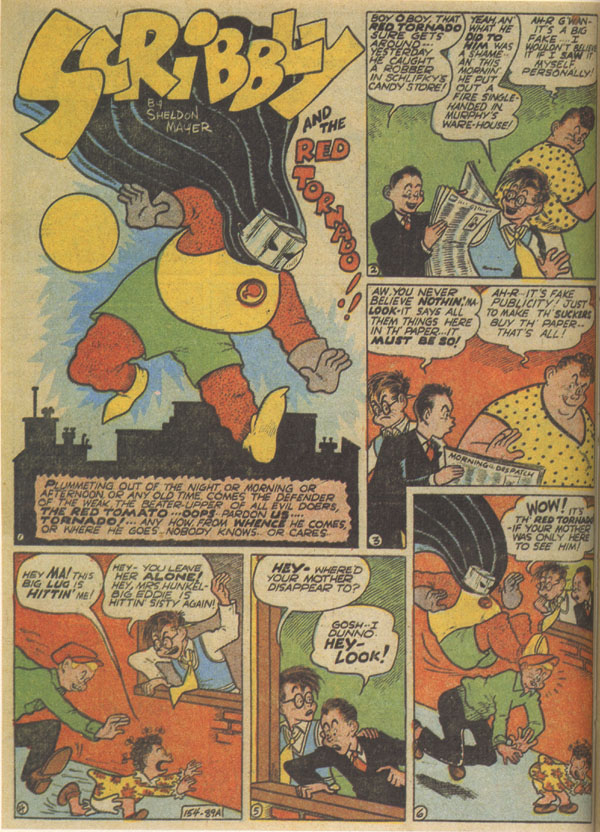
A Smithsonian Book of Comic-Book Comics helped me make connections between my undiscriminating childhood and my status-conscious adolescence.  It taught me Carl Barks’ name and helped show me that his talking duck characters weren’t just for little kids; it introduced me to the original version of Captain Marvel, before DC ensnared publisher Fawcett in a crippling lawsuit over his supposed similarities to Superman; it let me connect the name Basil Wolverton to the grotesque caricatures I had already seen occasionally in Mad; it introduced me to the ambitious and insightful work of Will Eisner in The Spirit and the breadth of E. C.’s output before the comics panic of the ‘50s and the Comics Code forced them to cancel everything but Mad; it made me unable to see Marvel’s parodic Forbush-Man without thinking of the similarly attired Red Tornado from Sheldon Mayer’s Scribbly.  It would even, much later on, form a foundation for me to understand what the heck was going on in the historically-informed comics of Tony Millionaire and Art Spiegelman.

ImageImage

Aside from giving me some ammunition if I’m ever cornered by Harlan Ellison, the Smithsonian book provided a great deal of entertainment and enriched my appreciation of the current books I was reading.  My adolescent comic book collecting in the 1980s coincided with a period of reassessment in the superhero world: Superman’s fiftieth anniversary would be celebrated in 1988, and (perhaps not coincidentally) fifty years of world-building and cross-referencing would be consolidated (or swept away, depending on your perspective) in 1985 by DC’s Crisis on Infinite Earths, clearing the decks for a “fresh start” for Superman and company in the first and biggest of many company-wide “reboots” to come.  The complexity of DC continuity included a number of parallel worlds, including separate universes for the Golden and Silver Age versions of characters, introduced to explain how Superman could fight saboteurs during World War II and still be a young man in the 1960s.  It was simple, really: there was an old Superman in one world and a young one in another, and sometimes they would break down the barriers between universes and team up.  Captain Marvel even came on board in the 1970s, at first in his own world (“Earth-S”) and later woven into the fabric of the DC universe as other characters had been before him (although he started going by the name Shazam to avoid confusion with that other comic book company).

The 1980s were also truly DC’s decade on screen, especially for Christopher Reeves’ iconic portrayal of Superman, but not overlooking Lynda Carter’s Wonder Woman on TV and the truly game-changing 1989 Batman directed by Tim Burton and starring Michael Keaton (many fans have cooled on Burton’s Batman in favor of Christopher Nolan’s grittier trilogy, but it’s hard to overstate what an event the 1989 film was at the time).  By comparison, Marvel’s best-received screen adaptation was The Incredible Hulk in the early ‘80s.

I don’t bring up Crisis or Burton’s Batman to make comparisons with DC’s New 52 or to point out Marvel’s current domination of the big screen.  The contrast speaks for itself, and more importantly the industry has changed greatly: one’s preference for a particular era of comics says as much about one’s age as it does about one’s taste.  I’m thankful I stopped collecting before the huge boom of the early ‘90s—otherwise I might be burdened by nostalgia for foil-stamped hologram covers, oversized guns, and costumes festooned with pouches!  Nor do I want to say things were better then just because I was younger: Crisis on Infinite Earths pissed off plenty of comics fans, myself included.  I liked the alphabet soup of parallel worlds and twisting timelines in the DC multiverse.  It irritated me to see whole settings and storylines erased from official existence.  On the other hand, if I were an editor or writer, chained to stories that had been written decades before, I might have felt differently.  Still, good writers had ways of getting around that, and a good story trumped pedantry any day.

And of course the characters who had been written out came back: Supergirl came back.  Titano the Super-Ape came back.  The Huntress came back.  Kamandi and OMAC and all the rest found ways back in, sometimes in different places and sometimes greatly changed, but eventually they came back.  And when Superman himself died, and it turned into a media frenzy, comics readers just nodded sagely to each other and knew it wouldn’t be permanent.  He’d be back.  Just ask Captain Marvel.

(Continue to Part Four)