Are You a Bad Enough Dude to Be a COMMANDO NINJA?

In 2019 I celebrated “Ninjanuary” with several posts about the ninja in popular culture, particularly in films and books from the 1980s, and I occasionally return to that theme. Past entries can be found by clicking on the Ninjanuary tag.

Can we ever escape the 1980s? In the case of movies with the word “ninja” in the title, probably not (this series is proof of that). Even in 1998, The Wedding Singer conjured up an MTV-era fantasy with a distinct candy-colored look, an exercise in nostalgia for an era not even two decades past, a Grease for Generation X. As we have moved farther in time from that decade, media basking in “’80s-ness” has become more and more baroque: Vaporwave fantasies inspired by movies (of the blockbuster and Blockbuster variety), comics, and video games that were already exaggerated reflections of a complex, fast-changing world.

Commando Ninja (Ben Combes, 2018) wears its influences from the title on down: the ninja action is largely of the Cannon Films/Golan-Globus variety, with some overt homages to Godfrey Ho, and the Commando part acknowledges the Schwarzenegger/Stallone wing of ‘80s action cinema, down to the obsession with the Vietnam War and those who survived it. It’s also apparent that as the generation who were children in the 1980s (or for whom it was before their time) have grown up to create their own art, the “toy commercial” cartoon shows like G.I. Joe and Transformers have turned out to be just as enduring and influential as Back to the Future or Pretty in Pink.

Beyond the passage of time, the internet and meme-ification of pop culture is probably also to blame. Commando Ninja, like Kung Fury, was a Kickstarter-funded project, and like many crowdfunded movies, it feels like it’s deliberately pitched to the Reddit crowd who are most likely to be online to hear about it in the first place. In addition to the obvious, Commando Ninja riffs on such period touchstones as Home Alone, the Mad Max series, the films of Andy Sidaris, 8-bit video games, and Jurassic Park. (Okay, that’s from the ‘90s, but there’s always room for dinosaurs in something like this: what I recently said about “comics FUN” also applies to self-consciously pulpy movies.) I started Commando Ninja feeling that it was at least more grounded than Kung Fury, but by the end I wouldn’t even say that. 

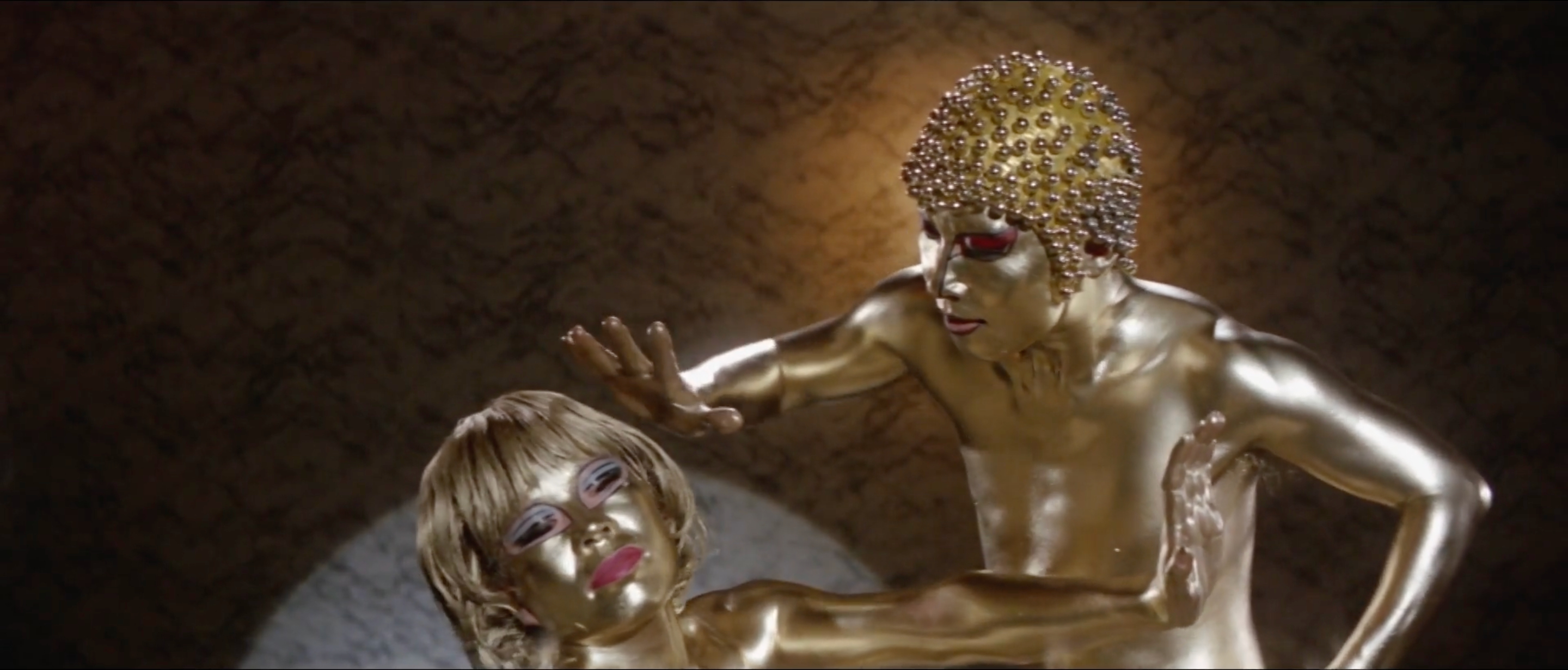
The plot of Commando Ninja flashes back and forth between 1968 and 1986 (always helpfully announcing when and where a scene takes place with title cards). It begins with a platoon of American G.I.s wading through a Vietnam delta, trading wisecracks and wary guesses about what they’re up against. They’re a diverse group, stereotypically so: the black guy is nicknamed “Snow White,” and another soldier is named “Kowalsky,” and there’s a “lovable” racist with a Confederate flag stitched to his camos. We see them from above through thermal imaging as warm red blobs, just like in Predator. When the unseen antagonist is revealed, it is a red-clad ninja with a golden facemask who can literally become invisible (again, much like the Predator). After a surprise attack, black-clad ninja henchmen finish the job of killing some of the soldiers and corralling the survivors, including hero John Hunter (Eric Carlesi).

Flashing forward to 1986, Hunter’s ex-wife is murdered at her front door by a very Terminator-like pizza delivery man, and his tween daughter nearly escapes from a pair of bumbling ninjas by means of homemade booby traps. But she hadn’t counted on the Terminator dude being invulnerable to being hit in the nuts, and he catches her. Hunter, contentedly chopping wood in a remote cabin in Canada, is approached by an Air Force official: Leeroy Hopkins (Philippe Allier), the redneck we last saw getting his arm blown off in Vietnam, now outfitted with a cybernetic replacement. He has good news and bad news: Hunter’s ex-wife is dead, and the bad news is that his daughter has been kidnapped.

It’s hard to tell how invested writer-director Ben Combes is in recreating the nastier edge that was often present in ‘80s action movies, whether he’s reveling in the perceived freedom to not be “politically correct,” or if he’s ironically pointing out the racism and misogyny baked into their premises. Ultimately, it’s not my problem, but Combes was invested enough in the side character Hopkins to give him a Taxi Driver-style prequel short that explains how he went from disabled Vietnam Vet to Air Force cyborg, and it involves slaughtering a ring of murderous Viet Cong guerillas in 1970s New York City.

Or perhaps it is a matter of perspective: although made in English, Commando Ninja was a French production. Kung Fury was made in Sweden. The post-apocalyptic ‘80s pastiche Turbo Kid was made in Canada. That isn’t to say that Americans don’t also tell these stories, but the non-domestic versions are often markedly weird, like a copy of a copy. Is this what the United States, filtered through the media we export, looks like to the rest of the world? I’ll admit that absurd macho posturing is a big part of our national brand, especially now.

In any case, John Hunter, Commando Ninja, springs into action, tracing his daughter’s kidnapper to his old nemesis, Kinsky (Olivier Dobremel), who was working with the Soviets in 1968 but now appears to be an independent crimelord with his own army of ninjas at his disposal. He chills at his luxurious mansion in a fictional Central American country, surrounded by bodyguards and beautiful women in bikinis, and has apparently arranged the kidnapping to extort Hunter into doing his dirty work. Kinsky is pointedly Jewish: make of that what you will. (There are some nice touches in these sequences, like the Garfield phone Kinsky uses to communicate with his henchmen, and the varied uses of the Nintendo Power Glove to represent high-tech gadgets.)

Things don’t go according to Kinsky’s plan, and along the way, Hunter recalls the imprisonment he suffered in Vietnam at Kinsky’s hands, and the means of escape he was given by a sympathetic Chinese Colonel (Thyra Hann Phonephet) who introduced him to martial arts and the path of the Commando Ninja. (Other questions answered by flashbacks include the sad story of Kowalsky, the soldier-turned-Terminator whose brain was replaced with a “powerful four-megahertz processor.”) Of course, Hunter uses the lessons he learned from his sensei to defeat his old enemy the red ninja, and then things really get weird.

The criticisms I have may make it sound like I didn’t enjoy Commando Ninja, but for what it is, I was entertained and even laughed out loud sometimes. Carlesi has the physique and demeanor of an original ‘80s action hero, and while much of the violence is played for laughs, with exaggerated blood squibs and exploding dummies, the hand-to-hand combat sequences are effective. The music convincingly evokes John Carpenter and Kenny Loggins to get the audience pumped up. There are more real location shots than you might expect, with greenscreen and CGI reserved for the really outlandish scenes. It also moves briskly and doesn’t wear out its welcome, coming in at under 70 minutes. But if you’re left wanting more—and the film does end on a cliffhanger—Commando Ninja is just the beginning of a burgeoning franchise: in addition to the aforementioned short Hopkins, a full-length sequel was completed last year and there’s also a prequel comic book. As of this writing, Commando Ninja is available to watch on YouTube.

Space Western Comics: A Review

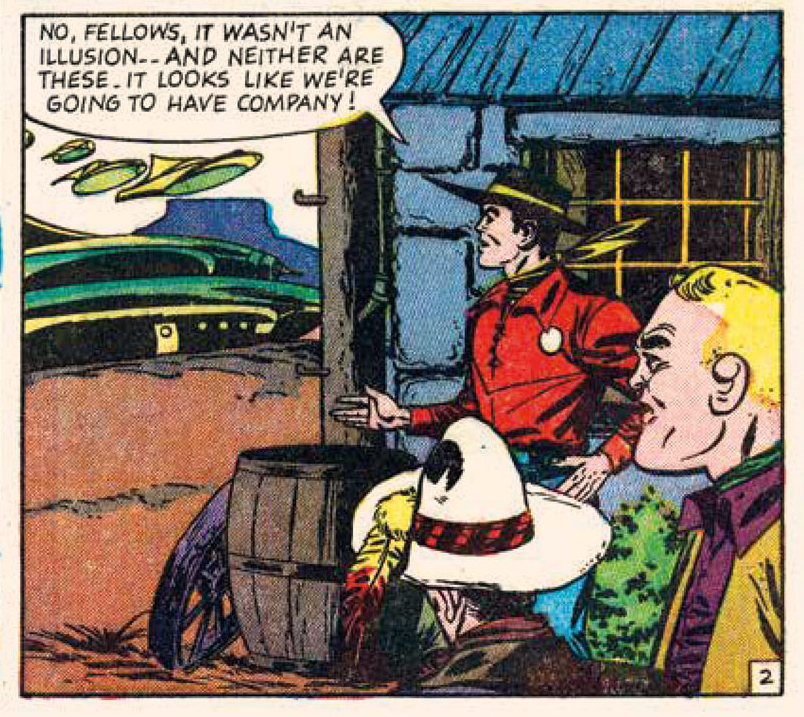
It’s tempting to look at pop culture trends in the 1950s and ‘60s in broad strokes, shaped by after-the-fact simplifications like Toy Story 2. In that film, classic cowboy Westerns were put out to pasture (heh) with the launch of Sputnik and the beginning of the Space Race, and almost overnight children’s imaginations turned to science fiction. In the long run, I suppose that did happen, but over decades rather than months or weeks. Throughout the 1950s and much of the ‘60s, Westerns (and related frontier and outdoorsman stories) remained popular with kids (and adults), and while sci-fi eventually overtook them in relevance, there were multiple attempts to combine the two popular flavors. Gene Roddenberry may have pitched Star Trek as “Wagon Train to the stars” and codified space as “the final frontier,” but he wasn’t the first to make the connection. Craig Yoe, prolific historian and anthologizer of comics, has produced a fun and informative volume in Space Western Comics, reprinting and contextualizing a run of adventure stories combining cowboys and aliens from the 1950s. It’s perfect reading for Vintage Science Fiction Month.

It’s worth noting that the term “space Western” was sometimes used (derogatorily) in sci-fi publishing and fan circles to describe stories that were just the same old formulaic good guys confronting bad guys dressed up in otherworldly verbiage, with rayguns replacing six-shooters and spaceships replacing horses. (Star Wars was attacked in the ‘70s by purists along exactly those lines, but at least Star Wars had considerable artistry on its side; in the ‘50s the white hats vs. black hats approach was strictly the domain of hacks.) But there were some literal space Westerns as well that combined the terminology and iconography of both genres into a single, (mostly) coherent story world. (I wrote about this weird subgenre several years ago and went into detail on the movie Cowboys & Aliens, at the time the most current example.)

Westerns in the first half of the twentieth century weren’t limited to the Old West. Real-life ranches and cowhands were enough of a reality that so-called “modern Westerns” could tell stories of pure-hearted (often singing) cowboys fighting cattle rustlers, land-grabbing oil or radium speculators, and other unscrupulous villains while using up-to-date technologies like automobiles, airplanes, and radio. While fanciful, these modern Westerns ostensibly took place in the “real world” of the 1930s, ‘40s, or ‘50s. Naturally, some of the same futuristic devices that were appearing in contemporary serials and comic books—miraculous rays, rockets, and the compelling but imperfectly-understood “television”—made appearances in the modern Western setting as MacGuffins or mysteries that needed to be unraveled. A cycle of “gadget Westerns” ran its course in the serials of the 1930s, but none of those involved actual space travel or alien visitors. The Phantom Empire, which famously sent Gene Autry underground to confront an ancient, advanced civilization miles beneath his ranch, stands out as an example of the Western exploring inner, not outer space.

So it is perhaps not surprising that the still-popular Western genre, chasing after trends, would incorporate UFOs, space travel, and alien life in an attempt to hold fickle audiences’ attention. And it is even less surprising that comics—a business with low costs and quick turnaround compared to the movies—would be in a position to take advantage of the brief moment when cowboys and spacemen appeared to be on equal footing (at least with the allowance-spending children of America).

In 1952, based on a suggestion from Charlton co-publisher Ed Levy, the already-extant Cowboy Western Comics changed its title to Space Western Comics (a common practice: instead of starting a new series with issue number one, it was believed that high numbers were more attractive to newsstand buyers, as they suggested a successful track record). Walter P. Gibson, the prolific writer and magician who developed and ghost-wrote The Shadow for Street and Smith, among many other projects, wrote and edited the adventures of “Spurs” Jackson, a rancher and electrical engineer whose ranch becomes the center of zany outer space adventures. (Shades of Gene Autry!) Artists John Belfi and Stanley Glidden Campbell provided the illustrations. The book reverted to Cowboy Western after only six issues, but a couple of stories starring Jackson from later issues are included in Yoe’s volume for the sake of completeness, as are two space-themed stories from Buster Crabbe’s comic book. (Crabbe had, of course, played both Flash Gordon and Buck Rogers in addition to cowboy roles, so this made perfect sense.)

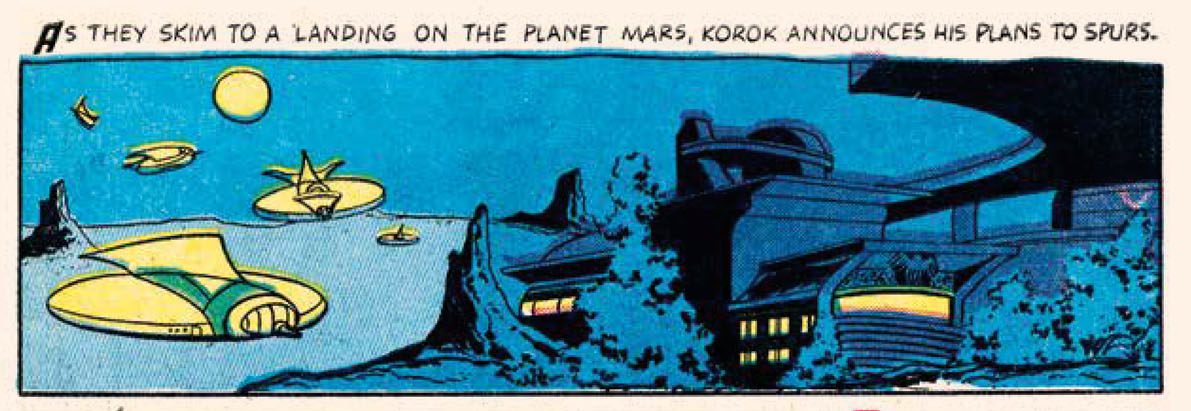
Space Western Comics begins with the Space Age already underway: flights to the moon have become routine, and a space station orbits the earth. “Spurs” Jackson is a character made to have adventures: unmarried and wealthy enough to occupy his free time inventing in his “secret lab,” the rancher-slash-engineer is charged with maintaining a 1000-foot-tall radar tower on his land (a government connection that serves to fuel several later stories), while leaving the day-to-day operations to his foreman, Hank Roper, and the Indian Strong Bow. The radar tower, which helps guide the lunar flights, attracts the attention of spaceships from Mars, who abduct the three men and take them to the red planet. There, they are presented as evidence that the Martians have conquered earth, a pretext that puts the scheming Korok on the throne of Mars instead of the rightful Queen Thula. This is classic space opera material straight out of Edgar Rice Burroughs, but the Western theme eventually pays off: Korok’s throne room is protected by a force field that prevents any metal from penetrating, so Martian weapons and the earthlings’ six-shooters are useless, but Jackson’s whip, Roper’s lariat, and Strong Bow’s bow and arrow, all non-metallic, win the day. For putting things right, Thula offers Jackson a position as her prime minister, but he can’t stay on Mars for long: ranching is an all-day job.

Some of the stories in this volume depend on the romance and exoticism of exploring other worlds, but in many of them the trouble is closer to home. Would-be alien invaders, Communist spies (sometimes disguised as aliens), criminal gangs, and even Nazis threaten the peace of the Bar-Z ranch. The desert makes for a compelling setting, full of isolated canyons and desolate flats, remote enough from civilization that no one in the cities would believe the stories but close to the Army’s testing ranges and bases so there are always plenty of troops and weapons ready to take charge of the surviving villains. As silly as the premises of these stories often are—rock men, plant men, and underground super-moles are among the aliens Jackson encounters—Gibson packs them with twists and clever problem-solving. Like a good engineer, “Spurs” Jackson out-thinks his opponents as much as he out-fights them (although he’s not above setting off an atomic bomb or two if that’s what it takes).

And frequently the twist is kept from the reader until the most dramatic moment, revealing that Jackson had his enemy’s number the whole time. In one of several text pieces, slavers from the planet Letos are foiled by a ship full of humanoid robots supplied by Jackson—“robots” who are actually humans in bullet-proof robot costumes. (Postal regulations required the text pages to secure favorable magazine rates; they were most often filled with editorials or letters columns, but short prose stories were not uncommon. The two-pagers Gibson provided for Space Western Comics are clever pulp miniatures, often written in the folksy voice of characters from around the Bar-Z. I think they would stand up well with the humorous sci-fi of Henry Kuttner and his contemporaries, should anyone think to mine comics’ text pages for anthologizing. Today, Alan Moore seems to be the only comics creator left with much affection for this archaic institution.)

Jackson isn’t the only savvy operator, either: Strong Bow is written as a more sophisticated and educated character than his Tonto-like dialogue might suggest. In more than one story, Indians appear to arrive from space, claiming to be heroes from the past or remnants of lost tribes, inviting the local Indians to overthrow the United States government. Of course, Strong Bow sees right through them, even if he might pretend to go along with the plan. (Although Space Western Comics predates the infamous Comics Code, it’s still as pro-government, pro-American, and pro-law and order as anything produced under the Code. The government and military in these stories are never less than righteous and upstanding, give or take a traitor or two in their midst, so nothing as subversive as suggesting Indian activists might have a point ever enters into the discussion.)

As I’ve alluded to in past articles, comics are a natural medium for the kind of mash-up represented by Space Western Comics: the visual shorthand that is a vital part of comics vocabulary lends itself to mixing and matching. Without attempting to catalog every example of the space Western from later comics, I’ll point to Terra-Man, a cowboy-themed villain from Superman comics. Abducted by space aliens as a child in the Old West, Terra-Man returned to earth with high-tech equivalents of the cowboy’s accessories and an alien winged horse. Current comics have embraced this kind of meta-referentiality with a vengeance, remixing popular iconographies of all kinds with kaleidoscopic variety. Sometimes it’s overwhelming, but I remind myself of being a comics reader in the 1980s, when the Big Two publishers seemed to be embarrassed by anything too “wacky,” and it was left to the independents to publish books like Marc Schultz’s Cadillacs and Dinosaurs (or for that matter, Teenage Mutant Ninja Turtles, as much a mash-up as a parody). I prefer the current acknowledgment of the medium’s silly roots, without the po-faced need to pretend that it’s all serious business.

By now, the proclamation that “comics are supposed to be FUN” is a tradition within comics that is up for grabs, just like every other past genre or practice that is ripe for revival, rehabilitation, or reinvention. Sometimes that means characters like Howard the Duck or Detective Chimp are given equal time with Iron Man or Wonder Woman; sometimes it means weaving disparate, contradictory threads into ambitious multi-layered story arcs that breathe new life into one-off concepts like the Green Team. Signifiers of “comics FUN” include (but are not limited to) ghosts, robots, dinosaurs, gorillas, and, of course, cowboys and rocket ships. Craig Yoe plays up how quaintly ridiculous the stories in Space Western Comics are, and is clear-eyed about the mercenary motives that led to its original creation. But he is equally up-front about how imaginative, breathlessly exciting, and yes, FUN, these stories are, and he has performed a valuable service by putting them together in a handsome and easily accessible package.

“Polkamania!” and Forty Years of “Weird Al” Polka Medleys

Recently, “Weird Al” Yankovic released a new polka medley online to commemorate the ten years (!) that have passed since his last studio album, Mandatory Fun. Since “Weird Al” in 3-D, medleys of current popular songs in polka form have been a feature of each album and something of a signature for the artist. Yankovic has continued to be active since Mandatory Fun, touring, making one-off appearances with other artists, and producing his “biographical” film, Weird, but the new medley, titled “Polkamania!”, was a good answer to the question, “Does Al still have it?” in an era when social media-native novelty artists like Nick Lutsko and Tom Cardy are dominating YouTube.

When I started this blog and called it “Medleyana,” Yankovic’s polka medleys were one of my inspirations, but I never ended up writing much about them except in a general way. I was fascinated by the mechanics of joining together disparate compositions such that they sound like they belong together (at least when Yankovic wasn’t deliberately emphasizing the contrasts between different styles and subject matters). What began as a one-off joke (who even remembers Stars on 45, the studio medleyists Yankovic was originally parodying?) was sustained by the wit and musicianship Yankovic and his band brought to the concept. Having outlived many of the artists he built his career on parodying, it’s not unrealistic to think of Yankovic as a Haydn or Mozart of pop music, supporting the broad, entertaining strokes of his output with a foundation of craft and attention to detail. (While we don’t usually think of Yankovic as a subtle humorist, his original songs written in the style of other artists can be seen as the mirror image of the polka medleys, in which he puts his own stylistic stamp on a broad range of music.)

The delivery of a new medley every few years turned into a “state of popular music” time capsule as he continued the pattern over decades. Almost as soon as “Polkamania!” appeared last week, it was followed by commentary videos cataloging the original songs and by edits incorporating the original vocals or music videos, so clearly there is a following for these that goes beyond affection or loyalty to Yankovic himself.

With a few exceptions, most of Yankovic’s medleys incorporate hit songs (either songs that became chart-toppers or widespread memes, but were somehow inescapable) from the few years since the previous one. “Polkamania!” covers a wider gap of ten years but otherwise follows the same format. Every song referenced has been huge, whether it’s Adele’s “Hello,” “We Don’t Talk About Bruno” from Encanto, or Cardi B’s “WAP.” It ends with a song by the current biggest artist in the world, “Shake It Off” by Taylor Swift. In addition to the adaptation to polka instrumentation (accordion, of course, but also clarinet and/or trumpet, tuba or electric bass, banjo, and a near-constant off-the-beat snare drum pattern), stereotyped polka riffs form the intro and outro as well as interludes between some of the song quotations. (Notably, each medley ends in almost the exact same way, with the final song expanded into a showy farewell chorus with a “shave and a haircut” from the band.)

The humor in this and the other medleys often comes from the contrast between the original songs’ sense of cool, danger, and/or emotional earnestness and the uncool, frantic pace of a polka (not to mention the yodeling). From his nickname on down, “Weird Al” Yankovic has made a virtue out of embracing and embodying the hopelessly dorky, turning a song about lusting after an underage girl into a song about bologna, “Like a Virgin” into “Like a Surgeon,” et cetera. Since Yankovic sings the majority of the vocals in the polka medleys, his exuberantly goofy voice is also front and center; it’s like having your dad sing along when you’re trying to look cool. Sometimes Yankovic leans fully into his Jerry Lewis persona (like his shoutout to the “sexy ladies” of “Gangnam Style” in an earlier medley); his take on the unimpressed, understated “duh” that punctuates Billie Eilish’s “Bad Guy” is so broad you can practically hear the drool. How could he be expected to resist bait like that? On the same spectrum is his replacement of swear words with broadcast-acceptable substitutes, turning “a god-damn vampire” into “a gosh-darn vampire,” or sound effects. A friend of mine pointed out how much Yankovic’s humor relies on laundering some pretty dark humor for younger listeners, much like MAD Magazine did when I was a kid, so while it is easy to roll your eyes at some of these choices, you have to admit Yankovic knows his audience.

Having said that, the medleys often also work alchemy on the original songs, revealing interesting qualities that aren’t only funny. Ballads sound especially colorful when sped up and locked into rigid time. (This goes back to Spike Jones, who burlesqued Henry Mancini’s “Laura” by playing it as a galop, among other musical transformations.) Also, not all the songs are separated by interludes, with Yankovic instead juxtaposing lyrics to make one song “answer” or flow into another as if they were in conversation. Constructing a medley is like being a DJ, leading from song to song and overlapping them to decide just how much of a break the audience should hear between them. In the early ‘00s, when the charts were dominated by hip-hop without much underlying harmony, Yankovic’s arrangements often invented accompaniments out of whole cloth, and the polka-style countermelodies sometimes also bridge more than one song.

From the beginning, Yankovic also broke up the tempo, slowing down for the middle part of the medley, which is probably necessary for variety but is sometimes more effective than others. In “Polkamania!”, the slowdown occurs for Lil Nas X’s “Old Town Road,” but there is another disjunct moment introducing “WAP;” and changes in tempo lead into “Uptown Funk” and “Shake It Off,” so the cumulative effect is of separating the songs into discrete sections rather than feeling like one leads into another. For that reason, while I like parts of “Polkamania!” I don’t consider it the strongest in its overall shape.

I’ve always enjoyed listening to these medleys for their own sake, even when I wasn’t as familiar with the original songs (I know, saying “I like Weird Al’s version better than the original” or “I only know Weird Al’s version of the song” is a cliché, but I guess sometimes it’s true). The amount of attention and scrutiny they get from his audience shows that the musicality continues to engage after the jokes have become familiar.

Now, since this is something I’ve toyed with doing for a long time, and I probably won’t get a good opportunity for another ten years, my personal ranking of “Weird Al” Yankovic’s polka medleys, from least to most favorite. Like all my ratings, it is subject to change at any time. After ten years of blogging, I’ve learned the hard way that no link is forever, but all of these can be found on YouTube, Spotify, et cetera, or maybe you just own all of these already. (“Bohemian Polka,” from 1993’s Alapalooza, while stylistically similar to the medleys, is a polka cover of Queen’s “Bohemian Rhapsody,” so I’m not including it. But I don’t like it and never listen to it anyway.)

13. “The Hamilton Polka” (2018): Some of this kind of works, but overall feels like one established cultural icon welcoming another. No thanks.

Favorite song (in the context of the medley, that is): Gun to my head, “Washington on Your Side”

12. “The Hot Rocks Polka” from UHF Original Soundtrack (1989): An outlier, in that every song in this medley is from the same artist. I’m not a huge Rolling Stones fan, but Yankovic gets as much contrast from the different songs in their catalog as he can. He himself is the anti-Jagger here, draining the cool from these songs in the name of humor. It’s effective, I guess, but I never listen to this one.

Favorite Song: The interlude after “Brown Sugar” is pretty good.

11. “Hooked on Polkas” from Dare to Be Stupid (1985): Solid. Hooked on Classics was a popular medley series, putting famous classical excerpts to a disco beat, so it’s another logical title to riff on. Yankovic does more silly voices on this one (“What’s Love Got to Do with It?,” “The Reflex”), but it has good momentum.

Favorite Song: “Relax”

10. “Polka Party” from Polka Party! (1986): Notable for its constant tempo, there’s no central slower section in this one. The arrangements are getting a little more ambitious.

Favorite Song: “Sussudio,” mostly because of the little accordion riff that answers the chorus 

9. “Polkarama!” from Straight Outta Lynwood (2006): This one’s kind of hard to place. The arrangement is quite good, but overall I don’t like it as much as its contemporaries.

Favorite Song: “Speed of Sound”

8. “Polka Your Eyes Out” from Off the Deep End (1992): This one isn’t my favorite, but it might be the most “Weird Al” of the medleys, the one you could play to show just what this guy is all about. It includes the “drum solo” that has become a staple of Yankovic’s live shows, and I can’t think of “Ice Ice Baby” without recalling the chipper way he says “Word to your mother!” It’s is also a good example of the time capsule effect and shows how dependent the medleys are on the current pop music landscape, as it’s an uneasy mix of Top 40 rock (Warrant’s “Cherry Pie”), hip-hop (“The Humpty Dance” was practically a novelty song in itself), and the incoming college rock/alternative wave (Nirvana is parodied by the album cover and “Smells Like Teen Spirit” was parodied as “Smells Like Nirvana,” but the B-52s and R.E.M., representing an older generation of alternative artists who had hits at this time, are represented with “Love Shack” and “Losing My Religion,” respectively).

Favorite Song: “Enter Sandman”

7. “NOW That’s What I Call Polka!” From Mandatory Fun (2014): Again, there’s a lot to like in this one, but it feels a bit repetitive, as if it spends a little too much time with each song before moving on. I haven’t quantified that or anything, but it does feel like the energy and invention are flagging compared to the earlier medleys. 

Favorite Song: “Thrift Shop”

6. “Polkamania!” (2024) Solid, with the caveats about tempo changes dragging down the momentum, and as with “NOW That’s What I Call Polka!”, some of the songs wear out their welcome, but it’s fun.

Favorite Song: “Vampire”

5. “Polkas on 45” from “Weird Al” Yankovic in 3-D (1984): As mentioned, this is the one that started it all, parodying the then-popular Stars on 45, an act that had topped the charts briefly with studio-recorded medleys of just the good/recognizable bits of pop hits from previous decades. As such, this includes songs from a wider timespan than most of Yankovic’s other medleys, bringing together current New Wave hits like Devo’s “Jocko Homo” and Talking Heads’ “Burning Down the House” with classic rock including the Beatles’ “Hey Jude” and The Rolling Stones’ “Jumpin’ Jack Flash.” It’s fast, funny (including a Lawrence Welk-style “champagne music” interlude, complete with bubbles), and it still holds up.

Favorite song: “Smoke on the Water” segueing into “Sex (I’m A . . .)”

4. “Angry White Boy Polka” from Poodle Hat (2003): Solid, a great sense of transitions. 

Favorite Song: “The Real Slim Shady”

3. “The Alternative Polka” from Bad Hair Day (1996): One of my favorites, really fires on all cylinders and gets a lot of mileage from the interesting chord progressions of this era of songwriting. The opening guitar riff from Beck’s “Loser” segueing into a polka makes for a terrific intro. Yankovic’s at the height of his powers as an arranger and performer.

Favorite Song: “Black Hole Sun”

2. “Polka Power!” From Running with Scissors (1999): This is another favorite, with a great sense of momentum. Hard to decide between this one and “The Alternative Polka.”

Favorite Song: The entire end section from “MMMBop” through “Sex and Candy” and “Closing Time”

1. “Polka Face” from Alpocalypse (2011): My favorite, using Lady Gaga’s “Poker Face” as a frame, starting and ending with it; great transitions, as from “Need You Now” into “Baby.”

Favorite Song: Other than “Poker Face,” “TiK ToK” is used to great effect.

F1dget (2022)

(This review contains spoilers.)

Craig Sanders (of Sanders Camper and RV) is back with another self-financed opus, nominally directed by DTV auteur Omi Capek (Vampire Abortion, Vampire Abortion 2: Corona Baby), but as usual it’s Sanders’ vision on display. We last saw Sanders as the MMA-themed superhero Secret Sentinel in the film of the same name, but with F1dget, Sanders dips his toe into horror with this tale of a cursed fidget spinner.

The Sanders clan is blessed with good fortune and a thriving RV dealership, but youngest son Seth (Seth Sanders) is having trouble. He gets a B on a test and, worse yet, says that recreational vehicles are “cringe.” A fidget spinner appears to help him focus, but its cursed nature soon emerges: when Seth is told to put it away, his symptoms becomes worse, and he can’t recover until he follows the spinner’s unspoken suggestions, emphasized by close-ups and eerie music. When a neighborhood bully tries to take it, he ends up with a broken wrist. A sympathetic but misguided therapist (Clint Howard) explains that sometimes children just need to be listened to, but that kind of talk leads to a fidget spinner buried in his skull like a ninja star. Once the bully also turns up dead and the fidget spinner transforms into a rotary saw blade and flies around the house, Phantasm-style, the Sanders family needs a hero. So of course they leave their house to rough it in one of Sanders’ luxurious custom campers. There, in a tearful scene, Craig Sanders confesses that he has been living a double life as a superhero—yes, this is a Secret Sentinel stealth sequel—and promises to un-haunt their home and help Seth reach his full potential.

The last act is a full-on Home Alone homage as multiple fidget spinners get underfoot, attempt to gouge out Sanders’ eyes, and whatever else CGI and/or stagehands throwing them from off-camera can inflict upon the Secret Sentinel. Refreshingly, we never learn what the “curse” is or why they’ve gone bad. My guess is that Sanders was too late to unload a load of fidget spinners he bought before the fad crashed, as there a lot of them in these sequences, and he sure has a grudge against them. But these aren’t Gremlins or Critters or even Small Soldiers—they’re just little plastic doodads with ball bearings in them, and despite Capek’s best attempts to imbue them with personality, Sanders’ “fight scenes” end up looking like Puck Night at an NHL game.

The effects are lousy and the acting is indifferent. Without a character to play, older daughter Kaci (Kaci Sanders) barely makes an impression. At least newcomer Alyssa Gutierrez-Sanders as the kids’ mother provides two good reasons to watch. If you missed out on the Kickstarter campaign or didn’t get the DVD as a giveaway at a Sanders Camper and RV event, look for it on Tubi . . . if you can sit still for it!

Deconstructing Avengers: Endgame with Trevor and Brett

Earlier this month, I had the opportunity to join Trevor Landreth and Brett Eitzen for an episode of their podcast Deconstructing the MCU. Trevor and Brett have been examining the films of the Marvel Cinematic Universe one by one, starting with 2008’s Iron Man, and I was excited to be invited to join the discussion of the culmination of the series up to that point, 2019’s Avengers: Endgame. We had fun debating what worked and what didn’t, breaking down the plot, revisiting our favorite character moments, and speculating on whether Endgame was too long, or not long enough? We wrapped it up by comparing Endgame‘s position relative to the other MCU installments and the films of 2019 ( here’s my year-end retrospective for comparison). The episode is now edited and available on Apple and Spotify. Thanks to Trevor and Brett for having me on!

Ten Years of Medleyana

Yes, that’s right. Ten years ago this month, I launched Medleyana, and it’s still going—well, maybe not going strong, but it’s going. This year in particular has been pretty fallow, and I couldn’t blame anyone for thinking that I’d abandoned it for good. All I can say is that I’ve been occupied with work and other personal projects that have taken up my time, but now I’m back. The approach of the spooky season in October usually gives me something to write about, so at a minimum you can expect a Halloween wrap-up at the end of the month.

But for now, I feel justified in taking a small victory lap and indulging in something I don’t do very often: repackaging old articles in new lists. I’ve gone through my posts and chosen ten of my favorites, one from each year of Medleyana’s existence (counting a year as beginning in September—you can take the academic out of the academy, but . . . ). Some of these are articles I still post links to when I feel compelled to summarize my viewpoint on a particular subject, and others are deep dives into my own personal interests. If you’ve been following me since the beginning, thank you, and I hope these are pleasant reminders of where we came from. If you’re new to Medleyana, consider this a sampler, all of them examples of what I mean by the blog’s slogan, “In praise of the eclectic.”

Everybody’s Looking for Some Action (November 2013)

When I began Medleyana, I started out by writing connected series and multi-subject articles in which I tried to get out ideas that had long occupied me, but even in the first year I started to get the hang of writing focused essays on single subjects. Since this article on collecting comic books was posted, I’ve become more serious about building and organizing my collection, and I ended up writing about comics a fair amount. But I’m still not planning on funding my retirement with them.

In the Hall of Mirrors with Captain Carrot and His Amazing Zoo Crew (October 2014)

This one combines several themes that I returned to over the years: review, commentary, and a bit of history as I look at an idiosyncratic “funny animal” comic book series.

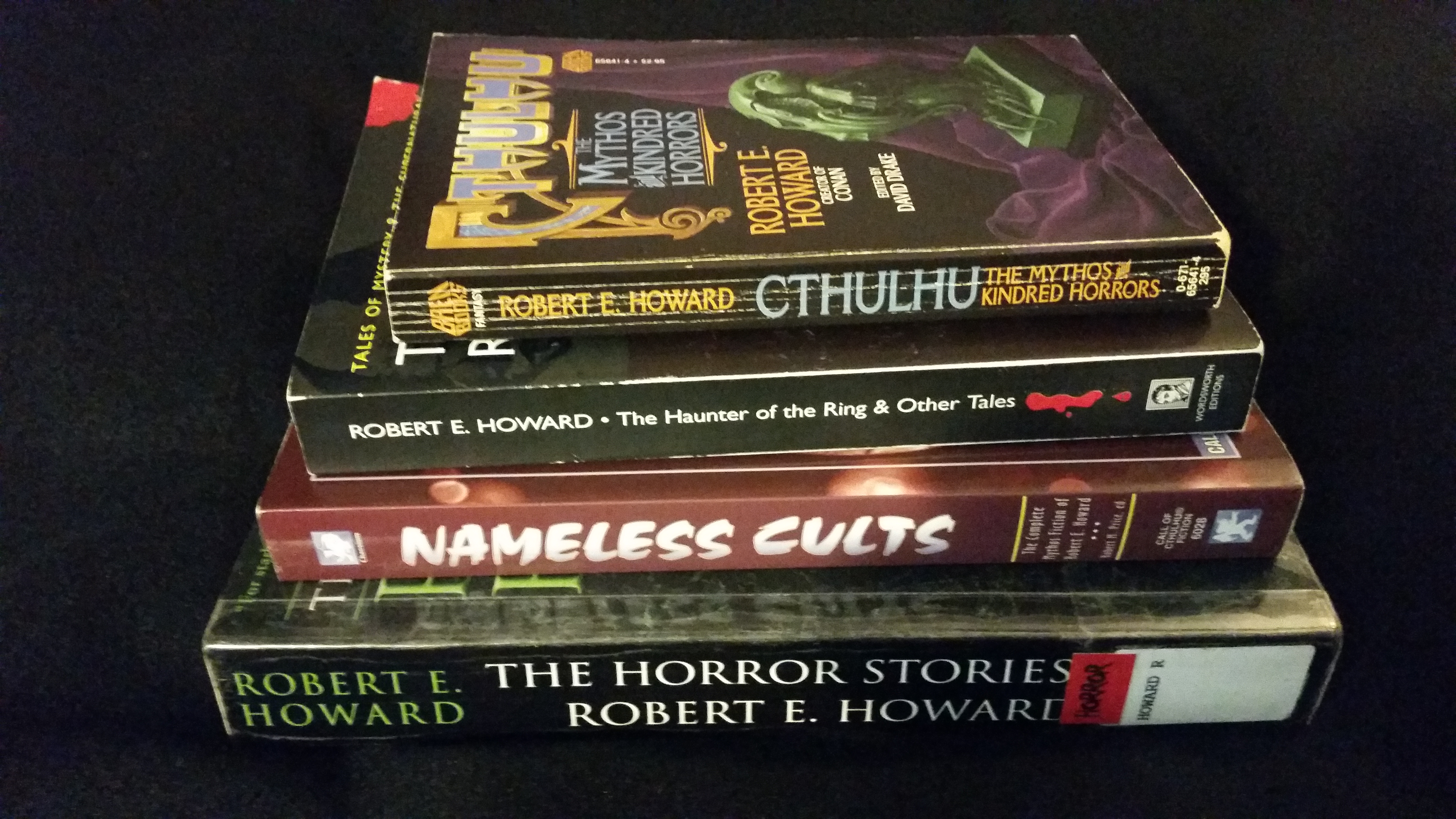
The Short Horrors of Robert E. Howard (October 2015)

The history of the pulps, both the magazines and the writers, is another subject I delved into quite a bit, and in this essay I investigated the contents of several horror-focused short story collections by the creator of Conan the Barbarian.

Remake, Revisited (January 2017)

I saw Indiana Jones and the Dial of Destiny earlier this summer, and I enjoyed it. The de-aging technology that made Harrison Ford look younger for a prologue set during World War II has continued to improve, but I couldn’t help wondering: if this technology had been available when they made Indiana Jones and the Last Crusade in 1989, would we have had the wonderful prologue with River Phoenix as young Indy?

Written in response to Rogue One, with its CGI-generated Peter Cushing and de-aged Carrie Fisher, this article has only become more relevant since. As of this writing, so-called “AI” threatens to upend every creative industry, and Hollywood writers and actors are striking, in part against the prospect of being replaced or devalued by chatbots and infinitely pliable computer simulations. The increased churn of low-quality streaming content and never-ending franchise service has reached a point of unsustainability, and audiences are already beginning to turn away. I stand by the assertion made in this article that CGI tools can be used responsibly, but they are just that, tools: algorithms don’t have original ideas, they don’t have desires or viewpoints to express, and they aren’t going to live up to producers’ fantasies of steady, guaranteed revenue forever.

Kamandi Challenge no. 9 (September 2017)

My interest in Jack Kirby’s science fiction comic Kamandi is another subject I’ve written about several times, and in 2017, Kirby’s centenary year, I posted issue-by-issue reviews of Kamandi Challenge, a tribute series in which rotating teams of artists and writers took on the character and his world, setting up a cliffhanger at the end of each issue for the next team to unravel. Issue no. 9 was a fascinating standalone story that explored some of Kamandi’s psychology and allowed me to express my thoughts on Jack Kirby’s qualities as a storyteller.

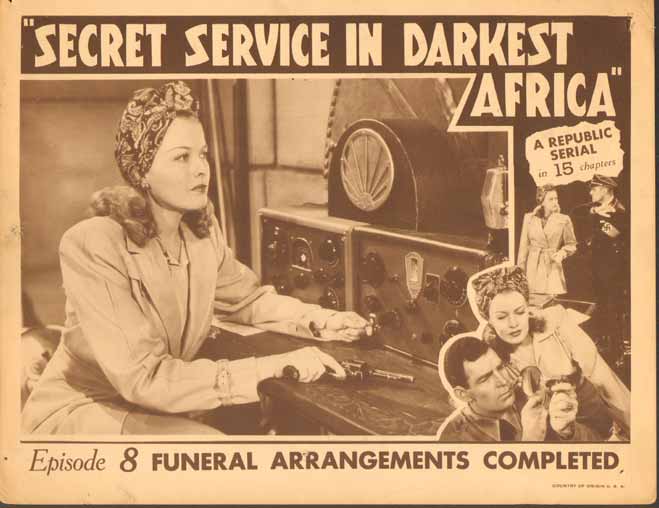
Fates Worse Than Death: Secret Service in Darkest Africa (September 2019)

A large number of my posts on Medleyana have been reviews of serials from the silent film era up to the 1950s, when the formula of narrative by weekly installment migrated to television. Although I was mostly interested in exploring the two-fisted adventure aesthetic (shared by the pulp magazines and Golden Age comics) at first, I learned a lot about plotting and setting up story conflicts with stakes, and going through each serial to take screenshots for illustrative purposes ended up being an education in composition and blocking. This review is typical, and if you enjoy it, there’s much more where it came from.

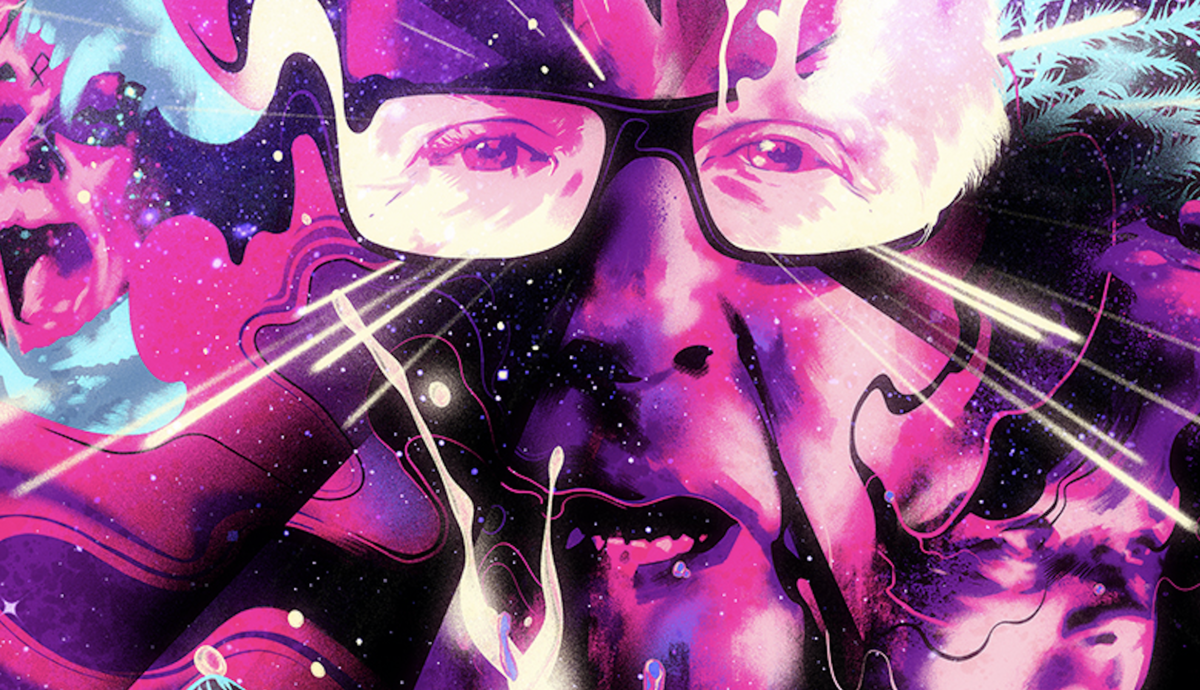
Color Out of Space: Horror Comes Home (January 2020)

Combining my interests in film, the pulps, and horror, this review gets at some of the challenges we face when we attempt to “separate the art from the artist.”

Thoughts on Electric Light Orchestra’s “Twilight” (March 2021)

When I began Medleyana, I thought I would primarily write about music. This article is a bit of a throwback in that it combines a couple of topics and bounces them off each other, but it’s also a good indicator of my increased interest in anime over the last decade as I examine the seminal fan film Daicon IV and its legacy.

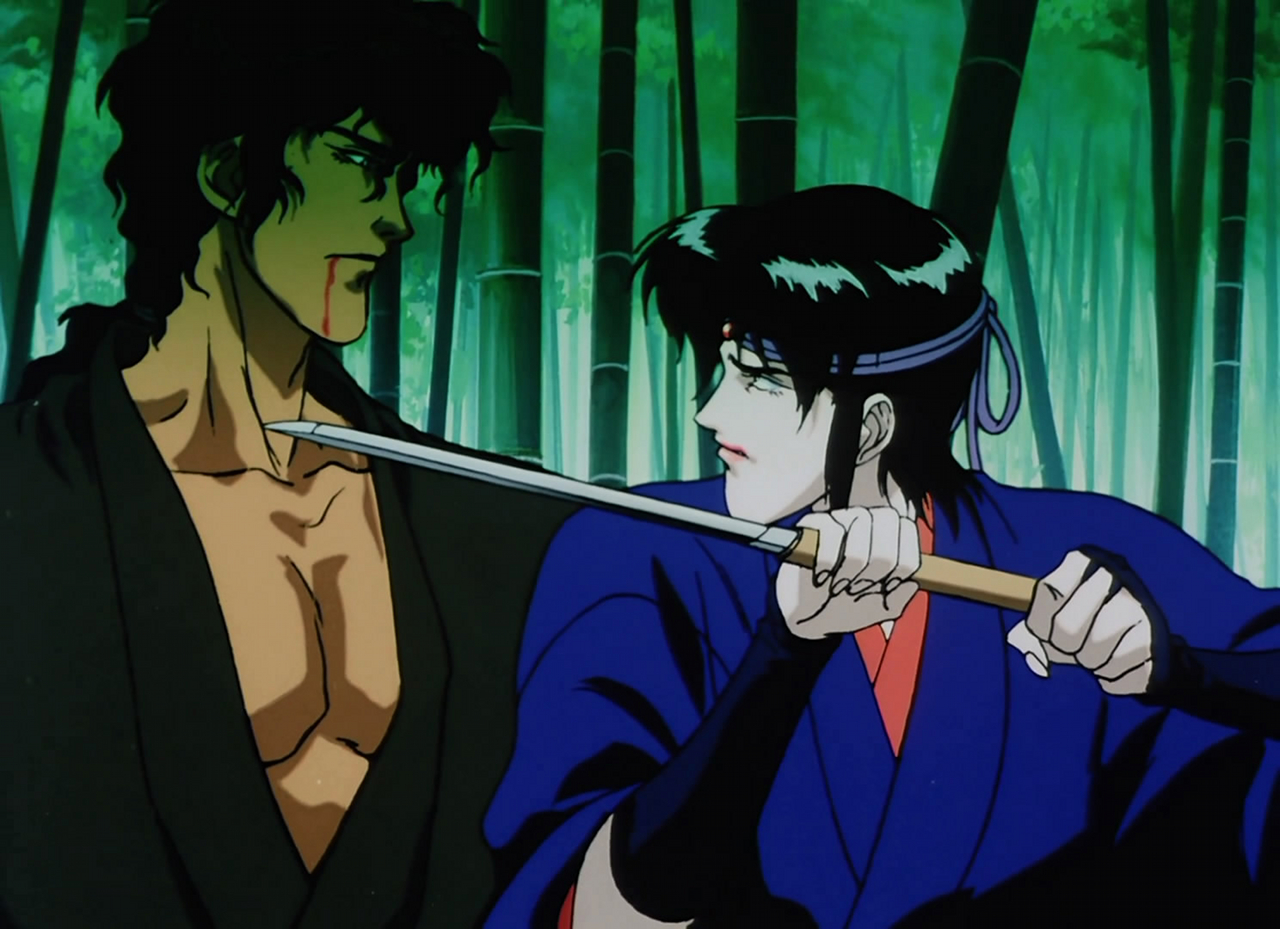
Revenge of the Ninjanuary: Ninja Scroll (January 2022)

Speaking of anime, this review is an example of that interest as well as representing my growing interest in martial arts and ninja media.

Halloween on a Monday: Spooktober 2022 (October 2022)

From the beginning, I’ve celebrated Halloween on the blog, culminating with a month’s-end list of spooky movies I watched and other activities I participated in. Last year’s wrap-up included meditations on the passage of time, mortality, and the reasons we like to scare ourselves, a theme that Medleyana ended up exploring much more than I expected when I began writing. I had just turned 40 when I started this blog, and now I’m 50. (It’s been a year since my wife was treated for the cancer I mention in this post, and she’s doing well, thanks for asking.) The last decade has been one of exploring interests that had been set aside because of school and work, including many new discoveries that hadn’t even been on my radar before I started writing. (It’s a good thing I had such an open-ended format from the beginning.) If I haven’t accomplished everything I set out to do, I’ve had other opportunities and made new friends that I didn’t expect. The very landscape of the internet has changed since I started—it’s mostly worse—but I’m proud of what I’ve created. It’s been a journey. Thank you for coming along with me.

Disenchantment, Season Two

“Everybody talks about ‘happily ever after.’ Y’ever try to read about the after? Ya can’t! The book just stops!”

So says King Zøg in the fourth episode of the newest season of Disenchantment, the animated series co-created by Matt Groening and Josh Weinstein, and which premiered Friday on Netflix. It’s a sentiment that many fantasy spoofs and “fractured fairy tales” have expressed in one way or the other, and it’s at the heart of the series’ interrogation and deconstruction of fantasy tropes. The context of Zøg’s lament is the fallout of the events that ended the first season: with Zøg’s first wife, Queen Dagmar, revealed to be a conniving sorceress who turned most of the population of Zøg’s kingdom to stone (they got better), and his second wife, the amphibious Oona, divorcing him and taking up a new career as a pirate, Zøg is disillusioned, depressed, and alone. Alone, that is, until an encounter with the mysterious, forest-dwelling Ursula, a forest selkie who can alternate between human and bear forms with the aid of her magical pelt. Zøg is smitten, and invites Ursula to live with him in the castle, where she struggles with the human business of wearing clothes and eating with knife and fork. Zøg knows her secret, and he senses that she wants to return to the forest: he knows that without her bearskin she will be a human, and belong to him, forever.

Zøg’s brush with temptation is, of course, the setup to a classic fairy tale, and probably the most direct borrowing in this second series of ten chapters. It’s also one of several episodes that focus on side characters, instead of the lead character, Zøg’s daughter Tiabeanie (nicknamed “Bean”). Like previous Groening-created series The Simpsons and Futurama, Disenchantment builds out a troupe of colorful supporting players, and one could even say (cliché alert!) that the series’ setting, Dreamland, is nearly a character itself. New developments in the second season include the continuing aftermath of Dagmar’s betrayal (Zøg spends the first couple of episodes alone, surrounded by the petrified remains of his subjects, and the desolate kingdom is looted by barbarians) and the influx of a population of elves, whose slumlike living conditions are a fertile source for new plots.

Still, Tiabeanie (voiced by Abbi Jacobson) remains the show’s heart, and it is her trials that are the show’s main focus. At the end of the first season, Tiabeanie had been spirited away by her mother, Dagmar, on a ship after Dagmar’s magical attack. Taken to the desert kingdom of Maru, she is introduced to the two mysterious strangers who sent the demon Luci to corrupt Bean, and who were occasionally seen watching her through a magical fire, in the first season: they turn out to be Dagmar’s brother and sister, Croyd and Becky (err, Rebecca). In the first episode, we learn of a prophecy that Bean would be the greatest woman of her age, as well as a family curse: madness, striking members of every other generation. Bean distrusts the obviously unstable Croyd and Becky immediately, only gradually realizing that her own mother is the real threat. Dagmar intends for Bean to fulfill the prophecy, even if it means screwing a painful-looking crown directly onto her head. Even after escaping Maru and seemingly ridding herself of Dagmar and her schemes, Bean continues to dream of her mother and find signs of her lingering influence, including a very creepy music box. Bean’s gradual discovery and processing of the truth about her lineage is the main long-term arc in the second season, and like the first it ends on a cliffhanger. The pleasure is in the many digressions and side quests along the way.

Perhaps it is simply the difficulty of maintaining an air of mystery as characters and settings become familiar, but even as Disenchantment‘s second season shifts between settings as diverse as Maru, the afterlife, and a retro-futuristic city-state, there is less of the awe of visiting new and strange vistas than the later episodes of the first season evoked. In my review of that season, I compared those scenes to early episodes of Adventure Time, in which one of the primary appeals lay in the vast emptiness of the landscape, full of atmosphere and potential. As Adventure Time continued, it became more crowded with recurring characters and settings, and even its weirdest features became downright cozy with familiarity. That feeling of being alone at the edge of the world (or at the edge of a Legend of Zelda world map, which amounts to the same thing) became rarer. A similar process is at work in Disenchantment: even new, strange settings feel like home as long as the characters we’ve come to know are centered in them.

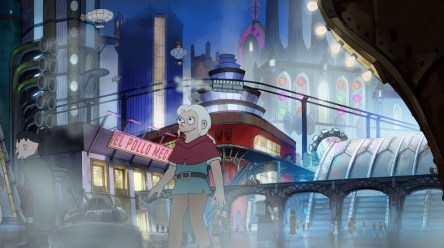
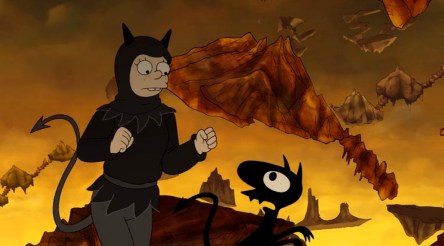
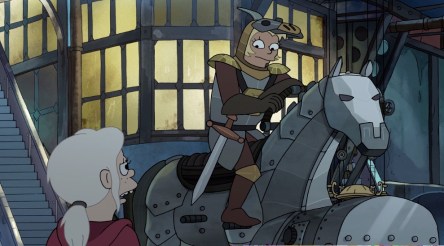
It is the nature of spoofs to puncture, to deflate: it’s probably a mistake for me to expect Disenchantment to maintain a sense of awe in a consistent way when its mode of comedy is snarky, down-to-earth–in short, Gen X. It’s right there in the title! That’s not to say that it doesn’t frequently dazzle, however. The blend of hand-drawn designs over computer-assisted 3-D models is much more seamless and less distracting in this season, for one thing, even as it becomes more ambitious: Hell, to which Bean and Luci travel in the second episode to reunite with their friend Elfo (who died at the end of the first season, and whom they must convince to leave Heaven in order to bring him back to life), is rendered as a cavernous space full of floating stone platforms, constantly in motion; the ninth episode’s Steamland scratches the itch for intricate mechanical and architectural complexities that Futurama regularly satisfied, but with a handsome nineteenth-century overlay, a city of the future as envisioned circa 1885.

Some of the more distracting story elements are also streamlined or absent. Elfo’s unrequited love for Bean, a plotline that never seemed likely to go anywhere interesting in the first season, is tempered in this one by Elfo learning the truth: that Bean chose her mother over him when using the single dose of elixir of life to revive her. Elfo (Nat Faxon) is far too good-natured to hold a grudge for long, of course, but jettisoning this particular subplot makes room for better gags and more compelling stories (including an unresolved tease about Elfo’s own parentage). As Elfo has become a little more world-weary, Bean’s other companion, the demon Luci (Eric André), has settled into his worldly existence, free of the mandate placed on him by Croyd and Becky and apparently abandoning his ambition to earn his wings (give or take a few twists in the “Stairway to Hell” episode). After winning the local pub in a bet (“and you barely cheated!”), Luci finds that slowly poisoning people is rewarding, too.

Ultimately, the theme that has remained constant throughout the series is the difficulty of being a woman in a quasi-medieval society (the “quasi” part allows for direct comparisons to the modern world, of course, and the ways in which things have or haven’t improved). At the beginning of the first season, Tiabeanie found herself unwillingly betrothed to a man she didn’t love (or even know) in order to serve her father’s political ambitions, and there are frequent reminders in the second season of her second-class status: unable to speak at court, left out of battles she is capable of fighting for herself, and even excluded from staging her own play in the theater.

Yet, the show is hardly about victimhood, as the resourceful Bean constantly finds ways to exert her will and insert herself into situations, and the male characters and their issues are frequently B-plots. Moreover, Disenchantment is full of powerful women: Dagmar and Oona, of course, but also the savage Ursula and a number of walk-ons. Bean’s trip to Steamland is illuminating not because of the city’s technological wonders but because women are free there to pursue careers closed to them in the relatively backward Dreamland. Disenchantment pokes fun at the tropes of “strong female characters” (Shelly, a circus performer, is physically strong but her real strength is in being the single mother of two kids) while centering a female perspective. On paper, Bean could easily be taken for a cliché–a hard-drinking tomboy princess–but the tight serialization of Disenchantment allows her something not all animated characters get: a sense of depth and growth over time.

Review: Disenchantment Season 1

disenchantment-netflix

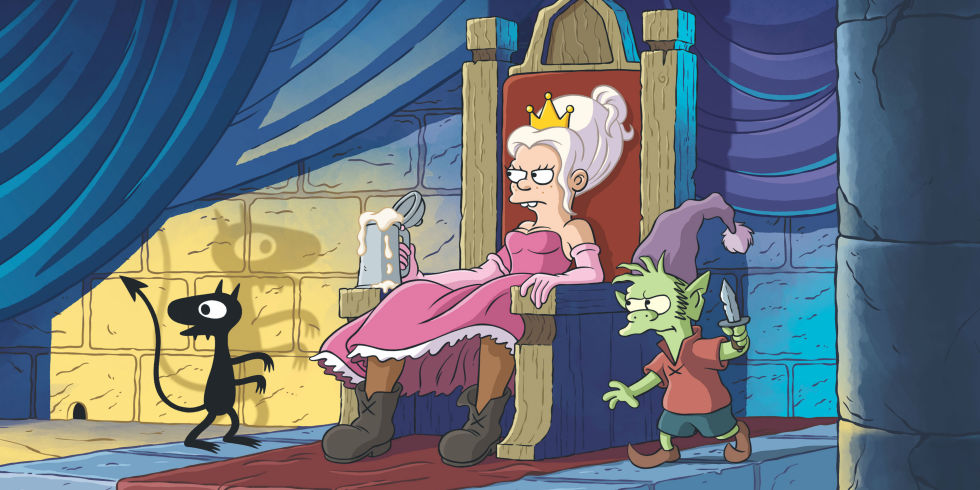
In the new Netflix animated series Disenchantment, Princess Tiabini of Dreamland, nicknamed “Bean,” chafes at the royal responsibilities of making appearances, conducting diplomacy, and above all marrying strategically. She’d rather sneak out of her tower bedroom and spend her nights drinking and carousing than play the dutiful daughter at court, and as a woman in a pseudo-medieval kingdom she has no more control over her own destiny than the poorest serf. She is, in short, a mess. Her father, the blustering King Zøg, doesn’t have the time or inclination to understand her, and in any case he has a new family to worry about, Bean’s stepmother Queen Oona and half-brother Prince Derek. What’s a girl to do?

Bean isn’t the only one who’s misunderstood and doesn’t feel that they fit in: Elfo lives and works in a secret woodland enclave of candy-making elves (a sort of combination of the Smurfs and the Keebler Elves), but he’s the only one who isn’t happy with a life of singing, dancing, and cooking. When he makes his inevitable break and leaves Elfwood, he finds his way to Dreamland and interrupts Princess Bean’s wedding to the moronic Prince Guysbert. The resulting fracas brings the pair together–elf’s blood is supposed to be the key to immortality, leading to Elfo being made a permanent “guest” of King Zøg and his court wizard Sorcerio–and sets the stage for their friendship. Both are, of course, trapped in the castle one way or another.

The third main character is equally supernatural: among the wedding gifts, Bean finds a box that looks a lot like one of the puzzle boxes from the Hellraiser movies; opening it, a demon appears and proclaims that she is now cursed and will never be rid of him. Luci, the demon, was sent to turn Bean to the dark side by a mysterious couple who monitor his progress through a magical fire, but since Bean was already troubled (and gifted at making trouble) Luci’s influence doesn’t make that much difference, and the two quickly become drinking buddies. Once the introductions are dispensed with and the stage is set, it becomes clear that Elfo and Luci are the angel and devil sitting on Bean’s shoulder (sometimes literally to make it clear), with the naïve, kind Elfo encouraging her to stay on the straight and narrow and Luci enabling her worst impulses.

However, Elfo’s inoffensive nature is mostly just “nice,” and as Stephen Sondheim famously pointed out, “nice” isn’t the same thing as “good.” Being a Matt Groening creation (with Josh Weinstein), the world of Disenchantment isn’t any more fair or forgiving than our own, and as Bean finds her place in it, Elfo learns to cut loose a little bit and begins to understand that standing up for himself sometimes means challenging what others perceive as “good.” For his part, Luci never seems all that bad (he’s “TV bad,” like Bender), and comes to feel loyalty toward Bean and even that annoying elf. In a world of shades of gray, the all-black Luci doesn’t stand out that much. (The business of Luci turning Bean toward the dark side is left unresolved in favor of other mysteries during this season.)

At first, Disenchantment looks familiar: it has a family resemblance to Matt Groening’s previous work, from Princess Bean’s buck teeth, reminiscent of Bongo, one of the rabbit stars of Groening’s Life in Hell comic strip, to the gleeful genre parody, the science fiction of Futurama replaced in Disenchantment by fantasy tropes. The cynical (or perhaps just clear-eyed) attitude of The Simpsons is as much part of Disenchantment‘s DNA as the characters’ ping-pong ball eyes. Similarly, anyone who has enjoyed “fractured fairy tale” spoofs like Monty Python and the Holy Grail or Shrek will find themselves in familiar territory: much of the humor is driven by the incongruity of essentially modern people with modern attitudes living in a medieval world alternately full of magic and high fantasy wonders on the one hand and wretched squalor on the other, the emphasis in any given moment entirely dependent on what is funnier. Ultimately, the show Disenchantment most reminds me of is Galavant (R.I.P.): while Disenchantment is (mostly) not a musical, the sense of self-aware rule-breaking and lampshading of well-worn genre clichés (and tweaking the contrast between fantasy as fun escapism and the miserable reality of the middle ages’ actual history) is the same.

Thankfully, Disenchantment takes off on its own fairly quickly, and after a somewhat stiff first couple of episodes, I was fully on board. It helps that the ten episodes of the first season are tightly plotted: The Simpsons in its classic years famously avoided almost any serialization, resetting at the beginning of each episode, and Futurama, while more serialized, struggled with episodes aired out of order and the uncertainty of renewal and being brought back from cancellation (by my count there were at least four “final” episodes, maybe five?). Being a Netflix production with all ten episodes available at once (the series premiered August 17), Disenchantment can afford to carry multiple story threads forward without losing the audience, and its initial premise of “misfits hanging out in a fantasy realm” turns out to hide an intriguing set of mysteries.

But so what? Everybody is doing that with their programs today, especially on Netflix, right? More impressively, Disenchantment is able to do this without the cop-out of essentially cutting a three-hour movie into sections: each episode (or “chapter”) has a self-contained story and can be enjoyed on its own, just like a classic sitcom. It is only as the season comes to a head that we can look back and realize how subtly ideas and plot devices were introduced that turned out to be crucial, each episode contributing a piece of the mystery and its eventual solution one step at a time. Call it the J. K. Rowling method: like Harry Potter, Disenchantment takes place in a world made up of spare parts, but the plotting and characterization breathe new life into it, and what at first seems like a generic fantasy trope often turns out to have been introduced for a very specific reason important to the plot (the tone and general aim could not be more different, of course, but I stand by my comparison).

To examine one example (and a particularly complex one) more closely, consider Dankmire, Dreamland’s neighbor and the home of Queen Oona. Given the most attention in Chapter Six (“Swamp and Circumstance”), it is revealed that King Zøg waged war on Dankmire in order to force the Dankmirians to build a canal through their wetland kingdom for the Dreamlanders’ benefit. Zøg’s marriage to Queen Oona (his previous Queen Dagmar, Bean’s mother, being out of the picture) was the gesture that sealed the two kingdoms’ treaty afterwards. Dankmire and its people make for an odd hodgepodge of “foreign” clichés, fantasy and otherwise. The Dankmirians are amphibious, with light blue skin and forked tongues; Oona’s creepy behavior is a running gag in the series. All of the Dankmirians speak with an exaggerated Slavic accent, with Oona herself (voiced by Tress MacNeille) sounding much like Natasha Fatale. The Dankmirians are not vampiric, so far as we know, but making them sound like Bela Lugosi makes the comparison to the American-accented Dreamlanders clear: Dankmire is spooky.

But in other aspects, they embody “Oriental” stereotypes, particularly the Dankmirian respect for protocol: a scene in which Luci outsmarts some pursuing Dankmirians, repeatedly bowing to them and forcing them to bow in return, thus slowing them down so the Dreamlanders can escape, reminds me of the apocryphal story (relayed by Huston Smith, who described it as an attempt to discredit Confucianism’s reverence for rules) of a high-class Chinese lady who supposedly died because she refused to leave a burning house without a chaperone. In the case of the Chancellor of Dankmire, the resemblance to a Japanese head of state is clearer both in his visual appearance and his accent (I was reminded of the crypto-Japanese Trade Federation in The Phantom Menace), and a scene in which an inebriated Bean vomits on him recalls a similar incident between President George H. W. Bush and the Prime Minister of Japan in 1992.

(A truly bizarre twist occurs later in the episode when the Dreamlanders fall into the hands of a pair of Dankmirian hillbillies, locals displaced by the canal King Zøg forced Dankmire to build: they are stereotypes as broad as Cletus on The Simpsons, but they continue to pronounce their “w”s as “v”s, making them a bunch of blue-skinned white trash Draculas. Like I said, weird, even for a fantasy program.)

None of this is to suggest that “Swamp and Circumstance” was written with racist intent, or even that such references were inserted deliberately, but that notions of the “other” from human history inevitably inform our fantasy worlds, perhaps all the moreso when modern references are freely overlaid. In addition to its general lack of reverence for the institutions of royalty, Disenchantment is more progressive than many classic works of fantasy (a gay relationship among the King’s staff is treated as neither a joke nor a scandal, and is hardly a plot point at all: it just is), but still begins from the starting point of the European middle ages as the default for the genre. I suspect that, as with George Lucas in the previously mentioned Phantom Menace, ethnic caricatures recur as character types because of their roots in earlier film and television as literal “color,” keeping stereotypes alive for their entertainment value even if no malice is intended. Making them into aliens or supernatural creatures may lend plausible deniability, but the implications can be troubling nonetheless. (On the other hand, Groening is from a generation of humorists who don’t see anything as off-limits; considering his reaction to the criticisms of Apu on The Simpsons, he would probably just conclude that I lack a sense of humor.)

Having said all that, “Swamp and Circumstance” is one of the best episodes of Disenchantment, and Dankmire is a richly-realized setting that I wouldn’t mind revisiting in a future episode. While I love picking apart the diverse influences that may have gone into it, Dankmire’s synthesis of those elements succeeds in fleshing out what starts as a simple foil to Dreamland’s “normalcy.” Dankmire also gave us one of the series’ funniest incidental characters, Chazz, a send-up of aggressively chummy waitstaff everywhere, appearing first as a (possibly deranged) spa attendant in Chapter Four (“Castle Party Massacre”) and showing up in “Swamp and Circumstance” as a passive-aggressive waiter. “I vill bring you vat you deserve,” he tells a temporarily teetotaling Bean.

Another interesting twist on a common formula is the show’s treatment of Bean’s relationship with Elfo. Predictably, Elfo develops a crush on Bean (“I like big girls,” the diminutive elf tells her at one point), and the show even points out the cliché with the royal scribe narrating their developing relationship with the words “will they or won’t they?” This is easily the most tedious subplot in the season, but it does lead to some sublime payoffs. Even as flawed as she is, Bean is pretty clearly out of Elfo’s league: there is an echo of Futurama‘s Fry and Leela, but I was reminded even more of Dipper’s crush on the older, cooler Wendy in Gravity Falls. However, since the story is largely from Bean’s point of view a relationship never really seems that plausible, and it’s clear from early on that Elfo is just the worst: beyond being a wimp, he is self-pitying and manipulative.

In Chapter Seven,”Love’s Tender Rampage” (another high point), Elfo’s face-saving claim to already have a girlfriend results in Bean sending the kingdom’s knights on a quest to rescue her. When they bring back the seemingly monstrous Tess (presumably short for “giantess”), Elfo just digs himself deeper and deeper by piling on the lies, a recipe for farce that delivers some of the series’ biggest laughs. Still, the season ends uncertainly, with the feeling that maybe there is something to Elfo deserving of Bean’s loyalty, if not her love. Characters change throughout the course of the season, and Elfo is no different, finding resources within himself and learning that growth is possible.

On the production side, the animation finds its groove quickly; the use of 3-D computer modeling with a hand-drawn “skin,” which worked so effectively for the sleek buildings and machines of Futurama, is a little disorienting when applied to the analog lines and textures of a stone castle, but the approach allows for some exciting tracking shots through the busy walled city that surrounds King Zøg’s castle, and later in the series there are some dazzling shots of exotic locations such as a city half-buried in the desert. There are some compositions that will stick with me long after the memory of the plot has faded as well: a shot of the mysterious couple who unleashed Luci, alone in their oversized lair, reminds me of the early episodes of Adventure Time and the weirdly enticing atmosphere that show spun out of emptiness and slabs of raw color.

Many of the voices are familiar from Futurama, including regulars MacNeille, John DiMaggio, Maurice LaMarche, and Billy West. King Zøg, voiced by DiMaggio, sounds like a mixture of Bluto with a little of Burt Lahr’s Cowardly Lion, appropriate for a character who is basically a medieval Archie Bunker (it’s a credit to DiMaggio that for an actor with such a distinctive voice, I didn’t hear Zøg and immediately think, “Hey, that’s Bender!”). Abbi Jacobson plays Bean, and, appropriately enough for the show’s emotional center, she comes off as a normal person. Nat Faxon’s Elfo is appropriately a bit more “cartoony,” and Eric André’s Luci is chill to the point of being deadpan. Among numerous others, I should also single out Matt Berry, who is perfect as Guysbert’s younger brother Prince Merkimer, a swaggering, self-important dufus definitely in the Zapp Brannigan mold (he goes through some changes, too, but I won’t spoil that development–suffice it to say that his subplot is another example of the show’s serialization: no reset button between episodes!).

Finally, Mark Mothersbaugh provides a whirling brass band theme song that smartly captures the show’s irreverent approach to its predecessors. It’s true that many stories have deconstructed fantasy tropes before, to the point that it can be considered a genre unto itself, but the tight plotting and secret warmth that lies beneath Disenchantment’s crusty exterior prove that there are still new stories to be told within it.

Review: Shin Godzilla

shin-godzilla

By now it is commonplace to observe that apocalypse figures so largely in Japanese science fiction because Japan is literally a post-apocalyptic society: the many scenes of civilians evacuating their homes or running from disasters in Japanese cinema are drawn from cultural memory, and frequently add pathos and potency to premises that might seem silly if the focus wasn’t kept so clearly on the people they affect. Shin Godzilla (aka Godzilla Resurgence), the first of a new series starring the venerable monster, keeps the memory of Hiroshima and Nagasaki front and center, along with echoes of 9/11 and the Fukushima meltdown. Written and directed by Hideaki Anno, it’s not quite as somber as Gareth Edwards’ American Godzilla of 2014, but it’s a serious film: there is none of the kid-friendly pro-wrestling action of the Showa series or the overstuffed craziness of the last Japanese Godzilla, 2004’s Final Wars. The only friendly-yet-sinister aliens in Shin Godzilla are the Americans who promise military aid when Godzilla lays waste to Tokyo, but with strings attached; and will their proposed solution be worse than Godzilla himself?

Shin Godzilla‘s tone is dry, sometimes documentary-like, complete with captions identifying speaking characters (almost entirely professionals: politicians, scientists, military, and first responders) and found footage. The approach is fitting for the story, which centers on an aspiring pol named Yaguchi (Hiroki Hasegawa) who fights against both the sclerotic bureaucracy of Japanese government (so concerned with adhering to protocol and passing the buck that little gets done, especially early on) and the machinations of the American and other international forces (whose interest in Godzilla includes the scientific knowledge to be discovered in his unique biology, as well as the economic and military leverage they can exert over Japan).

Yaguchi, young and headstrong, assembles a team of “lone wolves” from all disciplines to stop Godzilla, and their work as a team of equals is an obvious contrast to the hidebound cabinet surrounding the Prime Minister (Ren Ohsugi). Numerous montages of Yaguchi’s team in action borrow the language of low-angle shots, quick cuts, and wicked guitar riffs seen in commercials for businesses that sell “solutions.” The film is thus essentially a procedural, following a combination of political, military, and scientific campaigns, part The War Room and part Apollo 13. The older generation of politicians is represented as well-meaning but too set in their ways to effect much change, and change is what is needed: to stop Godzilla, and to solve the larger problem of Japan’s cultural and economic stagnation. The Americans (including a Japanese-American aide played by Satomi Ishihara) are not portrayed as harshly as, say, the Americans in Joon Ho Bong’s brilliant Korean monster movie The Host, but the Japanese view of America as perpetually occupying or dominating Japan is made quite clear (“The post-war goes on forever,” Yaguchi observes at one point).

Even the naming rights to the monster take on international dimensions: one of the few moments of comic relief involves the difference between the Japanese name “Gojira” and the Americanized “Godzilla,” a sometimes-contentious subject among fans. And speaking of unintentional comedy, Shin Godzilla‘s occasional forays into English dialogue are . . . idiosyncratic, to say the least (one American scientist casually drops “Our nuclear wisdom will be mankind’s savior” into a conversation, which got a few chuckles, from me at least).

That dry tone makes the scenes of destruction all the more shocking when they do occur. Godzilla’s arrival begins with a mysterious eruption in Tokyo Bay that closes down an underwater tunnel and sends geysers of steam skyward. After a series of inconclusive committee meetings, a huge (and supremely weird) amphibious animal appears and waddles on to land, plowing through a river full of boats and streets full of cars, pushing them out of the way as if they were toys. The reassuring evaluation by scientific consultants (as well as the extended treatment of Godzilla’s radioactive metabolism) show the influence of Darren Naish and other “speculative biologists,” if only to tweak their assumptions: the amphibious creature could never support its weight on land . . . until it does. A creature of its size would be unable to metabolize enough oxygen to live . . . unless it were a living nuclear reactor! It’s not even clear at first that the creature is Godzilla: this version of the famous kaiju takes on multiple forms, “evolving” like a Pokémon as it gathers energy.

In his final form, Godzilla has the familiar thick-legged outline (but with tiny, tyrannosaur-like arms and a long tail), but his hide is creased with red lines where he glows from within, giving him a demonic, flayed appearance. Finish the design off with beady, inexpressive eyes (“like a doll’s eyes”) and you have a terrifying (and fantastically huge) take on the character, a perfect update of the original Godzilla‘s vision of the monster as enigmatic, unknowable being and force of nature. Extrapolating on the creature’s radioactive origin and fiery breath, Anno comes up with some truly devastating applications, including focused beams (from Godzilla’s mouth and dorsal spines) that are more like lasers than flame-throwers. The result of Godzilla unleashing this force in the middle of Tokyo at night makes for a tense and unnervingly one-sided battle against military helicopters. The resulting irradiation of parts of the city, and the serious issues of when and how to evacuate civilians, raise echoes of the long displacement that followed the tidal wave and meltdown in Fukushima (like the scenes of evacuating crowds, clips of civilians in long-term shelters strike a deeper chord than they might if they only sprang from the screenwriter’s imagination).

As far as the production goes, Shin Godzilla has the most seamless mixture of CGI and practical effects I have yet seen, comparable only to Edwards’ film (and for the record, Anno isn’t nearly as stingy with footage of the monster as Edwards was); the sound design puts viewers right in the middle of the action (particularly in the theater), and it’s gratifying to hear passages from Akira Ifukube’s original Godzilla music on the soundtrack. Shin Godzilla is a worthy successor to the legacy of the King of the Monsters, balancing its weighty political themes with incredible spectacle and an exciting scientific race against time.

Review: Monster, 1959

cover illustration by Owen Richardson

cover illustration by Owen Richardson

K. leaps into existence amid them all, shark-eyed, snake-tongued reality: misery given form, solid and undeniable and taller than Hell itself. Feathers like a bloodsmear across his thorax, claws lashing furrows in the ground. Gangs of teeth glaring at the crowd over his lipless slash. Everybody screams.

It sounds like science fiction, and in strict terms, it is. The plot is the most familiar element of David Maine’s 2008 novel Monster, 1959–explorers discover an extraordinary monster on a remote Pacific island, and after restraining the beast they transport it to America to put it on display, after which eventually everything goes to Hell–but the novelty of the story isn’t really Maine’s concern. Monster, 1959 is the kind of novel that applies probing psychological realism to genre material, finding unexpected complexity beneath the surface of broadly-sketched stock types. What Katherine Dunn’s Geek Love did for Freaks and its body-horror descendants, Monster, 1959 does for King Kong and the monster movies of the 1950s.

If so many of the alien-invasion and monster-rampage stories of the Cold War were metaphors for political anxieties, postwar social displacement, and the catch-all term “future shock,” Maine is concerned with re-literalizing those metaphors, making sure that his fanciful monster mash takes place in a world that includes not only Hiroshima and Nagasaki and the bomb tests on Bikini Atoll, but also the infamous Tuskegee Syphilis Study and the eviction of Palestinians from newly-formed Israel. Maine’s omniscient shifts in focus from close-ups on the main characters to the wide shots of world events is reminiscent of the intriguing book Welcome to Mars by Ken Hollings and Erik Davis, which also shares Monster, 1959‘s year-by-year structure in making connections between seemingly disparate strands of history and popular culture.

In Monster, 1959, the main characters are the giant chimerical monster K., for “Kama ka,” the name given to him by the islanders who worship him as a god (but perhaps also standing for Kong, or kaiju, or in reference to the monogrammatic protagonist of Franz Kafka’s The Trial); Betty, the white woman whom K. first abducts and then finds himself strangely bonded to; and Johnny, the square-jawed man of action and Betty’s husband/rescuer. In retelling this age-old but highly specific beauty-and-the-beast tale, the members of the central triangle (and numerous characters who enter their orbit) are given shading and moral ambiguity, and of course relevance beyond the single story.

The novel’s most winning creation is K. himself, and Maine effortlessly relates events from K.’s perspective: animalistic, responsive to direct stimuli, and without much imagination or sense of the past or future. Despite the limitations inherent in writing from this point of view, Maine sketches a believable (and believably mysterious) persona. It’s common for audiences to partially identify with King Kong or Godzilla, but Maine is interested in what it would really feel like to be such a creature. While there is a fair amount of action in the story (“some sci-fi monster violence,” as the MPAA would have it), for all his size and power, K. is not the bloodthirsty predator one might expect; in fact, he’s a vegetarian. K.’s reactions to the humans invading his domain, the strange effect that Betty and her singing have on him, and his confusion at the series of entrapments and enclosures that he endures convey both how alien K.’s mentality is, and how alienating the modern world is when seen anew. Like the greatest movie monsters, K. is fearsome but ultimately sympathetic.

K., chained and transported in a custom box car, drugged and put on display in one roadshow after another, isn’t the only character who is trapped. There’s Doug, the seven-foot-two circus performer whose freakish height has come to be just as much a prison, and to whom the duty of administering K.’s sedatives has devolved. “It would be falsely melodramatic to say,” Maine tells us, “When Doug injects K., he feels as if he is injecting himself.” All the same, he does become disenchanted and disgusted enough to begin passive-aggressively slacking off, a decision that makes K.’s dramatic escape from confinement while performing at Madison Square Garden as inevitable as the failure of Jurassic Park’s electric fences. Life finds a way.

Betty, whom K. abducts all over again in New York, is not just a damsel in distress, but a woman of her generation whose deepest urges tell her to “throw herself into” her marriage and to give Johnny the benefit of the doubt. This extends to playing along with their friend Billy’s scheme to take the monster on tour, reenacting her abduction as a modern Romeo and Juliet story for paying audiences, against her better judgment. Johnny, over the course of the novel, finds that his experience in rescuing Betty has awakened a taste for adrenaline and alpha-male displays of prowess, a search for ever-greater highs that is ultimately his undoing. Ultimately it comes down to sex in forms as polymorphous as K.’s own mismatched body. “By now,” Maine writes after a particularly perverse episode, “you might be forgiven for wondering: Are there any normal people in this movie? It’s a fair question. To which the only possible answer would have to be: Are there any normal people in the world?

Finally, Monster, 1959 is no mere pastiche or stylistic exercise. Like the best environmental horror, it’s a warning, with K., the troubled child of the atomic bomb and master of an island of mutated terrors, returning like a bad dream to the country that created him and had hoped to forget him. Just as in a movie, the monster may be dispatched, but audiences know the fears that created it are still out there, and the monster can always come back.

THE END . . . ?