Guardian of the Gods: A Tribute to Nathan Rabin

This article was written as a tribute to Nathan Rabin, whose many columns on such diverse subjects as cinematic flops, Insane Clown Posse, and the ranking of the International Movie Database’s user-generated Top 250 have inspired me and other readers of The A.V. Club and The Dissolve over the last ten years. My look at Guardian of the Gods is inspired by Rabin’s long-running “Silly Little Show-Biz Book Club.” I wish “Nabin” good luck, wherever he lands next.
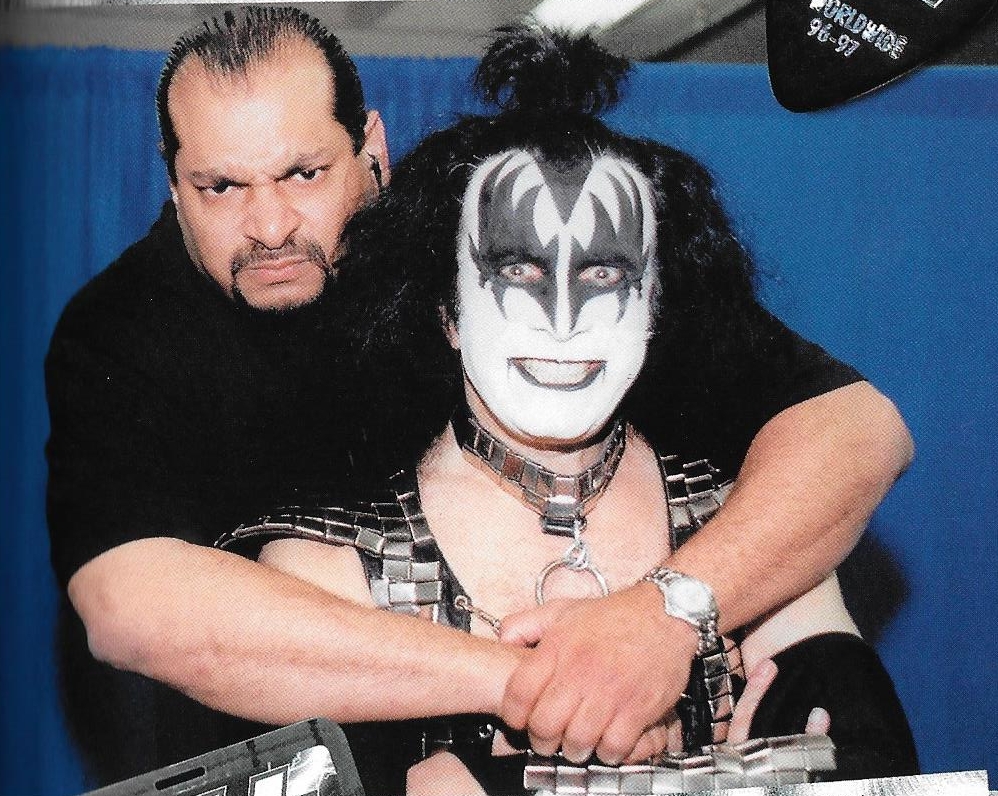
Andre Augustine with Kiss' Gene Simmons (Simmons is on the right)

Andre Augustine with Kiss’ Gene Simmons (Simmons is on the right)

How silly is Guardian of the Gods, Mark Rodgers’ 1999 profile of rock-star security director/road manager Andre Augustine? Most of it isn’t that silly at all, actually. The silliest thing about it is its bombastic title (which actually appears in the text as the breathless answer to a bystander’s question, “who’s he?”), and a cover blurb that promises a book-length description of Augustine wrecking fools who dare to breach the security perimeter around the stars he’s sworn to protect. There are also a few passages that walk the fine line between PR puffery and ardent fanfic, like this description of Kiss in concert:

Gene prowled the stage as though looking for victims. Paul danced like a gazelle. Ace, his human form merely a vehicle for some cosmic musical force, played flawlessly. And Peter looked like he was driving the world’s most powerful Mack truck. The moment was truly surreal.

Most of the book, however, which outlines Augustine’s career from his early athletic experience (he had a stint as a linebacker for the New York Jets) to handling security for rap acts like Run-DMC and N.W.A. before transitioning to working with rockers Aerosmith, Bon Jovi, and Kiss (among others), is a sober-minded account from a music-industry insider. Rodgers promises up-front that the book is not a tell-all: although there are numerous anecdotes about Augustine’s famous clients, the emphasis is on the competence and professionalism of Augustine and his fellow “road warriors.”

In many ways, Guardian of the Gods is a business card in the form of a book: as Augustine was (and continues to be) active in the industry, it tells potential clients, “I take your safety and success seriously; I am discreet; you can trust me not to do or say anything that will make you look bad in public (unless your name is Ace Frehley, or you are a member of Nelson).” Augustine emphasizes his hatred of drugs and they are, for the most part, mentioned only as something in the artists’ past or a bad influence brought to the venue by crowds. Although the phrases “rock ‘n’ roll circus” and “rock ‘n’ roll zoo” are used more than once, the unspoken message is, “I am one of the grown-ups.”

The feeling that the intended audience for this book is fellow professionals rather than starry-eyed fans or gossip hounds extends to the clinical distance with which Rodgers treats the rap phenomenon: Augustine got in on the ground floor of rap’s conquest of the American musical scene, accompanying Run-DMC and the Beastie Boys on their first US and international tours. However, while Augustine is African-American, his middle-class upbringing didn’t include the street experiences that shaped his first clients, and in addition to explaining African-American culture in the nerdiest way possible (“Artists on the Dope Jam tour participated in the daily game of ‘dozens,’ the verbal art of put-downs and a common practice with many of today’s urban youth,” reads a typical passage), Rodgers takes pains to let his (presumably white) readers know that rappers are really just regular guys and the reports of violence that trailed Run-DMC’s early concerts were completely exaggerated and misinterpreted. (It is interesting to see the lengths Rush Productions went to reassure skittish promoters that security would be tight, including press releases and news reports from the time: Rodgers’ use of multiple sources to provide context to Augustine’s story is a strong point of the book.)

Nevertheless, it’s with an almost audible sigh of relief that Augustine moved from protecting rappers to accompanying the relatively staid arena rock giants of the ’90s. Tensions ran high as Augustine tried to provide security for N.W.A., whose hit song “Fuck Tha Police” made it difficult, if not downright impossible, for him to coordinate his efforts with local law enforcement. The last straw was a threatening message left on manager Jerry Heller’s answering machine around the time Ice Cube left the group. Augustine doesn’t relay the message or name the person who left it, but it’s strongly implied that it was Death Row Records’ notorious founder, Suge Knight (darn it, that’s your problem, Andre: you’re just too dedicated to guarding your employers’ secrets!).

The not-very-sensational facts of Augustine’s experiences are mostly short on the kind of sex-and-drugs stories one might expect from a Silly Show-Biz Book, but Guardian of the Gods does provide copious detail about the procedures and challenges of keeping a touring band safe and on track, as well as portraits of many of the stars Augustine worked with. Augustine stresses that it’s hard for rock stars to have close friends: “It’s almost impossible to have a rock star you work for be your friend. . . . You are never really his peer,” he says, and adds that ego and isolation make it difficult for successful artists to befriend each other. Some of his work included making introductions between stars who were publicly feuding (or were perceived to be), a back-channel process as delicate as establishing diplomatic relations between rival governments. “Their egos won’t allow [friendships]. . . . But they would ask me, ‘What are the Aerosmith guys like?’ or ‘Are the Kiss guys fun to hang out with? What do they like to do?’ Privately, I think they are very curious about each other.”

Still, the long weeks and months of close contact with the artists on their tours and accompanying them as a personal bodyguard meant seeing them in private moments and just hanging out, and Augustine was close enough with many of them that he named his son after Run-DMC’s Jam Master Jay and mourned N.W.A.’s Eric “Eazy-E” Wright when he succumbed to AIDS. Friends or not, it’s clear that Augustine’s people skills are as important to his work as his organizing abilities and imposing physique.

In many ways, the stars’ personalities are about what you’d expect from their public personas: George Thorogood liked to spend his free time watching baseball and having a quiet drink in the bar; Jon Bon Jovi and Aerosmith’s Joe Perry spent a lot of time exercising; Kiss guitarist Ace Frehley took five suitcases of computer equipment with him on the Alive tour, possibly to distract himself from the drug and alcohol addictions that still haunted him.

Scouring concert venues for groupies is alluded to but mostly glossed over; although Augustine mentions that he always carried condoms when accompanying Gene Simmons, he says the practice of moving pretty girls to the front row has been overstated, and that finding high-energy fans was the first priority when offering ticket swaps. By the mid-’90s, many of the artists Augustine accompanied were family men, traveling with their wives. (Amusingly, the audiences for the single young rap artists he started off with were often dominated by teenage boys. “Where are the women at?” he says the rappers would ask.) What’s left are quirky but tame tidbits like Run-DMC’s penchant for wearing brand-new underwear and socks, fresh from the package every day, or an anecdote about Bon Jovi drummer Tico Torres’ insistence on shopping for antiques in Bogotá, Colombia, even in the face of kidnapping threats (nothing dangerous occurred).

Some of the funnier parts of the book involve Aerosmith lead singer Steven Tyler, who, if Guardians of the Gods is to be believed, may actually be the Joker when not performing: one time backstage, Tyler stormed into his dressing room. Concerned, Augustine followed and asked him if something was wrong.

Steven looked up and his eyes flashed wildly at Andre. “Yeah. As a matter of fact, there is something.” He stood up, turned his back to Andre and started rifling through his gig bag. Andre, rethinking his decision to enter Steven’s dressing room, suddenly felt like disappearing. Steven continued, “There’s something about you that has really been pissing me off lately, that I don’t like. I don’t like it at all.” Andre felt the blood drain from his face. “You don’t smile enough, man!” Steven turned his hand to reveal a gag set of chattering teeth. “Smile, man!”

Although the members of the band like each other, “Steven always has a private dressing room because the rest of Aerosmith prefers not to be in the same room with him prior to curtain.” He’s just too hyperactive: “Steven is supercharged and outgoing. He is constantly trying to make you laugh, messing with your ears and tickling you. Steven is a fun person, but he’s just out there.”

Imagining the soft-spoken “gentle giant” security guard and the flighty, flamboyant lead singer together suggests that any Hollywood producer interested in developing an odd-couple buddy comedy set in the world of rock ‘n’ roll should consider optioning Guardian of the Gods. They wouldn’t even have to cut anything to get a PG-13 rating.

My 2014 in Books

As I’ve mentioned before, I’m not usually one to keep a list of everything I read or watch, but in 2014 I kept a list of books I had read, in part because I was conscious that I wasn’t reading as much as I used to. Although the number this year is relatively small, I’d say the mixture of non-fiction and genre fiction is fairly typical of my reading in the last few years. The list includes some graphic novels and collections of comics, but not single comic book issues (which I’ve also fallen way behind on). It’s also influenced by subjects I was writing about; however, it only includes books I read from cover to cover, not those I dipped into for reference. Finally, all but one was a first-time read, although I had read parts of some of them in the past.

wpid-20140720_141419.jpg

January
Batman: Odyssey, Neal Adams
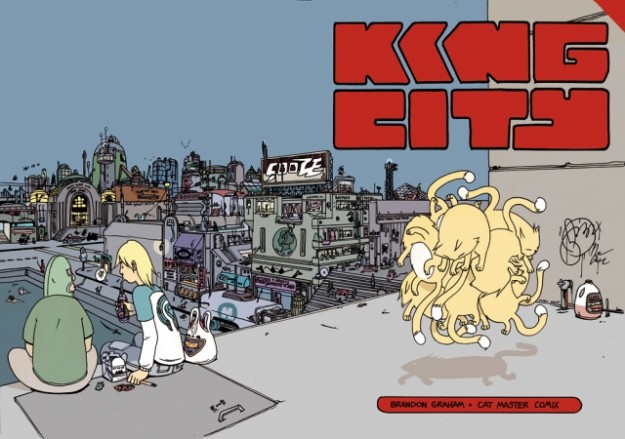
King City, Brandon Graham

February
The Look of the Old West, William Foster-Harris

March
Inventing Kindergarten, Norman Brosterman
Great American Folklore, Kemp P. Battle

April
The Old Patagonian Express, Paul Theroux
The Great Movie Serials: Their Sound and Fury, Jim Harmon and Donald F. Glut

May
Cliffhanger: A Pictorial History of the Motion Picture Serial, Alan G. Barbour
Misery, Stephen King

June
The Lost Worlds of Power Vol. 0, ed. Philip J. Reed

July
Showcase Presents The Great Disaster Featuring the Atomic Knights, various

August
The American Book of the Dead, Stephen Billias (reread)

September
The Bloodhounds of Broadway, Damon Runyon
The Extraordinary Adventures of Adèle Blanc-Sec, Jacques Tardi

October
Showcase Presents Captain Carrot and His Amazing Zoo Crew, various
All The Wrong Questions: “Who Could That Be at This Hour?”, Lemony Snicket
The Maltese Falcon, Dashiell Hammett

December
The Lost Worlds of Power, ed. Philip J. Reed
All the Wrong Questions: “When Did You See Her Last?”, Lemony Snicket
Crab Monsters, Teenage Cavemen, and Candy Stripe Nurses: Roger Corman: King of the B Movie, Chris Nashawaty

Much of my thinking on what I read this year has already been included in the articles to which they are linked, and since most of what I read was published before 2014 and is in a diverse range of genres, ranking them seems pointless. I am struck, however, by how long ago some of the books I read in the spring seem to me; I might not have remembered that I read them this year at all without this list, instead consigning them to a hazy, indistinct “past,” even though I enjoyed many of them. To tell the truth, even September seems a long time ago from this vantage point. Such is the telescoping effect of the end-of-year holidays, I guess.

It strikes me, however, that I began and ended my year with two very different books that explored the rush of unbridled creativity in different formats. (Sorry, Batman: Odyssey, I don’t mean you, although you were memorable in many ways.) Brandon Graham’s King City is a graphic novel set in the futuristic metropolis of the title; its central character is a young man returning to his old stomping grounds after training with a mysterious group that uses multi-talented cats as weapons (yes, it is quite strange, but that description doesn’t even scratch the surface). In Graham’s notes (which I am paraphrasing, as I borrowed the book from the library and don’t have it in front of me), he said that King City‘s plot was guided by his desire to only draw things that were exciting to him: to not bore himself. Such an impulse could have led to disaster, but tied to a strong sense of craft, it makes for an immersive, invigorating read, with its weaponized cats, ultra-violent gangs, sexy girls, and graffiti-filled urban vistas that are part Moebius and part Mad magazine.

kingcity

At the other end (and just finished today, in fact) was Chris Nashawaty’s pictorial/oral history of influential director/producer Roger Corman’s career, from his days cranking out cheapies for the drive-in market to his nurturing of young (and affordable) talent, to his eventual recognition as a Hollywood elder statesman. The book includes reminiscences from such graduates of “Corman University” as Martin Scorsese, Joe Dante, and James Cameron, to name only a few. I was somewhat familiar with Corman’s career and working methods, and of course many of his films; Corman, and “mavericks” like him, continue to inspire because of their perseverance and determination to create in the face of low budgets, limited time, and (in many cases) lack of prestige. Corman and his crew made a virtue of such limitations, but the many anecdotes about making films show the value of committing to do one’s best work, whether on a pointed political statement like The Intruder or on the many monster, biker, and women-in-prison movies that Corman made on an assembly-line basis.

Tomorrow, I look back on the movies I watched this year.

Adages, Aphorisms, and Analects

“One machine may do the work of fifty ordinary men. No machine can do the work of one extraordinary man.” –Elbert Hubbard

According to conventional wisdom, newspapers are in a fix because instead of reading them, everyone is getting their news from the Internet. One attempt to make the newspaper experience more interactive is the “Opinion Line,” a section of the editorial page made up of short, anonymous comments provided by readers who send them in or (ironically enough) leave their comments on the newspaper’s website. No longer is the writer required to lick a stamp or even sign their name to have their view printed, and the Opinion Line often becomes a partisan tug-of-war, full of snide put-downs of the Other Side.

There are many to reasons to be dismayed by the comments of the Opinion Line, but one that never fails to vex me is reading a joke or aphorism that has already gone around Facebook or Twitter days or weeks before, and is more than likely already played out, gone from original to viral to cliché, with the Opinion Line—a paper Twitter feed for the elderly and out of touch—as the final, senescent stage of its life cycle.

last_great_act_of_defiance

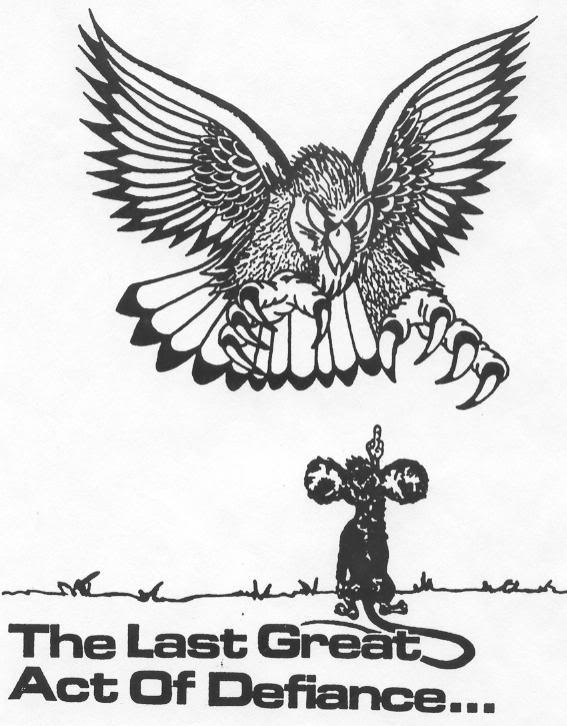
Memes have always been around, even in the pre-Internet days when pictures, signs, and jokes would circulate like chain letters in offices and schools. Classics like the mouse flipping off a hawk, its outlines fuzzy through multiple generations of photocopying, or signage reading, “I can only make one person happy per day; today isn’t your day, and tomorrow isn’t looking so good either,” were ubiquitous, a lingua franca of the workplace, a passive-aggressive way of saying, “You don’t have to be crazy to work here . . . but it helps!” Although the passing around of in-jokes has largely migrated to the electronic ether, first through the e-mail forwards that you likely still receive from a few older friends or relatives, and then to Facebook and Twitter, such slogans can still be seen on coffee mugs and other gift items in actual physical space. Memes will find a way.

insanity.mugs

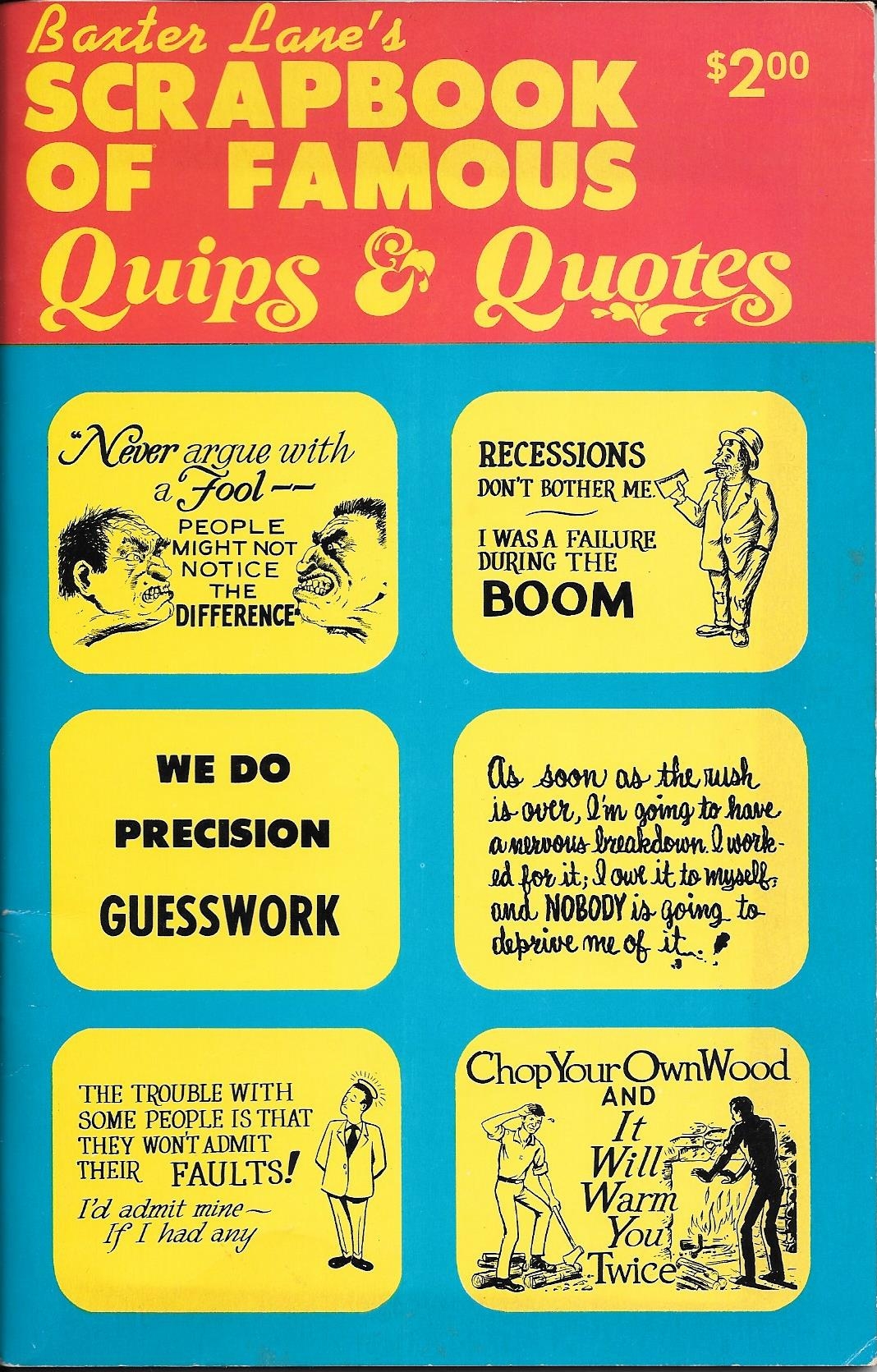
I was reminded of those old photocopied proto-memes when I uncovered a copy of Baxter Lane’s Scrapbook of Famous Quips & Quotes that I had purchased as a kid. The contents of this 64-page booklet are exactly what the title promises: a collection of pithy sayings, some attributed and some anonymous, on such universal subjects as work, marriage, and politics (the latter without much of a partisan edge beyond “How about those clowns in Congress?”). Although Famous Quips & Quotes is slim, it was of a piece with the dictionaries, trivia collections, and other miscellanies I could spend hours flipping through as a young reader. Along with such classics of browsing as The Guinness Book of World Records and Tom Burnam’s immortal Dictionary of Misinformation, collections of aphorisms were a favorite pastime. You just never knew what tidbit you might find, and many of the sayings and factoids I read back then have stuck with me.

BaxterLane1

Such collections are still published, of course, including standbys like Bartlett’s Familiar Quotations. In fact, the Baxter Lane Company is still in business, at least according to the online Yellow Pages: they don’t appear to have a web site of their own. Good for them. Located in Amarillo, Texas, Baxter Lane is listed as a “souvenir” or “gift shop” business: I’m sure I picked up my copy of Famous Quips & Quotes at a Stuckey’s or Nickerson Farms, and I could probably still find a Baxter Lane edition at my local Cracker Barrel. The back cover of the booklet even has “FROM” and “TO” address spaces and a square for third class postage, so you can send it in the mail as a postcard. “IT ISN’T NECESSARY BUT YOU CAN SEAL HERE WITH SCOTCH OR GUMMED TAPE IF YOU WANT TO,” reads a helpful caption along the edge.

BaxterLane2

“You can make the people follow the Way, but you can’t make them understand it.” –Confucius

In looking for online traces of Baxter Lane, I uncovered evidence of other booklets they have published over the years: many are cookbooks, but collections of aphorisms and folk wisdom are prominent (including a second volume of Famous Quips & Quotes). One of them, Honorable Confucius Says by Herb Walker, was published in 1977; also 64 pages in length, it is said to contain “authentic Confucianisms as well as words of wisdom from other sources,” so it is, in other words, probably not too different in character from Famous Quips & Quotes.

Needless to say, almost any clever-sounding or cryptic aphorism you could think of has been or could be attributed to the Chinese sage K’ung Fu-Tzu; some of them, such as the famous curse “May you live in interesting times,” are as recent as the twentieth century. That’s not even mentioning the many uses of Confucius to set up a pun or dirty joke (there’s a lot more where this one came from), a tradition predating the Internet:

Confuciussay

Jokes aside, Confucius and his sayings are the subject of The Analects, a volume I discovered a little later in life but recognized immediately as a more sophisticated example of the browsable collections I had grown up with, comparable in its significance to the Biblical Book of Proverbs, a similarly deep collection of teachings and sayings. In the words of scholar and translator Lin Yutang,

The Analects is generally regarded as the Confucian Bible, being a miscellaneous, unclassified and unedited collection of the remarks of Confucius on various occasions, mostly without any suggestion as to the circumstances in which the remarks were made, and certainly torn from their context. (Yutang, The Wisdom of Confucius)

Given my tastes, how could I resist such a collection? The lack of context was both a pro and a con: the book is easy to dip into, but there are many head-scratchers. For every clear and simple lesson, there is another tangled in history or symbolic meaning. On the subject of context, Yutang continues:

It is illuminating, for instance, to read in the Analects the remark by Confucius that “I have never seen people attracted by virtuous scholars as they are by beautiful women,” and then to learn from Szema Ch’ien that he made this remark after he had paraded the streets of Wei in a carriage with a beautiful queen, and found the people looked at the queen but did not look at him. The text of the Analects itself does not mention the circumstance, and actually puts it in the form of a more abstract remark: “I haven’t yet seen people who love virtue as they love beauty.”

That is a favorite example of mine, not because it deflates Confucius, but because it humanizes him; it teaches us something about vanity, although perhaps not the lesson Confucius thought he was imparting.

A little healthy skepticism isn’t a bad thing when reading such sayings. The best aphorisms provoke thought; memes substitute for it and are deployed to shut down arguments. One of the worst offenders in this regard is the “Condescending Willy Wonka” meme, its popularity based on Wonka’s well-known views in favor of Second Amendment rights:

WillyWonka1

Or wait, was Wonka in favor of gun control?

WillyWonka2

Like Confucius, Willy Wonka is now merely a vessel, a mouthpiece for whatever views we choose to attribute to him. The only difference is the speed at which memes can be generated.

The Lost Worlds of Power is here!

I am pleased to announce that The Lost Worlds of Power is now available for download! Made up of twelve novelizations of classic NES games, including my own take on “Legendary Wings,” The Lost Worlds of Power is the brainchild of Noiseless Chatter’s Philip J. Reed. I’ve only just started digging into it, but the book promises a range of styles and approaches to games both classic (“Battletoads,” “Marble Madness”) and obscure (“Linus Spacehead’s Cosmic Crusade”?). Download it for free here (and for a limited time, you can also download last summer’s Volume 0)!

LegendaryWings

More Lovecraft at The Solute

HauntedPalace

During last month’s horror movie marathon I caught up with several film adaptations of stories by H. P. Lovecraft. I first wrote about two fairly faithful twenty-first century adaptations by the H. P. Lovecraft Historical Society at The Solute, and after much delay I’ve put together my impressions of three films from American International Pictures: Roger Corman’s The Haunted Palace (1963), and Daniel Haller’s Die, Monster, Die! (1965) and The Dunwich Horror (1970). Although as a recovering Lovecraft purist I was skeptical of the AIP adaptations, I did find much to enjoy in them, and watching all three in a row provided an interesting overview of horror’s changing face in the 1960s. The article can be read at The Solute.

I Stood in Line for an Hour to Watch Stephen King on Television

wpid-20141114_182249.jpg

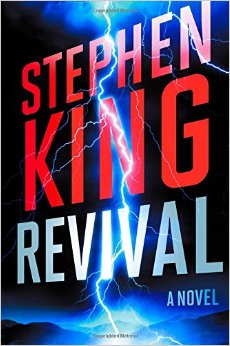
Like something straight out of the hit film The Lawnmower Man, a futuristic digital simulacrum of author Stephen King manifested in one of the “overflow rooms” of the Hughes Metroplex at Wichita State University on Friday. King visited Wichita as part of the tour supporting his newest novel, Revival, and while I arrived early to hear him speak, I didn’t arrive quite early enough. The event (a reading from the new book, some prepared remarks, and a Q&A) was to start at 6 pm; having secured my ticket before they quickly sold out last month, I thought I’d head over to the Metroplex at about 5, giving myself plenty of time for travel and parking. Around 4:30, my wife noticed a Facebook post from a friend who was already there: the line was three quarters of the way around the building already. I hopped in the car and left, just barely finding a place to park. The line was fully around the building by this time (about 5), and many more people got in line after me. It took an hour for the line to wind back around, an hour of standing in near-freezing weather; at least it wasn’t raining or snowing. Quite a few people gave up and left, or didn’t bother queuing up when they saw the size of the crowd.

To make matters worse, the event was oversold: only the first 1700 ticket holders would be seated in the auditorium, and to get in the auditorium you had to have a wristband, which they started issuing at 4 pm. This information was on the event’s website, but not printed on the ticket:

Seating at the event is general admission. Once the Lowe Auditorium is full, the remaining attendees will be seated in overflow rooms with excellent, live audio / visual feed to Mr. King’s presentation.

So perhaps I was naive not to expect something like this, but based on the number of people who gave up, and the backlash mentioned in the Wichita Eagle‘s coverage of the event, I wasn’t the only one unpleasantly surprised. Needless to say, I was in the “overflow.”

But enough bitching. How was the presentation? It was fine: although King protested that he was terrified of large crowds and implied that he was at best a reluctant public speaker (supported by the fact that the Revival tour would only have six stops), he had an easy-going, conversational tone and was engaging and relaxed. A slight cold didn’t noticeably slow him down: he promised us it wasn’t ebola, and on that note observed that every time a new flu strain hit the news, sales of The Stand spiked. He sounded much like he writes, at least his non-fiction: I never once heard him use the word “fuckeroo” (although the sample he read from Revival did include “whoremaster,” another King standby).

Stephen.King.Revival

I’m more interested in King’s creative process than his books these days. That’s not to say I won’t read Revival, a copy of which was included with the ticket price. But even King’s diehard fans tend to take his books as they come these days, cherishing the good ones and shrugging off the disappointments as part of the cost of being a fan of this most prolific of authors. King is like a baseball player, grinding out a season’s worth of games, day in and day out, and even the Hall of Famers don’t hit home runs every time they go up to the plate.

The unevenness of King’s work has a lot to do with his intuitive approach and (reported) two thousand words a day: early on, King observed that he is “not an organized writer,” to which I responded “NO SHIT” in my notes. King said that every story begins with an image, and the process of writing is one of exploring the implications of that image and asking what happens next. He compared it to pulling a thread from a mouse hole: sometimes the thread is as short as a few pages’ worth of story, and sometimes it’s as long as a novel. And since King doesn’t know where it’s leading any more than the reader does, there’s always the possibility that the ending won’t be satisfying, or that it won’t be what he thought it would be when he began. Sometimes characters turn out to be stronger than he expected (he cited ‘Salem’s Lot, saying that his original plan was for the vampires to win), and sometimes they don’t make it. “I love a happy ending as much as anyone,” he said; “it’s just not always possible.”

I was aware of his general approach from his writing already: in addition to his memoir/handbook On Writing, King has often included writing and storytelling (and discussions of same) in his fiction, to the point that stories about writers are a significant subset of King’s work. As I wrote last summer, Misery, in addition to being a gripping story of suspense, is also something of a master class in writing as King surrogate Paul Sheldon thinks his way through the book that will preserve his life as a captive of his “biggest fan,” Annie Wilkes. Much of the imagery King uses to describe his process, such as seeing the story through a hole or window, is present in Misery and was still part of King’s discussion on Friday.

I suspect this is one reason King continues to fascinate long after his ideas are not only no longer shocking, but even familiar: his willingness to allow readers into his thought process, to show his tricks, to let them come along as if he needed their help in telling the story, is endearing. It’s also as much of a pose as that of the author who reveals nothing (such as John Irving, whom King said told him that he doesn’t begin a book until he knows what the last sentence will be, to which King responded, “Jeez Louise”), and I’m not naive enough to believe that King has completely laid it all on the table for his audience. Still, the sense that King’s personality comes through his writing is palpable, and longtime fans accept him as they accept old friends or family members, foibles and all.

One of the more interesting moments came during the Q&A: an audience member asked if King still slept with the light on, as he once claimed in an interview. King appeared to search for a memory of having said that, gave up, and finally said, “I’m a big boy now.” The audience laughed, and King segued into a bit that he had likely delivered before and clearly relished, drawing the audience into one of his stories: he pointed out that of all the people at the Metroplex, some of us had probably forgotten to lock our cars, and “anybody could climb into the back seat. And when you’re driving home and you look in the rear-view mirror”–he mimed a figure rising from the back seat–“‘objects may be closer than they appear.’ . . . But that probably won’t happen.” He continued, “And when you get home, and your house is all dark, you’ll go into the bathroom and see the shower curtain closed, and you’ll tell yourself, ‘I left it like that.’ . . . There probably won’t be anybody there.” We all laughed, and King laughed, too. “We’re all laughing,” he said, “but these things have a time release. Because some time tonight, you’re going to be alone, and it’s going to be dark, and then it won’t seem so funny.”

It’s been a while since I’ve been able to offer an update on The Lost Worlds of Power, the fan-written collection of Nintendo game novelizations of which I’m honored to be a part. However, I’m told that the October 31 release date is still firm! The book will be available as a free download that day, so be on the lookout for that!

In the mean time, I am pleased to offer the illustration for my selection, “Legendary Wings,” by cartoonist Ron DelVillano:

Legendary Wings

When editor Philip J. Reed sent it to me as part of a bundle with the other illustrations, he noted:

Just so you know, I didn’t give Ron any guidance on what your stories were actually about…true to the Worlds of Power spirit! I only told him the games. In some cases, he actually ended up with some coincidentally appropriate details, which I love, and in other cases
the illustration is totally irrelevent, which I love even more.

How accurately does Ron’s illustration reflect the contents of my story? I’ll leave that for you to judge, but for the record, I think it’s awesome! More information will be forthcoming as I have it!

. . . And as a bonus, here’s another of Ron’s illustrations that is perfect for getting into the Halloween spirit:

Monster Party-01

The title? “Monster Party,” of course.

Two Lovecraft Film Adaptations at The Solute

CoCTitle

I recently posted a review of two films by the H. P. Lovecraft Historical Society over at The Solute: the 2005 silent adaptation of “The Call of Cthulhu” and the 2011 talkie “The Whisperer in Darkness.” Both are intriguing exercises in recreating the period of the stories rather than updating them as many adaptations have done in the past, making the most of limited budgets, and they show different approaches to adapting Lovecraft’s atmosphere-heavy stories. You can read about them at The Solute.

In the Hall of Mirrors with Captain Carrot and His Amazing Zoo Crew

Somewhere between “funny-animal” comics and cartoons for children and the evolved animals of Planet of the Apes and other adult science fiction lies the semi-serious talking animal trend in comic books of the 1970s and ‘80s. Howard the Duck is a familiar example of a walking, talking humanoid animal interacting with mainstream costumed superheroes, but he was neither the first nor the last character of his type. I’ve always been intrigued by anthropomorphic animal characters: years ago I wrote a lengthy analysis of Howard and his creator, Steve Gerber, and if I can find it I might post it here.

I was similarly drawn to Jack Kirby’s post-apocalyptic series Kamandi for its mixture of science fiction and talking animals. Last summer I wrote about DC’s Showcase Presents the Great Disaster, a “phone book” collection of material peripherally related to Kamandi and including a healthy selection of not-so-funny-animal stories; now DC has released another Showcase collecting the core run of another hybrid series, the superhero/funny-animal adventures of Captain Carrot and His Amazing Zoo Crew. Like Great Disaster, this volume was announced several years ago but was held up (reportedly by disputes over royalties) until now. In any case, it comes out at an opportune moment, as Captain Carrot has returned to comics as a main character in Grant Morrison’s The Multiversity, and the renewed popularity of the Teenage Mutant Ninja Turtles shows that there is still an audience for wise-cracking, butt-kicking humanoid animals.

CaptainCarrot

Most of the Captain Carrot stories were new to me, although the character has made brief appearances in DC books since his introduction in New Teen Titans no. 16 (included in this volume) in 1982. Created by prolific writer Roy Thomas and cartoonist/animator Scott Shaw! (yes, the exclamation point is part of his professional name), Captain Carrot and His Amazing Zoo Crew was tagged from the beginning as “Not just another funny-animal comic!” The tone is light and full of verbal humor and animal puns (Roger starts out in “Gnu York” and the team later moves to “Follywood, Califurnia”), but the adventures and conflicts between characters are firmly within the tradition of superhero comics.

Captain Carrot is the leader of the group: super-strong, tough, and blessed with super-hearing, as well as the ability to leap great distances (as with Superman, who could similarly “leap tall buildings in a single bound” in his early appearances, Captain Carrot would later be depicted as flying outright). Unlike his team, whose powers are constant, Captain Carrot gains his power from eating “cosmic carrots,” irradiated by the meteor that accompanied Superman when he visited from his own dimension. When the carrots’ effect has worn off, he reverts to his scrawny alter ego, cartoonist Roger (later Rodney) Rabbit, a secret identity with some resemblance to Clark Kent and Golden Age hero Hourman.

Rounding out the Zoo Crew are Rubberduck, who can stretch his form like Plastic Man; Yankee Poodle, a patriotic-themed heroine who can repel and attract matter via the stars and stripes she projects from her hands; Fastback, a turtle with super-speed; Pig-Iron, the tough guy; and Alley-Kat-Abra, a martial artist with mastery of magic, focused through her “Magic Wanda.” Each of these characters is an established type, and Thomas and Shaw! have made clear in commentary that they were conscious of the balance of personalities and powers that made up a good super-team, but none are outright copies of extant characters.*

Zoo_Crew

Most critically, Captain Carrot and his cohort are clearly established as living in one of the DC multiverse’s many parallel earths, a planet much like ours but inhabited by Saturday-morning-cartoon-style talking animals. The team’s origin is explicitly tied to Superman, who crosses from his own dimension to the funny-animal world, where he is viewed as a terrifying pink monster (with five fingers!): in Captain Carrot’s world, “men” are creatures of myth and legend. Changeling (aka Beast Boy) of the Titans and animal-themed villains Starro the Conqueror and Gorilla Grodd would also make appearances in the book, and many of the team’s subsequent appearances have been crossovers of one kind or another. Despite its obvious kid appeal, this isn’t segregated from DC continuity, as one might expect for a children’s title.

As noted, Captain Carrot and the other members of the Zoo Crew aren’t direct parodies of established superheroes. Although there are many winking references to human history and pop culture (particularly celebrities: Rubberduck’s civilian identity is movie star “Byrd Rentals,” and Yankee Poodle is gossip columnist “Rova Barkitt”—will readers younger than 40 even recognize the reference to Rona Barrett?), the Zoo Crew are unique individuals rather than being modeled after any specific character. This distinguishes Captain Carrot from Peter Porker, the Spectacular Spider-Ham, a similar parody of Marvel’s characters introduced in 1983 (a year after Captain Carrot’s first appearance).

In addition, master of minutia Roy Thomas built in many links to DC’s own funny-animal past: Pig-Iron was a transformed Peter Porkchops, a character who had appeared in DC’s Funny Stuff in the 1940s; Fastback was the nephew of another Golden Age funny-animal, McSnurtle the Turtle (who also moonlighted as a superhero, the “Terrific Whatzit”). Other characters from Funny Stuff were introduced as side characters, and in one story arc the team was split up and sent back in time to different eras, encountering characters such as Nero Fox (a jive-talking, jazz saxophone-playing funny-animal Roman emperor—in other words, a character who could only have been created during comics’ unselfconscious Golden Age) and the Three Mousketeers.

captain_carrot_009_full

Thomas’ obvious delight in making such connections and in capturing the essence of superheroic types brought to mind another creation of his: the Squadron Supreme, the analogue of DC’s Justice League of America that Thomas introduced in the pages of Avengers, and which has become a JLA stand-in in the Marvel multiverse. Intriguingly, while the Squadron very directly represents the JLA in the pages of Marvel Comics, the Zoo Crew actually strike me as a subtle reworking of Marvel’s character dynamic smuggled into a DC book. (Such are the differences between the two publishers that even parodying them requires a different approach: the Squadron Supreme is the JLA with a coat of paint, while the Zoo Crew mimics the contemporary soap opera feel of a Marvel book rather than specific characters.)

From the team’s first appearance, their stories are marked by squabbling and infighting, with the kind of character-based conflict that was a central ingredient in Fantastic Four, Avengers, and Uncanny X-Men. Captain Carrot is continually struggling to keep his allies focused on the mission, and nearly every issue includes one or more characters challenging his authority or the entire purpose of the group. Pig-Iron (most clearly modeled on FF’s Thing, pugnacious and blue-collar) wants to be left alone; Rubberduck and Yankee Poodle are accustomed to star treatment; Alley-Kat-Abra fights with Yankee Poodle over leadership roles and pines for the Captain’s affections. A great deal of the time, it’s not clear that the members of the team even like each other that much.

Consider another hero who is added later, the only member of the Zoo Crew to gain his powers through a source other than the meteor that entered their universe with Superman. Chester Cheese, a mouse, was a star basketball player whose father was a scientist working on the space program. Chester was approached by two goons working for a crime boss named Fatkat, who wanted him to throw a big game on which Fatkat had a lot of money riding. When Chester refused, his father was killed and Chester was locked in his laboratory. After eating a sample of lunar green cheese, he gained the power to shrink to small sizes, retaining his strength; calling himself “Little Cheese,” he enlists the Zoo Crew in an attempt to bring Fatkat to justice.

LittleCheese

On the surface, Little Cheese resembles other shrinking heroes like the Atom or Ant-Man, but his origin is a remix of Spider-Man’s, combining the drama of teenage life, super-science, and a parental figure whose tragic death leads him to use his powers for a higher purpose. (Not to mention that his nemesis, Fatkat, strongly resembles Marvel villain the Kingpin.) In short, Little Cheese’s story illustrates the Marvel habit of building stories around “little tragedies,” to borrow Chris Sims’ phrase. Tragic origins aren’t foreign to the DC universe, of course, but in combination with the personality conflicts and limitations placed on the Zoo Crew’s powers, it’s very much in line with Marvel’s modus operandi. In that light, Captain Carrot’s adventures are an overlooked example of what Sims calls “The Problem,” a decades-long desire on DC’s part to make itself more like Marvel.

It gets even more complicated when another funny-animal super-team is introduced, and this one is a direct parody: the Justa’ Lotta Animals, which starts out as the comic book that R. Rabbit illustrates as his day job, but which (naturally) turns out to be a real group from yet another parallel earth. The two-part crossover, “Crisis on Earth-C!” and “Crisis on Earth-C-Minus!”, parodies the annual Justice League/Justice Society crossovers in bringing the champions of two worlds together. This JLA consists of Super-Squirrel, Bat-Mouse, Wonder Wabbit, Green Lambkin, the Crash (a super-speedy turtle, showing there are only so many spins one can put on this kind of character, I guess), and Aquaduck (whom I almost forgot); when first encountered, only Captain Carrot is familiar with them, since he draws them for a living.

CptCt_14_GS

It’s a time-honored convention of comic books that when two or more superheroes meet for the first time, they fight each other (through confusion or a villain’s manipulation). The JLA/Zoo Crew match-up is no different, but even after getting the facts straight, inter-group rivalries persist. Captain Carrot has trouble adjusting to the idea that the fictional characters he draws are not only real, but have personalities and motives of their own, and both the Zoo Crew and JLA exhibit a territorial streak when it comes to another super-team in “their” world. A love triangle forms, as Super-Squirrel is immediately jealous and resentful of Wonder Wabbit’s interest in a fellow bunny (it’s really a love quadrangle, as Alley-Kat-Abra is also possessive of her Captain).

The “real” Superman and Wonder Woman weren’t romantically linked until recently, but this storyline uncovers subtext that was always present, if only in the minds of fans: just as Mark Gruenwald could have Hyperion and Power Princess consummate their love in the pages of Squadron Supreme, Super-Squirrel could give voice to feelings of jealousy and inadequacy that Superman would leave unspoken, if he felt them at all. (The Captain Carrot/Wonder Wabbit pairing can be read as a parody of all such “doomed romance” storylines, as they belong in two different worlds, but it isn’t treated as a joke: the story ends with Rodney drawing Wonder Wabbit for his comic book, ruefully acknowledging that he can’t even escape into his work to forget his loss.) As a fan of both funny-animals and pastiche characters, the whole thing is a fascinating chance to observe a diverse group of characters—some of whom stand in for entire mythologies**—bounce off each other. Captain Carrot isn’t just parody: it’s meta.

Jlanimals

* Behind-the-scenes commentary and information about the Zoo Crew’s creation is drawn from Alter Ego no. 72 (September 2007).

** Speaking of mythologies, I haven’t even gotten to the six-chapter Oz-Wonderland War, published as a three-issue miniseries in 1986, and a fitting culmination to the contents of the book, with more character development than most of the previous issues. The storyline draws the Zoo Crew into an interdimensional conflict based on the characters and settings of L. Frank Baum and Lewis Carroll (and includes a brief reunion with Wonder Wabbit), and includes some great artwork by Carol Lay, balancing the cartoon style of Shaw! with the illustrative styles of Denslow and Tenniel. It deserves a longer write-up, but as a blend of humor and reference (scripted by longtime DC writer and editor E. Nelson Bridwell, who had a reputation as a “continuity cop” himself) it’s a very pleasurable (if frequently downright weird) read.

Fates Worse Than Death: The Could-Have-Beens

In watching and researching motion picture serials over the past few months, I’ve run across many based on characters from other media: comics, radio, and literature. Allowing for the vagaries of art and commerce, I’ve been struck by the absence of several characters who one might expect to be adapted as source material. What follows is necessarily speculative, but I’ve compiled a list of characters, popular at the time, who could have appeared in a serial but didn’t, for whatever reason.

Perhaps arbitrarily, I’ve excluded characters who appeared in feature films or cartoons during the “Golden Age” of the serials: Sherlock Holmes and Dracula may not have appeared in serials, but they are well-represented on film. I’m more interested in characters whose film appearances are either limited to the modern era or who haven’t appeared on film at all (yet).

John Carter of Mars

From one perspective, it isn’t surprising that Edgar Rice Burroughs’ interplanetary hero didn’t make the leap to the big screen until 2012’s poorly-received adaptation. Although John Carter set the pattern for the early space heroes, appearing in print in 1912, both Flash Gordon and Buck Rogers were featured in serial adaptations during the Golden Age of science fiction (in 1936 and 1939 respectively). It was Gordon and Rogers who cemented the conventions and story beats of space opera for film audiences and became household names in the process. Later, Star Wars and other science fantasy epics would borrow elements of Carter’s adventures (what is Tatooine but Burroughs’ dying Mars?), further stealing the series’ thunder.

john-carter-poster

On the other hand, clearly there was a market for science fiction adventure, and Burroughs was aware of the power of licensing his creations: his other famous character, Tarzan, was featured in numerous film adaptations in the 1930s and ‘40s (continuing to this day), including one produced by Burroughs himself.

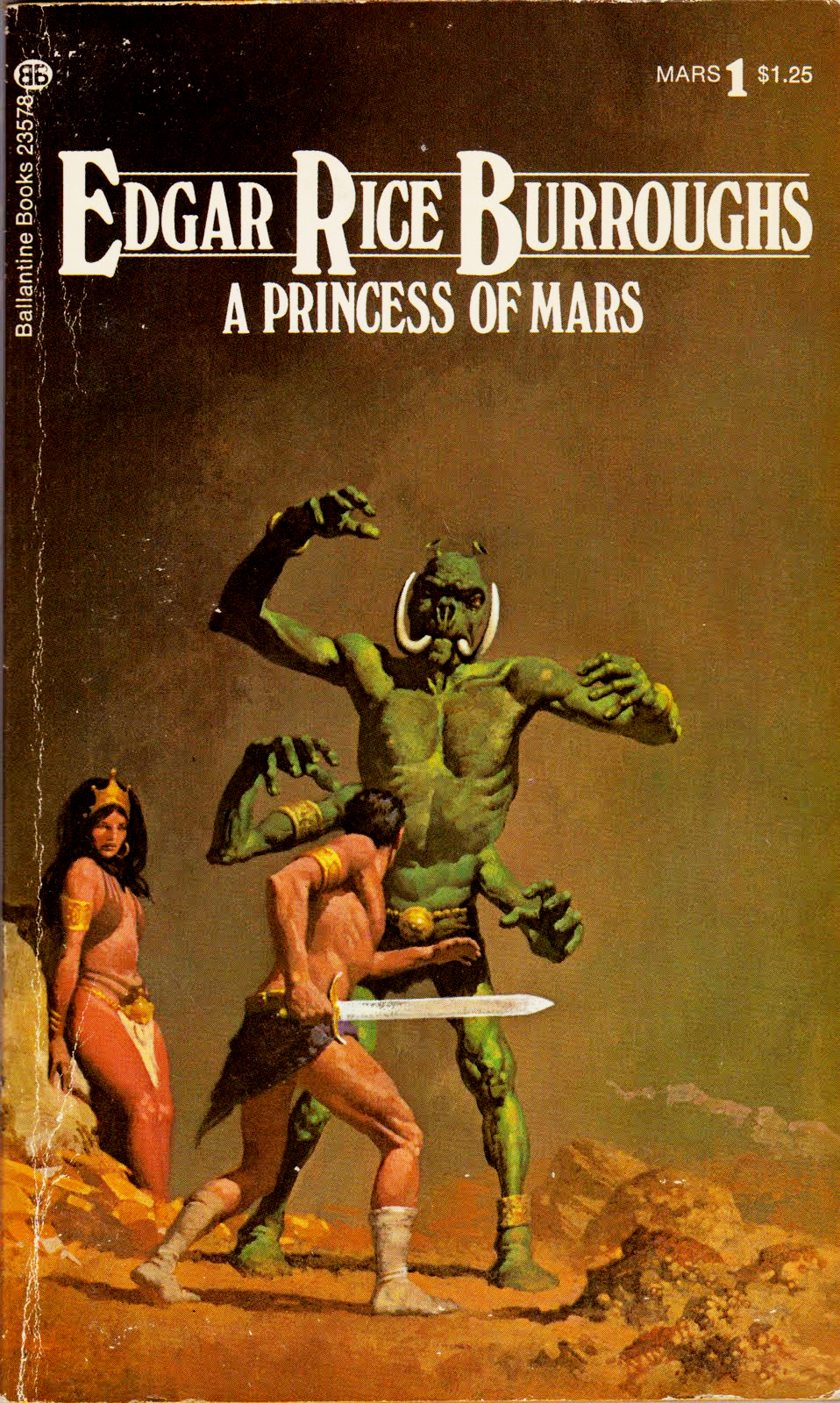
Perhaps it was the extravagant native fauna of Barsoom (the locals’ name for Mars) that made it prohibitive to film: in his adventures, Carter faces the four-armed giant Tharks (Green Martians), rides eight-legged thoats, and encounters other multi-limbed creatures that would have been compromised by the special effects of the 1930s, to say the least. (Flash Gordon tries manfully to create convincing space monsters, and is only intermittently successful.) In a similar vein, the fliers and radium guns of Burroughs’ novels might have seemed like a daunting proposition to film, but other science fiction serials and features found ways to create such effects or work around them.

Book-1-A-Princess-Of-Mars-1

Intriguingly, there was at least one attempt to produce a John Carter film during the Golden Age: in 1935, Warner Brothers animator Bob Clampett approached Burroughs with a proposal to put together an animated John Carter series that, had it been made, would have beaten both Snow White (the first animated feature) and the Flash Gordon serial to theaters. Clampett and Burroughs put together a deal with MGM, but ultimately the project was deemed too weird for audiences. Only a few minutes of test footage remain to show what might have been.


(Thanks to fellow fan Bruce Ross for alerting me to this aborted project, and check out Bruce’s blog to see his impressive custom action figures, including a certain Warlord of Mars.)

Jules de Grandin

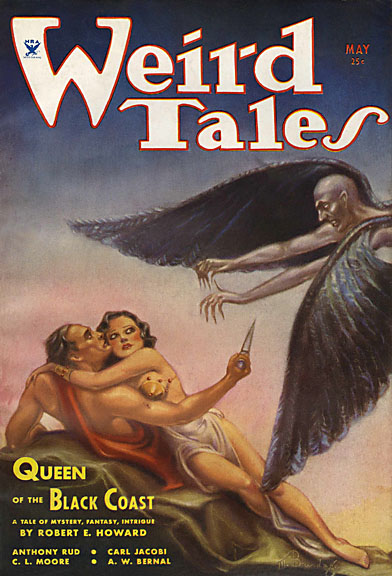
The most popular author to appear in Weird Tales magazine wasn’t Robert E. Howard or H. P. Lovecraft: it was Seabury Quinn, a lawyer with a specialty in mortuary law and the funeral business. Quinn’s most popular creation was the feisty French physician Jules de Grandin, a prime example of the “occult detective” character type. With his sidekick/narrator Dr. Trowbridge (clearly modeled after the sturdy Holmes/Watson dynamic), de Grandin defended Harrisonville, New Jersey against supernatural, scientific, and just plain criminal threats in nearly a hundred stories.

DeGrandin

Although less well-remembered now, the de Grandin stories contain plenty of ideas that could have made for excellent serials—killer animals, vampires, cults, mad scientists, and more—and were formulaic and action-packed enough to provide what audiences of the time expected.  De Grandin, with his cod-French exclamations (not only the time-honored “Sacre bleu!”—de Grandin would frequently vary his patter with insertions of “Parbleu!”, “Mordieu!”, “Zut!”, and odd turns of phrase like “Horns of a little blue devil!”, “Name of a gun,” etc.), was likewise a character whose exaggerated national character would be right at home at Republic or Columbia. (His catch-phrases are no sillier than the “inscrutable” Orientalisms of Charlie Chan or the “By Jove!” English of Anthony Tupper in Robinson Crusoe of Clipper Island.) More importantly, like all serial heroes, de Grandin favored the direct approach, and was as likely to defeat the forces of evil with a sword or automatic as with an incantation or clever trap.

WeirdTalesdeGrandin

Conan the Cimmerian, et al

Speaking of Robert E. Howard, it’s unlikely that a serial based on his famous creation Conan would have been anything like the 1982 feature Conan the Barbarian, influenced as it was by the success of special effects blockbusters like Star Wars and Raiders of the Lost Ark and the contributions of later authors (not to mention the Frazetta-esque physique of star Arnold Schwarzenegger). However, the ancient past had been represented in epics like Ben-Hur, and fantastical “lost worlds” were featured in serials such as The Undersea Kingdom and The Phantom Empire, so it wouldn’t have been out of the question. A Conan serial would have probably resembled those starring Tarzan or “jungle girl” Nyoka, with an emphasis on action and the lead’s physicality, toning down Howard’s often pessimistic philosophical digressions.

WeirdTalesConan

It’s worth noting, however, that Howard created several series characters, in a variety of genres, that could have headlined serials (and to this day, not all of them have been adapted for film). “Last king of the Picts” Bran Mak Morn and medieval Irishman Turlogh Dubh O’Brien represent Howard’s interest in the history and people of the British Isles; King Kull of Atlantis and swordswoman Red Sonja represent a strain of sword-and-sorcery similar to the Conan stories. Of all of Howard’s series characters, probably the closest in spirit to the serials is Steve Costigan, a modern-day merchant sailor and boxer whose stories combined action and wry humor. Although Conan remains Howard’s best-known creation, the author left behind a wealth of material yet to be mined for adaptation.

fightstoriesCostigan

The Spirit

thespirit

Cartoonist Will Eisner created the Spirit (the supposedly dead criminologist Denny Colt, going forth from his cemetery hideout to fight crime) in 1940 as the lead character in a series of comic books he produced for inclusion in newspapers owned by the Register and Tribune Syndicate. Ownership of his own character, with little editorial interference, gave Eisner the freedom to explore a variety of story-telling techniques, and due to his innovative approach to composition he is often compared to cinematic masters such as Hitchcock and Welles. (In Michael Chabon’s novel The Amazing Adventures of Kavalier and Clay, the title characters are inspired by Citizen Kane to invigorate their own comic book stories with devices such as achronological narratives, alternating points of view, and dynamic, cinematic compositions applied not just to the panel but to the entire page. Although fictional, this is likely a reference to the leaps forward that Eisner made with The Spirit.)

Sometimes the title character was barely featured in stories, making cameo appearances in the stories of a range of urban characters both poignant and humorous; this approach would have fit perfectly with the serials, which often introduced audiences to original characters who had equal screen time with the licensed characters in the title (such as Linda Page and her uncle in the 1943 Batman serial). Quoted in A Smithsonian Book of Comic-Book Comics, Eisner explained,

I began to realize who I was writing for”—that is, an audience dominated by adults, rather than children—and “I suddenly found an opportunity to do what I had really always wanted to do, which was to write ‘seriously’ or write good material, and at the same time stay within the medium I knew and had developed skills for.

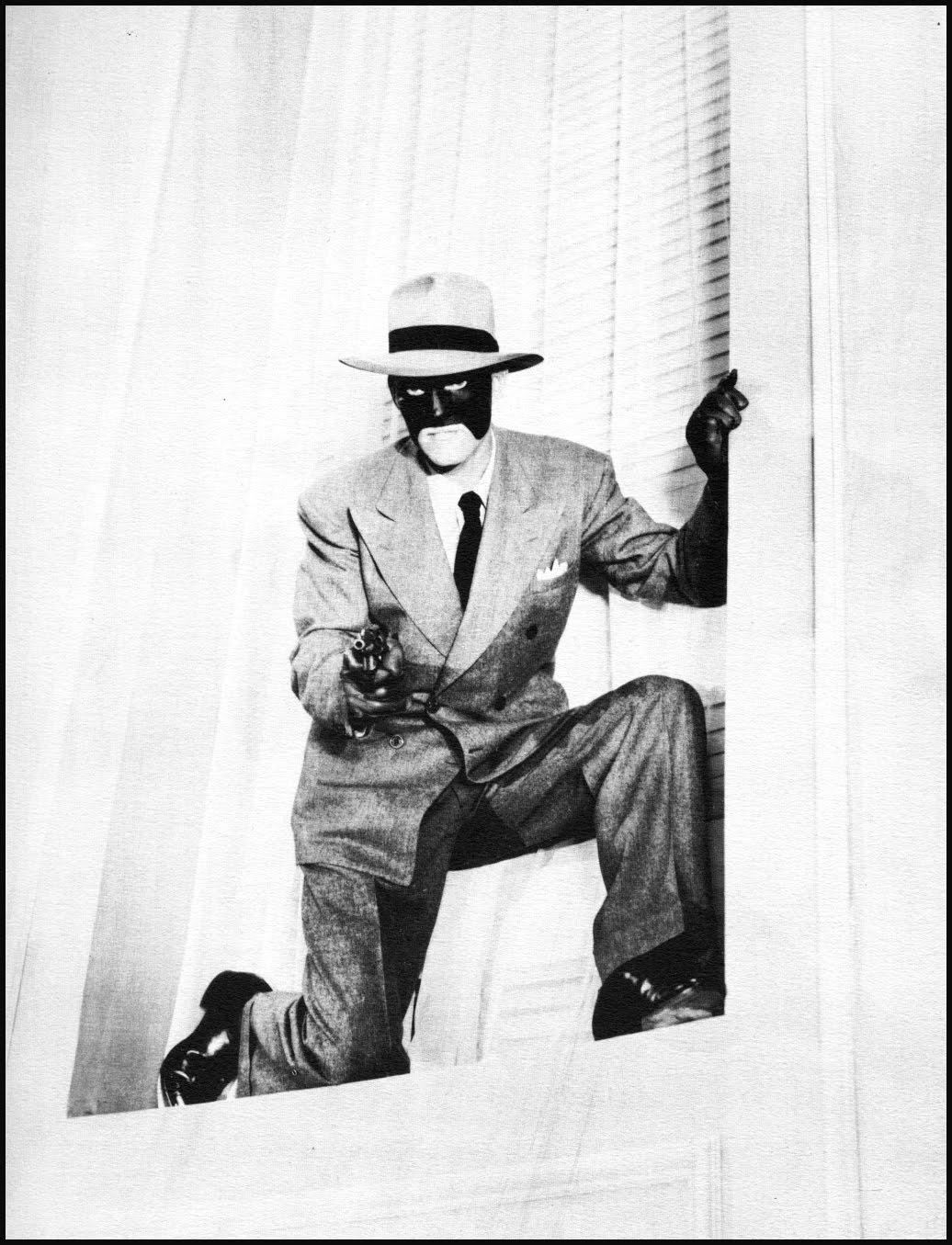
Ironically, as Eisner drew from film to develop his sophisticated visual language, the serials were increasingly geared toward children, dropping the nuances of the 1930s serials in favor of formula and non-stop action. Without Eisner’s ambitious style, the Spirit wasn’t superficially different from other masked pulp heroes like the Spider or the Green Hornet, and it is unlikely a Spirit serial would have been very distinguished. (However, many commentators have pointed out that the title character of the 1943 serial The Masked Marvel bears a strong resemblance to the Spirit; in that serial the central mystery of the story was the true identity of the hero, with four possible candidates.)

Tom Steele as the Masked Marvel

Tom Steele as the Masked Marvel

Wonder Woman

Seriously, what gives? Despite the news that DC’s premier superheroine—the female superhero in the mind of the public—will appear in Batman v Superman: Dawn of Justice, Wonder Woman is severely underrepresented on film. She has yet to headline her own theatrical feature film, and has only a single direct-to-video animated feature to her name. Considering that Wonder Woman spent World War II fighting Nazis alongside Captain Steve Trevor, a serial would seem to be a no-brainer. But it was not to be.

sensation-comics-13

Created in 1941 by psychologist William Moulton Marston, Wonder Woman reflected his desire to create a strong but loving role model for girls, an Amazon princess fighting for equality in “Man’s World;” in his words, she would be “a feminine character with all the strength of Superman plus all the allure of a good and beautiful woman.” Marston modeled his creation on both his wife Elizabeth and a woman named Olive Byrne who lived with the couple in a polyamorous relationship. Although Marston’s unconventional views on the sexes and Wonder Woman’s fetishistic overtones (including the “lasso of truth” and the notion of loving domination) raised eyebrows in later years, they don’t seem to have been considered problematic during the 1940s. (Certainly the serials had their share of questionable material, and anything objectionable would likely have been removed or changed anyway: some of the changes studios made to comic book characters could be quite drastic.)

Consider the screen presence of Wonder Woman’s fellow heroes: Columbia produced serials starring Batman (in 1943 and 1949) and Superman (1948); Republic brought Captain Marvel (1941) and Captain America (1944) to the screen, and there were numerous less-remembered costumed heroes in serials as well. (That’s not even mentioning the animated Superman shorts from Fleischer or the later Superman and Batman TV programs; as of this writing, Lynda Carter’s portrayal of Wonder Woman is still the only prominent, long-running live-action version of the character.)

Female-led serials weren’t unheard of: I’ve reviewed two this summer, The Perils of Pauline and Zorro’s Black Whip. The star of the latter, Linda Stirling, was actively groomed to be the next Pearl White, appearing in several jungle, Western, thriller, and science fiction serials for Republic. (In fact, it was reading about Stirling’s career that brought Wonder Woman to mind and inspired this article.)

Realworlds_Wonder_Woman

(Interestingly, an issue of DC: Realworlds, an out-of-continuity series in which DC’s heroes are expressly fictional but inspire ordinary people to take heroic action, features a hypothetical Wonder Woman serial. The story centers on an actress who finds the courage to stand up to a Red-baiting politician who combines features of Joseph McCarthy and Ronald Reagan. Perhaps in an alternate universe, audiences are thrilling to Wonder Woman vs. the Nazi Baroness or Wonder Woman vs. the Red Menace.)

What’s Next: In one week, I’ll conclude Fates Worse Than Death (for this summer, at least) with a look at Gang Busters. See you then!