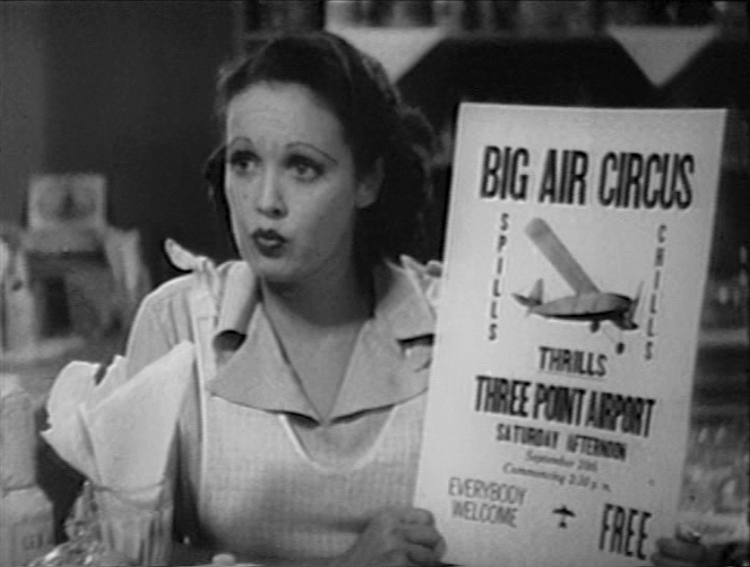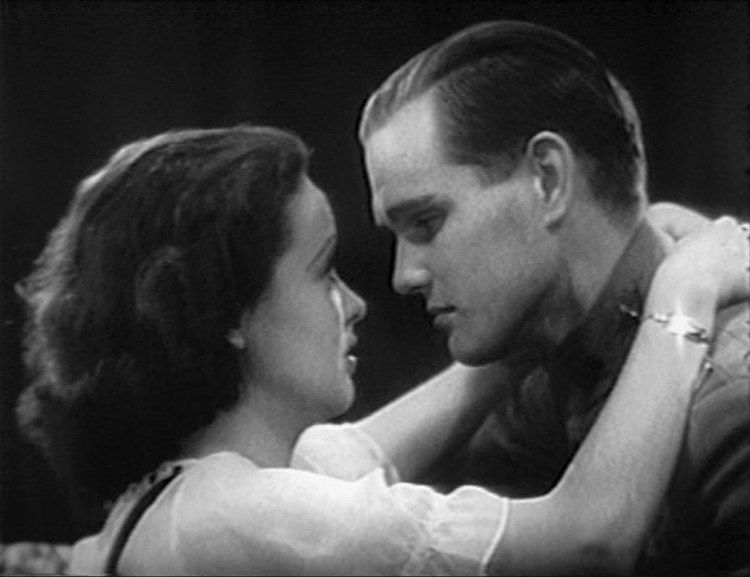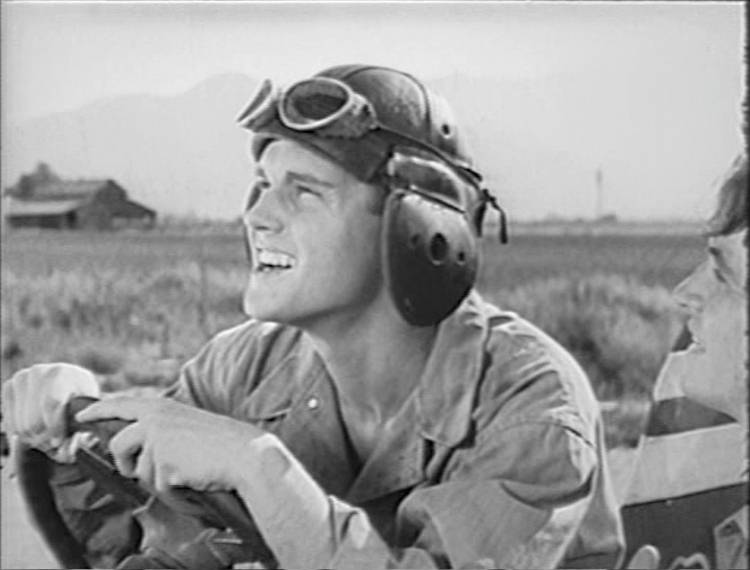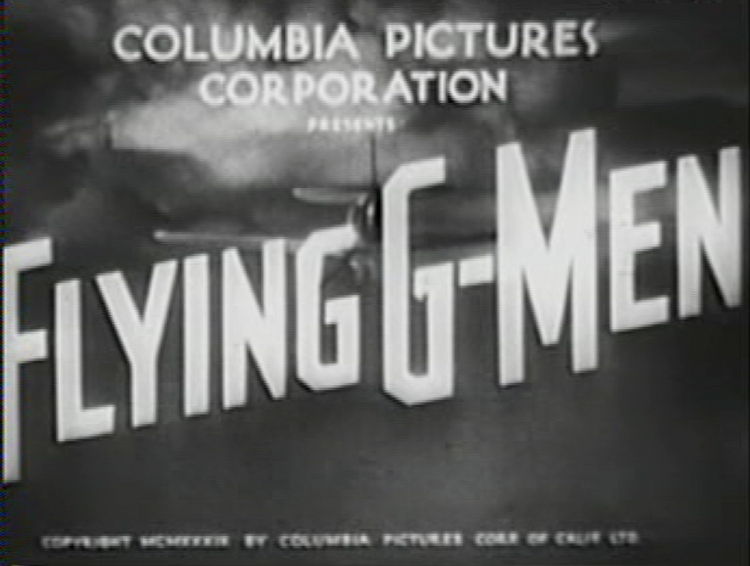
Fates Worse Than Death: Flying G-Men

FGM.title

“The peace and security of the nation have been threatened by a campaign of espionage and sabotage, conducted by a powerful spy ring whose head is known as the Professor! The Bureau of Investigation has assigned three flying G-Men to the case. They created the Black Falcon, a mysterious masked pilot whose sudden raids spread terror and confusion among the ranks of the conspirators!”
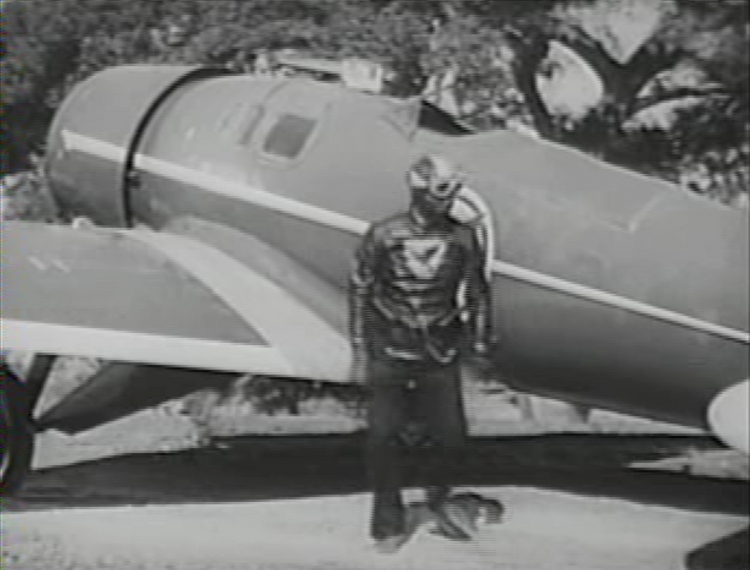
FGM.blackfalcon2

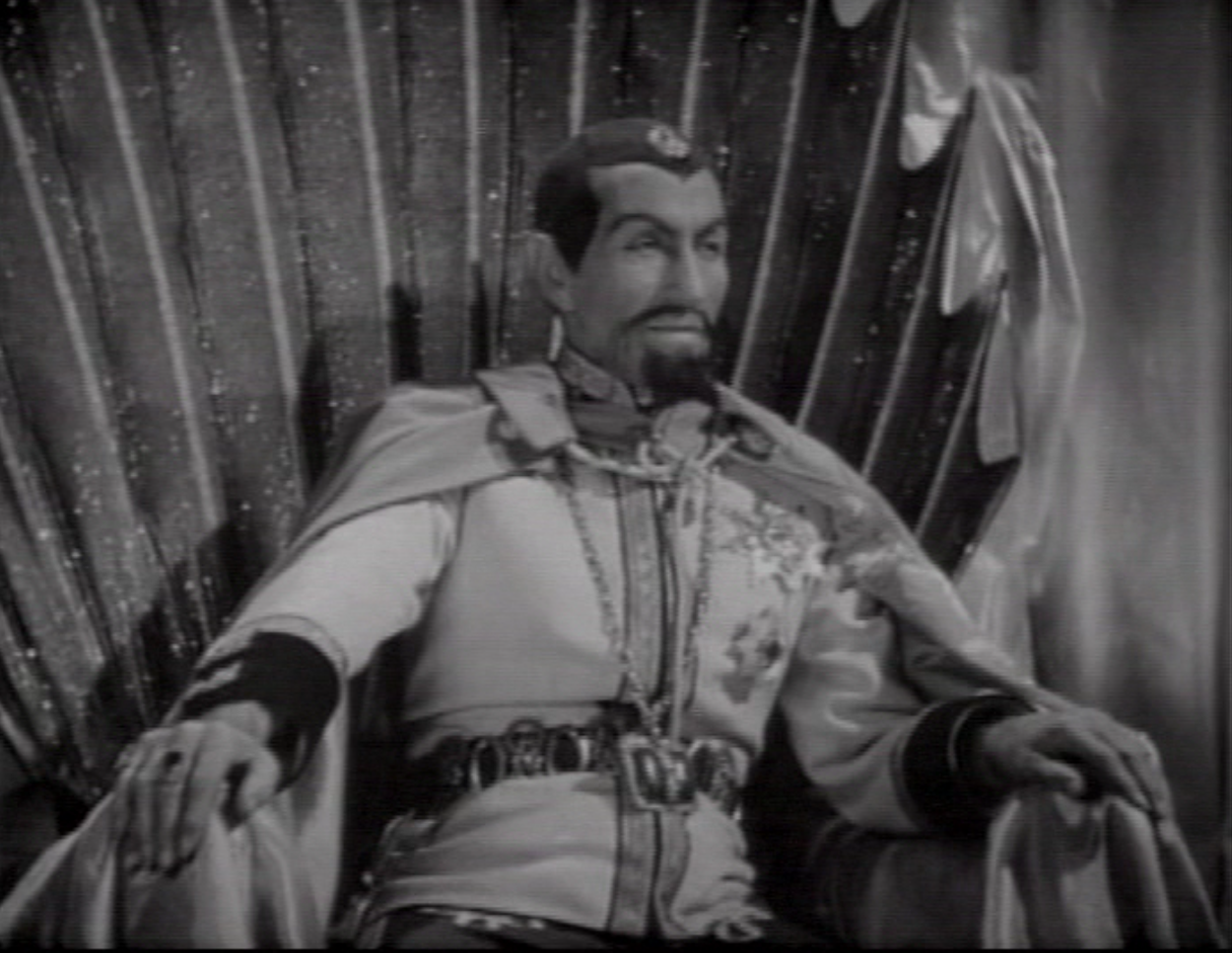
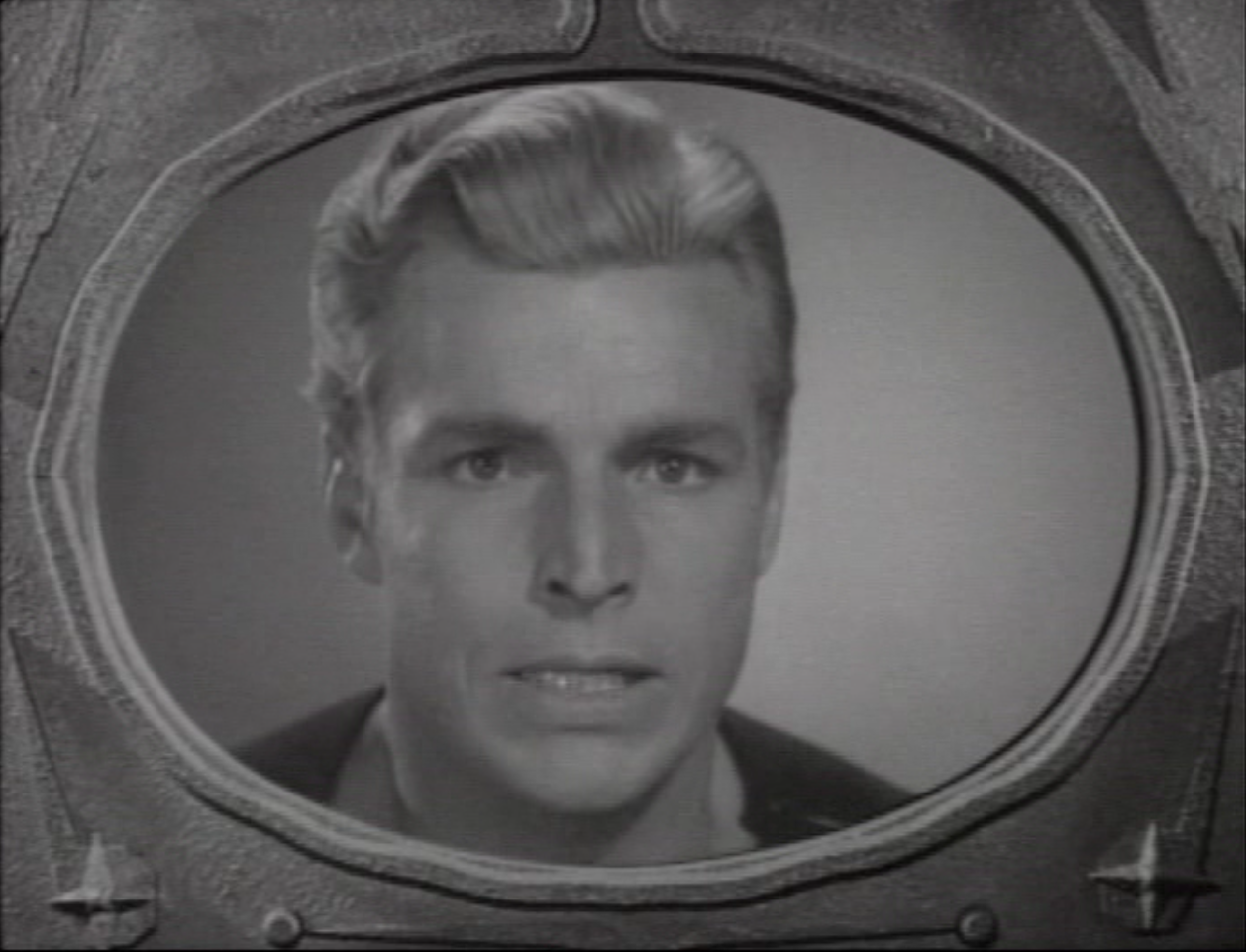
That burst of breathless narration (or a variation of it) introduces each chapter of the 1939 Columbia serial Flying G-Men, and honestly it summarizes the situation as well as I could, so let’s get to the meat of the discussion. Frankly, I often get hung up on plot, in the sense that when I’m reviewing something, or writing my own fiction, I spend way more time trying to untangle and summarize the action than I do when I’m just watching or reading something for pleasure. All along, I think I’ve been clear that I don’t really watch serials for their timeless stories or (God knows) their deep sense of characterization, but rather for their lurid, punchy aesthetic. An iconic pose; an atmosphere of potent menace; a trained dramatic actor making a meal of a pulp hack’s overheated prose; in short, the “cool factor” are greater contributors to my enjoyment than mere plot mechanics. I get the same kind of pleasure from an isolated image or moment that a really good cover illustration or dramatic turn of phrase conveys.
FGM.blackfalcon3

Still, unlike a pulp magazine cover or the posters that advertised the serials, movies unfold in time and feature narratives that deliver those moments in a structured way, so as I write I feel that I have to deal with the flow from A to B to C. It’s easy to get caught up in summary that is neither interesting to write nor to read, but is necessary for context when explaining why it’s so cool that it wasn’t really the Black Falcon who got shot by the Professor’s henchmen at the end of Chapter Ten, but rather a captured spy that the G-Men dressed in the Falcon’s uniform to serve as a decoy (or whatever).

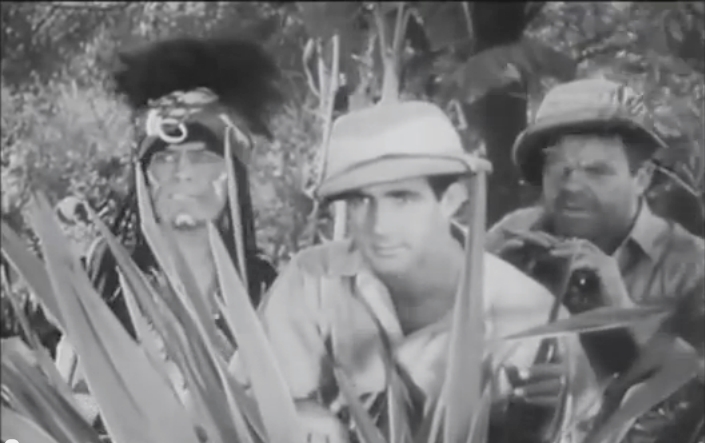
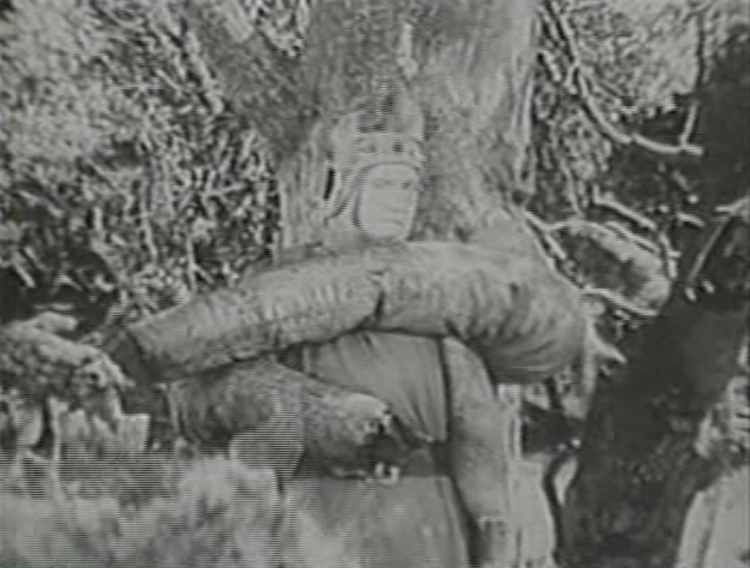
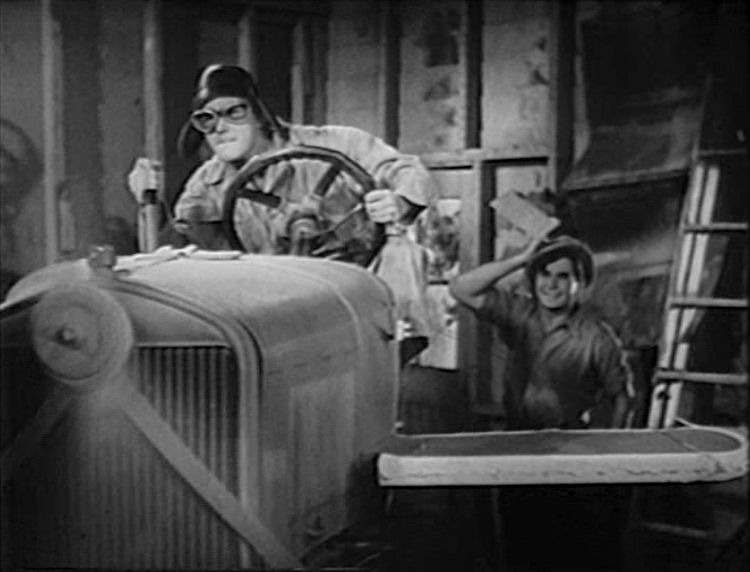
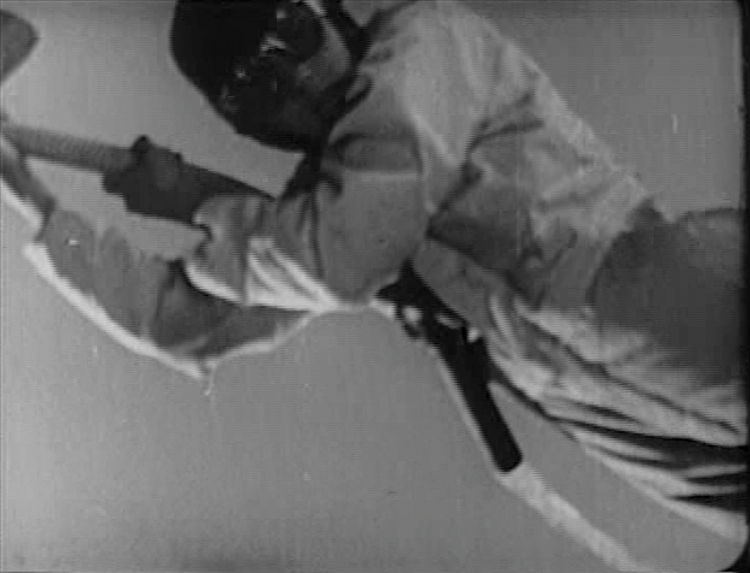
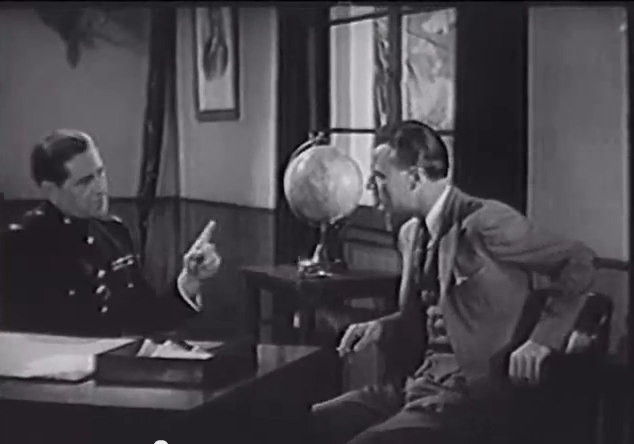
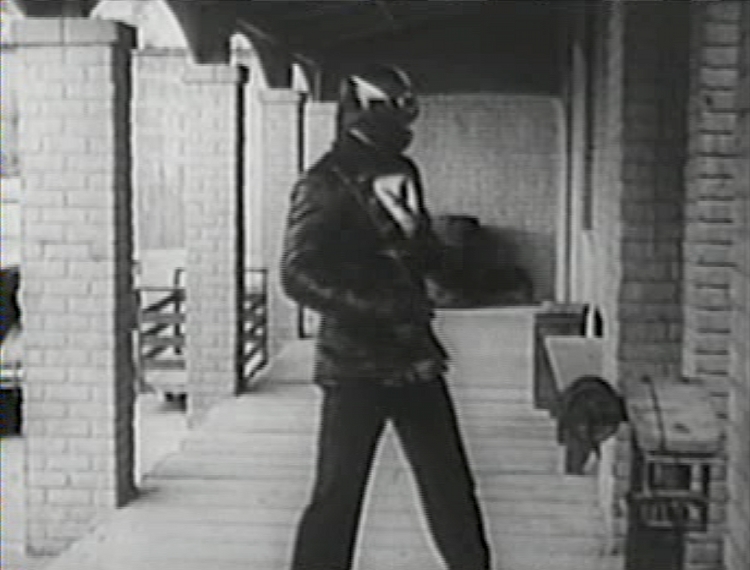
Flying G-Men provides many such moments, so I loved almost every minute of it. I think I’ve come to the realization that I enjoy police and gangster serials more than superhero or science fiction serials. In many cases, they are just as fanciful as their high-concept peers, featuring similar costumed characters and high-tech gadgets, but the supposedly more realistic setting forces them to explore that world in greater depth, as well as intersecting with crime pictures, film noir, and other kinds of drama in ways that are surprisingly artistic and expressive. Take a look at the frame below, for example: it’s as absolutely clear as a silent film what’s happening. That’s not to say that such artistic choices aren’t sometimes made in superhero or sci-fi serials, but I have noticed a tendency to lean on the dazzling design elements rather than creative staging in many of them.

FGM.hiding

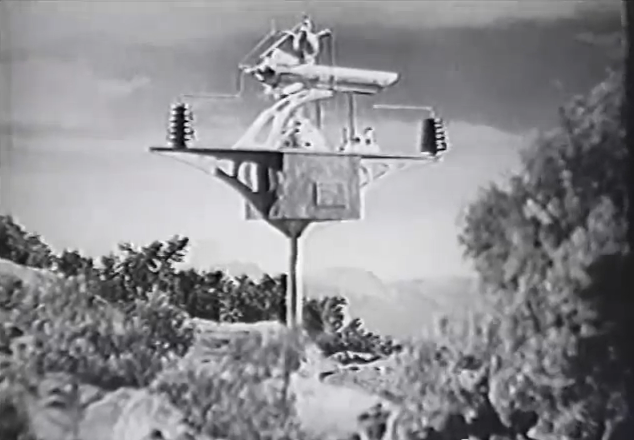
Of course, some exposition is inevitable. The titular G-Men, all in the employ of the FBI’s Air Division, were formerly known as the “Skyhawks,” a foursome who previously set a record flying around the world. (As in Pirate Treasure, an accomplishment that would ensure a lifetime of accolades in real life is here merely part of the heroes’ background; it’s as if Mark Watney’s experiences on the red planet in The Martian had served only to prepare him to stop a jewel heist on Earth.) The designer whose inventions made that flight possible, Ed McKay, has developed a remote-controlled robot bomber for military use, remarkably similar to a modern drone aircraft. Of course such a design is a target for espionage, and under the direction of the mysterious “Professor” a wide-ranging spy ring first kills McKay (leaving behind his sister and young son) and then makes efforts to steal the bomber plans for its own use.

FGM.gmen

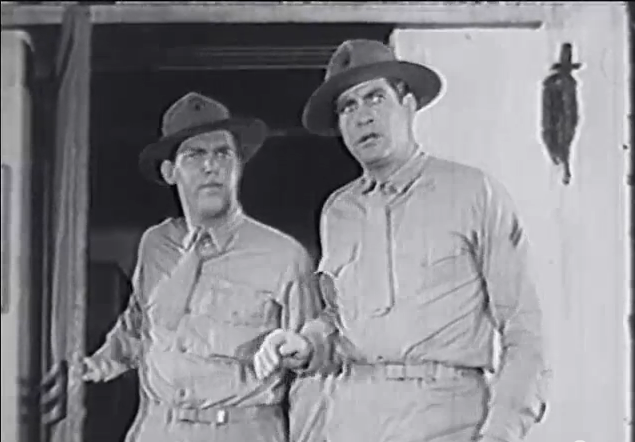
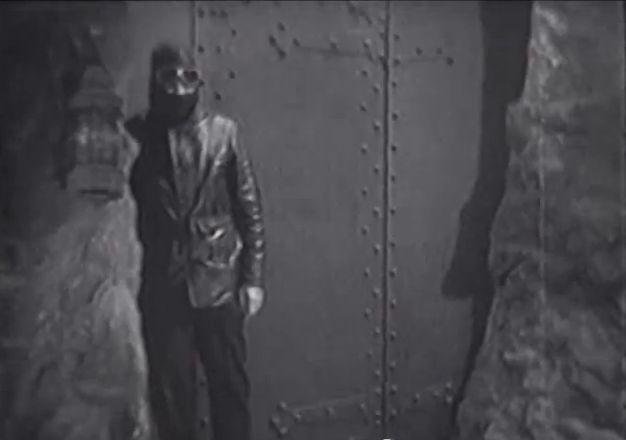
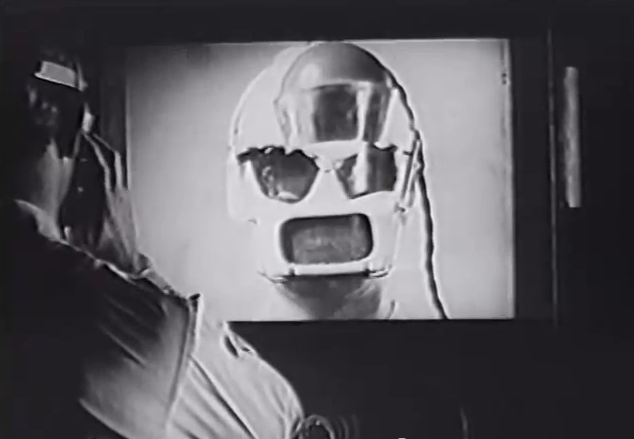
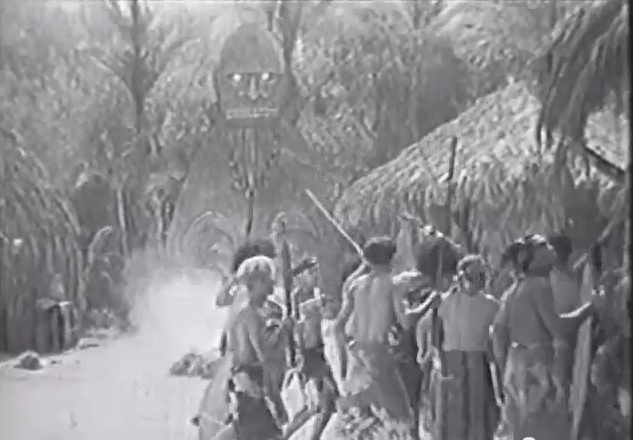
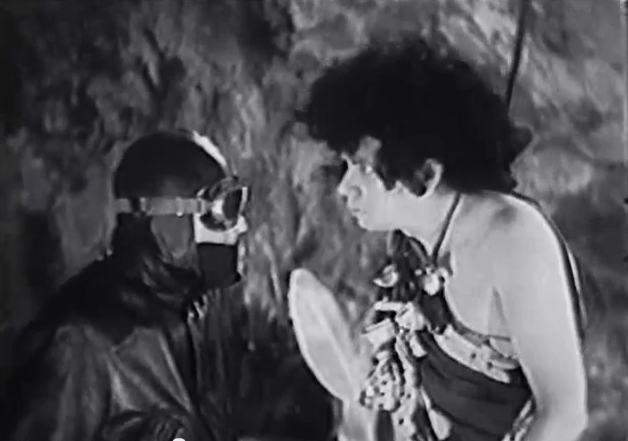
The spy ring is based on Flame Island, a fortified stronghold off the coast. The G-Men, unsatisfied with their legal remit to apprehend the spies, come up with a costumed identity, the “Black Falcon,” who can act with a free hand (as is frequently the case, this is really a pretext for dressing up in costume and using cool gadgets, because it’s not like the G-Men are held up by such red tape as arrest warrants, inquiries into their use of force, or even trials). The Falcon wears a stylish leather flight suit and face mask with goggles, very similar to the Tiger Shark from The Fighting Marines (and anticipating the twenty-first century tendency to replace spandex superhero costumes with more “realistic” paramilitary-style gear).

FGM.BlackFalcon1

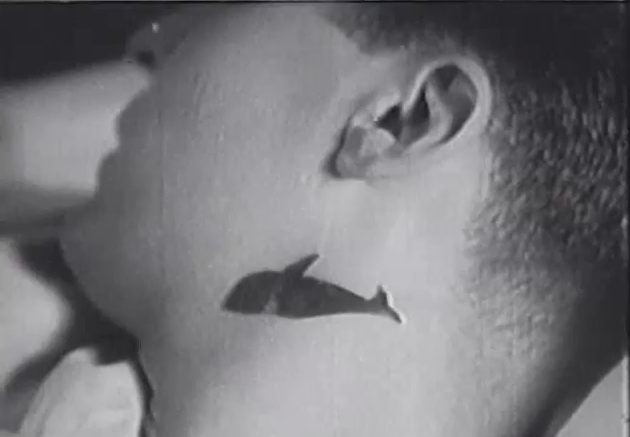
In order to protect the Falcon’s identity, the G-Men do not reveal to anyone (including the audience, until the very end) which of them is wearing the hero’s costume (The opening credits show “? ? as the Black Falcon”). As a proto-superhero, the Black Falcon even has a gimmicky talisman, a dart that he leaves behind to mark his kills (if he remembers, so about half the time).

FGM.headline

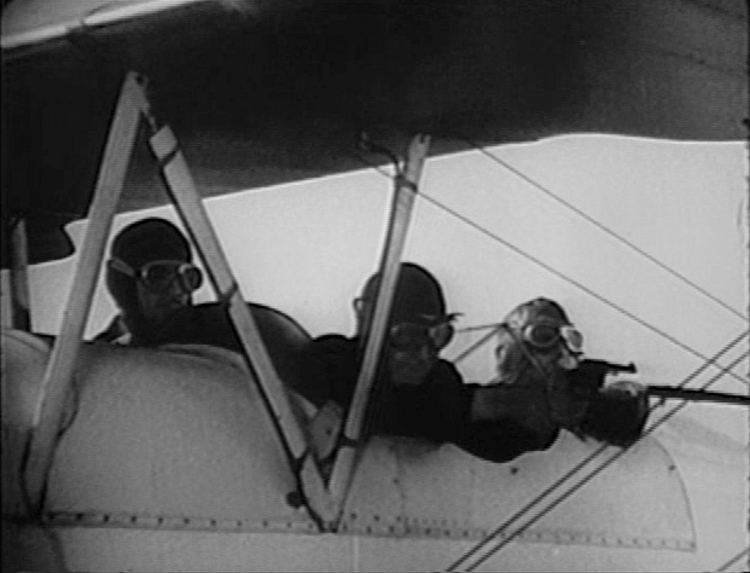
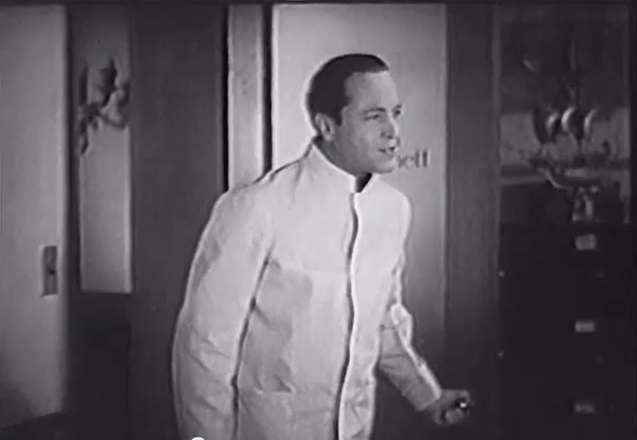
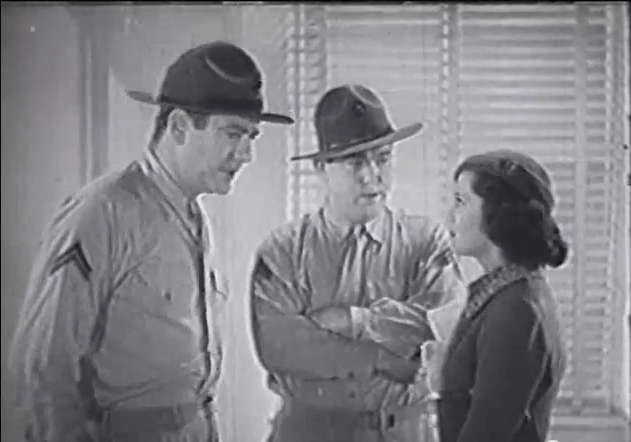
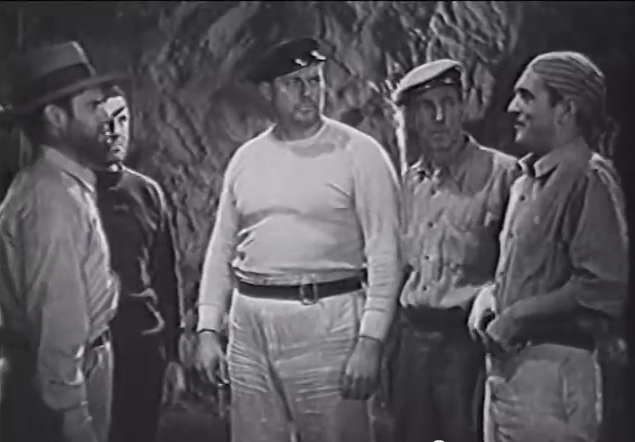
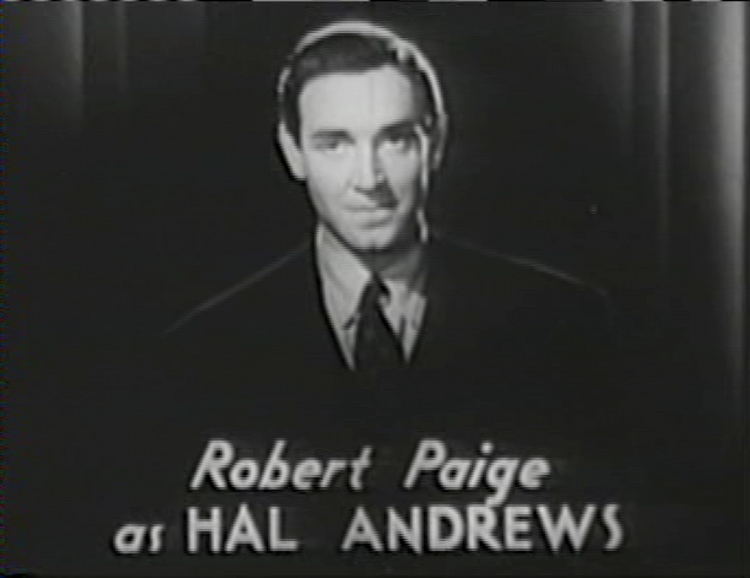
Thus, while the identity of the “Professor” is left unsolved only for the first third of the serial, the real mystery is which of the G-Men is the Black Falcon. The fact that Bronson, one of the four G-Men, dies early on would suggest a rather obvious answer to that puzzle, but you won’t get it from me: you’ll just have to watch for yourself. On occasions when the other two G-Men are accompanying the Falcon, they also wear face-covering masks to keep up the air of mystery, but they needn’t have bothered: as three white guys with dark hair and similar builds, I could hardly tell the three G-Men apart even when unmasked unless they called each other by name. (Is it just me? Maybe I suffer from face blindness when it comes to the actors in old black-and-white movies.)
FGM.Paige

FGM.Fiske

FGM.Craig

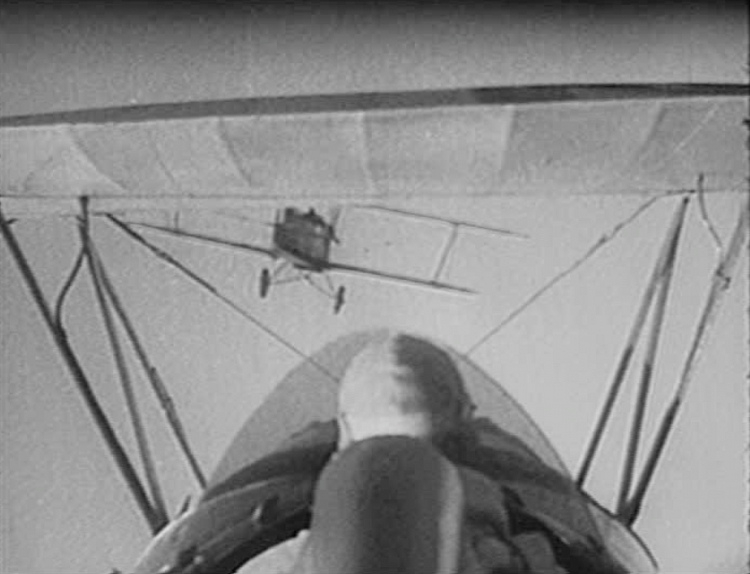
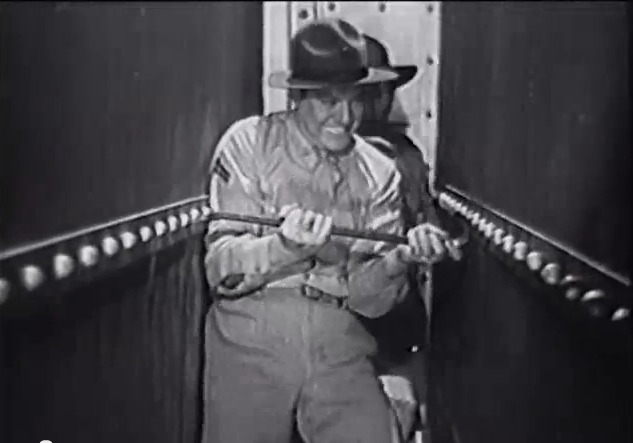
Flying G-Men is a pleasure to watch even when spinning its wheels: the action, of which there is quite a bit, in the form of fist fights, shoot-outs, and car chases, is generally clear and exciting. Fights are often no-holds-barred brawls, free of the stagey, wooden quality that plagues some serials, and they flow organically from the situation rather than beginning from an arbitrary “time to fight now” beat. The surging, constantly active score (credited to musical director M. W. Stoloff, but the work of diverse hands including composer Mischa Bakaleinikoff) does a lot of the work as well, giving a sense of urgency even to scenes of dialogue. (The main title theme in particular sounds like the Superman march and Wagner’s “Ride of the Valkyries” had a baby.) Aerial scenes, oddly enough, are relatively weak, in some cases cut together from obvious stock footage and in most places unclear as to how the combatants are positioned in relation to each other (see my comments below on the end of Chapter Four for a particularly egregious example). Still, these scenes are exciting and unpredictable, and in any case the “Flying G-Men” and the Black Falcon spend as much time fighting the spies on land as they do in the air.

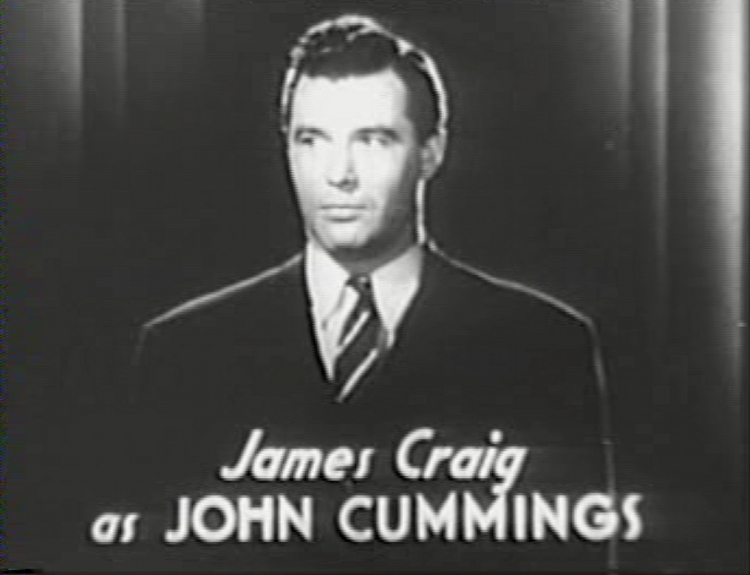
One nice touch is the degree to which events simply refuse to cooperate with the clichés of the genre: for example, disguises are a staple of spy adventures, but almost every time the G-Men attempt to pass themselves off as someone else, they are recognized. Going undercover as workers at an aircraft plant, G-Man Cummings (James Craig) is immediately recognized by Hamilton, the company’s president (and possibly the Professor himself); they had met in the FBI director’s office previously. Cummings offers the lame explanation “Other people have made the same mistake,” but the damage is already done. In another chapter, Andrews (Robert Paige) and Davis (Richard Fiske) invade a hidden lab belonging to the spy ring; after knocking out the lab workers, they don their protective masks and try to take their place when more spies arrive to check on them. “You’re not Walker!” one exclaims after hearing Andrews’ voice, and another fistfight erupts. So much for the art of deception.

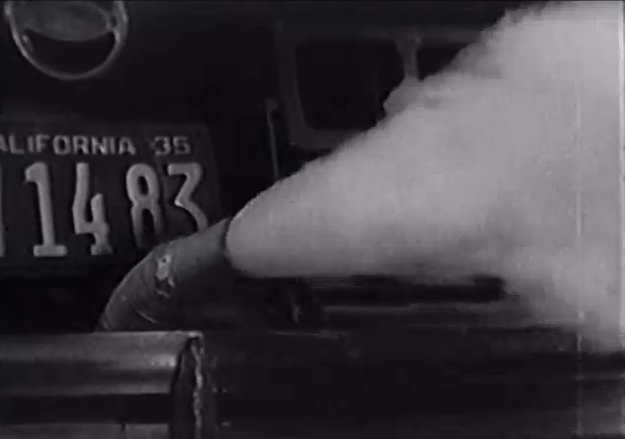
Flying G-Men also benefits from a strong ensemble of back-up players. Sammy McKim (young Kit Carson in The Painted Stallion) plays Billy, the orphaned son of the designer killed in the first chapter. Although not involved in every chapter, Billy has just the right amount of presence in the serial: in some chapters he’s put in danger and must be rescued, and in others he contributes to the G-Men’s campaign by being places that only children can go without arousing suspicion. He also has a few scenes with other kids, lending the support of his network of child airplane modelers and HAM radio enthusiasts to the G-Men. (And boy are those kids quick: in one scene, Billy’s aunt Babs is abducted by the spy ring and through quick thinking she drops her brother’s medal out of the car in front of a pair of boys. “Somebody in that car was trying to get a message to the G-Men!” they immediately conclude.)
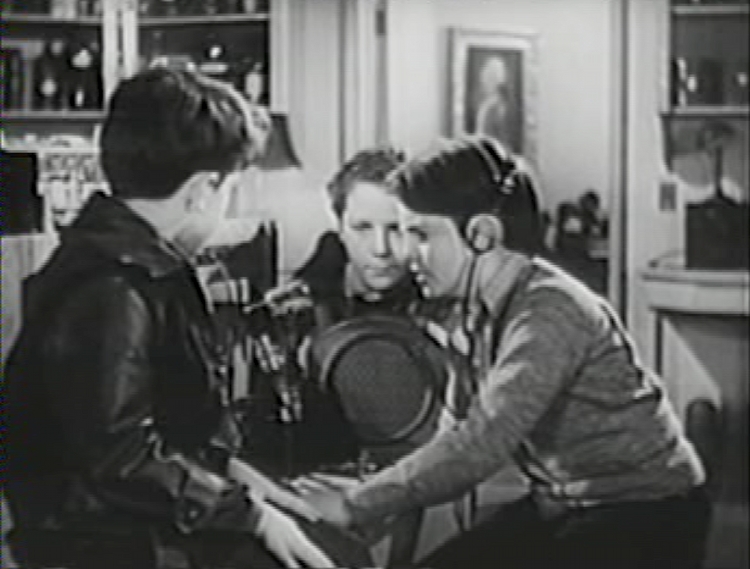
FGM.kids

Babs (another veteran of the serials, Lorna Gray, who later changed her screen name to Adrian Booth) similarly gets involved in a few of the chapters; aside from being kidnapped a couple of times, she also uses her head and helps the G-Men carry out their plans, mostly by pretending to have some more undisclosed plans for her brother’s designs, as a way of luring members of the spy ring out into the open.
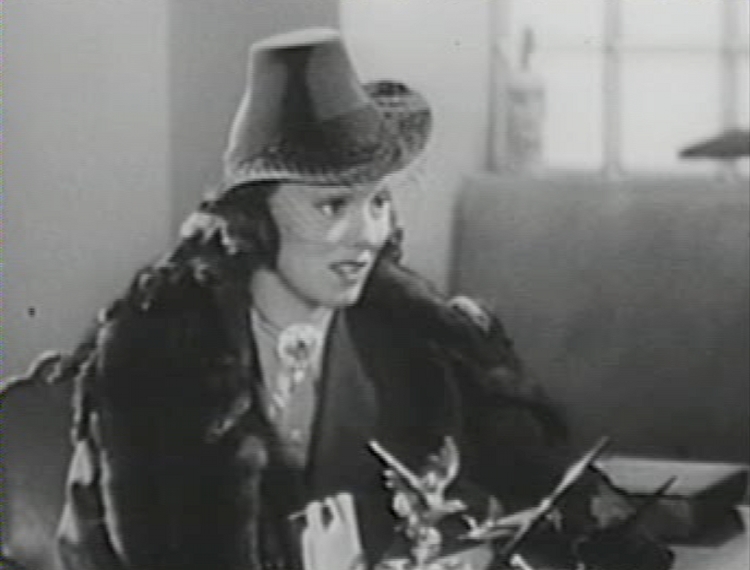
FGM.babs

I haven’t even mentioned the completely superfluous but nonetheless fantastic pretense by which the Professor recruits down-and-outers through his “Historical Study Group”; or the fact that the president of the steel mill in which some of the action is set is named “Lewis Carroll” for some reason; or the garage with a hidden elevator behind a sliding wall that forms a headquarters for the Professor’s second-in-command. Despite Columbia’s reputation for silliness, Flying G-Men largely strikes a satisfying balance between intentional and unintentional comedy: it knows how far-fetched this all is, but doesn’t feel the need to undercut its story with excessive winking and comic relief. Most gratifying to me, it also moves swiftly from one idea to the next, without the stretches of tedium that frequently plague serials (especially those in fifteen chapters). It has, in short, the quality that I value most in serials: it is imaginative, exhilarating, and above all, fun.
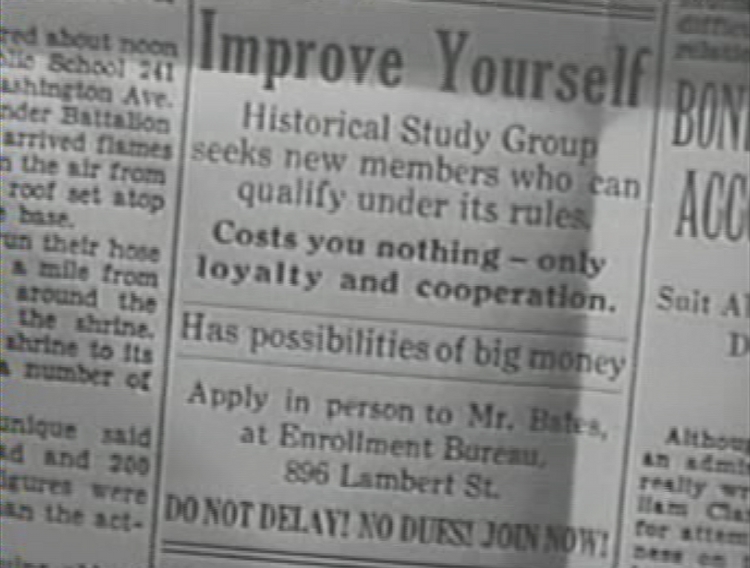
FGM.studygroup

What I Watched: Flying G-Men (1939, Columbia)

Where I Watched It: Flying G-Men was in the batch of DVDs I got from eBay at the beginning of the summer. It can be viewed on YouTube.

No. of Chapters: 15

Best Chapter Title: Frequently serial chapter titles will hint at the crisis featured in the episode or the cliffhanger that ends it, but most of the chapter titles in Flying G-Men are either vague enough that they could apply to any episode (Chapter One, “Challenge in the Sky”) or misleading, suggesting a doom that ends up being something else entirely (Chapter Nine, “Wings of Terror,” does include one of the serial’s many aerial dogfights, but ends with the Black Falcon falling off the roof of a building). Chapter Eleven’s title, “While A Nation Sleeps,” is an example of the former, conveying the shadowy, secretive activities of the spy ring, but has little to do with the events of the chapter: it doesn’t even take place at night.

Best Cliffhanger: In keeping with the disconnect between the chapter titles and the chapter endings, the cliffhangers are often somewhat perfunctory or not very well set up, indicating that they weren’t the filmmakers’ highest priority. Most of the chapters have plenty of action within the chapter that may or may not have anything to do with the cliffhanger. So while not the best cliffhanger, the one that has occupied my mind the most since watching it is at the end of Chapter Four, “The Falcon Strikes.” The spies, having publicized an experimental “stratosphere flight” that is actually intended to help them take aerial photographs of coastal defense installations, have ascended high into the sky in a spherical observation vessel suspended from a high-altitude balloon. The Black Falcon, finding out about the subterfuge and determined to stop the spies, attacks the balloon directly from his airplane, strafing the balloon with a machine gun. The editing of the sequence makes it look like the Falcon is diving toward the balloon, firing from above, but when the vessel falls, it lands directly on the Falcon’s plane, which is now somehow below the balloon. Both the vessel and the Falcon’s plane crash to the ground. It’s a real head-scratcher.
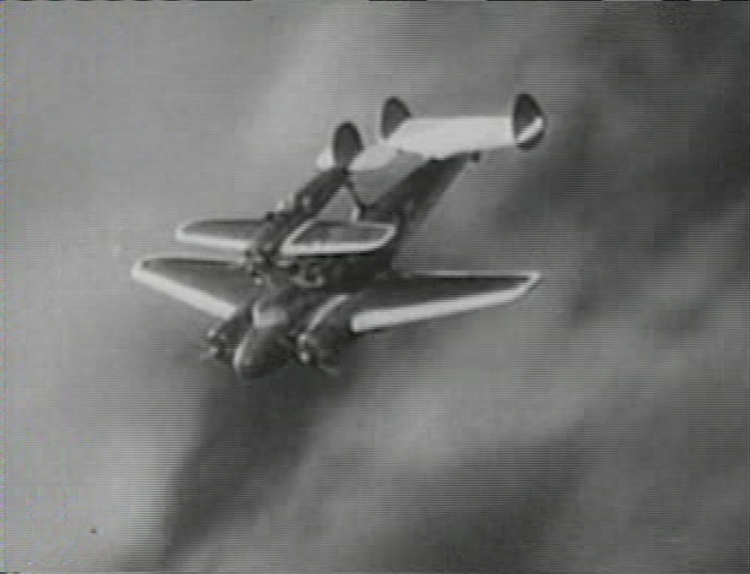
FGM.plane1

FGM.balloon

FGM.explosion

The resolution to this is also a curiosity: previously it’s been established that the Black Falcon sometimes flies a special small plane that can detach from a larger bomber, similar to the robot bombers whose plans are the MacGuffin of the serial. In the resolution to Chapter Four’s cliffhanger, it is shown that the Falcon flew away in the small plane while the spies’ vessel dropped the bomber to the ground. But as a newspaper headline shows, the Falcon’s “piggyback” plane is actually a “pick-a-back” plane. I’d never come across that idiom, but a little digging informs me that “pick-a-back” is actually the original form of the word. Still, according to my sources “piggyback” was current before the end of the nineteenth century, so it seems strange to see the older usage in print.
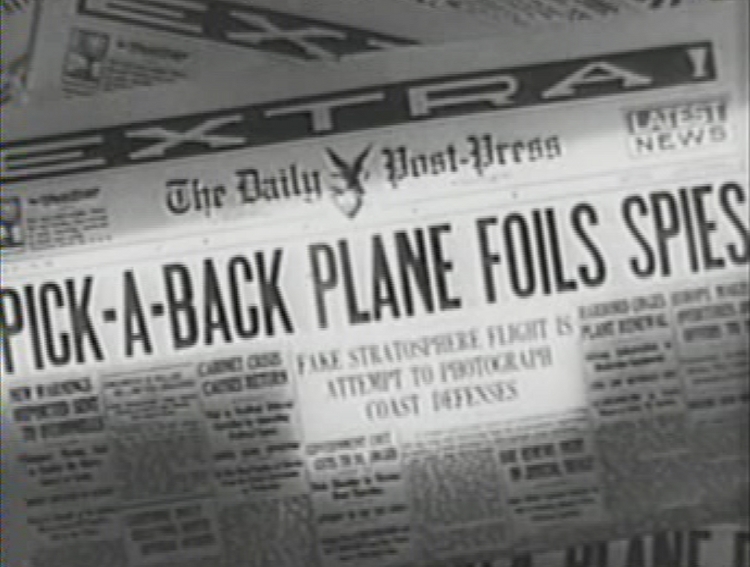
FGM.pickaback

Sample Dialogue: “Who knows but that it’ll be the Black Falcon who’ll step in and capture this Professor? This mysterious flyer seems to be doing some excellent work. In fact, he’s what could be considered a first-rate flying G-Man . . . don’t you think so?” –FBI Director Frank Carlton (Edward Earle), Chapter Eleven, “While A Nation Sleeps”

What Others Have Said: “The Falcon has a black leather flying outfit that is handier to get to when needed than the Durango Kid’s horse, while his two remaining partners are stuck with your basic gray . . . and together they are close to being a precursor to “Blackhawk” and his band. . . . Keeping a straight face is not easy to do when facing a gang of henchmen directed by James W. Horne behind the over-wrought narration of Knox Manning.” –Les Adams, summarizing Flying G-Men on the International Movie Database

This concludes this year’s Fates Worse Than Death. Thanks for following along with me! Barring any serial-related articles I may write this fall or spring, serial coverage will resume next summer. In the mean time, I hope you’ll keep following Medleyana, as you never know what I’ll choose to write about next!

Fates Worse Than Death: The Phantom (1943)

P.title

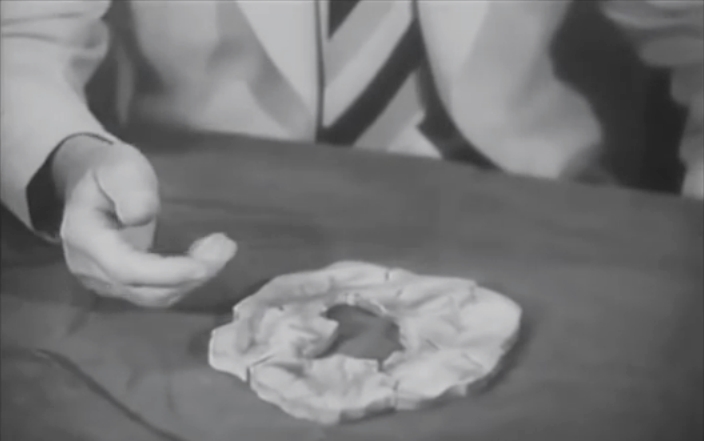
At Sai Pana, a trading post in an unspecified part of Africa, an expedition led by Professor Davidson is preparing to enter the jungle in search of the lost city of Zoloz, with the help of a map made of six pieces of ivory that fit together like a puzzle. Only the central seventh piece, which shows the exact location of Zoloz, is missing. Among those traveling with the Professor are his niece Diana Palmer and Geoffrey Prescott, a colleague from Melville University.

P.keys

Sai Pana’s resident physician, Dr. Bremmer, shows interest in Davidson’s search, but for his own reasons: Bremmer is actually the head of a ring of saboteurs who are building a secret air base in Zoloz, and he will use any connivance to throw Davidson off the scent so he can keep his activities hidden. At the same time, Singapore Smith, owner of the Trade Winds hotel in Sai Pana, schemes to get his hands on the Professor’s ivory keys (and the treasure it leads to) himself.

P.Bremmer

Meanwhile, deep in the jungle at Tonga village, the mysterious figure known as the Phantom has summoned the chiefs of the area tribes for a gathering. The Phantom, through his appearance of immortality and supernatural powers, has kept the peace between the tribes for centuries, but a thug named Long, disguised as a native, strikes the Phantom with a poison dart (an attack instigated by Bremmer, because he needs to be able to control the natives to get his airfield built). The Phantom’s assistant, Suba, ends the ceremony with a puff of smoke, but the damage is already done: the Phantom will die. The only hope for peace between the tribes is to find his son to take his place, as the Phantom identity has been passed down from father to son for generations. In this way, the Phantom is “the man who never dies.”

P.Phantom.Suba

The Phantom’s son? Geoffrey Prescott, currently in Sai Pana with Professor Davidson’s expedition! After tracking him down with the aid of trapper Rusty Fenton, Suba brings Prescott to his father, who lives just long enough to pass on the mantle of the Phantom. Now it’s up to the new Phantom to protect Davidson, unravel the mystery of the saboteurs, and keep the peace in the jungle, in the 1943 Columbia serial The Phantom!

P.throne

Although never as high profile as Batman or Tarzan, the Phantom has elements in common with both characters and has a long history as the star of a comic strip created by Lee Falk in 1936 (and still running in newspapers with the creative team of Tony DePaul, Mike Manley, and Terry Beatty). According to the strip’s mythology, the first Phantom was shipwrecked by pirates on the African coast in the 16th century. He was adopted by a peaceful tribe who both set him on his mission of fighting evil and taught him the many combat disciplines and sleight-of-hand tricks he uses to further that goal. The 1943 serial doesn’t go into that in any detail beyond the handing down of the Phantom’s identity; serials in general were much less concerned with origin stories than superhero movies in recent decades (the 1996 feature film starring Billy Zane makes for an instructive contrast), but unlike many serials The Phantom is reasonably faithful to the comics (and it’s a damn sight better than the Batman serial that immediately preceded it!).

P.skull

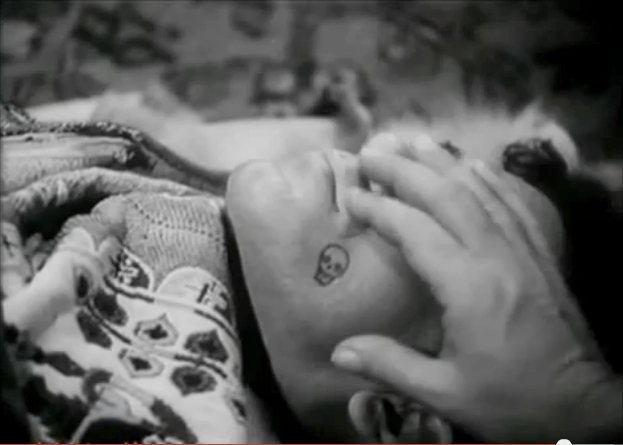
The first chapter is entitled “The Sign of the Skull,” and indeed the skull is an important part of the Phantom’s iconography, particularly the carved ring he wears which leaves the imprint of a skull on those on whom he metes justice. Instead of the remote and forbidding Skull Cave, however, the Phantom of the serial keeps his throne in public, in the center of Tonga village, where he ceremoniously makes appearances to speak to the natives and pass judgment on lawbreakers. There’s quite a bit of flair to these proceedings, as Suba uses flash powder to create bursts of flame and smoke, making it look as if the Phantom appears and disappears by magic. (Interestingly, Bremmer manages to use that same sense of theatricality against the Phantom, first setting up a fraudulent “Fire Princess” whose supposed control of flame makes her a challenger to the Phantom’s authority in the jungle, and later putting a Phantom costume on one of his henchmen after thinking he had eliminated the real one, in order to control the natives.)

P.fireprincess

The Phantom plays on the superstitions of the natives one-on-one, as well: confronting the rebellious chief Chota, the Phantom “summons the spirit of fire” to burn Chota’s village unless he tells the truth. In another episode, he smokes out a murderer by pretending to put poison into glasses of wine, saying it will only harm the guilty; of course, the killer is betrayed by his own fear rather than by the wine, which is harmless. Like many pulp heroes, the Phantom wins by his wits and his powers of psychology and detection as much as by his fists and weapons. (And like those heroes, there’s a certain unapologetic ruthlessness to his methods.)

P.Chota

There are certainly enough villains to choose from: right off the bat, Professor Davidson is victimized by both Dr. Bremmer and his saboteurs and the competing forces of Singapore Smith (the “outlaws”). There’s quite a bit of jockeying by both groups as they each try to steal the ivory keys from Davidson, and at times they work together against their common enemy. Given that both groups are white men with stubble wearing khakis and pith helmets, it’s easy to get them mixed up. However, Singapore Smith is so obviously shady that he doesn’t make it to the end of the serial; even in death he causes trouble for the Phantom, who pays him a visit (in disguise as “Mr. Walker”) and is then blamed for Smith’s murder. Meanwhile, Dr. Bremmer, like most classic serial villains, works his evil through proxies (including traitors within the expedition), avoiding suspicion until the final chapter.

P.Davidson.Singapore

In a late part of the story, the Phantom and Davidson’s expedition run afoul of the Tartar, the strict ruler of a kingdom that resembles Mongolia. The incongruity of a Mongol fortress in the middle of an African jungle, combined with the kingdom’s extreme isolationism (normally, all outsiders are put to death if they enter the Tartar’s kingdom, but naturally the Phantom wins him over), mark this episode as an example of the “lost world” genre embedded in the larger story. However, not even the Professor comments on its strangeness, and there is no explanation offered as to its presence and survival. (Also, it practically goes without saying that all the major characters speak English; there are a few scenes in which natives speak their own language and somebody has to translate, but not so many that it slows down the action.)

P.tartar

As the Phantom, Tom Tyler is nicely physical and has a commanding presence, and Jeanne Bates is adequate as the headstrong Diana Palmer, but the only antagonist to have much character is oily Singapore Smith (Joe Devlin). As Dr. Bremmer, Kenneth MacDonald has some good moments and is smooth enough to convincingly play both sides, but didn’t leave a strong impression on me. Frank Shannon (Flash Gordon‘s Dr. Zarkov) plays Professor Davidson, but the decline in energy obvious in the later Flash Gordon serials is in evidence here as well. The Phantom’s animal companion Devil, a wolf in the comics, is played in the serial by a German Shepherd, Ace the Wonder Dog.

P.Devil

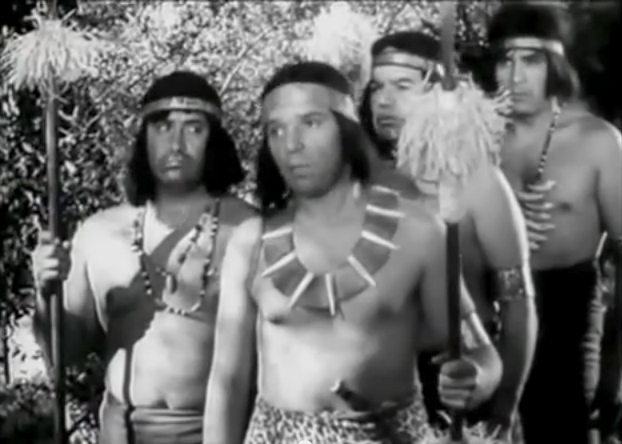
Beyond that, the casting of the many African tribesmen seems to have been mixed up with casting for a Western. Serials are not documentaries, of course, but the best of them make some effort to draw inspiration from the real world. In The Phantom, the natives resemble Hollywood Indians, (mostly) white actors with stilted accents and war paint. The Internet Movie Database lists among the uncredited actors playing natives Jay Silverheels (later TV’s Tonto) and Iron Eyes Cody, an Italian immigrant who adopted an Indian identity and made a specialty of playing Indian characters. This knot of tangled ethnic representation is not terribly unusual for the time, but compared to the actual black actors I just saw in Tim Tyler’s Luck, it’s especially phony.

P.natives

What I Watched: The Phantom (Columbia, 1943)

Where I Watched It: The whole thing can be watched on YouTube.

No. of Chapters: 15

P.Diana

Best Chapter Title: “The Road to Zoloz” (Chapter Thirteen) is nicely specific, and also suggests an entirely different film starring Bob Hope and Bing Crosby. It’s worth pointing out that both of the Phantom’s catch phrases, “The Man Who Never Dies” and “The Ghost Who Walks” are used as chapter titles (Chapters Two and Five, respectively).

Best Cliffhanger: Despite my criticisms of the acting in The Phantom, at least the action is pretty good, and there are not only several good cliffhangers but some exciting action sequences within the chapters. A very well-done cliffhanger ends Chapter Five (“The Ghost Who Walks”), in which the Phantom fights with the saboteurs on a rope bridge overhanging a deep gorge. Earlier, the Phantom, stalking the saboteurs as they drove an oxcart full of contraband ammunition to the secret airfield, had cut partially through the bridge’s ropes to weaken them. When he ends up fighting the saboteurs directly, of course the fight spills onto the damaged bridge, and the ropes give way, (seemingly) dropping them into the river far below.

P.bridge

Sample Dialogue: In the first chapter, Long (Wade Crosby) returns to witness a gathering at the Tonga village after killing the Phantom, along with fellow saboteur Andy (Sol Gorss) and upstart chief Chota (Stanley Price). To his chagrin, the new Phantom is accepted without question by the natives.

P.saboteurs

Long: Why, that can’t be the real Phantom. I know I killed him! This is just a trick to fool the natives.
Chota: No, him Phantom. Him Phantom! Man who never dies.
Andy: Looks like him to me.
Long: Why, it can’t be! He’s a much younger and taller guy than the real Phantom. I’m telling you that guy’s a fake.
Andy: Looks like you missed, Long.
Long: Let’s tell the natives that guy’s a phony.
Andy: Yeah? And when they ask us how we know, we tell ’em you killed the real Phantom. Why, you’d have your head drying over a fire in no time.

What Others Have Said: “Occasionally there was a shock when a player you had always associated as a good guy turned up in a serial as a crook. . . . You just couldn’t believe that lovable old rascal was really one of the baddies. . . . But, the real test of credibility came when Ernie Adams, who portrayed not only bad guys, but sneaky, yellow, cowardly bad guys, was cast in the role of Rusty Fenton in The Phantom in 1943, and you had to believe that the hero would have in him a good, trusted ally.” –William C. Cline, “When the Leopard Changed Its Spots” in Serials-ly Speaking

P.Rusty

(Serials I’ve reviewed in which Adams appeared include The Miracle Rider, in which he played the shady store operator’s clerk, and Tim Tyler’s Luck: Adams played Becker, the henchman whose death by gorilla meant so little to Spider Webb.)

What’s Next: For my final installment of Summer 2016’s Fates Worse Than Death, I will return to the air with Flying G-Men. See you in two weeks!

Fates Worse Than Death: Pirate Treasure

PT.title

Dick Moreland, after returning from a triumphant flight around the world, announces to his comrades at the Aero Club that his next feat will involve digging up a treasure his pirate ancestor, Sir John Moreland, buried centuries ago. The chart describing its island hiding place has been in Moreland’s family for generations, but he is the first member of the family to take it seriously and attempt to recover the treasure. Unfortunately for Dick, a new member of the club, Staley [sic] Brassett, isn’t the honest friend he appears to be: he’s been searching for Sir John’s treasure himself, and he immediately dispatches his henchmen to break into Dick’s house and steal the chart.

PT.moreland1

Chasing the henchmen, Dick enlists the aid of a young woman, Dorothy Craig, by falling into the street in front of her car. Dorothy turns out to be the daughter of an airline owner who becomes involved in the expedition and supplies a ship; and since she’s on the lookout for some excitement herself, she comes along as well. Brassett, still pretending to be a good guy while guiding the henchmen from behind the scenes, allows himself to be persuaded to join the search, too. For the majority of Pirate Treasure‘s running time, even as they travel to the island, Dick and co. assume that the lead henchman, Curt, is the head of the gang that has been hounding their steps, with Brassett taking increasingly convoluted steps to preserve his plausible deniability.

PT.Dick.Dorothy1

Pirate Treasure is neither the best nor the worst serial I’ve watched since beginning this series, but it may be the most elementary in its appeal. Serials were no strangers to formula, but Pirate Treasure goes beyond cliché to an almost Platonic ideal of wish-fulfillment with almost every element stripped down to its essentials. The secret map to buried treasure in the Spanish Main (a map which is also an ancestral inheritance); the brave and capable girl who nonetheless needs to be rescued and protected; the sneering villain who pretends to be the hero’s friend; the trusty sea captain who can palaver with the natives (who are themselves a composite of every “jungle savage” you’ve ever seen on screen); and of course the hero is not only strong and clever enough to come out on top, but the kind of mensch who will even rescue his enemies rather than let the natives burn them at the stake (and probably eat them). This is a serial that begins with the hero making a record-breaking solo flight around the world, just so that he can finance the adventure he really wants to go on.

PT.chart

It was, of course, made early enough that many of these plot devices were still fresh and didn’t require much in the way of “twists” for sophisticated audiences; the clichés were in the process of being born. Likewise, unlike many later serials, there is no reliance on a library of stock footage, and the stunts have more in common with the death-defying realism of the silent serials than with the careful montages of disguised stunt performers of later years. Pirate Treasure was Universal’s follow-up to The Perils of Pauline, but it feels like a product of an earlier era.

PT.car.plunge

Leading man Richard Talmadge brings his acrobatic experience to his action scenes: in some scenes he leaps from one rooftop to another like a 1930s parkour star, and many of his fight scenes take advantage of his tumbling skills. (I was strongly reminded of Charles Quigley in Daredevils of the Red Circle, who combined tumbling and judo in a similar way.) Talmadge also makes a specialty of leaping from great heights: into a moving car, into the water from the rigging of a ship, or on to his enemies in the many brawling fist fights that occur. All of this is filmed as it occurs (sometimes with a little undercranking to juice it up), giving the action an immediacy and a sense of realism that counteracts and grounds the unreality of the plot.

PT.Dick.Dorothy2

Talmadge is less assured when it comes to dialogue, however: his voice is light and almost childish, and occasionally halting in ways that give away the scripted nature of his lines. (I will say, however, that unlike many films from the early 1930s, the dialogue is crystal clear and easy to understand; between the clarity of the sound and the largely functional dialogue, Pirate Treasure was one of the easier to follow serials I’ve watched.)

PT.Dorothy.bound

Lucille Lund, who plays Dorothy Craig, also does her share of stuntwork: she’s something of a Pearl White type, doing double duty as both action heroine and damsel in distress. The one thing she doesn’t do is get involved in fights: even the most thuggish henchman won’t hit a woman in this kind of film, so unless she’s being grabbed and tied up, she is ignored when fights break out, leading to several amusing scenes of men grappling in the foreground while Dorothy stands aside screaming or looking worried. Lund is also a better actor than Talmadge, subtly supporting her costars by reacting to them as a thrill-seeking heiress who gradually finds herself out of her depth, terrorized by henchmen and natives, and whose growing affection for Dick Moreland grows naturally and believably. (The integration of action and romance also seems like a throwback to the silents, or at least the more mature storytelling found in features.)

PT.Curt.Brassett

Beyond the leads, Pirate Treasure has a strong supporting cast including frequent heavy Walter Miller as Brassett, who is suitably oily as a villain hiding his true colors (I think my favorite moment is when he recommends one of his own men as First Mate on the sea voyage, assuring Moreland that his pick is “one hundred percent loyal” and “you’ll be surprised at the thoroughness with which he does things”). As “spearhead” henchman Curt, Ethan Laidlaw gets to play a more traditionally villainous role, and makes the most of the active part (he also has a fine mustache so you can tell him apart from the other henchmen). Pat O’Malley plays John Craig, Dorothy’s father, without much color but with a stoic reserve that gives way in affectionate scenes with his daughter.

PT.Dorothy.Dad

Finally, William Desmond is Captain Carson, a convincingly salty sea-dog whose friendship with the natives and knowledge of their “lingo” (which mostly sounds like Spanish) saves the day. Incidentally, the Captain’s ship is the Lottie Carson: named for a lost love, or perhaps the Captain’s mother? If Captain Carson were one of those sailors with MOM tattooed over his heart, it wouldn’t surprise me at all. He and the rest of these characters would be right at home in something like Captain Easy or Tintin, series with which Pirate Treasure shares a milieu and a considerable family resemblance.

PT.Carson1

What I Watched: Pirate Treasure (Universal, 1934)

Where I Watched It: This was another of the DVD transfers I bought in a lot from eBay. The picture quality isn’t great, so please forgive the blurry screen shots. This serial doesn’t appear to be available to view online, but “pirate treasure” is a phrase that brings up thousands of hits when you search for it, so I could be wrong.

No. of Chapters: 12

Best Chapter Title: In keeping with the streamlined approach, many of the chapter titles are very literal (“Stolen Treasure,” Chapter One; “Mutiny!”, Chapter Eight). There is “The Death Plunge” (Chapter Two) as well as “The Fatal Plunge” (Chapter Eleven), “The Death Crash” (Chapter Six) and “Crashing Doom!” (Chapter Seven). My favorite, however, is “The Wheels of Fate” (Chapter Three), which is at least mildly poetic and (in true serial fashion, the chapter title often foreshadowing the cliffhanger at its end) sets up an exciting highway chase and a stunt of Talmadge jumping off a motorcycle speeding across a bridge onto a moving train below.

PT.motorcycle

Best Cliffhanger: The chapter endings in Pirate Treasure run the gamut from genuinely suspenseful “how are they going to get out of that one?” cliffhangers to rather abrupt cuts to black following a fall. Some of the best involve vehicle crashes (a speedboat crashing into a buoy at the end of Chapter Four, “The Sea Chase”; a car plunging down a hillside and rolling over at the end of Chapter Six, “The Death Crash”). I’ve complained about cliffhanger resolutions that neither get the heroes out of the jam before the crash nor come up with a plausible excuse for their survival, and both of these are prime examples: after the dramatic crash–the boat splintered to pieces in one case, and the open-top car rolling down the hillside in the other–Dick and Dorothy brush themselves off and are okay.

PT.car.wreck

The best cliffhanger in Pirate Treasure is also the worst offender in its resolution: at the end of Chapter Nine (“Hidden Gold”), Dick and Curt are fighting at the top of a tall, rocky cliff, when Dick loses his footing and falls down, down, down to the jungle floor below, the camera lovingly tracking his body as it bounces off rocks before hitting bottom. Falling bodies are, for some reason, one of the hardest effects to get right, even today with modern CGI and its vaunted “ragdoll physics”; just throwing a dummy down the cliff, as they did in the serial days, usually doesn’t look very convincing. This one, however, is pretty good, while still clearly a dummy. There’s no way Dick could have survived, at least without serious injury (or a massive cheat). However, at the beginning of the next chapter, he gets up after being momentarily stunned; he briefly holds his arm, as if it might be broken; but no, wait, it’s all right; and he’s off to meet the next challenge. From now on, I’ll just refer to this kind of save as a “walk it off” resolution.

PT.cliffs

Sample Dialogue:
Captain Carson: I’ve seen lots of treasure hunts. Most of them end in disaster.
Dick Moreland: Ha ha! But not this one.
–Chapter Five, “Into the Depths”

PT.Carson2

What Others Have Said:Pirate Treasure featured Richard Talmadge, who followed the tradition of Helen Holmes, Pearl White, Helen Gibson, and Joe Bonomo as an action stunt pioneer and innovator, doing things ‘the way you do it–making movies.'” –William C. Cline, Serials-ly Speaking

PT.treasure

What’s Next: Join me next time as I take my first dip into the “Canadian mountie” subgenre with Republic’s King of the Royal Mounted!

Fates Worse Than Death: The Adventures of Sir Galahad

AG.title

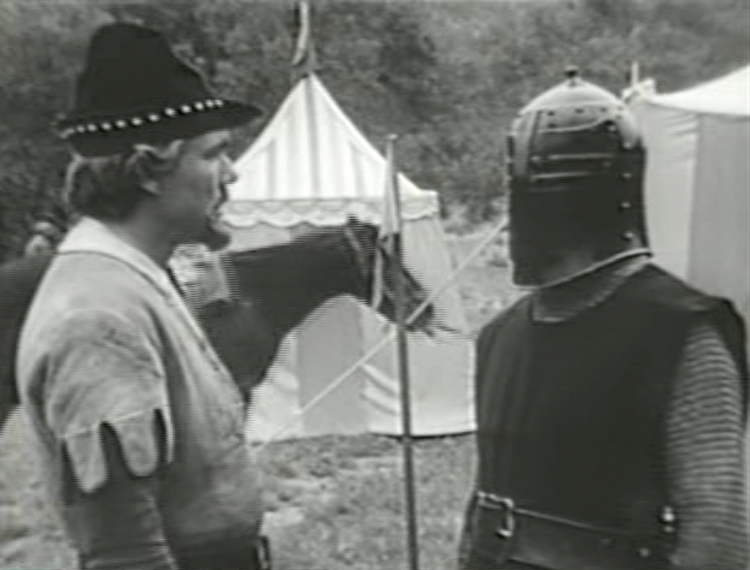
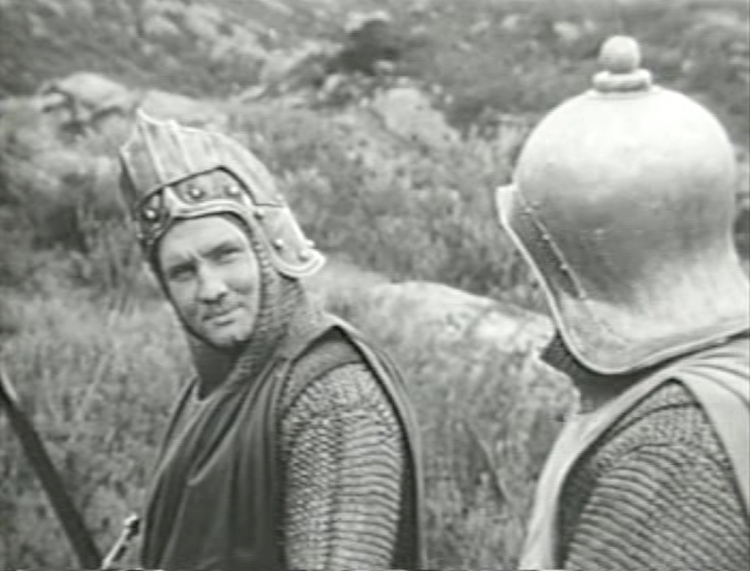
After a friendly joust between Camelot and Cornwall, an unknown knight rides forward and challenges the victors, Sir Bors and Sir Modred of Camelot. After defeating them, the stranger requests to be made one of King Arthur’s knights, and reveals that his name is Galahad. Impressed by the young knight’s skills and candor, Arthur agrees to put Galahad to the traditional test: he must stand guard over the sword Excalibur through the night. Through treachery and drugged wine, however, Galahad passes out, but not before seeing a suit of armor move! The mysterious armored knight takes the sword and escapes the castle through a secret passage. The next morning, Galahad is discovered asleep. No one believes his wild story, and Merlin himself accuses Galahad of perpetrating the theft. Even worse, the invading Saxons, led by King Ulric, are attacking! While Arthur defers punishment and Galahad is allowed to ride with the knights, he vows to find the sword and return it to Arthur to clear his name and earn his place at the Round Table.

AG.watch

Thus begins the twisting plot of The Adventures of Sir Galahad, the 1949 serial from veteran director Spencer Bennet. Along with Sir Bors (also under suspicion because it was he who served the wine that incapacitated Galahad), Galahad infiltrates the Saxon camp, fights against outlaws, and must even overcome Merlin’s magic, all while trying to win over the suspicious knights of Camelot. Ultimately, the villain is the “Black Knight,” the traitor within Camelot who seeks to manipulate the Saxons and outlaws into defeating Arthur in order to claim the throne for himself. He who wields the invincible Excalibur can stand against any foe, so of course the Black Knight keeps it for himself, even while pretending to aid Ulric.

AG.treachery

The legends and romances that make up the Arthurian cycle are so rich and varied that film adaptations inevitably borrow what can be used and discard the rest. Often the forbidden romance between Sir Lancelot and Queen Guinevere is featured, and the quest for the Holy Grail is another popular subject for film, tackled by both Monty Python and John Boorman. In some versions of the story, Galahad is Lancelot’s son, determined to prove himself before he reveals his identity to his father. The Adventures of Sir Galahad doesn’t deal with any of those plots, but it does an impressive job of creating an original story, combining the source material with the formal demands of a serial.

AG.Arthur1

In fact, The Adventures of Sir Galahad is unusual in its choice of setting: there are very few serials that deal with medieval or mythological settings (but see Jerry Blake’s comments below). Film studios were regularly releasing features about Arthur, Robin Hood, and other legendary figures, so sets and costumes would have been available for serials (Columbia’s The Green Archer features a castle and a Robin Hood-like character, but is set in modern times), but Galahad remained an outlier. It’s largely a successful hybrid, however: the struggle of the knight and his partner to solve the mystery and prove his innocence lends itself to the episodic rhythm of a serial; there are plenty of opportunities for fight scenes, both skirmishes and full-on battles, and the abundant swordplay makes a nice change from fistfights and shoot-outs; the disguised villain is very typical, comparable to such bad guys as the Scorpion or the Dragon (it ends up being exactly who you think it is, but still); and the frequent magical interference of Merlin (as well as Morgan le Fay, who has a few spells of her own) provide opportunities for unusual and inventive special effects and camera tricks.

AG.BlackKnight1

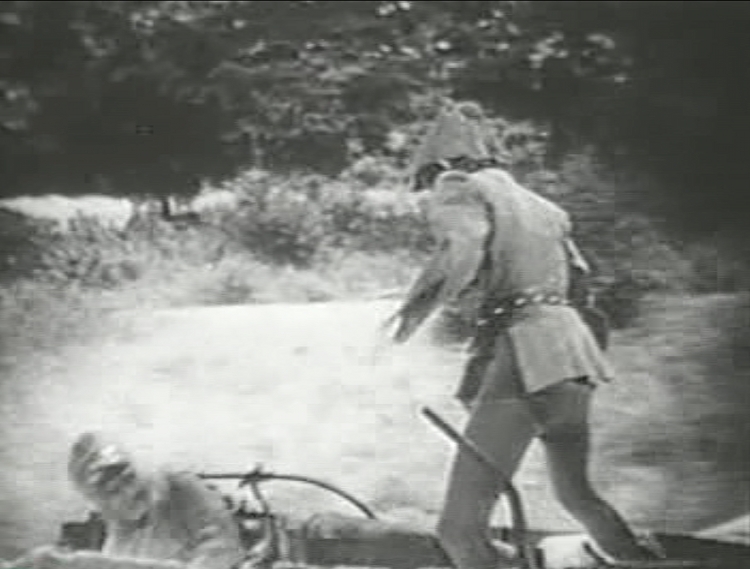
To cite just one example of the serial and fantasy worlds colliding, the cliffhanger of Chapter Eight (“Perilous Adventure”) features Galahad and an outlaw fighting in a wagon pulled by a runaway horse. The scene is identical in blocking and editing to similar fights atop trains or trucks in other serials, down to the use of rear projection, but the medieval setting puts it into a novel context.

AG.wagon

From a story perspective, writers George Plympton, Lewis Clay, and David Mathews also make some smart decisions: by setting Galahad against Merlin and the knights of Camelot at the beginning, the story upends expectations about good guys and bad guys: like Galahad, the audience is unsure who to trust. Merlin appears to be the villain at first; Morgan le Fay offers her own magical help, but what’s her agenda? Arthur (Nelson Leigh, seventh billed) is a distant figure, far from the center of the story. Galahad is left to his own resources, with only the dogged Sir Bors (Charles King) to provide both comic relief and the occasional voice of reason. If these versions of the characters ultimately conform to our expectations of them, it’s not without enough twists and turns to make them feel lived-in, the resolution to the story earned.

AG.Merlin.Morgan

The Adventures of Sir Galahad boasts a large cast for a serial, but the difference between serial and feature shows in the battle scenes, where one might expect hordes of extras: a dozen men on horseback is large enough to make a convincing posse or Indian war party in a Western, but when such a group is meant to represent the entire Saxon army, it’s a little puny. Galahad‘s fight scenes are more impressive when staged in close quarters (such as several fights that take place in an inn, or in mountainous terrain), hiding the small number of men involved and making the fight look more crowded. In many ways, The Adventures of Sir Galahad bears a close resemblance to the low-budget fantasy features that would become popular in the 1950s, such as Bert I. Gordon’s The Magic Sword or the many films about Hercules or Sinbad.

AG.battle

As Galahad, George Reeves (who would go on to play Superman on TV) makes a convincing hero, eager and brave, but at 35 he is more boyish (at one point a discouraged Bors calls him a puppy, “barking at nothing and chasing his own tail”) than boy (apparently a common pitfall in serial casting). Charles King plays Bors as an over-the-hill Falstaff, accustomed to big meals and the wenches who serve them, but he also becomes Galahad’s most loyal companion and, like all the knights of Camelot, will do what must be done to combat evil.

AG.Galahad.Bors1

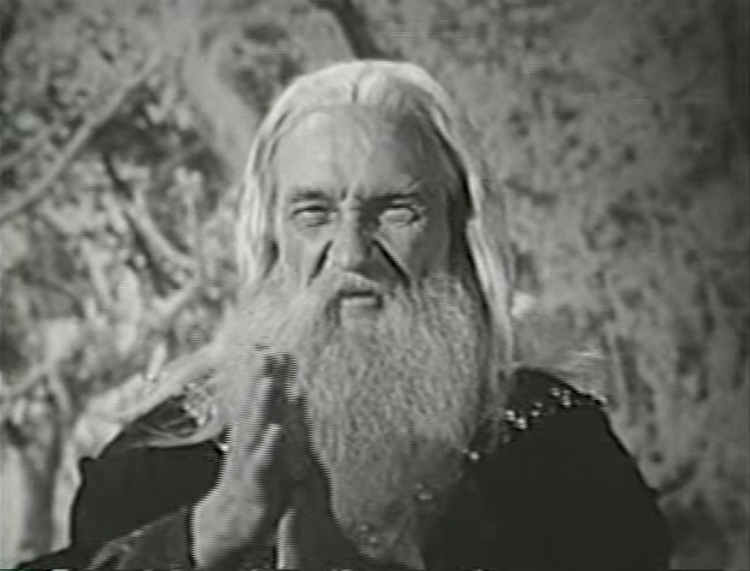
The MVP of the cast is William Fawcett, who plays Merlin. Fawcett was the crotchety scientist Professor Hamill in Batman and Robin; he’s just as crotchety here, but with the robes and long white beard of a wizard. He’s clearly having a ball chewing the scenery, throwing flash grenades to mask his magical comings and goings, and waving his hands to cast spells. It’s no wonder Fawcett had such a long career: he’s the quintessential character actor, breathing life into a stock character and stealing every scene he’s in.

AG.Merlin

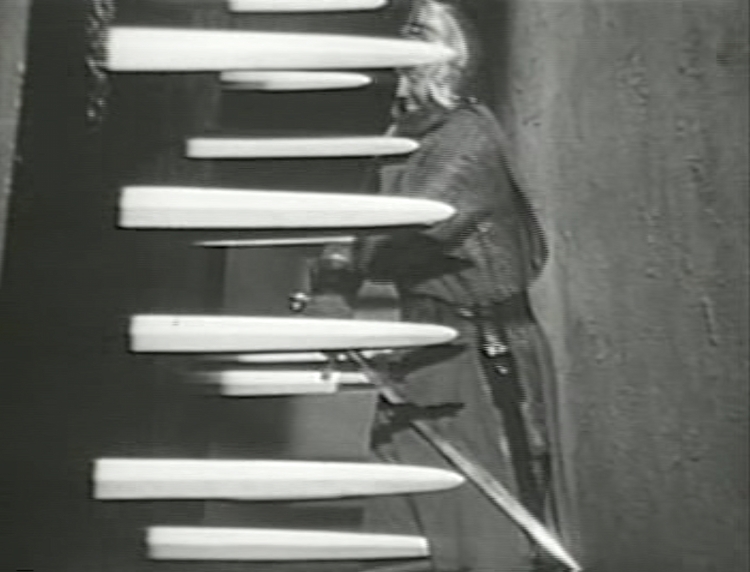
If I could add one thing to this serial, it would be to have Galahad fight a dragon; the only monsters the knight faces are ultimately human ones. Other than that omission, there’s as much Dark Ages atmosphere as you could hope for in The Adventures of Sir Galahad, with secret passages and dungeons, sword fights, magic spells, and mighty feasts. There is even a giant crossbow! The Adventures of Sir Galahad is highly recommended to both serial and fantasy fans.

AG.crossbow

What I Watched: The Adventures of Sir Galahad (Columbia, 1949)

Where I Watched It: I bought a batch of privately-burned DVDs of serials from a dealer on eBay, along with several others I’ll be writing about this summer. The transfer is pretty raw, but the price was right. The Adventures of Sir Galahad doesn’t appear to be available to view online.

No. of Chapters: 15

Best Chapter Title: Not since The Perils of Pauline has a serial emphasized the perils of its cliffhangers this much: in addition to “Passage of Peril” (Chapter Six) and “Perilous Adventure” (Chapter Eight), there’s my favorite, “Castle Perilous” (Chapter Twelve).

AG.passage

Best Cliffhanger: At the end of Chapter One (“The Stolen Sword”), Morgan le Fay has directed Galahad to find answers in the Enchanted Forest; this is Merlin’s domain, from which no man has returned. As Galahad and Bors enter, they are accosted by strange voices and sounds. Merlin appears and bewitches Galahad so that he can’t move; then Galahad is grabbed by a suddenly mobile tree, while flames dance around him. It’s a pretty intense and strange cliffhanger that lets us know we’re going into the deep end of fantasy here. Alas, my hope that all of the cliffhangers would be magical or fantastic wasn’t lived up to. Some are, and there are a few medieval-specific cliffhangers, like one in which Galahad is strapped down beneath a swinging spiked ball, à la The Pit and the Pendulum; but most are the typical falls or brushes with death common to all serials. But man, that first chapter: it’s a doozy.

AG.enchantment

Sample Dialogue:
Bors: Have you never heard it said that rashness is the father of disaster?
Galahad: True, but too much caution is the blood-brother of cowardice.
–Chapter Five, “Galahad to the Recue”

AG.Galahad.Bors2

What Others Have Said:Adventures of Sir Galahad represents its producer Sam Katzman’s second and last attempt to combine the serial and medieval-swashbuckler genres; it’s a huge improvement over Katzman’s previous effort in the same line, the shoddy and tedious Son of the Guardsman–even though Galahad and Guardsman have many sets, costumes, and actors in common.” —The Files of Jerry Blake
(I haven’t seen Son of the Guardsman yet, so I can’t make a comparison.)

What’s Next: X marks the spot! Join me next time for the generically-titled Pirate Treasure.
Fates Worse Than Death: Captain America (1944)

CA44.title

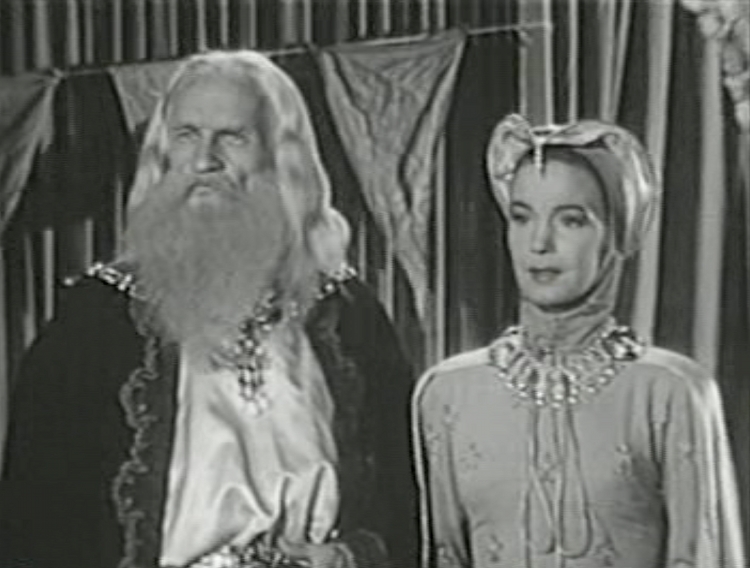
A bizarre series of deaths, some accidental and some obvious suicides, strikes at wealthy and influential men. The only connection between them is their involvement in an expedition to Central America in search of Mayan ruins, and the jeweled scarabs found in the victims’ possession. The mastermind behind the deaths, revealed to the audience in the first chapter, is Dr. Maldor, a member of the expedition who feels cheated of the glory and wealth that others have claimed. As the Scarab, Maldor is determined to take down his rivals, one by one, all the while posing as the friendly and helpful director of the Drummond Museum of Arts and Sciences.

CA44.scarab

Maldor’s plan might very well succeed, but for the industrious District Attorney, Grant Gardner, and his assistant Gail Richards, who stand in Maldor’s way and get far too close to the truth in their investigations. Even worse, Maldor’s henchmen keep running afoul of the costumed crime fighter known only as Captain America. Could Gardner and Captain America be one and the same? The audience knows, but will the Scarab learn the truth, and what will he do with it?

CA44.Cap2

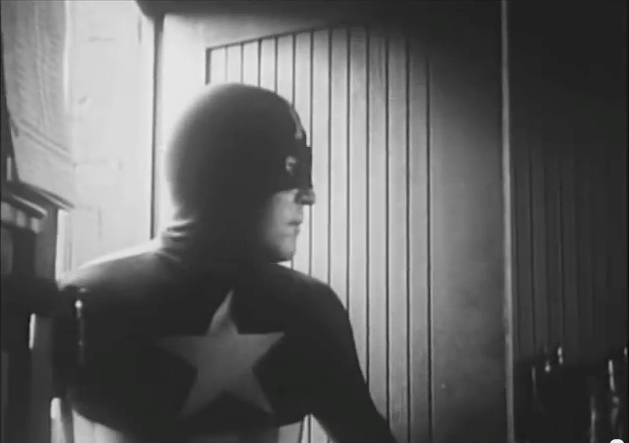
These days, when one reads about the 1944 Captain America serial, the focus is on its lack of fidelity to the comic books created by Joe Simon and Jack Kirby in 1941 and published by Timely (now Marvel) Comics. Instead of being Steve Rogers, a runty Army volunteer turned into a titan by the Super Soldier serum, the serial Captain America is Grant Gardner (played by Dick Purcell), a crusading district attorney who dons the costume to bring criminals to justice; no reference is made to his origin. Instead of wielding the iconic shield, Grant Gardner carries a gun, and he gets a lot of use out of it (in fact, considering how many bad guys Gardner kills in his civilian identity without anyone batting an eye, it’s not exactly clear why he needs to step outside of the law and put on a costume at all).

captainamerica1

This Captain America doesn’t even fight Nazis, all the more surprising considering the character’s explicitly patriotic concept and the serial’s wartime production. As in the 1949 Batman and Robin serial, Captain America’s foe follows the serial formula of a far-reaching (but apolitical) criminal mastermind: no Red Skull here, folks. Timely publisher Martin Goodman gave Republic the right to use the character for free (according to Marvel executive Tom Brevoort, speaking in the promotional documentary Captain America: 75 Heroic Years), likely expecting the film to boost sales of his comic books. Whether it had the desired effect, I don’t know, but one wonders what Simon and Kirby, not to mention their loyal readers, thought when they saw “Grant Gardner” going through the paces of a typical Republic adventure.

CA44.Gardner1

I was aware of all that before I watched the serial, but I tried to keep an open mind: although this is an extreme example, it wasn’t unusual for serial producers to change details of their source material to fit into their standard formula, and perhaps the serial would be a success on its own terms, even as it missed the mark as an adaptation. Unfortunately, I ultimately found it tedious and repetitive, even though it had some good performances and some individual chapters that worked well. Like many fifteen-chapter serials, Captain America can’t quite sustain its length, and might have been more effective cut down.

CA44.fight1

As both Gardner and Captain America, Dick Purcell has some personality and makes for an engaging central character, and there’s quite a bit of action (much of it supplied by longtime stunt man Dale van Sickel, who actually wore the costume for many of these sequences). He’s not really anything like what I think of as Captain America, being closer to a “cop who bends the rules” type rather than a boy scout, but free of other associations he held my attention. The sheer number of the Scarab’s henchmen that he blows away or throws out high windows, in either identity, would satisfy Charles Bronson.

CA44.Cap1

Even better is the supporting cast: played by Lorna Gray, Gail Richards is Grant Gardner’s capable assistant, and the only person who knows he’s Captain America. Although she sometimes ends up as the damsel in distress (the memorable cliffhanger in Chapter Five, “Blade of Wrath,” has her tied up and threatened with beheading by the guillotine-like blade of a paper-cutting machine), she also takes the initiative, and clearly takes after her boss. In one chapter, she catches someone tampering with Gardner’s car; when the man pulls a gun in an attempt to abduct her, she whips out her own heater and shoots him dead!

CA44.Gail1

As Dr. Maldor/The Scarab, Lionel Atwill is the very model of a plummy, cultured villain, complete with monocle. Using the “Purple Death,” he can make men do his bidding or drive them to suicide. Like most serial masterminds, he works through his disposable henchmen, keeping himself at a distance from the violence until the very end. His right-hand man (and also the most active in the field) is Matson (George Lewis), but John Davidson (whom we just saw in Tailspin Tommy) also lends his deep voice to the cause of evil as the henchman Gruber.

CA44.Maldor1

Maldor possesses a cutting wit, often directed at his bungling helpers. In one scene he sarcastically congratulates his henchmen: “You should be proud of yourself. Captain America has made a fool of you in every job you’ve attempted.” In a late chapter, when Maldor starts getting his hands dirty himself, he honest-to-God says “There are ways of making you talk” to the only man who knows how to decipher a Mayan treasure map, before flogging him with a cat-o-nine-tails.

CA44.Maldor2

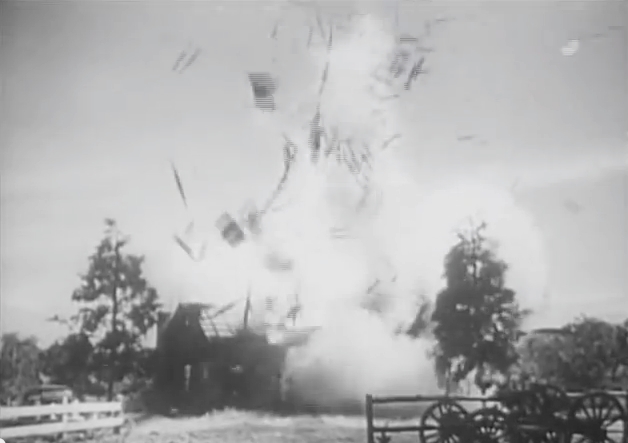
Later in the same episode, when Maldor learns that Gardner is on his way to the Scarab’s farmhouse hideout, he uses an airplane to personally drop bombs on the house in the hopes of destroying evidence of his presence and (even better) killing his nemesis at the same time (it is in fact the fifth building destroyed directly or indirectly by the Scarab in this serial, a showcase of special effects masters Theodore and Howard Lydecker’s genius). It would be nit-picky to question the efficiency or timeliness of this method. Rather, it points to the ways in which Maldor exemplifies the criminal mastermind: the true master criminal works through others, keeping the dirty work at a distance, as long as necessary; he always has multiple escape routes and alibis; and most importantly, he has the resources and the will to do whatever it takes to remove any obstacle that keeps him from his goal. If that means getting in a plane and blowing up his own hideout, so be it.

CA44.explosion

The thread of Maldor’s vengeance against the members of the Mayan expedition is really the only thing that ties together the various episodes, giving the serial a somewhat choppy rhythm: in several chapters, Gardner/Captain America is charged with protecting or rescuing a scientist or executive whom the Scarab threatens. In some cases, that involves recovering or destroying a new invention that the Scarab wants for himself (a “vibrating engine” shakes apart a building in the first chapter; an “electronic fire bolt” allows the Scarab’s gang to cut open bank vaults to finance his operations in the next, and so on). Unfortunately, too much time is spent explaining and talking, or with anonymous henchmen setting up traps without much happening. When Purcell, Atwill, or Gray aren’t on screen, the film lags.

CA44.Firebolt

What I Watched: Captain America (Republic, 1944)

Where I Watched It: The serial is on YouTube in its entirety.

No. of Chapters: 15

Best Chapter Title: All the bases are covered by Captain America‘s chapter titles: from the poetic (“Blade of Wrath”; “The Toll of Doom”) to the bluntly literal (“Skyscraper Plunge”), the alliterative (“Triple Tragedy”; “Horror on the Highway”) and the lurid (“The Dead Man Returns”). But before Captain America was “The First Avenger,” there was “The Avenging Corpse” (Chapter Ten), my pick for Best Chapter Title.

Best Cliffhanger: Sometimes simple misdirection makes for the most effective cliffhanger. At the end of Chapter Eleven (“The Dead Man Returns”), Captain America has tracked the Scarab to an electrical laboratory, where Dr. Lyman’s Life Restoring Machine is to be used to revive Matson. As he fights with one of the Scarab’s henchmen, the two of them end up inside of the generator room, which generates the million volts necessary to charge up the machine. Another of the Scarab’s men, Dirk, throws the switch to turn it on: we see a shower of sparks and then the camera cuts to Dirk’s horrified face and we hear a chilling scream. (Of course at the beginning of the next chapter we see our hero leap out of the generator room just in time: the scream belongs to the other guy.)

CA44.generator

Sample Dialogue: “Mister Gardner is a brave man; I’d feel much happier if Captain America were with him.” –Professor Dodge, Chapter Three, “Scarlet Shroud”

What Others Have Said: “Sadly, Purcell died of a heart attack shortly after completing this serial at the age of 35. It was a tragic end for the man who originated the role of a nearly immortal hero (in the comics, Captain America’s died and come back to life at least three different times). Purcell’s Cap isn’t the strongest or most physically fit, but there’s something to be said for the human dimension he brought to the role.” –Matt Singer, The Complete History of Comic-Book Movies

What’s Next: Join me in two weeks as we get medieval with The Adventures of Sir Galahad!

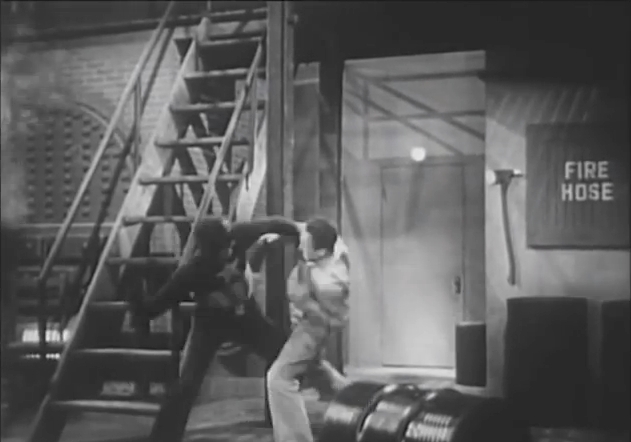
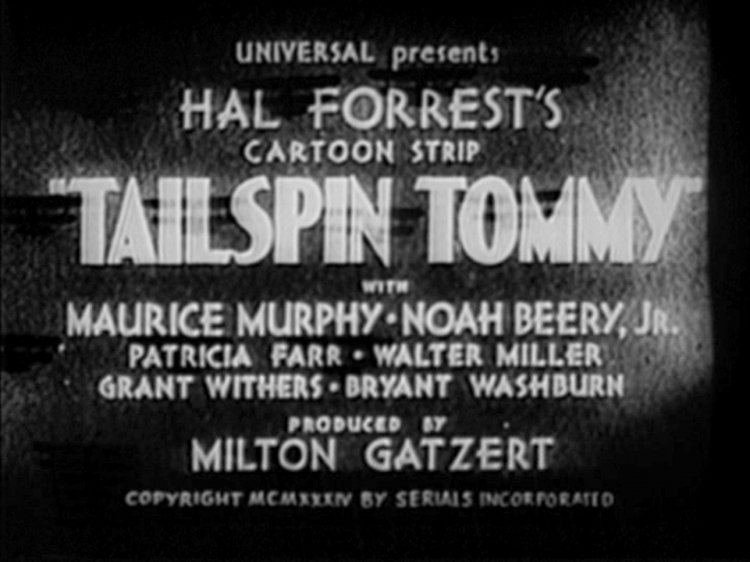
Fates Worse Than Death: Tailspin Tommy

TT.title

Stuck in rural Littleville, young mechanic Tommy Tompkins dreams of nothing more than becoming a flyer: he’s even rigged up an old jalopy with a throttle and flaps so he can practice the controls until he gets a chance at a real plane! Tommy’s opportunity arrives when Milt Howe, a pilot for the Three Points Air Line, makes an emergency stop in Littleville. As a reward for repairing his plane, Howe offers to take Tommy back with him to Three Points. When the injured Howe passes out before they can land, Tommy takes the controls and brings the plane in safely himself. Three Points owner Paul Smith is so impressed with the young man that he offers him a job with the ground crew and the chance to earn his pilot’s license.

TT.jalopy

Little do either of them know, however, that a rival air line, owned by Wade “Tiger” Taggart, is trying to muscle Three Points out of the way so that a lucrative gold shipment will be theirs. Worse yet, one of Three Points’ best pilots, Bruce Hoyt, is secretly in league with Taggart! Sabotage, misinformation, financial fraud, and even outright banditry are the weapons that Taggart will use to destroy Three Points and their bright young pilot, “Tailspin” Tommy. Will Tommy catch on to the plot against his employer? Will the traitorous Bruce Hoyt be found out? Will the suddenly successful Tommy remember his roots in Littleville? These and other questions are answered in the twelve-part 1934 serial, Tailspin Tommy!

TT.bandits2

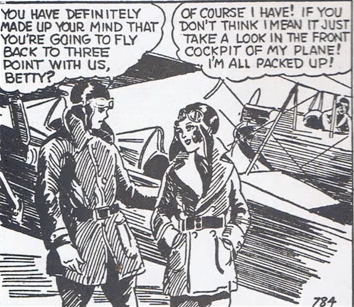
Hal Forrest’s Tailspin Tommy was a very popular comic strip (the first to be adapted into a serial in fact), with spin-offs that included a radio show, books, and toys. The serial’s plot covers a diverse range of settings and episodes, I suspect reflecting the variety of adventures that comic strip heroes undertook regardless of their ostensible genre (according to Jim Harmon and Donald F. Glut, the serial follows episodes from the radio show closely). Obviously, Tailspin Tommy explores the rich, then-contemporary setting of small regional airports and the short-hop pilots who flew by the seat of their pants, romanticized as daring aerial warriors in World War I and now connecting the scattered communities of the United States through faster travel and mail delivery. As the film makes clear, even civilian flying took nerve in the open-cockpit biplanes of the time, and mechanical failure, bad weather, or just plain bad luck could prove as dangerous as enemy fighters. Tailspin Tommy captured the spirit of a young nation enamored of hero-aviators like Howard Hughes and Charles Lindbergh. The character was popular enough to be the subject of a second serial (with an almost entirely different cast) in 1935, Tailspin Tommy in the Great Air Mystery, and two features in 1939, Mystery Plane and Sky Patrol.

TT.panel

Although Tailspin Tommy isn’t as well remembered today as many of its comic strip contemporaries, the youthful equation of flight with freedom has continued to inspire creators. One of Dave Stevens’ brilliant strokes in conceiving The Rocketeer was that, while borrowing liberally from such 1950s serials as King of the Rocket Men and Radar Men From the Moon, he transposed the action to this 1930s milieu, a setting in which pulp conventions, references to Hollywood’s Golden Age, and the prewar intrigues of Nazi spies and saboteurs could mingle freely. Flight-obsessed George Lucas is another heir in spirit: the portrait of young Anakin Skywalker as an eager, inventive wanna-be pilot in The Phantom Menace could have been drawn directly from Tailspin Tommy‘s first chapter.

TT.cockpit

However, in addition to scenes of flight and its attendant perils, the episodic story includes car chases, gunfights, and fist fights–the usual sources of generic serial “action”–as well as more exotic elements like a mad scientist’s lab (in Chapter Four, “The Copper Room”), an earthquake (Chapter Nine, “The Earth Gods Roar”), and the production of a Hollywood movie (in the last three chapters) that gives the filmmakers the chance to indulge in some war movie action even in peacetime. (The mad scientist has a scheme for turning copper into gold, a subplot that is dropped once Tommy and Betty Lou escape from the scientist’s house; at least it isn’t that old standby of the serials, radium.)

TT.bandits

There is a connecting thread in all this: Taggart (John Davidson of The Perils of Pauline) and his attempts to undermine his competition. Most, but not all of the dangers Tommy (Maurice Murphy) and his allies face are set up by Taggart directly or by his mole, Bruce Hoyt (Walter Miller). As good as Davidson is–he’s got a great sinister deep voice–Taggart is a one-note villain. It’s one of the strengths of the film that, in contrast with many serials, Taggart isn’t as interesting or compelling as the conflicted Hoyt or the good guy Tommy and his friends.

TT.Taggart

Those friends include “Skeeter” Milligan (Noah Beery, Jr.), Tommy’s partner in Littleville who stows away in Milt Howe’s plane to follow his friend and also ends up working for Three Points. Skeeter, given to pratfalls and one-liners, including a running gag about “unwritten law,” provides most of the comic relief, although he also backs up Tommy when things get rough and in one sequence he’s the object of rescue: after being blinded by a blast of hot oil while working on an engine, Skeeter must be flown to a hospital in Denver to be operated on or else lose his sight permanently; it wouldn’t be a serial if that emergency flight over the Rockies didn’t coincide with the biggest storm of the year, but Tommy makes it.

TT.plane

Then there’s Tommy’s love interest, Betty Lou Barnes (Patricia Farr), who is a well-rounded and active character in her own right: when Tommy first meets Betty Lou, she’s suffered a flat tire in Littleville, and tells him about Three Points, where she is learning to fly. She works behind the counter at the airfield’s Aileron Café (the kind of diner in which a grease monkey can order coffee and donuts by saying, “Gimme a sleep killer and a coupla spare wheels”). Betty Lou is gutsy, whether literally walking out of a flying lesson with Bruce Hoyt by jumping out of the plane with a parachute, or pulling a gun on some of Taggart’s men when they try to kidnap her and Tommy. In other sequences, she does her own detective work: she is the first to have any concrete proof of Hoyt’s treachery, and she gets lured into a trap herself as a result.

TT.BettyLou

Betty Lou’s relationship with Tommy highlights another unusual quality of this serial: the amount of time it covers. Unlike the breakneck pace of many serials, Tailspin Tommy takes for granted the passage of time between exciting events (although not between chapters, as cliffhangers are still the rule), as well as giving a sense of Tommy’s development as both a flyer and a hero. At one point, six weeks are mentioned to have passed before Tommy has his pilot’s license; at another, the time it takes for Skeeter to recover from his surgery is similarly glossed over. Reference is made to the awards and publicity that Tommy has received for his achievements. The twelve chapters allow for the natural transformation of Tommy from an unknown who had never even been in a plane in Chapter One to a nationally-recognized hero whose involvement in a movie is assumed to be a draw in the last few chapters.

That sense of growth over time is unusual for a serial, and Tommy’s relationship with Betty Lou undergoes similar development. Unlike many serials, in which the pairing of the male and female leads is held off until the very last minute (or left to the audience’s imagination), Tailspin Tommy has Tommy and Betty Lou as an item midway through its run time, and far from threatening their relationship with complications or misunderstandings, the plot even reinforces it: in Chapter Ten, Tommy has begun filming the war movie Midnight Patrol, but he has no chemistry with the actress who plays his lover and can’t even remember his lines. Seeing how much of a connection he has with Betty Lou when she visits the set, however, the director fires the actress and replaces her with Betty Lou! Their performance of the same scene is like night and day, reminiscent of Naomi Watts’ intense reading of the corny soap opera dialogue in Mulholland Drive.

TT.Tommy.BettyLou

Interestingly, while Taggart’s villainy is the connecting thread through much of this serial, he gets his comeuppance early in the last chapter, so that the big question at the end is whether Tommy will appear at the Hollywood premiere of his new film or return to Littleville for a homecoming celebration among the people who love him. Considering we see Tommy make his travel plans and carry them out, it’s a little anticlimactic (the chapter is called “Littleville’s Big Day,” for crying out loud!). I’ve watched enough serials by now to observe that filmmakers of the time didn’t always put a lot of emphasis on suspense or use narrative twists as much as we might assume in retrospect. The template was often that of old-style mysteries in which the audience knows whodunit from the beginning and the real question was when and how the hero would find out. In the serials, sometimes that applied to little mysteries, too.

What I Watched: Tailspin Tommy (Universal, 1934)

Where I Watched It: A DVD from VCI Entertainment. This serial doesn’t seem to be online, although the follow-up is on YouTube.

No. of Chapters: 12

Best Chapter Title: “The Earth Gods Roar” (Chapter Nine)

Best Cliffhanger: In Chapter Eight (“The Thrill of Death”), Tommy is leading Three Point Air Line’s team in the Los Angeles Air Meet, an air show in which crews compete in airplane races and timed contests. For the refueling contest, Tommy rides with Bruce Hoyt and climbs out of the ship to attach a mid-air refueling hose from another airplane. Hoyt, sensing an opportunity to serve Taggart and rid himself of a rival, suddenly dives (blaming a snapped rudder cable which he has himself cut), leaving Tommy hanging onto the dangling hose without a parachute.

TT.refueling1

Sample Dialogue: “Someday, I’m gonna be a real flyer–a great flyer, too.”

TT.someday

What Others Have Said: “If you find such a conclusion corny and anti-climactic, you should steer clear of Tailspin Tommy; the ending is of a piece with the rest of the serial, which is chiefly about a small-town boy making good in the adventurous new world of aviation, and only incidentally about his battles with villains. However, those who are interested in old-time aerial excitement, genuine 1930s period flavor, and interesting and well-acted characters, are strongly advised to take a spin with Tailspin Tommy.” —The Files of Jerry Blake

What’s Next: Last summer’s weekly schedule was a bit too much for me to attempt again, so I’ll plan on making biweekly updates to Fates Worse Than Death this year; any extra material I get posted will be a bonus. Join me in two weeks as I examine 1944’s Captain America!

My 2015 in Film

This year I saw 17 new releases (US release in 2015), mostly action blockbusters and animated family films, with a few outliers. As always, I didn’t see nearly enough to offer a comprehensive ranking (as subjective as those things are to begin with), but I can at least point to some of my favorites. (Also, I’m terrible at ranking things, so this could easily change tomorrow, and in fact has already undergone changes since I started drafting this.)

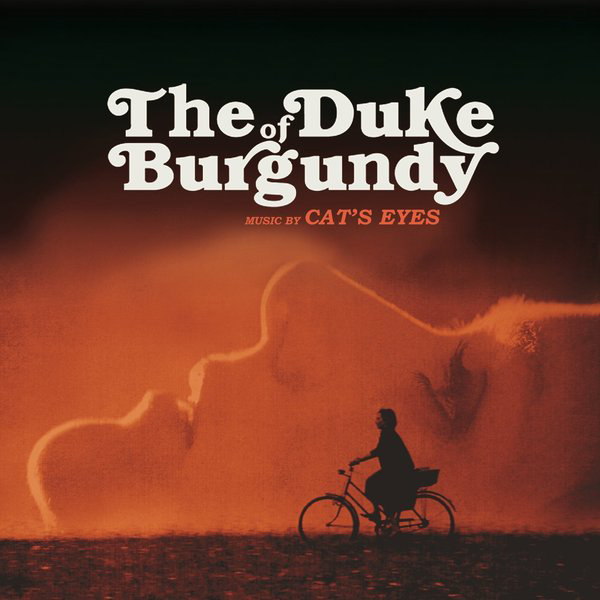
Duke_of_Burgundy

5. The Duke of Burgundy
I loved a lot about this movie, the story of a troubled dominant-submissive lesbian relationship. Director Peter Strickland’s appropriation of a 1970s European soft porn aesthetic, all soft focus and chanteuse-style pop music, is right in my postmodern wheelhouse (one of the opening credits, after “Dress and Lingerie” is for “Perfume by Je suis Gizella“). And there is a surprising streak of dry humor amidst the angst-filled meditations on control and the rigid boundaries we set for ourselves and each other. However, too many of the visual and auditory flourishes were straight out of David Lynch, particularly a sequence that felt uncomfortably indebted to Mulholland Drive, crossing the line beyond “homage.” I still liked the movie, but it may have been a victim of my high expectations.

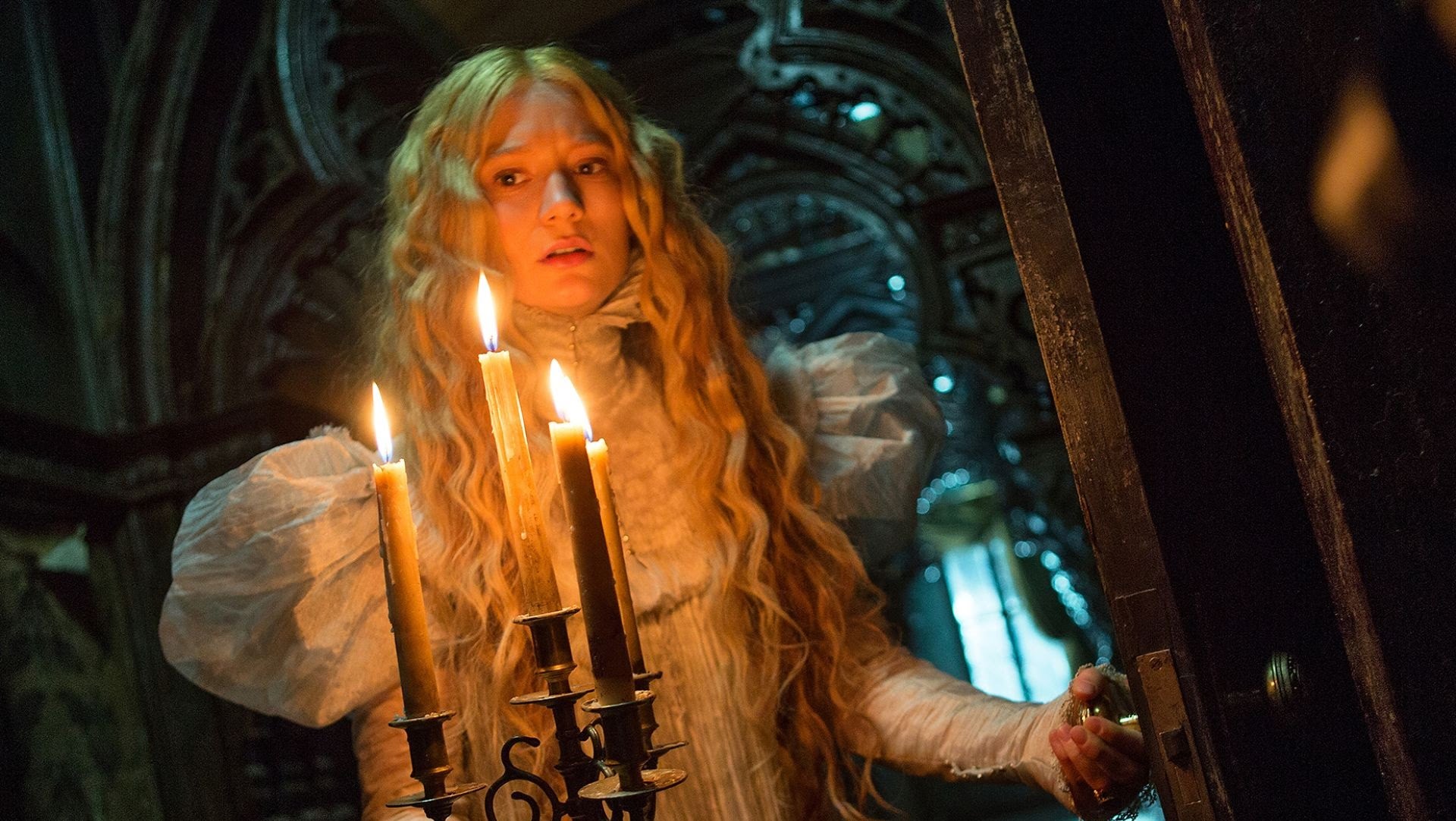
Crimson-Peak

4. Crimson Peak
After Guillermo Del Toro’s previous film, Pacific Rim, Crimson Peak was a welcome return to focus on human characters and their problems, while still featuring the director’s trademark grotesque monsters (this time the bloody ghosts that haunt the titular mansion). A gloriously gloomy gothic romance, it starred a perfectly cast Tom Hiddleston and Jessica Chastain as siblings with a dark secret, and Mia Wasikowska as the innocent caught in their web.

she-devils

3. Mad Max: Fury Road
I was as surprised as anyone to see the post-apocalyptic Mad Max series come roaring back after a thirty year absence from the screen, but director George Miller had clearly spent the time away thinking about the logistics and meaning of his future-primitive setting. Tom Hardy is fine as the title character, but it’s really Charlize Theron’s show as the bad-ass Furiosa. In addition to updating the setting in light of concerns about environmental collapse and climate change, Fury Road gives a fiercely feminist reading of the traditionally testosterone-filled “road warrior” genre (here’s what I thought immediately after seeing it).

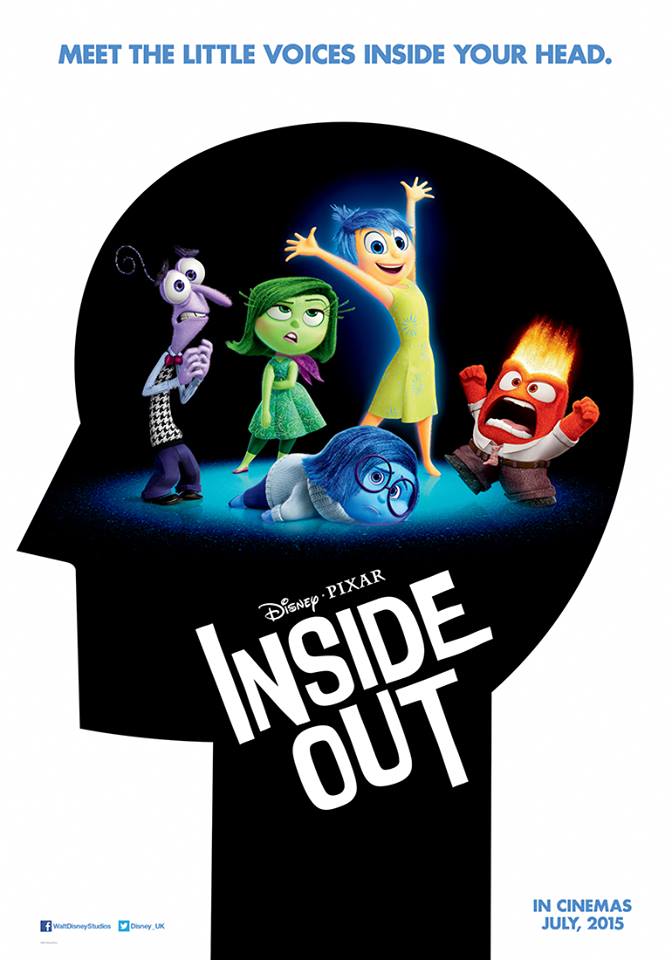
Inside_Out_(2015_film)_poster

2. Inside Out
A return to the daring conceptual heights of Ratatouille and Wall-E, Inside Out is simply the best Pixar film in years. Unsurprisingly, Inside Out was written and directed by Pete Docter, who also created Monsters, Inc.: there’s a similar fascination with factory-like spaces and a unique “backstage” interpretation of Pixar’s usual “secret life of ______” formula. Although the focus is on Joy, Sadness, and the other personified emotions inside eleven-year-old Riley’s head, the film benefits from the animation studio’s increasing confidence in creating expressive human characters that don’t resemble creepy dolls. I doubt it would work as well as it does if Riley and her parents didn’t hold up their end of the story in their scenes.

what_we_do_in_the_shadows

1. What We Do in the Shadows
I already talked up this one as the funniest movie I had seen all year when I saw it in October, and in the two months since I haven’t seen anything to topple it from my top spot. In addition to its humor, however, What We Do in the Shadows is as tightly-plotted as an Edgar Wright film while appearing as off-the-cuff as a Christopher Guest mockumentary or The Office. It also turns out to have some clever (and often poignant) observations about family, friendship, romance, and ambition (the last represented by Jackie van Beek, a “thrall” who hopes to ascend to vampirehood, a process that resembles an unpaid internship and virtual slavery to her vampire “master”).

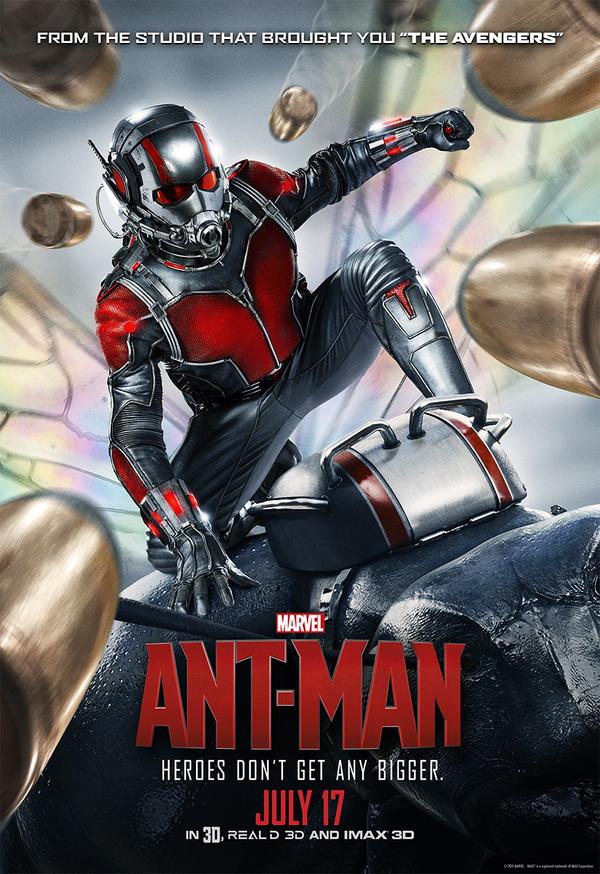
AntMan

Honorable Mention: Speaking of Edgar Wright, like many I was disappointed when Wright left Marvel’s Ant-Man, citing creative differences. But the movie we got, directed by Peyton Reed, still has Wright’s fingerprints all over it, from the fast cutting and clever narrative tricks to the visuals, which play with scale in a number of humorous and dramatic ways. In general I’ve enjoyed the free-standing Marvel movies more than the big team-ups: as exhilarating as it is as a comic book fan to see stories overlap and interact on screen just as they do in the comics, there’s a limit to how many characters and plot lines can comfortably fit in a feature film before I stop caring about any of them.

Surprisingly Good: Home did very well for itself at the box office and mostly got decent reviews. But unless you saw it you wouldn’t know how visually inventive it is and how its sense of humor is frequently a lot weirder than the clips of Jim Parsons as an overly-literal alien shown in the trailers suggested. (I’m willing to believe that the film’s stranger touches are drawn from the book it was based on, The True Meaning of Smekday by Adam Rex, but I haven’t read it.) I also appreciated the film’s emotional stakes and the revelation that Inside Out wasn’t the only family movie this year to stress the importance of empathy and accepting that sadness and grief have their place as healthy emotions. Finally, props for the good use it made of Steve Martin, who should really be considered more often as a voice actor.

star_wars_buddies4LIFE

Best Reboot (non-Mad Max category): I was pretty high on Star Wars: The Force Awakens after I saw it, and even after cooling off there’s still a lot I like about it. Under the new management of corporate owner Disney and director J. J. Abrams, The Force Awakens feels like a Star Wars film, visually and aurally. The return to largely practical effects is appreciated, and the new characters and their stories have some compelling hooks. As a passing of the torch to the new generation, it’s much more successful than, say, Indiana Jones and the Kingdom of the Crystal Skull, which did little to make me care about Jones’ son Mutt. In fact, I liked just about everything about The Force Awakens except the plot, which is just too much of a rehash of the original 1977 film (especially considering the Death Star had already been redone in 1983’s Return of the Jedi). Considering that The Force Awakens‘ planet-sized Starkiller follows Star Trek Into Darkness, which used the same ploy of “like the Enterprise, but bigger” for its bad guy’s ship, I’m glad Abrams will be stepping aside for the next installment of the Star Wars saga. After the much-maligned prequel trilogy, however, this was probably just what was needed to right the ship and get audiences excited again.

Most Forgettable: Fortunately, this year I haven’t seen any new releases that I really hated, so I don’t have a pick for “the worst.” However, at the bottom of my list is Jurassic World, which delivered the big dinosaur action it promised but was lackluster in all other respects, both derivative and lazy. I also didn’t get much out of Avengers: Age of Ultron (see my above comments about team-ups), but unlike Jurassic World it at least had compelling characters and the advancement of the ongoing Marvel plot going for it.

2015 was also another big year for catching up on movies from the past. In addition to the second summer of exploring serials in my Fates Worse Than Death series and my successful attempt to take in 31 horror films in October, I took advantage of repertory screenings, DVDs, TCM, Netflix, and YouTube to watch a variety of older films throughout the year.

wickedlady

First-time non-2015 movies that I liked were (in no particular order) El Hombre y el Monstruo (a Mexican riff on Jekyll and Hyde featuring a classical pianist who has sold his soul to the devil: whenever he plays a particular piece he transforms into a murderous wolfman), Polyester, The Man Who Laughed, The Thing, Repo Man, The Wicked Lady (1945), and the double feature Grindhouse (particularly Planet Terror, Robert Rodriguez’s half, but I appreciated the spirit of the whole project). I also caught up with a few movies from 2014 that I had missed the first time around, among them The Babadook, Under the Skin (a film I respected more than loved, but which isn’t looking for my approval anyway), and Edge of Tomorrow (aka Live/Die/Repeat), which did something I wouldn’t have thought possible: delivered a military sci-fi movie that both held my interest and made me care about its characters.

conquest

Worst non-2015 movie: This is easy. After seeing Lucio Fulci’s City of the Living Dead last year, I wasn’t exactly a fan: the movie was pretty hard for me to take, both extremely gory and nerve-wracking in its disregard for conventional plotting. Still, that’s one way to make a memorable horror movie, and although I didn’t love it I was willing to explore Fulci’s filmography further. Unfortunately, the next Fulci movie I watched was 1981’s Conquest, a dismal sword-and-sorcery picture that was clearly made in work-for-hire mode. It has some stylish character designs and graphic fight scenes, and the trailer puts enough cool moments together that I expected a passable Conan the Barbarian rip-off. Alas, those moments are doled out in an extremely stingy manner and the rest is filled with walking and talking scenes that have almost no energy, resulting in a dull, lifeless slog. (As far as Fulci goes, I also ended up seeing The House by the Cemetery recently, and while I didn’t care for it much, it was a lot better than Conquest.)

That’s about it for my look back at 2015. Happy New Year, and see you in 2016!

Fates Worse Than Death: Feature-Length Serials Revisited

SR.CommandoCody

This past summer when I wrote about the practice of cutting serials to feature length, I wrote, “Editing down a serial into a more modern feature length would undoubtedly be an interesting project for a film student or anyone who wants to learn more about the pacing and construction of these films.” A few weeks after that post, Wayne Keyser of goodmagic.com contacted me and offered to send me a DVD he had produced with his own cut-down version of two serials, Radar Men From the Moon and Undersea Kingdom. Of course I was interested, and after taking some time off from serials after my busy summer, I gave it a spin.

The disc, Serial Remix, promises “ALL the rayguns, spaceships, robots, action . . . LITTLE of the talk, ‘recaps,’ talk, car chases, and talk!” In his correspondence with me, Mr. Keyser elaborated, “I think it may be worthy of mention that every feature-length serial condensation I’ve ever seen is very short on what makes the serial interesting. When you’ve got rocket ships and robots, who needs bank robberies and car chases?” In that spirit, both films are cut to the bone, with a minimum of scene-setting and all the repetitive wandering around that pads out many serials eliminated. Readers of my reviews of these two serials will recall that they didn’t excite me that much, so I’m not offended by efforts to streamline them. (Unfortunately, Serial Remix is not commercially available, so my thoughts are offered in the spirit of a case study rather than a review.)

SR.rocket

The versions presented are truly “remixed”: in addition to being edited for time, they have been reformatted for 16×9 widescreen instead of the original 4×3 fullscreen; some effects have been digitally sweetened (ray and lightning effects are added, sparks added to explosions, and so forth); and some shots have been moved around for pacing or to show off the models and other effects. One could easily refer to these as “Special Edition” serials, but few of Keyser’s adjustments are as obtrusive as George Lucas’s additions to the original Star Wars trilogy.

SR.lightning

(It should also be noted that as ridiculous as both films are, the remixes are admirably straight-faced: there are no wacky sound effects or pop-ups added, and no Mystery Science Theater-styled riffs. The closest Keyser comes to making a joke of the material is a “Meet Our Characters” sequence preceding Undersea Kingdom that notes everyone’s propensity for funny hats. I can live with that.)

SR.character

For the most part, these changes don’t considerably alter the story, but they do move it along and gloss over some of the fine details (not unlike the feature-length cuts made by the studios). In fact, watching Keyser’s remixes made clear how much is left to the viewer’s imagination in modern editing: serials were frequently quite literal in explaining the plot and showing every step of an action, whether it be the villain setting a trap for the hero, the hero’s miraculous escape, or the villain getting in a car and driving away. To some extent that was a function of the serial’s need to fill time, and when poorly handled it would indeed smack of padding.

It was also, I think, natural to the procedural storytelling mode that serials often engaged in: whether obvious or subtle, the situation must be established if there is to be any suspense. We don’t realize that the hero is walking into a trap unless we see it set up, or at least have an establishing shot that clearly shows the threat. And while the audience might assume that a rickety bridge is going to pose a danger in an upcoming scene, serial writers were rarely above tipping off even the slowest viewers by having a character say something like, “Be careful on that bridge; it’s liable to collapse if there’s too much weight on it.”

I might go even further and speculate that it is the seeming solidity of cause and effect in classic serial editing that makes cliffhangers so susceptible to “cheats.” The danger to the hero is so firmly established in dialogue, in premonitory close-ups (on the lit fuse, on the stuck gas pedal, on the clock whose midnight stroke spells doom), and often in the scene as filmed, that his death seems inarguable. We saw him plunge from the cliffside or fall beneath a hail of bullets, and the only way he can be saved is to undo the peril, to rewind so that in the continuation fate takes a different path. The audience may cry “cheat!” if they are observant enough to notice the switch, but such reversals are, I’m starting to think, a necessary part of serial grammar and the ability to literally cheat death a superpower peculiar to the heroes of the form. (Or perhaps not so peculiar: when Superman reverses the Earth’s rotation in Richard Donner’s 1978 film, undoing the disaster that has killed Lois Lane, he is simply performing a large-scale version of what serial heroes had been doing on a small scale for decades.)

SR.juggernaut

Keyser (and other editors turning serials into features) swerves around that paradox by eliminating the cliffhangers, of course; each peril is now simply a beat in an action sequence. But the elimination of excess verbiage and travel is closer to the grammar of a modern action film, in which the audience is swept up in the heedless forward motion, and goes along with it because there is little time to take a breath and question it. I didn’t watch these films with a stopwatch, but my general impression is that the average shot length was shorter than in the original, again making the films feel more contemporary in their rhythm. (Consider how little down time there is in the Indiana Jones movies, particularly Temple of Doom, in comparison to the serials they draw from; at least Star Wars alternates its action sequences with moments of repose.)

To get down to specifics, Radar Men From the Moon, as you may recall, features George Wallace as Commando Cody, whose signature costume is his rocket-powered flight suit. The same concept (and effects) had appeared in Republic’s earlier serial King of the Rocket Men, and would later inspire Dave Stevens’ character the Rocketeer. In Radar Men, Cody and his team are dispatched to the Moon (on a rocket ship also designed and built by Cody) by government agents who suspect that recent disasters on Earth are linked to atomic activity detected on the lunar surface. After a trip as comfortable and uneventful as a coast-to-coast passenger flight, they discover a dying lunar civilization that is indeed softening up Earth for invasion; the lunarians are already on Earth, advance scouts coordinating explosions and acts of sabotage with the assistance of Earth criminals!

SR.DalyGraber

In Serial Mix, Radar Men is cut to a brisk 64 minutes, with an emphasis on Cody’s flying suit and other gadgets and the adventure on the lunar surface. Excised almost entirely are several middle chapters focused on the lunarians’ Earth helpers, Daly and Graber, as they steal supplies or attack Cody’s laboratory. Those sequences are entirely mundane, and aren’t missed. Daly and Graber still appear, essential to the story as they are, but they get much less screen time.

Undersea Kingdom, at 77 minutes, is (to my mind) more successful in its adaptation. With a few exceptions, the story of Crash Corrigan’s journey to Atlantis is adapted closely but with transitions and redundant material elided (often with the use of wipes imitating those in the original). The scene in which Corrigan is forced to take part in gladiatorial combat and wins the loyalty of fellow prisoner Moloch is skipped, as is the scene in which Corrigan saves the life of Atlantean high priest Sharad, earning him an invitation to lead the Atlantean army. The comic relief subplot with Smiley Burnette is omitted entirely (and since his scenes were shot and included after the fact, and his character doesn’t interact with Corrigan or the others at all, it’s an easy decision to make and takes nothing away from the main story).

SR.chariot

As one of a few special features on the disc, Keyser narrates “Remixing the Classics,” in which he describes his love of the serials and their effects and describes the process of editing them to shorter length. He points out some of the enhancements he made to the special effects, with before and after shots, and discusses the challenge of finding appropriate places to cut while preserving necessary plot information. This feature was of great interest to me and further illuminated Keyser’s approach.

SR.viewer1

Before and after: Keyser replaced a view of the lunar surface with a shot of the lunar city

Before and after: Keyser replaced a view of the lunar surface with a shot of the lunar city

Keyser also proves to be an engaging and knowledgeable host and storyteller; it’s clear that Serial Remix is a labor of love, and in addition to looking at the choices involved in editing, he takes a broader look at the conditions under which serials were made. Often rushed (he points out that Undersea Kingdom was made in 25 days) and made for low budgets, the serials naturally fell back on recycling props (such as the electrical devices built by Kenneth Strickfaden and used for set dressing in hundreds of films), costumes, story lines, and locations (such as Bronson Canyon near Hollywood). Keyser has no illusions as to the great artistic merit of the serials (I’ll accept his judgment that The Phantom Empire is “goofy,” but “bad”? No way!) but his enthusiasm is nonetheless one I share. Seen as one fan’s tribute to the boy’s-adventure spirit of the serials, Serial Remix is a very enjoyable and polished package.

Kenneth Strickfaden shown adjusting one of his electrical props

Kenneth Strickfaden shown adjusting one of his electrical props

Fates Worse Than Death: Flash Gordon Conquers the Universe

FG3.title

A mysterious plague is sweeping the Earth: known as the “Purple Death” because of the single purple spot it leaves on the skin of its victims, the disease is responsible for the deaths of thousands, and authorities are helpless to stop mounting panic. Professor Gordon is one of the scientists struggling to find a cure, and it is his son Flash (already a hero for saving the earth several times over) who, with Dr. Zarkov and Dale Arden, discovers the culprit. A ship from Mongo is spotted high in the atmosphere, dropping the malign dust that causes the Purple Death.

FG3.purpledeath

Starting for the planet Mongo at once in Zarkov’s rocket ship, the trio face aerial combat with the invading ship and, feigning a crash, descend to Arboria, the home of Flash’s ally Prince Barin. Barin confirms that Emperor Ming yet lives and is undoubtedly behind the attacks on Earth, and a council of leaders who are opposed to the merciless dictator soon convenes at Barin’s palace.

FG3.warcouncil

The only antidote for the Death Dust is the element “polarite,” which can be found in the far Northern reaches of Frigia, represented by Queen Fria. The expedition to the icy realm is bulked out with footage from an earlier polar exploration film, White Hell of Pitz Palu; footage of downhill skiers appears in the montage that opens each chapter, leading me to expect a snowbound assault on Ming à la The Spy Who Loved Me or Inception, but it never happens. (Also, it wasn’t until I was selecting screen caps that I noticed Flash and Dale in their cold-weather gear bear a strong resemblance to Santa and Mrs. Claus.)

FG3.coldgear1

Although the threat of the Purple Death doesn’t take twelve chapters to resolve, it’s the inciting incident that kicks off the latest round of strikes and counter-strikes in Flash Gordon Conquers the Universe, the third and final serial in Universal’s epic adaptation of Alex Raymond’s popular comic strip.

FG3.rocket4

Despite, or perhaps because of, its references to the events and characters of the 1936 and ’38 serials, Conquers the Universe shows just how much time has passed since the success of the first Flash Gordon. Many aspects of the production, impressive in ’36, would have seemed crude just four years later, especially with Republic’s slick, streamlined adventure serials entering the market in the mean time. The static recap cards from the earlier serials have been replaced by scrolling titles; this now-familiar format had been used in Buck Rogers (also starring Flash Gordon lead Buster Crabbe) and would appear in other serials of the 1940s (and of course was the inspiration for the similar opening crawl in the Star Wars films).

FG3.title.chapterhead

The pacing is rapid throughout, with clear but often functional dialogue that serves the plot; Flash Gordon was never about deep characterization or philosophy, but Conquers the Universe is especially plot-heavy. And while many effects look quaint to modern eyes (Mongo’s giant iguanas make an appearance, and electrical effects are frequently accomplished with zig-zag lightning bolts scratched directly onto the film), just as many impress with how effective simple devices can be, and there are enough new settings and perils that the serial doesn’t feel like a retread.

FG3.robots2

Of particular note are an assault by exploding robots (Chapter Three, “Walking Bombs”), given an uncanny mechanical gait through the magic of undercranking, and the tribe of “Rock Men” who dwell in Arboria’s “no man’s land.” (Unlike the Clay People of Flash Gordon’s Trip to Mars, the Rock Men only dress as rocks to camouflage themselves from the giant lizards.) The Rock Men speak backwards, and once Dr. Zarkov realizes that their language is the same as that of a “lost tribe” that once inhabited Earth’s Gobi Desert, he is able to communicate with them; after Flash saves the Rock King’s son from a disaster, they aid the Earthlings in their fight against Ming.

FG3.Rockman.Zarkov

Several plot elements that were missing from Flash Gordon’s Trip to Mars reappear in Conquers the Universe: Ming once again hopes to make Dale his bride, and Ming’s daughter Princess Aura reappears, still happily married to Prince Barin. The cast has been shuffled–Carol Hughes replaces Jean Rogers as Dale, and both Barin and Aura are recast (by Roland Drew and Shirley Deane, respectively)–but Buster Crabbe reprises the title role, Charles Middleton returns as Ming, and Frank Shannon again plays Dr. Zarkov.

FG3.Aura.Barin

Speaking of Barin and Aura, the happy couple looks quite different from their earlier incarnations. As Barin, Drew cuts a more dashing figure than Richard Alexander: with his trim mustache and forest costume, he strongly resembles Errol Flynn as Robin Hood. As for Aura, the changes to her personality outweigh those to her appearance: instead of the scheming, morally flexible antiheroine of the 1936 serial, she is here entirely settled and content in her life in Arboria, and her reaction to being pulled back into her father’s evil machinations is passive terror and indignation. Marriage has domesticated her.

FG3.Aura.Sonja

Fortunately (or not, depending on your perspective), the lack of Aura’s feminine wiliness is made up for by the introduction of Lady Sonja (Anne Gwynne), an Arborian lady-in-waiting secretly loyal to Ming. Once Sonja lures Aura to Arboria’s Red Forest to be abducted by Ming’s forces (for even he would not bomb Arboria without first making sure his daughter was safe), the treacherous lady becomes half of a villainous double act with Captain Torch (Don Rowan). Together, Torch and Sonja, along with Lieutenant Thong (tee hee), shadow Flash Gordon & co. and bedevil them in a variety of ways, carrying out missions for Ming.

FG3.Torch.Sonja1

Sonja doesn’t have the depth of Aura–she’s purely spiteful and untrustworthy, without even the motivation of misplaced love–but it’s worth noting the number of female characters in the Flash Gordon serials and the range of their motivations. Aside from Dale, Aura, and Sonja, there’s Queen Fria of Frigia (an uncredited Luli Deste), who expresses a hope that Flash Gordon might be convinced to lead Frigia’s armed forces, teasing a source of tension with Dale (this comes to nothing, although it may be more fleshed out in the comic strips that are the basis of the story).

FG3.QueenFria1

In fact, Flash Gordon does a better job of female representation than the original Star Wars trilogy that it inspired: in Conquers the Universe, Dale is revealed to be an expert chemist and radio operator, a detail I don’t recall being mentioned before, but which gives her more to do than simply be kidnapped. It’s true that at least some of the women on-screen are purely eye candy, and there’s less of the emphasis on Buster Crabbe’s physique that made the 1936 serial an equal-opportunity source of titillation (like the Tarzan series, Flash Gordon in all its iterations has celebrated the body beautiful). Still, compared to the many serials I’ve watched that have only a single token woman, it’s refreshing that the population of the fantasy world of planet Mongo at least contains individuals of both sexes.

FG3.Dale2

Ultimately, Ming’s greatest weakness is the number of people in his service–guards, scientists, soldiers–who are willing to turn against him. The political subtext is no more complex or subtle than before–dictators are bad–but the story emphasizes that those who take power by force and cruelty will never have the loyalty of those they conquer. Rather, they will only breed a thirst for revenge in their underlings. As always, Flash Gordon inspires trust and confidence in those he meets simply by doing the right thing.

And what about that title, anyway? Conquering isn’t really Flash’s bag. As silly as it sounds, Ming in his arrogance declares at one point, “I am the universe!” So, by the transitive property, when Flash inevitably conquers Ming . . . well, you get the idea.

FG3.Ming1

But just in case you didn’t, Zarkov explains it.

What I Watched: Flash Gordon Conquers the Universe (Universal, 1940)

Where I Watched It: A two-disc DVD set from Timeless Media Group

No. of Chapters: 12

Best Chapter Title: “Doom of the Dictator” (Chapter Twelve). Alliteration!

FG3.faceoff

Best Cliffhanger: Another plot thread that continues from the earlier serials is Ming’s desire to have Zarkov’s scientific genius at his command. So, in Chapter Four (“The Destroyer Ray”), when Ming has Zarkov captive and the Earth scientist refuses to serve him, Ming orders his execution. A death ray slowly moves toward the chained scientist, and when Flash shows up to rescue him, he appears to be caught in it, too. What really elevates this is that Ming, surrounded by his retinue, has forced Dale (also captive) to watch the scene unfold. She begs Ming to spare them, beating on his chest with her fists, and then covers her face, unable to watch, while Ming cackles at his victims’ helplessness. “He has chosen his own death!” he sneers. This is what we watch serials for.

FG3.Dale.Ming1

A Note on Costumes: Although there’s still a great deal of space opera exoticism, including long looks at the harem-like entertainments Ming has at his disposal, the costumes and sets display fewer of the ancient or near-Eastern motifs that were prominent in the earlier serials. Barin’s palace resembles a traditional European castle, with parapets and everything, and most of the male characters dress in military uniforms with braids and epaulets; except for the ray guns and space ships, Arboria might as well be Ruritania, an imagined Mitteleuropa in outer space.

FG3.roka.flash

Even Ming gets in on the act, assuming a high-plumed dress uniform, “now more a wicked general than Satan” in the words of Jim Harmon and Donald F. Glut. One could assume that proximity to Earth has affected Ming’s tastes: although most of Ming’s pleasures are accompanied by stereotypical “Oriental” music, the soundtrack is a distinctly modern rhumba in Chapter Four, leading me to imagine Xavier Cugat and his orchestra chained to a bandstand and forced to play just off-camera. You’re a peacock, Ming. Strut, Ming, strut.

FG3.Ming6

Sample Dialogue: “Seems like old times, being at war again with Ming, Zarkov.” –Flash Gordon, Chapter Two (“Freezing Torture”)

FG3.television2

What Others Have Said: “Earth heroes have journeyed to other worlds by Crystal Door and spaceship. Our own planet has been invaded many times by alien menaces bent on dominating the Earthlings. In all these instances there have been mighty conflicts between good and evil. But after the holocaust of ray zapping and atomic blasting had settled, the audiences huddled in the safety of terran movie houses admitted one important fact: There was only one alien tyrant capable of conquering the universe, Ming the Merciless. And there was but a single hero able to defeat him–Flash Gordon.” –Jim Harmon and Donald F. Glut, The Great Movie Serials

That brings this summer’s serial coverage to an end. I’ll probably still have a few serial-related articles coming up, and Medleyana will continue to update on other topics, but that’s it for regular entries until next summer. Until then, thanks for reading along, and thanks for all the comments and support!

Fates Worse Than Death: The Fighting Marines

FM.title

On land or sea in polar night
Or sweltering tropic scenes
Where e’er there’s fighting
You will find U. S. Marines.

–introduction to The Fighting Marines

FM.Larry.Mack1

The action of The Fighting Marines begins in media res (unusual but not unheard of for serials): Corporal Larry Lawrence (Grant Withers) and Sergeant Mack McGowan (Adrian Morris) of the U. S. Marine Corps are battling a gang of bandits in a jungle, trying to rescue their friend and fellow Marine, Sergeant William Schiller (George J. Lewis). Schiller is the inventor of a new “gyro compass,” and the bandits hope to learn its secret from him. After Schiller’s rescue, the real story begins: Schiller’s gyro compass will make it possible for the Marines to build a base on remote Halfway Island in the Pacific Ocean. So far, the island has been inaccessible because of a “magnetic dead spot” that causes ships and planes to crash short of the island. A businessman named Douglas (Robert Frazer) hopes to build a floating airstrip outside of the dead spot, and he stands to lose a fortune if the Marines succeed in building on the island.

FM.Bennett.Douglas

At the same time, unbeknownst to the Marines, Halfway Island is being used as a base by a notorious pirate known only as the Tiger Shark. As in Batman and Robin and Government Agents vs. Phantom Legion, even the Tiger Shark’s own men don’t know their boss’s identity, but they refer often to those poor suckers in the organization who had tried to find out, or who had tried to claim their shares of the loot before the Tiger Shark was ready to dispense them.

FM.TigerShark1

It is the Tiger Shark, who always appears in a fashion-forward leather flying suit and goggles, who is responsible for the dead spot, employing a “magnetic ray gun” to scramble approaching planes’ instruments. In addition, the Tiger Shark seems to know too much about the Marines and their operations, even before Larry and Mack are able to land on the island and discover the pirate’s base. It’s strongly implied that Douglas is the Tiger Shark, but could it be Buchanan (Frank Glendon), the head of the Oriental Navigation Company, who also has an interest in the region? Or could it be someone even closer to the Marines? Needless to say, the mystery is teased out until the very last chapter, when the villain’s identity is revealed.

FM.magneticraygun

I have to admit that I probably wouldn’t have gone out of my way to watch The Fighting Marines if I weren’t writing this series. Aside from its lack of recognizable characters, I wasn’t really sure what to expect from the title sequence, which combines Sousa’s “Semper Fidelis” march with stock footage of Marines in dress uniforms marching in parade formation. The premise seemed to suggest either a war movie (a genre I don’t usually go out of my way for) or, worse, high jinks on a military base. I needn’t have worried: with a few exceptions, The Fighting Marines is pure serial formula, from its mysterious costumed villain to his army of interchangeable henchmen and the gauntlet of fist- and gunfights, car chases, and other perils that the heroes face.

FM.crushing

There is also a distinctly pulpy, futuristic edge to the Tiger Shark’s equipment, although it is mostly limited to his base on Halfway Island. In addition to the magnetic ray gun, the Tiger Shark’s forces use television to communicate. However, unlike characters in other serials, the Tiger Shark’s henchmen must wear an elaborate headgear to use the television, whether necessary to make the technology work, like a radio headset, or simply to disguise their identities, I don’t know. Television is so often treated like a kind of magic in films of the 1930s that it shouldn’t be surprising that it requires a special costume to use it, like the ephod worn by the priest who handled the Ark of the Covenant. In some ways the ray gun and other high-tech gadgets make The Fighting Marines an early example of “spy-fi” à la James Bond or The Man From UNCLE rather than a purely military escapade.

FM.television

Other elements beside the costumed villain and his high-tech toys suggest similarities with other serials: although the two heroes are Marines under the authority of their Colonel (Robert Warwick), and wear uniforms and report to the Marine base, and even in a few chapters take part in military operations with larger squads, they mostly work on their own, with a free hand to track down clues and take on the bad guys by themselves. The format of their adventures isn’t that different from those of the independent agents in Robinson Crusoe of Clipper Island or The Miracle Rider, or the team of unofficial deputies in Daredevils of the Red Circle (or an episode of JAG, for that matter).

FM.Kota

The Fighting Marines was the last serial made by Mascot before the mergers that would lead to the birth of Republic, the studio that would be synonymous with serials for the next two decades. Producer Nat Levine had grown dissatisfied with the Mascot formula, and while I love some of Mascot’s serials, it’s not hard to see the growing pains that the format was suffering. The Fighting Marines is uneven, with choppy, often redundant storytelling (seriously, was it necessary to have flashbacks to previous scenes in three different chapters?). Characters come and go haphazardly: Douglas, after being established as a likely suspect for the Tiger Shark’s secret identity, disappears, replaced by Buchanan in Chapter Five; they don’t appear together until Chapter Eight, leading me to wonder if I had somehow confusedly given the same character two names. Larry and Mack are established as rivals for the affections of Schiller’s sister, Frances (Ann Rutherford), and she plays an important part in the first half of the serial; however, once the action moves to Halfway Island, not only is the love triangle forgotten, so is Frances. Finally, the many cheats used to resolve cliffhangers (see below) insult not only the intelligence of the viewer, but the idea of continuity itself.

FM.Larry.Mack.Frances

Having said all that, however, I really enjoyed most of The Fighting Marines, and I’m glad I checked it out. Despite its rough edges, it’s imaginative and full of retro cool: I’ve alluded to the Tiger Shark’s sense of style, but did I mention he flies an auto gyro?

FM.autogyro

Or how his victims are left with the “Mark of the Tiger Shark” imprinted on their necks?

FM.mark

And I live for scenes like the one where the Tiger Shark strafes a Marine encampment from a biplane with a Tommy gun, an image worthy of Dr. Strangelove:

FM.TigerShark2

I also haven’t mentioned the Tiger Shark’s Halfway Island henchmen, a crew of roughneck sailors straight out of a Popeye cartoon:

FM.Henchmen1

Or the tribe of natives who also call Halfway Island home, and their Hollywood Central Casting penchant for human sacrifice:

FM.natives

And a few things that should be considered SPOILERS: First, one that I’m not sure is really a spoiler because it doesn’t seem to have anything to do with the plot: it’s just a surprise. In the last chapter, when the Tiger Shark’s empire is collapsing around him, he consults with the chief of the Island natives. Like all of the natives, the chief wears a sarong and has a terrible afro; the chief pulls his afro wig off and it’s revealed that he’s not a native at all, just one of the Tiger Shark’s henchmen. So, does that mean all the natives are white men in disguise? That would explain why they all look so fake–they all have the same ridiculous-looking afros, for one thing–but apparently not. It’s just him. So how did he become chief?

FM.TigerShark.Chief2

There’s no time for that, because we finally learn the real identity of the Tiger Shark (DOUBLE SPOILERS): It’s neither Douglas nor Buchanan, but Kota, Colonel Bennett’s Japanese valet. This actually explains a lot, not least the casting of a relatively high-profile actor (Jason Robards, Sr.) in a role that hadn’t had more than five minutes of screen time until the big reveal. Note that it wasn’t unusual for a white to play an Asian character at the time: Keye Luke was more the exception than the rule. At least Kota isn’t a grotesque caricature like Batman’s foe Dr. Daka, but he isn’t very convincing, either. I didn’t even realize he was supposed to be Japanese until the second scene he showed up in.

FM.TigerShark.Chief3

The reveal also brings the conflict into focus in a way that is still subtextual but is obvious in hindsight: I’ve often harped on the way shadowy villains in the narratives of the 1930s could stand in for real-world political anxieties, and while no mention is made of why the Marines wish to build their base on “Halfway” (a clear stand-in for Midway) Island, it probably didn’t need to be explained to audiences in 1935 who were increasingly wary of Japanese aggression across the ocean. The narrative demand for a “the butler did it” twist is satisfied, with the real Tiger Shark hiding in plain sight, and while he is only a pirate, not an overtly political villain, one can hardly believe that his real identity or the location of his hideout are accidental. At the very least, it’s comparable to the decision to give villains Russian or German accents in films of subsequent decades: just as that choice gives modern film villains a threatening edge, so was the obsequious but treacherous character of Kota’s race taken for granted and was thus a socially acceptable storytelling device. But like I said, that seems more obvious from a contemporary vantage point: the main message The Fighting Marines sends is that nothing–not profiteers like Douglas, nor lawless pirates like the Tiger Shark–will stand in the way of the Marines when they set their minds to something. As Colonel Bennett says, “Remember what I said about the Marines always finishing what they start!”

What I Watched: The Fighting Marines (Mascot, 1935)

Where I Watched It: The whole thing is on YouTube.

No. of Chapters: 12

Best Chapter Title: “Two Against the Horde” (Chapter Twelve)

Best Cliffhanger: In one of many chase scenes, at the end of Chapter Ten (“Wheels of Destruction”), Larry and Mack are following two of the Tiger Shark’s henchmen, who have abducted Buchanan in the belief that he is the mysterious crimelord. The henchmen’s tricked-out car is equipped with a smokescreen that pumps thick, opaque clouds from the car’s exhaust pipe. Unable to see through the smoke, Larry and Mack drive their car right through the guardrail on a curve and plunge over the hillside, rolling repeatedly before landing at the bottom of the hill.

FM.smokescreen

Annie Wilkes Award for Most Blatant Cheat: Man, does The Fighting Marines ever cheat! In this case, it’s hard to narrow it down to just one (in fact, the cliffhanger in the aforementioned “Wheels of Destruction” is notable for not cheating: unbelievably, the two Marines are stunned but otherwise completely uninjured after rolling their roofless car multiple times, without even seat belts to keep them from being thrown out). Whether it’s a plane crash, a gunshot, or a fall from a high window, several cliffhangers are restaged to change or undo the surely-fatal peril our heroes were left in at the end of the previous chapter. Probably the most shameless is at the end of Chapter Six (“Robbers’ Roost”), in which Larry and Mack have cornered the Tiger Shark’s henchmen in a warehouse just as the Tiger Shark himself has landed his auto gyro on the roof. Coming down the stairs, the Tiger Shark opens fire on an unsuspecting Larry, who clutches his chest and slumps over. At the beginning of Chapter Seven (“Jungle Terrors”), however, Larry dodges the bullet and returns fire, as hale and hearty as ever. CHEAT!!!

Sample Dialogue: Mac: “Hey, if ya ask me, I think that fella Douglas is the Tiger Shark!”
Larry: “Sure took you a long time to figure that out!”
–Chapter Two (“Isle of Missing Men”)

What Others Have Said: “Levine decided that his new Republic serials would be vast improvements upon those turned out under the Mascot trademark. Analyzing his past products, he realized that perhaps the old Mascot plots were at times too involved. . . . The absence of music, such a hazard for the Mascot chapterplays especially in the action scenes, would be corrected with powerful scores to accompany all moods and situations. Furthermore, comic relief characters would be played down in future scripts.” –Jim Harmon and Donald F. Glut, The Great Movie Serials

(If it were really Levine’s intention to downplay comic relief characters in the Republic serials, I’m not sure what happened, as they seem even more formulaic in the ones I’ve watched. Harmon and Glut are correct about the lack of music, however: The Fighting Marines has only “Semper Fidelis” to serve as a theme song and no other background music.)

What’s Next: In one week, I’ll bring this summer’s serial coverage to an end with the third and final Flash Gordon serial, Flash Gordon Conquers the Universe.