According to Letterboxd’s year-end summary, my most-viewed actor in 2025 was Sidney Toler, who played Charlie Chan in a series of B-movie mysteries in the 1940s; my most-watched director was René Cardona, Jr., the subject of a pair of box sets from Vinegar Syndrome that I watched last spring. (Cardona was the son of René Cardona, Sr., who directed some of the installments of the Santo series, which I wrote about in 2024. The films in the Cardona, Jr. sets were primarily adventure and crime pictures.) I suppose those are typical examples of my viewing through much of the year (and, as always, you can look at my complete diary if you like), but neither body of work is particularly noteworthy beyond numerical superiority. I almost decided not to post an end-of-year list: I didn’t see very many new films in 2025, and there are obviously still a lot of movies I haven’t caught up with yet. However, I saw enough that I liked that I thought it would be worth writing at least a Top Five 2025 New Releases.
5. It would be difficult for the Marvel Cinematic Universe to pull off the conceit of the original Thunderbolts, a series by Kurt Busiek and Mark Bagley in which a new team of heroes shows up, only to be revealed that they are actually old villains operating in disguise under new names. However, in adopting the same name (with a cheeky in-universe explanation) for an ad hoc team of antiheroes, screw-ups, and antagonists from past MCU films, Thunderbolts* (dir. Jake Schreier) gives us an idea of what to expect, at least tonally. When a group of mercenary superhuman operatives is summoned to a remote lab, each with orders to kill each other and destroy the lab, it doesn’t take them long to figure out that someone in the government is trying to clean up after themselves, and they are determined to save their skins and bring the truth to light. Since this is part of the ongoing soap opera of the MCU, it helps to understand the history between White Widow (Florence Pugh) and her father Red Guardian (David Harbour, consistently a delight), and between disgraced former Captain America John Walker (Wyatt Russell) and James “Bucky” Barnes (Sebastian Stan), now a U.S. Senator. But it’s the appearance of the Sentry (Lewis Pullman), a previously unknown character, that really throws a wrench in to the plans of mastermind Valentina (Julia Louis-Dreyfus). In the comics, the Sentry was a character who had supposedly been created alongside the Fantastic Four and other Silver Age Marvel stars, but “erased” himself, forcing everyone to forget him, to protect the world from a danger he himself represented, and only reemerging in the 21st century. I liked the idea of the Sentry more than the execution, most of the time, but the film version (here depicted as a test subject given great power, but whose unresolved personal demons are a literal “dark side”) works very well and complements the theme of confronting and overcoming failure. And, as the asterisk at the end of the film’s title might hint, there is still a Thunderbolts-worthy twist.
4. I was surprised to learn that The Day the Earth Blew Up: A Looney Tunes Movie (dir. Peter Browngardt) was the first original feature film starring the famous cartoon characters (previous theatrical features were either compilations of existing shorts or live-action/animated hybrids like Space Jam), but if this was a trial balloon, it paid off. (Aside from it being good, it’s worth celebrating The Day the Earth Blew Up’s success for convincing Warner Bros. to release the previously shelved Coyote vs. Acme.) Rather than stuff the screen with characters, this one focuses on Porky Pig and Daffy Duck as adopted brothers struggling to pay off their inherited farmhouse while aliens secretly take over the local chewing gum factory for mysterious (but presumably sinister) reasons. It’s a fun balance of new and old, with plenty of references for the old-school animation heads to catch (there’s a great workplace montage set to Raymond Scott’s “Powerhouse,” the “factory” music incorporated into many classic Looney Tunes scores by Carl Stalling), but without feeling hidebound. It gets a lot of mileage from characterizations of Porky as the hard-working rule-follower, teamed up with Petunia Pig as a sweet-but-tough scientist, and Daffy as the well-meaning but easily distracted screwup. (This is original-flavor “agent of chaos” Daffy, not so much the egotistical foil to Bugs Bunny from later iterations.) The resolution to the alien plot (a spoof on 1950s alien invasion and body-snatcher movies, with nods to modern takes like The Thing and The X-Files) is suitably loony, and explains why an original alien character (voiced by Peter MacNicol) appears instead of Marvin the Martian.
3. Like a lot of people, I caught the fever for KPop Demon Hunters (dir. Maggie Kang and Chris Appelhans), first watching it on Netflix and later accompanying my wife to a sing-along screening. The film, in which the members of Korean pop trio Huntrix are secretly the heirs to a tradition of musical demon slayers, fighting off incursions from the underworld and keeping the world safe with their voices, wouldn’t work at all if the songs fell flat. But in addition to its memorable musical numbers, it’s often very funny, drawing humor and pathos alike from the characters of the three young women at its center.
2. Weapons (dir. Zach Cregger) begins with a voiceover, a child describing the night that the kids from an entire third-grade class walked out of their houses and disappeared, setting the tone for an enigmatic urban legend or dark fairy tale. It’s an approach that works surprisingly well for a story set in contemporary suburbia, and like a fairy tale, Weapons can be enjoyed as a story for its surface elements (told in fragments, from the perspectives of alternating characters, each expanding the audience’s view a little more, until finally revealing what’s really going on) or as a symbolic examination of current anxieties. In this case, the title and the specter of an enormous assault rifle that appears in a dream sequence suggest a meaning that is never stated explicitly, but in modern America, what’s the most common explanation for an entire classroom of children vanishing at once?
1. Sinners (dir. Ryan Coogler) contains multitudes: a period piece, a supernatural horror movie, a meditation on community and identity. Michael B. Jordan plays a dual role as twin brothers Smoke and Stack, who return to their small hometown in the Mississippi Delta with the idea of opening a roadhouse after bootlegging in Chicago. Their younger cousin Sammie (Miles Caton), torn between his father’s church and his worldly love of the Blues, begs for an opportunity to play guitar at the roadhouse’s opening. It’s not until Sammie’s playing literally lifts the veils between different times and places (in an audacious scene that demonstrates the “power of music”) that the genre switcheroo takes place, as the music attracts the attention of a band of Irish vampires who want Sammie’s power to revisit their own long-lost home. It’s a movie I will revisit.
It’s nearly halfway through January, so I guess I should put together my thoughts on the films I saw in 2023. Usually I limit myself to films I actually watched during the calendar year, but most years I put this list together much sooner, and it’s not like I’m going to be audited or anything. This year’s list is even more genre-heavy than usual, reflecting both my preferences and the movies I got around to seeing. As always, however, there are films I would have liked to consider that got away from me (I’m hoping to catch up with Poor Things soon). Ah, well. Even out of what I did see, putting together a list and ranking my choices poses a challenge. I know, I always say ratings and rankings are bullshit, and then I go ahead and try to do it anyway. My Letterboxd diary lists everything I watched for the first time last year, and if you care to investigate you may notice that my star ratings don’t always match this list. So take everything with a grain of salt.
Worst Movie: I usually put miscellaneous categories after the main list, but we’re here to celebrate the good films of last year, so let’s get this out of the way: Cocaine Bear (dir. Elizabeth Banks) promised a trashy, gleefully offensive good time, but it was only intermittently shocking, with the bear attacks (fueled by bags of coke dropped into its forest by bungling smugglers) stranded in a limp crime plot. The attempts to pull our heartstrings with a pair of cute/precocious kids lost in the woods just made it more insulting. There is enough big-name talent involved in this (RIP, Ray Liotta) that you’d think they would aim higher than an original you’d see on SyFy or Tubi.
Biggest Disappointment: I didn’t expect The Super Mario Bros. Movie (dir. Michael Jelenic and Aaron Horvath) to be a masterpiece, but I had higher hopes than this. Nintendo has been gun-shy about allowing adaptations of its IP since Jankel and Morton turned 1993’s Super Mario Bros. into a cyberpunk flop almost entirely divorced from the game, but this animated film veers too far in the opposite direction, with every potentially interesting choice sanded down in the name of brand management. The result is weirdly airless and a little mean, with Mario (voiced by Chris Pratt*) ushered through the beats of a hero’s journey that takes him from a put-upon plumber to savior of the Mushroom Kingdom. Poor Luigi (Charlie Day**) hardly has anything to do, just like younger siblings handed the Player 2 controller everywhere. It’s low-hanging fruit to compare a CGI animated movie to video game cut scenes, but sequences of Princess Peach (Anya Taylor-Joy***) coaching Mario through an obstacle course and our heroes building karts for the inevitable chase make the comparison hard to avoid. Wreck-It Ralph hit these marks with a lot more grace and heart.
* ?
** Okay, this kind of works.
*** Yes, all the major characters are voiced by celebrities. At least Jack Black is having fun.
On to the ranked list:
10. One thousand years ago, the warrior Gloreth defeated a great beast, and ever since, the realm has maintained walls and an order of knights armed with high-tech weapons in case it returns. There’s a lot to like about Nimona (dir. Troy Quane and Nick Bruno): a setting that combines the contemporary and medieval in a way we don’t see on film very often, a queer perspective still rare in animation, and a strong sense of design. Add to that a compelling central character, a knight (Riz Ahmed) disgraced by a crime he wasn’t responsible for, and it starts strong. What I didn’t like very much was the title character, a bratty pink-haired girl (voiced by Chloë Grace Moretz) who attaches herself to the knight in hopes of joining his (imagined) villainy. I lived through the ‘90s, I don’t need any more edgy mascot characters with attitude. Fortunately, there is more to Nimona than the punk exterior—much more. She is a shapeshifter, a dangerous ally to have in a realm built on a foundation of paranoid fear of monsters. There is another side to the story of Gloreth and the beast, and it’s in the second half of the film, as the truth comes to light, that Nimona soars.
9. Like a lot of moviegoers, I did see both halves of the “Barbenheimer” event that gripped cinemas last summer, although I didn’t see them on the same day. Barbie (dir. Greta Gerwig) is superficially similar to The Lego Movie: it establishes the world of a beloved toy brand on its own visual and metaphysical terms, then burrows into its underlying psychology. It even features Will Ferrell as a corporate CEO, but Ferrell’s presence is a bit of misdirection, as the struggle Barbie (Margot Robbie) faces isn’t about asserting herself in the face of an overbearing father/boss figure, at least not directly. In Barbie’s world, serious political thought and nightly dance parties coexist easily, since in her multitude she is both President and DJ in addition to all the other careers she’s had over the years (multiple actresses play these different versions, all of them “Barbie,” but Robbie is the Barbie, as it were). Ken (Ryan Gosling) hangs on her every word and gesture, just hoping for a little bit of attention. Without Barbie around, it’s like he hardly exists. The plot gets rolling when Barbie starts to have disturbing, uncharacteristic thoughts—What is death? Why am I unhappy sometimes?—that shake the foundations of her perfect existence, setting her and Ken on a journey to the real world, where girl power isn’t taken for granted. Barbie comments on patriarchy, womanhood, and role models, and it sometimes threatens to buckle under the weight of so much meaning, but Robbie’s and Gosling’s performances are alternately hilarious and touching, and Robbie understands the assignment of playing a doll—essentially a cartoon character—who gradually learns what it means to be human. Think of it as Pleasantville in reverse.
8. Many science fiction films ask, “What if your entire life was a lie?” In They Cloned Tyrone (dir. Juel Taylor), small-time hood Fontaine (John Boyega) is ambushed and killed by a rival drug dealer, only to wake up in his own bed the next morning. Far from being a nightmare, his murder happened in front of other people who are surprised to see him up and about. Their investigation leads to a far-reaching conspiracy involving clones (duh), mind-controlling chemicals, and underground bunkers. On the one hand, this seems to remix beats and themes from Jordan Peele’s films (especially Get Out and Us), but without all the subtlety and ambiguity that make Peele’s movies so unsettling. On the other hand, Peele doesn’t have a trademark on black horror, and subtlety isn’t everything. Tyrone clearly has deep roots in the kind of conspiracy theorizing featured in blaxploitation movies like Three the Hard Way and parodied in Undercover Brother, and it leavens the action and weirdness with humor. Jamie Foxx as a vain, over-the-hill pimp and Teyonah Parris as one of his girls who wants more from life get most of the funny lines (as well as being active characters who keep the plot moving forward), but Boyega as a man of few words undergoing an existential crisis is the emotional center.
7. Guardians of the Galaxy Vol. 3 (dir. James Gunn) brings the spacefaring subseries of the Marvel Cinematic Universe to a close, at least for now. While unable to totally escape the orbit of the larger MCU plot (particularly the replacement of Peter Quill’s lover Gamora with an angrier version of her from a different timeline who wants nothing to do with him), this installment provides as much information as is necessary for the trilogy to stand on its own. It mostly focuses on Rocket (Bradley Cooper) and finally explores his tragic history as a lab animal “uplifted” by the would-be godlike High Evolutionary before his escape. There’s a lot going on in this film as it ties up as many loose ends as it can, but it demonstrates again Gunn’s love for the weird byways in comics lore and shows why this oddball franchise has been such a good fit for him.
6. The Dungeons & Dragons game has never been one story, but rather a premise. Places, characters, and other conventions have been part of the official materials to the point that there is a recognizable D&D world distinct from other fantasy settings, but unless you’ve played it, you might only have a vague idea of tenth-level wizards and dark elves. Dungeons & Dragons: Honor Among Thieves (dir. John Francis Daley and Jonathan Goldstein) brings the game to life better than any previous adaptation, deploying character types, monsters, and magic that will be familiar to fans but in a story that won’t leave non-players feeling left out. Chris Pine plays a disillusioned bard whose turn to thievery to provide a better life for his family resulted in tragedy. After finally escaping from prison with a taciturn barbarian warrior (Michelle Rodriguez), he regroups with his old comrades only to find one of them was behind the betrayal that landed him there in the first place. This is a fun, high-spirited adventure with real emotional stakes and (of course) a bigger threat to the world than is immediately apparent, giving the ragtag found family of thieves and outcasts a chance to become heroes.
5. Many of Hayao Miyazaki’s films involve work: even in the magical bathhouse of Spirited Away, those towels aren’t going to fold themselves. In The Boy and the Heron, the grief-stricken boy Mahito spends part of his sojourn in the other world catching and cleaning fish alongside a butch sailor (who, like many of the people he encounters, corresponds to someone from his regular life, but transformed). It’s not hard to read these interludes as metaphors for redemption, with the main characters finding space to work out their issues, but since I started working at a coffee shop this winter, I was struck by the literal truth of it as well. When you start a new job, you go to a strange place full of unfamiliar people and spend hours performing tasks whose meaning may only gradually become clear. Time passes slowly or quickly but with little relation to the outside world. And eventually you feel at home there and become part of the scenery for someone else. Given that Miyazaki doesn’t seem likely to ever retire, despite announcing that this would be his last movie, I think this is a feeling he knows well.
4. Where 2018’s Into the Spider-Verse introduced Miles Morales (Shameik Moore) and several spider-themed heroes from parallel dimensions, the follow-up Spider-Man: Across the Spider-Verse (dir. Joaquim Dos Santos, Justin K. Thompson, and Kemp Powers) raises the stakes by introducing an organization of hundreds of such characters, and the real reason Miles hasn’t been invited to join them before. The eclectic, constantly-shifting animation style that made the first film so refreshing is, if anything, even more pronounced in this: as Miles and best friend Gwen Stacy (Hailee Steinfeld) spend time traveling between several different worlds, each one is rendered in a distinct visual style. The best part about this is that the trippy cosmic material is balanced by the emotional realities of the characters, their situations, and their motivations. It’s also, indirectly, an argument against the kind of schematic plot beats that make so many superhero movies tiresome, building to a daring cliffhanger ending.
3. In Suzume (dir. Makoto Shinkai), a schoolgirl follows a handsome wanderer to an abandoned town. When her curiosity leads her to open a door that releases a storm-like “dragon” and a mischievous cat spirit, she becomes entangled in his mission to keep the doors to the spirit realm closed. He also gets turned into a chair, which makes her help all the more crucial. Suzume is, obviously, a rather odd movie, but the magical realist plot turns are balanced by down-to-earth moments in which Suzume navigates her way across Japan by rail and ferry, finding friends and other helpful people along the way. The dragon stands in for the natural disasters that have struck Japan in recent years, but concentrating on one girl’s experiences, good and bad, keeps it from being too general.
2. God bless Wes Anderson. In the face of criticism that his work is too stagey and artificial, he doubles down and just keeps pursuing his own distinctive muse. Asteroid City is a frame within a frame: what at first appears to be a black and white television documentary gives way to staged scenes from the life of a playwright, with the central story—the dramatization of his play—designed and lit with the bright colors of a vintage postcard or schoolbook from the 1950s. The fragmentation of the story across these different layers—superficially about a diverse group stranded in a desert town after a UFO landing, but thematically about grief in all its forms—can be distancing, but Anderson has never been afraid to find the perfect settings for his jewels, whether those consist of close-ups, quietly devastating lines of dialogue, or carefully-composed scenes in their entirety. At this point, anyone lining up for an Anderson film knows what they’re in for. In the same year, he refined his hybrid staging even further with four adaptations of short stories by Roald Dahl for Netflix, with actors reading the narrative and switching to dialogue or action as Dahl’s text dictates, within sets combining moveable flats and real locations. My favorite of these was The Wonderful Story of Henry Sugar, the longest and most involved of the four and also the first one that was released.
1. It could be said that aspiring teen stuntwoman Ria (Priya Kansara) lives in her own world, and neither setbacks at school nor discouragement from her parents shakes her faith in herself. But when her older sister, art school dropout Lena (Ritu Arya), becomes engaged to a seemingly perfect guy, Ria believes that Lena’s been brainwashed into giving up her dreams and selling out, and she takes it upon herself to stop her. Ria’s campaign against the marriage leads to an escalating series of tactics, from attempts at persuasion to digging up dirt on Lena’s fiancé and planting evidence. She may have crossed the line, but what if she’s right? Polite Society (dir. Nida Manzoor) is a hoot, an energetic martial arts comedy (and, with They Cloned Tyrone, the second movie on this list to namecheck Nancy Drew) and a rousing affirmation of sisterhood set in the distinctive milieu of the Pakistani British community.
0. Oh shit, the hits keep on coming. The other half of the “Barbenheimer” duo, Oppenheimer (dir. Christopher Nolan) is arguably more straightforward than any of Nolan’s recent films, but even so it features multiple timelines and shifts of perspective that threaten to drop the floor from beneath the audience. The race to build the atomic bomb is interlaced with a security hearing a decade after Hiroshima, by which time physicist and project leader J. Robert Oppenheimer (Cillian Murphy) had become a scold of the international community, lionized but racked with guilt. The result is a portrait of a complex, conflicted man who was skilled at political operation, but ultimately not as skilled as he imagined.
-1. See what I did there? Godzilla Minus One (dir. Takashi Yamazaki) was my favorite movie of the year, and one of the best films of the entire Godzilla series. The title sets it up as a quasi-prequel, not quite in continuity with the 1954 original but in dialogue with it. As the story begins, Shikishima (Ryunosoke Kamiki), a Kamikaze pilot, lands on an island base for (unneeded) repairs to his aircraft. That night, the local sea monster attacks and Shikishima jumps into his grounded plane but is unable to pull the trigger of his forward guns. He survives but everyone else on the island is killed. Thus Shikishima is haunted by his two failures to act, and when he returns to a defeated, ruined Tokyo, he is shunned as a deserter. Even when he gets a job on a minesweeping boat and enters a tentative relationship with a young single mother (Minami Hamabe), he cannot escape the feeling that he is cursed, haunted by the ghosts of those soldiers he let down. Inevitably, the sea monster he spared returns, bigger, more powerful, and threatening the mainland. Of course, it is Godzilla, but to Shikishima it is destiny itself, come to collect on his earlier lapses of duty, with interest.
In the most harrowing sequence, he watches Godzilla destroy the new buildings in the Ginza district of Tokyo, undoing the progress achieved since the war’s end, and helpless to rescue the one person who has become most precious to him. Godzilla has always had greater resonance for Japanese audiences and creators than he has for Americans, and this film is more politically potent than many installments of the series, but in the moment in which Shikishima watches everything swept away—horrible enough, but made moreso by the knowledge that he could have prevented it—Godzilla Minus One strikes me as a movie about climate change and the numerous disasters that have hammered Japan because of it as much as a statement about war (although of course it is that, too). Godzilla Minus One is an epic, in its own way like Oppenheimer focused on the question, “What can one man do? What does he owe the world, and what himself?” The comparison of the two films, centered on the same time period, the same pivotal moment, reveals differences in both national outlook and artistic temperament. Both films are riveting, grandiose cinematic spectacles and neither presents easy answers.
Thanks for reading! Let me know if I missed any of your favorites from last year, and have a great 2024!
Yes, that’s right. Ten years ago this month, I launched Medleyana, and it’s still going—well, maybe not going strong, but it’s going. This year in particular has been pretty fallow, and I couldn’t blame anyone for thinking that I’d abandoned it for good. All I can say is that I’ve been occupied with work and other personal projects that have taken up my time, but now I’m back. The approach of the spooky season in October usually gives me something to write about, so at a minimum you can expect a Halloween wrap-up at the end of the month.
But for now, I feel justified in taking a small victory lap and indulging in something I don’t do very often: repackaging old articles in new lists. I’ve gone through my posts and chosen ten of my favorites, one from each year of Medleyana’s existence (counting a year as beginning in September—you can take the academic out of the academy, but . . . ). Some of these are articles I still post links to when I feel compelled to summarize my viewpoint on a particular subject, and others are deep dives into my own personal interests. If you’ve been following me since the beginning, thank you, and I hope these are pleasant reminders of where we came from. If you’re new to Medleyana, consider this a sampler, all of them examples of what I mean by the blog’s slogan, “In praise of the eclectic.”
When I began Medleyana, I started out by writing connected series and multi-subject articles in which I tried to get out ideas that had long occupied me, but even in the first year I started to get the hang of writing focused essays on single subjects. Since this article on collecting comic books was posted, I’ve become more serious about building and organizing my collection, and I ended up writing about comics a fair amount. But I’m still not planning on funding my retirement with them.
This one combines several themes that I returned to over the years: review, commentary, and a bit of history as I look at an idiosyncratic “funny animal” comic book series.
The history of the pulps, both the magazines and the writers, is another subject I delved into quite a bit, and in this essay I investigated the contents of several horror-focused short story collections by the creator of Conan the Barbarian.
I saw Indiana Jones and the Dial of Destiny earlier this summer, and I enjoyed it. The de-aging technology that made Harrison Ford look younger for a prologue set during World War II has continued to improve, but I couldn’t help wondering: if this technology had been available when they made Indiana Jones and the Last Crusade in 1989, would we have had the wonderful prologue with River Phoenix as young Indy?
Written in response to Rogue One, with its CGI-generated Peter Cushing and de-aged Carrie Fisher, this article has only become more relevant since. As of this writing, so-called “AI” threatens to upend every creative industry, and Hollywood writers and actors are striking, in part against the prospect of being replaced or devalued by chatbots and infinitely pliable computer simulations. The increased churn of low-quality streaming content and never-ending franchise service has reached a point of unsustainability, and audiences are already beginning to turn away. I stand by the assertion made in this article that CGI tools can be used responsibly, but they are just that, tools: algorithms don’t have original ideas, they don’t have desires or viewpoints to express, and they aren’t going to live up to producers’ fantasies of steady, guaranteed revenue forever.
My interest in Jack Kirby’s science fiction comic Kamandi is another subject I’ve written about several times, and in 2017, Kirby’s centenary year, I posted issue-by-issue reviews of Kamandi Challenge, a tribute series in which rotating teams of artists and writers took on the character and his world, setting up a cliffhanger at the end of each issue for the next team to unravel. Issue no. 9 was a fascinating standalone story that explored some of Kamandi’s psychology and allowed me to express my thoughts on Jack Kirby’s qualities as a storyteller.
A large number of my posts on Medleyana have been reviews of serials from the silent film era up to the 1950s, when the formula of narrative by weekly installment migrated to television. Although I was mostly interested in exploring the two-fisted adventure aesthetic (shared by the pulp magazines and Golden Age comics) at first, I learned a lot about plotting and setting up story conflicts with stakes, and going through each serial to take screenshots for illustrative purposes ended up being an education in composition and blocking. This review is typical, and if you enjoy it, there’s much more where it came from.
Combining my interests in film, the pulps, and horror, this review gets at some of the challenges we face when we attempt to “separate the art from the artist.”
When I began Medleyana, I thought I would primarily write about music. This article is a bit of a throwback in that it combines a couple of topics and bounces them off each other, but it’s also a good indicator of my increased interest in anime over the last decade as I examine the seminal fan film Daicon IV and its legacy.
From the beginning, I’ve celebrated Halloween on the blog, culminating with a month’s-end list of spooky movies I watched and other activities I participated in. Last year’s wrap-up included meditations on the passage of time, mortality, and the reasons we like to scare ourselves, a theme that Medleyana ended up exploring much more than I expected when I began writing. I had just turned 40 when I started this blog, and now I’m 50. (It’s been a year since my wife was treated for the cancer I mention in this post, and she’s doing well, thanks for asking.) The last decade has been one of exploring interests that had been set aside because of school and work, including many new discoveries that hadn’t even been on my radar before I started writing. (It’s a good thing I had such an open-ended format from the beginning.) If I haven’t accomplished everything I set out to do, I’ve had other opportunities and made new friends that I didn’t expect. The very landscape of the internet has changed since I started—it’s mostly worse—but I’m proud of what I’ve created. It’s been a journey. Thank you for coming along with me.
In 2019 I celebrated “Ninjanuary” with several posts about the ninja in popular culture, particularly in films and books from the 1980s. I’m bringing it back this year with a few more ninja-themed reviews; past entries can be found by clicking on the Ninjanuary tag.
“What—ninja Batmen!?” Yes, Harley, that’s right. Batman has been part ninja since at least the 1970s and ‘80s, when creators like Denny O’Neill, Neal Adams, and (of course) Frank Miller made explicit the connection between his use of shadows, disguises, and gadgets and the semi-legendary warrior-assassins of Japan. Christopher Nolan’s Batman Begins brought it to the big screen, for what is the “League of Shadows” but a fictionalized (more than usual) ninja clan? But 2018’s Batman Ninja, directed by Jumpei Mizusaki, goes even further, thrusting the Caped Crusader (along with a good selection of his allies and enemies from Gotham City) into Warring States-era Japan courtesy of a time-space machine built by the super-intelligent Gorilla Grodd.
Entering the time-warp a few seconds later than the elite of Gotham’s underworld, Batman finds that two years have already passed in Japan before his arrival, enough time for the criminals to ascend to power as daimyos (warlords) and begin altering the timeline. Penguin, Poison Ivy, Death Stroke and Two-Face each rule their own state, jostling for territory and power, but the most powerful of all is Lord Joker, ruling from “Arkham Castle” with his ever-present consort Harley Quinn. With the elements of Grodd’s “quake engine” divided up between the bad guys, they’ve industrialized and raised armies. Grodd himself waits, holed up in the mountains with his monkey troops, playing the supervillains off each other until the time is right for his own plan to unfold. The field is tilted against Batman before he’s even oriented, but luckily for him he also has friends who arrived before him: present and former protegés Nightwing, Red Robin, Red Hood, and Robin, as well as loyal butler Alfred and sometime-ally Catwoman. Another ally is Eian, leader of a ninja clan whose symbol is a bat—those bat-themed ninja who took Harley Quinn by surprise—and who has been awaiting a prophesied leader. Ultimately Batman must defeat all of the villains so he can get them in one place and return them to twenty-first century Gotham City.
Batman’s malleability as a character is one of the key reasons for his longevity: it’s been pointed out that the cheerful straight-arrow played by Adam West; the disillusioned grognard in Frank Miller’s The Dark Knight Returns; and the father figure to multiple Robins, the Outsiders, and even international Bat-franchises of recent years differ in which parts of the core mythos they emphasize, and yet are instantly recognizable as the same guy. Some artists—Darwyn Cooke and Grant Morrison come to mind—are able to synthesize the various portrayals into a cohesive whole, where others choose to focus on one element, using what they need for the particular story they have to tell.
In recent years, a hyper-competent, never-wrong, always-two-steps-ahead Batman has taken hold, at least as the popular view of the character. Batman Ninja begins with this idea, but takes pain to show how dependent Batman has become on his high-tech gadgets: suddenly appearing in the middle of a town in feudal Japan and attacked by Lord Joker’s samurai, Batman sets off a gas grenade and then aims his grappling gun, first in one direction and then another, realizing that there are no tall buildings for him to latch onto. Escaping on foot, he uses the built-in communications tech in his suit to orient himself, to no avail: there are no satellites to feed him GPS or news intel. Later, he recovers the Batmobile (which also came back in time with him), but it is destroyed by Arkham Castle’s defense system, with the car, the flying Batwing, the Batcycle, and even powered Bat-armor proving insufficient. With his toys broken, he doesn’t know who he is and complains that he has “nothing.” Is this really the Batman who usually seems so invincible?
Naturally, this stripping away of externals is only the first step in rebuilding himself, the low point before his ascendant triumph. It’s a classic case of backing the hero into a corner so that they can show what they’re really made of: when Batman realizes what he does have—his body and training, his keen mind, his will to fight, and his allies—then he can adapt to his situation. Marking this turning point with a dramatic monologue, he refers to the ninja’s pragmatism and versatility and declares, “We will master the ways of the ninja, our weapons will be everything that exists, and I will turn [the Bat clan’s] legend into reality.” Deception, disguise, and misdirection are major themes throughout the story, and the climax shows him fully embracing them and turning them to his service, clouding the Joker’s mind to make him see what Batman wants him to see, just like the classic ninja.
Made entirely by a Japanese crew (aside from the executive producers at DC and the Western voice talent for the English-language dub), Batman Ninja is a surprising and frequently exhilarating fusion of American superhero comics and Japanese anime, with young creators bringing their own influences and style to characters that are popular all over the globe but are usually presented from the Western perspective. (Jiro Kuwata’s so-called “Batmanga,” a series of original comics published in Japan in the 1960s and only widely-known in the West in recent years, is another example, but those stories were set in the modern era and spun off from the popular TV series, so cultural differences were more subtly expressed, rather than being the point.) Anime tropes are embraced, with the line between parody and homage lovingly smudged: that Robin suddenly has a monkey sidekick who can understand English (or is it Japanese? the language barrier is no more a problem than the barriers of time or space) surprises Batman upon his arrival, but everyone else has had time to get used to it. Likewise, steampunk “mobile fortresses” that transform into giant robots just come with the territory.
The creators are clearly having a blast finding points of connection between the two sources of inspiration, from the aforementioned similarities between Batman’s methods and those of the ninja to Gorilla Grodd’s control of the monkeys with a special flute. Specialized Eastern weapons like razor-edged fans and man-sized kites make appearances, showing that Batman isn’t the only one who likes clever gadgets. Bane makes an appearance as a super-powered sumo wrestler, an inspired choice, but one that doesn’t really leave anywhere else to go with him, so other than his one scene he doesn’t figure in the action. Character designer Takashi Okazaki has done a fantastic job translating the modern characters’ looks into costumes reflecting traditional and historical Japanese garb, as well as bringing in the ruffled collars and tights of eighteenth-century European visitors. Batman disguised as a missionary with a bat symbol carved into his tonsure is a fun example, as is Red Hood posing as a Buddhist monk with a tengai (head-covering basket). Both Western comics’ and anime’s love of fan service is fully embraced as well: “Time for some girl-on-girl action,” Catwoman says to Harley Quinn at one point, causing me to double-check the rating: PG-13, “some suggestive material,” and—oh, they’re just fighting, okay.
As far-out as some of Batman’s live-action films have gotten, it’s animated films like this that approach the free-wheeling, imaginative mixing and matching that comic books regularly indulge in. Interestingly, Batman Ninja doesn’t have time to make much of Batman’s secret identity as Bruce Wayne or his motives for becoming a vigilante, other than the Joker’s continual taunt that being a hero must be a drag. I could imagine a version of this story in which Wayne must assume the persona of an honorable landowner or samurai, hiding his secret life as a ninja, but this isn’t a full Elseworlds treatment, and in any case it’s nice to know that there’s still ground left uncovered in this premise. It’s admirably thorough in ringing changes on its ideas, though, fully justifying the awestruck Eian’s words upon seeing clouds of bats form a kaiju-sized Batman to fight Lord Joker’s Voltron-like castle on the “Field of Hell”: “Behold the mighty Bat-god before us!”
In 2019 I celebrated “Ninjanuary” with several posts about the ninja in popular culture, particularly in films and books from the 1980s. I’m bringing it back this year with a few more ninja-themed reviews; past entries can be found by clicking on the Ninjanuary tag.
“You should check out Ninja Scroll, it’s awesome.” I don’t recall what led up to that recommendation, whether I had talked about my recent dabbling in Japanese culture or whether it came out of the blue, but it stuck with me. A little over twenty years ago, I had a sudden burst of fascination with all things Japanese, triggered by reading Japanese Aesthetics and Culture: A Reader, edited by Nancy G. Hume. I recall being hit by the sense of a whole new world opening up for me, one that I had known of in a superficial way but which enriched my sense of history and provided a way forward to develop and deepen the aesthetic of my own work. At the same time, Japanese manga and anime were becoming hugely popular, and friends only a couple of years younger than me seemed to connect to it deeply and intuitively, while friends my own age couldn’t get past the big eyes, shrill voices, and memories of cheap imported cartoons like Speed Racer. In my late twenties, I was already aware of a generation gap.
Even then, with much less material available in the West than there is now, it seemed overwhelming: where to even start? Like a lot of those younger viewers, I recall Cartoon Network’s Toonami block being a big deal: I know I watched Cowboy Bebop around that time, and I started picking up translated manga volumes, nearly at random: not everything I read stuck with me, but I encountered Rumiko Takahashi’s Urusei Yatsura (aka Lum) for the first time, as well as reading American treatments of Japanese subjects like Stan Sakai’s Usagi Yojimbo. I usually preface discussions of manga and anime with the disclaimer that I’m not an expert, but by now I’ve seen enough to know where my preferences lie and to have a sense of how much I don’t know.*
As it happened, I didn’t get an opportunity to watch Ninja Scroll until last year, and, well, that was probably too late to be truly blown away by it. It does, in retrospect, make sense as a recommendation from that particular friend: he wasn’t a “weeb,” but he was still someone who dove deep into his chosen areas of fandom, a Dungeons & Dragons enthusiast with a big RPG collection and a classics major whose gateway had been the numerous myths and legends of the Greek and Roman worlds. I remember that he took his blood and thunder straight: he didn’t care much for the winking, tongue-in-cheek tone that undercuts the seriousness of so much modern genre fare. I haven’t talked to him in a long time, but I bet the Marvel Cinematic Universe drives him nuts.
Ninja Scroll is, if nothing else, serious: one might go so far as to call it grim, even gritty. Like the samurai manga that so influenced Frank Miller in the 1980s, the medieval fantasy world of Ninja Scroll is a dangerous one, with little room for sentiment. The 1993 animated film, directed by Yoshiaki Kawajiri, centers on Jubei Kibagami, a wandering mercenary ninja in Tokugawa-era Japan. Although Jubei minds his own business and (breaking with the usual practice) charges his employers only what they can afford, he becomes involved with a major conflict when he rescues Kagero, a kunoichi (lady ninja) of the Koga school, from a monstrous, rock-skinned attacker. The rest of the Koga ninja were wiped out after falling into a trap, and Kagero, after escaping, must report the attack to her clan patron and then, if possible, avenge her fallen comrades.
Jubei would be happy to move on from that one chivalrous act, but by interfering he has become a target of the rock man, Tessai, who is one of the Eight Demons of Kimon, a band of ninja whose mastery of supernatural forces has rendered them grotesque and inhuman. The manipulation of an impish old monk (and Tokugawa spy), Dakuan, seals Jubei’s involvement: the Demons are working for a shadowy “Dark Shogun” whose goal is the overthrow of the Tokugawa Shogunate (and to guarantee Jubei’s cooperation, Dakuan poisons him and offers the promise of an antidote as bait). Much of Ninja Scroll’s running time is made up of episodes in which individual Demons attack Jubei, Dakuan, or Kagero to prove themselves. Their attacks are coordinated by Yurimaru, a dandy who uses strings to eavesdrop, communicate, and control people from a distance, as well as killing directly by garotte or electrocution. Yurimaru is merely the first of the Demons among equals, reporting to Lord Genma, the real instigator of the plot and, it turns out, a figure from Jubei’s past. As in many martial arts movies and video games, it plays out like a series of boss fights before Jubei can reach the Final Confrontation.
Perhaps because I had an idea of what to expect, I enjoyed rewatching Ninja Scroll more than I did the first time I saw it. There is a great sense of atmosphere, whether in a dark forest or a fogbound marsh: a late scene in which Jubei fights to free a mind-controlled Kagero is strikingly rendered in shades of red against the setting sun. The beauty of nature—a spider’s web, lightning flashes, or glittering stars reflected on the surface of the ocean—is often contrasted with equally loving depictions of spilled blood, raining from the trees or trickling down the eaves of a roof, or spit out in gouts by the brutalized and near-dead. As over-the-top as some of it is, however, the hard-hitting violence is part of the genre’s appeal, and there is a definite “cool factor” to the various Demons and their powers: a snake woman whose tattoos come to life; a ninja who emerges from shadows and sinks back into them, attacking with a prehensile claw; a man in control of a swarm of wasps whose hive is his own body; and more. These enemies are as specialized and cleverly themed as comic book supervillains, and they’d be right at home in fighting games like Mortal Kombat (and I’m sure there was an overlap in fans of the two properties).
But the cynicism and nihilism of the characters and their world are also of their time, and were probably what I found off-putting the first time around. At worst, the bleakness and depravity of the setting comes off as trite, edgy for edginess’s sake. I’ve written before about the exploitative character of many kunoichi films, and Ninja Scroll continues that pattern, with the lady ninja being groped, assaulted and violated in ways that go from graphic to explicit. (I’m willing to accept that foreign standards are different when it comes to depictions of sexuality, but assuming that this wasn’t transgressive or shocking in its home country is equally patronizing: this is the kind of stuff that gave “otaku” a negative connotation in Japan.)
“When you fight monsters, you must become one yourself or you can’t win,” Dakuan warns Jubei. In the scene, Dakuan is referring to the hard, unsentimental choices the ninja must make, but it resonates with what we already know of Kagero, externally beautiful but deadly to embrace. Because of the lady ninja’s duties as a food taster for her patron, the poisons she’s been exposed to have built up in her body; yes, she’s immune to poison, a useful trait, but she is also toxic to any man she sleeps with, forced to live alone or slay her lovers. She is, in Dakuan’s words, “a perfect woman for this hellish world.” It’s hard to say if this is as meant as a commentary on womankind in general—the few (non-Demon) women who appear in the story seem to be present to show how limited Kagero’s choices for her life really are—but the conclusion to Jubei and Kagero’s will-they-won’t-they follows a well-worn pattern: she dies after saving his life, tragic and beautiful, and he moves on, carrying her memory, a more pure spiritual union than any mere physical coupling could accomplish. Perhaps it’s not surprising, considering when Ninja Scroll was made, following the AIDS epidemic and the sex = death ethos of so much 1980s horror, or perhaps it’s simply a case of pet themes and obsessions emerging in an artist’s work (Kawajiri’s 1987 debut, the bizarre Wicked City, was even more explicit in connecting intercourse with body horror).
The poison of forbidden flesh is also implicit in the Demons’ voracious appetites: for power, for status, for money, all of which have undercurrents of libertine self-gratification. The Demons’ cruelty is sensual: “I hope you have an excruciatingly painful death,” Yurimaru tells Jubei when he has him in his power, as if about to savor a delicious meal. Yurimaru isn’t physically a monster like the other Demons, but his explicit homosexuality marks him as one. Even the other Demons mock him to his face for it: at least Lord Genma is bisexual. For his part, Genma is a parody of the macho he-man, hugely muscular with a massive, projecting chin. Kawajiri saves his most brutal fight scene for the confrontation between Jubei and Genma aboard a burning ship: the history between them, with Genma having betrayed Jubei and Jubei killing Genma (he got better), is an intimacy that Kagero can’t hope to compete with.
Ultimately I didn’t have to go all the way to Japan for an explanation of the dynamic between Jubei and Kagero: in The Great Comic Book Heroes, Jules Feiffer uses the divide between Clark Kent and Superman, and their respective relationships to Lois Lane, to illuminate a common dynamic, one that applies equally to Japan’s wandering swordsmen and ninjas like Jubei Kibagami: “Our cultural opposite of the man who didn’t make out with women has never been the man who did—but rather the man who could if he wanted to, but still didn’t. The ideal of masculine strength, whether Gary Cooper’s, Lil Abner’s, or Superman’s, was for one to be so virile and handsome, to be in such a position of strength, that he need never go near girls. Except to help them. And then get the hell out. Real rapport was not for women. It was for villains. That’s why they got hit so hard.”
* Yeah, yeah, anime is a medium, not a genre, and there are movies and series that cover every subject imaginable, from the most mundane to the completely fantastical. But around the turn of the century, when I was just getting into it, the imports available in the US tended to be the latter, and getting into anime meant becoming familiar with a number of distinct narrative conventions, tropes, character types, and, yes, genres.
As 2021 draws to a close, I think it’s fair to say that the reopening of public life following the introduction of vaccines against Covid-19 hasn’t been all it was cracked up to be. With variants continually evolving and hospitalizations rising and falling like the peaks and valleys of a roller coaster, I just haven’t made it a priority to visit indoor movie theaters outside of a few times during the summer. So, while the film schedule cranked back up this year, I didn’t see very many new releases. On the other hand, the normalization of day-and-date streaming and shorter windows for streaming and home video releases meant that I did see more current films than I did in 2020: I just mostly watched them at home. (You can check out my diary on Letterboxd for a full list of films I viewed although I typically don’t rate or review anything.)
As far as the big releases go, I still need to see Dune (I almost went to see it during its IMAX rerelease, but the times didn’t line up for me to see it in the large-screen format, so I thought, why bother?) and Spider-Man: Far From Home. I wasn’t too impressed with Black Widow (too little too late for one of the Marvel Cinematic Universe’s most ill-served characters, plus ick), but Shang-Chi and the Legend of the Ten Rings was a lot of fun. Godzilla vs. Kong was another enjoyable popcornball that I saw at the drive-in.
Smaller releases I enjoyed include The Mitchells vs. The Machines (a little too formulaic to live up to the massive hype, but it had a lot of heart), Barb and Star Go to Vista Del Mar (ditto on the heart, but much less predictable), and Old (I joked about the most recent M. Night Shyamalan feature during my October wrap-up, but when I saw it, it was . . . good).
Still, continuing to explore films at home was as rewarding as ever, and here’s a small sample of the best or most interesting older films I watched for the first time this year:
Traveling Saleslady (Ray Enright, 1935)
This is one of several frothy pre-Code comedies starring Joan Blondell that I’ve watched in the last couple of years. Blondell plays the headstrong daughter of a stuck-in-his-ways toothpaste magnate, full of ideas for the business but always shut down by her father’s sexist conservatism. So, with the help of scientist Hugh Herbert, she takes her ideas (and the scientist’s new invention that makes toothpaste taste like the alcoholic beverage of your choice) to her father’s competitor under an assumed name. Does she cross paths with her father’s chauvinistic head salesman, and do they drive each other crazy until they can’t deny their mutual feelings for one another, and is there an explosive finale in which her true identity comes out? Well, some formulas don’t change.
Nightmare Alley (Edmund Goulding, 1947)
Speaking of Joan Blondell, her world-weary performance as carnival mind reader Zeena is a high point of this adaptation of the same William Lindsay Gresham novel that Guillermo Del Toro remade this year (I haven’t seen the new version yet but I plan to). Tyrone Power stars as Stanton Carlisle, an ambitious, unscrupulous carny who buys the act from Zeena and her washed-up husband, getting into the mentalism racket and taking it as far as it will go, with disastrous results. This may be my favorite new discovery of the year: Power is magnetic, as are the three women (Blondell, Coleen Gray as Stan’s naïve wife, and Helen Walker as a psychiatrist who is every bet the operator Stan is) who mark the stations of his rise and fall. Even the studio-mandated “happy ending” is only mildly hopeful, at best. Nightmare Alley explores the desperate underbelly of the American dream in a manner reminiscent of It’s a Wonderful Life (and was similarly rejected by audiences), but it’s as if the whole movie takes place in the world where George Bailey was never born.
Attack of the 50 Foot Woman (Nathan Juran, 1958)
This is one of those movies everyone thinks they’ve seen, but the famous rampage is only the last ten minutes or so. Before that is a good hour of melodrama about obsession, jealousy, manipulation, and, to a degree, “contactee psychology,” as millionaire heiress Nancy Archer (Allison Hayes) tries to convince anyone who will listen that she really did see a “satellite” and a thirty-foot-tall giant in the desert while her no-good husband Harry (William Hudson) plots to have her institutionalized. A short but sweet classic of ‘50s sci-fi.
The Fabulous Baron Munchausen (Karel Zeman, 1962)
I’ve been a fan of the Baron’s preposterous adventures since seeing Terry Gilliam’s 1988 The Adventures of Baron Munchausen—one of these days I’m going to carry out my threat of writing a series on cinematic Munchausen adaptations—so I was glad to catch up with the Czech version that seems to have been the most direct influence on Gilliam. The flat, cartoon-like compositions and animated interludes already have a lot in common with Gilliam’s early Monty Python animations, for one thing, and Milos Kopecký’s take on the Baron as charismatic and heroic but hilariously vain is also familiar through John Neville’s version of the character. The plot in Zeman’s version involves an astronaut arriving on the moon and finding the Baron dining with several other historical and literary figures there. In a reversal of the expected dynamic, the Baron treats the astronaut’s description of his rocket ship and modern life on earth as utterly ridiculous, and offers to help him find his way home . . . in the Baron’s own unique style, of course, and not without a few digressions along the way. It’s charming throughout, and while it has some of the same element of Munchausen being treated as a man out of step with modernity, Zeman uses a feather duster where Gilliam uses a sledge hammer.
Yokai Monsters trilogy (Kimiyoshi Yasuda and Yoshiyuki Kuroda, 1968-69)
As sometimes happens, I watched the three Yokai Monsters films (subtitled 100 Monsters, Spook Warfare, and Along with Ghosts) on YouTube about a month before Arrow announced a box set collecting them (along with Takashi Miike’s The Great Yokai War, which I haven’t seen). Each film is a standalone story, connected only by the recycling of puppets and props, but they are all fun ghost stories drawing on Japanese folklore (the yokai are something like ghosts or spirits attached to certain places, but by convention there are many discrete types, such as the long-necked lady or the one-eyed umbrella yokai who both make multiple appearances in the series). In a process familiar to fans of monster movies, the yokai who first appear as spooky threats to humans gradually become the heroes, guarding “their” humans from other, more serious supernatural menaces.
The Legend of Frenchie King (Christian-Jaque, 1971)
Comic Westerns are a favorite subgenre of mine, and one without much critical cachet—for every Cat Ballou or Blazing Saddles there are dozens of duds or forgotten obscurities—but every once in a while a surprise turns up. Going by Les Pétroleuses (dubbed in English as The Legend of Frenchie King), the French equivalent of the Italian “spaghetti Western” should be the “Beaujolais Western,” as it centers on a French-settled town in Texas where the saloon taps flow with red wine instead of beer or whiskey. Were it not clear enough that we’re in movieland, this gives us Brigitte Bardot as the leader of an all-girl gang of train robbers and Claudia Cardinale as a rancher battling over a plot of land with oil deposits hidden beneath it. With Bardot’s gang and Cardinale looking after her shiftless, rowdy brothers, there’s a comic-opera symmetry that fits the cartoonish plot (and even a literal cartoon explosion), and the frank but playful sexiness strikes me as very French indeed. Ditch the misogynistic McLintock! and give this one a try instead.
The Astrologer (Craig Denney, 1976)
A self-financed, self-aggrandizing pseudo-biopic about an astrologer who starts out telling fortunes at a carnival and uses his knowledge of the Zodiac to build a financial empire, The Astrologer is a bit like Nightmare Alley if it took for granted that the ambitious mentalist’s powers were genuine. I had wanted to see this for years since I first heard about it, but director-star Denney’s use of unauthorized music from the Moody Blues and others kept it in limbo, viewable only at infrequent public screenings of rare prints. Well, this year some Robin Hood of the internet put a fresh scan of the film on YouTube, and you’d better believe watching it became my top priority. The movie lived up to the hype: lavish and self-indulgent in the way that self-financed art often is, but equally stylish and eccentric, full of location shooting in Africa and Tahiti, slow motion, prismatic colored light effects, and let-it-all-hang-out storytelling. There are comparisons to The Room to be made, but this is a much more accomplished film, making the wtf moments (and there are many) stand out all the more.
Brainstorm (Douglas Trumbull, 1983)
Christopher Walken plays a researcher whose invention lets people share experiences directly, or even record them for later playback; the first half is mostly about the wonderful promise (and a few complications) of the device, but when it becomes clear the military has its own applications in mind it becomes more of a techno-thriller. Brainstorm is an interesting and beautifully-designed film (as one would expect from special effects artist-turned-director Trumbull) that doesn’t quite hang together. It invites comparisons to other movies, like Tron but less purely entertaining or WarGames but more ridiculous, and it seems to have been a major influence on Inception as well. Some of the shagginess is probably due to Natalie Wood’s death during the production but it is also divided between crowd-pleasing special effects showcase in the Spielberg vein and a more cerebral experience following Kubrick’s influence. (The criticism that Walken seems checked out most of the time is also fair.) The best performance and most intense scenes are from Louise Fletcher as the device’s co-inventor, but the plot dictates that she can’t be the center of the film.
The Journey to Melonia (Per Åhlin, 1989)
In this Swedish animated film, loosely based on The Tempest, a kindly wizard protects the last fertile island from an incursion by the residents of Plutonia, a grimy, industrialized island run by rapacious capitalists. The resultant film is not exactly subtle in its environmental and economic themes, but it’s gorgeously animated, reminiscent of Don Bluth and Hayao Miyazaki, and it has many clever touches: there’s a Hensonesque quality to Caliban, Prospero’s grouchy servant and gardener, being literally made of vegetables. This seems like it would have been an easy film to export, so I was surprised I had never heard of it until this year.
Neon Genesis Evangelion: The End of Evangelion (Hideaki Anno and Kazuya Tsurumaki, 1997)
The sprawling Evangelion series was a major pop culture blind spot I caught up with this year: the original TV series from 1995-96, the film that originally capped it off, and the twenty-first century “Rebuild” series of four films that ended this year with Evangelion 3.0+1.0 Thrice Upon a Time (how’s that for anime titling conventions, but the suggestion of a software update combined with an ancient myth or fairy tale fits surprisingly well). Years after the “Second Impact” and an attack by “angels” wiped out half of humanity, young Shinji is one of a few teenagers conditioned to pilot the gigantic bio-mechanical “Evas” prepared for the angels’ inevitable return (I had heard that Pacific Rim owed a lot to Evangelion, and boy, that was an understatement). The 1997 feature film reveals both the traumas that shaped the individual characters and how they tie into the ultimate goal of Commander Ikari, leader of the Eva program (and Shinji’s estranged father).
I had already seen series creator Hideaki Anno’s live-action updates of Gamera and Godzilla (not to mention the fan work that led to the formation of Studio Gainax), but this mixture of sci-fi action, mysticism, and psychodrama, exploring depression and the psychological toll of war, is where he made his mark. By turns exhilarating, devastating, baffling, and infuriating, I can’t say I always understood everything that was happening, but I’ve seen enough Anno by now to believe that’s the point: you can’t change the past, you’ll never know everything, and everyone around you is going through experiences you can only imagine, but you can make choices in the here and now. I’m planning a deeper dive into this with a friend of the blog for next year, so keep an eye out for that.
When I was a kid listening to my sister’s record collection with her, I went through a phase where I always requested “Twilight” by Electric Light Orchestra; she had the 45 rpm single, not the 1981 LP Time that it opened. The song is preceded by a short prologue, also included on the single, a hymn-like instrumental over which a robotic voice intones a portentous introduction: “Just on the border of your waking mind/ There lies another time/ Where darkness and light are one/ And as you tread the halls of sanity /You feel so glad to be/ Unable to go beyond.” The music builds like a dam about to burst, swelling in intensity; echoes of laughter and spacey sound effects can be heard layered in (this transition was my favorite part of the record, and I think the sense of expectancy it created was what attracted me to it). After that build-up, “Twilight” proper opens with a soaring, horncall-like synth line and a bombastic drum intro, and then the chugging symphonic rock that is an ELO trademark explodes into action.
The lyrics of “Twilight” (sung by composer/frontman Jeff Lynne sans vocoder) tell the story of a man beguiled by visions and phantasms, caught in the liminal space between night and day: “Am I awake or do I dream/ the strangest pictures I have seen/ night and day and twilight’s gone away.” The chorus continues the theme of being captivated, unable to separate dream from reality: “Twilight/I only meant to stay a while/Twilight/ I gave you time to steal my mind away from me.” But while the words beg for release, the music speaks only of rapture: if this is really a dream, who would want to wake up?
No resource is off the table for Lynne as he demonstrates his studio wizardry: the disco rhythms of earlier ELO productions are replaced by a more contemporary-sounding rock beat, but the strings are still there; Lynne multi-tracks his own voice, the chromatic harmonies and countermelodies building on the legacies of the Beach Boys and the Bee Gees; there’s a burbling background pulse reminiscent of the Who’s “Baba O’Riley” and a Gershwinesque piano solo; it even builds up to a dramatic major-to-minor shift echoing the introduction from Richard Strauss’s Also Sprach Zarathustra, aka the theme to 2001: A Space Odyssey. Like I said, Lynne doesn’t hold back when he wants to go big.
I don’t know that I would usually list ELO or Jeff Lynne as musical artists who influenced me, but revisiting this song and album makes me think that perhaps I should. I’ve always enjoyed the maximalism of Lynne’s production work as he out-Wall of Sounds Phil Spector and Brian Wilson, bringing their meticulous sense of construction into the disco era and beyond. It’s often cheesy, like selections from a Las Vegas buffet piled too high on a small plate, but I’ve come too far to deny my love for that kind of excess, and at his best Lynne combines his operatic inclinations with a perfectionism that keeps his ideas focused and the various layers clear: under the (sometimes literal) bells and whistles are the most addictive musical hooks he can come up with.
Perhaps even more formative than “Twilight” for me was “Video,” Lynne’s contribution (as a solo artist) to the soundtrack for the 1984 film Electric Dreams. Within the film, “Video” is a poppy love song written by a sentient home computer to impress its owner’s musician neighbor. The computer, tasked with writing an original song, turns on the TV for inspiration, listening to and rejecting several commercial jingles (“too simple . . . too long . . . “) before hitting on “Get that Pepsi Spirit!” and deciding it’s perfect. “Now: backwards,” the computer says, and the reversed sound of the jingle segues into Lynne’s song over a montage of the main character’s first date with his new girlfriend. I was about ten when I saw this film for the first time, old enough to know that computers didn’t work that way, but the song and the scene in the movie still fascinated me. “Now: backwards” is still a useful strategy for getting started.
Later, when I started using computer sequencers for real, I indulged in the usual tricks of playing back florid Switched-on-Bach-style compositions at inhuman tempos; you can bet that I had that Pepsi Spirit. A friend said that I must have been the kid who watched things on fast forward and reverse when I first got a VCR, grooving on the sense of speed, which, yeah, I probably did that, too. But I guess I was as fascinated by technology as Lynne obviously was: he was having fun with this one, channeling Thomas Dolby or the Buggles in addition to his own pop inclinations. “Self-parody” can be hard to identify: sometimes giving free rein to one’s impulses is more authentic than staying cool; it’s “good taste” that is the performance. Full of more samples and sound effects than a morning DJ’s soundboard, “Video” represents the craftsmanship of ELO brought to bear on something as trite as a commercial jingle: but after years of songs and albums on a symphonic scale, Lynne still knew the value of the “silly love songs” that had always been the backbone of pop music and the primary-color emotions that drove them.
II. “I see Daicon’s making its rounds again in everyone’s recommendation feed XD” –YouTube comment
Speaking of letting it all hang out, I hadn’t given “Twilight” much thought at all for years, and had kind of forgotten about it, until I was recently introduced to the short film that preceded Daicon IV, a Japanese sci-fi/anime convention that took place in 1983. One of several fan-made animations that welcomed con attendees at the time, Daicon IV is the mash-up to end all mash-ups. It was put together by a team of artists, including Hideaki Anno, who would go on to form Gainax, an anime powerhouse that put its stamp on the medium (and raised standards across the industry) in such works as Neon Genesis Evangelion. Two years previously, their Daicon III film had depicted a young girl given a task by some friendly visitors from outer space: carry a glass of water while fighting her way past some of pop culture’s most famous monsters and robots, who try to stop her. Although unassuming in appearance, the girl has a few tricks up her sleeve, including a ruler that doubles as a sword and a backpack that hides a jetpack and missile battery. Along the way, recognizable icons like Godzilla and the starship Enterprise blow up. When she reaches her goal, she finds a daikon radish withering in a drought-stricken field. Yes, the whole thing turns on a pun. After she pours the glass of water on it, the revived daikon turns into a giant daikon-shaped spaceship, and she is beamed aboard to be its captain; the ship departs for the stars.
Daicon IV begins with a short recap of the first film’s events, remade with even better quality animation. The screen goes black after the daikon ship has flown away. Then as a flowing starfield fades in, the notes of ELO’s “Prologue” start up. The lyrics appear on the screen over a superimposed silhouette of the daikon ship. At the transition to “Twilight,” the young girl from Daicon III, now grown up, reappears as a sexy young woman in a Playboy bunny costume (why? well, why not?): she has returned to continue the fight, or to take it to whole new worlds. Again, Bunny Girl (as she is usually referred to) battles a range of popular villains and monsters from Japan and the West, ranging from kaiju to Darth Vader, while yet more characters from manga, anime, science fiction, and American superhero comics look on or make cameo appearances.
The fluidity and beauty of the animation and the range and density of references are incredible, and setting the whole thing to ELO’s song gives it a dramatic sweep greater than Daicon III’s similar outline. It functions as a music video for the song and takes advantage of “Twilight”’s sense of tension and release to play with the audience in a similar manner. The action on screen shifts from hand-to-hand combat to Bunny Girl riding a flying sword into an aerial dogfight, and finally the sword divides itself and strikes multiple targets like the air-to-air missiles seen in Daicon III. During a dramatic pause in the song before the final chorus push, the fighting gives way to a supernatural transformation: an explosion, seemingly the nuclear detonation that would be the culmination of all the destruction from before, turns into a whirlwind of cherry blossoms that sweep away the old order, blowing away the cities of the modern world and even emerging from the ground, prying loose the pavement and highways choking the earth and raising mountains in their place; the daikon ship fires a beam that signals a renewal of the natural world, with whole forests springing up instantly; seen from above, the surface of the brown earth is covered by new growth; finally, we zoom out to a glimpse of the entire solar system, which turns into the Daicon IV logo (perhaps suggested by the musical reference to 2001—whatever, it fits together perfectly). Whew!
Daicon IV is a complete sugar rush: “Twilight” already lays it on thick, and the animators pushed themselves to create the visual equivalent (note that their use of the song, like their appropriation of pre-existing characters and visuals, was totally unauthorized: although they sold copies of the film on laserdisc—leading to its appearance on YouTube and elsewhere—it has never been “officially” released due to the legal complexities of “sampling” so many properties). The effect, particularly if you’re already a fan, is the same emotional reaction we get from crossovers—all your favorites, together for the first time!—amped up to kaleidoscopic levels. Looking back at the effervescent Beatles medley that made Stars on 45 a hit in 1981, Tom Breihan points out that “It mashes the ‘Oh shit, I love this song!’ button like a toddler playing Nintendo. . . . The point is to tickle whatever part of your brain holds affection for those songs, and then to keep tickling it. The point is the recognition.” One could certainly say the same thing is happening in Daicon IV. Now, I’m unabashedly a fan of medleys and mash-ups—see the name of this blog, for one example—and there’s no doubt that Daicon and similar projects play with fans’ affection and nostalgia, but I don’t recognize half of the references in them, and the effect still comes through for me. One could argue that the rapid-fire montage is itself stimulating: just the highlights, all killer, no filler. Familiarity with the characters adds to the enjoyment, but it’s not strictly necessary. (Note how the introductory sequences for so many anime series and Western cartoons employ the same quick-cutting devices to get the audience hyped up for what’s to come.)
I wish I had known about the Daicon films before I wrote about Ready Player One: jam-packed with visual references married to a surging pop anthem, they represent exactly the kind of “fangasm” RPO is going for, and were probably an influence on Ernest Cline while writing it. Shots from Daicon IV were iconic enough to be paid homage in subsequent anime, some of which I had seen without realizing the original source. (Another YouTube video I watched, explaining the film’s origins and influence, cites the shot of Bunny Girl flexing her muscles after overthrowing a giant Gundam mech as particularly iconic: “There it is: the first Gainax bounce,” he says as Bunny Girl’s chest jiggles. I didn’t really need that phrase to be stuck in my head, thanks.) Weirdly, I had already seen Otaku no Video (“Fan’s Video”), the fictionalized story of Gainax’s origins, but not having seen the original I didn’t quite put together how foundational Daicon IV was. Rewatching it, Otaku no Video turns out to be full of references that would have been obvious to anyone familiar with the original fan film, and even stops to include a clip of the cherry blossom sequence so the animator’s in-film stand-in can point out how amazing it is!
Both Ready Player One and Otaku no Video depict victories for fandom. RPO is meatheadedly optimistic about the prospect; Otaku no Video is more cynical, parodying moral watchdogs’ concerns about the wasted lives and near-criminal deviancy of the otaku, and bitterly aware of how business conflicts can poison the wells of art and fellowship. Ultimately, it has more insight into the current, often toxic state of modern fandom. But it, too, acknowledges that fandom is a force that can change lives for the better. For the youthful artists who created Daicon IV, those struggles lay in the future, and part of the film’s exuberance is its hopefulness, and yes, naivete. Daicon IV’s sequence of destruction and renewal (a theme present in watering the daikon in Daicon III, but now spread to the entire world) suggests that being a fan is bigger than just following your favorite series and characters: it is transformational, a way to imagine and access a better world by uniting across fandoms and harnessing their combined creativity and enthusiasm.
“Everybody talks about ‘happily ever after.’ Y’ever try to read about the after? Ya can’t! The book just stops!”
So says King Zøg in the fourth episode of the newest season of Disenchantment, the animated series co-created by Matt Groening and Josh Weinstein, and which premiered Friday on Netflix. It’s a sentiment that many fantasy spoofs and “fractured fairy tales” have expressed in one way or the other, and it’s at the heart of the series’ interrogation and deconstruction of fantasy tropes. The context of Zøg’s lament is the fallout of the events that ended the first season: with Zøg’s first wife, Queen Dagmar, revealed to be a conniving sorceress who turned most of the population of Zøg’s kingdom to stone (they got better), and his second wife, the amphibious Oona, divorcing him and taking up a new career as a pirate, Zøg is disillusioned, depressed, and alone. Alone, that is, until an encounter with the mysterious, forest-dwelling Ursula, a forest selkie who can alternate between human and bear forms with the aid of her magical pelt. Zøg is smitten, and invites Ursula to live with him in the castle, where she struggles with the human business of wearing clothes and eating with knife and fork. Zøg knows her secret, and he senses that she wants to return to the forest: he knows that without her bearskin she will be a human, and belong to him, forever.
Zøg’s brush with temptation is, of course, the setup to a classic fairy tale, and probably the most direct borrowing in this second series of ten chapters. It’s also one of several episodes that focus on side characters, instead of the lead character, Zøg’s daughter Tiabeanie (nicknamed “Bean”). Like previous Groening-created series The Simpsons and Futurama, Disenchantment builds out a troupe of colorful supporting players, and one could even say (cliché alert!) that the series’ setting, Dreamland, is nearly a character itself. New developments in the second season include the continuing aftermath of Dagmar’s betrayal (Zøg spends the first couple of episodes alone, surrounded by the petrified remains of his subjects, and the desolate kingdom is looted by barbarians) and the influx of a population of elves, whose slumlike living conditions are a fertile source for new plots.
Still, Tiabeanie (voiced by Abbi Jacobson) remains the show’s heart, and it is her trials that are the show’s main focus. At the end of the first season, Tiabeanie had been spirited away by her mother, Dagmar, on a ship after Dagmar’s magical attack. Taken to the desert kingdom of Maru, she is introduced to the two mysterious strangers who sent the demon Luci to corrupt Bean, and who were occasionally seen watching her through a magical fire, in the first season: they turn out to be Dagmar’s brother and sister, Croyd and Becky (err, Rebecca). In the first episode, we learn of a prophecy that Bean would be the greatest woman of her age, as well as a family curse: madness, striking members of every other generation. Bean distrusts the obviously unstable Croyd and Becky immediately, only gradually realizing that her own mother is the real threat. Dagmar intends for Bean to fulfill the prophecy, even if it means screwing a painful-looking crown directly onto her head. Even after escaping Maru and seemingly ridding herself of Dagmar and her schemes, Bean continues to dream of her mother and find signs of her lingering influence, including a very creepy music box. Bean’s gradual discovery and processing of the truth about her lineage is the main long-term arc in the second season, and like the first it ends on a cliffhanger. The pleasure is in the many digressions and side quests along the way.
Perhaps it is simply the difficulty of maintaining an air of mystery as characters and settings become familiar, but even as Disenchantment‘s second season shifts between settings as diverse as Maru, the afterlife, and a retro-futuristic city-state, there is less of the awe of visiting new and strange vistas than the later episodes of the first season evoked. In my review of that season, I compared those scenes to early episodes of Adventure Time, in which one of the primary appeals lay in the vast emptiness of the landscape, full of atmosphere and potential. As Adventure Time continued, it became more crowded with recurring characters and settings, and even its weirdest features became downright cozy with familiarity. That feeling of being alone at the edge of the world (or at the edge of a Legend of Zelda world map, which amounts to the same thing) became rarer. A similar process is at work in Disenchantment: even new, strange settings feel like home as long as the characters we’ve come to know are centered in them.
It is the nature of spoofs to puncture, to deflate: it’s probably a mistake for me to expect Disenchantment to maintain a sense of awe in a consistent way when its mode of comedy is snarky, down-to-earth–in short, Gen X. It’s right there in the title! That’s not to say that it doesn’t frequently dazzle, however. The blend of hand-drawn designs over computer-assisted 3-D models is much more seamless and less distracting in this season, for one thing, even as it becomes more ambitious: Hell, to which Bean and Luci travel in the second episode to reunite with their friend Elfo (who died at the end of the first season, and whom they must convince to leave Heaven in order to bring him back to life), is rendered as a cavernous space full of floating stone platforms, constantly in motion; the ninth episode’s Steamland scratches the itch for intricate mechanical and architectural complexities that Futurama regularly satisfied, but with a handsome nineteenth-century overlay, a city of the future as envisioned circa 1885.
Some of the more distracting story elements are also
streamlined or absent. Elfo’s unrequited love for Bean, a plotline that never
seemed likely to go anywhere interesting in the first season, is tempered in
this one by Elfo learning the truth: that Bean chose her mother over him when
using the single dose of elixir of life to revive her. Elfo (Nat Faxon) is far
too good-natured to hold a grudge for long, of course, but jettisoning this
particular subplot makes room for better gags and more compelling stories
(including an unresolved tease about Elfo’s own parentage). As Elfo has become
a little more world-weary, Bean’s other companion, the demon Luci (Eric André),
has settled into his worldly existence, free of the mandate placed on him by
Croyd and Becky and apparently abandoning his ambition to earn his wings (give
or take a few twists in the “Stairway to Hell” episode). After
winning the local pub in a bet (“and you barely cheated!”), Luci
finds that slowly poisoning people is rewarding, too.
Ultimately, the theme that has remained constant throughout the series is the difficulty of being a woman in a quasi-medieval society (the “quasi” part allows for direct comparisons to the modern world, of course, and the ways in which things have or haven’t improved). At the beginning of the first season, Tiabeanie found herself unwillingly betrothed to a man she didn’t love (or even know) in order to serve her father’s political ambitions, and there are frequent reminders in the second season of her second-class status: unable to speak at court, left out of battles she is capable of fighting for herself, and even excluded from staging her own play in the theater.
Yet, the show is hardly about victimhood, as the resourceful Bean constantly finds ways to exert her will and insert herself into situations, and the male characters and their issues are frequently B-plots. Moreover, Disenchantment is full of powerful women: Dagmar and Oona, of course, but also the savage Ursula and a number of walk-ons. Bean’s trip to Steamland is illuminating not because of the city’s technological wonders but because women are free there to pursue careers closed to them in the relatively backward Dreamland. Disenchantment pokes fun at the tropes of “strong female characters” (Shelly, a circus performer, is physically strong but her real strength is in being the single mother of two kids) while centering a female perspective. On paper, Bean could easily be taken for a cliché–a hard-drinking tomboy princess–but the tight serialization of Disenchantment allows her something not all animated characters get: a sense of depth and growth over time.
In the new Netflix animated series Disenchantment, Princess Tiabini of Dreamland, nicknamed “Bean,” chafes at the royal responsibilities of making appearances, conducting diplomacy, and above all marrying strategically. She’d rather sneak out of her tower bedroom and spend her nights drinking and carousing than play the dutiful daughter at court, and as a woman in a pseudo-medieval kingdom she has no more control over her own destiny than the poorest serf. She is, in short, a mess. Her father, the blustering King Zøg, doesn’t have the time or inclination to understand her, and in any case he has a new family to worry about, Bean’s stepmother Queen Oona and half-brother Prince Derek. What’s a girl to do?
Bean isn’t the only one who’s misunderstood and doesn’t feel that they fit in: Elfo lives and works in a secret woodland enclave of candy-making elves (a sort of combination of the Smurfs and the Keebler Elves), but he’s the only one who isn’t happy with a life of singing, dancing, and cooking. When he makes his inevitable break and leaves Elfwood, he finds his way to Dreamland and interrupts Princess Bean’s wedding to the moronic Prince Guysbert. The resulting fracas brings the pair together–elf’s blood is supposed to be the key to immortality, leading to Elfo being made a permanent “guest” of King Zøg and his court wizard Sorcerio–and sets the stage for their friendship. Both are, of course, trapped in the castle one way or another.
The third main character is equally supernatural: among the wedding gifts, Bean finds a box that looks a lot like one of the puzzle boxes from the Hellraiser movies; opening it, a demon appears and proclaims that she is now cursed and will never be rid of him. Luci, the demon, was sent to turn Bean to the dark side by a mysterious couple who monitor his progress through a magical fire, but since Bean was already troubled (and gifted at making trouble) Luci’s influence doesn’t make that much difference, and the two quickly become drinking buddies. Once the introductions are dispensed with and the stage is set, it becomes clear that Elfo and Luci are the angel and devil sitting on Bean’s shoulder (sometimes literally to make it clear), with the naïve, kind Elfo encouraging her to stay on the straight and narrow and Luci enabling her worst impulses.
However, Elfo’s inoffensive nature is mostly just “nice,” and as Stephen Sondheim famously pointed out, “nice” isn’t the same thing as “good.” Being a Matt Groening creation (with Josh Weinstein), the world of Disenchantment isn’t any more fair or forgiving than our own, and as Bean finds her place in it, Elfo learns to cut loose a little bit and begins to understand that standing up for himself sometimes means challenging what others perceive as “good.” For his part, Luci never seems all that bad (he’s “TV bad,” like Bender), and comes to feel loyalty toward Bean and even that annoying elf. In a world of shades of gray, the all-black Luci doesn’t stand out that much. (The business of Luci turning Bean toward the dark side is left unresolved in favor of other mysteries during this season.)
At first, Disenchantment looks familiar: it has a family resemblance to Matt Groening’s previous work, from Princess Bean’s buck teeth, reminiscent of Bongo, one of the rabbit stars of Groening’s Life in Hell comic strip, to the gleeful genre parody, the science fiction of Futurama replaced in Disenchantment by fantasy tropes. The cynical (or perhaps just clear-eyed) attitude of The Simpsons is as much part of Disenchantment‘s DNA as the characters’ ping-pong ball eyes. Similarly, anyone who has enjoyed “fractured fairy tale” spoofs like Monty Python and the Holy Grail or Shrek will find themselves in familiar territory: much of the humor is driven by the incongruity of essentially modern people with modern attitudes living in a medieval world alternately full of magic and high fantasy wonders on the one hand and wretched squalor on the other, the emphasis in any given moment entirely dependent on what is funnier. Ultimately, the show Disenchantment most reminds me of is Galavant (R.I.P.): while Disenchantment is (mostly) not a musical, the sense of self-aware rule-breaking and lampshading of well-worn genre clichés (and tweaking the contrast between fantasy as fun escapism and the miserable reality of the middle ages’ actual history) is the same.
Thankfully, Disenchantment takes off on its own fairly quickly, and after a somewhat stiff first couple of episodes, I was fully on board. It helps that the ten episodes of the first season are tightly plotted: The Simpsons in its classic years famously avoided almost any serialization, resetting at the beginning of each episode, and Futurama, while more serialized, struggled with episodes aired out of order and the uncertainty of renewal and being brought back from cancellation (by my count there were at least four “final” episodes, maybe five?). Being a Netflix production with all ten episodes available at once (the series premiered August 17), Disenchantment can afford to carry multiple story threads forward without losing the audience, and its initial premise of “misfits hanging out in a fantasy realm” turns out to hide an intriguing set of mysteries.
But so what? Everybody is doing that with their programs today, especially on Netflix, right? More impressively, Disenchantment is able to do this without the cop-out of essentially cutting a three-hour movie into sections: each episode (or “chapter”) has a self-contained story and can be enjoyed on its own, just like a classic sitcom. It is only as the season comes to a head that we can look back and realize how subtly ideas and plot devices were introduced that turned out to be crucial, each episode contributing a piece of the mystery and its eventual solution one step at a time. Call it the J. K. Rowling method: like Harry Potter, Disenchantment takes place in a world made up of spare parts, but the plotting and characterization breathe new life into it, and what at first seems like a generic fantasy trope often turns out to have been introduced for a very specific reason important to the plot (the tone and general aim could not be more different, of course, but I stand by my comparison).
To examine one example (and a particularly complex one) more closely, consider Dankmire, Dreamland’s neighbor and the home of Queen Oona. Given the most attention in Chapter Six (“Swamp and Circumstance”), it is revealed that King Zøg waged war on Dankmire in order to force the Dankmirians to build a canal through their wetland kingdom for the Dreamlanders’ benefit. Zøg’s marriage to Queen Oona (his previous Queen Dagmar, Bean’s mother, being out of the picture) was the gesture that sealed the two kingdoms’ treaty afterwards. Dankmire and its people make for an odd hodgepodge of “foreign” clichés, fantasy and otherwise. The Dankmirians are amphibious, with light blue skin and forked tongues; Oona’s creepy behavior is a running gag in the series. All of the Dankmirians speak with an exaggerated Slavic accent, with Oona herself (voiced by Tress MacNeille) sounding much like Natasha Fatale. The Dankmirians are not vampiric, so far as we know, but making them sound like Bela Lugosi makes the comparison to the American-accented Dreamlanders clear: Dankmire is spooky.
But in other aspects, they embody “Oriental” stereotypes, particularly the Dankmirian respect for protocol: a scene in which Luci outsmarts some pursuing Dankmirians, repeatedly bowing to them and forcing them to bow in return, thus slowing them down so the Dreamlanders can escape, reminds me of the apocryphal story (relayed by Huston Smith, who described it as an attempt to discredit Confucianism’s reverence for rules) of a high-class Chinese lady who supposedly died because she refused to leave a burning house without a chaperone. In the case of the Chancellor of Dankmire, the resemblance to a Japanese head of state is clearer both in his visual appearance and his accent (I was reminded of the crypto-Japanese Trade Federation in The Phantom Menace), and a scene in which an inebriated Bean vomits on him recalls a similar incident between President George H. W. Bush and the Prime Minister of Japan in 1992.
(A truly bizarre twist occurs later in the episode when the Dreamlanders fall into the hands of a pair of Dankmirian hillbillies, locals displaced by the canal King Zøg forced Dankmire to build: they are stereotypes as broad as Cletus on The Simpsons, but they continue to pronounce their “w”s as “v”s, making them a bunch of blue-skinned white trash Draculas. Like I said, weird, even for a fantasy program.)
None of this is to suggest that “Swamp and Circumstance” was written with racist intent, or even that such references were inserted deliberately, but that notions of the “other” from human history inevitably inform our fantasy worlds, perhaps all the moreso when modern references are freely overlaid. In addition to its general lack of reverence for the institutions of royalty, Disenchantment is more progressive than many classic works of fantasy (a gay relationship among the King’s staff is treated as neither a joke nor a scandal, and is hardly a plot point at all: it just is), but still begins from the starting point of the European middle ages as the default for the genre. I suspect that, as with George Lucas in the previously mentioned Phantom Menace, ethnic caricatures recur as character types because of their roots in earlier film and television as literal “color,” keeping stereotypes alive for their entertainment value even if no malice is intended. Making them into aliens or supernatural creatures may lend plausible deniability, but the implications can be troubling nonetheless. (On the other hand, Groening is from a generation of humorists who don’t see anything as off-limits; considering his reaction to the criticisms of Apu on The Simpsons, he would probably just conclude that I lack a sense of humor.)
Having said all that, “Swamp and Circumstance” is one of the best episodes of Disenchantment, and Dankmire is a richly-realized setting that I wouldn’t mind revisiting in a future episode. While I love picking apart the diverse influences that may have gone into it, Dankmire’s synthesis of those elements succeeds in fleshing out what starts as a simple foil to Dreamland’s “normalcy.” Dankmire also gave us one of the series’ funniest incidental characters, Chazz, a send-up of aggressively chummy waitstaff everywhere, appearing first as a (possibly deranged) spa attendant in Chapter Four (“Castle Party Massacre”) and showing up in “Swamp and Circumstance” as a passive-aggressive waiter. “I vill bring you vat you deserve,” he tells a temporarily teetotaling Bean.
Another interesting twist on a common formula is the show’s treatment of Bean’s relationship with Elfo. Predictably, Elfo develops a crush on Bean (“I like big girls,” the diminutive elf tells her at one point), and the show even points out the cliché with the royal scribe narrating their developing relationship with the words “will they or won’t they?” This is easily the most tedious subplot in the season, but it does lead to some sublime payoffs. Even as flawed as she is, Bean is pretty clearly out of Elfo’s league: there is an echo of Futurama‘s Fry and Leela, but I was reminded even more of Dipper’s crush on the older, cooler Wendy in Gravity Falls. However, since the story is largely from Bean’s point of view a relationship never really seems that plausible, and it’s clear from early on that Elfo is just the worst: beyond being a wimp, he is self-pitying and manipulative.
In Chapter Seven,”Love’s Tender Rampage” (another high point), Elfo’s face-saving claim to already have a girlfriend results in Bean sending the kingdom’s knights on a quest to rescue her. When they bring back the seemingly monstrous Tess (presumably short for “giantess”), Elfo just digs himself deeper and deeper by piling on the lies, a recipe for farce that delivers some of the series’ biggest laughs. Still, the season ends uncertainly, with the feeling that maybe there is something to Elfo deserving of Bean’s loyalty, if not her love. Characters change throughout the course of the season, and Elfo is no different, finding resources within himself and learning that growth is possible.
On the production side, the animation finds its groove quickly; the use of 3-D computer modeling with a hand-drawn “skin,” which worked so effectively for the sleek buildings and machines of Futurama, is a little disorienting when applied to the analog lines and textures of a stone castle, but the approach allows for some exciting tracking shots through the busy walled city that surrounds King Zøg’s castle, and later in the series there are some dazzling shots of exotic locations such as a city half-buried in the desert. There are some compositions that will stick with me long after the memory of the plot has faded as well: a shot of the mysterious couple who unleashed Luci, alone in their oversized lair, reminds me of the early episodes of Adventure Time and the weirdly enticing atmosphere that show spun out of emptiness and slabs of raw color.
Many of the voices are familiar from Futurama, including regulars MacNeille, John DiMaggio, Maurice LaMarche, and Billy West. King Zøg, voiced by DiMaggio, sounds like a mixture of Bluto with a little of Burt Lahr’s Cowardly Lion, appropriate for a character who is basically a medieval Archie Bunker (it’s a credit to DiMaggio that for an actor with such a distinctive voice, I didn’t hear Zøg and immediately think, “Hey, that’s Bender!”). Abbi Jacobson plays Bean, and, appropriately enough for the show’s emotional center, she comes off as a normal person. Nat Faxon’s Elfo is appropriately a bit more “cartoony,” and Eric André’s Luci is chill to the point of being deadpan. Among numerous others, I should also single out Matt Berry, who is perfect as Guysbert’s younger brother Prince Merkimer, a swaggering, self-important dufus definitely in the Zapp Brannigan mold (he goes through some changes, too, but I won’t spoil that development–suffice it to say that his subplot is another example of the show’s serialization: no reset button between episodes!).
Finally, Mark Mothersbaugh provides a whirling brass band theme song that smartly captures the show’s irreverent approach to its predecessors. It’s true that many stories have deconstructed fantasy tropes before, to the point that it can be considered a genre unto itself, but the tight plotting and secret warmth that lies beneath Disenchantment’s crusty exterior prove that there are still new stories to be told within it.
In The Secret Life of Pets, released last week, rival dogs Max and Duke, on the run after losing their collars and being separated from their owner, sneak into a Brooklyn sausage factory and eat to their hearts’ content. Their binge is interpreted as a dream sequence full of singing and dancing sausage links, set to Grease‘s “We Go Together” in a giant production number. (Co-director Chris Renaud has more to say about it here.) Of course it ends with Max and Duke chomping down on the wieners, even as the musical number continues. Yes, it’s reminiscent of the “Land of Chocolate” sequence from The Simpsons; Secret Life felt like it borrowed quite a few spare parts from other animated films, but that’s beside the point.
I hadn’t heard about this sequence or seen it in any of the advertising for The Secret Life of Pets, but it’s actually the first of three films scheduled for release this year that feature anthropomorphized hot dogs or sausages. Sausage Party, scheduled for an August 12 release, is an animated feature (story by Seth Rogen and Evan Goldberg) about a hot dog whose idyllic life in the grocery store comes to a horrifying end when he learns that the whole point of his (and his friends’) existence is to be eaten. From the trailer it looks to be a savage, raunchy twist on the Pixar “secret life of _______” formula, but no matter what, it definitely features a crew of talking hot dogs.
Then there’s Yoga Hosers (September 2), the latest from Clerks mastermind Kevin Smith, and the second installment of his planned “Canadian trilogy” after the gonzo body-horror movie Tusk. Although live action, Yoga Hosers looks to be cartoony in its own way, as it features a pair of convenience store cashiers (Lily-Rose Depp and Harley Quinn Smith) who confront an army of living Nazi bratwursts (“Bratzis,” of course). I’m not gonna lie: as dumb as this looks, it’s the kind of movie I would have loved when I was thirteen, and even now I appreciate a film that takes an absurd-on-its-face premise and runs with it. (At the very least, it’s a suitably weird follow-up to a movie about a mad scientist surgically transforming a man into a walrus.)
So what is the explanation for this coincidence? (Other than sausages being hilarious, I guess.) Paid product placement by Big Sausage (or, more likely, since all of these examples end up making meat-eating look kind of horrible, pro-vegetarian propaganda)? Synchronicity? A message from an alien race of talking wieners? I have no answers. All I know is that these three movies would make for one heck of a triple feature, or at least a very strange montage at the Academy Awards when all three films are inevitably nominated for Best Picture.
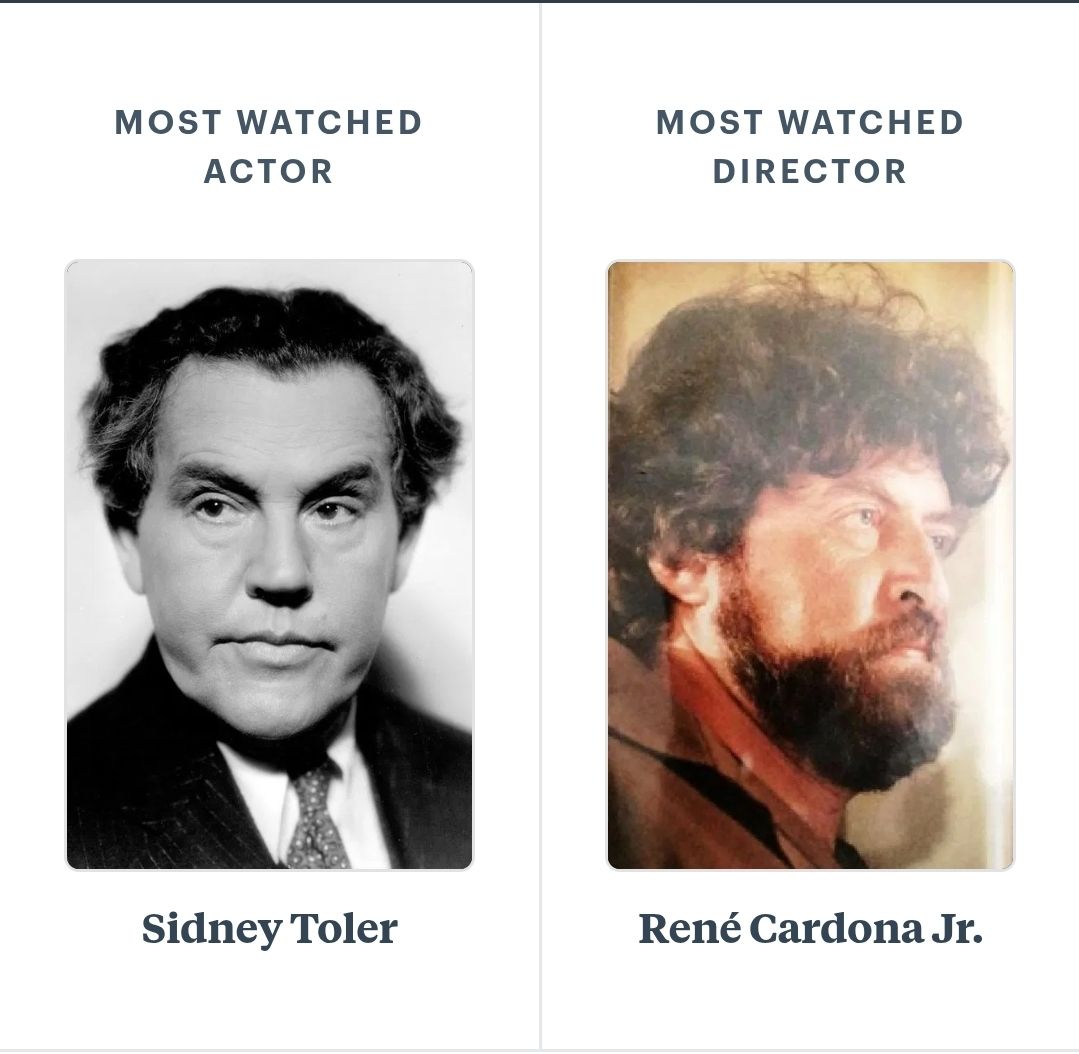

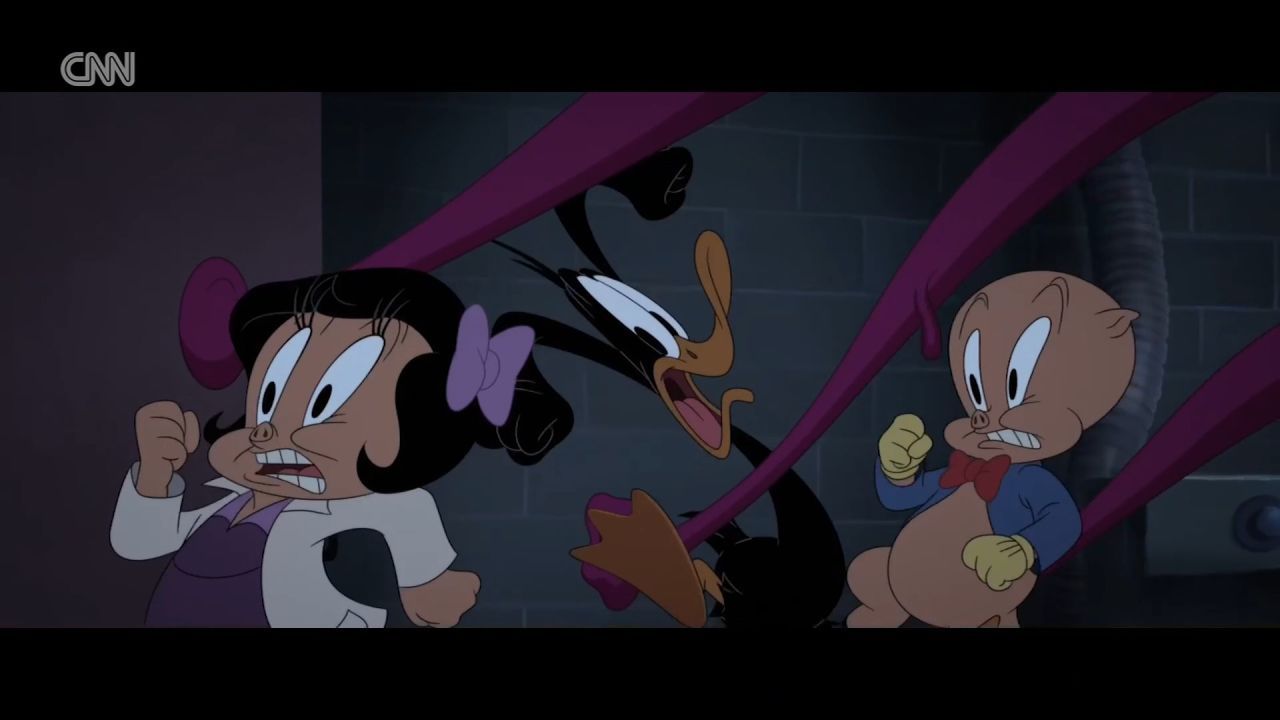

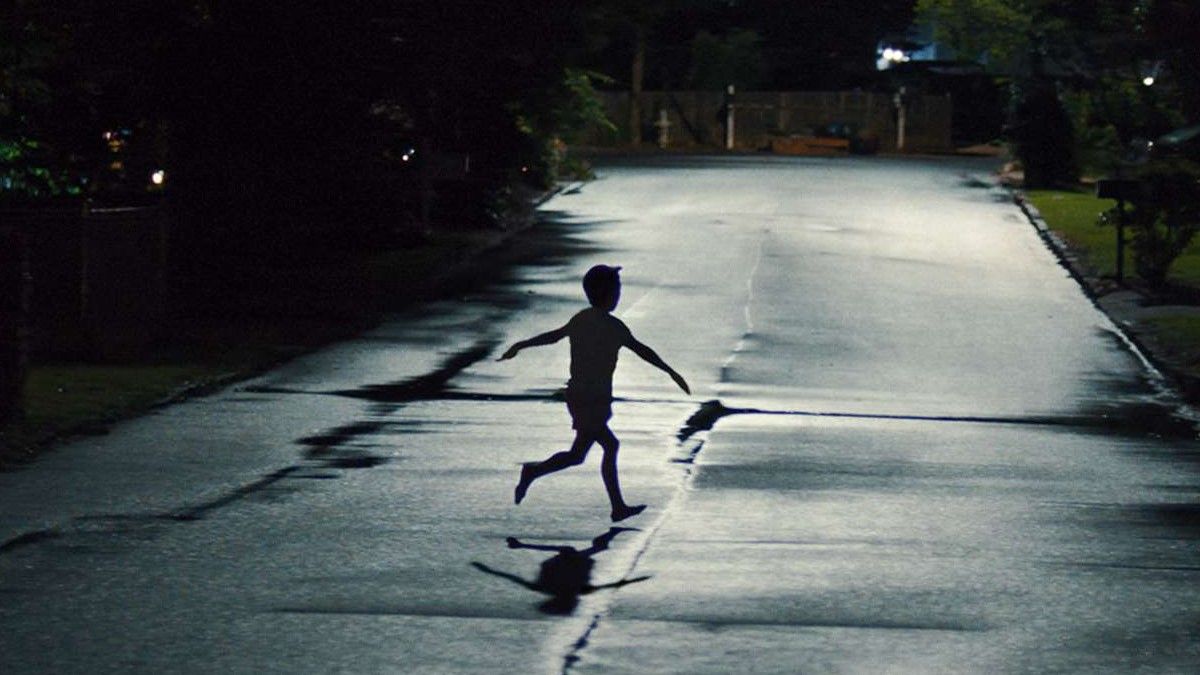

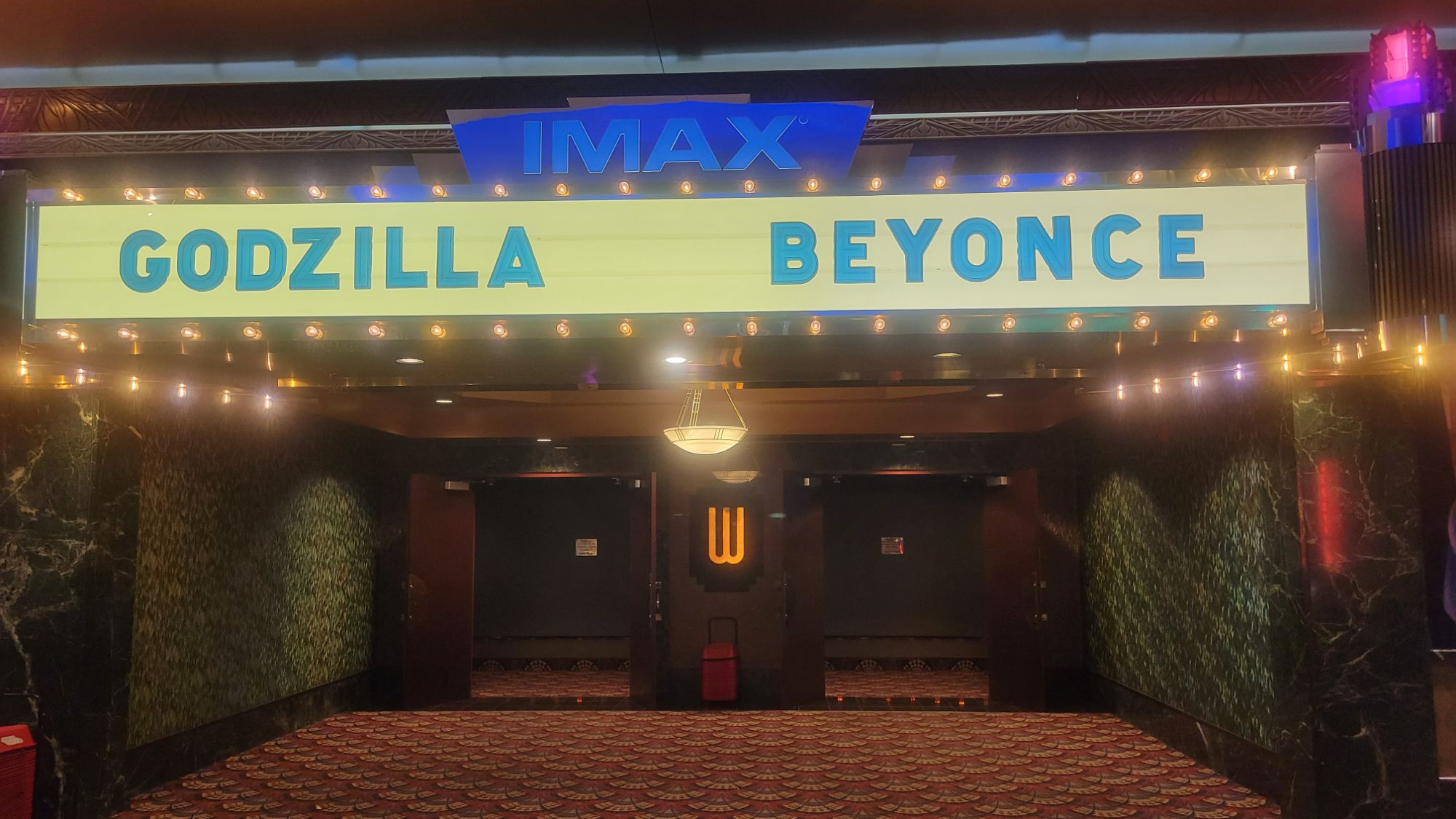
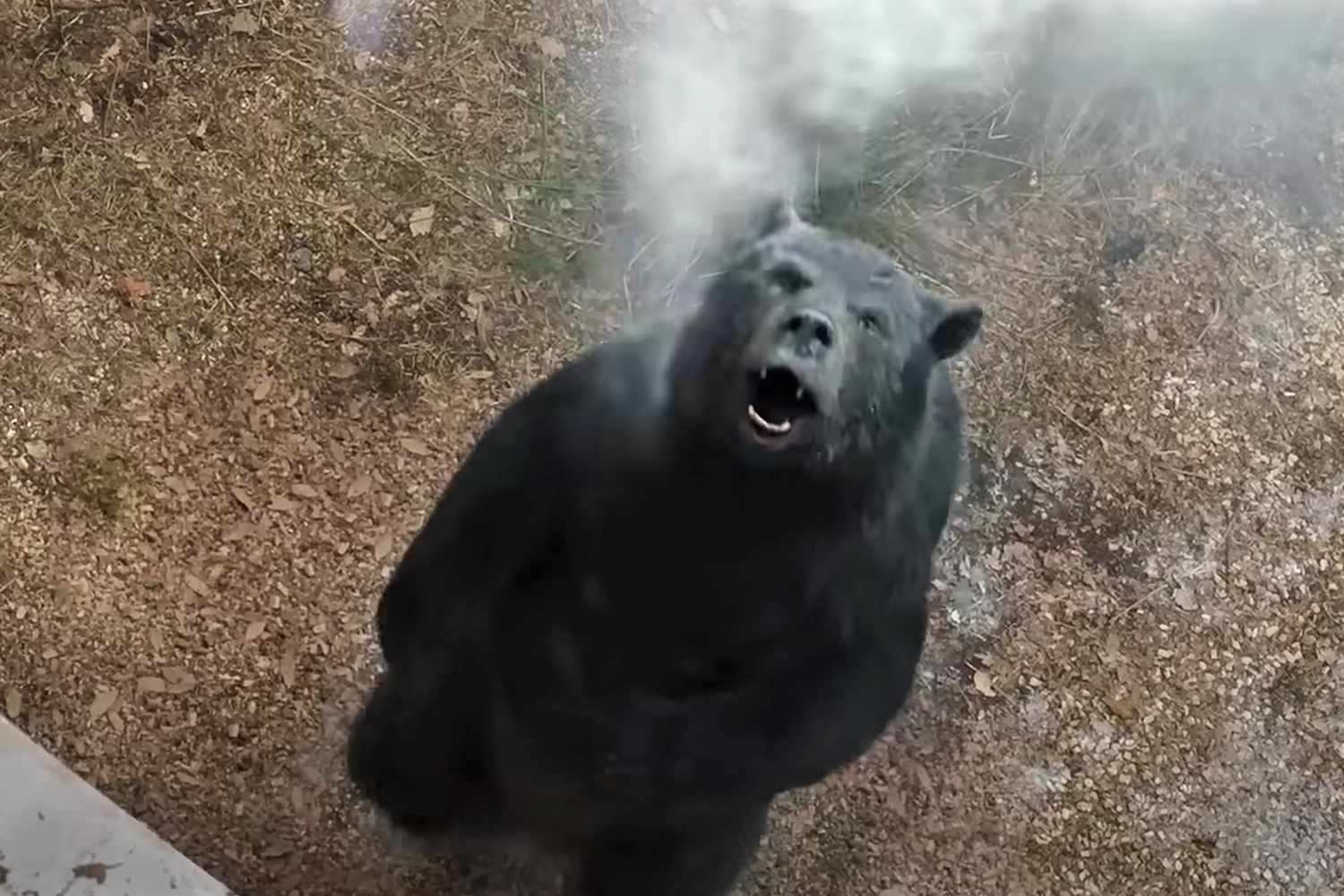
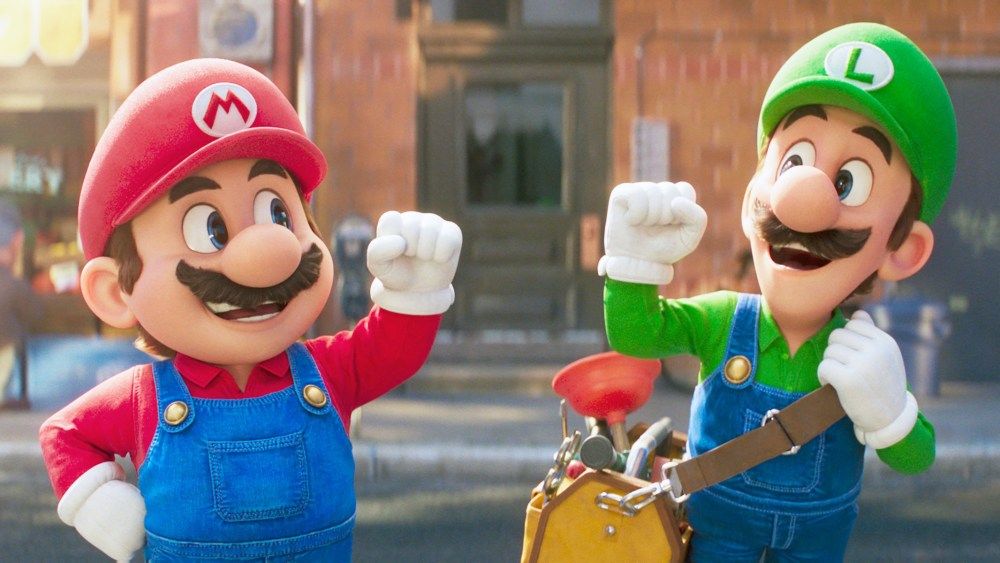
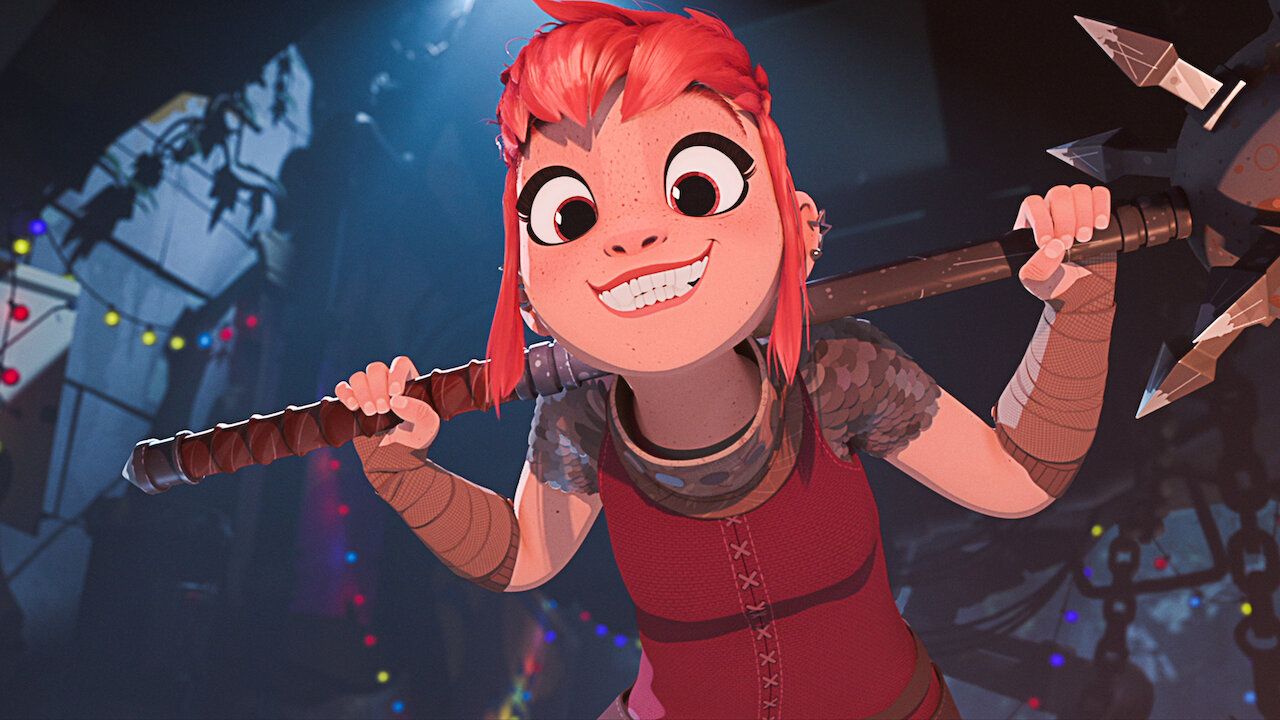


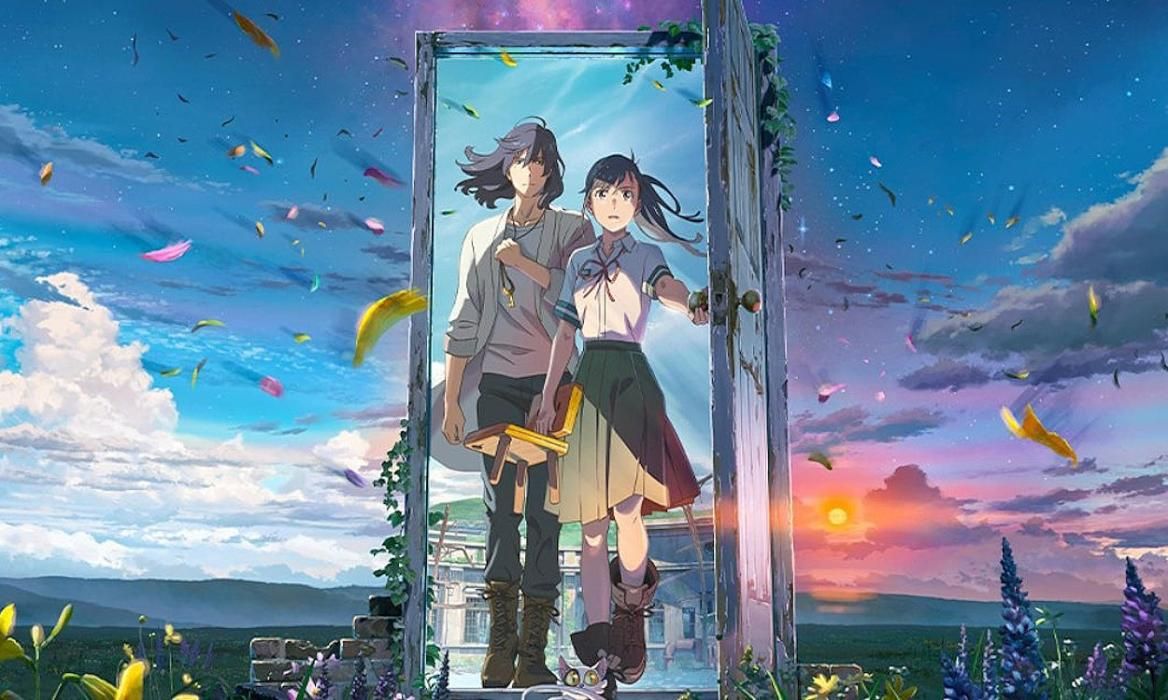

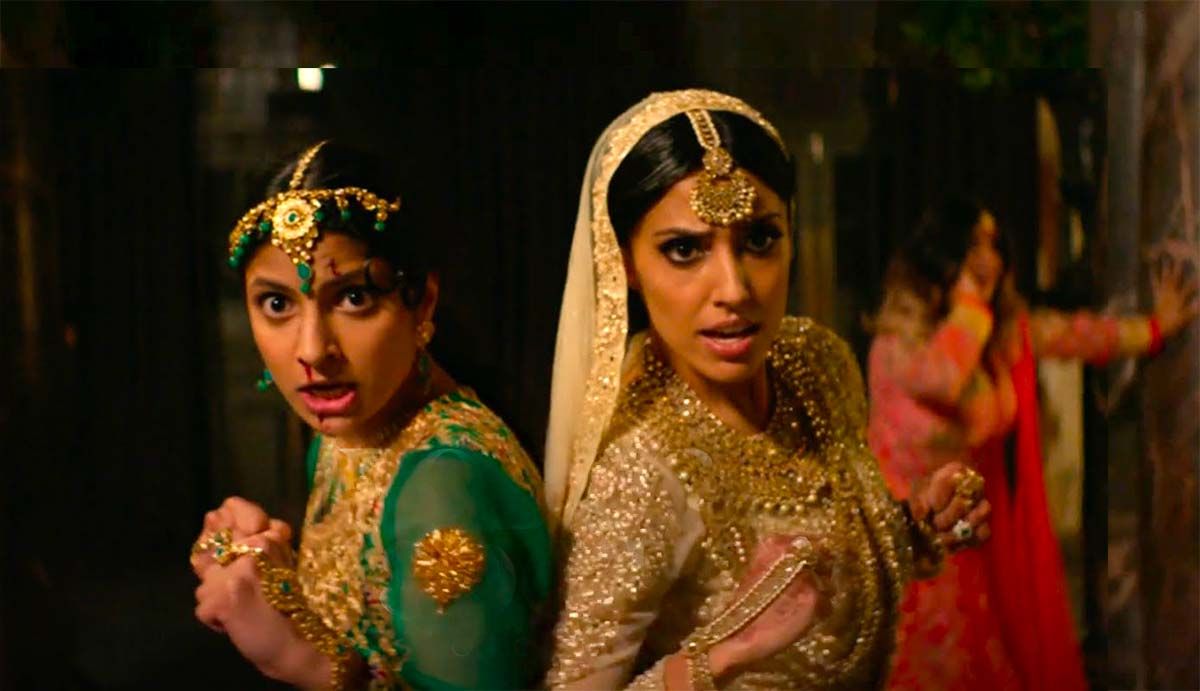
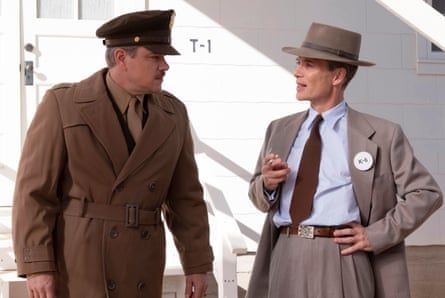
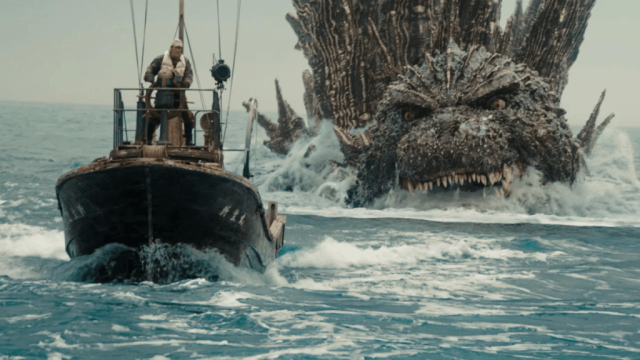


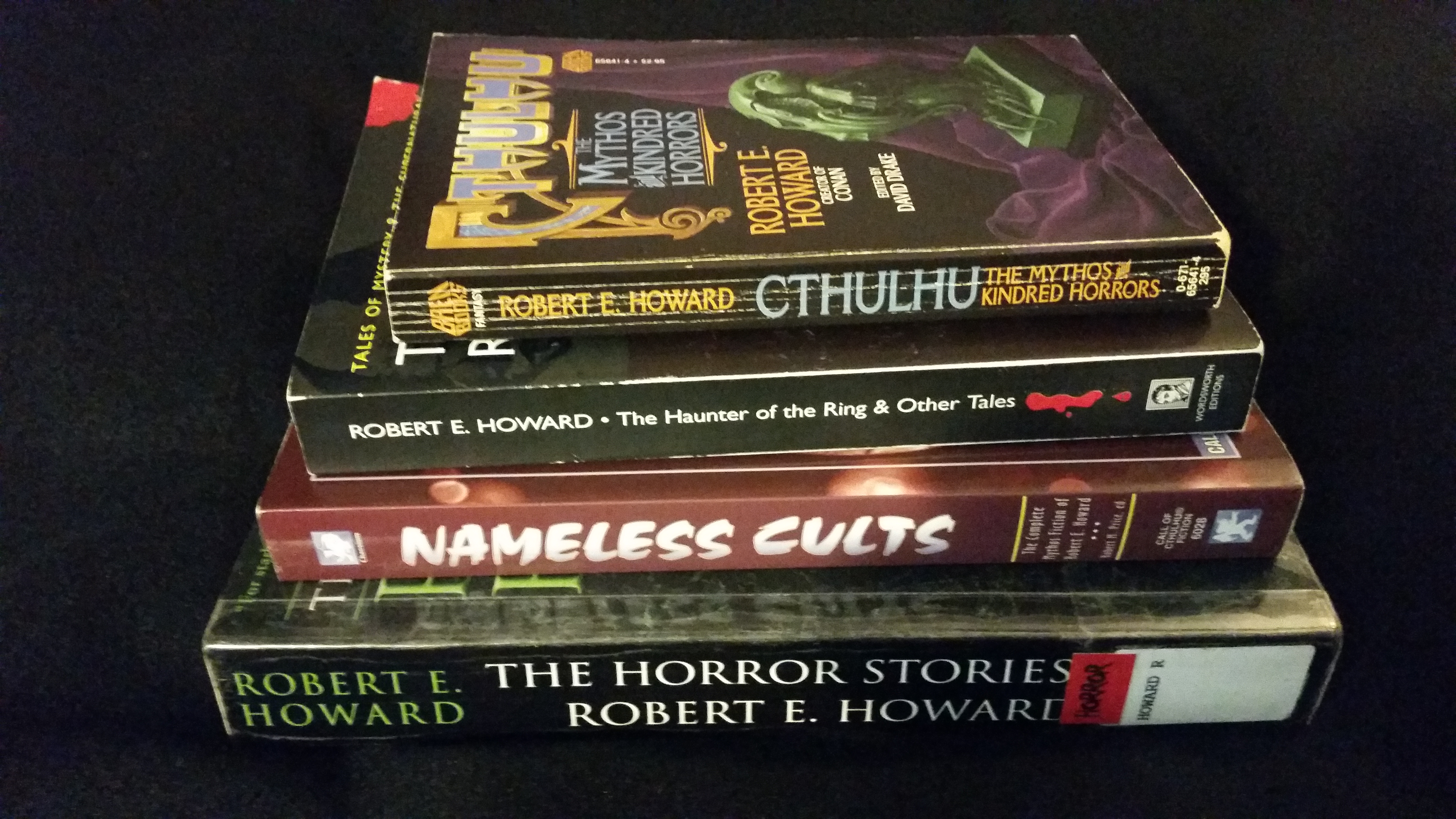


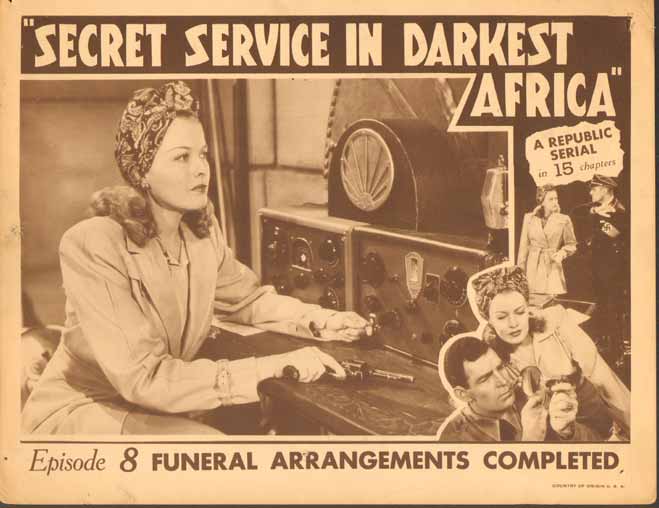
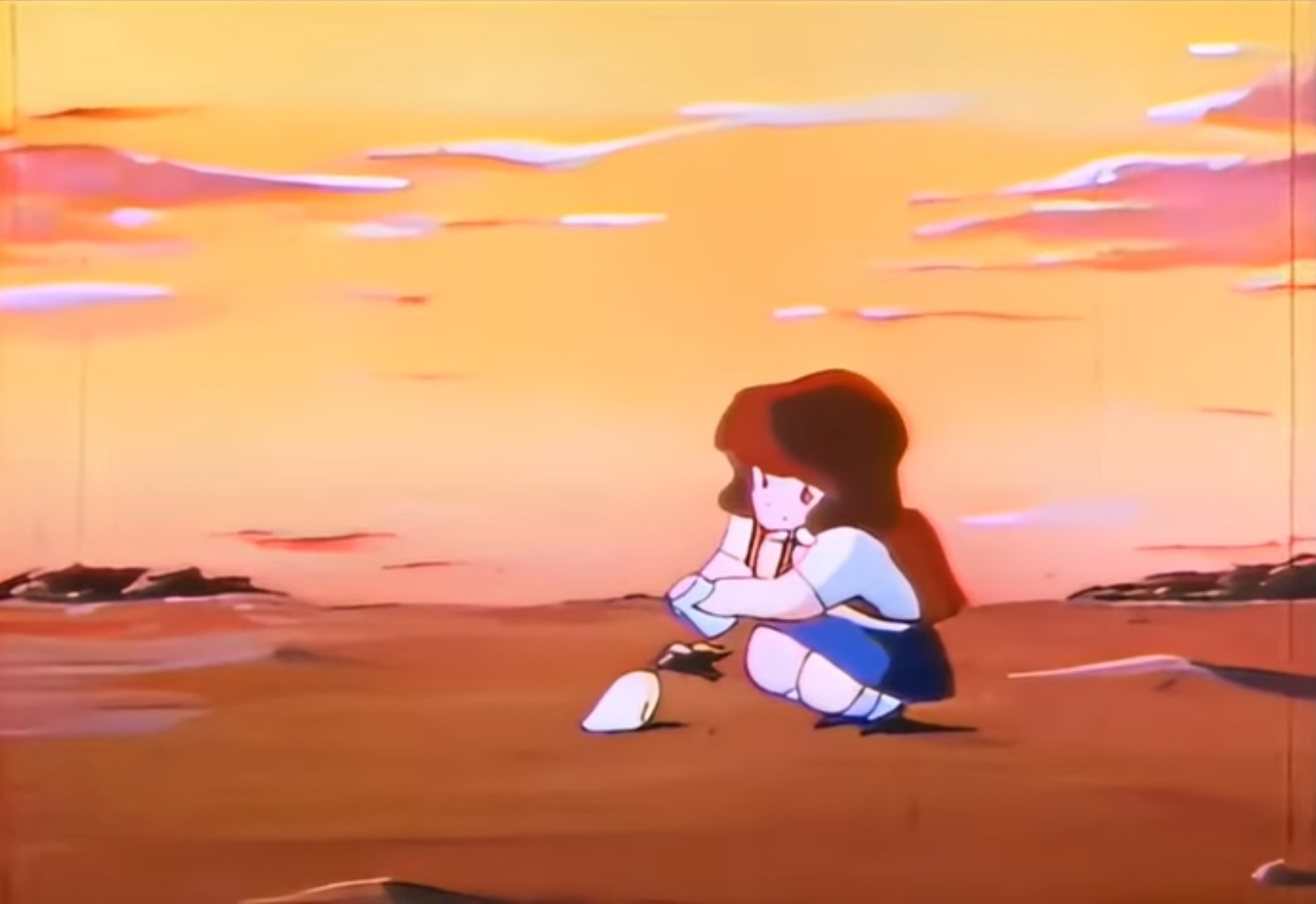
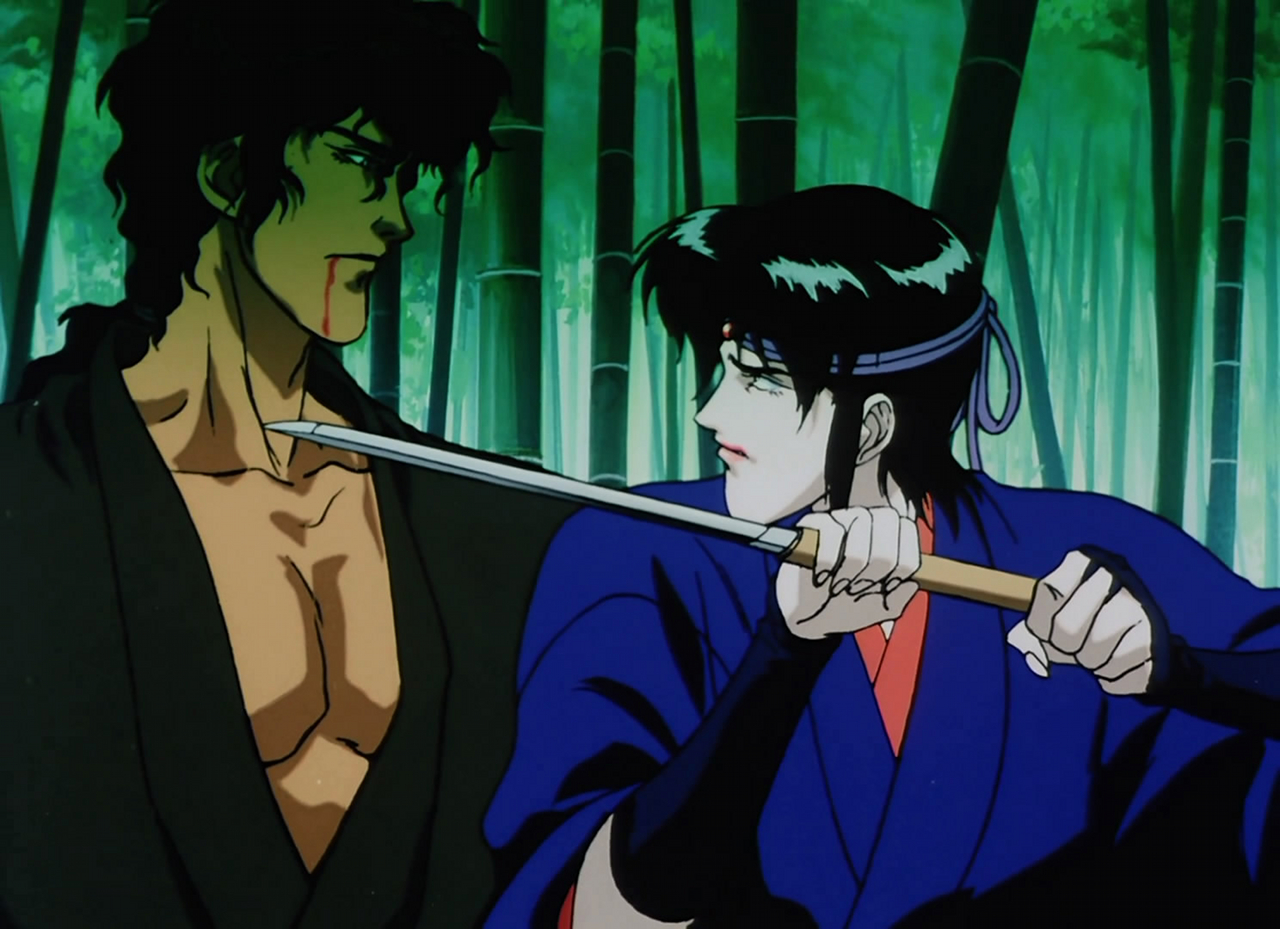


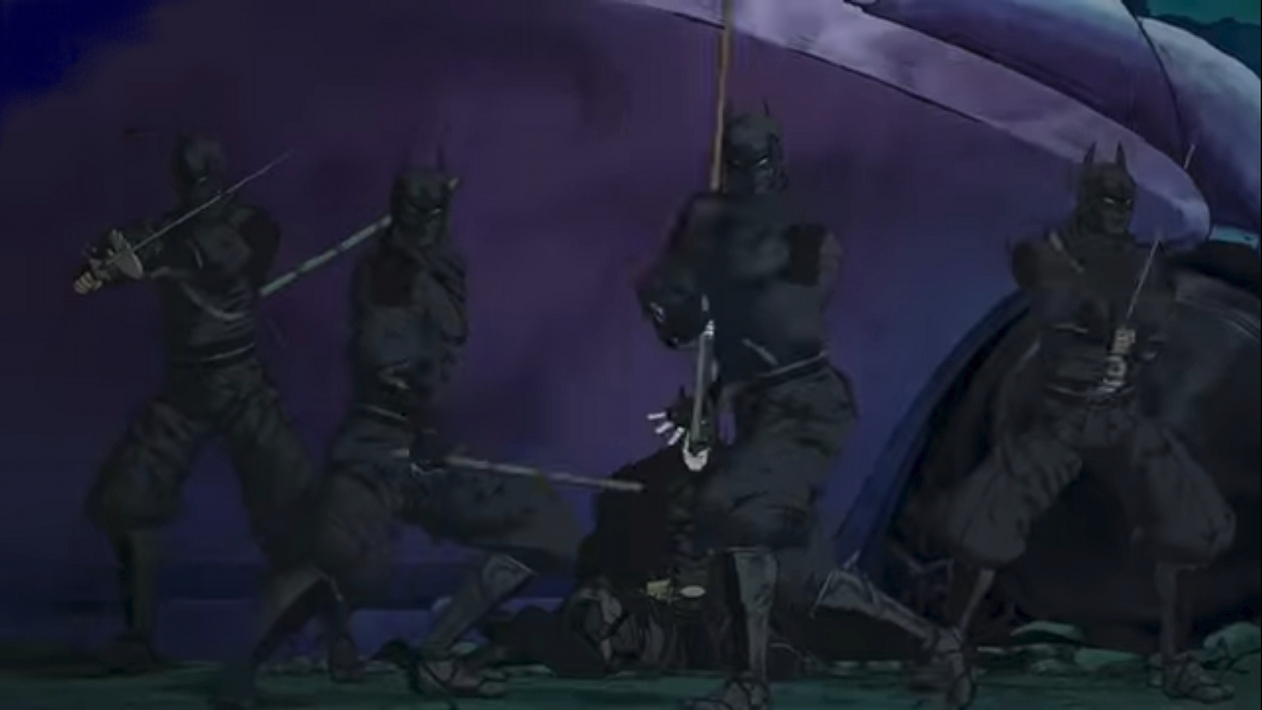


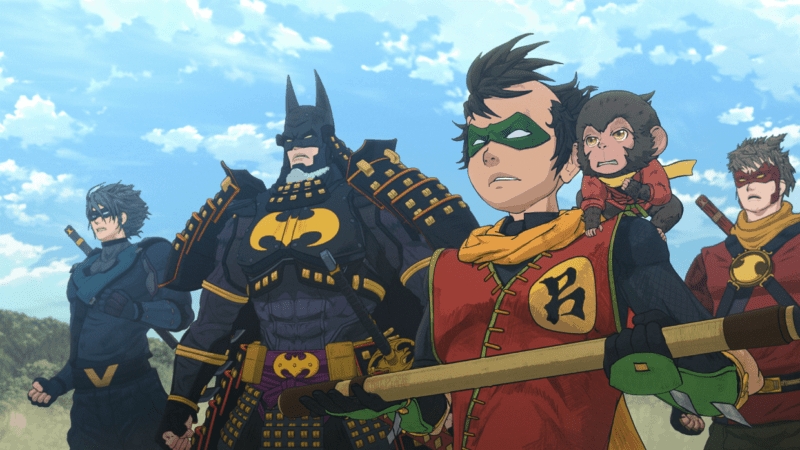
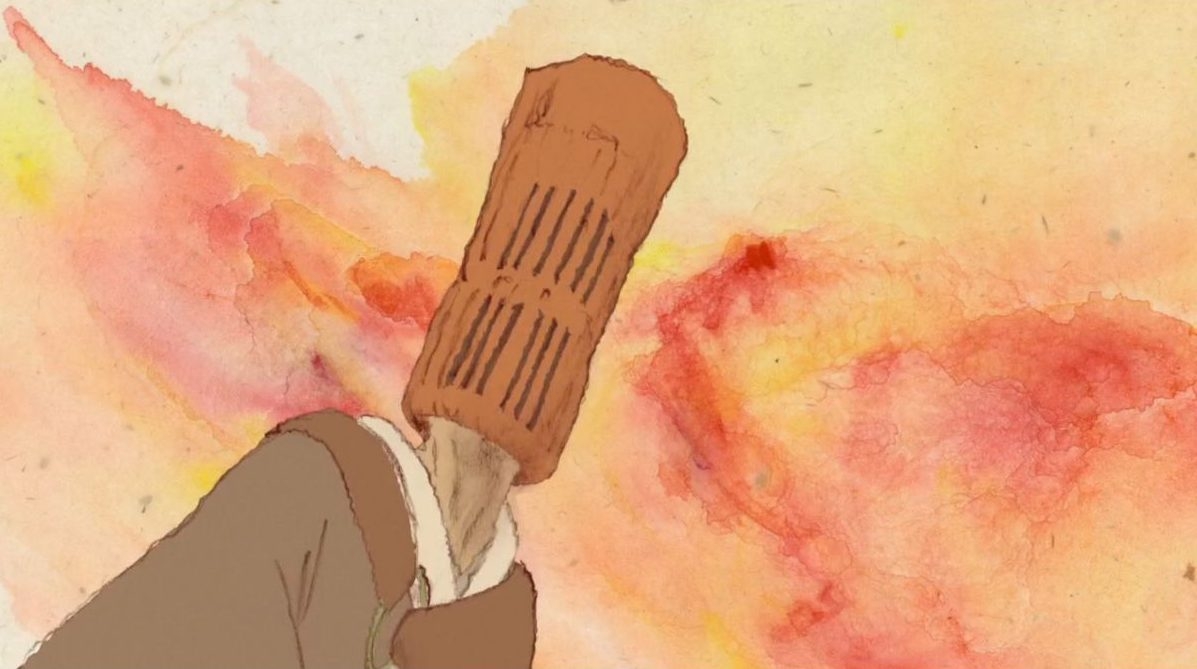


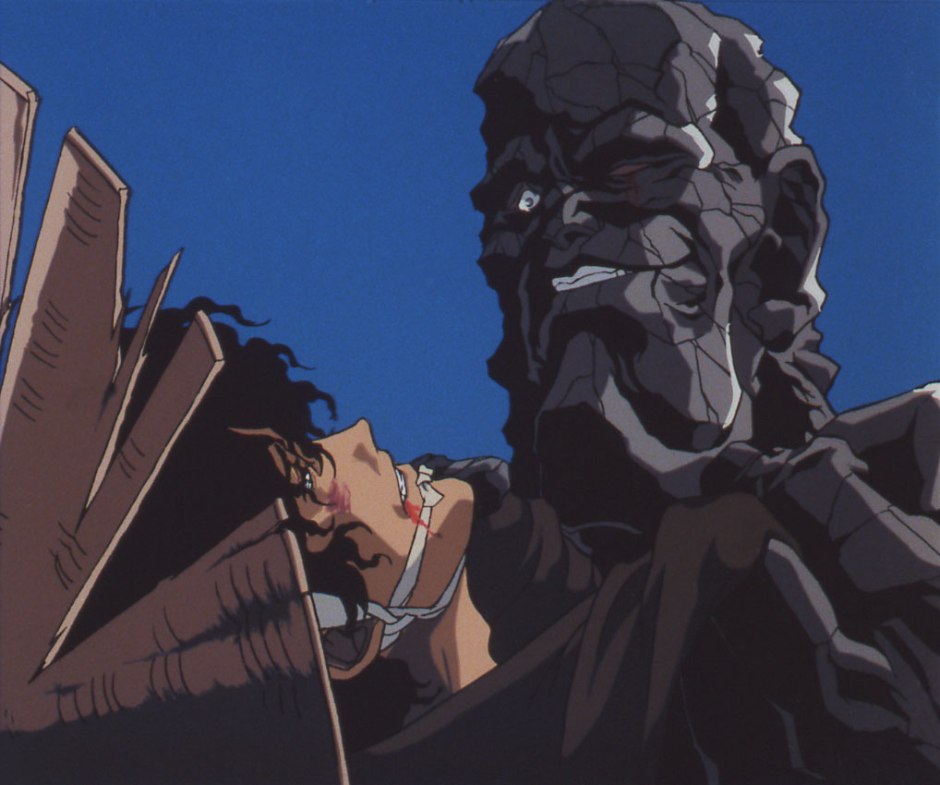

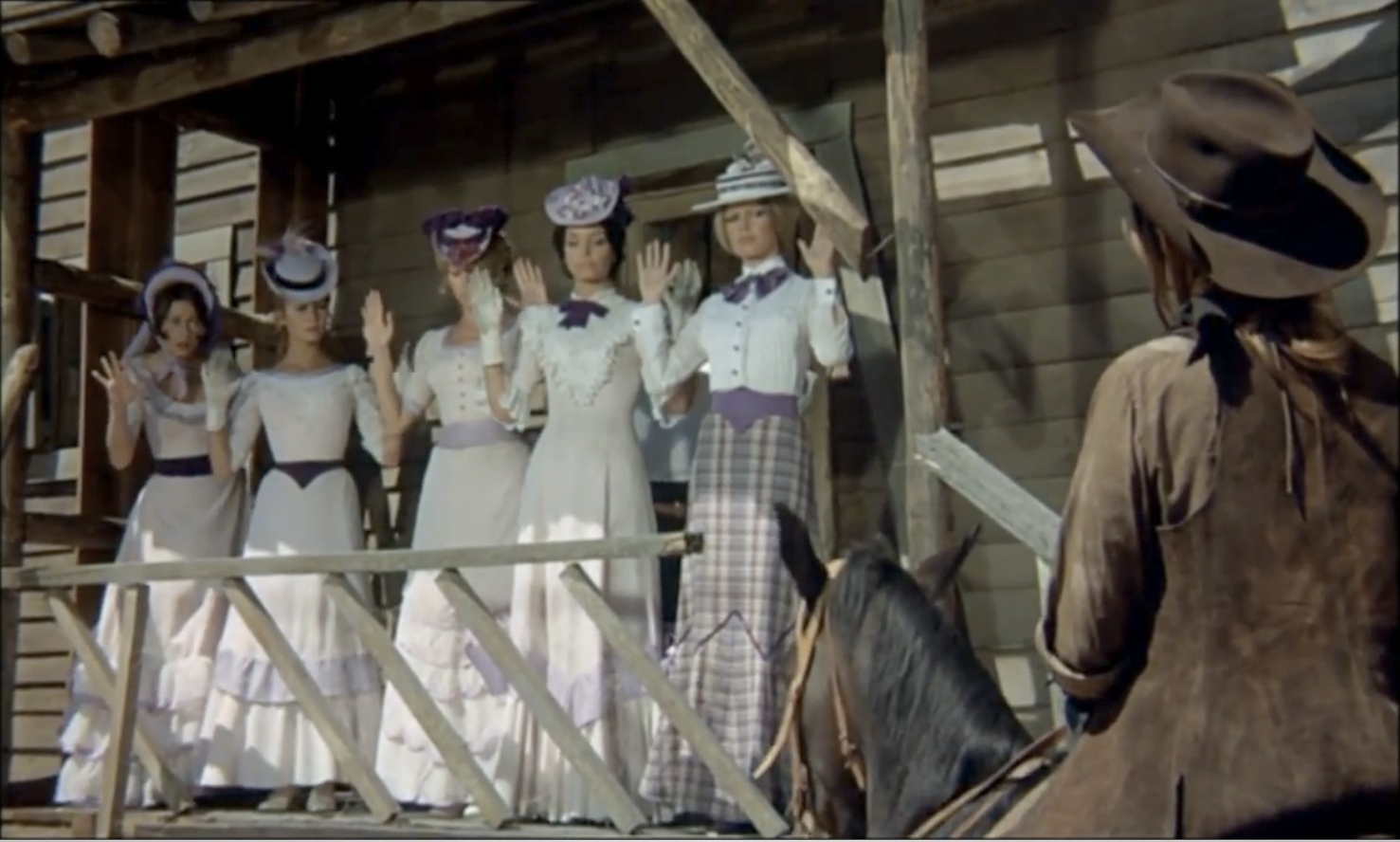


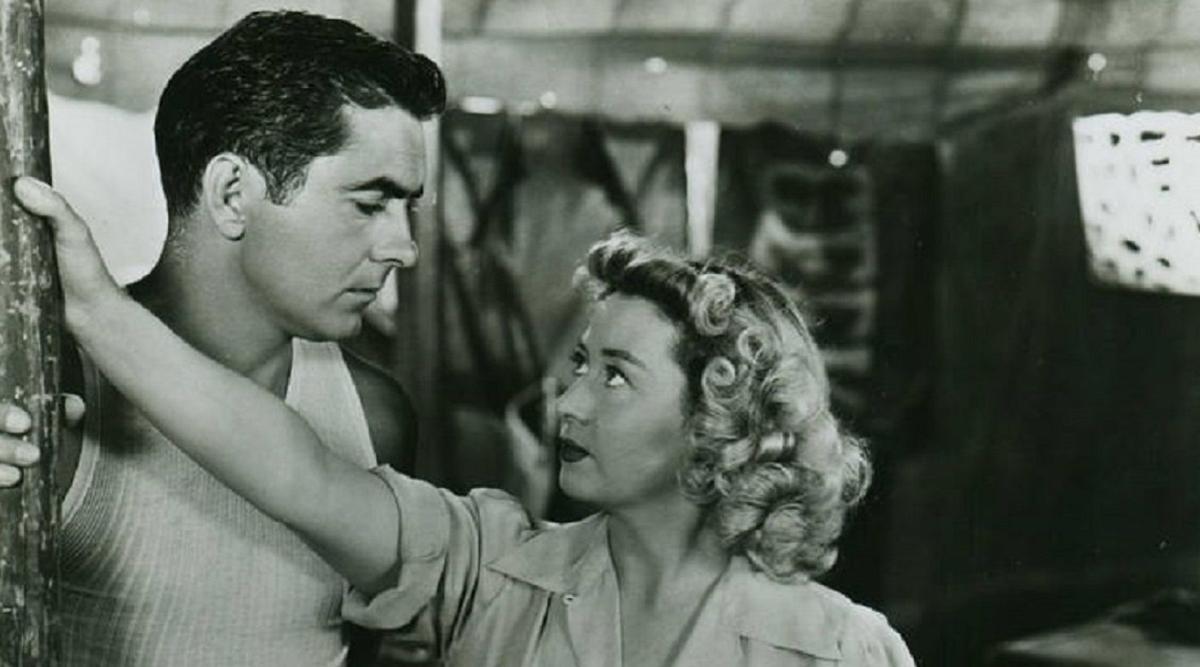
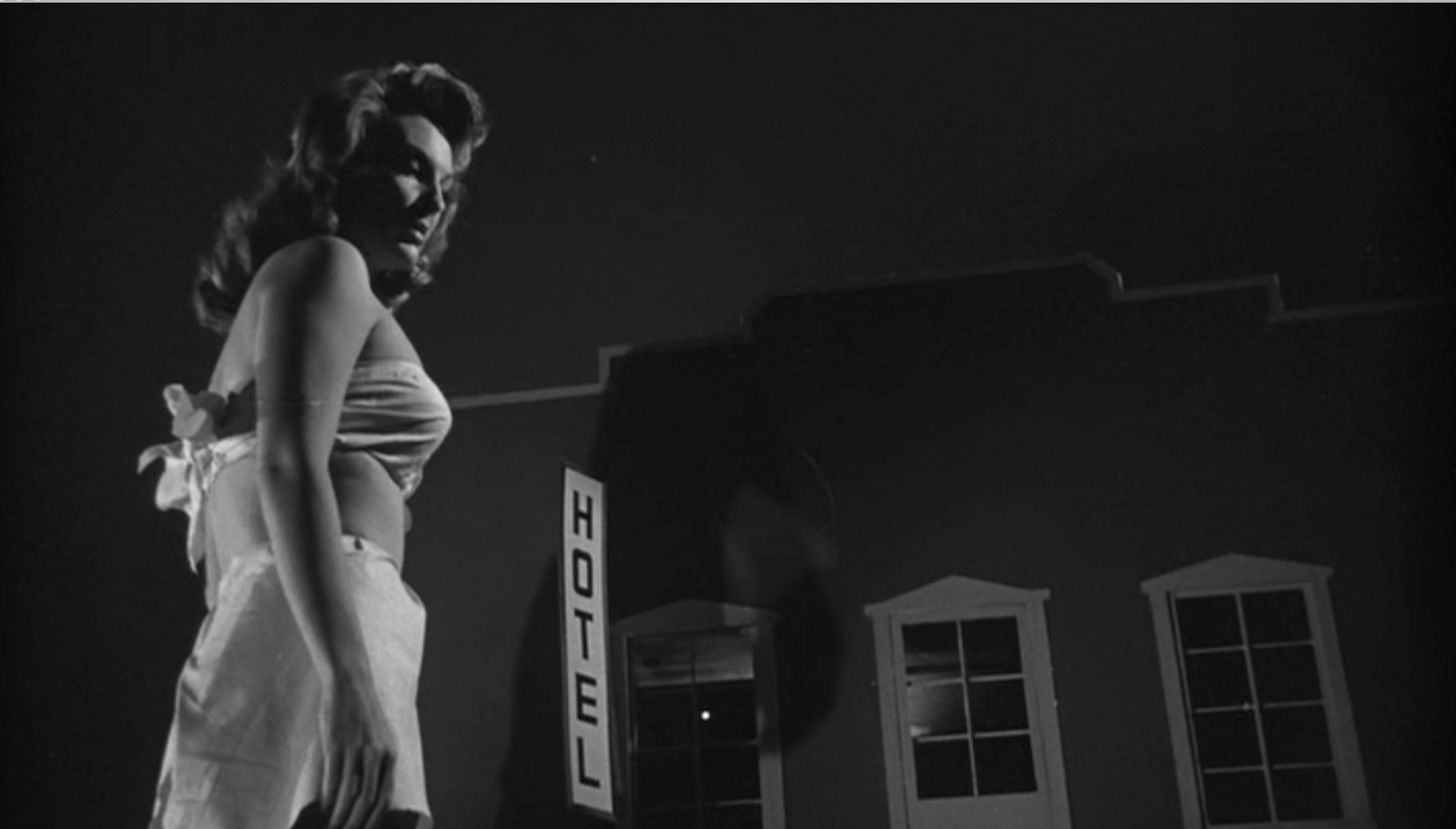

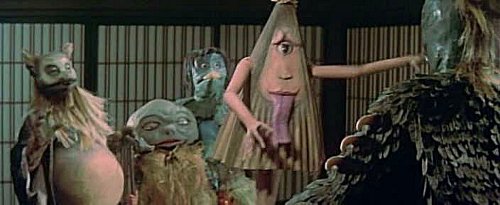

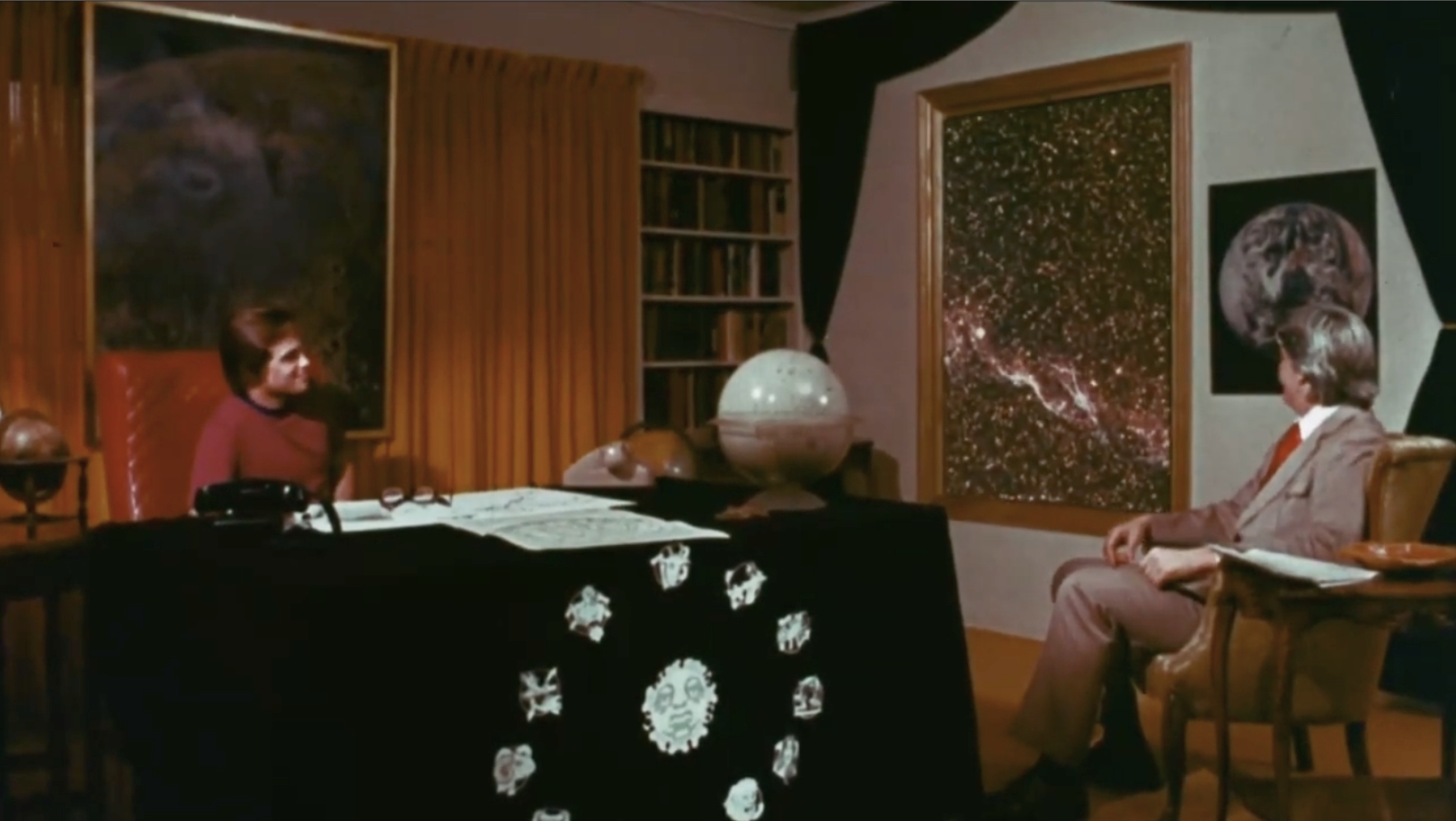
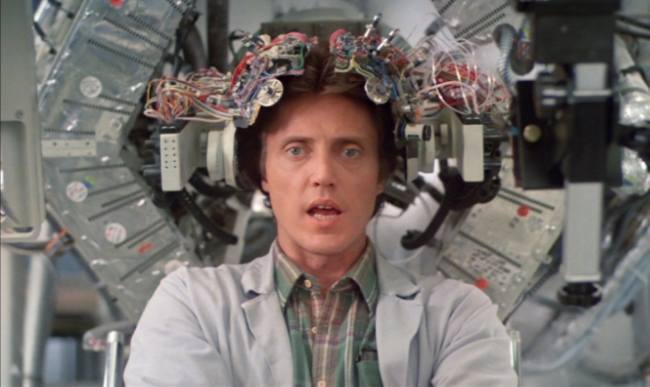


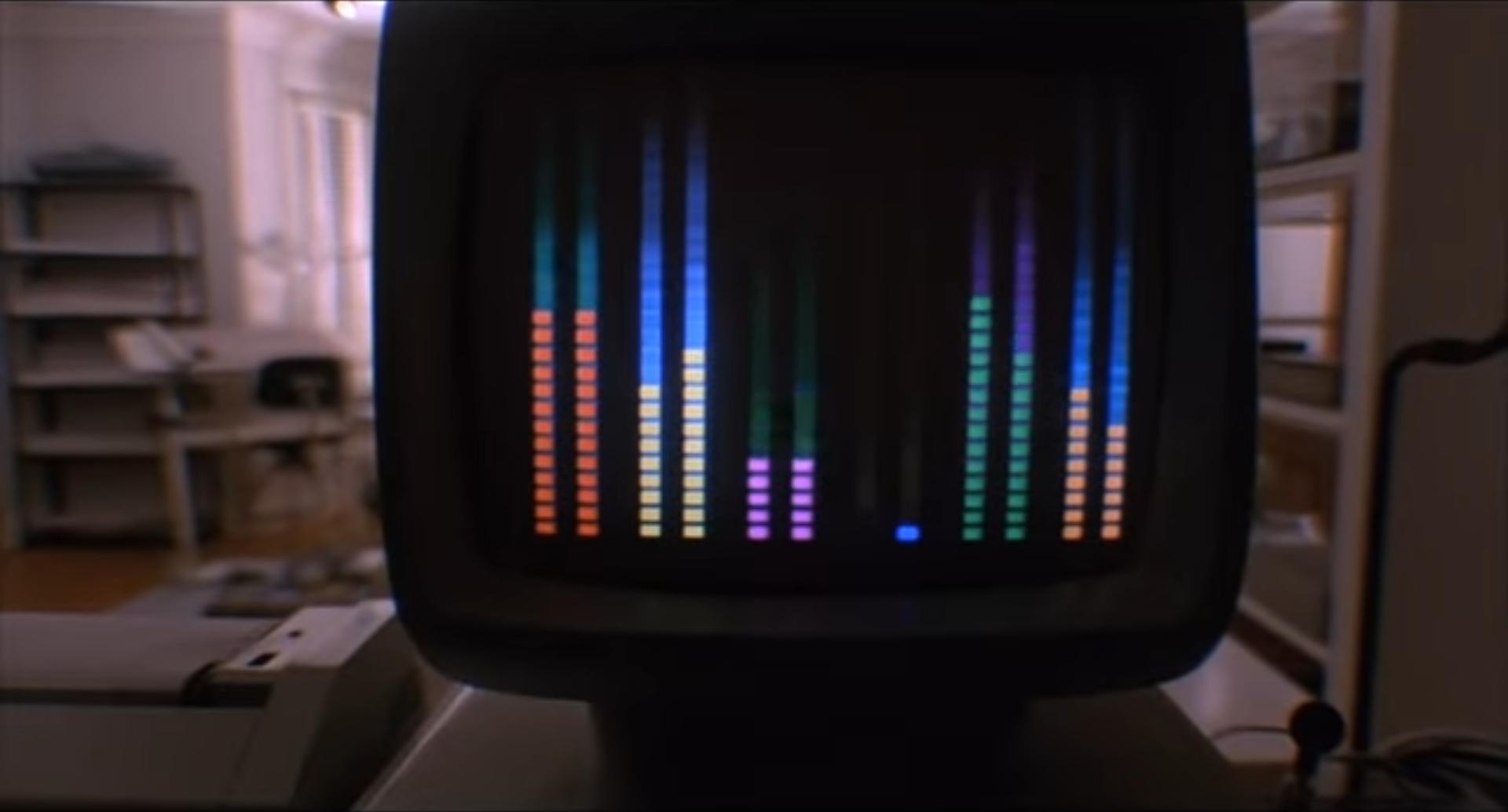
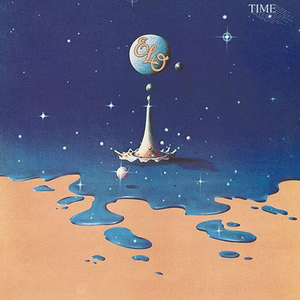




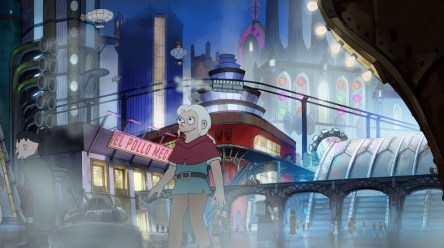
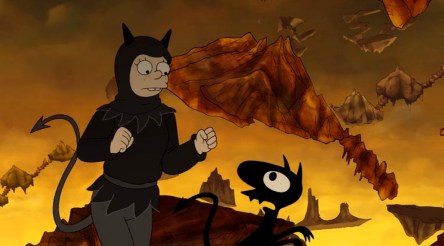
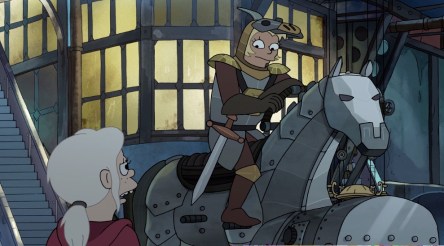
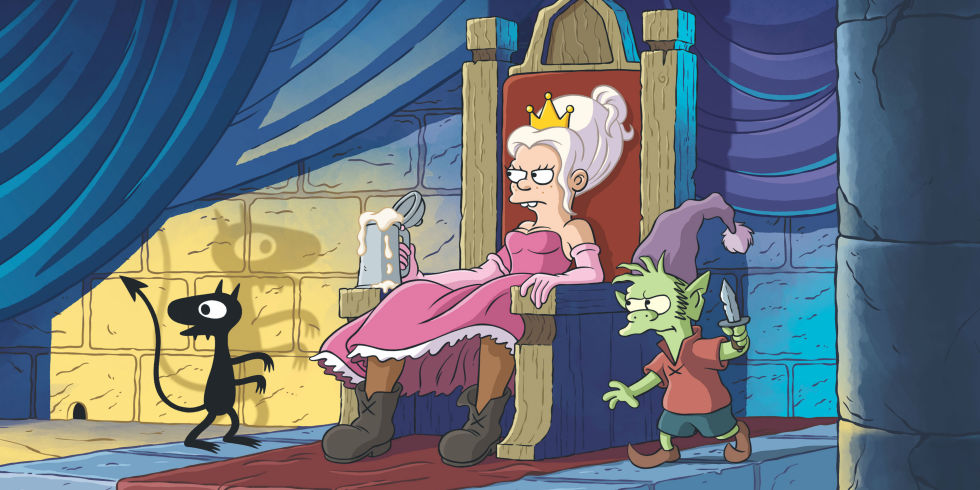

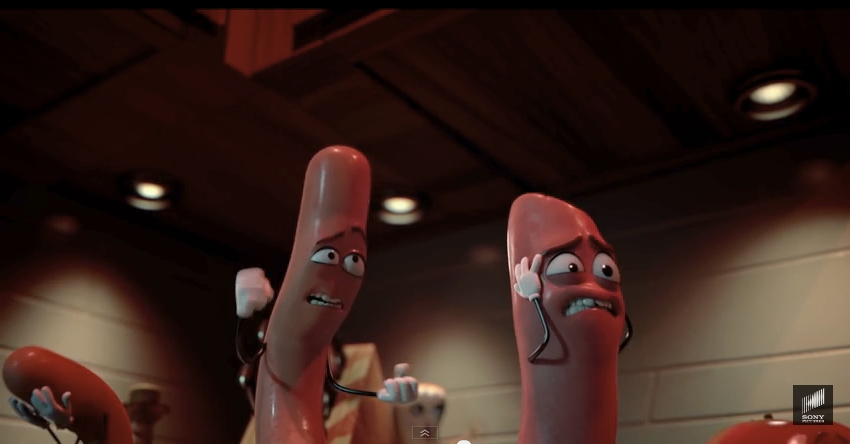

 Medleyana