Fates Worse Than Death: Junior G-Men

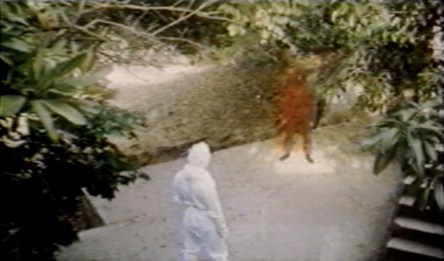
Which is more terrifying: to be trapped in an out-of-control elevator, plummeting down the shaft to the basement, or to be in the bottom of that shaft, trapped as the elevator descends to crush you? Billy Barton and Harry Trent, the heroes of the 1940 serial Junior G-Men, face both situations: the first as enemies thrown together by chance and the second later as allies, once street kid Billy has seen the necessity of joining forces with the Junior G-Men, perhaps even signing up to become one himself! In between those two cliffhangers, they and their friends face off against kidnapping attempts, fires, and explosions, even experiencing a building coming down around them! It’s all in the line of duty for the Junior G-Men!

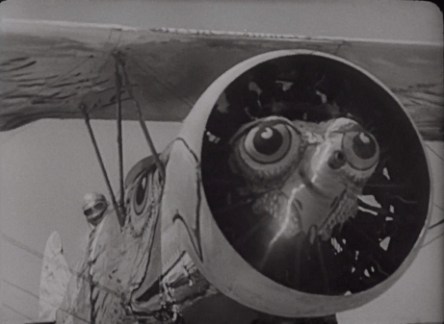
Several times during this series, I have commented on the necessity of combining the action and mystery formulas of the serials with other genres: of course there are superhero, Western, and jungle adventure serials, to name a few, settings capacious and widespread enough to encompass whole strands of serial style. One can be a fan of one of those formats and have plenty to watch without ever having to branch out. But there are also settings and premises that were only adapted to the serials a few times: the “giant bug” creature feature of Panther Girl of the Kongo comes to mind, and Junior G-Men is an example of the serialization of the “juvenile gang” film. Kid characters aren’t too unusual in serials, but Junior G-Men is a vehicle for the Dead End Kids, essentially a genre unto themselves. The Dead End Kids began as a group of young actors who broke out together in the Broadway play (and 1937 feature film) Dead End, a slice-of-life drama about tenement life in Lower East Side New York. They went on to star in numerous films together in different combinations, eventually devolving from the socially-conscious melodrama of Dead End and Angels With Dirty Faces to the goofy, sitcom-like antics of the Bowery Boys in the 1950s. The additional billing of the “Little Tough Guys” in the cast of Junior G-Men does not indicate a second group, but rather an attempt to rebrand the troupe after moving from Warner Brothers to Universal; it’s a little confusing. (Trav S.D., author of books on Vaudeville and film comedy, has a more detailed breakdown of the Dead End Kids and their various spinoffs here.) Notably, Leo Gorcey, whose name is most closely associated with the later Bowery Boys, does not appear in Junior G-Men.

As Junior G-Men begins, we observe Billy Lang’s gang in its natural habitat, the city streets, engaging in the kind of behavior teenage boys get up to in packs: rough-housing, verbally busting each other’s chops, catcalling women, and cadging apples from street vendors (okay, that last one is a bit more specific to their time and place). The only indication that these tough kids might be more than loudmouthed delinquents is when Billy (Billy Halop) pushes one of his fellows out of the way of a speeding car. You could call it Billy’s “Save the Cat” moment, but it just ends up causing more trouble, resulting in a wreck and traffic jam that spirals into a fight between the drivers.

While the cops are distracted and the other adults are rubbernecking, Billy and the boys help themselves to the pies from the back of a stalled bakery truck. A slick-looking, better-dressed boy observes them at a distance, and once they’ve left, helps the cops track down the teenage pie thieves. That boy is Harry Trent, head of the local Junior G-Men chapter and an aspiring Fed, just doing the right thing in the name of law and order; once Billy and his gang find out who squealed on them, they invade the Junior G-Men’s clubhouse and beat the snot out of them, at least until one of the junior agents is able to place a call and summon the police.

It might end there, but once Harry’s uncle, FBI agent Jim Bradford (Phillip Terry), arrives, he learns that “Billy Lang” is actually Billy Barton, the missing son of one Colonel Barton, a scientist and inventor who had disappeared years earlier. (Col. Barton had placed his son in a military school before going on the mission during which he went missing, a school which Billy ran away from, leading to life on the streets and his new assumed identity.) Bradford realizes that Billy may be the key to defeating the Order of the Flaming Torch, a secret organization dedicated to overthrowing the United States government.

With their choice of iconography, an arm holding a raised torch, and their penchant for Roman columns in their hideout, the Torch gang (or “Torchies,” as they are frequently called later) suggests a fascist insurgency, but as usual their exact politics are left a mystery beyond their goal of replacing democratic government with their own rule. And they seem close to achieving it: their cells are spread out across the country, and they’ve succeeded in kidnapping several scientists and other prominent individuals, like Barton, to force them to work for their cause. Col. Barton (Russell Hicks) is the inventor of a new explosive (“Bartonite,” of course) that is not only more powerful than any yet developed, it can somehow cause the detonation of any other explosives within a range dependent on how much of the substance is used. Barton has thus far refused to share the formula for his explosive, only preparing small amounts for the Torchies to test; while he maintains that leverage, he remains alive. Once the Torchies, and their leader Brand, have the formula, they can manufacture as much of the substance as they want, and they will be ready to make their move. Brand learns that Billy is Col. Barton’s son, and immediately plans to kidnap him, hoping to use Billy to force his father’s hand.

Many serials and pulp narratives start out with characters suspicious of or antagonistic to each other, but Junior G-Men really goes the extra mile in establishing Billy’s dislike for Harry. Harry Trent (played by Kenneth Howell, not one of the regular Dead End Kids) is an uptight square, at first appearing to be the kind of rich “softy” the Dead End Kids beat up for laughs in their earlier films. His efforts to bring the kids to justice for stealing a few pies shows, at best, an eagerness to show off and be part of the system, and he seems to expect Billy to thank him for showing him the way back to the straight and narrow.

Because of the Production Code and the need for clearly-drawn heroes and villains, the serials were generally pro-law-and-order (their earnest squareness is a frequent target of later spoofs), so making the anarchic, sarcastic, and authority-defying Dead End Kids the heroes (and keeping the antagonism going for as long as it does–it’s about halfway through before Billy really commits to working with Harry and his chums) makes for an unusual change of pace. When Jim Bradford appeals to Billy’s sense of patriotism, the word hardly has any meaning, he’s been pushed around so much. “The government or the cops never did nothin’ for me!” Billy sneers. “Stop preachin’ to me, wiseguy.” Proof that the “juvenile delinquent” archetype of the 1950s had deeper roots than many think.

At first Billy doesn’t believe Bradford’s claim that the Torchies are holding Col. Barton, but once he sees the evidence for himself he acts: at first on his own, still refusing the aid or advice of the FBI (“I’ll find him without the help of any copper!”), and later only grudgingly cooperating. Most of the middle chapters feature at least one scene in which Billy observes Harry’s cutting-edge police work, so like the Dick Tracy serials, and says something like, “That scientific stuff of yours is pretty good.” There’s even a montage in which Bradford explains the FBI’s fingerprint database, complete with stock footage of agents combing through thick files and using the latest technology like computer punch cards.

Billy is won over as much by the cool radio equipment and good food at the Junior G-Men clubhouse as he is by Harry’s and Bradford’s efforts at persuasion. Eventually he agrees to “put our wallop together and go after those Torchies.” Even then, Billy and his gang do things their own way, and they don’t really change character. It’s sometimes a little frustrating–there are plenty of times Billy takes dumb risks instead of waiting for backup, but that’s what we love about the loose-cannon detectives in later mismatched buddy cop comedies, isn’t it? Serial heroes can sometimes be a little too perfect, so the often-fractious efforts at teamwork between the raucous kids and the straitlaced FBI makes for a lively, colorful adventure. It’s also generally exciting and satisfying to see the kids get one over on the pompously assured Brand (Cy Kendall, seen before in this series in The Green Hornet and Jungle Queen). “They got away, as usual,” Brand’s right-hand man, Severn (Ben Taggart), says morosely after yet another failed encounter.

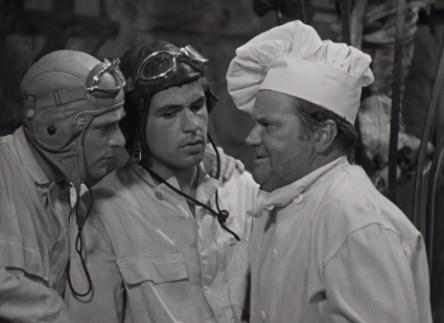
Aside from Billy, the Dead End Kid who gets the most screen time is Gyp, the cut-up (and would-be lady’s man) played by lanky, rubber-faced Huntz Hall. Most of the overt comic relief comes from Gyp (or at his expense), giving Billy space to brood and take charge of situations. Many of Gyp’s lines, mostly “so’s your old man” non sequiturs, are really memorable because of Hall’s delivery: when Gyp–who is earlier shown learning how to drive–jumps into Harry’s car after Billy and Harry have been grabbed yet again by the Torchies, he yells at a pedestrian, “Hey, whadya wanna do, become an angel or somethin’?” It’s funnier on screen than it is in print.

Other gang members, regular members of the troop, include Lug (Bernard Punsly) and Terry (Gabriel Dell), but they don’t get more than a few lines at a time and are mostly noticeable when the kids have to split up into different groups for plot reasons (that’s pretty much the way the formula plays out in regular Dead End Kids or Bowery Boys vehicles, as well). They still come off better than the Junior G-Men, however: aside from Harry, I couldn’t remember the names of any of the others, and they’re pretty much completely interchangeable. The numbers of kids pays off in fight scenes, however, which they throw themselves into with gusto, filling the screen with action and practically tearing the sets down (that rowdiness apparently continued off the set, and was one of the reasons the troupe passed under different studios and producers over the years).

As far as I can tell, Junior G-Men lies halfway between the soapy but plausible mixture of drama and comedy in the early Dead End Kids films and the kooky, formulaic encounters with ghosts, psychics, and Russian spies in the Bowery Boys pictures. Already, Billy’s gang is shown living out the teenage fantasy of independence, with a cool junkyard clubhouse (hidden behind a secret entrance in a fence, of course), and it goes without saying that their battles with the Torch gang are pure pulp. With America pulling out of the long Depression, even such concerns as hunger and physical danger are mere inconveniences or opportunities for adventure rather than the soul-destroying epidemics of Dead End. Conversely, Billy’s disillusionment with the government is mined for drama, and the Torch gang isn’t playing around (interestingly, gunplay is largely avoided because the FBI doesn’t want to start shooting with kids around, and the Torchies don’t want to lose their leverage over Col. Barton by accidentally killing his son). Much of the charge in Junior G-Men comes from characters from two different genres–the slapstick and sarcasm of the kid gangs and the clipped “Now see here” patter of the crime serial–bumping against each other. The result is a unique and entertaining film in which the roots of many future kiddie adventure flicks can be seen.

What I Watched: Junior G-Men (Universal, 1940)

Where I Watched It: A two-tape VHS set from Rhino Video (It is also on YouTube, which is where I grabbed the screen caps.)

No. of Chapters: 12

Best Chapter Title: “Trapped by Traitors” (Chapter Six); but have no fear, victory is ultimately assured by “The Power of Patriotism” (Chapter Twelve)!

Best Cliffhanger: In the aforementioned “Trapped by Traitors,” Billy and the gang trace the Torchies to their city hideout in an unfinished apartment building and decide to do some snooping without involving Bradford. However, Bradford overhears the boys’ plans and summons his own G-men to raid the hideout. Bradford arrives just in time to help Billy and Harry out of a trap and shake off their would-be captors, but unbeknownst to our heroes, Brand has had both towers of the apartment building wired with explosives that can be set off remotely. Learning that their cover has been blown, Brand gives the signal, and stock footage of the apartment tower collapsing are alternated with interior shots of billowing dust and rafters caving in. Will the senior and junior G-men make it out in time? (Dialogue from Chapter Six, including “Oh boy, that was a close one!”, suggests they will.)

Sample Dialogue:

Bradford: Did the Torch gang clear out?

Gyp: Yeah, but they won’t get far.

Bradford: Why not?

Gyp: I knifed one of them.

Bradford: Knifed ’em?

Gyp: Ehhhh, I knifed one of their tires.

(Chapter Seven, “Flaming Death”)

What Others Have Said: “A big, stout, lumbering man, whose first impression of drowsiness or laziness was disarmingly deceptive, [Cy Kendall] portrayed with finesse the sly, crafty, insinuating gang boss who badgered those around him with guile and deceit, praising them with a sarcastic display of oily supercilious charm, while constantly nagging them with a cynical sneer of thinly disguised contempt. His ‘boys’ never knew what he really thought of them, but the audience did. He was so easy to hate that regular serial fans grew to love him.” –William C. Cline, In the Nick of Time: Motion Picture Sound Serials

What’s Next: The Dead End Kids starred in two more serials for Universal, Sea Raiders and Junior G-Men of the Air, which I may get to, but for now I’m heading back to the jungle with Clyde Beatty in Darkest Africa! See you next time!

Fates Worse Than Death: Jungle Queen

A plane flies over the African jungle in darkness: aboard are two American hunters, Bob Elliot and Chuck Kelly, and Pamela Courtney, niece of the world-famous British explorer Alan Courtney. Although neither quite trusts the other yet, Bob and Pamela are both heading to the village of Tambosa for the same reason: Alan Courtney, known and respected by the Tongghili tribesmen, is the only white man who knows the secret to the Sword of Tongu, the emblem of office held by the head man of all the regional tribes, and the key to controlling the territory. Back in Nairobi, where the plane took off, the mechanic who readied the plane predicts that it is about to develop engine trouble; no one will question the plane’s disappearance, and there will be no survivors. When addressed as “Johann,” the mechanic quickly corrects his interviewer: he may be “Johann” back in Berlin, but here he’s “Jack.” Yes, the Germans have an interest in the Sword of Tongu and control of the jungle as well, and they have many eyes and ears in America and Great Britain to keep track of their rivals. The year is 1939, and the Nazis are making plans to conquer first Europe, and then the world, with central Africa an important part of their strategy. Sure enough, miles from any safe landing spot, the plane begins to sputter and smoke; a last-ditch effort is made to land in a clearing, but can anyone survive the crash and resulting fireball? Have our American and British heroes met their fate before their true purpose is even known to each other? So ends “Invitation to Danger,” the first chapter of Jungle Queen!

Along with the image of the helpless damsel tied to a railroad track or a conveyor belt leading to a buzz saw (a premise nowhere near as common in actual serials as in the popular imagination), one of the most common latter-day representations of the serials involves a strong-jawed hero clobbering a hapless Nazi (in full uniform, of course) for the good ol’ U. S. of A. As I’ve pointed out before, however, the serials I’ve reviewed so far were for the most part much less explicit in their politics than we tend to remember: usually, when a rival nation is the enemy, it’s presented in vague terms, clear enough to read between the lines but easy to ignore for those who, back then just as today, prefer to think of their entertainment choices as apolitical. Even Captain America, a hero explicitly created to fight Nazis (and famously shown punching Hitler on the cover of his first issue), was made into a crusading district attorney and crimebuster when he made the leap to the serials.

There are exceptions, of course: the first Batman serial is explicitly anti-Japanese, to the point of actively endorsing the internment of Japanese-American citizens, making it hard to watch without wincing today. And there is Jungle Queen, produced in 1945 but set in 1939, before the invasion of Poland, and depicting Nazi machinations in central Africa for strategic control of approaches to Europe. While American movie studios in the 1930s didn’t want to alienate audiences who preferred to stay neutral or may even have been sympathetic to Germany (a dirty little secret of American politics that was conveniently forgotten once war was declared), by 1945 there was no risk in being explicitly anti-Nazi. (Making Bob and Chuck “volunteers” also makes a point: “See, America was involved, we just couldn’t make it official!”)

The word “Nazi” is frequently used in Jungle Queen, the nationalities of the characters are stated out loud, and if the visual cues of polished black boots and references to Mauser rifles weren’t clear enough, the frequent appearance of swastikas, death’s heads, and stock footage of Nazi troops on parade in Berlin make this by far the most politically explicit serial I’ve seen (and a clear forebear of the Nazi-punching Indiana Jones movies). Note that while Jungle Queen makes it clear that the Nazis are bad guys, it only takes issue with their lust for power in the abstract and their violent methods, making no mention of the racism and anti-Semitism at the root of their movement. It’s the same kind of portrayal of Nazis as cartoonish thugs, without reference to ideology, that Steven Spielberg later disavowed (but as I said, it’s at least more specific in comparison to other serials of the time).

The (slightly) more realistic politics in Jungle Queen lead to a greater emphasis on the characters’ international background and support systems than is usual as well: while American adventurers Bob Elliot and Chuck Kelly carry most of the serial’s action, we also see events orchestrated by the British spymaster “Mr. X” in London and Commissioner Chatterton in Tambosa, and on the other side by an unnamed German officer in Berlin supervising the Nazi spies. Each chapter begins with one or more of these figures receiving reports that bring the audience up to date on the situation in Africa, also serving to remind us of the area’s strategic importance. It’s one of the more complex depictions of international relations I’ve seen in the usually action-oriented serials, and the degree of intrigue, espionage, and counter-espionage is like something out of a Carol Reed film.

But back to the action: before too long, Bob and Pamela come to accept that neither one is a Nazi spy, and they can work together. Bob and Chuck were sent by American intelligence to secretly aid the Brits, just as Pamela was sent by Mr. X to find her uncle, in the belief that she is the only person Alan Courtney would trust. They’re just in time, too, as the jungle region is practically overrun with German spies and collaborators, and their plan is already in motion.  A Swedish scientist named Dr. Elise Bork(!) runs an experimental farm outside of Tambosa; she is actually the local Nazi ringleader, overseeing Lang, her safari boss, and Danka, the farm’s foreman. Hidden in the farmhouse is a direct line to a Nazi listening post in the jungle, through which they relay their communications with Berlin. (There are three important female characters in this: Pamela Courtney, Dr. Bork, and Lothel, the mysterious “jungle queen” of the title. That doesn’t sound like much, but it’s actually pretty good for a serial.)

The German plan is straightforward enough: the village of Tong-Gara is home to a Judge who controls the diverse villages of the Tongghili tribe; the current Judge, Tongu, is friendly with the British, but the Germans hope to replace Tongu with a tribesman whom they can control. When Tongu is slain, his successor, Godac, prepares to name his own successor, Maati. Unbeknownst to Godac, Maati is a traitor, secretly working with Lang, and he plans to kill Godac once he is named successor, after which he will cooperate fully with Germany. Maati is possibly the least sympathetic character in the serial, not only a traitor but an obvious fool, concerned only with taking power locally and quite uninterested in the Nazis’ larger ambitions.

However, before Godac can name Maati, a gong sounds in the temple, announcing the arrival of Lothel, “mysterious queen of the jungle.” Lothel appears from within the flames that only the innocent can walk through and delivers a warning: there are enemies among them, and Godac must choose wisely! Godac opts to delay his decision until the situation is clearer to him. Lothel (played by Ruth Roman, in her only serial role) is a white woman (we are told that her name means “white butterfly”), a “white goddess” in the tradition of H. Rider Haggard or Edgar Rice Burroughs. (One could even trace such characters back to the medieval legend of Prester John, the potentate imagined to rule a Christian empire somewhere in India or the Far East).

Lothel is obeyed and trusted implicitly by the black tribesmen, and why not? She alone can walk through the flames that burn eternally within the temple, and her comings and goings all over the jungle are sudden and unexplained enough–she appears out of nowhere to deliver her messages or protect those she favors–to be the product of magic. She seems to know things that others don’t, as well: she is aware of the foreign interlopers in the jungle and has definite ideas about who is good and who is evil, regardless of their outer appearances. (Lothel is also frequently framed by archways, her arms raised, as if she were singlehandedly holding up the temple or was perhaps prepared, Samson-like, to tear it down.)

As in many serials, the characters are mostly stock types; Bob Elliot (Edward Norris) is blandly heroic, the better for audience members to project themselves onto; ditto for Pamela Courtney (Lois Collier). Chuck Kelly, played by Eddie Quillan, however, is the comic relief, so he gets to have a personality, mostly catty. He may be two-dimensional, but that’s twice as many dimensions as most of the other characters get: he’s an astrology buff, and he’s from Brooklyn (“The U. S. is the other half of Brooklyn,” he says). He refers to Lothel as “Queenie,” and is full of opinions, but mostly he’s a foil for Bob’s stoic manliness and Pamela’s stiff upper lip, giving them someone to explain things to and saying things out loud no one else will: a Thelma Ritter of the jungle.

The other colorful characters tend to appear in only a few chapters, such as Tambosa Tim (Cy Kendall), the shady operator of the local watering hole, and Captain Drake (Oliver Blake), a flinty seaman who has a few secrets of his own. Dr. Bork (Tala Birell) plays deception well, appearing warm and friendly to Commissioner Chatterton (Lester Matthews) and haughty and cold when among her fellow Nazis. The “spearhead villain,” Lang, who does most of Dr. Bork’s dirty work, is played by Douglas Drumbille in the same vein as Wheeler Oakman’s many henchman roles (he’s got a mustache, so you know he’s evil).

Finally, Jungle Queen gets partial credit for differentiating its African tribesman characters (and they are all men); there are still plenty of scenes of exotic jungle drums and attempted human sacrifice, but the scenes of the Judge in council with the heads of the tribes are treated seriously, and the internal politics of the Tongghili are given equal weight with the external maneuvering of the great powers. Most important among the tribal characters is the elderly, dignified Godac (Clinton Rosemond); the treacherous Maati (Napoleon Simpson); and Kyba (Clarence Muse), the rightful leader whose loyalties are torn between following Lothel and doubting the wisdom of her counsel.

In discussing the political dimensions of Jungle Queen or any other serial, of course I don’t mean to suggest that children (the primary audience for the serials) demanded absolute realism or fidelity to outside events in their entertainment: it’s called “escapism” for a reason. Still, even fantasy benefits from some contact with the real world, the addition of depth and complexity that comes from the feeling that the writers know something of the world and are willing to confront it in their work. Compared to the cardboard characters and storybook settings of something like Captain Africa, Jungle Queen has the breath of life in it (although characterization isn’t really Jungle Queen‘s strong point, either). However, once the real world is let in, it isn’t easy to cordon off parts of the story from implications we’d rather ignore. Like many of the serials I’ve examined, Jungle Queen engages with its African characters from a colonialist point of view. Some are good and some are bad; it’s not the worst example I’ve seen, but it’s not the best, either. It goes without saying that Lothel is a literal “white savior,” the “white goddess” trope being rooted in white supremacy, no matter how benevolently it is depicted. Perhaps this is why the racial ideology of Nazism is never brought up: the beautiful Lothel, lording over the black tribesmen, is a little too close to Nazi fantasy for comfort, and saying it out loud would raise the question of why the Tongghili need to be lead by outsiders at all. The British influence is depicted as peaceful and mutually beneficial, but that’s colonialism in a nutshell, isn’t it: at least our brand of exploitation is better than theirs.

Spoilers for the last chapter of Jungle Queen: Jungle Queen teases the audience throughout with the explanation of Lothel’s presence. Before he dies, Alan Courtney (Boyd Irwin) says cryptically, “The secret of the sword is . . . Lothel.” When Maati is about to take power, Lothel appears again and reveals that there are actually two swords, and Godac has given Maati the decoy, which she is able to prove; how does she know such secrets?

It turns out that the explanation for Lothel’s power over the Tongghili is . . . that there is no explanation! Usually, a “white god/goddess” character is explained as being the child of an explorer or castaway, or some such Tarzan-like origin; or the possessor of some mystic secret, like Haggard’s Ayesha; or perhaps they are a secret agent, sent by one of the Western countries to be an ally or protector (or, like the Phantom, it could be a combination of all three). Any of those explanations could be true of Lothel, but the filmmakers are uncharacteristically willing to let the mystery go unexplained. Perhaps she even has genuine magical powers?

During the climax of the final chapter, Dr. Bork, her spy ring destroyed, the Nazi plan failed, almost gets away . . . almost. After wiring her jungle mountain hideout to explode, taking the evidence of her activities with it, she is stopped by the appearance of Lothel, the first time the two have faced each other directly. The jungle queen’s fury is finally unleashed: “German weapons kill Germans!” she says when Dr. Bork shoots at her, to no effect. “Nazis kill Nazis!” Then the mountaintop explodes, seen from below by Bob and Chuck. The heroes never see Lothel again, but the last shot reveals her still walking through he flames in the temple at Tong-Gara, unknowable to the last.

What I Watched: Jungle Queen (Universal, 1945)

Where I Watched It: DVD released by VCI Entertainment

No. of Chapters: 13

Best Chapter Title: “Invitation to Danger” (Chapter One)

Best Cliffhanger: Most of the cliffhangers in this serial are a little abrupt. Almost all of them cut quickly to the come-on for the next chapter once the danger to our heroes is established, but the amount of preparation and foreshadowing is what really determines how sudden the peril feels, whether it comes out of the blue or seems like the logical outcome of an unfolding process. This serial follows the general rule that the chapter title foreshadows the nature of the cliffhanger that ends the chapter, so “Wildcat Stampede” (Chapter Four) ends with Maati and his tribesmen releasing captive leopards and lions in Alan Courtney’s camp as a distraction, with one of them attacking Pamela, and so forth. A few cliffhangers take more time to generate actual suspense by establishing the threat: the more the audience knows about the approaching danger, the more tension it creates. A lion leaping directly at the camera is a shock, but directors Ray Taylor and Lewis Collins would have to linger on the moment and (for example) show Pamela attempting to fight it off in order to generate more than passing surprise.

In “Trip-Wire Murder” (Chapter Seven), Chuck and Pamela have been captured by Captain Drake and tied up aboard his schooner, the Silver Star. Just in case anyone should think to nose around his ship, Drake has rigged a trip-wire in the hall outside his cabin, set to fire a machine gun through a hidden hole in the door at anyone in the hall. Not only do we see Drake lay the trap, we see Dr. Bork almost set it off, but then avoid it, when she enters the cabin, and Bob’s later entry (the one that sets off the trap and forms the cliffhanger) is liberally cut with shots of the wire and the gun hidden behind the door. The suspense isn’t in wondering what will happen–that is made extremely clear–but when, and how Bob will survive it.

Annie Wilkes Award for Most Blatant Cheat: Part of the reason so many of the cliffhangers seem abrupt is because of the way their resolution is put together. Several resolutions rely on an old trick that a purist like Annie Wilkes would probably consider a cockadoodie cheat. Late in the serial, at the end of Chapter Twelve (“Dragged Under”), Chuck is chased through the jungle by Maati’s tribesmen. Desperately, he plunges into a shallow river and swims across; Maati looks on in satisfaction, predicting that Chuck will be no match for the crocodiles that swarm the water. Sure enough, the chapter ends with a shot of thrashing crocodiles in a feeding frenzy.

However, as the next chapter begins, after Maati points out the crocs, a whole new sequence is inserted: Lothel appears on the riverbank holding a large hunk of meat. She throws it into the water to distract the crocs, and Chuck escapes while they devour the meat: the same footage shown in the previous chapter, but now with a totally different meaning. (Needless to say, Chuck is never actually onscreen at the same time as the crocodiles.) Throughout Jungle Queen, scenes are edited to show that the context of the cliffhanger wasn’t quite what it appeared, without outright contradicting a frame of what was shown before. (Because of this, it would probably be a challenge to preserve even the minimal suspense of these perils in a feature-length edit; the “trip-wire murder” described above is an exception.)

Sample Dialogue:

Bob: Look Chuck: if we can help the English, that’s okay. They don’t want it, we’ll just hunt lions.

Chuck: Well, here’s hoping the English can use some volunteer Americans, because I’d rather hunt Nazis!

(Chapter One, “Invitation to Danger”)

What Others Have Said: “The movie serial, of course, was involved symbolically in the struggle before it began. As World War II approached, those foreign powers bent on stealing the destructive ray gun or ultra-powered explosive began to look more and more like Axis nations. When hostilities began, it was necessary only to identify the spies or aliens of the ‘steal-the-secret’ serials as Germans or Japanese. . . . No doubt about it, in jungle, prairie, or metropolis, the cliffhanging heroes and heroines did their part in the war effort–though one must overlook their apparent aversion to ordinary service in the armed forces. Scenes of battle action were no more than inserts in tales of spy fighting or fifth-column activity.” –Raymond W. Stedman, The Serials: Suspense and Drama by Installment

What’s Next: As I mentioned last time, earlier this year I bought a big box of serials on VHS. Reaching into the box to pull one out at random, my next installment will cover . . . the Dead End Kids in Junior G-Men! See you then!

Fates Worse Than Death: Tailspin Tommy in the Great Air Mystery

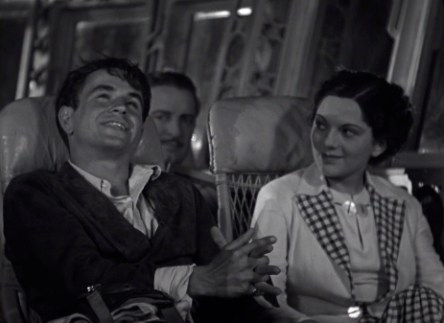
When last we saw “Tailspin” Tommy Tompkins, the youthful daredevil pilot from Littleville, he had a steady job at Three Points airfield and a steady girl in Betty Lou Barnes, and was even something of a celebrity, having acted in a movie. As the second Tailspin Tommy serial begins, Tommy and his partner “Skeeter” Milligan are still working out of Three Points, with Skeeter operating a camera as Tommy flies them over fleet maneuvers for the Navy. Once they finish up, they get their next job offer: Betty Lou’s uncle Ned Curtis hires the pair to make an aerial survey of a tropical island and blaze trails for the oil pipelines Curtis and his partner, Don Alvarado Casmetto, are laying. Tommy and Skeeter are to join Betty Lou, her uncle, and Don Casmetto’s niece Inez on a dirigible bound for the island of Nazil.

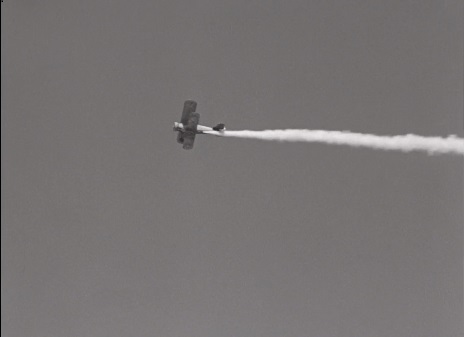
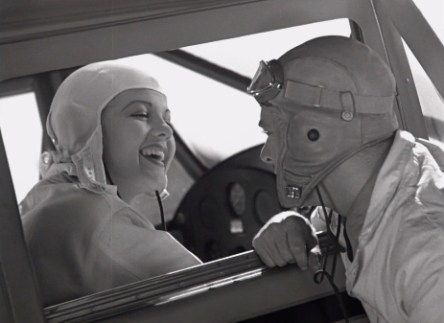
However, after a detour to Littleville, Tommy and Skeeter miss their flight; they decide to follow the dirigible’s path in their own plane with the intention of docking in mid-air. The captain refuses at first, but then a mysterious plane decorated like an eagle appears, and its pilot–also wearing an eagle-themed suit and helmet–sends a message instructing the dirigible to take the boys on board. The eagle plane lays down a smoke screen and vanishes as quickly as it had appeared. Soon the boys have docked and joined their party. But a storm blows up, and with the dirigible’s radio damaged, the only chance to send an S.O.S. is the radio in Tommy’s still-docked plane. He descends into the cockpit while the storm rages around him; suddenly the wind knocks the plane loose from its mooring with Tommy inside it; it plummets toward the ocean below while the dirigible collapses. Will Tommy’s adventure be over before it even begins? Audiences in 1935 would have to wait a whole week to find out in subsequent chapters of Tailspin Tommy in the Great Air Mystery!

During the 1930s, the promise of freedom and adventure in the skies fueled an entire subgenre of aviation-themed comic strips, books, and movies. Hal Forrest’s Tailspin Tommy, a footnote today, was one of the most popular, branching beyond the comics to radio, Big Little Books, and, of course, motion pictures. Like so many of the kids in his audience, Tommy Tompkins was a small-town boy obsessed with airplanes and flight, and his first serial relayed his journey from wannabe to hero pilot in compressed form, stringing together several episodes from his comic-strip adventures over an unusually long period of time.

Filmed just a year later, Tailspin Tommy in the Great Air Mystery is a much more typical serial, focused on a single plot: when Tommy and Skeeter and the rest finally arrive at the island of Nazil, they find that it is disputed territory. Don Casmetto’s half-brother, Manuel (Herbert Heywood), has a base on the opposite end of the island, and with the encouragement and financial backing of an unscrupulous oil speculator named Raymore (Mathew Betz) he is making war with the goal of taking over Casmetto’s lucrative oil fields. Manuel has airplanes and pilots of his own at his disposal, so the situation provides plenty of opportunities for scenes of aerial reconnaissance, chases, dogfights, crashes, and daring rescues (not to mention the kinds of fist fights and cave-ins that provide the thrills in all serial genres). Nazil is Hollywood-exotic, combining elements of the island/jungle genre (namely, an active volcano and aggressive natives on a neighboring island) with the kind of Spanish colonial color–haciendas, mariachis, and the elegant lifestyle of the dons–seen in the Zorro series. The story’s self-containment in an exotic locale is somewhat similar in that regard to the near-contemporary Ace Drummond, with a south-of-the-border setting in place of that serial’s Mongolia.

One of the chief elements of suspense is the eagle-themed plane and its pilot, nicknamed “El Condor” by Manuel’s men: who is he, and how does he achieve such amazing aerial maneuvers and disappear so quickly once he is no longer needed? From the very first chapter, El Condor appears to be on Tommy’s side (and, by extension, Don Casmetto’s); he is an example of a standard character type in the serials, the masked hero who is not the main protagonist, but who comes to the aid of the main characters and whose identity is eventually revealed to them. (The solution to this mystery is one that is in plain sight, but one could be forgiven for missing the significance of a few lines of dialogue by a secondary character in the first chapter.) Although the mysterious plane isn’t treated as a macguffin like in some serials, there is a nod toward the trope of high-tech equipment that mustn’t fall into the “wrong hands”: once Tommy has learned El Condor’s true identity and flown with him, experiencing one of the plane’s miraculous getaways for himself, El Condor says with understandable pride, “A great weapon for war, Tommy,” to which Tommy immediately replies, “A great weapon for peace, you mean.”

However, El Condor is not the only masked flyer in the serial, nor the only character who has secrets. One of Don Casmetto’s friends, Enrico Garcia (Paul Ellis), is quickly shown to be a traitor, feeding damaging information to Manuel and Raymore, as well as taking to the air himself as “Double X,” retaining his anonymity with an aviator cap and goggles marked by twin Xs, a literal “double cross.” Garcia is able to play both sides for quite a while, and is even able to convince Don Casmetto for a time that he is the mysterious “El Condor.”

Another character, Bill McGuire (Jim Burtis), first appears as a cook and gopher for Manuel, but he is actually a reporter and a friend of Tommy’s, working undercover as he gathers information for a big story. In several chapters he helps Tommy and Skeeter by setting them free from Manuel’s dungeon or giving them key information; he also, it turns out, knows the real identity of El Condor, making him critical to the serial’s climactic chapters. At the same time, he occasionally serves as a surrogate character for the audience, watching events unfold from the ground and exchanging a “gee, whiz” or a whistle of amazement with his pet parrot. (He provides a bit of comic relief, but he’s not a bumbler in the Smiley Burnette mold; he only appears to be one when serving Manuel to avert suspicion.)

Despite the short time between the two serials’ production, Great Air Mystery recasts most of the main characters, with Clark Williams taking the title role in place of the first serial’s Maurice Murphy; Jean Rogers, the future Dale Arden, now plays Betty Lou, replacing Patricia Farr. (Such recasting occasionally happens today, but it was even more common in the studio era when film production was more akin to an assembly line.) Fittingly, Noah Beery, Jr. returns to play Skeeter, the most distinctive character among them, but even here his shtick is changed: as a comic relief sidekick, Skeeter usually has a running gag: in the first Tailspin Tommy serial, he had a tendency to make a proclamation or observation and proclaim it an “unwritten law.” In the 1939 feature Sky Patrol, Skeeter was given to malapropisms, mangling or misusing polysyllabic words. In Great Air Mystery, however, Skeeter’s comedy isn’t that broad, mostly limited to attempts at card tricks (in one sequence he attempts to use one to distract Manuel’s men after being captured) and his nervous reaction to Inez Casmetto’s obvious come-ons (not an unusual trait for a comic sidekick at the time).

Of course, Betty Lou isn’t content to sit back and let the boys have all the adventure: recall that in the first serial, it was she who first had her pilot’s license and was Tommy’s introduction to the world of flying. In Great Air Mystery, despite Tommy and Skeeter’s efforts to keep her away from danger, she several times either stows away (hiding in a truly tiny-looking compartment in Tommy’s plane!) or flies off on her own, alone or with Inez (Delphine Drew). (Needless to say, this sometimes does put her in danger, but that just puts her on the same footing as everybody else in this serial.) Betty Lou’s attitude is summed up in Chapter Seven (“The Crash in the Clouds”) when she arrives at Don Casmetto’s oilfield in her own plane with Inez after being told to stay away. Skeeter tells her, “Hey, don’t you know this is men’s work?”, to which she replies, “Where’s the sign?” When Skeeter asks what sign, she spells it out for him: “Men. At. Work.” (No, it’s not exactly Preston Sturges.)

Tailspin Tommy in the Great Air Mystery isn’t bad: it features likable characters in a colorful environment and keeps the plot moving along. Of course, the main draw is the aerial action, which is for the most part exciting and not hard to follow, and there are several well-done action set pieces. (Apparently it was the practice to blaze trails by flying above the territory and dropping grenades on the jungle below, and you can bet all those explosives find other uses, blowing up warehouses, hangars, and airplanes on the ground alike!) On the other hand, Great Air Mystery doesn’t have the small-town charm of the first serial, so nothing about it stands out from the other aviation-themed serials that were being churned out in the mid-’30s. Needless to say, however, there is the possibility that I am simply becoming jaded and harder to surprise as I watch more of these films. As always, YMMV.

What I Watched: Tailspin Tommy in the Great Air Mystery (Universal, 1935)

Where I Watched It: This serial ran on Turner Classic Movies on Saturday mornings last summer, and I recorded it on my DVR. I had originally promised to write this up last fall, but it didn’t quite work out that way (I remember why I usually write these articles in the summer!). As it happens, since TCM didn’t make it easy to record the whole thing as a series (a pet peeve of mine!), I missed recording about an episode and a half. The only place I found to watch the missing parts online was at Night Flight Plus behind a paywall (and knowing how these deals work, I assume that TCM and Night Flight licensed the same restoration, and this new financial investment is the reason the serial has been scrubbed from YouTube). It’s also available on DVD and Blu-ray.

No. of Chapters: 12

Best Chapter Title: “Crossed and Double Crossed” (Chapter Nine) I like this one because, in addition to its nice use of repetition, it accurately describes the main action of the chapter, in which El Condor is captured and impersonated and then reclaims his identity. It also involves a pun, as this chapter is the climax of Garcia’s arc as the masked “Double X” flyer.

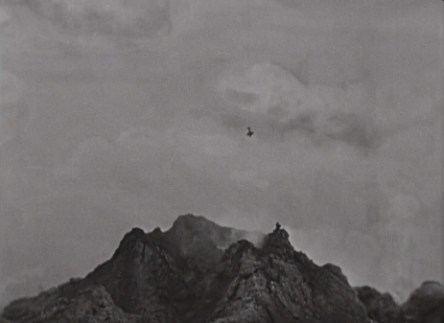
Best Cliffhanger: Unsurprisingly, there are several cliffhangers in this serial involving plane crashes, or planes exploding or colliding in mid-air. There are also no fewer than three cliffhangers in which a building is blown up while one or more of our heroes are inside (or are they?). I particularly like the ending of Chapter Two (“The Roaring Fire God”) in which, after another skirmish with one of Manuel’s planes and a timely rescue by El Condor, Tommy loses control of his plane, goes into a dive, and appears to fly straight into the smoking crater of a live volcano.

I would also be remiss if I didn’t mention the peril at the end of Chapter Six (“Flying Death”): Tommy and Skeeter have stolen one of Manuel’s planes, a bomber specially brought in by Raymore to attack Casmetto’s oil fields, but little do they know that onboard the plane is a time bomb, set specifically to prevent such a theft. Such a cliffhanger, complete with a countdown to the deadly explosion, wouldn’t be too unusual, but for the large “TIME BOMB” label on the control panel that neither seems to notice. (The solution to this cliffhanger is singled out by Jim Harmon and Donald F. Glut in The Great Movie Serials, a book I have frequently referred to in this series, as an example “typical of the hokum of the medium.”)

Sample Dialogue: “What a twist! Is that a story or is that a story!”

–Bill McGuire, after Raymore experiences a particularly ironic comeuppance (Chapter Twelve, “The Last Stand”)

What Others Have Said: “After Universal released Tailspin Tommy back in 1934 [notably the first serial based on a newspaper comic strip], they couldn’t wait to get its sequel into release. Exactly 12 months later, they released Tailspin Tommy in the Great Air Mystery, and then in succession at least one comic strip every six to ten months for the next seven years, up to Don Winslow of the Coast Guard in December 1942.” –William C. Cline, “Coming Back Like a Song” in Serials-ly Speaking

What’s Next: This is just a one-off entry for the spring, but I intend to return to my regular schedule of serial coverage this summer; I usually begin on Memorial Day and publish an entry every one or two weeks. Earlier this year I bought a big box of serials on VHS; I’m not nostalgic at all for videotape, but the price was right, and it will keep me in serials for months to come. I hope you’ll join me then!

Daredevil vs. the Ninjas

An hour ago, she was a prisoner. Bound to a man, to his city, shackled by a love she had tried to kill. Now, she is free. She is beyond her pain, her need, beyond her self. Yet, even as she swims deeply in meditation, a part of her remains alert. She feels a breeze where none should be . . . hears a curtain rustle lightly, briefly. In an instant, she is ready. For she is Elektra–mercenary, bounty hunter, assassin. Mistress of the deadly art of Ninjutsu. She is Elektra–and she is no man’s fool. –“Gantlet,” Daredevil no. 175, October 1981

In the early 1980s, one of the hottest young comic artists on the scene was Frank Miller, who beginning with issue no. 158 had taken over Marvel’s Daredevil. Blind lawyer Matt Murdock by day, radar-enhanced superhero by night, Daredevil is a prime example of the ability of a strong artistic team and bold direction to lift B-list characters to popularity and make them relevant. With Miller both writing and penciling, and inking duties given to Klaus Janson (with whom Miller would have a long professional relationship), Daredevil went from an also-ran to a must-read, a moody, complex urban gothic melodrama, the lead character closer to Batman than to Spider-Man (to whom he had usually been compared).

Most Marvel comics were centered in New York City, and for Daredevil’s rough Hell’s Kitchen neighborhood Miller provided a gritty, ground-level texture, drawing from his own experience as a newcomer to the city in the Taxi Driver era (compare these depictions of New York to the descriptions in Eric Van Lustbader’s contemporaneous novel The Ninja), full of local color and making the city backdrop an essential part of the atmosphere. Miller shifted the viewpoint between different characters, framed the action in visually striking ways, and tightened the screws on Murdock/Daredevil to make his choices more dramatic and compelling. Ultimately he would put his own stamp on all future depictions of the character. In doing so he showed the influence of Will Eisner and Neal Adams, among others, but he was also vocal in interviews about his enthusiasm for the classic manga Lone Wolf and Cub by Kazuo Koike and Goseki Kojima, at a time when Japanese comics were barely present in the American market. His interest in Japanese culture also found its way into the pages of Daredevil, which became one of the key avenues for the influx of ninjas into American comics.

In issue no. 168, dated January 1981, Miller introduced one of his most enduring creations: Elektra Natchios, once the great love of Murdock’s life (revealed in an extensive flashback to the pair’s college years) but who, after the death of her Greek diplomat father, had become first a ninja and then a freelance bounty hunter. They cross paths while both searching for the same criminal: Daredevil to save an innocent man on trial, Elektra to collect a bounty on the criminal’s head. The delicate dance that ensues over the next year’s worth of issues, with Elektra unable to kill Daredevil and Daredevil unable to save Elektra from her choices, plays on the conflict between the heart and one’s duty and the inescapability of the past. (True to comic book practice, Elektra would die and be resurrected several times over the years.) Elektra was immediately popular; in addition to the action and Elektra’s undeniable sex appeal, the soap opera elements (never far away in Marvel comics) and the strong depiction of Elektra’s side of the story drew in female readers as well. Readers loved Elektra. (It’s also worth noting that while Miller was one of the main creators responsible for the increasingly dark tone of comics in the 1980s, these stories don’t feel gratuitously bleak or shocking like so many later “grim and gritty” comics, including many by Miller himself. Perhaps it was the influence of the still-active Comics Code, or that Miller’s mindset hadn’t turned quite so dark yet himself, but these issues still feel fresh and vibrant, with the joy of a maturing artist discovering new possibilities in his medium.)

The Elektra arc makes for an interesting study of the ways ninja lore and traditional martial arts storylines could be blended with larger-than-life superhero concepts. Indeed, in its more fantastical form the ninja movie is already a kind of superhero tale, with ninjas and martial arts masters engaging in superhuman acrobatics and demonstrating seemingly magical powers. Daredevil’s super-sensitive hearing is well-established, able to detect people hiding just by listening for their heartbeat; the ninja, able to slow his heartbeat and go for long stretches without breathing, remaining perfectly still, makes for a formidable challenge. And Miller clearly enjoys choreographing fight scenes that pit Daredevil’s acrobatic fighting style against the ninjas’, using his billy club much as the ninjas use bo, bokken, or nunchaku. It’s a good fit.

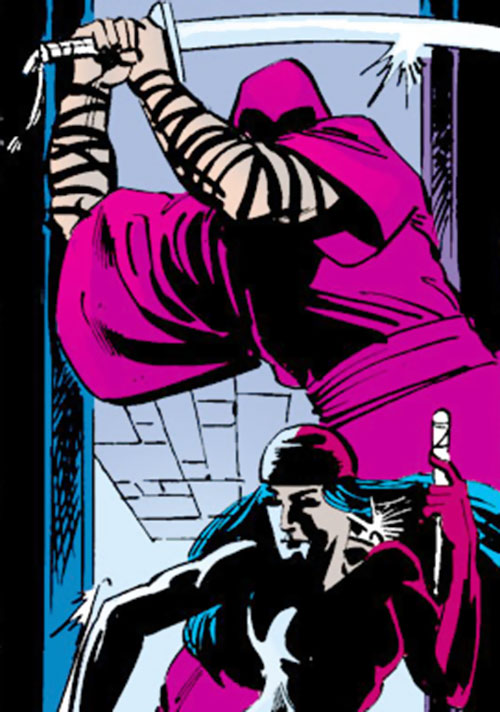
As I mentioned in discussion of Enter the Ninja, ninja movies rely on visual cues such as different-colored uniforms to distinguish combatants; in real life, the ninja’s need for stealth would rule out bright and flashy colors (and forget about Elektra’s long, flowing hair), but in fantasy the ninja gi is a “second skin,” just like a superhero’s costume, relaying something about the ninja’s character and narrative function. Ordinary rank-and-file ninjas (genin, or “agents”) mostly get plain black uniforms with little to distinguish them as individuals; important characters get different colors, or more elaborate armor, or at least an insignia. This is true in the comics as well as in the movies: Elektra, the former ninja, wears a red leotard and head scarf (when she’s not in disguise, that is). It is essentially her hero costume, putting her on the same narrative level as Daredevil, the villain Bullseye, or the other superpowered main characters. In addition to being visually distinctive, her red scarf connects to an early form of Matt Murdock’s Daredevil mask he wears in the flashback (and of course both their costumes are red); whether they like it or not, they are connected, their destinies intertwined. Finally, Elektra has a signature weapon, a pair of sai (swords with forked blades), although like all ninjas she is skilled with many different weapons.

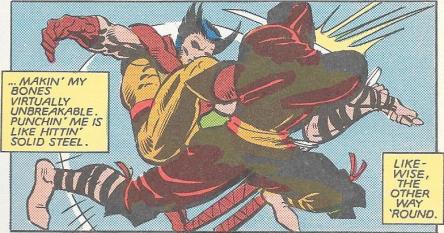
By contrast, most of the members of the “Hand,” the ninja clan with which Elektra trained but which now hunts her as a traitor, are nondescript, standard-issue ninjas. There are several comic book touches in their depiction, however, the most startling of which is their tendency to dissolve into mist when killed, highlighting their uncanny nature. The ninjas’ habit of speaking as one, finishing each others’ sentences like Huey, Dewey, and Louie, also highlights the uniformity and groupthink the Hand requires of its members. Only one agent of the Hand gets the distinctive costume treatment: Kirigi, a ninja among ninjas and the boss whom Elektra must defeat, and whose superhuman strength and endurance is visually signaled by his large size and hooded purple gi. As with the lesser members of the Hand, the question of Kirigi’s humanity is left open, with suggestions that he is immortal, or perhaps a demon. Frank Miller would delve much deeper into the mystical dimensions of ninjutsu in later stories, but in this early stretch the Hand make for a colorful and slightly spooky set of antagonists. (The Wolverine limited series, a collaboration between Miller and Uncanny X-Men writer Chris Claremont, would also feature the Hand as a worldly rather than mystical force: in taking the clawed mutant Wolverine to Japan and suggesting that he had connections with the samurai in his past, Miller and Claremont made an essential contribution to the character’s depiction. In that particular story the Japanese ethos of bushido is a fresh lens through which Wolverine’s animalistic nature and personal code of honor could be examined.)

Epilogue: Just as Kurt Cobain said that he knew he had made it when “Weird Al” Yankovic parodied one of his songs, so the popularity of Frank Miller’s approach can be confirmed by an unlikely spoof that has turned out to be as enduring as Elektra. In 1984, Kevin Eastman and Peter Laird produced a self-published 40-page black and white comic book. They dedicated it to their heroes, Jack Kirby and Frank Miller, and riffed affectionately on Miller’s style and themes. Miller’s ninjas were part of the “hand,” so Eastman’s and Laird’s ninja villains were the “Foot clan.” Their four heroes narrated their adventures in grim, self-serious monologues, playing an outlandishly cartoony premise completely straight; one of them even wielded Elektra’s weapons of choice, a pair of sai. Eastman and Laird hoped that their modest effort might sell a few copies and entertain their friends. Little did they know that their creation would become a smash hit in the indie comics world, inspiring their own knock-offs, and would even be adapted into multiple television cartoon series and feature films. The franchise they gave birth to is still known by the same title they gave their initial 40-page book: Teenage Mutant Ninja Turtles.

And, as Paul Harvey says, now you know the rest of the story. This concludes Ninjanuary and my biweekly exploration of the shadowy world of the ninja (as reflected in pop culture, at least). Thanks for reading and following along, and if you haven’t read my previous installments you can click on the “Ninjanuary” tag in the column next to this article to see all of them. I’ve got a few things planned for the spring, so check back here or follow me on Twitter for updates, but farewell for now, or should I say, Sayonara?

Challenge of the Lady Ninja

In Electric Boogaloo: The Wild, Untold Story of Cannon Films, after acknowledging that Ninja III: The Domination is “a very strange film,” director Sam Firstenberg attributes the movie’s box office failure to audiences who just weren’t ready for the idea of a female ninja. Perhaps American audiences weren’t, but I think there’s more to it than that. It’s true that many action and fantasy films of the 1980s, including some that are now classics, make some pretty wild leaps of logic to smush together their various genre elements into original shapes, but few filmmakers outside of the Golan-Globus orbit would have thought at the time to rip off both Flashdance and The Exorcist by way of a martial arts movie. In The Domination, Lucinda Dickey plays a telephone line worker who moonlights as an aerobics instructor; when she is possessed by the spirit of a dying ninja, she starts to display the evil ninja’s powers and personality until it can be vanquished by the arrival of a good ninja (played by ever-reliable Sho Kosugi). I suspect the absurdity of the plot turned off more viewers than a straightforward martial arts movie starring a woman would have. (Incidentally, the only reason I haven’t covered The Domination separately is that while I’ve seen it, I don’t have a copy at hand to review so I hesitate to go into more detail from memory.)

More to the point, the kunoichi, or “lady ninja,” was already well-established in a subgenre of Japanese ninja movies (and at least one female ninja had made a big splash with American readers in the pages of Daredevil in 1981 and ’82: I hope to discuss Elektra and other ninjas in the comics before the month is over). Many, if not most, of these movies were every bit as exploitative as The Domination, not just gender-swapping the protagonist but playing up the sexiness of the heroine and putting her in provocative settings, such as infiltrating a brothel, facing the possibility of rape, catfighting with other women, or displaying distinctly feminine versions of typical ninja abilities, to name a few examples. Even the best examples of the genre are at least a little bit sleazy.

Historically, kunoichi were women trained in the arts of ninjutsu with an emphasis on disguise, infiltration, and seduction: servants, artists, musicians, and prostitutes had access to the inner circles of power that were off limits to other outsiders. Furthermore, closeness to their targets put them in a position to quietly gather information, influence decisions, or even kill. Ironically, women’s subservience and unimportance in the male-dominated samurai society made them effectively invisible. In discussing sex as one of the “five needs” (which could be turned against the ninja’s intended victim), Stephen K. Hayes in The Ninja and Their Secret Fighting Art writes “In another reliable ploy, the desires of an individual can be catered to by supplying sexual excitement. . . . In the midst of lusty physical gratification, an enemy’s guard is lowered and he becomes much more vulnerable to physical attack or verbal probing.” It’s not hard to see how the kunoichi could add sex appeal to an already-popular genre whether treated in a historical or fantastical manner. (This is not to say that stories of male ninjas were necessarily free of sex or exploitative elements–merely that it seems to be more of a driving element in the “lady ninja” films.)

I’ve watched a few “lady ninja” movies, but I don’t think I’ve watched enough to try to offer an overview of the genre in more than these broad strokes. For one thing, the plethora of overlapping titles is a thicket deeper than I care to venture into at the moment: they generally all have “kunoichi” or “lady ninja” in their titles, but beyond a few examples most are not part of related series; even some that are part of a series, such as Memoirs of a Lady Ninja, are actually free-standing entries beyond the thematic connection, much like Cannon’s Ninja trilogy. Finally, some of the more popular lady ninja films have been remade, just like popular Western stories. In order to avoid muddying the waters any more than I already have, I’ll describe one I’ve watched recently and let it stand as an example.

The Challenge of the Lady Ninja (aka Chinese Super Ninjas 2; the Internet Movie Database also lists it as Never Kiss a Ninja, which seems like good advice) is on the more ridiculous side of the genre. It’s a low-budget effort with the ninjas demonstrating magical powers that the special effects can’t quite pull off. The fight scenes, using wuxia-style wirework and trampoline-aided leaps, make up in imaginative staging what they lack in believability, and they do go in some weird directions. Most bizarre of all, Challenge is a period piece, taking place during the WWII-era Japanese occupation of Shanghai, that makes no effort to disguise contemporary fashions, settings, and automobiles. It’s as if it takes place in an alternate reality, which it might as well.

Like many ninja stories, Challenge begins with a test: Wu Shiau (Hui-Sang Yang) faces off against her school, and ultimately her classmate Kuroda (Kang Peng), to obtain the ninja medallion that will prove her abilities. After some challenges and demonstrations of her skills (including a seductive illusion that reduces four of her opponents to slobbering wolves making cartoon “hubba hubba” noises), she gets past Kuroda by using “moving shadow,” a technique that makes her appear to split into two or three duplicates, disappearing and reappearing at will like images in a hall of mirrors. Even once he is defeated, Kuroda challenges the master of the ninjas, upset that a Chinese (!) woman (!!) should advance to the rank of ninja while Japan is at war with China (!!!). The real root of Kuroda’s disgruntlement, however, is that the master would teach Wu Shiau moving shadow and not him: his lust for power is too great to be trusted. The student/sibling rivalry that is at the root of so many ninja conflicts is well-represented here.

After passing the test, Wu Shiau learns that her father has died back in China. Upon arriving in Shanghai to pay her respects, she learns that the man responsible was Li Tung, the man she was betrothed to as a young girl, but who has turned traitor, helping the Japanese occupiers by working against the Chinese revolutionaries and steering gold and other resources to Japan. (Li Tung is so evil that when he first appears on screen he is accompanied by John Williams’ “Imperial March.”) Wu Shiau vows to avenge her father, infiltrating his compound that night; she finds him well-guarded, and is forced to retreat when she comes face to face with Li Tung’s four bodyguards (each is a specific type and has a particular fighting style). She is aided in her escape by a mysterious skull-masked figure who later returns to provide useful information to her.

Narrowly escaping with her life, Wu Shiau decides that what she needs is a team, so with the help of her fellow revolutionaries she goes about recruiting three more women: an expert swordswoman who was forced to close her school by the Japanese; another woman willing to give her life to fight the occupiers; and a prostitute who overhears one of the men looking for enemies of Li Tung who figures it’s a good opportunity to fight back. Through a series of training montages (it’s the ’80s, after all), Wu Shiau gets her squad in shape, teaching them the ways of ninjutsu, bolstered by the particular skills they already had (they are remarkably quick studies). It’s this part of the movie that is the most “male gazey,” with numerous shots of the girls working out in skimpy attire and even practicing their seduction skills on a hapless dupe. (Corny comic relief also comes with the territory in martial arts movies, and most of it is in this section.)

Their first attack on Li Tung and his bodyguards (with the girls hidden inside plaster lions in front of a temple!) is another flop, and the lady ninjas barely escape (again!) with their lives. They’ll have to think strategically: they study each of Li Tung’s bodyguards to strike at their weaknesses and take them down individually. Noteworthy fights include Wu Shiau taking on a female tae kwan do expert in an oil-filled ring (again, the ’80s) and another against a tribesman who fights with a razor-edged boomerang and spiderweb-like net. (And yes, one of the bodyguards is killed in a brothel as one of the ninjas takes the regular girl’s place.) It’s all pretty bonkers, and not everything is as it seems, but they save Li Tung’s most dangerous henchman, a Japanese swordsman named Yamamoto with ritual tattoos on his forehead and eyebrows, for last.

Afterword: When discussing Ninja Assassin last week, I mentioned the frequency with which CGI-enhanced fight scenes were compared to video games. There’s no mistaking anything in this circa 1983 production for a computer more sophisticated than a video effects processor, but in its own way it does remind me of the games of the time. There’s the procession from one boss to the next, leading up to the final confrontation, of course; and as mentioned, the effects that send fighters leaping through the air are sometimes primitive, but the result is quaintly analog. Beyond that, the number and frequency of odd weapons flying around that Wu Shiau has to avoid while fighting (like the aforementioned boomerang; there’s also an odd moment when she later faces off against her old classmate Koroda and he sends chains hovering through the air at her) are visually reminiscent of the busy, moving obstacle-filled screens in games like Ninja Gaiden or Castlevania. In some cases the sheer abstraction of the visuals takes me back to the Atari 2600 or NES: is that black square a platform or a hole? Is that moving bar of color a searchlight or a deadly laser beam? I picked up this ninja medallion at the beginning of the game–if I attach it to someone, will they explode? Is that how I win? Only one way to find out!

Ninja Assassin

As Ninja Assassin (directed by James McTeigue) begins, a swaggering yakuza boss receives a sealed letter containing nothing but black sand. An old tattoo artist recognizes this as the warning of approaching death by ninja; the yakuza and his cronies all laugh, of course, until they are graphically cut down by an assailant whose approach they can neither see nor hear. Thus we are introduced to the fantastic, violent world of the ninja. Back in his apartment, the mysterious Raizo (Korean pop star Rain) prepares for his next mission, broodingly recalling in flashback his childhood training with the Ozunu ninja clan. Sho Kosugi, star of the Cannon Ninja trilogy, has played good ninjas and bad ninjas in his long career, and here he plays one who is downright evil: as leader of the Ozunu, he oversees the kidnapping of orphans to fill the next generation of ninjas, and he controls their existence like a cult leader, bonding them into a family with himself as surrogate father. Weakness is not tolerated, and all of the Ozunu trainees bear the scars of punishment. As we learn more about Raizo and the forbidden love for a fellow student that drove him to break with the Ozunu clan, we realize that he is actually the hero of the story.

Parallel with these developments, Mika (Naomie Harris), a forensic researcher for Interpol–sorry, “Europol”–has put together clues suggesting that the yakuza boss was just the latest victim of a shadowy conspiracy, that the legendary ninja are still around and can still be hired for the price of one hundred pounds of gold (or its market equivalent), just as they were centuries ago. Since the victims of the ninja are not only crimelords but CEOs and government officials, she finds herself in deep waters when she convinces her boss (Ben Miles) to pay attention. A former KGB operative, whose work she is building on, found himself expelled from his agency and then eliminated by the ninjas when he got too close to the truth. This goes all the way to the top! Inevitably, Mika and Raizo cross paths when she herself is targeted by the ninjas because of her discovery.

Ninja Assassin has some big names behind it (it was produced by Joel Silver and the Wachowski siblings, and co-written by Babylon 5 creator and comic book writer J. Michael Straczynski), but I don’t remember hearing about it when it came out in 2009. Perhaps I was just busy, or not as focused on action movies, or maybe it got lost in the shuffle. In any case, there’s no mistaking it for a 1980s throwback like its contemporary Ninja: it’s every bit a product of the early twenty-first century. In addition to its kinetic, computer-aided “bullet time” approach to action (and as much spilled CGI blood as the entire Blade trilogy), the plot reveals the same affinity for government conspiracies and hidden history that have been with us since the 1990s, filtering the mystique of the ninja through the lens of John Grisham, Dan Brown, and the Mission: Impossible movies. I don’t think Mika’s side of the narrative is very compelling, but it is satisfying when she finally brings down the force of Europol on the Ozunu mountain stronghold for the final battle.

Ninja Assassin is quite gory, full of dismemberments and fountains of blood spewing from slashing wounds, comparable to the martial arts horror of Riki-Oh or other Hong Kong or “extreme Asia” imports. (A plot point concerns the ninja’s ability to heal himself through the power of the mind, so there are also close-ups of grisly wounds that would be fatal to mere mortals.) The visceral impact of all this bloodshed is tempered by being mostly CGI, however; the fight scenes, too, are marked by quick cutting and CGI compositing. As Raizo, Rain (who also appeared in the Wachowskis’ Speed Racer) looks the part, but based on this I really couldn’t tell you how much skill he actually has in hand-to-hand combat or with the whirling chain hook that is Raizo’s specialty. It’s easy to dismiss this as video game stuff, a frequently-heard criticism of action movies in the 2000s, but the comparison goes beyond the action itself to the hordes of faceless enemies Raizo mows down, the ease with which even armored soldiers are sliced in half, and the relative invulnerability of the important characters. During a scene when Ozunu digs his fingers into Raizo’s abdomen, I thought maybe he was going to rip his heart out like in Mortal Kombat. It doesn’t go quite that far–it’s a mystical manipulation of the enemy’s chi, causing intense pain, rather than something so graphic–but it’s still pretty gnarly.

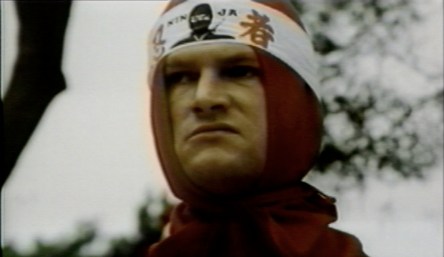
On the other hand, while it sounds like I’m being critical, the heavy reliance on special effects brings to life the ninja’s ability to blend into shadows and move in seemingly impossible ways: an early fight scene in a dark room, illuminated only by Mika’s shaky flashlight beam, makes it appear as if the ninjas are appearing from nowhere, melting back into the shadows as the beam spotlights them. In other scenes, ninjas appear to crawl on walls like insects, their movements reduced to a blur seen out of the corner of the eye, and with the layering of whispered voices on the soundtrack, one gets the sense of how these stealthy assassins could terrorize their victims before striking. Finally, while it is true that all martial arts movies are choreographed and shot to make the action dramatic and theatrical to some degree, the subject of the ninja, with its superhuman, even supernatural, powers, lends itself to movie magic more than most. Once Raizo confronts Ozunu, we are treated to a more sophisticated version of the magical sleight-of-hand I observed in Ninja Destroyer: the two master ninjas disappear at will, reappearing behind their opponent, even casting false shadows as misdirection, before dueling to a very bloody death. Is this “the greatest ninja movie of all time,” as the DVD cover promises? Not really–one could argue it’s not even the greatest ninja movie of 2009–but it is certainly among the most gruesome.

Scott Adkins’ Ninja Duology

So far in Ninjanuary, I’ve focused on the ninja’s 1980s heyday, but as I mentioned in my introduction, the ninja as a conventional figure has never really gone away once its popularity was established. The more recent Ninja (2009) and its sequel, Shadow of a Tear (2013), both directed by Isaac Florentine and starring Scott Adkins, were recommended to me as worthy modern additions to the ninja canon, and they make for interesting examples.

Ninja begins with an introduction to the concept of the ninja for any newcomers, at the same time economically foreshadowing a major plot point. In a flashback to medieval Japan, a ninja is shown taunting a dying samurai with the only antidote to the ninja’s poison, the knowledge of which gave the ninja ultimate power over life and death. But, the narration continues, the ninja’s sword could bring life as well as death. What is the meaning of this enigma? Stay tuned!

The story proper begins at Koga dojo in modern times, where two top students prepare to spar: Casey (Adkins), an American orphan who has spent his entire adult life at the dojo, and Masazuka (Tsuyoshi Ihara), a hot-headed Japanese student who needles Casey for being a gaijin with no family. When the ostensibly friendly fight with bokken (wooden practice swords) goes against Masazuka, his rage boils over and he grabs a real blade, attacking Casey with obvious intent to kill. Casey only manages to save himself by keeping a cool head, and in fighting back he inflicts a small cut beneath Masazuka’s eye. Horrified by this breach of honor and Masazuka’s inability to control his anger, Takeda (Togo Igawa), the Sensei of the dojo, expels Masazuka from the school. “You must find your own path,” he tells him.

“Some time later,” Takeda is about to pass leadership of the dojo to Casey, his best disciple, symbolized by the passing of the Yoroi Bitsu, a wooden chest containing the Koga ninja’s secrets as well as weapons and gear. The ceremony is interrupted by the appearance of Masazuka, now a professional assassin, who resembles a swaggering rock star and is recognizable by the scar beneath his eye. “I have found my own path,” he announces, and demands to take possession of the Yoroi Bitsu. Of course, Takeda refuses, and Masazuka vows to return. Takeda sends the Yoroi Bitsu to America for safekeeping, accompanied by Casey, Takeda’s daughter Namiko (Mika Hijii), and a couple of other students without much established personality. It goes without saying that Masazuka isn’t far behind.

Yes, she took a guy’s crutches.

Ninja and its sequel share many of the stylistic tics of other twenty-first century action movies, most notably CGI blood spatter and the “speed ramping” made popular by Zack Snyder’s 300. Masazuka’s ninja style is also distinctly contemporary, even paramilitary, combining age-old ninjutsu strategies with modern body armor, high-tech grenades, and night vision goggles. With his appearance (and his fondness for sleek, chrome furnishings), he would be at home in a contemporary superhero movie, where Kevlar has replaced spandex as the uniform of choice. In other ways, however, Ninja is in many ways a throwback to the action movies of the ’80s, with inventive, well-shot fights and a premise that is instantly familiar, and it manages to do so in under 90 minutes. (The presence of Boaz Davidson, an action filmmaker involved with many of the Golan-Globus productions of the ’80s, as writer-producer may have something to do with this.)

Then there’s “the Ring,” the cult-like order hiding behind the corporate façade of Temple Industries, which also feels very much like something from an ’80s movie (Masazuka had been shown earlier in the movie assassinating a Russian oligarch whose business stood in Temple’s way). Of course Masazuka manages to track Casey and Namiko down in New York with the help of his corporate contacts. Soon the pair find themselves on the run from gun-toting mercenaries and brawling thugs. Highlights include an intense fight on a subway train (in which Namiko shows herself just as capable as Casey), but eventually the pair are caught by the police, blamed for the killing of their American hosts. Handling the case is Detective Traxler (Todd Jensen), another figure familiar from ’80s cinema, the hardened cop who dismisses Casey’s story as a “fairy tale” until Masazuka single-handedly invades the police station where Casey and Namiko are being held. After a few complications, Casey recovers the Yoroi Bitsu (which had been safely hidden) and dons the mantle of Koga ninja himself for (say it with me) the final confrontation.

Ninja‘s 2013 sequel, Shadow of a Tear, boasts a new writer, David White, and a shift in tone that reminds me of long-running comic book heroes becoming “darker” and “grittier” in response to changing audience expectations. It begins with Casey, now head of the Koga dojo and married to Namiko; they are expecting their first child. Everything is going great; Casey presents Namiko with a necklace bearing the kanji symbol for “happiness” (do you see where this is going?).

Casey has enemies, at first a pair of seemingly random street thugs who attempt to mug him, but it doesn’t stop there. Yes, Namiko ends up getting “fridged” by an unknown assailant (Boooooo!), the kind of hoary, heavy-handed narrative device that I had hoped we were beyond by this decade. Namiko (still played by Mika Hijii) is seen frequently in flashback, a reminder of what Casey has lost, but it feels manipulative, as if we’ve forgotten the hero’s motives, and it made me more annoyed with the filmmakers than with the killers, which I don’t think is what they had in mind. Casey, whose whole thing in the first movie was that he didn’t get angry (fudoshin, the “immovable mind”), is transformed into a creature of rage, unable to control himself as he seeks out the muggers whom he assumes are the killers. (There is a minor plot point that turns up frequently in martial arts movies, and which has some basis in reality: Casey tracks down the muggers by recognizing an unusual move one of them made in their fight, a “triple kick,” and finding out which dojo specializes in that move.)

An old friend, Kakabura (Kane Kosugi, whom we last saw as a child in Revenge of the Ninja, and now a grown-up martial artist and actor in his own right), invites Casey to his dojo in Thailand to work through his grief and get himself under control. While there, Casey gets into a few more dustups, beating up local toughs, but it isn’t until one of Kakabura’s students is killed, his body showing the same marks Namiko’s killers left, that he suspects he is being targeted. Kakabura reluctantly reveals the true story behind the Koga ninjas, involving a squad of Japanese “ghost soldiers” sent to invade Burma (now Myanmar) during World War II, and the three survivors: Casey’s old sensei Takeda was one of them; Kakabura’s father, who stayed in Thailand, another; and the third, who continued into the Burmese jungle and became a drug lord: Goro. It is Goro who is trying to eliminate his rivals, and with the help of an old map, Casey sets out to destroy him. (Before Casey gets to him, we see the ruthlessness with which Goro (Shun Sugata) treats his own men, interrogating an underling about a two-year-old shipment that was light: “That was a long time ago!” the man pleads, to which Goro responds, “I have a long memory,” before strangling him.)

The Burmese setting is colorful, both in the city and in the jungle, and there is more excellent action, some of it in the Jason Bourne vein, with quick editing and with Casey outnumbered and fighting his way out of police stations and back alleys, leaving a trail of bodies behind him. This is Casey to the extreme, pulling no punches, the ninja as Rambo. The squalid third-world atmosphere, drug business, improvised weapons, and numerous double-crosses are a world away from the first movie, which is almost cartoony in comparison (both are rated R for violence, but the second is much more visceral). I won’t say I didn’t enjoy it, because it is compulsively watchable, but viewing the two films back to back makes for a jarring comparison. Purely as an action movie, Shadow of a Tear is pretty great, actually, but I might have enjoyed it more as a standalone, like the unconnected Cannon Ninja films, rather than as a sequel.

Ninja Busters

Ninja Busters is the story of two buddies, Bernie (kata champion Eric Lee) and Chic (martial arts instructor Sid Campbell, who wrote the screenplay), who start out as a pair of chumps in the Dumb and Dumber vein. A running gag early in the film has Bernie pretending to be Bruce Lee’s student and Chic pretending to be Bruce Lee’s teacher, but despite their bravado they get their asses handed to them several times. Eventually, they decide to enroll in a martial arts class–not to toughen up, but to meet girls. (This goes about as well as could be expected until they get serious about their training.) One of their fellow classmates, Sonny (Frank Navarro), had previously beaten them up, but the school’s sensei (Gerald Okamura) insists that the rivals earn their black belts before having a rematch.

So far, no ninjas. Other than a short scene at the beginning, the first forty-five minutes or so are down to earth, a gentle slapstick spoof of the martial artist’s journey. The ninjas enter the picture as the hired army of a local crimelord, Santos (Juan Morales); Bernie and Chic had worked at one of Santos’ warehouses and learned about the boss’ reputation as a smuggler (the goods are in special crates marked with a dragon). It’s not until Bernie and Chic spot their old boss making a drug deal and decide to follow him that they wind up targeted by Santos’ ninjas, who invade the martial arts school and follow our heroes to a nightclub and finally Santos’ warehouse for the final confrontation.

Ninja Busters is a comedy, and much of the humor is corny or silly, but it moves briskly and is continually entertaining; moreover, the spine of the story is one of rivals becoming friends and losers finding that they can become winners through hard work. It’s a formula for feel-good cinema. The cast, stacked with real martial artists, also makes up in realistic action what it sometimes lacks in polished line delivery. The ninjas are actually a little underwhelming: their stealth is exaggerated for dramatic effect (when Santos asks if he can see the ninjas, their dragon lady boss replies, “Why not? They’re looking at you”), but in action they’re easily handled by our heroes from the dojo. These are ninjas as faceless, mostly interchangeable enemies.

One reason Ninja Busters is so much fun to watch is its vibrantly multicultural setting: filmed in San Francisco and Oakland, it features a cast more ethnically diverse than many films made today (some of those characters are stereotypes, but, eh, it’s a comedy). In some ways it’s a comic take on the racial division that separates people (like the Black Panther-like “Liberation Army”), but at least within the dojo differences in color are set aside in favor of the immortal truths of karate. The big climax, which brings together the ninjas, the karate school, Santos’ gang, and even Sonny’s old biker gang crew, is a fun riff on gang war standards like The Warriors. Ninja Busters’ reliance on local settings and music give it a jolt of urban energy, from break dancers in the street to the band in a Latin night club. The original score by Frank Navarro, who played Sonny, is full of pulsing electro-funk bangers and John Carpenter-like synth riffs; the tracks accompanying the various montages are so good I wouldn’t mind owning the soundtrack just to listen to by itself.

It’s probably unavoidable that Ninja Busters will be compared to Miami Connection, another heartfelt action-comedy about friends united to kick ninja butt, and there are similarities, but Ninja Busters is mostly PG in spirit, without the spurting blood squibs and “stupid cocaine” of Miami Connection (there are references to Santos smuggling “dope,” but that’s about it, and while a few people die, it isn’t too graphic). It’s also clearly the work of professionals, even if made short on time and money. Director Paul Kyriazi, who also made Death Machines (to which it has some resemblance), notes in his commentary on the Garagehouse Blu-ray that most of Ninja Busters was filmed in one take; many of the cast are not polished actors, so some slips make it into the movie, but from a technical standpoint it’s the equivalent of a professional executing a tricky maneuver without a net. Viewers will be surprised that such a finished film (with a few flaws, sure, but hardly more than many low-budget films display) was allowed to simply disappear without a trace, but I suppose it happens more often than we would like to think.

Filmed over three years between 1981 and ’84 but never released (after completion, the film’s distributor went belly up and disappeared with all known prints–shades of Shirkers), Ninja Busters became available when Harry Guerro of Garagehouse Pictures rediscovered a complete print and had it restored a few years ago. It’s another case of what might have been: with its mixture of humor and action and its likeably goofy characters, I can imagine a movie like this having a big cult following today if it had been released back in the ’80s.

Eric Van Lustbader’s The Ninja

There had been a man. Miyamoto Musashi. Perhaps Japan’s greatest warrior. Among other things, he founded the Niten or Two Heavens school–or ryu–of kenjutsu. It taught the art of wielding two swords at once. Another aspect of musashi, known as Kensei, the Sword Saint, was that he used bokken–wooden swords–in actual combat–claiming that he did so because they were invincible.The Ninja, p. 114

As American audiences were first introduced to the ninja (at least those who weren’t already delving into the martial arts cinema of Japan and Hong Kong), a common narrative ploy was to hook the audience’s identification with an American or European initiated into the ways of the shadow warriors, learning about them along with the reader or viewer. Stephen K. Hayes’ non-fiction book The Ninja and Their Secret Fighting Art, published in 1981, starts from a similar premise, laying out the basic philosophies and some of the techniques of ninjutsu while describing Hayes’ own search for a teacher who might admit him into the inner circle. Starting as an American black belt, he is humbled by the recognition of how little he knows, but his journey toward mastery is shared with the reader; it’s a heady formula and one that would be repeated throughout the 1980s.

Nicholas Linnear, the protagonist of Eric Van Lustbader’s 1980 novel The Ninja, plays a similar role as both an audience identification character and an insider who can access secret teachings and relay their meaning to American readers. We first encounter Nicholas as he leaves a high-powered advertising career, although looking back from the vantage point of the book’s end, it’s hard to imagine him putting up with such a job. Born and raised in Japan, Nicholas feels adrift in America, its ways still alien to him, but after his years there he feels that it has changed him, buried his true self beneath layers of foreign ways of thinking and feeling. In Japan, as we learn in copious flashbacks, parallel to the present-day story, he was treated as a different kind of outsider. The son of a British colonel attached to the postwar occupation (who was also Jewish, so he too felt alien in his own culture) and a widow of mysterious Asian extraction (possibly Chinese or Japanese, but possessed of an incredible family legacy), Nicholas excelled in everything he did, including the study of bujutsu, and yet still felt there were mysteries he had not penetrated, among them the political intrigue represented by his uncle Satsugai and the sexual mysteries of Satsugai’s ward, Yukio. So far, so good.

More than anything else, he needed a challenge, with women as well as with all the interests in his life. For he felt quite deeply that nothing in life was worth possessing without a struggle–even love; especially love. This too he had learned in Japan, where women were like flowers one had to unfold like origami, with infinite care and deliberateness, finding that, when fully opened, they were filled with exquisite tenderness and devious violence.  –p. 36

Having retreated to a life of meditation in a Long Island beach house, Nicholas’ soul-searching is interrupted by a chance meeting with a neighbor, Justine, an artist whom he had briefly met in his advertising career. Instantly, there is a bond between them that explodes into graphic, lovingly-described sex. There is a lot of sex in this book, all of it graphic, enough that the paperback cover characterizes Van Lustbader as a “master of the erotic and terrifying thriller.” I’m not sure there’s actually more sex in The Ninja as a percentage of its pages than in the average Stephen King book, but I don’t recall him being characterized as a “master of erotic horror.” In any case, it is certainly true that sexual attraction and obsession is a driving force for many of the characters, and it fits with the general characterization of the East as alluring, unknowable, and ultimately maddening.

Of course, neither Nicholas nor Justine can be truly happy until they conquer their inner demons: Nicholas in the form of his memories of Yukio, whose fate is gradually unfolded in flashback, and Justine in her need to escape from her domineering tycoon father and her own desires to be dominated by the men in her life. At the same time, a strange killing in their beachside community–the killing that actually caused Nicholas and Justine to cross paths–hints at macabre business. The first death could be mistaken for a heart attack, but for the tiniest sliver of a shuriken found in the victim’s chest during the autopsy, coated with a rare poison that takes the local examining doctor back to his own memories of the Pacific front during World War II. Brought into the case as an expert on such things, Nicholas knows instantly that there is a ninja in the area. Sure enough, more killings follow.

The Ninja has more in common with the works of Stephen King than its thickness and the presence of some NSFW subject matter. Like many of the popular horror novels discussed by Grady Hendrix in Paperbacks From Hell, The Ninja borrows a concept from a foreign culture, emphasizing its most lurid and threatening aspects, and sets it loose in modern America to kill some yuppies. The ninja behind the killings is treated like the monster in a horror movie for much of the book, until his identity is gradually revealed, at first striking from the shadows, so that its first victims don’t even realize what has killed them. When the ninja is seen and described, he is wordless and implacable, an unstoppable killing machine in the vein of Michael Myers or Jason Vorhees. Plenty of characters are on hand, as well, to establish the ninja’s deadly threat, first walk-ons who only get a page or two of background before being killed, but the ninja works his way through those who are more established in the narrative and whose deaths make a real impact on the reader. It’s not too much of a spoiler to say that it ultimately comes down to a contest between the ninja and Nicholas, the only man in the area–possibly in America–who really understands what he’s up against.

“You know, Linnear, for those two stiffs being your friends you certainly aren’t broken up about it.”

Nicholas sat perfectly still. A pulse beat strongly in the side of his neck; a cool wind seemed to blow through his brain. There were haunting echoes, as if he were hearing words of his ancestors carried to him through the corridors of time. Beneath the table, his fingers were as stiff as knives, his thigh muscles like steel. He required no blade, no concealed weapon. There was only himself, as deadly a killing machine as ever was created in any country at any time.

Croaker was staring into his eyes. “It’s all right,” he said softly. He gestured with the tines of his fork, laced with running yolk. “Your food’s getting cold.” He went to work on his own and never knew just how close he had come to being killed. –p. 191

The Ninja takes place in that phase of the early 1980s when it was still the 1970s in a lot of places: in additional to the frequent casual sex, the fact that Justine is described as spending a lot of time at the disco sets the period. Another temporal marker is that New York City is a hellhole, full of noise and crime, as we are reminded every time Nicholas or Justine grudgingly ride in from Long Island (Van Lustbader was a lifelong native of Greenwich Village, so his descriptions of the city in all its terrible grandeur ring true). In addition to Nicholas, the shifting viewpoint frequently turns to Lieutenant Croaker, the kind of policeman who ruffles feathers but dammit, he gets the job done (he’s the cop who didn’t know how close he was to being killed in the excerpt above). One of the ninja’s killings even takes place in a grimy Times Square porno theater.

Very much a New York character is Rafael Tomkin, Justine’s father, a wheeler-dealer type with a sprawling family estate on Long Island but who is almost always at his under-construction high-rise headquarters or in his private limo. A thin-skinned control freak, he keeps tabs on his estranged daughters (Justine’s older sister Gelda also figures in the narrative) and hires Nicholas to supplement his bodyguards when he realizes how skilled he is. It’s natural in this poisoned time to see every such caricature of the egotistical blowhard businessman as a portrait of Donald Trump, and it’s possible that Van Lustbader had Fred Trump in mind (Donald would have still been one of those youngsters filling up the discos with Justine at the time The Ninja was written), but I’m sure Van Lustbader had plenty of potential models for both Tomkin’s duplicitous character and his unhealthy interest in his daughters’ sex lives.

The ninja are not bound by the Way, Kansatsu had said, and that was correct. Yet ninjutsu was more complex than that and, as in bujutsu itself, there were many types propounded and taught. Good and evil. The black and the red. Kansatsu himself had shown it to Nicholas before he had left Tokyo. Of the red, he had said, far and away the most dangerous, the most virulent ryu is the Kuji-kiri. “It is the Chinese word for the ‘nine-hands cutting,’ the basis for much of the ninja’s real or imagined power. It is said by many that these hand signs are the last remaining vestiges of magic in this world. As for me, I cannot say, but as you yourself have come to understand, there are times when the dividing line between imagination and existence can disappear.” –p. 382

The Ninja strongly reminds me of the paperbacks I remembered my parents reading when I was a kid–Stephen King, yes, but also the popular novels of Danielle Steel or historical epics like James Clavell’s Shogun.  Sometimes I would read the “adult” novels that were lying around the house if I got bored enough and didn’t have anything of my own to read, gleaning what I could of my own preferred subjects in between the subplots about divorce or real estate or whatever. (I did read some Stephen King in middle school, but as I’ve mentioned before, I had the bad luck of getting into his work during a particularly weak stretch of books, so I wrote him off and didn’t reappraise him until I was an adult.)

A good example is Rona Jaffe’s Mazes and Monsters, a novel that has become an infamous example of the anti-Dungeons & Dragons panic of the 1980s (and the source for a risible Tom Hanks TV movie); as a D&D-playing kid I knew that Jaffe wasn’t on my “side,” but I still read her book in the hopes that she might have some original ideas about fantasy. She didn’t, and it quickly became clear that she didn’t have much exposure to the actual game or the way it was played, either, but for some reason I got sucked into the drama of rich, disaffected college kids and their addictive pastime.

I didn’t read The Ninja as a kid; if anyone in my family did, I don’t recall seeing it, but I probably would have at least looked into it if I had. I have more appreciation now for the personal drama that fills novels like this–in this case, not just the hero caught between two worlds, but a great deal of soap concerning Justine’s father and all of his family and business problems–but would I have found enough about, y’know, ninjas to satisfy my ten-year-old imagination? I think I would have: aside from being a better book than Mazes and Monsters (faint praise, I know), The Ninja is dense with research, so reading it one learns about the philosophy and technique of many kinds of armed and unarmed combat, and some terminology to go with it; the mindset and methods of the ninja as he undertakes his mission; and the history and mythology of Japan, both in the middle ages and the twentieth century, with at least the pretense of presenting insights into the differences between the Japanese and Western mindsets. Later in the 1980s, when Americans were terrified of being passed up by the ascendant Japanese economy, businessmen were said to be reading Miyamoto Musashi’s classic Book of Five Rings in order to understand the mindset of their opponents. The Ninja, with its mixture of ancient philosophies and modern economic realities, is likewise concerned with bringing Japanese ways of thinking to Western audiences (it’s even divided into five parts in direct imitation of Miyamoto’s work).

It’s the kind of book, still popular even as Jonathan Franzen complains that the Internet has devalued thorough research, that doles out history lessons between sex scenes and moments of intense violence, so that you could feel that you were learning something while being entertained. Its pulpy mixture of action, mystery, sex, and history promises something for everyone, and although I could quibble with the details of Van Lustbader’s style–he frequently chooses inelegant words in his hurry to get on with the story–he keeps the pages turning. As its status as a bestseller (and its several sequels) demonstrates, Van Lustbader knew what readers were looking for, and in The Ninja he got in on the ground floor of a trend that was set to explode in popularity.

Ninja Destroyer

It sometimes seem like half of my movie reviews for this site include complaints about muffled dialogue, characters I can’t tell apart, or other reasons that I can’t understand just what the heck is going on. Regular readers would be forgiven for thinking that either I’m a complete idiot or I should spend my time watching better movies (of course, both possibilities can be true at once). But so help me, the plot of Ninja Destroyer, a 1986 effort by prolific Hong Kong director Godfrey Ho, is hard to follow.

This was the first film by Ho I’ve watched–at least, I think it was. One of the themes of this particular series is keeping an eye out for movies I might have actually watched back in the ’80s that I could have forgotten about due to the passage of time and the fact that I was a more passive viewer as a kid. So far, nothing has rung a bell; I thought I might have seen Enter or Revenge of the Ninja, due to the titles being familiar, but they didn’t bring any memories back. In any case, based on what I know of Ho, whose reputation for recycling and combining footage rivals Jerry Warren’s, I’m quite willing to place the blame for my confusion squarely at his feet. It’s not me, it’s him.

Ninja Destroyer is actually two movies: the first, which takes up most of the running time, concerns a dispute over an emerald mine near the border between Thailand and Vietnam. A group of rebels mounts periodic attacks on the work camp, hoping to take over so they can use the emeralds to fund their activities. The owners hire a man named Harold to defend the camp, but he gets greedy and decides to make his own play to take over. A third force, the Black Knights, a group of black-clad horsemen, led by a mysterious masked woman, periodically rides in to battle the rebels. A young man named Chester gets caught in the middle and plays the various forces off of each other. I could go into more detail if I felt like watching Ninja Destroyer again and keeping track of all these people, but I really don’t. Suffice it to say that with its struggles over resources and borders, double-crosses, and horseback chases, the oft-repeated cliché applies here: it really is a Western if you think about it.

The second strand of the plot, clearly filmed separately and connected to the rest by dialogue, is where Ninja Destroyer gets its title: the CIA has trained an elite squad of ninjas, led by a man named Michael (Stuart Smith), and they’ve gone rogue, working with the Vietnamese against the Thais and training the rebels in the tactics they use to terrorize the emerald miners. The US government cannot let this potentially embarrassing evidence of covert activity survive, and the only man who can eliminate the ninjas is Byron (Bruce Baron), once Michael’s closest friend and a ninja himself.

Only a true ninja can wear this headband.

Interestingly, the memory of the Vietnam War is fresh in everyone’s mind: the emerald miners are afraid of Thailand becoming the next Vietnam, and the Americans are concerned about rogue assets pulling the region back into conflict. (Note that, since this is a Hong Kong production, all of the American characters–and many of the dubbed Asian characters–have British or Australian accents.) Byron is supposed to liaison with Chester, and Michael occasionally has conversations with the rebel leaders, but those are the only connections, and it’s clear from the way their conversations are filmed that the actors never got anywhere near each other.

While the plot is confusing, the action is the real draw, and there is some fun to be had. The back of the DVD promises “incredible kung-fu heel-to-skull techniques,” which is a fancy way of saying that a lot of people get kicked in the head. There is a lot of kicking and tumbling, but there’s also quite of bit of gunplay (the raids on the mining camp are more like something out of a war movie or, like I said, a Western) and knife action. The transfer on the DVD is clearly from a VHS source, with occasional tracking lines, and I was struck by an increase in static around one shot of a fighter with a big knife having his blade turned on him by Chester and sticking himself in the gut, as if that were somebody’s frequently rewound favorite shot. Say what you will about 4K transfers, you don’t get that kind of insight into your fellow viewers’ minds with digital formats.

And of course there is the ninja action, with Byron taking out Michael’s squad one by one before the final confrontation. The ninjas in this are of the superhuman variety, performing incredible feats (with the aid of the camera, of course): leaping onto rooftops, hiding in unlikely places (my favorite example of this is Byron hiding behind a Chinese hat and rolling along the ground to shield himself from Michael’s arrows), and even disappearing and reappearing in different places with a sci-fi pinging noise. The film makes you wait until the last ten minutes for this, but it’s worth the wait, as it’s paired with dialogue that sounds like it was written by Garth Marenghi:

Byron: You’re coming back for the court-martial.

Michael: Damn your court-martial. Don’t be such an asshole!

B: I won’t stop until I’ve stopped you.

M: Let’s make a deal. I’ll offer you a million dollars.

B: A million dollars won’t bring back a million people’s lives.

There’s more where that came from, but you get the idea. I award Ninja Destroyer one out of five throwing stars, a rating I just made up.