Fates Worse Than Death: The Fighting Marines

FM.title

On land or sea in polar night
Or sweltering tropic scenes
Where e’er there’s fighting
You will find U. S. Marines.

–introduction to The Fighting Marines
FM.Larry.Mack1

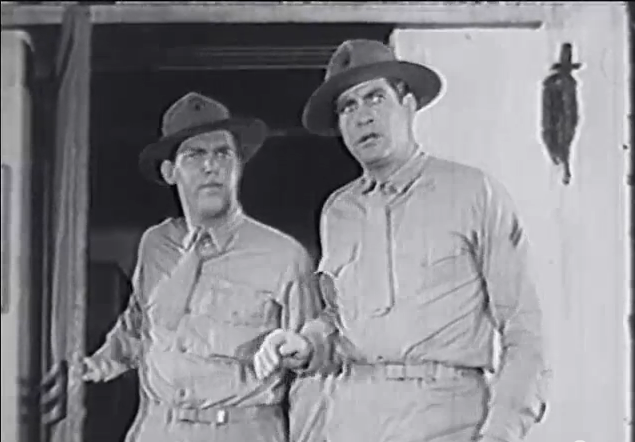
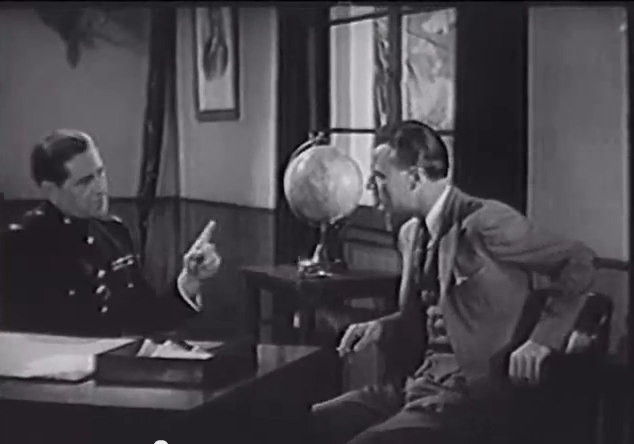
The action of The Fighting Marines begins in media res (unusual but not unheard of for serials): Corporal Larry Lawrence (Grant Withers) and Sergeant Mack McGowan (Adrian Morris) of the U. S. Marine Corps are battling a gang of bandits in a jungle, trying to rescue their friend and fellow Marine, Sergeant William Schiller (George J. Lewis). Schiller is the inventor of a new “gyro compass,” and the bandits hope to learn its secret from him. After Schiller’s rescue, the real story begins: Schiller’s gyro compass will make it possible for the Marines to build a base on remote Halfway Island in the Pacific Ocean. So far, the island has been inaccessible because of a “magnetic dead spot” that causes ships and planes to crash short of the island. A businessman named Douglas (Robert Frazer) hopes to build a floating airstrip outside of the dead spot, and he stands to lose a fortune if the Marines succeed in building on the island.
FM.Bennett.Douglas

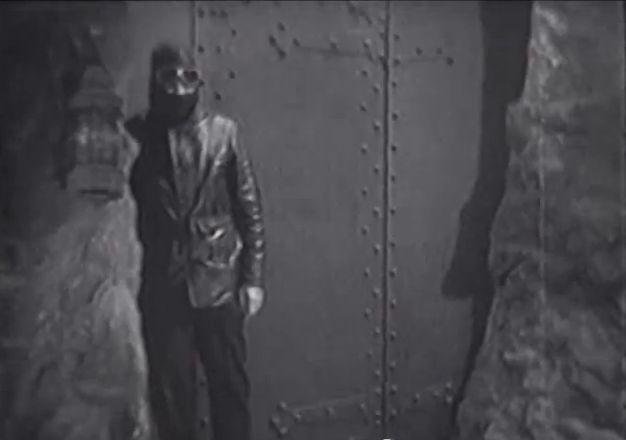
At the same time, unbeknownst to the Marines, Halfway Island is being used as a base by a notorious pirate known only as the Tiger Shark. As in Batman and Robin and Government Agents vs. Phantom Legion, even the Tiger Shark’s own men don’t know their boss’s identity, but they refer often to those poor suckers in the organization who had tried to find out, or who had tried to claim their shares of the loot before the Tiger Shark was ready to dispense them.
FM.TigerShark1

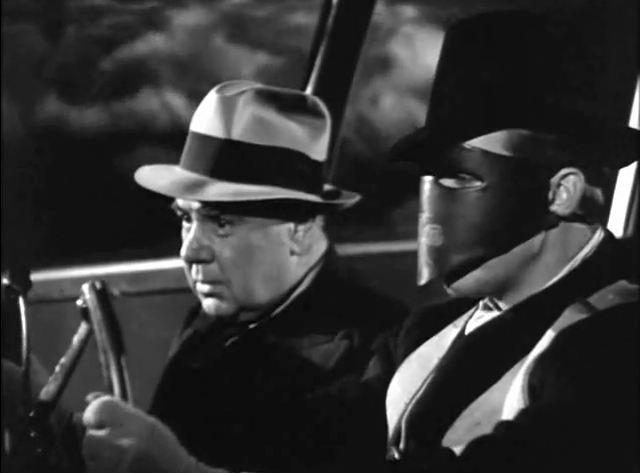
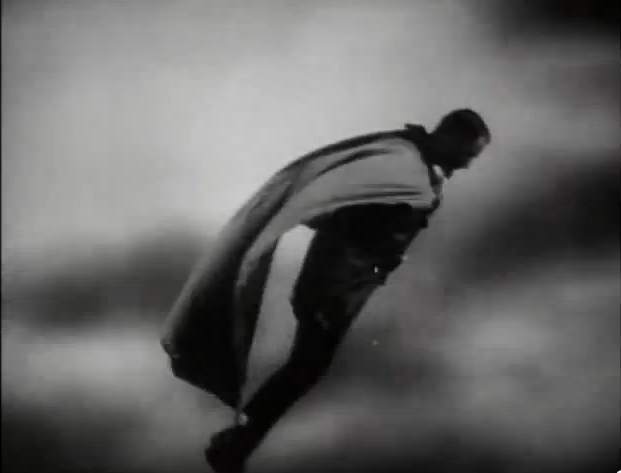
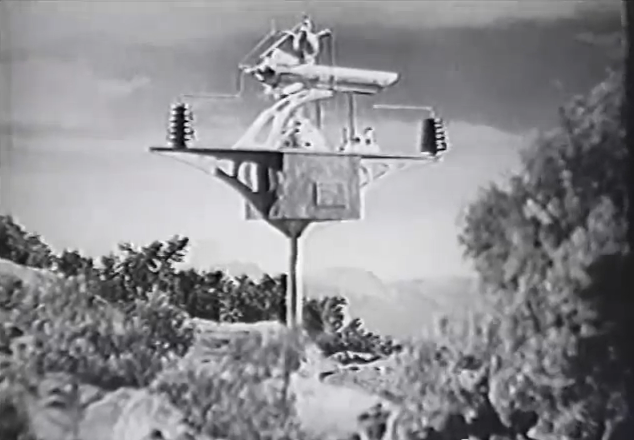
It is the Tiger Shark, who always appears in a fashion-forward leather flying suit and goggles, who is responsible for the dead spot, employing a “magnetic ray gun” to scramble approaching planes’ instruments. In addition, the Tiger Shark seems to know too much about the Marines and their operations, even before Larry and Mack are able to land on the island and discover the pirate’s base. It’s strongly implied that Douglas is the Tiger Shark, but could it be Buchanan (Frank Glendon), the head of the Oriental Navigation Company, who also has an interest in the region? Or could it be someone even closer to the Marines? Needless to say, the mystery is teased out until the very last chapter, when the villain’s identity is revealed.
FM.magneticraygun

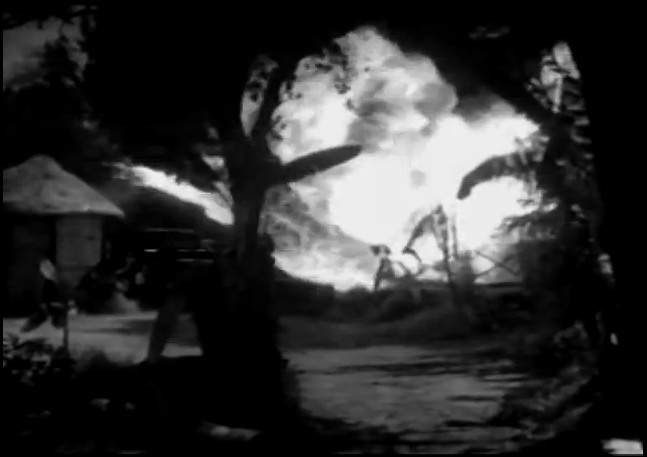
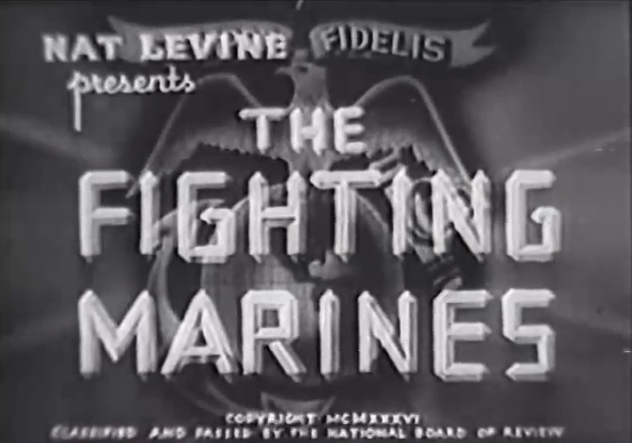
I have to admit that I probably wouldn’t have gone out of my way to watch The Fighting Marines if I weren’t writing this series. Aside from its lack of recognizable characters, I wasn’t really sure what to expect from the title sequence, which combines Sousa’s “Semper Fidelis” march with stock footage of Marines in dress uniforms marching in parade formation. The premise seemed to suggest either a war movie (a genre I don’t usually go out of my way for) or, worse, high jinks on a military base. I needn’t have worried: with a few exceptions, The Fighting Marines is pure serial formula, from its mysterious costumed villain to his army of interchangeable henchmen and the gauntlet of fist- and gunfights, car chases, and other perils that the heroes face.
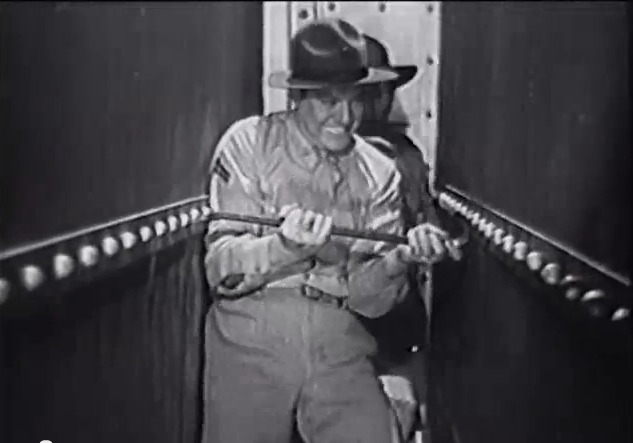
FM.crushing

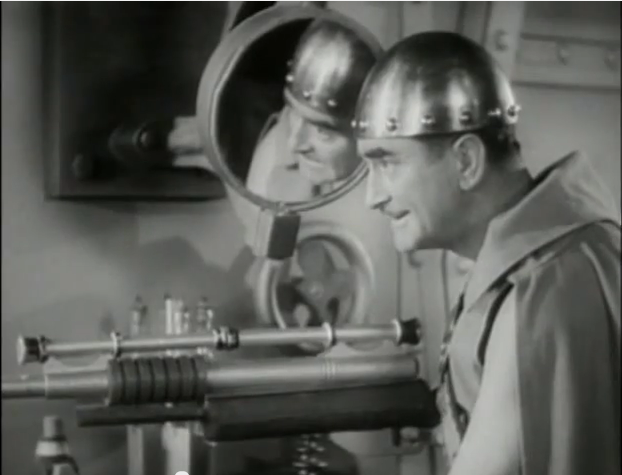
There is also a distinctly pulpy, futuristic edge to the Tiger Shark’s equipment, although it is mostly limited to his base on Halfway Island. In addition to the magnetic ray gun, the Tiger Shark’s forces use television to communicate. However, unlike characters in other serials, the Tiger Shark’s henchmen must wear an elaborate headgear to use the television, whether necessary to make the technology work, like a radio headset, or simply to disguise their identities, I don’t know. Television is so often treated like a kind of magic in films of the 1930s that it shouldn’t be surprising that it requires a special costume to use it, like the ephod worn by the priest who handled the Ark of the Covenant. In some ways the ray gun and other high-tech gadgets make The Fighting Marines an early example of “spy-fi” à la James Bond or The Man From UNCLE rather than a purely military escapade.
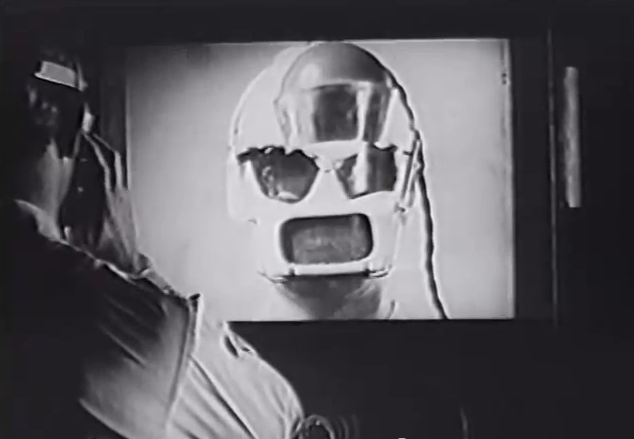
FM.television

Other elements beside the costumed villain and his high-tech toys suggest similarities with other serials: although the two heroes are Marines under the authority of their Colonel (Robert Warwick), and wear uniforms and report to the Marine base, and even in a few chapters take part in military operations with larger squads, they mostly work on their own, with a free hand to track down clues and take on the bad guys by themselves. The format of their adventures isn’t that different from those of the independent agents in Robinson Crusoe of Clipper Island or The Miracle Rider, or the team of unofficial deputies in Daredevils of the Red Circle (or an episode of JAG, for that matter).
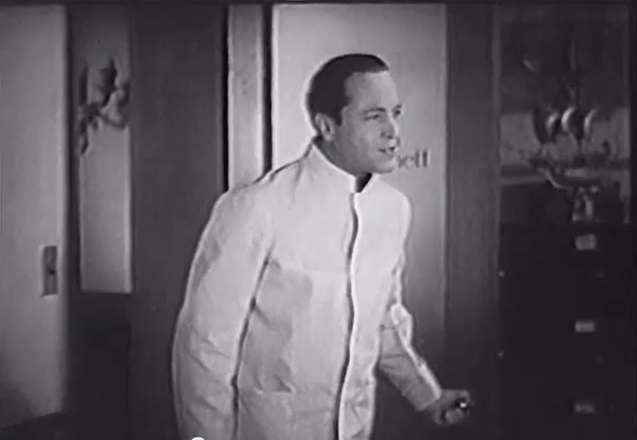
FM.Kota

The Fighting Marines was the last serial made by Mascot before the mergers that would lead to the birth of Republic, the studio that would be synonymous with serials for the next two decades. Producer Nat Levine had grown dissatisfied with the Mascot formula, and while I love some of Mascot’s serials, it’s not hard to see the growing pains that the format was suffering. The Fighting Marines is uneven, with choppy, often redundant storytelling (seriously, was it necessary to have flashbacks to previous scenes in three different chapters?). Characters come and go haphazardly: Douglas, after being established as a likely suspect for the Tiger Shark’s secret identity, disappears, replaced by Buchanan in Chapter Five; they don’t appear together until Chapter Eight, leading me to wonder if I had somehow confusedly given the same character two names. Larry and Mack are established as rivals for the affections of Schiller’s sister, Frances (Ann Rutherford), and she plays an important part in the first half of the serial; however, once the action moves to Halfway Island, not only is the love triangle forgotten, so is Frances. Finally, the many cheats used to resolve cliffhangers (see below) insult not only the intelligence of the viewer, but the idea of continuity itself.
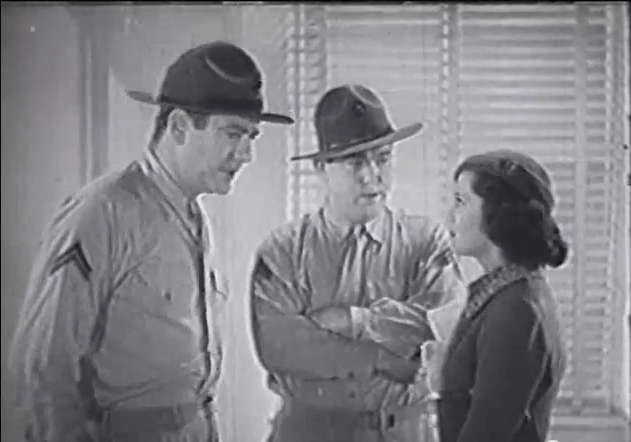
FM.Larry.Mack.Frances

Having said all that, however, I really enjoyed most of The Fighting Marines, and I’m glad I checked it out. Despite its rough edges, it’s imaginative and full of retro cool: I’ve alluded to the Tiger Shark’s sense of style, but did I mention he flies an auto gyro?

FM.autogyro

Or how his victims are left with the “Mark of the Tiger Shark” imprinted on their necks?
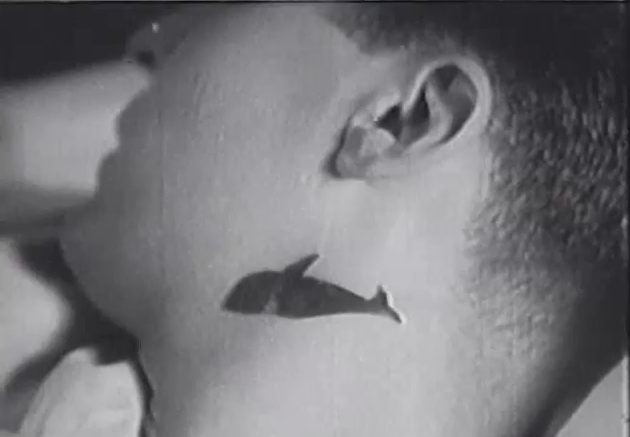
FM.mark

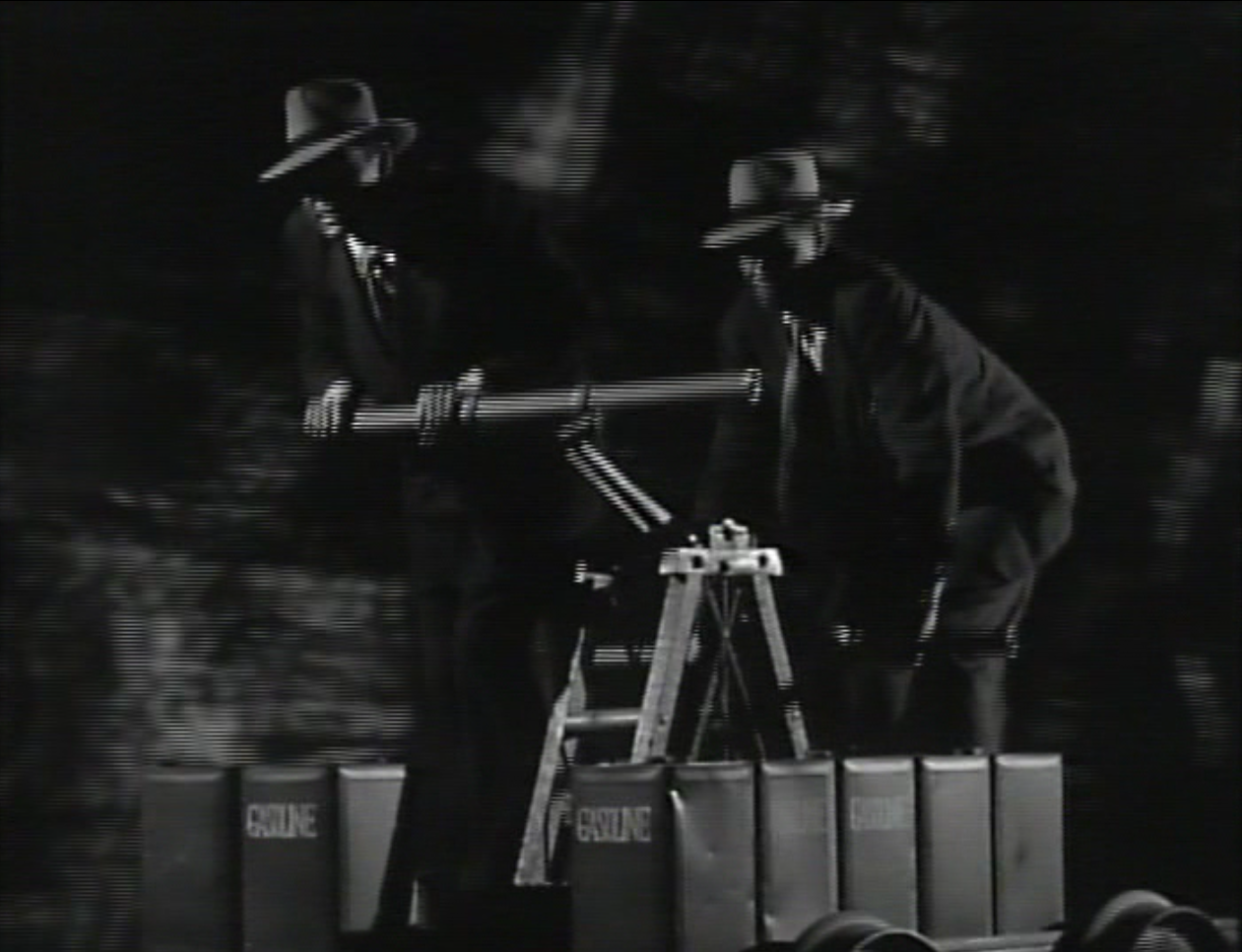
And I live for scenes like the one where the Tiger Shark strafes a Marine encampment from a biplane with a Tommy gun, an image worthy of Dr. Strangelove:

FM.TigerShark2

I also haven’t mentioned the Tiger Shark’s Halfway Island henchmen, a crew of roughneck sailors straight out of a Popeye cartoon:
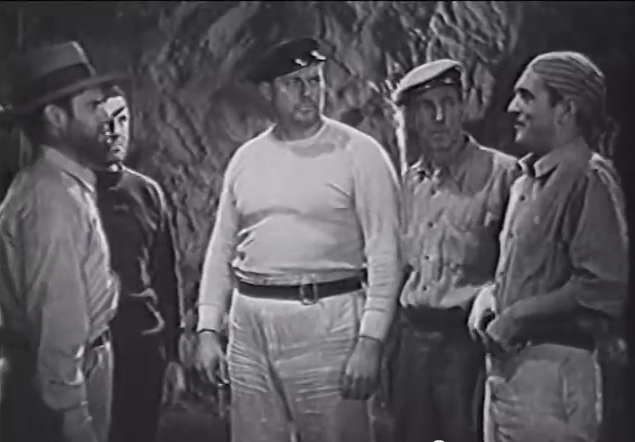
FM.Henchmen1

Or the tribe of natives who also call Halfway Island home, and their Hollywood Central Casting penchant for human sacrifice:
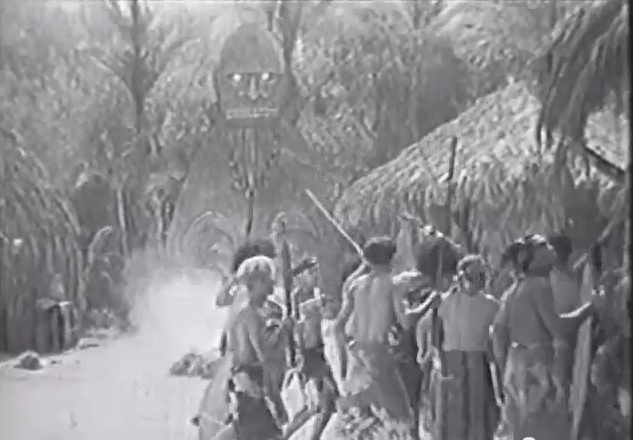
FM.natives

And a few things that should be considered SPOILERS: First, one that I’m not sure is really a spoiler because it doesn’t seem to have anything to do with the plot: it’s just a surprise. In the last chapter, when the Tiger Shark’s empire is collapsing around him, he consults with the chief of the Island natives. Like all of the natives, the chief wears a sarong and has a terrible afro; the chief pulls his afro wig off and it’s revealed that he’s not a native at all, just one of the Tiger Shark’s henchmen. So, does that mean all the natives are white men in disguise? That would explain why they all look so fake–they all have the same ridiculous-looking afros, for one thing–but apparently not. It’s just him. So how did he become chief?
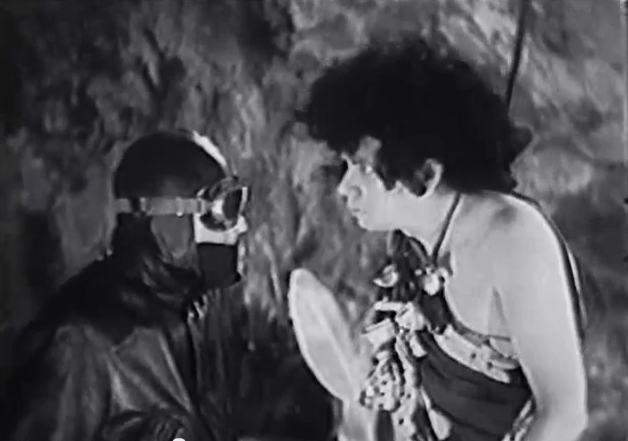
FM.TigerShark.Chief2

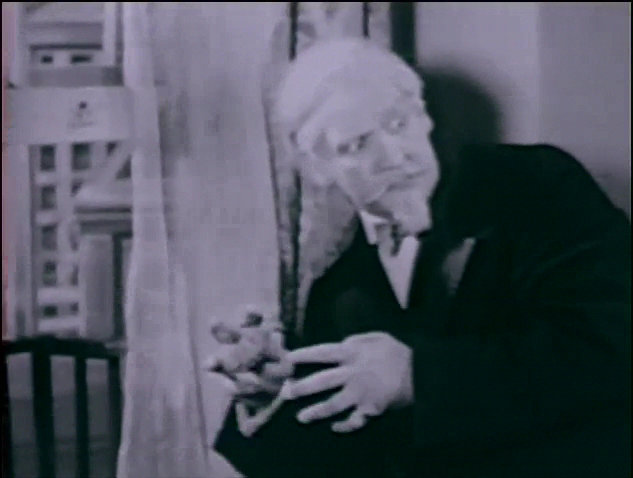
There’s no time for that, because we finally learn the real identity of the Tiger Shark (DOUBLE SPOILERS): It’s neither Douglas nor Buchanan, but Kota, Colonel Bennett’s Japanese valet. This actually explains a lot, not least the casting of a relatively high-profile actor (Jason Robards, Sr.) in a role that hadn’t had more than five minutes of screen time until the big reveal. Note that it wasn’t unusual for a white to play an Asian character at the time: Keye Luke was more the exception than the rule. At least Kota isn’t a grotesque caricature like Batman’s foe Dr. Daka, but he isn’t very convincing, either. I didn’t even realize he was supposed to be Japanese until the second scene he showed up in.

FM.TigerShark.Chief3

The reveal also brings the conflict into focus in a way that is still subtextual but is obvious in hindsight: I’ve often harped on the way shadowy villains in the narratives of the 1930s could stand in for real-world political anxieties, and while no mention is made of why the Marines wish to build their base on “Halfway” (a clear stand-in for Midway) Island, it probably didn’t need to be explained to audiences in 1935 who were increasingly wary of Japanese aggression across the ocean. The narrative demand for a “the butler did it” twist is satisfied, with the real Tiger Shark hiding in plain sight, and while he is only a pirate, not an overtly political villain, one can hardly believe that his real identity or the location of his hideout are accidental. At the very least, it’s comparable to the decision to give villains Russian or German accents in films of subsequent decades: just as that choice gives modern film villains a threatening edge, so was the obsequious but treacherous character of Kota’s race taken for granted and was thus a socially acceptable storytelling device. But like I said, that seems more obvious from a contemporary vantage point: the main message The Fighting Marines sends is that nothing–not profiteers like Douglas, nor lawless pirates like the Tiger Shark–will stand in the way of the Marines when they set their minds to something. As Colonel Bennett says, “Remember what I said about the Marines always finishing what they start!”

What I Watched: The Fighting Marines (Mascot, 1935)

Where I Watched It: The whole thing is on YouTube.

No. of Chapters: 12

Best Chapter Title: “Two Against the Horde” (Chapter Twelve)

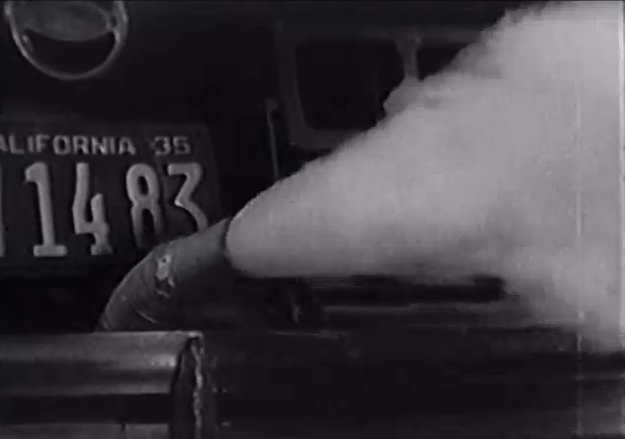
Best Cliffhanger: In one of many chase scenes, at the end of Chapter Ten (“Wheels of Destruction”), Larry and Mack are following two of the Tiger Shark’s henchmen, who have abducted Buchanan in the belief that he is the mysterious crimelord. The henchmen’s tricked-out car is equipped with a smokescreen that pumps thick, opaque clouds from the car’s exhaust pipe. Unable to see through the smoke, Larry and Mack drive their car right through the guardrail on a curve and plunge over the hillside, rolling repeatedly before landing at the bottom of the hill.
FM.smokescreen

Annie Wilkes Award for Most Blatant Cheat: Man, does The Fighting Marines ever cheat! In this case, it’s hard to narrow it down to just one (in fact, the cliffhanger in the aforementioned “Wheels of Destruction” is notable for not cheating: unbelievably, the two Marines are stunned but otherwise completely uninjured after rolling their roofless car multiple times, without even seat belts to keep them from being thrown out). Whether it’s a plane crash, a gunshot, or a fall from a high window, several cliffhangers are restaged to change or undo the surely-fatal peril our heroes were left in at the end of the previous chapter. Probably the most shameless is at the end of Chapter Six (“Robbers’ Roost”), in which Larry and Mack have cornered the Tiger Shark’s henchmen in a warehouse just as the Tiger Shark himself has landed his auto gyro on the roof. Coming down the stairs, the Tiger Shark opens fire on an unsuspecting Larry, who clutches his chest and slumps over. At the beginning of Chapter Seven (“Jungle Terrors”), however, Larry dodges the bullet and returns fire, as hale and hearty as ever. CHEAT!!!

Sample Dialogue: Mac: “Hey, if ya ask me, I think that fella Douglas is the Tiger Shark!”
Larry: “Sure took you a long time to figure that out!”
–Chapter Two (“Isle of Missing Men”)

What Others Have Said: “Levine decided that his new Republic serials would be vast improvements upon those turned out under the Mascot trademark. Analyzing his past products, he realized that perhaps the old Mascot plots were at times too involved. . . . The absence of music, such a hazard for the Mascot chapterplays especially in the action scenes, would be corrected with powerful scores to accompany all moods and situations. Furthermore, comic relief characters would be played down in future scripts.” –Jim Harmon and Donald F. Glut, The Great Movie Serials

(If it were really Levine’s intention to downplay comic relief characters in the Republic serials, I’m not sure what happened, as they seem even more formulaic in the ones I’ve watched. Harmon and Glut are correct about the lack of music, however: The Fighting Marines has only “Semper Fidelis” to serve as a theme song and no other background music.)

What’s Next: In one week, I’ll bring this summer’s serial coverage to an end with the third and final Flash Gordon serial, Flash Gordon Conquers the Universe.

Fates Worse Than Death: The Green Hornet Strikes Again

GH2.title

Sentinel publisher Britt Reid, taking a much-needed vacation in Hawaii, has left his newspaper in the hands of an editor named Harper. While Reid is gone, his secretary Leonore Case and reporters Axford and Lowery begin to suspect that Harper is connected with the criminal Syndicate running rampant in the city: Harper has killed stories about big crimes and even refuses to expose the racketeers when given information straight from the District Attorney. Harper is a member of the Syndicate, secretly run by a man named Crogan, and while Axford and Case send telegrams urging Reid to return from Hawaii, the Syndicate’s men on the island try to prevent him from doing so. First they try to discourage him indirectly, and when it’s clear that he’s heading back to the mainland they kidnap him and his valet Kato, tying them up in a fishing shack with the intention of feeding them to the sharks in the morning.

GH2.Reid.Kato1

The Syndicate’s island force is headed by a man named Bordine, who already has a grudge against Reid for uncovering the truth about a past crime Bordine had pinned on an innocent man. When Reid and Kato escape the fishing shack (with a little help from Reid’s alter ego the Green Hornet) and make it to the departing ship, Bordine follows them in hopes of finishing them off. An unrelated fire that begins in the boiler room derails his scheme, however, and endangers everyone on board. And this is just in the first chapter of The Green Hornet Strikes Again!

GH2.Hornet1

As should be clear from the summary of Chapter One, The Green Hornet Strikes Again has no shortage of twists and turns. In fact, it has one of the most convoluted plots of any serial I’ve watched yet: while in broad outline it follows a similar plot to The Green Hornet (from earlier in the same year), with its overarching Syndicate being broken apart by the Hornet one racket at a time until he can finally confront the big boss, it has more chapters, more characters, more settings, and, like most sequels, is generally overstuffed. (Of course, it was meant to be watched on a weekly basis rather than all at once, but I’m not sure how it would have been any easier to keep track of with a week elapsing between each chapter.) Having said that, there are many enjoyable scenes and chapters in this, and plenty of action in the serial tradition.

GH2.Reid1

The Green Hornet Strikes Again features a different actor in the title role (Warren Hull, who unlike his predecessor Gordon Jones also provides the Hornet’s voice while in costume), but otherwise brings back the main cast of the earlier serial. Keye Luke plays Kato, Anne Nagel plays Leonore Case, and Wade Boteler plays Irish policeman-turned-reporter Michael Axford. Instead of Jenks, the ambitious young reporter is Lowery (Eddie Acuff), whose antagonistic partnership with Axford is the main source of comic relief. A few references are made to events from The Green Hornet, but the Syndicate in Strikes Again isn’t the same one that was defeated in the first serial.

GH2.office

The Syndicate’s plots are also more ambitious than those of its predecessor: in addition to the attempt to take over the Sentinel, there’s a plot to replace the heiress to an aluminum fortune with an actress, allowing the Syndicate to control the aluminum company’s board of directors; an attempt to sabotage the source of the aluminum plant’s electricity when that scheme fails; a plot to develop a “magnetic bomb” in a secret laboratory in a steel plant; and even some that don’t involve metal or factories. This provides ample room for stock footage, often integrated smoothly through the use of rear projection: it really looks like Reid and Lowery are on the floor of the steel plant, and through quick editing they appear to be in real danger of having molten metal “accidentally” spilled on them. In other scenes, the Green Hornet is called on to commandeer speeding cars, trucks, or airplanes, and survives all kinds of crashes, explosions, and building collapses (including one caused by a bolt of lightning!). In almost all the crimes perpetrated by the Syndicate, there’s a theme of urgently-needed wartime materiel being diverted to foreign buyers, and again there’s no need to specify who they are, or why they are bad news.

GH2.Crogan

Kato, who is both Reid’s manservant and the Green Hornet’s faithful ally, doesn’t have as much to do in this serial, unfortunately: in The Green Hornet he got to karate chop a few bad guys, but in Strikes Again he mostly drives the car and pulls the Green Hornet out of the rubble after the aforementioned disasters. I wanted to mention him, however, because there’s a good case to be made for Kato as the most interesting character in the Green Hornet saga. According to the exposition at the beginning of The Green Hornet, Kato is loyal to Britt Reid for saving his life in his native Shanghai; although Kato’s subservience fits the “Oriental houseboy” trope, he has always been portrayed as intelligent and capable. In addition to his martial arts skill, he designed and built the Green Hornet’s gas gun and equipped their customized automobile, the Black Beauty.

GH2.Hornet.Kato1

Kato has been well-represented in the movies as well: Keye Luke, who originated the role on film, first became prominent playing Charlie Chan’s “Number One Son,” Lee, and had a distinguished career as a character and voice actor in film and television, including a recurring role on Kung Fu. In the 1966 television series, Kato was played by up-and-coming martial arts icon Bruce Lee, who was so popular in his native Hong Kong that the series aired as The Kato Show there. In 1974, three episodes of the program were edited together into a theatrical Green Hornet film to take advantage of Lee’s growing fame.

BruceLee

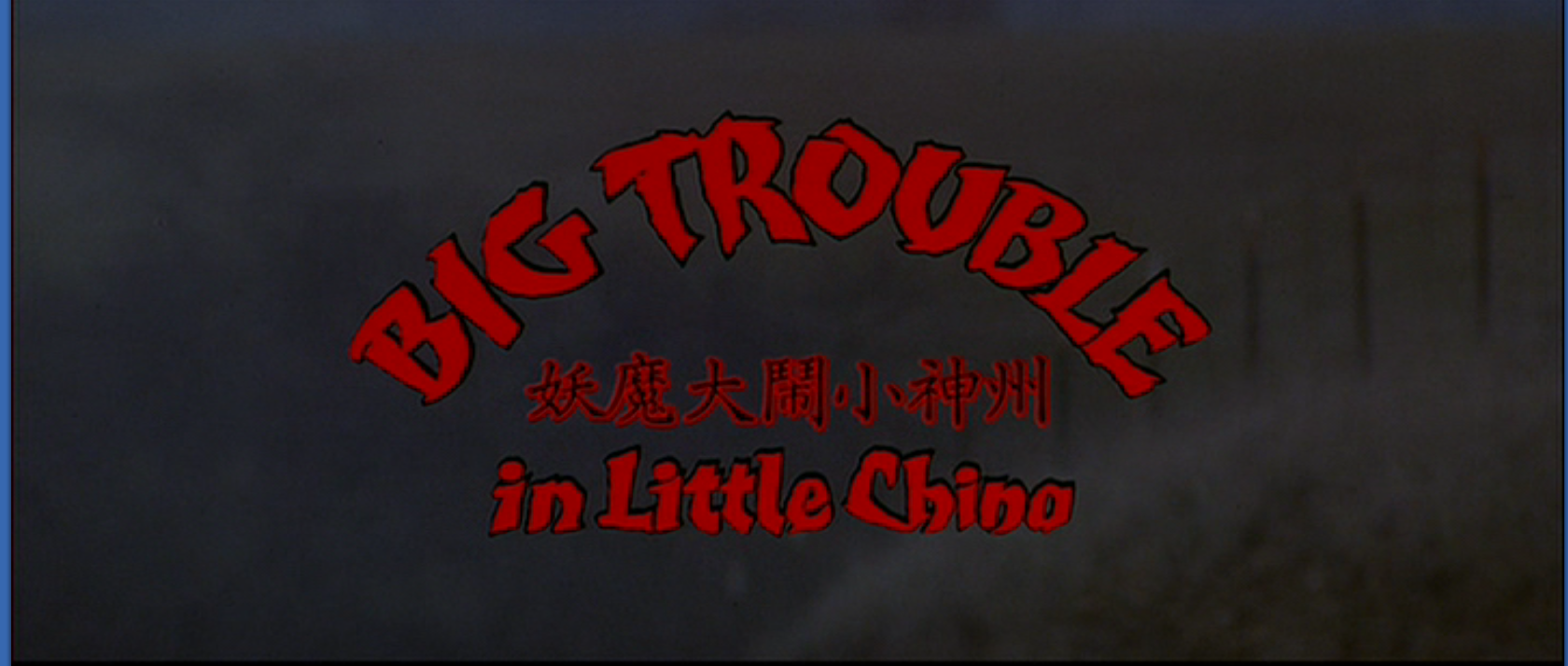
Finally, the comedic, Seth Rogen-starring 2011 Green Hornet feature leans heavily into the realization that Kato (played by Jay Chou) is the skilled one while Rogen’s Britt Reid is a clueless party animal who at first gets into the hero business for kicks and only gradually realizes his responsibility. Like Big Trouble in Little China and the 2013 Lone Ranger film, the 2011 Hornet delights in reversing the expected relationship between hero and sidekick, and the pair can only work together effectively when Reid is able to see Kato for what he has always been: a partner.

GH2011.Kato.Hornet

What I Watched: The Green Hornet Strikes Again (Universal, 1940)

Where I Watched It: A Pacific Entertainment DVD, which, since it was sourced from videotape, manages to look worse than The Green Hornet did when I watched it on YouTube.

No. of Chapters: 15

Best Chapter Title: “Racketeering Vultures” (Chapter Fourteen)

Best Cliffhanger: In Chapter Twelve (“Crashing Barriers”), Michael Axford and Leonore Case have been taken hostage by the Syndicate and taken to a warehouse to be disposed of. Following in another car, the Green Hornet drives straight through the warehouse’s freight door–and right into a huge pile of explosives stacked inside, which detonate immediately!

GH2.explosives

Annie Wilkes Award for Most Blatant Cheat: All but one of the cliffhangers in this serial feature Britt Reid in his role as the Green Hornet, but the end of Chapter One (“Flaming Havoc”) allows him to take heroic action as himself. When a fire breaks out on the ship heading back to the mainland, Reid rescues Gloria (a character whom I thought would continue to be important, but who turned out to be another member of the rotating cast, never to be seen again), carrying her through a blazing hallway to the open deck. The serial appears to be over before it’s even begun when a flaming rafter falls directly on top of them and the screen fills with the ever-growing fire. In my notes for the beginning of Chapter Two (“The Plunge of Peril”), I have simply jotted, “they make it,” indicative of how little danger these mishaps actually pose for our heroes. The boat still sinks, however.

GH2.Reid.Gloria

Favorite Character (Aside from Kato): Every once in a while a secondary character shows up and steals the movie for a chapter or two. Frenchy Ludoc in Gang Busters was one such character; Vultan in Flash Gordon was another. In Chapter Fourteen of The Green Hornet Strikes Again, it’s Foranti (Jay Michael), a racketeer illicitly placed in charge of the Builders’ Association by the Syndicate. While skimming off Association funds for his own use, Foranti is funneling money toward the construction of an expensive house, ultimately to belong to Crogan. When the Sentinel prints the truth about him, he shows up to intimidate Britt Reid in person.

GH2.Foranti1

Although soft-spoken, every line he speaks sounds like it was written for Edward G. Robinson, see? He just figures Reid needs to be leaned on a little, see? And the squealer who fed the Sentinel the information about Foranti is dead now, see? You get the picture. Foranti isn’t exactly comic relief (that’s what we have Axford and Lowery for), but as a parody of the popular gangster, he veers farther into camp than the rest of the film; he’d be more at home in Columbia’s Batman serials. This chapter also makes good use of the conceit that the Green Hornet poses as a criminal to get information, and here he gets Foranti to turn on his associate Breedon by playing to his paranoid fear that Breedon is betraying him. On top of all that, Foranti has the distinction of being gassed twice in the same chapter by the Hornet, the only villain so treated.

Sample Dialogue: Crogan (Pierre Watkins), to his men (sarcastically): “Yes, that’s right, the Green Hornet: a lone wolf who plays your own game and makes monkeys out of all of you!” (Chapter Twelve, “Crashing Barriers”)

What’s Next: Join me next week for The Fighting Marines!

Fates Worse Than Death: Government Agents vs. Phantom Legion

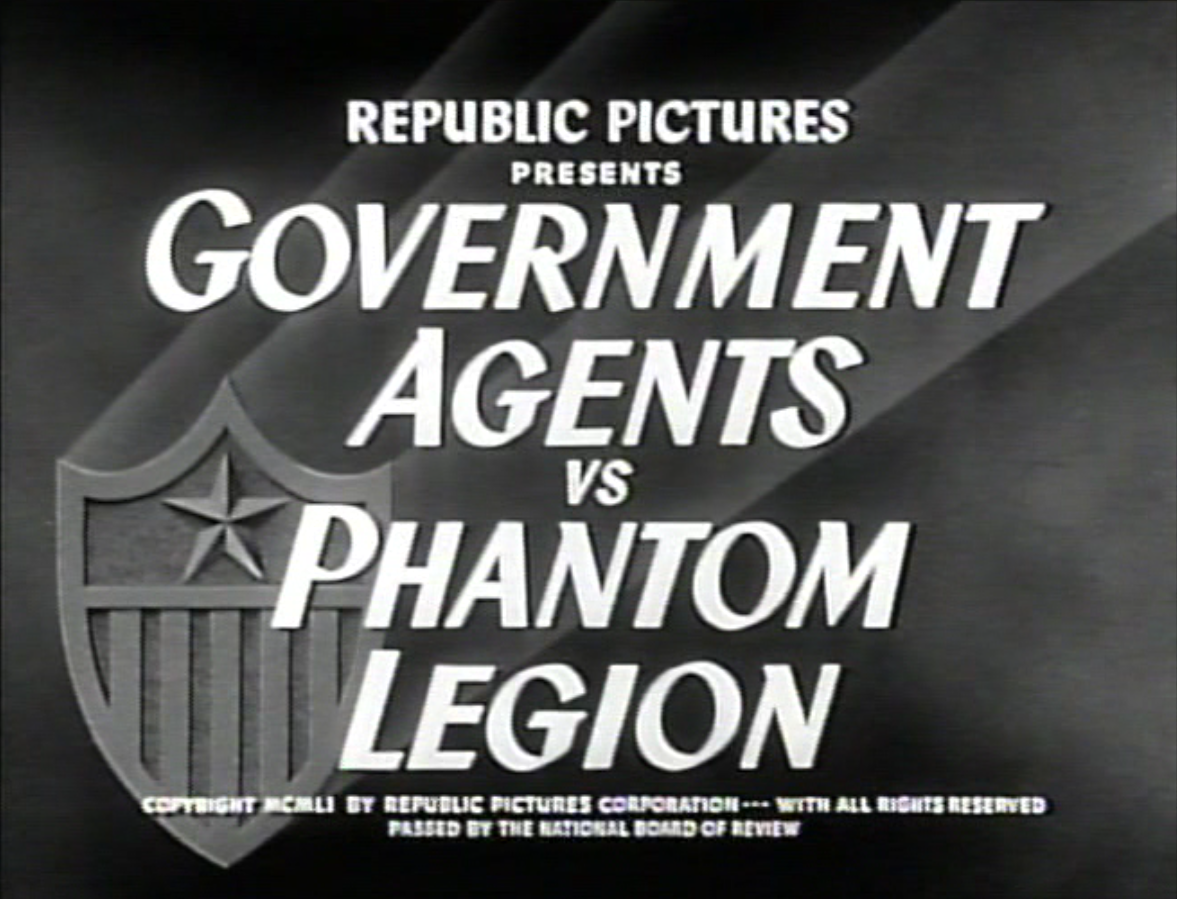
GAPL.title

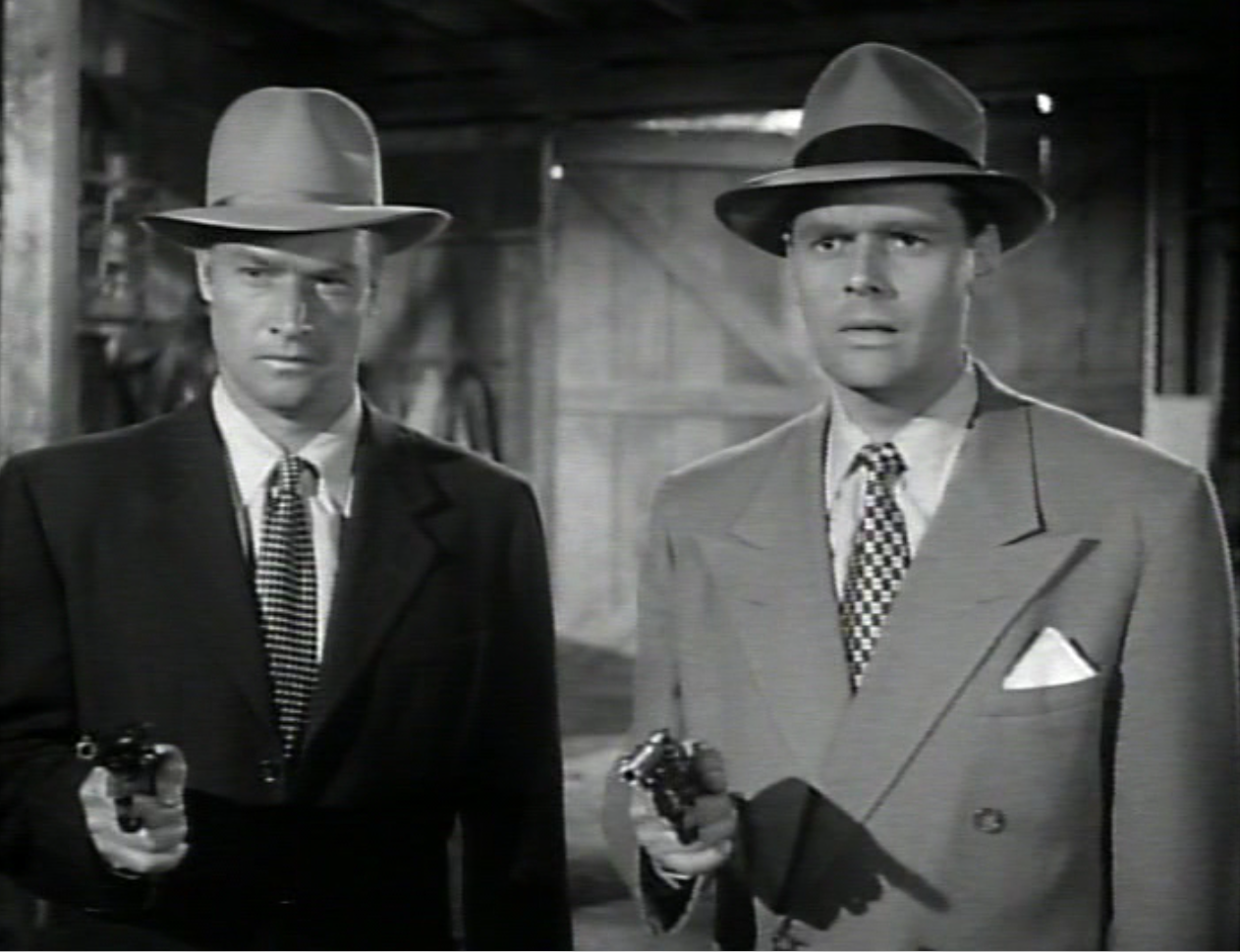
A rash of hijackings and acts of sabotage plagues the trucking industry. Because these crimes are disrupting not only regular business shipping but the transport of sensitive military technologies, the government steps in to investigate. The heads of the four big trucking lines that make up the Interstate Truck Owners’ Association meet in their office with special agent Hal Duncan (Walter Reed). With his assistant Sam Bradley (John Pickard), Hal tries to get to the bottom of the mystery by riding along, tracking the hijackers, and gathering evidence.

GAPL.truckassn

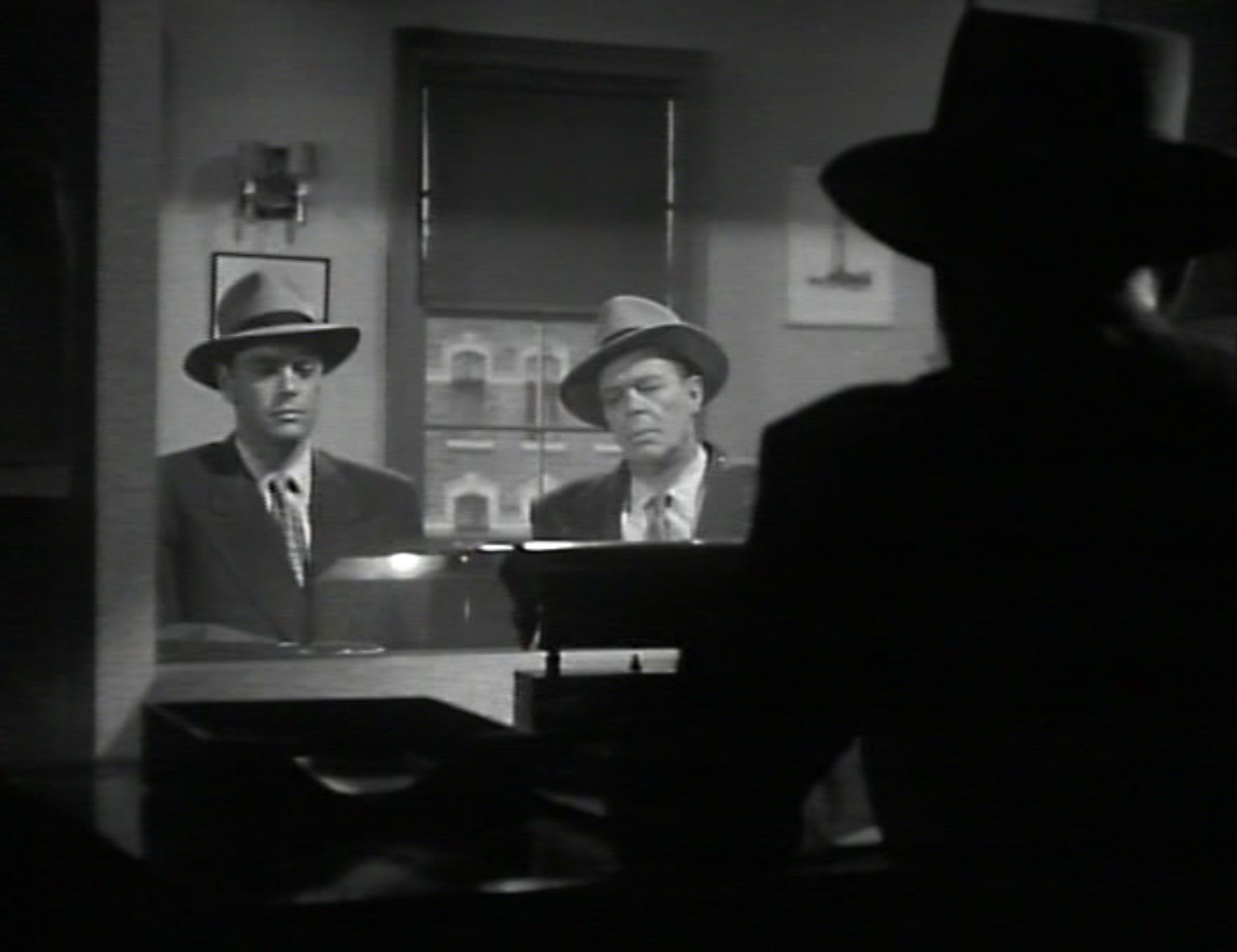
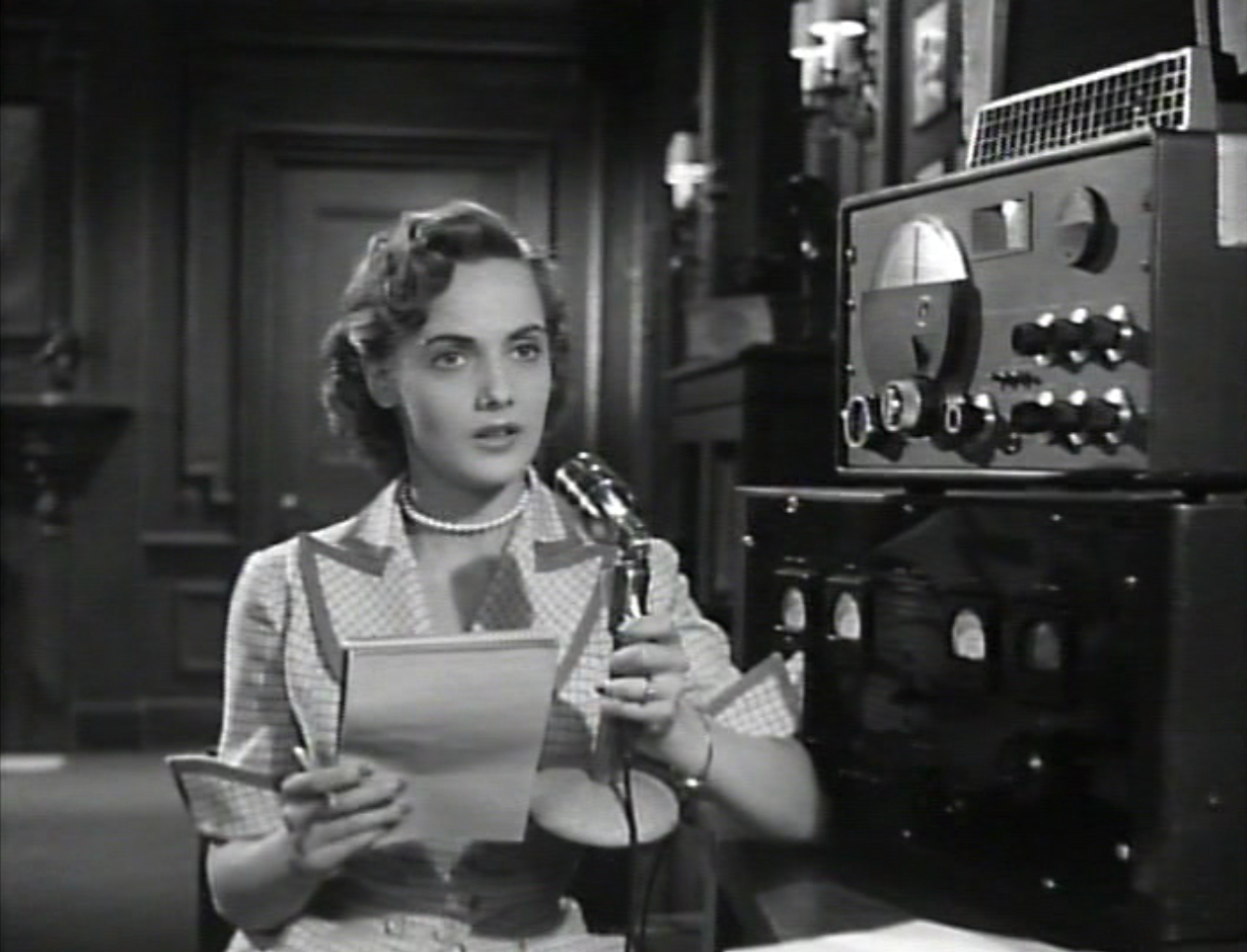
Little does he know that the mysterious “Chief” to whom the hijackers report is one of the four bosses of the Association! The Chief meets with his henchmen behind a mirror of one-way glass in an anonymous office: even they do not know his real identity (and neither do we, until the last chapter, although it isn’t hard to guess). Hal soon realizes what is going on when the hijackers are able to coordinate attacks based on information that only the four bosses have. He can only trust his partner Sam, the Association’s secretary Kay Roberts (Mary Ellen Kay), and his gut, but he’s determined to find out the truth in the 1951 serial Government Agents vs. Phantom Legion!

GAPL.Chief

Government Agents vs. Phantom Legion is on the shorter side (under three hours), which seems typical of the serials Republic was producing in the early 1950s. I’ve compared the serials from the ’50s unfavorably to those from the ’30s for being simplistic and routine, even when dealing with fantastical concepts, but Government Agents held my interest with well-done action and effects. Stuntmen Tom Steele and Dale Van Sickel are onboard to coordinate some excellent fights, including an inventive, acrobatic brawl that takes place on a dock; without overstating it, this and other fights reminded me of the choreographed, everything-but-the-kitchen-sink fights of Jackie Chan’s oeuvre. The effects and miniatures are courtesy of the Lydecker brothers, those workhorses of Republic’s model shop, showing why they were legendary in the business (although water effects continue to be one area in which the small scale is clear on screen: below a certain size, waves and splashes just don’t look right, even when slow motion is used). And although there isn’t a cast of thousands, the number of characters isn’t so small that the world of the story feels too small.

GAPL.SamHal3

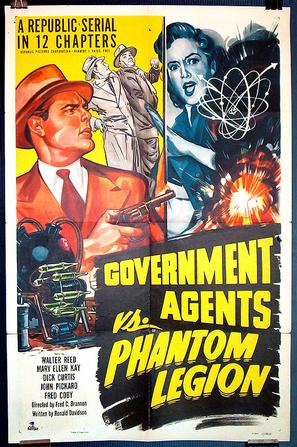
I enjoyed Government Agents vs. Phantom Legion well enough, but it’s hard not to detect a bit of bait-and-switch in its gloriously clumsy title (not to be confused with 1949’s Federal Agents vs. Underworld, Inc. or 1953’s Canadian Mounties vs. Atomic Invaders) and the proto-Drew Struzan-style poster, which suggests sci-fi with a side of superheroics. Well, there are government agents in the serial, and the atom-age symbolism is justified by the presence of refined uranium, radar equipment, and electronics being among the goods the truck hijackers are stealing, but that high-tech equipment is for the government: it never actually sees use on screen. The real meat of the action–car chases, fist- and gunfights, traps and cave-ins and explosions–could have been filmed at any time in the previous two decades. (Even the perils that could be termed science-fictional–capsules of poison gas, hidden radio transmitters for eavesdropping, a truck driven by remote control–were being featured in the serials of the 1930s.)

Govt.Agent

And what of the “foreign government” the Chief is selling his plunder to? I wonder which government that could be? Like the pre-war serials, Government Agents is coy about naming names, or even ideologies: the uranium, hand grenades, and other goods are necessary for American “defense,” but the Chief’s interest in it is purely monetary. What his foreign customers plan to do with it isn’t his problem. The two main thugs, Regan and Cady (played by Dick Curtis and Fred Coby), might as well be working for the invading Lunarians of Radar Men From the Moon for all their activities reflect any real-world context. On the other hand, of course it wasn’t necessary to name names for the audience to get it, and more explicit references would have both detracted from the serial’s escapist quality and dated the material quickly.

GAPL.Kay1

Although the villains’ organization is never referred to as the “Phantom Legion” within the story, it’s an accurate description of the group, so shadowy that even its members don’t know who their leader is, their actions cloaked in mystery so that the heroes never know from which direction the next strike will come. It’s also worth calling attention to the frequency with which that word, “phantom,” is used in serials and pulps: how fitting that entertainments that reflected popular unease and political paranoia, but rarely named their targets specifically, would cast their villains as invisible, pervasive, and essentially unknowable sources of evil. A serial could tease fears that villains were out there, perhaps hiding behind the faces of friends or acquaintances, but that by their nature they would eventually be conquered by goodness, law, and order. I’m certain that it was with an awareness of the word’s connotations and history within the genre that George Lucas chose the much-ridiculed title “The Phantom Menace” for his Star Wars prequel, which also delved into the political conspiracy at the root of his imagined Galactic Empire.

GAPL.shadow

Finally, the rather mundane plot makes some of the crazier set pieces all the more surprising: in Chapter Three (“The Death Trap”), Hal needs to stop a train before it rolls over a section of the track that has been rigged with dynamite. He has little time to spare, so he . . . charters a plane? Yes! And then when he has Sam buzz the train to convince the engineer to put the brakes on, the engineer waves them off, thinking they’re joyriding, so he . . . jumps out of the plane in front of the speeding train! Well, what would you do? The cliffhanger at the end of the chapter shows the train rumbling over the parachute laid across the tracks. Other chapters include a mine tunnel race on handcars; an out of control speedboat; and a stolen gas tanker used to create a trail of fire on the road. It doesn’t always make a lot of sense, but it’s rarely boring.

GAPL.handcar2

What I Watched: Government Agents vs. Phantom Legion (Republic, 1951)

Where I Watched It: A DVD from Cheezy Flicks

No. of Chapters: 12

Best Chapter Title: There were several good chapter titles, including “Doorway to Doom,” “Sea Saboteurs,” and “Perilous Plunge” (what can I say, I’m a sucker for alliteration), but I’ll give the award to Chapter Five, “Deadline for Disaster” (alliteration!).

Best Cliffhanger: There’s quite a bit of vehicular mayhem in this serial, fitting for a case involving hijacked trucks. It’s a tough call, but I’m going to single out Chapter Six, “Mechanical Homicide” (another great chapter title, weakened only by the fact that it doesn’t involve a robot). One of the trucking bosses, Crandall (Arthur Space, whom we last saw in Panther Girl of the Kongo) is planning to defend all of his shipments with armed guards, a decision that puts him in the crosshairs of the Chief and his criminal organization. The Chief has Regan and Cady attach a remote control device to one of the trucks they’ve stolen, with instructions to fill it with explosives and ram it into Crandall’s home, killing him. Hal spots the pair testing the remote control truck and confronts them; after a struggle he is knocked out and locked in the truck’s cab, so that he will be eliminated at the same time as Crandall. With Regan controlling it from outside, Hal can’t stop the truck even after he comes to and realizes what is happening. Through shots from the speeding truck’s POV, the audience sees what Hal sees, swerving through Crandall’s upscale neighborhood, straight toward his house. The chapter ends with the truck bomb slamming into Crandall’s house (or does it?), resulting in an enormous explosion (one of many in this serial).

GAPL.Hal2

Annie Wilkes Award for Blatant Cheat: No one chapter stands out, but the resolution to “Mechanical Homicide” is typical: in the next chapter, a shot of Hal jumping out of the cab just in time is included, and it’s revealed at the next meeting of the Association that Crandall is alive and well, the truck having only hit his garage. As I said, several cliffhangers involve crashes or explosions of one kind or another, and inevitably Hal is saved by leaping out of the way at the last minute. This was standard operating procedure for Republic by this time.

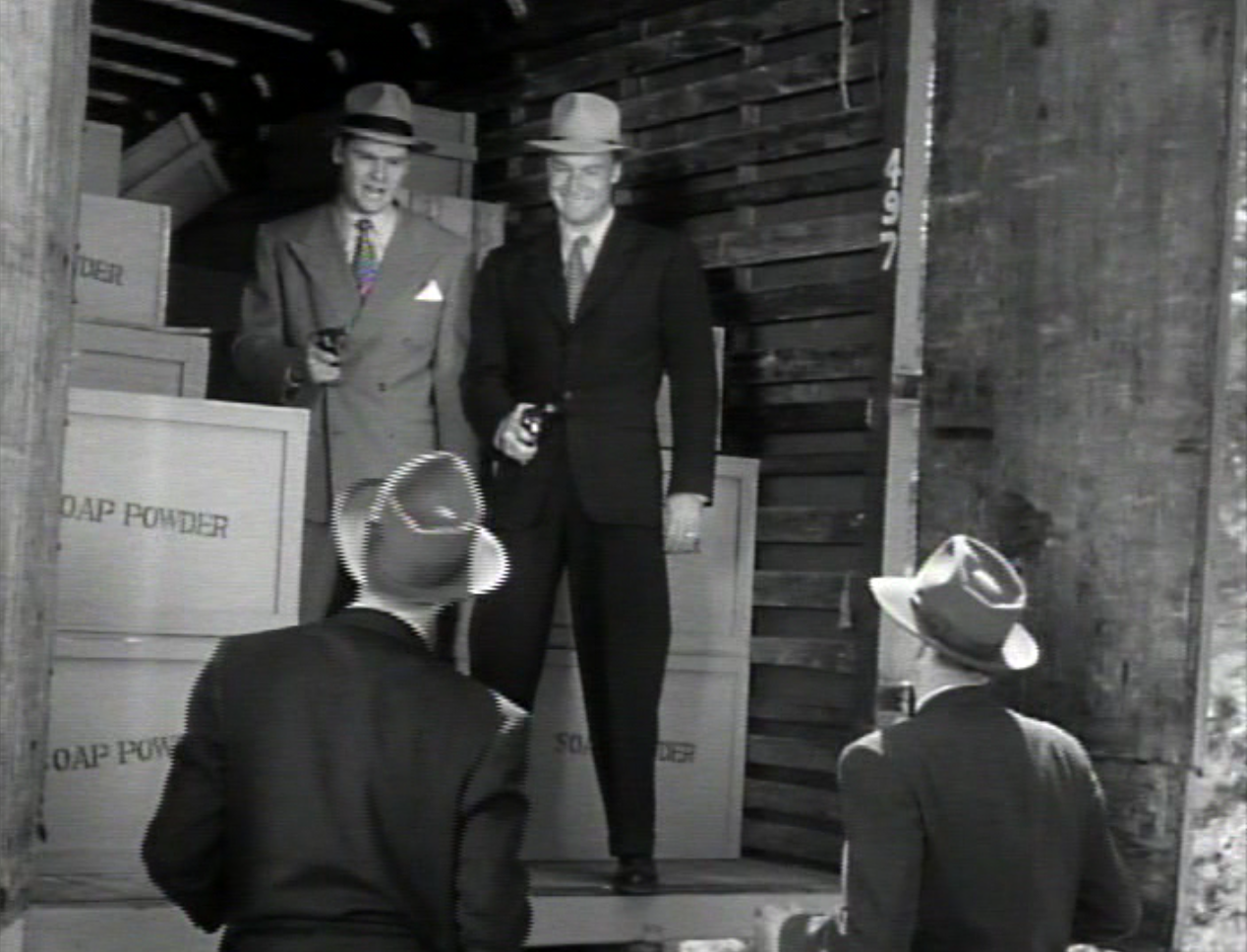
Sample Dialogue: “This is the soap powder you boys have been looking for, but I don’t think you want it–it really is soap!” –Sam, after Hal has tricked Regan and Cady into hijacking a shipment with disinformation that uranium has been disguised as soap (Chapter Nine, “Peril Underground”)

GAPL.soap

What Others Have Said: “Almost always in serial fights, the stuntmen wore hats, fastened to their heads by elastic bands, screening their faces so that telling them from the actors they represented was difficult. (That also answers the question: Why don’t their hats fall off during a fight?)” –Jim Harmon and Donald F. Glut, The Great Movie Serials

GAPL.fight2

What’s Next: As promised, next week I’ll look at The Green Hornet Strikes Again.

Fates Worse Than Death: The Painted Stallion

PS.title

Westward! The trail to empire! From Independence, Missouri to Santa Fe dogged pioneers fought to penetrate a wilderness of savage Indians, massacres and death. Even worse were the white renegades, outlaws and bandits unscrupulous in their greed.

So begins The Painted Stallion, a 1937 serial set along the Santa Fe trail in the early years of the nineteenth century. With some stunning Southwestern scenery, exciting and arduous physical stunts, and a streamlined plot, The Painted Stallion is a prime example of what Republic was bringing to its productions in the late 1930s. It even tops off the entertainment with a minor historical gloss: I wonder how many Depression-era school kids tried to get away with cribbing the preamble text above for writing assignments, or the shorter dedication that preceded subsequent chapters:

To the heroes of yesterday! Those pioneers who braved the perilous trek Westward, defeated a hostile wilderness, and blazed a glorious trail across the pages of American history!

PS.Dupray2

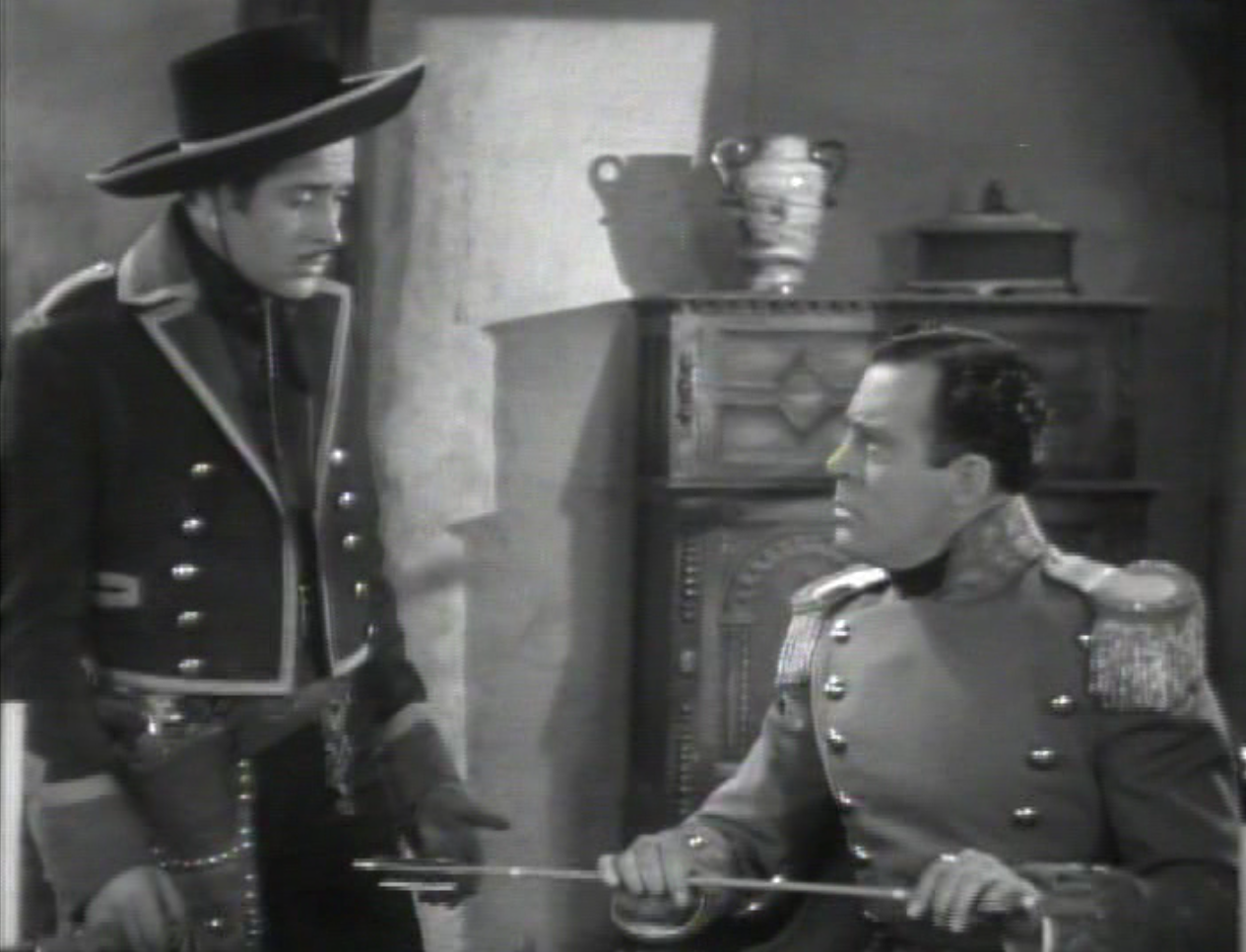
The Painted Stallion gets underway with several plot threads converging: in Santa Fe, the Spanish colonial government has just been overthrown by Mexican revolutionaries. Dupray, the Spanish-appointed governor (LeRoy Mason), conspires with his right-hand man, Zamorro (Duncan Renaldo), to hold onto his power (and the plunder he is able to collect through taxation and graft) by abducting the incoming Mexican governor before he can arrive in Santa Fe. At the same time, American Walter Jamison (Hoot Gibson) is preparing a wagon train heading to Santa Fe from Independence, Missouri, with the goal of establishing trade between the United States and the new Mexican government. Dupray reasons that if he and his men can destroy the wagon train or force it to turn back, the blow to legitimate trade will strengthen his own position.

The first chapter thus establishes this conflict and puts the characters in their starting places. Although Jamison is the leader of the wagon train, the real hero is Clark Stuart (Ray “Crash” Corrigan, star of Undersea Kingdom), a government agent sent to protect the traders and carrying letters empowering him to negotiate with the Mexican governor. An all-around athlete and stuntman, Corrigan has plenty of opportunities to perform physical acts of derring-do, but they’re a little more organic than the wrestling and high-wire walking he performed in Undersea Kingdom. (Worth noting is the presence of Yakima Canutt in the cast, and you’d better believe his signature stunt–climbing beneath the chassis of a runaway wagon to take control of the reins–is included among the many spectacular set pieces.)

PS.Stuart1

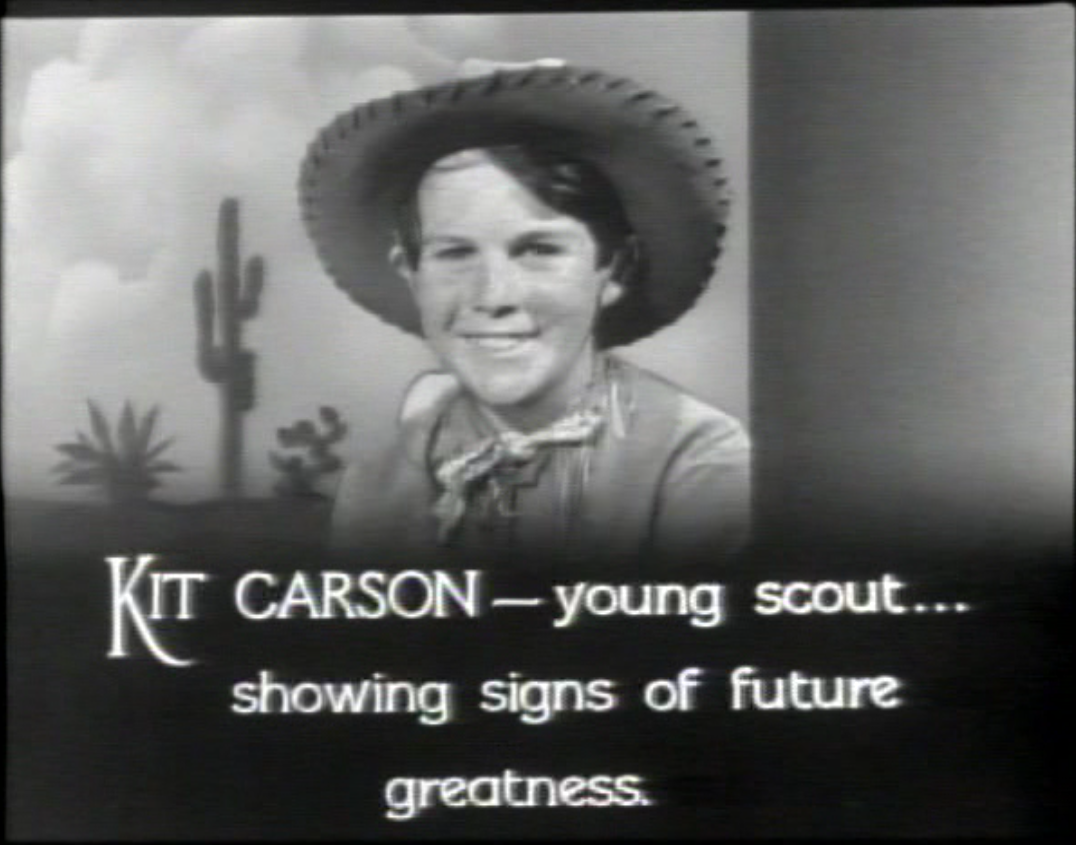
Stuart is first seen on a riverboat, where a young stowaway (Sammy McKim) saves his life from an assassination attempt by one of Dupray’s men. In return for the boy’s help, Stuart assumes responsibility for him when he is caught by the Marshal; it turns out the boy is a runaway, heading west in hopes of becoming a scout. When asked his name, he answers, “Christopher,” and Stuart muses, “That’s too long a name, we’ll change it to . . .” (dramatic pause) “. . . Kit.” Holy heck, it’s Kit Carson, future scout, Indian fighter, and Western hero!

PS.Stuart.Kit2

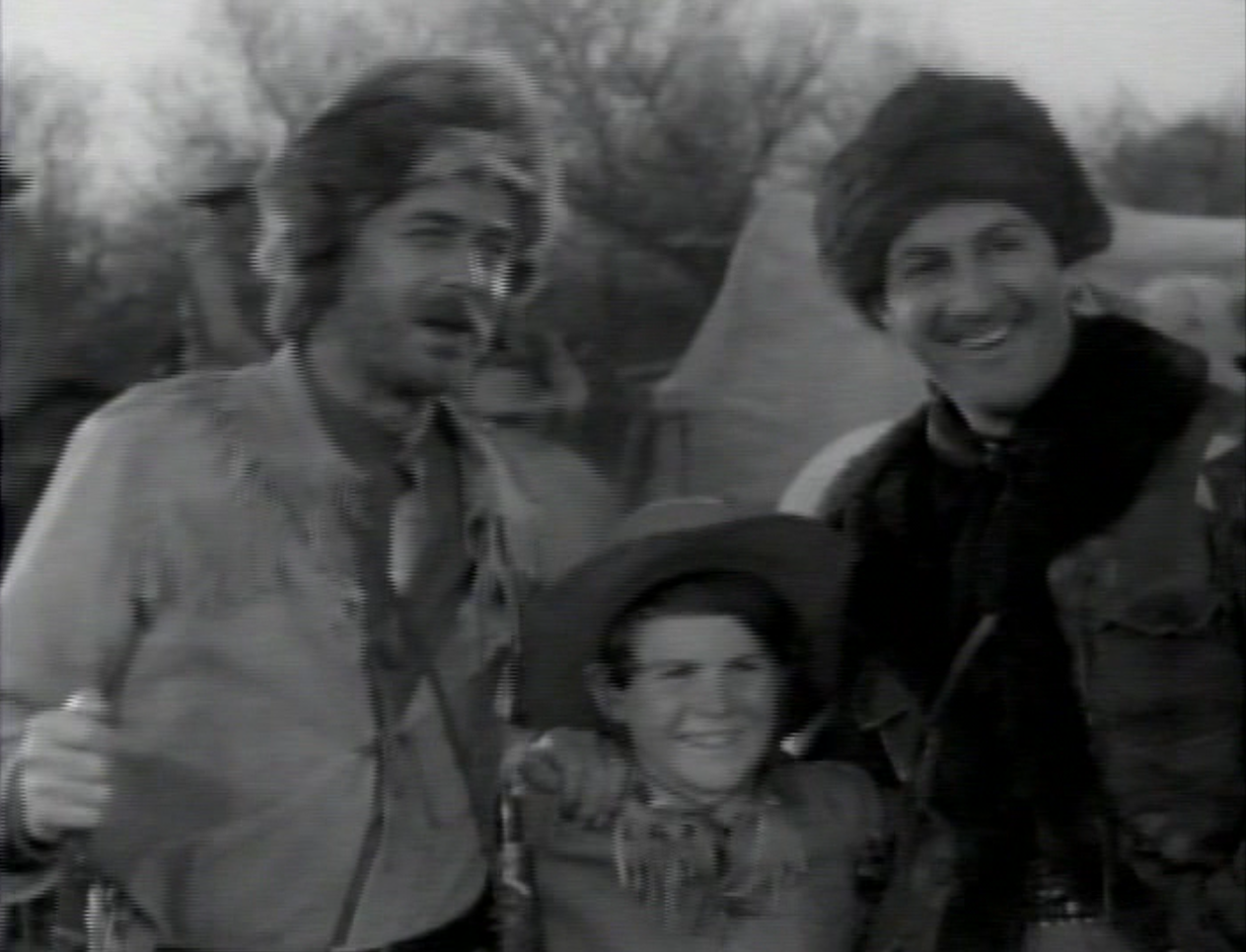
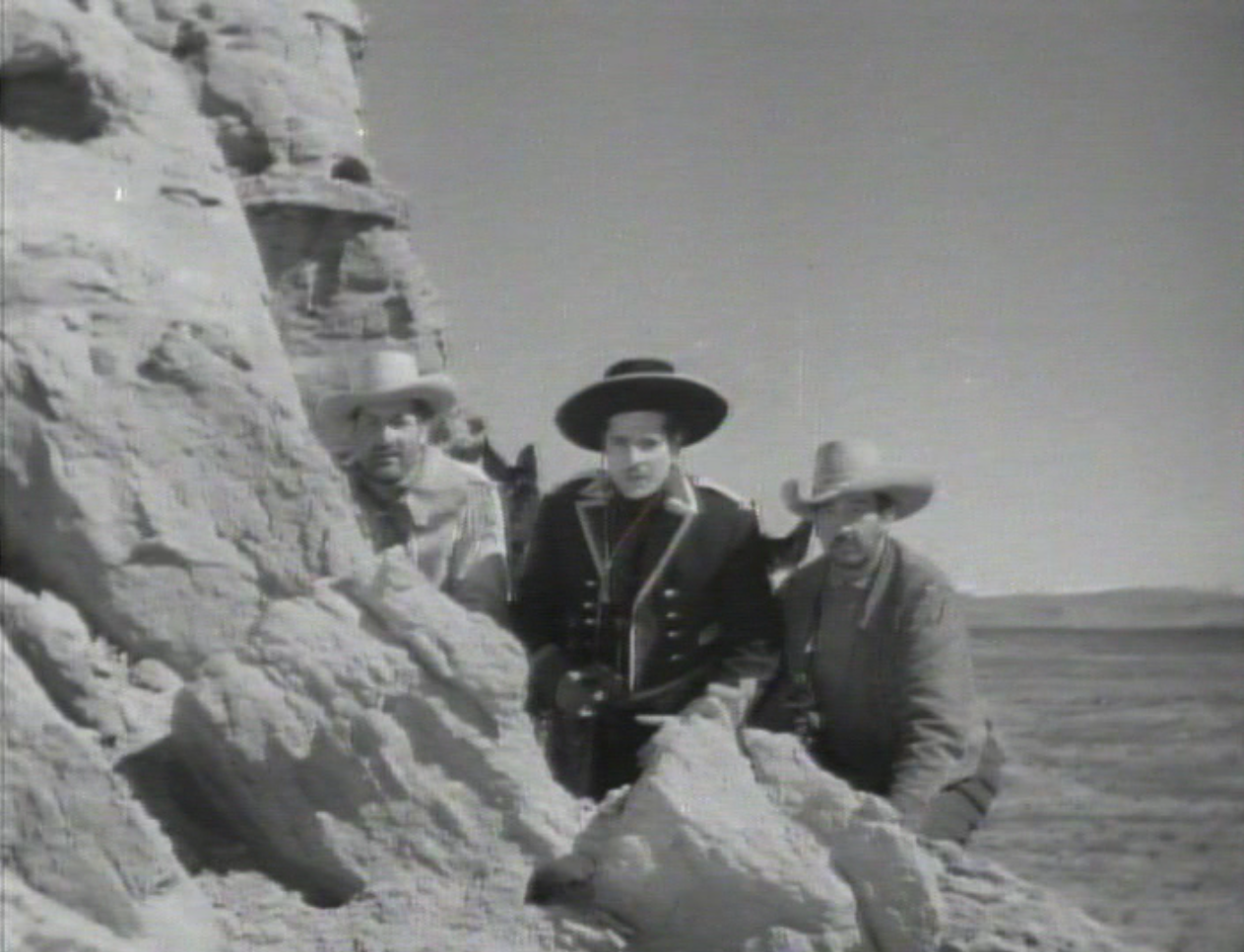
That’s not all: young Kit is at first left in Independence to help the storekeeper run things in Jamison’s absence, but he stows away again, hiding in one of the covered wagons. Recognizing an ambition that will not be denied, Stuart accepts Kit as part of the trading expedition and entrusts him to legendary frontiersmen Jim Bowie and Davy Crockett, who also just happen to be riding with the wagon train. Between these three role models, young Kit begins learning the ropes of scouting and wilderness survival.

PS.Kit.Bowie.Crockett

Also along are Elmer and Oscar, a pair of comic types; in the tradition of comic relief, their characters on screen have the same names as the actors. From what I can tell, the pair frequently worked together, bringing their established personas into the film with them like the Three Stooges (or much as Dan Whitney is usually credited in films under his better-known alter ego, Larry the Cable Guy). Elmer stutters. That’s it: it’s his only defining trait. Like Porky Pig, Elmer struggles to get out a sentence, only to give up and spit out a much pithier paraphrase. Elmer (real name Lou Fulton) is no Mel Blanc: most of his scenes are excruciating, and it only gets worse when he is given a mule with a polysyllabic Spanish name. Oscar (Ed “Oscar” Platt) is slow of speech and wit (yes, that means he has even less characterization than Elmer) but translates for Elmer when the scene is going on too long.

PS.Elmer.Oscar

Finally, Dupray has a number of his men planted in the wagon train as saboteurs. None of them are very interesting or deep, but they need to be mentioned, as their treachery provides the danger in the first few chapters as they attempt to halt the wagon train and/or murder Stuart. Later, after they’ve been discovered and escaped capture, several of them form the gang that supports Dupray in his increasingly desperate maneuvers to hold onto power.

PS.renegade2

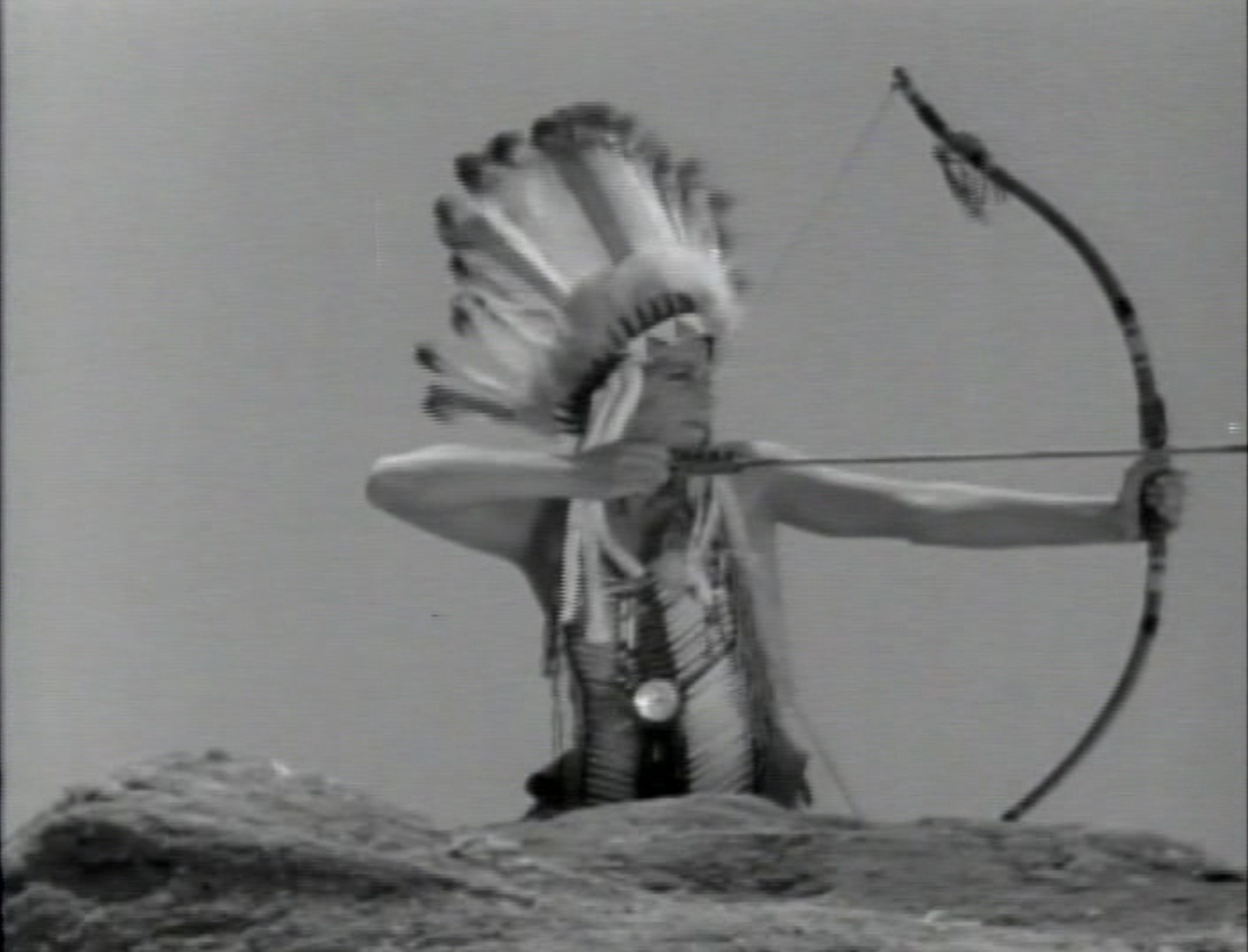
The titular Painted Stallion belongs to a mysterious Indian rider who appears at opportune times to warn the wagon drivers of trouble or protect them. Although Stuart and the other characters don’t find out for a few chapters, the Rider is a beautiful blonde woman (Julia Thayer) wearing a feathered chief’s headdress; appearing on the top of a ridge or other cinematic vantage point, she fires “whistling arrows” (the sound effect is like a long glissando on a violin) to warn the Americans, send messages, or (sometimes) kill hostile Indians or Mexicans. Speaking only a few words of English, she is shown having the power to command animals (her own horse and a panther, which she sets to guard Stuart after he has been knocked out at one point), and she knows the land intimately, including secret entrances to Dupray’s mountain hideout. Who is she? Why does she ride alone, and why do even the local Indians defer to her? Other than Stuart’s brief expression of surprise when he first meets her, no one has much time for that question until it’s resolved at the very end of the serial.

PS.Rider

Even after the wagon train makes it safely to Santa Fe and Dupray’s plot is discovered, there’s trouble. The new governor won’t sign the trade agreement until the Americans can catch Dupray and the bandits who have been under his leadership all along, and with Dupray having fled Santa Fe, the second half of the serial turns into a series of sieges of both the Presidio in Santa Fe and the gang’s hideout. Any historical animosity between Mexico and the United States is wiped away by their mutual foe, the dastardly Spaniard Dupray. “We’re holding them off successfully, thanks to you Americans!” says the new governor during a fire fight. At one point, Jim Bowie is captured. When asked where he is after the fight, Crockett says, “I don’t know, but those bandits had a prisoner that sure looked like him.”

PS.Zamorro1

After the main conflict has been resolved, and all the villains get their comeuppance (even the Painted Stallion gets to face off personally against Zamorro’s black steed), a bunch of loose ends are tied up in literally the last two minutes. (Spoilers follow if you actually plan on watching this, as if you couldn’t guess these developments.) As the new governor signs the trade agreement, he casually notes a story told of a white child raised by the Comanche, the sole survivor of a massacred settlement, and worshiped as a “Goddess of Peace” by the Comanche because of her blonde hair. I was beginning to think the filmmakers were never going to get around to explaining this, but it’s exactly what it seems, a variation on the “White Goddess” trope as seen in She and Green Mansions, the romantic “best of both worlds” fantasy seen in the works of Edgar Rice Burroughs, and a far cry from the complexities of something like The Searchers.

PS.Rider1

In addition to this explanation, Kit is taken under the wing of Jim Bowie and Davy Crockett, who, like everyone else in the serial, foresee his future as a great Western scout. Elmer gets kicked by his mule and finds that his stutter is gone: he rails at the mule with a stream of articulate invective: “You bothersome beast! I denounce you henceforth!”

PS.Elmer

Finally, Stuart and the Rider are shown riding off together after watching the now-successful wagon train head back up the trail. Unlike some of the conclusions of other serials, it’s unclear what their relationship is. In general this is a boy’s affair, like many serials (Thayer is the only woman in the film), but Corrigan and Thayer have real chemistry in their scenes together, so a romantic ending is possible. On the other hand, they don’t so much as hug, so they could just be platonic friends, celebrating their victory over the corrupt Dupray. Even the complication posed by their obvious cultural differences could go either way. I’ll admit that The Painted Stallion has challenged my preconceptions about characters pairing up in formulaic fiction: it’s subtle enough that you could read Clark Stuart as asexual, a progressive representation before its time, or it could just be that the presumed audience of preteen boys wouldn’t want any icky kissing or stuff. And if you wanted to believe that he and the Rider get married and have ten children, you could do that too. Or perhaps I’m overthinking this.

What I Watched: The Painted Stallion (Republic, 1937)

Where I Watched It: A DVD from (ahem) Cheezy Flicks

No. of Chapters: 12

Best Chapter Title: “Tunnel of Terror” (Chapter Eleven; this is a favorite chapter title, used in many serials.)

Best Cliffhanger: Dupray’s mountain hideout includes a trap door that spills out onto a rugged cliff face, spelling certain death for anyone unlucky enough to fall through it. In Chapter Eight (“The Whistling Arrow”), Stuart is captured by the renegades, but manages to turn the tables on them, holding them at gunpoint as he walks backward through the cave. The tease is a little more artful than usual as we are first shown the trap door, and Stuart almost steps on it, but then doesn’t, but then finally does, giving the bad guys the split second they need to dispose of him (cue footage of a ragdoll-limbed dummy falling down the rock wall).

PS.Stuart2

Sample Dialogue: “The West is too big for those hankerin’ to spoil it, Kit. They may try for a while, cause a lot of trouble, maybe kill a lot of good men. The West’ll win out. This wild country we’re travelin’ across will someday be settled. There’ll be railroads, pushing all the way across to the Pacific. The land will be covered with farms, ranches, and homes. Youngsters like yourself, Kit, might even be going to school somewheres close by. Heh, heh. Ah, I wonder how many of them’ll be knowin’ a young fellow named Kit Carson, who first became a scout in these here . . .” –Clark Stuart, Chapter One (The scene simply fades out in the middle of Stuart’s speech, implying that he goes on like this for some time. Give the kid a break, Stuart!)

PS.Kit.title05

PS.Kit.title06

Sample title cards illustrating the "Chosen One" theme decades before Luke Skywalker and Harry Potter

Sample title cards illustrating the “Chosen One” theme decades before Luke Skywalker and Harry Potter

What Others Have Said: “Several historical personages assisted Corrigan throughout–among them a young runaway named Kit Carson, who was played by Sammy McKim. The young Carson, as befit a future Western legend, was written as less of a ‘kid tagalong’ than as a genuinely helpful junior frontiersman, and McKim’s hardiness and spunk suited the role perfectly.” —The Files of Jerry Blake, “Sammy McKim”

PS.Kit2

Point of Connection: While watching The Painted Stallion, I was continually reminded of The Adventures of Brisco County, Jr., the short-lived but fondly-remembered Western TV show starring Bruce Campbell as the title character. While Brisco County drew from many sources, Corrigan was clearly playing the kind of strong-jawed, wholesome (and completely white-bread) hero that Campbell has, in his own winking way, made a specialty. No one would deny that Campbell is more charismatic than Corrigan (not to snark, but compared to Corrigan, Buster Crabbe is Laurence Olivier), but there’s a resemblance. It didn’t hurt that The Painted Stallion is full of the kinds of pulp bric-a-bric–chases, traps, Western lore, and flamboyant characters–that The Adventures of Brisco County, Jr., lovingly indulges in.

What’s Next: Next week I’ll be looking at the Republic serial Government Agents vs. Phantom Legion, again courtesy of (sigh) Cheezy Flicks.

Fates Worse Than Death: The Green Hornet (1940)

GH.title

Britt Reid (played by Gordon Jones) is the owner and editor of esteemed newspaper the Sentinel, having inherited the position from his father; every day, surrounded by his staff, he attempts to shine a light on the criminal activities that vex the citizens of his city. Although he officially believes the newspaper should only cover the news and that solving crimes should be left up to the police, he has a secret: at night he becomes the masked hero the Green Hornet, taking down racketeers in a more direct manner. His valet and driver Kato (the prolific Keye Luke) also backs up his heroics with his martial arts skill and mechanical aptitude (it was Kato who constructed the Hornet’s gas gun and customized the duo’s souped-up automobile, the “black beauty”).

GH.eyewear

GH.Hornet.Kato1

Like Batman, the Green Hornet must affect nonchalance in his civilian identity, and as editor of the Sentinel he even goes along with the fiction that the Green Hornet is just another criminal, only targeting the city’s racketeers because he wants to take their place. The staffers on the paper reflect a range of opinions about the crusader, little realizing that he is in their very midst. Secretary Leonore Case (Anne Nagel) openly admires the Hornet and believes that he is a force for good; Michael Axford (Wade Boteler), a former policeman and now Reid’s bodyguard, accepts the view that the Hornet is a criminal, and he’s gunning for the reward for the Hornet’s capture; reporter Jasper Jenks (Phillip Trent) just wants to get a good story out of the affair.

GH.Sentinel

Almost every chapter of the serial follows the same formula: word comes to the Sentinel (either by one of the reporters chasing down a story or by someone calling Reid, asking him to cover it) about a racket. The rackets are the kinds of injustices that organized crime might inflict on ordinary people: bridges and tunnels built with substandard materials; a rash of car thefts at a particular parking lot; various protection and insurance rackets that are jacking up prices for dry cleaning or shipping; et cetera. There are no death rays or automatons, nor are the crimes particularly outsized (the biggest is an attempt to elect a mobbed-up mayor through repeat voting and literal ballot box-stuffing), but each one is being helmed by a member of the same criminal Syndicate, taking orders by radio from an unknown Leader.

GH.radio

Reid goes to check it out in person with Jenks or Axford, but only gets far enough to verify that something crooked is going on. So he returns as the Green Hornet, Kato by his side, to step in; sometimes he is able to prevent the damage the Syndicate is doing, but in all cases he gets the drop on the gangster in charge of the particular scheme and brings them in, dead (always accidentally, of course) or alive. Posing as a fellow criminal aiming to cut himself into the Syndicate’s deal, he tricks them into revealing facts about their operation as he works his way closer to the boss. Frequently, Axford shows up with similar ideas about confronting the Syndicate, complicating things for the Hornet. After the cliffhanger, the Hornet gets away, setting the stage for the next racket to be taken down.

GH.Hornet1

Obviously, the repetition in the chapters would be less of an issue when viewed on a weekly basis. The Green Hornet had originated on the radio in 1936, and the film serial hews closely to the radio version, even using similar plotlines; the episodic rhythm would have had a comforting familiarity to viewers, much like the majority of series television shows until the last couple of decades. (Indeed, The Green Hornet became a popular TV series in 1966 after Batman became a hit, even crossing over with the Caped Crusader.) Watched back to back, however, it becomes predictable, even for a serial.

From a production standpoint, The Green Hornet is pretty slick, benefiting from Universal’s library of stock footage (some of the bigger set pieces include a burning office building also seen in The Perils of Pauline, a train derailment, and an elaborate carnival). The theme music, Rimsky-Korsakov’s “Flight of the Bumblebee” (the same as in the radio show), is supplemented by other tracks familiar from Universal films, and the titles, newspaper headlines, and other design elements are even better than usual (just look at that title card at the top!). While it is hardly the most sophisticated example of serial storytelling, it does what it sets out to do with style and flair.

GH.chapter.title

What I Watched: The Green Hornet (Universal, 1940)

Where I Watched It: Funny story: last week I said I would be covering The Green Hornet, knowing I had it on DVD. I guess I hadn’t looked at the case very closely, because the DVD I had bought was The Green Hornet Strikes Again, the sequel from later the same year (!). So I had to go back to YouTube, yet again.

No. of Chapters: 13

Best Chapter Title: “Panic in the Zoo” (Chapter Twelve; it’s just what it sounds like)

GH.blackbeauty

Best Cliffhanger: In Chapter Eleven (“Disaster Rides the Rails”), the Syndicate plans to ruin John Roberts by wrecking a train carrying shipments for his trucking business, as payback for refusing to smuggle munitions under his bill of lading. The Green Hornet, catching wind of this plot, hops the train and struggles with one of the gang members while the others uncouple the train cars from the engine. The uncoupled cars begin to roll backwards, down a steep mountain–but there’s another train coming up from behind! A collision seems inevitable, unless the railroad attendant can get the tracks switched in time. The cliffhanger cuts rapidly between three perils: the Hornet’s fight on the back of the caboose, the oncoming train, and the attendant’s attempt to manually pry the stuck switch open, diverting the runaway cars.

Annie Wilkes Award for Most Blatant Cheat: As in many of these serials, some of the least satisfying resolutions involve the Green Hornet (or other characters) simply picking themselves up and brushing themselves off after being in car crashes or trapped in burning buildings. However, the cliffhanger at the end of Chapter Three (“Flying Coffins”) and its resolution in Chapter Four (“Pillar of Flame”) are more typical of what are usually called “cheats:” after forcing the head of a crooked flying school to take off in a plane he knows to be sabotaged, the Green Hornet and the crook struggle while the plane goes down, crashing with a fiery explosion. At the beginning of Chapter Four, however, a shot of the Green Hornet bailing out with a parachute is inserted before the plane crashes (carrying the flying school boss: it’s notable that in all these cliffhangers, the hero never knowingly leaves a Syndicate member to suffer the fate he had in store for the Hornet: he’s a good guy, after all).

GH.Hornet3

Sample Dialogue: “Open that car door while I get this fruit destroyer ready.” –Syndicate member Sligby, in another sabotage attempt on John Roberts’ shipping company, Chapter Seven (“Bridge of Disaster”). No, we never get to see what a “fruit destroyer” looks like.

What Others Have Said: “Who was to play Britt Reid/Green Hornet [on the radio]? Al Hodge auditioned and got the part! For Britt Reid he used a cultured mid-western voice similar to his own, while for the Hornet he used a deeper, rougher, tougher growl. His Hornet voice was so distinctive that for the first Green Hornet movie serial, in which Britt Reid was played by Gordon Jones, Hodge went to Hollywood and dubbed all the Hornet’s lines.” –“Al Hodge, Before and After Captain Video

What’s Next: I’ll cover The Green Hornet Strikes Again eventually. But next week, we’ll go back to the Old West with The Painted Stallion!

Fates Worse Than Death: Serials at Feature Length

NAT.feature.title1

The studios that produced serials were nothing if not parsimonious: considering the ways in which stock footage, costumes, and other production elements were reused, it is not surprising that the films themselves would be repackaged and rereleased as many times as were profitable. During the heyday of the serial format, a popular serial could be rereleased in its entirety after a few years (there were no options for viewers to see them in any other way, of course, and since most were aimed at youngsters, a new audience would arise over time).

Serials were also frequently edited down to feature length (anywhere from sixty to a hundred minutes), either released simultaneously with the serial or later rereleased as “B” pictures. The arrival of television introduced a new market for “featurized” serials, as well. (As an example, in 1966, Republic made a number of its films available to television, both complete serials and several cut down to one hundred minutes.) Sometimes, but not always, these shortened serials reappeared under new titles: Flash Gordon’s Trip to Mars was released simultaneously with the feature-length Mars Attacks the World, its title chosen to exploit the notoriety of Orson Welles’ War of the Worlds broadcast; Undersea Kingdom surfaced on television as Sharad of Atlantis; and so on.

(Note that the photos on the poster are drawn from the 1936 Flash Gordon serial.)

(Note that the photos on the poster are drawn from the 1936 Flash Gordon serial.)

Since I began exploring the serials last summer, I’ve been curious about these feature-length cuts: how do they differ from the serialized originals, and how effective are they at conveying the story and its thrills? There is no one answer: even a cursory survey reveals differing approaches to editing and marketing, and the context of production and the studio’s goals can have a big impact on the final product. In theory, one could cut the titles and credits and the redundant material from the cliffhangers and have a perfectly serviceable movie. In reality, the end product would still be too long for what was considered “feature length” in the mid-twentieth century and the pacing might prove unsatisfying for one sitting. From what I can tell, most cut-down serials come in somewhere between an hour and an hour and a half. (Editing down a serial into a more modern feature length would undoubtedly be an interesting project for a film student or anyone who wants to learn more about the pacing and construction of these films. Indeed, YouTube searches reveal a range of cleaned-up and “restored” versions; how far these restoration efforts extend into actual recutting is a question I haven’t explored in depth.)

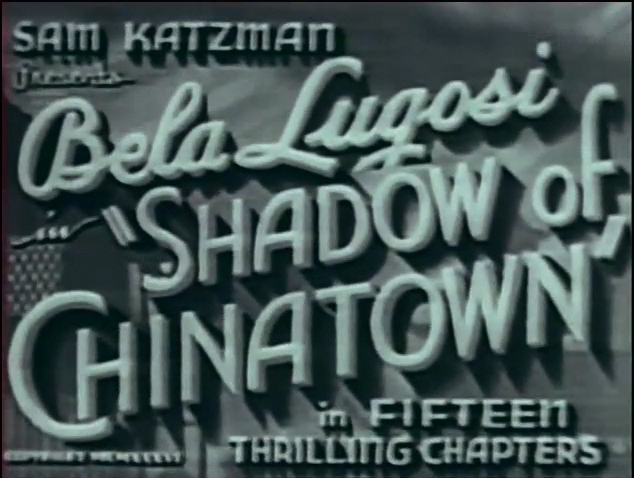
For purposes of comparison I sought out a few “featurized” versions of serials I have already reviewed for this series. An approach that I would assume is typical is seen in the shortened cut of Shadow of Chinatown: at a brisk 69 minutes, the feature zips through the major events of the serial. Much of the “Oriental” color is done away with, as are scenes that have Martin Andrews’ manservant Willy Fu briefly kidnapped, and a car chase between Los Angeles and San Francisco. What is mostly eliminated is repetitive or slow-moving, however; everything that’s left is worthwhile, and more importantly the story makes sense. Willy gets in a few of his pseudo-Confusion aphorisms, and Bela Lugosi still has enough screen time to justify his top billing.

SC.Poten4

Interestingly, however, the reduction of the action to its most exciting elements makes reporter Joan Whiting a more obvious (and sympathetic) lead character than the mansplaining Andrews, at least for a while. Also, the ending cuts off one final twist in which Lugosi’s character comes back from an apparent death to strike at Andrews: this time, he gets his comeuppance the first time. There are a few other small changes, such as the addition of musical underscore to scenes that were without accompaniment in the serial, at least the version I watched; that seems to be pretty standard practice, a way of covering the seams and updating the production. Although I enjoyed the full serial of Shadow of Chinatown, I would consider the feature version an adequate substitute for an interested viewer.

SC.Martin.Joan

By contrast, the feature-length cut of The Phantom Empire feels rushed. Admittedly, its story is complex, with Gene Autry and his Radio Ranch friends pitted against both an unscrupulous radium-hunting scientist and denizens of Murania, the hidden realm located 25,000 feet beneath the surface. Much of what I appreciate in this serial is around the edges, however: those small atmospheric moments or character beats that make it unique. As a feature, The Phantom Empire is still very distinctive. Autry’s musical numbers, integral to the plot (he must broadcast every day or else lose his radio contract, and thus the ranch), are still there, as are Frankie and Betsy Baxter’s DIY electronics lab and their club, the Thunder Riders. Missing, however, are those scenes in which Murania’s Queen Tika spies on the surface world through her television, seething with disdain, as well as a similar scene in which she shows Autry the realities of poverty and war on the surface. Gone also are most of Autry’s fight scenes and a sequence in which, near death, he mumbles in the backwards “language of the dead” before being revived by the miracle of radium. The murder of Tom Baxter is glossed over even more than in the serial, without much time given for it to sink in.

PEAutry1

The biggest loss is the erasure of Queen Tika’s motivation for keeping Murania hidden and, ultimately, deciding to stay with her kingdom during its destruction instead of fleeing to the upper world with Autry. Speechifying is something sci-fi fans often tolerate rather than enjoy, and it’s usually the easiest thing to cut when editing for length, but in this case reducing Tika’s presence drains the serial of much of its personality, turning her into another cardboard villain. If most viewers between the 1950s and 1990s were only able to see the feature-length cut, it’s not surprising that The Phantom Empire is appreciated only by aficionados: without the atmosphere and dramatic build-up found in the full version, it comes off as a diverting novelty in the mold of Undersea Kingdom.

PETika2

The New Adventures of Tarzan was actually edited into two feature films. The first, also called The New Adventures of Tarzan, is a longer version of the first two chapters of the serial, in which Tarzan joins the Guatemalan expedition of Major Martling in order to find his friend, the downed pilot D’Arnot, who is trapped in the same “lost city” in which Martling hopes to find a legendary idol, the Green Goddess. Also hunting for the idol is Raglan, a rival explorer working for a foreign company that wants the explosive formula hidden inside the idol. Although two chapters doesn’t sound like very much, the first chapter of the serial is an unusual forty minutes long, so stretching the film to seventy minutes isn’t as odd as it sounds.

(Also worth noting: while the feature’s release date is given as 1935, a release simultaneous with the serial, the version I watched is obviously a later rerelease, as the leading man is listed as Bruce Bennett; Brix changed his name to Bennett in 1939, a change that coincided with a transition into more prestigious Hollywood fare such as Sahara, Dark Passage, and The Treasure of the Sierra Madre. The music that accompanies these updated credits also sounds like something from the 1940s.)

NAT.Tarzan.Martling

As I mentioned in my review of the serial, I had trouble following the first chapter’s setup, as the sound was patchy and some of the dialogue was hard to understand. The feature version clarifies things a great deal by including extra scenes of dialogue and improving the sound. Some of the dialogue is obviously dubbed, and the voice coming from Tarzan’s mouth doesn’t sound like Herman Brix; I wonder if this version was the cause of John Taliafero’s complaints about Brix sounding like a “school master:” it’s both higher and fussier than Brix’s normal speaking voice, and it doesn’t sound like anyone’s idea of the lord of the jungle. As for the rest of the dubbing, it at least helps the story make sense, and there are also added background music and sound effects that give the film a more complete, modern atmosphere.

NAT.feature.title2

NAT.feature.title3

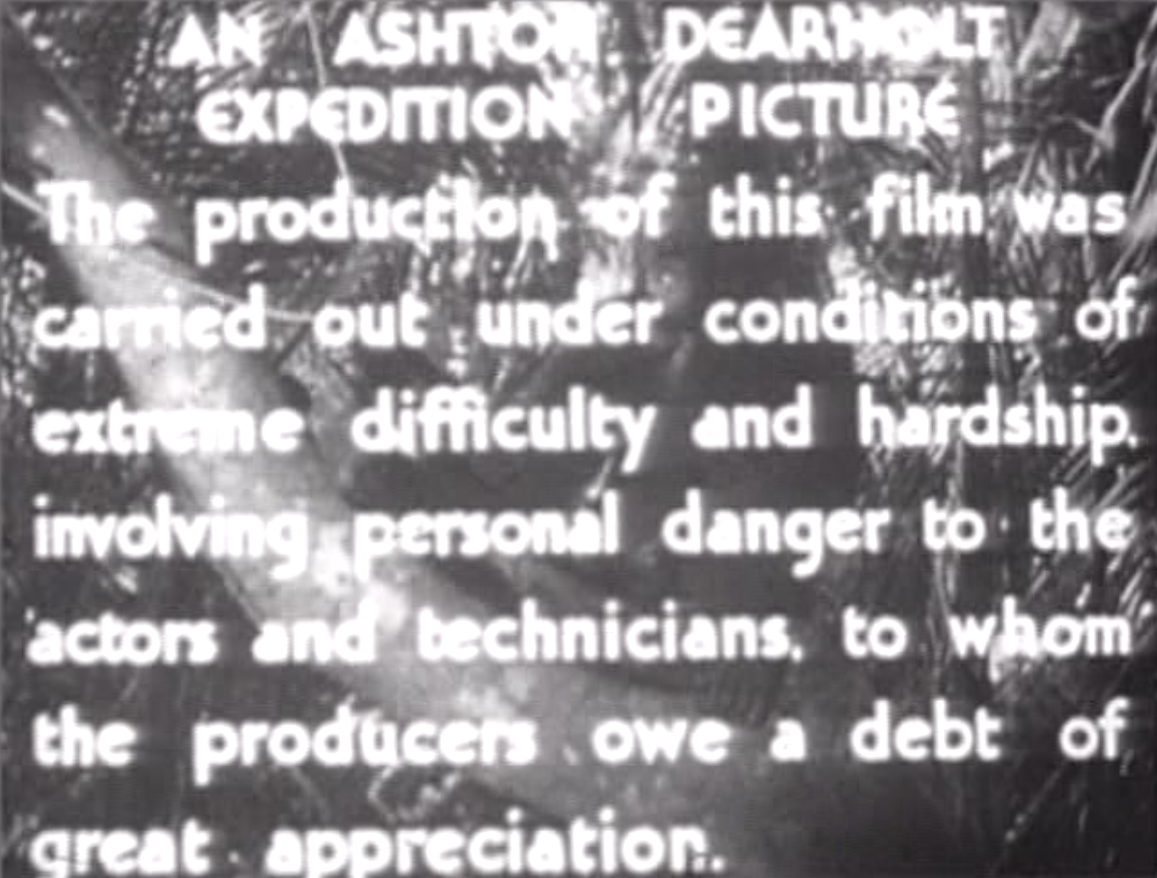
Even so, the film begins with an apology for the sound quality, recorded under difficult conditions, and begs for the indulgence of the audience. It’s hard to imagine any modern film making such a plea, unless it were a documentary. Taliafero mentions that the Ashton Dearholt expedition that filmed The New Adventures in Central America ended up with enough footage for both a serial and a feature film, and sure enough there is a great deal of footage that doesn’t appear in the serial. Much of it is atmospheric footage of wild animals, natives, and the exotic country, and while it is impressive on its own, its inclusion in the finished film often smacks of padding, giving the film the air of a travelogue punctuated by a few scenes of action. (Particularly shameless is a flashback to D’Arnot’s plane crash that includes almost five minutes of aerial footage of animals before the actual crack-up.)

Some of the events from the serial are rearranged slightly (and obviously the cliffhangers from the serial are simply played out as action scenes without interruption), but the biggest change is at the end: in the serial, Raglan is able to steal the idol from the lost city and make away with it, with Martling and Tarzan on his trail. In the feature, Tarzan recovers the idol from Raglan almost immediately after he steals it and Martling is able to open it right there, finding the jewels inside. A happy ending for all!

GG.title

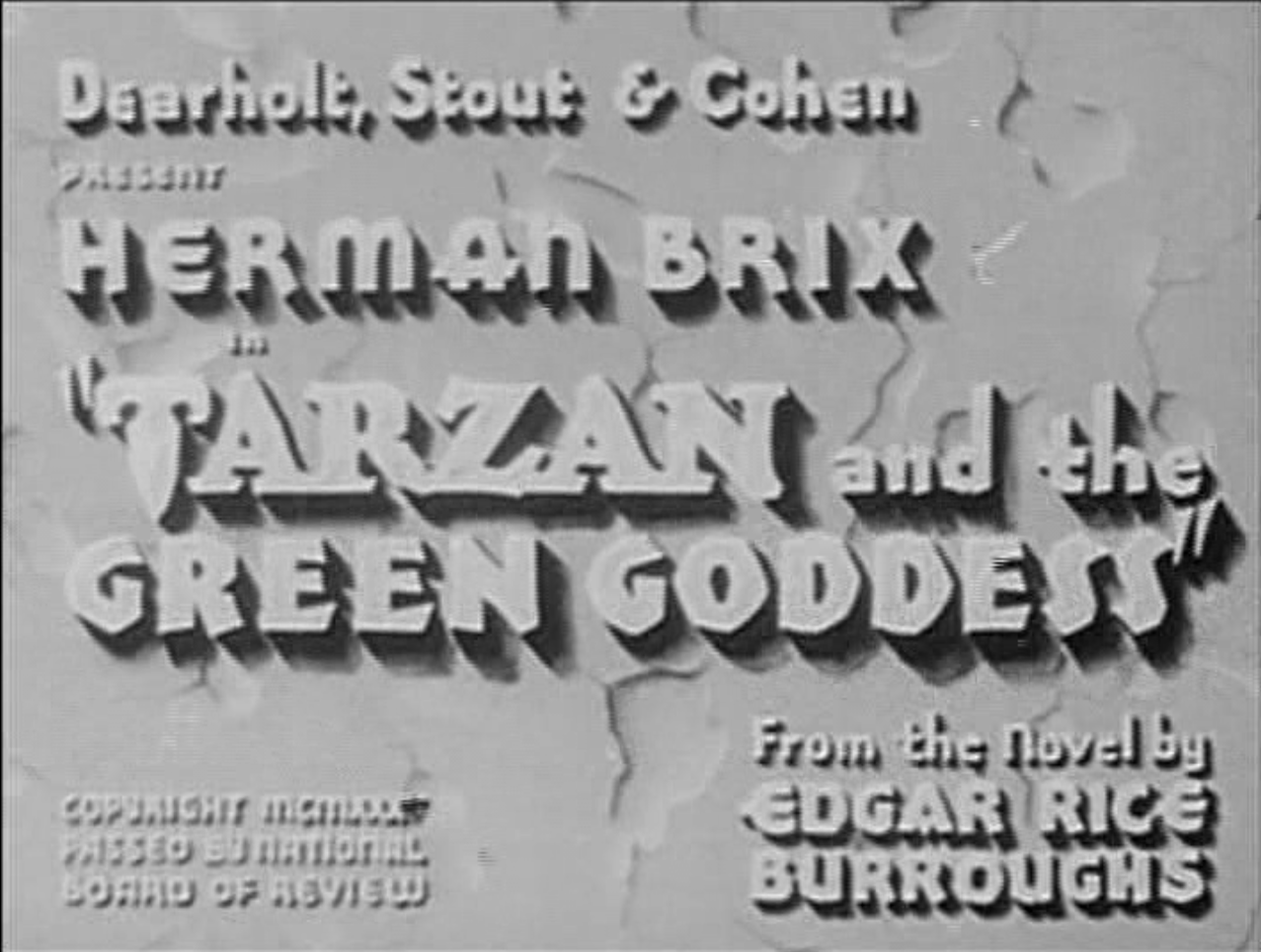
Of course, Raglan gets away, and his (as well as the lost city cultists’) attempts to take back the idol are the main thread of Tarzan and the Green Goddess, the 1938 feature that includes the rest of the serial. In this film, the raw material of The New Adventures undergoes a more interesting transformation. The last chapter of the serial takes place at Lord Greystoke’s British estate, where he is holding a Gypsy-themed costume party; some of his guests ask him to recount his recent adventure in Guatemala, and he does so in flashback, turning the last episode into a belated “economy chapter.” Green Goddess puts this frame device around the entire film, which takes up the action following the escape from the lost city. The movie barely reaches an hour in length, and without the padding found in the first feature the plot moves at a breakneck pace (although it still finds room for a scene in which Martling’s valet George chases a monkey who has stolen his yo-yo). Despite being edited together with more sophistication than the 1935 releases, I’m glad I had seen the whole serial before watching this, for the sake of clarity.

GG.GreystokeManor

Finally, there is the issue of availability. After long years of being hard to find, even for collectors (Harmon and Glut’s 1972 The Great Movie Serials, a book I have found an invaluable resource for this series, was partially based on memories of serials sometimes seen years before, and occasionally the distance shows in distorted or jumbled details), home video made it possible for many serials to be seen as they were originally released, and websites like YouTube and the Internet Archive have made it even easier for anyone with an internet connection to watch these films. In the case of feature-length cuts, the internet is frequently the only choice, as even high-quality restorations for home video don’t usually see fit to include them (I watched the feature versions of both Shadow of Chinatown and The Phantom Empire on YouTube).

Having said that, since many serials and their feature cuts are in the public domain or can be considered “orphan works,” I have found that they also turn up on cheap movie-compilation DVDs. Both of the Tarzan features I have discussed here are included on a Mill Creek collection entitled Wrath of the Sword: 20 Legendary Movies, which includes several Tarzan movies from the 1930s, a bunch of sword-and-sandal movies from the ’50s and ’60s, and (for some reason) one random Christopher Lambert movie from 2005. There’s nothing in the packaging of Wrath of the Sword that would indicate that the two Tarzan movies are related sequentially or derived from the same serial, but that’s part of the fun of this sort of quantity-over-quality package: you never really know what you’re going to get, and you have the opportunity to make discoveries and draw your own conclusions.

WrathoftheSword

Next week I’ll be back with regular serial coverage as I examine The Green Hornet.

Fates Worse Than Death: Flash Gordon’s Trip to Mars

FG2.title

At the end of Universal’s 1936 serial Flash Gordon, Flash, Dale Arden, and Dr. Zarkov are bound for Earth by rocket ship after saving the planet from destruction by the invading planet Mongo and its ruthless Emperor, Ming (who was, to all appearances, burned to death in the “Tunnel of Terror,” leaving his daughter Aura and Prince Barin to rule over Mongo with a presumably gentler hand). As the 1938 sequel Flash Gordon’s Trip to Mars begins, the people of Earth are still awaiting that rocket ship, which successfully lands in the first chapter. That makes Trip to Mars a direct continuation of the original serial, and in many ways it’s a sequel in all the modern senses of the word: it has most of the same cast as the first (although as Dale Arden, Jean Rogers has inexplicably let her hair return to its natural brunette during the trip from Mongo to Earth), and is in all ways bigger, with more ambitious effects, more locations, and greater length (fifteen chapters instead of thirteen). There are even some flashbacks to the 1936 serial spliced in to explain plot developments.

FG2.Dale1

It’s worth noting that the practice of making sequels and series, what we now call film “franchises,” is nothing new, and wasn’t even new in 1938. Some of the long-running episodic serials like Hazards of Helen were closer to ongoing series than the closed narratives of the serials I’ve been examining here. Beginning in the silent era, popular characters such as Boston Blackie, Charlie Chan, and Tarzan had proven that cinema audiences liked to catch up on the adventures of familiar characters just as much as book and magazine readers did. By the time Flash Gordon was taking his trip to Mars, the Andy Hardy series was already on its fifth installment, and it had only started the year before! Similarly, the Dead End Kids made six films for Warner Brothers between 1937 and ’39. The Blondie series, which would eventually run to twenty-eight films, also began in ’38.

FG2.cockpit

No sooner have Flash (Larry “Buster” Crabbe) and company returned to heroes’ welcomes (SUPER-MEN OF CENTURY WIN WORLD ACCLAIM! reads my new favorite newspaper headline) when Earth suffers an attack similar to that which opened the ’36 serial. Disasters and weather events threaten the planet, this time tied to mysterious beams of light emanating from the planet Mars. Suspecting the hand of their erstwhile foe Ming, Flash and his allies (joined by a reporter who stows away on the rocket ship) take off for Mongo. However, unlike Abbott and Costello, Flash does actually end up on Mars, as the deadly beam interferes with their ship and causes them to crash on the red planet.

FG2.Azura.Ming1

In a twist that will surprise no one, Ming (Charles Middleton, in fine scenery-chewing form) is on Mars, having survived the flames of the Tunnel of Terror (it’s eventually explained that he can walk through flames without injury), and he is cooperating with the Martian Queen Azura, using the beam to draw “nitron” from Earth’s atmosphere, which Azura can use as an explosive in her war against the Clay Kingdom (and without which the Earth will die, suiting Ming’s purposes nicely). Ming’s goals are conquest and revenge upon the Earthlings who thwarted him before; his previous goal of marrying Dale Arden is never mentioned.

FG2.forest

As the events of the serial take place on Mars, there are several new settings and exotic races for Flash and company to encounter and either overcome or win to his side. The Fire People live in a gnarled forest, dressed in caveman furs and worshipping idols; loyal to Ming, they imprison Flash the first chance they get, leading him to a reunion with his old ally Prince Barin (Richard Alexander), also a captive of the Fire People. The Martians themselves, Azura, and her palace are pure art deco space opera, equal parts Galactic Empire and Emerald City of Oz. In fact, the embrace of fantasy is even more committed here than in the first Flash Gordon serial: although there’s still a great deal of pseudoscientific rationalization with rays and “nitron” and “televisors” and so on, at some point the writers threw their hands in the air and said, “Fuck it, it’s magic.” The Glenda-like Azura is described as a “Queen of Magic,” with a white sapphire that allows her to teleport in a puff of smoke and lay curses on her enemies.

FG2.Azura

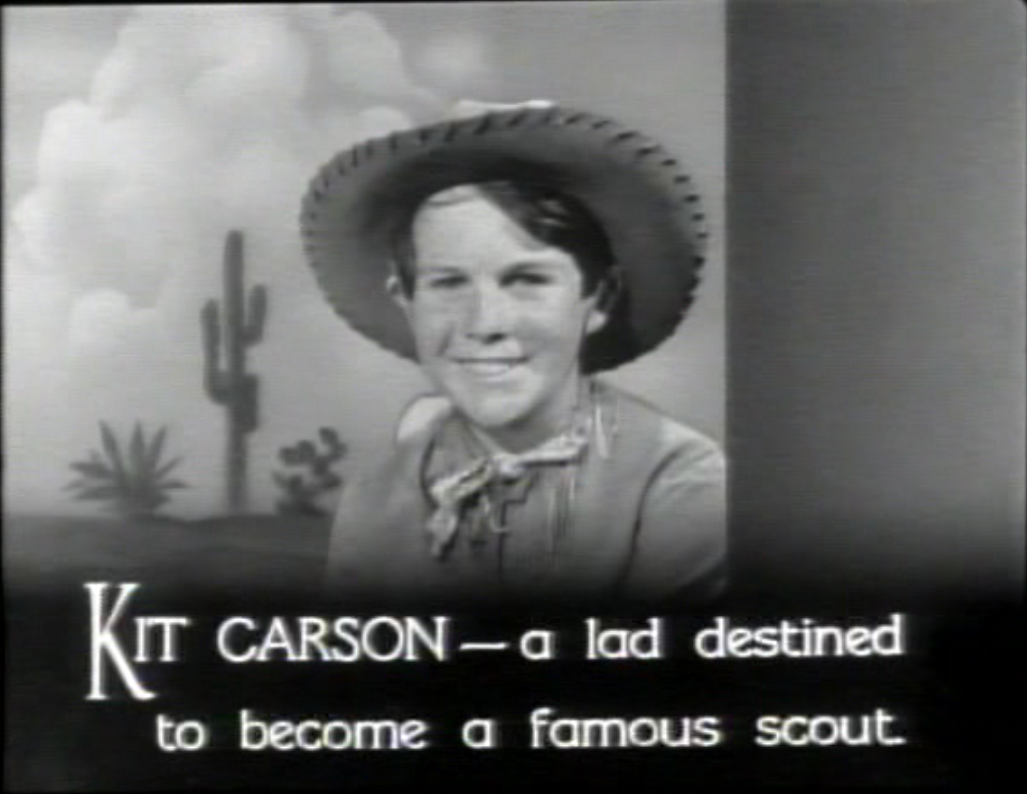
The victims of one of those curses, the Clay People, were once normal Martian men until they rebelled against Azura, and she transformed them into mud monsters, exiled to a remote cave. As the Clay King, British actor Montague Shaw delivers his lines through an immobile rubber mask, the equivalent of casting Alec Guinness and Peter Cushing in Star Wars and having them play Jawas. The Clay People occupy the moral middle ground that Vultan and his Hawk Men occupied in the first serial: waging war against Azura and suspicious of spies, they at first capture Flash and his friends, holding Dale hostage until Flash can bring the Queen to them and force her to undo their curse. After winning their trust, however, Flash and company find the Clay People capable allies, and they’re eventually able to help them regain their human forms.
FG2.Clayking

As far as the new additions to the cast go, reporter “Happy” Hapgood (Donald Kerr) is a typical sequel misstep: the “cool” character who comes along for the ride (in this case literally) to provide comic relief and deflate the stuffiness of the proceedings, but who doesn’t add as much as he detracts. Such characters are sometimes meant to be audience surrogates, seeing with fresh eyes the wonders that the heroes take for granted. In the case of Flash Gordon, however, that isn’t really necessary, as his essentially open nature is part of the character’s appeal; he may not be impressed by the likes of Ming, but he doesn’t really do “jaded,” either. Also, Hapgood’s one-liners, delivered with “make ’em laugh” intensity and frequency, just aren’t that funny. Fortunately, after the first couple of chapters he isn’t that prominent in the serial, providing Dale some company while she’s held hostage and providing the fight scenes an extra body when rough stuff is necessary, limiting his jokes to only one or two per chapter.

FG2.Azura.Ming2

On the plus side, I’ve made no secret of my appreciation for the haughty, imperious women who often turn up in the serials: think of Princess Aura, or Queen Tika from The Phantom Empire. So it will be no surprise that I enjoyed Beatrice Roberts’ performance as Azura, her eyes flashing and lip curling with amusement at the primitive Earthmen opposing her, and delivering lines like “Thus do I banish all traitors!” Of course, Azura learns what stern stuff Flash is made of, although it’s noteworthy that she doesn’t fall in love with him. Like Tika, she’s ultimately a tragic figure who realizes too late that she’s cast her lot with the wrong side. (Another connection to Tika is the presence of mustache-twirling character actor Wheeler Oakman, who played the treacherous Lord Argo in Phantom Empire. Here Oakman plays Azura’s captain of the guard Tarnak, who willingly serves Ming until he realizes that the Emperor intends to follow up destroying Earth by doing the same to Mars after it has served his purposes.)

FG2.Tarnak

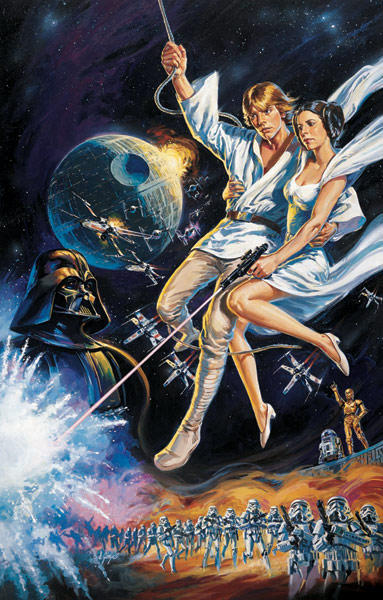
If anything, Flash Gordon’s Trip to Mars sets the template for Star Wars even more clearly than the 1936 serial: there are broad similarities, shared by many serials, such as the blend of exotic locations, flashy visuals (including cutting-edge effects and immersive production design), and fast-paced action, combined with the fairy-tale clash of good and evil. The stirring music (including a version of the love theme from Tchaikovsky’s Romeo and Juliet) and remixing of ancient and medieval motifs with futuristic elements is also something that George Lucas would update for his space fantasy. But there are little moments, too, that stick out: the quirky music that accompanies the Clay People, for example, is echoed in the Jawas’ theme; the repeated back-and-forth as Flash and his allies return to Azura’s high-tech city for one reason or another–to destroy the “nitron lamp” that is slowly draining the Earth; to find an antidote for the “Incense of Forgetfulness”; to confront first Azura and then Ming–is one source for Luke Skywalker and the Rebels’ infiltration of the Death Star and their later raids on it (and its successor in Return of the Jedi). Flash even rescues Queen Azura from falling off a “light bridge” by swinging on a cable, a move borrowed from Douglas Fairbanks and Errol Flynn and recreated by Mark Hammill with Carrie Fisher.

StarWars_Gouzee

It all comes down to a final confrontation, and although Crabbe would return as Flash one more time in Flash Gordon Conquers the Universe, it appears that Ming is defeated, and Mars, like Mongo, is left in better hands. The four heroes return to Earth, and to my amusement the newspaper headline again reads SUPER-MEN OF CENTURY WIN WORLD ACCLAIM! (I like to imagine an editor, knowing that he already struck gold once with that headline, saying to himself, “Why mess with perfection?”)

FG2.Flash.Ming1

What I Watched: Flash Gordon’s Trip to Mars (Universal, 1938)

Where I Watched It: It’s on YouTube in its entirety.

No. of Chapters: 15

Best Chapter Title: “The Black Sapphire of Kalu” (Chapter Eight). I usually define “good” chapter titles as having a certain punch or flair, or capturing the tone of the serial especially well, and there are several chapter titles in Trip to Mars that meet that standard. I chose this one, however, because of its specificity, a somewhat rare quality in chapter titles.

Best Cliffhanger: Just as Flash Gordon found its titular hero robbed of his memory thanks to one of Princess Aura’s schemes, so here does Flash’s paramour Dale Arden experience the “Incense of Forgetfulness” in the Temple of Kalu at the end of Chapter Ten. Convinced that she is a servant of the forest people’s god, she stabs Flash in the back when he shows up to rescue her. (Flash recovers from his wound, but only by returning to Azura’s city are Flash and Zarkov able to find an antidote so Dale can recover her memory.)

FG2.Dale2

Another Note About Costumes: In my review of Undersea Kingdom, I noted the prominence of Roman-style helmet crests and other kinds of cranial plumage in the costume design. Mars appears to have a similar taste for adornment based on the uniforms of Queen Azura’s soldiers (here, Flash, disguised as a member of Azura’s Death Squadron, pretends to hold Dr. Zarkov prisoner):

FG2.Flash.Zarkov

And just look at this fellow on the left:

FG2.plumes

Sample Dialogue: “I’d feel a lot better if I had a parachute instead of these Martian wings!” Dr. Zarkov (Frank Shannon), just before bailing out of a “stratosled” (Chapter Four, “Ancient Enemies”)

FG2.Zarkov

Bonus Sample Dialogue: “I wonder what the wife’s going to say when I get home!” –“Happy” Hapgood (Chapter Fifteen, “An Eye For an Eye”)

What Others Have Said: “We tried to buy the rights to Flash Gordon from King Features but the deal would have been prohibitive. They wanted too much money, too much control, so starting over and creating from scratch was the answer.” —Star Wars producer Gary Kurtz in a 2010 interview with the Los Angeles Times

What’s Next: After the epic length (about five hours) of Flash Gordon’s Trip to Mars, I’m going to take next week to focus on a special topic: serials cut down to feature length.

Fates Worse Than Death: Panther Girl of the Kongo

PG.title

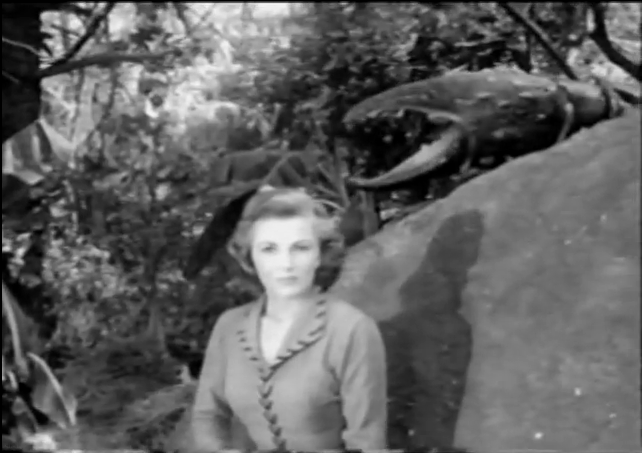
While filming wildlife in the jungle for a foundation, Jean Evans and her native guides stumble across a terrifying monster: a giant, horse-sized crustacean with huge pincers. The chief of the Utanga people, Evans’ hosts, suggests that she contact Larry Sanders, a hunter on safari in the area, and enlist his help: “Bwana Sanders big hunter,” says Timbu, Evans’ rifle bearer. “He go with us, me go.”

PG.Evans2

In the mean time, two other white men in the area are causing trouble: Cass and Rand, first posing as hunters, try to intimidate Sanders into leaving the area. As the audience soon finds out, the pair is in the employ of Morgan, a chemist living on his own in the jungle. Morgan has discovered that an abandoned gold mine in the jungle is full of diamonds, and he’s using a “hormone compound” of his own creation to turn ordinary crawfish into the giant “devil beasts” to scare off intruders. He must be careful, however: the monsters are useful if they frighten the natives away from the mine, but if Evans and Sanders are able to bring proof of their existence to the colonial authorities, a force of soldiers is sure to be sent in to clean up the district, spoiling Morgan’s plans.

PG.Morgan2

So begins Panther Girl of the Kongo, almost the last serial Republic produced (only one more, King of the Carnival, followed). Since I’ve been watching serials for Fates Worse Than Death, I’ve idly speculated about a combination of the serial format and its two-fisted plotlines with the monster movie, another favorite genre. Panther Girl is in many ways that film, although it is closer in spirit and technique to Them! and the other “giant bug” movies of the 1950s than it is to Godzilla or any of the rampaging kaiju films that followed.

PG.Beast3

It should be immediately apparent that the “devil beast” (alternately, “claw monster”) actually is a normal crawfish filmed in extreme close-up to make it look large, sometimes surrounded by miniature props (provided, as always, by the Lydecker brothers, Howard and Theodore, who at least receive onscreen credit this time) to give it a sense of scale. Even better, the actors are sometimes inserted into the foreground via rear projection, relying on perspective to enhance the illusion, but just as often the creature’s size is implied through the magic of editing. And when someone is unfortunate enough to be attacked by the devil beast, it takes the form of a single enormous claw extending from offscreen, like the giant hand grabbing Fay Wray in King Kong.

PG.claw

Other than the formal restraints placed on it by being a serial–division into chapters with contrived cliffhanger endings–Panther Girl feels very much of its time: by comparison to the often melodramatic serials of the 1930s, it’s very no-nonsense, with an emphasis on the professional competence of the two leads. Although thankfully not as inert as Radar Men From the Moon, the characters are fairly dry, emphasizing that they have jobs to do and they’ve got to be done right. Even the “mad scientist,” Morgan, plays things cool: he’s in it for the money, not revenge or a grand scheme to remake the world. Other than the trendiness of the mammoth crawfish (which invite comparison to director Bert I. Gordon‘s similar low-budget giants), the small scale of the action and limited number of characters make it feel very much like a television production.

PG.Beast2

Television was surely having an impact: although Panther Girl was released in theaters, Republic obviously made the film with an eye toward repackaging it for broadcast. Other than the first chapter, which is about twenty minutes long, all the chapters are about thirteen minutes in length. Two chapters could be aired during a half-hour block with room to add commercials. A number of serials had already been cut down to feature length and licensed for television broadcast, and several characters who had appeared in theatrical serials had made the jump to TV-only productions. Even the actors in Panther Girl were doing most of their work for the small screen. In the face of competition that kept audiences–especially kids–at home, the serials were on their way out.

The lead actress, Phyllis Coates, had played Lois Lane on television opposite George Reeves in Adventures of Superman (she had also appeared in a previous serial, Jungle Drums of Africa, with Clayton Moore, television’s Lone Ranger; I haven’t seen it, but it doesn’t seem to have been very impressive). Myron Healey, who played Sanders, was a prolific character actor usually cast as the heavy; most of his credits were from television. In 1955, the year Panther Girl was released, he had parts in over twenty films or TV episodes. His performance here reminded me of Russell Johnson’s Professor on Gilligan’s Island.

PG.EvansSanders2

Commentators have noted an increased reliance on stock footage during Republic’s later years, another sign of pinched budgets. In the case of Panther Girl, the scenes of Evans (who, in a flashback, earned the title “Panther Girl” by saving the Utanga village from a black panther that had been prowling around and attacking the villagers) swinging from vines and mounting a tame elephant were repurposed from Jungle Girl, an earlier serial starring Frances Gifford. That is apparently the main reason Evans appears to have gone native in a short buckskin tunic.

PG.elephant

Her costume and familiarity with vines aren’t the only traits she owes to Tarzan and the jungle monarchs who preceded her. Both Evans and Sanders take the natives’ obedience for granted: the Utanga speak pidgin English and address the whites as “Bwana” (“boss,” “master”) and although they sometimes have to be persuaded to take a course of action, they mostly fall in line. When Evans and Sanders conceive of digging a pit to trap one of the devil beasts, Sanders says, “Let’s head back to the village and get the natives started.” (Morgan also has a tribe of natives to boss around in addition to his two white henchmen: the Returi are addicted to a “tonic” he supplies them with and will do his bidding to get it.)

PG.Morgan1

Although minor, there are pleasures to be found in Panther Girl of the Kongo: the giant crawfish is imaginative, if not exactly scary, and the two leads are a pair of likeable squares who work well together. Morgan (Arthur Space) isn’t the most compelling villain but his plans lead to a dramatically satisfying increase in peril for our heroes, from stolen evidence to quicksand, then to being shot at and blown up with dynamite. On the negative side, the representation of African natives obviously wouldn’t be acceptable today; it’s one cannibal cooking pot away from hitting almost every stereotype imaginable and says more about the popular image of colonialism than the reality. (A pair of stiff-upper-lipped Brits in pith helmets show up to handle the Returi tribesmen toward the end, but they’re hustled offstage quickly so that Evans and Sanders can confront Morgan by themselves. If those British soldiers wanted in on the action, they should have gotten their own serial.)

PG.soldier

What I Watched: Panther Girl of the Kongo (Republic, 1955)

Where I Watched It: The whole thing is posted on YouTube.

No. of Chapters: 12

Best Chapter Title: “Test of Terror” (Chapter Five). The test in question is the “Test of the Lion Men,” in which Jean Evans reassures the doubting natives that she still has the protection of the gods by entering an arena and killing a lion. Based on the costumes, and the fact that this interlude makes no sense, I assume it’s also cribbed from an earlier film.

PG.lion

Best Cliffhanger: At the end of Chapter Three (“The Killer Beast”), Evans is captured by the Returi and tied to a tree while one of the tribesmen plays a drum to lure predators from the jungle. The goal is to fool the Utanga into believing that the Panther Girl has been slain by wild animals. A gorilla attacks her while she’s tied up, and Sanders is unable to help her after being knocked out by the Returi.

Annie Wilkes Award for Most Blatant Cheat: Most of the cliffhanger resolutions play fair. The most questionable is at the end of Chapter Ten (“Blasted Evidence”), in which Cass and Rand throw a bomb through the window of Evans’ house where she and Sanders have just shown the district police inspector the film of the devil beast, convincing him to send reinforcements to the district. It appears that the bomb explodes immediately, engulfing the house in a great fireball.

PG.explosion

However, as shown at the beginning of Chapter Eleven (“Double Danger”), the bomb doesn’t detonate right away, and the three have the chance to flip over a table and shield themselves from the blast. Even so, I’m not sure how they escaped being burned alive.

Biggest Surprise: I fully expected the mad scientist Morgan to die at the hands–er, pincers–of one of his own devil beasts. It just made sense: he grows the things in a crate right in front of his own house where the final showdown occurs, and the filmmakers even make a point of having Evans and Sanders discover it, solving that part of the mystery. But that’s it: I won’t share how he gets his comeuppance, but it isn’t death by claw. Perhaps there was originally an intent to deliver poetic justice but filming it didn’t work out. In any case, the ending makes it seem that the devil beasts aren’t really that dangerous, aside from that nasty pinch.

Sample Dialogue: “Panther Girl bad magic, bring devil beast, make pictures for her. Devil beast kill natives. She no care!” –Returi tribesman, sowing discord among the Utanga (Chapter Five, “Test of Terror”)

PG.Returi

What Others Have Said:Panther Girl of the Kongo could not save the Republic serial from extinction. The first and last female serial star from that studio wore the same jungle garb. But the clothes and every setting and situation they appeared in, in 1955, was secondhand and worn out.” –Jim Harmon and Donald F. Glut, The Great Movie Serials: Their Sound and Fury

What’s Next: Flash Gordon’s Trip to Mars

It saddens me to say that The Dissolve, my favorite site on the Internet for the last two years, is closing up shop. The whole thing happened rather suddenly, but has been confirmed by an announcement from Editor Keith Phipps. I’m saddened to lose the insights of Phipps and the other writers for the site, but I’ll also miss the lively discourse among the commenters and the general culture of sincerity and encouragement. Despite The Dissolve’s official focus on movies, subjects under discussion often ranged widely both in the regular articles and in the comment sections. There are at least four articles on this blog that got their start as comment-section projects (my Lovefests on Addicted to Love and Cowboys & Aliens, my Scarefest on The Visitor, and my tribute to former Dissolve writer Nathan Rabin, Guardian of the Gods). That’s not even mentioning The Solute, the site launched as both a tribute to and an extension of its parent site. I’ll continue to post over there, and if the current influx of commenters over there is anything to go by, it may well end up being a continuation of the lively forum we had at the Dissolve; I invite you to read wallflower’s memorial, which eloquently sums up the feelings of so many of us.

R.I.P. The Dissolve, and good luck to its staff as they move forward.

Fates Worse Than Death: Shadow of Chinatown and Big Trouble in Little China

SC.title

“China is here, Mister Burton.” –Uncle Chu (Chao Li Chi), Big Trouble in Little China

BT.title

Like most fans of John Carpenter’s Big Trouble in Little China, I didn’t see it during its 1986 theatrical release, but came to love it through its repeated airings on cable and home video. Starring Kurt Russell as Jack Burton, a clueless trucker drawn into a supernatural battle in San Francisco’s Chinatown, and full of martial arts action, special effects, and comic banter, it was one of those movies that if I ran across it on TV, I had to watch to the end (so I’ve seen the middle and ending many more times than the beginning). It was probably the beginning of a fascination with Orientalism–both the legitimate history and art of the Far East, but also those hybrids of detective, occult, and political fantasy produced in the West and collectively referred to as “Yellow Peril.”

BT.LoPan2

Although always questionable from a perspective of accuracy and cultural sensitivity, stories set in Chinatown have proven irresistible to pulp and comic book writers and filmmakers alike (one collection of pulp stories bears the memorable title It’s Raining Corpses in Chinatown). The idea of an enclave of exotic, unknowable foreigners at one’s doorstep, perhaps possessed of uncanny abilities and ancient wisdom, was catnip for writers who needed simple, lurid story hooks and artists who were tired of drawing white guys in fedoras.

SC.Martin.Wong

And of course, a story set in an Asian enclave in the West has a very different dynamic from one set in a purely Asian culture: one gets the sense of a hidden world, the door to which just happens to be a cab ride or subway stop away. Such stories are inevitably told from the perspective of a white (or at least non-Asian) outsider drawn into the web, pulling back the curtain to discover whatever is really going on behind the curio shops and chop suey palaces, be it the opium trade, “white slavery” (i.e., human trafficking), or a brewing tong war. A 1909 article about New York’s Chinatown summed up this juxtaposition of the exotic and the familiar in language that could have been pulled from any number of pulp stories or movies of later decades:

There it lies, unfathomed and unknown, in the very ear of the city where all things come to be known–where a pin dropped on the other side of the world is heard an instant afterward–contemptuous, blandly mysterious, serene, foul-smelling, Oriental, and implacable behind that indefinable barrier which has kept the West and the East apart since the centuries began. Within the boundaries of the three acres which it occupies, five thousand slant-eyed children of Cathay and three or four hundred whites, who have cast their lot with them, order their existence like rabbits in a warren.

Chinatown

Really, it’s all there: physical stereotyping, the “inscrutability” of the Orient, even the “foul” smells of another culture. Hinted at in this excerpt, and persisting throughout the article (“Slumming in New York’s Chinatown,” reprinted in the book Tales of Gaslight New York), is the unshakable belief that the Chinese population is up to something, that they hide their real intentions and loyalty, and that their influence on whites can only be a corrupting one. Framed as an exposé, “Slumming in New York’s Chinatown” presents many of the same arguments that were used to justify the internment of Japanese-Americans during World War II, and which today target other immigrant populations. In this point of view, summed up nicely by the quotation with which this article began, Chinatowns and other ethnic enclaves are really extensions of the Old Country: step in, and you are effectively in foreign territory.

So how can I justify being a fan of a genre frequently steeped in ugly stereotypes and often pointedly racist in its political undertones? Were I of Chinese descent, I am sure I would not be so blasé about such issues, and I would surely take them more personally. Here, at last, I must address an issue that I have circled and sometimes approached in this series, but never taken head on.

The serials (and the other pulp fiction and comics that I write about) were made during a time in which racism was not only a tolerated but an actively endorsed part of life–not by everybody, of course, as even in the days of Jim Crow laws and the kind of housing discrimination that led to the formation of Chinatowns and other ghettos in the first place, there were brave voices willing to speak up for equal treatment of their fellows–and their content often reflects prevailing attitudes, some of which seem merely quaint today and some of which were downright ugly. I hope it is clear to my readers, however, that I don’t bring up these attitudes to burnish my own image or simply congratulate myself for living in a more enlightened time. I genuinely enjoy the entertainment of this period, and while I may take a good-natured poke at the sillier contrivances I encounter, I wouldn’t bother with it if I didn’t find that it rewarded the time I’ve invested in watching and researching these films. If the writing, production, and cultural context of serials are worth taking seriously, then so are the issues of representation they bring up.

To me, this is an appropriate place to deploy the word “problematic:” it may be overused, but I think it accurately describes art that provides substantial entertainment or edification but which has issues that can’t simply be dismissed. After all, if a work has no redeeming value at all, that’s not really a problem, is it? It can be safely dismissed as racist trash. Rather than perform mental gymnastics to prove to myself that a given representation isn’t really offensive, just because I happen to like the work it is a part of, it’s probably healthier to simply acknowledge that we can enjoy works without endorsing every part of them or the politics that underlie them. (And here I’m not so much referring to Big Trouble in Little China, which I consider a knowing riff on Chinese fantasy themes, as I am the pre-war serials and stuff like Sax Rohmer’s Fu Manchu novels; however, others may draw those lines in different places, and that also comes with the “problematic” territory.) For fans of the pulp era, that requires some self-examination to ensure that we’re not nostalgic for the wrong things (or for a world which was largely a simplified, fictional construct in the first place).

BT.Chinatown

Anyway, this is all preamble to this week’s serial: knowing that I would be attending a theatrical screening of Big Trouble in Little China (thanks to Big Screen Wichita’s Return of the Cults series) last week and that a remake of the film starring Dwayne Johnson is scheduled for 2016, it seemed like a perfect time to look back at a serial on a similar subject: Victory’s 1936 serial Shadow of Chinatown, starring Bela Lugosi. It turned out to be an even more illuminating comparison than I expected.

Lugosi, of course, needs no introduction: he’s an icon for his performance as the title character in Tod Browning’s Dracula, a role that fit him so perfectly he never really found another one to match it. The story of his decline is also well-known, as changing styles and his own drug addiction forced him into smaller, tackier films, including some truly awful garbage (and I’m not even referring to his final films with Edward D. Wood, Jr., which at least have their own kooky charm). Lugosi escapes Shadow of Chinatown with his dignity intact, however: while it’s not high art, the serial provides him with a role that allows him to purr seductively, rage and monologue, and employ the famously intense gaze (“more sinister than sinister” in the words of one character) that made him such a compelling vampire.

SC.Poten4

Lugosi is first billed, but as the villain of the piece; the hero is played by Herman Brix (who would later change his name to Bruce Bennett). This is the third serial with Brix that I have watched, and the first one in which I was acutely aware of his shortcomings as an actor. Although John Taliaferro characterized Brix’s performance as the title character in The New Adventures of Tarzan as “stiff,” I thought he was fine in what was primarily a physical role; in the same vein, Brix was part of a trio of leads in Daredevils of the Red Circle, and had more stunts and fight scenes than spoken lines. Shadow of Chinatown gives Brix much more dialogue than either of those films and asks us to believe that he is simply a writer, unwillingly dragged into the action; and, much worse, gives him the task of engaging in “playful” banter with his female co-star, Joan Barclay, that would sound mean-spirited even if delivered by Cary Grant. Needless to say, Brix is no Cary Grant.

SC.Martin2

As Shadow of Chinatown begins, Sonya Rokoff (Luana Walters), the representative of a European department store syndicate, is scheming to eliminate competition from the merchants in San Francisco’s Chinatown. She hires Victor Poten (Lugosi), a “Eurasian” scientist in need of funds, to help her destroy the merchants (at first by hiring white gangsters to dress up as Chinese and riot in the streets of Chinatown, scaring tourists away; later, the plans get more elaborate). It isn’t long before Poten is running things, controlling Rokoff through intimidation and (later) hypnosis. Although her plan was to put the Chinese out of business for her employers, Poten is motivated by hatred of “both the Oriental and Occidental races;” his ultimate goal is to begin a race of his own.

SC.Sonya1

It’s an interesting transformation for Lugosi’s character: in the first chapter he is little more than a henchman, with Rokoff calling the shots, and he wears a telephone repairman’s coveralls as he sneaks from place to place executing Rokoff’s orders. As his power and confidence grows, so do the abilities he displays: his technology becomes more like magic; he’s a master of disguise; he controls people by hypnosis. By the last few chapters, he has miniature spy cameras planted in the homes and offices of every prominent person in Chinatown: nowhere is safe from his prying gaze. In effect, he grows into a particularly intense version of the all-powerful, all-seeing mastermind of paranoid fantasy, Fu Manchu in all but name.

SC.Poten2

The central joke of Big Trouble in Little China is that Jack Burton, for all his John Wayne swagger, is actually the comic relief sidekick: it’s his friend Wang Chi (Dennis Dun) who understands what is going on and has the connections and skills to rescue the damsels in distress and defeat the evil Lo Pan, while Burton loses his knife, forgets to take the safety off his gun, accidentally knocks himself out, and struggles to move after the one bad guy he kills falls on top of him. Burton has his moments, to be sure, but his role is summed up by an exchange in which he complains that he feels like an outsider and is told in no uncertain terms, “You are.”

BT.Burton1

Surprisingly, Shadow of Chinatown plays with that dynamic as well, although not to the same degree. When Rokoff’s and Poten’s schemes start causing trouble in Chinatown, the mayor of San Francisco invites author Martin Andrews (Brix) to consult with the merchants on the basis of a book Andrews has written that makes him an authority on Chinatown. In reality, everything Andrews knows has been gleaned from his Chinese man servant, Willy Fu (Maurice Liu), who has been feeding him gossip (and his own fabrications) for use as story ideas.

Willy is the most clichéd character in the serial: he speaks with a heavy accent, addresses Andrews as “honorable master,” and is given to pseudo-Confucian aphorisms (“Detective instinct bloom like beautiful chrysanthemum in your honorable head!”). Willy is capable (especially at pushing Andrews to doing the right thing when he rather sensibly balks at getting involved with things the police should handle), but he never meets a stereotype he doesn’t lean into with gusto. In a final irony, Rokoff and Poten draw the methods of their attacks on Chinatown’s merchants from Andrews’ book, causing a suspicious police captain (Forrest Taylor) to treat the reluctant author as his number one suspect.

SC.Willy1

The fact that most of the lurid preconceptions about Chinatown turn out to be false largely passes without comment, but it’s hard to miss. When eager reporter Joan Whiting (Barclay) tries to pump a police officer for information, she’s certain she’s on the trail of the kind of sensational story quoted above, rattling off the thrilling scenes she (and the audience) expect to see: “I want to know who started the trouble, which tongs are fighting, are there any hatchet men, how many people killed. . . .”

As the audience already knows, the “hatchet men” are impostors, and the troubles are completely the work of the Russian-sounding Sonya Rokoff (who may wear a “dragon lady” dress, but who doesn’t look Asian at all, and is described as being of “mixed blood”) and the “Eurasian” Victor Poten. In fact, the message (typical for the inter-war years) seems to be that the Chinese people want only to live in peace without trouble, but must remain vigilant against “foreign” agitators. Of course, this message of brotherhood with the Chinese comes at the expense of demonizing those of mixed heritage (and as I have argued, “Eurasians” and other unnamed foreigners were often code for powers with which America was not yet at war, left conveniently indeterminate), but baby steps, I guess.

In fact, the serial’s treatment of its female lead is more striking (and not always in a good way) than its Chinese window dressing (although again I don’t expect it to stand up to twenty-first century gender norms). Joan Whiting is a fantastic character, a gutsy woman who’s determined to get her story with a combination of chutzpah, gumption, and moxie. She pushes her way into rooms where she thinks she can get information, doesn’t take no for an answer, and, like Willy Fu, isn’t afraid to push other people into danger if it means getting to the bottom of the mystery. She and Martin Andrews have a combative relationship, with him continually insisting she should stay out of danger (even convincing the police and her editor to order her to stay away) and her finding ways to get back into the action, even as they secretly worry for each other’s safety.

SC.Martin.Joan

The banter between the pair (and this serial as a whole has a lot of memorable dialogue, including some absolutely cold put-downs) aspires to the irreverent and breezy, but too often it veers into mean-spirited: when Joan wonders if Poten is a mind reader, Martin says, “He’d draw a blank if he tackled you.” Boom, roasted! There’s a lot more where that comes from, and with Brix’s whitebread personality and rather flat delivery, it comes off like Bing Crosby at his most paternalistic, shutting down the little woman for her own good.

The His Girl Friday dynamic is much more successfully pulled off in Big Trouble in Little China, in the characters of Gracie Law (Kim Cattrall) and Margo Litzenberger (Kate Burton), a crusading lawyer and reporter (with the Berkeley People’s Herald) looking for her big break respectively. Rewatching the film again this week it was clear how much Cattrall’s Gracie is a direct descendant of the brassy, fast-talking reporters of which Joan Whiting is a prime example. John Carpenter in his director’s commentary mentions his desire for a Howard Hawks-like “pop” to scenes where Gracie and Jack spar verbally, and expresses admiration for the speed with which Cattrall could spit out rapid-fire exposition. (It’s Margo who gets the real mouthful, however: “You mean David Lo Pan that is chairman of the National Orient Bank and owns the Wing Kong Import/Export Trading Company, but who’s so reclusive that no one’s even laid eyes on this guy in years?”, one of many moments that call attention to the film’s B-movie heritage).

BT.Gracie

As an aside, one of the true pleasures of revisiting so many old favorites in the Return of the Cults series after having delved into serials and learning more about the history of film in general is in making these kinds of connections and adding new layers of enjoyment to movies I thought I knew well. Big Trouble in Little China is usually cited as Carpenter’s take on Wuxia (martial arts fantasy) movies; it is undoubtedly that, but realizing that it also falls firmly into the “Chinatown exposé” genre has allowed me to see it from a whole different angle, almost like a brand new film.

To return to Shadow of Chinatown, the most striking quality of this serial is its breadth of tone: although the ingredients are not always combined completely successfully, there are elements of action, suspense, horror, romance, comedy, and noir threaded through its fifteen episodes. That in itself is not so unusual for a serial, but the degree of change many of the characters undergo is striking. Often the formulas of pulp storytelling don’t allow for much character development (except in the sense that the villain might change from alive to dead by the end of the last chapter), but most of the characters are in very different places at the end of this serial and have revealed sometimes surprising truths about themselves through their actions. According to John Carpenter, one of the complaints leveled against Big Trouble in Little China was that audiences never felt the lead characters were really in any danger: there were no stakes. The same criticism could easily be leveled against most serials, including Shadow of Chinatown, but more than one character undergoes changes that couldn’t be predicted from the first chapter, and in all of this the original motivation–the European department store trying to eliminate Chinese competition–is little more than an afterthought. Towering above it all, Lugosi gives a performance that is bigger than a mere serial can contain.

BT.Burton2

What I Watched: Shadow of Chinatown (Victory, 1936)

Where I Watched It: This serial is on YouTube, but the audio was badly out of sync in some of the chapters, so I ended up watching it at the Internet Archive.

No. of Chapters: 15

Best Chapter Title: “Death on the Wire” (Chapter Four)

Best Cliffhanger: There are several good ones, including a few classics like the room with walls closing in (Chapter Two, “The Crushing Walls”) and a gruesome trap involving a poisoned needle embedded in a telephone receiver (the aforementioned “Death on the Wire”), but I think the cliffhanger most worthy of comment is at the end of Chapter Five (“The Sinister Ray”). Martin Andrews is knocked out in his home and Poten prepares a gruesome fate for him: he adjusts a suspended fishbowl so that the sun’s rays are focused on Andrews’ face, where it will burn him to death . . . eventually. Before moving the bowl, Potens orders his henchman, “Don’t hurt the fish!”

SC.Grogan2

Most Tragic Character: Special note must made of Poten’s henchman, Grogan (Charles King). Grogan starts out as a typical enforcer, doing Poten’s dirty work and taking his boss’s abuse when he fails to eliminate the meddling Martin and Joan. Sensing that he’s working for a madman, he appeals to Sonya, who is at first happy to have someone she might be able to keep on her side in the event of a split with Poten. When it’s clear that Grogan wants more than steady employment from her, she rebukes him and he threatens her. Then it starts getting weird: Grogan attempts to kill Poten on board a ship, but Poten manages to put Andrews in Grogan’s noose (at least temporarily). When Grogan is ready to talk to the police, Poten shoots him with a poison dart that makes him appear dead. Taking him from the ship’s sick bay, Poten revives Grogan and disguises him as an old man. From then on, he is a broken shell, susceptible to violent outbursts and nonsensical raving, but he is still in Poten’s thrall, taking orders to hurl a live grenade at our heroes or attacking Andrews on the roof of Sonya’s apartment building: a strange and gruesome fate for a character who at first seemed like just another disposable henchman.

SC.Grogan3

Sample dialogue: Grogan: “I’ll get him next time. He can’t make a sap out of me!”
Poten: “No, your parents already did an excellent job of that!”
–Chapter Three (“13 Ferguson Alley”)

What Others Have Said: “Yellow Peril . . . how can a phrase that reeks so of racism and paranoia yield a body of fiction so . . . cool?” –F. Paul Wilson, Sex Slaves of the Dragon Tong (Foreword)

What’s Next: I haven’t decided. Maybe I’ll let it be a surprise. If you have any suggestions or requests for future serials, feel free to list them in the comments, or hit me up on Twitter. (Edit: I ended up covering Panther Girl of the Kongo.)