Fates Worse Than Death: The Miracle Rider

TMR.title

Tom Morgan, Texas Ranger, has been a friend to the Ravenhead Indians since his father, also a Ranger, died protecting the Indians’ land from “reservation jumpers,” and has even been made an honorary chief of the tribe. But now the Ravenhead face a threat that has even Tom Morgan stumped: attacks by the legendary “Firebird” have some members of the tribe agitating to leave their land. Morgan doesn’t believe in native superstitions, but who could gain from forcing the Indians off their land? Could it be merchant Emil Janss, who depends on the Indians for trade but who is also hoping to sell a large parcel of land to the government for use as a new reservation? Is it Longboat, a disgruntled member of the Ravenhead who hopes to usurp the rightful chief? Or is it Zaroff, an oil baron who appears to have an unusual interest in the reservation land? These questions and more are answered in The Miracle Rider, starring beloved Western icon Tom Mix!

TMR.Tom

Actually, it doesn’t take long for the audience to find out that it is Zaroff (Charles Middleton, Flash Gordon‘s Ming) behind the attacks; posing as an oil man, Zaroff is secretly mining “X-94” on Indian lands, an incredibly powerful explosive which he plans to sell to an unnamed foreign power. In addition to refining and finding applications for X-94 (which later include a super-fuel), Zaroff’s chief scientist Metzger (Niles Welch) has created the high-tech gadgets that have the Ravenhead convinced that they are under attack. An Archimedes’ mirror-like heat ray causes fires to “spontaneously” ignite on the reservation, and a remote-controlled rocket glider with a whining electric siren is the Firebird itself.

TMR.glider1

The Miracle Rider was Mascot’s follow-up to The Phantom Empire, and because of its infusion of the modern Western with up-to-the-minute scientific speculation, Jim Harmon and Donald F. Glut considered it as part of the “zap-gun Western” fad in their book The Great Movie Serials. However, as I argued in a recent look at science fiction Westerns, The Miracle Rider isn’t nearly as fantastical as The Phantom Empire. Although there is some novelty in seeing Tom Mix in his giant cowboy hat ride the bat-winged rocket glider, Zaroff and his weaponsmith Metzger are not very different from the criminal masterminds and spies that other serial, pulp, and comic book heroes were facing in the mid-1930s.

Most of the super-scientific inventions the writers of these stories came up with were just refinements of existing technologies (communication and remote control by radio; ever-more powerful explosives) or inventions that were widely regarded as just around the corner (television). Plot-wise, X-94 is less important as a scientific discovery than as the MacGuffin that motivates the plot: in the inter-war years, as in the Cold War, espionage often took the place of actual combat, so a new invention or discovery in danger of being stolen by the enemy was a reliable story starter. Finally, the rocket glider, which is genuinely eerie, crashes in only the second chapter, snuffing out any potential for airborne thrills.

TMR.glider2

Modern viewers will also recognize quite a bit of Scooby-Doo in the basic plot, with one meddling Texas Ranger the only thing standing between Zaroff and his goal to be “the most powerful man in the world” (as he says out loud several times). At first, Zaroff throws suspicion on Janss, the merchant (Edward Hearn), but when Janss figures out what’s going on he demands to be cut into the deal. Longboat (Bob Kortman), the treacherous Ravenhead, is also under Zaroff’s thumb: in addition to his desire to be chief, Longboat is secretly a “half-breed,” making him vulnerable to Zaroff’s blackmail. With the addition of Zaroff’s gang of interchangeable henchmen and his right-hand man Carlton (Jason Robards, Sr.), that makes for quite a few villains Tom Morgan must get through before he can accuse and apprehend Zaroff.

The Miracle Rider begins unusually, with a fifteen-minute prologue dramatizing the shrinking of the Indians’ land in the face of white incursion. (I suspect this prologue was cut off in at least some markets; I’ve seen versions of The Miracle Rider that omit it, and it adds only background information not vital to the plot.) From 1777 up to Custer’s Last Stand, the struggle for land is dramatized as a series of historical figures including Daniel Boone, Davy Crockett, and Buffalo Bill Cody stand up to white poachers and claim jumpers to whom government agreements with Indians mean nothing. The invaders say things like “The sooner we kill off the Indians, the better it’ll be for all of us!” and “The Indian thinks he can keep land once the white man wants it!” Despite the efforts of the “friends of the Indian,” history is not on their side, as an animated map shows the spread of white settlement, with Indian territory squeezed into ever smaller spaces. By the time the U.S. government is shown granting the Ravenhead tribe a reservation twenty miles long “for all time,” it’s both pathetic and obvious that this will be just the latest in a long string of broken promises, but the filmmakers evidently intend it to be taken in earnest.

TMR.map

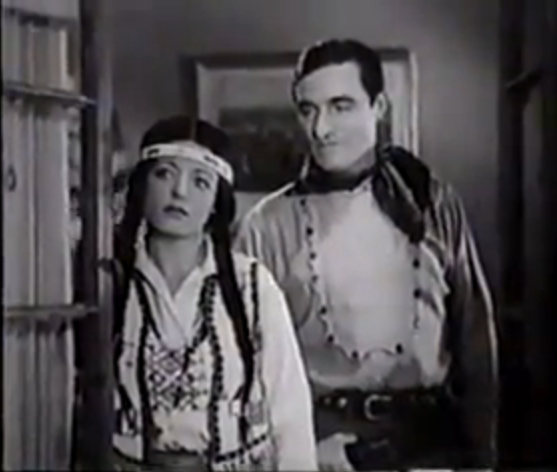
There’s much in The Miracle Rider that modern viewers could take issue with: most (though not all) of the Indians are played by white actors, and the Ravenhead are dependent on their “white brother” (or even “white chief”) Tom to protect them from those who would exploit them. But The Miracle Rider is surprisingly frank about the injustices suffered historically by Native Americans without making unrealistic saints out of them. Early on, the Ravenhead chief Black Wing (Bob Frazer) is killed by one of Zaroff’s men, leaving an opening for the corrupt Longboat to argue that the reservation land is cursed and they should migrate elsewhere. Black Wing’s daughter Ruth (Joan Gale) pleads with Tom to convince the tribe to stay; as the son of a Ranger who gave his life for the Ravenhead, Tom grew up among them and knows their ways (there’s that “best of both worlds” trope again). There’s no question that he would do what he can to help, but unlike more modern depictions that feature a corrupt or unreliable government, Tom is backed up by a solid and dependable Indian Agent, Adams (Edward Earle). Despite the presence of bad men like Zaroff, the forces of law and order haven’t given up; The Miracle Rider doesn’t claim that history could have been any different, but it does suggest that it’s at least possible to treat people, Indian or otherwise, with dignity and fair play.
TMR.Tom.Ruth

As for leading man Tom Mix, The Miracle Rider was both a beginning and an ending: Mix had made dozens of films (mostly Westerns, in many of which he played characters named Tom) and had been a huge star in the late teens and 1920s, famous for his flashy Western costumes and ten-gallon hat and his “million-dollar smile;” one of the first multi-media stars, Mix was at home in the circus performing Wild West routines and would later have a successful radio show. But Mix’s films in the ’20s had been silent, and the talkies he made in the ’30s were seen as something of a comeback, to varied success. Mix was in his fifties when The Miracle Rider was made, and while he still rides and shoots like a pro, he’s no longer the youthful romantic hero of his earlier films: at the end, after he’s been promoted to Director of Indian Affairs, he asks Ruth to come to Washington with him . . . as his secretary. “And here’s the contract,” he says: it’s a handshake. The Miracle Rider would turn out to be his last major film and his only sound serial.

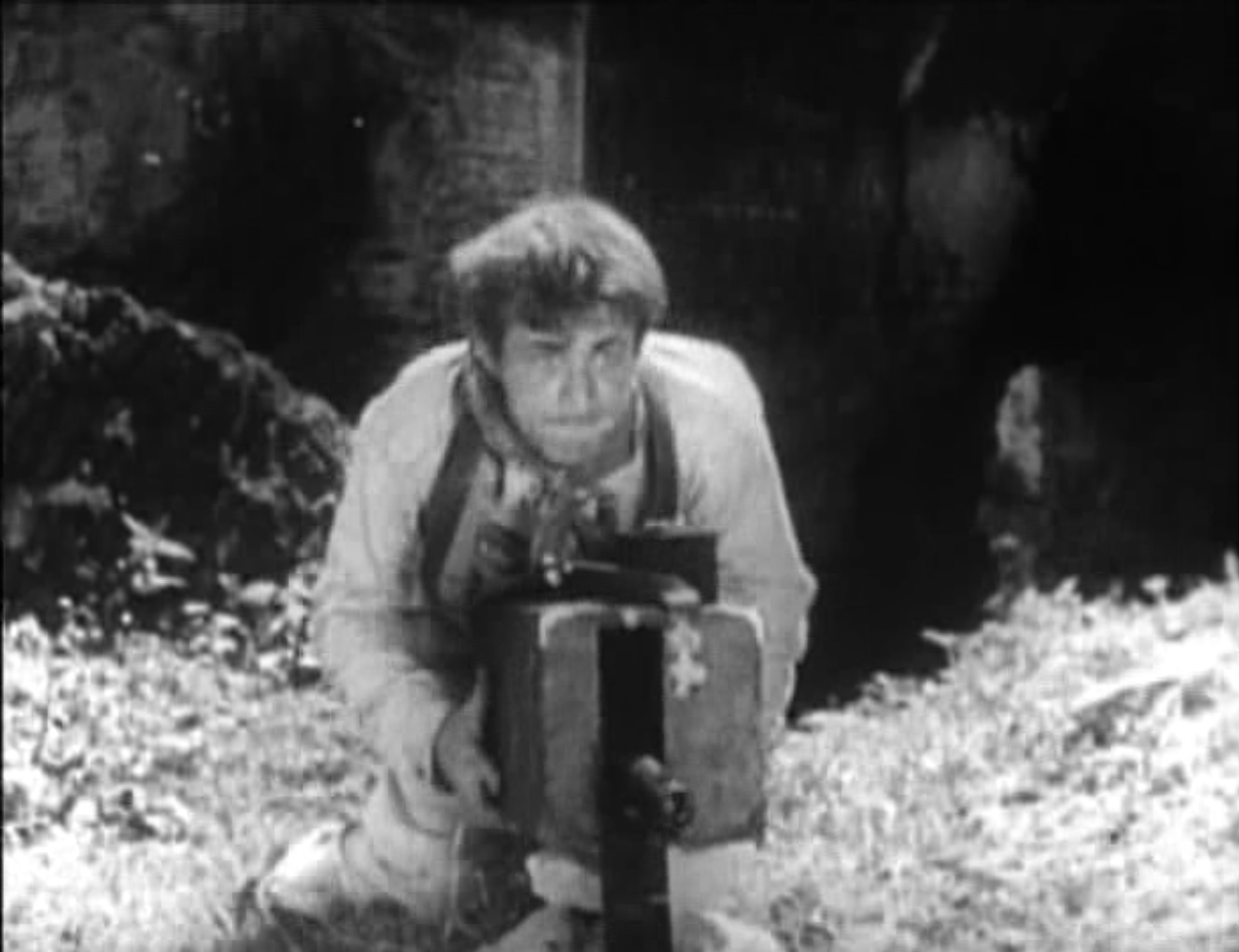
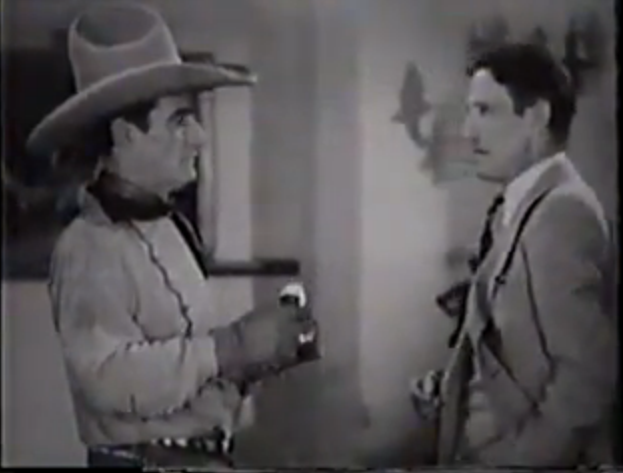
Despite some draggy sections (it’s gotten to the point where I inwardly groan when I see that a serial has 15 chapters), The Miracle Rider is the work of a man still innovating. In the very last chapter, Tom Morgan is held at gunpoint by Zaroff and two of his henchmen; when asked if he has a last request, Morgan asks to make a cigarette. After he takes too long, Zaroff impatiently bats the rolling papers away, sneering, “An old trick, Morgan! Trying to blow tobacco in our eyes, so we couldn’t see, eh?” At that moment, Tom’s horse (Tony Jr.) sticks his head in a car parked outside and honks the horn, distracting Zaroff and his men long enough for Tom to turn the tables. “That’s another old trick, Zaroff,” he says, “but you’ve got to have a good horse to do it.”
TMR.Tom.Zaroff

What I watched: The Miracle Rider (Mascot, 1935)

Where I watched it: I watched the whole thing on YouTube, which is why I haven’t included very many screen shots. My apologies; you can pretend it’s a radio program if you like.

No. of chapters: 15

Best chapter title: “Danger Rides With Death” (Chapter 12)

Best cliffhanger: At the end of Chapter 2 (“The Firebird Strikes”), Tom Morgan has infiltrated the Indian Cave hideout in which the “Firebird” rocket glider is stored; during a fight with Zaroff’s men, he climbs inside it and is stuck inside when it takes off. The chapter ends with the glider, remote-controlled by Zaroff, crashing to the ground in a fiery explosion. (Needless to say, Tom survives, in this case by parachuting out before the crash.)

Annie Wilkes Award for Blatant Cheat: In my discussion of Undersea Kingdom, I noted that Republic seemed to cheat its cliffhanger resolutions more frequently than other studios, but I think that habit began at Mascot, the studio that later became Republic. The resolution of the cliffhanger that ends chapter 6 (“Thundering Hoofs”) isn’t quite as mind-bending as the Annie Wilkes Award winner for Fighting with Kit Carson, but it plays pretty fast and loose, as do some others in this serial. In this one, Tom is riding with his captive, Sewell, tied up behind him, chased by one of Zaroff’s men on a motorcycle. Passing under a tree branch, Sewell reaches up and catches it with the ropes that bind him, hanging himself in the tree and pulling Tom to the ground, where he is in imminent danger of being trampled by horses. However, as the scene is reset at the beginning of chapter 7 (“The Dragnet”), the gang on horseback is distracted by Sewell hanging from the tree and simply stops riding. They don’t come anywhere near Tom, who is able to pick himself up with no problems. I can hear Annie Wilkes screaming about this one from here.

Sample dialogue: “Today the Ravenhead tasted the tongue of the Firebird–tonight they’ll fell its claws!” –Zaroff, Chapter 1 (“The Vanishing Indian”)

What others have said: “The present writers lack the psychic insight of some reviewers to know whether Tom Mix was bored with the serial or not, but certainly, what appears on the screen in private showings is a quiet professionalism. Tom Mix had ridden these familiar trails many times before, but nobody knew how to ride them better.” –Harmon and Glut, The Great Movie Serials

TMR.poster

What’s next: The Green Archer

Fates Worse Than Death: The New Adventures of Tarzan

Guatemala: jungle land of mystery! Homeland of the lost Maya! Cradle of secrets! It is to this land that Major Martling brings his expedition in search of the Green Goddess, a mysterious idol said to contain an unknown but highly potent explosive formula, as well as a fortune in jewels. Along with his daughter Alice and her fiancé Gordon, Martling is accompanied by his friend Lord Greystoke, who has some experience in the wilderness himself. Greystoke has come to Guatemala to find his old friend Lieutenant D’Arnot, a pilot who crash-landed in the Central American jungle.

NAT.title

Of course there are complications: in addition to the typical jungle perils of wild animals and hostile natives, Martling is hounded by Raglan, a rival explorer in the employ of a munitions company that hopes to recover the explosive formula for its own use. In addition, both parties are being shadowed by a mysterious woman, Ula, who claims to be the widow of D’Arnot’s co-pilot, and who seems to have unfinished business with Raglan. She tries to foil Raglan’s plans, but is she on Martling’s side? What is her real aim?
NAT.idol

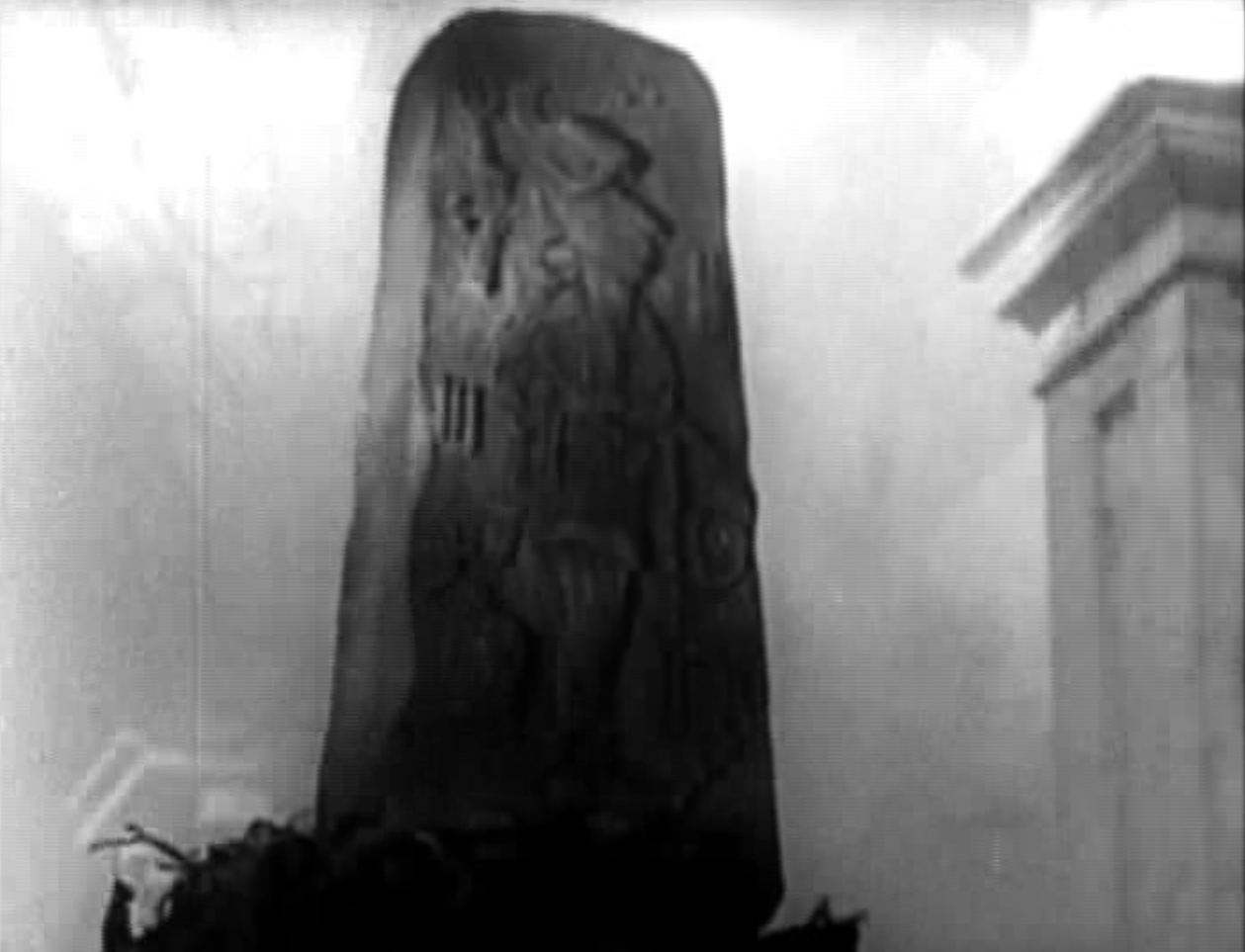
Deep in the jungle lies the Dead City, home to a tribe and a cult that is very much alive, worshiping the Goddess under the leadership of a tiger-striped high priestess. They threaten Martling’s party with sacrifice, even as Raglan steals the idol while the cultists are distracted. Were Martling and his party alone, this might be their end, but Lord Greystoke is not just the worldly traveler he appears to be: he is also Tarzan, Lord of the Jungle! Through an action-packed twelve chapters that includes fights with jungle cats, explosions, gunfights, espionage, and more, Tarzan and Martling race to recover the idol before Raglan can get it onto a ship bound to Europe, all while fending off the vengeful natives and the hooded warriors who will likewise stop at nothing to recover their Goddess, in The New Adventures of Tarzan!

NAT.priestess2

I’ll admit I had a hard time getting into The New Adventures of Tarzan at first, for a couple of reasons. In the copy I was watching, the sound started out kind of fuzzy, making it hard to hear the dialogue, and there is a lot of exposition to get out of the way, with numerous characters and their histories and motivations being introduced. Because The New Adventures was based on storylines from Edgar Rice Burroughs’ Tarzan novels (although not directly on any one novel), it is less streamlined than many later serials, and the accumulation of multiple subplots and shifting settings feels surprisingly modern, like an overstuffed summer blockbuster.

NAT.Tarzan.Martling

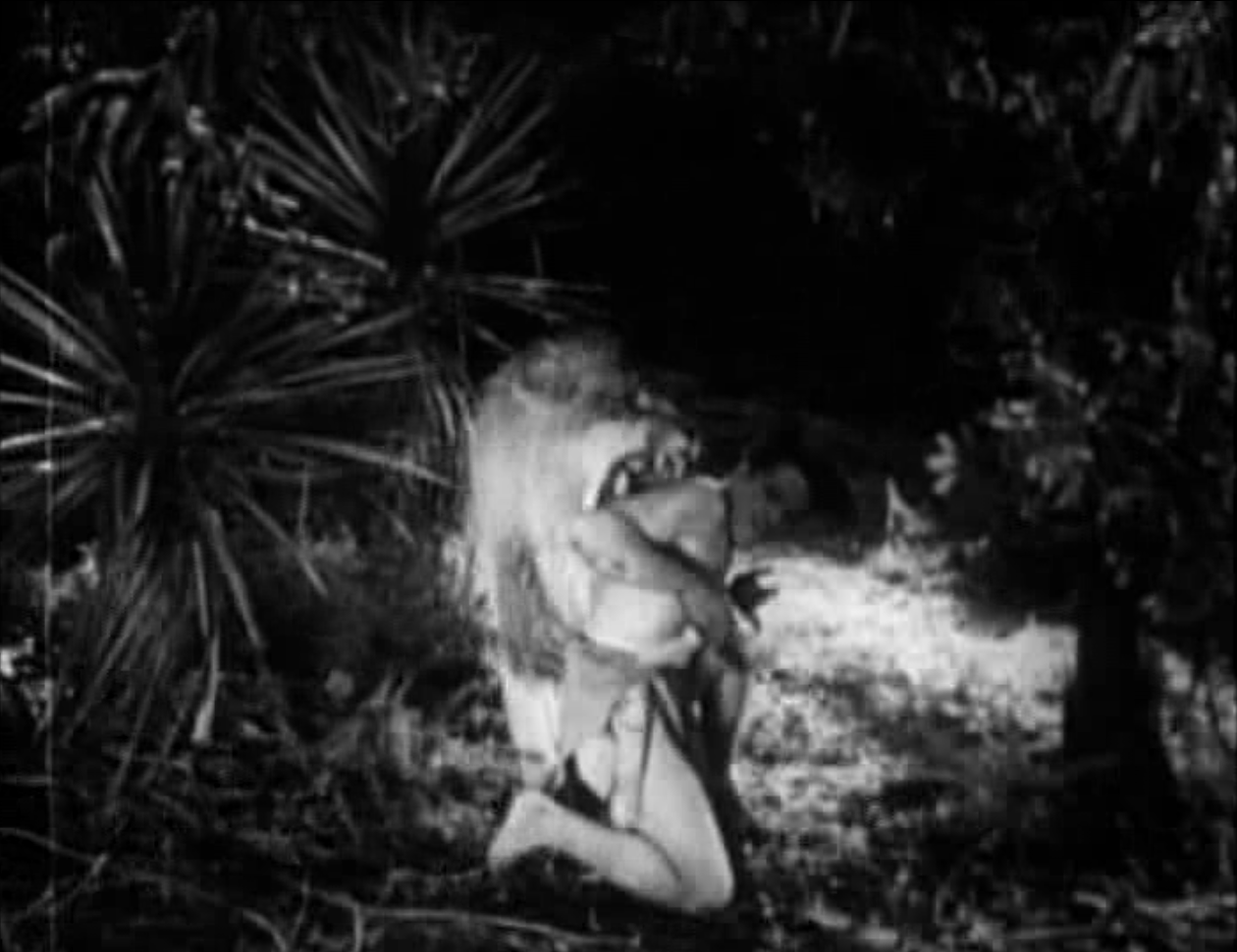
The first chapter is also forty minutes long, and contains several set pieces that could easily have been cliffhangers between chapters (Tarzan wrestles with crocodiles in a river, and later saves Major Martling’s daughter from a snare that suspends her over a jaguar pit). I have grown so accustomed to the rhythms of the serial that when these crises were resolved without chapter breaks and the chapter crept toward twenty-five, thirty, and thirty-five minutes in length, I started to wonder if the DVD producers had edited out all the chapter breaks (a move that would compromise this project, to say the least). But no, the first chapter is just extra-long, and does eventually end on a cliffhanger, like the other, shorter chapters.

NAT.Nkima1

I’m glad I stuck it out, however, as once the slow engine of story got underway and the excess baggage of characters and subplots was shed, The New Adventures of Tarzan turned out to be an engaging serial with a variety of colorful settings and some exciting action sequences. The main conflict, in which a well-intentioned, patriotic explorer and an unscrupulous mercenary fight over an ancient, powerful artifact, recalls both the 1933 Perils of Pauline and, of course, the later Raiders of the Lost Ark. (There’s also Martling’s notebook which contains the code necessary to open the idol, and which changes hands several times.)

NAT.deadcity1

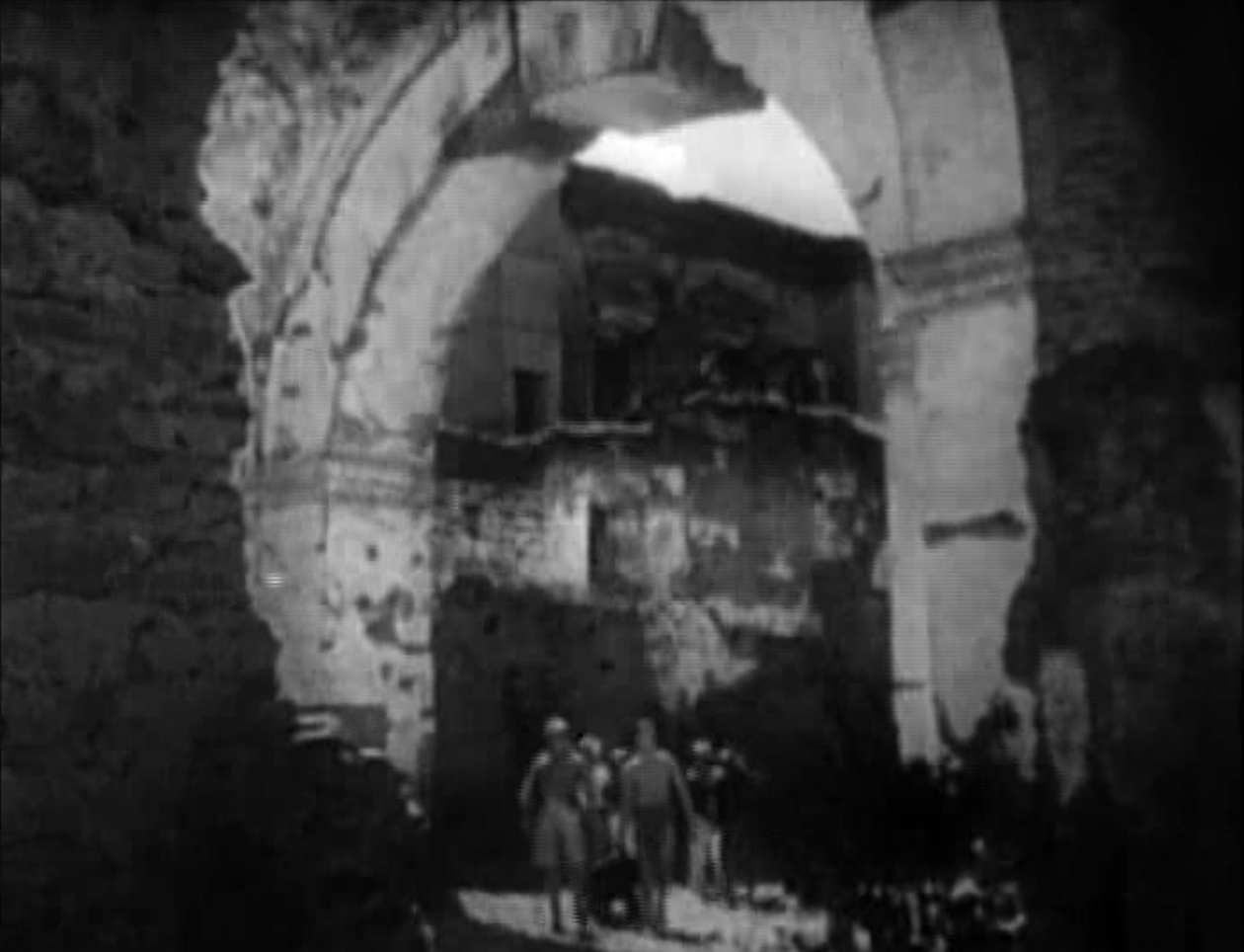
Much of the serial was filmed on location in Guatemala, including Chichicastenango and the ruins of Tikal, by producer Ashton Dearholt; the conditions turned out to be almost as difficult for the cast and crew as for the characters on screen, with illness and bad weather taking their toll. The role of Raglan, credited to Dan Castello, was actually played by Dearholt himself after Castello had to drop out early on. The expense and danger of the production mostly end up on the screen, however. The big cats Tarzan fights are real (at least up until the moment an obviously stuffed cat is thrown down; some of these fights are better edited than others); the giant waterfalls over which characters (or, again, their dummy stand-ins) plunge are suitably impressive, giving the film an epic scope.

NAT.Tarzan2

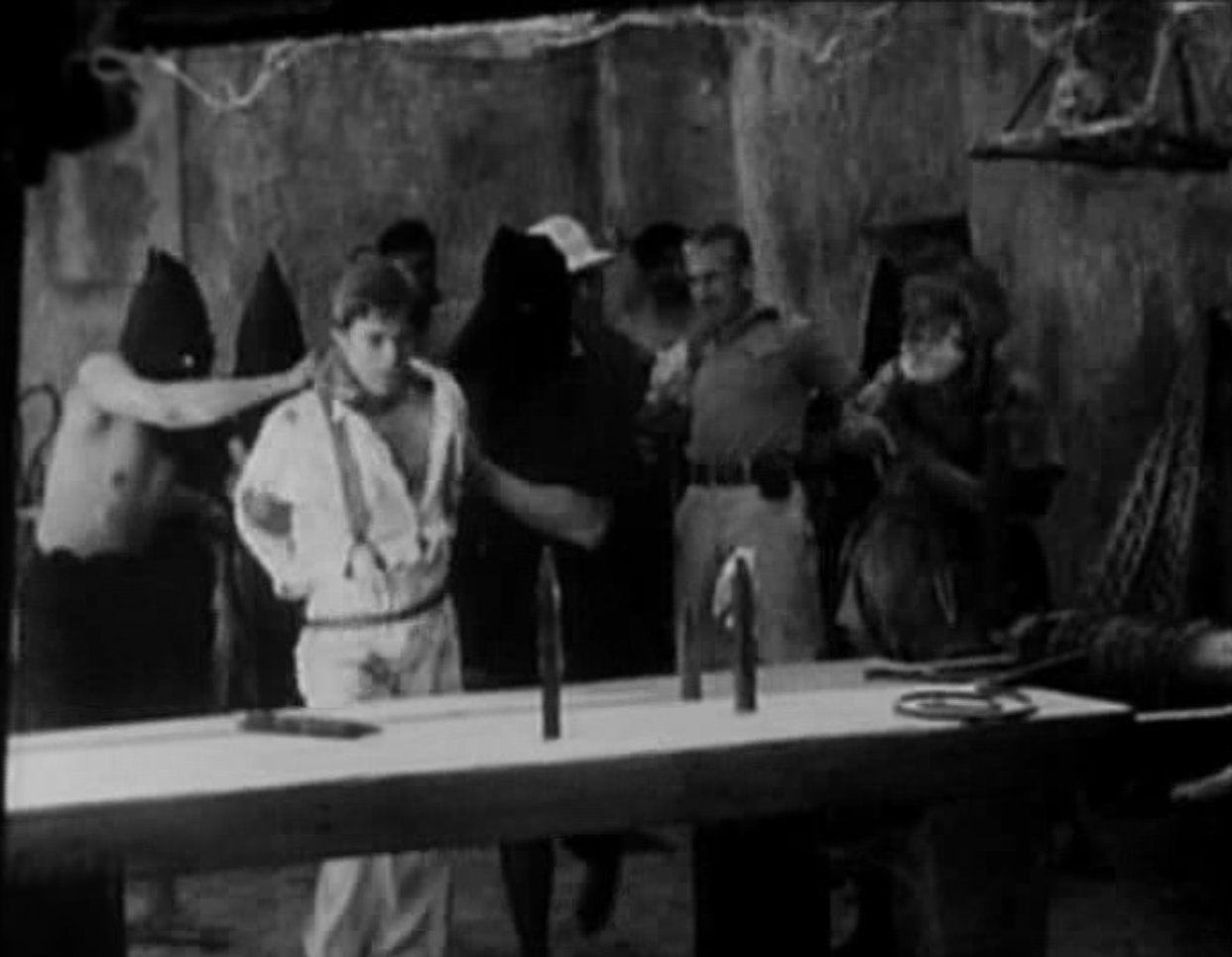
On the other hand, the film shows some of the limitations of independent production: other than the chapter titles, there is little to no background music; combined with the relatively meager dialogue during Tarzan’s many solo excursions and only ambient sound, long stretches of The New Adventures could pass for a silent movie. One strange touch occurs in the Dead City: a recurring gong, sometimes the only thing heard on the soundtrack, is distorted enough to sound like the disturbing, unexplained drones David Lynch frequently includes in his films, and is a surprisingly eerie match for the scenes of torture and imprisonment by hooded inquisitors. (No, I never expected to make a comparison between a serial and Lynch either, but here we are.)

NAT.torture2

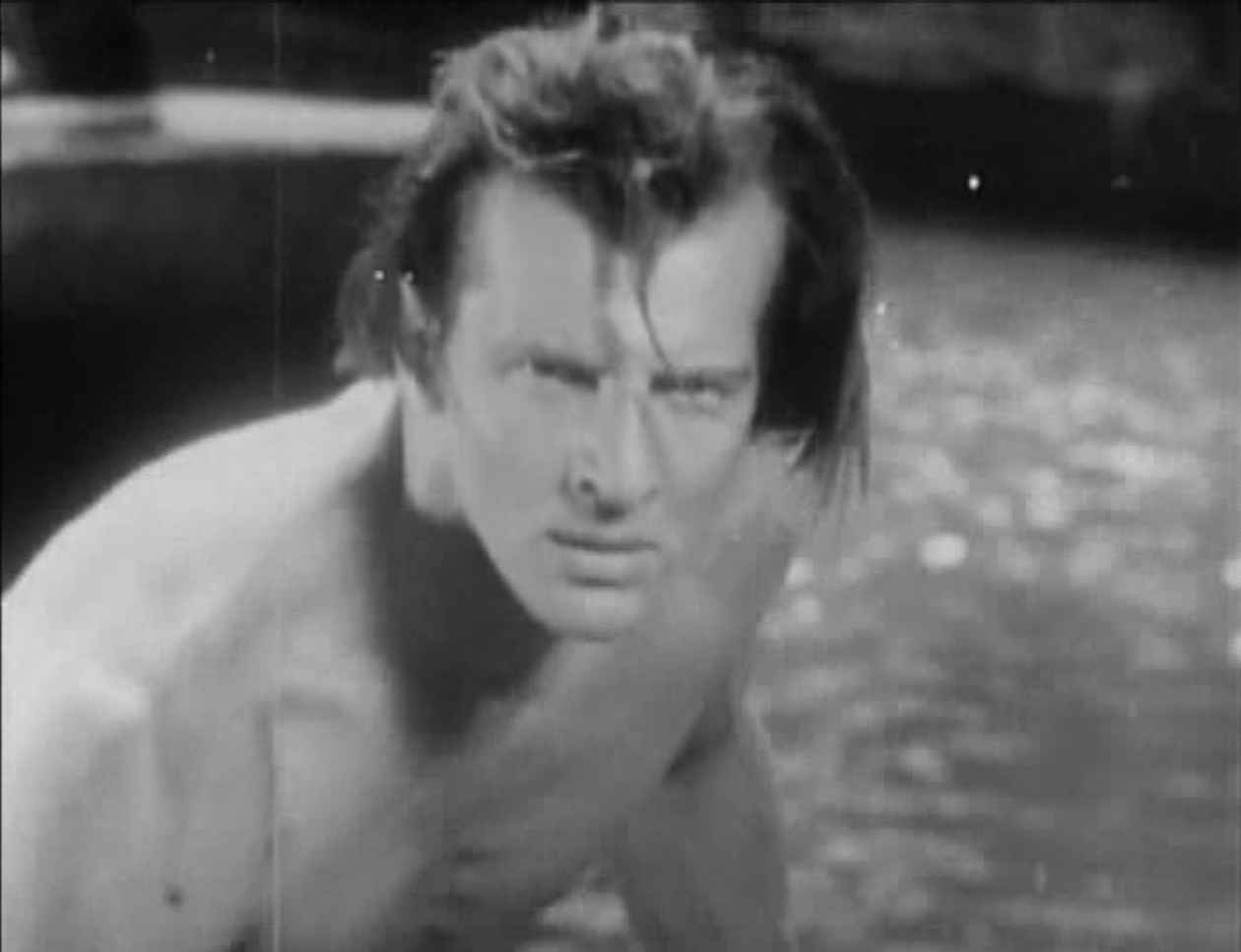
Tarzan himself (Herman Brix, who would later change his name to Bruce Bennett) is not the monosyllabic wild man of popular culture; because this serial was produced by Tarzan’s creator Edgar Rice Burroughs, it reflects the character as he appears in the books, speaking perfect English and transitioning effortlessly between his identities as Lord Greystoke and Lord of the Jungle. This version of Tarzan never says anything like “Me Tarzan, you Jane,” not least because Jane isn’t in this story.

NAT.Greystoke2

Whereas other film representations of Tarzan emphasized the noble savage or fish-out-of-water elements in his story, The New Adventures treats him more like a superhero: as Greystoke he wears his wealth and title easily, an aristocratic Bruce Wayne, but when there’s trouble he strips down to a loincloth and takes to the jungle, swinging on vines and talking to animals. His identity is far from secret, however, and he’s treated like a celebrity: Martling’s valet George, in fact, is described as “the flunky who joined the expedition to be closer to his idol, Tarzan.” Burroughs’ Tarzan represents a colonialist ideal: the “best of both worlds,” with all the education and material advantages of Western civilization and all the vigor, toughness, and native wisdom of his adoptive culture.

NAT.Tarzan3

In addition to its ambitious location shooting, The New Adventures stands out from the serials I’ve watched in other ways. Burroughs’ stories could be quite bloody, emphasizing “nature red in tooth and claw” and featuring villains evil enough to justify just about anything the good guys might do to them. That’s often sanitized in film and TV retellings, which are more kid-oriented than the books they’re based on. Although not especially graphic, The New Adventures includes gunplay, stabbings, explosions, and more, with (mostly) realistic consequences. No bloodless fistfights here: Tarzan and co. don’t mess around. The most surprising sequence involves George (who is otherwise comic relief) spraying machine gun fire at attacking waves of tribesmen from the Dead City as if in flashback to the Great War. Even Indiana Jones would save that kind of move for Nazi soldiers.

NAT.machinegun1
NAT.machinegun2

As I mentioned, the rhythm of this serial is also somewhat odd, with a profusion of subplots (especially at the beginning) that gradually thin out as D’Arnot is recovered and leaves with Alice and Gordon, and Ula joins Martling’s party. Once the idol is stolen, the vengeful warriors from the Dead City don’t pick up Raglan’s and Martling’s trail until Chapter Seven, and the action is essentially resolved in Chapter Eleven. Many serials include an “economy chapter,” in which flashbacks to earlier events are included to catch up latecomers: The New Adventures treats the last chapter as a recap, an anticlimax that serves only to tie up a few loose ends and put a cap on the serial. Still, I’ve come to appreciate the looser, less formulaic serials of the early ’30s, if only because they have more capacity to surprise; however lumpy its storytelling, The New Adventures of Tarzan is full of invention. No one is phoning it in.

NAT.Ula3

What I watched: The New Adventures of Tarzan (1935, Burroughs-Tarzan Enterprises)

Where I watched it: Pop Flix’s 2-DVD Classic Tarzan Collection, which also includes three features: Tarzan the Fearless, Tarzan’s Revenge, and Tarzan and the Trappers.

No. of chapters: 12

Best chapter title: “Devil’s Noose” (Chapter 3)

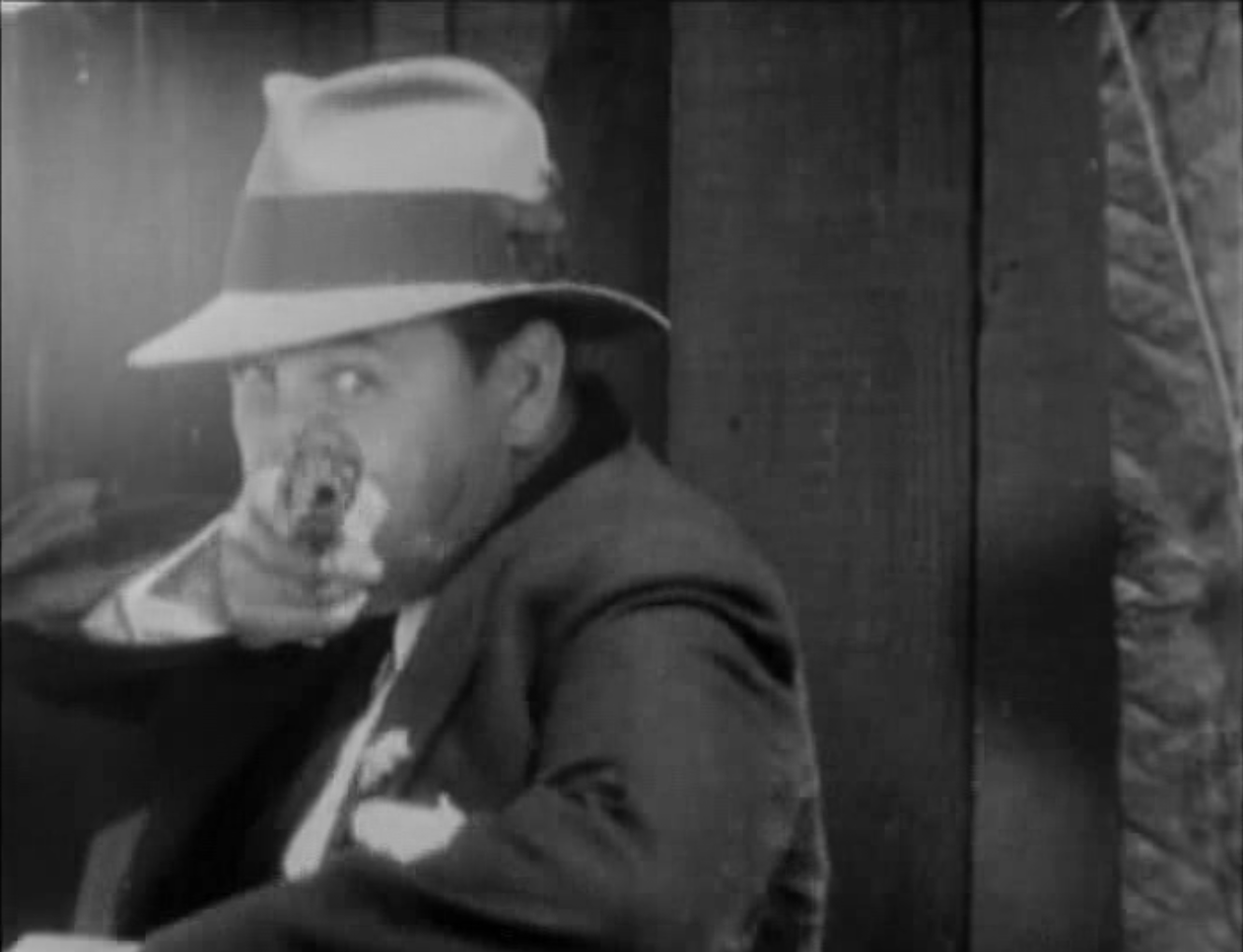
Best cliffhanger: At the end of Chapter 10 (“Secret Signals”), Tarzan confronts Raglan on the dock in Mantique as Raglan prepares to load the Goddess idol onto Simon Blade’s ship. There’s a scuffle with Raglan and his crew, during which the idol drops over the side of the dock, where it hangs from a rope. Raglan pulls a gun and commands Tarzan to step away from the idol, promising this will be “the last time you meddle in my business!” In a sequence straight out of a gangster film, after a close-up of Tarzan, the shot reverses to Raglan, the camera pointing straight down the barrel of his gun. Bang!

NAT.Tarzan6
NAT.Raglan2

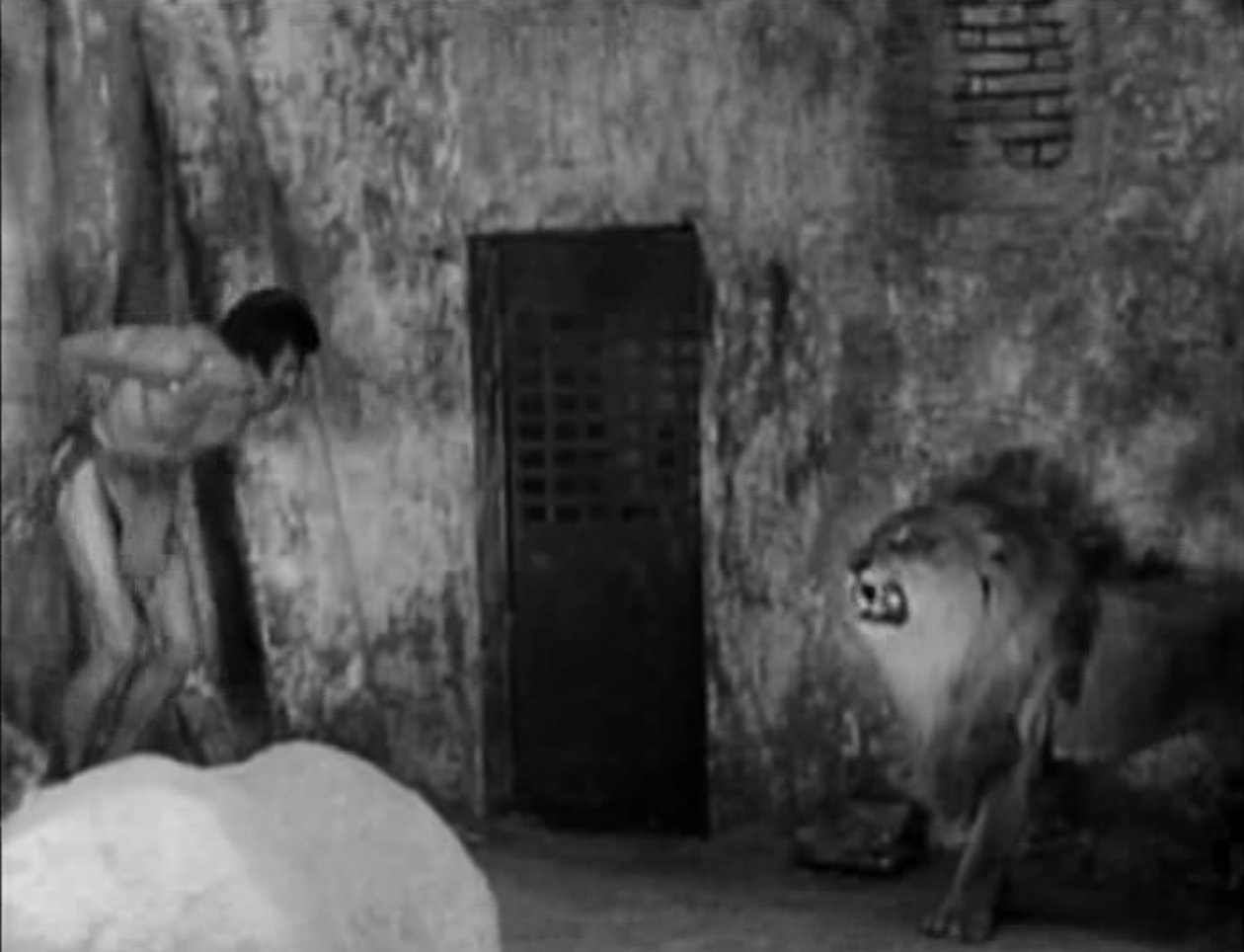
Annie Wilkes Award for Most Blatant Cheat: In Chapter Nine (“Doom’s Brink”), one of the most action-packed chapters, the members of Martling’s party have been captured separately and taken to the Dead City by the Goddess’ worshipers. Each faces a different peril: Martling and George are taken to a torture chamber (!), Ula is imprisoned in a cell with an old woman who attempts to stab her, and Tarzan is tied up in the cell next to Ula’s with a chained lion. After overcoming the old woman, Ula uses her knife to dig through the wall separating herself from Tarzan. As Tarzan hurries to untie himself, the lion’s chain gives way; the last shot of the chapter is of the lion’s slavering jaws as it lunges at the camera.

NAT.Tarzan5

It looks like the game is up for Tarzan, no? As the beginning of Chapter Ten resets this peril, however, not only does Ula make a hole big enough to pass Tarzan the knife, he has time to untie himself and maneuver to the hole before the lion attacks, so he’s not even in the same place when the lion lunges off of its chain. (This is at least more satisfying than the chapter where Tarzan is caught in a spiked tiger trap, only to be grazed by the spikes instead of impaled: such “oh, I guess he’s okay” resolutions are even more anticlimactic than straight-up cheats, in my opinion.)

Funniest moment: Martling’s valet George (Lewis Sargent) has a lot of similarities to Professor Hargrave’s secretary Dodge from The Perils of Pauline, but despite his silly attachment to his yo-yo, his always-growling stomach, and his panicky reactions to mundane jungle plants and animals, George has a few serious moments. His machine gunning of natives from the Dead City (see above) is later paid back when George is the first to be tortured in Chapter Nine. Still, most of George’s scenes involve clowning of one kind or another, and I’ll admit to laughing when, in Chapter Seven (“Flaming Waters”), George is bitten and chased by a bunch of water turtles, an ordeal to which Tarzan responds with an epic eye-roll.

NAT.George2

Sample dialogue: “He reminds me of some of the jungle cats I’ve known: they’re most dangerous when they purr.” –Tarzan, referring to Captain Blade, Chapter 11 (“Death’s Fireworks”)

What others have said: “At one point, Burroughs had worried that so much local scenery had been eliminated from the episodes that the whole thing might just as well have been shot in Hollywood. But in the final edit, enough Mayan ruins, colonial cities, and Guatemalan Indians survive to create a richly exotic and authentic backdrop. And for once, Tarzan is able to swing through trees other than the sycamore and eucalyptus so predominant in earlier films shot in or near Los Angeles.” –John Taliaferro, Tarzan Forever: The Life of Edgar Rice Burroughs, Creator of Tarzan

What’s Next: The Miracle Rider

Fates Worse Than Death: Undersea Kingdom

UK.title

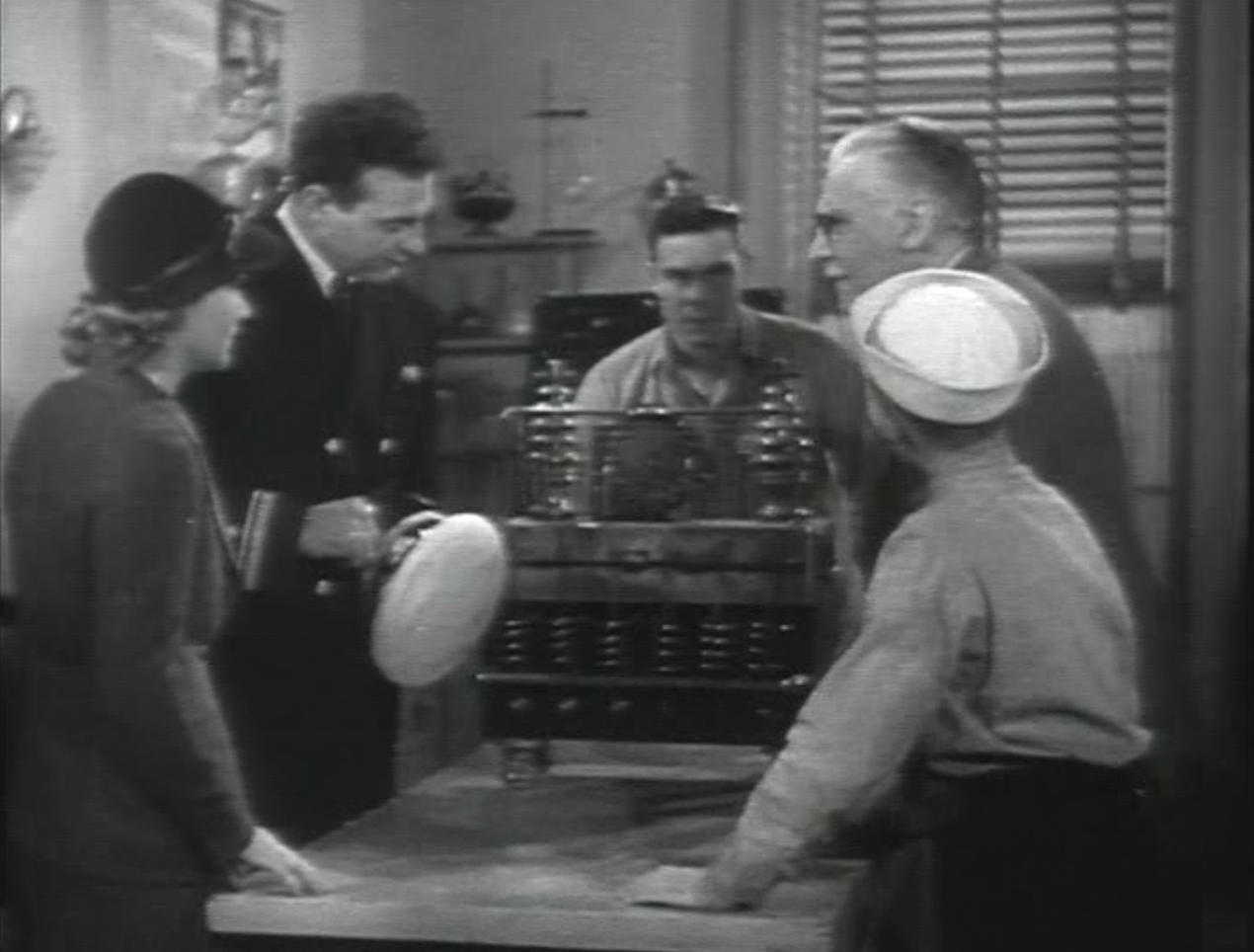
A troubling rise in earthquake frequency and intensity has led Professor Norton to build an earthquake prediction machine, with which he also hopes to prevent future quakes. Guessing that the earthquakes are somehow being caused by radio signals from deep beneath the sea, Norton plans an aquatic expedition to find its source. “I hope you’re not going to spring that yarn of the lost continent of Atlantis,” chides reporter Diana Compton, but oh, yes! The Professor has his suspicions, and the discovery of oricalcum–the legendary metal that Plato described as unique to the sunken realm–gives the Professor all the evidence he needs to proceed.

UK.Norton2

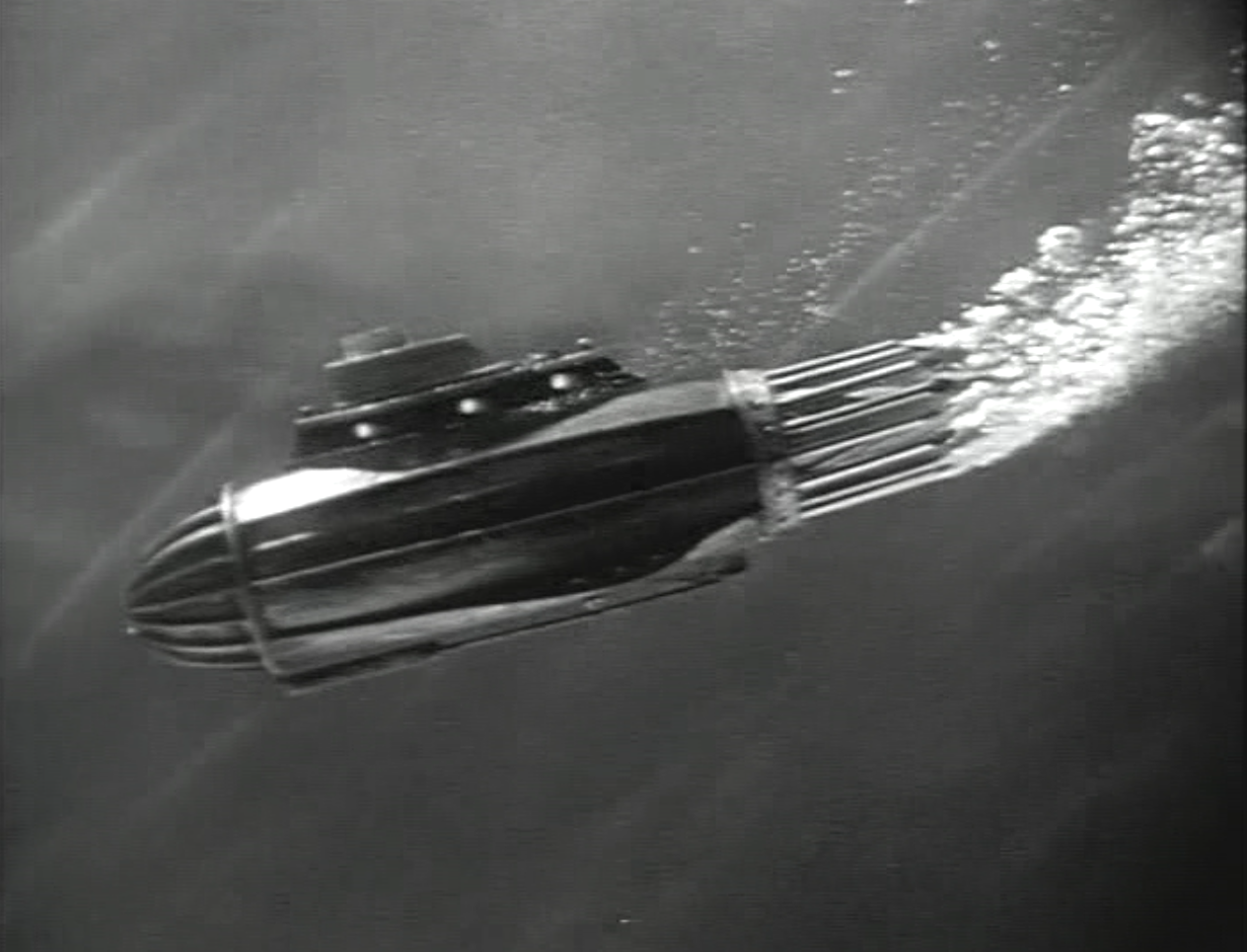
Naval Lt. Ray “Crash” Corrigan, all-around athletic champion and straight arrow, is Professor Norton’s only choice to accompany him in his experimental submarine (an excellent miniature, one of many created by Howard and Theodore Lydecker). The submarine’s crew grows when Diana invites herself along for a story too good to resist, and again when it’s discovered that Professor Norton’s young son Billy has stowed away. The sub’s pilot cracks under the pressure when he realizes how deep the Professor intends to take it, and in his madness sends the sub into a steep dive.

UK.sub1

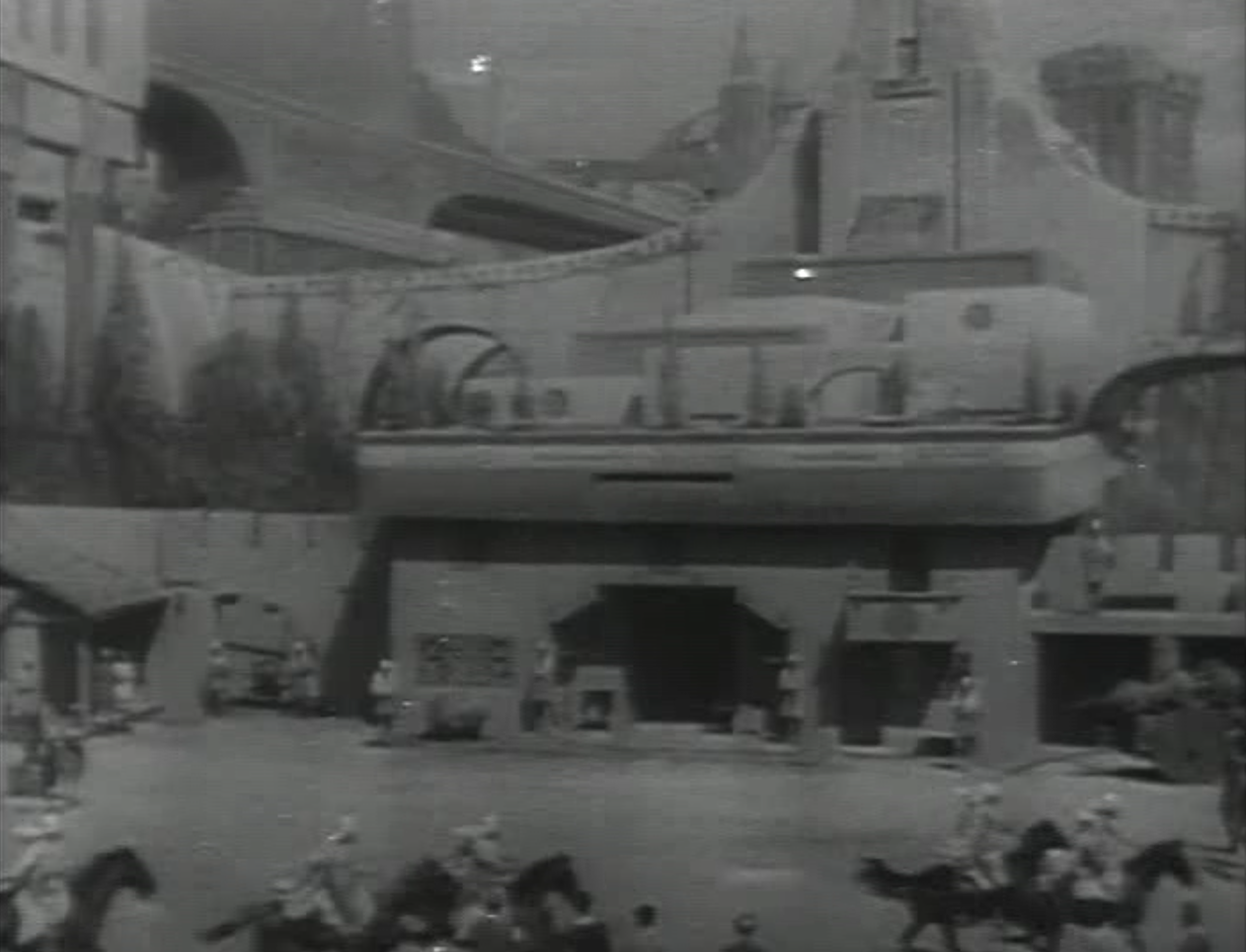
Little do the submariners know that Atlantis survives under a great dome of oricalcum, like a bubble at the bottom of the sea, and even now is riven by conflict: Unga Khan, usurper to the throne, is laying siege to the city of Atlantis, where high priest Sharad, described as the last of the true Atlanteans, is the only force remaining to stand up to Unga Khan. From his metal tower, Unga Khan commands a legion of black-robed horsemen and soldiers; robotic “Volkites;” airships; and the juggernaut, a fast-moving electric tank. It’s only a matter of time before Sharad’s defenses give way.

UK.tower

Unga Khan, detecting Norton’s submarine, latches onto it with a magnetic beam and brings it safely into Atlantis’ inland sea, hoping to turn it to his own advantage. Upon discovering Professor Norton’s scientific abilities, Unga Khan brainwashes him with a “transformation chamber” and puts him to work building engines to turn his tower into a rocketship, so that he may ascend to the surface world and either conquer or destroy it! Only Crash Corrigan and his allies can prevent Unga Khan’s mad plans from wreaking havoc on both Atlantis and the surface world in the 1936 Republic serial, Undersea Kingdom!

UK.Unga4

Undersea Kingdom has similarities to both Flash Gordon (released the same year) and The Phantom Empire, which had come out the previous year. Like The Phantom Empire‘s underground kingdom of Murania, Undersea Kingdom‘s Atlantis is a classic “lost world,” a remote corner of the world untouched by modernity but paradoxically full of superscience. Other than its underwater location and the mention of oricalcum (dropped after the first chapter), there’s not much to connect the film’s Atlantis to Plato’s account, but it is part of a long tradition of using the name as a code word for a hidden place where anything becomes possible. And like Murania and Flash Gordon‘s Mongo, in Atlantis ancient swords and chariots are used side-by-side with atomic rays and futuristic war machines: boundaries between science fiction and fantasy were not so rigidly defined before World War II.

UK.Atlantis

Just as singing cowboy Gene Autry starred in The Phantom Empire as singing cowboy Gene Autry, Undersea Kingdom stars “Crash” Corrigan as a fictionalized version of himself and gives him plenty of room to show off his talents. As an actor, he does OK with dialogue, which is largely functional (“At least those mechanical men can’t follow us through those flames!”), but it’s displays of athleticism that are the real draw. Corrigan was a trainer and bodybuilder who started out in film as a stuntman, often portraying gorillas (he played the “sacred orangopoid” in Flash Gordon), and as a leading man his onscreen persona emphasized his mastery of physical culture and sports. Just as The Phantom Empire gave ample opportunities for Autry to sing within the story, every chapter of Undersea Kingdom finds Corrigan wrestling, climbing, pole-vaulting, swimming, or even walking a tightrope, and that’s aside from the usual running, riding, and fighting that are typical for serial heroes.

UK.Crash4

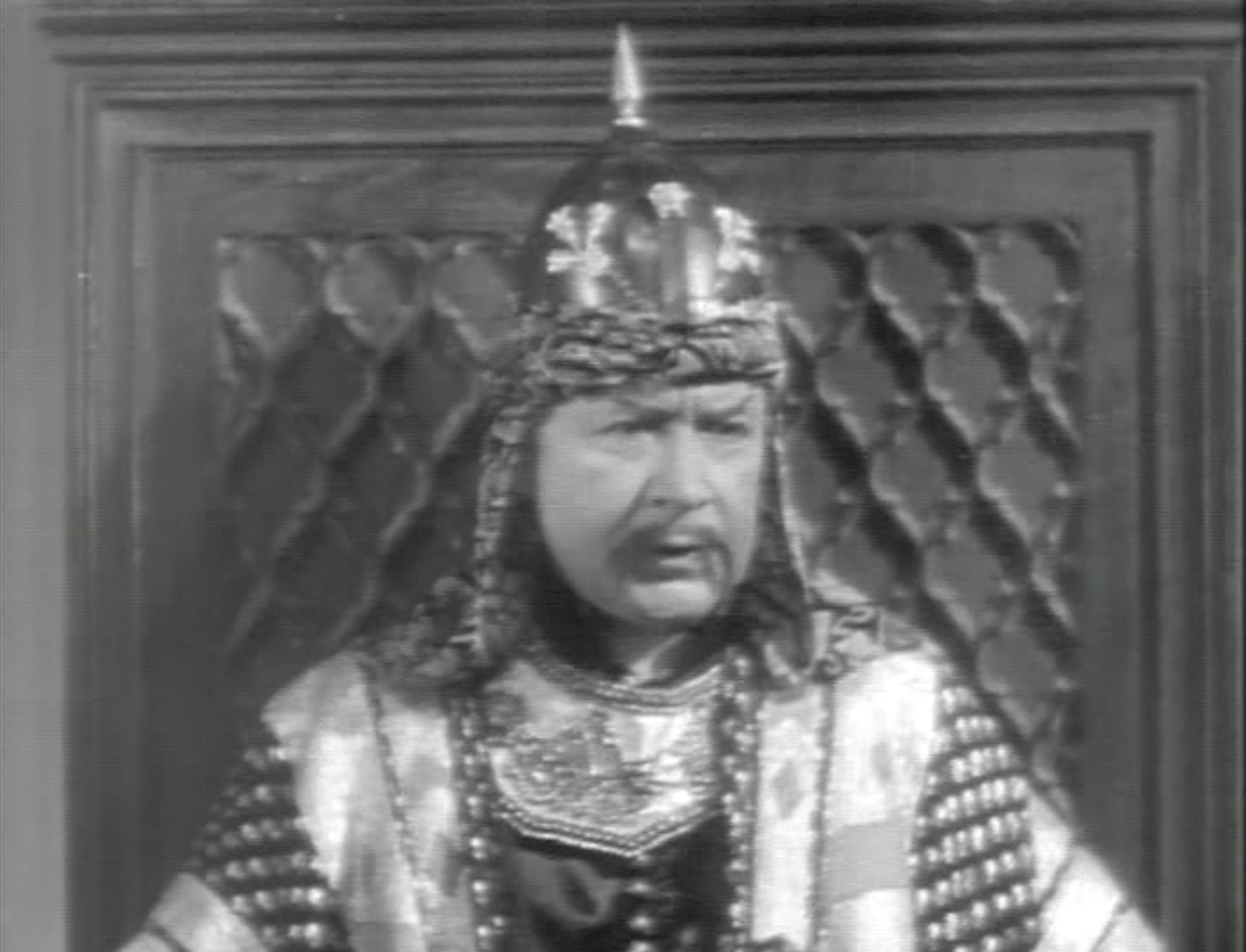
The other characters fit into clearly established types: Professor Norton (C. Montague Shaw) is the inventor whose submarine makes the adventure possible but then spends almost the entirety of the serial enslaved by the villain (and unlike Flash Gordon‘s Dr. Zarkov, Norton is so completely brainwashed that he actively resists rescue and demands to be taken back to his “Master” until he is restored in the transformation chamber). Speaking of the villain, Unga Khan (Monte Blue) is cast from the same mold as Ming: imperious, given to grandiose monologues (“With Crash Corrigan out of the way, nothing can interfere with my plans to conquer the upper world!”), and ruthless in carrying out his scheme. The fact that his plans are so over-the-top crazy is one of the pleasures of this kind of pulp.

UK.juggernaut2

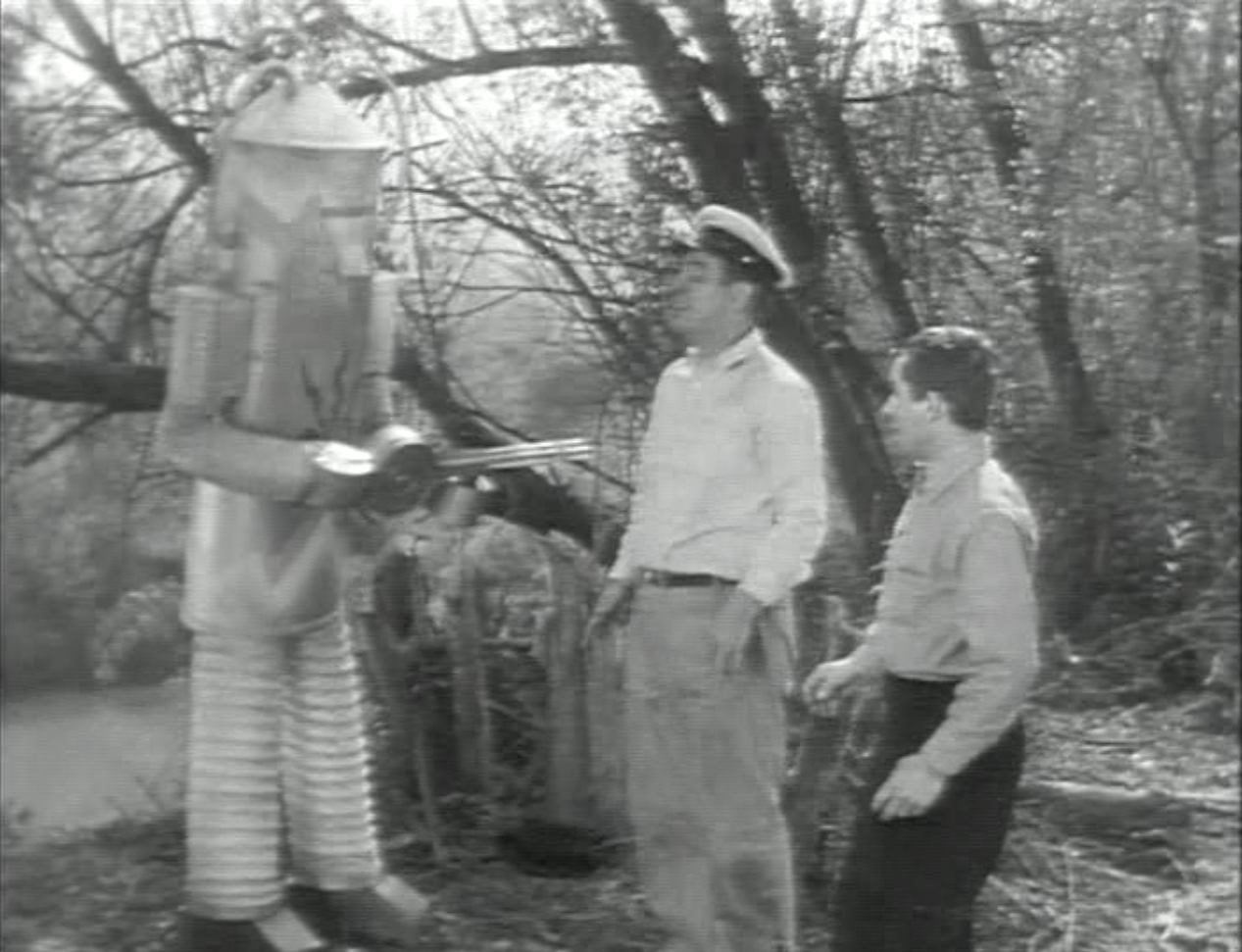
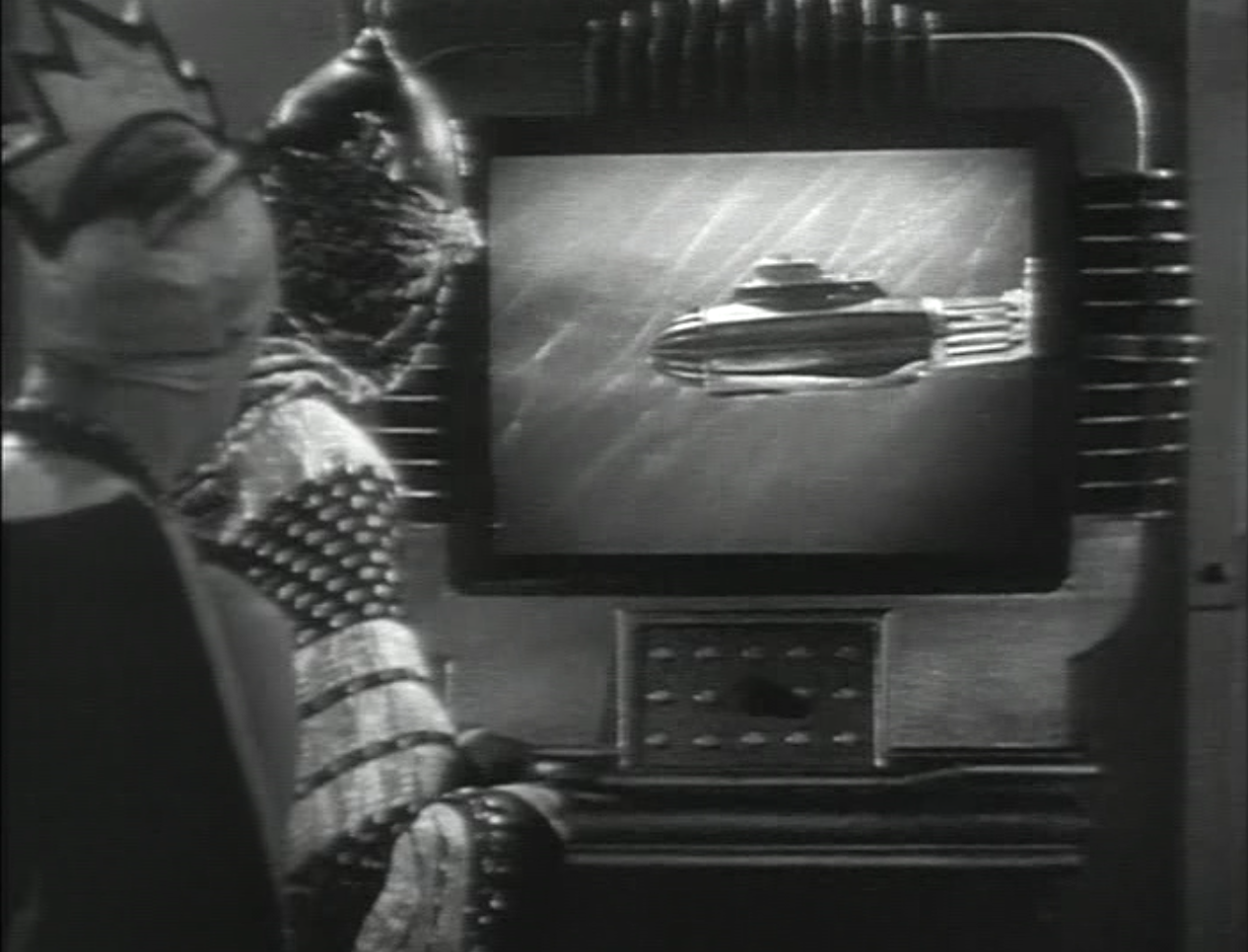
As mentioned, Unga Khan has quite a bit of futuristic hardware at his disposal, including a “disintegrator ray” that strangely takes the form of a missile (recycled from The Phantom Empire). Also as in The Phantom Empire, television is an object of fascination, with Unga Khan observing the surface world, the Atlantean countryside, and even Sharad’s inner sanctum through his “reflecto plate,” all without any indication of having cameras in those places. Some of Unga Khan’s doomsday weapons are even more vague than is usual for serials, but they sure look cool. The standout is his army of Volkites, mechanical men armed with “atom guns,” old-school cylindrical “water heater” robots that look intimidating but move slowly and are clumsy enough that Corrigan is able to hang one from a suspended hook at one point without much trouble.

They break into old people's houses and steal their medicine to use as fuel.

They break into old people’s houses and steal their medicine to use as fuel.

Diana Compton (Lois Wilde) is a gutsy, brassy reporter, and while she talks her way onto the submarine, I’m hard-pressed to think of anything she actually does other than offer commentary and occasionally fall into some peril from which she must be rescued. As formulaic as that role is, however, it’s worth mentioning that she is literally the only woman in the entire serial: the above-ground scenes with which it begins take place at the Naval Academy in Annapolis, and the Atlantean scenes are divided between Unga Khan’s tower and Sharad’s city, both militarized settings filled with soldiers (the latter resembles a Spanish mission or French Foreign Legion outpost dressed up with a few exotic props). And while Diana and Crash end up together, there’s little romantic spark between them: this is boy’s adventure, through and through.

UK.Diana1

There is a literal boy, as well, and Billy Norton (Lee Van Atta) divides his time between dialogue even more functional than Corrigan’s (“Boy, I’d sure like to explore that city,” and cheering on the hero with “Let ‘im have it, Crash!”), engaging in junior acts of derring-do, and being rescued himself. He’s more a sidekick than an audience-identification character (he doesn’t have anything like the screen time or personality of Frankie and Betsy Baxter in The Phantom Empire), but there is some pathos when his own father, brainwashed by Unga Khan, doesn’t recognize him.

UK.Billy1

Smiley Burnette is also along to provide (mercifully brief) comic relief: he and Frankie Marvin play submarine crew members who, along with their mischievous parrot Sinbad, take off to explore Atlantis on their own, getting in and out of trouble with prankish incaution. Burnette performs some of his usual shtick, such as playing the harmonica and causing slapstick trouble with explosives (including a stunt that I’m sure would have left at least one black-robe guard dead), but unlike in The Phantom Empire his and Marvin’s antics don’t have any bearing on the story, and could in fact be cut entirely without affecting the plot. (According to Jerry Blake these scenes were added after the fact to pad out the serial’s run time, and it shows.)

UK.volkite5

Finally, Crash Corrigan himself–the fictional version, that is–is every bit the strong-jawed hero of this era’s serials, pulp magazines, and comics. In a development that will be very familiar to readers of Edgar Rice Burroughs or H. Rider Haggard, Corrigan inserts himself into the Atlantean conflict, first inadvertently and then by appointment. Captured by Sharad’s forces (who suspect him and the other surface-dwellers of being spies in the service of Unga Khan), Corrigan is forced to fight a group of prisoners to the death. After demonstrating his superiority by wrestling them into submission, he refuses to deal a killing blow, assuring the loyalty of Moloch (John Merton), the opponent whose life he spares.

UK.Sharad2

Moloch becomes a trusted friend and ally during Corrigan’s time in Atlantis (a character as useful to the writers as to Corrigan, allowing for fight scenes that don’t rely entirely on Corrigan to carry them), a native brother-in-arms like Tars Tarkas or Umslopogaas. Then, after saving the high priest Sharad’s life, Corrigan is offered command of the Atlantean White Robe Army (“Commander of the army? Oh boy, oh boy!” says Billy) and the magnificent uniform that comes with it. The loyalty of the White Robes to Corrigan is unquestioned, and like John Carter, Flash Gordon, and others, Corrigan proves that what the Atlanteans need for victory is a strong American leader at the front.

UK.reflecto

What I watched: Undersea Kingdom (1936, Republic)

Where I watched it: A DVD from TV Serial Classics. I don’t usually comment on my sources unless they’re especially high- or low-quality, but I do want to point out one of the ugliest menu screens I’ve run across (especially in comparison to Republic’s typically excellent titles):

UK.menu

No. of chapters: 12

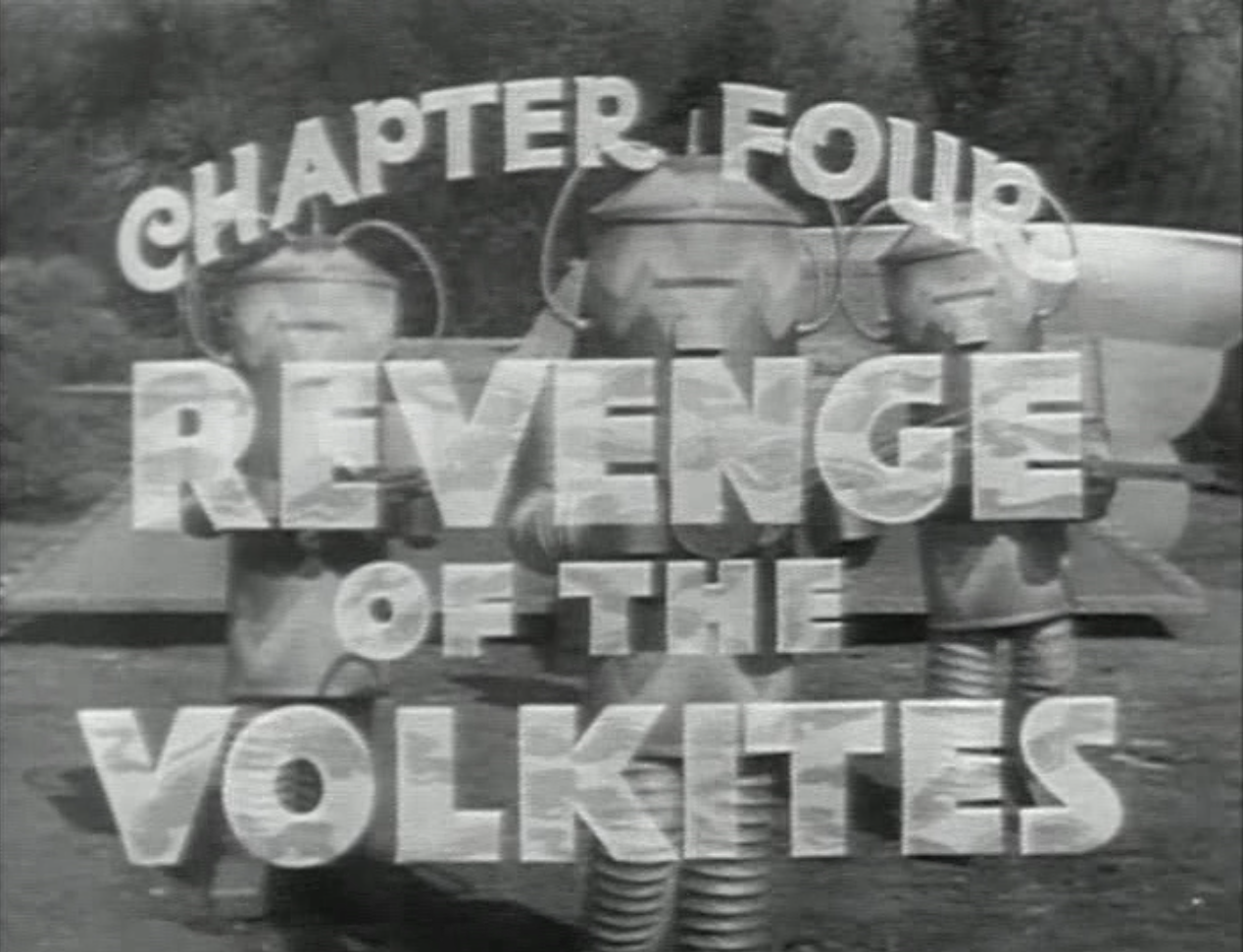
Best chapter title: “Revenge of the Volkites,” Chapter Four. I’m not really sure where the “revenge” angle comes in, as the robotic Volkites are neither paying back the surface dwellers for an earlier defeat nor turning on their master, Unga Khan. It’s surely the kind of title George Lucas had in mind when naming his Star Wars episodes, however, and with about as much connection to the actual story.

UK.Chaptertitle

Best cliffhanger: This one is easy. At the end of Chapter Eight (“Into the Metal Tower”), Crash Corrigan, captured by Unga Khan’s Black Robes, is lashed to the front of the juggernaut and driven to the gate of Sharad’s city. If the gates are not opened to the invading army and Sharad given up, the juggernaut will ram the gates, crushing Corrigan. In the face of such barbarism, Corrigan defiantly tells the juggernaut’s driver, “Go ahead and ram!”

UK.Crash6

The image of Corrigan strapped to the front of the juggernaut like a human hood ornament looked teasingly familiar, almost as if I had seen it somewhere recently . . . but where?

fury_road

Annie Wilkes Award for Blatant Cheat: Republic seems to be the worst offender in this (and in fact Harmon and Glut in The Great Movie Serials cite the juggernaut cliffhanger as a textbook example of a cheat), so as always there are several candidates. At the end of Chapter Eleven (“Flaming Death”–honestly, all of the chapter titles are pretty good), Moloch, Corrigan, and Professor Norton are trapped beneath the rocket engines that will lift Unga Khan’s towers to the surface when they begin firing. There’s no way they’re getting out of there without being burned to a crisp, right? Right?

Well, I don’t think it will spoil the movie to say that Corrigan gets away at the beginning of Chapter Twelve, and the hole in the floor that he conveniently falls through at the very moment of the rocket’s ignition definitely wasn’t there at the end of Chapter Eleven.

A word on costuming: The 1930s were the heyday of art deco in film, and that extended beyond titles and set design to the costumes themselves. Like other space operas and lost worlds of this time period, Atlantis is a jumble of medieval, Romanesque, and completely fanciful motifs. Uncredited but attributed to Robert Ramsey, Undersea Kingdom‘s costumes are partially unified by the importance of finned headgear: like the intricate tail feathers of male birds, the number and complexity of fins indicate the strength and importance of the wearer. Most of Unga Khan’s Black Robes have only a single dorsal fin on their headgear (right), while leaders like Captain Hakur (left) and Unga Khan’s major domo Ditmar have a trifold fin (and check the zig-zag lightning motif that also appears on Unga Khan’s throne).

UK.Hakur

Those pale, however, before the righteous plume that decorates Corrigan’s helmet once he takes command of the White Robe Army (a force whose uniform is otherwise completely unfinned: the entire budget for military bling went into this one outfit): look upon it, and mourn for the days such a costume could be worn without any self-consciousness.

UK.Crash5

Sample dialogue: Too much to choose from!

“Little do the people of the upper world realize what is in store for them. . . . Start the disintegrator. . . . Start the earthquake!” –Unga Khan, Chapter Eight

“Is my plan of empire to be wrecked by this handful of strangers from the upper world!?” —ibid.

“They’ll never expect to find any Volkites in the submarine!” –Captain Hakur (Lon Chaney, Jr.), Chapter Eleven

“Prepare the disintegator [sic]!” –Unga Khan, Chapter Twelve

What Others Have Said: “The serial features few of the fistfights common to Republic’s later serials, but compensates by including some truly unique action sequences, chief among them the large-scale attacks on Sharad’s Sacred City by the Black Robes; these battle scenes are beautifully staged by directors Joseph Kane and B. Reeves Eason (Eason directed many similar sequences in silent and sound “spectacles” like 1925’s Ben-Hur and 1936’s Charge of the Light Brigade).” –Jerry Blake, whose blog Files of Jerry Blake includes extensive reviews and commentary on movie serials and “other cliffhanging material.”

What’s Next: The New Adventures of Tarzan

Fates Worse Than Death: Batman and Robin (1949)

Welcome back to Fates Worse Than Death (#summerserials on Twitter). I’ll be exploring the legacy of the motion picture serial every week this summer between Memorial Day and Labor Day (which, yes, is more ambitious than last year’s biweekly schedule, so wish me luck). You can read the introduction to last year’s series here to see what this is all about, and you can access the complete list of last year’s entries by visiting the Series page.

BatmanRobin.title

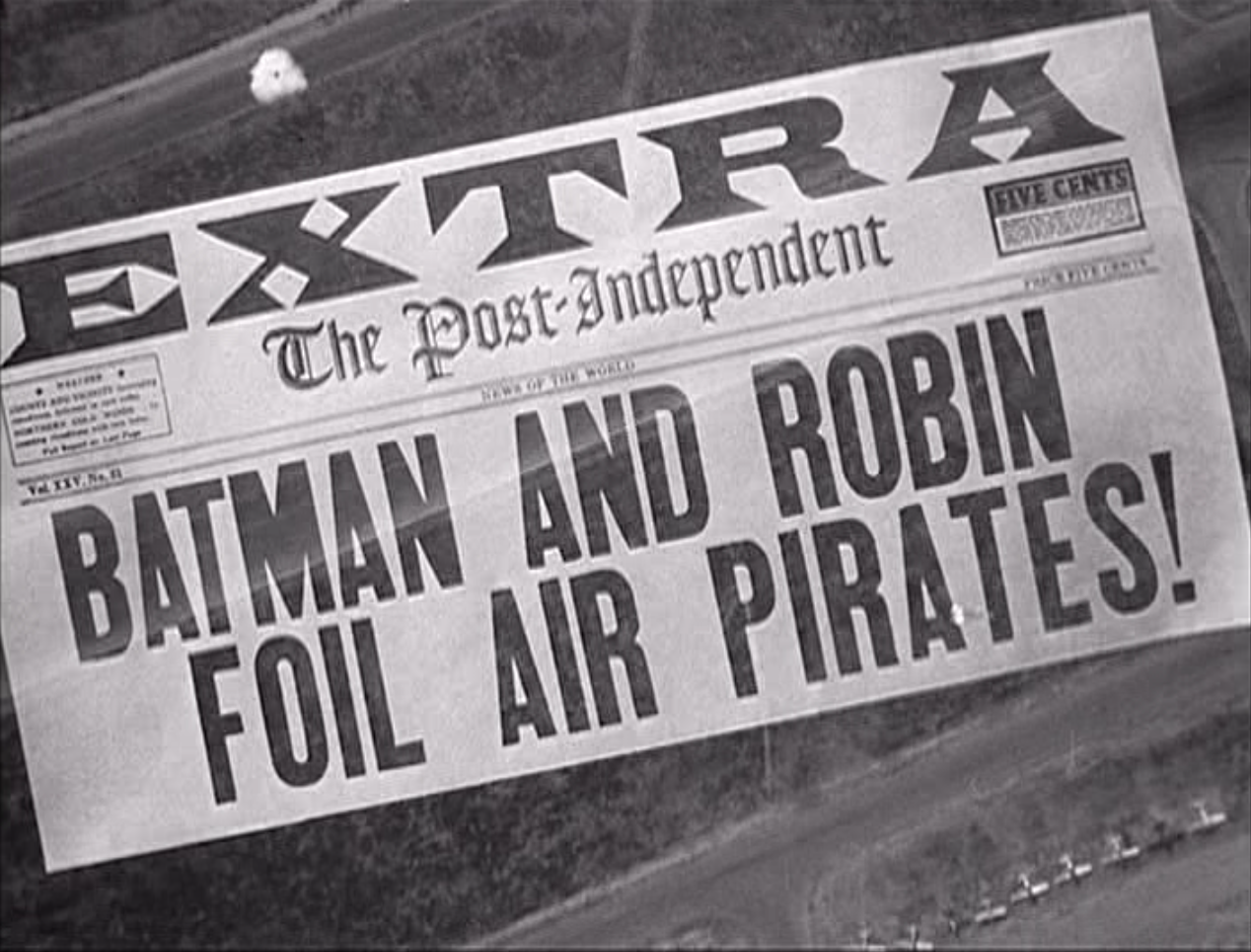
“Crime, stalking our city by night and day, is on the increase! Our undermanned police force is helpless to cope with the situation. But they have an ally: Batman, who, with the faithful Robin, wages unending war against all criminals!” The stentorian voice-over is accompanied by a montage of the Dynamic Duo fighting it out with a variety of gangsters and henchmen interspersed with spinning headlines describing their victories. Batman and Robin are already established crimefighters with a reputation for cleaning up the streets. However, their greatest threat looms before them: will they have what it takes to wrest Gotham City from the remote-control terror of the masked villain known only as the Wizard?

BR.headline2

After I reviewed 1943’s Batman serial last summer, a friend warned me that the 1949 follow-up Batman and Robin was “less racist but somehow more terrible.” Batman and Robin is much less offensive: unlike the wartime Batman, Batman and Robin has no need to demonize the Japanese or anyone else, and is purely cops-and-robbers. It’s unfortunately deficient in energy and suspense, however, so my friend’s warning proved sadly apt.

BatmanRobin

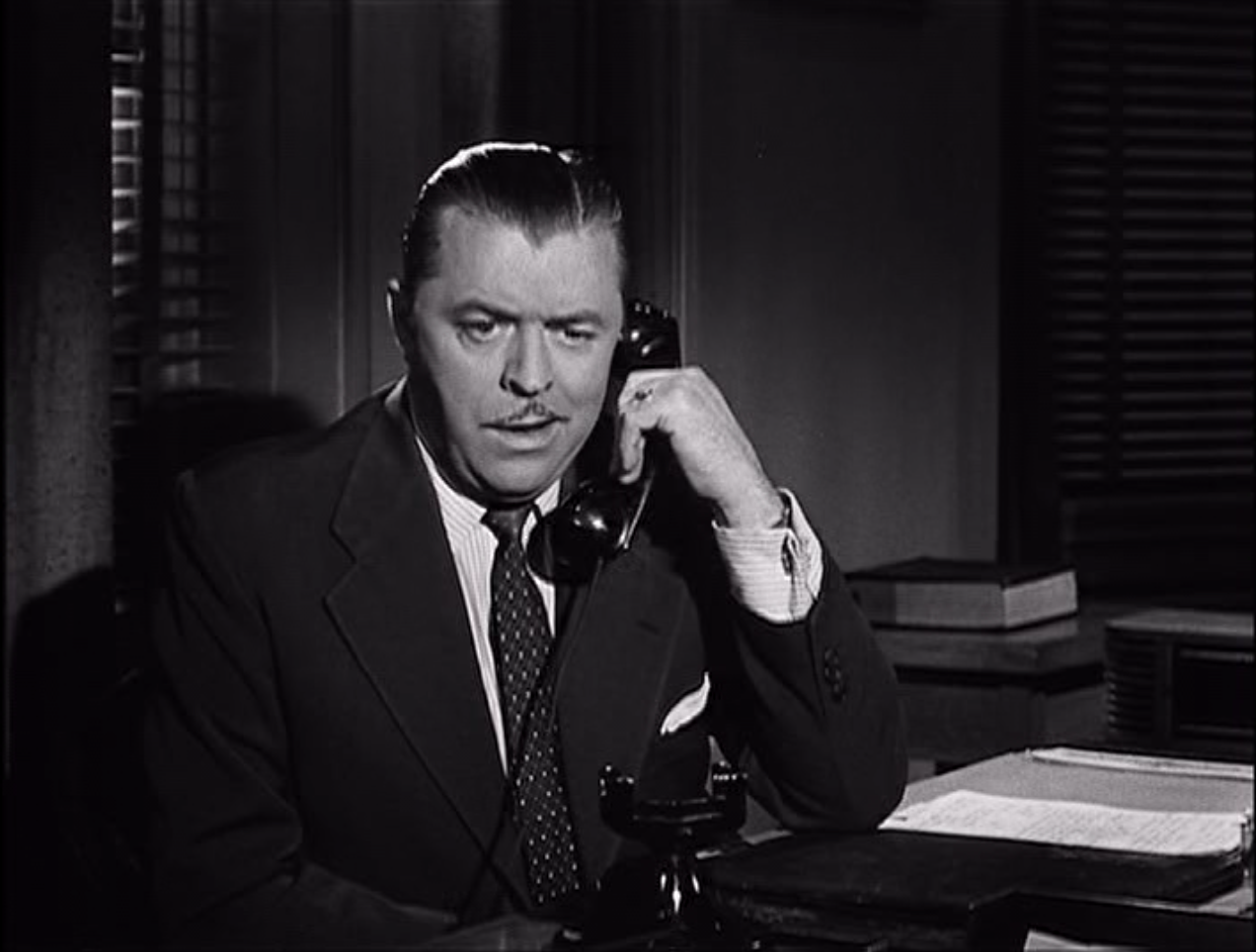
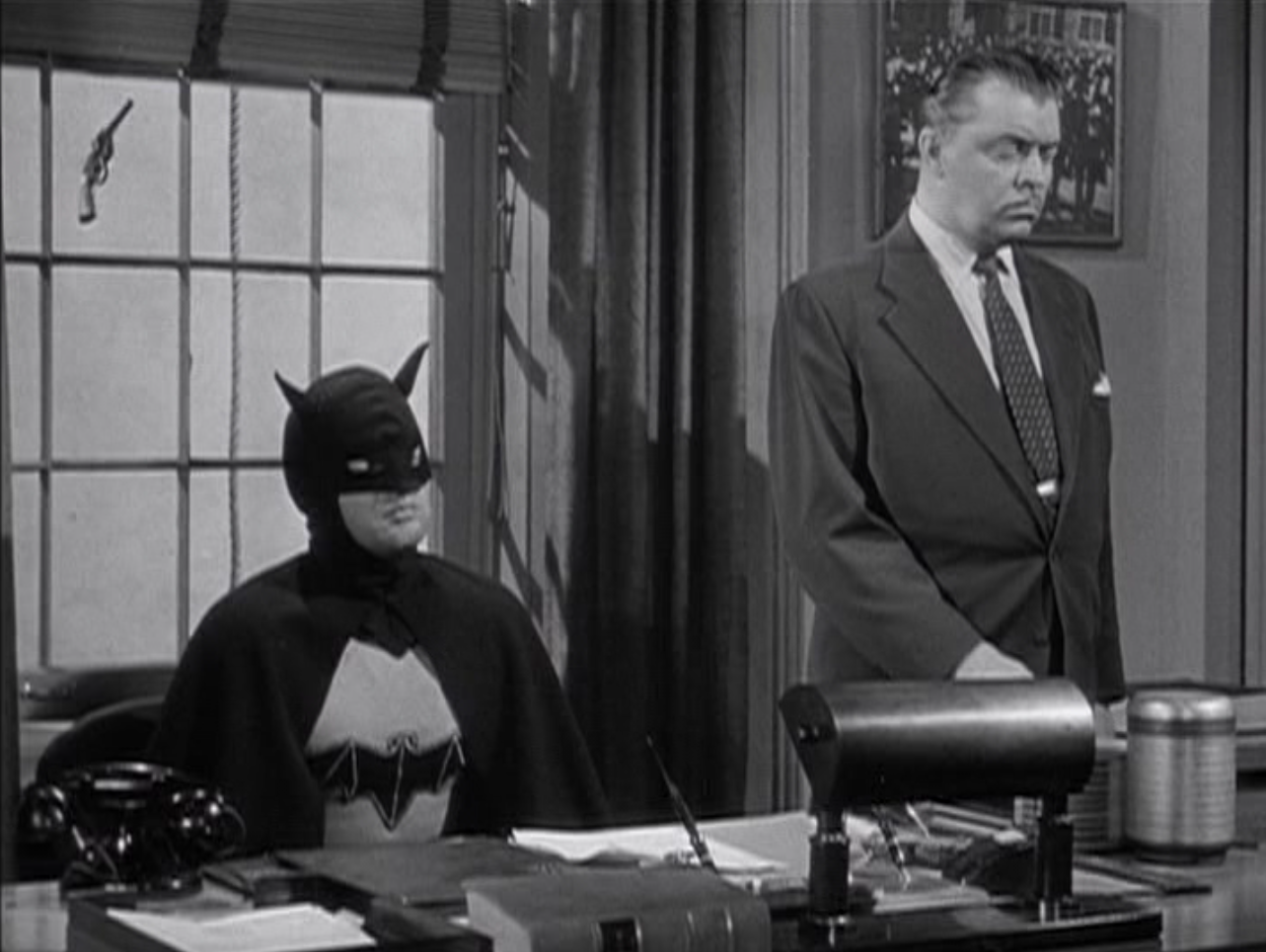
The problems start with leads Robert Lowery as Bruce Wayne/Batman and John Duncan as Dick Grayson/Robin, who are not very convincing as either superheroes or their civilian alter egos. (Duncan in particular is cursed with marble-mouthed line delivery and is just plain too old to be the “Boy” Wonder.) They continue with a plot that, in true serial fashion, is at once baldly simple—a criminal mastermind who calls himself the Wizard has stolen a high-tech gizmo that allows him to take control of any vehicle at a distance, bringing Gotham City to its knees—and at the same time confusingly roundabout, with a boatload of characters and each chapter featuring its own distinctive crisis or mission.

BR.Dick.Bruce

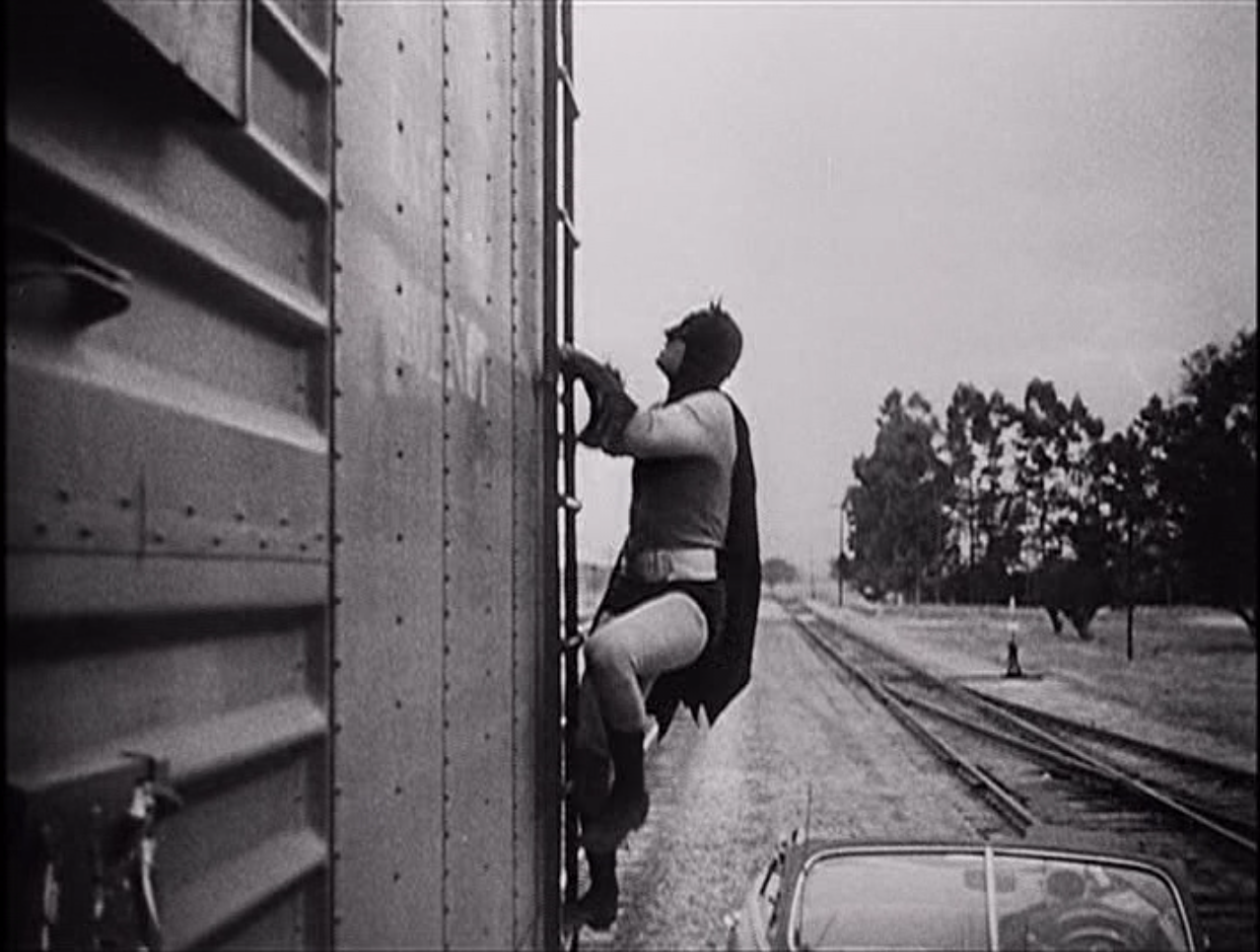
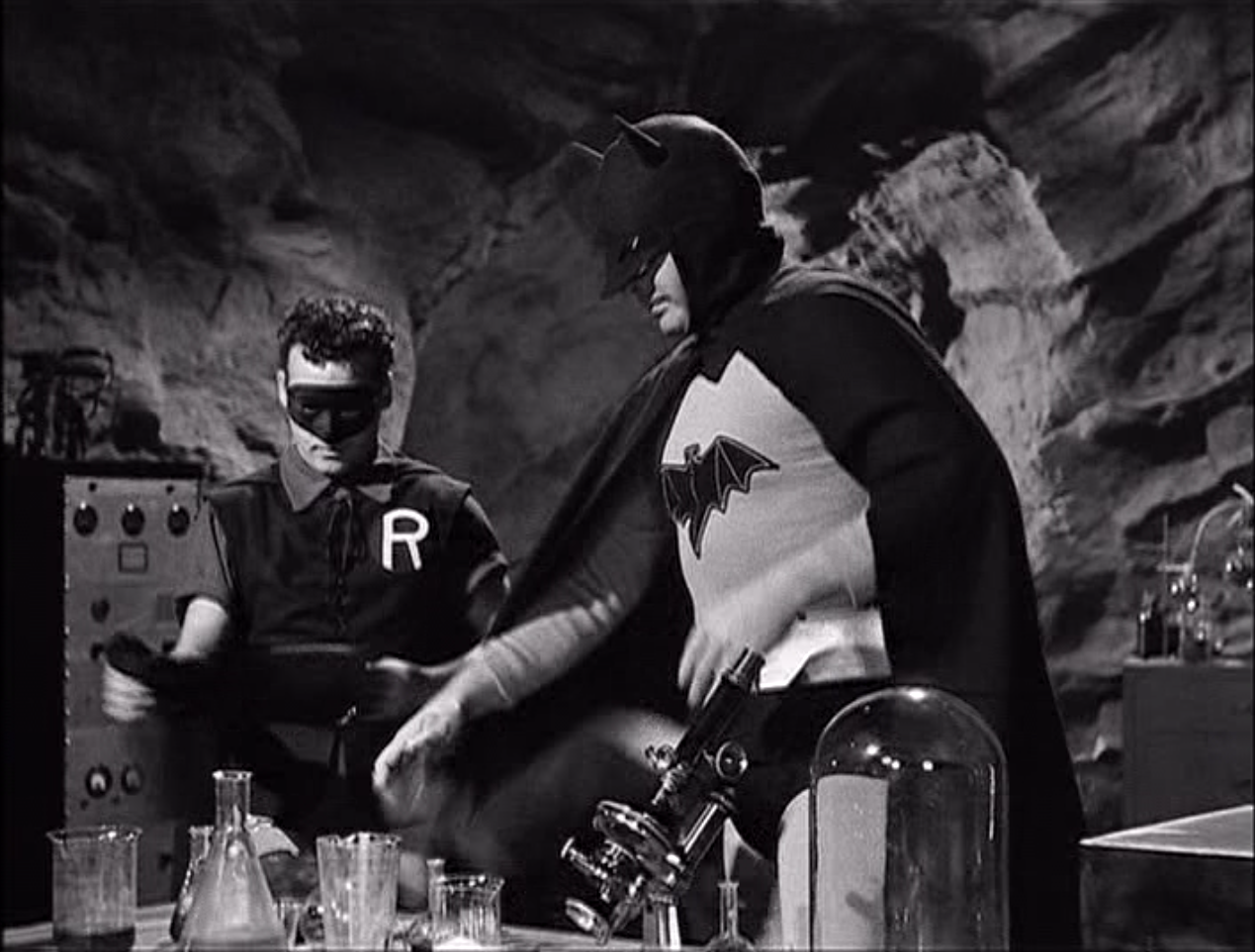
It’s not all bad, however (and Batman and Robin is far from the worst serial I’ve seen). For fans of the comics, Batman and Robin gets closer to the character’s essence than Batman, and includes such familiar characters as faithful butler Alfred (who has much more presence here, and participates by wearing some disguises and driving the car) and Commissioner Gordon, and such essential props as the Bat Signal (there’s still no Batmobile as such, however: at least once the villains wonder why Batman showed up driving Bruce Wayne’s car). There are no criminals left for the police with the “sign of the bat” stamped on their foreheads, nor is Batman presented as a government agent secretly working with Uncle Sam. One new character, photographer Vicki Vale, would prove popular enough to appear in Batman’s comic book adventures, where she is now an established part of his mythos (just as the Bat Cave was introduced in the ’43 serial and has become a constant fixture of Batman’s adventures).

BR.Batsignal

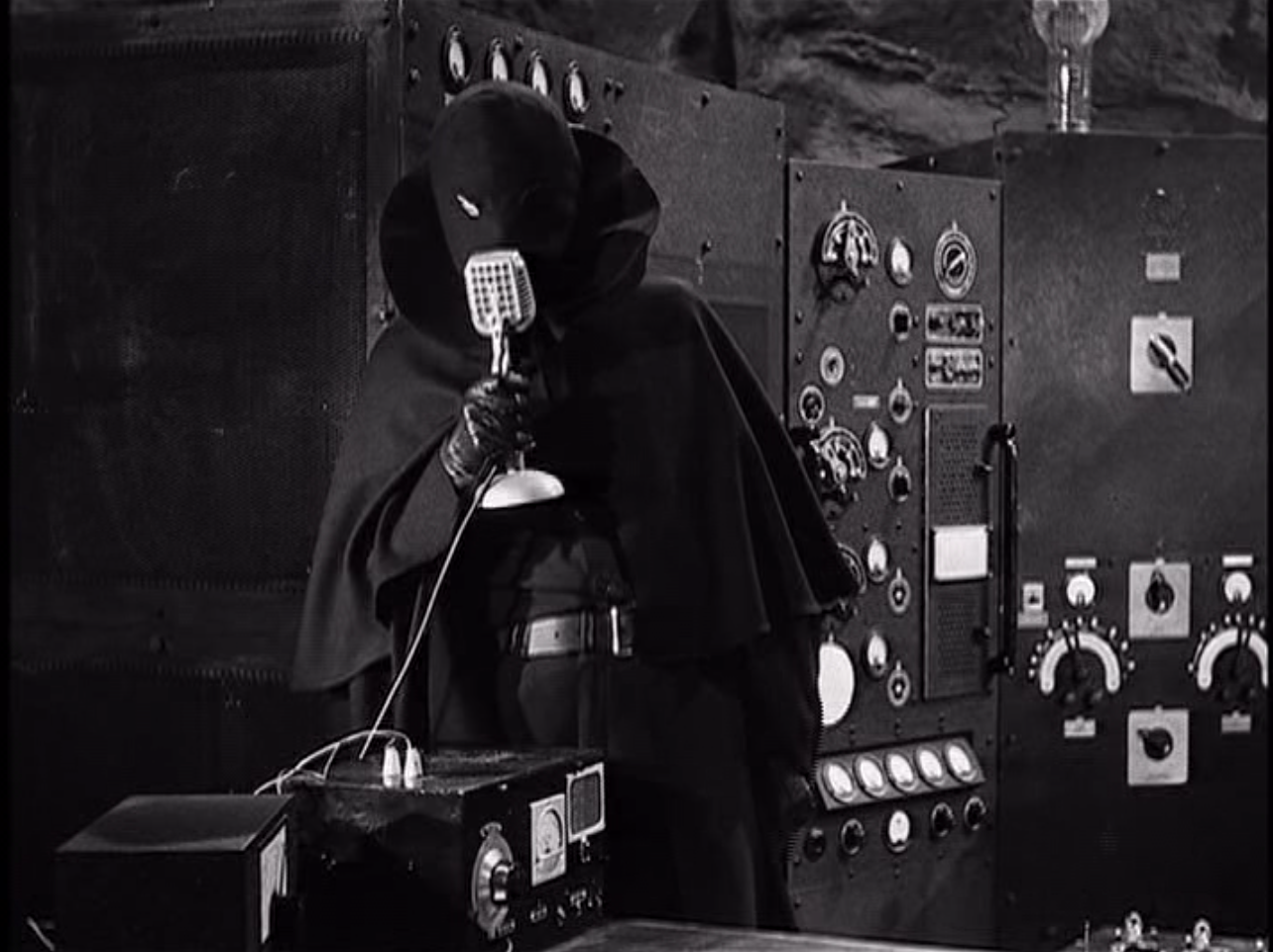
The biggest change for comics readers is the villain: the Wizard himself, a hooded, cloaked figure of scientific genius and unshakeable confidence (“I always have a plan!” he states more than once), is a type frequently found in contemporary pulp magazines and in other serials. Unlike the themed villains that were already facing off against Batman in the comics, the Wizard is fairly generic, using superscience to project his image at great distances, extract secrets by hypnotic suggestion, controlling his henchmen from a secret lair accessible only by submarine, and even making himself invisible for brief stretches.

BR.Vicki1

As is often the case, his identity is unknown until the final chapter, but several candidates are presented to the audience: is the Wizard actually radio newsman Barry Brown, whose broadcasts always seem to include information that the Wizard’s gang needs to commit their crimes? Or is it wheelchair-bound Professor Hammil, the inventor of the remote control device, who regularly visits a secret laboratory and rejuvenates himself so that he can stand and walk for periods of time? Or perhaps it is the private detective Dunne, who always seems to turn up after the Wizard’s crimes have been committed, and claims to be on the trail of the stolen device?

BR.Wizard4

From one perspective, the problems with Batman and Robin are problems with serialized stories in general, and they are the same problems that comic books, serialized TV shows, and the interconnected feature films of the Marvel Cinematic Universe have all had to deal with. To wit, it’s necessary that each installment tell a complete (or nearly complete) story while contributing to the larger arc and teasing a cliffhanger or loose thread that will intrigue audiences enough to return for the next episode. Furthermore, while self-contained stories generally feature change, the classic superheroes are largely static: if one villain is defeated, another will simply arise to take their place.

BR.Wizard3

Superheroes are often described as “timeless,” and even compared to the gods and heroes of mythology; surely their simple, stylized appearance and highly formulaic (ritualized, one might say) storylines contribute to this feeling, but could their “timelessness” not also be a side effect of the sliding timeline that has made these characters contemporary–and roughly the same age–for over three quarters of a century? A few literary characters have been reinvented in contemporary fashion, their adventures updated so that Sherlock Holmes, for example, has exercised his powers of deduction during both World War II and the War on Terror, and Dracula has awoken to terrorize horror audiences in the 1930s, 1960s, and 1990s (he’s already immortal, though, so perhaps he doesn’t count). That’s different from, say, Indiana Jones, who is inseparable from both a milieu and a definite timeline.

BR.Batman2

Timeless, iconic characters, while attractive from the perspective of intellectual property and merchandising, however, must still be able to take part in actual stories–stories where the setting and action are sharpened from the vague dreamtime of the iconic to the specific here and now of this time, this place–if they are to remain current and alive, lest they become only a brand.

BR.Batcave

Batman, in particular, is a character that has been interpreted in many different ways, from the kid-friendly “happy warrior” of the Adam West-starring TV show and the Super Friends cartoons to the wounded child of Tim Burton’s films and the Arthurian scion of Gotham City in Christopher Nolan’s trilogy, and that’s only looking at film and television portrayals. Of those, only Burton and Nolan are interested in exploring Batman’s origins and asking (as comics did, post-Watchmen and post-The Dark Knight Returns) why an orphaned millionaire might choose this particular form of costumed vigilantism instead of, say, investing in social programs; and only Nolan chose to bring the Batman myth-cycle to its conclusion, asking what specific act of justice would heal Bruce Wayne sufficiently that he could hang up the cape and cowl for good.

BR.Hammil2

Although neither serial addresses Batman’s origins, it’s likely that viewers familiar with the comics would at least be aware of his adventures in the comics, and possibly the earlier serial as well, so it doesn’t seem unfair to compare the 1949 serial to other portrayals of the character. All adaptations carry the baggage of already-familiar characters, even if fans in the 1940s wouldn’t have expected their voices to carry like they do now. It’s useful to ask, at least rhetorically, what does this specific version bring to the table, and why was this interpretation resonant at the time it was made? (It’s not necessary for the filmmakers to be conscious of such questions, of course: it wasn’t a given that costumed heroes had anything to say about their cultures in those days, and writers weren’t churning out “thinkpieces” about either the comics or the movies.)

BR.Gordon1

In this context, the 1943 Batman serial is the wartime Batman: its excesses are those of a nation throwing all of its resources into existential war, and while that doesn’t excuse the racist caricature of Dr. Daka it gives the serial a definite identity, a context in which Batman, like all other costumed heroes of the time, were on the side of good, which meant fighting America’s foes. The 1949 serial has no such purpose, and has no dramatic vision to replace it; like many of the later serials, it is primarily aimed at children, and even within that context it’s mostly going through the motions.

What I watched: Batman and Robin (Columbia, 1949)

Where I watched it: Mill Creek Entertainment’s 2-disc Gotham City Serials, which also includes 1943’s Batman

No. of chapters: 15

Best chapter title: “The Wizard’s Challenge” (chapter 13)

Best cliffhanger: At the end of chapter 14 (“Batman vs. Wizard”), the Wizard, turned invisible by the combination of the remote control device and a “neutralizing ray” designed to counter it (just go with it), attempts to kill Commissioner Gordon (as he has previously threatened to do) by hanging from a rope and shooting Gordon through his office window while Batman and Vicki Vale stand by. The Wizard is invisible, but the rope and gun aren’t, so Gordon appears to be shot by a gun floating in mid-air. (Fortunately, Vicki is able to take a picture of the unmasked Wizard using a special infra-red flash bulb devised by Batman. Whew!)

BR.invisible2

Best character: The only person who looks like he’s having any fun in Batman and Robin is William Fawcett, who plays the wheelchair-bound Professor Hammil. An actual Ph.D. and professor of theater with hundreds of credits to his name (mostly in Westerns and television programs), Fawcett would have been an obvious choice to play Captain Marvel’s nemesis Dr. Sivana if he had ever been portrayed onscreen. (There was a Captain Marvel serial, but it had a tenuous connection to the comic book, and Sivana is nowhere to be found in it).

BR.Hammil1
BR.sivana

The wiry and cantankerous Professor Hammil steals just about every scene he’s in. Right off the bat, as the inventor of the remote control device everyone is searching for, Hammil demands to be driven to the research plant just to insult everyone when the device is stolen. (“You’re a pack of careless idiots! Whoever stole it probably has more brains than all of you!”) For another thing, Hammil’s house is nicer than Bruce Wayne’s (the Bruce Wayne I know wouldn’t live in the suburbs!), and even includes a secret laboratory like the Bat Cave (see Matt Singer’s comments below). Hammil actually is known to the public as an inventor, of course, so security is presumably a bigger concern than secrecy, but still: both Hammil and Wayne know that no mansion is complete without a secret passageway to a hidden lair. I’m not going to say whether Hammil is the Wizard or not, but he is nonetheless not a person to be tangled with.

Sample dialogue: “Batman gets entirely too much credit as it is, Vicki. . . . I get tired just hearing about it.” –Bruce Wayne in Chapter 1 (“Batman Takes Over”)

What Others Have Said: “The notion of an evil version of Batman is an intriguing one. . . . Hammil is a near-perfect doppelganger for Bruce Wayne: He lives in an enormous estate on a hill with his own butler to attend to all his needs (along with that hidden, high-tech cave beneath his house). He’s an ideal antagonist and dark mirror image for our hero.” —Matt Singer, whose “Complete History of Comic-Book Movies” at Screencrush is well worth checking out. Singer is, if anything, harder on Batman and Robin than I am.

What’s Next: Join me next week as I explore Atlantis in Undersea Kingdom, starring Ray “Crash” Corrigan.

Revisiting Farinelli il Castrato at The Solute

Farinelli

Gérard and Andrée Corbiau’s 1994 film Farinelli il Castrato was released in the US twenty years ago this month. At the time of its release, the film received a lot of attention for its use of digital editing to simulate the castrato‘s unique vocal qualities. I took a look at it to see how it holds up as cutting-edge technology and as a drama about some age-old concerns (sex, money, and artistry). Visit The Solute to read the article.

More Lovecraft at The Solute

HauntedPalace

During last month’s horror movie marathon I caught up with several film adaptations of stories by H. P. Lovecraft. I first wrote about two fairly faithful twenty-first century adaptations by the H. P. Lovecraft Historical Society at The Solute, and after much delay I’ve put together my impressions of three films from American International Pictures: Roger Corman’s The Haunted Palace (1963), and Daniel Haller’s Die, Monster, Die! (1965) and The Dunwich Horror (1970). Although as a recovering Lovecraft purist I was skeptical of the AIP adaptations, I did find much to enjoy in them, and watching all three in a row provided an interesting overview of horror’s changing face in the 1960s. The article can be read at The Solute.

October is the Coolest Month

wpid-20141031_163834.jpg

Or is it the cruelest? There’s always too much to do and too many events to take advantage of them all during October, between post-season baseball, family Halloween activities, school and work, rehearsals and performances. (I should also mention that The Lost Worlds of Power, which was supposed to be released on Halloween, has been delayed, for reasons best explained here. No worries; I’ll update as I get information.) This year my wife dressed as the Queen from Snow White, and we thought of a costume for me that (I think) came together really well:

"Mirror, Mirror, on the wall . . ."

“Mirror, Mirror, on the wall . . .”

Then there are the movies: a lot of people plan to watch 31 horror movies during October, a movie a day; I knew I would have a hard time reaching that number (and as the month went on I remembered why I had never done it before), but this year I made an effort to catch up on some I had never seen (while revisiting a few favorites). I made it to 21 and still felt like I was cramming them in; as enjoyable as it was, I doubt I’ll try to keep up this pace year-round.

I didn’t plan ahead, for the most part, and for those I saw on the big screen the programmers of the October at the Oldtown horror series made the decisions for me. For my own choices, I defined “horror” pretty broadly, and included some examples of fantasy and thriller, depending on my mood. (Pulp Fiction, which I rewatched in order to write an article on its twentieth anniversary, is the real outlier.)

Barbara Kellerman in The Monster Club

Barbara Kellerman in The Monster Club

The movies I covered are listed below with their year of release and director, as well as a key pointing out a few repeated elements. For example, five of the movies I watched in October were adaptations of stories by H. P. Lovecraft (I wrote about two of them at The Solute, and intend to write about the remaining three in the near future), and considering I didn’t watch any martial arts movies there were a surprising number of samurai sword attacks.

1. The Call of Cthulhu (2005, Andrew Leman)* a, g, hpl, w
2. ParaNorman (2012, Chris Butler and Sam Fell) b, c, v
3. Elvira: Mistress of the Dark (1988, James Signorelli) b, m
4. 7 Faces of Dr. Lao (1964, George Pal)
5. Tentacles (1977, Ovidio G. Assonitis as “Oliver Hellman”) v (diving masks–I guess that counts)
6. The Whisperer in Darkness (2011, Sean Branney) a, g, hpl, v
7. Pulp Fiction (1994, Quentin Tarantino)* ss, v
8. Basket Case (1982, Frank Henenlotter)** c, t
9. The Gate (1987, Tibor Takács)* g
10. The Hole (2009, Joe Dante) c, g
11. Grand Piano (2013, Eugenio Mira) m
12. The Monster Club (1981, Roy Ward Baker) c, m, v
13. The Gates of Hell aka City of the Living Dead (1980, Lucio Fulci)** d, g
14. Demons (1985, Lamberto Bava)** ss, v
15. The Haunted Palace (1963, Roger Corman) a, b, hpl, p
16. Die, Monster, Die! aka Monster of Terror (1965, Daniel Haller) a, hpl, w
17. The Visitor aka Stridulum (1979, Giulio Paradisi as “Michael J. Paradise”)* c, p, w
18. The Dunwich Horror (1970, Daniel Haller) d, g, hpl, t
19. The Texas Chain Saw Massacre (1974, Tobe Hooper)** v, w
20. Eraserhead (1977, David Lynch) c, g(?), m
21. Donovan’s Brain (1953, Felix Feist) p

* rewatch
** seen in theater

a: Arkham setting
b: character burned at the stake (or threatened with burning)
c: monstrous or supernatural child
d: Dunwich setting
g: gateway or portal to otherworldly realm opened
hpl: H. P. Lovecraft adaptation
m: musical number
p: possession or domination by a disembodied intelligence
ss: samurai sword attack
t: twins
v: masks
w: character in wheelchair

Did I miss anything? And did you watch anything in the last month that you would recommend or that made an impression on you?

Scarefest: The Visitor

“Maybe this just isn’t the right time to bring children into this bad, mixed-up world. Some of them are confused: they think that the forces of evil are stronger than the forces of good.” –Jane Phillips (Shelley Winters), in The Visitor

Vis_Katy1

This article was written as a contribution to Scarefest, a series of pieces by commenters on film website The Dissolve, organized by commenter Miller. The week before it ran, I alerted Miller that I was changing my Scarefest entry to The Visitor, and another commenter asked, “Are you writing about how scary it is that it’s so bugnuts insane?” I assume he was kidding, but my short answer is yes. Yes, I am.

The 1979 film The Visitor, directed by Giulio Paradisi (as “Michael J. Paradise”), has long had a reputation as a hard-to-find cult oddity; after a restoration and rerelease by Drafthouse Films in 2013, it became more widely available on disc and VOD. TCM ran the restored version as part of its “TCM Underground” series last summer, and that’s where I saw it. I didn’t know a lot about it, other than having seen the bizarre trailer Drafthouse put together for it, and knowing that the film was considered extremely weird even among cult horror aficionados. I was prepared to have my mind blown, but I wasn’t prepared for The Visitor to actually be, you know, scary.

The plot isn’t easy to summarize except in broad outlines: businessman Raymond Armstead (Lance Henriksen) has made a deal with a shadowy organization dedicated to perpetuating the bloodline of an evil alien being referred to as Sateen. His girlfriend Barbara (Joanne Nail) has one child, Katy (Paige Conner), now eight, but Barbara is afraid of Katy and reluctant to have another child. Because of this, the organization pressures Raymond behind the scenes—their plans for world domination require that Katy have a brother—and Katy, in whom Sateen’s influence is already strong, alternately wheedles and punishes her mother for her obstinance. In the mean time, Jerzy (John Huston), the “visitor” of the English title, stalks Katy on behalf of Franco Nero’s character, a Christ-like figure who lives somewhere (in outer space? or is it Heaven?) with a congregation of bald children and who is opposed to Sateen. Is the visitor’s mission to kill Katy or save her? A lot of other stuff happens in the margins, but that’s basically it: a blend of New Age contactee mysticism and 1970s devil-child horror. So far, so good.

I: The Sleep of Reason

Vis_prologue2

So why did this movie, much of which is absurd on its surface, freak me out? For one thing, the film’s late-‘70s style took me back to my childhood, and not in a good way. I’m just over 40, so my memory of the 1970s is filtered through the subjective haze of being a young child then. The ‘70s were pretty strange to begin with, and even more so when you have no reference for much of the adult world. Much of what was considered “grown-up” moviemaking (and a lot that was aimed at kids) back then was characterized by, to use President Carter’s infamous term, the “malaise” of the time, and for me that resulted in a lot of free-floating unease, even when watching things that were ostensibly light. You just never knew when things were going to take a dark turn. The gauzy, soft-focus cinematography, cheesy cop show music, and swinging suburban styles of The Visitor were all intimately familiar to me, to the point that I couldn’t be sure I hadn’t seen this movie as a kid (I’m still not sure).

My reaction is a subjective one, but is there anything more subjective than fear? Like laughter or arousal, the fear reaction is fundamentally irrational; it can be controlled on the viewer’s part, and there are techniques filmmakers can use to evoke it, but at a base level it touches something that cannot be reasoned with. In my case, that reaction has always been close to the surface: I could hardly watch scary movies or TV shows as a kid, even tame fare like The Twilight Zone, because being afraid or tense wasn’t a pleasant sensation for me like it is for many kids. I was drawn to fantasy, but even something that wasn’t scary at first could come to haunt me, taking on a life of its own as I lay in bed, waiting for sleep, which in many phases of my childhood had its own terrors in the form of realistic nightmares. The Visitor falls flat as a vehicle for ideas or even as a story: too many things happen without explanation, there are abrupt tonal shifts and weird distortions of sound and image, and it just doesn’t make a lot of sense. But is that not an accurate description of a dream?

In dreams, anything can happen, and ordinary events and objects can be invested with emotional power greater than they have while awake. The very first scene, a (possibly allegorical) confrontation between Katy and Jerzy in a gold-lit field, is overtly surreal, and typical of the over-the-top visual flourishes in the movie’s more fantastic sections. As Katy approaches, thick snowflakes swirl around and stick to her face; eventually, only her eyes are visible. It’s spooky, like something from Altered States or Ridley Scott’s Legend (Scott also came to mind later in the film when the skyscrapers of downtown Atlanta are seen through a smoky haze, like the future Los Angeles of Blade Runner).

But the first scene that really threw me is relatively mundane: at her birthday party, Katy eagerly opens a box which was supposed to contain a mechanical bird purchased by her aunt in an earlier scene. Through Sateen’s power (or something), the box contains a gun, which Katy excitedly waves around and then tosses onto the couch, where it goes off and hits Barbara in the back. Katy shrugs, like, “oops?” Barbara spends the rest of the movie in a wheelchair, paralyzed by a bullet to the spine. It’s a crazy scene, but part of its nightmare power is how casually it occurs, and the mismatch of typical “suspense” build-up with gleefully committed violence that literally comes out of nowhere.

Vis_Katy2

Later, after Barbara has recovered and started getting back to a normal life, she is stranded with Katy while driving at night. A semi truck, of which we can only see the lights, pulls up on the side of the road in front of their car. Barbara is worried, and Katy openly mocks her fear. Barbara is right to be afraid: the truck is a mobile operating room, and after she is rendered unconscious agents of the conspiracy artificially inseminate her to speed up their plan. The imagery is straight out of an alien abduction report: stranded motorists, lost time, the dim memory of an operation (I suspect that it is this sequence, and a few scenes of glowing lights in the sky, that led to criticism of The Visitor as a knock-off of Close Encounters of the Third Kind), and a surprise pregnancy.

Upon discovering her condition, Barbara goes to her ex-husband (played by Sam Peckinpah!) and pleads with him to help her get an abortion. When she returns home from that operation (still in her wheelchair), Katy savagely attacks her. No pretenses now! And again, the sudden eruption of violence, while motivated by character and plot, is surprising in its intensity. Even Damien usually cloaked his actions in the plausible deniability of a “freak accident.”

II. The Sound of Nightmare

Vis_Katy3

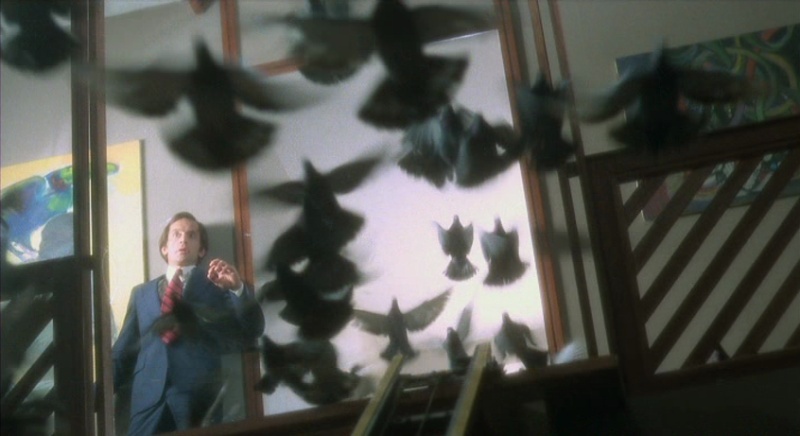
The Visitor’s Italian title, Stridulum, is appropriate: Latin for “whizzing or hissing,” and surviving in English in the word “stridulation,” for the buzzing sound insects make by scraping their legs together, it’s a clue to how important sound is in The Visitor. Both Sateen and his enemy (a spaceship-flying “Commander Yahweh”—shades of Chariots of the Gods!), have birds as an important part of their back story; Katy keeps a hawk called Squeaky who obviously represents her diabolical heritage and with whom she communicates, and the visitor summons a flock of birds during the climax of the film to scourge Katy of Sateen’s influence (I think). I suspect that birds are so important to The Visitor because they’re a convenient artsy symbol for the soul, and also because, post-Hitchcock, birds are creepy. Either way, the soundtrack is full of echoing, distorted screeches and bird calls (in addition to analog synthesizer sounds—another skin-crawling part of my childhood—and the aforementioned funky cop show music). Whenever Katy is about to use her psychic powers (as at the birthday party), we hear the eagle cry, or see a glimpse of Squeaky, or both.

Then there’s the mechanical bird that was supposed to be in the box: it’s a gold and blue knick-knack that says “I’m a pretty bird” in a synthesized drone, followed by a whine of feedback, on a constant loop. Even in the first scene, when Katy’s aunt buys it, I’m not sure how anyone could hear that and think of the bird as anything other than a prop in a horror movie. Later, when a detective (Glenn Ford!) is trying to figure out where the gun at the party came from, he finds the bird and takes it with him in his car. It’s still talking as he drives his car down the freeway with it on the passenger seat. “I’m a pretty bird * wee-ooo * I’m a pretty bird * wee-ooo * I’m a pretty bird * wee-ooo,” et cetera, until Squeaky attacks the detective and he drives the car off the road, where it bursts into flame before he can escape. Squeaky strikes again!

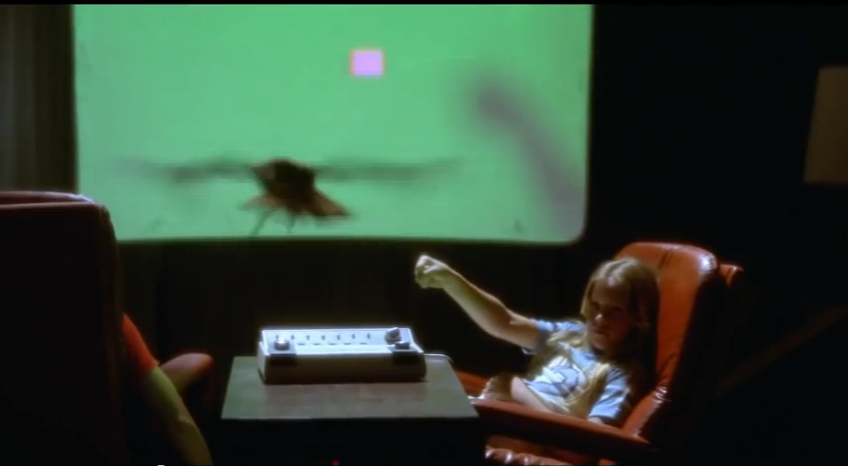
Sound also plays a role in the scariest scene in the film, the scene that I actually had to turn off for a few minutes to get myself together before I could finish watching it: early in the film, Katy is shown playing Pong on a big-screen TV, hidden by the chair in which she is sitting. The electronic blip of the game is the counterpoint to the conversation she has with her mother. Much later in the film, after Katy has been institutionalized for her violent behavior, Barbara returns home to her empty house and hears: blip . . . blip . . . blip. The game is turned on, Katy is in her chair. After Katy’s brutal attacks, just her presence in the house again is scary, but the whole sequence following is . . . well, it scared the hell out of me, but it is also much stranger than anything I’ve described yet, so I won’t spoil it.

III. All in the Family

visitor07__large

Paige Conner doesn’t look like she’s eight years old in this movie: maybe ten. It could be that she’s big for her age or I could just chalk it up to the precocity of child actors. In any case, her Katy Collins is a miniature tyrant, controlling and profane. Her poor mother is constantly put-upon, and her would-be stepfather mostly stays out of her way. Even when Katy’s words are pleading, her tone is commanding or threatening. Only Jerzy and a suspicious housekeeper (Shelley Winters) really see her for what she is, but take opposite approaches to dealing with her.

By coincidence, I had an older sister who would have been about Katy’s age in 1979, and while she wasn’t the holy terror that Katy is in the movie, I’m sure it affected my reception of this movie. The trappings of a late ‘70s girlhood cheek-by-jowl with the freaky events of the movie was unsettlingly close to my childhood nightmares and brought to the surface more anxiety than I realized I still carried with me.

Domestic abuse was an issue that got a lot of attention in the late ‘70s and early ‘80s, as if the lid had finally come off a closely-held secret and now everyone was free to sort it out in public. I’m fortunate that I didn’t grow up with firsthand experience of family violence, but it was something I became aware of thanks to the new openness about it. Nowadays, when I hear about Mommie Dearest at all, it’s as a camp classic: “No more wire hangers, ever!” et cetera. It wasn’t funny to me as a kid, however: Faye Dunaway as Joan Crawford terrified me. I might have chosen that movie for Scarefest, except I haven’t gone back to watch it since then.

The Visitor pushes some of the same buttons for me. I’m not kept up at night by its cosmic battle of good and evil, or the slow-motion mayhem, or even the bird attacks: those are par for the course with science fiction and horror movies. I enjoy that stuff. What really shocked and disturbed me was the sudden eruption of violence in otherwise very mundane settings, worst of all between family members. For such an unreal movie, it feels an awful lot like someone’s issues being laid bare.

Now that I’m an adult, I see my childhood anxieties from the other side: my daughter is eight years old. I love her. She’s a good kid. But even in the best of relationships there are moments: children can be shockingly amoral and single-minded about getting what they want. As a parent, it’s natural to wonder about and be frustrated by those moments, and fearful not of our children but for them. I’m also not proud to admit that there are moments I feel like Shelley Winters’ Jane, just wanting to slap some respect into the “bad” kids. Is that what this genre of horror boils down to? Is that the root of The Bad Seed and The Good Son and “It’s a Good Life” and The Omen and all the rest? Is it simply the recognition that children can be brats, taken to the nth degree?

Possibly. But I think it’s more general than that: even the people closest to us have sides to them that are unknown to us. They share our lives and homes, but their thoughts are no more visible to us than those of strangers halfway around the world. The Visitor taps into the fear that we don’t really know the people around us: the “Visitor” could be a stranger, or someone we’ve known our whole lives.

Two Lovecraft Film Adaptations at The Solute

CoCTitle

I recently posted a review of two films by the H. P. Lovecraft Historical Society over at The Solute: the 2005 silent adaptation of “The Call of Cthulhu” and the 2011 talkie “The Whisperer in Darkness.” Both are intriguing exercises in recreating the period of the stories rather than updating them as many adaptations have done in the past, making the most of limited budgets, and they show different approaches to adapting Lovecraft’s atmosphere-heavy stories. You can read about them at The Solute.

Marching Into the Movies at The Solute

boysband2

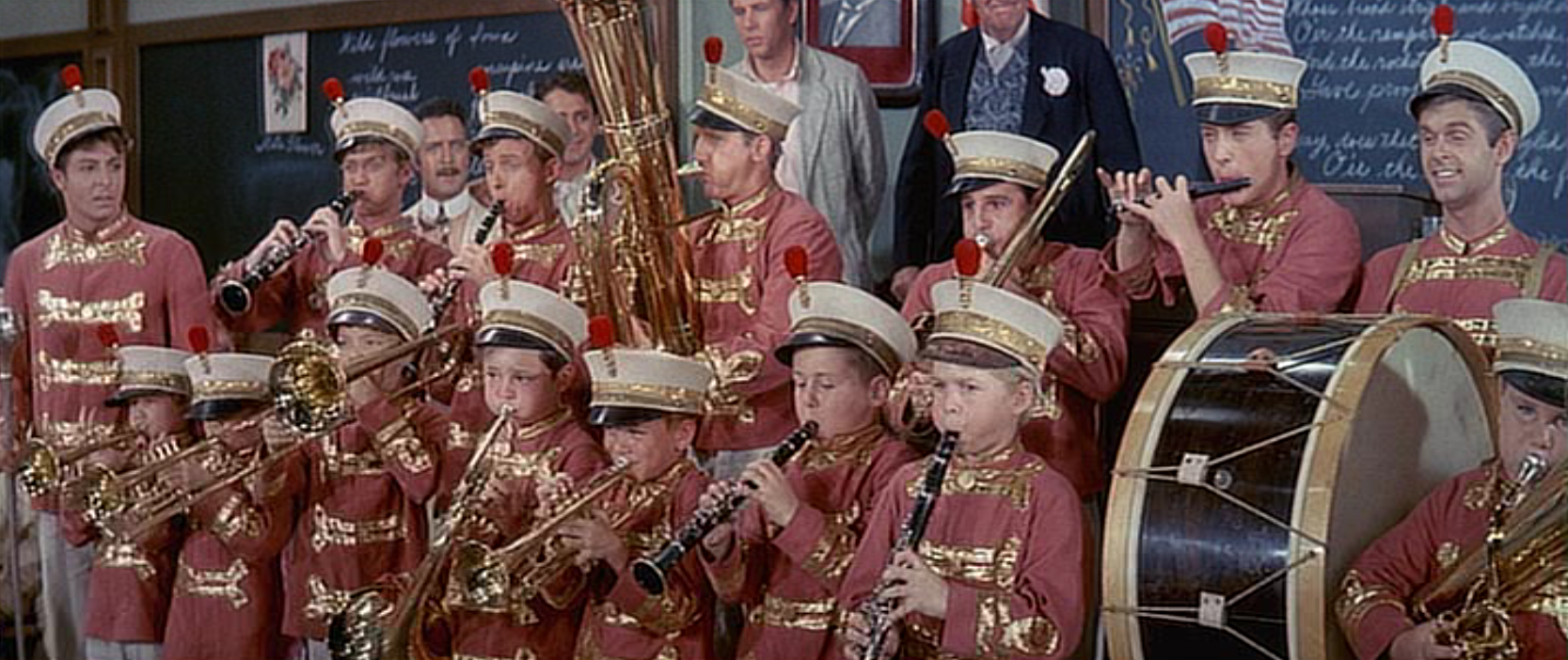
I’ve got another one at The Solute today, and this one’s a long one. I examine several movies about or featuring bands, marching and otherwise, and examine the different ways this unique form of social and educational music-making have been portrayed on film. You can read it here.

(And don’t worry, this isn’t the end of long-form content here at Medleyana: I will still be posting longer articles here as well!)