Fates Worse Than Death: Batman (1943)

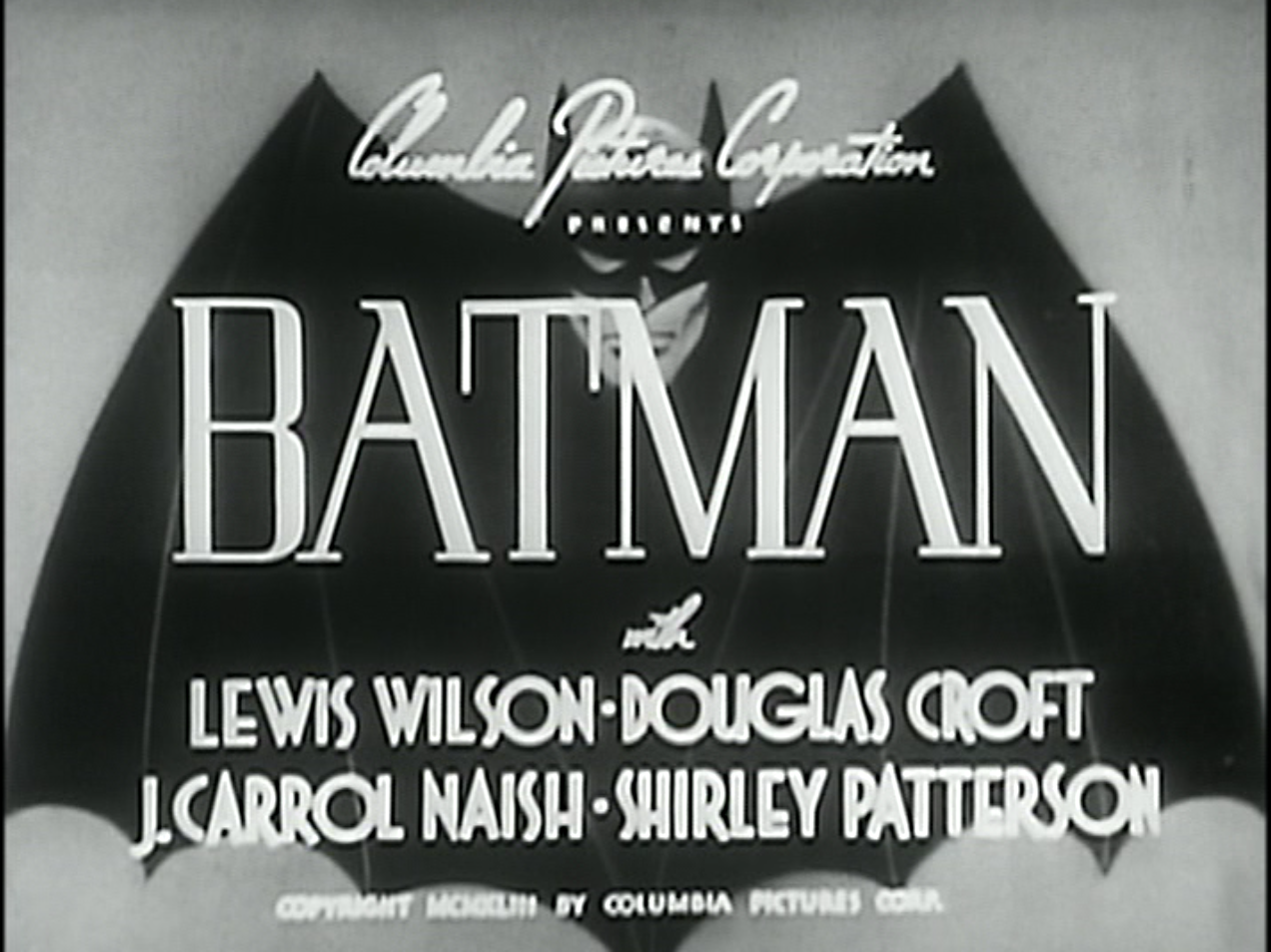
BatmanTitle

Industrialist Martin Warren, after serving his sentence for an unnamed crime, is about to be released from prison; his niece, Linda Page, asks (her boyfriend? fiancée?) playboy Bruce Wayne to accompany her to pick him up.  Although Wayne’s life of leisure doesn’t allow him to get out very early in the morning, he promises to accompany her.  But before they arrive, Warren is picked up by some other old acquaintances, who coerce him to meet their boss, Dr. Daka.  Daka is a Japanese spy striking at the United States from within, and if Warren doesn’t join Daka’s ring of “dishonored” engineers, bankers, and other professionals and agree to serve his “League of the New Order,” he’ll be turned into a mindless zombie by one of Daka’s inventions.  In the mean time, the costumed crimefighter known only as the Batman, with his sidekick Robin, leave a pair of crooks (complete with the “mark of the Bat” on their foreheads) for the police to pick up.  Who are Batman and Robin, and what do they have to do with Bruce Wayne and his young ward, Dick Grayson?
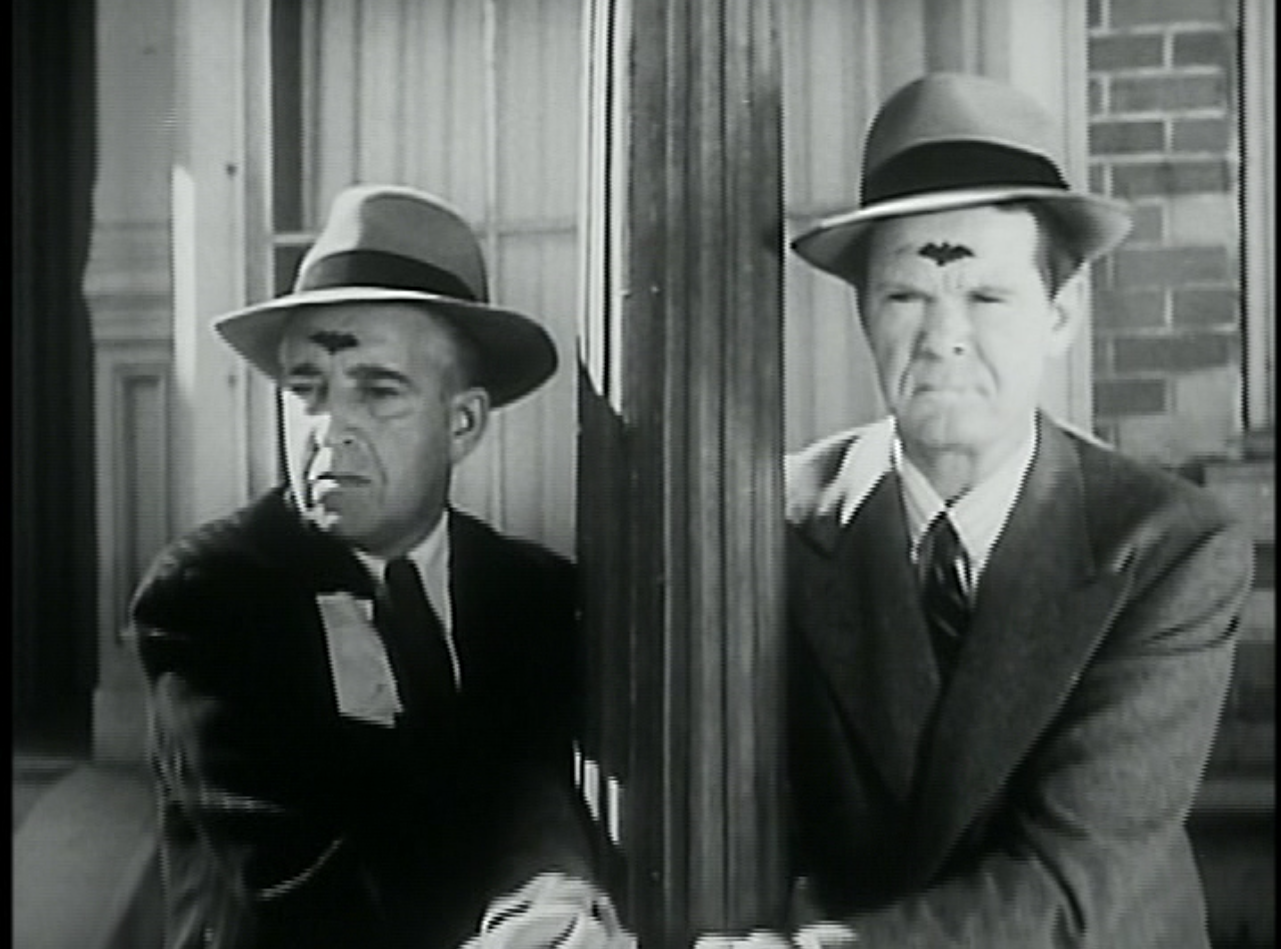
BatMark

There can be hardly anyone reading this who isn’t aware that Bruce Wayne and the Batman are one and the same, of course, and the 1943 Batman serial wastes no time in letting the audience in on that information.  In making the leap from the comics to the screen, only the core trio of Bruce/Batman, Dick/Robin, and Alfred the butler were retained (Batman’s police contact is Captain Arnold, not Commissioner Gordon), but their characters and identities are recognizable to readers of the comic book (for the most part: Alfred is relegated to comic relief, skittish and easily flustered, but he still comes through when his services are needed).  None of Batman’s usual enemies like the Joker or Penguin are present (many of the most familiar villains weren’t created until later anyway); Batman was made during wartime, and the enemy he faces in Dr. Daka is a nationalistic one.

Batman_Robin

Even allowing for its wartime origin, it saddens me to report that Batman is incredibly racist.  As a cringe-inducing caricature of the effete, treacherous Oriental, Daka is grossly offensive, but if the serial stopped there Daka would fit in with the pseudo-exotic threats I’ve mentioned before (and he is, after all, supposed to be a villain).  But that isn’t enough: Daka’s lair is located on a street in “Little Tokyo,” which according to the enthusiastic narrator has been nearly empty “since a wise government rounded up the shifty-eyed Japs.”  That’s in the first chapter and it doesn’t get any better: even Daka’s own henchmen despise him and throw around racial slurs behind his back.  “I’m not afraid of him or any other squint-eye,” says one named Forrester before rebelling.  Forcing Daka to surrender, Forrester tells him “That’s the kind of answer that fits the color of your skin,” when he (briefly) has the advantage over him.  Subtle it is not. (Unsurprisingly, Daka was played by a heavily made-up white actor, J. Carrol Naish, a common practice in 1940’s Hollywood.)

Daka2

The wartime angle is also apparent in constant references to America’s fighting spirit and the important work being done by the armed forces and munitions manufacturers.  In a twist from the comics, Batman and Robin undertake secret missions for the U. S. government, receiving coded messages from contacts about threats to America’s intelligence and infrastructure.  (According to Jim Harmon and Donald F. Glut in The Great Movie Serials: Their Sound and Fury, rigid censorship ensured that serial heroes were never shown taking the law into their own hands.  Since being a vigilante is central to Batman’s identity, in the serial he remains independent from the police, taunting an exasperated Captain Arnold who nonetheless depends on the cases his “best agent” wraps up for him, but ultimately Batman gets his orders from Uncle Sam.)

After the generic “spy ring” of Robinson Crusoe of Clipper Island, Batman has a refreshing specificity: Daka plots to steal radium (both to fuel a superpowered “radium gun” and to build an even larger one), blow up a supply train, steal an experimental plane, jump a claim on a radium mine (truly a magical element that allowed screen writers to add a contemporary touch to the hoariest plots), and more.  The political context may have brought out some ugly, jingoistic racism, but there is also never a question of the time and place and what the stakes of the conflict are.
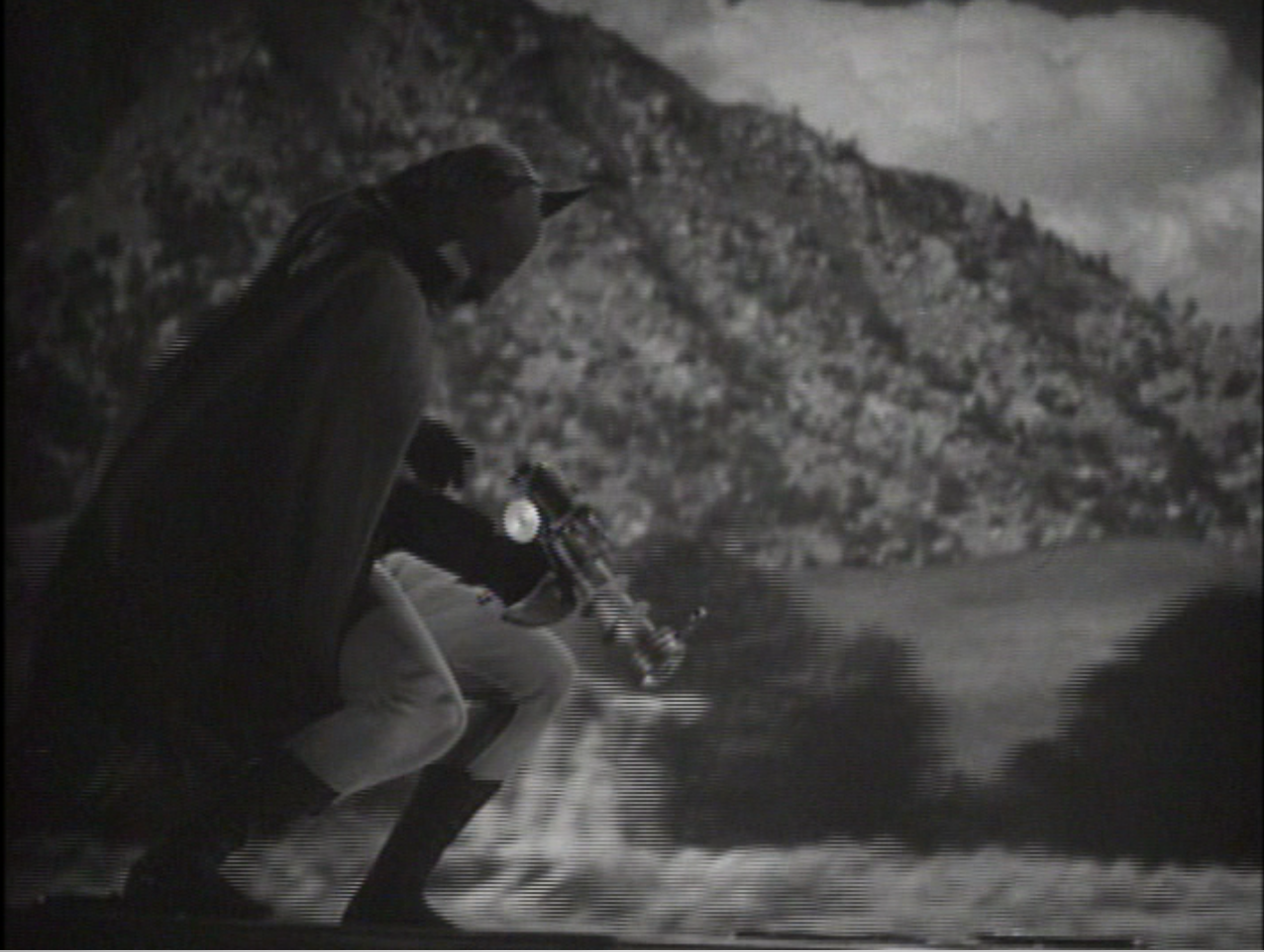
Batman.radium

The oddest aspect of this propagandistic impulse is in the setup of Daka’s Little Tokyo hideout: the League of the New Order has its headquarters hidden in a “Japanese Cave of Horrors,” a wax museum primarily containing tableaux of Japanese war atrocities.  Every time the front of the business is shown, a carnival barker is pitching its importance to the war effort: “See the life-size models of the victims of our savage enemies! . . . See how they treat their prisoners. It’ll make your blood turn cold!”  It almost seems as if the filmmakers intend the barker’s words to represent the serial itself: “Come on in here and spend a dime, my friends, and wise yourself up. It’s not a circus, it’s not a carnival—this is a serious proposition!”  Yet the carnival barker is in league with Daka, sending his henchmen to the secret entrance and selecting victims to be brainwashed.  It’s either brilliantly self-referential, a commentary on the bottomless duplicity of the enemy, or just goofy.  Daka believes in hiding in plain sight, apparently.
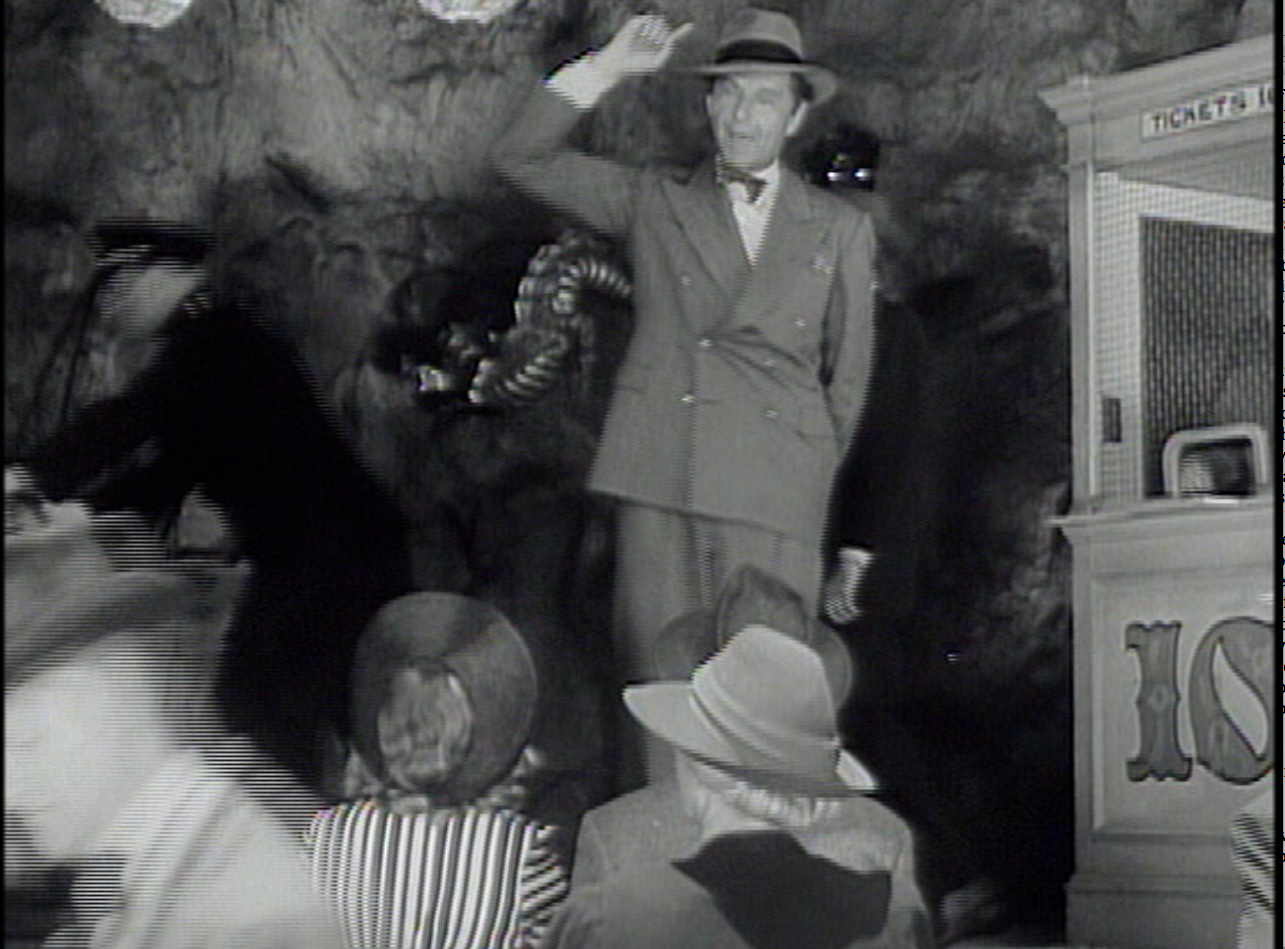
barker

The seriousness of Japan’s Imperial ambition isn’t necessarily foreign to either the serial format or Batman as a character—both have featured their share of would-be world conquerors—but it is an odd fit with the tone of the 1943 production, which is frequently light, even whimsical.  Lewis Wilson as Batman and Douglas Croft as Robin appear to be having a ball whether in costume or out: this isn’t the grim, tortured Batman of Christian Bale, or even the reclusive weirdo Michael Keaton portrayed.  Even Naish as Daka gets to rub his hands gleefully and display a few moments of humor, like when he feeds raw meat to his pet alligators and briefly considers throwing a zombie to them as “something special.”  The actors and narrator embrace even the most absurd contrivances with gusto, and I’m not convinced this is entirely a case of straight-faced material only appearing funny in hindsight: comic relief was an essential component of the serial, and I daresay the funny parts are fresher and more entertaining than the repetitive fistfights and formulaic cliffhangers.  (It became very easy to predict what the cliffhanger would be in each episode, as the same beats were employed to set the stage each time. When, as in Chapter Six, a thug says, “Let’s get out of here before that chemical reaches those wires!” you know exactly what’s going to happen next.)

The 1943 Batman serial is likely to be of interest primarily to Batman completists, but I doubt it will satisfy any fan who would describe themselves as such.  It was rereleased to theaters in the 1960s as a camp film, where it influenced the next wave of Batman adaptations. Fans of the 1966 Adam West Batman TV show will recognize many elements: the deadpan acceptance of ridiculous situations, enthusiastic narrator, and even the two-part episodes with cliffhangers very much in the serial style.

Batman1

So what works?  For all the fistfights, Batman engages in quite a bit of detective work in this serial: not only does he find and analyze clues, he goes undercover (he disguises himself as a thug named “Chuck White,” and sends Alfred out in disguise a couple of times), gets information out of Daka’s henchmen through a variety of means, and even manages to turn their traps around on them, all while maintaining his secret identity.  Batman also delegates responsibility to Robin and Alfred, who several times come to the rescue.  The complexity of the puzzles is laughable and the level of thought isn’t that deep, but within the bounds established by the script, it’s easy to believe that Batman and Daka are waging a high-stakes chess game against each other, striking and counter-striking until the big confrontation.

I also liked Lewis Wilson as the title character more than I expected: to cover his real purposes, his Bruce Wayne is vapid and silly, and his excuses for not being around—he took Dick to a polo match or an amusement park; he doesn’t get moving until around noon—are amusingly flip.  He expects Linda to believe him, because what red-blooded man would use such indolence as an excuse unless it were the truth?  When one of Daka’s henchmen suggest that Wayne might be the costumed troublemaker, Daka sneers, “Don’t be absurd—that simpering idiot could never be the Batman!”

Bruce2

What I Watched: Batman (1943, Columbia)

Where I Saw It: I watched a Columbia Pictures DVD set, but it is on YouTube (in many parts) starting here.

No. of Chapters: 15

Best Chapter Title: Almost all the chapter titles are pretty great, with the kind of snappy immediacy and hint of exciting developments that all the best pulp titles have.  If forced to choose, I’ll go with Chapter Four, “Slaves of the Rising Sun” (balanced out by the fifteenth and final chapter, “The Doom of the Rising Sun”).

Best Cliffhanger: Chapter Thirteen, “Eight Steps Down,” ends with a double cliffhanger: Batman, trying to sneak into Daka’s lair, is threatened by the classic spiked-walls-closing-in trap, while at the same time, Linda Page is about to be turned into a zombie by Daka’s mind control device.  However will they escape?

Linda.zombie

Annie Wilkes Award for Most Blatant Cheat: Many of the escapes in Batman are of the kind that would infuriate Annie Wilkes: a train bears down on the hero, or an armored car plummets off a cliff and explodes, only to be revealed in the next chapter that Robin pushed Batman off the railroad trestle or Batman leapt from the armored car just in time, all shown from a different angle.  If any of those are cheats, then they all are.  However, I can’t say any of them explicitly undo the setup of the cliffhanger.

Actually, my favorite is the resolution to the cliffhanger of Chapter Fourteen (“The Executioner Strikes”), in which Batman, knocked out and placed in a coffin-sized wooden crate, is carried to Daka’s lair; the box, unopened, is dropped into Daka’s alligator pit.  At the beginning of Chapter Fifteen, it’s revealed that Batman had escaped before the crate was even brought to Daka’s lair, and it was Daka’s henchman Wallace in the box.  You can bet he didn’t get the benefit of a last-minute cheat.

Sample dialogue:

Bruce: “Well, we never got to the cave.  It was so hot out, we laid down by the side of the road and took a nap.”

Linda: “Asleep! Just when I needed you both so much.  If it hadn’t have been for the Batman I’d be dead in the cave!”

(Chapter Nine, “The Sign of the Sphinx”)

What Others Have Said: “Where could even a Japanese spy get enough ration stamps for all that meat?” Harmon and Glut, referring to the fodder for Daka’s pet alligators

What’s Next: Join me in two weeks as I vicariously travel the Western frontier through Fighting with Kit Carson.
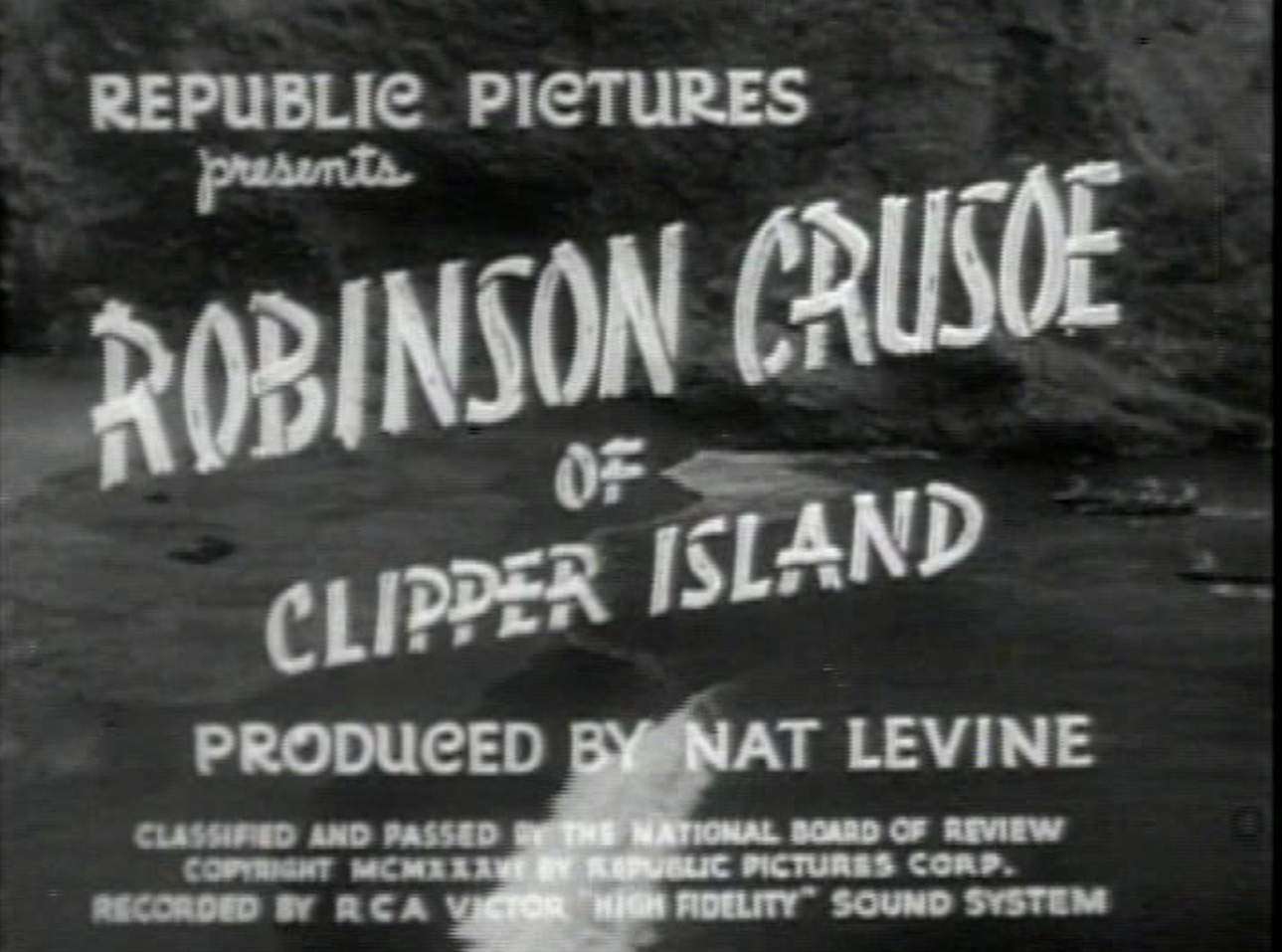
Fates Worse Than Death: Robinson Crusoe of Clipper Island

RCTitles

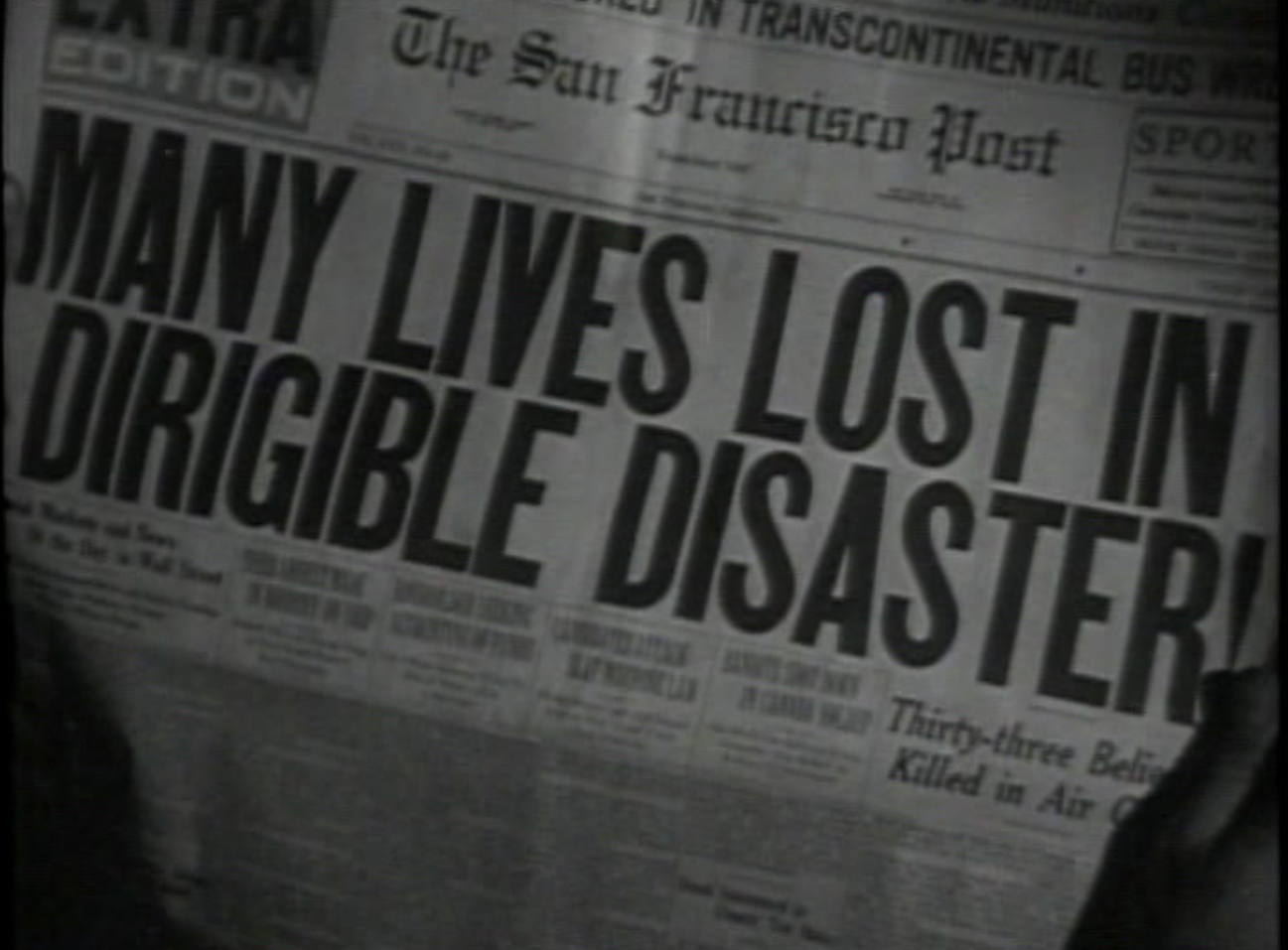
The year is 1936.  The leaders of Pacific Dirigible Airlines are monitoring the maiden voyage of the airship San Francisco between California and Australia.  Just before the dirigible reaches the mid-point refueling station at Clipper Island, disaster strikes!  The radio operator on Clipper Island, half dead, reports that something has destroyed the fuel tanks.  The island is taboo to the native Komatoans; have they risen in revolt, or was it the vengeance of their volcano god, Pele?  The three directors, Ellsworth, Canfield, and Jackson, don’t have time to worry about that: if the San Francisco is forced to turn back, the fledgling company will be ruined.  Suddenly, the airship itself is on fire and doomed to crash before it ever reaches the island.  Oh, the humanity!

Headlines

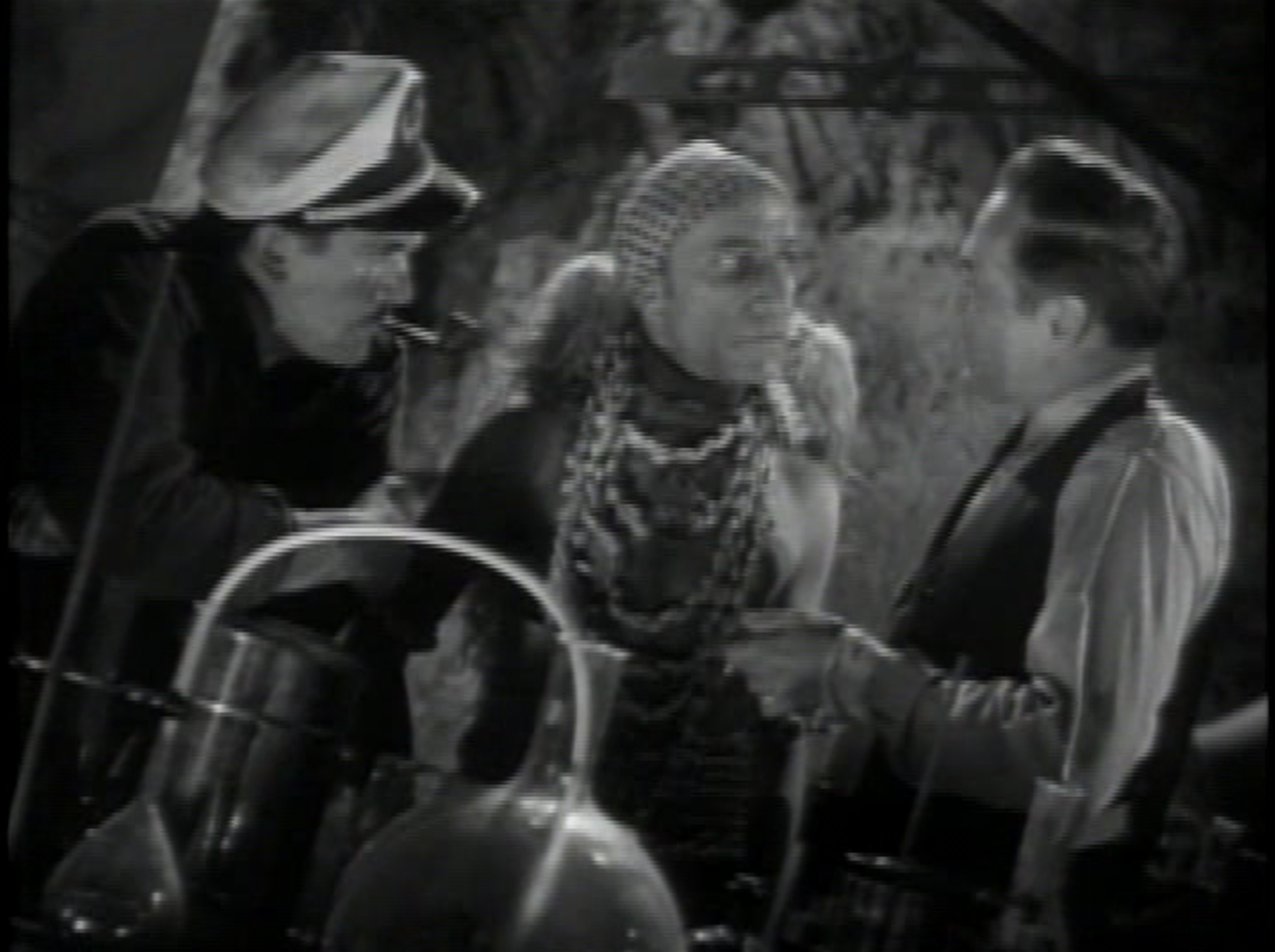
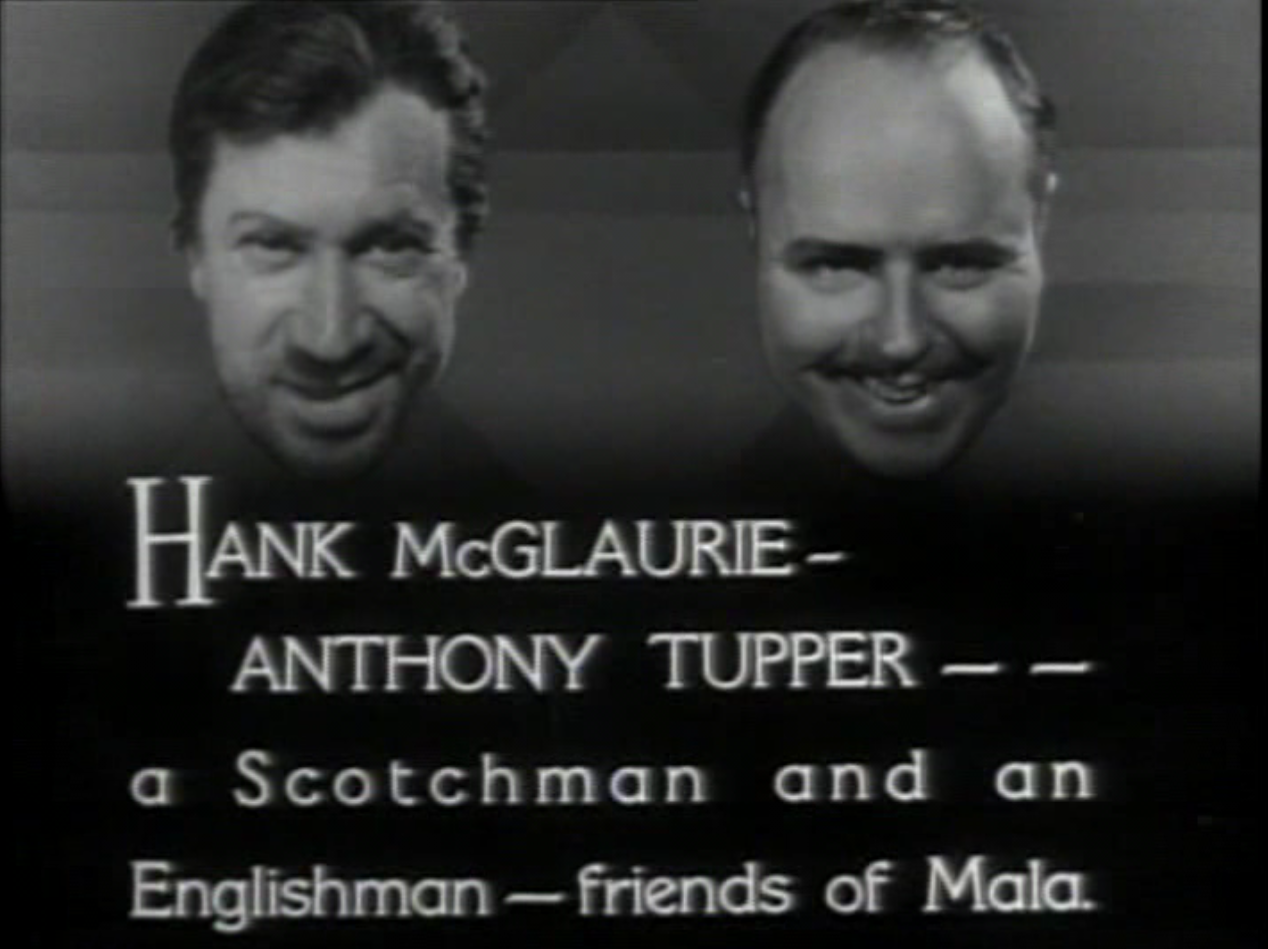
Ellsworth and his board suspect sabotage, and a government agent, Mala, is called in to investigate.  Posing as the new radio operator, Mala travels to Clipper Island, where he gets mixed up with Melani, the Komatoan princess, and the high priest Porotu, who schemes to take her throne.  Working with Mala are Scottish Hank McGlaurie and English novelist Anthony Tupper, as well as the second-billed stars Rex and Buck, a horse and a dog respectively. (Both Rex the “Wonder Horse,” aka “King of the Wild Horses,” and Buck were already animal stars, and they assist by attacking and harrying the bad guys, protecting the princess, and even going for help when Mala is in trouble, as in “I think he’s trying to tell us something!”)

Rex_Buck

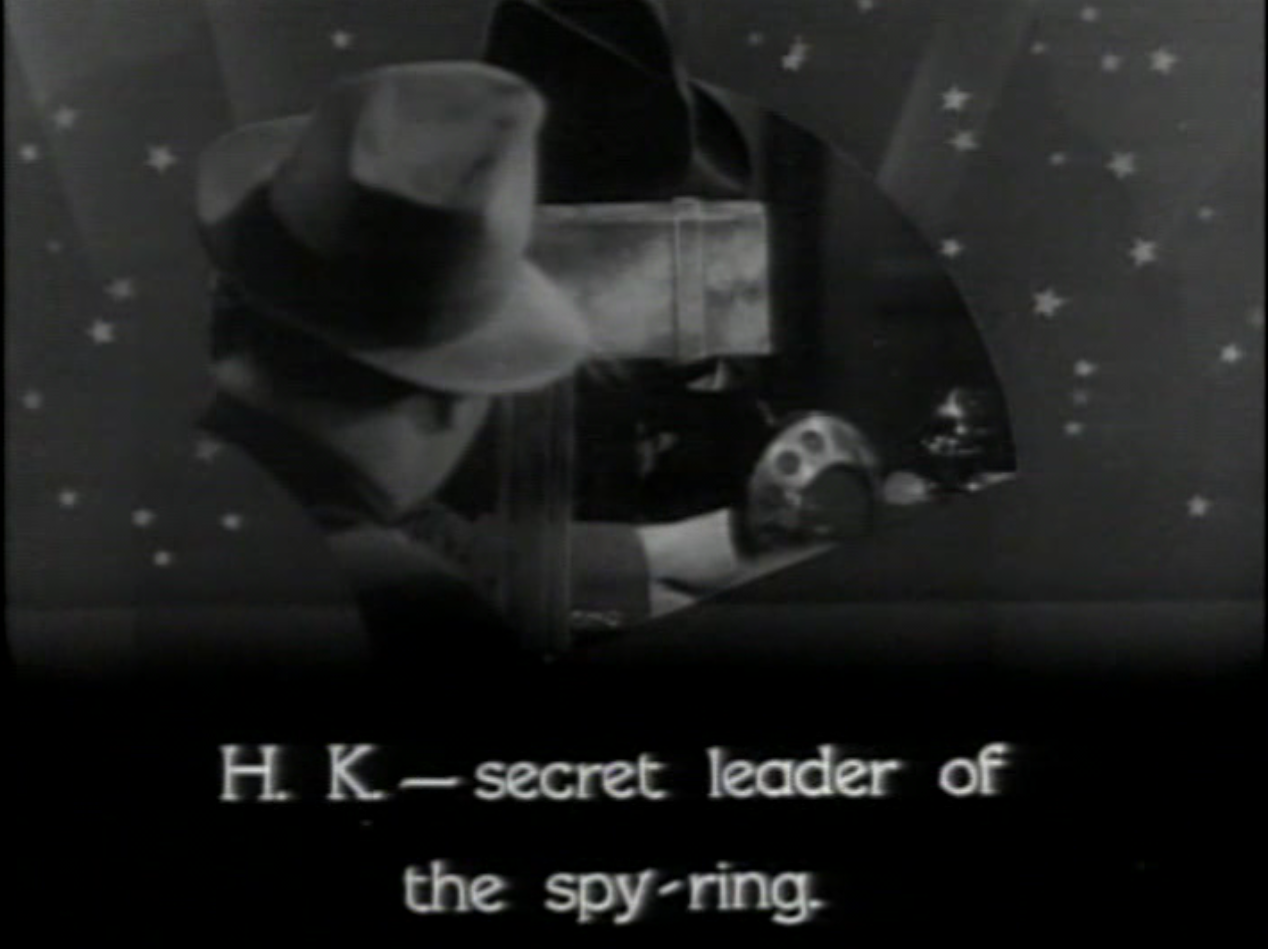
Unbeknownst to both Mala and Melani, Porotu is secretly in league with a spy ring called the “Black Chamber,” led by a mysterious person known only as “H. K.”  (Whenever H. K. is shown on screen, his face is blocked by a lamp, and his voice is dubbed.)  The spies have a base in an old stone fort atop the volcano on Clipper Island, a location convenient for them to tap into the Trans-Pacific Cable to intercept secret messages (the main part of the villains’ lair that we see is an elaborate code-breaking operation led by Draker, the head of the Clipper Island branch).  Porotu and the Black Chamber are working together to keep unwelcome guests off the island.

Porotu

Will Mala gain the trust of Princess Melani and her people?  Will he discover the true identity of “H. K.” and smash the spy ring?  Will the successful establishment of a dirigible route across the Pacific ensure that airship travel is the wave of the future?  These questions and more are posed over the fourteen episodes of Robinson Crusoe of Clipper Island.

Robinson Crusoe of Clipper Island was only the fourth serial produced by Republic Pictures, but it already included many elements of the Republic formula: a capable (if bland) hero backed up by comic relief sidekicks, lots of fistfights and daring stunts (including vehicular mayhem and the destruction of a mountainside fort, accomplished with miniatures), and a nefarious criminal organization led by a shadowy figure whose identity would only be revealed in the last chapter.  (Some of the fights feature noticeable “undercranking”: it was a common practice to roll the camera slightly more slowly than normal, so that when the film was projected at regular speed all the action would appear sped up, increasing the excitement.)

McGlaurie_Tupper

Despite its trailer’s claim to be “based on a novel all youth loves,” Robinson Crusoe of Clipper Island bears almost no resemblance to Defoe’s classic.  In fact, despite the island setting, at no time is the hero ever truly a castaway—he doesn’t have to forage for sustenance or improvise his own shelter—and he hardly ever lacks for company.  (The title comes from the nickname bestowed on Mala by Tupper, who notes the irony of a Native Crusoe assisted by a white Man Friday in the person of McGlaurie.)

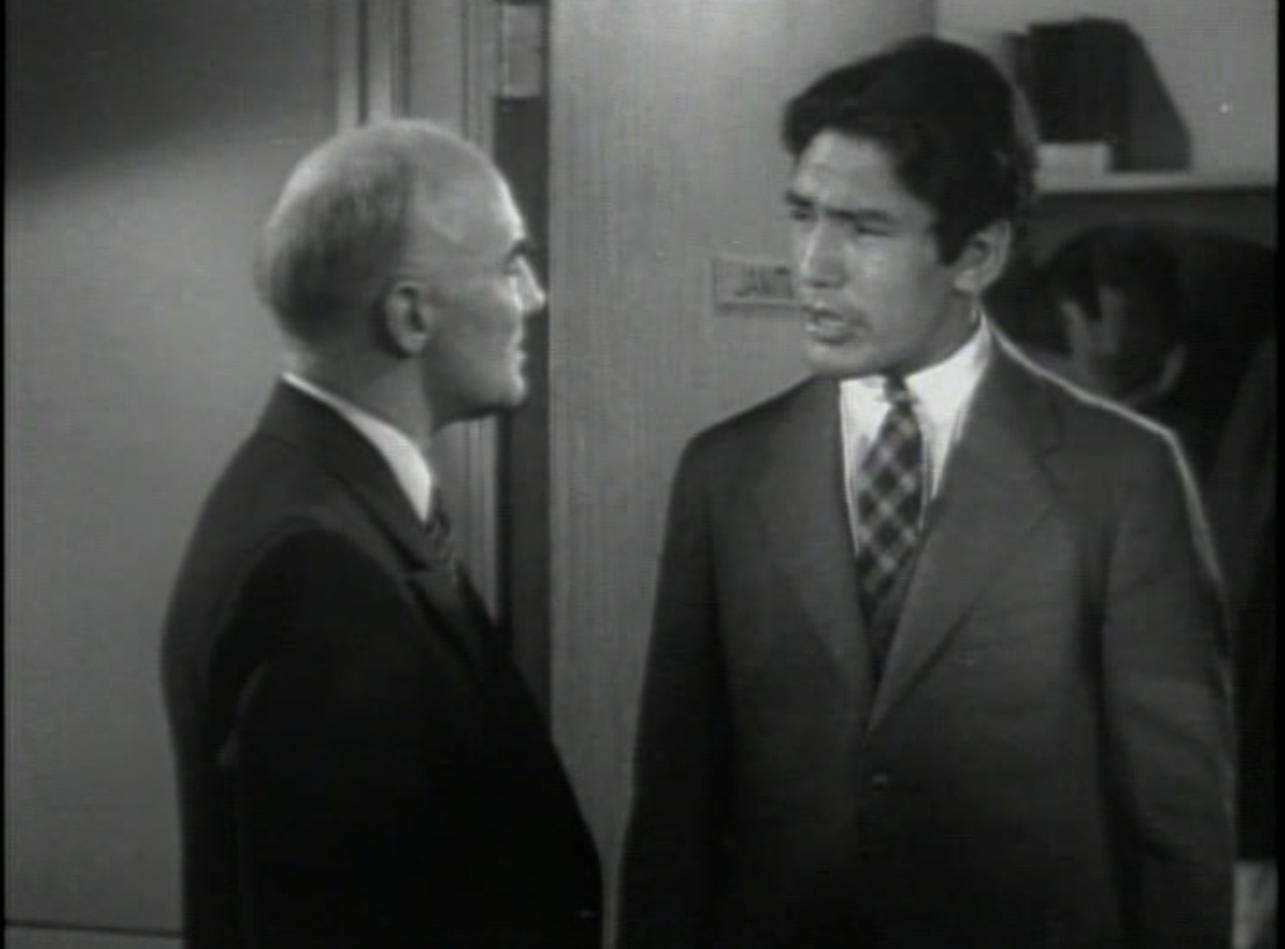
The hero is played by Mala (aka Ray Mala, née Ray Wise), a half-Native Alaskan who had already come to fame as the star of Eskimo (aka Mala the Magnificent) and the Tahiti-set Last of the Pagans, and who would lend his lean, athletic presence to several more features (and two more serials) as both an actor and as a cameraman and cinematographer.  Mala is celebrated as the first Native American movie star, and is a notable exception to the almost exclusively white serial heroes.  The character he portrays is also named Mala, but as an apparently Polynesian g-man, it would be a stretch to say he appears as “himself,” even by the loose standards of Hollywood.

AgentMala

I previously mentioned the deliberately apolitical invaders and menaces in the serials, pulps and comics of the 1930s.  Robinson Crusoe is more down to earth than Flash Gordon but no less circumspect: H. K. and the Black Chamber are not identified with any nation or cause.  The Pacific setting implies a Japanese connection, but the Black Chamber is shown to have branches all over the world.  Depending on one’s perspective, the spy ring could represent fascism, international communism, or even gangsters intercepting government secrets for their own financial gain.  The filmmakers may have had their own politics, but vagueness was undoubtedly better for business.

HK

Robinson Crusoe of Clipper Island transposes many conventions of jungle adventure—primitive tribes, wild animals, and exotic locales—to its island setting.  Like the “modern Western” and “Canadian mountie” genres that were also popular, it combines the picturesque setting and colorful native peoples of the frontier with such contemporary touches as automobiles, airplanes, and radio. Over the course of the serial, a fleet of vehicles are featured traveling by land, sea, and air: dirigibles, a submarine, seaplane and biplane, and more.

Also like some other serials, it features white evildoers manipulating presumably superstitious natives through modern technology: Robinson Crusoe of Clipper Island includes a volcano that can be made to erupt at will, allowing the spies to pose as the Komatoans’ god and strengthening Porotu’s position. The high priest claims that “Pele is quick to destroy those who arouse the wrath of the gods!”, even threatening to sacrifice first Mala and later Melani in a pit of molten lava, but the technology that stokes the volcano predictably gets out of control and destroys both the spies’ fort and Porotu by the end.

The Komatoans themselves are a Hollywood version of Pacific Islanders, living in thatched huts among a mélange of tiki idols and masks (not to mention an Easter Island head inside the sacred Cave of the Winds).  Both the Black Chamber and Pacific Dirigible Airlines require the cooperation of the Komatoans (to whom Clipper Island is taboo) to carry out their activities, so Mala’s interest in protecting and (later) restoring Melani spring from more than altruism.  The fact that Melani (Mutiny on the Bounty‘s Mamo Clark) is beautiful and smart surely doesn’t hurt, either.  (Robinson Crusoe doesn’t get bogged down in mushy stuff, however: even with a nudge from Rex, Mala only says “You have rewarded me with your friendship,” and the concluding chapter fades out before they can do so much as embrace.  The love triangle of Flash Gordon is positively steamy by comparison.)

Mala_Melani

What I Watched: Robinson Crusoe of Clipper Island (1936, Republic)

Where I Saw It: I watched a Hal Roach Studios DVD, but it is on YouTube starting here.

No. of Chapters: 14 (According to the DVD liner notes, this unusual number was a result of the production going over budget, requiring the addition of an inexpensive “economy chapter,” recapping earlier events and increasing the serial’s revenue by an additional week.)

Best Chapter Title: “Jaws of the Beast” (Chapter Eight)

Best Cliffhanger: “Trail’s End” (Chapter Seven): After rescuing Melani from Porotu’s attempt to sacrifice her to Pele, Mala tries to leap with her across a boulder-strewn gorge.  The boulder they land on isn’t steady enough, and the two fall helplessly into the abyss.  How are they going to get out of this?

Annie Wilkes Award for Most Blatant Cheat: Weeeell, as it happens “Trail’s End” doesn’t play quite fair.  At the beginning of Chapter Eight, Mala and Melani grab a vine and pull themselves to safety in noticeably different footage.  I wrote CHEAT!!! in my notes.  “Trail’s End” is only the runner-up for this award, however, as Chapter Ten (“Wings of Fury”) features an even more blatant cheat.  Mala, back in San Francisco, is chasing down a member of H. K.’s organization, a pilot.  The pilot jumps in a biplane and takes off, with Mala clinging to the side of the cockpit.  The pilot tries to shake him off, but when Mala gets him in a headlock the pilot loses control of the plane, and it crashes into the water of San Francisco Bay . . . until the beginning of Chapter Eleven, that is, when the biplane pulls up and avoids the water at the last minute.  The cockadoodie plane crashed, I tell you!  I saw it! CHEEEEEAAT!!!!!!

Sample dialogue: “As you leap into the fire pit, Princess Melani, remember the vengeance of the priest of Pele!” –Porotu, Chapter Six (“God of the Volcano”)

What Others Have Said: “While I have mentioned the better performances, there were a number of rather awful serial performances that do deserve some mention: the four leads [in The Masked Marvel] probably rate our booby prize for bad acting, while following close behind are Mala in Robinson Crusoe of Clipper Island and Bill Kennedy in The Royal Mounted Rides Again.” –Alan G. Barbour, Cliffhanger: A Pictorial History of the Motion Picture Serial

What’s Next: In 1943, a costumed crime-fighter made the leap from the comics to the big screen, not for the last time.  Join me in two weeks for a look at Batman.

Fates Worse Than Death: “What an Amazing Escape!”

Introducing the Annie Wilkes Award for Most Blatant Cheat

SceneMissing

Although the serials are nearly synonymous with cliffhangers—in which the tension builds to a high point before the episode ends, with a character in mortal danger or a major revelation left dangling—they didn’t invent them, and cliffhangers continue to be used on television, in comics, and even in film.  In the nineteenth-century, all kinds of writers serialized their work in popular magazines, from the authors of penny dreadfuls to Charles Dickens, and later pulp writers were similarly aware of the cliffhanger’s power to hold the reader’s interest.  Edgar Rice Burroughs not only used them between chapters, but also between books: he ended his second John Carter novel, The Gods of Mars, with Martian princess Dejah Thoris’ fate unknown, only to be revealed in the subsequent The Warlord of Mars.  (There is, of course, a similar narrative connection between The Empire Strikes Back and Return of the Jedi, and indeed it is now common practice for the second book or film of a trilogy to end on an uncertain note.)  Any serialized medium—in which chunks of story are doled out in installments—will sooner or later take advantage of cliffhangers to keep readers or viewers hooked.

As crude a narrative device as they are, however, cliffhangers are popular because they work: already in the short time since I began this project, I’ve sat down more than once with the intention of watching one or two chapters of a serial, only to be drawn forward by curiosity and suspense, and I’ve ended up watching several more than I planned.  I can only imagine what it was like to wait a whole week to find out whether the hero would live or die (and make no mistake, in a very few cases the hero actually did die, only to be resurrected later, or for it to be revealed that someone else had taken his place).  If you were the right age or particularly attached to the characters, it was probably as intense as the wait for a new Harry Potter novel or episode of Breaking Bad in recent years.  For casual viewers, I imagine it was more like my experience of reading daily comic strips or watching soap operas: easy to forget and not think about after the fact, but when reading or watching the next installment it all comes back to me.

Serial chapters always rewound the story to a point before the cliffhanger, both providing context (for anyone who might have missed the previous chapter) and renewing the tension (for new viewers and regulars alike).  Like reading daily comics collected in book form or watching an entire season of television in one sitting, binge-watching a serial makes for an experience with built-in redundancy.  Seeing the cliffhanger and its resolution back-to-back also makes it more obvious when the filmmakers cheat (more on this in a bit).

In Paul Malmont’s The Astounding, the Amazing, and the Unknown, a fictional mystery starring several real-life science fiction and pulp authors set in 1943, there’s an amusing scene in which L. Ron Hubbard is trapped in a forgotten, gaslit aqueduct beneath the Empire State Building with a group that also includes Isaac Asimov, Robert A. Heinlein, L. Sprague de Camp and Walter Gibson (author of the Shadow novels).  A self-styled man of action, Hubbard plans their escape:

Hubbard jerked a thumb back to the bigger hall.  “Why don’t we douse the flame, let the gas fill up, then ignite it with the lighter and blow the lid up there clean off?”

“Are you nuts?” the kid [Asimov] asked.  “Don’t you understand the formula for gas density? . . . It means we’d suffocate before we ever built up enough gas to do anything.”

“And even if we could survive that,” de Camp added, “a basic energy equation shows that the shock wave would kill us even before the roof collapsed on our heads.”

“Well, let’s dam up the stream and just float up and let the water pressure pop the top off!”

“Are you kidding? . . . The hypothermia would kill us.”

“Before we drowned under the ceiling.

The joke isn’t just that Hubbard (then a self-aggrandizing young writer, not yet the father of Scientology) is an ignoramus; rather, he is thinking like the kind of pulp hero he is accustomed to writing about.  Serial heroes, like their magazine counterparts, often relied on the same kind of likely-sounding but scientifically impossible solutions to get them out of jams.  In addition, well-aimed shots, conveniently dangling ropes or vines, and explosions from which the heroes were miraculously thrown clear tended to balance out the contrived death traps that threatened them.

That’s not the kind of cheat that infuriated serial audiences however; as long as the solution played fair and didn’t significantly change the cliffhanger’s setup, it didn’t matter whether it was likely or even possible.  After all, Flash Gordon, the Lone Ranger, and Gene Autry were heroes precisely because they could do things ordinary people couldn’t, and if their array of talents included one-in-a-million strokes of luck, well, that’s what audiences expected from them.

The difference between realistic and fair is explicated as clearly as possible by Annie Wilkes, author Paul Sheldon’s “number one fan” in Stephen King’s Misery. Wilkes (played by Kathy Bates in the 1990 film adaptation) demands that Sheldon, her captive patient, write a novel resurrecting his beloved character Misery Chastain after he had killed her off.  She won’t accept any rewriting cheats to do so, and she uses an example from the serials to explain:

This was a no-brakes chapter.  The bad guys put Rocket Man—only it was Rocket Man in his secret identity—into a car that didn’t have any brakes, and then they welded all the doors shut, and then they started the car rolling down this twisty-turny mountain road. . . .

“And here came the car, with Rocket Man still trying to put on the brakes or bash the door open, and then . . . over it went!  It flew out into space, and then it went down.  It hit the side of the cliff about halfway down and burst into flames, and then it went into the ocean, and then this ending message came up on the screen that said NEXT WEEK CHAPTER 11, THE DRAGON FLIES. . . .

“The new episode always started with the ending of the last one.  They showed him going down the hill, they showed the cliff, they showed him banging on the car door, trying to open it.  Then, just before the car got to the edge, the door banged open and out he flew onto the road!  The car went over the cliff, and all the kids in the theater were cheering because Rocket Man got out, but I wasn’t cheering, Paul. I was mad!  I started yelling, ‘That isn’t what happened last week! . . . Are you all too stupid to remember?  Did you all get amnesia?’ . . .

“He didn’t get out of the cockadoodie car!  It went over the edge and he was still inside!  Do you understand that?

Even allowing for the small number of serials I’ve watched so far, I’ve known that feeling: the hero didn’t get out of the cockadoodie car before it went over the cliff, or out of the building before the cockadoodie bomb went off, or didn’t switch the cockadoodie train to another set of rails before it crashed.  Some cheats were more obvious than others, and some studios were more prone to pull a fast one than others.  Cheats also became more common later in the serial era, when dumbed-down serials were aimed at supposedly gullible kids.  But there’s an Annie Wilkes in every audience, and they’re watching closely.  So I’m proposing the Annie Wilkes Award for Most Blatant Cheat, to be awarded (when deserved) to those moments where the film’s producers don’t quite play fair with the audience, rescuing the hero at the expense of the suspension of disbelief.  I believe I’ll have plenty of candidates.

Our Founder

Our Founder

Fates Worse Than Death: Flash Gordon (1936)

FGtitles

A strange planet is moving through the Solar system on a collision course with Earth, Velikovsky-style, bringing meteor showers and global panic with it.  Professor Gordon, stationed at an observatory, receives word that his son, Flash, has postponed his polo game so that he can take a transcontinental flight to return home before (presumably) the end of the world.  While on that flight, Flash (Buster Crabbe) and a female stranger (Jean Rogers) bail out at the same time, just before meteors cause the plane to crash.  They’ve landed near the rocket ship of Dr. Zarkov (Frank Shannon), a scientist (and former colleague of old Professor Gordon) whose plan is to fly to the invading planet and redirect it away from earth.  Needing an assistant, Zarkov coerces Gordon and the young woman, Dale Arden, into the ship.  The three blast off and soon arrive on the mysterious planet.

Zarkov

The planet Mongo, as it turns out to be, is ruled by Emperor Ming (Charles Middleton), to whom the three are taken as prisoners.  Upon seeing the beautiful Dale, Ming desires to take her for his bride; upon learning that Zarkov built the rocket ship that brought them there, Ming puts him to work in his own laboratory, in order to conquer the Earth instead of destroying it.  As for Flash, his attempts to free his friends awaken Ming’s ire; he has him thrown into the arena to battle three beast men.  Ming’s daughter, Princess Aura (Priscilla Lawson), however, has other ideas, and schemes to keep Flash alive for herself.

MongoLanding

Thus begins the epic, thirteen-episode Flash Gordon, which puts Flash and company into cliffhanging perils that include a flooding underwater palace, fights with fearsome beasts, torture, and even a machine that makes Flash disappear completely.  And did I mention the rays?  In addition to ray guns, there are gravity rays, melting rays, rays that restore health, and an invisibility ray (the explanation for Flash’s previous disappearance, of course).  Throughout the serial, our heroes encounter Shark Men, Lion Men, and Hawk Men, all with their own leaders and complex political relationships with Ming.  (Whatever its crimes against realism may be, you can’t accuse Mongo of being a monocultural “Planet of Hats” in the Star Trek vein.)  Beyond the physical threats, there are shifting alliances and treachery, and all the while Princess Aura plays both sides, helping Flash escape but working to keep him separate from Dale.

Alex Raymond’s comic strip had only been running for two years when Universal Pictures released its serial adaptation in 1936, scripted by Frederick Stephani, George Plympton, Basil Dickey, and Ella O’Neill, and directed by Stephani.  The producer was Henry MacRae, who had been a director of serials since the silent era and knew how to get the most bang for the buck. Although serials were known for their low budgets, Flash Gordon was lavish by comparison (the claim that it cost a million dollars has been disputed, but it is still easy to believe that it was more expensive than the average chapter play); it was the first serial to play in a Broadway movie theater and set the tone for much of the cinematic science fiction that followed.

rocketship

It would be damning with faint praise to say Flash Gordon looks good “for its time;” many of the shortcuts taken in its production—the use of stock footage, recycled sets and costumes, and a score cobbled together from previous Universal horror and adventure films—would have been more obvious to viewers at the time than they are now.  Three years after Willis O’Brien wowed audiences with the stop-motion in King Kong, the many monsters that Flash battles are either familiar animals with some outer space bling attached, or small animals filmed against miniature sets to make them appear gigantic—or both, like the dragon-sized finned iguanas that prowl the valley where Flash and his compatriots first land.  The exception is the bipedal papier-mâché dragon with lobster claws that inhabits the “Tunnel of Terror” in Chapter Two; with the addition of horns and a wall of flame, it doubles as the “Sacred Fire Dragon” in Chapter Nine.

dragon

None of that matters, however, as the story unfolds with a swiftness that encourages suspension of disbelief, and a game cast that takes the material only as seriously as it needs to be, but no more.  First among them is Buster Crabbe as the title character, and I think it’s fair to say that Crabbe is ideal for the part.  Like Tarzan (whom Crabbe had also played), Flash Gordon isn’t a role to be acted: it’s a role to be embodied, and Crabbe has the physique (he had been a champion Olympic swimmer, winning a Gold Medal in 1932) and movie-star looks (with hair bleached to match Gordon’s comic-strip appearance) to pull it off.  That’s not to impugn Crabbe’s acting: while he isn’t called on to chew the scenery like Middleton as Ming or John Lipson as the Hawk Men’s King Vultan, he has a natural, unaffected screen presence, perfect for the kind of all-American hero who finds himself at the center of all this craziness.  Crabbe is engaged with the material and never sounds like he’s reciting lines from a cue card (more than can be said of James Pierce as Prince Thun of the Lion Men).

Torture

Flash’s adversary, Ming the Merciless, is played by Charles Middleton, who long specialized in “heavies,” and brings a prickly grandiloquence to the role.  He’s the kind of seasoned actor who can deliver lines like, “Why did not the sacred gong sound the final note which completes the marriage ceremony?” and make it sound perfectly natural.  Ming is one of the great pulp villains, of course, and with his arched eyebrows, pointed beard and mustache, bald head, and long fingernails, he shares a great deal of DNA with that poster child of Yellow Peril racism, Fu Manchu. Like Sax Rohmer’s criminal mastermind, Ming is an invasive force, the perfect stand-in for overseas threats from Europe or Asia (before Pearl Harbor, the pulps and comics often replaced Japan and Germany with their own invented enemies, such as the “Purple Empire” that Operator #5 battled; sometimes such threats were even described as “Eurasian,” covering all the bases).  Hailing from outer space instead of a foreign country, however, Ming has a veneer of plausible deniability that has made it easier to keep him around in later decades. Opposing him, Flash Gordon is the ideal American of the 1930s who doesn’t start fights but isn’t afraid to finish them.

Ming2

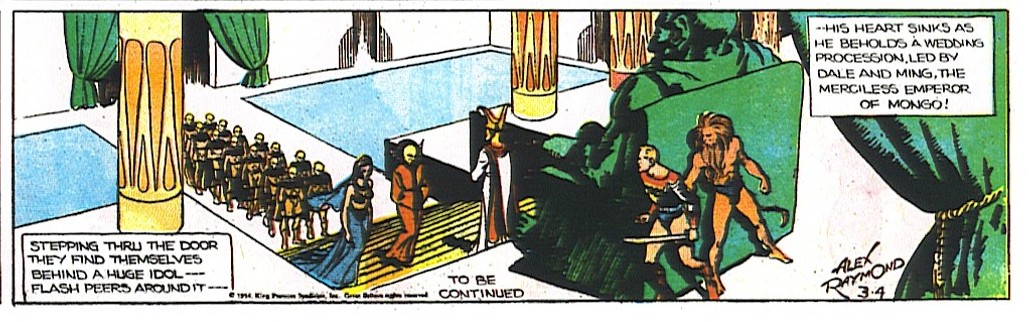
Beyond his name and visual appearance, Ming embodies the stereotype of the “Oriental potentate,” cruel, decadent, and treacherous.  In the Universal production, Ming entertains himself watching combat in the arena and gaudy choreographic displays (courtesy of Universal’s library of stock footage); the costume of his empire is a mix of spage-age tunics, medieval robes, and Roman centurion armor for the men, and harem outfits for the women. The costumes (and most of the set dressing) are straight from Universal’s warehouses, but the mixture of styles isn’t that far off from Raymond’s comic strip design, which also borrowed freely from distant times and places from Earth’s history.  The question of how people on other planets might dress hadn’t really been settled: when Edgar Rice Burroughs (creator of Tarzan) sent John Carter to the planet Mars, he described the inhabitants as nude, or nearly so.  Artists illustrating his books preserved Earth standards of modesty by draping Dejah Thoris in Roman togas and other stylized garb.  While the comic strip Buck Rogers, which premiered in 1929, gave a more fantastical, futuristic appearance to its space travelers, Flash Gordon was mostly content to be Prince Valiant in space; despite the rocket ships and ray guns, Gordon was often shown fighting with a sword like John Carter.  It’s not for nothing that this genre became known as “space opera.”

Flash_Gordon_Excerpt

No character in the 1936 production illustrates this better than King Vultan of the Hawk Men.  All the Hawk Men (there are no Hawk Women, near as I can tell) have enormous, feathery wings sprouting from their backs, and wear Viking horned helmets and armor.  With his boisterous laugh and enormous appetites, Vultan is clearly modeled after Henry VIII (he’s even shown feasting on the drumsticks of what I assume is some kind of space chicken, and mention is made of his numerous wives).  However, with his truly over-the-top headdress and the exaggerated pectorals of his breastplate, he looks like Luciano Pavarotti as Brünnhilde in a drag production of Die Walküre.

Vultan2

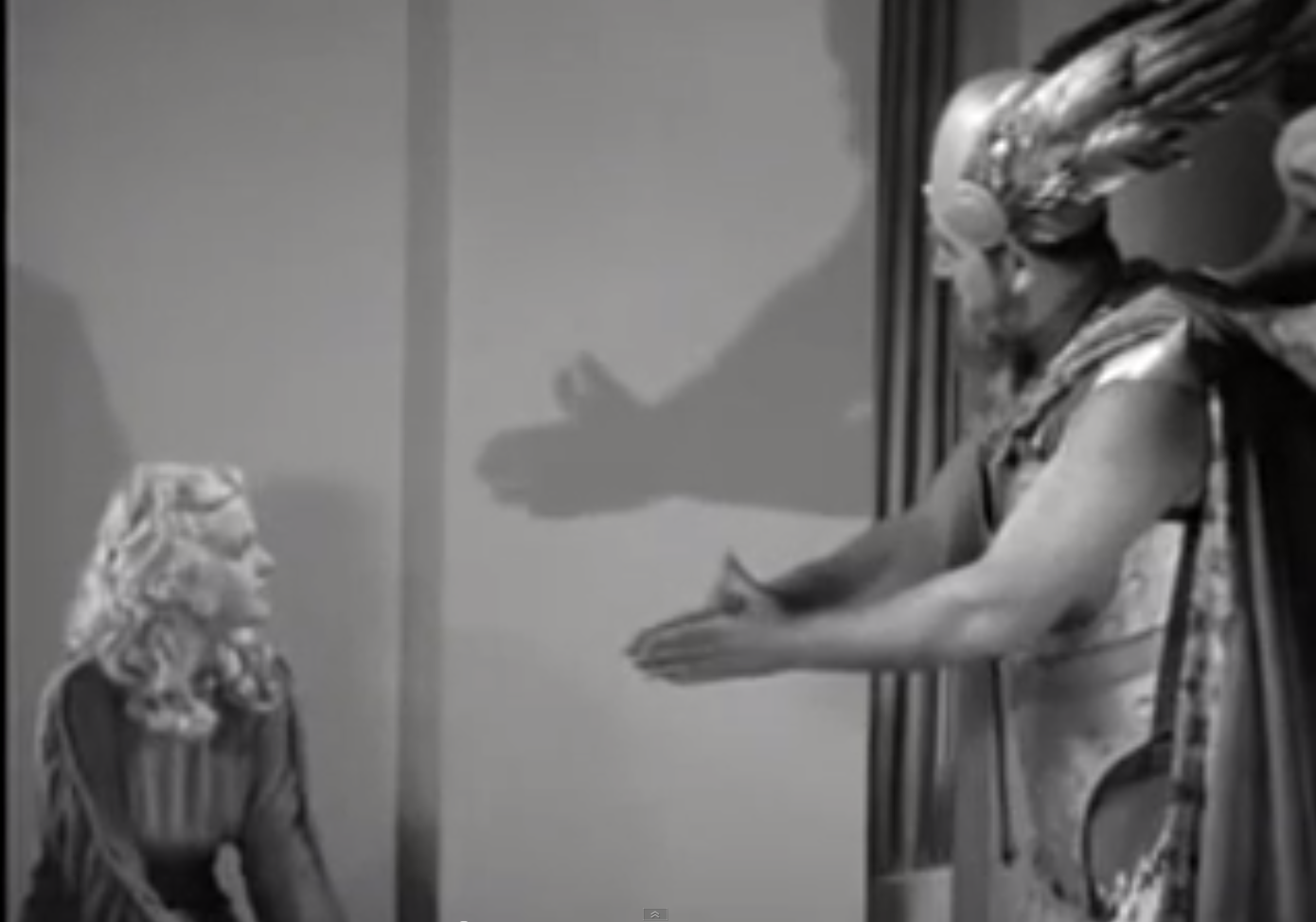
I like Vultan, though: unlike the humorless Ming and colorless Kala (King of the Shark Men, who can’t breathe water—I mean, where to even start?), Vultan is the only one who seems to really enjoy his villainy.  He is, however, a strong argument against those who feel that the 1980 feature version of Flash Gordon was too campy compared to the original.  Upon capturing Dale and (inevitably) deciding to wed her himself, he courts her by first terrifying her with his pet “Urso” (a bear painted with badger stripes) and then tries to entertain her by making shadow puppets on the wall.  This guy is all over the place; naturally, he becomes Flash’s ally by the end of the serial.

shadows

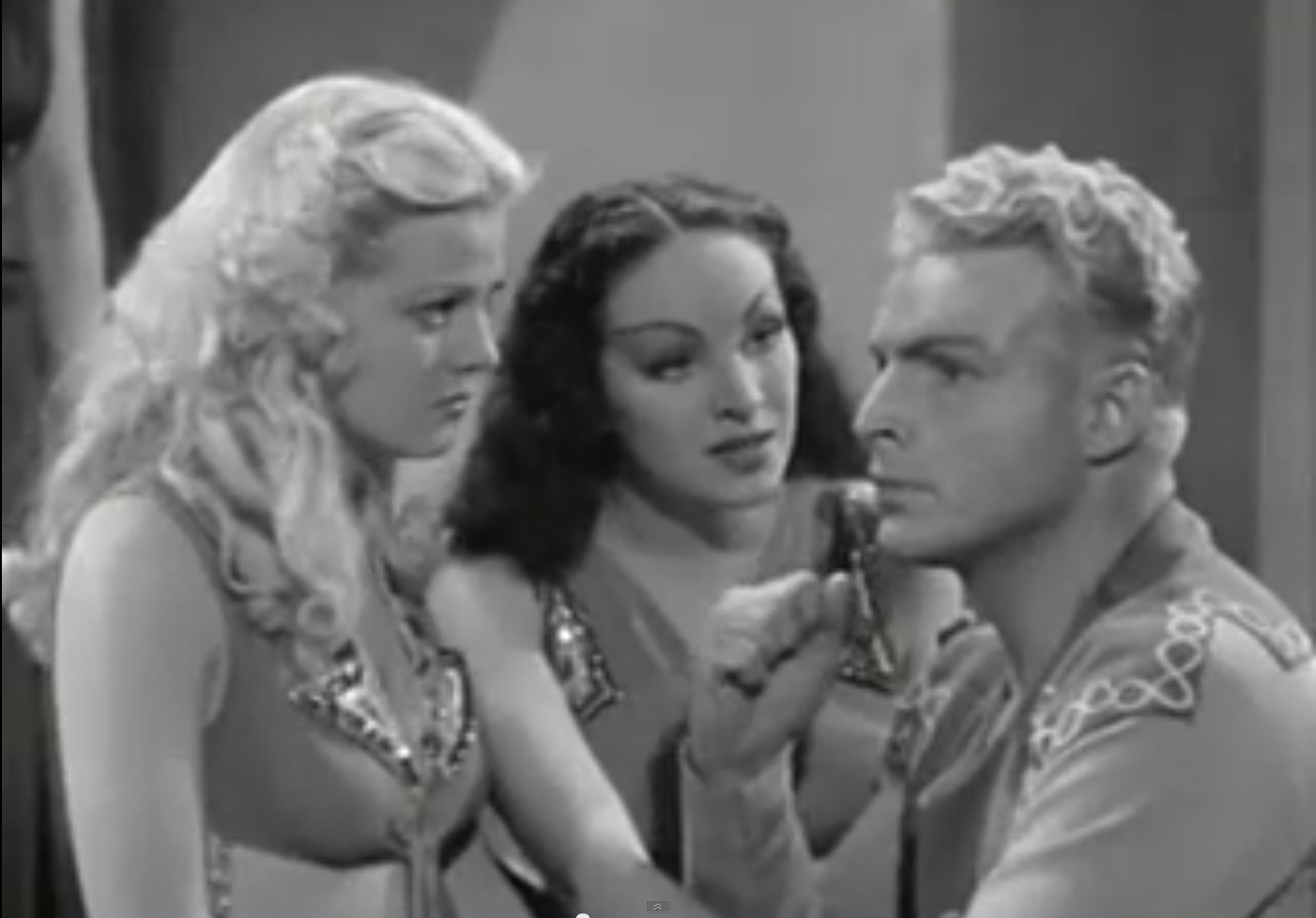
And who is Dale Arden but a classic “damsel in distress?”  She mostly screams and faints and exists to be rescued (interestingly, only one cliffhanger actually puts her in danger); she is subjected to mind games by Princess Aura, who convinces her that she must make Vultan believe she loves him, or else he will kill Flash.  The role isn’t the fault of Jean Rogers, who does as much as she can with it and looks great in the part.  In fact, between Rogers as Dale and Lawson as Aura fighting over Flash, it’s not hard to imagine a Depression-era boy at a Saturday matinee developing a sudden, unexpected interest in polo.

An amnesiac Flash Gordon tries to decide between Dale Arden and Princess Aura, the Betty and Veronica of outer space.

An amnesiac Flash Gordon tries to decide between Dale Arden and Princess Aura, the Betty and Veronica of outer space.

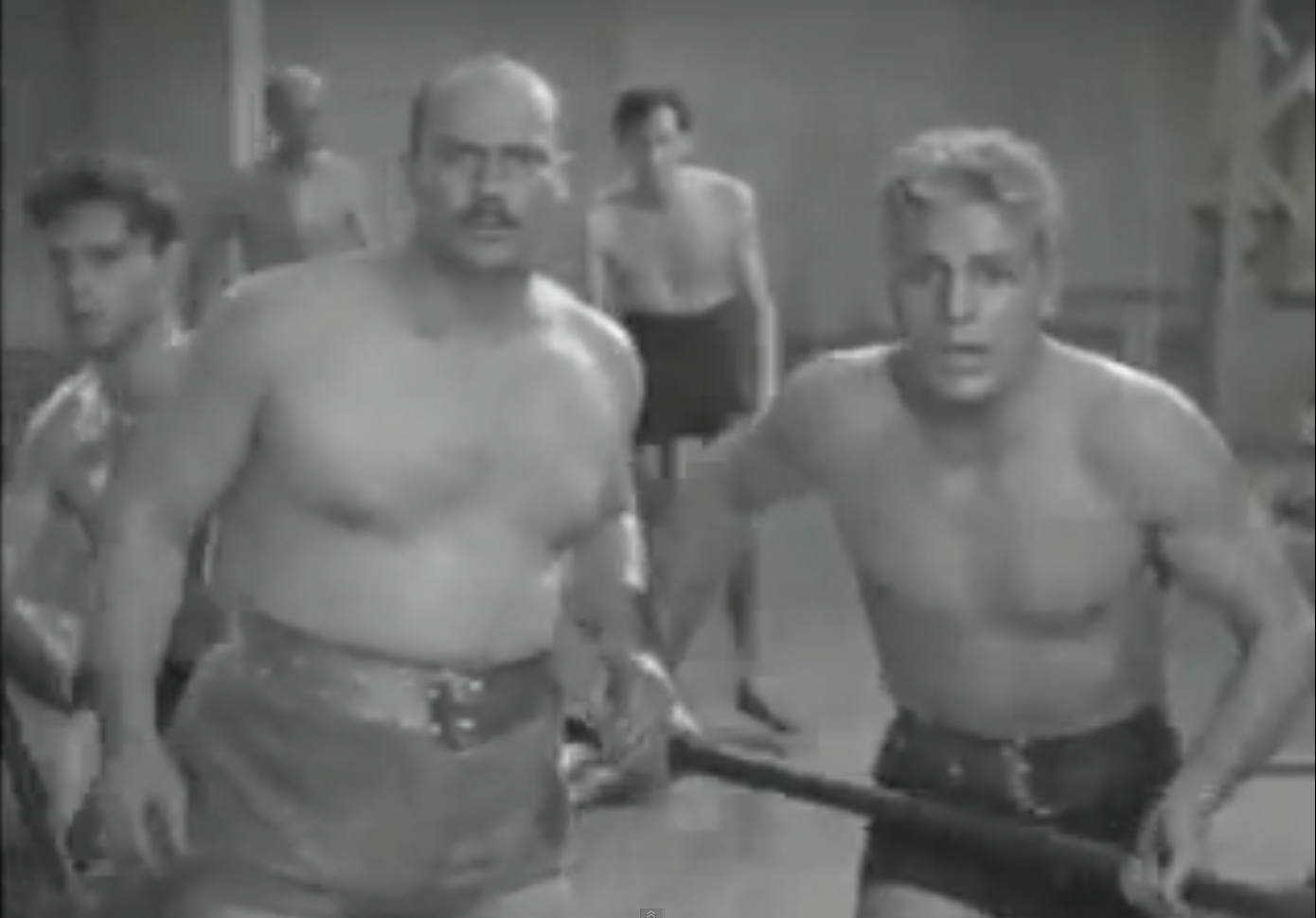
And it’s not only for the boys (and their dads): I mentioned Buster Crabbe’s physique, but I didn’t get to how often he appears without his shirt, slick with sweat or bound and tortured.  The sensuality and overt (but still PG) eroticism of the 1980 version weren’t invented from whole cloth.

FlashBarin

When the plot isn’t being moved forward by Ming or one of the other rulers of Mongo, it’s often one of Princess Aura’s schemes that does the trick.  To my mind, she’s the real hero of the story, resourceful, determined, and intense.  No wonder she ends up on the throne at the end, paired up not with Flash but the loyal Prince Barin, who is so exciting and interesting that I didn’t even think to bring him up until now.

What I Watched: Flash Gordon (1936, Universal)

Where I Saw It: It’s on YouTube.  The first chapter is here.

No. of Chapters: 13

Best Chapter Title: “The Unseen Peril” (Chapter Ten)

Best Cliffhanger: “Shattering Doom” (Chapter Seven): Flash, enslaved in King Vultan’s atomic furnace room, has an electric wire attached to his wrist, to kill him instantly if he rebels.  Doctor Zarkov surreptitiously attaches the wire to the handle of Flash’s shovel and instructs him to throw the shovel into the furnace when the time for escape is right.  Flash orders the other slaves to duck behind the safety wall and makes his move, triggering a massive explosion.  Will he get to safety in time?

Sample Dialogue: “Is there no way a man can conquer the sacred orangopoid?” –Princess Aura, Chapter Nine

With a Dry, Cool Wit Like That: “Scared, huh?” –Flash, as he grabs Dale and pushes her out of the airplane in Chapter One

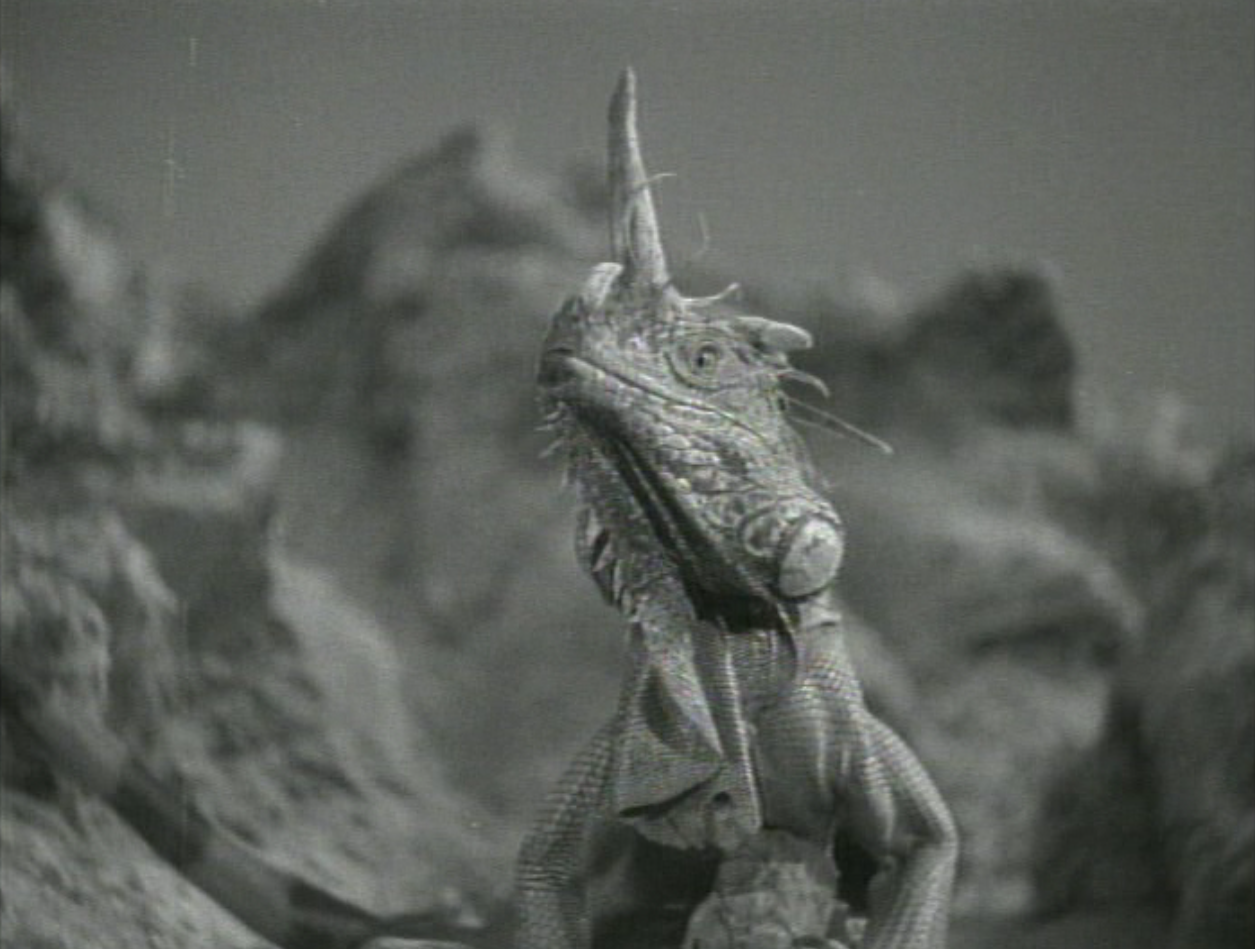
Cheapest Special Effect: As much as I’d like to, I can’t count King Vultan’s shadow puppets, which are certainly odd but aren’t meant to be taken for anything else. Instead, I choose this fellow, the terrifying giant lizard of Mongo:

Lizard

Most Embarrassing Costume: I’ve already addressed the costumes in some detail, and while King Vultan’s appearance is certainly memorable, I think I’m going to award this honor to the Hawk Man servant who briefly makes an appearance in a full chef’s uniform in Chapter Six:

Chef

Biggest Cop-Out: Does anyone believe Ming is dead at the end of Flash Gordon?  Even without the knowledge that there would be two sequels, did anyone believe it in 1936?

What Others Have Said: “They were flying over and they were forced down where there was a rocket ready to take off—I mean, if you accept that, you have no problem with anything. If it bothers you that they happened to be flying over a rocket made by Dr. Zarkov, why then, this movie isn’t for you.” –Lorenzo Semple, Jr., screenwriter of the 1980 Flash Gordon feature film

What’s next: In two weeks, join me again for a look at Robinson Crusoe of Clipper Island.

Addicted to Love: A Reappraisal

This article was written as a contribution to Lovefest, a series of pieces by commenters on film website The Dissolve, organized by commenter The Narrator.  The only requirement was to write about a movie you like but no one else does.

Audiences who only went by this poster had no idea what they were in for.

Audiences who only went by this poster had no idea what they were in for.

In the 1997 film Addicted to Love, astronomer Sam (Matthew Broderick) appears to live a charmed life: after successfully predicting a supernova, he turns his observatory’s telescope to see his girlfriend, schoolteacher Linda (Kelly Preston) wave at him, as he does every day at noon (which is totally not weird or creepy, why would you say that?).  He’s perfectly content with everything the way it is until Linda tells him that she’s been selected to represent her school district in New York City for two months; unwilling to give his blessing (“Stay,” he tells her bluntly) but too timid to join her, he even drives his truck next to her plane as it takes off so he can see her one last time.

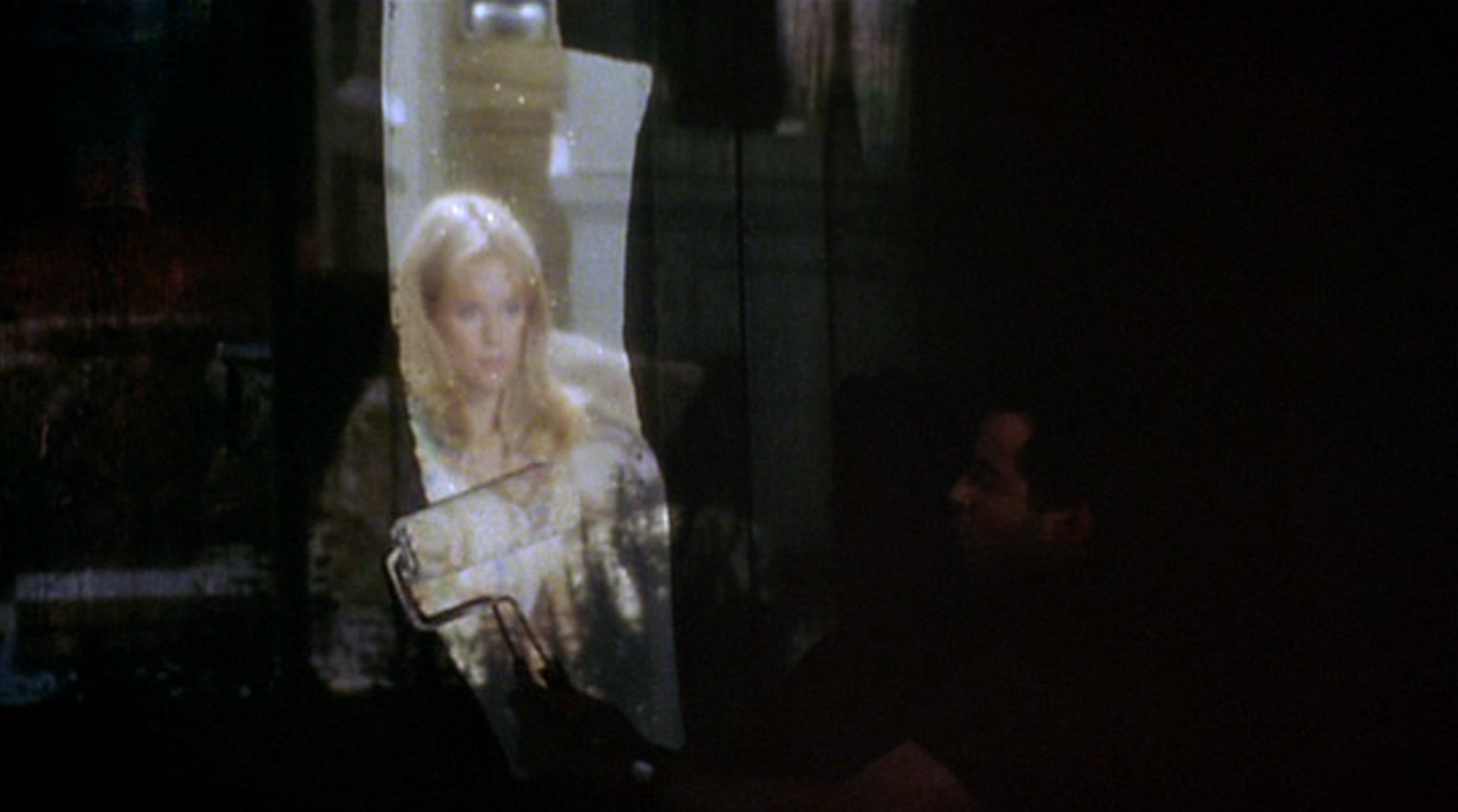
Cut to Sam preparing for Linda’s return two months later; instead of Linda, he is joined by her father (Nesbit Blaisdell in an amusing turn) who is there to read her “Dear John” letter.  “I’m not finished—the best part’s coming up,” he says as Sam rushes to pack so that he can work it out with Linda in New York.  Once in New York, Sam tracks Linda to an apartment, but to his horror he hears a man’s voice through the door: Anton (La Femme Nikita’s Tcheky Karyo), a French restaurateur possessing a volcanic temper and Rabelaisian appetites.  Rather than confront his rival, Sam retreats to a conveniently abandoned building across the street and begins living there as a squatter, spying on the pair.  Borrowing a camera obscura from the observatory, he is able to project an image of the apartment onto the wall of his crumbling loft, recording and analyzing Linda’s every gesture with the same precision he uses to observe the stars, convinced that once her infatuation with Anton is over, she’ll want to continue her relationship with Sam right where it left off.

cameraobscura

Enter a mysterious motorcyclist in sexless black helmet and body armor; after breaking into Sam’s loft, the intruder removes its helmet, revealing it is none other than Meg Ryan, sporting a look reminiscent of Melanie Griffith’s road warrior in Cherry 2000 and with a gravelly, threatening voice she abandons after only two lines of dialogue.  Her character, Maggie, is Anton’s ex, and like Sam she wants to use the loft to keep tabs on him; unlike Sam’s passive stalking, however, she is bent on revenge.  Anton used her to get in to the United States and then dumped her, and now he is going to pay.

The contrast between Maggie’s edgy, in-your-face to-the-extremeness and Sam’s attempts to keep everything (including himself) under control at all times is the comic mainspring of Addicted to Love’s first half.  Maggie needles Sam relentlessly, challenging his certitude that Linda will return to him (“The only way that girl is coming back to you is if a blast of semen catapults her across the street and through the window,” Maggie says with the tact that marks her character), with Sam insisting that everything is going according to plan.  The pair has real chemistry, and it’s clear that they belong together in an opposites-attract way. To its credit, the film doesn’t draw out the will-they/won’t-they: they will, before the film is half over, but under circumstances that highlight their obsessions with their exes.  They have unfinished business before a happy ending is a possibility for either of them.

Maggie’s plan is to destroy Anton utterly, to reduce him to zero dignity, to make him suffer as she suffered.  She enlists Sam to plant suspicion in Linda’s mind through a series of screwball contrivances: they steal Anton’s credit card and use it to buy flowers and jewelry; they bribe a street performer to put lipstick on a monkey, which plants kisses on Anton; they pay schoolchildren to spray expensive perfume on Anton with squirt guns (as absurd as their schemes are, the comedy really pays off when Anton tries to explain these weird occurrences to an increasingly dubious Linda: it’s New York, rich school kids have nothing better to do than squirt people with perfume, right?).  Sam takes a job washing dishes at Anton’s restaurant, an opening that allows them to sabotage an important critic’s visit (warning to the squeamish: it involves cockroaches).  Maggie even has a plan to trigger Anton’s allergies so that he is unable to model (his job before he opened his restaurant).

But a funny thing happens as Sam gets closer to Anton: he gets to know him, and Anton (not knowing who Sam is, of course) takes him under his wing.  As Anton, Karyo gives the film’s biggest performance: he absolutely is the intimidating, smooth-talking continental horndog Sam takes him to be, with a habit of threatening to rape people’s skulls (“He says that to everybody,” Maggie tells Sam), but he has positive qualities as well, and tries to share his wisdom with Sam.  As much a perfectionist as Sam, Anton is otherwise everything that Sam isn’t: a driven alpha male who isn’t afraid to go after what he wants.  In a scene set in the restaurant, Anton explains that France is like the planet Krypton—everyone there can do what he does—but when he came to America with his charming accent and culinary skill, he became Superman (one nice touch: Anton’s other employees echo and respond to his story as he tells it; it’s obvious they’ve heard it many times).  (The same concept would resurface in Love, Actually, but in fairness, Addicted to Love isn’t the first film by any stretch to point out that Americans are entranced by foreign accents.)

As Anton’s life falls apart (Linda does leave him, but not because of Maggie and Sam’s frame-up job: it turns out he really was sleeping with someone else), he holds Sam closer, believing him to be his only friend.  He drags Sam back to the apartment with him, plying him with wine and food (to Maggie’s disgust: she’s still watching them through the camera obscura).  When Sam finally confronts Anton about the women he’s wronged and reveals his identity as Linda’s ex, Anton surprises him—and Maggie—by confessing that he knows he used Maggie terribly, that he tried to love her after she helped him come to America (“I thought if I could just love her, then . . . the shame would go away”) but found it impossible.  “You can’t choose who you love. . . . Who the hell do you think you are you to judge?” Anton asks the man who punched him in the face, broke into his apartment, destroyed his restaurant, and pushed him down an elevator shaft (the last was an accident, but still).  While Maggie goes to comfort Anton (“Just say we’re even,” she says as she scratches the itchy rash that she herself caused), Sam goes to Linda and confesses.  At least, that’s implied: just as we have through much of the movie, we only see Linda’s angry reaction through a window, and we later see her return to Anton.

As for Sam and Maggie, they’ve discovered their true feelings for each other through everything they’ve done together, right?  Not quite.  Sam is ready to have a relationship, but Maggie insists she has no feelings for him and that he should just move on.  Sam leaves, but on the plane ride home he finds two last symbolic images: an envelope of photos of him and Maggie together, and an in-flight showing of Lassie.  As he tells Maggie upon his return to New York, Lassie helped him realize that Maggie was just pushing him away for his own good, that she didn’t want him to be hurt again.  One last joke, a kiss, and—after a Fincheresque trip through the camera obscura itself—we’re on to Neneh Cherry’s terrible rendition of the title song over the end credits.  It’s a bit weak after the whiz-bang climax, but the meaning is clear: Sam and Maggie are through the looking glass and back in the real world, no longer trapped by their illusions.

Even this summary of the plot skims over many details: Addicted to Love is a ribald farce, packed with incident, that nevertheless makes time to simply hang out with its lead characters.  It’s light and frothy, except when it isn’t, when surprising shadows darken the mood and the snappy dialogue gives way to yearnings that words can’t convey.  The long takes of Sam and Maggie simply watching, the camera centered on their faces as they react to what they see, suggests that despite its billing as a film about revenge, Addicted to Love is at its core a film about loneliness.

MegRyan2

In fact, Addicted to Love might as well be called Gaze: the Movie for its frequent scenes of men and women (but mostly men) looking at each other and themselves through telescopes, cameras, mirrors and other devices.  Sam and Maggie (an astronomer and a photographer, respectively) see the world literally refracted through lenses and mediated metaphorically through their ideas of what love is and how their lovers should respond to them.

The theme of seeing and being seen is further developed in dialogue: Linda was “imprinted” on Sam’s psyche as the perfect woman when they were in grade school together; Maggie predicts that Anton will make Linda feel like she’s “really been seen” for the first time, remembering her own experience with him.  The power of looking isn’t subtext: it’s right on the surface.  Even the concluding revelation, in which Sam realizes that Maggie—despite her protests—actually loves him, arrives in the form of pictures of Sam and Maggie together.  It suggests that people might lie, but cameras don’t.

Screenwriter Robert Gordon would go on to write Galaxy Quest, a connection of which I was unaware until I started researching this film.  In retrospect, it makes perfect sense, and although Addicted to Love isn’t as tight as Galaxy Quest (a hilarious and perfectly cast tribute to Star Trek and its fans), both films take a familiar genre (the romantic comedy and the science fiction adventure) and turn its tropes inside-out, looking for the human reality beneath the clichés.  You can call it “deconstruction” if you like, although I don’t think that acknowledges the degree of self-awareness that was already a big part of the 1990s romantic comedy boom.  Rom-com characters are constantly comparing their experiences to fairy tales and romance novels—what is Sleepless in Seattle but a movie-length tribute to An Affair to Remember?—and finding their own lives lacking.  (The current fascination with Jane Austen takes a similarly layered view of romantic expectations.)

Both films also walk a fine line between satirizing and fulfilling the pleasures of genre, in Addicted to Love’s case through casting against type and a deliberate rejection of the gauzy, soft-focus refinement associated with romantic wish-fulfillment: Addicted to Love puts the “com” front and center, the better for the “rom” to sneak up on the audience.   With its cartoonish cruelty and overreaction, baroque schemes and contraptions, and setting in a decaying old building, Addicted to Love bears comparison to Gore Verbinski’s feature debut, Mouse Hunt (or possibly David Fincher’s Fight Club: it wouldn’t take much editing to suggest that Maggie is a figment of Sam’s imagination, representing the aggressive side of his personality).  Like Verbinski, Dunne is clearly enamored of old-school slapstick, but unlike him Dunne, along with Gordon, is interested in plumbing the psychological depths beneath the Rube Goldberg surface.

As far as romantic comedies go, one of my least favorite conventions is the “wrong” man or woman with whom the heroine or hero is involved (possibly engaged), and with whom the relationship must be broken off before they can be united with their soulmate.  This thankless character is usually handled in one of two ways: sometimes they are so mild-mannered and understanding that they meekly step out of the way (think of Bill Pullman in Sleepless), making the breakup relatively painless (for the leads, at least).  On the other hand, sometimes they are so transparently awful that it’s easy for the audience to root against them.  Either way, it turns a potentially nuanced character into just another obstacle for true love to overcome on its way to the inevitable happy ending.  Addicted to Love takes two of those types—a bland “nice guy” and a possessive psycho—and puts them at the center, revealing that they have more in common than is apparent on the surface.

Obviously, the likeability of the stars is a key factor in Addicted to Love, which asks us to sympathize with characters way outside the bounds of accepted behavior.  If you don’t share my fondness for Broderick and Ryan, it may not work for you. The casting alone is meant to put us on their side, however: as I alluded to above, Ryan is not at all convincing as the vengeful badass she at first portrays, but it’s essential to the comedy that we know and recognize the vulnerable and kind-hearted Ryan of other films beneath the black leather and “Project Mayhem” exterior.  We need to see Maggie as wounded rather than evil: if she were played by Angelina Jolie, Anton would be dead before the movie even started.  (For that matter, consider a gender-reversed take on the story: if it was Karyo playing the angry, resourceful ex, enacting revenge on Ryan, we would be looking at an Enough-style suspense thriller or a cautionary Lifetime movie.)

AddictedtoLove

Maggie is a Hollywood costumer’s idea of a punky, bohemian “bad girl,” adding accessories such as oversized aviator goggles and a feather boa to her ensemble.  It never feels like more than playing dress-up, but where some may see that as a failure I think it matches the heightened tone of the film, and it’s great fun to see Ryan cut loose.  Despite her “mousy” or “pixieish” public image, Meg Ryan has actually taken on some surprising roles; however, her onscreen persona is dominated by When Harry Met Sally and Sleepless in Seattle, and the success of her films has largely depended on her adherence to the “Meg Ryan” character type.

As for Ryan’s costar, in the 1990s Matthew Broderick was an actor in transition, no longer a boy but retaining much of his boyish charm.  He spent the latter half of the decade alternating between lead roles in junk like Godzilla (1998) and Inspector Gadget and parts that made his boyishness seem wimpy (as in The Cable Guy), or revealed less appealing sides of that quality (such as 1999’s Election). Addicted to Love falls square in the middle of those years: Sam’s can-do attitude (and the way he puts just as much effort into sneaking around and spying on his ex as he does into his work as an astronomer) anticipates Broderick’s similar fall from grace as Jim McAllister in Election.

Like Jimmy Stewart, Broderick specializes in characters who are likeable, but who often put that likeability to the test.  Mr. Potter’s words to George Bailey in It’s a Wonderful Life could equally apply to many of Broderick’s adult roles: “Look at you.  You used to be so cocky.  You were going to go out and conquer the world. . . . What are you but a warped, frustrated . . . miserable little clerk, crawling in here on your hands and knees?” (After last seeing Broderick in Tower Heist, I was shocked to see how buff he is in Addicted to Love: he looks like a leading man, even if his character doesn’t act like one.)  There is still much of Ferris Bueller in Sam, the world just starting to slip from his grasp.

And speaking of Stewart, although the situation is superficially similar to Rear Window, Addicted to Love leans closer to Vertigo in its examination of Sam’s obsession (this is very much a script by a writer just out of film school): the audience’s first view of Linda is through Sam’s telescope, through which he gazes at her every day at noon; later, the comedy slows down for us to just look at her through Sam’s camera obscura.  There are notes of real longing in Broderick’s performance that make his actions understandable, if not excusable.  There is an obvious metaphor of moviegoing that runs through all of the surveillance Sam and Maggie undertake in the film, and Dunne is honest enough to acknowledge its appeal: Kelly Preston is as radiant as a silent film star in these moments, and the scene of Sam standing next to her projected image, trying to will himself into the frame—back into a relationship with her—isn’t played for laughs.  It’s telling, however, that not only is he unable to hear what goes on in the apartment between Linda and her new lover, he doesn’t want to hear it.  “I just want to be with her,” he says of the image, but clearly he prefers the fantasy to the whole person.  Only after his curiosity gets the better of him and he avails himself of Maggie’s bugging equipment does he listen in, and the sound of Linda and Anton’s lovemaking convinces him to join forces with Maggie.

Linda

It’s likely that Addicted to Love fell between two stools in 1997: too gross and weird for audiences expecting another Sleepless in Seattle, but not acidic enough for fans of black comedies like The War of the Roses.  Still, its mixture of slapstick and psychodrama has its charms for those on its wavelength.  It’s no Galaxy Quest—not everything works, and as I said it depends greatly on the viewer’s appreciation of some very specific elements—and there’s no question that Addicted to Love is off-putting: while not as dark as Helena Bonham Carter saying “I want to have your abortion,” this is a movie in which America’s sweetheart delivers a monologue about her father picking maggots from a dog’s anus and cites it as an example of love. As with Meg Ryan’s character, however, it’s all an act, a deliberately abrasive exterior that conceals a squishy, pulsating heart.

Fates Worse Than Death: Exploring the Motion Picture Serials

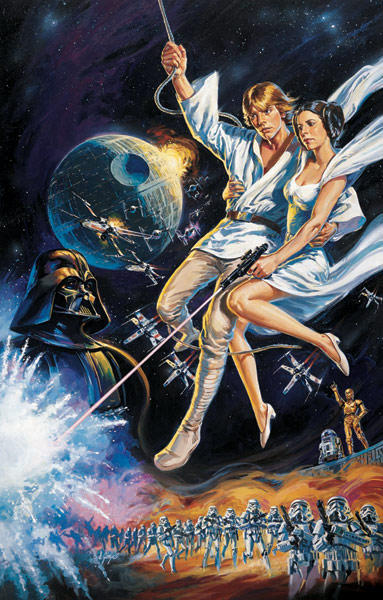
Several years ago I was sitting in Century II Concert Hall before a Wichita Symphony pops concert; the day’s program was to include film music excerpts (some accompanying silent film clips), including selections from John Williams’ Star Wars score.  I don’t remember quite how the conversation started, but an older lady sitting next to me was blunt in her assessment: “People don’t realize it now,” she told me, “but Star Wars was a comedy.  The first time I saw it, I just laughed, because I had seen it all before.  Luke Skywalker swinging across the chasm on a rope? That’s Douglas Fairbanks.”

StarWars_Gouzee

I already knew that in a general way before this conversation, of course: not only had George Lucas acknowledged the inspiration he had taken from the adventure and science fiction movies of his youth, Star Wars’ debt to the weekly serials was a big point of discussion among fans and critics of the Star Wars saga.  Between 1913 and 1956, serials, or “chapter plays,” were a unique genre of motion picture: episodic, with a week-to-week continuity and boldly drawn, easy to follow stories that kept audiences coming back for more.  The serials developed in parallel with pulp magazines and comic books and shared many of the same story-telling conventions (and specific characters).  They were best known for the “cliffhangers” that ended each chapter with a character in peril, waiting until the beginning of the next chapter to show their escape.

Although the serials of the silent era were produced with an adult audience in mind, from the mid-‘30s onward, sound serials were increasingly geared to children.  Almost all were livened up with spectacular stunts: fist- and gunfights, chases, natural and man-made disasters.  Whether the story took place in the Old West, outer space, or the jungle, whether it was an adaptation of a classic novel or a story of (purportedly) true crime, the storytelling mode was the same, emphasizing action, adventure, and suspense.

Perilsofpauline

Serials of the sound era generally included between ten and fifteen chapters (by contrast, one silent serial, The Hazards of Helen, boasted over one hundred; it appears to have been an open-ended “continuing adventure” rather than a single narrative, however).  The first episode introduced the characters and set up future conflict (ending on a good cliffhanger to get the audience hooked!); episodes were around twenty minutes in length (with exceptions: sometimes the first episode would be a little longer, like the pilot of a television show).  Serial chapters were shown in conjunction with full-length features (along with newsreels, cartoons and other “shorts”), part of a weekly moviegoing experience that had little to do with the specific film being shown.

Although I tend to see Star Wars as more homage than parody, there’s no denying that it draws heavily on the language of the serials that were popular from the 1930s to the 1950s, before their thunder was stolen by television. Indeed, watching the 1977 original today with an awareness of serials like Flash Gordon and Buck Rogers, it’s easy to see just how much the characters and situations were based on very specific models: how, in Terry Gilliam’s words, Darth Vader is just “the cowboy with the black hat”—the “spearhead villain” in the terminology of the serials.
I had seen clips from the original serials, sometimes in conjunction with material from Star Wars (or Raiders of the Lost Ark, Lucas’ and Steven Spielberg’s other homage to the format).  As I mentioned in a previous essay, the pop culture of my childhood was marked by a major resurgence of the characters and formats popular in the 1930s and ‘40s: not just the movies, but also the comics, pulp magazines, and radio shows of the Depression and war years.  During the 1970s and 1980s, there were new movies, comics, and television shows based on characters such as Conan the Barbarian, Doc Savage, the Lone Ranger, Tarzan, Flash Gordon, Buck Rogers, and many others.  Some were revived in response to the success of Star Wars and Indiana Jones; others had been brought back as part of the “adult fantasy” wave that had also swept J. R. R. Tolkien and Dungeons & Dragons to cultural prominence in the early 1970s, and of which Star Wars was partially a product.  And some had never really gone away.

Still, it was rare for serials to be shown in their entirety on television when I was a kid: there had been a serial revival in the mid-1960s, coinciding with the popularity of the Batman TV series, but that was before I was born.  Many of the serials had been “featurized”—edited down to hundred-minute movies—for television broadcast, so I might have seen some without even realizing it, but it wasn’t until I was an adult that I was able to get the full, multi-chapter experience.  As much as I love the pulpy aesthetic of old movie posters and the juicy, crackling dialogue of the old-time villains, the serials themselves were something of a blind spot for me.

The goal of this series is to explore some of the classic serials, not necessarily as they were originally seen, but at least uncut and at full length.  Of the hundreds of serials that were made, not all have survived, but many are available on DVD and a large number can be seen on YouTube.  Without trying to be comprehensive, I will have plenty of material to examine.

serialsonDVD.jpg

In reading about the history of the serials, many names pop up frequently: the serials had their own stars, such as leading men Buster Crabbe, Tom Tyler, and Kirk Alyn; and leading ladies Pearl White (“Pauline” of The Perils of Pauline, the archetypal silent serial) and Linda Stirling.  (Stars such as Bela Lugosi and Boris Karloff also made appearances in serials, as did future star John Wayne and television’s Lone Ranger, Clayton Moore.)  Behind-the-scenes personnel made long careers out of the serials, such as stuntmen Tom Steele and Yakima Canutt, and directors Spencer G. Bennet and the team of William Witney and John English.  One also sees the name Sam Katzman frequently: the corner-cutting producer who, despite the tight budgets with which serials were typically made, was said to have never lost money on a production.

Finally, the name of Republic Pictures is nearly synonymous with the serial.  While other studios made serials as part of their output, Republic specialized in them, and one can hardly discuss the subject without acknowledging them.  After forming through the merger of Mascot (an established producer of serials) with Consolidated Film Laboratories and Monogram in 1933, Republic made sixty-six serials over the next two decades, almost to the end of the serial era.  Republic, along with Columbia, Universal, and a number of smaller studios, brought superheroes like Captain Marvel and the Phantom to the screen for the first time, and eventually created some of their own, such as Rocket Man.  In examining the serials, I intend to examine both the source material from which these characters were drawn and the serials’ lasting influence on the TV shows and movies that followed.

So much for the preliminaries.  I’ve decided to start with one of the most successful serials of all time: in two weeks, I’ll examine Universal’s 1936 production of Flash GordonI hope you’ll join me.

FlashGordon

When Stock Footage Roamed the Earth

“Why, if I had half the chance, I could make an entire movie using this stock footage!” exclaims Johnny Depp as the title character in the 1994 film Ed Wood as he examines film clips of explosions, military maneuvers, and stampeding buffalo.  Although Wood never went quite that far, later filmmakers would take up that challenge, and the scene illustrates just how much movies in the black-and-white era depended on footage of stunts, special effects, and locations culled from other sources in the studios’ extensive libraries to cut costs.  (Even into the 1970s and ‘80s it wasn’t uncommon for low-budget directors to build films and TV episodes around footage of car crashes and stunts, matching the actors’ clothes to the pre-existing clips.) As a kid in the 1980s, I was indirectly exposed to a great deal of older movies and television by the flood of repurposed stock footage on TV at that time.

Certainly it was more common to find old movies, shorts, and black-and-white shows on television as part of cheap daytime syndication packages (I watched Leave it to Beaver, I Love Lucy, and The Little Rascals after school—can you imagine that today?) and the “late late show.”  Sunday afternoon was reserved for the “Creature Feature,” a phrase that in my naiveté I thought the local station managers had come up with themselves.  Creative editing into new formats such as music videos, commercials, and interstitials was just the next step for this material, much of which, before the explosion of cable channels and the revival of TV shows on DVD, was considered nearly worthless.

An appetite for old film clips excerpted from their context began to develop in the 1970s with the emergence of full-length “docutainment.”  The pioneer of the nostalgic clip movie was That’s Entertainment!, a celebratory look at movie musicals made in 1974 to commemorate Metro-Goldwyn-Mayer’s fiftieth anniversary.  In addition to editing together highlights from both classic and obscure MGM musicals, That’s Entertainment! brought together a large number of the stars from Hollywood’s Golden Age to talk about their experiences filming such classics as Singin’ in the Rain and reminisce about the good old days.  (A recurring theme of both the film and its marketing was that this would be the last time so many stars would be gathered in one place—although there would be two sequels—and even the trailer emphasizes its escapist quality in the Watergate era, ending its ballyhoo with a hilariously downbeat “That’s Entertainment! Boy! Do we need it now.” Ah, the 1970s.)

That’s Entertainment! is a film that I’ve returned to several times over the years, but 1982’s It Came from Hollywood was more my speed at the time: comics Dan Aykroyd, John Candy, Gilda Radner, and Cheech and Chong introduced clips from dozens of science fiction, horror, and cult movies, ranging from cheap B movies and serials to the monster classics of the 1950s and focusing on such niche categories as drug panic, juvenile delinquency, and even musicals.  In addition to the skits setting up each category (which also included “Monsters,” “Gorillas,” “The Brain,” and “Aliens,” among others), they offered a running commentary, often razzing the cheapness or tastelessness of the films in a manner that echoed the audience participation of The Rocky Horror Picture Show and the mockery of The Golden Turkey Awards (in fact, Golden Turkey winner Edward D. Wood, Jr. is the subject of his own segment in It Came from Hollywood, the only filmmaker so “honored”) and anticipated the format of Mystery Science Theater 3000.

It Came from Hollywood is doubly nostalgic for me now, hearkening back both to an era of drive-in double features and Saturday matinees I only experienced second-hand, and to the early 1980s heyday of the hip comedians (younger at the time of filming than I am now, and two of them sadly since passed away: seriously, did anyone in 1982 think that of all these comedians, Cheech Marin would have the strongest career in 2014?) I considered the height of cool back then.  Unlike That’s Entertainment!, It Came from Hollywood didn’t bother to name most of the films it excerpted (except in a long list during the end credits), lending a dissociative, dream-like quality to the proceedings (and often leaving me unable to place a particular image for years, until the internet made it easier to find such information, not to mention the films themselves).

Another film that must have had a considerable influence on me was 1977’s Gizmo!, produced and directed by Howard Smith, which, unlike my two previous examples, drew most of its footage from films that purported to be true (or were at least staged for publicity: mostly Depression-era newsreels, from the look of it).  Many of the clips are of gadgets and contraptions made to solve the petty problems of life—a dog-powered washing machine, a self-rocking cradle, and a spaghetti fork mounted on a hand-held drill so as to twirl automatically—in the truest Rube Goldberg spirit.  Gizmo! casts a wide net, however, including many examples of “self-invention” as well, people with strange talents or driven by obsession: human flies and high wire walkers, a “human camel” drinking gallons of water and washing it down with kerosene, feats of strength and endurance.

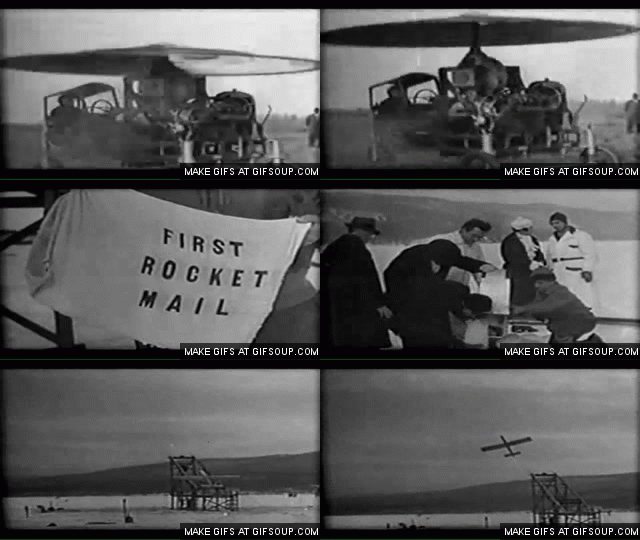
Obsession and invention come together in the numerous doomed-to-fail flying machines, each presentation inevitably preceded by the delusional inventor’s proclamation that “what we are about to see will change the world.”  The succession of disastrous ornithopters, “triphibians,” rocket planes, and bat-winged flying costumes fizzling, burning out, or simply tumbling off the ends of their take-off ramps was probably the inspiration for a similar passage in Airplane! (1980) in which former pilot Ted Striker suffers the most pathetically hilarious flashback in all of film.

failed-flying-machines-o

In fact, the Airplane! sequence is just one of many examples of footage that was insinuated into public consciousness through its reuse: while it may not have been the first film to revive them, Gizmo! contains many images that have become iconic, such as performer Frank “Cannonball” Richards being shot in the belly point blank by a cannon.  If they didn’t see Gizmo!, viewers in the 1980s might have seen this image in numerous other contexts such as commercials or music videos; it was ubiquitous enough that when The Simpsons parodied it in “Homerpalooza” they could assume that the majority of their audience would get the reference.

cannonball

As it happens, I did see Gizmo! several times: in addition to appearing on HBO (like both of the other films I’ve mentioned), it was a favorite of my middle school shop teacher, good old Mr. Lundquist (who would often joke that he couldn’t use a typewriter because he had lost his “typing finger” in a bandsaw accident—he was truly a shop teacher of the old school).  Whenever we had an inactive day (for whatever reason), Mr. Lundquist would pop Gizmo! into the VCR for us to watch, on the pretense that we might glean some insight into mechanical engineering from it: I must have seen the damned thing at least half a dozen times in school.

Although now mostly forgotten, Gizmo! (along with other docutainments) led to such programs as That’s Incredible! and Real People with their mix of weird talents, record-breaking attempts, and magazine-like pieces on strange subjects, kicking off a brief “reality TV” craze twenty years before Survivor.  In a more serious vein, the obsessed oddballs of Gizmo! are the forefathers of Errol Morris’ subjects in the similarly anthology-like Fast, Cheap & Out of Control.

It was on basic cable that stock footage became almost a medium in itself, continually reshaped and recombined by editors, filling in the cracks in programming and propping up commercial messages like the media equivalent of duct tape.  Rick Prelinger, collector and curator of countless educational and industrial films, was one source, financing his more serious preservation projects by supplying film clips to cable channels and other buyers.  Nickelodeon and the Comedy Channel frequently ran old shorts in the late 1980s when their own programming was thin on the ground. And it’s a cliché by now to complain that MTV no longer runs music videos, but what I really miss are the incredible variety of cult films and the kind of sponsored films that Prelinger specialized in: safety, hygiene, and civil defense films from the 1950s and ‘60s, presented uncut but ironically juxtaposed with the rest of the channel’s programming.

Black-and-white footage was especially felicitous for film collage: just as the low-budget filmmakers of the time had reused stunts to cut costs, counting on the consistency of the film stock to hide discrepancies, modern editors could draw on a vast body of film to assemble an original world from spare parts: in It Came from Hollywood, the invaders of Earth vs. the Flying Saucers could share the screen with the alien masterminds of Mars Needs Women and the ape-like Robot Monster could trade places with the gorilla from The Perils of Nyoka, making the visuals as archetypal and interchangeable as the storylines.  Later filmmakers could, and would, go much farther in assembling collages (the work of Craig Baldwin, for example, deserves a write-up of its own, to follow at a later time); the uniformity of black-and-white film bears comparison to the Victorian engravings that Max Ernst turned into the surreal graphic novel La Femme 100 Têtes, the consistency of the illustration style allowing for a greater suspension of disbelief than more typically disjunct visual collage.*

ernst18

In fact, my memory of the 1980s is so colored by the reuse of kaleidoscopic Busby Berkeley routines, death-defying stunts, and proto-steampunk flying machines set to new soundtracks, that they largely run together in my mind.  For example, I had completely forgotten that Gizmo! has a voiceover, yet the announcer talks over the clips almost continuously.  I wonder, too, how much effect this had on other members of my generation: I was beguiled by these hints of an older world, touched by both history and fantasy, and I eventually had the opportunity to dig deeper, to watch complete films.  But the emphasis on dippy inventions and quaint habits of the past might have equally fueled the perception that old movies (and even the world they represented) were uniformly corny, boring, and dumb—an attitude that can be hard to overcome.

Similarly, the use of editing to present only the highlights—a pattern that is already evident in That’s Entertainment!, but which would accelerate with each passing year—both artificially juices the excitement level and misrepresents the more leisurely pacing that was the norm in old films.  (That’s not to say that editors of the 1930s and ‘40s never used quick cutting—they did—but over the length of a feature intense and exciting passages were generally balanced with slower sequences.) From a modern perspective, one of the most interesting sequences in That’s Entertainment! edits together the numerous examples of Mickey Rooney and Judy Garland in the so-called “Backyard Musicals” series, saying “Let’s put on a show!” (or a dance band, or a rodeo) in rapid succession, a predecessor of the supercuts that now thrive on YouTube.

Perhaps like any fad, the use of stock footage on television began to fade; by 1994, Turner Classic Movies was on the air, providing a more respectable home for both feature films and ephemeral short features that could be presented original and uncut.  Likewise, many of the original sources from which features like Gizmo! drew are available online now and can be easily seen; it isn’t as necessary for them to be edited together for general viewers.  What is needed is context, and curators like TCM or Criterion are able to provide that.  With the availability of this footage has come easy-to-use editing software, so that anyone can create the kind of collage that was once trendy on television.  As for the low-budget producers, they are now more likely to lean on the crutch of CGI for their features, which may not be any more believable than stock car crashes or explosions, but can be quickly produced and can be tailored to their specific needs.  And MTV?  Well, everyone knows they don’t show videos any more, anyway.

* In this connection, the most intriguing example of this from the 1980s is Tom Schiller’s 1984 film Nothing Lasts Forever, a black-and-white homage to Golden Age Hollywood that uses stock footage to lend authenticity to the trippy journey of a young would-be artist.  More popular was Carl Reiner’s Dead Men Don’t Wear Plaid (1982), a film noir parody in which Steve Martin played the detective, interacting with characters from classic movies through the magic of intercutting.

Film Review: Following the Ninth

It’s easy to be desensitized as a defense against hype; all around us we are being sold, told that something is the biggest, the best, the newest. Folding our arms and saying, “Oh, yeah? Prove it!” isn’t just reflexive cynicism, it’s practically a self-defense mechanism, the only way to protect ourselves against the barrage of pitches clamoring for our attention.  Arts advocacy, sadly, isn’t immune to hyperbole, and even well-meaning statements like Mr. Holland’s Opus and The Mozart Effect can overstate their cases, ringing hollow.  I’m as guilty as anyone else: music can be a powerful experience, and difficult to put into words. If we sometimes go overboard when speaking on its behalf, it’s because we have been transported, and words are rarely big enough to explain it.

Kerry Candaele (the director of Wal-Mart: The High Cost of Low Price and other documentaries) described himself in his 20s as full of “angst, existential dread, and spiritual maladies,” before his discovery of the music of Ludwig van Beethoven, specifically a cassette recording of Beethoven’s Ninth Symphony.  The music touched him so deeply that he became a convert, digging into Beethoven’s music and wanting to pound on people’s doors, asking them, “Do you have Beethoven in your life?”  Fortunately, instead of doing that, Candaele wrote and directed Following the Ninth, which takes a different tack (I caught the film at the Wichita Orpheum Theatre Wednesday night, co-presented by the Tallgrass Film Association and Wichita Symphony Orchestra).

Following

Before Wednesday night’s screening of Following the Ninth, Candaele spoke briefly to those brought to the screening “not under their own free will,” seeking to allay their fears by stating up front that his film is not a biopic, and not an academic analysis of the music.  Indeed, as the film proceeded there were relatively few pronouncements from musical experts and almost no references to Beethoven’s biography, other than the fact that by the time he composed the Ninth (his last completed symphony) in 1824, he was completely deaf.  The film focuses squarely on individuals from China, Japan, Chile, and Germany, speaking in their own words (and with the support of copious historical and newly-filmed footage) about what the Ninth Symphony has meant to them.  Candaele makes his case for the power of art by example.

Following the Ninth celebrates the communal nature of Beethoven’s masterpiece, concentrating on times and places in which the complete work (especially the famous “Ode to Joy” of the last movement) gave solace or energy to people desperate for freedom, equality, brother- and sisterhood.  In 1989, mere months apart, demonstrators in Tiananmen Square and crowds celebrating the dismantling of the Berlin Wall adopted the Ninth as anthems under very different circumstances: the Chinese student demonstrators, represented by student leader Feng Congde, hijacked public PA systems and blared the Ninth Symphony to drown out official announcements and threats; in East Berlin, Lene Ford grew up being forced to sing Beethoven’s work in school, taught only that he was a “social revolutionary.”  After the collapse of the Wall (only two months after Lene’s brother had been shot trying to escape to the West!), the Ode to Joy symbolized a moment of sudden openness: for a young woman who had been spied upon by the Stasi simply because she had pen pals in other countries, “who were like fiction to me, because I knew I would never see them,” the experience of freedom was overpowering.

While the Chinese student demonstrations would be crushed by government force, and East Germany would be reunited with the West as the Soviet system crumbled, both Feng and Ford speak to the transformation they underwent during those events: the sense that they could do anything, that both they and the world had changed.  Ford comments that the feelings she experienced, and the welcome she received from West Germans the first day the border was opened, have stayed with her, forming a reserve of strength she has drawn on throughout her life since then.  At a concert after the Wall fell, conductor Leonard Bernstein famously changed a single word in the Ode from freude (joy) to freiheit (freedom)–a change not without some controversy; while both words were appropriate for the moment, it is the sense of utter joy that comes through as Ford recounts her story.  As for Feng, when he describes the plaster statue of a woman holding a torch aloft that the students erected in Tiananmen Square–an iconic image that was interpreted as a Chinese Statue of Liberty in the U. S.–he refers to her as Joy personified.

Feng’s recollections of his role in the protests dwell on the liberation of the students’ artistic impulses during the protests, and emphasize that the restriction of the Communist system was not only physical, but a sort of prison of the mind: while the protesters faced physical violence, they were protesting against a more pervasive “violence of culture,” in which art, music, and dance were all “bourgeois,” forbidden.  A sad irony of totalitarianism is that the same creative outlets were forbidden under the fascist government of Chile under General Augusto Pinochet: in the words of one activist, “there was no culture, because all culture was Left culture.” It was forbidden to sing Chilean folk songs or the “Himno de la Alegria,” as the Ode to Joy is known in Spanish, because of their association with popular socialist movements, or simply because the majority of musicians were known to have leftist sympathies. It is a reminder that, as Czech author Josef Škvorecký pointed out (in “Red Music”),

when the lives of individuals and communities are controlled by powers that themselves remain uncontrolled–slavers, czars, führers, first secretaries, marshals, generals and generalissimos, ideologists of dictatorships at either end of the spectrum–then creative energy becomes a protest. . . .  Totalitarian ideologists don’t like real life (other people’s) because it cannot be totally controlled; they loathe art, the product of a yearning for life, because that too evades control.

Some of the most harrowing passages in the film describe the paranoia and secrecy that marked Pinochet’s Chile, as suspected dissidents were “disappeared,” rounded up by the government for torture and (sometimes) execution.  Indeed, many of the public protests against Pinochet were led by women: so many of the men had been taken that the women left behind became the public voices of dissent, keeping the names and faces of the “disappeared” in the public eye and leading non-violent demonstrations (including singing the forbidden “Himno”).  Although Pinochet is gone, the recollections of the Chilean activists are bittersweet, with a sense of grievous loss that can only be processed through wry humor or simply by moving on.

Unlike the examples of the Ode taking on heightened significance at moments of political crisis, the annual performance of Beethoven’s Ninth has been an established tradition in Japan since World War I: professional orchestras, schools, and Daiku (“great nine”) associations stage hundreds of performances of the symphony every year in December, where it is associated with the New Year, similar to choral societies in the West that perform Handel’s Messiah and other works annually.  Candaele sits in on rehearsals with some of these groups, made up of amateurs who sing for both musical fulfillment and camaraderie; as in the West, Daiku choruses are civic and social as well as artistic in function, with a great emphasis placed on the value of cooperative endeavors.  Following the Ninth was six years in the making; at the outset of filming, Candaele could not have expected the horrific earthquake and tsunami that devastated parts of Japan in March 2011; but in the aftermath, Beethoven’s Daiku was an obvious symbol for the Japanese people to express their resilience and solidarity.

Following the Ninth is not a straight concert film, but it does roughly follow the order of Beethoven’s symphony, with the Ode to Joy as a recurring touchstone, introduced at the very beginning and referred to throughout the film (whereas in the symphony it is heard only in the final movement).  The four countries’ stories are intertwined, cutting back and forth, leaning on the similarities more than the differences (after all, the theme of the Ode is universal brotherhood).  Beethoven’s music is frequently heard in the background under dialogue or in tandem with footage of crucial events, but longer passages are also played over montages of images cut to match the rhythm of the music.  It’s in these sections that Following the Ninth comes closest to being outright manipulative: scenes of children playing, people marching, and breathtaking natural vistas are like cinematic candy–tasty but not very nutritious–and Beethoven’s music doesn’t need the extra juice.  Likewise, the scenes of goose-stepping German soldiers, Chinese tanks rolling over student encampments, and massive walls of water bearing down on the Japanese coast are chilling enough without Beethoven’s timpani or ominous harmonies making the point.

Still, even those scenes contribute to the film’s theme: the unity of mankind in all its diversity, as optimistically celebrated by poet Friedrich Schiller in the Ode that Beethoven would set to music in his monumental symphony; and the ways in which Beethoven’s music has been adopted and given meaning in settings quite different from that which he experienced.  Candaele opens the film with punk/folk singer Billy Bragg telling the story of the time he was invited to rewrite the words to Schiller’s Ode; like Bernstein’s change of a crucial word, that is sacrilege to some people, but it is similar to the way in which each person interviewed in the film has made Beethoven their own, and the way Candaele has used the symphony as a vehicle for telling their stories.  I think that’s the reason so little of Beethoven’s specific history is included in Following the Ninth: it’s already well-known, sure, but more importantly it’s beside the point.  For the Chilean and Chinese protesters, for the suddenly liberated East Germans, and for the Japanese coming together in the face of disaster, Beethoven’s music wasn’t history, or even a convenient symbol: it was alive and it was speaking to them in that moment.  I suspect that’s what we really mean when we say a work of art is “timeless,” and it’s the reason it’s so difficult to put into words after the moment is over.