Wichita Symphony with Stephen Hough, piano

Sergei Prokofiev: Symphony No. 1 in D Major, Op. 25, “Classical”
Ludwig van Beethoven: Piano Concerto No. 2 in B-flat Major, Op. 19 and Piano Concerto No. 1 in C Major, Op. 15
Stephen Hough, piano

British pianist (and composer, author, etc.) Stephen Hough joined the Wichita Symphony Orchestra under the direction of Maestro Daniel Hege for a performance of two Beethoven piano concertos and Prokofiev’s “Classical” Symphony. You can read my brief write-up of the concert for The Wichita Eagle here.

Cowboys & Aliens: A Reappraisal

Following last week’s look at the odd history of the science-fiction Western, I offer a more detailed defense of 2011’s Cowboys & Aliens (warning: spoilers ahead). Like my article on Addicted to Love, this was written as an entry for Lovefest, an ongoing series organized by commenters on film website The Dissolve. The only requirement for Lovefest is that it is an appreciation of a movie that flopped, was panned by critics, and/or is generally forgotten.
cowboys.poster

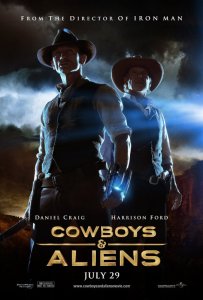
The title Cowboys & Aliens promises a high-concept romp. In interviews featured on the Blu-ray, writers Roberto Orci and Alex Kurtzman and director Jon Favreau mention that the title alone of Scott Mitchell Rosenberg’s comic book series got them excited, and perhaps Universal’s marketers assumed that audiences would be similarly turned on by the prospect of B-movie thrills in a genre mash-up. Further, the involvement of Favreau, known for witty banter and a slyly comic approach (whether directing Will Ferrell in a Christmas comedy or setting the template for Marvel’s superhero franchise with Robert Downey, Jr.), probably fed expectations that this would be more of the same.

Instead of the fun promised by the title, however, audiences got a fairly serious, even grim, drama that was surprisingly gruesome for its PG-13 rating and included moments of outright horror. (In the same featurettes, the filmmakers mention the inspiration they drew from Alien, but I don’t remember that being highlighted in the trailers.) There is some comic relief and plenty of action, but it’s not really a lighthearted movie. One never really knows how a movie will perform, but considering the talent involved and that audiences and critics claim to want original* blockbusters, a less generic title and more accurate marketing might have given the film a better chance. While a viewer might agree with everything I have to say and still not find this movie to their taste, fans of other maligned films like John Carter and The Lone Ranger will probably find something to enjoy in Cowboys & Aliens.

*In this case, “original” is a fuzzy concept: Cowboys & Aliens is original in the sense that it is neither sequel nor remake (even the comic book on which the film is based is hardly a well-known property, and appears to have been optioned solely for the name and concept), but it treads in well-worn pathways, featuring characters who are familiar by type if not by name.

cowboys.lonergan1

Set in 1875 New Mexico, Cowboys & Aliens begins with a man (Daniel Craig) waking up in the desert, injured and with no memory of who he is. On his wrist is a strange metal shackle; in his pocket, a picture of a woman (Abigail Spencer). After brutally fending off an assault by three highwaymen, this literal Man With No Name makes his way to a depressed mining town called Absolution. He makes the acquaintance of a pragmatic preacher (Clancy Brown) and a strange woman, Ella (Olivia Wilde), who recognizes the shackle and says she can help him recover his memory. An obvious man of action, the stranger can’t help but insert himself into a scene caused by Percy Dolarhyde (Paul Dano), a bullying, loudmouthed twerp who takes advantage of the protection of his father (Harrison Ford), the local cattle king whose business keeps the town alive.

Provoked by the take-no-shit stranger, Percy fires his gun carelessly, hitting a nearby deputy in the shoulder. The sheriff (Keith Carradine) has no choice but to lock Percy up, but he quickly realizes that the newcomer is Jake Lonergan, wanted for stealing a shipment of gold that belongs to Colonel Dolarhyde and for the murder of a prostitute; Lonergan gets locked up, too.

As night falls, the sheriff prepares to deliver both Percy and Lonergan to a judge in Santa Fe, and Colonel Dolarhyde and his men show up to stop him. Dolarhyde is first shown torturing a man whom he suspects of killing one of his herds (actually the work of the titular aliens, of course), and he has no qualms about using force to free his son or enacting rough justice on the man who stole from him.
cowboys.lasso2

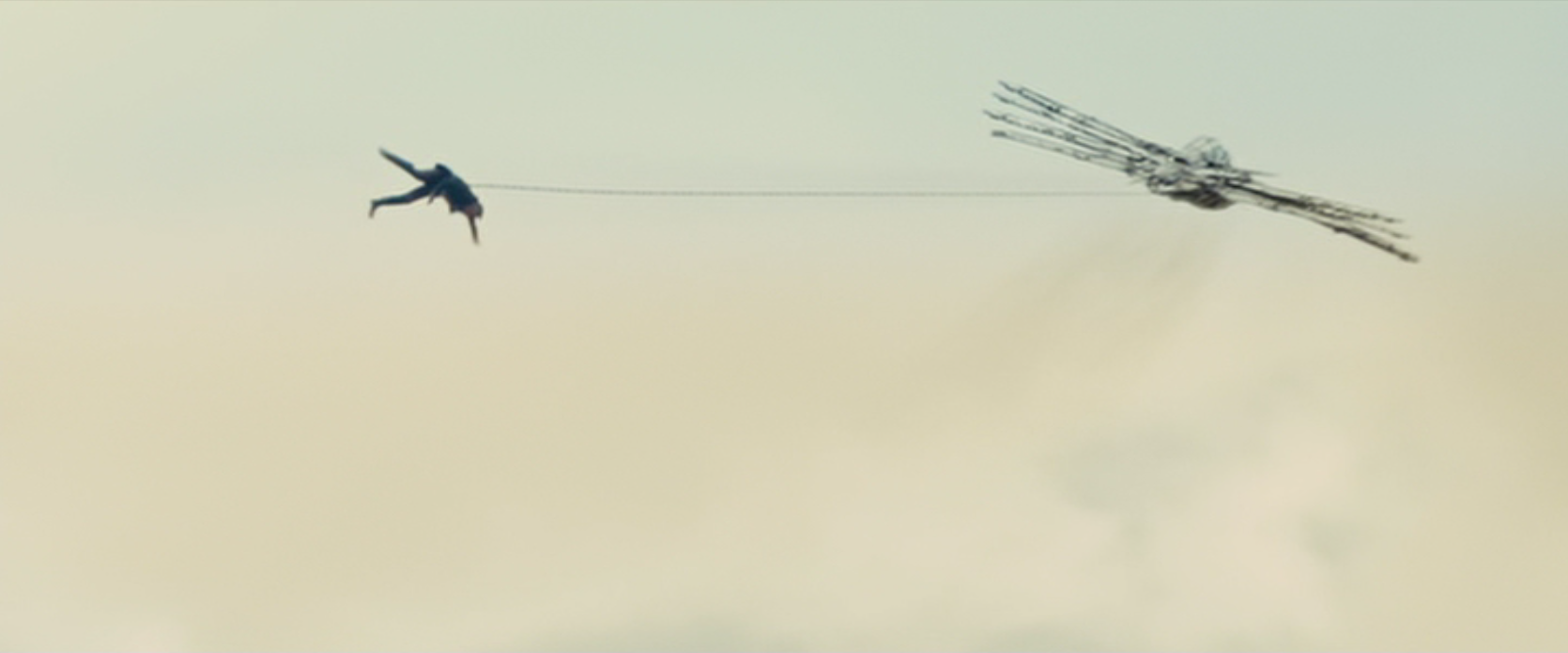
Just as all of these strands of plot are coming together, the aliens attack from the air, causing explosive mayhem with their lasers and pulling townspeople into the air with lasso-like snares. When the aliens’ ships come in range, the bracelet on Lonergan’s wrist lights up, and he finds that he can use it as a powerful blaster; he shoots down one of the gliders, but it is too late to halt the attack completely. In the chaos, Percy is among those captured, as are the sheriff and the wife of Doc (Sam Rockwell), the town’s meek doctor/barkeep.

cowboys.lonergan4

From here, the main plot is set in motion: Dolarhyde takes command of the situation and plans a rescue party, believing that the townspeople were taken alive for a reason. (“If they wanted ‘em dead, they’d be dead,” he says. “This was a round-up.”) Joining the search party are the tenderfoot doctor, who doesn’t even own a gun, and a young boy, Emmett (Noah Ringer), the sheriff’s grandson; Ella also joins for her own reasons, but Lonergan chooses not to go, even as Dolarhyde urges him to add his strange weapon to the search.

Where Cowboys & Aliens is most successful is in taking the premises of classic Westerns and alien-invasion stories seriously. The Western townspeople, while stock character types, are neither fools nor gifted with period-inappropriate knowledge. The film begins with several mundane plots in motion: there are no cardboard slasher victims, standing around waiting for the action to start. Further, they behave as any nineteenth-century person of average education might when faced with something beyond their understanding: when the aliens strike, some wonder if they are being attacked by demons, and they probably wouldn’t seek out trouble if they weren’t trying to retrieve their kidnapped loved ones. The film doesn’t count on the characters to relay exposition about aliens: we see the action through their eyes and fill in the details with our own genre experience.

As Lonergan’s memories gradually return, he visits an abandoned cabin, where he remembers bringing the stolen gold to his lover (the woman whose picture he had, and whom he is accused of killing), with the intention of starting over somewhere far away. In the first of several eerie flashbacks, the gold coins are melted into slag and sucked through the roof of the cabin by a mysterious force, and then one of the aliens’ skyhooks pierces the roof and captures the woman.

cowboys.gold

After finding nothing at the cabin, Lonergan joins the search party, which has been tracking an injured alien. The main tracker, a Mexican Indian named Nat (Adam Beach), is Dolarhyde’s hired man and Percy’s companion and protector, but is more importantly everything Percy isn’t: brave, competent, and honorable. To Dolarhyde, however, Nat is just a thick-skulled Indian.

After losing the tracks in a rainstorm, the party comes across an upside-down riverboat, stranded miles from any river. The searchers hole up in the eerie, decaying boat for the night, and several character arcs begin to unfold: the preacher helps Doc practice shooting; Dolarhyde reluctantly takes Emmett under his wing, giving him a knife for protection; Nat inadvertently reveals how much Dolarhyde has been a father figure to him, but is rebuked.

Will Doc learn to shoot in time to help save his wife? Will that knife come in handy just when Emmett needs it? Will Dolarhyde come to appreciate the surrogate son who has been in front of him the whole time? Most importantly, will Lonergan regain his memory and redeem himself after his former life of crime, coming to an understanding with the similarly hardened Civil War veteran Colonel Dolarhyde? If you can’t guess the answers to those questions, then you haven’t seen very many Westerns or sci-fi action movies.

cowboys.glider

It is worth emphasizing that Cowboys & Aliens presents a distinctly cinematic version of both the genres it combines: it is primarily an action movie with a secondary focus on character. Neither the history of the West nor a philosophy of science have any particular bearing on events, other than an awareness of the passing of the Indian in the face of white migration (something that is at the heart of many Westerns, but which is also, as we shall see, of thematic importance to Cowboys & Aliens).

As mentioned, the characters are archetypes of Western fiction; their familiarity helps us take sides right away. Also, whether consciously or not, Cowboys & Aliens exploits the fact that early filmed sci-fi took advantage of the rocky, arid terrain of the Southwest to stand in for alien planets. (The association of science fiction with desert landscapes has long literary associations, as well.) The same caves and canyons around Hollywood that were backdrops for Johnny Mack Brown and Tom Mix served just as well for the surface of the moon or the planet Mongo a few years later.

This is more than just convenience or historical association: it contributes vitally to the tone of the film. In an essay entitled “The Alien Landscapes of the Planet Earth: Science Fiction in the Fifties,” Vivian Sobchak points out that lonely, desolate places on earth have more power to awaken terror than visions of advanced technology that inevitably become dated with the passage of time. In Sobchak’s words, “What we wonder at today, we may laugh at tomorrow. But the desert and the beach, the wind and the sea, the black lagoon and the frozen stretches of Arctic ice do not date, and will never lose their power to awe and disturb us.”

The power Sobchak describes is what the romantics called the sublime, the combination of wonder and terror one experiences in the face of the vast works of nature such as the storm, or the sea . . . or the desert. It is what often makes even the lousiest Western worth watching for its panoramic vistas of the great plains, the deserts of the Southwest, or formations such as Monument Valley. Against the grain of much modern filmmaking, Cowboys & Aliens was filmed on location in New Mexico: all of its settings are real, physical places, even the spaceship interior sets; the aliens and their technology are brought to life with a mixture of CG and practical effects; and the daytime scenes are filmed with natural light. (Director of Photography Matthew Libatique is best known as a long-time collaborator with Darren Aronofsky, and had previously worked with Favreau on the first two Iron Man movies.) It is as real as a film about cowboys fighting alien invaders can be, and its sense of place is a powerful asset.**

**It also sounds great: composer Harry Gregson-Williams had the job of effectively scoring two movies, but his score fits together and bridges the gap between genres very effectively.

cowboys.footprint

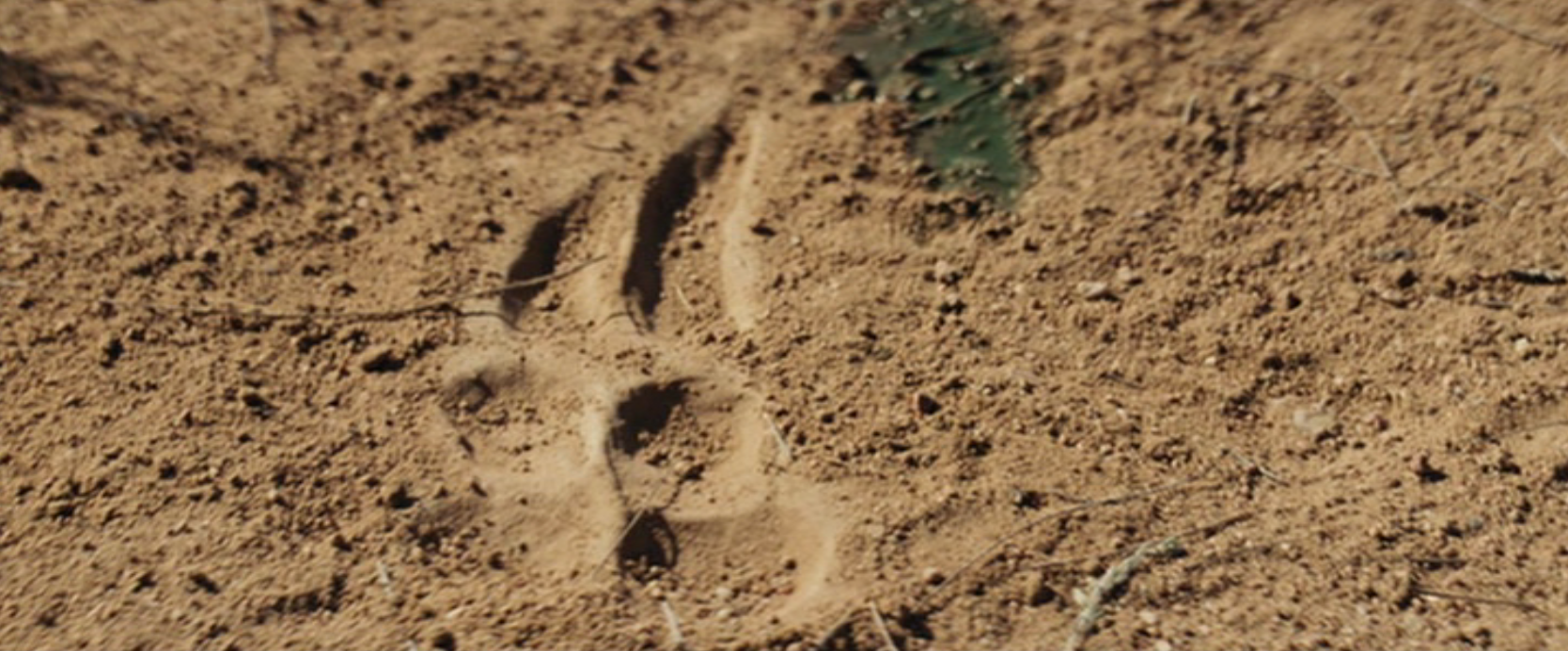
In the films Sobchak was writing about (largely low-budget monster and alien-invasion movies such as Them! and It Came From Outer Space), the scope and ruggedness of natural settings are only part of their effectiveness in setting mood: they are also isolated. The tension in these films is in part a product of their settings’ loneliness and distance from help, and the frisson generated when encountering something that doesn’t belong where no one should be: “strange inhuman footprints on an impressionable beach,” to cite one of Sobchak’s examples. Cowboys & Aliens features exactly that trope, with Indian tracker Nat following the trail of footprints left by the alien.

Tracking is an important part of Western lore, and the Indian scout is one of several archetypal characters the movie presents. The anxiety and eeriness of seeing the alien footprints is only slightly greater than that a settler might have experienced upon finding prints in unknown territory: do they belong to friend or foe? In that strange world west of the tree line, the unknown almost always represented danger.

cowboys.riverboat

Another common visual motif of science fiction is the juxtaposition of the natural and the artificial, or the primitive and the high-tech (in his essay “The Science Fiction Film Image,”*** Fred Chappell identifies this as one of five types of incongruity that can make an image recognizably science fictional: “the spaceship in the wilderness” and “the spaceman among alien aborigines” are two examples he gives). The riverboat, already made eerie by its landlocked, overturned state, is half-overgrown with weeds, and rain water filters through its cracked floors and ceilings. It’s an image of nature and technology in collision, and its wrongness foreshadows the searchers’ ultimate destination, a tower-like spaceship hidden among the rock formations of a remote canyon. In Cowboys & Aliens, the aliens are the spacemen, the humans the aborigines, a very effective reversal of common imagery (more about this momentarily).

***Both Vivian Sobchak’s and Fred Chappell’s essays are found in the Monarch Film Studies volume Science Fiction Films, edited by Thomas R. Atkins.
cowboys.ship

Unbeknownst to the group, the injured alien is also hiding in the riverboat, and this sequence of the movie recalls Alien’s “haunted house” formula; the first clear view of the alien reveals it as a tall, vaguely humanoid creature with a mixture of reptilian and insectoid features (including, most disturbingly, a breastplate that opens to reveal a pair of tiny, grasping forelimbs for fine manipulation, a clear nod to the mouth-within-a-mouth of H. R. Giger’s xenomorph). The alien picks off a few members of the party, including the preacher, and escapes.

cowboys.alien2

The next morning, after picking up the alien’s fresh tracks, the party runs afoul of a gang of robbers: some of Lonergan’s old crew, now run by a dufus named Hunt (Walton Goggins). Lonergan, still not completely recovered from his amnesia, plays along and asks Hunt to take him back to the gang’s camp. It’s there that he learns that he had left the gang high and dry, taking their share of the stolen gold in order to run away with his woman. The gang isn’t too willing to have him back, and they threaten the members of the search party. Another aerial attack by the aliens interrupts them.

Ella is taken by one of the aliens’ lassos, and Lonergan manages to jump onto the ship carrying her, blowing it up with the blaster; they both land in the water, but Ella is wounded by the ship’s alien pilot, who also escaped the crash of his craft. Lonergan carries Ella back to the search party, but it’s too late: she is dead.

cowboys.Ella2

The party is surrounded by an Apache tribe on horseback who take them back to their encampment. Dolarhyde’s anti-Indian attitudes come to the fore, but Nat is able to translate and keep the two groups from killing each other. When Ella’s body is thrown onto a funeral pyre, it releases a burst of energy and she comes back to life: she is the last of her kind, one of another race that had already been wiped out by the aliens, and who has been following them to make sure no other world suffers the same fate as her home. Finally we get a little exposition: the aliens are part of a scouting mission, looking for gold (“It’s as rare to them as it is to you,” she explains) and abducting humans to perform tests and analyze their weaknesses in advance of a full invasion force.

Even when it’s clearer what is happening, there is no outpouring of foreign names or history, no grand mythology of which this film is only a single episode; in an era of incessant franchise-building, it’s refreshing to see such a self-contained story. (If the film’s poor performance has one bright side, it’s that we weren’t subjected to a series of increasingly convoluted and unsatisfying sequels.)

Because of its singularity—there is only a single scout ship, destroyed by the humans by the end of the movie—and its remoteness from civilization, this is a story that can take place without rewriting known history. It has a level of plausible deniability: even if the characters were to share their story at some point, who would believe them? (I don’t know if it was intentional, but this alien-invasion story fits neatly with the nineteenth-century “airship mysteries” that are sometimes cited as proto-UFO phenomena, not to mention the various hoaxes that filled newspapers of the time.)

In a sweat lodge ceremony, the Apaches help Lonergan recover the rest of his memories in a deeply unsettling sequence: a hard-to-place memory of his lover lying next to him is revealed to be her vivisection at the hands of an alien scientist, before her disintegration right before Lonergan’s eyes. In the flashback, he is strapped to a table, awaiting his turn to be tested and then exterminated. He remembers how the alien’s carelessness gave him the chance to steal its weapon and use it to escape, his mind still scrambled by a hypnotic light the aliens used to keep their captives docile.

cowboys.penned

At this point, all the threads come together for the big finish: Nat helps Dolarhyde reach an accommodation with the Apaches (who have also lost many of their people to the aliens) by explaining that Dolarhyde raised him like a son, even though they were not blood, and Lonergan rides out to convince his old gang to join the fight. The townspeople, gang members, and Apaches converge on the aliens’ base, a spaceship half buried in the ground in a remote canyon, disguised to look like the rocks around it. (I personally love scenes where erstwhile foes join together to defeat a common foe, like the gangsters and G-men standing up to the Nazis in The Rocketeer. If Cowboys & Aliens could be described as Independence Day in the Old West, at least it has more nuance than that film.)

The images of alien footprints and the alien vessel in the canyon are doorways from which the Western transitions into science fiction in Cowboys & Aliens, but they are also reminders that the Western is already a kind of science fiction, a historically-based example of Isaac Asimov’s definition of science fiction as “that branch of literature which is concerned with the impact of scientific advance upon human beings.” Although not always the central focus of Western stories, the telegraph, the railroad, the Winchester rifle, and even the horse—introduced by the conquistadors, and which transformed the plains tribes before settlers had even crossed the Mississippi—are clear examples of new technologies affecting entire civilizations. (Technological superiority alone does not account for the relentless expansion of colonists at the expense of Native peoples, but it is surely a significant factor.) Even if white settlers had been wholly benign, Native culture could not have avoided changing through contact and trade with them.

Cowboys & Aliens puts all its human characters, white and Indian alike, in the position of natives faced with conquerors who vastly outgun them (and will also outnumber them in the event of a full-scale invasion). The Apaches and whites, who otherwise would have no cause to trust or associate with each other, have a good reason to work together here. The aliens see humanity as a mere inconvenience, almost beneath notice, fit only to exploit and experiment upon; they sweep in and take what they want, in a pattern of conquest that (according to Ella) has happened again and again. Human beings are even compared explicitly to cattle, first by being roped up and taken, and then by being penned while they await slaughter. The movie doesn’t hit us over the head with it, but it isn’t subtle.
cowboys.watches

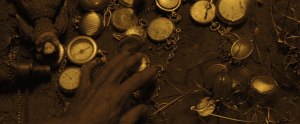
The film is at its most horrifying not when the searchers are being picked off by a lone alien in the upside-down riverboat, but in Lonergan’s memories and his return to the spaceship. Watching his lover disposed of as a science experiment; finding piles of pocket watches and glasses from past victims; the prisoners herded together as a nameless mass awaiting their turn—and Lonergan remembering himself as one of them: these are images not just of genocide, but of Holocaust, the scientist-alien (whom the filmmakers in their commentary describe tellingly as the uber-alien) as Dr. Mengele. It is this, more than anything else in the film, that likely made it so hard to swallow for audiences who only wanted a Western lark with a twist, an afternoon with the kids to sit in air conditioning and eat popcorn, and it makes the cannibalism and Indian slaughter of The Lone Ranger seem measured by comparison.

cowboys.uber

Finally, a few words about the cast: it’s loaded with well-known stars and terrific character actors, but as we all know that doesn’t always lead to a good movie. In this case, however, the cast has great chemistry; most of the actors are familiar faces with experience in Westerns and do many of their own stunts, adding to the sense of lived-in reality. Daniel Craig is a natural as a bad man who finds himself capable of heroism, and Olivia Wilde’s otherworldly beauty makes her an excellent choice for her role; the supporting cast is also a pleasure to watch. I’d like to single out Harrison Ford, however, for the best performance he’s given in years. Colonel Dolarhyde is the kind of tight-lipped grouch Ford has been playing for the last decade-plus, but here he doesn’t come off as a pampered, over-the-hill star marking time until he can get back to flying his plane. His anger, his disappointment in his son, and the bitterness that has grown into a thick shell around him feel genuine, and his last scenes with Nat are moving in the best hey-I’m-not-crying-it’s-just-getting-awfully-dusty-in-here guys’-movie tradition. In the interviews on the Blu-ray, Ford mentions that he’s playing the old man role, mostly talking while Craig does all the stunts. It’s an exaggeration, but it points to a relationship that plays out on screen, with the grudging respect that develops between the two men unfolding naturally. Harrison Ford is really acting in this one, guys: see it and believe it.

cowboys.dolarhyde1

Hitch Your Wagon to a Star: The Elusive Hollywood Sci-Fi Western

Despite the title, not a space Western

Despite the title, not a space Western

It seems like it should be easy: “space cowboys” such as Han Solo and Mal Reynolds are essentially Old West gunslingers dropped into the cockpit of a spaceship, so why shouldn’t it work the other way around: a robot on horseback or a space alien on a stagecoach? Despite the longstanding popularity of both Westerns and science fiction, the number of films that successfully bring the two genres together in this way is surprisingly small. To be sure, ghost stories, tall tales, and bloody violence are all established parts of Western lore, and some great movies have been made exploring these themes, but the “weird Western” typically explores the boundaries of fantasy and horror, myth and history, rather than science fiction. It turns out that it’s easier to move the Old West into outer space than vice versa.

Undoubtedly, the cinematic grandfather of all such hybrids is the 1935 serial The Phantom Empire (of which I have written more extensively elsewhere), in which singing cowboy Gene Autry runs up against members of a super-advanced underground civilization. In their book The Great Movie Serials, Jim Harmon and Donald F. Glut characterize The Phantom Empire as the beginning of a cycle of “zap-gun Western” serials. However, the other examples they cite, such as Tom Mix’s final film The Miracle Rider, involve super-science of purely human invention, and lack the sense of weird mystery and contact with alien forces that makes The Phantom Empire so distinctive.

PErobot.disguise

Perhaps the reason there have been so few overt fusions of science fiction and the Western in film is that such a hybrid is redundant: once science fiction (especially in the pulpy, action-adventure mode that has dominated popular film-making) took over the Western’s role as the main arena for playing out America’s myths and fears, it borrowed wholesale many of the plots and character types associated with the older genre, effectively replacing it. Good guys (almost exclusively white in the early years of both genres) and bad guys (sometimes literally alien, sometimes white men whose greed had overcome them); a thirst for exploration and conquest, usually in the name of civilization but often identified with commercial interests; and a sense of isolation, of being separated from the routines and mores of the old world (including meditations on the softening, corrupting influences of civilized society), were all notable features of both the Western and early science fiction, to the point that “horse opera” could be updated to “space opera” without any misunderstanding on the part of audiences. The “edge of civilization” was constantly moving outward: Star Trek’s description of space as “the final frontier” is illustrative.

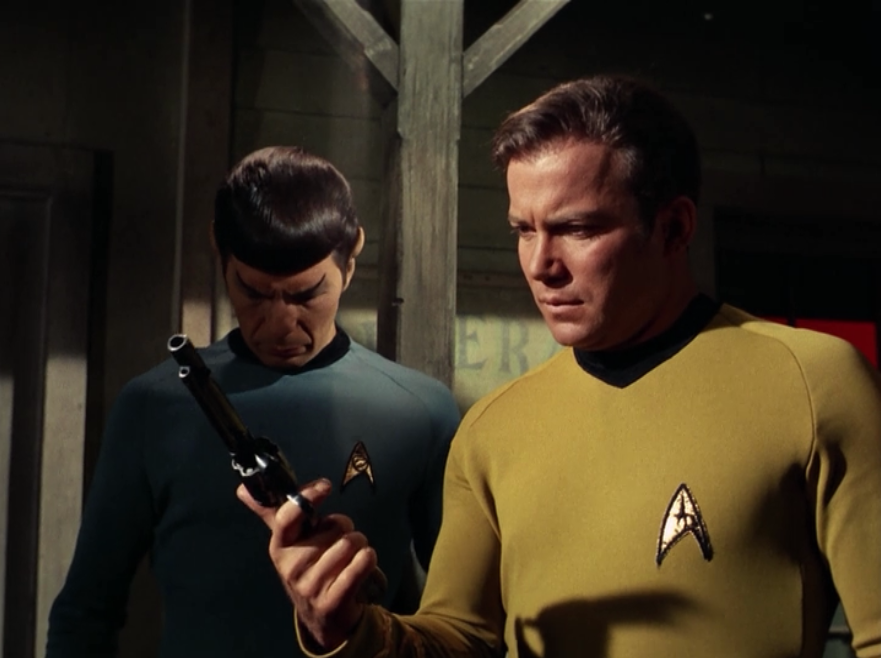
Show creator Gene Roddenberry pitched Star Trek as "Wagon Train to the stars." A few episodes, such as "Spectre of the Gun," made it literal.

Show creator Gene Roddenberry pitched Star Trek as “Wagon Train to the stars.” A few episodes, such as “Spectre of the Gun,” made it literal.

Besides the gunslinger, other characters, such as the alien other, the damsel in distress (or the hooker with a heart of gold in racier manifestations: neither genre had much use for well-developed female characters, as pioneering was considered man’s work), the white man “gone native,” the amoral company man, and the wise tribesman (often the last of his kind, given a tragic nobility once no longer a threat) were translated easily. Science fiction, arriving as it did in a period of both rapid dissemination of ideas and ready access to literature of the past, became a clearinghouse of genre storytelling, absorbing themes and tropes like a sponge. From this point of view, it’s only natural that Terry Gilliam could describe Darth Vader as “the cowboy with the black hat,” that Flash Gordon’s Princess Aura fits the mold of the femme fatale, and that Seven Samurai could be remade as both a Western and as a space adventure. Ultimately, callow, daydreaming farm boys are the same everywhere, whether from Texas or Tatooine.

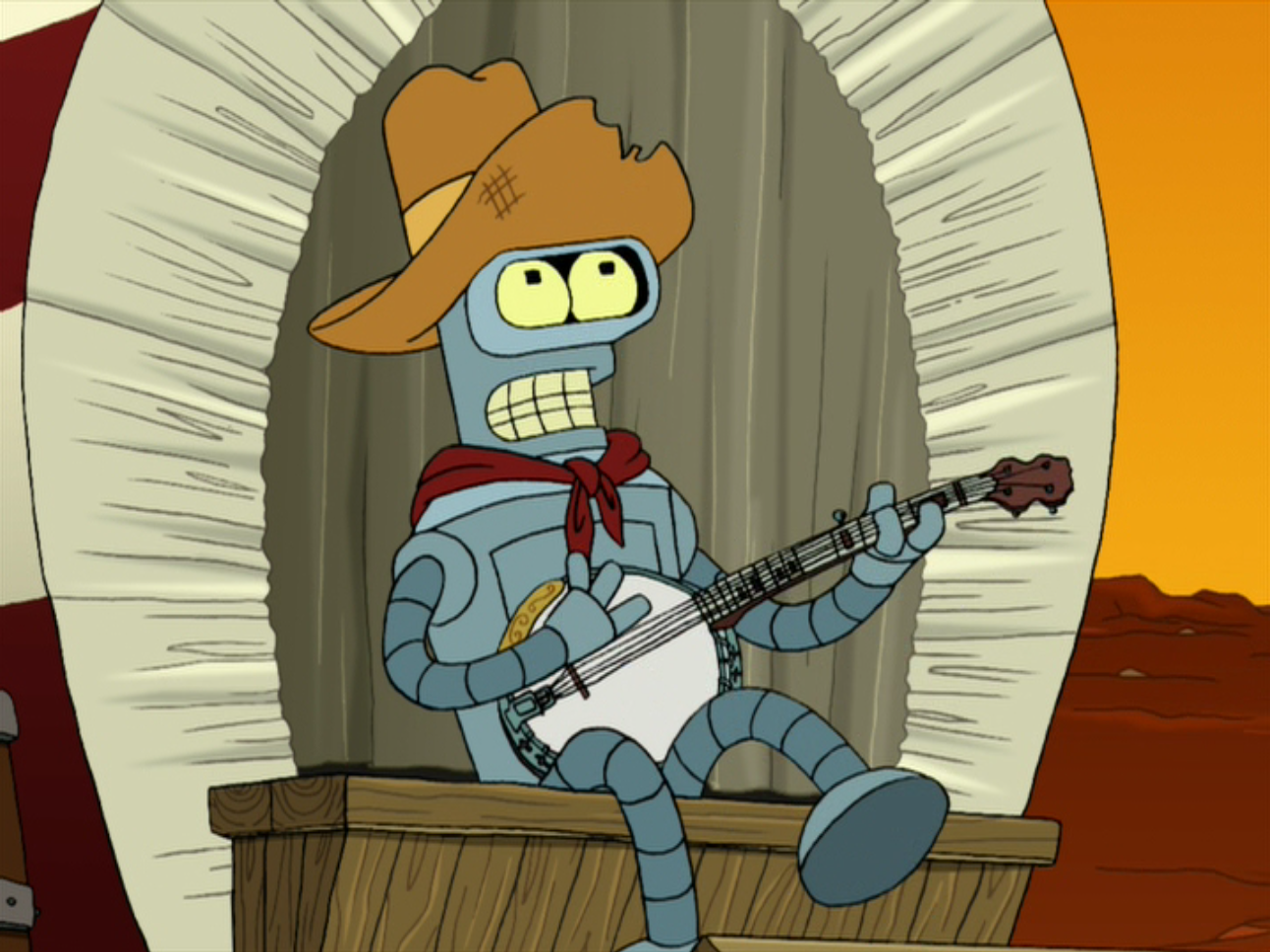
In that case, the distinction between the two genres is one of iconography, and iconography flourishes in visual media: comic books and cartoons have always been friendly to the robot in a cowboy hat, as have the pop surrealism movement and the artists who contribute to sites like DeviantArt. When it comes to mixing and matching, Western and sci-fi are primary colors that can be laid on in broad strokes.

Bender3

Both literary and cinematic science fiction have had to work to absorb Western motifs, however: all but the most fantastic stories attempt to rationalize the mixture of Old West and New Frontier, and here the difference between the two genres is a clear obstacle.* The Western is rooted in a specific time and place, and once that historical moment was over, the Western became a genre about the past (one reflecting contemporary attitudes, to be sure, but almost always focusing through the lens of history); science fiction, especially in the early Space Age, was about the future, and whether focused on the promise of exploration or the horror of nuclear war, it used speculation about the future to examine the current moment. In short, both forms stood in the present, but the Western looked into the past, either searching for some imperialistic original sin or retreating into comforting nostalgia, while science fiction looked into the future, projecting either our hopes or fears.

wild-wild-west-kenneth-branagh

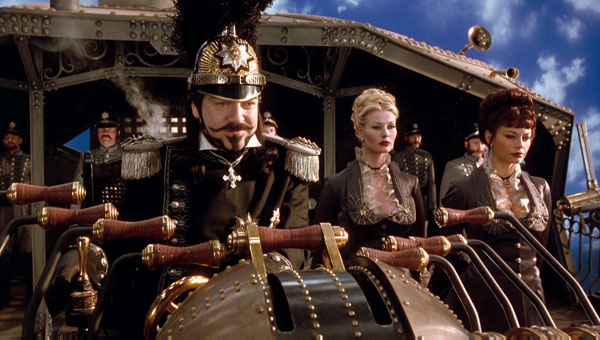
Given that difference in emphasis, science fiction has often chosen to visit the Old West by means of time travel or alternate history. The “steampunk” movement has produced a wide variety of literature, some of it great, but on film it has been too often a faddish visual template that can be applied to the same old pulp storytelling: the result has been ambitious failures like the film version of Wild Wild West or “high concept” dreck like Abraham Lincoln, Vampire Hunter. (Complaints about the perceived hackiness of combining the two genres aren’t new: Wikipedia’s “Space Western” entry notes pulp-era efforts to stamp out lazy updates of Western plots in sci-fi garb, including one magazine’s ad campaign claiming “You’ll never see it in Galaxy.”)

Westworld_ver2

Better are films that find ways to repurpose the trappings of the Western, like Westworld, in which the Western setting is a fiction within the fiction, or Serenity (the belated finale of television series Firefly), which makes explicit both the themes of colonization and post-civil war disillusionment that are a part of the Western. In both cases, the adoption of Western dress and lingo are made to seem not only organic to the setting but essential to the stories being told: both use science fiction to interrogate the Western, and by extension mythmaking in general.

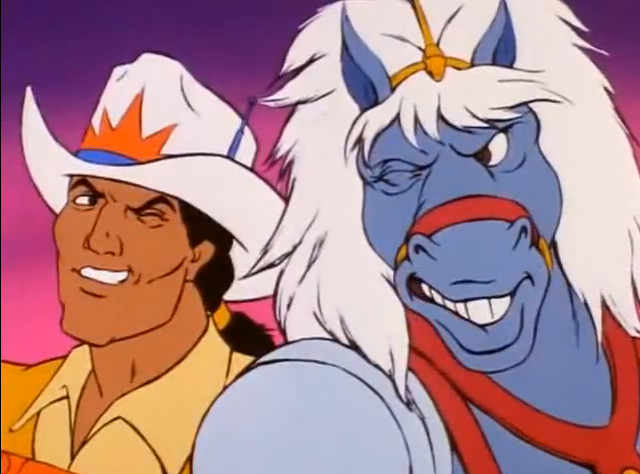
* Even excursions into outright fantasy don’t always pass the laugh test: I invite you to consider the short-lived 1987 cartoon series BraveStarr:

I’ve also just become aware of a 1999 film called Aliens in the Wild, Wild West that doesn’t look too promising; although I haven’t seen it, an imdb reviewer calls it “one of the top ten worst movies I have ever seen.” Tellingly, like The Phantom Empire and like BraveStarr and similar cartoons, Aliens in the Wild, Wild West appears to have been made primarily for children.

BraveStarr

BraveStarr

Next week, I’ll look at a recent example of the genre, 2011’s Cowboys & Aliens.

Wichita Symphony Orchestra with Time for Three

Manuel De Falla: Ritual Fire Dance from El Amor Brujo
Jennifer Higdon: Concerto 4-3
Igor Stravinsky: Suite The Firebird (1919 revised version)
Leonard Cohen: Hallelujah
Arturo Márquez: Danzón No. 2
Mumford and Sons: Little Lion Man

On January 31, I attended the Wichita Symphony Orchestra’s Blue Jeans concert, a casual-dress program featuring eclectic string trio Time for Three.
Here’s what I wrote for The Wichita Eagle.

Je Suis Charlie

Je-suis-Charlie

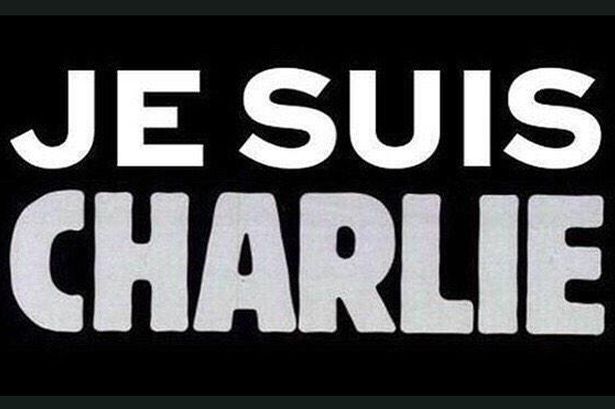
I wasn’t a reader of Charlie Hebdo, but I’m as shocked as anyone by yesterday’s terrorist attack on the offices of the satirical magazine in Paris, a premeditated shooting that left twelve dead. Like many of the people around the world who are responding to the attack with expressions of solidarity, I’m horrified by the concerted attempt to shut down free expression through intimidation and violence.

France is arguably the cradle of free speech in its modern form, given expression by such Enlightenment thinkers as Voltaire and Beaumarchais, but it is also more vulnerable to terrorism than the United States, both geographically closer to the Middle East and home to a much larger Muslim population than the United States. It goes without saying that radical Muslims are a small minority, but relations between the majority and minority cultures in France are fraught. (I’ve spent some time in France, mostly as a child, so I’ll limit recollection of first-hand events to recalling that I was advised not to speak English loudly or be seen reading English-language newspapers on the Metro: during the 1980s, a period of tension with Iran, it was considered wise not to advertise your Americanness, although I’m sure I could hardly help it.)

Situations in the U. S. and France are not exactly comparable, of course. Still, it is striking that the attack on Charlie Hebdo happened on the same day that I read about Kirby Delauter, a Maryland politician who threatened to sue his local newspaper for using his name and likeness without authorization because it was publishing stories about him that he didn’t like.

To be fair, Delauter’s threatened lawsuit (a suit which would be laughed out of court, if he could find a lawyer willing to pursue it at all) is hardly in the same category as a shooting spree. However, it reveals a similar mindset, a hostility to the free press and its tendency to print truths or opinions outside of the subject’s control, and the message to writers is the same: don’t stick your neck out. (To his credit, Delauter has apologized for his comments.)

It’s a mindset revealed in the wake of last year’s massive Sony hacks and the subsequent withdrawal of the studio’s comedy The Interview (which depicts the fictional assassination of North Korean dictator Kim Jong-un) from wide release. There are still disagreements over whether North Korea was actually behind the cyberattack, but the fact remains that the authoritarian country was happy to take credit for it and that it is still a place where open criticism of the Dear Leader is grounds for imprisonment or execution.

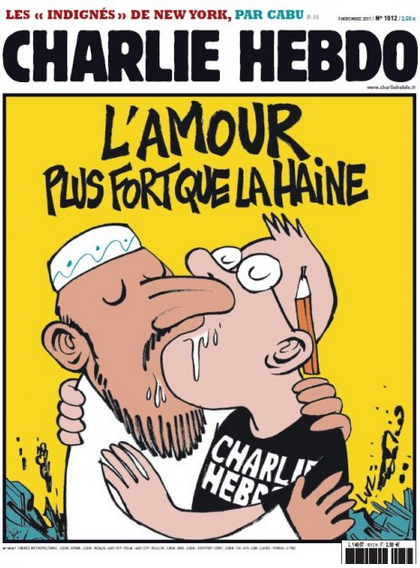
In both the case of Charlie Hebdo (which regularly ran cartoons skewering Muslim fundamentalists, including irreverent depictions of Mohammed) and The Interview, one could argue that the humor on display is tasteless, even offensive. It is especially offensive expression that needs protection, however: articles or cartoons that offend no one hardly need protection, do they? In any case, the magazine’s staff were fully aware of the risks they were taking (having been the targets of threats and arson previously) and felt the threat itself was reason enough to keep pushing: as editor Stéphane Charbonnier (who published as “Charb” and was among the dead) told Le Monde after another threat in 2012, “When activists need a pretext to justify their violence, they always find it.”

It is tragic that such words now form Charbonnier’s epitaph, but if they are remembered and taken seriously, we can learn from them. Those who attacked Charlie Hebdo believe they are sending a message, but the clear meaning is the opposite of what they intend: the answer to offensive speech is more and better speech, and participation in civil society, not bullets and intimidation. Perhaps that sounds naïve, and is easy to say from my relative safety in the U. S., but it is a principle worth standing by. As one of Charlie Hebdo’s own headlines read, “Love is stronger than fear.” In the wake of these attacks, Nous sommes Charlie.

Charlie_Hebdo_love_hate.0

My 2014 in Film

matinee

Another year is coming to an end, and with it another slate of new film releases. As I did last year, I came up with my own (necessarily incomplete) list: not necessarily the “best” of the year, but my favorite movies and other pop culture among those I was able to catch in the last twelve months. And unlike last year, I’m including a list of some non-2014 movies I caught up with for the first time.

I didn’t keep a list of movies I watched (other than the list I kept during October), but perhaps I should have, as this was a big year for me to catch up on movies. Keeping a list is not a passive act, however: with list-making comes the desire to add to the list, to see it grow. For my rather meager reading this year, that’s a good thing, but if I had kept track of movies I watched I might have tried to watch even more than I did, and felt as drained as I did after my October marathon. Still, lists are great for looking back at what you did, watched, or read over the year: January seems awfully long ago when I look back at what I was doing then.

I saw sixteen 2014 releases, either in the theater or at home. There are several I still haven’t seen, such as Interstellar and The Babadook, that I expect to respond to when I catch up with them, but here are my top three favorites so far:

GRAND BUDAPEST HOTEL_c371.JPG

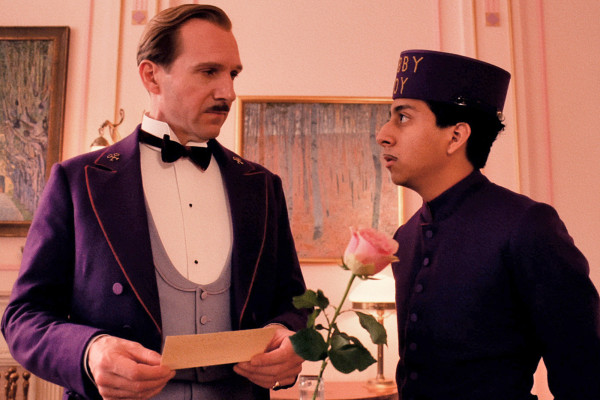
3. The Grand Budapest Hotel. I’m a sucker for writer/director Wes Anderson’s carefully-curated style, and I was particularly receptive to this multi-layered story, set in the fictional Alpine nation of Zubrowka. I had a Czech composition professor who always bristled at the term “Eastern Europe,” and liked to point out that Prague is actually to the West of Vienna; it was hard not to think of him, and of a summer trip to Prague, when watching this. Inspired by the writings of Stefan Zweig, Anderson gets the sense of being at the crossroads of East and West, of being somewhere off the map, and of “small” countries’ determination to hold onto their idiosyncrasies in the face of empire, be it political or cultural. In addition, the majority of the film is set in the early 1930s, the anxious period of fascist uprisings that would inevitably lead to war and sweep away the old world that the titular hotel and its dapper concierge (Ralph Fiennes) represent. The juxtaposition of a farcical caper with looming historical tragedy gives the standard Andersonian business a more directly political edge than usual, and is a good fit with the sadness that is often just under the surface of Anderson’s whimsy.

Whiplash-5547.cr2

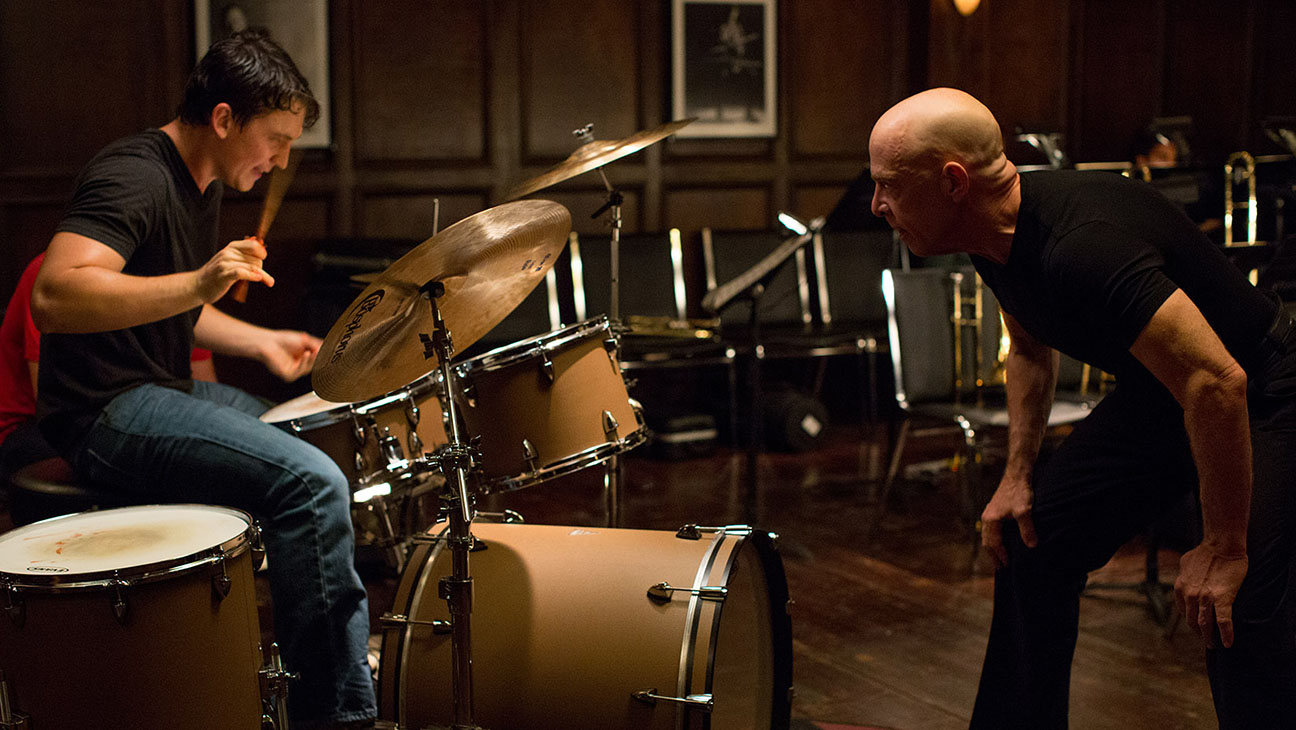
2. Whiplash. Between this film, written and directed by Damien Chazelle, and Grand Piano, which Chazelle wrote, I think I have a favorite new filmmaker. Whiplash’s story of an ambitious student drummer (Miles Teller) and the punishing, even sadistic treatment he receives at the hands of his jazz band director (J. K. Simmons) examines the personal price of artistic ambition in a way that is more brutally honest (emphasis on “brutally”) than most films about budding artists and their mentors usually are. In fact, while the plot has the twists and turns of a taut thriller, the tantrums, self-laceration, and even the explosions of violence in the film don’t seem that exaggerated, bringing to mind both certain high-strung individuals I’ve known as a musician, and the hazing scandals that have afflicted some high-profile college bands in recent years. It also manages to leave the ultimate question—is it all worth it?—up to the audience to decide. The film makes a fitting and devastating postscript to the series of films about bands and inspirational music teachers I wrote about this fall; Mister Holland’s Opus, it ain’t.

The_LEGO_Movie_10

1. The Lego Movie. Sure, it’s a film for kids—a feature-length toy commercial, even. But even after repeated viewing, it’s a stunning technical and aesthetic achievement that has something meaningful to say about the creative process and relationships. Honestly, I could just look at the billowing ocean of Lego bricks for hours; the fact that the characters are so vibrant is a bonus, and a testament to the writing and direction of Phil Lord and Chris Miller. The notion that each of the main Master Builder characters represent a creative type (or a single facet of a creative mind) is an easy leap to make (it could be a Buzzfeed quiz: “Which Lego Master Builder are you?”), but I’ll be darned if I don’t relate to Uni-Kitty’s desperate attempts to stay positive in the face of disaster, or Wyldstyle’s—that is, Lucy’s—repeated reinventions and desire to be “edgy.” The beautiful thing about the story is how it brings together and values the contributions of all kinds of personalities, even while recognizing that everyone has flaws. It’s a great example of something I’ve long felt: that broadly-drawn characters, even cartoons, can still have feelings, and it makes The Lego Movie one of the most humane films of the year.

Honorable Mention: I was charmed by the Swedish import We Are the Best!, as low-key in its depiction of three middle school girls who form a punk band as Whiplash was intense. Directed by Lukas Moodysson, We Are the Best! is mostly slice-of-life, drawing much of its comedy from the contrast between the girls’ bravado and their meager talent, but it never makes them the butt of the joke. Rather, it’s the clueless adults who don’t know what to make of the trio, whether it’s one girl’s dad trying to join their “jam session” on the clarinet, or the manager of the activity center where they rehearse underestimating the lead guitarist (the only one of the three who can actually play).

This was also a good year for blockbuster entertainments: although I chose not to rank more than four movies, I enjoyed Captain America: The Winter Soldier and Guardians of the Galaxy, as well as Gareth Edwards’ revival of Godzilla. I was late seeing Godzilla, so I had already heard that the big lizard doesn’t get a lot of screen time, but it was almost comical how Edwards contrived to keep him off screen, hidden behind smoke, buildings, or even closing doors. I can’t help but feel that some of the complaints were driven by viewers who hadn’t seen the original Toho films, which also often kept the monsters off screen for the majority of their running times. If anything, my biggest complaint was an over-reliance on coincidence to keep star Aaron Taylor-Johnson at the center of the action, but, you know, movies.

Other highlights

HauntedPalace

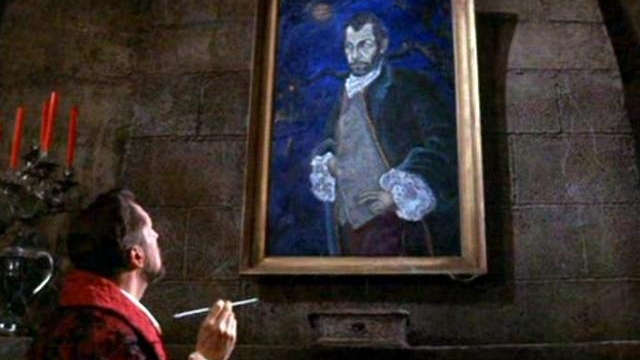
Some of the best movies I saw this year were older ones; first-time non-2014 movies that I loved include (in no particular order) Nothing Lasts Forever, TerrorVision, A Town Called Panic, The Whisperer in Darkness, The Haunted Palace, Matinee, Gang Busters, The Visitor, Eraserhead, Strike Up the Band, Drumline, Scott Pilgrim vs. the World, and Thoroughly Modern Millie.

I’m also glad I had the opportunity to see The Texas Chain Saw Massacre in a beautiful 4k restoration last October; as someone who didn’t enjoy horror films as a kid, I never thought I would go out of my way to see this film, but I knew I would regret it if I passed up the opportunity. I took the precaution of inviting a horror-savvy friend to go with me so I wouldn’t chicken out, but it turned out he hadn’t seen it either! As so often happens, it wasn’t nearly as scary as I had built up in my mind. Suspenseful? Yes. Graphic? Very. Horrifying? Sure. But after decades of imitators, I realized that in a way I had already seen it, by way of the influence that trickled down through the numerous slasher movies that followed. The next day, I heard chainsaws running all day, as my neighbors were cutting down a tree; it didn’t freak me out, but it tickled me to imagine that they were extending my TCSM experience beyond the theater, like Disney Imagineers.

Lowlights

MrPeabody

The worst 2014 release I saw this year was Mr. Peabody & Sherman, which was both mean-spirited and tried way too hard to be edgy; it felt very much like a throwback to Dreamworks’ snarky, post-Shrek output, and I am mystified by the middling-to-positive reviews it received. Even my kids didn’t seem to enjoy it that much, and quickly forgot about it.

First-time non-2014 films that didn’t do much for me included Radar Men From the Moon, the 1961 Babes in Toyland (which had Ray Bolger and not much else), the 1960 13 Ghosts (with Margaret Hamilton—maybe a retrospective of Wizard of Oz cast members’ careers is in order), and Demons, which started out really promising but lost me about halfway through. The most ridiculous movies I saw this year include the 1952 Bloodhounds of Broadway, Shanghai Surprise, and Elvira: Mistress of the Dark, although I’m probably forgetting some.

Thanks for reading and watching along with me this year. I hope you’ll return in 2015!

My 2014 in Books

As I’ve mentioned before, I’m not usually one to keep a list of everything I read or watch, but in 2014 I kept a list of books I had read, in part because I was conscious that I wasn’t reading as much as I used to. Although the number this year is relatively small, I’d say the mixture of non-fiction and genre fiction is fairly typical of my reading in the last few years. The list includes some graphic novels and collections of comics, but not single comic book issues (which I’ve also fallen way behind on). It’s also influenced by subjects I was writing about; however, it only includes books I read from cover to cover, not those I dipped into for reference. Finally, all but one was a first-time read, although I had read parts of some of them in the past.
wpid-20140720_141419.jpg

January
Batman: Odyssey, Neal Adams
King City, Brandon Graham

February
The Look of the Old West, William Foster-Harris

March
Inventing Kindergarten, Norman Brosterman
Great American Folklore, Kemp P. Battle

April
The Old Patagonian Express, Paul Theroux
The Great Movie Serials: Their Sound and Fury, Jim Harmon and Donald F. Glut

May
Cliffhanger: A Pictorial History of the Motion Picture Serial, Alan G. Barbour
Misery, Stephen King

June
The Lost Worlds of Power Vol. 0, ed. Philip J. Reed

July
Showcase Presents The Great Disaster Featuring the Atomic Knights, various

August
The American Book of the Dead, Stephen Billias (reread)

September
The Bloodhounds of Broadway, Damon Runyon
The Extraordinary Adventures of Adèle Blanc-Sec, Jacques Tardi

October
Showcase Presents Captain Carrot and His Amazing Zoo Crew, various
All The Wrong Questions: “Who Could That Be at This Hour?”, Lemony Snicket
The Maltese Falcon, Dashiell Hammett

December
The Lost Worlds of Power, ed. Philip J. Reed
All the Wrong Questions: “When Did You See Her Last?”, Lemony Snicket
Crab Monsters, Teenage Cavemen, and Candy Stripe Nurses: Roger Corman: King of the B Movie, Chris Nashawaty

Much of my thinking on what I read this year has already been included in the articles to which they are linked, and since most of what I read was published before 2014 and is in a diverse range of genres, ranking them seems pointless. I am struck, however, by how long ago some of the books I read in the spring seem to me; I might not have remembered that I read them this year at all without this list, instead consigning them to a hazy, indistinct “past,” even though I enjoyed many of them. To tell the truth, even September seems a long time ago from this vantage point. Such is the telescoping effect of the end-of-year holidays, I guess.

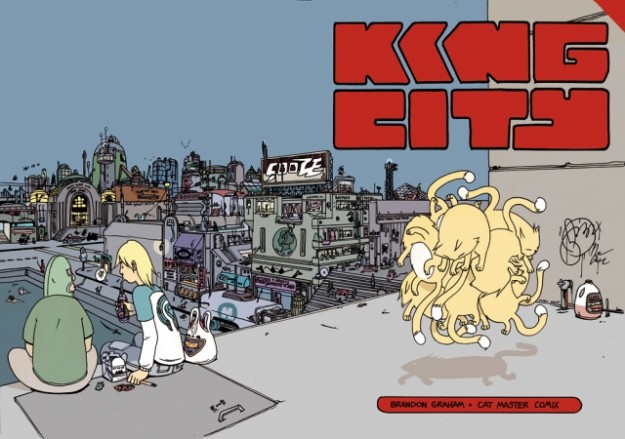
It strikes me, however, that I began and ended my year with two very different books that explored the rush of unbridled creativity in different formats. (Sorry, Batman: Odyssey, I don’t mean you, although you were memorable in many ways.) Brandon Graham’s King City is a graphic novel set in the futuristic metropolis of the title; its central character is a young man returning to his old stomping grounds after training with a mysterious group that uses multi-talented cats as weapons (yes, it is quite strange, but that description doesn’t even scratch the surface). In Graham’s notes (which I am paraphrasing, as I borrowed the book from the library and don’t have it in front of me), he said that King City‘s plot was guided by his desire to only draw things that were exciting to him: to not bore himself. Such an impulse could have led to disaster, but tied to a strong sense of craft, it makes for an immersive, invigorating read, with its weaponized cats, ultra-violent gangs, sexy girls, and graffiti-filled urban vistas that are part Moebius and part Mad magazine.

kingcity

At the other end (and just finished today, in fact) was Chris Nashawaty’s pictorial/oral history of influential director/producer Roger Corman’s career, from his days cranking out cheapies for the drive-in market to his nurturing of young (and affordable) talent, to his eventual recognition as a Hollywood elder statesman. The book includes reminiscences from such graduates of “Corman University” as Martin Scorsese, Joe Dante, and James Cameron, to name only a few. I was somewhat familiar with Corman’s career and working methods, and of course many of his films; Corman, and “mavericks” like him, continue to inspire because of their perseverance and determination to create in the face of low budgets, limited time, and (in many cases) lack of prestige. Corman and his crew made a virtue of such limitations, but the many anecdotes about making films show the value of committing to do one’s best work, whether on a pointed political statement like The Intruder or on the many monster, biker, and women-in-prison movies that Corman made on an assembly-line basis.

Tomorrow, I look back on the movies I watched this year.

My 2014 in Television

LetsWatchTV

I didn’t watch a lot of television this year. Oh, I logged plenty of screen time, but I was mostly watching movies rather than TV series. Other than Community’s fifth season (which I wrote about last spring), most of what I did watch was animated, since I watch with my kids, and since I’m not exactly allergic to cartoons myself.

The new series I found most exhilarating this year was Adult Swim’s Rick and Morty, the animated brainchild of Justin Roiland and Community creator Dan Harmon. (It technically began in December of 2013, but the majority of it came out this year.) Rick and Morty starts with a hoary premise—mad scientist Rick Sanchez takes his fourteen-year-old grandson Morty (both voiced by Roiland) on a series of wild adventures, getting them both into and out of jams with his inventions—and then turns it inside out. Rick isn’t just eccentric, he’s seriously damaged, and the show, while comedic, doesn’t shy away from the dangers he exposes Morty and his family to, and doesn’t simply set the reset button at the end of each episode. In just its first short season (eleven episodes), one of Rick’s schemes permanently transforms the world into a monster-filled wasteland, and the only solution is for Rick and Morty to relocate to a parallel universe in which their counterparts have conveniently died, taking their places. (No, this isn’t one I watch with my kids.)

RickandMorty

That points to another of the show’s strengths: like Futurama before it, Rick and Morty assumes that viewers have seen Back to the Future, Doctor Who, Star Trek, The Twilight Zone, Zardoz, The Fly, and the many other shows that are winkingly alluded to, and there’s a minimum of hand-holding. It’s the twenty-first century, and the audience doesn’t need to have genetic modification, virtual reality, or (for that matter) the dangers of unintended consequences explained in long-winded detail. That leaves more time to develop characters (mainly the rest of Morty’s family: sad-sack dad Jerry and frustrated mom Beth, and overlooked big sister Summer) and fill the run-time with off-the-wall humor.

I can’t think of anything I laughed at harder this year than the episode “Rixty Minutes,” in which Rick’s modification of the TV cable box allows the family to view programming from infinite parallel universes (including glimpses of the lives Jerry and Beth could have had if they hadn’t stayed together). The combination of rapid-fire absurdity and referential gags most closely resembles Community’s Season Two episode “Paradigms of Human Memory,” and like that episode, “Rixty Minutes” puts the insanity of its plot in the service of its characters, up to a surprisingly poignant climax.

overthegardenwall

On the non-series front, 2014 was a year in which special events, already making a comeback in recent years, continued to gain ground as networks look for (non-sports-related) ways to keep viewers tuned in at the time of broadcast instead of time-shifting. Even the mini-series, that prestige format of the 1980s, is coming back into vogue (ABC’s upcoming Galavant is definitely on my radar for 2015). I’ve already written at length about Over the Garden Wall, Cartoon Network’s five-night mini-series that aired in November; suffice it to say that upon rewatching it, I still found it greatly enjoyable, and were I to rank it with my favorite films of the year, it would at least be in the top five.

SpecialSpecial

There were some other specials that grabbed my attention this year, as well: I’d like to highlight Lil Bub’s Special Special, which aired on Animal Planet way back in February. At a slight half hour, this celebration of the eponymous cat was as instantly disposable as the cute animal videos and memes of which the special is an extension, but the whole thing (held together by human costars Amy Sedaris and Andrew W. K.) had such a light touch (and just enough self-awareness) that I was charmed by it. It hasn’t been rerun to my knowledge, but it has a permanent home on my DVR (and you can watch it here).

drwhochristmas_bbc

Finally, there were the usual crop of Christmas specials. I could quibble with Doctor Who’s “Last Christmas,” leaning as it does on the revived Who staple of monsters that you can’t look away from, or that you can’t remember, or that (in this case) you can’t even think about without them coming for you. And I’m not as taken by the chemistry of leads Peter Capaldi and Jenna Coleman as some are. However, my personal bar for the annual Doctor Who Christmas special is set pretty low, and as long as it doesn’t involve David Tennant being carried aloft by robotic angels, I’m willing to cut it some slack.

To be fair, “Last Christmas” was actually pretty good, in both spinning out an intriguing menace and lampshading its similarities to both Alien and The Thing, as well as casting Nick Frost as a snarky but ultimately benevolent Santa Claus and making it work. The special is part of a long tradition of Christmas films and stories examining the nature of faith and belief, with Santa as a safely secular football. If Santa Claus weren’t so widely regarded as a fiction for children, would Christmas stories still demand that we believe in him unconditionally? Entertainment that aspires to mainstream appeal can no longer preach with such certainty about Jesus or any other religious figure, but such arguments can be broached in the language of fantasy. Like most such stories, “Last Christmas” ends ambiguously (in more ways than one: a comment I read online accurately described it as “Doctor Who does Inception”), but it is clear on the power of faith, with Santa described as a “dream sent to save us,” a nice summary of the value of both fiction and religious parable.

ElfSpecial

2003’s Elf is similarly engaged with convincing the unbelieving, with Santa (Ed Asner) stating explicitly that belief, not confirmation, is the source of his power: “If I were seen, all would be lost!” As Jesus told his apostle “Doubting” Thomas, “Blessed are they who have not seen, and yet have believed.” This year’s Elf: Buddy’s Musical Christmas, based on the film and the Broadway musical that sprang from it, isn’t quite so explicit, but finds a middle ground between the movie and the Rankin/Bass productions that inspired its story of a human orphan raised by elves at the North Pole. I mentioned this special on Christmas Eve, pointing out that it wasn’t as good as the original movie, but I would be remiss if I didn’t at least mention the stylish, handmade production—the stop-motion figures resemble Rocky & Bullwinkle‘s characters brought to 3-D life—and charming score (by Matthew Sklar and Chad Beguelin). Mostly, I enjoyed it when it wasn’t directly imitating the movie, as the comparison is unflattering to the special; like many shows with familiar subject matter, it was more approachable when doing its own thing.

Tomorrow, look for my thoughts on the books I read in 2014.

A Merry Christmas to All

. . . or, A Visit From Saint Nicholas

AmbushBug.Santa

Well, I didn’t mean to take three weeks off from posting; I hope you’ve all been able to get along without me. In my absence from Medleyana, I’ve been writing and revising some fiction, as well as participating in the family and church activities that come with the season. As soon as anything comes of those projects, readers here will be the first to know it. I will also have a post on my favorite films and other pop culture of the year soon, but I’m still trying to squeeze a few things in before I make a definitive list. And to make up for my absence, I’ve arranged to have Santa Claus himself, Saint Nicholas, drop by to greet all my loyal readers!

In the mean time, I wish you all a happy, peaceful, and safe Christmas, and a prosperous New Year. And for my readers who don’t celebrate Christmas, I wish you a joyous holiday season! I hope you get what you’re wishing for, be it a set of chimes or a collection of holiday-themed novelty songs.

Atari.Xmas

When I was a kid, this was the time of year for television holiday specials: classics like A Charlie Brown Christmas and How the Grinch Stole Christmas!, of course, but also specials tied into newspaper comic strips like Garfield, Ziggy, For Better or for Worse, and . . . Doonesbury? Thanks to nostalgic Gen-Xers on the Internet and the magic of YouTube, those not-so-classic specials have gotten some renewed attention in recent years, but there are still gaps: for example, I’m still sure that I saw a Doonesbury Christmas special in the early 1980s that wasn’t the award-winning A Doonesbury Special from 1977, but I can find nothing about it. Can anyone help me out?

I like the fact that prime-time animated Christmas specials have made a comeback in recent years, even if I’m not always that excited about them (sorry, Prep & Landing: your shtick is just too similar to The Santa Clause). This year’s Elf: Buddy’s Musical Christmas, while cute, didn’t really hit the heights of the 2003 feature film on which it is based, and even the beloved Toy Story franchise only left me lukewarm with its latest installment, Toy Story That Time Forgot. Well, they can’t all be classics.

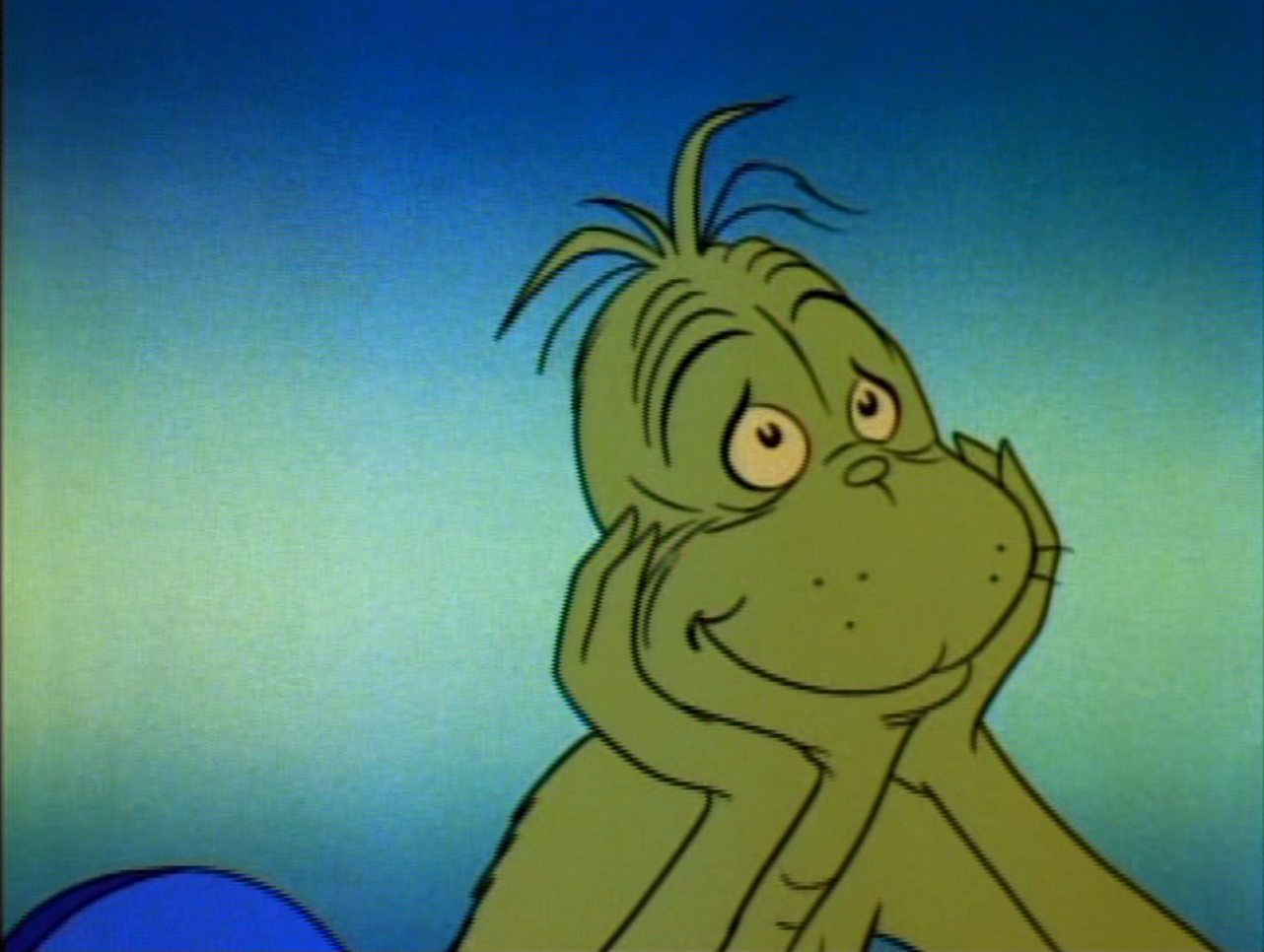
Speaking of a classic, let’s check in on the titular star of How the Grinch Stole Christmas! and see how he’s dealing with the pressures of fame:

Grinch3

Hmm. Oh. I see. It just goes to show: the holidays are rough on a lot of people. Let’s give the Grinch some space; we’ll check back on him later. But wait! Is that the merry sound of jingle bells I hear? Is Santa here?

Elf.v.Santa1

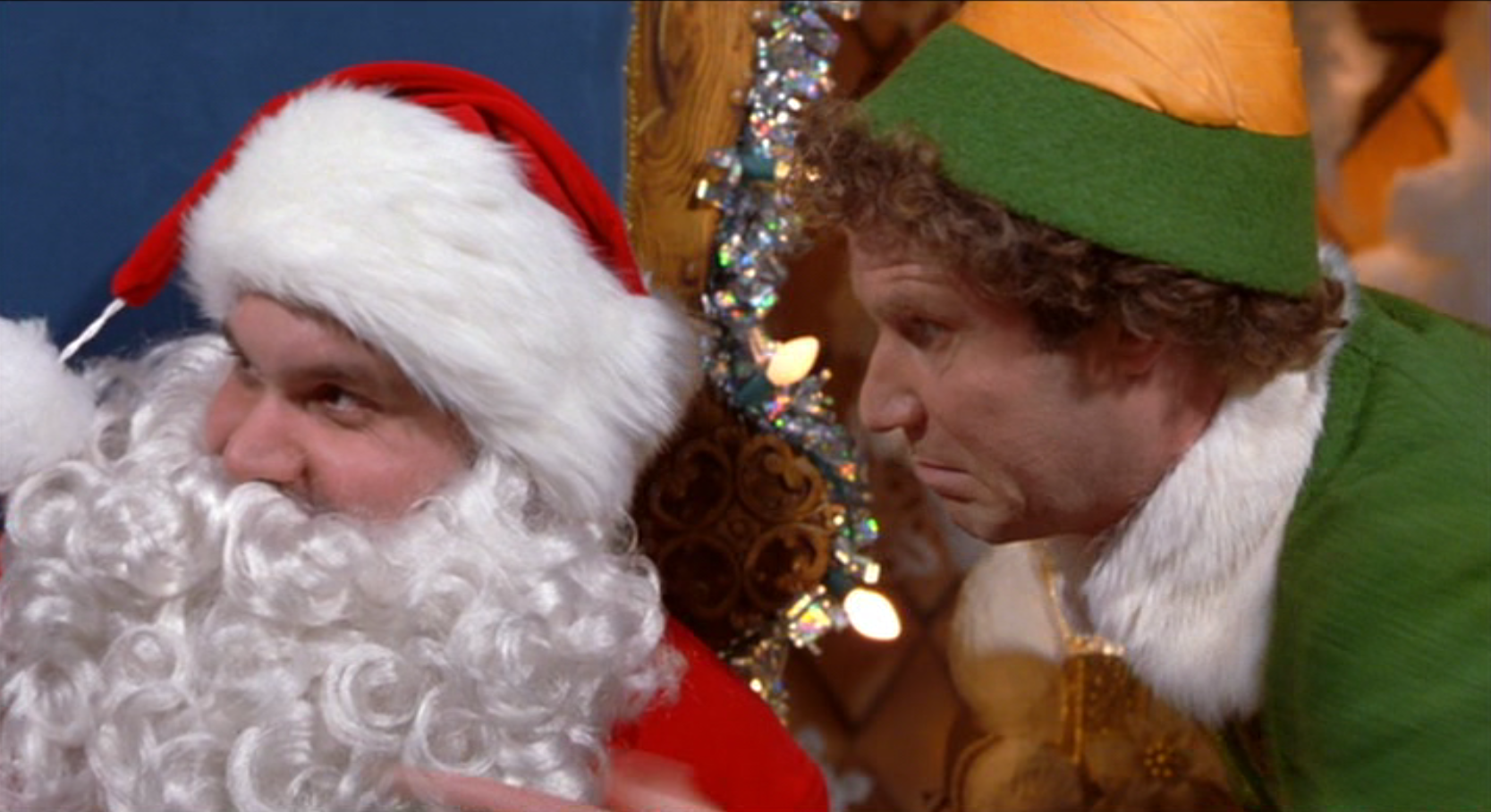
Oh. . . . No, it’s just the False Santa from Elf, stirring up trouble. (NB: So there are two movies that combine Will Ferrell and Lego cities; I don’t know what that means, but I think Internet Law requires there to be a mash-up now, right?)

Elf.v.Santa2

While we wait, how about some visuals to get into the Christmas spirit? What could be more festive than the 1954 film White Christmas?

Choreography4

So, this is . . . a pageant? A Living Nativity? I don’t see any snow.

Moving on, maybe Santa is here?

JackSkellington

Oh, not quite. But what about those classic Rankin/Bass specials like Rudolph the Red-Nosed Reindeer? Surely, there must be plenty of iconic Christmas characters we can while away a cold Christmas Eve with? Like these guys:

NewYear1

And let’s not forget:

XmasinJuly2

And then there’s The Leprechaun’s Christmas Gold; nothing says “Christmas” like leprechauns:

Leprechauns

And what are the leprechauns staring at, Spielberg-style? Is it Santa?

Leprechauns.StPat

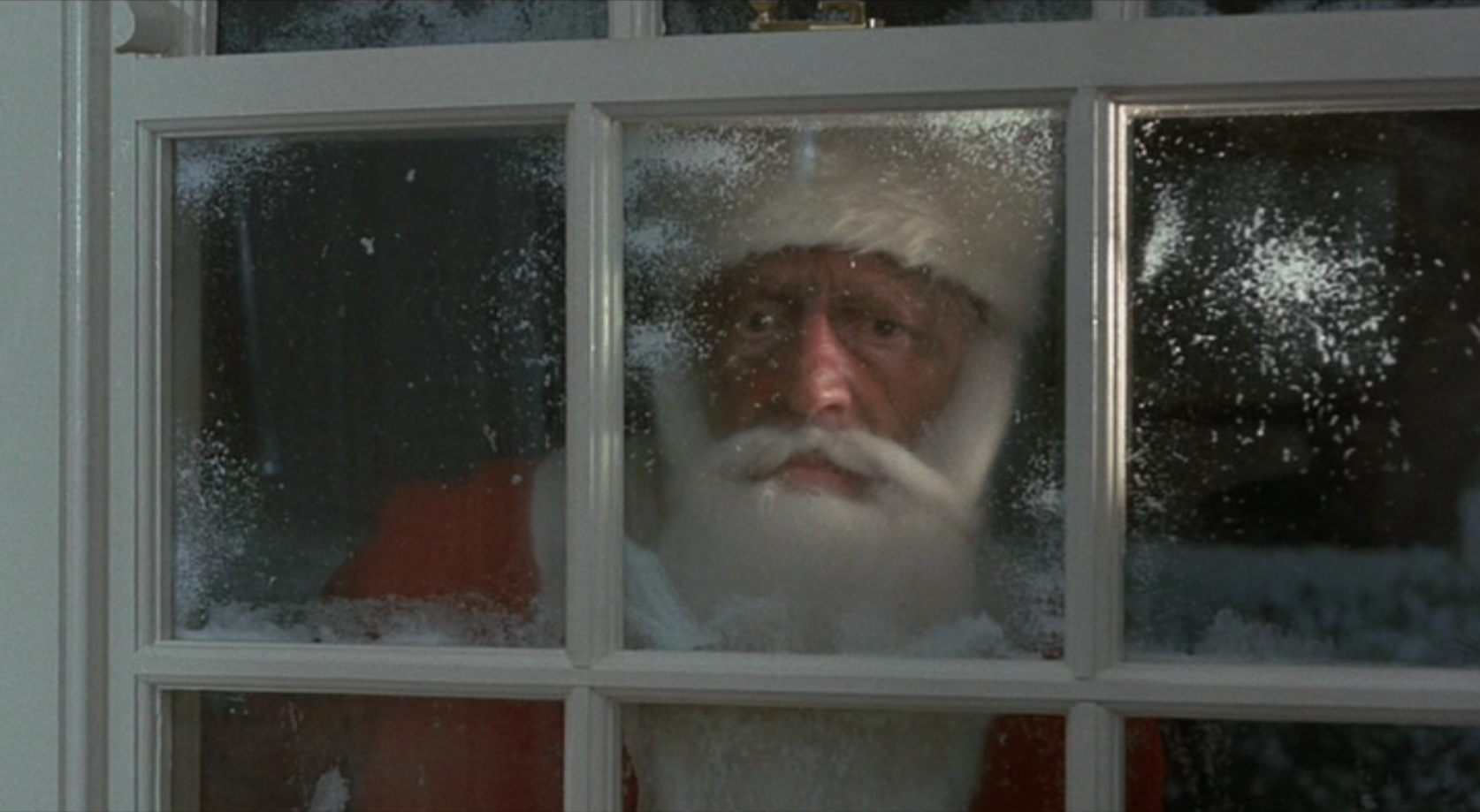
Nice try. But wait! I think I hear him: it’s Santa, tapping at our windowpane! How festive!

TalesSanta1

Let’s let him in! What’s that, Santa? Okay, we can hug. I mean, sure, why not?

TalesSanta2

Wait! Aagh! No! Is there no end to these False Santas?

TalesSanta3

Well, to be fair, the real Santa Claus is very busy this time of year; but I bet you’ll never complain about your office Secret Santa again! Anyway, it’s not too soon to start dreaming about next Christmas! Season’s Greetings!

Grinch2

Adages, Aphorisms, and Analects

“One machine may do the work of fifty ordinary men. No machine can do the work of one extraordinary man.” –Elbert Hubbard

According to conventional wisdom, newspapers are in a fix because instead of reading them, everyone is getting their news from the Internet. One attempt to make the newspaper experience more interactive is the “Opinion Line,” a section of the editorial page made up of short, anonymous comments provided by readers who send them in or (ironically enough) leave their comments on the newspaper’s website. No longer is the writer required to lick a stamp or even sign their name to have their view printed, and the Opinion Line often becomes a partisan tug-of-war, full of snide put-downs of the Other Side.

There are many to reasons to be dismayed by the comments of the Opinion Line, but one that never fails to vex me is reading a joke or aphorism that has already gone around Facebook or Twitter days or weeks before, and is more than likely already played out, gone from original to viral to cliché, with the Opinion Line—a paper Twitter feed for the elderly and out of touch—as the final, senescent stage of its life cycle.

last_great_act_of_defiance

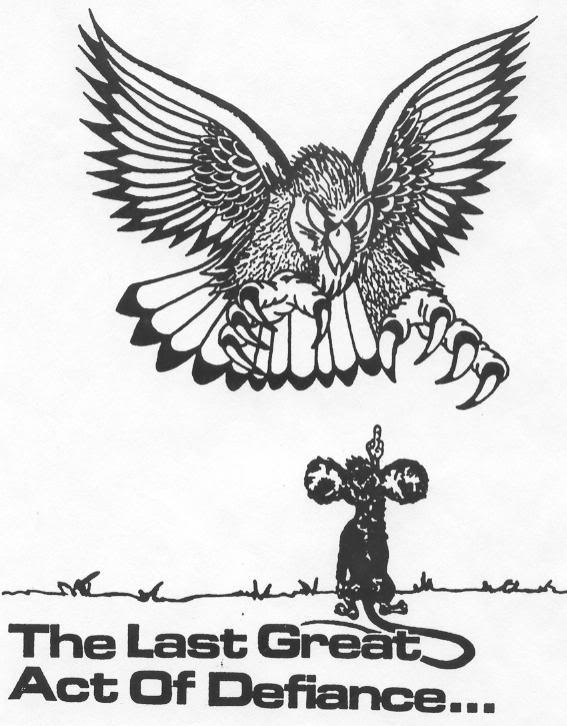
Memes have always been around, even in the pre-Internet days when pictures, signs, and jokes would circulate like chain letters in offices and schools. Classics like the mouse flipping off a hawk, its outlines fuzzy through multiple generations of photocopying, or signage reading, “I can only make one person happy per day; today isn’t your day, and tomorrow isn’t looking so good either,” were ubiquitous, a lingua franca of the workplace, a passive-aggressive way of saying, “You don’t have to be crazy to work here . . . but it helps!” Although the passing around of in-jokes has largely migrated to the electronic ether, first through the e-mail forwards that you likely still receive from a few older friends or relatives, and then to Facebook and Twitter, such slogans can still be seen on coffee mugs and other gift items in actual physical space. Memes will find a way.

insanity.mugs

I was reminded of those old photocopied proto-memes when I uncovered a copy of Baxter Lane’s Scrapbook of Famous Quips & Quotes that I had purchased as a kid. The contents of this 64-page booklet are exactly what the title promises: a collection of pithy sayings, some attributed and some anonymous, on such universal subjects as work, marriage, and politics (the latter without much of a partisan edge beyond “How about those clowns in Congress?”). Although Famous Quips & Quotes is slim, it was of a piece with the dictionaries, trivia collections, and other miscellanies I could spend hours flipping through as a young reader. Along with such classics of browsing as The Guinness Book of World Records and Tom Burnam’s immortal Dictionary of Misinformation, collections of aphorisms were a favorite pastime. You just never knew what tidbit you might find, and many of the sayings and factoids I read back then have stuck with me.

BaxterLane1

Such collections are still published, of course, including standbys like Bartlett’s Familiar Quotations. In fact, the Baxter Lane Company is still in business, at least according to the online Yellow Pages: they don’t appear to have a web site of their own. Good for them. Located in Amarillo, Texas, Baxter Lane is listed as a “souvenir” or “gift shop” business: I’m sure I picked up my copy of Famous Quips & Quotes at a Stuckey’s or Nickerson Farms, and I could probably still find a Baxter Lane edition at my local Cracker Barrel. The back cover of the booklet even has “FROM” and “TO” address spaces and a square for third class postage, so you can send it in the mail as a postcard. “IT ISN’T NECESSARY BUT YOU CAN SEAL HERE WITH SCOTCH OR GUMMED TAPE IF YOU WANT TO,” reads a helpful caption along the edge.

BaxterLane2

“You can make the people follow the Way, but you can’t make them understand it.” –Confucius

In looking for online traces of Baxter Lane, I uncovered evidence of other booklets they have published over the years: many are cookbooks, but collections of aphorisms and folk wisdom are prominent (including a second volume of Famous Quips & Quotes). One of them, Honorable Confucius Says by Herb Walker, was published in 1977; also 64 pages in length, it is said to contain “authentic Confucianisms as well as words of wisdom from other sources,” so it is, in other words, probably not too different in character from Famous Quips & Quotes.

Needless to say, almost any clever-sounding or cryptic aphorism you could think of has been or could be attributed to the Chinese sage K’ung Fu-Tzu; some of them, such as the famous curse “May you live in interesting times,” are as recent as the twentieth century. That’s not even mentioning the many uses of Confucius to set up a pun or dirty joke (there’s a lot more where this one came from), a tradition predating the Internet:

Confuciussay

Jokes aside, Confucius and his sayings are the subject of The Analects, a volume I discovered a little later in life but recognized immediately as a more sophisticated example of the browsable collections I had grown up with, comparable in its significance to the Biblical Book of Proverbs, a similarly deep collection of teachings and sayings. In the words of scholar and translator Lin Yutang,

The Analects is generally regarded as the Confucian Bible, being a miscellaneous, unclassified and unedited collection of the remarks of Confucius on various occasions, mostly without any suggestion as to the circumstances in which the remarks were made, and certainly torn from their context. (Yutang, The Wisdom of Confucius)

Given my tastes, how could I resist such a collection? The lack of context was both a pro and a con: the book is easy to dip into, but there are many head-scratchers. For every clear and simple lesson, there is another tangled in history or symbolic meaning. On the subject of context, Yutang continues:

It is illuminating, for instance, to read in the Analects the remark by Confucius that “I have never seen people attracted by virtuous scholars as they are by beautiful women,” and then to learn from Szema Ch’ien that he made this remark after he had paraded the streets of Wei in a carriage with a beautiful queen, and found the people looked at the queen but did not look at him. The text of the Analects itself does not mention the circumstance, and actually puts it in the form of a more abstract remark: “I haven’t yet seen people who love virtue as they love beauty.”

That is a favorite example of mine, not because it deflates Confucius, but because it humanizes him; it teaches us something about vanity, although perhaps not the lesson Confucius thought he was imparting.

A little healthy skepticism isn’t a bad thing when reading such sayings. The best aphorisms provoke thought; memes substitute for it and are deployed to shut down arguments. One of the worst offenders in this regard is the “Condescending Willy Wonka” meme, its popularity based on Wonka’s well-known views in favor of Second Amendment rights:

WillyWonka1

Or wait, was Wonka in favor of gun control?

WillyWonka2

Like Confucius, Willy Wonka is now merely a vessel, a mouthpiece for whatever views we choose to attribute to him. The only difference is the speed at which memes can be generated.