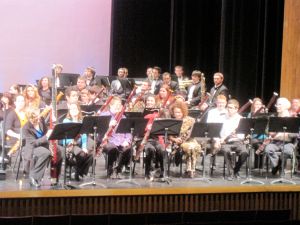
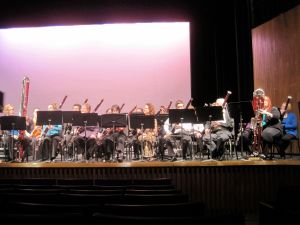
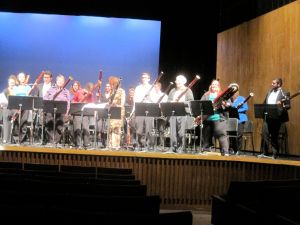

As part of Monday night’s Friends University Band concert, nineteen bassoons (including two contrabassoons) were played together on the stage of Sebits Auditorium. Stix, the performing arm of the Wichita Bassoon Society, was joined by guest artist Nancy Goeres. They performed Daniel Baldwin’s charming Echo of the Spheres (scored for four bassoon quartets) under the direction of Dr. John Taylor. What kind of encore could follow such a piece? Leroy Anderson’s Bugler’s Holiday, of course!
Author: Guy Vollen
Lego House on the Prairie
I saw The Lego Movie this weekend, and I loved it. This isn’t a review, and I won’t spoil anything, although I will direct you to Charlie Jane Anders’ review at io9 and its (accurate, in my view) contention that a successful genre spoof must authentically partake of the genre it sends up (in this case, the summer blockbuster and the hackneyed “chosen one” motif).

Like all the recent movies based on beloved toys, The Lego Movie is at least partly pitched toward the nostalgia center of viewers’ brains. Sure, I played with Lego bricks as a child, and still enjoy them now that I have my own children to provide cover. If that were all there were to it, however, I doubt I would have reacted so strongly to the film; the other Lego spin-off video games and cartoons I’ve seen are entertaining, but not profound. No, what I feel compelled to explore is how successful the film is at building an elaborate world out of familiar components, and its connection to the student films and music videos that did the same thing with toys when I was a kid.
The idea of toys (or other inanimate objects) coming to life is hardly new, of course: before the Toy Story movies there was Corduroy and The Velveteen Rabbit and Raggedy Ann, back to the fantasies of E. T. A. Hoffmann and beyond. In all likelihood we could trace it all the way back to the idea of “household gods” and the pervasive spirits of pantheistic animism, or perhaps the unity of self and environment in earliest infancy. In any case, that’s not really my point; what connects my memory of playing with Lego bricks to the new movie (and makes it successful at driving its themes home) is the constructive nature of Lego: all imaginative play gives back only what you put into it, but Lego is explicitly open-ended. Since the first bricks were produced in 1949, every piece is part of a compatible system and can be connected together in some way. That’s the first prong of the movie: the pleasure of digging up and recombining the different “worlds” Lego has produced over the years (including some “deep cuts” like Fabuland).
The second prong of the movie’s appeal is how this world is set in motion cinematically. As a kid, I was obsessed with stop motion animation: my first exposure was probably on shows like Sesame Street, which, among its many other virtues, was often a showcase for inventive (and sometimes downright experimental) film. The Carmen-singing orange was one I remember (although I had forgotten the rubbery ‘70s-era synth soundtrack, another element that connects it to many childhood memories):
Obviously, there’s a lot more where that came from.
What remains captivating about many of these little films is their handmade quality, and their use of everyday objects: toys, food, utensils. As with furnishing dollhouses, creating dioramas, or assembling Rube Goldberg-like marble slides (think of the game Mousetrap!), there is an obvious pleasure in the handicraft involved in the creation of a tiny world, playing God on a child’s scale. When given the illusion of movement, it made it easy to imagine the ordinary objects I saw all the time having a secret life when I wasn’t around, both tapping into and feeding that sense of domestic enchantment alluded to above.
It also made it look easy to get into the game: I recently discovered this short Super 8 film, made in 1980, and starring 12-year old Stefano Paganini’s Lego collection:
It’s rough—I know I wouldn’t have been able to do any better at that age—but it has the same sense of play that the makers of The Lego Movie explore on a grand scale.
It’s the limitations of Lego—where they can fit together, the articulation points of the minifigures—that give it character and provide something for the filmmakers—for whom there are practically no limits anymore with the use of computers—to bump against. As Brian Eno wrote in 1995 (published in A Year with Swollen Appendices),
Whatever you find weird, ugly, uncomfortable and nasty about a new medium will surely become its signature. CD distortion, the jitteriness of digital video, the crap sound of 8-bit—all these will be cherished and emulated as soon as they can be avoided.
Eno was mostly speaking of audio formats, but his prescient words have also proven true for visual styles.
The aesthetic qualities of Lego—abstracting familiar shapes into a grid, designed as “bricks” but able to approximate all kinds of shapes—are something that every child encounters one way or another. Although Lego has introduced many angled and curved pieces to its arsenal, it’s the jagged sawtooth of the square pieces arranged in stair-step fashion that is still an essential part of Lego’s “look.”
Eno mentions 8-bit sound; I think the abstraction Lego encouraged was a reason I was similarly fascinated with the blocky graphics of the the video games that emerged in the late 1970s; just as with the stop motion videos that appeared to bring Lego bricks or candy to life, Space Invaders and Pong gave movement—controlled by the player!—to simple, even primal, geometric shapes. I was so fascinated by this level of abstraction that I would practice breaking down pictures into their component pixels using graph paper. I even briefly took up cross-stitching because it looked to me like video game graphics; the only tangible proof of that brief flirtation that I left behind was a sample sheet with a few segments of the Centipede from the game of the same name, rendered in cross-stitch.
I’m reminded of Norman Brosterman’s book Inventing Kindergarten and its thesis that the first generation of twentieth-century modernists were shaped in early childhood by the highly abstracted geometric play that was a core component of nineteenth-century kindergarten. As developed by founder Friedrich Froebel in the 1830s and ‘40s, the geometric elements of kindergarten were centered around the series of about twenty “gifts,” playthings that were meant to introduce primary forms—the sphere, the cube, the cone, for example—and encourage young children to model aspects of the real world in a progression of graduated complexity. Architect Frank Lloyd Wright would later credit Froebel’s system for developing his spatial faculties, but he was far from the only one. According to Brosterman,
During the system’s heyday—roughly the half century before World War I—Frank Lloyd Wright was merely one of millions of people, including most of the so-called “form-givers” of the modern era who were indoctrinated, in effect, programmed, by the spiritual geometry of the early kindergarten.
Brosterman’s book is full of pictures juxtaposing nineteenth-century kindergarten projects made by small children with artwork made by adults of the same generation years later. The comparisons are suggestive, to say the very least.
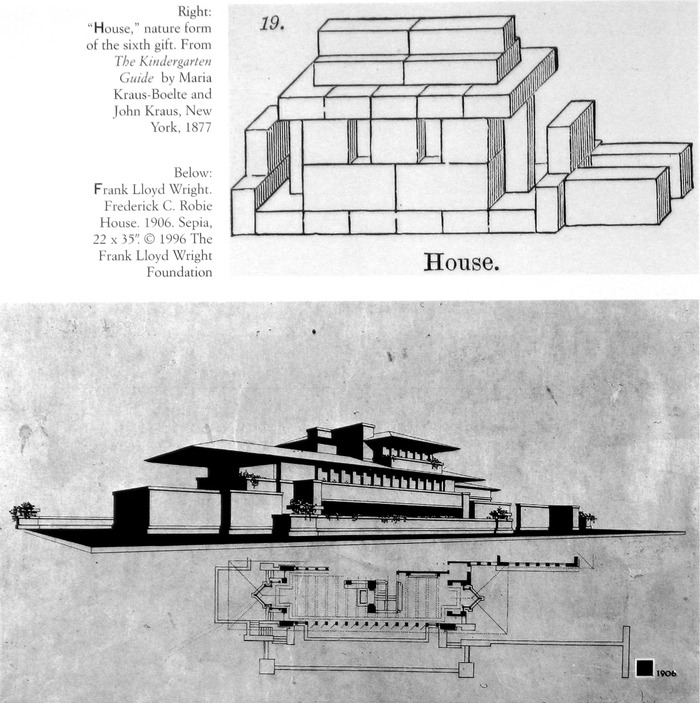
From Norman Brosterman’s Inventing Kindergarten
In addition to the Froebel gifts, there were also “occupations,” which consisted of paper, string, and clay, media that could be used to create finished projects. Brosterman quotes American kindergarten leader W. N. Hailmann as describing the distinction between gifts and occupations:
The gift gives the child a new cosmos, the occupation fixes the impressions made by the gift. The gift invites only arranging activities; the occupation invites also controlling, modifying, transforming, creating activities. The gift leads to discovery; the occupation, to invention. The gift gives insight; the occupation, power.
Without wishing to overstate the case, Lego bricks descend from the same progressive concept of early childhood development as a process of discovery and mastery, and lend themselves to a similar kind of abstraction of the real world.

Interestingly, the debt Wright and other modernists owe to Froebel’s kindergarten, as described by Brosterman, has not been lost on modern educators and toy makers (in this context “toy” may sound dismissive, but it’s relevant: Milton Bradley, for example, was an important U. S. maker of Froebel gifts). Froebel USA now makes a “Prairie House Block Set” of abstract building blocks, both a tribute to the credit Wright gave to the Froebel system and, in all likelihood, an appeal to parents who might hope for a similar start for their own children.

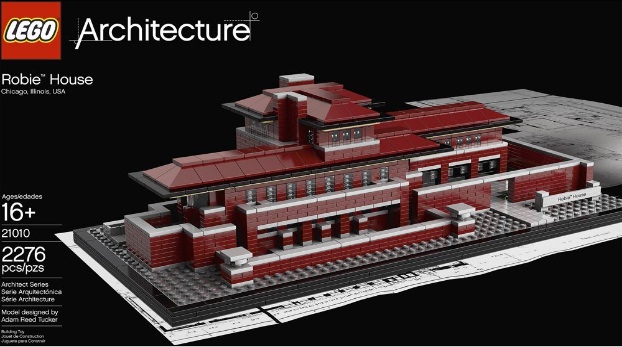
And while Lego has expanded its original system of interlocking blocks to include very young children with its Duplo blocks, it’s also moved in the other direction with its “Architecture” line aimed at teenage and adult model-builders. Detailed Lego versions of real-life architectural masterpieces, including some by Frank Lloyd Wright, are available as kits. (Here’s a more detailed description of the Prairie-style Robie House model shown below.) With the Architecture line, the emphasis is on faithful recreation, but the pieces are just as compatible with the Lego system as any other. That’s the beauty of it: whether following the instructions or building freely, it’s all up to you. That’s a core component of Lego that The Lego Movie gets.
This is the Story: The Cyclical Nature of the Expository TV Theme Song

If it seems that the art of television theme music has made a comeback lately, it’s not just you. As television has taken on more cinematic qualities and attracted viewers with higher production values and artier production (especially on premium cable and through such new outlets as Netflix’s original programming), the opening credits sequence and theme music have returned to prominence. Just a few years ago, this wasn’t the case at all: networks tried to squeeze as much commercial time out of their programming as possible, as well as trying to avoid any lull—such as a lengthy opening—that might tempt viewers to click away. Thus, we had a spate of super-brief openings like that of Lost or Better Off Ted, which were just a logo and a chord or two at most. In 2010, the Emmy Awards nearly eliminated the award for Outstanding Main Title Theme, leading to a lot of hand-wringing about the end of an era. However, as critic Robert Lloyd pointed out in the Los Angeles Times, memorable themes were continuing to be written, just not for prestigious prime-time genres: tween programming and cartoons carried the torch for the theme song even in those dark days. Ultimately the award was kept, and there has been a bounce back to more lavish opening sequences since then.
However, one subgenre of television music has mostly remained dormant (with a few exceptions): the expository “story song” that describes the premise and characters of the show in detail in the manner of a Shakespearean prologue (even if the shows themselves were hardly highbrow). Many of the most iconic TV themes from the 1960s, the “golden age” of the expository TV theme, fit this description: The Beverly Hillbillies (1962), Gilligan’s Island (1964), and The Brady Bunch (1969) all have memorable, catchy songs that bring viewers up to speed, whether watching for the first or the fiftieth time (dates given for these and all series mentioned are premiere dates only). Admit it: you’re probably hearing one of these songs in your mind right now, aren’t you?
One might expect such elaborate theme songs to be a holdover from the days of radio programming, but that appears not to be the case. In fact, a cursory survey of radio show themes turns up far more introductions consisting of an instrumental theme with a voiceover by an announcer, a format mostly found on late-night talk shows today. In fact, with a few exceptions, the songs repeated week-to-week on the radio usually sang the praises of the show’s sponsor, placing them squarely in the history of commercial jingles rather than theme songs.
The mania for story-telling TV themes appears to coincide with the popularity of ballads in general in popular music: Fess Parker’s “The Ballad of Davy Crockett,” used as the theme song for The Adventures of Davy Crockett in 1954, reached No. 1 on the U. S. pop chart the following year. While ballads shared the pop charts with dance crazes, standards, and rock ‘n’ roll, there was no shortage of hit songs in the format: Johnny Horton’s “The Battle of New Orleans” in 1959 and, later, Staff Sergeant Barry Sadler’s “The Ballad of the Green Berets” (1966). “The Beverly Hillbillies” fit firmly within this tradition.* As late as 1981, the short-lived Open All Night featured what is probably the densest summary of a character’s life story to be found in a TV theme:
It’s no surprise that the expository format was most often used for comedies (although not only “situation” comedies, as we shall see) and adventure shows, two genres that lend themselves to “high concept” approaches. While adventure shows continued to explain their premises into the 1970s and ‘80s (often through voiceover, as in the introductions to The Six Million Dollar Man (1973), Charlie’s Angels (1976), The Incredible Hulk (1978), and Quantum Leap (1989), to name just a few), comedies began to adapt an impressionistic, low-key approach, using songs that described a mood rather than a situation (a long-lasting trend that covered at least three decades’ worth of programs, including the themes to Taxi (1978), Cheers (1982), and Friends (1994)—maybe it has something to do with one-word titles?). The theme to WKRP in Cincinnati (1978) is almost in this category, although it’s clear enough from its lyrics that it’s set at a radio station; compare it to the themes for later radio-bound sitcoms NewsRadio (a purely instrumental theme, 1995) and Frasier (a show about tossed salad and scrambled eggs, 1993).**
Interestingly, as storytelling songs declined in pop music, they continued to be prominent in rap and country, both genres that exploded in popularity in the 1990s. The Fresh Prince of Bel Air, which began airing in 1990, was developed around the likable persona of Will “Fresh Prince” Smith, already known for a family-friendly rap style that spun shaggy-dog stories out of the foibles and ironies of everyday life. The theme song he and producer Quincy Jones came up with is spun directly out of his act and sets up the fish-out-of-water comedy that was the show’s bread and butter in early seasons. (At almost three minutes, the song is fully as long as a typical pop song, and was edited to be much shorter after the first few episodes; effectively, the opening credits sequence was like an introductory music video.)
There are many, many theme songs for cartoon shows from the 1980s that have expository qualities; a large number of them appear to take Kenny Loggins’ “Danger Zone” as their model. The theme for Teenage Mutant Ninja Turtles is among the most detailed, describing how the four title characters came to be, naming them individually and describing the qualities they bring to the team (not to mention their love of partying, dude). When the series was resurrected in 2012, the theme song was remade in a more current style, with the lyrics turned into a rap that fits in even more narrative detail.
Indeed, as Robert Lloyd alluded to, the expository theme song is common for children’s programming in general. Whether this reflects the practical realities of syndication (which makes it even more likely that any episode could be a viewer’s first) or television executives’ dim view of a younger audience’s ability to follow in-context clues I couldn’t say, but anecdotal evidence suggests the latter.
In any case, it is striking to consider how many expository theme songs, both for children and adults, begin with the words “This is the story . . . “ or some variation thereof. It invites the viewer to settle in and enter the world and mindset of the narrative, and in some cases it’s a literal invitation to “come inside” or “come along,” as if the show were a real place, just on the other side of the television screen. The introduction to Pee-Wee’s Playhouse (1986) takes that premise about as far as it can go, not only with the opening invitation and the lyrical inclusion of the many, many characters on the show, but with a wordless, “Quiet Village”-style introductory section that further separates the ordinary world outside the Playhouse from the manic sugar-high to be found within.
The extent to which these songs have penetrated the collective memory is evident in the number of parodies and remakes that have been done, and secondary references in movies and other TV shows. They have the quality of received folklore, which is perhaps part of their cyclical appeal: as kids for whom they are part of their childhood grow up and move into positions of influence in media, a new crop of explanatory story-songs are composed for television shows that reflect their experience. In the late 1980s, comedy game show Remote Control (1987) and bad-movie powerhouse Mystery Science Theater 3000 (1988) both drew on this tradition (interestingly, both centered on the viewer’s relationship to the media, its influence, and the desire to reshape or talk back to it; the stock footage-driven Dream On (1990) fit a similar pattern, although it was introduced with a wordless opening-credits sequence rather than a song). MST3K’s theme song is quite possibly the ultimate example of the genre, not just for its breakdown of the show’s premise and “robot roll call” but for its trope-defining final couplet: “If you’re wondering how he eats and breathes and other science facts, then repeat to yourself, ‘It’s just a show, I should really just relax.’”
Now, the generation that came of age with those programs is making its mark and bringing back the expository theme song, particularly in animation, with such programs as Phineas and Ferb (2007), Adventure Time (2010), and Sanjay and Craig (2013). Outside of their theme songs, these shows make frequent use of songs in montage; the humor found in the “literal” narration, baldly describing events that can be seen occurring onscreen, hearkens back to the theme for It’s Garry Shandling’s Show (1986), another late ‘80s touchstone that challenged classic sitcom structure by calling attention to it at every possible turn.
Will the expository theme song return to prime time? It doesn’t seem likely right now, but who knows? Perhaps the kids watching Disney, Nick, and Cartoon Network today will become the creators and composers of tomorrow and continue the cycle.
* This leaves aside programs based on popular songs, of which there were several: Harper Valley PTA (1981) was a spinoff from a 1978 movie, based on a hit song from ten years before; a number of holiday specials have been based on narrative songs, most notably “Rudolph the Red-Nosed Reindeer” and “Frosty the Snowman,” but also including “Grandma Got Run Over by a Reindeer.” Naturally, the songs that inspired these programs were used as themes.
** Not to dismiss those theme songs, of course, but they have a different function, exploring the theme or character of their show rather than the plot.
Wichita Symphony Orchestra with Cirque de la Symphonie: Blue Jeans Concert
Friday was the Wichita Symphony’s annual Blue Jeans Concert, an event at which the orchestra dresses down and the atmosphere is less formal than the typical Classics Concert. This year, the guest artists were members of Cirque de la Symphonie; my review of the concert for The Wichita Eagle can be found here.
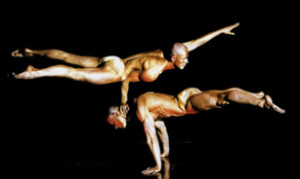
Strongmen Jarek and Darek of Cirque de la Symphonie
The complete program, directed by conductor Daniel Hege:
“Hail Wichita” (Wichita State University fight song)
Shostakovich: Festive Overture, Op. 96 (Orchestra)
Saint-Saëns: Danse macabre, Op. 40 (Christine Van Loo, aerial rope)
Bizet: Danse bohème from Carmen: Suite No. 2 (Vladimir Tsarkov, ring juggling)
Tchaikovsky: Valse from Sleeping Beauty: Suite, Op. 66a (Elena Tsarkov, contortion and dance)
Bizet: Les toréadors from Carmen: Suite No. 1 (Vova Tsarkov, spinning cube)
Badelt: Medley from Pirates of the Caribbean (Orchestra)
Rimsky-Korsakov: Scena e canto Gitano and Fandango asturiano from Cappricio espagnol, Op. 34 (Aloysia Gavre, aerial hoop)
Intermission
Tchaikovsky: Dance of the Swans from Swan Lake: Suite, Op. 20a (Vladimir Tsarkov and Elena Tsarkova, magic act)
Glinka: Overture to Ruslan and Lyudmila, Op. 5 (Orchestra)
Kabalevsky: Galop from The Comedians, Op. 26 (Vladimir Tsarkov and Vova Tsarkov, juggling glowing pins on a semi-darkened stage)
Offenbach: Galop (Can-Can) from Orpheus in the Underworld (Elena Tsarkova, ribbon dance)
Rimsky-Korsakov: Dance of the Buffoons from The Snow Maiden: Suite (Alina Sergeeva, hula hoops)
Strauss II: Thunder and Lightning (Polka), Op. 324 (Orchestra)
Tchaikovsky: Valse from Swan Lake: Suite, Op. 20a (Alexander Streltsov and Christine Van Loo, aerial duo on silks)
Sibelius: Finlandia, Op. 26 (Jarek and Darek, strongmen)
To Spec or Not to Spec?
There are really two questions intertwined in this subject. How much time and effort should be invested in “spec” (short for “speculative”) projects? And is it worth it to create original work for contests (or open calls)?
Admittedly, the answer to these questions depends on the stage of one’s career and the medium in which one works. A poet or writer’s work is essentially fungible: it can be printed anywhere with little change (although something written with a specific audience in mind may have trouble finding a home elsewhere). A composer who writes notated music, however, still has to get their composition into the hands of performers to bring it to life (a performing composer, or a studio composer who can realize their composition electronically, doesn’t face this hurdle in the same way, of course). In that sense their “product” is more like the script for a play or movie, and is only finished in performance. I’m going to speak from my own experience, but I’m interested in viewpoints from other fields, such as film or computer games. Comments are welcome!
As a composer, I’ve seen this from several different perspectives. I’ve composed pieces that were exactly what I wanted to hear, without any regard to potential performances; I’ve been fortunate to receive offers to write music for specific performers and events. I’ve had the opportunity to program concert series as a conductor, and been a performing member of chamber groups; in both cases, that gave me the ability to compose or arrange music for a specific ensemble and ensure that it would be performed. Every piece is different, and not just musically: the known and unknown factors—including the abilities of performers, the amount of rehearsal time, and the nearness of the performance date—influence decisions made in the heat of creation.
When just starting out, almost any work of art is, by necessity, created without knowing whether it will have an audience.* Art or music schools are, in part, venues where students are expected to create and display or perform, both to develop skills and good work habits and to build a portfolio, a track record for future work. Whatever you might say about such institutions, I’ve always found it energizing to be surrounded by people with a similar passion for creation and who are actively engaged in projects. That simple question “What are you working on?” that passes for small talk among artists is a constant reminder that you’re not the only one working to get those ideas that have been rattling around in your head out into the world. If you’re lucky, you might find a supportive colleague whose enthusiasm for your work can be encouraging when you feel your inspiration or energy flagging. Whether fueled by competition or camaraderie, motivated people are motivating to be around.
On the other hand, as I mentioned in my very first post here, it’s easy to talk about projects instead of working on them. Do you know someone who always has great ideas for stories, movies, comics, songs, et cetera? They want to tell you all about it, but it never seems to materialize. I’ve been that guy; most of us probably have been at one time or another, and I’ve put myself on guard against talking up ideas that I haven’t put any work into, to the point that I’ve sometimes lost sight of how sharing an idea can build enthusiasm for it. This is the downside of perfectionism: working in solitude, even secrecy, until everything is just right. Some of those compositions I wrote with no set performance in mind now reek of the hothouse to me, overwrought and impractical. At least I was able to cross the hurdle of finishing things, but even that must be learned—it’s hard to let go sometimes. Again, knowing that someone, somewhere, wants to see or hear your creation is a great incentive to putting a double bar or writing “The End” on your baby.
As I’ve gotten older, it’s harder and harder for me to pick up the pen to write unless I know there will be someone to perform it. Many of those youthful pieces were written not just on “spec” but on faith, and were driven by internal necessity. Most of those pieces got performed eventually, but not all, and ultimately I don’t consider a composition finished unless I can at least get a reading, so it’s in my interest to be realistic. Ultimately, life’s too short.
So what about contests, or open calls for scores/works? Twenty years ago, when band composer Francis McBeth visited my college and gave a talk, he singled out competitions as singularly worthless attempts to encourage original composition: composers won’t write new pieces, he said, they’ll just pull something old that fits the contest requirements out of the drawer and send it in. Commissions, he said, encourage new composition directly, but they represent a greater risk for the organizations running them. I won’t argue those points; I think they are largely true, and McBeth didn’t even go into the fact that some of these contests have an entry fee, effectively asking the losers to subsidize the contest prize and/or administrative expenses. (The subject of contest entry fees is a perennial bone of contention over at the Society for Composers, Inc.)
Having said that, there have been numerous times that I’ve read the description of a contest, and, totally against my will and better judgment, had an idea pop into my head that would be just perfect. Most of the time, I have to let things like that go—see that bit about being realistic, above—but if I think I have enough time, and if it’s something that might have legs apart from the contest itself, I’ve been known to try to pull off original work for things like this. An idea is an idea, and once it takes hold it’s not always easy to shake.
It doesn’t always work—I once overshot the deadline for a call for wind ensemble works by something like a year, but I was already invested in the composition so I just kept going after the deadline passed. As for entry fees, that’s part of the calculation as well: if I think I have a really good entry, the fee is reasonable, and the rewards are sufficient, I might take a chance. (So, you’re probably wondering if I’ve won any of these, and if not, what value my opinion is. The short answer is yes, I’ve been selected for a few things, but nothing so big you would have heard of it. It’s really another story which I may go into another time.)
So, what are your thoughts? Where are you in your career, and to what degree does someone else’s interest in your work influence what you create? What’s your opinion of contests and open calls in general? Are they for suckers, or have you been inspired by one to come up with something that fits the requirements? I hope to hear from you in the comments!
* Actually, this never goes away, as the shifting sands of taste and the arts economy can derail the plans of even the most established artist, and the more expensive their medium, the more those outside factors can influence what gets made. Still, if being “established” counts for anything anymore, it’s having some kind of fan base that can be expected to turn out for your latest project.
Where Seldom is Heard: a Sesquicentennial Overture
I’ve previously shared some of my thoughts on medleys, and my interest in them as a genre unto themselves, and the upcoming observation of Kansas Day (January 29) is as good an opportunity as any to share one of my own. 2011 marked the 150th anniversary of Kansas’ statehood, so in advance of that date I suggested to Bill Johnson, director of the Senseney Music Community Band here in Wichita, that I compose a work to honor the anniversary. Since the band didn’t play during January, the finished work could be performed during the band’s summer season (months after Kansas Day, but still within the anniversary year). He expressed his interest and I got to work.

Tragic Prelude by John Steuart Curry, a painting representing “Bleeding Kansas” hanging in the Kansas State Capitol
I’ve been involved with the Senseney Band for many years, and have written for them before. It is a community band, open to any adult musician without an audition, but standards are high and everybody who plays in the group knows what is expected. Many in the group are professional musicians, and many more are trained musicians who happened to make their careers outside of music. Still, to cope with the varying levels of ability, I would compose with an eye toward keeping the most difficulties in the first parts and making section parts easier (early on, we thought we might perform this work with high school or other community bands joining us, which would also be made easier by this practice).
In the year or so leading up to the planned premiere, I did what most composers do: I procrastinated. Well, I called it “research.” I read up on Kansas’ aviation history; I learned about the Kanza and Wichita Indians; I read In Cold Blood and listened to “Wichita Vortex Sutra.” I imagined multi-movement forms, cyclic works, pieces that would take the audience from the prehistoric ocean that once covered the plains through important moments in Kansas history and beyond. I pondered the essence of Kansan-ness and how best to express it in music. I gathered far more ideas than I would ever be able to fit into one piece. I compiled notebooks of clippings and quotations, made a few sketches, and dreamed about it.
But before I was able to really get started on it, I had other things I needed to finish. I was teaching and conducting. I had a family. Mostly, I had to complete a concerto my brass trio was scheduled to premiere in February 2011, and I was scoring the orchestra accompaniment all the way into January, so I had a late start on the community band piece.
Ultimately, the short lead time turned out to be a blessing in disguise. Whenever I’m asked how long it should take to write a piece of music, I think the best answer is, “long enough to get the details right but not so long that you lose focus.” In the past, projects I was working on tended to get bigger and bigger, with no end in sight, and while deadlines helped, they didn’t always stop me before things had snowballed out of my control. I still have that tendency to want to keep adding details, but now I’m more realistic about how much I can get done in a limited amount of time, and perhaps have a better sense of proportion when it comes to works in progress.
On the one hand, I had been thinking a lot about this piece for a year or more before I put pen to paper; I believe that the unconscious mind is often at work on artistic processes, and what seems like inspiration is often the result of mental preparation. On the other hand, time was short: with just a few months to compose, score, and edit a work for full band (no easy feat, if strictly from an editorial standpoint), I looked for the most direct entry point: Kansas’ Civil War history. In the decade before Kansas’ statehood and the beginning of the Civil War, the territory was a hotbed of violence between pro- and anti-slavery forces, fighting to determine whether Kansas would enter the Union as a free or slave state; the dispute came to be known as “Bleeding Kansas” and was a prelude to the larger Civil War. There would be plenty of material for me to use.
The Civil War was a central moment in U. S. history, of course, and it was also an important stage in the development of the wind band: both North and South fielded regimental bands that would establish standards of instrumentation, organization, and repertoire for the many town, school, and shop bands that would spring up in every community in the latter part of the nineteenth century. The music of the time period was also a fertile source for composers of twentieth century band literature, including such classics as Clare Grundman’s The Blue and the Gray, Jerry Bilik’s American Civil War Fantasy, and Morton Gould’s American Salute (based on the song “When Johnny Comes Marching Home”). (In addition to those models, I had such “public” works as Tchaikovsky’s 1812 Overture in mind; indeed, many of my influences as a composer–John Philip Sousa, Charles Ives, Gustav Holst–would come through clearly, and not always consciously. Some pieces are just like that.)
With those connections in mind, I chose three songs that could be shaped into a dramatic arc: first, “Ho! for the Kansas Plains” was written by abolitionist James G. Clark of Boston, Massachusetts in 1856 after the sacking of Lawrence by pro-slavery forces. His intention was to encourage anti-slavery activists to head to Kansas and lend their voices and arms to the cause. The lyrics read in part, “Huzza for the prairies wide and free; Ho! for the Kansas plains; Where men shall live in liberty; Free from a tyrant’s chains.” I found this song through an online search of the Library of Congress; I used only the chorus, freely reharmonizing the melody. Its 6/8 meter and obvious character as a marching song made it natural to arrange and develop in the style of a military band march (beginning at 2:17 in the audio clip embedded below, after a good deal of mood-setting introductory material).
As it progresses, the song becomes more and more agitated, until it gives way to stylized “battle music” (3:11). Again, this is a well-established idiom for band music; it allows the brass to ring through with repeated bugle calls and keeps up a driving, percussive rhythm. The music in this section is original, but will easily be recognized for its family resemblance to “Mars, the Bringer of War” from Gustav Holst’s The Planets, a work that has continued to influence concert and film music. The final blast (4:30) is written as a series of holds in which the brass and percussion play repeated figures freely, overlapping one another in a chaotic “fog of war.”
The second song I chose was “The Vacant Chair,” a song written by George F. Root in 1861, and a longtime favorite (for singers and instrumentalists, including bands) in North and South in the decades after the war. The lyrics, from a poem by Henry S. Washburn, lament the absence of a fallen soldier: “When a year ago we gather’d, Joy was in his mild blue eye, But a golden cord is severed, And our hopes in ruin lie.” In my arrangement, the verse is first played by a solo trumpet (George Naylor) in the aftermath of the noisy battle music. The refrain (“We shall meet, but we shall miss him, There will be one vacant chair; We shall linger to caress him, When we breathe our evening pray’r.”) is taken up, first by the horns as a ghostly funeral march, then by the rest of the band as a triumphal anthem, leading to the climax of the entire composition. I first learned this song from an old collection called The Blue Book, but it can also be found in Dover Publications’ The Civil War Songbook, edited by Richard Crawford.
Finally, how could I not include “Home on the Range”? Kansas’ state song, “Home on the Range,” was written in the 1870s by Dr. Brewster M. Higley and Daniel E. Kelley, and thus looks forward to the space and freedom the plains afforded settlers after the war. The song is more freely arranged and combined with music from other sections of the piece, representing the resilience and indifference of the prairie, which was there before and continues after the bloody events that accompanied Kansas’ birth as a state.
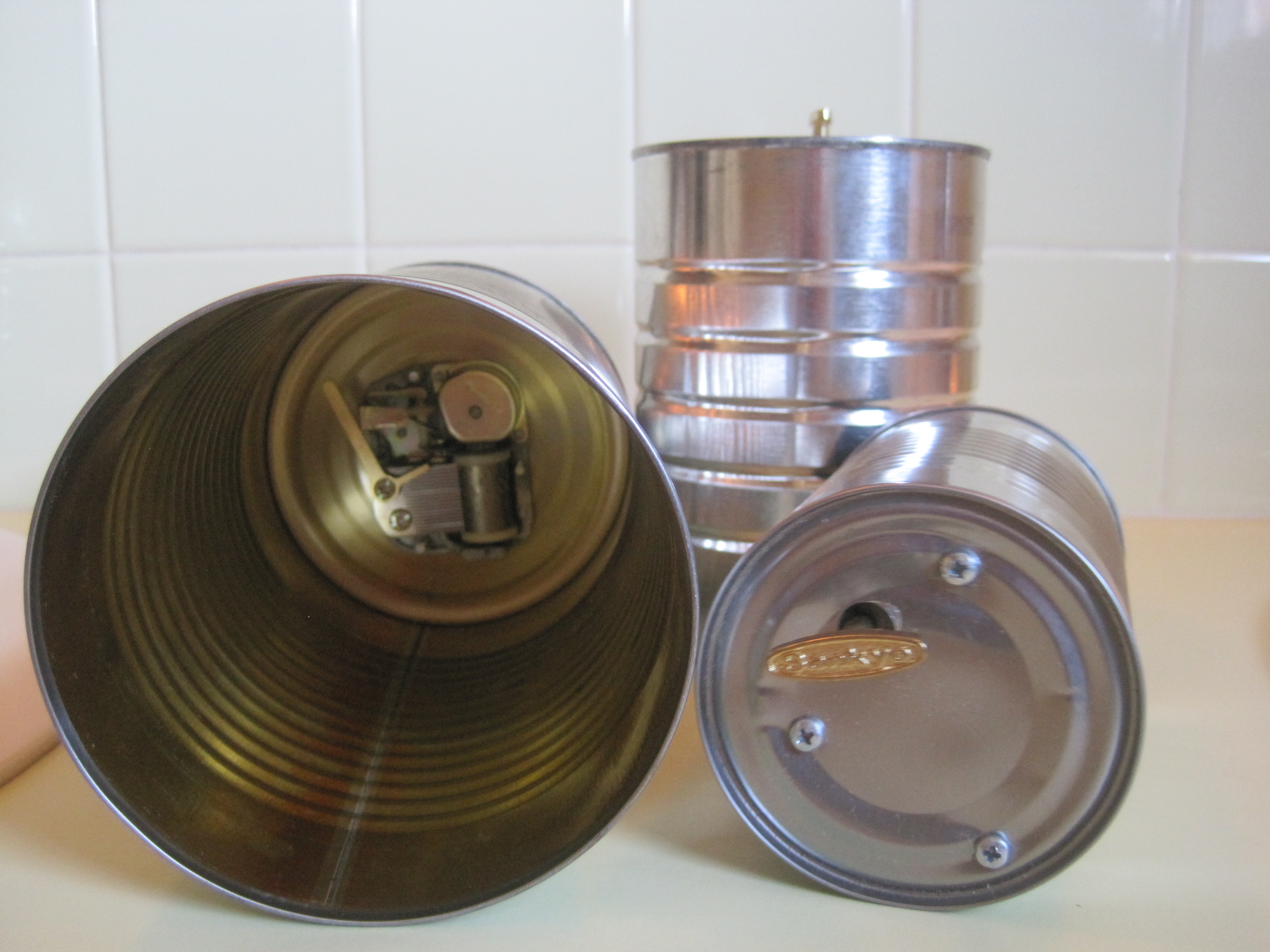
During this section some members of the band play music box movements mounted in tin can resonators; I’m interested in both mechanical musical instruments and ways of introducing handmade craft into the musical experience, so I had been experimenting with these for some time. The first few I put together were salvaged from music boxes that were otherwise broken, but for this I would need at least two dozen to create the “field” of tinkling, overlapping melodies I had in mind. (They can be heard starting from about 6:35.) So in the months leading up to the performance, I got several cases of music box movements and screwed them into empty cans in my garage. Probably even more would be useful in creating the desired effect; it depends on the number of players over all and the dimensions of the performance space. Combined with the layered statements of “Home on the Range” in the winds and bells, the music boxes are meant to evoke Kansas’ motto, “Ad Astra per Aspera” (“To the Stars through Adversity”). The ending is hopeful, but tinged with the shadows of the past.

Here’s the entire piece, which I titled Where Seldom is Heard, after the relevant lyric in Home on the Range, of course:
http://soundcloud.com/guy-vollen/where-seldom-is-heard
Finally, a great big thank you goes out to Bill Johnson and all the members of the Senseney Band for the hard work they put into this piece back in 2011. It is always helpful for a composer to be able to work directly with an ensemble; numerous changes were made during the rehearsal progress, both to clarify my intentions and to get the best results, and everyone in the band was very supportive and helpful in making this project come together. In the end we performed it three times (another luxury I don’t always get!); the recording here is from the second performance. Thanks for listening!
Wichita Symphony Orchestra: Ginastera, Saint-Saëns, and Franck; conductor Maximiano Valdés, cellist Julian Schwarz
Alberto Ginastera, Pampaneas No. 3, Op. 24
Camille Saint-Saëns, Cello Concerto No. 1 in A Minor, Op. 33
Julian Schwarz, cello
César Franck, Symphony in D Minor
Guest conductor Maximiano Valdés
My review of January 18’s performance of the Wichita Symphony Orchestra, as it ran in The Wichita Eagle.
The Most Annoying Music in the World
“How do they sound? Perfect! They can’t play a lick! But mainly they got the right attitude, which is all rock’n’roll’s ever been about from day one. (I mean, not being able to play is never enough.)” —Lester Bangs, on The Shaggs
I didn’t set out to become a vinyl collector. The first couple of records I owned myself as a kid got so scratched up through carelessness and deliberate “misuse”—I wasn’t exactly trying to imitate the DJs who spun hip-hop beats, or “breakdancing music” as my friends and I called it, but I was fascinated by how changes of speed and direction altered the recorded sound—that they were nearly unplayable. Later on, my dad encouraged me to record my new albums to tape so the vinyl wouldn’t get worn out. Combine those experiences with a few warped records encountered here and there, and I was left with the impression that vinyl records were a lot more fragile than they really were.
Nevertheless, when I was a teenager records became irresistible to me for a couple of reasons. The arrival of the compact disc in the late 1980s convinced many people that vinyl was going the way of the vacuum tube, and lots of them dumped their record collections for pennies, or for nothing: it wasn’t an uncommon sight for a box of old records to be left on the curb with the trash, free for the taking. When I was scouring garage sales and junk shops throughout the 1990s, the number, variety, and sheer strangeness of the records I encountered (not to mention the low prices for which they were selling) made them much more desirable than when I was a kid and they seemed both fragile and overpriced. Many people were upgrading their collections to the new format (there were recurring jokes along the lines of Dennis Miller’s complaint that he was buying Meet the Beatles for the fourth time), but there was also a generational turnover: among the outlets I frequented were garage sales by downsizing retired couples, as well as estate sales. In some cases the audience for the first wave of “easy listening” and “mood music” LPs was aging out, and their grown children had no interest in keeping the music that had (undoubtedly) driven them into the waiting arms of rock and roll in their own youth.
Indeed, for a few years, practically any place that sold used goods—antique stores, flea markets, thrift shops, and more—would have records, and I was always, always compelled to look through what they had to offer. When I was a student at Wichita State University, there was a regular (every three semesters) sale held to raise money for the music department, and I’d spend a good part of the sale week between classes browsing boxes of donated records (along with books, sheet music, and other items). My collection swelled.
Classical music predominated at the music department sale, but there were always oddball items as well. Like a lot of teenagers, especially in the “whatever, man” ‘90s, I was driven to search for the tackiest, most ridiculous items I could find in order to mock or celebrate them as “so bad it’s good.” I’ve mentioned following the Dr. Demento radio show; the good Doctor would sometimes feature what he called the “Audio Torture Chamber,” a selection from a truly excruciating (usually deliberately so, but not always) record. That’s where I first heard snippets of Lou Reed’s infamous Metal Machine Music and “the world’s worst orchestra,” the Portsmouth Sinfonia. As a collector and aficionado of the weird, I wanted in on that action. Maybe it says something about me that I loved being able to put on a record that elicited squirms, groans, and protests from my captive audience. It was at least a more dramatic response than the assumed coolness that would come over them when I tried to play something, you know, good. (Whether it was any more genuine, or they were just playing up their reaction for my benefit, I couldn’t say at this remove.)
In general, the less specialized the store was, the better: record stores were (generally) staffed by people who had an idea their wares were valuable—although the weird stuff I was looking for was usually in the bargain bin anyway—but thrift stores weren’t picky, and everything might be priced at fifty cents or a dollar apiece, cheap enough that I could gamble on a promising cover. Years later, when I saw the hip-hop DJ documentary Scratch, I learned about a gizmo some of the crate-diggers used to audition records before they bought them: a motorized toy truck with a needle on the front and a tiny speaker inside. The truck would “drive” around the record, the needle keeping it in the groove as the sound played through the little speaker. Brilliant! As it was, I usually had to rely on the appeal of the cover or my sketchy knowledge of the artists involved.
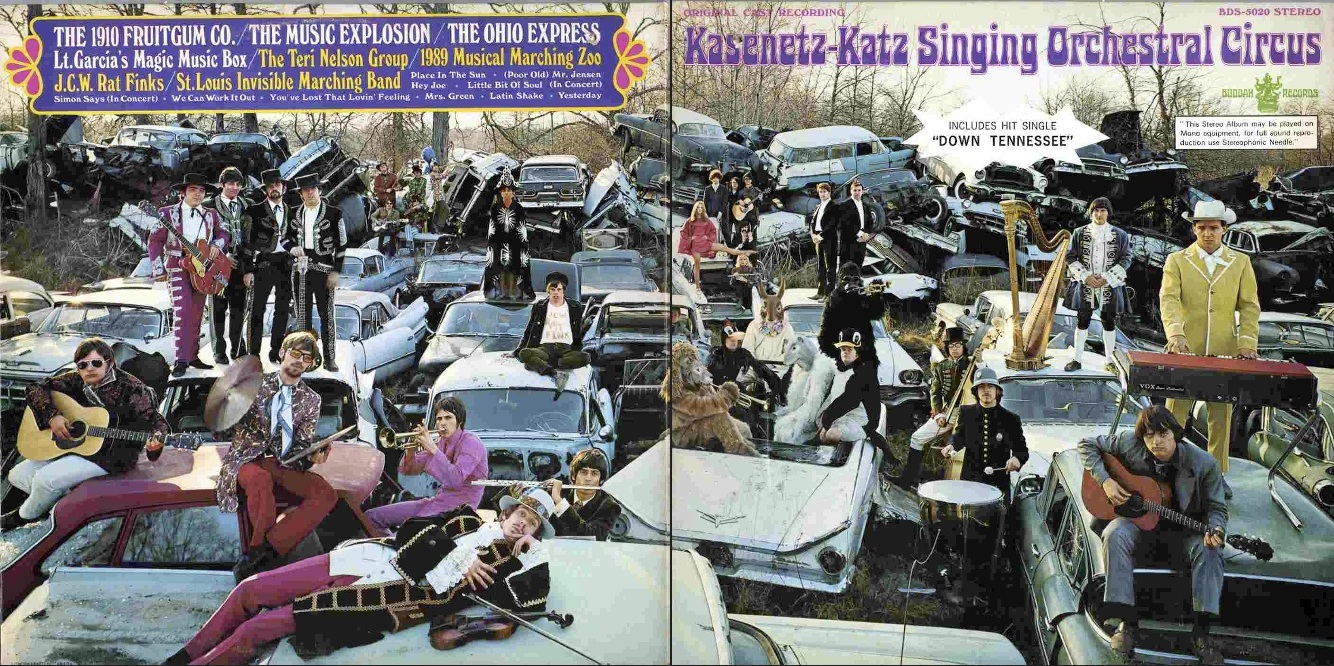
Yes, I have this in my collection. Be jealous!
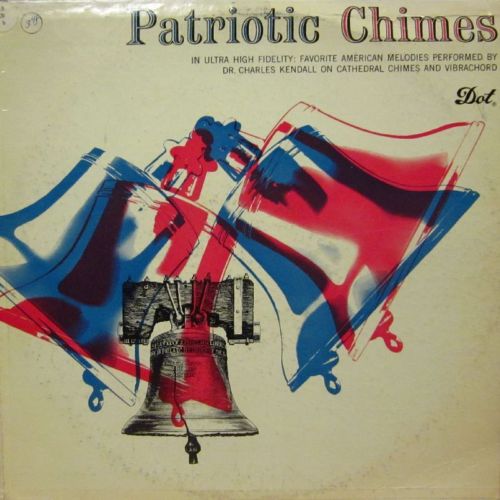
And what covers they were! The LP was a miracle of packaging and marketing: its twelve-inch square cover was a perfect canvas for beautiful (or at least striking) art, suitable for framing, an advertisement for itself. If the music inside turned out to be good, that was an added bonus. Sometimes the contents were merely conventional: with the right cover and some creative liner notes, a collection of military band marches could be sold as Music for Baton Twirlers, and an album of bump-and-grind studio jazz packaged as How to Strip for Your Husband. In both cases, the music is pretty good, but what sticks are the pop art covers and the impulse toward functionality, toward treating music as an accessory to one’s lifestyle, common enough in the hi-fi ‘50s.

I was already exploring this territory when RE/Search Publications’ Incredibly Strange Music series arrived and handed me a map to make sense of it. Founded in San Francisco by series editors Andrea Juno and V. Vale, RE/Search began as underground ‘zine Search & Destroy; by the time I encountered them, it had developed into a series of books dedicated to “fringe” topics: freaks, body modification, cult films, and challenging artists such as J. G. Ballard, William S. Burroughs, and Brion Gysin. Incredibly Strange Music Volumes I and II were Numbers 14 and 15 in the series, published in 1993 and ’94, and the series’ format showed its magazine roots, consisting of interviews with musicians (including the Cramps, Eartha Kitt, and Jean-Jacques Perrey in Vol. I), collectors, and assorted eccentrics, as well as short articles on aspects of the recording industry. First and foremost, the series was a celebration of the incredible diversity of music recorded on vinyl (especially in the heyday of the LP, from the 1940s to the ‘70s), most of which was in danger of being forgotten. A theme that runs through many of the interviews is that, in addition to vinyl’s superiority over the CD (a given for many audiophiles at the time), a vital popular heritage was in danger of being swept away because only the established classics were being converted to CD. People were throwing records away in order to go digital, but many of their vinyl albums might never make that transition!
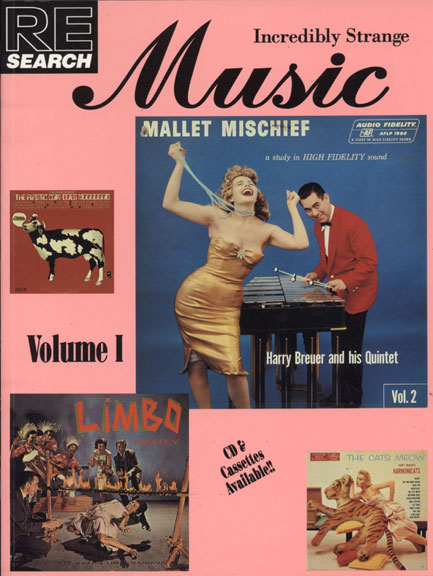
Incredibly Strange Music became, in effect, a guidebook to the kinds of records I might find, and an informal checklist of specific artists and titles to look out for. Records were about more than just music: for example, Mickey McGowan, proprietor of the “Unknown Museum,” listed such categories as bird recordings, sound effects, promotional, soundtracks, celebrity recordings, outer space (often including electronica), comedy, children’s records, and whistling records, among others, when discussing his collection. Recovering once well-known artists like Indian organist Korla Pandit or the exotic, multi-octave vocal phenomenon Yma Sumac from obscurity was another goal of many of the collectors interviewed. A feeling common to many collectors, and reinforced by the interviews in Incredibly Strange Music, was one of cultural archaeology: we were all doing important work, rescuing the cultural flotsam that wasn’t considered significant enough to preserve in libraries or conventional museums.
Music of the hopelessly inept was another “incredibly strange” kind of music discussed, but it was a recurring thread, whether considering the “turn your poems into songs” racket, vanity records that allowed amateurs to put together professional-looking, if not –sounding, projects, or small-time regional acts that didn’t have what it took to crack the big time. Then there were such unclassifiable acts as The Shaggs (who I think I also first heard on Dr. Demento’s “Audio Torture Chamber”), a group of sisters whose father, Austin Wiggin, Jr., had dreams of turning them into pop stars, despite their lack of musicianship, charisma, or even the ability to keep a steady beat. Were The Shaggs really “better than the Beatles,” as Frank Zappa reportedly claimed? Not according to standard definitions of quality, but there is something otherworldly about their spacey, off-key recordings, and there is an endearing charm to their guileless enthusiasm. For those who seek out this sort of “outsider music,” it’s not uncommon to express wonderment that such a thing exists at all: some of The Shaggs’ recordings are so out there that it’s easy to forget they were conceived of as a pop combo, but their repertoire won’t let us forget, mixing covers of songs by Tom T. Hall and the Carpenters with stream-of-consciousness originals like “My Pal Foot Foot.”
The implication that professional product is too slick to be authentic, and that music like The Shaggs’ comes straight from the heart (or the id, or possibly from another dimension), and is thus more honest, is one that’s been around for a while, and it can be problematic. Not necessarily wrong, mind you—there is always a point at which the inquisitive listener seeks to go beyond what they’ve grown up with, what they’ve been exposed to by their parents, the radio, and the surrounding culture. Something like The Shaggs may be just what it takes to start such a listener exploring, and I’ll accept the sincerity of Zappa’s praise of The Shaggs, or that of early Shaggs booster Tom Ardolino (who claimed to hear a resemblance between the Shaggs and early Ornette Coleman), whether or not I agree with it. Such praise can often be backhanded, though: would notorious perfectionist and technician Zappa have wanted the Wiggin sisters in his band? I think we know the answer to that.
Any appreciation of outsider art that veers into ironic “so bad it’s good” praise, celebrates a lack of craftsmanship or obscurity for its own sake (especially as a form of one-upmanship: “You probably haven’t heard of it”) can be interpreted, deservedly or not, as either mean-spirited or simply contrary—in either case, inauthentic. You might even invite the dreaded “hipster” label. Similarly, the assumption that an outsider artist can be “redeemed” by official recognition or appropriation by someone in the establishment is troubling. As much as I love Tim Burton’s Ed Wood, for example, its existence doesn’t validate the gonzo creations of its eponymous hero: it doesn’t have to, for they exist on their own and are worthy of consideration as works of art, however naïve. To treat them any other way is to perpetuate an unfortunate tendency of the fine art world to draw on folk/ethnic/commercial/outsider sources that are conveniently defined as “non-art” in order to be transformed (i.e., exploited) by a “real” artist, or to recognize the occasional genius working outside the system only after they are safely dead.
Still, anyone who feels that the Shaggs are being condescended to should compare their career to that of the Cherry Sisters, who were in some ways the Shaggs of the 1890s. According to author Irwin Chusid in Songs in the Key of Z, “Effie, Addie, Ella, Jessie, and Elizabeth Cherry of Marion, Iowa, were by contemporary accounts the worst act in showbiz. Their program, Something Good, Something Sad, was so atrocious it triggered a perverse public hysteria: it played to sold-out New York houses for 10 weeks.” The Cherry Sisters’ mawkish, humorless performances (“an evening’s worth of hokey, moralistic one-acts, derivative ballads, and awkward ethnic routines,” in Chusid’s words) were greeted with such vitriol that a wire-mesh screen had to be erected across the stage to protect them from vegetables and other missiles thrown by patrons. Promoters (including Oscar Hammerstein) knew exactly what they were selling, but the sisters at least pretended not to know—they claimed the rowdy crowds were hired by jealous rival actresses to sabotage their performances. Were the Cherry Sisters playing along or hopelessly naïve? They never let on, but were able to tour across the Midwest with their show, and earned upwards of $200,000, according to some reports.
A funny thing happened as I explored the world of kitschy, tacky music: I found things I genuinely liked, in an unironic way. I was already having a good time, of course—I wouldn’t have wasted so much time and money looking for these things if I weren’t enjoying myself—but at some point I crossed the invisible line between “Get a load of this!” and “Hey, this is really good!” A lot of the music I gravitated to was only “incredibly strange” in the sense of its separation in time, coming as it did from past decades with very different ideas of what was cool. For example, Lawrence Welk was the epitome of squareness even before I was a kid, but the musical chops of many of his stable of performers were for real. I was already interested in ragtime and early jazz, so I was receptive to Jo Ann Castle. Ditto with Myron Floren: I liked the accordion—again, maybe because it was so dorky, associated with performers like “Weird Al” Yankovic, but also because it just sounded cool—and Floren could really play. There was a whole galaxy of once-popular instrumental virtuosi that I’m still discovering. My recent column on banjo groups led me to Eddie Peabody, whom I hadn’t encountered before:
Part of the process is simply hearing enough to find what you respond to. One of my favorite albums that I found in high school was called Dutch Band Organ, and it contained lively, full-sounding arrangements of syncopated pop tunes like “Cuddle Up A Little Closer” and “Did You Ever See A Dream Walking?” It is the standard by which I have judged other band organ records for twenty years. Similarly, I have a hard time imagining what the world was like when The Three Suns (a trio of accordion, organ and guitar) were representatives of sophisticated popular music, but I’m glad I found them (their early records, like Cocktail Time, are more impressive to me than the later records where they team up with a full orchestra). Turntable artist Christian Marclay has commented on his attraction to “deeply unhip” records for his collage-like performances, and I share that interest: I’m always on the lookout for recordings of oddball instruments like the banjo, accordion, or chimes, the seeming underdogs of popular music. They deserve to be heard, too.
Much has changed since Incredibly Strange Music was published. The entire RE/Search series captures a moment, a transitional period between the underground culture of the 1970s and ‘80s and the internet culture that makes it much easier for like-minded people to find each other and share information. Many of the recordings featured in the book are easily heard online now; in fact, a great many of the vinyl oddities that were expected to disappear forever have made the transition to CD, however belatedly. Labels like Collector’s Choice and Sepia specialize in this sort of material. Even Dutch Band Organ is on CD now, something I never, ever would have expected. Of course, the CD as a format is now on the wane, replaced by streaming, even as vinyl records have made a comeback, but the older audience that presumably favors these reissues isn’t known for being early adopters, so they may be a better bet for CD manufacturers, for now, anyway. As for me, I love the options I have now, and I’m glad vinyl has continued to be relevant, but I’m glad I was in a position to explore the LP heritage at a time when it seemed like it might be gone for good.
The Force in Four Colors: Revisiting Marvel’s Star Wars
Recent news that the license to publish Star Wars comics would shift from Dark Horse to Marvel in 2015 probably didn’t come as a surprise to anyone: now that both Lucasfilm and Marvel are under the umbrella of Disney, it was only a matter of time before corporate synergy asserted itself. Already, Disney-owned properties such as the Muppets, Darkwing Duck, and the Pixar characters have been withdrawn from licensee Kaboom! (not all of them to reappear at Marvel, at least so far). It’s too bad: Kaboom! publishes some of the best comics for children around, and their books were clearly being written and drawn by creators with knowledge of and affection for the characters. Still, it makes business sense for Disney to consolidate its holdings, now that it has film, animation, and comic book outlets at its disposal. I don’t blame them at all; I’m sure it was part of their plan in acquiring those companies in the first place.

The news has stirred up memories of the often-wacky Marvel Star Wars line that ran from 1977 to 1986, and there have been a lot of jokes at Marvel’s expense. Heck, I’ve sprinkled Twitter and WordPress with my share of comments about the Zeltrons, a race of pink-skinned empaths whose sexual openness was often a source of comic relief (and pinup-worthy cheesecake) in the series. No one would deny that Marvel’s version of George Lucas’ science fantasy epic is more remembered for six-foot tall green rabbits, horny pink-skinned aliens, and a seriously off-model Jabba the Hutt than for its merits, especially in comparison to the more straight-faced Dark Horse run.

Although some of Marvel’s contributions to the Star Wars canon have been picked up and used by others (including the Zeltrons, actually), its run was compromised by its publication alongside and in between the release of the original trilogy’s films. Before Star Wars (sorry, A New Hope) was released, Marvel was already publishing its six-issue adaptation, including scenes that were cut from the final film: most notably Luke’s conversation with Biggs on Tatooine and Han Solo’s confrontation with a very different-looking Jabba the Hutt in Mos Eisley. The yellow-skinned, humanoid version of Jabba would appear a couple of times in the comics, until he officially disappeared from existence, replaced by the slug-like Jabba of Return of the Jedi.

To be fair, it can’t have been easy for the writers (including Roy Thomas, Archie Goodwin, and Mary Jo Duffy, among others) to spin stories out of a saga that wasn’t completed yet: the challenge was to give readers more of what they loved in the movies without deviating too far from formula or accidentally contradicting or giving away plot twists planned for the sequels (plot twists that were generally secret–Marvel’s editors wouldn’t always know they had crossed the line until it was too late). Particularly between The Empire Strikes Back and Return of the Jedi, writers were tasked with providing the illusion of change so familiar to readers of superhero comics: Han Solo could not be freed from his carbonite imprisonment, although many issues were dedicated to attempts to rescue him; Darth Vader was off the table, so there could be no answer to the question: was he Luke’s father?
Some of the weirdness in Marvel’s version was also due to the relationship between licensor and licensee at the time. In those days there was simply not the expectation that film and comics be a seamless continuity: comics were exercises in brand extension, ancillary revenue streams, not sacred texts. To a large degree, the comics’ writers and artists treated the Star Wars universe as just another sci-fi/fantasy playground to be filled with weird landscapes and monsters (one story arc was repurposed from unused John Carter, Warlord of Mars artwork). Remember, this was from the same decade as Jack Kirby’s adaptation of 2001: A Space Odyssey and Whitman’s adaptation and continuation of The Black Hole. Making up and adding material was thought of as giving good value to the reader. Star Wars and its Expanded Universe would be a major influence in shaping fans’ expectations of continuity across all media, but that tighter approach didn’t emerge overnight.
Still, before I was a Marvel kid I was a Star Wars kid, and the latter was a big reason for the former. I remember vividly the discovery that piqued my interest: in the box of comics I shared with my sister (about which I’ve written previously), I discovered a copy of Star Wars number 18, missing its cover. This was the first issue of a major story arc in the early days of the series, the “Wheel” saga, named after a huge space station-bound casino that is the setting of the action. I didn’t know that at the time (1982 or ’83, I would guess), and it would be a few years before I was able to read the “Wheel” arc in its entirety. What captivated me was the idea that the characters I knew from the movies were having entirely separate adventures in these comics. I tended to accept anything official-looking as gospel, so I had no trouble accepting the legitimacy of Marvel’s version (although Carmine Infantino’s square-jawed rendition of Luke Skywalker looked more like He-Man than Mark Hamill).

For the first time, I became a regular comic buyer, actively looking for new issues on the stands and seeking out back issues to fill in my collection. Jumping into the series, there were many unfamiliar characters and references to previous adventures from the comics. I had a lot of catching up to do. I didn’t live anywhere near a dedicated comic book store, so I relied on trading with friends and mail order: the biggest comic book purchase of my childhood, in fact, was an order for all the Star Wars issues that were available from one of Mile High Comics’ summer sales. Mile High’s yellow two-page ads were once a common sight, and the summer sales were the best, unloading comics for 25 or 50 cents apiece. It helped that, aside from the first few issues, Star Wars had never been terribly sought-after or valuable, and at most they were only a few years old. The day the box arrived in the mail with forty issues or so—far from a complete run, but more than I had ever read at once and including many gems—I holed up in my room and immersed myself in “a galaxy far, far away.” It would be the first of many long afternoons delving into another world through comics.
One of the things I liked about the comics, and which still holds up today, was the focus they were able to bring to individual characters. Many issues were solo adventures, or featured groups of only two or three characters working together in ways that the epic scope of the films didn’t always have time for. In the comics you could observe Princess Leia as a diplomat waging high-stakes games of cat-and-mouse with Darth Vader and the Empire (in “The Third Law”); Luke Skywalker’s role in the Rebellion’s space fleet could receive more attention; Han Solo, and later Lando Calrissian, could be shown in their element as smugglers, gamblers, and “scoundrels” (in flashback, of course). In essence, the Star Wars universe could support stories of action-adventure, espionage, horror, romance, and even comedy, much as the Expanded Universe still does today. It made sense: the movies were themselves indebted to many different genres, including the science fiction serials of the 1930s and ’40s; Westerns; World War II aerial dogfights; and the samurai films of Kurosawa. It was only natural for the comic book adaptations to continue in that spirit and flesh out elements that could only be implied on film. Not all of the stories worked, and not all of the original characters fit into the Star Wars aesthetic, but I still remember them fondly, from the “Wheel” saga to the the twisty, long-running story of Shira Brie, to the many, many attempts to rescue Han Solo.

After Return of the Jedi, the Marvel series continued without much apparent purpose, introducing its own villains (the Nagai) and tying up threads from the comics. The writing was on the wall. I was a faithful reader until the end, but I couldn’t disagree with the decision to cancel the series after 107 issues: it had become a shadow of its former self, and by that time I had gotten hooked on Marvel’s superhero offerings.
I didn’t spend much time reading the Dark Horse series–I guess I was still a Marvel kid at heart–but from what I could see the quality was good, and they made a lot of smart decisions. Unlike the Marvel series’ focus on the main characters of the film trilogy (understandable, but ultimately limiting), Dark Horse was able to flesh out the Old Republic and other settings within the Star Wars universe. They even obtained the rights to the Marvel run and released it in a handsome series of trade paperbacks, a fitting tribute to an imperfect but often richly entertaining saga, and a challenge to the assumption that everyone involved would rather forget it existed. With the distance of time, new and old readers alike can approach these adaptations, see that there was more to it than green rabbits, and make up their own minds.
(Images from Wookieepedia, the Star Wars Wiki)
Get Your Chimes On! (What to do with Christmas leftovers)
So you got a set of chimes (aka “tubular bells”) under the old Christmas tree? Congratulations! Perhaps these are your first chimes, or–if you’re Mike Oldfield–you finally wore out your original set and somebody got you replacements. Either way, you have years of musical enjoyment to look forward to. If you’re like me, you probably spent the holiday hammering out favorites like “Silent Night” or “Joy to the World;” or maybe you had some friends over for an impromptu sing-along with A Christmas Gift For You From Phil Spector or the Spector-influenced “All I Want For Christmas is You.” But a few days afterward, you may be saying to yourself, “That was fun, but what am I going to play the other eleven months of the year?”
“How am I going to fit this in a stocking?”
Fortunately, record producers’ use of chimes isn’t limited to the Christmas season: here are a few pop and rock songs that make use of the instrument to tide you over until next December. (I’m leaving aside those songs that include the tolling of church bells, such as AC/DC’s “Hell’s Bells”* or Metallica’s “For Whom the Bell Tolls.” You can imitate church bells on the chimes, of course, but it only takes one pitch. The songs that follow cover a wider range and sometimes–gasp!–even take the lead.)
Some kids got the deluxe model this year.
If you’re feeling funky and futuristic, there’s electronic music pioneer Pierre Henry’s “Psyché Rock” (with Michel Colombier, 1967) and Jean-Jacques Perrey’s “E.V.A.” (1970). Both feature chimes prominently amongst the fuzz guitar and space-age sound effects. Henry’s composition, in particular, was the inspiration for Christopher Tyng’s Futurama theme (which also includes chimes, so learn all three and you can really make a night of it):
These guys know what I’m talking about:
If you still have a rhythm section at your disposal, consider Blondie’s 1981 mega-hit “Rapture,” the first single to contain rap to hit number one on the U.S. pop charts (and one of the first music videos played on fledgling cable outlet MTV that year). The sound of bells can be exuberant or mournful; in “Rapture” they complement the slinky bass line in creating an otherworldly nocturnal atmosphere. Along with Perrey’s frequently-sampled “E.V.A.”, “Rapture” can be heard as a spiritual forerunner of trip-hop.
Staying in the early ’80s, the British girl group Dolly Mixture is one of the most unjustly overlooked bands of the post-punk scene, but they are increasingly receiving their due. Most of their recorded output is from the (unsurprisingly) spare Demonstration Tapes; their single “Everything and More” from 1982 has a fuller sound reminiscent of Phil Spector’s style, including a rocking chime riff:
Working a similar vein of updated ’60s guitar pop were The Housemartins, whose 1986 hit “Happy Hour” prominently features our chosen instrument in the break:
Perhaps your tastes run toward alternative or indy music. May I suggest Throwing Muses’ “Mexican Women” (1988) or The Flaming Lips’ “The Abandoned Hospital Ship” (1995)? Both songs save the chimes for the big ending, giving you ample time to make a dramatic entrance.
It’s fitting that we conclude this list with They Might Be Giants, a group that has throughout its history explored varying styles of production, often using the signature sound of an era or artist to frame its songs, as if they came from a slightly off-kilter parallel universe of pop music. “Destination Moon,” from the 1994 album John Henry, draws on both the “wall of sound” of ’60s pop and the futurism of Henry and Perrey for a vision of outer (and inner) space travel that’s equal parts Heinlein and Dick.
That ought to do it. Happy chiming!
* Not to be confused with this “Hell’s Bells,” sung by Betty Boop in the 1934 cartoon Red Hot Mamma. Playing the chime part for this requires two pitches: Betty Boop 1, AC/DC 0.
 Medleyana