Review: Monster, 1959

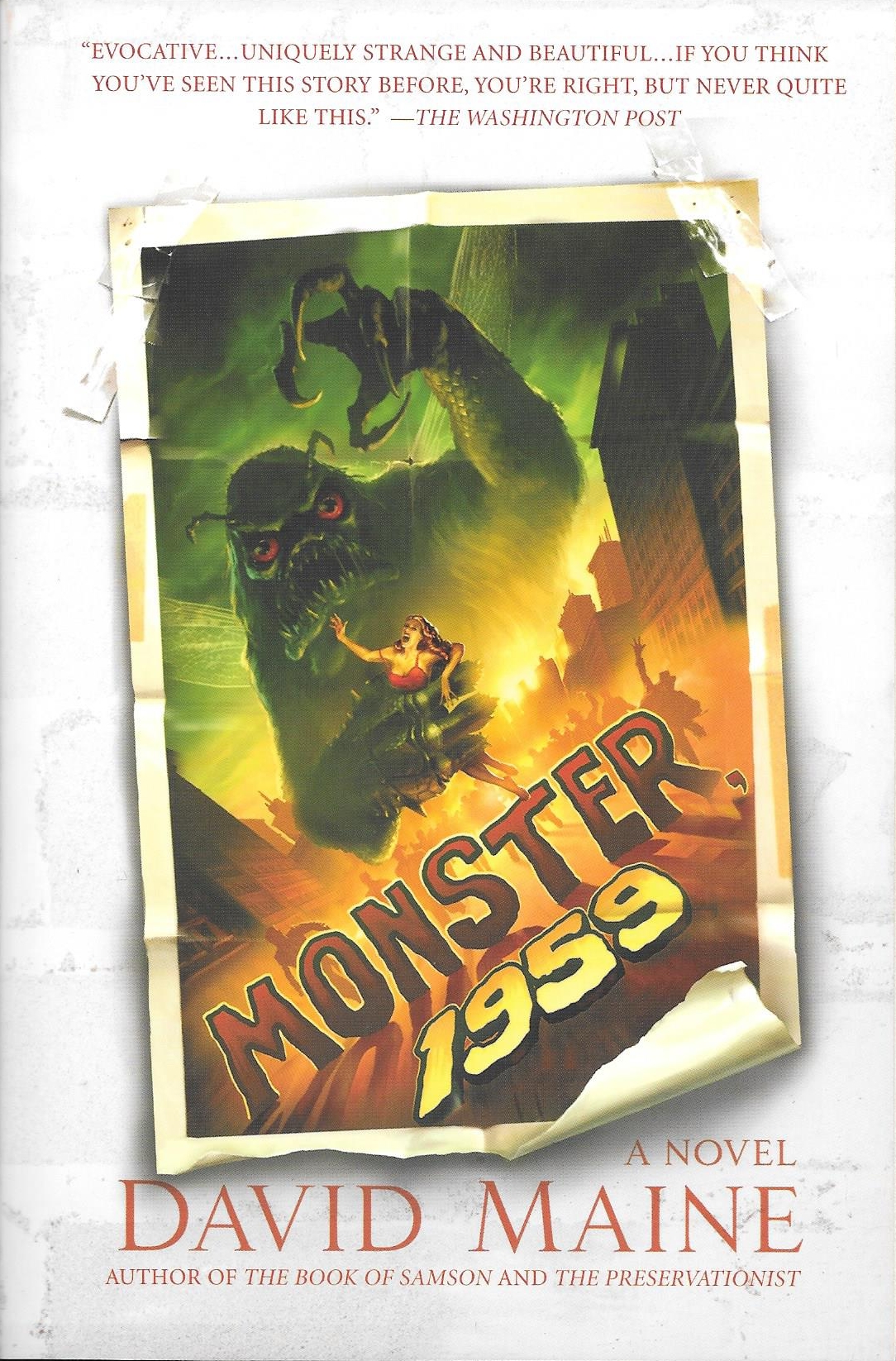
cover illustration by Owen Richardson

cover illustration by Owen Richardson

K. leaps into existence amid them all, shark-eyed, snake-tongued reality: misery given form, solid and undeniable and taller than Hell itself. Feathers like a bloodsmear across his thorax, claws lashing furrows in the ground. Gangs of teeth glaring at the crowd over his lipless slash. Everybody screams.

It sounds like science fiction, and in strict terms, it is. The plot is the most familiar element of David Maine’s 2008 novel Monster, 1959–explorers discover an extraordinary monster on a remote Pacific island, and after restraining the beast they transport it to America to put it on display, after which eventually everything goes to Hell–but the novelty of the story isn’t really Maine’s concern. Monster, 1959 is the kind of novel that applies probing psychological realism to genre material, finding unexpected complexity beneath the surface of broadly-sketched stock types. What Katherine Dunn’s Geek Love did for Freaks and its body-horror descendants, Monster, 1959 does for King Kong and the monster movies of the 1950s.

If so many of the alien-invasion and monster-rampage stories of the Cold War were metaphors for political anxieties, postwar social displacement, and the catch-all term “future shock,” Maine is concerned with re-literalizing those metaphors, making sure that his fanciful monster mash takes place in a world that includes not only Hiroshima and Nagasaki and the bomb tests on Bikini Atoll, but also the infamous Tuskegee Syphilis Study and the eviction of Palestinians from newly-formed Israel. Maine’s omniscient shifts in focus from close-ups on the main characters to the wide shots of world events is reminiscent of the intriguing book Welcome to Mars by Ken Hollings and Erik Davis, which also shares Monster, 1959‘s year-by-year structure in making connections between seemingly disparate strands of history and popular culture.

In Monster, 1959, the main characters are the giant chimerical monster K., for “Kama ka,” the name given to him by the islanders who worship him as a god (but perhaps also standing for Kong, or kaiju, or in reference to the monogrammatic protagonist of Franz Kafka’s The Trial); Betty, the white woman whom K. first abducts and then finds himself strangely bonded to; and Johnny, the square-jawed man of action and Betty’s husband/rescuer. In retelling this age-old but highly specific beauty-and-the-beast tale, the members of the central triangle (and numerous characters who enter their orbit) are given shading and moral ambiguity, and of course relevance beyond the single story.

The novel’s most winning creation is K. himself, and Maine effortlessly relates events from K.’s perspective: animalistic, responsive to direct stimuli, and without much imagination or sense of the past or future. Despite the limitations inherent in writing from this point of view, Maine sketches a believable (and believably mysterious) persona. It’s common for audiences to partially identify with King Kong or Godzilla, but Maine is interested in what it would really feel like to be such a creature. While there is a fair amount of action in the story (“some sci-fi monster violence,” as the MPAA would have it), for all his size and power, K. is not the bloodthirsty predator one might expect; in fact, he’s a vegetarian. K.’s reactions to the humans invading his domain, the strange effect that Betty and her singing have on him, and his confusion at the series of entrapments and enclosures that he endures convey both how alien K.’s mentality is, and how alienating the modern world is when seen anew. Like the greatest movie monsters, K. is fearsome but ultimately sympathetic.

K., chained and transported in a custom box car, drugged and put on display in one roadshow after another, isn’t the only character who is trapped. There’s Doug, the seven-foot-two circus performer whose freakish height has come to be just as much a prison, and to whom the duty of administering K.’s sedatives has devolved. “It would be falsely melodramatic to say,” Maine tells us, “When Doug injects K., he feels as if he is injecting himself.” All the same, he does become disenchanted and disgusted enough to begin passive-aggressively slacking off, a decision that makes K.’s dramatic escape from confinement while performing at Madison Square Garden as inevitable as the failure of Jurassic Park’s electric fences. Life finds a way.

Betty, whom K. abducts all over again in New York, is not just a damsel in distress, but a woman of her generation whose deepest urges tell her to “throw herself into” her marriage and to give Johnny the benefit of the doubt. This extends to playing along with their friend Billy’s scheme to take the monster on tour, reenacting her abduction as a modern Romeo and Juliet story for paying audiences, against her better judgment. Johnny, over the course of the novel, finds that his experience in rescuing Betty has awakened a taste for adrenaline and alpha-male displays of prowess, a search for ever-greater highs that is ultimately his undoing. Ultimately it comes down to sex in forms as polymorphous as K.’s own mismatched body. “By now,” Maine writes after a particularly perverse episode, “you might be forgiven for wondering: Are there any normal people in this movie? It’s a fair question. To which the only possible answer would have to be: Are there any normal people in the world?

Finally, Monster, 1959 is no mere pastiche or stylistic exercise. Like the best environmental horror, it’s a warning, with K., the troubled child of the atomic bomb and master of an island of mutated terrors, returning like a bad dream to the country that created him and had hoped to forget him. Just as in a movie, the monster may be dispatched, but audiences know the fears that created it are still out there, and the monster can always come back.

THE END . . . ?

Introducing a New Series at The Solute

Buckrogersserial

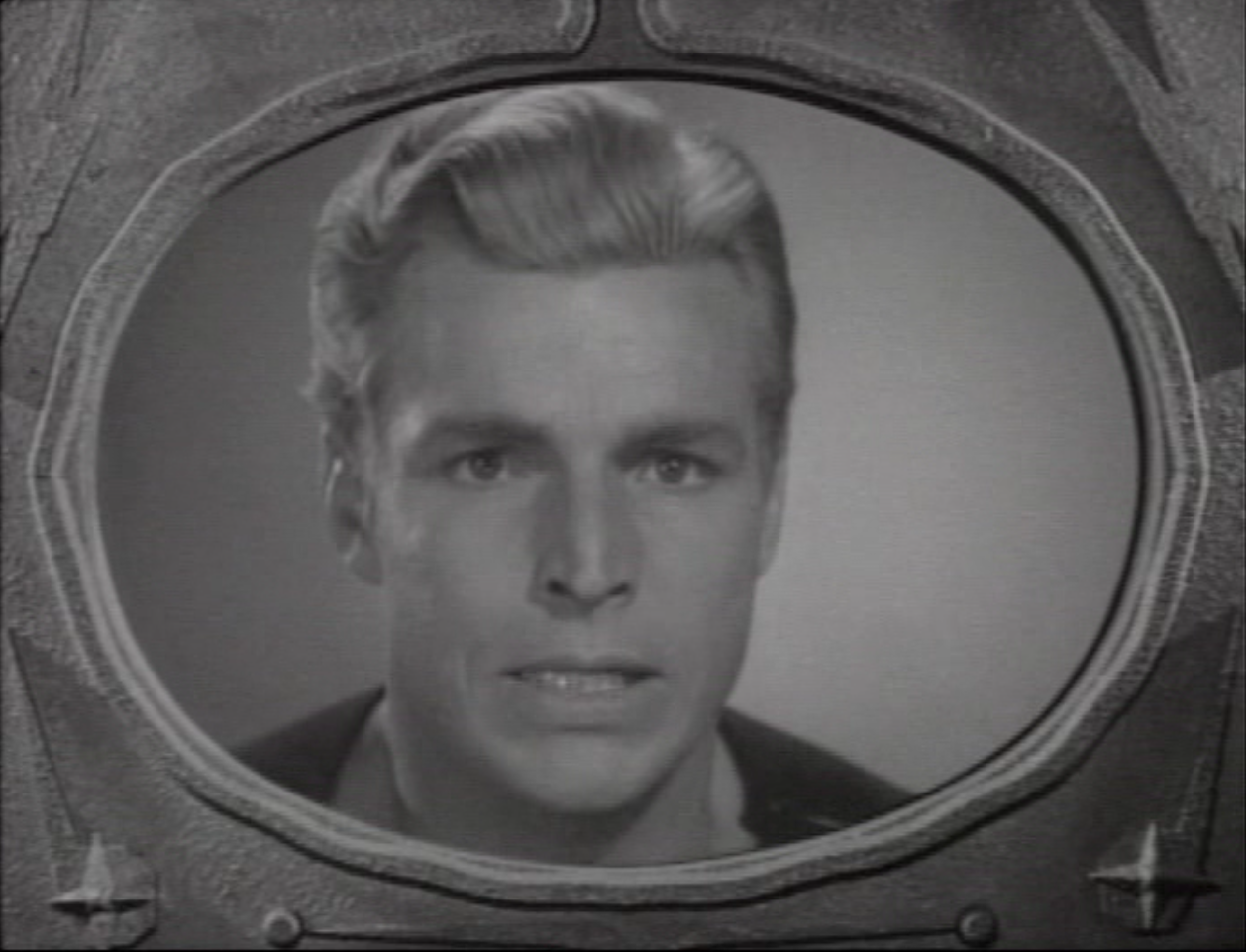
If you’ve enjoyed my summer coverage of movie serials in Fates Worse Than Death, I invite you to check out a new serial-related feature at The Solute: in Tune In Next Week, I’ll be watching and reviewing the same kinds of serials one episode at a time rather than over the course of a week. I explain more about this approach in this introductory article, as well as setting up the first serial I’ll be covering: 1939’s Buck Rogers, starring Flash Gordon star Buster Crabbe. The weekly approach will probably be a little different from what I did in Fates Worse Than Death, but I plan to continue that series here in the summer, and I expect the two formats to complement one another. (I also don’t plan on repeating coverage of serials I’ve already written about here.) New installments of Tune In Next Week will appear on The Solute on Saturday mornings. Come on over!

Fates Worse Than Death: Feature-Length Serials Revisited

SR.CommandoCody

This past summer when I wrote about the practice of cutting serials to feature length, I wrote, “Editing down a serial into a more modern feature length would undoubtedly be an interesting project for a film student or anyone who wants to learn more about the pacing and construction of these films.” A few weeks after that post, Wayne Keyser of goodmagic.com contacted me and offered to send me a DVD he had produced with his own cut-down version of two serials, Radar Men From the Moon and Undersea Kingdom. Of course I was interested, and after taking some time off from serials after my busy summer, I gave it a spin.

The disc, Serial Remix, promises “ALL the rayguns, spaceships, robots, action . . . LITTLE of the talk, ‘recaps,’ talk, car chases, and talk!” In his correspondence with me, Mr. Keyser elaborated, “I think it may be worthy of mention that every feature-length serial condensation I’ve ever seen is very short on what makes the serial interesting. When you’ve got rocket ships and robots, who needs bank robberies and car chases?” In that spirit, both films are cut to the bone, with a minimum of scene-setting and all the repetitive wandering around that pads out many serials eliminated. Readers of my reviews of these two serials will recall that they didn’t excite me that much, so I’m not offended by efforts to streamline them. (Unfortunately, Serial Remix is not commercially available, so my thoughts are offered in the spirit of a case study rather than a review.)

SR.rocket

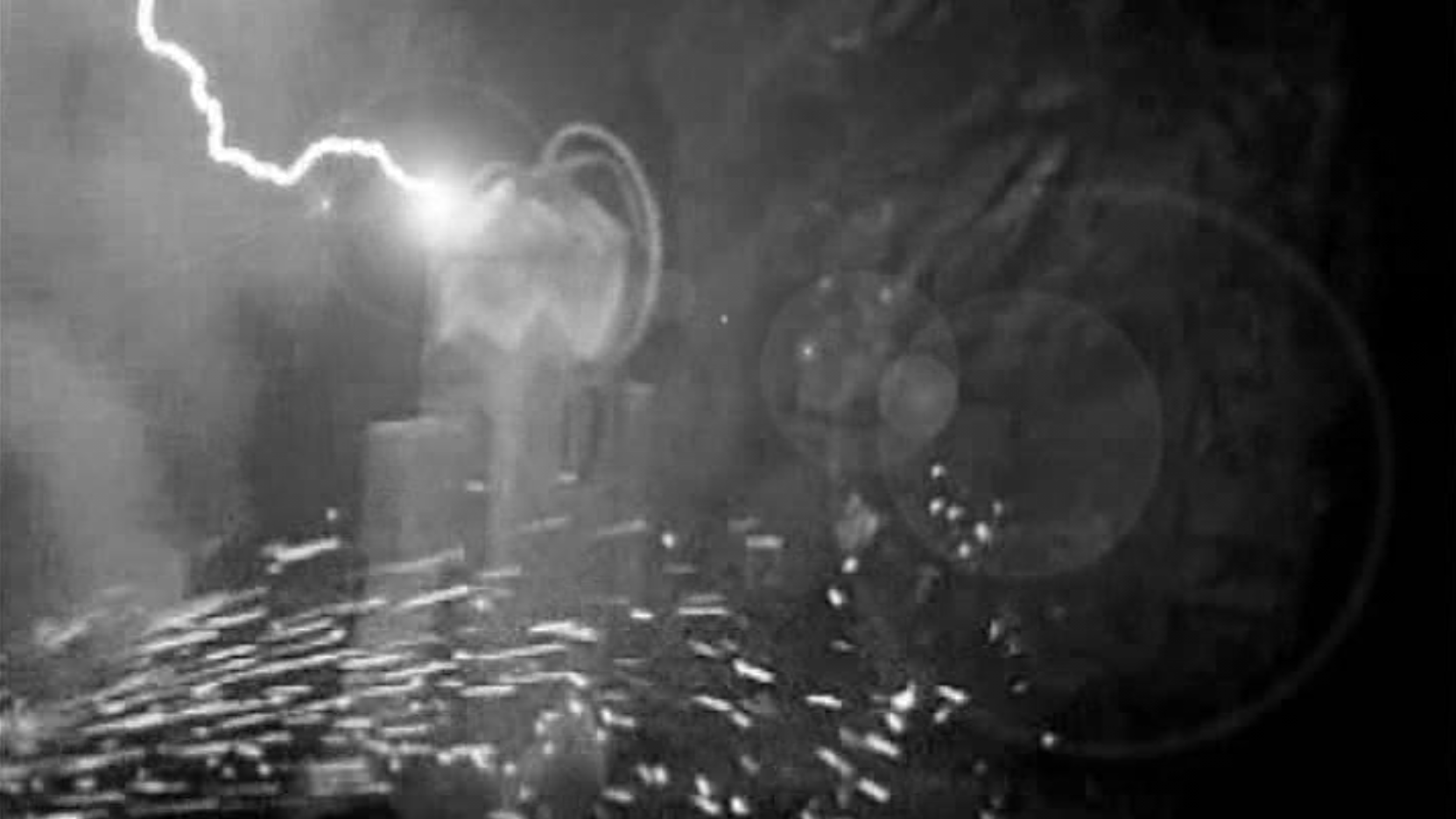
The versions presented are truly “remixed”: in addition to being edited for time, they have been reformatted for 16×9 widescreen instead of the original 4×3 fullscreen; some effects have been digitally sweetened (ray and lightning effects are added, sparks added to explosions, and so forth); and some shots have been moved around for pacing or to show off the models and other effects. One could easily refer to these as “Special Edition” serials, but few of Keyser’s adjustments are as obtrusive as George Lucas’s additions to the original Star Wars trilogy.

SR.lightning

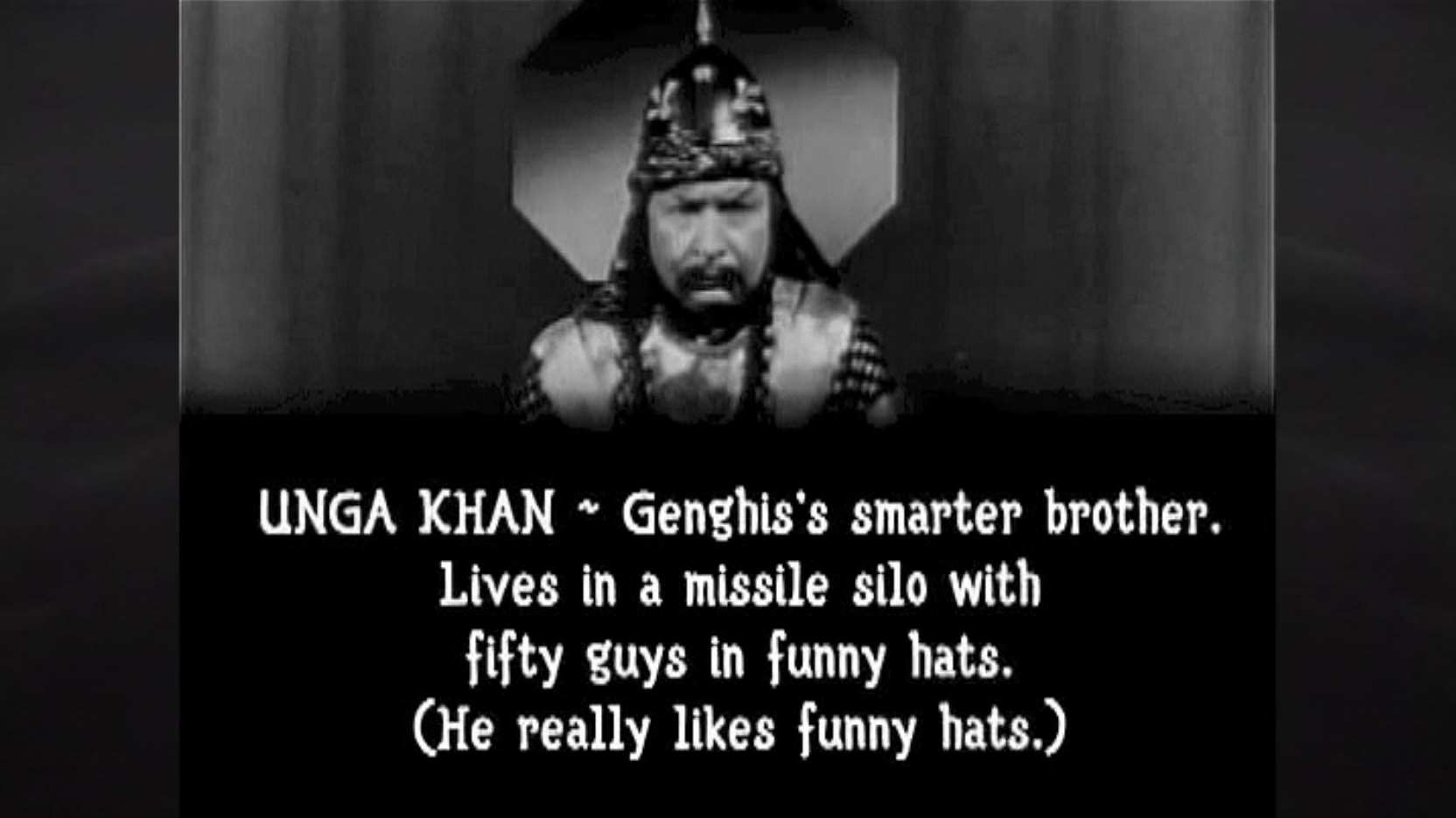
(It should also be noted that as ridiculous as both films are, the remixes are admirably straight-faced: there are no wacky sound effects or pop-ups added, and no Mystery Science Theater-styled riffs. The closest Keyser comes to making a joke of the material is a “Meet Our Characters” sequence preceding Undersea Kingdom that notes everyone’s propensity for funny hats. I can live with that.)

SR.character

For the most part, these changes don’t considerably alter the story, but they do move it along and gloss over some of the fine details (not unlike the feature-length cuts made by the studios). In fact, watching Keyser’s remixes made clear how much is left to the viewer’s imagination in modern editing: serials were frequently quite literal in explaining the plot and showing every step of an action, whether it be the villain setting a trap for the hero, the hero’s miraculous escape, or the villain getting in a car and driving away. To some extent that was a function of the serial’s need to fill time, and when poorly handled it would indeed smack of padding.

It was also, I think, natural to the procedural storytelling mode that serials often engaged in: whether obvious or subtle, the situation must be established if there is to be any suspense. We don’t realize that the hero is walking into a trap unless we see it set up, or at least have an establishing shot that clearly shows the threat. And while the audience might assume that a rickety bridge is going to pose a danger in an upcoming scene, serial writers were rarely above tipping off even the slowest viewers by having a character say something like, “Be careful on that bridge; it’s liable to collapse if there’s too much weight on it.”

I might go even further and speculate that it is the seeming solidity of cause and effect in classic serial editing that makes cliffhangers so susceptible to “cheats.” The danger to the hero is so firmly established in dialogue, in premonitory close-ups (on the lit fuse, on the stuck gas pedal, on the clock whose midnight stroke spells doom), and often in the scene as filmed, that his death seems inarguable. We saw him plunge from the cliffside or fall beneath a hail of bullets, and the only way he can be saved is to undo the peril, to rewind so that in the continuation fate takes a different path. The audience may cry “cheat!” if they are observant enough to notice the switch, but such reversals are, I’m starting to think, a necessary part of serial grammar and the ability to literally cheat death a superpower peculiar to the heroes of the form. (Or perhaps not so peculiar: when Superman reverses the Earth’s rotation in Richard Donner’s 1978 film, undoing the disaster that has killed Lois Lane, he is simply performing a large-scale version of what serial heroes had been doing on a small scale for decades.)

SR.juggernaut

Keyser (and other editors turning serials into features) swerves around that paradox by eliminating the cliffhangers, of course; each peril is now simply a beat in an action sequence. But the elimination of excess verbiage and travel is closer to the grammar of a modern action film, in which the audience is swept up in the heedless forward motion, and goes along with it because there is little time to take a breath and question it. I didn’t watch these films with a stopwatch, but my general impression is that the average shot length was shorter than in the original, again making the films feel more contemporary in their rhythm. (Consider how little down time there is in the Indiana Jones movies, particularly Temple of Doom, in comparison to the serials they draw from; at least Star Wars alternates its action sequences with moments of repose.)

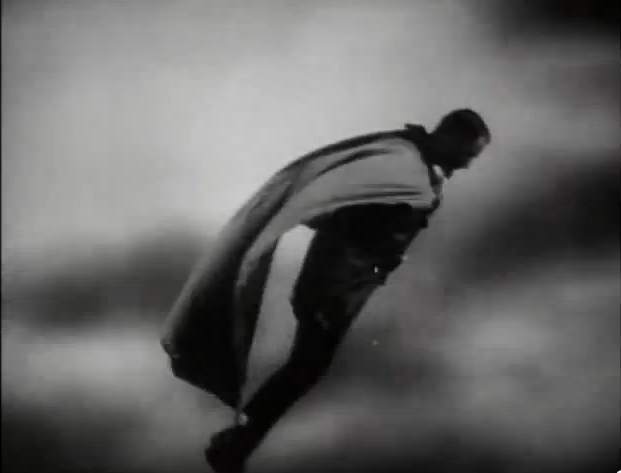
To get down to specifics, Radar Men From the Moon, as you may recall, features George Wallace as Commando Cody, whose signature costume is his rocket-powered flight suit. The same concept (and effects) had appeared in Republic’s earlier serial King of the Rocket Men, and would later inspire Dave Stevens’ character the Rocketeer. In Radar Men, Cody and his team are dispatched to the Moon (on a rocket ship also designed and built by Cody) by government agents who suspect that recent disasters on Earth are linked to atomic activity detected on the lunar surface. After a trip as comfortable and uneventful as a coast-to-coast passenger flight, they discover a dying lunar civilization that is indeed softening up Earth for invasion; the lunarians are already on Earth, advance scouts coordinating explosions and acts of sabotage with the assistance of Earth criminals!

SR.DalyGraber

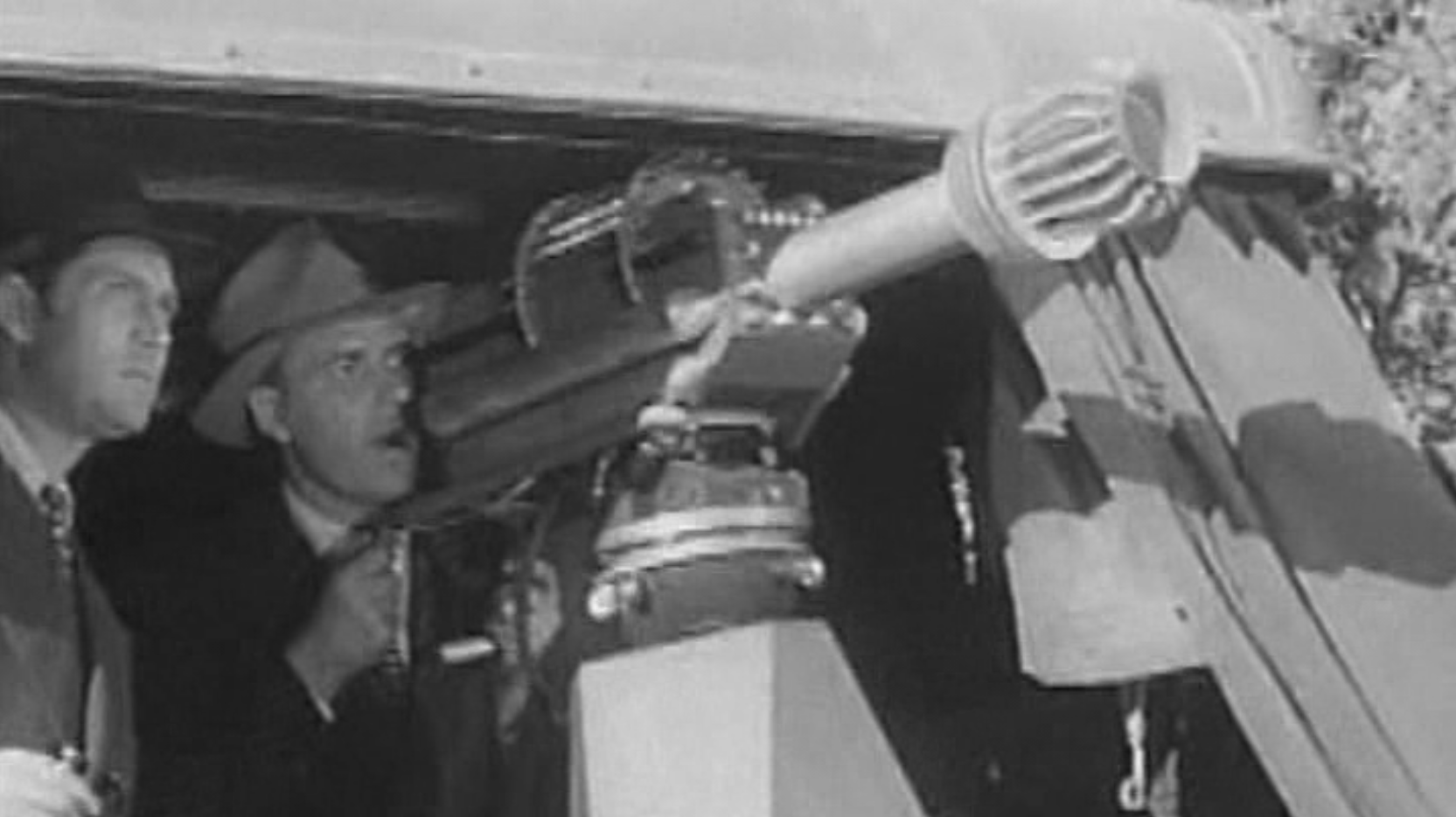
In Serial Mix, Radar Men is cut to a brisk 64 minutes, with an emphasis on Cody’s flying suit and other gadgets and the adventure on the lunar surface. Excised almost entirely are several middle chapters focused on the lunarians’ Earth helpers, Daly and Graber, as they steal supplies or attack Cody’s laboratory. Those sequences are entirely mundane, and aren’t missed. Daly and Graber still appear, essential to the story as they are, but they get much less screen time.

Undersea Kingdom, at 77 minutes, is (to my mind) more successful in its adaptation. With a few exceptions, the story of Crash Corrigan’s journey to Atlantis is adapted closely but with transitions and redundant material elided (often with the use of wipes imitating those in the original). The scene in which Corrigan is forced to take part in gladiatorial combat and wins the loyalty of fellow prisoner Moloch is skipped, as is the scene in which Corrigan saves the life of Atlantean high priest Sharad, earning him an invitation to lead the Atlantean army. The comic relief subplot with Smiley Burnette is omitted entirely (and since his scenes were shot and included after the fact, and his character doesn’t interact with Corrigan or the others at all, it’s an easy decision to make and takes nothing away from the main story).

SR.chariot

As one of a few special features on the disc, Keyser narrates “Remixing the Classics,” in which he describes his love of the serials and their effects and describes the process of editing them to shorter length. He points out some of the enhancements he made to the special effects, with before and after shots, and discusses the challenge of finding appropriate places to cut while preserving necessary plot information. This feature was of great interest to me and further illuminated Keyser’s approach.

SR.viewer1

Before and after: Keyser replaced a view of the lunar surface with a shot of the lunar city

Before and after: Keyser replaced a view of the lunar surface with a shot of the lunar city

Keyser also proves to be an engaging and knowledgeable host and storyteller; it’s clear that Serial Remix is a labor of love, and in addition to looking at the choices involved in editing, he takes a broader look at the conditions under which serials were made. Often rushed (he points out that Undersea Kingdom was made in 25 days) and made for low budgets, the serials naturally fell back on recycling props (such as the electrical devices built by Kenneth Strickfaden and used for set dressing in hundreds of films), costumes, story lines, and locations (such as Bronson Canyon near Hollywood). Keyser has no illusions as to the great artistic merit of the serials (I’ll accept his judgment that The Phantom Empire is “goofy,” but “bad”? No way!) but his enthusiasm is nonetheless one I share. Seen as one fan’s tribute to the boy’s-adventure spirit of the serials, Serial Remix is a very enjoyable and polished package.

Kenneth Strickfaden shown adjusting one of his electrical props

Kenneth Strickfaden shown adjusting one of his electrical props

Short Fiction at Defenestration

FG.Aura

I’m pleased to announce that a short “fake nonfiction” piece of mine has been published at Defenestration, “A Literary Magazine Devoted to Humor.” “Queen Aura’s Address to the People of Planet Mongo Upon Her Coronation Day” is just what it sounds like, a speech by the erstwhile Princess of Mongo eulogizing her father, Ming the Merciless, and setting a course for her planet’s future destiny. Regular readers of Fates Worse Than Death will recognize this as an outgrowth of my interest in pulp characters and, from my review of the 1936 Flash Gordon serial, my conviction that Aura is “the real hero of the story, resourceful, determined, and intense.” I hope you enjoy it.

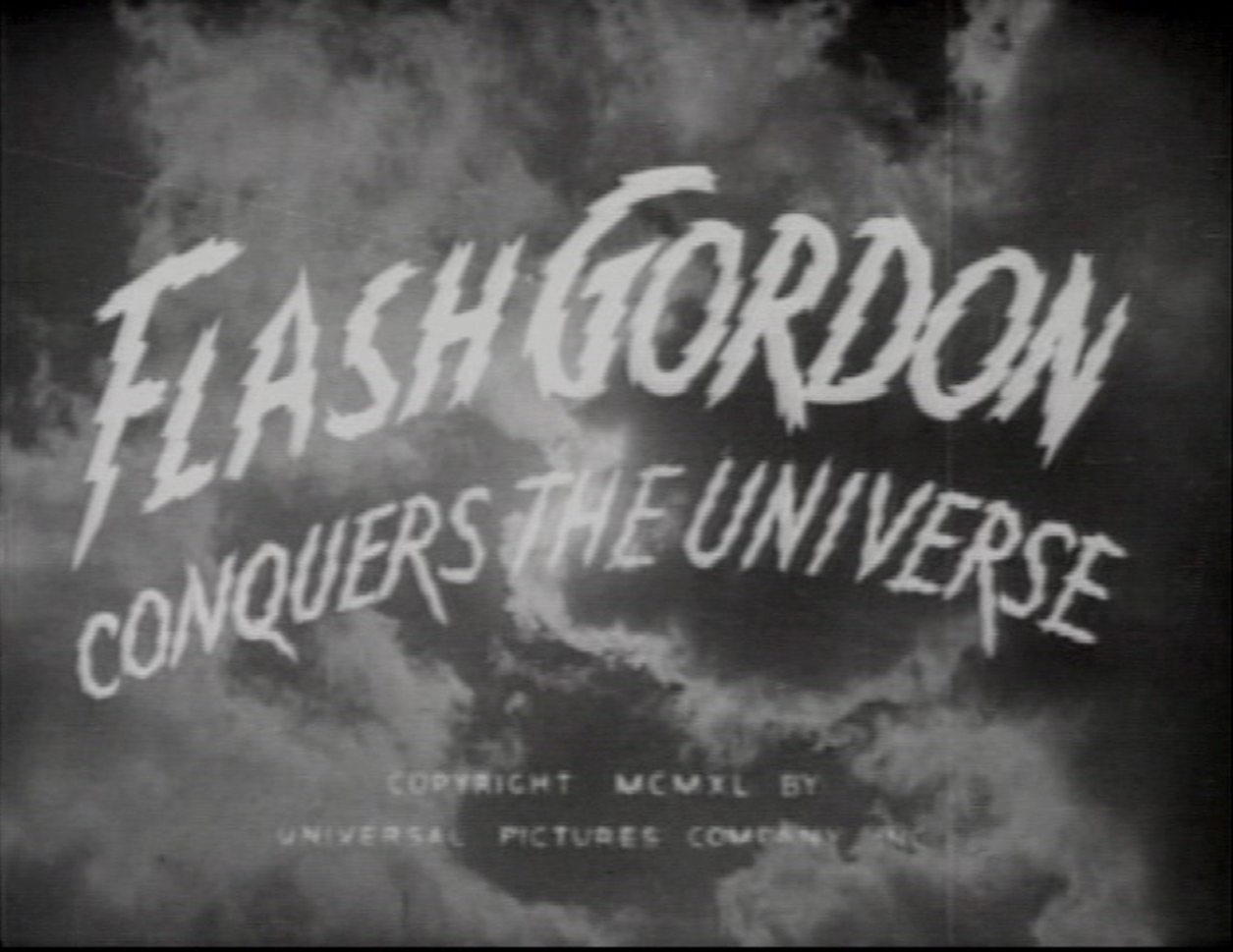
Fates Worse Than Death: Flash Gordon Conquers the Universe

FG3.title

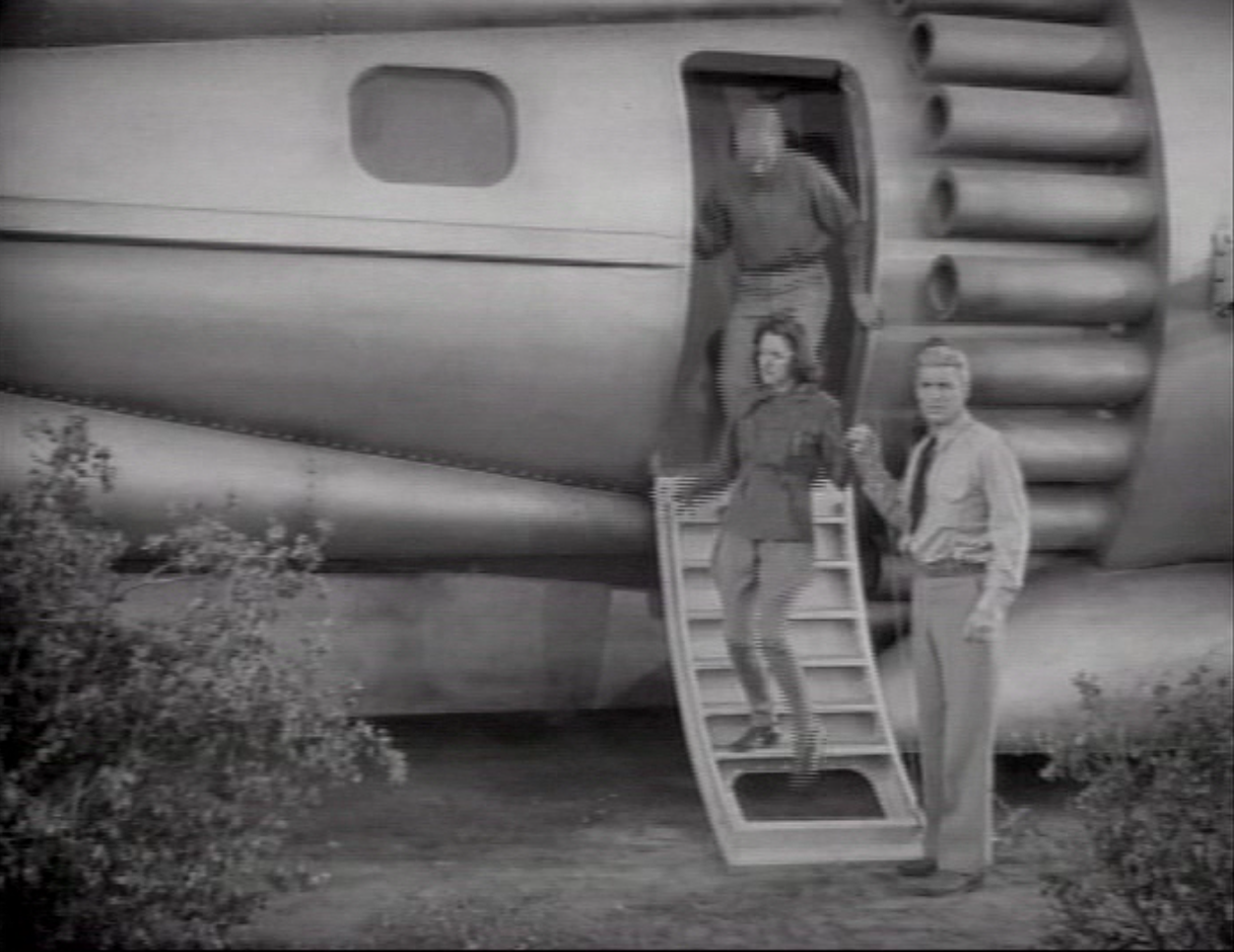
A mysterious plague is sweeping the Earth: known as the “Purple Death” because of the single purple spot it leaves on the skin of its victims, the disease is responsible for the deaths of thousands, and authorities are helpless to stop mounting panic. Professor Gordon is one of the scientists struggling to find a cure, and it is his son Flash (already a hero for saving the earth several times over) who, with Dr. Zarkov and Dale Arden, discovers the culprit. A ship from Mongo is spotted high in the atmosphere, dropping the malign dust that causes the Purple Death.

FG3.purpledeath

Starting for the planet Mongo at once in Zarkov’s rocket ship, the trio face aerial combat with the invading ship and, feigning a crash, descend to Arboria, the home of Flash’s ally Prince Barin. Barin confirms that Emperor Ming yet lives and is undoubtedly behind the attacks on Earth, and a council of leaders who are opposed to the merciless dictator soon convenes at Barin’s palace.

FG3.warcouncil

The only antidote for the Death Dust is the element “polarite,” which can be found in the far Northern reaches of Frigia, represented by Queen Fria. The expedition to the icy realm is bulked out with footage from an earlier polar exploration film, White Hell of Pitz Palu; footage of downhill skiers appears in the montage that opens each chapter, leading me to expect a snowbound assault on Ming à la The Spy Who Loved Me or Inception, but it never happens. (Also, it wasn’t until I was selecting screen caps that I noticed Flash and Dale in their cold-weather gear bear a strong resemblance to Santa and Mrs. Claus.)

FG3.coldgear1

Although the threat of the Purple Death doesn’t take twelve chapters to resolve, it’s the inciting incident that kicks off the latest round of strikes and counter-strikes in Flash Gordon Conquers the Universe, the third and final serial in Universal’s epic adaptation of Alex Raymond’s popular comic strip.

FG3.rocket4

Despite, or perhaps because of, its references to the events and characters of the 1936 and ’38 serials, Conquers the Universe shows just how much time has passed since the success of the first Flash Gordon. Many aspects of the production, impressive in ’36, would have seemed crude just four years later, especially with Republic’s slick, streamlined adventure serials entering the market in the mean time. The static recap cards from the earlier serials have been replaced by scrolling titles; this now-familiar format had been used in Buck Rogers (also starring Flash Gordon lead Buster Crabbe) and would appear in other serials of the 1940s (and of course was the inspiration for the similar opening crawl in the Star Wars films).

FG3.title.chapterhead

The pacing is rapid throughout, with clear but often functional dialogue that serves the plot; Flash Gordon was never about deep characterization or philosophy, but Conquers the Universe is especially plot-heavy. And while many effects look quaint to modern eyes (Mongo’s giant iguanas make an appearance, and electrical effects are frequently accomplished with zig-zag lightning bolts scratched directly onto the film), just as many impress with how effective simple devices can be, and there are enough new settings and perils that the serial doesn’t feel like a retread.

FG3.robots2

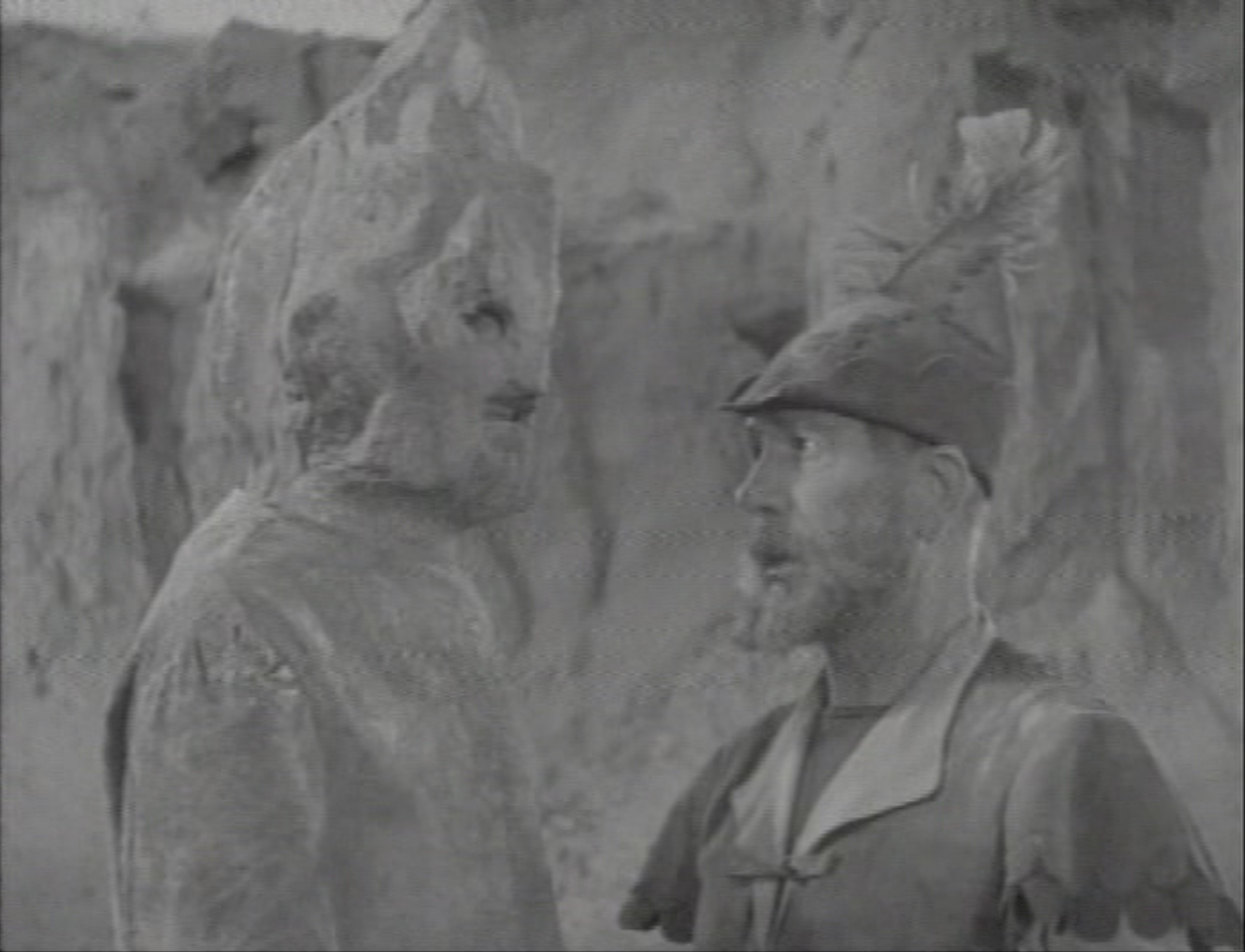
Of particular note are an assault by exploding robots (Chapter Three, “Walking Bombs”), given an uncanny mechanical gait through the magic of undercranking, and the tribe of “Rock Men” who dwell in Arboria’s “no man’s land.” (Unlike the Clay People of Flash Gordon’s Trip to Mars, the Rock Men only dress as rocks to camouflage themselves from the giant lizards.) The Rock Men speak backwards, and once Dr. Zarkov realizes that their language is the same as that of a “lost tribe” that once inhabited Earth’s Gobi Desert, he is able to communicate with them; after Flash saves the Rock King’s son from a disaster, they aid the Earthlings in their fight against Ming.

FG3.Rockman.Zarkov

Several plot elements that were missing from Flash Gordon’s Trip to Mars reappear in Conquers the Universe: Ming once again hopes to make Dale his bride, and Ming’s daughter Princess Aura reappears, still happily married to Prince Barin. The cast has been shuffled–Carol Hughes replaces Jean Rogers as Dale, and both Barin and Aura are recast (by Roland Drew and Shirley Deane, respectively)–but Buster Crabbe reprises the title role, Charles Middleton returns as Ming, and Frank Shannon again plays Dr. Zarkov.

FG3.Aura.Barin

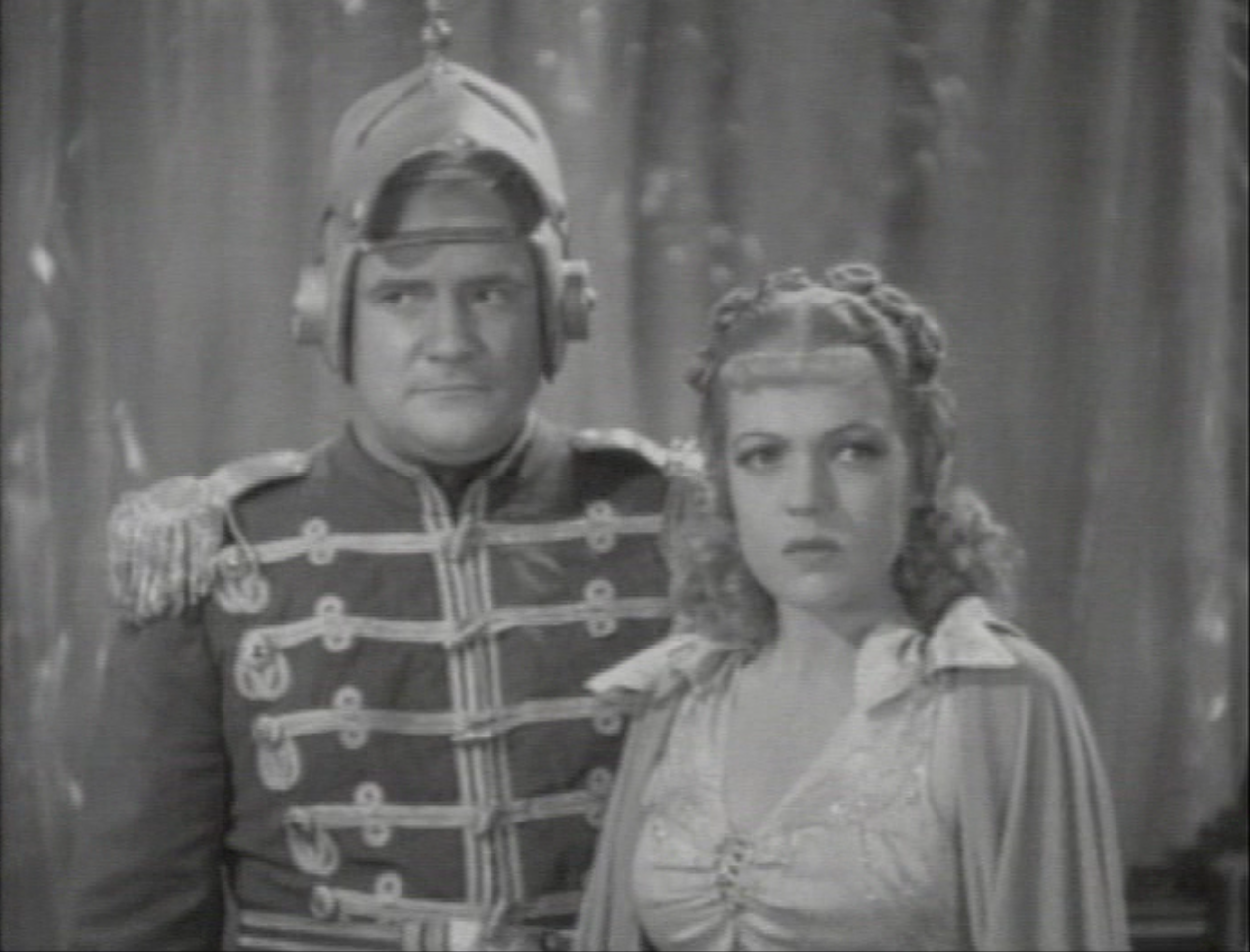
Speaking of Barin and Aura, the happy couple looks quite different from their earlier incarnations. As Barin, Drew cuts a more dashing figure than Richard Alexander: with his trim mustache and forest costume, he strongly resembles Errol Flynn as Robin Hood. As for Aura, the changes to her personality outweigh those to her appearance: instead of the scheming, morally flexible antiheroine of the 1936 serial, she is here entirely settled and content in her life in Arboria, and her reaction to being pulled back into her father’s evil machinations is passive terror and indignation. Marriage has domesticated her.

FG3.Aura.Sonja

Fortunately (or not, depending on your perspective), the lack of Aura’s feminine wiliness is made up for by the introduction of Lady Sonja (Anne Gwynne), an Arborian lady-in-waiting secretly loyal to Ming. Once Sonja lures Aura to Arboria’s Red Forest to be abducted by Ming’s forces (for even he would not bomb Arboria without first making sure his daughter was safe), the treacherous lady becomes half of a villainous double act with Captain Torch (Don Rowan). Together, Torch and Sonja, along with Lieutenant Thong (tee hee), shadow Flash Gordon & co. and bedevil them in a variety of ways, carrying out missions for Ming.

FG3.Torch.Sonja1

Sonja doesn’t have the depth of Aura–she’s purely spiteful and untrustworthy, without even the motivation of misplaced love–but it’s worth noting the number of female characters in the Flash Gordon serials and the range of their motivations. Aside from Dale, Aura, and Sonja, there’s Queen Fria of Frigia (an uncredited Luli Deste), who expresses a hope that Flash Gordon might be convinced to lead Frigia’s armed forces, teasing a source of tension with Dale (this comes to nothing, although it may be more fleshed out in the comic strips that are the basis of the story).

FG3.QueenFria1

In fact, Flash Gordon does a better job of female representation than the original Star Wars trilogy that it inspired: in Conquers the Universe, Dale is revealed to be an expert chemist and radio operator, a detail I don’t recall being mentioned before, but which gives her more to do than simply be kidnapped. It’s true that at least some of the women on-screen are purely eye candy, and there’s less of the emphasis on Buster Crabbe’s physique that made the 1936 serial an equal-opportunity source of titillation (like the Tarzan series, Flash Gordon in all its iterations has celebrated the body beautiful). Still, compared to the many serials I’ve watched that have only a single token woman, it’s refreshing that the population of the fantasy world of planet Mongo at least contains individuals of both sexes.

FG3.Dale2

Ultimately, Ming’s greatest weakness is the number of people in his service–guards, scientists, soldiers–who are willing to turn against him. The political subtext is no more complex or subtle than before–dictators are bad–but the story emphasizes that those who take power by force and cruelty will never have the loyalty of those they conquer. Rather, they will only breed a thirst for revenge in their underlings. As always, Flash Gordon inspires trust and confidence in those he meets simply by doing the right thing.

And what about that title, anyway? Conquering isn’t really Flash’s bag. As silly as it sounds, Ming in his arrogance declares at one point, “I am the universe!” So, by the transitive property, when Flash inevitably conquers Ming . . . well, you get the idea.

FG3.Ming1

But just in case you didn’t, Zarkov explains it.

What I Watched: Flash Gordon Conquers the Universe (Universal, 1940)

Where I Watched It: A two-disc DVD set from Timeless Media Group

No. of Chapters: 12

Best Chapter Title: “Doom of the Dictator” (Chapter Twelve). Alliteration!

FG3.faceoff

Best Cliffhanger: Another plot thread that continues from the earlier serials is Ming’s desire to have Zarkov’s scientific genius at his command. So, in Chapter Four (“The Destroyer Ray”), when Ming has Zarkov captive and the Earth scientist refuses to serve him, Ming orders his execution. A death ray slowly moves toward the chained scientist, and when Flash shows up to rescue him, he appears to be caught in it, too. What really elevates this is that Ming, surrounded by his retinue, has forced Dale (also captive) to watch the scene unfold. She begs Ming to spare them, beating on his chest with her fists, and then covers her face, unable to watch, while Ming cackles at his victims’ helplessness. “He has chosen his own death!” he sneers. This is what we watch serials for.

FG3.Dale.Ming1

A Note on Costumes: Although there’s still a great deal of space opera exoticism, including long looks at the harem-like entertainments Ming has at his disposal, the costumes and sets display fewer of the ancient or near-Eastern motifs that were prominent in the earlier serials. Barin’s palace resembles a traditional European castle, with parapets and everything, and most of the male characters dress in military uniforms with braids and epaulets; except for the ray guns and space ships, Arboria might as well be Ruritania, an imagined Mitteleuropa in outer space.

FG3.roka.flash

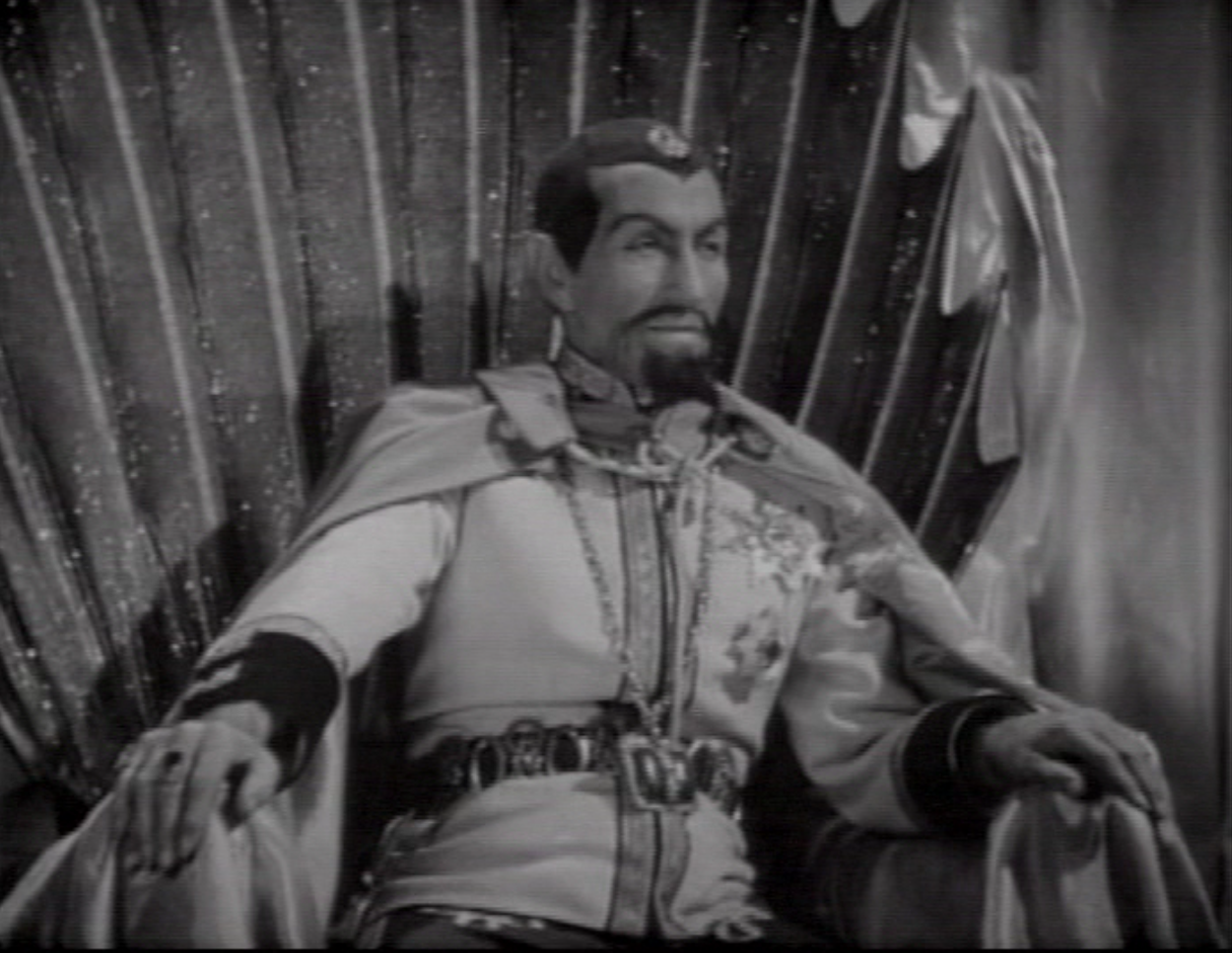
Even Ming gets in on the act, assuming a high-plumed dress uniform, “now more a wicked general than Satan” in the words of Jim Harmon and Donald F. Glut. One could assume that proximity to Earth has affected Ming’s tastes: although most of Ming’s pleasures are accompanied by stereotypical “Oriental” music, the soundtrack is a distinctly modern rhumba in Chapter Four, leading me to imagine Xavier Cugat and his orchestra chained to a bandstand and forced to play just off-camera. You’re a peacock, Ming. Strut, Ming, strut.

FG3.Ming6

Sample Dialogue: “Seems like old times, being at war again with Ming, Zarkov.” –Flash Gordon, Chapter Two (“Freezing Torture”)

FG3.television2

What Others Have Said: “Earth heroes have journeyed to other worlds by Crystal Door and spaceship. Our own planet has been invaded many times by alien menaces bent on dominating the Earthlings. In all these instances there have been mighty conflicts between good and evil. But after the holocaust of ray zapping and atomic blasting had settled, the audiences huddled in the safety of terran movie houses admitted one important fact: There was only one alien tyrant capable of conquering the universe, Ming the Merciless. And there was but a single hero able to defeat him–Flash Gordon.” –Jim Harmon and Donald F. Glut, The Great Movie Serials

That brings this summer’s serial coverage to an end. I’ll probably still have a few serial-related articles coming up, and Medleyana will continue to update on other topics, but that’s it for regular entries until next summer. Until then, thanks for reading along, and thanks for all the comments and support!

Fates Worse Than Death: Flash Gordon’s Trip to Mars

FG2.title

At the end of Universal’s 1936 serial Flash Gordon, Flash, Dale Arden, and Dr. Zarkov are bound for Earth by rocket ship after saving the planet from destruction by the invading planet Mongo and its ruthless Emperor, Ming (who was, to all appearances, burned to death in the “Tunnel of Terror,” leaving his daughter Aura and Prince Barin to rule over Mongo with a presumably gentler hand). As the 1938 sequel Flash Gordon’s Trip to Mars begins, the people of Earth are still awaiting that rocket ship, which successfully lands in the first chapter. That makes Trip to Mars a direct continuation of the original serial, and in many ways it’s a sequel in all the modern senses of the word: it has most of the same cast as the first (although as Dale Arden, Jean Rogers has inexplicably let her hair return to its natural brunette during the trip from Mongo to Earth), and is in all ways bigger, with more ambitious effects, more locations, and greater length (fifteen chapters instead of thirteen). There are even some flashbacks to the 1936 serial spliced in to explain plot developments.

FG2.Dale1

It’s worth noting that the practice of making sequels and series, what we now call film “franchises,” is nothing new, and wasn’t even new in 1938. Some of the long-running episodic serials like Hazards of Helen were closer to ongoing series than the closed narratives of the serials I’ve been examining here. Beginning in the silent era, popular characters such as Boston Blackie, Charlie Chan, and Tarzan had proven that cinema audiences liked to catch up on the adventures of familiar characters just as much as book and magazine readers did. By the time Flash Gordon was taking his trip to Mars, the Andy Hardy series was already on its fifth installment, and it had only started the year before! Similarly, the Dead End Kids made six films for Warner Brothers between 1937 and ’39. The Blondie series, which would eventually run to twenty-eight films, also began in ’38.

FG2.cockpit

No sooner have Flash (Larry “Buster” Crabbe) and company returned to heroes’ welcomes (SUPER-MEN OF CENTURY WIN WORLD ACCLAIM! reads my new favorite newspaper headline) when Earth suffers an attack similar to that which opened the ’36 serial. Disasters and weather events threaten the planet, this time tied to mysterious beams of light emanating from the planet Mars. Suspecting the hand of their erstwhile foe Ming, Flash and his allies (joined by a reporter who stows away on the rocket ship) take off for Mongo. However, unlike Abbott and Costello, Flash does actually end up on Mars, as the deadly beam interferes with their ship and causes them to crash on the red planet.

FG2.Azura.Ming1

In a twist that will surprise no one, Ming (Charles Middleton, in fine scenery-chewing form) is on Mars, having survived the flames of the Tunnel of Terror (it’s eventually explained that he can walk through flames without injury), and he is cooperating with the Martian Queen Azura, using the beam to draw “nitron” from Earth’s atmosphere, which Azura can use as an explosive in her war against the Clay Kingdom (and without which the Earth will die, suiting Ming’s purposes nicely). Ming’s goals are conquest and revenge upon the Earthlings who thwarted him before; his previous goal of marrying Dale Arden is never mentioned.

FG2.forest

As the events of the serial take place on Mars, there are several new settings and exotic races for Flash and company to encounter and either overcome or win to his side. The Fire People live in a gnarled forest, dressed in caveman furs and worshipping idols; loyal to Ming, they imprison Flash the first chance they get, leading him to a reunion with his old ally Prince Barin (Richard Alexander), also a captive of the Fire People. The Martians themselves, Azura, and her palace are pure art deco space opera, equal parts Galactic Empire and Emerald City of Oz. In fact, the embrace of fantasy is even more committed here than in the first Flash Gordon serial: although there’s still a great deal of pseudoscientific rationalization with rays and “nitron” and “televisors” and so on, at some point the writers threw their hands in the air and said, “Fuck it, it’s magic.” The Glenda-like Azura is described as a “Queen of Magic,” with a white sapphire that allows her to teleport in a puff of smoke and lay curses on her enemies.

FG2.Azura

The victims of one of those curses, the Clay People, were once normal Martian men until they rebelled against Azura, and she transformed them into mud monsters, exiled to a remote cave. As the Clay King, British actor Montague Shaw delivers his lines through an immobile rubber mask, the equivalent of casting Alec Guinness and Peter Cushing in Star Wars and having them play Jawas. The Clay People occupy the moral middle ground that Vultan and his Hawk Men occupied in the first serial: waging war against Azura and suspicious of spies, they at first capture Flash and his friends, holding Dale hostage until Flash can bring the Queen to them and force her to undo their curse. After winning their trust, however, Flash and company find the Clay People capable allies, and they’re eventually able to help them regain their human forms.

FG2.Clayking

As far as the new additions to the cast go, reporter “Happy” Hapgood (Donald Kerr) is a typical sequel misstep: the “cool” character who comes along for the ride (in this case literally) to provide comic relief and deflate the stuffiness of the proceedings, but who doesn’t add as much as he detracts. Such characters are sometimes meant to be audience surrogates, seeing with fresh eyes the wonders that the heroes take for granted. In the case of Flash Gordon, however, that isn’t really necessary, as his essentially open nature is part of the character’s appeal; he may not be impressed by the likes of Ming, but he doesn’t really do “jaded,” either. Also, Hapgood’s one-liners, delivered with “make ’em laugh” intensity and frequency, just aren’t that funny. Fortunately, after the first couple of chapters he isn’t that prominent in the serial, providing Dale some company while she’s held hostage and providing the fight scenes an extra body when rough stuff is necessary, limiting his jokes to only one or two per chapter.

FG2.Azura.Ming2

On the plus side, I’ve made no secret of my appreciation for the haughty, imperious women who often turn up in the serials: think of Princess Aura, or Queen Tika from The Phantom Empire. So it will be no surprise that I enjoyed Beatrice Roberts’ performance as Azura, her eyes flashing and lip curling with amusement at the primitive Earthmen opposing her, and delivering lines like “Thus do I banish all traitors!” Of course, Azura learns what stern stuff Flash is made of, although it’s noteworthy that she doesn’t fall in love with him. Like Tika, she’s ultimately a tragic figure who realizes too late that she’s cast her lot with the wrong side. (Another connection to Tika is the presence of mustache-twirling character actor Wheeler Oakman, who played the treacherous Lord Argo in Phantom Empire. Here Oakman plays Azura’s captain of the guard Tarnak, who willingly serves Ming until he realizes that the Emperor intends to follow up destroying Earth by doing the same to Mars after it has served his purposes.)

FG2.Tarnak

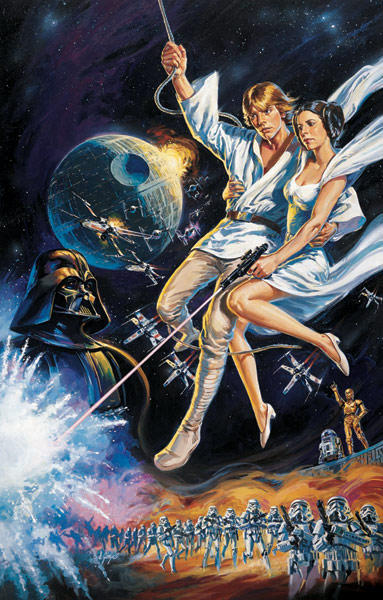
If anything, Flash Gordon’s Trip to Mars sets the template for Star Wars even more clearly than the 1936 serial: there are broad similarities, shared by many serials, such as the blend of exotic locations, flashy visuals (including cutting-edge effects and immersive production design), and fast-paced action, combined with the fairy-tale clash of good and evil. The stirring music (including a version of the love theme from Tchaikovsky’s Romeo and Juliet) and remixing of ancient and medieval motifs with futuristic elements is also something that George Lucas would update for his space fantasy. But there are little moments, too, that stick out: the quirky music that accompanies the Clay People, for example, is echoed in the Jawas’ theme; the repeated back-and-forth as Flash and his allies return to Azura’s high-tech city for one reason or another–to destroy the “nitron lamp” that is slowly draining the Earth; to find an antidote for the “Incense of Forgetfulness”; to confront first Azura and then Ming–is one source for Luke Skywalker and the Rebels’ infiltration of the Death Star and their later raids on it (and its successor in Return of the Jedi). Flash even rescues Queen Azura from falling off a “light bridge” by swinging on a cable, a move borrowed from Douglas Fairbanks and Errol Flynn and recreated by Mark Hammill with Carrie Fisher.

StarWars_Gouzee

It all comes down to a final confrontation, and although Crabbe would return as Flash one more time in Flash Gordon Conquers the Universe, it appears that Ming is defeated, and Mars, like Mongo, is left in better hands. The four heroes return to Earth, and to my amusement the newspaper headline again reads SUPER-MEN OF CENTURY WIN WORLD ACCLAIM! (I like to imagine an editor, knowing that he already struck gold once with that headline, saying to himself, “Why mess with perfection?”)

FG2.Flash.Ming1

What I Watched: Flash Gordon’s Trip to Mars (Universal, 1938)

Where I Watched It: It’s on YouTube in its entirety.

No. of Chapters: 15

Best Chapter Title: “The Black Sapphire of Kalu” (Chapter Eight). I usually define “good” chapter titles as having a certain punch or flair, or capturing the tone of the serial especially well, and there are several chapter titles in Trip to Mars that meet that standard. I chose this one, however, because of its specificity, a somewhat rare quality in chapter titles.

Best Cliffhanger: Just as Flash Gordon found its titular hero robbed of his memory thanks to one of Princess Aura’s schemes, so here does Flash’s paramour Dale Arden experience the “Incense of Forgetfulness” in the Temple of Kalu at the end of Chapter Ten. Convinced that she is a servant of the forest people’s god, she stabs Flash in the back when he shows up to rescue her. (Flash recovers from his wound, but only by returning to Azura’s city are Flash and Zarkov able to find an antidote so Dale can recover her memory.)

FG2.Dale2

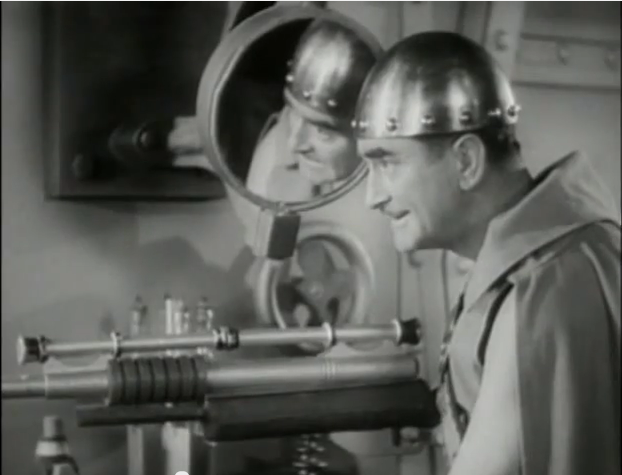
Another Note About Costumes: In my review of Undersea Kingdom, I noted the prominence of Roman-style helmet crests and other kinds of cranial plumage in the costume design. Mars appears to have a similar taste for adornment based on the uniforms of Queen Azura’s soldiers (here, Flash, disguised as a member of Azura’s Death Squadron, pretends to hold Dr. Zarkov prisoner):

FG2.Flash.Zarkov

And just look at this fellow on the left:

FG2.plumes

Sample Dialogue: “I’d feel a lot better if I had a parachute instead of these Martian wings!” Dr. Zarkov (Frank Shannon), just before bailing out of a “stratosled” (Chapter Four, “Ancient Enemies”)

FG2.Zarkov

Bonus Sample Dialogue: “I wonder what the wife’s going to say when I get home!” –“Happy” Hapgood (Chapter Fifteen, “An Eye For an Eye”)

What Others Have Said: “We tried to buy the rights to Flash Gordon from King Features but the deal would have been prohibitive. They wanted too much money, too much control, so starting over and creating from scratch was the answer.” —Star Wars producer Gary Kurtz in a 2010 interview with the Los Angeles Times

What’s Next: After the epic length (about five hours) of Flash Gordon’s Trip to Mars, I’m going to take next week to focus on a special topic: serials cut down to feature length.

Fates Worse Than Death: Panther Girl of the Kongo

PG.title

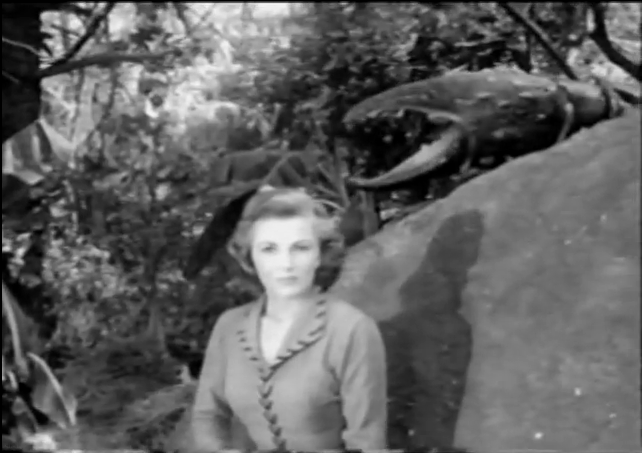
While filming wildlife in the jungle for a foundation, Jean Evans and her native guides stumble across a terrifying monster: a giant, horse-sized crustacean with huge pincers. The chief of the Utanga people, Evans’ hosts, suggests that she contact Larry Sanders, a hunter on safari in the area, and enlist his help: “Bwana Sanders big hunter,” says Timbu, Evans’ rifle bearer. “He go with us, me go.”

PG.Evans2

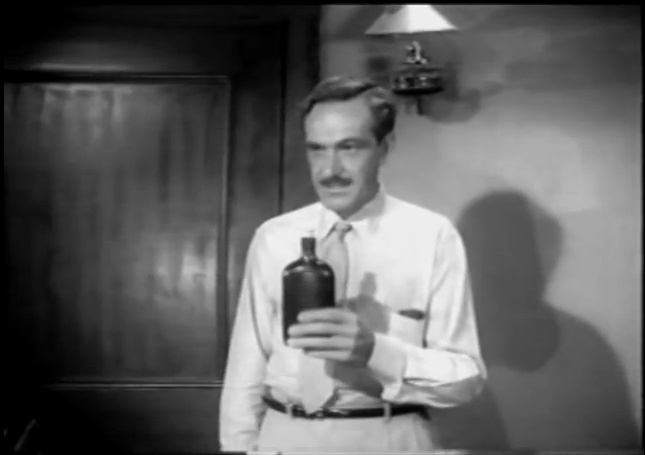
In the mean time, two other white men in the area are causing trouble: Cass and Rand, first posing as hunters, try to intimidate Sanders into leaving the area. As the audience soon finds out, the pair is in the employ of Morgan, a chemist living on his own in the jungle. Morgan has discovered that an abandoned gold mine in the jungle is full of diamonds, and he’s using a “hormone compound” of his own creation to turn ordinary crawfish into the giant “devil beasts” to scare off intruders. He must be careful, however: the monsters are useful if they frighten the natives away from the mine, but if Evans and Sanders are able to bring proof of their existence to the colonial authorities, a force of soldiers is sure to be sent in to clean up the district, spoiling Morgan’s plans.

PG.Morgan2

So begins Panther Girl of the Kongo, almost the last serial Republic produced (only one more, King of the Carnival, followed). Since I’ve been watching serials for Fates Worse Than Death, I’ve idly speculated about a combination of the serial format and its two-fisted plotlines with the monster movie, another favorite genre. Panther Girl is in many ways that film, although it is closer in spirit and technique to Them! and the other “giant bug” movies of the 1950s than it is to Godzilla or any of the rampaging kaiju films that followed.

PG.Beast3

It should be immediately apparent that the “devil beast” (alternately, “claw monster”) actually is a normal crawfish filmed in extreme close-up to make it look large, sometimes surrounded by miniature props (provided, as always, by the Lydecker brothers, Howard and Theodore, who at least receive onscreen credit this time) to give it a sense of scale. Even better, the actors are sometimes inserted into the foreground via rear projection, relying on perspective to enhance the illusion, but just as often the creature’s size is implied through the magic of editing. And when someone is unfortunate enough to be attacked by the devil beast, it takes the form of a single enormous claw extending from offscreen, like the giant hand grabbing Fay Wray in King Kong.

PG.claw

Other than the formal restraints placed on it by being a serial–division into chapters with contrived cliffhanger endings–Panther Girl feels very much of its time: by comparison to the often melodramatic serials of the 1930s, it’s very no-nonsense, with an emphasis on the professional competence of the two leads. Although thankfully not as inert as Radar Men From the Moon, the characters are fairly dry, emphasizing that they have jobs to do and they’ve got to be done right. Even the “mad scientist,” Morgan, plays things cool: he’s in it for the money, not revenge or a grand scheme to remake the world. Other than the trendiness of the mammoth crawfish (which invite comparison to director Bert I. Gordon‘s similar low-budget giants), the small scale of the action and limited number of characters make it feel very much like a television production.

PG.Beast2

Television was surely having an impact: although Panther Girl was released in theaters, Republic obviously made the film with an eye toward repackaging it for broadcast. Other than the first chapter, which is about twenty minutes long, all the chapters are about thirteen minutes in length. Two chapters could be aired during a half-hour block with room to add commercials. A number of serials had already been cut down to feature length and licensed for television broadcast, and several characters who had appeared in theatrical serials had made the jump to TV-only productions. Even the actors in Panther Girl were doing most of their work for the small screen. In the face of competition that kept audiences–especially kids–at home, the serials were on their way out.

The lead actress, Phyllis Coates, had played Lois Lane on television opposite George Reeves in Adventures of Superman (she had also appeared in a previous serial, Jungle Drums of Africa, with Clayton Moore, television’s Lone Ranger; I haven’t seen it, but it doesn’t seem to have been very impressive). Myron Healey, who played Sanders, was a prolific character actor usually cast as the heavy; most of his credits were from television. In 1955, the year Panther Girl was released, he had parts in over twenty films or TV episodes. His performance here reminded me of Russell Johnson’s Professor on Gilligan’s Island.

PG.EvansSanders2

Commentators have noted an increased reliance on stock footage during Republic’s later years, another sign of pinched budgets. In the case of Panther Girl, the scenes of Evans (who, in a flashback, earned the title “Panther Girl” by saving the Utanga village from a black panther that had been prowling around and attacking the villagers) swinging from vines and mounting a tame elephant were repurposed from Jungle Girl, an earlier serial starring Frances Gifford. That is apparently the main reason Evans appears to have gone native in a short buckskin tunic.

PG.elephant

Her costume and familiarity with vines aren’t the only traits she owes to Tarzan and the jungle monarchs who preceded her. Both Evans and Sanders take the natives’ obedience for granted: the Utanga speak pidgin English and address the whites as “Bwana” (“boss,” “master”) and although they sometimes have to be persuaded to take a course of action, they mostly fall in line. When Evans and Sanders conceive of digging a pit to trap one of the devil beasts, Sanders says, “Let’s head back to the village and get the natives started.” (Morgan also has a tribe of natives to boss around in addition to his two white henchmen: the Returi are addicted to a “tonic” he supplies them with and will do his bidding to get it.)

PG.Morgan1

Although minor, there are pleasures to be found in Panther Girl of the Kongo: the giant crawfish is imaginative, if not exactly scary, and the two leads are a pair of likeable squares who work well together. Morgan (Arthur Space) isn’t the most compelling villain but his plans lead to a dramatically satisfying increase in peril for our heroes, from stolen evidence to quicksand, then to being shot at and blown up with dynamite. On the negative side, the representation of African natives obviously wouldn’t be acceptable today; it’s one cannibal cooking pot away from hitting almost every stereotype imaginable and says more about the popular image of colonialism than the reality. (A pair of stiff-upper-lipped Brits in pith helmets show up to handle the Returi tribesmen toward the end, but they’re hustled offstage quickly so that Evans and Sanders can confront Morgan by themselves. If those British soldiers wanted in on the action, they should have gotten their own serial.)

PG.soldier

What I Watched: Panther Girl of the Kongo (Republic, 1955)

Where I Watched It: The whole thing is posted on YouTube.

No. of Chapters: 12

Best Chapter Title: “Test of Terror” (Chapter Five). The test in question is the “Test of the Lion Men,” in which Jean Evans reassures the doubting natives that she still has the protection of the gods by entering an arena and killing a lion. Based on the costumes, and the fact that this interlude makes no sense, I assume it’s also cribbed from an earlier film.

PG.lion

Best Cliffhanger: At the end of Chapter Three (“The Killer Beast”), Evans is captured by the Returi and tied to a tree while one of the tribesmen plays a drum to lure predators from the jungle. The goal is to fool the Utanga into believing that the Panther Girl has been slain by wild animals. A gorilla attacks her while she’s tied up, and Sanders is unable to help her after being knocked out by the Returi.

Annie Wilkes Award for Most Blatant Cheat: Most of the cliffhanger resolutions play fair. The most questionable is at the end of Chapter Ten (“Blasted Evidence”), in which Cass and Rand throw a bomb through the window of Evans’ house where she and Sanders have just shown the district police inspector the film of the devil beast, convincing him to send reinforcements to the district. It appears that the bomb explodes immediately, engulfing the house in a great fireball.

PG.explosion

However, as shown at the beginning of Chapter Eleven (“Double Danger”), the bomb doesn’t detonate right away, and the three have the chance to flip over a table and shield themselves from the blast. Even so, I’m not sure how they escaped being burned alive.

Biggest Surprise: I fully expected the mad scientist Morgan to die at the hands–er, pincers–of one of his own devil beasts. It just made sense: he grows the things in a crate right in front of his own house where the final showdown occurs, and the filmmakers even make a point of having Evans and Sanders discover it, solving that part of the mystery. But that’s it: I won’t share how he gets his comeuppance, but it isn’t death by claw. Perhaps there was originally an intent to deliver poetic justice but filming it didn’t work out. In any case, the ending makes it seem that the devil beasts aren’t really that dangerous, aside from that nasty pinch.

Sample Dialogue: “Panther Girl bad magic, bring devil beast, make pictures for her. Devil beast kill natives. She no care!” –Returi tribesman, sowing discord among the Utanga (Chapter Five, “Test of Terror”)

PG.Returi

What Others Have Said:Panther Girl of the Kongo could not save the Republic serial from extinction. The first and last female serial star from that studio wore the same jungle garb. But the clothes and every setting and situation they appeared in, in 1955, was secondhand and worn out.” –Jim Harmon and Donald F. Glut, The Great Movie Serials: Their Sound and Fury

What’s Next: Flash Gordon’s Trip to Mars

Fates Worse Than Death: The Miracle Rider

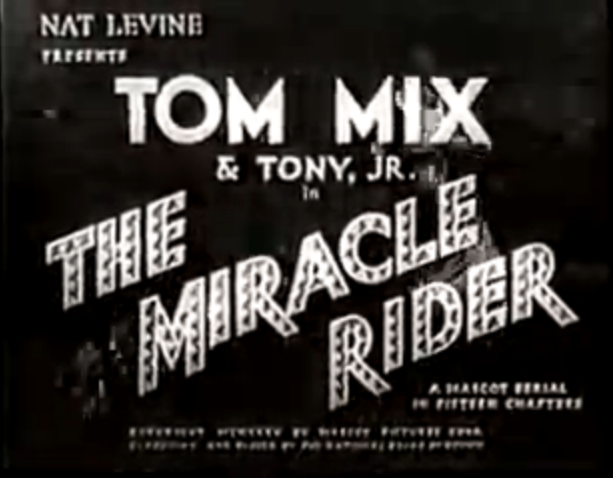
TMR.title

Tom Morgan, Texas Ranger, has been a friend to the Ravenhead Indians since his father, also a Ranger, died protecting the Indians’ land from “reservation jumpers,” and has even been made an honorary chief of the tribe. But now the Ravenhead face a threat that has even Tom Morgan stumped: attacks by the legendary “Firebird” have some members of the tribe agitating to leave their land. Morgan doesn’t believe in native superstitions, but who could gain from forcing the Indians off their land? Could it be merchant Emil Janss, who depends on the Indians for trade but who is also hoping to sell a large parcel of land to the government for use as a new reservation? Is it Longboat, a disgruntled member of the Ravenhead who hopes to usurp the rightful chief? Or is it Zaroff, an oil baron who appears to have an unusual interest in the reservation land? These questions and more are answered in The Miracle Rider, starring beloved Western icon Tom Mix!

TMR.Tom

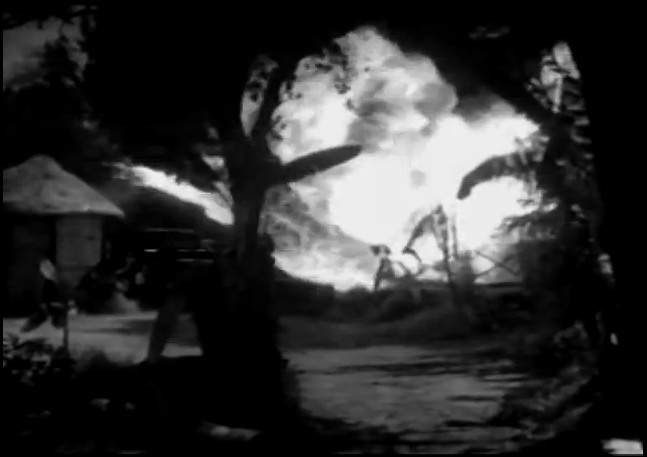
Actually, it doesn’t take long for the audience to find out that it is Zaroff (Charles Middleton, Flash Gordon‘s Ming) behind the attacks; posing as an oil man, Zaroff is secretly mining “X-94” on Indian lands, an incredibly powerful explosive which he plans to sell to an unnamed foreign power. In addition to refining and finding applications for X-94 (which later include a super-fuel), Zaroff’s chief scientist Metzger (Niles Welch) has created the high-tech gadgets that have the Ravenhead convinced that they are under attack. An Archimedes’ mirror-like heat ray causes fires to “spontaneously” ignite on the reservation, and a remote-controlled rocket glider with a whining electric siren is the Firebird itself.

TMR.glider1

The Miracle Rider was Mascot’s follow-up to The Phantom Empire, and because of its infusion of the modern Western with up-to-the-minute scientific speculation, Jim Harmon and Donald F. Glut considered it as part of the “zap-gun Western” fad in their book The Great Movie Serials. However, as I argued in a recent look at science fiction Westerns, The Miracle Rider isn’t nearly as fantastical as The Phantom Empire. Although there is some novelty in seeing Tom Mix in his giant cowboy hat ride the bat-winged rocket glider, Zaroff and his weaponsmith Metzger are not very different from the criminal masterminds and spies that other serial, pulp, and comic book heroes were facing in the mid-1930s.

Most of the super-scientific inventions the writers of these stories came up with were just refinements of existing technologies (communication and remote control by radio; ever-more powerful explosives) or inventions that were widely regarded as just around the corner (television). Plot-wise, X-94 is less important as a scientific discovery than as the MacGuffin that motivates the plot: in the inter-war years, as in the Cold War, espionage often took the place of actual combat, so a new invention or discovery in danger of being stolen by the enemy was a reliable story starter. Finally, the rocket glider, which is genuinely eerie, crashes in only the second chapter, snuffing out any potential for airborne thrills.

TMR.glider2

Modern viewers will also recognize quite a bit of Scooby-Doo in the basic plot, with one meddling Texas Ranger the only thing standing between Zaroff and his goal to be “the most powerful man in the world” (as he says out loud several times). At first, Zaroff throws suspicion on Janss, the merchant (Edward Hearn), but when Janss figures out what’s going on he demands to be cut into the deal. Longboat (Bob Kortman), the treacherous Ravenhead, is also under Zaroff’s thumb: in addition to his desire to be chief, Longboat is secretly a “half-breed,” making him vulnerable to Zaroff’s blackmail. With the addition of Zaroff’s gang of interchangeable henchmen and his right-hand man Carlton (Jason Robards, Sr.), that makes for quite a few villains Tom Morgan must get through before he can accuse and apprehend Zaroff.

The Miracle Rider begins unusually, with a fifteen-minute prologue dramatizing the shrinking of the Indians’ land in the face of white incursion. (I suspect this prologue was cut off in at least some markets; I’ve seen versions of The Miracle Rider that omit it, and it adds only background information not vital to the plot.) From 1777 up to Custer’s Last Stand, the struggle for land is dramatized as a series of historical figures including Daniel Boone, Davy Crockett, and Buffalo Bill Cody stand up to white poachers and claim jumpers to whom government agreements with Indians mean nothing. The invaders say things like “The sooner we kill off the Indians, the better it’ll be for all of us!” and “The Indian thinks he can keep land once the white man wants it!” Despite the efforts of the “friends of the Indian,” history is not on their side, as an animated map shows the spread of white settlement, with Indian territory squeezed into ever smaller spaces. By the time the U.S. government is shown granting the Ravenhead tribe a reservation twenty miles long “for all time,” it’s both pathetic and obvious that this will be just the latest in a long string of broken promises, but the filmmakers evidently intend it to be taken in earnest.

TMR.map

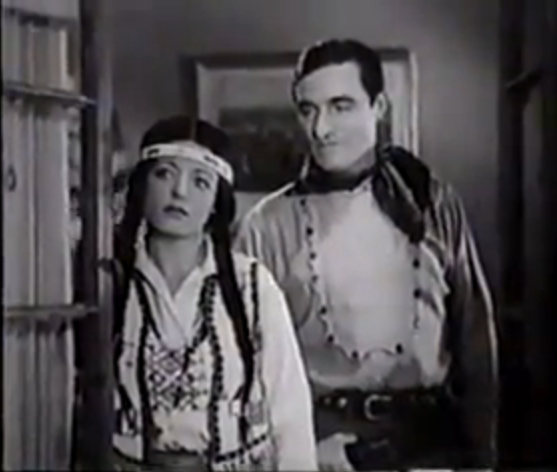
There’s much in The Miracle Rider that modern viewers could take issue with: most (though not all) of the Indians are played by white actors, and the Ravenhead are dependent on their “white brother” (or even “white chief”) Tom to protect them from those who would exploit them. But The Miracle Rider is surprisingly frank about the injustices suffered historically by Native Americans without making unrealistic saints out of them. Early on, the Ravenhead chief Black Wing (Bob Frazer) is killed by one of Zaroff’s men, leaving an opening for the corrupt Longboat to argue that the reservation land is cursed and they should migrate elsewhere. Black Wing’s daughter Ruth (Joan Gale) pleads with Tom to convince the tribe to stay; as the son of a Ranger who gave his life for the Ravenhead, Tom grew up among them and knows their ways (there’s that “best of both worlds” trope again). There’s no question that he would do what he can to help, but unlike more modern depictions that feature a corrupt or unreliable government, Tom is backed up by a solid and dependable Indian Agent, Adams (Edward Earle). Despite the presence of bad men like Zaroff, the forces of law and order haven’t given up; The Miracle Rider doesn’t claim that history could have been any different, but it does suggest that it’s at least possible to treat people, Indian or otherwise, with dignity and fair play.

TMR.Tom.Ruth

As for leading man Tom Mix, The Miracle Rider was both a beginning and an ending: Mix had made dozens of films (mostly Westerns, in many of which he played characters named Tom) and had been a huge star in the late teens and 1920s, famous for his flashy Western costumes and ten-gallon hat and his “million-dollar smile;” one of the first multi-media stars, Mix was at home in the circus performing Wild West routines and would later have a successful radio show. But Mix’s films in the ’20s had been silent, and the talkies he made in the ’30s were seen as something of a comeback, to varied success. Mix was in his fifties when The Miracle Rider was made, and while he still rides and shoots like a pro, he’s no longer the youthful romantic hero of his earlier films: at the end, after he’s been promoted to Director of Indian Affairs, he asks Ruth to come to Washington with him . . . as his secretary. “And here’s the contract,” he says: it’s a handshake. The Miracle Rider would turn out to be his last major film and his only sound serial.

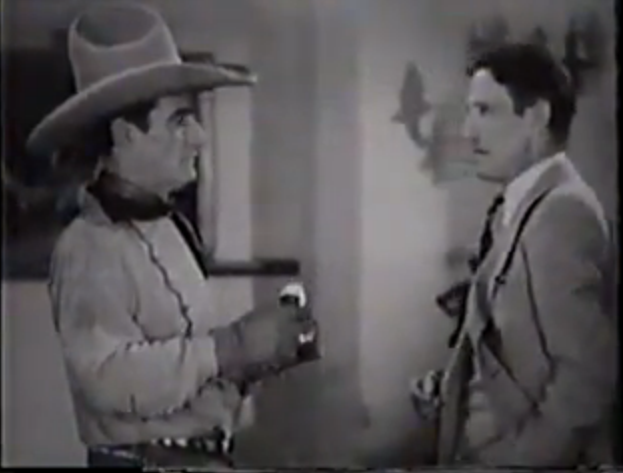
Despite some draggy sections (it’s gotten to the point where I inwardly groan when I see that a serial has 15 chapters), The Miracle Rider is the work of a man still innovating. In the very last chapter, Tom Morgan is held at gunpoint by Zaroff and two of his henchmen; when asked if he has a last request, Morgan asks to make a cigarette. After he takes too long, Zaroff impatiently bats the rolling papers away, sneering, “An old trick, Morgan! Trying to blow tobacco in our eyes, so we couldn’t see, eh?” At that moment, Tom’s horse (Tony Jr.) sticks his head in a car parked outside and honks the horn, distracting Zaroff and his men long enough for Tom to turn the tables. “That’s another old trick, Zaroff,” he says, “but you’ve got to have a good horse to do it.”

TMR.Tom.Zaroff

What I watched: The Miracle Rider (Mascot, 1935)

Where I watched it: I watched the whole thing on YouTube, which is why I haven’t included very many screen shots. My apologies; you can pretend it’s a radio program if you like.

No. of chapters: 15

Best chapter title: “Danger Rides With Death” (Chapter 12)

Best cliffhanger: At the end of Chapter 2 (“The Firebird Strikes”), Tom Morgan has infiltrated the Indian Cave hideout in which the “Firebird” rocket glider is stored; during a fight with Zaroff’s men, he climbs inside it and is stuck inside when it takes off. The chapter ends with the glider, remote-controlled by Zaroff, crashing to the ground in a fiery explosion. (Needless to say, Tom survives, in this case by parachuting out before the crash.)

Annie Wilkes Award for Blatant Cheat: In my discussion of Undersea Kingdom, I noted that Republic seemed to cheat its cliffhanger resolutions more frequently than other studios, but I think that habit began at Mascot, the studio that later became Republic. The resolution of the cliffhanger that ends chapter 6 (“Thundering Hoofs”) isn’t quite as mind-bending as the Annie Wilkes Award winner for Fighting with Kit Carson, but it plays pretty fast and loose, as do some others in this serial. In this one, Tom is riding with his captive, Sewell, tied up behind him, chased by one of Zaroff’s men on a motorcycle. Passing under a tree branch, Sewell reaches up and catches it with the ropes that bind him, hanging himself in the tree and pulling Tom to the ground, where he is in imminent danger of being trampled by horses. However, as the scene is reset at the beginning of chapter 7 (“The Dragnet”), the gang on horseback is distracted by Sewell hanging from the tree and simply stops riding. They don’t come anywhere near Tom, who is able to pick himself up with no problems. I can hear Annie Wilkes screaming about this one from here.

Sample dialogue: “Today the Ravenhead tasted the tongue of the Firebird–tonight they’ll fell its claws!” –Zaroff, Chapter 1 (“The Vanishing Indian”)

What others have said: “The present writers lack the psychic insight of some reviewers to know whether Tom Mix was bored with the serial or not, but certainly, what appears on the screen in private showings is a quiet professionalism. Tom Mix had ridden these familiar trails many times before, but nobody knew how to ride them better.” –Harmon and Glut, The Great Movie Serials

TMR.poster

What’s next: The Green Archer

Fates Worse Than Death: Undersea Kingdom

UK.title

A troubling rise in earthquake frequency and intensity has led Professor Norton to build an earthquake prediction machine, with which he also hopes to prevent future quakes. Guessing that the earthquakes are somehow being caused by radio signals from deep beneath the sea, Norton plans an aquatic expedition to find its source. “I hope you’re not going to spring that yarn of the lost continent of Atlantis,” chides reporter Diana Compton, but oh, yes! The Professor has his suspicions, and the discovery of oricalcum–the legendary metal that Plato described as unique to the sunken realm–gives the Professor all the evidence he needs to proceed.

UK.Norton2

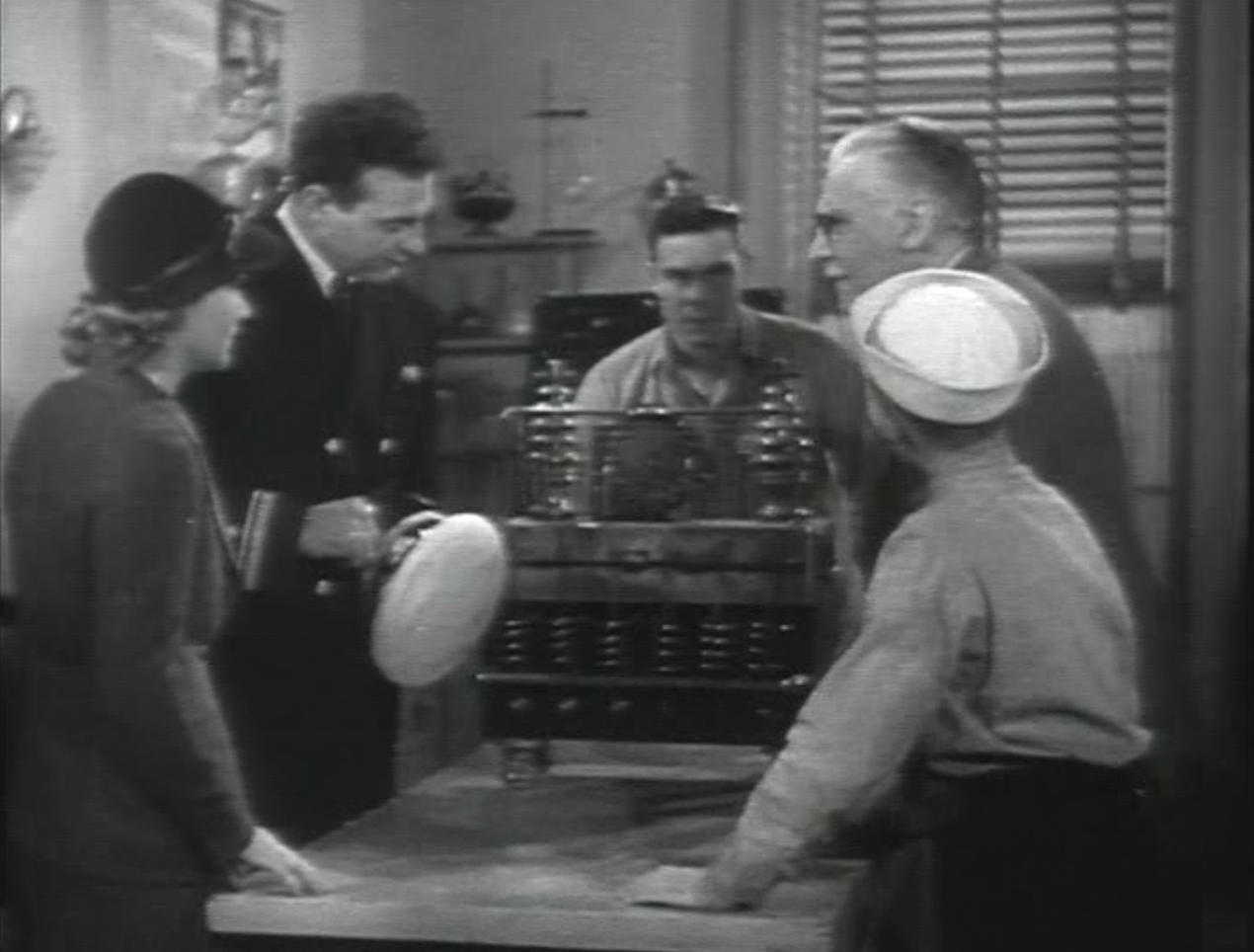
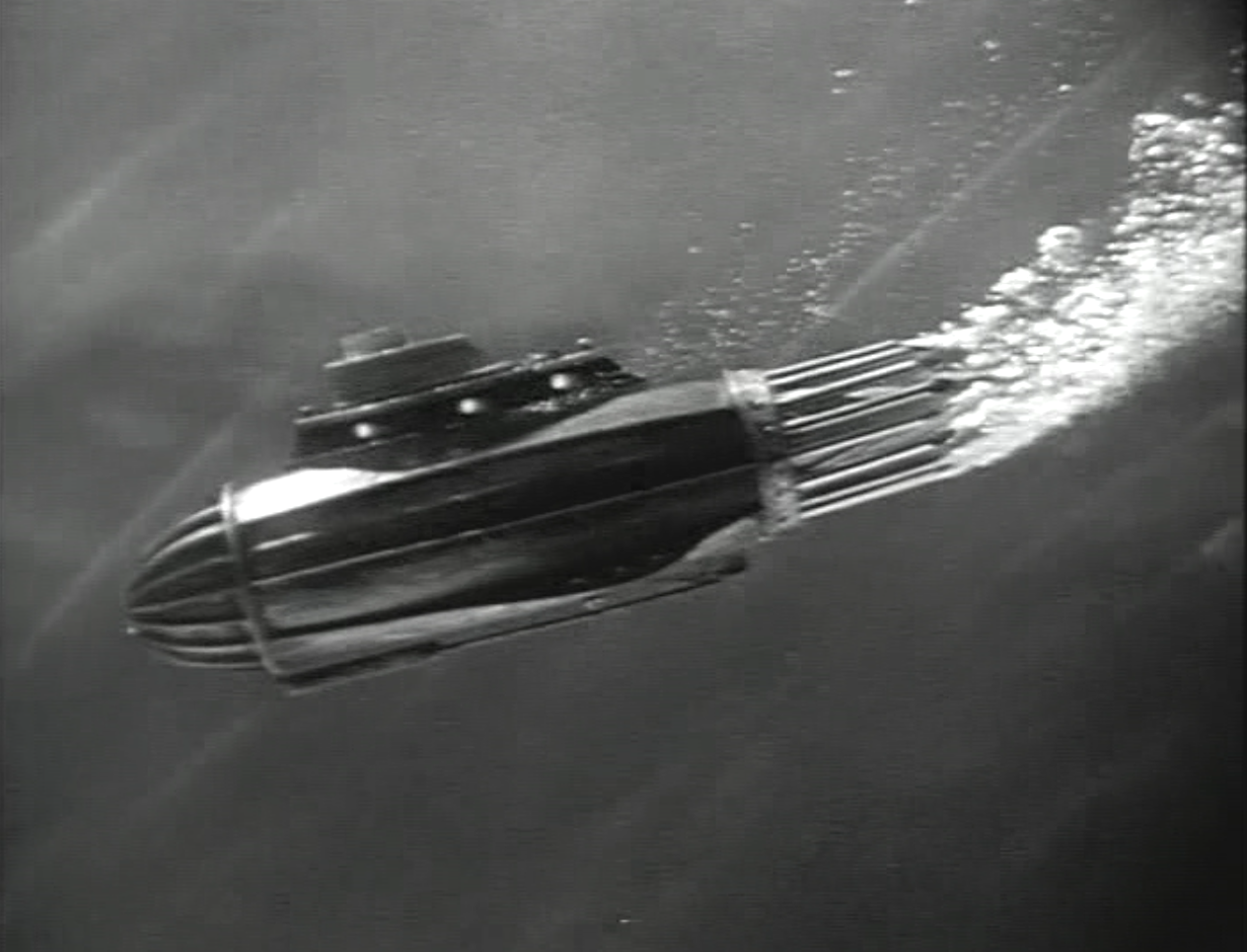
Naval Lt. Ray “Crash” Corrigan, all-around athletic champion and straight arrow, is Professor Norton’s only choice to accompany him in his experimental submarine (an excellent miniature, one of many created by Howard and Theodore Lydecker). The submarine’s crew grows when Diana invites herself along for a story too good to resist, and again when it’s discovered that Professor Norton’s young son Billy has stowed away. The sub’s pilot cracks under the pressure when he realizes how deep the Professor intends to take it, and in his madness sends the sub into a steep dive.

UK.sub1

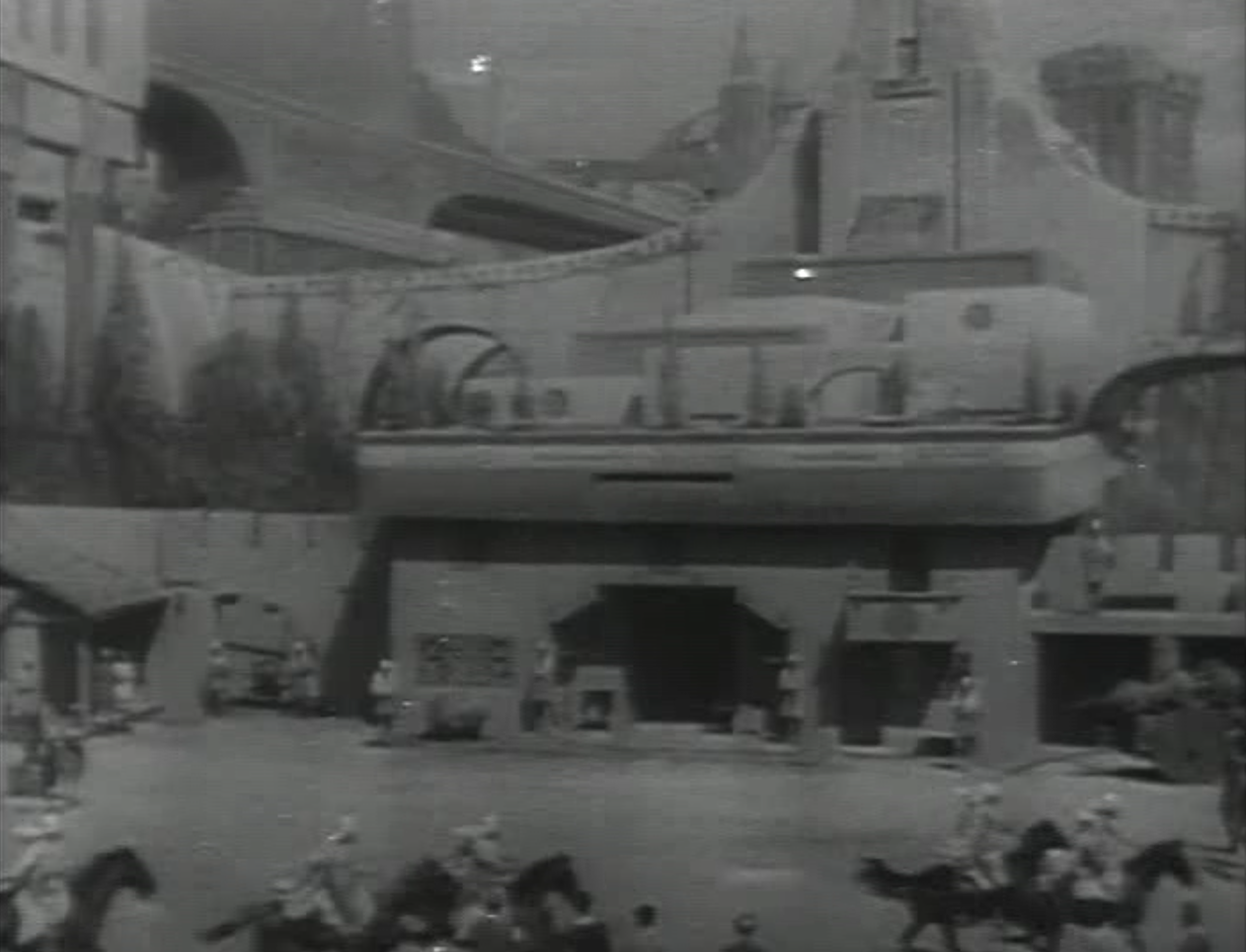
Little do the submariners know that Atlantis survives under a great dome of oricalcum, like a bubble at the bottom of the sea, and even now is riven by conflict: Unga Khan, usurper to the throne, is laying siege to the city of Atlantis, where high priest Sharad, described as the last of the true Atlanteans, is the only force remaining to stand up to Unga Khan. From his metal tower, Unga Khan commands a legion of black-robed horsemen and soldiers; robotic “Volkites;” airships; and the juggernaut, a fast-moving electric tank. It’s only a matter of time before Sharad’s defenses give way.

UK.tower

Unga Khan, detecting Norton’s submarine, latches onto it with a magnetic beam and brings it safely into Atlantis’ inland sea, hoping to turn it to his own advantage. Upon discovering Professor Norton’s scientific abilities, Unga Khan brainwashes him with a “transformation chamber” and puts him to work building engines to turn his tower into a rocketship, so that he may ascend to the surface world and either conquer or destroy it! Only Crash Corrigan and his allies can prevent Unga Khan’s mad plans from wreaking havoc on both Atlantis and the surface world in the 1936 Republic serial, Undersea Kingdom!

UK.Unga4

Undersea Kingdom has similarities to both Flash Gordon (released the same year) and The Phantom Empire, which had come out the previous year. Like The Phantom Empire‘s underground kingdom of Murania, Undersea Kingdom‘s Atlantis is a classic “lost world,” a remote corner of the world untouched by modernity but paradoxically full of superscience. Other than its underwater location and the mention of oricalcum (dropped after the first chapter), there’s not much to connect the film’s Atlantis to Plato’s account, but it is part of a long tradition of using the name as a code word for a hidden place where anything becomes possible. And like Murania and Flash Gordon‘s Mongo, in Atlantis ancient swords and chariots are used side-by-side with atomic rays and futuristic war machines: boundaries between science fiction and fantasy were not so rigidly defined before World War II.

UK.Atlantis

Just as singing cowboy Gene Autry starred in The Phantom Empire as singing cowboy Gene Autry, Undersea Kingdom stars “Crash” Corrigan as a fictionalized version of himself and gives him plenty of room to show off his talents. As an actor, he does OK with dialogue, which is largely functional (“At least those mechanical men can’t follow us through those flames!”), but it’s displays of athleticism that are the real draw. Corrigan was a trainer and bodybuilder who started out in film as a stuntman, often portraying gorillas (he played the “sacred orangopoid” in Flash Gordon), and as a leading man his onscreen persona emphasized his mastery of physical culture and sports. Just as The Phantom Empire gave ample opportunities for Autry to sing within the story, every chapter of Undersea Kingdom finds Corrigan wrestling, climbing, pole-vaulting, swimming, or even walking a tightrope, and that’s aside from the usual running, riding, and fighting that are typical for serial heroes.

UK.Crash4

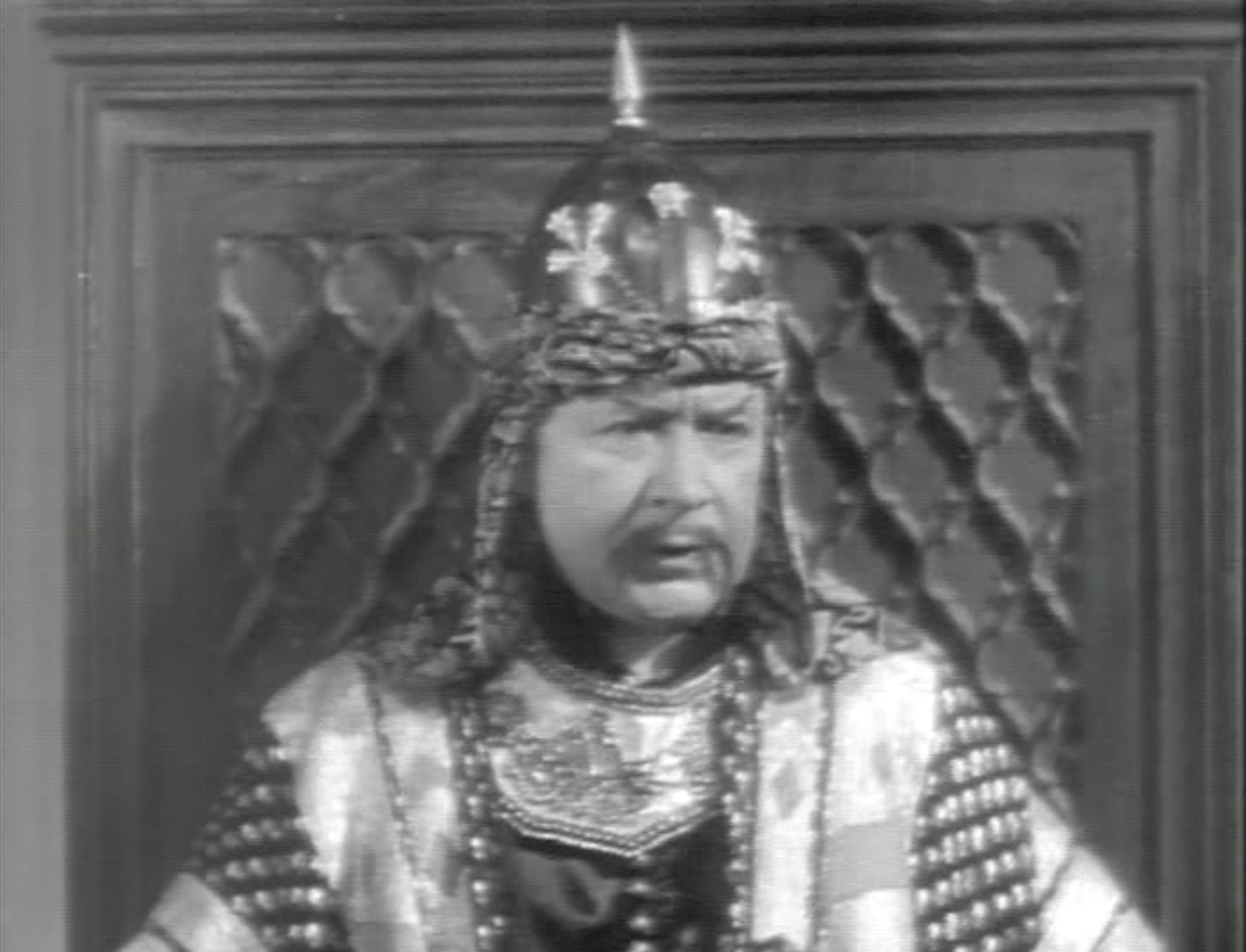
The other characters fit into clearly established types: Professor Norton (C. Montague Shaw) is the inventor whose submarine makes the adventure possible but then spends almost the entirety of the serial enslaved by the villain (and unlike Flash Gordon‘s Dr. Zarkov, Norton is so completely brainwashed that he actively resists rescue and demands to be taken back to his “Master” until he is restored in the transformation chamber). Speaking of the villain, Unga Khan (Monte Blue) is cast from the same mold as Ming: imperious, given to grandiose monologues (“With Crash Corrigan out of the way, nothing can interfere with my plans to conquer the upper world!”), and ruthless in carrying out his scheme. The fact that his plans are so over-the-top crazy is one of the pleasures of this kind of pulp.

UK.juggernaut2

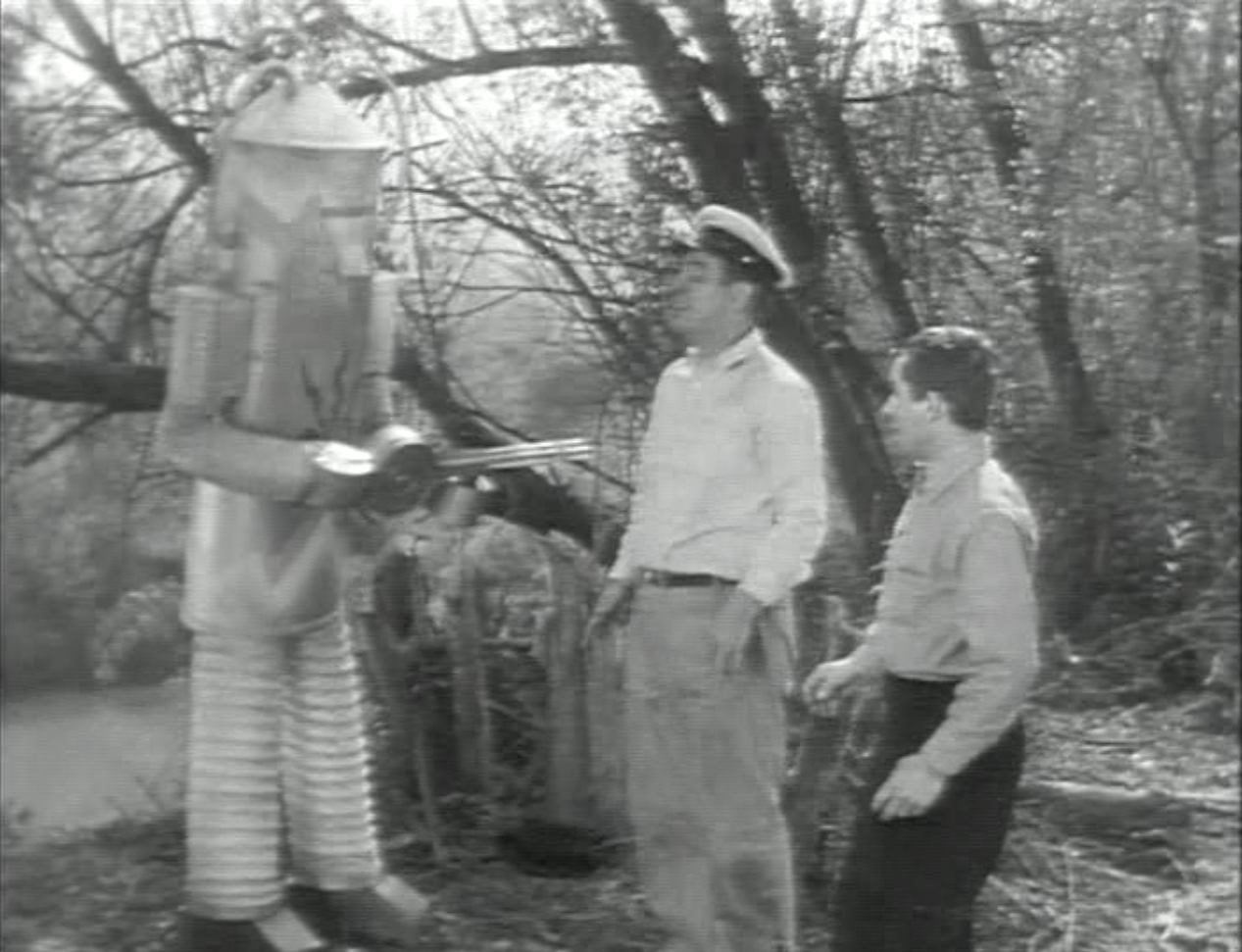
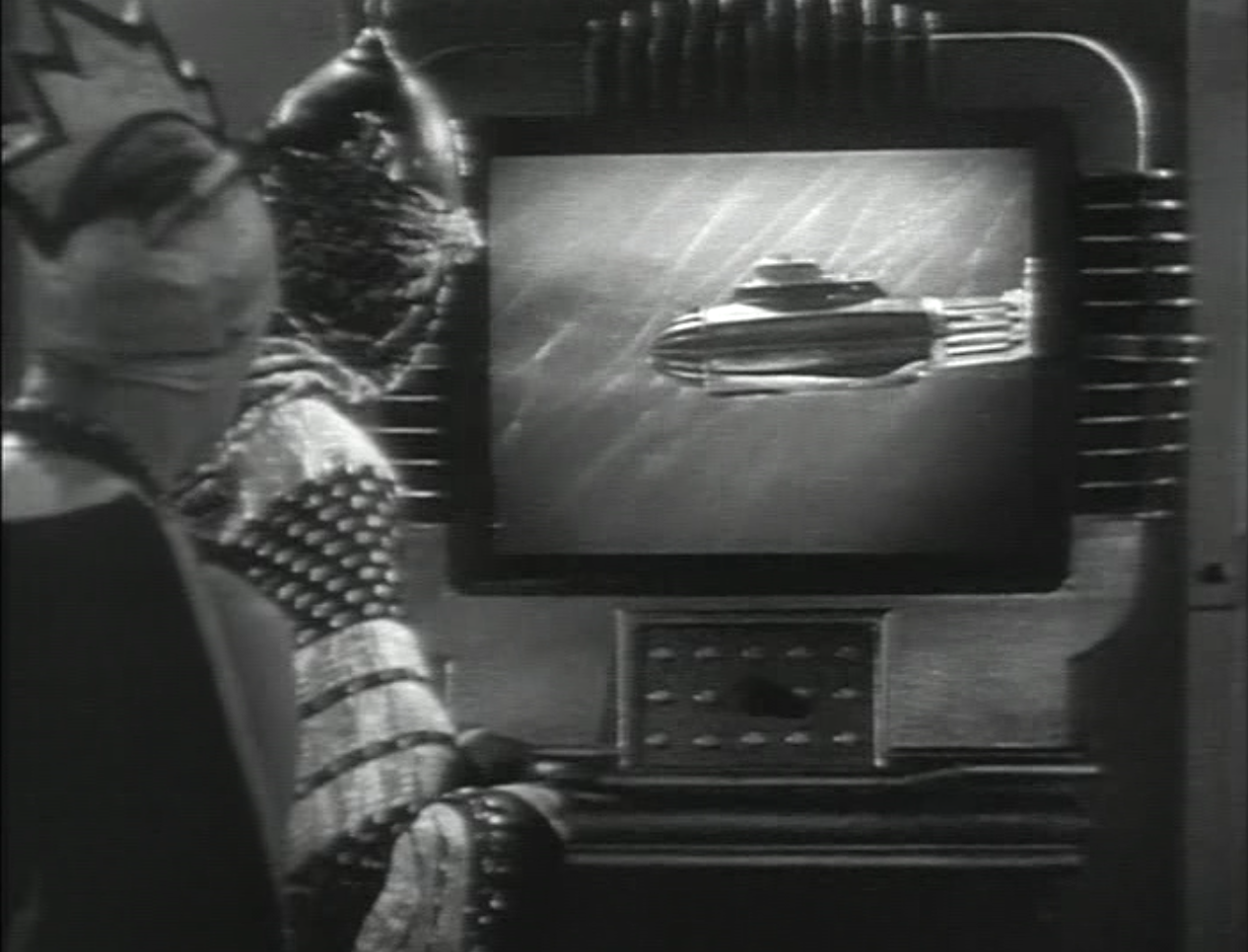
As mentioned, Unga Khan has quite a bit of futuristic hardware at his disposal, including a “disintegrator ray” that strangely takes the form of a missile (recycled from The Phantom Empire). Also as in The Phantom Empire, television is an object of fascination, with Unga Khan observing the surface world, the Atlantean countryside, and even Sharad’s inner sanctum through his “reflecto plate,” all without any indication of having cameras in those places. Some of Unga Khan’s doomsday weapons are even more vague than is usual for serials, but they sure look cool. The standout is his army of Volkites, mechanical men armed with “atom guns,” old-school cylindrical “water heater” robots that look intimidating but move slowly and are clumsy enough that Corrigan is able to hang one from a suspended hook at one point without much trouble.

They break into old people's houses and steal their medicine to use as fuel.

They break into old people’s houses and steal their medicine to use as fuel.

Diana Compton (Lois Wilde) is a gutsy, brassy reporter, and while she talks her way onto the submarine, I’m hard-pressed to think of anything she actually does other than offer commentary and occasionally fall into some peril from which she must be rescued. As formulaic as that role is, however, it’s worth mentioning that she is literally the only woman in the entire serial: the above-ground scenes with which it begins take place at the Naval Academy in Annapolis, and the Atlantean scenes are divided between Unga Khan’s tower and Sharad’s city, both militarized settings filled with soldiers (the latter resembles a Spanish mission or French Foreign Legion outpost dressed up with a few exotic props). And while Diana and Crash end up together, there’s little romantic spark between them: this is boy’s adventure, through and through.

UK.Diana1

There is a literal boy, as well, and Billy Norton (Lee Van Atta) divides his time between dialogue even more functional than Corrigan’s (“Boy, I’d sure like to explore that city,” and cheering on the hero with “Let ‘im have it, Crash!”), engaging in junior acts of derring-do, and being rescued himself. He’s more a sidekick than an audience-identification character (he doesn’t have anything like the screen time or personality of Frankie and Betsy Baxter in The Phantom Empire), but there is some pathos when his own father, brainwashed by Unga Khan, doesn’t recognize him.

UK.Billy1

Smiley Burnette is also along to provide (mercifully brief) comic relief: he and Frankie Marvin play submarine crew members who, along with their mischievous parrot Sinbad, take off to explore Atlantis on their own, getting in and out of trouble with prankish incaution. Burnette performs some of his usual shtick, such as playing the harmonica and causing slapstick trouble with explosives (including a stunt that I’m sure would have left at least one black-robe guard dead), but unlike in The Phantom Empire his and Marvin’s antics don’t have any bearing on the story, and could in fact be cut entirely without affecting the plot. (According to Jerry Blake these scenes were added after the fact to pad out the serial’s run time, and it shows.)

UK.volkite5

Finally, Crash Corrigan himself–the fictional version, that is–is every bit the strong-jawed hero of this era’s serials, pulp magazines, and comics. In a development that will be very familiar to readers of Edgar Rice Burroughs or H. Rider Haggard, Corrigan inserts himself into the Atlantean conflict, first inadvertently and then by appointment. Captured by Sharad’s forces (who suspect him and the other surface-dwellers of being spies in the service of Unga Khan), Corrigan is forced to fight a group of prisoners to the death. After demonstrating his superiority by wrestling them into submission, he refuses to deal a killing blow, assuring the loyalty of Moloch (John Merton), the opponent whose life he spares.

UK.Sharad2

Moloch becomes a trusted friend and ally during Corrigan’s time in Atlantis (a character as useful to the writers as to Corrigan, allowing for fight scenes that don’t rely entirely on Corrigan to carry them), a native brother-in-arms like Tars Tarkas or Umslopogaas. Then, after saving the high priest Sharad’s life, Corrigan is offered command of the Atlantean White Robe Army (“Commander of the army? Oh boy, oh boy!” says Billy) and the magnificent uniform that comes with it. The loyalty of the White Robes to Corrigan is unquestioned, and like John Carter, Flash Gordon, and others, Corrigan proves that what the Atlanteans need for victory is a strong American leader at the front.

UK.reflecto

What I watched: Undersea Kingdom (1936, Republic)

Where I watched it: A DVD from TV Serial Classics. I don’t usually comment on my sources unless they’re especially high- or low-quality, but I do want to point out one of the ugliest menu screens I’ve run across (especially in comparison to Republic’s typically excellent titles):

UK.menu

No. of chapters: 12

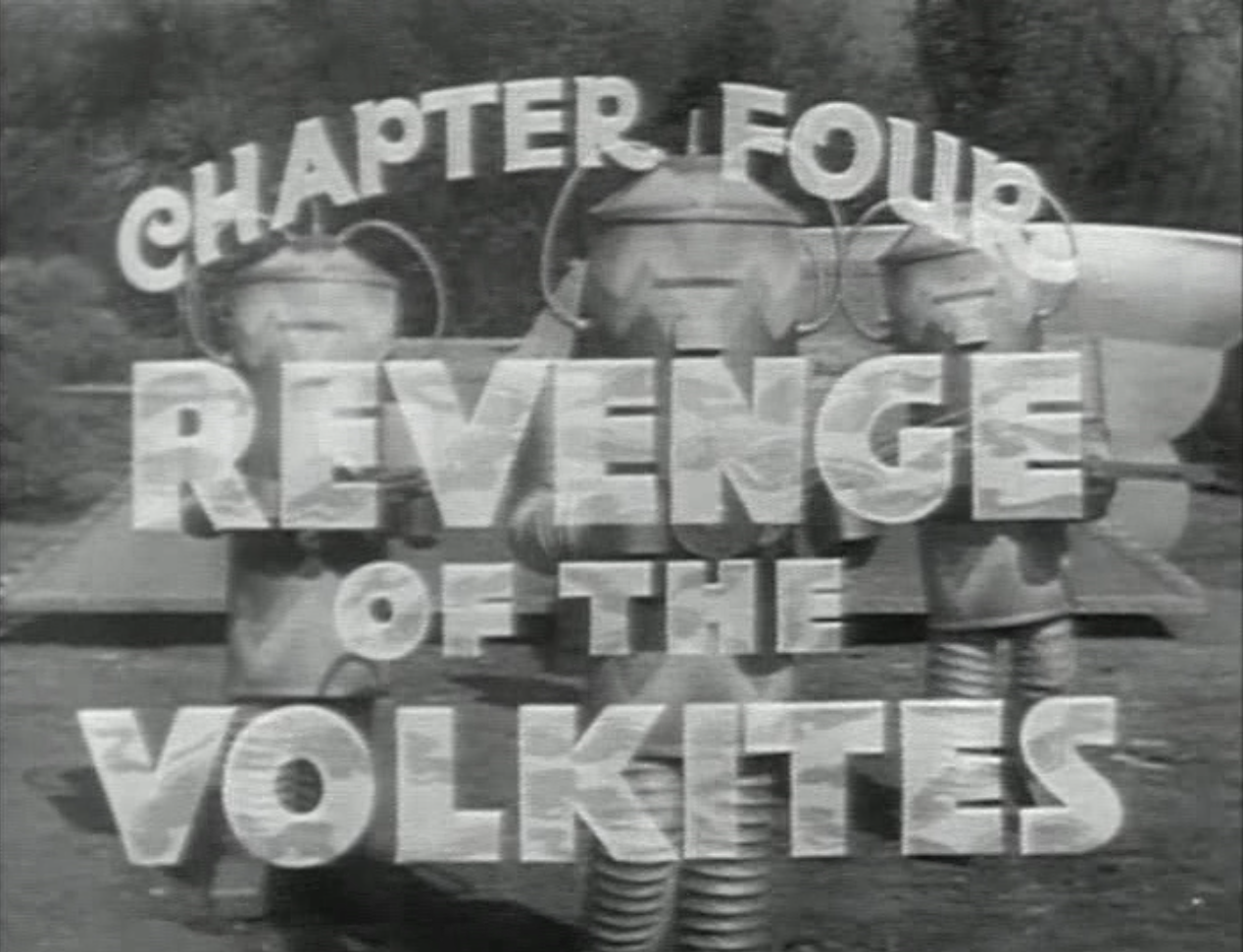
Best chapter title: “Revenge of the Volkites,” Chapter Four. I’m not really sure where the “revenge” angle comes in, as the robotic Volkites are neither paying back the surface dwellers for an earlier defeat nor turning on their master, Unga Khan. It’s surely the kind of title George Lucas had in mind when naming his Star Wars episodes, however, and with about as much connection to the actual story.

UK.Chaptertitle

Best cliffhanger: This one is easy. At the end of Chapter Eight (“Into the Metal Tower”), Crash Corrigan, captured by Unga Khan’s Black Robes, is lashed to the front of the juggernaut and driven to the gate of Sharad’s city. If the gates are not opened to the invading army and Sharad given up, the juggernaut will ram the gates, crushing Corrigan. In the face of such barbarism, Corrigan defiantly tells the juggernaut’s driver, “Go ahead and ram!”

UK.Crash6

The image of Corrigan strapped to the front of the juggernaut like a human hood ornament looked teasingly familiar, almost as if I had seen it somewhere recently . . . but where?

fury_road

Annie Wilkes Award for Blatant Cheat: Republic seems to be the worst offender in this (and in fact Harmon and Glut in The Great Movie Serials cite the juggernaut cliffhanger as a textbook example of a cheat), so as always there are several candidates. At the end of Chapter Eleven (“Flaming Death”–honestly, all of the chapter titles are pretty good), Moloch, Corrigan, and Professor Norton are trapped beneath the rocket engines that will lift Unga Khan’s towers to the surface when they begin firing. There’s no way they’re getting out of there without being burned to a crisp, right? Right?

Well, I don’t think it will spoil the movie to say that Corrigan gets away at the beginning of Chapter Twelve, and the hole in the floor that he conveniently falls through at the very moment of the rocket’s ignition definitely wasn’t there at the end of Chapter Eleven.

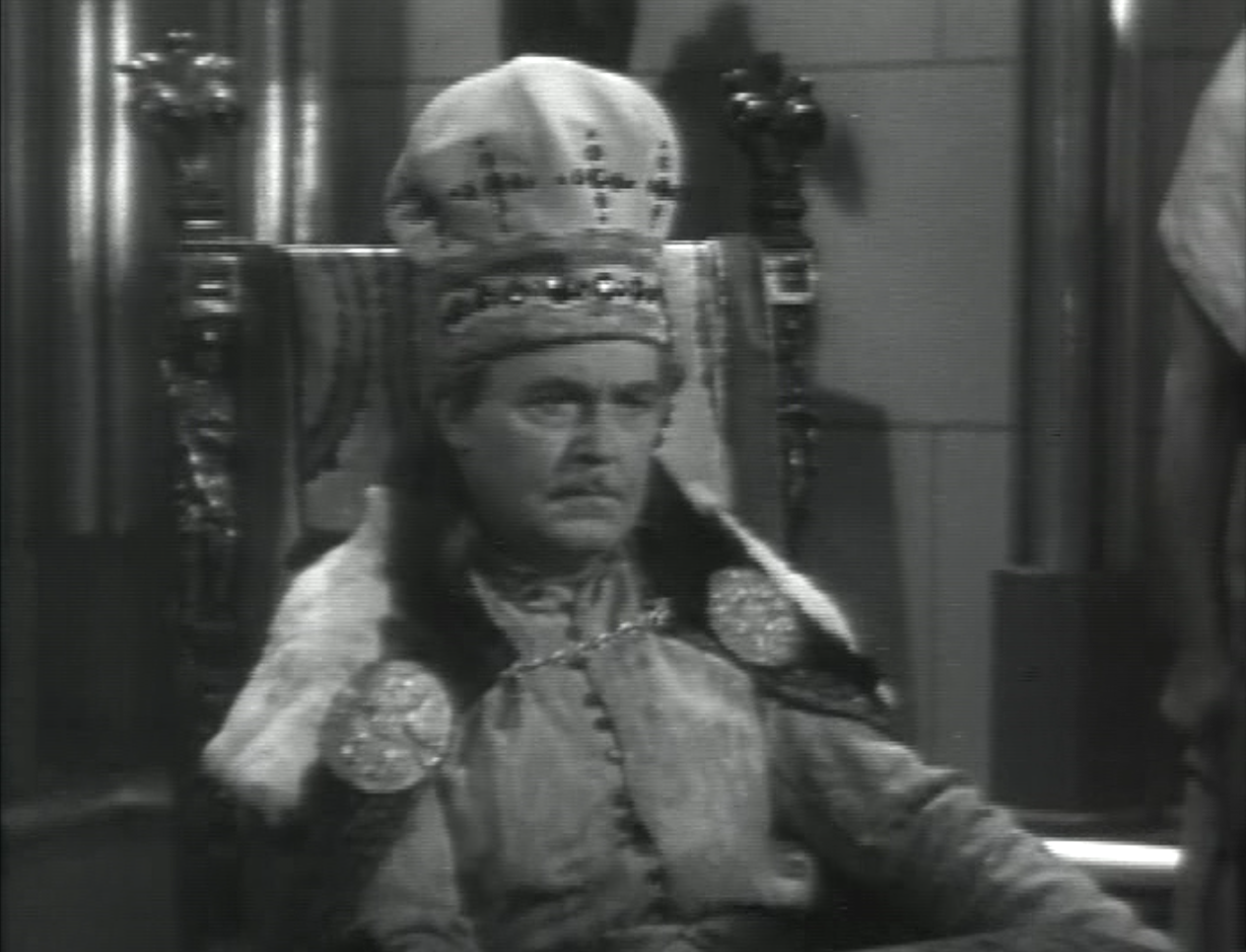
A word on costuming: The 1930s were the heyday of art deco in film, and that extended beyond titles and set design to the costumes themselves. Like other space operas and lost worlds of this time period, Atlantis is a jumble of medieval, Romanesque, and completely fanciful motifs. Uncredited but attributed to Robert Ramsey, Undersea Kingdom‘s costumes are partially unified by the importance of finned headgear: like the intricate tail feathers of male birds, the number and complexity of fins indicate the strength and importance of the wearer. Most of Unga Khan’s Black Robes have only a single dorsal fin on their headgear (right), while leaders like Captain Hakur (left) and Unga Khan’s major domo Ditmar have a trifold fin (and check the zig-zag lightning motif that also appears on Unga Khan’s throne).

UK.Hakur

Those pale, however, before the righteous plume that decorates Corrigan’s helmet once he takes command of the White Robe Army (a force whose uniform is otherwise completely unfinned: the entire budget for military bling went into this one outfit): look upon it, and mourn for the days such a costume could be worn without any self-consciousness.

UK.Crash5

Sample dialogue: Too much to choose from!

“Little do the people of the upper world realize what is in store for them. . . . Start the disintegrator. . . . Start the earthquake!” –Unga Khan, Chapter Eight

“Is my plan of empire to be wrecked by this handful of strangers from the upper world!?” —ibid.

“They’ll never expect to find any Volkites in the submarine!” –Captain Hakur (Lon Chaney, Jr.), Chapter Eleven

“Prepare the disintegator [sic]!” –Unga Khan, Chapter Twelve

What Others Have Said: “The serial features few of the fistfights common to Republic’s later serials, but compensates by including some truly unique action sequences, chief among them the large-scale attacks on Sharad’s Sacred City by the Black Robes; these battle scenes are beautifully staged by directors Joseph Kane and B. Reeves Eason (Eason directed many similar sequences in silent and sound “spectacles” like 1925’s Ben-Hur and 1936’s Charge of the Light Brigade).” –Jerry Blake, whose blog Files of Jerry Blake includes extensive reviews and commentary on movie serials and “other cliffhanging material.”

What’s Next: The New Adventures of Tarzan

Cowboys & Aliens: A Reappraisal

Following last week’s look at the odd history of the science-fiction Western, I offer a more detailed defense of 2011’s Cowboys & Aliens (warning: spoilers ahead). Like my article on Addicted to Love, this was written as an entry for Lovefest, an ongoing series organized by commenters on film website The Dissolve. The only requirement for Lovefest is that it is an appreciation of a movie that flopped, was panned by critics, and/or is generally forgotten.

cowboys.poster

The title Cowboys & Aliens promises a high-concept romp. In interviews featured on the Blu-ray, writers Roberto Orci and Alex Kurtzman and director Jon Favreau mention that the title alone of Scott Mitchell Rosenberg’s comic book series got them excited, and perhaps Universal’s marketers assumed that audiences would be similarly turned on by the prospect of B-movie thrills in a genre mash-up. Further, the involvement of Favreau, known for witty banter and a slyly comic approach (whether directing Will Ferrell in a Christmas comedy or setting the template for Marvel’s superhero franchise with Robert Downey, Jr.), probably fed expectations that this would be more of the same.

Instead of the fun promised by the title, however, audiences got a fairly serious, even grim, drama that was surprisingly gruesome for its PG-13 rating and included moments of outright horror. (In the same featurettes, the filmmakers mention the inspiration they drew from Alien, but I don’t remember that being highlighted in the trailers.) There is some comic relief and plenty of action, but it’s not really a lighthearted movie. One never really knows how a movie will perform, but considering the talent involved and that audiences and critics claim to want original* blockbusters, a less generic title and more accurate marketing might have given the film a better chance. While a viewer might agree with everything I have to say and still not find this movie to their taste, fans of other maligned films like John Carter and The Lone Ranger will probably find something to enjoy in Cowboys & Aliens.

*In this case, “original” is a fuzzy concept: Cowboys & Aliens is original in the sense that it is neither sequel nor remake (even the comic book on which the film is based is hardly a well-known property, and appears to have been optioned solely for the name and concept), but it treads in well-worn pathways, featuring characters who are familiar by type if not by name.

cowboys.lonergan1

Set in 1875 New Mexico, Cowboys & Aliens begins with a man (Daniel Craig) waking up in the desert, injured and with no memory of who he is. On his wrist is a strange metal shackle; in his pocket, a picture of a woman (Abigail Spencer). After brutally fending off an assault by three highwaymen, this literal Man With No Name makes his way to a depressed mining town called Absolution. He makes the acquaintance of a pragmatic preacher (Clancy Brown) and a strange woman, Ella (Olivia Wilde), who recognizes the shackle and says she can help him recover his memory. An obvious man of action, the stranger can’t help but insert himself into a scene caused by Percy Dolarhyde (Paul Dano), a bullying, loudmouthed twerp who takes advantage of the protection of his father (Harrison Ford), the local cattle king whose business keeps the town alive.

Provoked by the take-no-shit stranger, Percy fires his gun carelessly, hitting a nearby deputy in the shoulder. The sheriff (Keith Carradine) has no choice but to lock Percy up, but he quickly realizes that the newcomer is Jake Lonergan, wanted for stealing a shipment of gold that belongs to Colonel Dolarhyde and for the murder of a prostitute; Lonergan gets locked up, too.

As night falls, the sheriff prepares to deliver both Percy and Lonergan to a judge in Santa Fe, and Colonel Dolarhyde and his men show up to stop him. Dolarhyde is first shown torturing a man whom he suspects of killing one of his herds (actually the work of the titular aliens, of course), and he has no qualms about using force to free his son or enacting rough justice on the man who stole from him.

cowboys.lasso2

Just as all of these strands of plot are coming together, the aliens attack from the air, causing explosive mayhem with their lasers and pulling townspeople into the air with lasso-like snares. When the aliens’ ships come in range, the bracelet on Lonergan’s wrist lights up, and he finds that he can use it as a powerful blaster; he shoots down one of the gliders, but it is too late to halt the attack completely. In the chaos, Percy is among those captured, as are the sheriff and the wife of Doc (Sam Rockwell), the town’s meek doctor/barkeep.

cowboys.lonergan4

From here, the main plot is set in motion: Dolarhyde takes command of the situation and plans a rescue party, believing that the townspeople were taken alive for a reason. (“If they wanted ‘em dead, they’d be dead,” he says. “This was a round-up.”) Joining the search party are the tenderfoot doctor, who doesn’t even own a gun, and a young boy, Emmett (Noah Ringer), the sheriff’s grandson; Ella also joins for her own reasons, but Lonergan chooses not to go, even as Dolarhyde urges him to add his strange weapon to the search.

Where Cowboys & Aliens is most successful is in taking the premises of classic Westerns and alien-invasion stories seriously. The Western townspeople, while stock character types, are neither fools nor gifted with period-inappropriate knowledge. The film begins with several mundane plots in motion: there are no cardboard slasher victims, standing around waiting for the action to start. Further, they behave as any nineteenth-century person of average education might when faced with something beyond their understanding: when the aliens strike, some wonder if they are being attacked by demons, and they probably wouldn’t seek out trouble if they weren’t trying to retrieve their kidnapped loved ones. The film doesn’t count on the characters to relay exposition about aliens: we see the action through their eyes and fill in the details with our own genre experience.

As Lonergan’s memories gradually return, he visits an abandoned cabin, where he remembers bringing the stolen gold to his lover (the woman whose picture he had, and whom he is accused of killing), with the intention of starting over somewhere far away. In the first of several eerie flashbacks, the gold coins are melted into slag and sucked through the roof of the cabin by a mysterious force, and then one of the aliens’ skyhooks pierces the roof and captures the woman.

cowboys.gold

After finding nothing at the cabin, Lonergan joins the search party, which has been tracking an injured alien. The main tracker, a Mexican Indian named Nat (Adam Beach), is Dolarhyde’s hired man and Percy’s companion and protector, but is more importantly everything Percy isn’t: brave, competent, and honorable. To Dolarhyde, however, Nat is just a thick-skulled Indian.

After losing the tracks in a rainstorm, the party comes across an upside-down riverboat, stranded miles from any river. The searchers hole up in the eerie, decaying boat for the night, and several character arcs begin to unfold: the preacher helps Doc practice shooting; Dolarhyde reluctantly takes Emmett under his wing, giving him a knife for protection; Nat inadvertently reveals how much Dolarhyde has been a father figure to him, but is rebuked.

Will Doc learn to shoot in time to help save his wife? Will that knife come in handy just when Emmett needs it? Will Dolarhyde come to appreciate the surrogate son who has been in front of him the whole time? Most importantly, will Lonergan regain his memory and redeem himself after his former life of crime, coming to an understanding with the similarly hardened Civil War veteran Colonel Dolarhyde? If you can’t guess the answers to those questions, then you haven’t seen very many Westerns or sci-fi action movies.

cowboys.glider

It is worth emphasizing that Cowboys & Aliens presents a distinctly cinematic version of both the genres it combines: it is primarily an action movie with a secondary focus on character. Neither the history of the West nor a philosophy of science have any particular bearing on events, other than an awareness of the passing of the Indian in the face of white migration (something that is at the heart of many Westerns, but which is also, as we shall see, of thematic importance to Cowboys & Aliens).

As mentioned, the characters are archetypes of Western fiction; their familiarity helps us take sides right away. Also, whether consciously or not, Cowboys & Aliens exploits the fact that early filmed sci-fi took advantage of the rocky, arid terrain of the Southwest to stand in for alien planets. (The association of science fiction with desert landscapes has long literary associations, as well.) The same caves and canyons around Hollywood that were backdrops for Johnny Mack Brown and Tom Mix served just as well for the surface of the moon or the planet Mongo a few years later.

This is more than just convenience or historical association: it contributes vitally to the tone of the film. In an essay entitled “The Alien Landscapes of the Planet Earth: Science Fiction in the Fifties,” Vivian Sobchak points out that lonely, desolate places on earth have more power to awaken terror than visions of advanced technology that inevitably become dated with the passage of time. In Sobchak’s words, “What we wonder at today, we may laugh at tomorrow. But the desert and the beach, the wind and the sea, the black lagoon and the frozen stretches of Arctic ice do not date, and will never lose their power to awe and disturb us.”

The power Sobchak describes is what the romantics called the sublime, the combination of wonder and terror one experiences in the face of the vast works of nature such as the storm, or the sea . . . or the desert. It is what often makes even the lousiest Western worth watching for its panoramic vistas of the great plains, the deserts of the Southwest, or formations such as Monument Valley. Against the grain of much modern filmmaking, Cowboys & Aliens was filmed on location in New Mexico: all of its settings are real, physical places, even the spaceship interior sets; the aliens and their technology are brought to life with a mixture of CG and practical effects; and the daytime scenes are filmed with natural light. (Director of Photography Matthew Libatique is best known as a long-time collaborator with Darren Aronofsky, and had previously worked with Favreau on the first two Iron Man movies.) It is as real as a film about cowboys fighting alien invaders can be, and its sense of place is a powerful asset.**

**It also sounds great: composer Harry Gregson-Williams had the job of effectively scoring two movies, but his score fits together and bridges the gap between genres very effectively.

cowboys.footprint

In the films Sobchak was writing about (largely low-budget monster and alien-invasion movies such as Them! and It Came From Outer Space), the scope and ruggedness of natural settings are only part of their effectiveness in setting mood: they are also isolated. The tension in these films is in part a product of their settings’ loneliness and distance from help, and the frisson generated when encountering something that doesn’t belong where no one should be: “strange inhuman footprints on an impressionable beach,” to cite one of Sobchak’s examples. Cowboys & Aliens features exactly that trope, with Indian tracker Nat following the trail of footprints left by the alien.

Tracking is an important part of Western lore, and the Indian scout is one of several archetypal characters the movie presents. The anxiety and eeriness of seeing the alien footprints is only slightly greater than that a settler might have experienced upon finding prints in unknown territory: do they belong to friend or foe? In that strange world west of the tree line, the unknown almost always represented danger.

cowboys.riverboat

Another common visual motif of science fiction is the juxtaposition of the natural and the artificial, or the primitive and the high-tech (in his essay “The Science Fiction Film Image,”*** Fred Chappell identifies this as one of five types of incongruity that can make an image recognizably science fictional: “the spaceship in the wilderness” and “the spaceman among alien aborigines” are two examples he gives). The riverboat, already made eerie by its landlocked, overturned state, is half-overgrown with weeds, and rain water filters through its cracked floors and ceilings. It’s an image of nature and technology in collision, and its wrongness foreshadows the searchers’ ultimate destination, a tower-like spaceship hidden among the rock formations of a remote canyon. In Cowboys & Aliens, the aliens are the spacemen, the humans the aborigines, a very effective reversal of common imagery (more about this momentarily).

***Both Vivian Sobchak’s and Fred Chappell’s essays are found in the Monarch Film Studies volume Science Fiction Films, edited by Thomas R. Atkins.

cowboys.ship

Unbeknownst to the group, the injured alien is also hiding in the riverboat, and this sequence of the movie recalls Alien’s “haunted house” formula; the first clear view of the alien reveals it as a tall, vaguely humanoid creature with a mixture of reptilian and insectoid features (including, most disturbingly, a breastplate that opens to reveal a pair of tiny, grasping forelimbs for fine manipulation, a clear nod to the mouth-within-a-mouth of H. R. Giger’s xenomorph). The alien picks off a few members of the party, including the preacher, and escapes.

cowboys.alien2

The next morning, after picking up the alien’s fresh tracks, the party runs afoul of a gang of robbers: some of Lonergan’s old crew, now run by a dufus named Hunt (Walton Goggins). Lonergan, still not completely recovered from his amnesia, plays along and asks Hunt to take him back to the gang’s camp. It’s there that he learns that he had left the gang high and dry, taking their share of the stolen gold in order to run away with his woman. The gang isn’t too willing to have him back, and they threaten the members of the search party. Another aerial attack by the aliens interrupts them.

Ella is taken by one of the aliens’ lassos, and Lonergan manages to jump onto the ship carrying her, blowing it up with the blaster; they both land in the water, but Ella is wounded by the ship’s alien pilot, who also escaped the crash of his craft. Lonergan carries Ella back to the search party, but it’s too late: she is dead.

cowboys.Ella2

The party is surrounded by an Apache tribe on horseback who take them back to their encampment. Dolarhyde’s anti-Indian attitudes come to the fore, but Nat is able to translate and keep the two groups from killing each other. When Ella’s body is thrown onto a funeral pyre, it releases a burst of energy and she comes back to life: she is the last of her kind, one of another race that had already been wiped out by the aliens, and who has been following them to make sure no other world suffers the same fate as her home. Finally we get a little exposition: the aliens are part of a scouting mission, looking for gold (“It’s as rare to them as it is to you,” she explains) and abducting humans to perform tests and analyze their weaknesses in advance of a full invasion force.

Even when it’s clearer what is happening, there is no outpouring of foreign names or history, no grand mythology of which this film is only a single episode; in an era of incessant franchise-building, it’s refreshing to see such a self-contained story. (If the film’s poor performance has one bright side, it’s that we weren’t subjected to a series of increasingly convoluted and unsatisfying sequels.)

Because of its singularity—there is only a single scout ship, destroyed by the humans by the end of the movie—and its remoteness from civilization, this is a story that can take place without rewriting known history. It has a level of plausible deniability: even if the characters were to share their story at some point, who would believe them? (I don’t know if it was intentional, but this alien-invasion story fits neatly with the nineteenth-century “airship mysteries” that are sometimes cited as proto-UFO phenomena, not to mention the various hoaxes that filled newspapers of the time.)

In a sweat lodge ceremony, the Apaches help Lonergan recover the rest of his memories in a deeply unsettling sequence: a hard-to-place memory of his lover lying next to him is revealed to be her vivisection at the hands of an alien scientist, before her disintegration right before Lonergan’s eyes. In the flashback, he is strapped to a table, awaiting his turn to be tested and then exterminated. He remembers how the alien’s carelessness gave him the chance to steal its weapon and use it to escape, his mind still scrambled by a hypnotic light the aliens used to keep their captives docile.

cowboys.penned

At this point, all the threads come together for the big finish: Nat helps Dolarhyde reach an accommodation with the Apaches (who have also lost many of their people to the aliens) by explaining that Dolarhyde raised him like a son, even though they were not blood, and Lonergan rides out to convince his old gang to join the fight. The townspeople, gang members, and Apaches converge on the aliens’ base, a spaceship half buried in the ground in a remote canyon, disguised to look like the rocks around it. (I personally love scenes where erstwhile foes join together to defeat a common foe, like the gangsters and G-men standing up to the Nazis in The Rocketeer. If Cowboys & Aliens could be described as Independence Day in the Old West, at least it has more nuance than that film.)

The images of alien footprints and the alien vessel in the canyon are doorways from which the Western transitions into science fiction in Cowboys & Aliens, but they are also reminders that the Western is already a kind of science fiction, a historically-based example of Isaac Asimov’s definition of science fiction as “that branch of literature which is concerned with the impact of scientific advance upon human beings.” Although not always the central focus of Western stories, the telegraph, the railroad, the Winchester rifle, and even the horse—introduced by the conquistadors, and which transformed the plains tribes before settlers had even crossed the Mississippi—are clear examples of new technologies affecting entire civilizations. (Technological superiority alone does not account for the relentless expansion of colonists at the expense of Native peoples, but it is surely a significant factor.) Even if white settlers had been wholly benign, Native culture could not have avoided changing through contact and trade with them.

Cowboys & Aliens puts all its human characters, white and Indian alike, in the position of natives faced with conquerors who vastly outgun them (and will also outnumber them in the event of a full-scale invasion). The Apaches and whites, who otherwise would have no cause to trust or associate with each other, have a good reason to work together here. The aliens see humanity as a mere inconvenience, almost beneath notice, fit only to exploit and experiment upon; they sweep in and take what they want, in a pattern of conquest that (according to Ella) has happened again and again. Human beings are even compared explicitly to cattle, first by being roped up and taken, and then by being penned while they await slaughter. The movie doesn’t hit us over the head with it, but it isn’t subtle.

cowboys.watches

The film is at its most horrifying not when the searchers are being picked off by a lone alien in the upside-down riverboat, but in Lonergan’s memories and his return to the spaceship. Watching his lover disposed of as a science experiment; finding piles of pocket watches and glasses from past victims; the prisoners herded together as a nameless mass awaiting their turn—and Lonergan remembering himself as one of them: these are images not just of genocide, but of Holocaust, the scientist-alien (whom the filmmakers in their commentary describe tellingly as the uber-alien) as Dr. Mengele. It is this, more than anything else in the film, that likely made it so hard to swallow for audiences who only wanted a Western lark with a twist, an afternoon with the kids to sit in air conditioning and eat popcorn, and it makes the cannibalism and Indian slaughter of The Lone Ranger seem measured by comparison.

cowboys.uber

Finally, a few words about the cast: it’s loaded with well-known stars and terrific character actors, but as we all know that doesn’t always lead to a good movie. In this case, however, the cast has great chemistry; most of the actors are familiar faces with experience in Westerns and do many of their own stunts, adding to the sense of lived-in reality. Daniel Craig is a natural as a bad man who finds himself capable of heroism, and Olivia Wilde’s otherworldly beauty makes her an excellent choice for her role; the supporting cast is also a pleasure to watch. I’d like to single out Harrison Ford, however, for the best performance he’s given in years. Colonel Dolarhyde is the kind of tight-lipped grouch Ford has been playing for the last decade-plus, but here he doesn’t come off as a pampered, over-the-hill star marking time until he can get back to flying his plane. His anger, his disappointment in his son, and the bitterness that has grown into a thick shell around him feel genuine, and his last scenes with Nat are moving in the best hey-I’m-not-crying-it’s-just-getting-awfully-dusty-in-here guys’-movie tradition. In the interviews on the Blu-ray, Ford mentions that he’s playing the old man role, mostly talking while Craig does all the stunts. It’s an exaggeration, but it points to a relationship that plays out on screen, with the grudging respect that develops between the two men unfolding naturally. Harrison Ford is really acting in this one, guys: see it and believe it.

cowboys.dolarhyde1