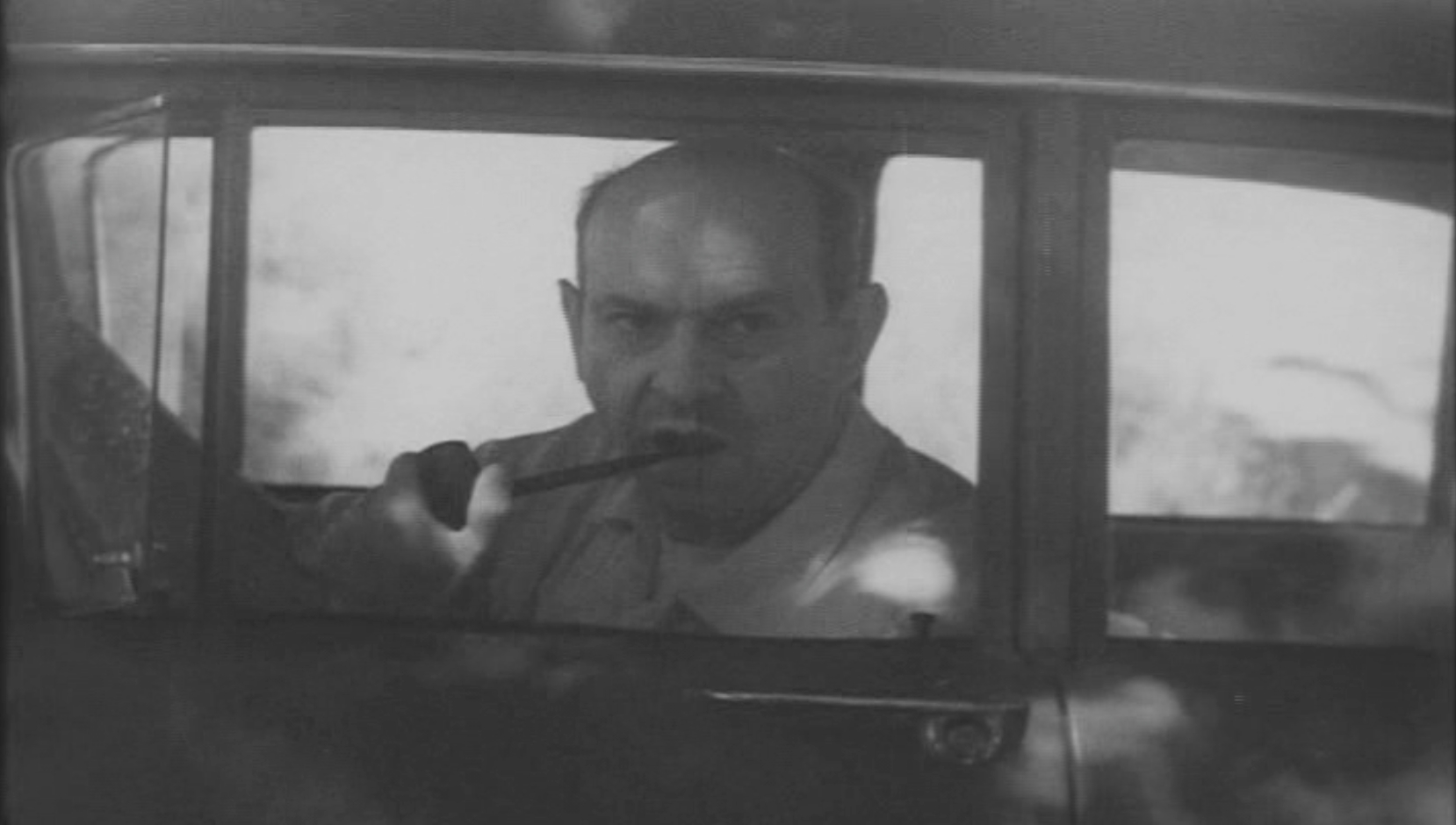
Fates Worse Than Death: The Phantom Creeps

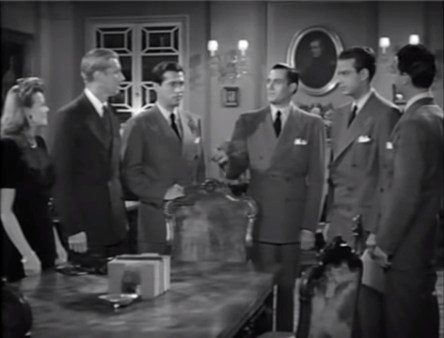
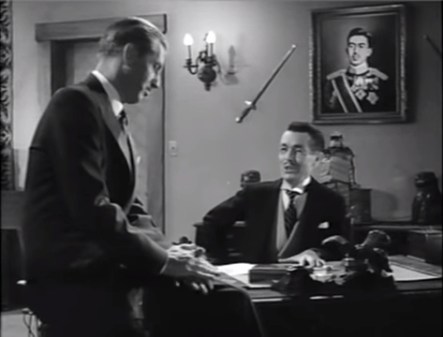
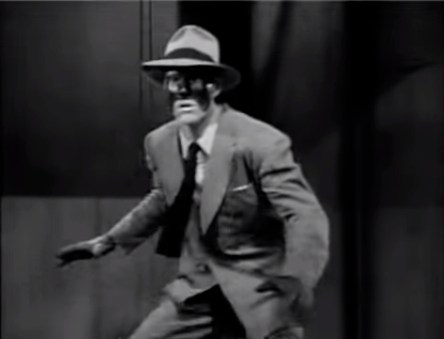
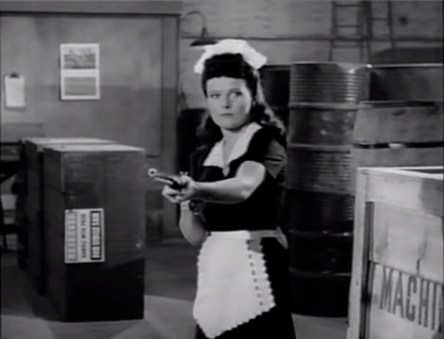
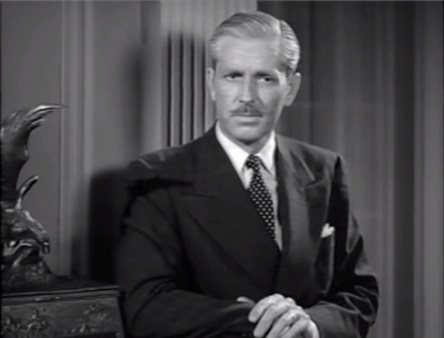
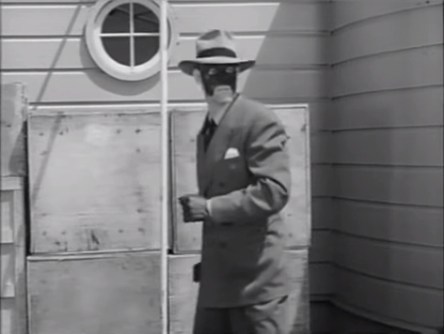
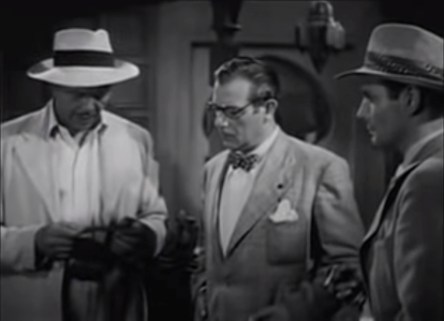
Dr. Alex Zorka, one of the world’s most brilliant scientific minds–the most brilliant, according to him–is a proud man. The sacrifices he has made for his work, the depth of his genius, and above all his monumental ego will not allow him to countenance turning over his fabulous inventions to the government–not even on the eve of war, when the world is about to become much more dangerous. Zorka’s wife, Ann, has tried to convince him to turn back before his research takes him too far, even bringing his former partner, Dr. Mallory, to help plead the case. Zorka’s latest invention consists of a small disc that can be planted anywhere (or on anyone), and a mechanical spider that homes in on it; when the spider comes into contact with its target, a small burst of smoke paralyzes anyone within range with a unique form of suspended animation. Mallory urges Zorka to give the disc technology to the government, but Zorka already has a buyer lined up; what they choose to do with it is of no concern to him. Gloating later to his assistant, Monk (an ex-con Zorka freed and disguised, making him indebted to him and practically a slave), Zorka shows off his latest device, a “devisualizer” belt that renders its wearer invisible. “Now, as the Phantom, there is nothing that I cannot do.” Zorka’s pride is already tipping into megalomania, and he hasn’t even revealed his killer robot to the world!

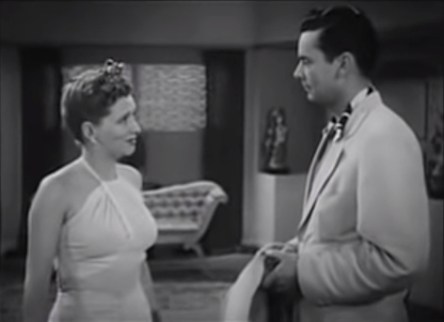
After Dr. Zorka disappears (into a secret laboratory hidden in his house) and then fakes his own death, Captain Bob West of military intelligence gets involved, interviewing Ann Zorka and Dr. Mallory. A nosy reporter, Jean Drew, shows up, but West stonewalls her. When West and his partner Jim Daly load Ann into a plane to take her to identify her husband’s body, Jean stows away, hoping for a scoop. None of them realize that Dr. Zorka, invisible, has planted one of the magnetic discs on the plane with the idea of paralyzing his wife and then claiming her body (under a new identity) to keep her from talking to the authorities. The plan backfires, paralyzing Daly while he’s piloting the plane and causing a deadly crash. Ann dies, and in his grief and madness Zorka blames West and the government. “They shall pay!” he rants in one of his many diatribes. The stage is set for Dr. Zorka to wreak scientific vengeance while outmaneuvering both the G-men and the foreign agents who still hope to obtain his invention.
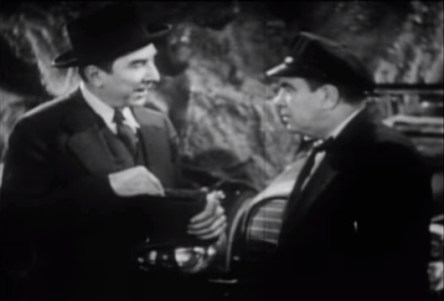
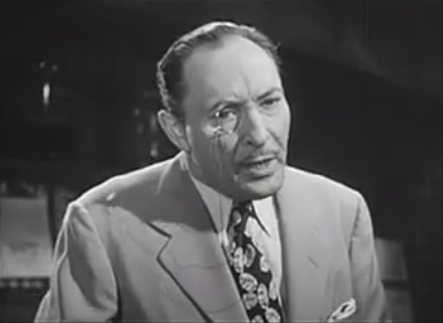
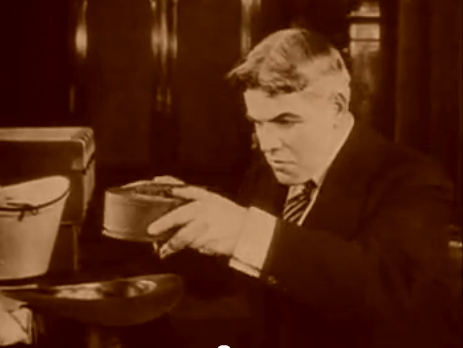
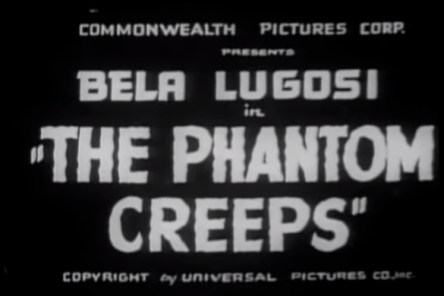
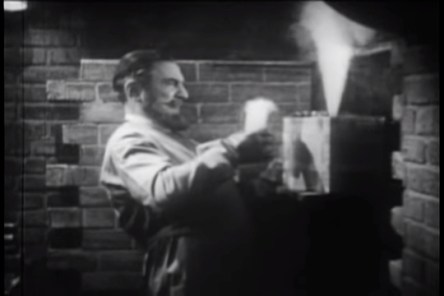
His final serial appearance, The Phantom Creeps stars the great Bela Lugosi in full scenery-chewing mode as Dr. Zorka. From the beginning, Zorka’s main emotional note is aggrievement: his scientific peers don’t appreciate his genius, he doesn’t owe anything to the government, they’ll see, he’ll show them all, blah blah blah. It’s a character type that was as much Lugosi’s bread and butter as the suave vampire that brought his initial fame. After Zorka’s wife dies and his various plots are foiled, his mania becomes more and more pronounced and his goals proceed from selling his invention for riches to conquering the world, or, failing that, destroying it. The only character he regularly interacts with is poor, put-upon Monk (Jack C. Smith), who follows him out of fear as much as any sense of loyalty. Constantly complaining that he’ll be caught and thrown back into Alcatraz (“It’s where you belong,” Zorka answers dismissively), Monk waits for the opportunity to sell out his boss, and he almost turns the tables more than once before Zorka gets the upper hand again. It is to Monk (and thereby indirectly the audience) that Zorka explains his various devices, revealing the highly volatile element that powers his inventions: the element is deadly unless kept in a shielded box, and even when opened a crack to siphon off its energies it emits deadly fumes. “They must never know about you, the source of all my power,” Zorka says to the box lovingly. But of course “they” do find out, and the box becomes the main MacGuffin of the plot, changing hands between the spies, the G-men, and back to Zorka as they all scheme to hold on to it.
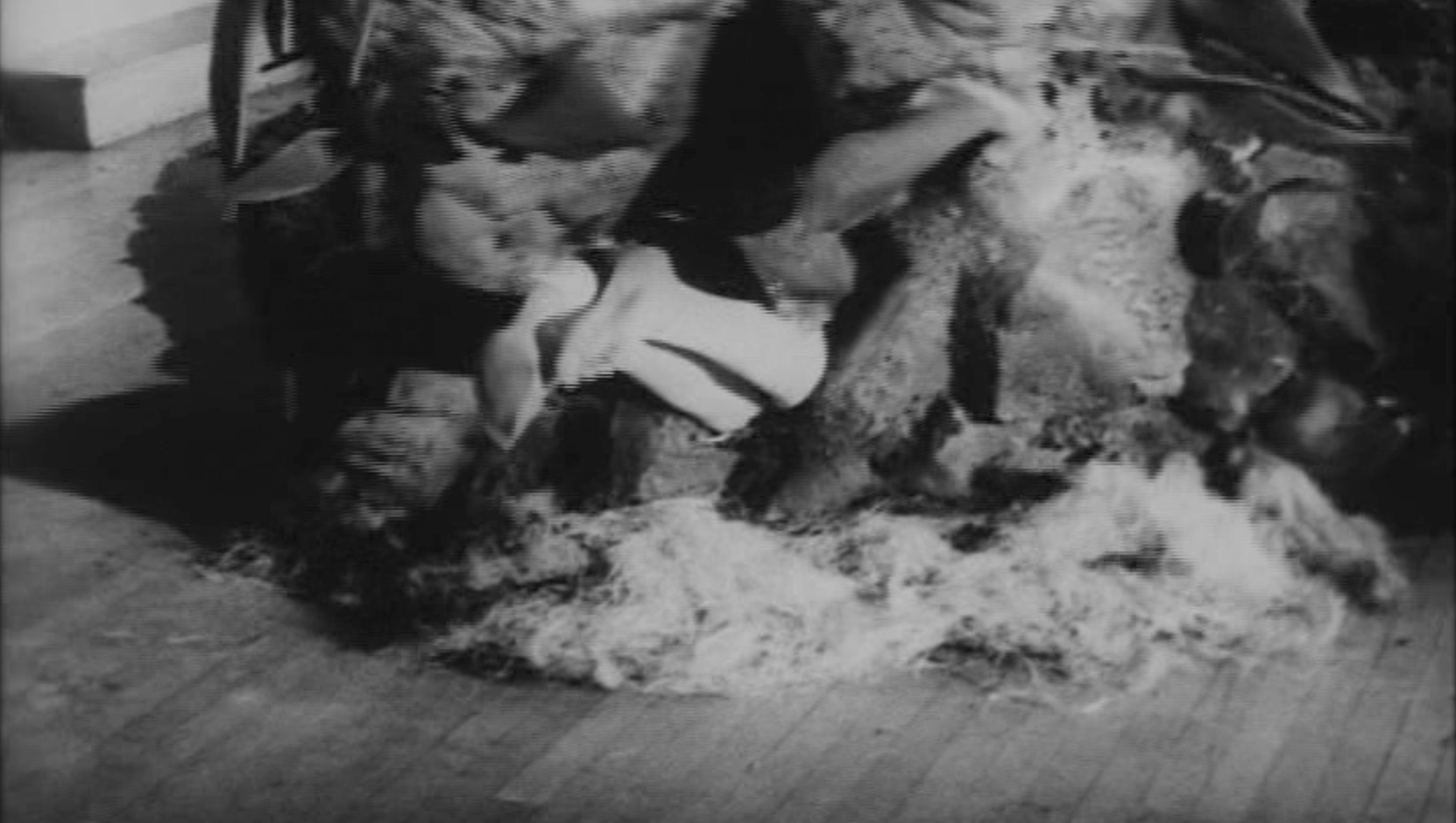
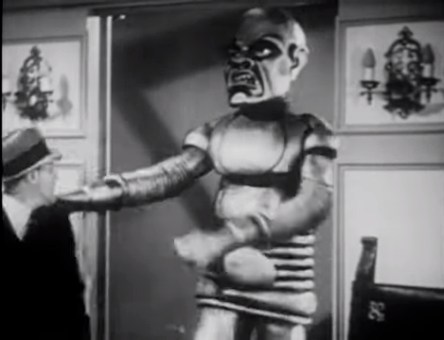
It is perhaps not surprising that the best-known element of this serial is not the precious element in its box or the invisibility device that inspired its title, but the robot (or “iron man”) who serves as Zorka’s guardian and sometimes attack dog. Inside the robot costume is 7’4″ Ed Wolff, a former circus performer who specialized in giant roles. The robot’s appearance is, on one level, ridiculous, a large humanoid machine with a grotesque molded face on an oversized head, a design choice that goes against our usual idea of robots as being more streamlined than their human models (perusing illustrations of early attempts at building robots reveals that many designs made up in baroque style what they lacked in functionality). But however ugly, it is clearly the most visually distinct element in the film. To be charitable, it resembles a pagan idol, and its role in the story is akin to that of a temple guardian, never leaving its one room until the very end of the serial. If serials are part of the modern mythmaking machinery by which ancient fables are dressed anew in contemporary garb (and I think they are), it makes sense that the iron man would continue the lineage of such pre-Enlightenment automatons as the golem or Talos, the bronze warrior from Greek mythology. (Surprisingly, Zorka doesn’t end up dying at the hands of the iron man, an ironic comeuppance that would have been perfectly in line with this kind of storytelling; the robot remains under control to the end. Zorka’s fate is a little more, ahem, explosive.)
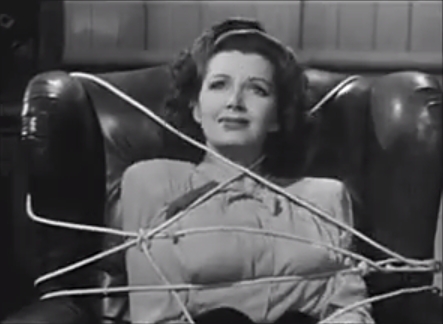
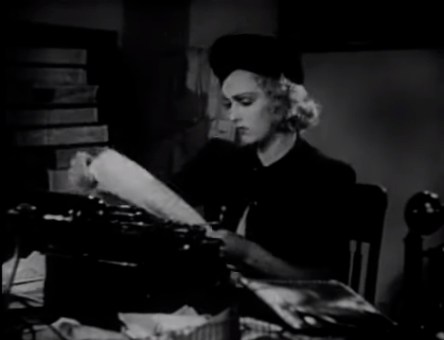
The dynamic of the square-jawed hero (Robert Kent as West) and the gutsy reporter who will take any risk for a story (Dorothy Arnold as Jean Drew) is one that has shown up in many serials and pulp narratives (including the other Lugosi serial I’ve covered, Shadow of Chinatown). Filmmakers in the ’30s and ’40s seem to have loved brassy “girl reporters,” partially as a career choice open to independent women that allowed for zany adventures and partially for the opportunity for more level-headed male characters to put them in their place. The Phantom Creeps patronizes Jean an average amount I’d say, with Bob West tweaking her resolve with comments like, “That isn’t like a hard-boiled newspaper girl to faint!”
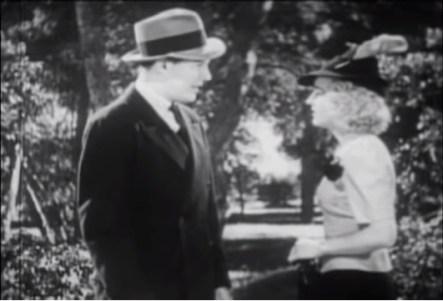
At least West is motivated by official secrecy to keep her silent, urging Jean to keep details to herself even as her editor hounds her for something fit to print. West’s partner Daly (Regis Toomey) seems more irritated by having a girl nosing around and becomes especially suspicious when he observes Jean leaving a warehouse to which he had trailed the spies (caught unawares by them, she had posed as a fellow operative, hoping to find Zorka’s invention and sell it herself). “Save it for Captain West,” he says: “He likes fairy stories.” Finally, when Jean is rewarded for her cooperation with the story of her career, West compliments Jean’s restraint by saying, “The hardest job for a reporter is the suppression of timely news.” In other words: loose lips sink ships.

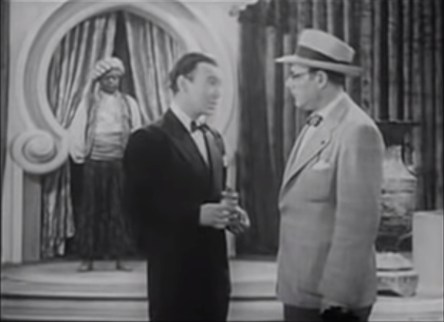
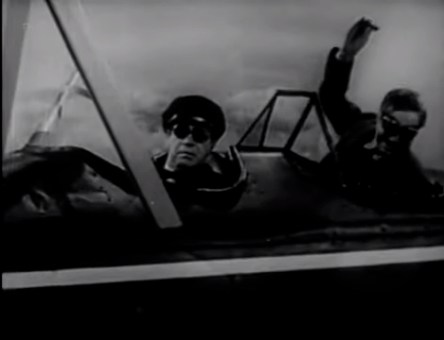
The spies, to whom Zorka had initially hoped to sell his invention and who later try to steal it outright, have a few nice touches. The only one of the field agents who has much personality, Rankin (Anthony Averill), is sort of a spearhead villain, indistinguishable from a typical movie gangster, but the head of the spy ring, Jarvis (Edward Van Sloan) is a bit more of a character. The spies maintain an “International School of Languages” as a cover, from which they broadcast cryptic coded messages by radio. As is frequently the case, the spies’ foreign superiors go unnamed except for vague mentions of a “leader” or occasionally “His Highness.” I wonder which foreign governments they might have been thinking of in 1939? I’d be remiss if I didn’t point out this incredible flying costume Jarvis wears in Chapter Four (“Invisible Terror”) during a brief moment when the spies are in possession of the box and try to fly it out of the country.

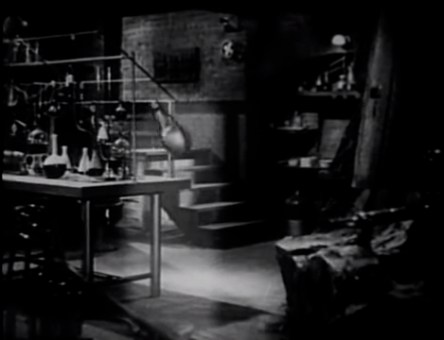
The Phantom Creeps has many elements that I love in the serials: crazy gadgets, distinctive visuals, colorful characters, and a great villain. The tone, from the ominous theme music to the shadowed interiors of Zorka’s mad science lab (full of Kenneth Strickfaden’s whirling, sparking electrical contraptions) is closer to Universal’s famous monster series than the typical action serials of the day. There is also plenty of drama to be mined in the confrontations of the individual characters and their competing goals; even the small-time spies and beat cops get little character moments as they deal with the unknown menace of the “Phantom.” So I really wish I liked it more, and it saddens me to report that these promising parts rarely coalesce into a satisfying whole.
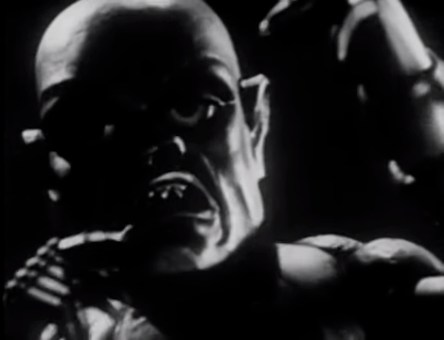
It’s hard to put my finger on why it fell short for me. Part of the problem is that there is just too much going on: too many characters, too many of whom change their behavior or loyalties depending on the scene in order to keep the story going. The way the action returns again and again to a few locations makes it feel like it’s spinning its wheels (considering that Zorka’s robot never leaves his house, where it is hidden behind a sliding panel, it’s surprising how much use it gets, since characters keep finding reasons to go back there). The ways in which the characters encounter each other are often dependent on coincidence: one might think there was only one road in California for the number of times characters pass and recognize each other, setting off yet another chase (“There go two of the spies in that car!” is a typical line of dialogue). I guess it comes down to too much filler, not enough killer.

There is also the general shabbiness that many serials display, amplified by the sense that The Phantom Creeps is made up of bits and pieces thrown together or borrowed from other productions. Other serials have featured invisible characters and made them spookily effective, but only a few scenes in this truly use the “Phantom” conceit in a thrilling or atmospheric way. (The invisibility effect is little more than a double-exposed smudge of light, or occasionally a shadow.)
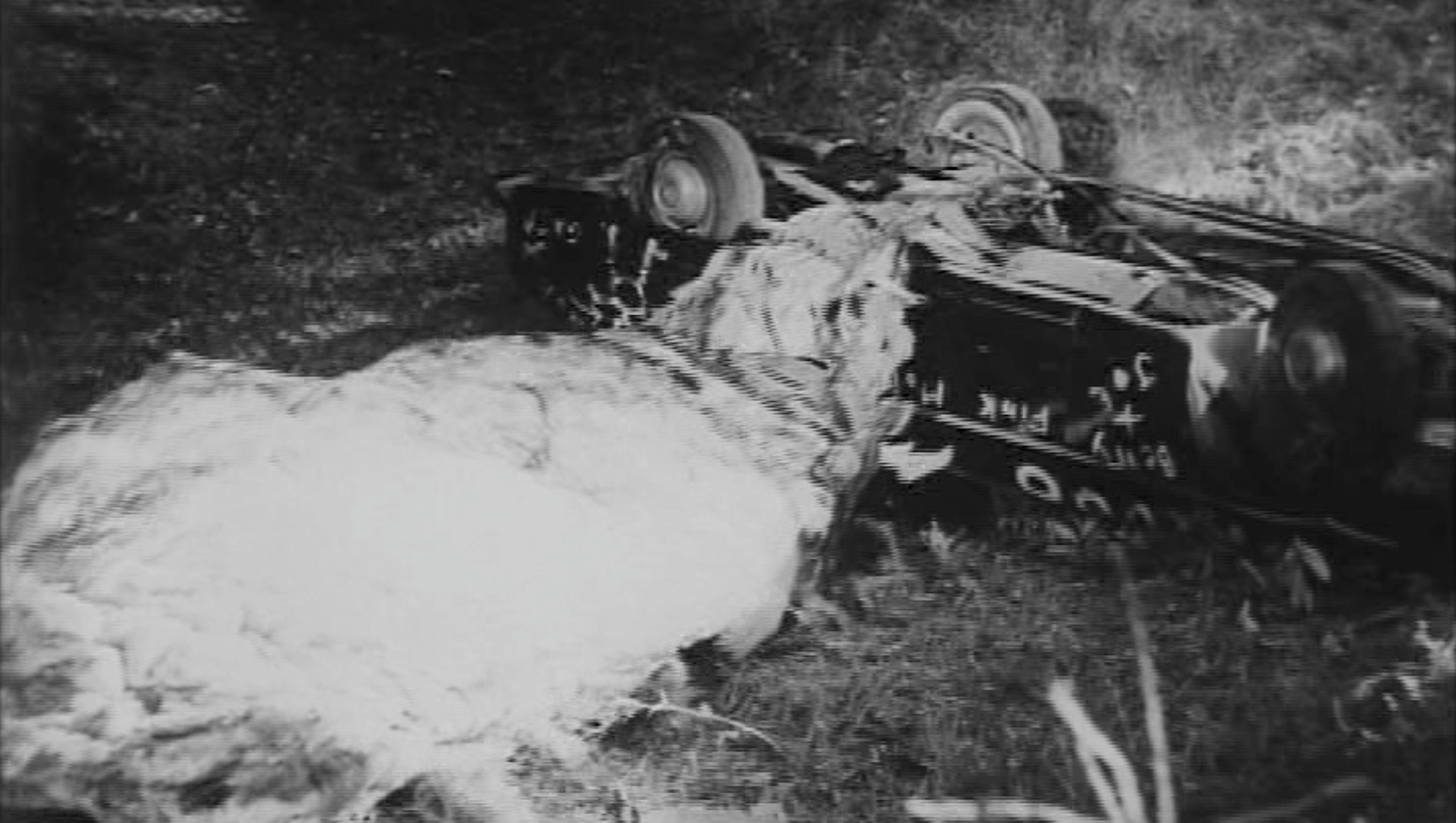
The use of stock footage to ramp up the threats to our heroes also becomes excessive (and familiar–it surely doesn’t help that I’ve seen this boat crash, that building fire, and even that shot of the Hindenburg disaster in other serials) as it approaches its literally cataclysmic finale. Or perhaps it’s simply how generic everything seems; one of the best parts of The Phantom Creeps is a short flashback in which Dr. Zorka reveals the mysterious radioactive element that powers all of his inventions: it fell to earth in Africa as a meteorite centuries ago, where it lay buried in the ground until Dr. Zorka arrived to dig it up. The visual of Zorka in a protective hazmat suit, lowered into a crevice by native bearers and chipping the sparking, smoking stone from the rock is specific to the story in a way that too much of it simply lacks (wouldn’t you know it, that sequence turns out to be lifted from the 1936 Lugosi/Karloff feature The Invisible Ray).

What I Watched: The Phantom Creeps (Universal, 1939)

Where I Watched It: A two-tape VHS set from VCI’s “Classic Cliffhanger Collection”
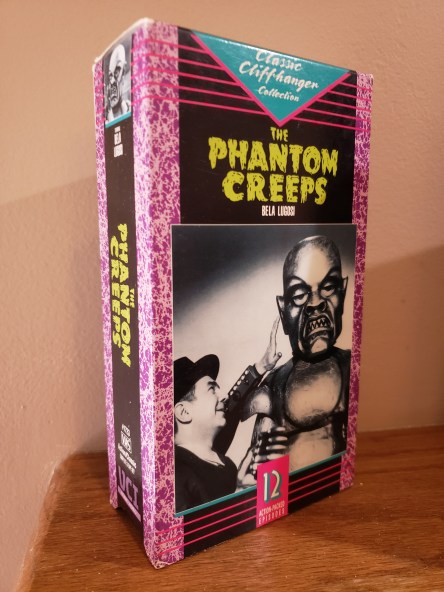
No. of Chapters: 12

Best Chapter Title: “To Destroy the World” (Chapter Twelve)
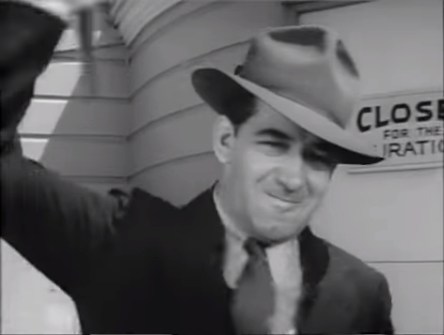
Best Cliffhanger: At the end of Chapter Eleven (“The Blast”), spies Jarvis and Rankin have taken off in their car with the meteorite (and, unbeknownst to them, Zorka in his invisible state); spotting them, West and Jean follow, with Jean driving. Jarvis pulls up at a barricade: the road is closed for blasting, but the workers let the car through. The workers continue preparation for blasting, and because of a faulty detonation plunger one of them lights a long fuse. Just then, West and Jean drive up and spot the barricade. “It may be a trick to stop us,” West says, instructing Jean to keep driving. Despite the protests of the workmen, they drive through the barricade; mere moments later–kaboom!

Breaking news: Like many serials, especially those featuring reporter characters, The Phantom Creeps has some great on-screen newspaper headlines for quick bursts of exposition.

SCIENTIST AND WIFE MEET DEATH SAME DAY IN DIFFERENT ACCIDENTS!
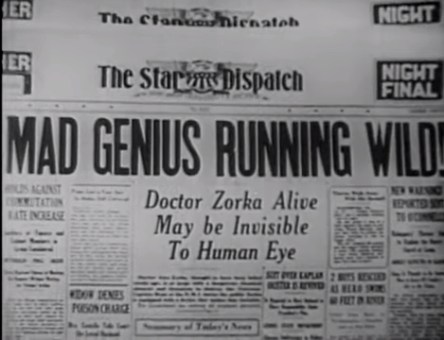
MAD GENIUS RUNNING WILD!
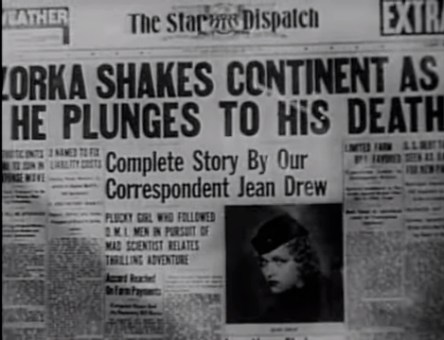
ZORKA SHAKES CONTINENT AS HE PLUNGES TO HIS DEATH

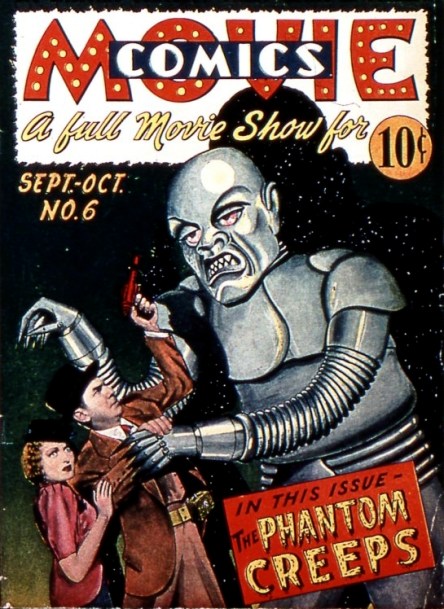
Don’t forget the funny pages: The Phantom Creeps was adapted (very freely) in an issue of Movie Comics; the publication retouched frames from the movies, turning them into comic panels. The eight-page story takes liberties from the very first page, putting Zorka’s laboratory in an old castle instead of a house, and in this version “Phantom” is the robot’s name. Some things never change. The entire story can be read at the blog Four-Color Shadows.
Sample Dialogue:

Monk (invisible, having stolen Zorka’s devisualizer belt): I’m free, Dr. Zorka! I’m stronger than you now! Stronger than the police! You’ll never make a slave out of me again. Ha ha ha!

[Zorka zaps Monk with a “Z-ray” and makes him reappear, briefly incapacitating him]

Zorka: You traitor! You didn’t know that you too had been sprayed with my invisible gas. Get up on your feet! . . . You belong to me! You can never escape me! Go!

–Chapter Seven, “The Menacing Mist”
What Others Have Said: “The contribution of The Phantom Creeps to later serials was an auto chase in which a 1939 black Nash pursued an ancient touring car. The appearance of a vintage vehicle in a chase was a sure sign that sooner or later it would go over a cliff and burn. New cars didn’t match those in crashes in the stock-film library, and stock shots were meant to last many years.” –Raymond W. Stedman, The Serials: Suspense and Drama by Installment
What’s Next: For what will probably be the last installment of this series for the summer, let’s check out the proto-Raiders adventure, Secret Service in Darkest Africa aka Manhunt in the African Jungles!
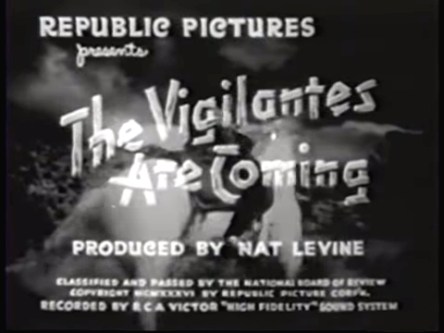
Fates Worse Than Death: The Vigilantes Are Coming

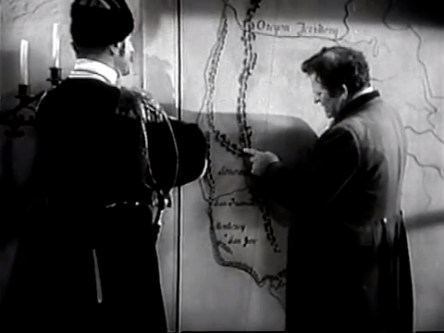
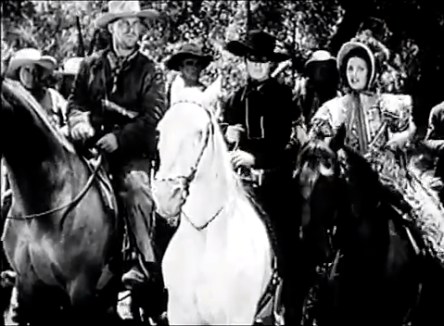
California, 1844, “The Last Days of the Dons”: A young Don Loring says farewell to his father and brother as he prepares to join the expedition of Captain Fremont exploring the Pacific Northwest. While he is gone, Don Loring Sr. confronts General Jason Burr for trespassing on Loring’s property, not realizing that Burr has secretly discovered gold on the land and is already mining it, using conscripts Burr has abducted from nearby villages. After the tense meeting, Burr has Loring and his other son killed. As it happens, Burr’s plans go beyond secretly enriching himself: he is in contact with the Russian emissary Count Raspinoff, and he has proposed turning California over to the Russian empire with himself installed as dictator over the territory.

Raspinoff (Robert Warwick) and Burr (Fred Kohler)

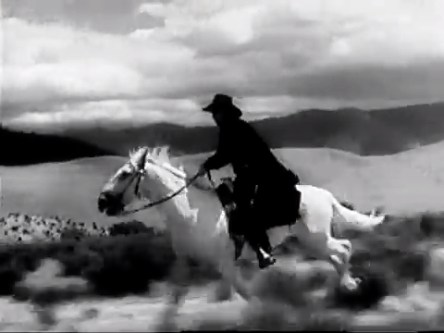
Later, after young Don Loring’s return to the Sonoma Valley and his discovery that his family has been murdered, he declares vengeance. His crusade will require secrecy: he vows to adopt the persona of the Eagle until justice is achieved! In a short montage, the Eagle strikes down a series of henchmen, working his way up to the boss, each time leaving an eagle feather as a calling card. It’s not long before General Burr notices this hindrance to his plans, so he invites the Eagle for a parley–actually a trap, of course, but one that the Eagle cleverly evades. Face to face with Burr, the Eagle gives him a whipping, literally, before making a narrow escape. It’s going to take more than one man to bring down the would-be dictator, especially now that Count Raspinoff has provided him with a battalion of Cossacks from the Tzar’s army, so the Eagle sets about organizing a Vigilance Committee made up of the ranchers in the Valley. All is set for a confrontation of historic proportions in The Vigilantes Are Coming!

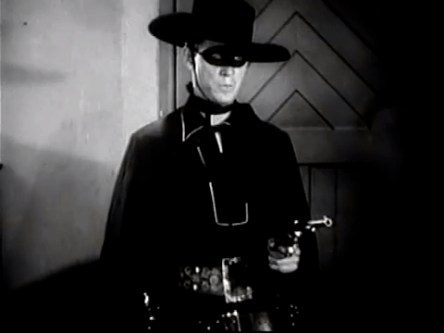
It should be obvious that the Eagle is a dead ringer for Johnston McCulley’s Zorro, right down to the friendly village padre who provides a hiding spot in his church, and if this were billed as a name-brand Zorro adventure no one would bat an eye. Star Robert Livingston, who plays the Eagle, would actually play Zorro by name in The Bold Caballero for Republic the very same year; Republic would make several Zorro serials, beginning with Zorro Rides Again in 1937, and there would be more feature films and televison series as well, but in 1936 all of those other adaptations lay in the future, with the major exception of Douglas Fairbanks’ 1920 silent take on the character in The Mark of Zorro. (With its scheme to separate California from American rule and its hidden gold mine dug by slave labor, The Vigilantes Are Coming has some resemblance to 1998’s The Mask of Zorro starring Antonio Banderas.)

Guinn “Big Boy” Williams and Raymond Hattan played Don Loring’s comrades.

But it’s the mash-up of California colonialism with Western tropes (mostly in the person of Salvation and Whipsaw, a pair of mountain-man scouts who split off from Fremont to accompany Don Loring home) and the Russian (or “Roosian,” as characters repeatedly say) bad guys that really makes this serial distinctive. It’s not quite as strange as it was made out to be, at least not while The Phantom Empire is right there, but for a serial rooted in a historical time and place it has an unusual premise. How plausible is it?

While the Russian plot to take California is an obvious alternate history conceit, it makes sense as a story hook, considering that Alaska was still Russian territory until 1867. Moreover, Burr’s attempt to set himself up as dictator mirrors those of real-life adventurers who hoped to carve their own fiefdoms out of the still-open frontier, including Aaron Burr’s much-debated attempt to conquer former Mexican territory and William Walker’s campaigns in Sonora and Nicaragua. More notable is the avoidance of the Mexican-American War: in the serial, Raspinoff demands secrecy because Russia has no desire to go to war with Mexico or the United States, but by the time it’s all over the Russian flag over Burr’s fort has been replaced with the stars and stripes, the Americanization of the territory a fait accompli.

Captain Fremont’s role as commander of the military troops who ride in to save the day also glosses over the real Frémont’s more controversial role in wresting California away from Mexico in the years leading up to that war. Like Frémont’s real-life associate Kit Carson, who also took part in the territorial conflict, the heroism and genuine accomplishments of his career tended to overshadow his grislier reputation as an “Indian-killer,” especially in popular entertainment like this. The sleight-of-hand by which it’s the Russians who stand in the way of Manifest Destiny, and not the clashing ambitions of neighbors Mexico and the United States, is a variation on the popular Western trope in which a malevolent white man (like Burr in this case) turns whites and Indians against each other for his own gain, preventing the peaceful settlement of the territory that benefits everyone. The whiteness of “Don Loring” and his family, while the peasants are presented as more stereotypical Mexicans, is another sign of their preemptive Americanization. It is a truism that Western movies say more about the time in which they are made than the era in which they are ostensibly set, and The Vigilantes Are Coming is no different.

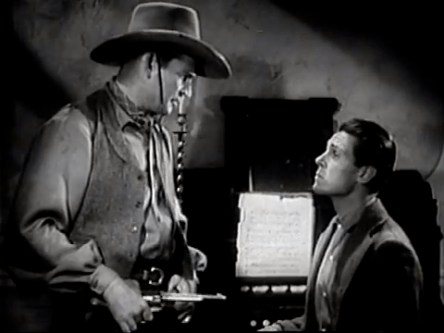
Leaving such issues aside and taken on its own terms, this is an entertaining and fast-moving serial. Robert Livingston makes for a fine hero, convincingly brash when he needs to be; when he poses as a mere organ student to hide his identity, he appears meek, but reveals the calculation that goes into his deception to the audience. (He’s not the only one with a penchant for disguises: Salvation disguises himself as a Mexican peddler, and Whipsaw takes a captured Cossack’s uniform–and beard!–to infiltrate Burr’s fort in a humorous sequence.)

Of course, a leading man needs a leading lady: Kay Hughes plays Doris Colton, whose mining engineer father is held captive by Burr to run his gold mine. She is mostly held prisoner herself (communicating with the Eagle through carrier pigeons), but when she gets the opportunity she does her part, helping the Eagle set the fort on fire and leading the Vigilantes to the gold mine.

A brief misunderstanding

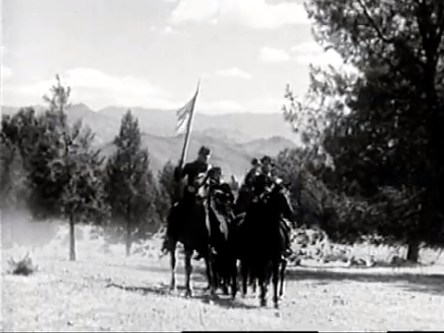
Preceding Republic’s adaptation of The Lone Ranger by two years, The Vigilantes Are Coming cast the mold for a whole slew of masked Western heroes to come: allowing for the similarities to Zorro already pointed out, the Eagle settles disputes with his six-shooter and bullwhip much more than with a blade (there is only one swordfight sequence in the whole thing), and despite the Southwestern setting much of the action and characters are clearly indebted to the traditional Western. Set pieces include a siege of the fort, with guns blazing; a fire that nearly burns down the Mission; a stand-off in which the vigilantes hold the gold mine against Cossack artillery; and a rousing “here comes the cavalry” ending. What more could you ask for?

What I Watched: The Vigilantes Are Coming (Republic, 1936)

Where I Watched It: A two-tape VHS set from Republic Pictures Home Video

No. of Chapters: “Foreign Fiendishness in 12 Saber-Rattling Episodes”

Best Chapter Title: There are a number of stock chapter titles that reappear frequently in different serials (Chapter Seven’s title, “Wings of Doom,” seems like one I’ve seen before), but I can’t imagine any other serials have a chapter called “Condemned by Cossacks” (Chapter Three).

Best Cliffhanger: A number of strands come together for maximum suspense at the end of Chapter Ten (“Prison of Flame”): after Don Loring and Doris Colton are both captured, Burr having finally figured out who the Eagle is, Doris offers to reveal where Count Raspinoff is being held in exchange for the Eagle’s life. Taken to the Mission, she demands that the Eagle be locked somewhere safe, and the key given to her, in order to guarantee his safety. Still bound, the Eagle is locked in the sexton’s room at the base of the bell tower. While Doris stalls, the Eagle manages to pull the rope to ring the Mission’s bell, the prearranged signal for the gathered Vigilantes to come to the Mission. While pulling the rope, he knocks over a lamp and starts a fire. Cutting between the approaching Vigilantes and their confrontation with the Cossacks, Doris’ increasingly desperate attempts to stall Burr’s men, and worst of all the sexton’s room filling with smoke, the chapter ends with burning rafters falling from the ceiling into the room in which the Eagle is trapped as the bell tower threatens to collapse on him!

Annie Wilkes Award for Most Blatant Cheat: As I have frequently noticed in Mascot and early Republic serials, there are a few clear-cut classic cheats in The Vigilantes Are Coming, the kind that seem to rewrite history rather than simply providing a new context or having the hero wriggle out of danger at the last second. The most obvious is at the end of Chapter Four, “Unholy Gold,” set in Burr’s gold mine the first time the Vigilantes attempt to take it. When the Vigilantes enter, they find the main chamber empty except for Doris’ injured father and a waterwheel-driven pile driver used for crushing rocks. Once the inevitable fight breaks out between Burr’s men and the Vigilantes, the Eagle is punched out and falls into the shaft supporting the pile driver; before he can recover, the weight descends on his chest, crushing him! At the beginning of the next chapter, however, when the same punch sends the Eagle beneath the pile driver, Salvation quickly pulls him out of danger before the weight descends. It doesn’t get much more revisionist than that!

Sample Dialogue: “I see you have all the qualities of a dictator.” –Count Raspinoff to Burr, after Burr has ordered the killing of Don Loring Sr. and his son, Chapter One (“The Eagle Strikes”)

What Others Have Said:The Vigilantes Are Coming was a reworking of The Eagle, Rudolph Valentino’s silent film. It served as a showcase for Robert Livingston, one of Republic’s popular leading men. . . . He is best remembered for his role as Stony Brooke, the lead cowboy in the well-liked Three Mesquiteer films. Livingston played in twenty-nine of them between 1936 and 1941, except for a stretch in 1938-39, when he was promoted to romantic melodramas and replaced by John Wayne.” –Raymond W. Stedman, The Serials: Suspense and Drama by Installment

What’s Next: Another VHS classic from the big ol’ box of videotapes–let’s go with something a little spooky and watch Bela Lugosi in The Phantom Creeps!

Fates Worse Than Death: The Masked Marvel

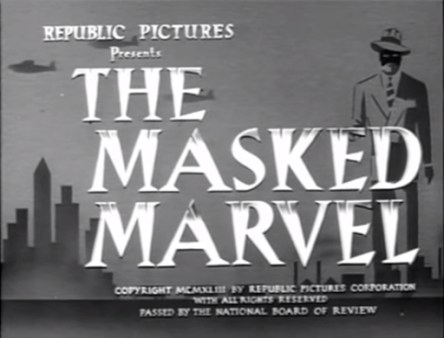
Worldwide Insurance has been writing a lot of checks for claims lately, big ones: a series of disasters has befallen Worldwide’s major clients, all of them related to the war effort. While Warren Hamilton, Worldwide’s president, gladly pays out, he hopes that the secretive agent known only as the Masked Marvel will be able to dig up some clues that explain this extraordinary run of bad luck. But perhaps it isn’t luck at all–the Masked Marvel has determined that Japanese spymaster Mura Sakima is hiding somewhere in the U.S., coordinating these attacks on shipping and production. When notorious gangster “Killer” Mace shoots and kills Hamilton in broad daylight, it’s only a matter of time before the murder is traced back to Sakima. In the mean time, Worldwide’s vice president, Martin Crane (secretly in league with Sakima), takes over, and Hamilton’s daughter Alice remains to coordinate the Masked Marvel’s investigation.

So, yes, The Masked Marvel is another wartime serial unafraid to name America’s enemies specifically. Hitler is mentioned, but the focus is on the menace of the Rising Sun, personified by Sakima, who appears in every episode, communicating with his underlings until the final confrontation at the end. Thankfully, the overt racism of the contemporaneous Batman serial isn’t present here: Sakima is played by Johnny Arthur as a haughty, effete stereotype, part Tojo and part Mr. Moto, and his lair is decorated with as much Oriental bric-a-brac as the set dressers could get their hands on so we know he’s foreign, but it could be worse. There are no other Japanese characters to paint with a broad brush, much less the explicit approval of interning Japanese civilians on display in Batman. Sakima prefers to work through American turncoats and mercenaries. All of Sakima’s schemes involve stealing a critical invention for Japan or destroying it so that the Allies can’t use it, or blowing up supply lines with time bombs or explosive fuel additives; the end result is a series of episodes similar to any number of crime or superhero serials, but with a unified (and explicit) political angle.

The Masked Marvel is also an almost-Platonic example of a certain kind of serial in which the hero’s identity is unknown until the end (see also: Flying G-Men). In the first chapter, four insurance investigators are introduced: Frank Jeffers (Richard Clarke), Terry Morton (Bill Healy), Robert Barton (David Bacon), and Jim Arnold (Rod Bacon–Harmon and Glut have him as David’s brother, but that doesn’t appear to be the case). All four will be working with Alice Hamilton to get the Sakima affair settled. What’s more, one of these four men is secretly the Masked Marvel! Presumably he is safer in his civilian identity if it’s not known which one he is (although he reveals his true face to Alice early on).

The four investigators do a lot of detective work, tracking down clues and getting in fights, but when it comes to the really dangerous stuff, the Masked Marvel shows up–in the spirit of similar pulp heroes, he wears the same suit and fedora as the investigators but covers most of his face with a rubber mask stuck on with spirit glue. It’s the Masked Marvel who faces death in most of the cliffhangers, although of course he also rescues Alice a couple of times. Sakima and his underlings attempt to solve the mystery by dividing up or delaying the investigators and seeing if the Marvel shows up, but the Marvel always comes through, even after two of the investigators die in the line of duty over the course of the serial.

I’ve mentioned before how often members of the cast in serials look alike, but in this case it’s an essential part of the mystery, since it would be too obvious if the investigators all had different body types. Unfortunately, the similarity of the investigators undercuts any suspense that might come from not knowing which one is the Marvel: they don’t have any individual personality for us to root for one or the other, nor do they have any differences in skills that might help us figure it out. And as in many serials featuring costumed heroes, the good guys are just as effective when out of costume, so why the secrecy?

As it happens, even eagle-eyed viewers wouldn’t have been able to identify the Marvel through his mask, because when in costume he’s played by an entirely different actor, stuntman Tom Steele, and his voice dubbed by radio actor Gayne Whitman. This is actually typical of the serials: not just the use of stunt doubles, which of course was and remains a common practice, but the use of a different actor to play characters when they are in disguise. The Masked Marvel is unusual in the degree to which it is built around this conceit, but the substitution of actors was common enough in the serials. Tom Steele wasn’t even listed in the credits of the original film (fellow stuntman and fight coordinator Dale Van Sickel was), but his name is on the cover of the videotape I watched, reflecting later fans’ awareness of and interest in the work of unheralded professionals like Steele. (Steele also appears, unmasked, as one of Sakima’s thugs; apparently the original plan was to give him top billing, but when producers changed their minds he received no credit at all.)

Tom Steele, behind the mask

The fact that The Masked Marvel is a showcase for Steele also means that fight scenes–many of them big, set-destroying brawls involving leaps or falls–are the main course, with the Marvel and the other investigators getting into dust-ups in every single chapter, in a variety of colorful settings. Location shooting was at a minimum due to wartime restrictions, so most of the serial was shot on the Republic backlot. A pottery warehouse full of extremely breakable crockery in the first chapter is an illustrative example, but other fights take place on rooftops and in underground tunnels, as well as the more typical houses and places of business. (Several impressive explosions are the work of the Lydecker brothers, as usual.) Regular fistfights are alternated with shoot-outs and car chases, as well as a couple of chases involving motorboats. To me, it gets a little repetitive, but if it’s action you love in the serials, The Masked Marvel has what you’re looking for.

Still, there are plenty of the gimmicks and gadgets the serials are known for: I love that Sakima’s lair is actually located directly under Crane’s house, and that Crane descends in his office chair on a platform when he wants to visit Sakima. (The first inkling the investigators get of this treachery is when one of them observes Mace entering through a secret entrance on Crane’s property.) I love how the Masked Marvel communicates through phonograph records with a custom label resembling his mask, anticipating the pop-art flourishes of the later Batman and Green Hornet television revivals. (In fact, the whole serial is more notable for its sense of visual flair than for its plot: check out the cool title cards!) There is also more than one case of our heroes hiding in trucks and crates, hoping to be taken directly to Sakima. Of course, nothing ever works out quite like we’d hope, but it makes for some exciting and surprising adventure.

The cast includes some familiar faces: Mace is played by Anthony Warde, Buck Rogers‘ Killer Kane, and Alice Hamilton is played by Louise Currie, Adventures of Captain Marvel‘s Betty. As in Captain Marvel, Currie displays a mixture of vulnerability and gutsiness; a chapter in which she goes undercover as a waitress at a spy-run café is a high point.

It is William Forrest, who plays the duplicitous Crane, rather than any of the four investigators, who is first billed; Forrest appeared in a few serials and had small, often uncredited roles in many films in the 1940s, and continued to act, especially on television, into the 1970s.

What I Watched: The Masked Marvel (Republic, 1943)

Where I Watched It: A two-tape VHS set from Republic Pictures Home Video

No. of Chapters: 12

Best Chapter Title: “Death Takes the Helm” (Chapter Two)

Best Cliffhanger: Interestingly, for a serial that places so much emphasis on action, The Masked Marvel includes one cliffhanger focused not on immediate mortal peril, but on the danger of being discovered: at the end of Chapter Four (“Suspense at Midnight”), Sakima orders Crane to summon the four investigators while he listens in, confident that the Masked Marvel won’t be able to respond in time. Whoever isn’t there must be the Marvel, and so it seems, as Alice asks “Where’s Jim?” “So,” Sakima concludes, “Jim Arnold is the Masked Marvel!” (Not so fast, Sakima!)

But that’s an exception, and the other cliffhangers threaten as much danger as you could wish. The conclusion of Chapter Three (“Dive to Doom”) is particularly good, as the chapter is centered around the freight elevator in a multi-story building. In the course of the chapter, Alice is threatened with being crushed beneath the platform (Mace uses the elevator to crush a barrel to demonstrate); when the Masked Marvel arrives to rescue her and the fight moves to an upper story, the open elevator shaft remains a danger. First, one of the henchmen falls to his death, answered by the terrified scream of Alice, still on the first floor; then the Masked Marvel falls–or at least appears to. (Several of the cliffhangers rely on mistaken identity for their resolution–i.e., it wasn’t really the Masked Marvel you saw getting shot, it was some other guy in a fedora–but I’m too old to get het up about such cheats anymore. Chapter Three’s cliffhanger at least has a more creative solution than that, as in the next chapter Alice is shown raising the elevator so the Marvel doesn’t have as far to fall, saving his life.)

Sample Dialogue: “You wanted to go for a ride in this truck, huh? Now you can go for a ride, by yourself!” –Mace, abandoning a speeding truck in which the Masked Marvel is trapped in the back, Chapter Nine (“Danger Express”)

What Others Have Said:The Masked Marvel‘s impressive action sequences have frequently caused it to be overrated by admirers of Republic’s stuntwork and effects (most notably the great serial buff Alan Barbour, who tended to treat it as one of the studio’s masterpieces); this overrating has in turn led other reviewers (particularly those of the Internet generation) to criticize Marvel far more harshly than it deserves, sometimes dismissing it as completely uninteresting. While it’s quite true that Masked Marvel could have been a much better serial had its plotting and casting been handled with the same care bestowed on its action scenes, it’s still far from a failure–and remains well worth the time of any serious chapterplay fan.” —The Files of Jerry Blake (Blake’s entry includes quite a bit more information on the stunts for those in search of such detail.)

What’s Next: Regular readers of this column know how much I enjoy the weird serials of the 1930s, and have I got a doozy lined up! “Swashbuckle your seatbelts! Cowboys and Cossacks collide in one of Republic’s most curious cliffhangers ever.” From 1936, join me as I review The Vigilantes Are Coming!

Fates Worse Than Death: Lost City of the Jungle

“The warmonger who steals peace is the worst of all thieves.” –United Peace Foundation member

Agent Rod Stanton of the United Peace Foundation should be basking in triumph: thanks to his efforts, the world is rid of Sir Eric Hazarias, one of the most pernicious warmongers ever, Hazarias’ car having driven off a bridge and burst into flame. The Foundation is one step closer to its goals of uniting the world and banishing war forever. However, Stanton cannot be satisfied until he has followed up on rumors that Sir Eric didn’t die at all, but rather one of his doubles, and the warmonger has resurfaced in the Himalayas under the name “Geoffrey London.” Stanton, with the support of the Foundation, flies to the remote nation of Pendrang, even though a consistent headwind makes it nearly impossible for even the best pilot to get into Pendrang with the approach of winter. Add to that the presence of a stowaway, Marjorie Elmore, daughter of the archaeologist whose expedition in Pendrang is being financed by “Geoffrey London.” When the weather brings their plane down in the inhospitable, icy Himalayan mountains, where the threat of deadly cold and avalanches is more immediate than the machinations of Sir Eric Hazarias, nothing could seem farther away than the warmth of the jungle, but that is their ultimate destination: the Lost City of the Jungle, in fact!

Ah, the jungle. Jungle adventures were so popular in the 1930s and ’40s that Africa and South America weren’t big enough to contain them, and new exotic locales had to be found for adventurers to explore. Pacific islands worked for a while, but even those no longer seemed so exotic or scary now that thousands of American G.I.s were returning to the mainland and setting up tiki bars and hosting luau-themed barbecues in the back yard. Particularly after World War II, when the wide-open frontiers of Africa and the Middle East were hardening into closed national borders, and there were fewer blank spots on the map for writers to speculate about, the settings for “lost world” stories and jungle treks moved to less likely but still mysterious places.

So it is that Lost City of the Jungle takes place in the fictional nation of Pendrang, in “an isolated jungle basin in the Himalayas,” making for an odd juxtaposition of ice-covered mountains and sari-wearing natives living among palm trees. Apparently there are some tropical rainforests in the eastern foothills of the Himalayans, but Pendrang, as described, is truly hidden in the center of the range, cut off from the rest of the world by heavy ice that blocks the passes in and out for five months of the year (conveniently trapping good and evil characters alike without escape or outside aid).

Plausibility aside (a disclaimer that should be assumed with most serials), Pendrang is an interesting place and a lively, varied setting for adventures. Although there is a whiff of Shangri-La about Pendrang, there are no lamas or immortals. The capital city of Zalabar is purely worldly, ruled by the casino operator Indra, whose wealth allows her to bend the laws to her liking, and the mystical beliefs of the tribesmen who live in the surrounding jungle turn out to have a surprisingly rational basis. Indeed, the “eternal sun” the natives venerate in the name of the “glowing goddess” is revealed to be a radioactive element, the MacGuffin for which the bad guys are searching. This is the age of science, baby!

Once Stanton (Russell Hayden) and Marjorie (Jane Adams) make it to Zalabar with the help of local agent Tal Shan (Keye Luke of the Green Hornet serials), they reunite with Dr. Elmore (John Eldredge). Elmore is a man of scholarship, completely unaware of the real goals of his patron, or that his assistant, Professor Grebb (John Gallaudet, whose voice sounds uncannily like Bob Newhart’s), is secretly in league with Hazarias. The main thread of the plot is a classic treasure hunt, with characters finding clues in the forms of tablets, tomb carvings, and plaques covered with hieroglyphics that must be translated to determine the next step. (Of course one or more of these artifacts get stolen and must be recovered, and there are still the natives, for whom these are sacred objects, to worry about.)

The land beneath Pendrang is full of caves and tunnels, and needless to say there are deathtraps to snare the unwary, such as tomb chambers that fill with gas and ledges that hang precariously over pools of bubbling lava, forming some of the serial’s cliffhangers. If those don’t bring our heroes’ adventures to an end, perhaps Hazarias’ henchmen Marlow (George Lynn) and Johnson (Dick Curtis) will. There are always henchmen.

Lost City of the Jungle followed Jungle Queen by a year, and shared the same directors, Lewis D. Collins and Ray Taylor. Like the earlier serial, in addition to the usual action there is an emphasis on spycraft and agents working for global forces, although the apolitical “United Peace Foundation” is a step back from the explicit references to the Allies and Axis in Jungle Queen (the United Nations resolution is mentioned, but the Foundation is a bit more hands-on). Sir Eric Hazarias, who is indeed going by “Geoffrey London” in Pendrang, is first and foremost a capitalist, a non-ideological promoter of war who hopes to profit from conflict around the world. In Pendrang he is looking for “meteorium,” the element critical to his scientist Gaffron’s design for neutralizing the atomic bomb (still a startlingly recent development). Once the element is isolated, this anti-nuke device will be sold to the highest bidder, and the nation who owns it will be free to use atom bombs without fear of reprisal.

Lost City of the Jungle is also similar to Jungle Queen in lacking title cards or narrator for recaps at the beginnings of chapters: instead, each chapter begins with a meeting of the United Peace Foundation back in San Francisco, going over Rod Stanton’s progress in the Pendrang matter. Reminders of important details are also included in dialogue, which makes things flow organically but results in “TV exposition” in which people repeat information they already know to each other. If the relationship between meteorium, the atomic bomb, and the glowing goddess is confusing at first, don’t worry: it gets explained multiple times.

Finally, another similarity to Jungle Queen is the shifting loyalties and hidden motives of many of the characters, making for an atmosphere of suspicion and distrust. If anything, the depth of characterization is greater here than in Jungle Queen (while still relying on many stock character types). I particularly like the circle around Indra (Helen Bennett) at her Star of Asia Casino, a neutral territory at which the de facto ruler of Zalabar can interrogate strangers and make deals in safety, as long as she keeps the police and guards paid off. It reminds me a bit of Rick’s Café in Casablanca, and the most colorful side characters are found here: “Doc” Harris (Ted Hecht), the cool casino manager, and “System” Reeves (Arthur Space), a hapless gambler who’s convinced he’ll crack the roulette wheel any day, but who in the mean time is a useful extra pair of eyes for Harris.

On that note, at least one of those character twists was the result of offscreen events: Sir Eric is played by Lionel Atwill, who had been a major horror star in the 1930s; when not playing out-and-out mad scientists, he portrayed well-spoken, monocle-wearing villains (including Dr. Maldor in the Captain America serial). That Atwill, who had at one time been as big as Lugosi and Karloff, ended his career in “Poverty Row” serials and B movies was the result of an earlier scandal in which Atwill was found guilty of perjuring himself following a police raid on an orgy at his house in 1940. After that, the majors (with the exception of Universal, who continued to find parts for him in the Frankenstein series) effectively blacklisted him. Lost City of the Jungle was, in fact, Atwill’s final film; he died during its production, and in addition to such time-honored tricks as using a double to finish some of his scenes, the producers had the script rewritten, bumping up the importance of another character. Early on in the story, it is revealed that Sir Eric’s personal secretary, Malborn (John Mylong), is actually the power behind the throne, directing events from relative obscurity with Sir Eric as a mere figurehead. Of course, eventually Malborn goes too far and Sir Eric asserts himself. . . . The reconfiguration around Atwill’s death makes sense in retrospect, but not knowing it while I was watching the serial, I suspected nothing. It just felt like a particularly twisty plot.

What I Watched: Lost City of the Jungle (Universal, 1946)

Where I Watched It: TCM has been running this one on Saturday mornings this summer, but it’s also on YouTube, so I watched about half on my DVR and then went ahead and finished watching it online.

No. of Chapters: 13

Best Chapter Title: It’s a toss-up between “Wave-Length for Doom” (Chapter Three) and “Death’s Shining Face” (Chapter Six).

Worst Chapter Title: Actually, most of the chapter titles in this are pretty blah, but the worst is the title of Chapter Seven, “Speedboat Missing.” The extreme passive voice, as if the title were a flyer announcing a search for lost property, goes against all the principles of dynamic phraseology I’ve been hammering on for the last six(!) years. Even adding the definite article to make it “The Missing Speedboat” would at least be neutral, but it’s not even about a missing speedboat: the chapter ends with a high-stakes chase on the water, with Marlow throwing grenades at Rod and Tal Shan.

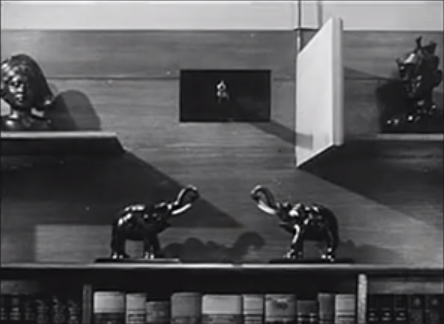
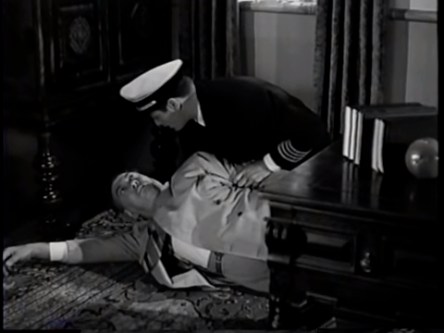
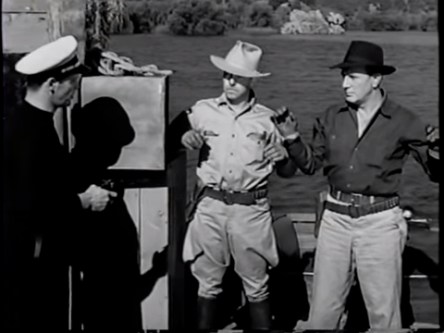
Best Cliffhanger: As in Jungle Queen, the cliffhangers are not always the best parts of the chapters, with some of them seeming like afterthoughts. However, there are a few good deathtraps in the serial style, and the best is at the end of Chapter Nine, “Zalabar Death Watch.” After being lured to the schooner on which Dr. Elmore is being held (the presence of the schooner in landlocked Pendrang, justified as a folly built for river trade that never materialized, is typical of serials’ use of stock locations and situations without much concern for realism), Marjorie is tied to a chair and placed in front of a bookshelf. On the mantel are two bronze elephants, and with the flip of a switch they begin to move towards each other, triggering a gunshot from a mounted rifle when they make contact. The kidnappers’ hope is to make Dr. Elmore talk before that happens, but will Rod and Tal Shan decipher the secret message Marjorie left behind in time to rescue her?

Sample Dialogue:

Gaffron: Now our hands are tied, we can do nothing!

Sir Eric: Our hands are never tied, remember that!

–Chapter Ten, “Booby Trap Rendezvous”

What Others Have Said: “The stocky, suavely sinister [Lionel] Atwill was one of the most menacing character actors of the classic age of horror. The man behind that façade was equally fascinating . . . and some would say almost as sinister.” –“Dr. Abner Mality,” “The Rise and Fall of Lionel Atwill” at Ravenous Monster

What’s Next: It’s back to the big box of VHS tapes; join me next time as I review The Masked Marvel!

Fates Worse Than Death: Haunted Harbor

Captain Jim Marsden is in trouble: his schooner Dolphin disappeared with a million-dollar shipment of gold bullion, and he’s deep in debt. To compound the suspicion, Vorhees, the man Marsden owes, has been murdered, and Marsden was discovered with the body. Before dying, Vorhees gave Marsden a name and a location–“Carter . . . Haunted Harbor”–but it won’t do him any good if he hangs for Vorhees’ murder.

Broken out of jail by his crew and offered a place out of the law’s reach by a businessman friend, Marsden makes for the island of Pua Mate to run the trading post and investigate Haunted Harbor. On the way there, he and his crew rescue an injured doctor and his daughter stranded by a storm. Once on the island, Marsden and his new friend Patricia Harding search for the identity under which Carter hides: is it Dranga, the assistant at the trading post? Or Kane, who operates a gold mine? Or is it . . . well, actually we know right away that it’s Kane, and there really aren’t very many other suspects, but it takes a while for all of this to come to light. In the mean time, in addition to the danger and double-crosses that come from his search for Carter, he attempts to solve the mystery of Haunted Harbor, which the natives fear to approach. Are the two cases related? I think you know the answer to that.

As Patricia Harding, Kay Aldridge has Big Hermione Energy.

Despite its Pacific island setting, Haunted Harbor is stylistically similar to Zorro’s Black Whip, which would immediately follow the same year. Aside from leads Kane Richmond (Spy Smasher) as Marsden and Kay Aldridge (Perils of Nyoka) as Patricia, it shares a few cast members with the other serial, as well as both directors (Spencer (Gordon) Bennet and Wallace Grissell). Most notably, George J. Lewis, who would play the hero of Zorro’s Black Whip, plays the duplicitous Dranga, a role apparently more typical for him. The most prominent side characters are Marsden’s crewmen and friends Yank (Clancy Cooper) and Tommy (Marshall J. Reed), and Kane/Carter’s chief henchmen, Snell (Bud Geary) and mine foreman Gregg (Kenne Duncan). (In typical serial fashion, Kane/Carter works his evil through his henchmen for as long as possible to keep Marsden from suspecting him: at one point Marsden even turns Gregg over to Kane, believing that the foreman is Carter.)

Stuntmen Dale Van Sickel and Tom Steele also appear in the casts of both films, a sure sign of energetic fisticuffs to come. As in Zorro’s Black Whip, the fight scenes–and there are many–are chaotic brawls, full of leaps and falls, taking place on sets crammed with breakaway furniture and loose objects that can be thrown or scattered around (the interior of the trading post is trashed several times, but is always straightened up in time for the next bout!). Of course, the men’s hats stay firmly on their heads, the better to disguise the use of stunt doubles.

Patricia mostly gets knocked out during these struggles, and she gets tied up more than once; I haven’t yet seen Perils of Nyoka (it’s on my list), but stills from it suggest that being bound was an Aldridge specialty. Typically, Patricia is the only female character, and while it’s a foregone conclusion that she’ll end up falling in love with Marsden (“Jim don’t need any help now,” Galbraith tells Yank after everything has been wrapped up), any potential chemistry is sublimated through the cinematic power of terrified screaming on her part and take-charge masculine problem-solving on his. Solve the mystery of Haunted Harbor, and you have solved the mystery of the human heart.

There is also gunplay, but most of the time when someone gets the drop on another character and says “hold it right there,” their quarry is able to twist the gun out of their hand, or kick some object into them to knock the gun loose–moves that would surely get someone killed if they weren’t very lucky–and the scramble starts all over again. (Of course, when the plot dictates that a character’s time has come, the bullet is suddenly very accurate.) It’s worth noting that Kane/Carter (played by career heavy Roy Barcroft) has one of the most gruesome comeuppances of any serial I’ve seen, but it occurs just off screen, allowing the audience to fill in the blanks with their imagination.

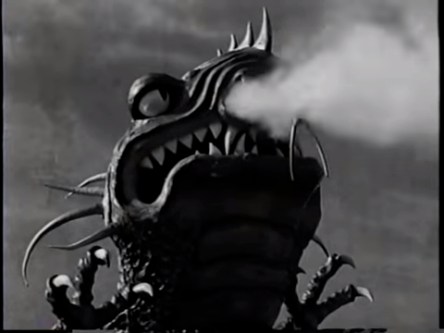
The most distinctive feature of Haunted Harbor is the location that gives the serial its name: the natives have stopped working to harvest copra* for the plantation (owned by Galbraith, the same man who owns the trading post Marsden manages), frightened off by demons and sea monsters. (The natives are mostly an abstraction, talked about more than seen, although one chapter takes place in the natives’ village.) It takes Marsden a while to get to the harbor to investigate for himself, but when he and Patricia take a boat out onto the water, the surface is disturbed by a horrible-looking sea serpent spouting steam from its nose. It sinks and pops back up in several locations, never attacking but looking menacing nonetheless. Marsden fires at it, but the bullets have no effect (his rifle had previously been loaded with blanks by Dranga, covertly working for Kane/Carter, but Marsden doesn’t know that). Real, honest-to-God monsters aren’t too common in the serials, especially those that aren’t otherwise science fiction, but the Haunted Harbor sea serpent is a memorable and well-designed creature, a candidate for a “deep cut” when discussing the sometimes quaint beasts that haunt old black and white movies. (The Lydecker brothers, Theodore credited and Howard uncredited, are responsible for the serial’s many effects shots, but I’m not sure if they actually designed the creature’s appearance.)

* the dried kernel of the coconut, from which oil can be extracted–see, I’m learning stuff from this!

Other than appearing in title cards at the beginning of each chapter, the first glimpse the audience gets of the sea serpent is at the end of Chapter Five (“Harbor of Horror”), where its appearance and Marsden’s attempt to fight it form the cliffhanger, and then we don’t see it again until the last few chapters. It’s not hard to see why: as cool as the design is, the creature barely moves, its rigid expression frozen in place, relying on surprise and superstition to scare off the unwary rather than a real physical threat. As anyone who’s seen an episode of Scooby-Doo might guess, the sea serpents are fakes, mechanical monsters controlled from a remote switchboard and placed in the harbor to scare the natives away, allowing Kane/Carter to carry out his real scheme undisturbed. Although he doesn’t say so right away, Marsden clearly suspects this, but it isn’t until he can get a diving rig and crew to the harbor that he can prove it.

Like most of Republic’s output, Haunted Harbor goes down easily: it’s slick and entertaining, and the story is so straightforward that there’s not much risk of the audience getting confused. Transplanted to television, the narrative formulas established in serials like this would continue for decades (in particular, the “man on the run” aspect of this story foreshadows series like The Fugitive and The Incredible Hulk, and it is episodic enough that one could imagine it being much longer, stretching out Marsden’s search for Carter in order to clear his name). It’s worth noting that Haunted Harbor was based on a novel by “Dayle Douglas” (a pen name for screenwriter Ewart Adamson) and was the last direct serial adaptation Republic made (although there would be a few more Zorro titles, presumably original stories licensing the character).

What I Watched: Haunted Harbor (Republic, 1944)

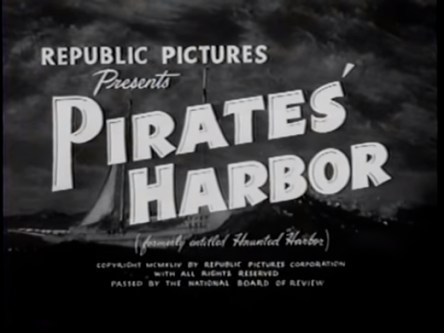
Where I Watched It: A two-tape VHS set from Republic Pictures Home Video (The title card on the tape version actually calls it Pirates’ Harbor, the title under which Haunted Harbor was rereleased in 1951.)

No. of Chapters: 15

Best Chapter Title: “Crucible of Justice” (Chapter Fifteen)

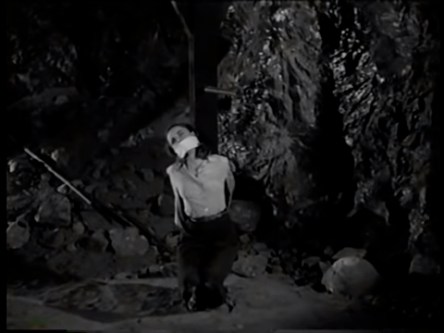
Best Cliffhanger: Republic in the mid-’40s seems to have rediscovered the element of sex appeal that had been toned down in some of their earlier serials. A “damsel in distress” bound, gagged, and in immediate mortal peril is a common shorthand for the serials, and while the ubiquity of this device is frequently exaggerated, there are nevertheless examples that justify the image. In Haunted Harbor, Patricia Harding is often on the receiving end of such treatment, nowhere more graphically than at the end of Chapter Nine, “Death’s Door.” In this chapter, Patricia has been abducted by Carter’s men and is held hostage in exchange for Dranga, whom they suppose to be injured and at risk of spilling Carter’s true identity. While the henchmen wait for Dranga to be delivered, they tie Patricia to a post in Kane’s mine and aim a powerful air drill at her, its trigger tied to the door so that if anyone enters the machine will fire its (loosened) bit through her skull. As in most cliffhangers, the threat is established, and then we are reminded of it via crosscutting between the outside room (where Marsden, having disguised himself as the actually deceased Dranga, is fighting it out with Carter’s henchmen) and Patricia at the post, quaking with fear, her eyes bulging. It’s a strong image, the kind of thing that makes an impression and looms larger in the memory than the more numerous prosaic scenes: no, women weren’t being tied up all the time in the serials, and this is just one cliffhanger out of many in this specific serial, but I can see why it tends to be remembered over other, less primal, scenes. (This was the era of Wonder Woman, after all.) Of course, once Marsden has finished mopping up the bad guys, he goes to the door and pulls it open: the air drill comes to life, and the bolt is fired. . . .

Best Resolution: At the beginning of the next chapter (“Crimson Sacrifice”), when Marsden opens that door, activating the air drill, Patricia simply ducks, sliding down the pillar so that the bit drives into the wood just above her head.

No offense, but that’s kind of anticlimactic. It means she wasn’t really tied that tightly in the first place, doesn’t it? My favorite resolutions tend to display the characters’ (and writers’) ingenuity in finding surprising ways out, but this is a bit of a shrug. In any case, as the story continues, Marsden gets into trouble for presenting the chief of the natives with a radio, a radio that has been hooked up with an explosive by Carter’s men so that it will take out the chief and make Marsden look bad. Sure enough, after the explosion of the chief’s hut, Marsden is accused of witchcraft (“You brought the devil box here to slay our chief!”) and immediately seized; in no time at all, he’s been tied to a platform suspended over a raging funeral pyre. The chapter ends with the flames surrounding him and the platform collapsing into the bonfire.

But wait! As resolved in the next chapter (“Jungle Jeopardy”), Patricia, who has been forced to stand by and watch, grabs a gun from her captors and shoots the ropes that bind Marsden (through a wall of flames and at a distance, the kind of one-in-a-million shot that serial heroes routinely make), then covering his captors so that they can both escape. Now, that’s more like it.

Sample Dialogue: “Haunted Harbor certainly seems quiet and peaceful enough. . . . A sea serpent!” –Patricia Harding, Chapter Five (“Harbor of Horror”)

What Others Have Said: “[Roy] Barcroft played many minor parts in serials until 1944. That year he took the lead villain’s role in Haunted Harbor at Republic, and launched an amazing career. For the next ten years, he played a succession of bad guys probably unequalled by any other actor in the field–pirate, outlaw, gangster, crooked cop, spaceman, renegade, crooked sheriff, saloon keeper, politician–you name it. He was Republic’s top villain for those ten years, and the man the fans ‘loved to hate.'” –William C. Cline, “Good at Being Bad” from Serials-ly Speaking

What’s Next: I’m taking a slight detour from my “summer of VHS” to examine a late Universal serial, Lost City of the Jungle!

Fates Worse Than Death: Darkest Africa

While showing off his African base camp to a pair of circus promoters, animal trainer Clyde Beatty is called to action: a lion has escaped its confinement and ended up in the same cage as a tiger. Immediately, Beatty steps in to prevent the big cats from tearing each other apart. Just as he did in his circus act, he calms and separates the two animals with only a metal chair, a whip to get their attention, and a pistol (loaded with blanks). Afterwards, Beatty decides he might work that up as part of his act, but he can’t explain why a tiger, native to India, was loose in the African jungle. Later, making his way to a nearby village, he discovers that someone–white men, based on the prints of boots in the soil–has been disturbing his animal traps.

Little does Beatty know that he is being watched, not by whomever emptied his trap, but by a young boy and his seemingly tame companion, a large gorilla. At the village, the boy, clad only in a fur loincloth, reveals himself in order to rescue a baby threatened by a lion. Using just a stick, the boy holds off the lion as well as Beatty could have! Impressed by the boy’s skill and shocked at his appearance, Beatty approaches him and hears a seemingly impossible tale: Baru, the son of missionaries, was raised alone in the jungle by animals after his parents’ death. Bonga, his ape companion, befriended him after Baru’s escape from the lion pit in the city of Joba. Joba is known only as a legend, a city that lies beyond a taboo region the natives consider haunted, and one which outsiders are never permitted to leave alive. Worse yet, Baru’s sister Valerie is still being held at Joba, where the high priest Dagna has installed her as a goddess (thereby keeping a strong grip on power); it was in trying to help Valerie escape that Baru was captured in the first place.

Beatty immediately takes this story at face value–perhaps convinced by the boy’s amazing rapport with animals–and agrees to help rescue Valerie. This conversation, held in full view of the village, gets the attention of Craddock and Durkins, the crooked traders and ivory smugglers who have been messing with Beatty’s traps, among other crimes. They notice the unusual clasp on Baru’s loincloth, inlaid with rare green diamonds: the jewels too are from Joba, and the pair take an immediate interest in shadowing Beatty as he accompanies Baru back to Joba on his mission of rescue, becoming the secondary villains of the film. It’s quite a bit of plot to set up so quickly, an almost literal “call to adventure,” but there’s never any question that Beatty will lend his support to rescue the “beautiful blonde goddess” held against her will. Before you know it, Beatty has had his manager and aide-de-camp Hambone prepare bearers for an expedition into Darkest Africa!

Republic came out of the gate strong with Darkest Africa, its first serial, but of course the Republic formula was built on the previous success of Mascot, the studio that preceded Republic prior to a merger and reorganization, and the skills of the old hands producing their serials. Co-director (with Joseph Kane) B. Reeves Eason had a career that went back to Vaudeville and the silent era and had helmed several serials for Mascot (and would continue to direct for Republic). Clyde Beatty had also previously starred in The Lost Jungle for Mascot. Beatty was the leading lion tamer of his day (he’s billed as the “world’s greatest wild animal tamer” in this), joining his first circus at age 16 as a “cage boy” and working his way up until he had formed his own show in partnership with the Cole Brothers in 1934; the 1930s and ’40s were the highest points of his fame, and in addition to making films he wrote several popular books about his exploits. Beatty was primarily an animal tamer and performer as opposed to a collector like Frank “Bring ‘Em Back Alive” Buck, but his public persona was that of a big game hunter (he preferred training wild animals to those raised in captivity, as he felt captivity dulled their wits): as Rhina Kirk describes in Circus Heroes and Heroines, “For his performances and public appearances Beatty dressed like an African hunter of Hollywood movies–shiny boots, flaring white breeches and pith helmet.”

Naturally, when he appeared in those Hollywood movies, the setting is the jungle rather than the circus. Beatty is playing “himself,” as he did in The Lost Jungle, and as in other cases the story is written around those talents he was known for: obviously, each chapter gives him an opportunity to face off against one or more big cats, either in a cage or in the wild. His act usually included mixed lions and tigers, their natural animosity to each other making for dramatic situations and heightened stakes, so a contrivance is introduced to justify the appearance of tigers in the African jungle. Part of Beatty’s act included him “staring down” a lion or tiger, subduing it with his dominating will, so Beatty the character also does it a couple of times to escape from being mauled.

Despite its title and focus on jungle cats, Darkest Africa is mostly a “lost world” story, with similarities to The Phantom Empire and Undersea Kingdom (the next Republic serial, also directed by Eason). For creators of H. Rider Haggard’s and Edgar Rice Burroughs’ generations, those blank, “unexplored” sections of the map were tempting invitations to free-associating invention. The mysterious city of Joba lies in a “haunted” region in the “mountains of despair,” taboo to the natives, beyond a volcanic region and adjacent to the territory of the “tiger men” (the tribe venerate the tiger and are the source of the tigers found in the jungle). As a writer, once you’ve set up all those barriers, you can put absolutely anything you like in there, from survivals of ancient civilizations (some of the title cards suggest that Joba was founded by Solomon) to secret high technology (the city is protected by winged “bat-men”–I assume their uniform is a winged flying harness rather than the natural wings of Flash Gordon‘s hawk-men, but the effect is the same). Joba is also described as the “city of the Golden Bat,” with the old god having slept in the temple for three thousand years (this last fact is something of a throwaway: it only comes up once, when the high priest Dagna commands Hambone to use his magic to reawaken the Golden Bat, apparently a plan B to cope with the loss of Dagna’s chosen goddess Valerie, but it’s the kind of detail I dearly love in stories like this). Joba would make a kick-ass setting for a fantasy role-playing game.

Once the action centers on the city itself, it might as well be on the planet Mongo as anywhere else, as it is pure fantasy. Valerie (the beautiful Elaine Shepard) is indeed being held against her will by Dagna (Lucien Prival, who had appeared in Bride of Frankenstein, among many other films), forced to play the role of “Goddess of the Golden Bat” with the elderly Gorn (Edward McWade), keeper of the sacred books, her only companion and advocate. Valerie’s situation is an interesting twist on the “white goddess” character (a type I have some fondness for, even as I’ve acknowledged ways in which it can be problematic): she has the love of the people, and privileges, such as a sanctuary closed even to Dagna, but no freedom, so despite her exalted position she is another example of that standby of the serials, the damsel in distress (until, at least, the end of the serial, when she threatens to sacrifice herself to force Dagna’s hand).

The supporting heroes are also quite diverse (in character type, at least)–there’s no worry of getting characters mixed up in this one! Baru is played by Manuel King, billed as the “world’s youngest wild animal trainer”; he was thirteen years old when Darkest Africa was made, and it was apparently the only film he was ever in, but he lived to be 92 years old, only passing away in 2016!

Bonga, the “ape with almost human understanding,” is credited as playing himself, as if he were an animal star like Rex the Wonder Horse or Rin-Tin-Tin, but in reality Bonga was played by stuntman (and star of Undersea Kingdom) Ray “Crash” Corrigan, the all-around athlete, stunt double, and (later) owner of the extensive studio ranch dubbed “Corriganville.” Corrigan was a “gorilla man,” one of a subset of stunt performers who specialized in playing simians and most of whom owned their own costumes, and while it is clear that Bonga is a man in a suit, he is still a strong, vivid character, with both impressive physicality (Bonga swings from tree to tree on vines, for example) and expression (see below for more on this specialized art).

Then there’s Hambone (Ray Turner), Beatty’s comic-relief factotum; on the surface, Hambone is a walking stereotype, a pop-eyed fraidy-cat bumbler, a black American (as opposed to the mostly anonymous African natives) in the Stepin Fetchit mold. As the story continues, however, Hambone reveals depths of shrewdness and resourcefulness. When Beatty’s bearers return to the village without their boss, scared off by Joba’s patrolling bat-men (or “wind sentries,” a nicely evocative name), Hambone heads into the jungle alone to track down Beatty and rescue him if needed. Overburdened with duffel bags and an enormous elephant gun, Hambone’s separate adventure, shown intermittently, plays like a spoof of Beatty’s journey: Beatty runs afoul of the tiger men and is thrown into a tiger pit, which he gets out of through a combination of his skills and Bonga’s help; later, Hambone is cornered by the same tiger men and manages to avoid being thrown in the pit by the good fortune of his grenade belt landing in the fire and scaring the tribe away; and so forth. Once Hambone arrives at Joba (and wanders in the front door unseen, as opposed to the arduous secret entrance Beatty and Baru made, spied on at every turn by Dagna’s sentries), he rejoins the main plot, doing his part to help Clyde Beatty save Valerie . . . and the day.

What I Watched: Darkest Africa (Republic, 1936)

Where I Watched It: A two-tape VHS set from Republic Home Video (continuing my summer of VHS, this included having to open the case and clean the heads on my VCR to get it playing correctly–thank goodness for YouTube tutorials!)

No. of Chapters: 15 (but most are only about 15 minutes long)

Best Chapter Title: “Trial by Thunder-Rods” (Chapter Ten) The two smugglers, Craddock (Edmund Cobb) and Durkin (old reliable Wheeler Oakman), have forged an uneasy alliance with Dagna, warning him of the approaching “outlanders” (Beatty and Baru) and offering the high priest a shipment of rifles in exchange for more of the green diamonds they covet. Once Hambone arrives with his elephant gun, Dagna has the idea of testing it against the smugglers’ “thunder-rods” to determine which is more powerful–by having Craddock and Hambone aim at each other and fire simultaneously! Amazingly, this is not the actual cliffhanger of this chapter.

Best Cliffhanger: Unsurprisingly, most of the cliffhangers involve lions or tigers, with Beatty’s skills put to the test to get him out of the jam in the following chapter. There are also a few actual cliffhangers, as in the first chapter (“Baru–Son of the Jungle”), when the ledge supporting Beatty and Baru collapses during an earthquake and they appear to be buried in an avalanche. There are also two cliffhangers in which Beatty hides behind something and is detected, leading to enemies attacking his hiding spot with spears or rifles. However, my favorite cliffhanger is in Chapter Nine (“When Birdmen Strike,” another great chapter title). Beatty has escaped through the mines beneath Joba into the jungle in order to find the ammunition cached by Craddock and Durkin. After finding the crate of ammo, he attempts to cross a clearing with it, drawing the Bat-men away from Baru. Shown zig-zagging across the clearing from overhead, Beatty is an easy target, and without actually showing the hit, the last shot reveals Beatty, prone, with a spear appearing to skewer him. (As the following chapter reveals, Beatty once again feigned death, the spear having passed under his arm and stuck into the ground. Repeat after me: “That was a close one!”)

Sample Dialogue: “You must not forget that Beatty enjoys the reputation of being the world’s greatest wild animal trainer.” –Durkin, warning Dagna not to underestimate Beatty (Chapter Seven, “Swing for Life”)

What Others Have Said: In light of “Crash” Corrigan’s performance as Bonga, let us check in with a “gorilla man” from a later generation, special effects artist and collector Bob Burns. Burns explains how he learned the ropes from ape performer Charles Gemora: “He shared with me some of his trade secrets for bringing life to a mask that was limited, mobility-wise, to simply opening and closing its mouth. For example, he explained that if you wanted to look ferocious you should rear back your head while opening the mouth, which shows the audience more teeth and creates an illusion of facial expression. He also stressed the importance of acting with your eyes, as they are the only exposed part of the wearer. Charlie was so skillful in projecting with his eyes that people who have watched his performances sometimes swear they saw the gorilla’s brow and other facial muscles move–even though everything is immobile.” –Bob Burns with John Michlig, It Came From Bob’s Basement!: Exploring the Science Fiction and Monster Movie Archive of Bob Burns

What’s Next: Join me next time as I tackle another Republic serial, 1944’s Haunted Harbor!

Fates Worse Than Death: Tailspin Tommy in the Great Air Mystery

When last we saw “Tailspin” Tommy Tompkins, the youthful daredevil pilot from Littleville, he had a steady job at Three Points airfield and a steady girl in Betty Lou Barnes, and was even something of a celebrity, having acted in a movie. As the second Tailspin Tommy serial begins, Tommy and his partner “Skeeter” Milligan are still working out of Three Points, with Skeeter operating a camera as Tommy flies them over fleet maneuvers for the Navy. Once they finish up, they get their next job offer: Betty Lou’s uncle Ned Curtis hires the pair to make an aerial survey of a tropical island and blaze trails for the oil pipelines Curtis and his partner, Don Alvarado Casmetto, are laying. Tommy and Skeeter are to join Betty Lou, her uncle, and Don Casmetto’s niece Inez on a dirigible bound for the island of Nazil.

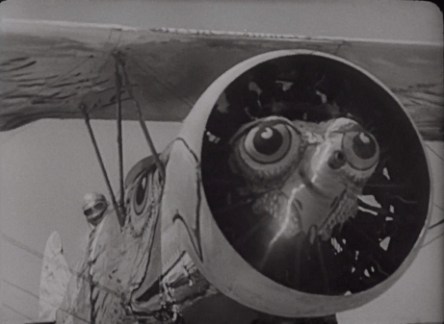
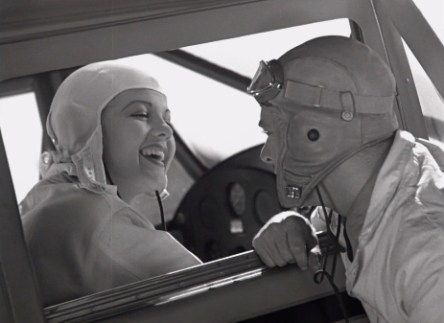
However, after a detour to Littleville, Tommy and Skeeter miss their flight; they decide to follow the dirigible’s path in their own plane with the intention of docking in mid-air. The captain refuses at first, but then a mysterious plane decorated like an eagle appears, and its pilot–also wearing an eagle-themed suit and helmet–sends a message instructing the dirigible to take the boys on board. The eagle plane lays down a smoke screen and vanishes as quickly as it had appeared. Soon the boys have docked and joined their party. But a storm blows up, and with the dirigible’s radio damaged, the only chance to send an S.O.S. is the radio in Tommy’s still-docked plane. He descends into the cockpit while the storm rages around him; suddenly the wind knocks the plane loose from its mooring with Tommy inside it; it plummets toward the ocean below while the dirigible collapses. Will Tommy’s adventure be over before it even begins? Audiences in 1935 would have to wait a whole week to find out in subsequent chapters of Tailspin Tommy in the Great Air Mystery!

During the 1930s, the promise of freedom and adventure in the skies fueled an entire subgenre of aviation-themed comic strips, books, and movies. Hal Forrest’s Tailspin Tommy, a footnote today, was one of the most popular, branching beyond the comics to radio, Big Little Books, and, of course, motion pictures. Like so many of the kids in his audience, Tommy Tompkins was a small-town boy obsessed with airplanes and flight, and his first serial relayed his journey from wannabe to hero pilot in compressed form, stringing together several episodes from his comic-strip adventures over an unusually long period of time.

Filmed just a year later, Tailspin Tommy in the Great Air Mystery is a much more typical serial, focused on a single plot: when Tommy and Skeeter and the rest finally arrive at the island of Nazil, they find that it is disputed territory. Don Casmetto’s half-brother, Manuel (Herbert Heywood), has a base on the opposite end of the island, and with the encouragement and financial backing of an unscrupulous oil speculator named Raymore (Mathew Betz) he is making war with the goal of taking over Casmetto’s lucrative oil fields. Manuel has airplanes and pilots of his own at his disposal, so the situation provides plenty of opportunities for scenes of aerial reconnaissance, chases, dogfights, crashes, and daring rescues (not to mention the kinds of fist fights and cave-ins that provide the thrills in all serial genres). Nazil is Hollywood-exotic, combining elements of the island/jungle genre (namely, an active volcano and aggressive natives on a neighboring island) with the kind of Spanish colonial color–haciendas, mariachis, and the elegant lifestyle of the dons–seen in the Zorro series. The story’s self-containment in an exotic locale is somewhat similar in that regard to the near-contemporary Ace Drummond, with a south-of-the-border setting in place of that serial’s Mongolia.

One of the chief elements of suspense is the eagle-themed plane and its pilot, nicknamed “El Condor” by Manuel’s men: who is he, and how does he achieve such amazing aerial maneuvers and disappear so quickly once he is no longer needed? From the very first chapter, El Condor appears to be on Tommy’s side (and, by extension, Don Casmetto’s); he is an example of a standard character type in the serials, the masked hero who is not the main protagonist, but who comes to the aid of the main characters and whose identity is eventually revealed to them. (The solution to this mystery is one that is in plain sight, but one could be forgiven for missing the significance of a few lines of dialogue by a secondary character in the first chapter.) Although the mysterious plane isn’t treated as a macguffin like in some serials, there is a nod toward the trope of high-tech equipment that mustn’t fall into the “wrong hands”: once Tommy has learned El Condor’s true identity and flown with him, experiencing one of the plane’s miraculous getaways for himself, El Condor says with understandable pride, “A great weapon for war, Tommy,” to which Tommy immediately replies, “A great weapon for peace, you mean.”

However, El Condor is not the only masked flyer in the serial, nor the only character who has secrets. One of Don Casmetto’s friends, Enrico Garcia (Paul Ellis), is quickly shown to be a traitor, feeding damaging information to Manuel and Raymore, as well as taking to the air himself as “Double X,” retaining his anonymity with an aviator cap and goggles marked by twin Xs, a literal “double cross.” Garcia is able to play both sides for quite a while, and is even able to convince Don Casmetto for a time that he is the mysterious “El Condor.”

Another character, Bill McGuire (Jim Burtis), first appears as a cook and gopher for Manuel, but he is actually a reporter and a friend of Tommy’s, working undercover as he gathers information for a big story. In several chapters he helps Tommy and Skeeter by setting them free from Manuel’s dungeon or giving them key information; he also, it turns out, knows the real identity of El Condor, making him critical to the serial’s climactic chapters. At the same time, he occasionally serves as a surrogate character for the audience, watching events unfold from the ground and exchanging a “gee, whiz” or a whistle of amazement with his pet parrot. (He provides a bit of comic relief, but he’s not a bumbler in the Smiley Burnette mold; he only appears to be one when serving Manuel to avert suspicion.)

Despite the short time between the two serials’ production, Great Air Mystery recasts most of the main characters, with Clark Williams taking the title role in place of the first serial’s Maurice Murphy; Jean Rogers, the future Dale Arden, now plays Betty Lou, replacing Patricia Farr. (Such recasting occasionally happens today, but it was even more common in the studio era when film production was more akin to an assembly line.) Fittingly, Noah Beery, Jr. returns to play Skeeter, the most distinctive character among them, but even here his shtick is changed: as a comic relief sidekick, Skeeter usually has a running gag: in the first Tailspin Tommy serial, he had a tendency to make a proclamation or observation and proclaim it an “unwritten law.” In the 1939 feature Sky Patrol, Skeeter was given to malapropisms, mangling or misusing polysyllabic words. In Great Air Mystery, however, Skeeter’s comedy isn’t that broad, mostly limited to attempts at card tricks (in one sequence he attempts to use one to distract Manuel’s men after being captured) and his nervous reaction to Inez Casmetto’s obvious come-ons (not an unusual trait for a comic sidekick at the time).

Of course, Betty Lou isn’t content to sit back and let the boys have all the adventure: recall that in the first serial, it was she who first had her pilot’s license and was Tommy’s introduction to the world of flying. In Great Air Mystery, despite Tommy and Skeeter’s efforts to keep her away from danger, she several times either stows away (hiding in a truly tiny-looking compartment in Tommy’s plane!) or flies off on her own, alone or with Inez (Delphine Drew). (Needless to say, this sometimes does put her in danger, but that just puts her on the same footing as everybody else in this serial.) Betty Lou’s attitude is summed up in Chapter Seven (“The Crash in the Clouds”) when she arrives at Don Casmetto’s oilfield in her own plane with Inez after being told to stay away. Skeeter tells her, “Hey, don’t you know this is men’s work?”, to which she replies, “Where’s the sign?” When Skeeter asks what sign, she spells it out for him: “Men. At. Work.” (No, it’s not exactly Preston Sturges.)

Tailspin Tommy in the Great Air Mystery isn’t bad: it features likable characters in a colorful environment and keeps the plot moving along. Of course, the main draw is the aerial action, which is for the most part exciting and not hard to follow, and there are several well-done action set pieces. (Apparently it was the practice to blaze trails by flying above the territory and dropping grenades on the jungle below, and you can bet all those explosives find other uses, blowing up warehouses, hangars, and airplanes on the ground alike!) On the other hand, Great Air Mystery doesn’t have the small-town charm of the first serial, so nothing about it stands out from the other aviation-themed serials that were being churned out in the mid-’30s. Needless to say, however, there is the possibility that I am simply becoming jaded and harder to surprise as I watch more of these films. As always, YMMV.

What I Watched: Tailspin Tommy in the Great Air Mystery (Universal, 1935)

Where I Watched It: This serial ran on Turner Classic Movies on Saturday mornings last summer, and I recorded it on my DVR. I had originally promised to write this up last fall, but it didn’t quite work out that way (I remember why I usually write these articles in the summer!). As it happens, since TCM didn’t make it easy to record the whole thing as a series (a pet peeve of mine!), I missed recording about an episode and a half. The only place I found to watch the missing parts online was at Night Flight Plus behind a paywall (and knowing how these deals work, I assume that TCM and Night Flight licensed the same restoration, and this new financial investment is the reason the serial has been scrubbed from YouTube). It’s also available on DVD and Blu-ray.

No. of Chapters: 12

Best Chapter Title: “Crossed and Double Crossed” (Chapter Nine) I like this one because, in addition to its nice use of repetition, it accurately describes the main action of the chapter, in which El Condor is captured and impersonated and then reclaims his identity. It also involves a pun, as this chapter is the climax of Garcia’s arc as the masked “Double X” flyer.

Best Cliffhanger: Unsurprisingly, there are several cliffhangers in this serial involving plane crashes, or planes exploding or colliding in mid-air. There are also no fewer than three cliffhangers in which a building is blown up while one or more of our heroes are inside (or are they?). I particularly like the ending of Chapter Two (“The Roaring Fire God”) in which, after another skirmish with one of Manuel’s planes and a timely rescue by El Condor, Tommy loses control of his plane, goes into a dive, and appears to fly straight into the smoking crater of a live volcano.

I would also be remiss if I didn’t mention the peril at the end of Chapter Six (“Flying Death”): Tommy and Skeeter have stolen one of Manuel’s planes, a bomber specially brought in by Raymore to attack Casmetto’s oil fields, but little do they know that onboard the plane is a time bomb, set specifically to prevent such a theft. Such a cliffhanger, complete with a countdown to the deadly explosion, wouldn’t be too unusual, but for the large “TIME BOMB” label on the control panel that neither seems to notice. (The solution to this cliffhanger is singled out by Jim Harmon and Donald F. Glut in The Great Movie Serials, a book I have frequently referred to in this series, as an example “typical of the hokum of the medium.”)

Sample Dialogue: “What a twist! Is that a story or is that a story!”

–Bill McGuire, after Raymore experiences a particularly ironic comeuppance (Chapter Twelve, “The Last Stand”)

What Others Have Said: “After Universal released Tailspin Tommy back in 1934 [notably the first serial based on a newspaper comic strip], they couldn’t wait to get its sequel into release. Exactly 12 months later, they released Tailspin Tommy in the Great Air Mystery, and then in succession at least one comic strip every six to ten months for the next seven years, up to Don Winslow of the Coast Guard in December 1942.” –William C. Cline, “Coming Back Like a Song” in Serials-ly Speaking

What’s Next: This is just a one-off entry for the spring, but I intend to return to my regular schedule of serial coverage this summer; I usually begin on Memorial Day and publish an entry every one or two weeks. Earlier this year I bought a big box of serials on VHS; I’m not nostalgic at all for videotape, but the price was right, and it will keep me in serials for months to come. I hope you’ll join me then!

My 2018 in Movies: Top Ten

2018 was a great year for film: I don’t see everything that comes out, so if even I can say that, and have to make tough choices to narrow my favorites down to a top ten, while still having missed out on some of the most acclaimed films of the year, then it must have been good. Still, I did see more contemporary films than in previous years, nearly fifty from 2018, a third or so of them in the last month alone as I played catch-up. As always, the rankings given below are so subjective that even I may not agree with them tomorrow, but at least they give me a chance to organize my thoughts and explore common themes that run through the year’s cinema. You will also note that I am sometimes using a film’s entry to draw comparisons with a similar or complementary film: this isn’t necessarily to say that one is “better” than the other, even if I make clear why I prefer one over the other. Perhaps it is simply an opportunity to write about more than the arbitrary limit of ten films during this rich year. (My selection of films is based on U.S. release dates; some of these films were released earlier in other countries or sat on the shelf for a while.)

10. Sorry to Bother You (Boots Riley)

Oakland native Cassius Green (Lakeith Stanfield) rockets to the top of his telemarketing job when an older African-American colleague advises him to use his “white voice” to connect with potential marks. From this already whimsical conceit (Green’s nasal “white voice” is dubbed in by comic David Cross), Sorry to Bother You goes in increasingly bizarre directions as Green is admitted to the “Power Callers,” where he cold calls dictators and corporate CEOs to sell them weapons, indentured labor, and other unsavory products, while struggling to keep it real with his performance-artist girlfriend Detroit (Tessa Thompson) and working-class friends. Not everything works in this scattershot comedy, but the righteous anger at the dehumanizing elements of our society and economy are refreshing and necessary, and the Gondryesque production design is a delight.

9. Mom and Dad (Brian Taylor)

I’m as surprised as you to find this on my top ten instead of the year’s other big Nicolas Cage vehicle, Panos Cosmatos’ instant cult favorite Mandy: Mandy has a lot going for it, and I would have liked to have seen it on the big screen, but it ultimately felt a little hollow beneath its fog- and synth-drenched surface. Mom and Dad is a lot messier, and its premise–a mania of unknown origin causes parents all over the world to turn violently on their own children, setting up a confrontation between Cage and wife Selma Blair and their two kids in their suburban home–is so ugly that I almost didn’t watch it. The seams frequently show, and Cage seems unhinged from the get-go, making his turn to homicidal maniac less than surprising, but there’s some honest examination of the frustrations of aging and parenthood beneath the provocation. A sense of clever gallows humor pervades the action, with some of the film’s biggest laughs courtesy of Zackary Arthur, who plays the couple’s young son. A gauzy soft-focus opening-credit sequence set to a maudlin ballad suggests an homage to issue-driven ’70s horror, but that’s a stylistic feint, and the film proper has a hyperkinetic, chronology-twisting sensibility that is clearly contemporary; it has gotten under my skin and stayed with me in the weeks since I saw it.

8. Teen Titans Go! to the Movies (Aaron Horvath and Peter Rida Michail)

The animated series Teen Titans Go! is essentially the Looney Tunes of superhero media, treating its heroes as the punchlines to absurd jokes and extended gags: putting the emphasis on “Teen,” the Titans would rather hang out and play video games or eat pizza than fight crime, much to the chagrin of their ambitious leader, Robin. In their first cinematic outing, the Titans deflate the rest of the DC universe–and superhero cinema in general–in similar fashion, setting their sights on the current crop of big-screen comic book adaptations. Robin’s insecurity as a leader is a natural peg to hang the story on, and with seemingly every other character getting a movie, his ambition gets the better of him. Teen Titans Go! to the Movies is one of the flat-out funniest movies of the year, with both broad slapstick and wordplay and jokes targeting the glut of superhero movies and jabs at specific characters and bits of DC mythology (a sequence in which the Titans use time travel to clear the field of competing heroes is a high point).

7. Cam (Daniel Goldhaber)

Alice (Madeline Brewer) earns money as a cam girl online, putting on an edgy live sex show as “Lola.” While lucrative, it has risks, from stalkers who can’t separate online fantasy from real life to the possibility of her family and friends discovering what she really does for a living. Things get weird, however, when “Lola” takes on a life of her own, locking Alice out of her own website and crossing lines that Alice swore she never would. Has she been hacked? Is it one of her fellow cam girls messing with her, taking professional rivalry too far? Cam isn’t quite a horror movie, except in the existential sense that it updates the classic fear of the doppelganger for an age of identity theft and online sex work. The line between representation and reality is one of my favorite themes, and some of the best scenes in Cam are those that put Alice on the opposite side of the screen, watching the character she created come to life and trying to figure out just what’s real and what’s an act like any other john. Like Sorry to Bother You, Cam trades in the unsettling feeling–frequently pushed down so we can get on with our day–that you never really know who’s on the other end of the line.

6. Colette (Wash Westmoreland)

The creative process can be difficult to portray on film, particularly something as private and relatively quiet as writing, but as the title character in Colette, Keira Knightley makes it seem both urgent and sensual. (Between this and The Nutcracker and the Four Realms, it’s been quite a year for Knightley to play characters who get off on their work.) The film begins with Colette’s marriage to the older, already-successful writer Willy (Dominic West), whose factory-like output is produced by a cadre of ghostwriters. While coming to terms with his profligate, philandering lifestyle, Colette writes the first of her books about the precocious schoolgirl Claudine, which she allows Willy to publish under his name. A few books later, Claudine is a national sensation, inspiring fashion and style trends and bushels of tie-in products, as well as a line of wannabe Claudines lined up to satisfy Willy’s sexual fantasies. At the same time, Colette has come to terms with her attraction to women, leading to an uneasy open marriage (and an amusing sequence in which Colette and Willy trade liaisons with the same woman). The tensions inherent in such a marriage could not last forever, and Colette must choose what she wants out of life even as her older husband seems more and more used up. Knightley and West make a dynamic pair in this, and the film is charming and breezy while making room for the depth of feeling beneath the banter and fin-de-siècle Parisian style.

5. Blockers (Kay Cannon)

Blockers (as in “cock blockers”) had one of the more obnoxious marketing campaigns in recent memory, flipping the “teens set out to lose their virginity” premise of so many raunchy comedies by showing it from the perspective of the parents out to stop their fun. Perhaps no trailer could get across how thoughtful and, yes, funny, the actual film is, but I’m glad positive word-of-mouth encouraged me to give it a try. Leslie Mann, John Cena, and Ike Barinholtz are the parents of three teenage girlfriends, and when they get wind of their daughters’ prom night plans, they go into protective overdrive, each for their own reasons. (Barinholtz in particular is hilarious as a sketchy divorced dad, but his motives are actually the purest, hoping to protect his closeted lesbian daughter from what he sees as hetero peer pressure.) Through misadventures and complications, the parents come to understand their children and learn to let go, and the three girls go through their own journey of self-discovery. This year had another fantastic comedy in Game Night, but I liked Blockers a bit more: it got me in the feels as well as making me laugh.

4. Paddington 2 (Paul King)

The polite, marmalade-loving bear is back, and this time the plot centers around a pop-up book of London Paddington (voiced by Ben Whishaw) hopes to give his Aunt Lucy. When the book is stolen, Paddington is blamed and he brings his sense of good manners and good intentions to prison where he makes an unlikely friend in cook Knuckles McGinty (Brendan Gleeson). Hugh Grant, as has-been actor Phoenix Buchanan (and the real thief), makes for a more fitting villain than Nicole Kidman’s bloodthirsty taxidermist in the first movie; it’s a great star turn as he dons one disguise after another, a performance that deserves to be mentioned in the same breath as Vincent Price in Theater of Blood. This charming comedy has some big laughs and a truly warm heart; Paddington’s message of civility may be simple, but it never feels cloying. And, like the Harry Potter series before it, the Paddington series is apparently dedicated to finding a place for every working actor in the British Isles.

3. Shirkers (Sandi Tan)

A captivating documentary about the nascent indie film scene in Singapore in the 1990s, Shirkers is both a retrospective and something of a mystery: Sandi Tan’s debut film, Shirkers, had completed filming when its director (and Tan’s mentor) Georges Cardona disappeared with the footage. Much of the runtime of Shirkers (the documentary) sets the scene, using clips of the original film (the reels were finally recovered after Cardona’s death a few years ago) and describing the fallout of the film’s disappearance in the lives of Tan and her collaborators. One doesn’t have to buy the doc’s implication that Shirkers would have been a great film to appreciate the injustice Tan suffered, although the parallels between Tan’s film and later indie darlings, especially Ghost World, are eerie, to say the least. Cardona comes off as at best negligent and at worst predatory, and since he is no longer around to explain his actions, the enigmatic (and silent–Cardona preserved everything carefully but apparently lost the film’s audio tracks) excerpts from the original Shirkers stand as a monument for a rural Singapore that is now vanished and a promising film career that never materialized.

2. The Other Side of the Wind (Orson Welles)

Like Shirkers, The Other Side of the Wind was long considered a lost film, but one made by an established master at the end of his career. Orson Welles filmed the project patchwork-style over several years in the 1970s, struggling to secure funding and eventually losing legal access to nearly one hundred hours of footage in a tangle of claims and counterclaims. The film was finally freed from red tape and completed (“restored” seems like the wrong word) in the last few years according to detailed instructions left behind by Welles. The film portrays an aging director (John Huston) on the last night of his life (the film is framed as a documentary investigation of the director’s apparent suicide–shades of Citizen Kane!), shown through the multiple cameras of documentarians and cameramen invited into his home for an epic birthday party. At the same time, we are treated to lavish excerpts from the director’s magnum opus–also called The Other Side of the Wind–as he searches for a producer willing to invest in completing the film (and yet Welles denied the film was a self-portrait!). These excerpts, starring Welles’ muse Oja Kodar in a wordless, erotic journey that finds Welles outdoing his French New Wave competitors, are magnificent. The entire film is fragmentary and often frustrating, with many clear analogues to then-current figures in Hollywood (although I knew the general outlines of this story, the accompanying documentary They’ll Love Me When I’m Dead, detailing Welles’ final years, was illuminating and raised my opinion of The Other Side of the Wind; also recommended is the featurette A Final Cut for Orson, which describes the actual process of collecting, restoring, and assembling the footage; all three films can be seen on Netflix).

1. Thoroughbreds (Cory Finley)

Two teenage girls, Lily (Anya Taylor-Joy) and Amanda (Olivia Cooke) hatch a plot to rid themselves of Lily’s asshole stepfather, recruiting a local drug dealer (Anton Yelchin, in his last performance–this movie was made in 2017 but wasn’t released until this year) to do their dirty work. Amanda is a sociopath, so detached from her emotions that she denies having any; is Lily in Amanda’s thrall, or is something else going on? The description of the plot makes it sound similar to any number of psychological thrillers or true crime dramas, but the clinical approach and icy humor make it closer to something like The Neon Demon or one of Alexander Payne’s upper class satires. I went into this one knowing very little about it, and that’s probably the best way to appreciate its many surprises.

Worst Movie: Gotti (Kevin Connolly)

I can’t say I wasn’t warned. “Self-serving” doesn’t begin to cover it, as the John Travolta-starring biopic of late mafia boss John Gotti goes beyond apologia to hagiography, deflecting any criticism of its main character with tough questions like, “What if government prosecutors are the real gangsters, huh, didja ever think of that?” and “What are you, a pussy?” Leaving aside its heroic spin on real-life criminality–after all, there have been plenty of compelling films about morally questionable protagonists, and it’s not like we haven’t made heroes out of mobsters before–it’s a boring slog, like a series of Dateline NBC reenactments strung out to feature length, jumping from one “highlight” to another over a series of years. Even when Gotti should be sympathetic, like when his young son is killed in a car accident, the filmmakers can’t help themselves, having him heroically tell his wife to “snap out” of her understandable depression and assuming that we’ll agree the driver of the car deserved to get wacked. Aside from a few jaw-droppingly bad choices, Gotti doesn’t even have the mercy of being comically terrible: I borrowed it from the library and I still feel like I paid too much.

Dumbest Movie I Will Almost Certainly Watch Again: The Happytime Murders (Brian Henson)

The Happytime Murders first came to prominence as a screenplay by Todd Berger that made The Black List, a noirish fantasy about a washed-up puppet detective paired with a human to solve the murder of one of his own. That sounds great! Then the reviews started coming in, describing it as a labored, unfunny insult to the legacy of the Muppets. That sounds terrible! Perhaps helped by low expectations, I found The Happytime Murders to be neither a hidden masterpiece nor the complete disaster it had been made out to be. Its biggest flaw is the assumption that puppets spewing obscenities is inherently hilarious; the lack of wit becomes apparent pretty quickly, but the plot and characters are diverting, and while it’s no Who Framed Roger Rabbit, it does succeed in delivering a few laughs. The Happytime Murders wouldn’t work at all without Melissa McCarthy’s game central performance as the troubled human police detective forced to team up with disgraced puppet Phil Phillips (Bill Barretta). Actually, one of the best parts of the movie is the end credits, which includes behind-the-scenes footage showing how the puppets were filmed alongside the live actors.

The Ones That Got Away

As I mentioned, I don’t get out to see everything, and even with the options of streaming and home video there are only so many hours in the day. Of the movies that I had hoped to get to, it’s mostly films that came out in the last few months of the year that I still haven’t seen. I didn’t make Damien Chazelle’s First Man a high priority when it came out in October because I was focused on horror, even though I had enjoyed Chazelle’s previous films, and now I’m regretting that I didn’t make more of an effort. I am also kicking myself for not getting to Luca Guadagnino’s Suspiria remake, but it was difficult trying to find the time for a two-and-a-half hour film in November. I also expected to see Spider-Man: Into the Spider-Verse before the end of the year, but at least that (and Aquaman, which I also haven’t seen) will still be in theaters in January. As for the rest, well, I try not to beat myself up over deadlines that are entirely personal; I know that I’ll be able to catch up with films I missed, and since I’ve already made it clear that rankings don’t really mean much to me (even as I arbitrarily assign them), I don’t plan on losing sleep over the placement of a movie. There’s always next year, right?

Thanks for reading. Have a happy New Year and a great 2019!

Lovefest: The Creeping Terror

This article was written for Lovefest, a group project of the Dissolve Facebook community, in which individual writers step up to defend or promote films that flopped, were critically maligned, or are generally forgotten. My previous Lovefest entries can be read here and here; a list of all of the movies covered in past Lovefests can be found here.

ct.title

For me, it started with Gilda Radner: in one sketch in It Came From Hollywood, the 1982 homage/clip show celebrating old genre flicks (and an early inspiration for my love of monster movies), Radner plays a little girl excitedly describing and reacting to the latest monster shows she had seen, throwing stuffed animals around the room while pretending they’re the Fly, the Horror of Party Beach, and so on. “I call this one the carpet monster,” she says over a clip of a creature that does indeed look much like an ambulatory pile of carpet samples, or perhaps an oversized bedspread, invading a dance party. “He eats up ladies . . . except for their shoes,” she continues as a pair of shapely nylon-clad legs is slurped into the monster’s gaping mouth. After rediscovering It Came From Hollywood a few years ago, I set out to watch the complete “carpet monster” movie, whatever it was: ICFH ends with a list of the movies excerpted in the film, but doesn’t credit them in individual scenes. With the help of Google and IMDB I was able to narrow it down and found that I already owned a copy of The Creeping Terror (A. J. Nelson, 1963) that I hadn’t watched yet on a public-domain monster movie collection. (Only afterwards did I find out that The Creeping Terror had been featured on Mystery Science Theater 3000; I could have saved myself a lot of trouble but I had stopped watching the show by the time that episode aired.)

It would be a stretch to say that I “love” The Creeping Terror, and even more of one to defend it on the basis of its quality, which veers from workmanlike to surreally inept. Like Edward D. Wood, Jr.’s infamous Plan 9 From Outer Space, The Creeping Terror was included in Michael Medved’s The Golden Turkey Awards; we’re long past believing that Plan 9 is actually the worst movie ever made, but The Creeping Terror . . . well, let’s just say it’s still awaiting its critical reevaluation. Made on a shoestring in 1963, the film features hopelessly crude special effects, amateurish acting, and a plot that’s beyond formulaic: it’s schematic. Yet I would argue that it is an interesting film in its own right, with some effective moments that are overshadowed by its reputation (and yes, there are some jaw-droppers as well).

ct.martin.brett

As the story goes in its 76-minute run time, Deputy Martin Gordon (Vic Savage), returned from his honeymoon with his new bride (Shannon O’Neil), sees a UFO land (an effect accomplished with some blurry moving lights and footage of a rocket liftoff shown in reverse). Joining his uncle, the Sheriff, to investigate the landing site, they find a spaceship with a monstrous creature locked inside; the Sheriff is the first to be eaten while exploring the ship’s interior. After that, the investigation is taken over by the military; a top space scientist, Dr. Bradford (William Thourlby), arrives to study the ship and, if possible, communicate with its passenger. Unbeknownst to them, a second creature had already escaped into the nearby woods, and it cuts a swath through the area population, (slowly) eating necking picnickers, a young mother, a boy and his grandpa, the participants at a “hootenanny,” and finally an entire community center’s worth of dancers. Once the monster hits the nearby lover’s lane, the authorities catch up to it and confront the creature; it gets shot up by a platoon of soldiers, and then eats them. The Colonel finally blows it up with a grenade.

ct.monster5

“Anyone who experienced that catastrophe and lived would never go there again.”

After finding electrical components in the creature’s carcass, Dr. Bradford returns to the ship and is nearly killed by an explosion that releases the second creature. Deputy Gordon rams his police car in to the monster and kills it. Bradford tells Gordon that he has solved the mystery: he believes that the monsters were sent by a distant civilization as test animals, “living laboratories” engineered to eat and evaluate whatever life forms they found. He guesses that, now that the creatures are dead (and humanity’s weaknesses known), the ship’s computer will transmit their findings back to their home planet. Gordon tries to smash the ship’s computer but fails. Before he dies, Dr. Bradford says there may yet be reason to hope: perhaps by the time the creatures’ alien masters can act on the information they collected, mankind will be more advanced and ready for the challenge. “Only God knows for sure.” The End.

ct.soldiers

The first thing one notices is the intermittent sound: sometimes the characters’ voices are dubbed so they are speaking lines normally, but most of the time an omniscient voiceover narrates the film, paraphrasing the conversation the characters are having onscreen, their mouths still moving out of sync. There are reasons for this, having to do with the film’s fly-by-night production (see below), but the result is alienating; it would be death for a romantic comedy, but for a horror film it sort of works, and it lends a documentary gravity to the otherwise absurd plot: its very flatness is ironically a mark of verisimilitude. In one scene in which Martin’s friend, fellow officer Barney, deals with the emotional fallout of his buddy getting married and not wanting to hang out as much, the narration takes on the fatherly tone of a contemporary mental hygiene film, as if this were merely a case study for class discussion: “Life has its way of making boys grow up, and with marriage Martin’s time had come,” the announcer intones while Barney stews on the couch, Mr. and Mrs. Gordon making out in the kitchen. In other scenes, the effect is downright surreal as the sound engineers add layers of ambient sound and music after the fact to cover up the characters’ uncomfortable silence.

ct.newlyweds4

The film’s isolated settings (filmed at the shabby Spahn Movie Ranch, a comedown from the intended Lake Tahoe setting) also contribute to its sense of menace: most of the victims are outdoors or near the woods, making them seem small and easy to pick off. One might think that almost anyone could outrun the slow-moving monster, but in one of the film’s more laughable conceits, the creature is so terrifying that most of its victims stay rooted on the spot, screaming in fear until it can catch up to them. The film’s money shot (repeated often) consists of a woman’s legs or feet dangling from the creature’s maw as it swallows them slowly enough that the actors could be crawling inside (which, of course, is how it was actually filmed).

ct.legs3

Other kills are more cinematically effective, either shown from the monster’s POV with the cowering victim in the center of the frame (the death of the young mother hanging laundry while her baby fusses inside is probably the most effective in the film; in addition to the weird effect of the creature wriggling into the otherwise mundane shot, at the moment of the woman’s death her scream cuts to the sound of her baby crying) or simply left for the audience’s inference (Bobby, the young boy fishing with his grandpa, leaves behind only a bit of torn cloth from his shirt). Scenes in which the monster kills with brute force are less successful: when sucking a pair of teenagers out of their convertible at lover’s lane, it appears to be humping the car; later, it eats all of the soldiers at once by dropping on top of them. Even at the dance, it’s impossible to imagine the creature killing everyone without them obligingly lining up to get in its belly.

ct.mother2

The film’s most elaborate set piece, the creature’s attack on the dance hall, shows The Creeping Terror at its best and worst. An uncharacteristically long buildup shows the dance in progress, the crowd made up of a range of ages; while the band plays a repetitive twist tune, dancers fill the floor while others sit at tables and the bar. It’s all very normal; the only element that might raise an eyebrow is the amount of time spent on close-ups of the legs and feet of several dancers in tight pants. On the sidelines, a few human dramas play out: a woman leaves in a huff, and a drunk swipes the drink she left behind; a fight breaks out. It’s possible that these characters were more fully fleshed out in the original script, but with only a few audible lines here and there all we get are snippets. It’s like going to a party where you don’t know anyone, observing people at random and only seeing disconnected glimpses of their behavior.

ct.dance2

Abruptly, we see a shot of the approaching monster outside, the music twisting away at a lower volume, as if heard from a distance, so we know it’s nearby. The narrator has already informed us that the community dance hall would be the next target, but the sequence, cutting between the oblivious dancers and the creature outside, getting closer, is almost suspenseful. A shot of a dancer’s jiggling bottom cuts to the writhing tendrils that crown the monster’s “head.” Subtle, it is not.

ct.dance9

Suddenly, without any transition or shot of the monster coming through a doorway, it is there, in the corner of the room! It is in this moment that the film’s weak grasp on continuity comes to resemble the anti-logic of the nightmare, and the scrambled soundtrack reinforces the confusion. A woman shouts, “My God, what is it!?”, her voice dubbed, but another woman screams without any sound added, her terror expressed only by the musical soundtrack, the relentless twist finally giving way to more typical horror music.

ct.dance3

The partygoers gather in one corner of the room while the monster, shot from overhead, awkwardly pushes past tables and chairs; they would obviously have time to reach the exits, but this is the kind of nightmare where your feet won’t budge, and they have no choice but to await their fate (in one overhead shot of the monster, a couple clearly approach the monster and the man even gives the woman a little push forward as if to say, “you first”). Insanely, the fistfight that broke out earlier still continues in the other corner of the room. We get plenty of close-up shots of pretty legs sticking out of the creature’s slit-like mouth, and if we haven’t figured out by now what the director’s main interest in the material is, then I don’t think we can say he’s the one who doesn’t get it.

ct.legs1

After years of contradictory information about the making of this low-budget oddity (so obscure at first that there’s no evidence it was even screened until it was sold as part of a TV package in the 1970s, leading to late-night broadcasts and sparking its notoriety among horror hounds), several facts came to light thanks to the research of fan Pete Schuermann (the story as I now relay it comes from Schuermann’s docudrama The Creep Behind the Camera and an article in Screem magazine no. 30 by Brian Albright). For one thing, leading man “Vic Savage” and director “A. J. Nelson” were one and the same person, a petty criminal and con artist named Arthur White. White had always wanted to be a star, and this obsession seems to have sprung from the same sociopathic narcissism that led him to abuse and exploit everyone around him, including his long-suffering wife Lois.

ct.martin

It is unclear whether he intended The Creeping Terror to be a real movie or if it was a hustle all along, but in addition to making the movie as cheaply as possible, he funneled much of the funding he got from backers (including Thourlby, a former Marlboro Man) into his personal drug habit, and he spun the opportunity to make his film further by selling shares in it to cast and crew, effectively turning it into a pay-for-play scheme. (He had previously absconded with the profits from his first film, Street-Fighter.) According to some members of the film crew at the time, he would film the same scenes with different people multiple times because he had made so many promises, often without actually putting film in the camera. In any case, White disappeared before the movie was completed, possibly fleeing law enforcement (in addition to drugs, White had connections to a prostitution ring and Schuermann’s film implies he may have been involved in child pornography) and leaving Thourlby to piece together the existing footage and replace the missing (or possibly never-recorded) audio. By this time, writer Allan Silliphant had cut ties with White in disgust, so there was probably no longer a script to refer to and the actors had all gone their separate ways: thus, the voiceover was written to patch the scenes together.

ct.poster

From these behind-the-scenes details, it is clear that The Creeping Terror works largely by accident and thanks to the hard work of professionals trying to salvage something out of disaster. It’s hard enough to make a movie on purpose: the fact that The Creeping Terror is as watchable as it is, flaws and all, is nearly miraculous. (Even as a patch-up, it compares favorably to the similar work of White’s contemporary, Jerry Warren, for example.) But what are we to make of Arthur White and his contribution? Aren’t there enough actual good movies in the world that we don’t have to feel obligated to give time to work made by scumbags? For what it’s worth, I had seen The Creeping Terror and found it interesting before I heard about its origins; I don’t think White’s scamming and abuse make his movie “cool” or “edgy,” and there were plenty of earnest, would-be professional filmmakers involved with the production. They were White’s victims, too, and they could have cut their losses, but they didn’t. (If it makes you feel any better about watching, White never made any more money from it after dropping out of the production, leaving it in a legal limbo; he died in 1975 and the film is now in the public domain.)

ct.newlyweds1

But knowing the context does explain some of the more bizarre choices the film makes, and especially shines a spotlight on the sexual imagery that lies so close to the surface, on the obsession with legs and feet, with the blunt symbolism of a monster that combines both phallic and vaginal imagery, and especially with the film’s odd detours into the domestic sphere. Shannon O’Neil (her real name Shannon Boltres), the lead actress, was White’s girlfriend at the time, even while he was still married to Lois, who had returned to him with the promise of better behavior after one of their splits; were the scenes of newlywed bliss meant to rub his infidelity in Lois’ face, or was he imagining the married life–he upstanding and virile, she nubile and obedient–that he would have preferred? Or was it simply the writer’s take on a well-worn formula? Perhaps because she has an actual character to play, neither one of the screaming victims nor a stoic hero, O’Neil/Boltres comes off as the best actor in the film, with a few small moments that suggest she knew exactly what kind of movie she was in. She doesn’t have any later screen credits, so it’s hard to say what she might have done in a better film.

ct.legs4

Screenwriter Allan Silliphant later claimed that his script was intended to be a spoof, with a brain-dead plot and comically obvious symbolism, and that does line up with a certain kind of gleefully acidic L.A. satire; but the end product doesn’t scan as being funny (aside from the unintentional laughs) or even ironic. It’s too out there, more like the cut-up methods William Burroughs was exploring; the contemporary equivalent to its scrambled production method might be one of those scripts generated by an A.I. after feeding it x number of sample scripts, the results inspiring the nervous laughter of seeing ourselves reflected back at us by something completely alien. As Brian Albright describes it, The Creeping Terror is “almost an un-film.” But honestly, most genre movies involve some mental sorting of this kind, separating what works from what can be enjoyed in a humorous way and what can only be discarded. This may be an extreme example, but it’s short, rarely boring, and includes several memorable sequences.

ct.pipe

In the lover’s lane scene, there’s a guy sitting in his car by himself, smoking a pipe, apparently spying on the young couples parking and necking, or maybe just checking up on them. When the monster shows up and starts attacking teenagers, the pipe smoker just sits and watches in disbelief before driving off. He’s the only completely passive observer in the movie. I guess he’s a little like the audience for this film: he came to see one thing, possibly with a prurient interest, but he got a lot more than he bargained for.

ct.end

Fates Worse Than Death: Les Vampires

20180831_101250.jpg

Philippe Guérande, investigative reporter for the Globe, arrives at his office one morning to begin another day of battling with his pen against the dangerous criminal organization known only as the Vampires. Discovering the documents of his investigation missing from his locked drawer, Guérande quickly zeroes in on a hapless coworker named Mazamette: Mazamette still has the papers on him and throws himself on Guérande’s mercy. The expense of raising his children as a single parent has driven him to seek money by illicit means. Guérande, moved by Mazamette’s plea, forgives him and decides not to call the police, to which Mazamette responds that he owes Guérande his life. (Remember that.)

Summoned by the editor in chief, Guérande is dispatched to cover his next big story: the body of Inspector Durtal, in charge of the Vampire case, has been found decapitated in a countryside marsh, his head nowhere to be found. Before he leaves Paris, Guérande’s mother tells him of an old family friend, Doctor Nox, who lives near the crime scene; Guérande pays Nox a call at the same time that a wealthy American woman, Margaret Simpson, has come to stay at Nox’s house in Chesnaye with an interest in buying his château.

While visiting with her, Guérande admires Mrs. Simpson’s fine jeweled cigarette case. Later that night, sleepless in his bed, Guérande finds a note in his pajama pocket: “Give up the search or something bad will befall you!” Curious as to where the note could have come from, Guérande searches his room and finds a sliding panel hidden in the painting over his bed, opening into a secret crawlspace. During the same night, a hooded figure enters Mrs. Simpson’s room and steals her jewelry while she is fast asleep. The next morning, Doctor Nox asks Guérande for a cigarette and expresses surprise when Guérande finds Mrs. Simpson’s cigarette case in his pocket. Almost immediately, Mrs. Simpson reports that her jewels and money have been stolen! “By fleeing the scene,” Nox says, “the thief has betrayed himself.”

20180831_100956.jpg

But Guérande, sensing a frame-up, has not fled: he heads straight to the district’s examining magistrate to relay his experiences and his suspicions. The magistrate has Guérande conceal himself when Doctor Nox and Mrs. Simpson arrive to report Guérande’s crime and asks them to wait in a room which he locks and places under guard so he can investigate the scene himself. When Guérande shows the magistrate the secret crawlspace behind the painting in his room, they find a small chest hidden there. However, it contains not the incriminating jewelry stolen from Mrs. Simpson, but the missing head of Inspector Durtal! Convinced of Guérande’s innocence, the magistrate returns to his office to confront Doctor Nox: but even guarded by policemen on all side, somehow Nox has disappeared, and left behind Mrs. Simpson–dead!

The only evidence left of Nox is a cast-off suit of clothes and a note: “The real Doctor Nox, whose identity I have stolen, is dead, assassinated by me. You’ll never find me. I am the Grand Vampire!” While Guérande and the magistrate marvel at the criminal’s audacity, a hooded, black-clad figure is seen clambering across the roof of the police station, having climbed up the chimney. Guérande escaped with his life and his reputation intact this time, but he will face much greater dangers as he seeks the truth in Louis Feuillade’s follow-up to his successful Fantômas series, the ten-chapter serial Les Vampires!
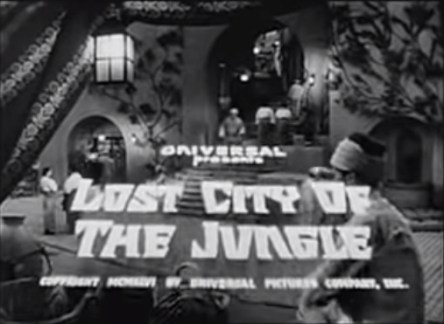
In this first chapter, “The Severed Head,” the influence of Fantômas is still quite clear, both in the story of an intrepid reporter battling a nefarious underworld gang and in the character of the Grand Vampire himself: a master of disguise, ruthlessly eliminating his enemies and liabilities and disappearing without a trace (not to mention that hooded costume he wears). However, there are signs of the greater freedom Feuillade would take with this story, free of the constraints of adapting a pre-existing property: in contrast to the single-minded struggle between Juve and Fantômas, Les Vampires gives Guérande (played by Édouard Mathé) a family and friends, and there are many elements of the humor and domestic drama that Feuillade incorporated into his many popular film series in other genres. Furthermore, rather than the connected features of the Fantômas saga, Les Vampires is a true serial in ten chapters, each leading to the next, and with a definite ending. Each chapter is between thirty and forty-five minutes, making the total film six and a half hours in length, by far the longest serial I have reviewed for this series.

20180831_141828.jpg

NOT Irma Vep

As Les Vampires proceeds in the second chapter, the gang strikes at a dancer, Marfa Koutiloff (Stacia Napierkowska), “believed to be Guérande’s fiancée,” killing her with a poisoned ring presented to her by the Grand Vampire (Jean Aymé) in one of his many disguises. Was she killed to strike at Guérande, or was it because she dared to portray a vampire in her ballet, symbolically invading the Vampire gang’s turf? In this chapter, Guérande himself is abducted by the Vampires and left to face the torments of the Vampire Grand Inquisitor, but he is rescued at the last minute by an unlikely savior: Mazamette (Marcel Lévesque), who in the first chapter swore his loyalty to Guérande and is now moonlighting as a Vampire henchman. Again, Mazamette swears that only the expense of providing for his numerous children would drive him to such employment, and he frees Guérande, allowing him to turn the tables on the Grand Inquisitor and steal a Vampire codebook before his escape.

It is in the third chapter, “The Red Cryptogram,” that Les Vampires really comes into its own with a playful combination of suspense, humor, and eroticism. First, Guérande begs off coming into the office, fatigued as he is by his experience as a captive of the Vampires. Doted upon by his mother, with whom he lives, he stays tucked in bed; but the moment she closes his bedroom door, like all kids playing hooky, he jumps up and reveals himself to be in the pink of health, even lifting some dumbbells to show how fit he is. Then he sets to work deciphering the codebook he recovered in the previous episode.

20180831_142032.jpg

It is also in the third chapter that Feuillade introduces his most famous creation, the muse and mistress of the Grand Vampire and the star of the floor show at the underworld nightclub The Howling Cat: Irma Vep, whose name is an anagram for–guess what?

irmavep

Played by Jeanne Roques, known by her stage name Musidora, Irma Vep essentially takes over the serial as a co-lead, appearing in every chapter after the third and even outliving the Grand Vampire, to whom she is at first a right-hand woman but whose importance increases as she moves to the center of the action. She has true star power, leaning on the double meaning of the word “vamp,” both dangerous and enticing. Interestingly, she only wears the black catsuit that is her most iconic look in one chapter (in retrospect, Marfa Koutiloff and her Vampire act seems like a dry run for Irma): the rest of the time she wears a variety of dresses, pajamas, and men’s suits depending on the role she is playing. Unlike the Grand Vampire, Irma rarely disappears into the different disguises she wears, instead playing the role of a diva showing off her various costume changes.

Most of all, Irma Vep looks modern in a way few of the other characters do and reminds the contemporary viewer that Paris was at the vanguard of both the arts and new forms of self-expression. Like all of the actors in this style of silent cinema, in which close-ups are rare, Musidora makes asides to the camera to show reactions, but unlike the others she frequently appears to be looking through the camera, directly to the audience. With her frizzy hair, dark lined eyes, and mannish clothes, Musidora presents a chic androgyny that transcends the period trappings of the story. Leaving aside such direct sartorial descendants as Catwoman or homages by later filmmakers like Georges Franju, Irma Vep lives on in the personae of such stars as Siouxsie Sioux and Helena Bonham Carter, and is the true distaff version of the iconic Fantômas.

20180831_143910.jpg

The fourth chapter, “The Spectre,” introduces the last new major character, a businessman named Juan-José Moréno (Fernand Herrmann). Moréno rents a flat from the Grand Vampire in another of his identities, this time a real estate agent named Treps, and specifies that he requires a safe. While “Treps” shows him a suitable apartment, Irma Vep listens from the other side of the wall. After Moréno puts a bag in the safe and leaves, Irma and the Grand Vampire open the safe from the other side of the wall by removing the back, a ploy that has obviously yielded results in the past. Does the bag contain cash, or jewels, or perhaps sensitive documents? As the pair examine the black clothing, mask, and lock-picking tools in the bag, Irma wryly concludes, “Seems to be a colleague!”

20180831_144002.jpg

Yes, the Vampires have some competition: Moréno, aka the Spectre, is both a fellow burglar and head of his own rival gang, and his intrusion into Vampire territory marks both an escalation of the Vampires’ reign of terror and yet another complication in Guérande’s campaign against the gang. Later, Moréno captures Guérande, and the journalist is saved only by inside knowledge of the Vampires’ next big heist, allowing Moréno to steal their loot from under the Grand Vampire’s nose. After being freed, Guérande receives a note reading “We are done . . . for now.”

Like its American contemporaries such as The Perils of Pauline, the chapters of Les Vampires are self-contained episodes, without cliffhangers. Although there are storylines that run through the entire serial, each chapter presents and resolves a situation. Largely this takes the form of a new plot or scheme on the part of the Vampires or the Spectre and Guérande’s reaction to it. The question each chapter asks is less “How is the hero going to get out of this one?” than “What will the villains do next?” Film historian David Kalat states in his commentary on the Fantômas series that Feuillade tended to improvise on the set, filming sequences based on a loose outline rather than a rigid script. (Having made hundreds of films in his career, and working quickly, he certainly would have had an idea of what would work in the moment.) If this continued to hold true during the making of Les Vampires, it comes through in the flow from one chapter to another, with a new plot or setting coming up in each one; in the gradual additions to the cast of characters; and in the escalating mayhem as Feuillade strives to top himself with increasingly apocalyptic disasters. (The sense of improvisation also comes through in one sequence where Feuillade reuses some unused footage of a Spanish bullfight, an economy that many later serials would display!)

However, the plotting within each chapter is quite clear and obviously shows some forethought, with each threat the Vampires pose having a solution that is set up within the episode. For example, when Mazamette presents Guérande with a fountain pen containing poison ink, a gadget “borrowed” from the Vampires, Guérande gives it to his mother to defend herself; when she is kidnapped and forced to write her own ransom note, the literal “poison pen” helps her escape her captors.

Marcel_Lévesque-Les_Vampires,_8_episodio.jpg

From these examples, it is clear that the tone of Les Vampires is much more whimsical than that of the Fantômas features, with witty plots and comic relief characters, especially Mazamette. In one chapter, Mazamette’s son Eustache comes to stay with him and ends up helping to solve a case: the mischievous boy is played by René Poyen, alias “Bout de Zan,” star of one of Feuillade’s long-running series. It probably goes too far to say that Les Vampires is a spoof of the Fantômas films, but the injection of humor and self-awareness is a welcome change from the more claustrophobic Fantômas series. Moréno, Irma Vep, and the other Vampires are convincingly motivated by greed, pride, lust, and other recognizably human motivations, as opposed to being dedicated to crime in the abstract. Some of the nightmarish qualities of Fantômas–of characters being trapped, of secrets spilling out in torrents of Freudian symbolism–are still present, but are grounded in details of everyday life rather than suspended in a surrealistic void. The almost supernatural all-knowingness of Fantômas is replaced by a more realistic dependence on cleverness and the occasional lucky break. Instead of the sensation of being trapped within a struggle against unknown forces, there is a sense of the main characters, heroes and villains alike, playing a game–a game with life or death stakes, to be sure, but one they willingly signed up for. If the morbid terrors of Fantômas suggest Kafka at times, Les Vampires is more like Antionio Prohías’ Spy vs. Spy cartoons, playful and ironic. It is in this sense, and with its delight in inventions such as the poisoned pen or the Grand Vampire’s portable cannon, that it foreshadows the superheroics of many of the later sound serials, as well as the often fanciful exploits of James Bond and other super spies.

Lesvampires.PNG

What I Watched: Les Vampires (Gaumont, 1915-1916)

Where I Watched It: Kino Classic’s two-disc Blu-Ray set containing the 1996 restoration

No. of Chapters: 10

Best Chapter Title: In “The Eyes That Mesmerize” or “Hypnotic Eyes” (Chapter Six), Moréno traps Irma Vep and, using the power of his hypnotic gaze, bends her to his will, making her his lover and setting her up to kill the Grand Vampire (the serial ultimately goes through three “Grand Vampires”). This incident, and a later one in which she escapes the sinking of the ship that was to take her to an Algerian prison colony, goes a long way toward making Irma Vep more sympathetic. Ultimately, however, her experiences cause her to reaffirm her loyalty to the Vampires and she goes down fighting. The straight and narrow is not for her.

Les-vampires-irma-vep.jpg

Best Peril: As noted, the dangers into which Philippe Guérande and his friends are placed are not quite the centerpieces that they would be in later cliffhanger serials, but there are still many dangerous incidents, and a great deal of suspense is wrung out of timed explosives and poisoned wine that Guérande barely avoids. An incident that would be echoed in many later serials is typical: in Chapter Eight (“The Lord of Thunder”), Satanas (the second Grand Vampire, played by Louis Leubas) visits Guérande at his home, a time bomb hidden in his hat. Upon shaking hands with the visiting stranger, Guérande is paralyzed by a poison on a pin hidden in Satanas’ glove. While Guérande cannot move a muscle, Satanas reveals his identity to him and leaves him, the hidden explosive left behind. In a cliffhanger serial, we would have to wait for the next chapter to see the resolution, but in this case it all works out within a single episode: Mazamette arrives just in time to learn the truth and throw the hat out the window, where it explodes harmlessly.

Les_Vampires_(8)-Louis_Leubas.tiff.png

Sample Dialogue: “Although vice is seldom punished, virtue is always rewarded.” –Mazamette, newly wealthy after collecting the reward for the arrest of an American criminal, presenting his philosophy to a group of rapt journalists (Chapter Six)

What’s Next: This brings us to the end of the summer, but I have a few more serials I intend to get to, so stay tuned for some fall updates. I still plan on covering Feuillade’s Judex; also, Turner Classic Movies has been running Tailspin Tommy in the Great Air Mystery on Saturdays, and I’ll have a review of that once it’s finished. In the mean time, thanks for spending another summer with me!