The Return of/My Return to Community

Since my children were born, I’ve developed something of a tradition: at the beginning of each fall television season, I pick one new show that I make an effort to follow.  It wasn’t a conscious thing I started doing; apparently one new show is all I can handle adding to my schedule and giving my full attention.  I watch other shows, of course, but if I miss an episode or have other things to do I don’t sweat it.  Sometimes it works out: I love animation, so Adventure Time and Gravity Falls have been rewarding to follow, although my one-show-at-a-time habit meant I missed out on Bob’s Burgers and am only belatedly catching up.  Other shows have been disappointing: Studio 60 on the Sunset Strip looked like the opportunity to get in on the ground floor of the next big thing, but after a promising start it never felt remotely like anything real, and was often laughably pretentious and self-important. It was a relief when it was canceled, but so help me, I watched every episode.  Other programs, like the already-forgotten Nathan Fillion cross-country racing adventure Drive and the completely bonkers conspiracy thriller Zero Hour, didn’t even last more than a few episodes.

It is both harder and easier to be a fan of a TV show than when I was young.  On the one hand, it is easier than ever to time shift, recording and watching a program on my own terms with a DVR or finding it online.  I watched a lot of TV as a kid, and part of my thinking was that if I missed something, it might never be shown again.  I didn’t want to miss anything.  It’s easier to let go now in the knowledge that YouTube, Netflix, or a DVD set will allow me to catch up down the road.  I think The Simpsons is the first show that stopped being “appointment television” for me; the decline in quality around 2000 was part of it, but I also knew the episodes I missed wouldn’t disappear into the ether like so much of the stuff I watched as a kid.

But that same accessibility raises the bar.  When I was a kid, if you knew the names of background characters, or–God help you–the behind the scenes personnel, it made you a superfan; now there is so much information that there’s practically no end to how deep you can go.  My wife recently got into Doctor Who, and while that’s an extreme case—fifty years of history, and a show that is particularly beloved on the Internet—it’s incredible just how much material there is to master.  Mastery is still a key value of geekdom: how do you know you’re the biggest fan unless you can out-trivia anyone else in the room—or online, where it becomes a more daunting prospect?

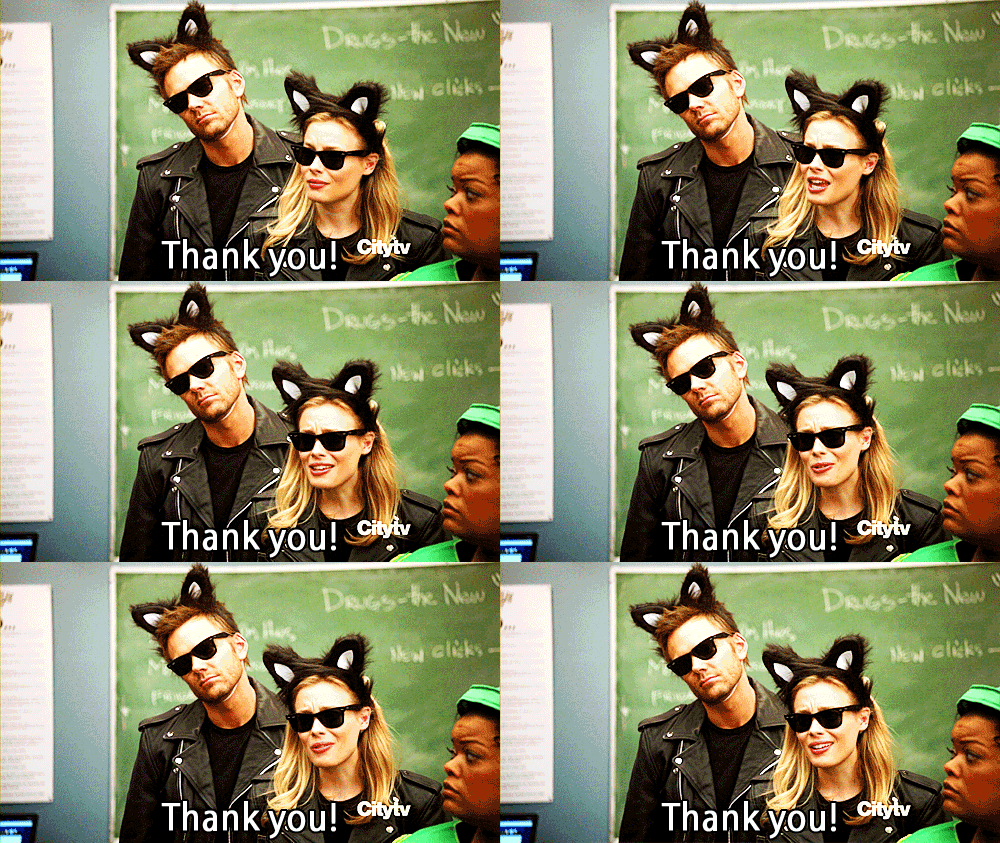
The most intense relationship I’ve had with a television show in recent years was with Community.  Beginning in 2009, Community was a classic “hang out show” stocked with colorful characters who were just fun to be around: Greendale has often been compared to The Simpsons’ Springfield, and its knowing embrace of TV and movie clichés (mostly expressed by TV-obsessed Abed) included many elements close to my heart: wordplay, slapstick, doppelgangers, pastiche, and metanarrative games.  One of the common criticisms of the show was that it flattered an audience that congratulated itself for getting references to other TV shows and movies, and I wouldn’t deny it, but what can I say?  Community rewarded an obsessive attention to detail: as closely as the audience was willing to look, creator Dan Harmon had anticipated it and put some callback or Easter egg there to reward them.  The show’s mixture of smart and dumb comedy grabbed me, and there was enough genuine feeling underlying the arch tone for some truly cathartic moments.  It didn’t just feel real: it was better than real.
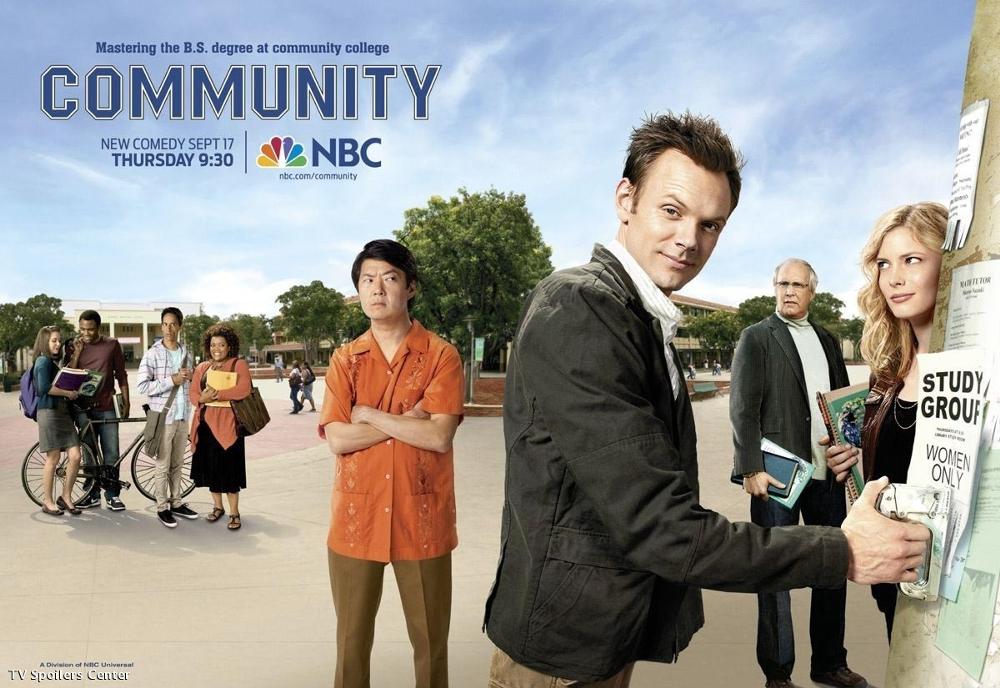
Community-Season-1-Promo-Posters

It didn’t hurt that the show premiered during an uncertain time of my life, including the birth of my second child and a reevaluation of my career.  The fact that it was set on the campus of a community college also meant I could relate to it, or at least recognize the character types involved.  Community was funny from the beginning—the interaction of Jeff Winger (Joel McHale), forced to return to school after his fake law degree gets him disbarred, with Professor Ian Duncan (John Oliver) is a highlight of the pilot episode—and although the first half of season one is considered uneven, especially compared to what would follow, it steadily improved and kept my interest throughout.  However, “Debate 109” was the episode in which Community went from being a good show to being my favorite show: the episode’s multiple threads (Jeff assists go-getter Annie in the debate against rival/mirror-image City College; the study group discovers that Abed’s student film project has been eerily predicting their activities; “non-traditional” student Pierce tries to help Britta stop smoking through hypnosis) come together brilliantly after a comic crescendo without becoming frantic or madcap.  The final scene, set to Edward Sharpe and the Magnetic Zeros’ “Home,” captures the feeling of discovery—of self and of others—that is part of the college experience, and was central to the show at its best. The episode is quintessential Community as both psychological comedy and laid-back farce.

It was also fascinating and exciting to watch the fan community develop online: reading along with Todd VanDerWerff’s reviews at the AV Club, taking part in the discussion and speculation with other fans, watching the comment threads increase in size and fervor.  It was fun to get swept up in something big; by season one’s “Modern Warfare,” an epic paintball battle told through the rhythms and visuals of an action movie, Community was a cult phenomenon.  The fact that it continued to be low-rated and seemingly underappreciated by parent network NBC only added to the fans’ love: like Arrested Development, this would be the show all your friends would catch on to in four or five years, after it had been canceled due to low ratings.  Those of us in the know were ahead of our time.
Community.thankyou

In retrospect, my infatuation with Community’s first season was like the bloom of first love: in subsequent seasons I either had to adjust to the reality that the show wouldn’t stay the same forever, or move on.  The second and third seasons were often great (the Christmas episodes “Abed’s Uncontrollable Christmas” and “Regional Holiday Music” have become required seasonal viewing for me), but it was inevitable that there would be missteps, and divisions within the fan community appeared as viewers reacted differently to the show’s plot developments.  (“Epidemiology,” the second season Halloween episode, was especially divisive, with its apparently real zombie plague.)

I began to sour on the show during its third season, as its increasingly outlandish plots and the emphasis on the dark undertones of the characters’ psychology became both off-putting and unreal.  The genre-hopping that seemed so brilliant in “Modern Warfare” came to seem like a crutch as they went to that well a few too many times, and instead of realistically flawed but likeable people the study group started to seem genuinely emotionally disturbed.

And this is where the realities of modern fandom started to wear on me.  Show creator Dan Harmon has a highly visible presence online: he’s active on Twitter, he regularly holds forth in his “Harmontown” podcasts, and he’s not shy about sharing his opinions on storytelling, dealing with actors and the studio, and anything else.  His troubles with the network and producer Sony, and his run-ins with cast member Chevy Chase, came to dominate news about Community; questions about its renewal were more dramatic than the show itself in its third season. Eventually, Harmon was leaking angry phone messages he had received from Chase, essentially airing dirty laundry in public.  As much as I enjoyed his work, I was starting to feel that I knew too much about the man behind the curtain.  I know, I know, “trust the art, not the artist.”  Easier said than done.  When the decision about Community’s fourth season finally dropped, it seemed to be the worst of both worlds: the show would continue, but Harmon was removed due to his inability to work with Sony.  As I said, I had already become dissatisfied during the third season, but I trusted Harmon to turn things around, and I stuck with it.  But the prospect of a “zombie Community” run by someone else, even someone sympathetic to Harmon’s aesthetic, didn’t appeal.

I watched a couple of episodes of the fourth season, but I wasn’t feeling it.  Barring a few moments here or there, it wasn’t very good, and felt like a parody confirming all the criticisms of Community as heartless and too clever for its own sake.  Combined with the sour feelings I now associated with it, tarnished by my knowledge of the behind-the-scenes rancor, I checked out and didn’t look back. I was busy anyway, and if Community was no longer the show I had loved so fervently, I no longer needed the escapism it had represented.

And yet. . . . In the wake of news that Dan Harmon would be returning to take the helm after the generally reviled fourth season, NBC is promoting the January 2 premiere of the fifth season as a rebirth and a return to form.  Seeing the teasers for the hour-long premiere event, with Jeff Winger returning to Greendale as a teacher (I guess he graduated at the end of last season, but from what I’ve heard no one was very satisfied with how it unfolded), I’m actually a little excited.  Clearly NBC is hoping to bring back fans like me, and maybe hook some new ones.  I’m going to give it a shot.  It will be hard to recapture the excitement I felt during the first season, but it will still be nice to check in with old friends.

Orphans of the Orchestra, Part Three

Early in Ernest La Prade’s Alice in Orchestralia (which I discussed in Part Two of this series), the title character is welcomed to Fiddladelphia, home of the stringed instruments, by the Bass Viol.  In promising to introduce Alice to the other members of the orchestra, the Bass Viol offhandedly remarks:

The others don’t live in Fiddladelphia, except a few of the lower-class stringed instruments, such as the guitars and mandolins and those pesky ukuleles, who hang about the outskirts of the village.  By rights they ought not to be here at all; they’re not members of the orchestra.  But it seems impossible to keep out the undesirable elements, even in Orchestralia.

(Previously, Alice finds the Bass Viol locked inside a case by “those naughty Ukulele boys” who are “always up to mischief,” so the antipathy is obviously mutual.)

One might assume this is another skirmish in the never-ending war between classical and popular music, the snooty Bass Viol playing into the stereotype of the uptight classical musician, while the “lower-class” ukes and guitars just want to live it up, “Roll Over, Beethoven”-style.  At the time of Alice’s writing in 1925, however, the jazz age was just getting underway, and rock and roll was decades in the future. Although there were some associations with “cheap” popular music such as ragtime and the songs of Tin Pan Alley, guitars, banjos, and mandolins had a solid presence in middle-class music making before World War I, and much of the repertoire for these instruments would strike even the following generation as quaint.  No, the undesirable element the Bass Viol hoped to escape wasn’t so much one of rebellion, but of amateurism.

Looking back to the mid-sixteenth century Renaissance, bowed and plucked string instruments were on nearly equal footing.  Instrumental music as a whole was not as developed as vocal music, and it was common for parts to be played by whatever instruments were on hand.  This was the “consort system,” a consort being a family of like instruments in different sizes and registers; a single consort, say a matched group of viols or recorders, could perform a multi-part work, or members of different families could be played together as a “mixed” or “broken” consort.  Along with the bowed viols were lutes, theorbos, and citterns, which were plucked with the fingers.

The lute, in particular, enjoyed great popularity as both a solo instrument and as accompaniment for voices; the first instruction book on playing a musical instrument was written for beginning lute players.  Queen Elizabeth I played the lute and included a lutenist as a member of her court.  John Dowland, who desired the position but never attained it (probably for political reasons), left a substantial body of lute songs and instrumentals. This musical activity primarily took place in homes; although music was used in the theater, at church, and for dancing, the public concert of music for its own sake was a later innovation.

Venere Lute Quartet

Venere Lute Quartet

After this high water mark of acceptance, plucked strings gradually split from the mainstream, following a parallel tradition.  The bowed strings gained momentum as the viols were superseded by the violin family; great makers such as Amati, Guarneri and Stradivari contributed to the design and made instruments that are still played and treasured today (although many of these makers also made lutes and mandolins).  The string orchestra as we know it came together in the mid-seventeenth century, both in Italy and in France at the court of Louis XIV.  Composers Arcangelo Corelli and Jean-Baptiste Lully are both credited with the innovation of bowing string ensembles in unison (perhaps a case of independent invention), a key to the rich, pure sound and unified phrasing of the orchestra that is taken for granted today.

The plucked strings were largely left out of this development, except for special uses: the mandolin continued to be a popular solo instrument in Italy, and (for example) there are a number of concerti by Vivaldi for the instrument, but it has never been a regular member of the orchestra.  The lute hung on as a continuo (chording) instrument in the Baroque period for a while, but was eventually replaced by the harpsichord, and fell into almost complete disuse until the “early music” revival of the early twentieth century that also brought the harpsichord back into currency.  The guitar, originally Spanish, became a nearly universal popular instrument in the eighteenth and nineteenth centuries, but within the classical tradition it filled the niche of the earlier lute, playing solo or accompaniment roles but rarely joining the orchestra.  Other plucked string instruments were relegated to folk use, and there they have largely stayed.

Jumping ahead to nineteenth-century America, the growing wealth and education of the middle class, along with the increased production of material goods thanks to the Industrial Revolution, led to the cultivation of an amateur music-making culture comparable to the one that had existed in Elizabethan England.  A piano came to be seen as an essential article of furniture, and in those pre-radio and –television days it was common for families to while away an evening singing or playing.  Sheet music publishers supplied a steady stream of novel but not-too-hard compositions in anticipation of the pop music cycles of the twentieth century.  Outside of the home, choirs and bands were as much civic organizations as musical ones, and were variously sponsored by churches, schools, businesses, and even prisons.

This atmosphere of low-level but pervasive music making, supported as it was by social expectations and commercial interests (primarily but not only publishers and instrument manufacturers), was fertile ground for all kinds of musical fads to spring up and fade away.  One trend was the adaptation of the banjo (adapted from the African banja or banjar,) which had been popularized by minstrel shows as early as the 1840s but which continued to evolve throughout the century, adding the characteristic metal hoop and frets as late as the 1880s.  Banjo clubs became a popular outlet, and instrument makers obliged by creating different-sized instruments to play a full range of parts, consort-style.  (As a group, these were sometimes referred to as “plectral” ensembles, as all the associated instruments were played with a plectrum, or pick.)

I wish this video were longer; it is obviously from a later period than the 1880s and ‘90s, but it features a good look at a bass banjo with (kangaroo?) gut strings.  When I saw a bass banjo at Miles’ Musical Museum in Eureka Springs, Arkansas*, it was strung with wound piano strings, but it was a newer instrument and undoubtedly had a steel rod to reinforce it against the tension of the strings, which wasn’t the case before the turn of the twentieth century; the instrument here appears to be all wood.  The fact that the bandleader feels the need to introduce the bass banjo (and the bemused expressions of his bandmates) indicates that even at the height of the banjo craze the bass member of the family was a rarity at best.  (A number of different banjo groups, some with mixed instrumentation, can be seen here.)

The popularity of the banjo as a parlor instrument dimmed in the US, not to be revived until jazz brought it back in a louder, snappier form.  Overlapping and superseding the banjo fad was the popularity of the mandolin, first sparked by the American tour of the Estudiantina Figaro in 1880, a group of “Spanish students” who may not have played the mandolin at all, but rather the bandurria, a Spanish instrument similar to the mandolin.  Historically, the mandolin had a teardrop-shaped body with a round back, like an egg sliced in half (much like the lute, to which the original mandolin is closely related); the bandurria was more pear-shaped, with a flat back.  Both instruments, however, were strung with double courses and played with a fast tremolo, so the style was immediately recognizable, particularly to Italian-Americans who were among the first to follow the Spanish students’ lead in organizing their own mandolin groups.  (There was already some basis for an ensemble of different sized mandolins in Italy: Norman Del Mar in his Anatomy of the Orchestra mentions an Italian mandolin orchestra arrangement of a Cimarosa overture in his possession, p. 484.  The American mandolin orchestras took off in their own direction, however.)

Orville Gibson undoubtedly had the most influence on the development of the mandolin in America: a violin-maker, he applied the principles of his profession to a new design with a flat back and carved top, lengthening the scale and adding a cutaway to make the high positions more accessible; he also added the ornamental curl and art nouveau curves that are his design’s most distinctive features.  Gibson’s F-4 “Florentine” instrument was both visually striking and projected more loudly than his competition’s, a feature that was actually toned down with gut and wound silk strings.  At the time, the ideal mandolin sound was light and “fairy-like;” in a situation parallel to the banjo’s use in jazz, it wasn’t until the rise of bluegrass that a brassy, projecting sound was considered desirable.  But Gibson’s design could supply it.

Gibson also understood the power of advertising, and sold his instruments’ capacity to bring people together as much as their musical qualities.  Building on the consort principle that had proven successful for band instruments and (to a lesser degree) banjos, he and other makers expanded the mandolin family, adapting the tenor mandola (which had previously existed but wasn’t common) and developing a “mando-cello” and “mando-bass.”  With these four instruments, the mandolin consort could match the bowed string orchestra as its plucked equivalent; with the addition of a guitar or harp, and a few carefully chosen woodwinds, it had the potential to be a real orchestra unto itself.

Quartet of Gibson mandolins. Source: Wikipedia.

Quartet of Gibson mandolins. Source: Wikipedia.

The potential to rival the traditional orchestra, advocated by some**, was undercut by instrument makers’ insistence that learning to play was easy and painless.  A point frequently made in advertisements was the difficulty of playing the bowed (and fretless) orchestral strings: “While the violin pupil is struggling to grasp but one phase of his studies—accurate intonation—the student of the fretted instrument is able to enjoy his instrument in both solo and ensemble playing,” claimed Gibson’s 1921 catalog.

Large groups of mandolins or other plucked strings weren’t limited to the middlebrow approach described here, of course: in the classical realm, Australian composer Percy Grainger wrote for “guitar bands” in his idiosyncratic search for unusual sounds and textures, including a band of forty mandolins and guitars in his accompaniment for the Faeroe Island Dancing Ballad “Father and Daughter***,” along with more traditional instrumentation.  Bandleader James Reese Europe, a key figure in the transition from ragtime to jazz, is reported to have taken numerous mandolins and banjos with him as part of the “Hell Fighters” Band when he led the regimental band of the 369th Infantry in World War I.  The ranks of plucked strings were partly there for volume in those days before electrical amplification made it possible for a single guitarist to comp for an entire band.  Once jazz and swing replaced ragtime and parlor tunes in popularity, gigantic plectral ensembles became strictly the domain of folk festivals; witness the Russian balalaika orchestras that were an official part of Soviet musical culture.

Karl Alex Smyser Banjo Band ca. 1931, from Bluegrass Today.  (Follow the link for audio recordings!) Note the mando-bass on the right.

Karl Alex Smyser Banjo Band ca. 1931, from Bluegrass Today. (Follow the link for audio recordings!) Note the mando-bass on the right.

Ultimately, the mandolin orchestra gave way to jazz and other kinds of popular music after World War I, although a few groups soldiered on (such as the Smyser band shown above), and of course the mandolin itself became an essential voice in the developing bluegrass style.  A few mandolin orchestras stayed active (a list of active groups can be found here) as far afield as Australia, Japan, and Germany, and the last decade has seen a resurgence in large plectral ensembles; the ukulele is the most visible of the currently popular plucked strings, but a quick YouTube search (how I wish it had been that simple back when I first learned about this music!) turns up numerous performances ranging from the traditional “light classic” approach, to jazz, to covers of contemporary pop songs.  Fortunately, both scholarship and popular music have played a role in rescuing this fascinating instrumental genre from obscurity.

* Sadly, this institution is no more; it was truly a magical place.

** For example, William Place, Jr., in his 1917 book The Organization, Direction, and Maintenance of the Mandolin Orchestra, commenting on the practice of bolstering plucked groups with bowed instruments, wrote, “We have a complete string quintet of our own mandolin family, and there is no reason why we should be obliged to ask for outside assistance.”

*** Described and excerpted in Cecil Forsyth, Orchestration, pp. 481-485.

Dole/Darko ’88

I used to be a real pack rat when it came to newspapers (used to, I hear my wife saying).  While going through some boxes that had been at my parents’ house for about twenty years, I found quite a few papers and magazines that I had saved for one reason or another: historical value (“Clinton Sweep,” read the headline of the Wichita Eagle the day after Bill Clinton’s 1992 election) and souvenirs of places I’d been, but also stories that seemed dramatic or exciting to me, and which, in those heady days, I thought might be the basis for a dramatic work.  I was very much under the spell of contemporary dramas like David Henry Hwang’s M. Butterfly and John Adams and Alice Goodman’s Nixon in China; it seemed that any out-of-the-ordinary story might have sufficient conflict or resonance to turn into an opera or play.  I was fairly susceptible to any kind of cultural theory that came along, so my early thoughts about aesthetics were a jumble of second-hand Marshall McLuhan, Peter Sellars, and Gilbert Seldes, cut liberally with the provocative Dadaism of the Residents and Frank Zappa.  At one point I set a few comic strip texts to music, partially as an exercise, but also believing that “mass media” sources were the natural successor to the communal folk sources that had informed the classical tradition from the eighteenth to the early twentieth centuries.  Don’t get me wrong, those are still areas of interest to me, but like a lot of teenage “artistes” I was trying way too hard.  In any case, my own subsequent experience, not to mention the flood of shallow, hacky biographical operas that became trendy after Nixon‘s success, showed me that it wasn’t as easy as it looked, and not every news story held a grain of dramatic truth waiting to be turned into poetry.

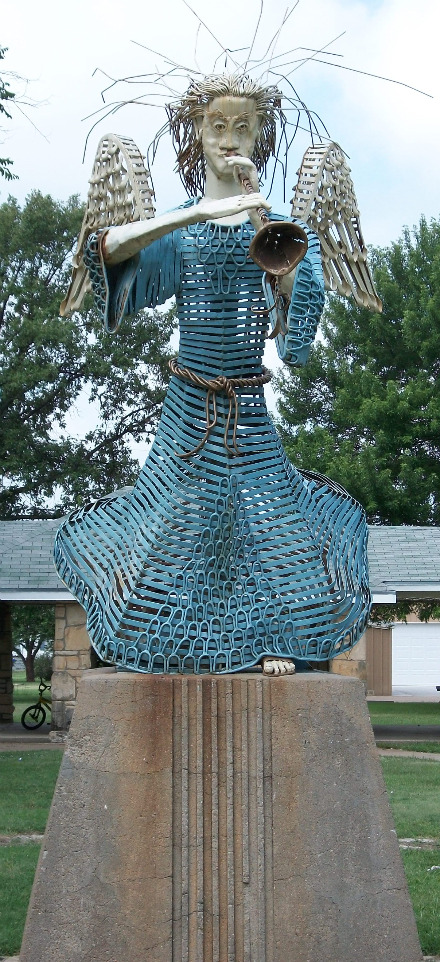
One article I found that I still remembered vividly appeared in the Wall Street Journal of Tuesday, October 15, 1991: “Odd Tales of UFOs And Sen. Bob Dole Visit Russell, Kan.” by staff reporter (now WSJ editor) Kevin Helliker.  The disappearance of four women from Russell cast a spotlight on local writer Donna R. Butts, who had published a book about her contact with space aliens (and who was among the missing). According to her book, the Second Coming would begin as soon as Kansas Senator Bob Dole, who grew up in Russell, was elected president and moved the White House to his hometown, among other apocalyptic prophecies.  Members of Butts’ group of believers included local art teacher Gertrude “Trudy” Furney, whose public sculpture of the Seventh Trumpeter from the Book of Revelation sat (and still sits) in Russell’s Lincoln Park.  According to Rural Kansas Tourism, the sculpture (now popularly known as the Angel in the Park) “was constructed in 1988 to symbolize a turnaround of the local economy and a new beginning.  The artist’s idea was to portray that when the angel blows the 7th trumpet, better times and new beginnings were ahead.”

angel websize

It was apparently not unusual for the sculpture to be interpreted in more literal terms, however: according to Helliker’s article, the disappearances set off a wave of anxiety.  “Students at Bickerdyke Elementary School, located across the street from the Seventh Trumpeter sculpture, swore they saw the angel’s trumpet move.”  Psychologists were brought in to counsel the panicked students.  The public library was overwhelmed with requests for Butts’ book, and UFO sightings in the area spiked.

UFOcontact

I didn’t live in Russell, but the atmosphere of expectant foreboding described in the article felt familiar.  In the fall of my freshman year in high school, a brilliant light on the horizon convinced a number of people in my hometown that the Second Coming had arrived, or so I heard; it was the lights from the football stadium for the first home game, seen through an unseasonal haze.  There was a lot of that going around in the late 1980s and early ’90s, enough that director Richard Kelly’s decision to set his spooky 2001 film Donnie Darko on the eve of the 1988 presidential election felt weirdly appropriate.  In hindsight, this story, and several others that I collected, pointed to a convergence of two trends that would go mainstream in the 1990s: interest in UFOs and paranormal activity, and millennial fundamentalism.  The popularity of The X-Files gave a boost to the former, and the political ascendance of the latter is a reality that is still with us; in both cases, the Internet’s ability to connect like-minded people surely contributed to the trends.  The fact that “rational explanations” were forthcoming–pranksters confessed to faking UFOs with road flares tied to helium balloons, and the four missing women had undertaken a pilgrimage to Israel without telling anyone–makes it conveniently easy to dismiss the whole thing, leaving aside the question of why people get swept up in these manias in the first place.

Donnie Darko, 2001

Donnie Darko, 2001

I don’t have an answer to that, at least nothing that would go beyond the volumes that sociologists and philosophers have already written.  Perhaps, in addition to my dramatic ambitions, I was simply trying to make sense of the data, like that other famous clipper, Charles Fort.  Fort spent years arranging the “damned facts,” weird happenings and sightings culled from newspapers from all over the world, into his four books; the cumulative force of his observations asserts a loose philosophy of skepticism toward both unsubstantiated myth and scientific orthodoxy, putting his faith in facts without jumping to conclusions about how they fit together.  The Internet has made it both easier and more difficult to follow the weird happenings in the world: easier because we have greater access than Fort, sitting at a table in the New York Public Library, could have imagined, and more difficult because of the sheer scope of the information available.  Ultimately, the lack of a definitive conclusion is what makes this sort of story less satisfying for dramatic purposes than we might desire: we’re left either exaggerating the reality of the aliens’ presence, as in a Hollywood blockbuster, or dismissing it altogether, as most outside observers would.  The ambiguity and misdirection, the need to believe without being able to prove anything, was something The X-Files would get right, for the most part, and as Donnie Darko would demonstrate, sometimes the most captivating aspect of a case like this isn’t a story at all, but a mood.

And with that, I leave you with Donald Erb’s 1969 composition The Seventh Trumpet, appropriate mood music for this article.

Alliterative Insult: an Operatic Example

When composing his epic, four-installment opera Der Ring des Nibelungen, Richard Wagner wasn’t content just to write the music; as he had done with his previous operas, he wrote the text as well.  Wagner intended his work to be comprehensive.  As a Gesamtkunstwerk (“total art work”), Wagner’s form of theater would encompass music, text, stage direction, and even the design and construction of a new theater, all guided by a single controlling vision: his own.  Although Wagner’s musical innovations are well-known to audiences—his thorough-going chromaticism, his extended forms, the importance of the orchestral accompaniment in spinning out leitmotivs—his text is not always given the same appreciation, especially among non-German speakers.

When introducing students to works in foreign languages, I’ve noticed an assumption on many listeners’ part that the words are completely comprehensible to native speakers, and that their meaning for them is as clear as the translations that often appear as subtitles on video or projections in the theater.  There are many reasons that this is not so, and vary depending on the composer and the language in question; undoubtedly some operas are easier to understand than others.  The musical setting of the text (not to mention individual performance conditions) can emphasize clarity or destroy it, just as the range of English-language music theater runs from the transparent to the obscure.

In the case of the Ring cycle, the challenges go beyond that of translating from one language to another: Wagner borrowed and expanded a technique called Stabreim (“stave rhyme”) from the Icelandic Eddas, the medieval saga that, along with the German Nibelungenlied, provided the basis for his exploration of the Norse gods and their fall.  Stabreim, far from being a rhyme scheme as we might conceive it, is a form of poetic meter based on alliteration, the repetition of initial consonants at key points within the poetic line.  Wagner, believing the Eddas to be a spontaneous (and thus pure) outpouring of unconscious folk creation, sought to channel that supposed primitive force by imitating and expanding upon it.  Thus, his text is both deliberately archaic and in some places obscure; it’s comparable, I think, to English-language writers borrowing “thee” and “thou” from Shakespeare and the King James Bible to channel some of their solemnity and sense of antiquity, but goes even farther.  According to one translator, an anecdote has it that Wagner’s grandson Wieland, when directing productions of the Ring, would have the cast translate their lines into German—that is, modern German—in order to understand their parts.  If true, that certainly puts our difficulties into perspective.

It has proven challenging to translators, as well, and as is often the case, they have sometimes had to prioritize the meaning of the text over Wagner’s alliterative scheme (or his exclusive use of German root words, or the complex use of puns that saturate the text).  Still, there are a few places where the alliteration is too good to resist.  In Scene One of Das Rheingold, the dwarf Alberich, overcome by lust, is taunted by the three Rhine maidens for his ugly appearance (it is, of course, this teasing that leads him to steal the Rhine gold and renounce love, the decision that starts the plot moving).  Wellgunde, one of the maidens, rebukes Alberich by singing (at 8:50 in the embedded video):

Pfui, du haariger,

höck’riger Geck!

Schwarzes, schwieliges

Schwefelgezwerg!

The alliteration in the last two lines paints a detailed (and insulting) portrait of Alberich, calling him a Schwarzes (black), Schwieliges (callous) Schwefelgezwerg (Schwefel meaning sulphur and zwerg meaning dwarf).  Alberich is more than just a little person, however: in Wagner’s interpretation of Teutonic mythology, the Nibelungs were a race of skilled metal workers and miners that toiled in the ground in their own realm (Nibelheim), separate from either men or gods (think of Snow White’s seven dwarfs, or the dwarves** of J. R. R. Tolkien, who drew on many of the same medieval sources for his Lord of the Rings).  When zwerg is used, it is a term of disparagement (as in Scene Three, when Alberich calls his brother Mime a Tückischer zwerg, a shifty or treacherous dwarf).  Elsewhere in the text, Alberich is referred to either as a Nibelung or occasionally as an Alp (elf).  So, right off the bat, Wellgunde’s taunt calls attention to his ugly appearance, darkness*, and his connection to the deep earth (in fact, Alberich appears to have reached the Rhine by climbing out of a cave underneath it).

What have translators made of this? It’s one of the more colorful examples of alliteration in the text, so most translators have tried to preserve it.  In the video (from Robert Lepage’s recent staging at the Metropolitan Opera) the lines are subtitled as “You’re a hairy, horrible thing!  So hideous and spotted!”  It’s safe to say that there have been more ambitious renditions of Wellgunde’s insult.  A 1904 translation by Charles Henry Meltzer has it as

Faugh ! Thou hairy

and  Humpy old oaf!

Swarthy, shuddersome,

Sulphurous dwarf!

The adjective “sulphurous” can be taken literally, but also has a connotation of spitefulness: a poisonous disposition.  The uncredited translator of The Authentic Librettos of the Wagner Operas (Crown Publishers, 1938, although apparently the Rheingold translation also goes back to 1904) renders it as

Faugh!  You hairy

and horrible imp!

Swarthy, stunted,

and shriveled up dwarf!

Note the loss of any reference to sulphur; “shriveled up” could refer to Alberich’s size, old age, or (obliquely) sexual undesirability.

Stewart Spencer, in Wagner’s Ring of the Nibelung: A Companion (Thames & Hudson, 1993) has

Ugh!  You hairy,

hunchbacked fool!

Brimstone-black

and blistered dwarf!

I like this one; it’s a vivid and incisive description of a creature living too close to volcanic fissures underground.  Finally, lest we assume that subtitles, with their bias toward ease of reading and keeping the plot moving, must be devoid of interest, I present the translation used for the 2002 production at the Staatsoper Stuttgart, staged by Joachim Schlömer:

Urgh! You hairy,

misshapen old hog!

You randy, wrinkled,

rheumaticky runt!

It’s as if each translator has tried to do justice to the alliterative excess in Wellgunde’s insult but without repeating their predecessor’s choice of words. Fortunately, while the polyglot heritage of English vocabulary makes it challenging to construct extensive rhyme schemes (by comparison to the Italian terza rima of Dante, for example), the variety of words available provides almost unlimited potential for alliteration.  One could conceive of Alberich as a “miniature, mephitic miscreant,” a “pestilent, pint-sized playboy,” or even a “callous, coal-black Casanova”—none are exactly the same as the original, of course, but what translation ever is?

*The Eddas also mention “dark elves,” which some scholars think may have been dwarfs by another name; in any case the concept has branched into its own category, separate from dwarves, in modern fantasy literature.

** The plural “dwarves” was popularized by Tolkien, and has become standard when discussing them as a fantasy race; I have used the more standard “dwarfs” in this article except for explicit reference to Tolkien’s treatment of them.  Hence the discrepancy.

Christmas with the Doctor (No, not that one!)

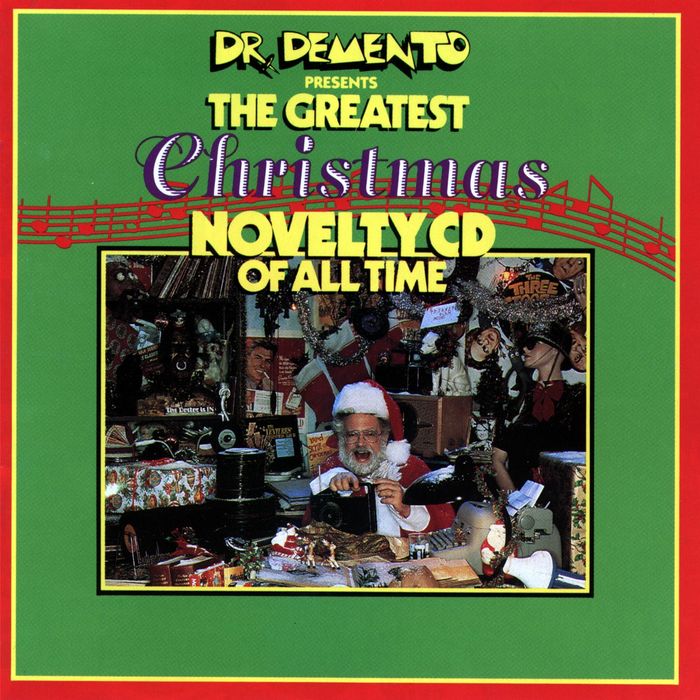
Now that Thanksgiving is past, it’s time for the Christmas decorations to go up, and the Christmas music to come out!  In my family, one of our favorite Christmas albums is Holidays in Dementia, collected by the one and only Dr. Demento.  I’ve been a fan of the good Doctor since I was in middle school, although my interest has waxed and waned over the years as with so many youthful obsessions.  Holidays in Dementia was a gift to my wife on our first Christmas as a married couple (I know, but hear me out), in part because I remembered some of the songs on it, and knowing that she was a fan of “Weird Al” Yankovic and similar “demented” humor.  It’s since been played every year during December and has been the source of a number of inside jokes.  Holidays in Dementia was the 1995 follow-up to 1989’s Dr. Demento Presents The Greatest Christmas Novelty CD of All-Time, both released by Rhino.  The contrast between the two albums is interesting:

DOCTOR DEMENTO XMAS

The Greatest Christmas Novelty CD of All-Time

  1. The Chipmunk Song: The Chipmunks with the Music of David Seville
  2. All I Want for Christmas is My Two Front Teeth: Spike Jones & His City Slickers
  3. Jingle Bells: The Singing Dogs
  4. The Twelve Gifts of Christmas: Allan Sherman
  5. I Want a Hippopotamus for Christmas: Gayla Peevey
  6. Nuttin’ for Christmas: Stan Freberg
  7. A Christmas Carol: Tom Lehrer
  8. Grandma Got Run Over by a Reindeer: Elmo & Patsy
  9. I Yust Go Nuts at Christmas: Yogi Yorgesson
  10. Twelve Days of Christmas: Bob & Doug McKenzie
  11. Green Chri$tma$: Stan Freberg
  12. I’m a Christmas Tree: Wild Man Fischer (Duet with Dr. Demento)
  13. I Saw Daddy Kissing Santa Claus: Kip Addotta
  14. Santa Claus and His Old Lady: Cheech & Chong
  15. Christmas at Ground Zero: Weird Al Yankovic
  16. Christmas Dragnet: Stan Freberg & Daws Butler

demento.holidays

Holidays in Dementia

  1. The Twelve Pains of Christmas: Bob Rivers Comedy Corp
  2. It’s So Chic to be Pregnant at Christmas: Nancy White
  3. Gridlock Christmas: The Hollytones
  4. It’s Christmas and I Wonder Where I Am: The Bob & Tom Band
  5. Santa Claus is Watching You: Ray Stevens with the Merry Melody Singers
  6. Santa’s Lament: Father Guido Sarducci
  7. Rusty Chevrolet: Da Yoopers
  8. Christmas is Coming Twice This Year: The Hollytones
  9. Christmas Wrapping: The Waitresses
  10. Santa Claus is Comin’ to Town: Joseph Spence
  11. A Terrorist Christmas: James & Kling
  12. Stop the Cavalry: Jona Lewie
  13. The Pretty Little Dolly: Mona Abboud
  14. Hanukkah Rocks: Gefilte Joe & The Fish
  15. Hanukkah Homeboy: Doc Mo Shé
  16. Happy New Year: Spike Jones & His City Slickers
  17. New Year’s Resolutions: Scary Gary Alan

There are a few differences between the two discs: whereas Christmas is right in the title of the first collection, Holidays in Dementia also includes songs dedicated to Hannukah and New Year’s Eve (according to his introduction, the Doctor had intended to represent the winter holidays equally, but there weren’t many non-Christmas songs to choose from).  I wouldn’t argue against any of the songs on The Greatest Christmas Novelty CD; most of the songs on it earned their place through years of airplay.  The downside is that you’ve probably heard them all before.  It’s like having a friend whose favorite rock songs are “Stairway to Heaven” and “Hey Jude”: they’re classics, but not very interesting or surprising as choices.  Still, these are all songs you would want in your library of Christmas novelty songs (doesn’t everyone have one of those?), value added by Dr. Demento’s scholarly liner notes (scholarship genuinely arrived at, I might add: in his civilian identity as Barry Hansen, Dr. Demento has a degree in ethnomusicology, as well as being a crate-digging record collector of the first order, much like his predecessor Harry Smith).  It does cover a wide historical range, from songs that predate Dr. Demento and his influence (you can’t go wrong with Tom Lehrer and Spike Jones, for example) to artists like Demento discovery “Weird Al” Yankovic and others whose primary distribution was through the Doctor’s radio show.  (Incidentally, I had no idea the original Singing Dogs record appeared in 1956.)

If it sounds like I’m putting down The Greatest Christmas Novelty CD, I don’t mean to; it just doesn’t have the same personal connection for me as Holidays in Dementia, and the songs it includes are widely known and available, so even though I like them, I don’t think of this album specifically when I listen to them.  Going through the track list for Holidays, however, I’ve realized there are several that I skip when I listen to it (“A Terrorist Christmas,” a flat recitation of “The Twelve Days of Christmas” with weapons replacing the traditional gifts, doesn’t work for me; unlike the equally dark “Christmas at Ground Zero,” there’s neither wit nor musicality).  But the songs I like, I really like: if a novelty song is going to be a perennial, it either has to be as funny on the hundredth listen as the first (a high bar for any comedy record), or it has to work as a song that just happens to have witty lyrics.  Most of the songs on both CDs fit one category or the other, and some fit both; surprisingly, there are few direct song parodies (“Jingle Bells” turns into “Rusty Chevrolet,” for example; Kip Addotta’s “I Saw Daddy Kissing Santa Claus” rewrites a song that was already a novelty to begin with) outside of the numerous takes on “The Twelve Days of Christmas” (four between the two discs, five if you count its inclusion in “Green Chri$tma$”).  Most of the songs are original.

Perhaps what I respond to in Holidays is the specificity of the songs: both CDs prick the commercialism, sanctimony, and hassle of Christmas, but Bob Rivers’ “The Twelve Pains of Christmas” dissects the misery of the season so expertly, and draws such indelible characters with only a few lines, that it feels universal.  Selected lines have become the standard reference when sending cards (“I don’t even know half these people!”) or putting up lights (“One light goes out, and they all go out!”) in our house.

On the flip side, we might not all be able to relate to the expectant mother of Nancy White’s “It’s So Chic to be Pregnant at Christmas,” the harried single girl of The Waitresses’ “Christmas Wrapping,” or the children of divorce from the Hollytones’ “Christmas is Coming Twice This Year,” but they evoke times and places as clearly as a short story.  So many Christmas songs are narratives to begin with, the line between “seasonal” and “novelty” is fuzzy at best.  The Hollytones’ “Gridlock Christmas” is one of my favorites, and one of the songs I sought out when buying Holidays in the first place: it came out in 1988, and must have been new when I first heard it on Dr. Demento’s radio show.  The tale it spins of motorists making the best of it while stuck on the freeway is ironic but with a core of sincerity: “I’m having gridlock Christmas / With people I don’t even know. / Though friends and family can’t be here / We’ll have good old Christmas cheer / With carols on the car radio.” The song combines a laid back, two-beat country accompaniment (complete with slide guitar) with a jazzy clarinet, and singer Floyd Elliot’s crooning delivery (complete with a Johnnie Ray-style catch in his voice) brings together the contrasting musical elements in the same way strangers are drawn into fellowship in the song.  Is it a testament to the resilience of the holiday spirit, of the way we can turn anything, even nuisances and frustrations, into traditions?  Perhaps, but it’s also just a terrific song.

BONUS VIDEO: In case you felt misled by this post’s title, here’s another Dr. Demento favorite from 1988: “Doctorin’ the TARDIS” by The Timelords/KLF, a mash-up of the classic Who theme and Gary Glitter’s “Rock and Roll Part 2,” complete with a music video featuring authentic special effects from the classic series (I kid, I kid):

Points of Connection, Part Five: Shadow Kingdoms

“If the Pirates of the Caribbean [ride] breaks down, the pirates don’t eat the tourists.” –Dr. Ian Malcolm (Jeff Goldblum), Jurassic Park

WallyWorld

Many of the narratives discussed so far serve as commentary on the relationship between appearance and actuality: the actors on Galaxy Quest learn to live up to the roles they portray; Squadron Supreme, Watchmen and The Venture Bros. contrast the glamorous and well-intentioned ideal of the superhero with its flawed, sometimes squalid reality; The Adventures of Baron Munchausen plays with the very notion of storytelling’s ability to shape events.  This is directly tied to the revisionary, “postmodern” stance, of which pastiche, parody, and intertextuality are such an important part, as well as making it easier to critique thinly-veiled properties that might otherwise be off-limits due to copyright or marketing needs.

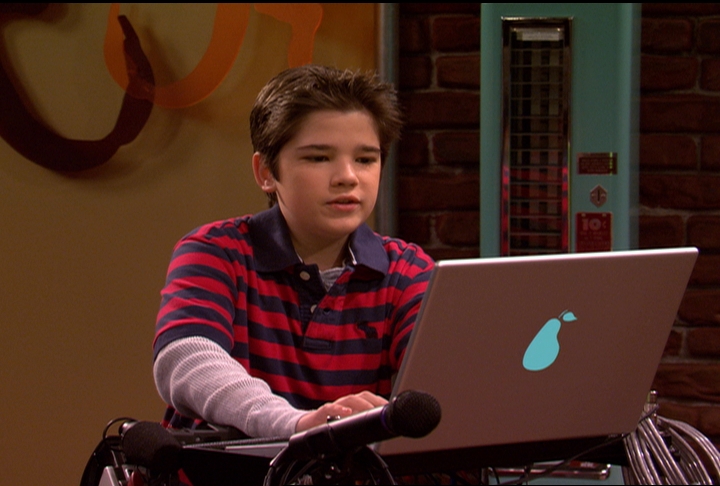
In film and television, the need for doppelganger brands and trademarks goes beyond storytelling requirements and is frequently undertaken as a matter of course: there is a cottage industry of production designers that supplies television and movie studios with fake products (like Heisler Beer) for set dressing.  Although they are sometimes the vehicle for critiques of branding or consumerism, they are usually just part of the background, used in order to avoid litigation or fees that might be demanded if a trademark holder were unhappy with either the portrayal or association of their product with a film or television show.  Similarly, filmmakers may wish to avoid the stigma of paid product placement.  Fictional branding is often just another aspect of crafting a believable setting or extending an aesthetic (such as Community‘s Greendale, where Let’s Potato Chips and Hot & Brown Coffee are popular brands), and some filmmakers have brands that permeate their creations, like J. J. Abrams’ Slusho!  No matter what the motivation, or whether real or fictional brands are used, the implication is clear that brands and logos are now so ubiquitous that realism demands their presence.*

"Pearbook" on iCarly

“Pearbook” on iCarly

"Heisler Gold Ale" produced by Independent Studio Services

“Heisler Gold Ale” prop packaging by Independent Studio Services

Leaving aside cases of paid product placement, critiques are more likely to be effective when brands are named directly instead of implied by doppelgangers (even with paid placement, filmmakers are sometimes able to get the last laugh: witness the future society of Demolition Man, in which “all restaurants are Taco Bell”).  Plenty of fictional products have skewered commercialism in films and television, but they are often deliberately unreal, placing the emphasis on the stupidity or crassness of marketing, making the satire clear but less believable in a fictional context (as an example, see “Mooby,” literally a golden calf, in Kevin Smith’s Dogma).  Films like Fight Club or Idiocracy have more bite in this regard for using real-life brands and making their target perfectly clear (although Idiocracy also included fictional brands: who could forget Brawndo?).  The use of brand names in such critical ways is generally protected by the First Amendment, but film producers aren’t always willing to invest in a court fight against big corporations and choose to play it safe; hence the common blurring of even innocuous background logos in documentaries and the proliferation of fake brands on television.  In general, the bigger the company brand, the bigger the target it makes for satirists and the more aggressive its lawyers are in policing its trademarks.

It doesn’t get much bigger than the Walt Disney Company, which is famously protective of its image and is known to be very litigious when it comes to unauthorized use of its intellectual property.  That made it all the more incredible when Escape from Tomorrow was released in 2013: Escape was largely filmed surreptitiously at Disneyland and Walt Disney World with handheld cameras, the cast and crew posing as tourists.  It caused a sensation at film festivals, not least from the audacity of its production, but whether it would ever be distributed was debatable, based on the presumption that Disney would never allow a film secretly made on their property (and in which EPCOT’s Spaceship Earth is shown blowing up and rolling off its foundation, among other dark images) to be widely seen if they had anything to say about it.  Ultimately, it was released with a prominent disclaimer disavowing any connection with Disney (or the Siemens Corporation, which also figures prominently in one of the film’s most bizarre scenes).

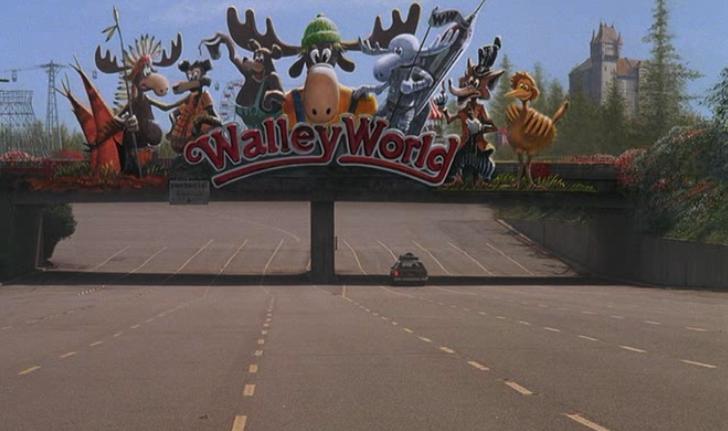
Walt Disney and his company, characters, and theme parks have been fictionalized, parodied, and referenced in ways too numerous to count, but a few examples will suffice.  Mooby, referenced above, is a clear Mickey Mouse analogue.  The Magic Kingdom is recognizable in Walley World, the frustratingly out-of-reach destination in National Lampoon’s Vacation, and in Brisbyland, the home of “Busy Bee” in “The Incredible Mr. Brisby,” an episode of The Venture Bros.  (In both cases, the park founder is still alive and present at his park, and has the first name “Roy,” surely a reference to Roy O. Disney, Walt’s brother and co-founder of the Walt Disney Company, or Roy E. Disney, Roy O.’s son and a longtime Disney executive.) Disney’s futuristic outlook, epitomized by EPCOT (originally intended to be a self-contained model community) but apparent through his entire career, has been a rich source of inspiration for both fiction and urban legend (for example, although Escape from Tomorrow doesn’t address Walt Disney’s supposed cryogenic preservation, it does include memory manipulation, robots, and other technologies behind the scenes—but how much of this is real is open to interpretation; more on this momentarily).  Finally, Disney is a natural focus for stories targeting whitewashing, controlled environments, prefab narratives, and illusory realities: whether one believes Walt Disney to have been a visionary artist, a commercial hack, something more sinister, or some combination of the three, the impact his company’s work has had on (for example) our understanding of familiar fairy tales, American history, and branding (not to mention our expectations for immersive entertainment: the “theme park” as we know it would be much different without Disney, if it existed at all) are incalculable.  If P. T. Barnum epitomizes nineteenth century show business in all its hucksterism and canny exploitation of the audience’s secret desires, Walt Disney is his technologically-empowered twentieth century heir.  Disney is thus a useful mirror for any artist interested in the contrast between calculated cover stories and messy realities.

Beyond association with Disney specifically, the haunted/abandoned/out-of-control amusement park has a long history, going back to the shady and dangerous “otherness” of the traveling circus (see the dark carnivals and mysterious midways of Ray Bradbury, who made extensive use of this setting)**, and kept alive in the malfunctioning high-tech entertainments of Westworld and Jurassic Park (both from the pen of Michael Crichton). The scary old carnival was something Disney actively tried to move away from: “carnies” with tattoos and facial hair would not be employed at his parks; every detail would be looked after to make sure guests felt safe, welcome, and at home; recreations of “old time” entertainments, such as Paradise Pier, the idealized Boardwalk at Disney California Adventures, are scrubbed clean of anything potentially offensive or threatening.  As for Crichton’s cybernetic system failures, those too drew inspiration from Disney, sensing a fatal hubris in the technophilia and micromanagement of Disney’s parks. The Simpsons knowingly brought things full circle, parodying Disneyland, Westworld, and Jurassic Park in “Itchy & Scratchy Land.”

Escape from Tomorrow thus makes a potent counterexample to the pastiches discussed in this series: it’s unlikely that the same film set in a fictionalized version of the park would make such a splash.  To point out that theme parks conceal things from their guests, or that “it’s all fake,” would be trite; everyone knows this, but like the audience for stage magic, we want to be seduced, to be tricked, at least for the duration of the show.  Escape’s trailer makes this case explicitly, and sells the film, with one line of dialogue: as Alison Lees-Taylor’s jaded ex-princess says, “People come here because they want to feel safe.  Bad things happen everywhere—especially here.”  The specificity of its references play with our familiarity with the urban legends and jokes about Disney—some are referenced directly, and others are left to our imagination.

(Spoilers follow.)  In the film, written and directed by Randy Moore, husband and father Jim White (Roy Abramsohn) is fired from his job (via phone call) on the last morning of his Disneyworld vacation; while attempting to put a good face on it, he is continually distracted in the park by a pair of beguiling French teenagers, whom he clumsily follows around.  Other subplots abound, and the story is largely episodic, broken up by periodic flights of fantasy (reference is made to Jim’s “blackouts”) which provide the more overt horror elements: the characters in the rides suddenly turn into demonic tormentors; Jim finds himself entangled in a high-tech conspiracy; other park visitors, such as a scooter-riding Southerner, take on sinister significance.  In other words, the “Happiest Place on Earth” has its mask ripped away.  As Lees-Taylor’s character says, “You can’t be happy all the time.”

Pastiche is still present in at least one element of Escape from Tomorrow: the music.  Licensing requirements would have made it prohibitive to use the actual songs from Disney’s catalog, so composer Abel Korzeniowski provides convincing and frequently gorgeous backgrounds in the lush, cinematic style associated with Disney’s “golden age,” and sound-alike ditties for the rides.  The film is better for it.  This is especially clear in an early scene set on the “It’s a Small World” ride, in which the song of the same name is suggested–and its cloying, repetitive qualities exaggerated–but not actually used.  The end title song (“Imaginate!”) similarly toys with the optimistic “marching into the future” genre, giving it a vaguely threatening edge: compare it to “Miracles from Molecules,” a song (by Robert and Richard Sherman) heard in Disney’s Tomorrowland, but note that the transformations in “Imaginate!” aren’t in the inanimate materials of chemistry, but in the listener: “Everyone is here, no time to fear / And we will never let you go. . . . Imaginate! What can we do / When tomorrow there’s another you?”

Ultimately, Escape from Tomorrow pulls a bait-and-switch on the audience not unlike Disney’s hard-to-keep promise of happiness: the most surreal and dramatic scenes (like the explosion of Spaceship Earth) are fantasies, whereas the real horrors are those of the mundane world, playing on fears anyone can relate to: unemployment, alcoholism, infidelity, being separated from a child in a crowd, getting sick far from home.***  Terry Gilliam’s The Adventures of Baron Munchausen was the third in a loose trilogy (with Time Bandits and Brazil) focused on the importance of escapist dreams.  While Randy Moore’s cinematic language is closer to David Lynch than Gilliam (one of the spookiest scenes involves a slightly out-of-focus balloon, hovering just inside the frame), Jim’s breaks from reality clearly serve the same purpose as Sam Lowry’s in Brazil.  Even the French teenagers, in whom Jim’s interest is primarily sexual, can be seen as emblematic of a tempting other life, the specifics not so important.  It’s surely a commentary on our times that even as frightening, disorienting, and paranoid as Jim’s fantasies are, they’re still preferable to his everyday life.  That’s not to say that “reality” isn’t still a malleable concept: as in Gilliam, the boundaries of dream and waking are permeable.  At Escape‘s denouement, a “fixer” implants a happy memory in Jim’s son’s mind: who’s to say that Moore’s film doesn’t perform a similar alchemy in reverse, supplanting the company’s narrative with its own?

* David Foster Wallace notes the change in attitude toward brand names and other mass media references in literary fiction, and the role television has played in shaping that transition, in “E. Unibus Pluram: Television and U. S. Fiction,” especially pp. 41-44, included in A Supposedly Fun Thing I’ll Never Do Again.

** “Something Wicked This Way Went: Whatever Happened to the Creepy Circus?” by EsoterX has a nice take on the subject.

*** A comparison can be made to Alfonso Cuarón’s Children of Men and Max Brooks’ World War Z: the political and social ills in both scenarios are plausible enough to be scary by themselves, but presumably wouldn’t draw as much of an audience without the sci-fi “hooks.”

In Defense of Medleys

As a composer and performer, one aspect of musical composition that has always fascinated me is the mysterious alchemy by which two ideas, which may have little in common (at least superficially), can be joined together simply by their presence in the same piece of music.  This may seem trivial, but the question of why some ideas seem to fit together and others remain stubbornly separate is an important one for composers and songwriters, and the performers and conductors who do their best to interpret their ideas.  It’s taken me a few months to come around to this directly, but I wanted to get some entries under my belt before I tackled the subject.

Although I intend to keep blogging about comics, movies, musical instruments, and anything else that catches my fancy, Medleyana takes its name from an oft-maligned genre of music: the humble medley—you know, the sort of piece that delivers the most exciting or recognizable bits of several songs or pieces in a self-contained arrangement.  It’s not hard to see why the medley form is underappreciated, or not even acknowledged as a legitimate form at all.  Anyone who has played an instrument in a school band or orchestra, or had a child who did, has suffered through watered-down arrangements of movie themes or pop tunes that are too difficult for students to perform in their original form, cementing an association between medleys and amateur music-making.  For the same reason, medleys are considered an essentially “commercial” form, trafficking in the ephemera of songs and movies that are omnipresent for a season and then forgotten.  Even those medleys of evergreen favorites like Christmas carols or patriotic songs are subject to the whims of changing fashion or the vagaries of the publishing business.  (Bob Lowden’s Armed Forces Salute, a well-regarded arrangement of the service songs of the five U. S. armed forces, and one I’ve played countless times, including a half dozen in the last year alone, recently went out of print.)  Nostalgia and pedagogy are not usually respected as serious aesthetic motivation: a form that typically combines both is doomed to be overlooked.

Still, the medley has been surprisingly robust as a genre.  Since the middle ages, dance tunes (at least those that were written down) were often strung together to create longer forms, a practice that has more to do with the necessity of providing accompaniment for an evening of dancing than any overarching compositional philosophy.  In the nineteenth century, possibly the golden age of concertizing, virtuoso performers and conductors would program crowd-pleasing medleys of popular operatic arias, often under the moniker of “fantasy” or “potpourri.”  A savvy self-promoter like Franz Liszt would be sure to have prepared a collection of the appropriate national songs of whatever country he was visiting as a sop to the audience, the equivalent of a rock star’s “Hello, Cleveland!” shout-out.  The concert band developed in this milieu, and its literature has always reflected this populist tendency.  And while ambitious composers have largely left Broadway and popular song medleys to pops concerts and school band publishers, most of the early twentieth century British masterworks that are the foundation of serious band literature—Gustav Holst’s Second Suite in F, Ralph Vaughan Williams’ Folk Song Suite, and Percy Grainger’s Lincolnshire Posey—are essentially medleys, albeit with a great deal more craft and passion than was normally lavished on compositions for the medium at the time.

In short, the typical medley form—one idea following another, like beads on a string, until it ends—may be simple, but a form it is, and one with a long pedigree in both “serious” and popular music.  Its continued presence is like the survival of those turtles and crocodilians that have remained largely unchanged since the days of the dinosaurs: they may be more modest than the giants they once walked among, but they are a surviving link to those days and worthy of our attention.

Personally, I have always preferred forms with a great deal of contrast; multi-strain forms like the march or piano rag, programmatic works, theatrical and film music, and the like.  In our current referential, sample-driven “remix culture,” there has been a renewed focus on issues of appropriation, quotation and recontextualization.  In the kind of medleys I mentioned, appropriation is less of an issue: songs under copyright must be licensed when included in a published arrangement, and as such the medley is an auxiliary to the original product, in effect an advertisement for the original.  The line is fuzzier when it comes to quotations so brief or so transformed that they fly under the radar of copyright niceties, or when the original work is in the public domain and safely available for anyone to use as they like.  Would the original composer approve of their tune’s new setting?  Is it necessary to observe original intent when combining or rearranging old chestnuts?  Will the audience even be aware of the borrowing?  Does it matter?  To be sure, “spot the reference” can be fun when dealing with magpie composers like Charles Ives or Danny Elfman, but even when the sources are unfamiliar I get a lot of pleasure from the sensory overload that comes from rapid-fire changes of musical texture, and there have been plenty of pop songs that I first heard as part of a medley, mash-up or mix tape, that captivated me enough to look up the original.

Perhaps it’s because I grew up in the era of “Hooked on Classics,” what writer Noel Murray calls the “Medley Age.”  Or maybe decades of playing medleys in school and community bands have left me with musical Stockholm Syndrome.  It could just be that I’m a hopeless vulgarian with a short attention span.  In any case, the pleasure of recognition is often only the beginning of what a medley or mash-up has to offer.  Readers of this blog will have noted that I am, at best, ambivalent about totalizing theoretical or aesthetic frameworks, whether in music, literary analysis, or comic book continuity: as seductive as they can be, they can be too constricting when taken as a blueprint for the creative act, and when used as an editor’s guiding principle can cut out much that was fresh and vital in the first place.  In my view, it’s better to “let a thousand flowers bloom,” even knowing that the results may be messy, chaotic, and contradictory.  In that sense, they are much more like life as it is lived than as we would like it to be.

Points of Connection, Part Four: Mirror Universes

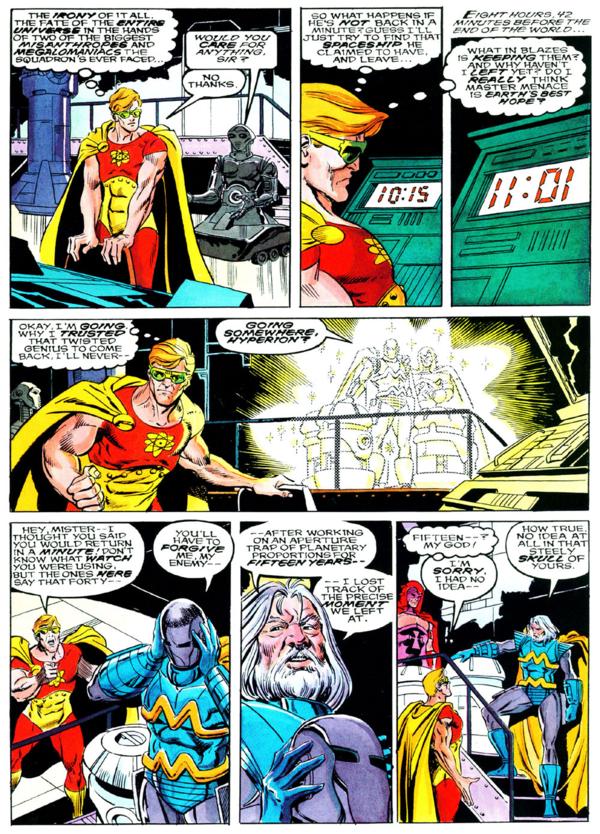
One of my favorite scenes involving the Squadron Supreme is in Mark Gruenwald’s follow-up to the SS miniseries, the graphic novel Squadron Supreme: Death of a Universe.  In Death, a mysterious growing blot threatens to erase the entire universe, a danger that brings former enemies together for the sake of survival.  Dr. Emil Burbank, alias “Master Menace,” who has been established as the Lex Luthor to Hyperion’s Superman (although his armor makes him look more like Dr. Doom—this is still a Marvel book, after all) volunteers to travel forward in time in order to develop a solution using the future era’s advanced technology.  (It’s one of many possible futures; as one character points out, the universe they’re in may not have a future.)  Nearly an hour after his departure, his time machine returns.  Burbank steps out, an old man: he has spent fifteen years of intense labor in the future perfecting his device.  Hyperion is shocked at the sacrifice his old enemy has made.  “At last he treats me with the respect one of my stature is entitled to!” thinks Burbank.

From Squadron Supreme: Death of a Universe, art by Paul Ryan and Al Williamson.  Source: Comic Book Resources.  Brian Cronin was struck by the same scene as myself.

From Squadron Supreme: Death of a Universe, art by Paul Ryan and Al Williamson. Source: Comic Book Resources. Brian Cronin was obviously struck by the same scene as myself.

It’s a little too on-the-nose, but it’s of a piece with Gruenwald’s interest in illuminating the relationships between comic book archetypes.  It’s also, in a way, a rare moment of understanding between two antagonists; comic book narratives depend on direct conflict, and have historically placed emphasis on action, not détente.  It’s clear that Master Menace is acting from self-interest as usual, but he also seems intrigued by the possibility of playing hero, if just this once.  If we accept the notion that villains are most compelling when they reveal something about the hero*, it suggests that what Hyperion and Master Menace share is both a higher purpose and a natural superiority to others (why deny it?), but in Burbank’s eyes only Hyperion has received the acclaim he deserves.  Burbank has had to work for his success, and has seen his ambitious visions thwarted (usually by Hyperion, obviously), but all Hyperion has to do is flex his muscles and punch a few bad guys and he is universally beloved.  What Master Menace really wants is to be seen as a worthy opponent instead of just another criminal, to have his greatness recognized.  I’m probably reading some of the shared history of Lex Luthor and Clark Kent into this scene, but isn’t that the point? (For a similar take from the villain’s point of view, see Dr. Horrible’s Sing-Along Blog.)

Although they aren’t cast as hero/villain, Jason Nesmith (Tim Allen) and Alexander Dane (Alan Rickman) have a similar dynamic in the 1999 film Galaxy Quest.  Bound together by their roles on the long-cancelled television series of the same name, as “Commander Peter Quincy Taggart” and “Dr. Lazarus” respectively, Nesmith relishes the adulation of fans and the chance to relive his glory days as the boyish, heroic starship captain, while Dane mourns that a classically-trained Shakespearean such as himself has become trapped in a one-dimensional, prosthetic-forehead-wearing role defined by a single catchphrase: “By Grabthar’s Hammer. . . .”  To Dane, Nesmith is a hammy showboat; to Nesmith, Dane is a snob who needs to lighten up.

Galaxy-Quest-Lazarus

Of course, it’s immediately obvious that “Nesmith/Taggart” is William Shatner playing James T. Kirk, and “Dane/Lazarus” is Leonard Nimoy as Mr. Spock, and indeed the entire setup, from the canceled cult TV show to the easily mocked conventions, is a pastiche of Star Trek and its real-life fandom.  An early moment in the film, when Nesmith lashes out at his fans, snarling “It’s just a television show,” is undoubtedly inspired by the well-known Saturday Night Live sketch in which William Shatner tells his fans to “get a life;” Dane’s self-loathing is a comic exaggeration of Nimoy, who was so famously ambivalent about his best-known role that he published two autobiographies, one called I Am Not Spock and, twenty years later, I Am Spock. Galaxy Quest gets a lot of story across in a short amount of time because we already know its premise and characters in broad outline, and the casting adds more layers to the joke. Rickman surely knew a thing or two about lending his theatrical gravitas to B-movie genre roles; Gwen DeMarco (the eye-candy communications officer Tawny Madison, whose job is to repeat everything the computer says) is played by Sigourney Weaver, Ellen Ripley herself; Sam Rockwell plays Guy, the unnamed crew member terrified he’ll be as expendable as Star Trek’s “red shirts;” my favorite is Fred Kwan (Tech Sergeant Chen), who admits Kwan isn’t even his real name, played by the Lebanese-American Tony Shalhoub (himself frequently cast in Italian, Arab, or Russian “ethnic” roles).

It’s a testament to the strength of the performances and the attention to detail that the pastiche works as a commentary on Star Trek without descending into simple parody.  As the story unfolds, with the cast of the TV show mistaken for actual space explorers and drafted into an alien war**, there are stakes, and there is character growth; there are jabs at cheap sets, formulaic writing, and rubber masks, but they are, in a sense, coming from inside knowledge, an elbow nudge from one fan to another.  The writers and director clearly have an affection for the subject, and like fans everywhere have earned the right to point out the more risible aspects of the show without giving up the reasons they fell in love with it in the first place.

It’s also hilarious.  Based on the films that have already been made, it would seem to be difficult to make a humorous science fiction film, at least one in which the comedy and science fiction elements are given equal footing.  Sure, humorous elements have been present in written science fiction almost since the beginning, Fredric Brown being an early practitioner, but when it comes to putting fantastic visions on celluloid, there has historically been a divide between the self-seriousness of sci fi and the tendency of TV and movie comedians to deflate, to tear down artifice (or at least there was through much of the twentieth century; a balanced combination of comedy and genre elements isn’t quite the rarity it was in 1999).  Galaxy Quest finds a lot of its humor in the backstage bickering and self-delusion of actors, as well as lazy writing that amps up tension at the expense of believability (like the self-destruct timer that only stops at 0:01, or ridiculous obstacle courses that would be safety hazards in a supposedly utilitarian spaceship***).  The phoniness on display is that of show business in general, not science fiction specifically.  When the film finally turns its attention to cheesy special effects, usually the lowest hanging fruit for satire, it’s the deepest moment of pathos, a point of complete disillusionment.

One thing Galaxy Quest doesn’t do is so much as whisper the names Star Trek, Kirk, Spock, Enterprise, Klingons, or anything else that would tip us off; you either get it or you don’t.  Doing so wouldn’t just throw the pastiche into relief as a copycat (who would ask for Brand X when they could have the real thing?), it would rob it of the superlative element that, as I’ve said, is an important element of this kind of storytelling.  It’s one thing, for example, to create a fictional Senator, astronaut, car company, or NFL team, and have them mingle with real-life figures: in that case, they are part of a class, and adding one more doesn’t change things too much.  Cultural objects like television shows or books, however, are trickier: they generally occupy niches from which they must be displaced, not simply added to.  One would think this is obvious, but it happens all the time: Aaron Sorkin’s Studio 60 on the Sunset Strip, a behind-the-scenes look at a distinctly Saturday Night Live-like sketch comedy show, had a lot of problems, but an easily avoided one was constant mentions of Saturday Night Live. If, in the show, Studio 60 was such a groundbreaking program, what was SNL?  In Mike Carey’s ongoing comic book series The Unwritten, Tom Taylor is the unwitting star of a series of fantasy novels clearly based on the Harry Potter series, the success of which is an obvious point of inspiration.  The originality and influence attributed to the Tommy Taylor series is undercut, however, by references to Harry Potter and its author, J. K. Rowling.  It comes down to the old problem of a work-within-a-work having to live up to the claims characters in the story make for it: it’s easier to suspend disbelief if we can imagine the work standing in for something we already know to be successful, but if we’re confronted with both the original and the pastiche existing within the fiction, how can the pastiche not seem like a pale imitation?

Spock_(mirror)

Finally, Galaxy Quest connects to Star Trek through the moral division of its characters: Star Trek confronted this literally with the Mirror Universe (“Mirror, Mirror”), a parallel world full of evil versions of the Enterprise crew, very much in the spirit of the Crime Syndicate of America or Squadron Sinister.  In Galaxy Quest, the division is internal: the actors aren’t evil, but fallible, and the doubles they must face are the heroic characters they play and for whom they are mistaken.  Nesmith, who loves playing the hero, is forced to bear the burdens of leadership and consequences that real leaders face, and is forced by circumstance to admit that it’s all fake; Dane, who already feels like a fraud playing the one-dimensional Dr. Lazarus, comes to realize how much he has meant to his fans, and embraces his role.  Interestingly, it is the villain, General Sarris, who articulates the themes of theatricality most clearly: despite his reptilian appearance, he is more human in temperament than the literal-minded Thermians.  It is Sarris who immediately grasps that Nesmith and his crew are actors, and forces him to explain it to the Thermian leader “as you would a child.” The final role-reversal occurs when Sarris accuses the actors of “playing war,” and Nesmith, fully embracing the role of Commander, tells him “It doesn’t take a great actor to recognize a bad one.”  Ultimately, Galaxy Quest redeems its characters by showing that, as ridiculous as they may be, audiences believe in them, perhaps not literally like the naïve Thermians, but as ideals.  It’s that optimistic spirit that most closely unites Galaxy Quest to its model.

* Batman is generally thought to have the best rogue’s gallery because the villains mirror Bruce Wayne/Batman’s qualities in distorted ways: the Joker reflects Batman’s psychosis, and his reaction to tragedy is to use violence and pranks to unravel the social order Batman strives to uphold; the Riddler mocks Batman’s pretensions as the Great Detective; the Penguin is the plutocratic face of Bruce Wayne’s inherited wealth; Two-Face is as divided as Wayne/Batman, but in an unmistakably public and troubled way, and so forth. (These observations are indebted to Richard Reynolds’ Superheroes: A Modern Mythology and Geoff Klock’s How to Read Superhero Comics and Why.)

** The element of mistaken identity in Galaxy Quest is a standard comic trope, of course, and the specific element of actors mistaken for the roles they play is as old in film as To Be or Not to Be. Galaxy Quest’s basic plot had already been used in Three Amigos and A Bug’s Life, but recognizing the similarity doesn’t ruin the enjoyment.  As with all the pastiches I’ve discussed (or Campbell’s monomyth, or any analytic framework that reduces works to an underlying recurrent pattern), the pleasure is in how the story unfolds rather than recognition of the universal pattern: we first attend to the surface, the specificity of this story, and can then proceed to the middle ground, where comparisons can be made between competing realizations of the underlying myth.

*** A trope still in use, by the way: “chompers,” or some variation, show up in the Star Wars prequels and in the revived Doctor Who series, to cite examples off the top of my head.

Points of Connection, Part Three: Invasion of the TV Doppelgangers

Of course, sometimes less is more: a few carefully selected details can tell us everything we need to know about a character, especially in the visual media of comics or film.  At the very least, putting a familiar character in a new uniform with a new name can work wonders, creating a “reskinned” version of the known character, to borrow a metaphor from video games.  The Justice League are suggested visually in Planetary and The Authority; numerous pulp and comics figures are recognizable in Planetary, and entire worlds where costumed heroes are the norm are presented in works such as Astro City, Top 10, and The Venture Bros.: our escapist fantasy is their day-to-day, and naturally there are connections to familiar characters, sometimes played straight and sometimes distorted like the reflections in a funhouse mirror.

Unnamed Justice League doubles, from Planetary No. 1; art by John Cassaday

Unnamed Justice League doubles, from Planetary No. 1; art by John Cassaday

It can be most fascinating when only a hint is given: Berthold, Albrecht, Adolphus, and Gustavus, the companions of Baron Munchausen (themselves a sort of 18th century superhero team) have little backstory or individuality beyond their extraordinary abilities, but I was captivated by them after seeing Terry Gilliam’s 1988 film. Berthold is the fastest man alive (literally faster than a speeding bullet), to the point that he is shackled to a pair of iron balls to keep him in place; Albrecht is a gentle giant, possessed of great strength; Adolphus is the hawkeyed marksman; Gustavus has incredible hearing and can exhale gale-force winds (two abilities that don’t appear related on the surface, but there is a poetic rightness to their pairing). The simplicity of their characterization is tied into their superlative abilities: comic book and fairy tale narratives alike depend on simple, clearly defined characters, who are often boiled down to the pure essence of whatever they are.  Being well-rounded isn’t required, particularly for those in supporting roles.  Munchausen’s companions compare well to Doc Savage’s team of experts or any other team where diverse abilities and personalities are subordinated to a strong leader who can bind them together.

The best example of the power of suggestion is probably the bounty hunter Boba Fett, a “gadget antihero,” whose cool uniform and badass swagger (as has been pointed out many times before, his bona fides were instantly established with two words from Darth Vader: “No disintegrations”) sparked the imagination of Star Wars fans everywhere when he appeared in The Empire Strikes Back.  Even his ironic, thoroughly non-badass fall into the Sarlacc pit in Return of the Jedi took little shine off his reputation.  Sadly, his origin, as established in the prequel trilogy, has only served to deflate his mythic status (along with everything else in the Star Wars universe).  Sometimes it is really better not to reveal too much.

I mean, just look at him.

I mean, just look at him.

Television has developed its own conventions for doubles, for reasons unique to the medium.  It’s very common for procedurals like Law & Order and political dramas like The West Wing to fictionalize real-life individuals, with L & O especially prone to using cases that are “ripped from the headlines.”  In addition to the changes of names and inessential details involved, the casting of actors signals the added layer of unreality to the audience: like the use of superhero pastiches, it allows the writer the freedom to embroider or change facts (especially important considering the need to wrap up a criminal case every week, as opposed to the sometimes murky and prolonged real-life cases they’re based on).  Indeed, it’s only one step removed from casting a role in a biopic or docudrama, or impersonating a public figure on Saturday Night Live.  In an era where celebrities, politicians, and other public figures are familiar to audiences through their television appearances, the replacement of one heavily mediated figure with another can be accepted without batting an eye.

Animation is fertile ground for the kind of doubling seen in the comics: it is a visual medium limited only by the imagination of the artists, and most animated shows draw on genres and conventions related to the comics: superheroes, fantasy/science fiction, adventure, and humor, all of which benefit from bold designs and clear characterization based on stock types—in other words, the domain of the archetype and the doppelganger.  Animation does add a layer unavailable to the comic book, however: voice acting.  Just as in the thinly fictionalized cases of L & O, the presence of a familiar actor (even if in voice only) can cue the audience to similarities between characters.  For example, TV’s longtime Batman Adam West lent his voice to the Squadron Supreme’s Nighthawk on an episode of Super Hero Squad Show (“Whom Continuity Would Destroy!”), a not-so-subtle nod to Nighthawk’s model (and one in a long string of self-deprecating turns by West).  Likewise, Kevin Conroy (the voice of the title character on Batman: The Animated Series) appeared as  Captain Sunshine (a character superficially resembling Superman, but whose mansion and relationship with his “ward,” Wonder Boy, clearly parodies the homoerotic subtext often attributed to Batman’s relationship with Robin, the “Boy Wonder”) on The Venture Bros. (“Handsome Ransom”).

Shelbyvillelimit

Comedies, however, have really taken the doppelganger concept and run with it in the last decade: it fits perfectly with the self-referential, metatextual idiom that took hold in the 1990s with The Simpsons and Seinfeld, and came to fruition with programs such as Spaced, Arrested Development, and CommunityThe Simpsons had its Shelbyville, a mirror version of hometown Springfield, complete with doppelgangers of the main cast (in the episode “Lemon of Troy”).  On Seinfeld, when Elaine started hanging out with Kevin, referred to as “Bizarro Jerry” in the episode of the same name (a reference, of course, borrowed from Superman’s mythos), she found herself at a different coffee shop and with a group that resembled Jerry, George, and Kramer.  (The fact that Bizarro Jerry and his friends were generous and considerate, of course, ultimately excluded Elaine from their company: she didn’t fit in with them.)  Since then, there is hardly a single TV comedy from the last ten years that hasn’t played with the idea of a character or group that mirrors one or more of the main characters.

bizarro

A theme that runs through many of the examples I’ve cited is one of maturity, even senescence, looking back and reevaluating the follies of youth (the youth of a medium, its characters, or its audience, it makes no difference), what Geoff Klock calls the revisionary narrative. In Gilliam’s film, Baron Munchausen revisits the scenes of his youthful adventures, getting his servants together and confronting the results of his earlier decisions.  The screwed-up lives of professional adventurers and the way their dysfunction is passed from generation to generation is a primary theme of The Venture Bros. (In Gilliam’s film, Berthold was stranded in a cage on the Moon for twenty years after being abandoned by the Baron; Dr. Jonas Venture similarly left trusted companions, experimental subjects, and dangerous inventions behind in the Venture Compound, messes his son Rusty has had to deal with throughout the series.)  And of course, the characters in Watchmen are dominated by the past, ruminating on it, trying to get past it or relive it, digging up skeletons that are better left buried.  Nostalgia, regret, and loss of potency figure in all three narratives.  (Still, I don’t want to overlook the enormous pleasure I get from these stories: even Watchmen, which I wouldn’t exactly describe as “fun,” is exhilarating on account of its ambition and technical achievement.  It has the uplifting quality of a great tragedy instead of just being a giant bummer.)

Special thanks to Matthew Grenier and Adam Byers for helping me sharpen some of my arguments and pointing me toward some examples I hadn’t thought of.  Of course, my wrong-headed conclusions are all my own, and the only blame they deserve is for encouraging me.

Next, I’ll examine pastiche writ large, and a counterexample: Galaxy Quest and Escape From Tomorrow.