Ten Years of Medleyana

Yes, that’s right. Ten years ago this month, I launched Medleyana, and it’s still going—well, maybe not going strong, but it’s going. This year in particular has been pretty fallow, and I couldn’t blame anyone for thinking that I’d abandoned it for good. All I can say is that I’ve been occupied with work and other personal projects that have taken up my time, but now I’m back. The approach of the spooky season in October usually gives me something to write about, so at a minimum you can expect a Halloween wrap-up at the end of the month.

But for now, I feel justified in taking a small victory lap and indulging in something I don’t do very often: repackaging old articles in new lists. I’ve gone through my posts and chosen ten of my favorites, one from each year of Medleyana’s existence (counting a year as beginning in September—you can take the academic out of the academy, but . . . ). Some of these are articles I still post links to when I feel compelled to summarize my viewpoint on a particular subject, and others are deep dives into my own personal interests. If you’ve been following me since the beginning, thank you, and I hope these are pleasant reminders of where we came from. If you’re new to Medleyana, consider this a sampler, all of them examples of what I mean by the blog’s slogan, “In praise of the eclectic.”

Everybody’s Looking for Some Action (November 2013)

When I began Medleyana, I started out by writing connected series and multi-subject articles in which I tried to get out ideas that had long occupied me, but even in the first year I started to get the hang of writing focused essays on single subjects. Since this article on collecting comic books was posted, I’ve become more serious about building and organizing my collection, and I ended up writing about comics a fair amount. But I’m still not planning on funding my retirement with them.

In the Hall of Mirrors with Captain Carrot and His Amazing Zoo Crew (October 2014)

This one combines several themes that I returned to over the years: review, commentary, and a bit of history as I look at an idiosyncratic “funny animal” comic book series.
The Short Horrors of Robert E. Howard (October 2015)

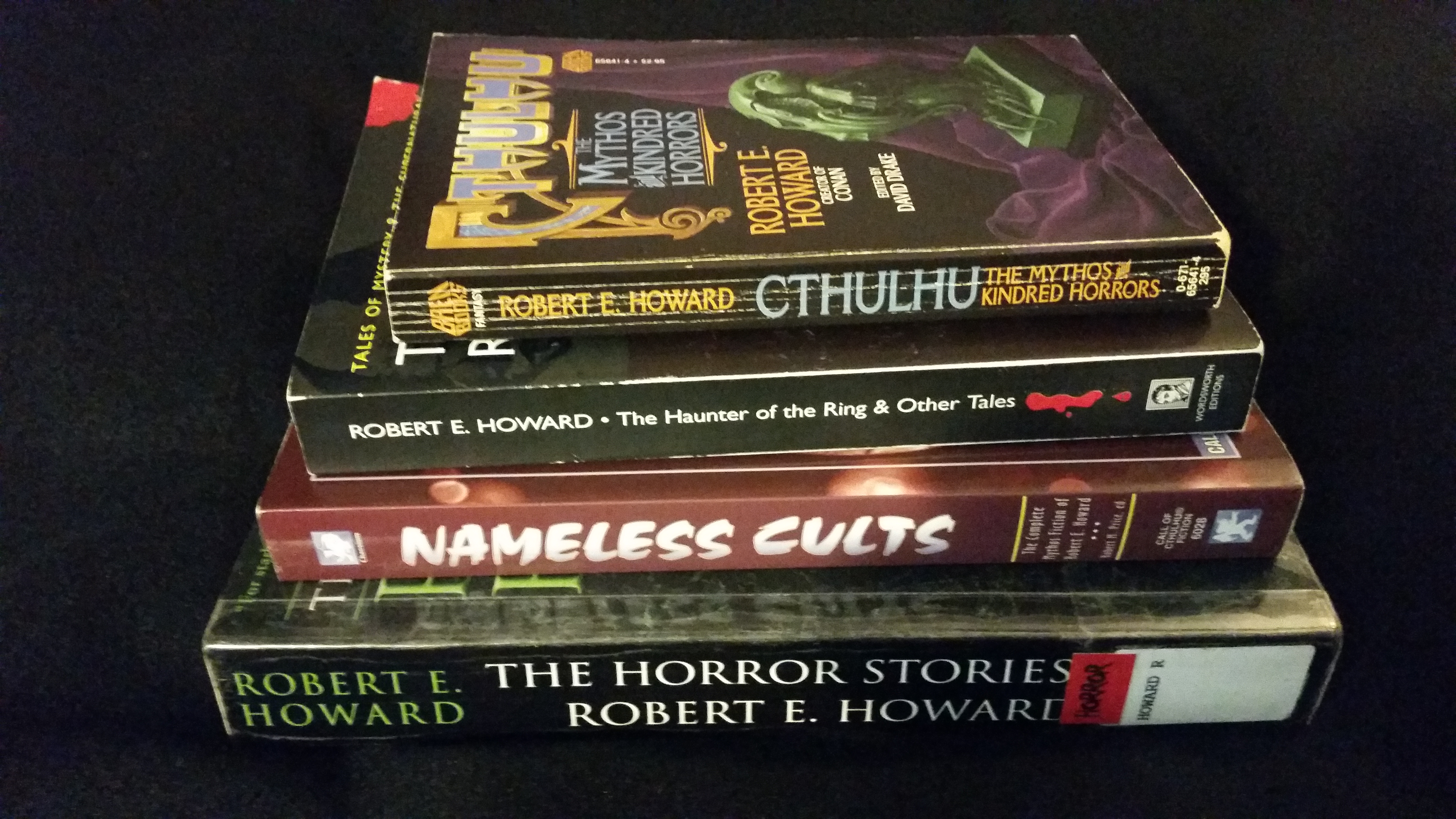
The history of the pulps, both the magazines and the writers, is another subject I delved into quite a bit, and in this essay I investigated the contents of several horror-focused short story collections by the creator of Conan the Barbarian.

Remake, Revisited (January 2017)

I saw Indiana Jones and the Dial of Destiny earlier this summer, and I enjoyed it. The de-aging technology that made Harrison Ford look younger for a prologue set during World War II has continued to improve, but I couldn’t help wondering: if this technology had been available when they made Indiana Jones and the Last Crusade in 1989, would we have had the wonderful prologue with River Phoenix as young Indy?

Written in response to Rogue One, with its CGI-generated Peter Cushing and de-aged Carrie Fisher, this article has only become more relevant since. As of this writing, so-called “AI” threatens to upend every creative industry, and Hollywood writers and actors are striking, in part against the prospect of being replaced or devalued by chatbots and infinitely pliable computer simulations. The increased churn of low-quality streaming content and never-ending franchise service has reached a point of unsustainability, and audiences are already beginning to turn away. I stand by the assertion made in this article that CGI tools can be used responsibly, but they are just that, tools: algorithms don’t have original ideas, they don’t have desires or viewpoints to express, and they aren’t going to live up to producers’ fantasies of steady, guaranteed revenue forever.

Kamandi Challenge no. 9 (September 2017)

My interest in Jack Kirby’s science fiction comic Kamandi is another subject I’ve written about several times, and in 2017, Kirby’s centenary year, I posted issue-by-issue reviews of Kamandi Challenge, a tribute series in which rotating teams of artists and writers took on the character and his world, setting up a cliffhanger at the end of each issue for the next team to unravel. Issue no. 9 was a fascinating standalone story that explored some of Kamandi’s psychology and allowed me to express my thoughts on Jack Kirby’s qualities as a storyteller.
Fates Worse Than Death: Secret Service in Darkest Africa (September 2019)

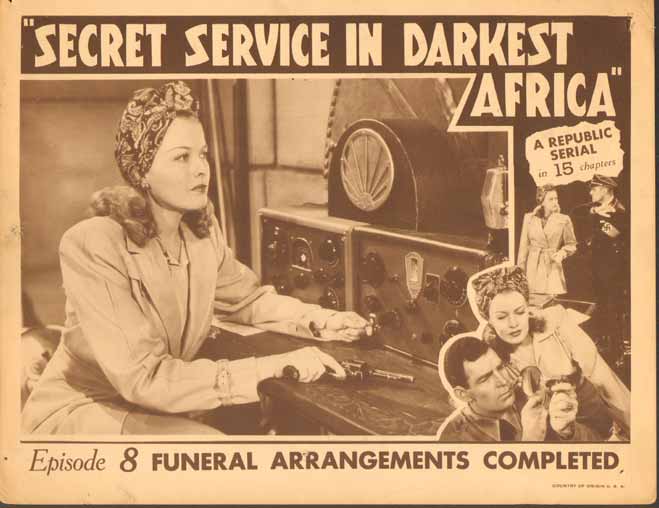
A large number of my posts on Medleyana have been reviews of serials from the silent film era up to the 1950s, when the formula of narrative by weekly installment migrated to television. Although I was mostly interested in exploring the two-fisted adventure aesthetic (shared by the pulp magazines and Golden Age comics) at first, I learned a lot about plotting and setting up story conflicts with stakes, and going through each serial to take screenshots for illustrative purposes ended up being an education in composition and blocking. This review is typical, and if you enjoy it, there’s much more where it came from.
Color Out of Space: Horror Comes Home (January 2020)

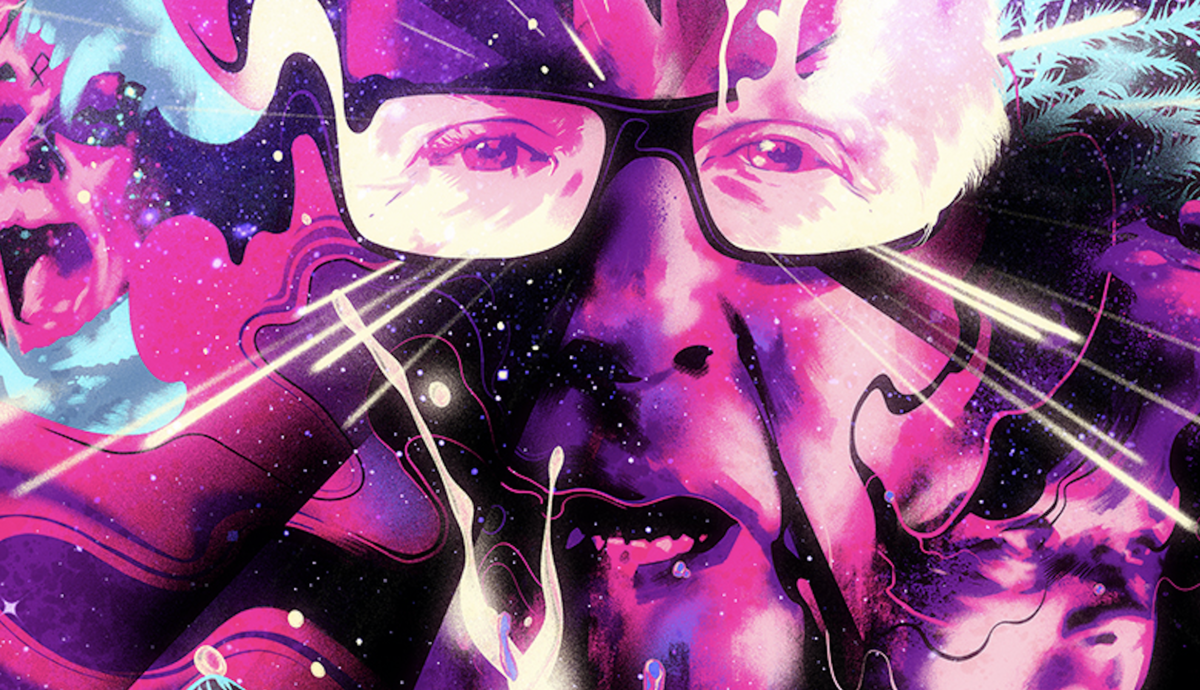
Combining my interests in film, the pulps, and horror, this review gets at some of the challenges we face when we attempt to “separate the art from the artist.”
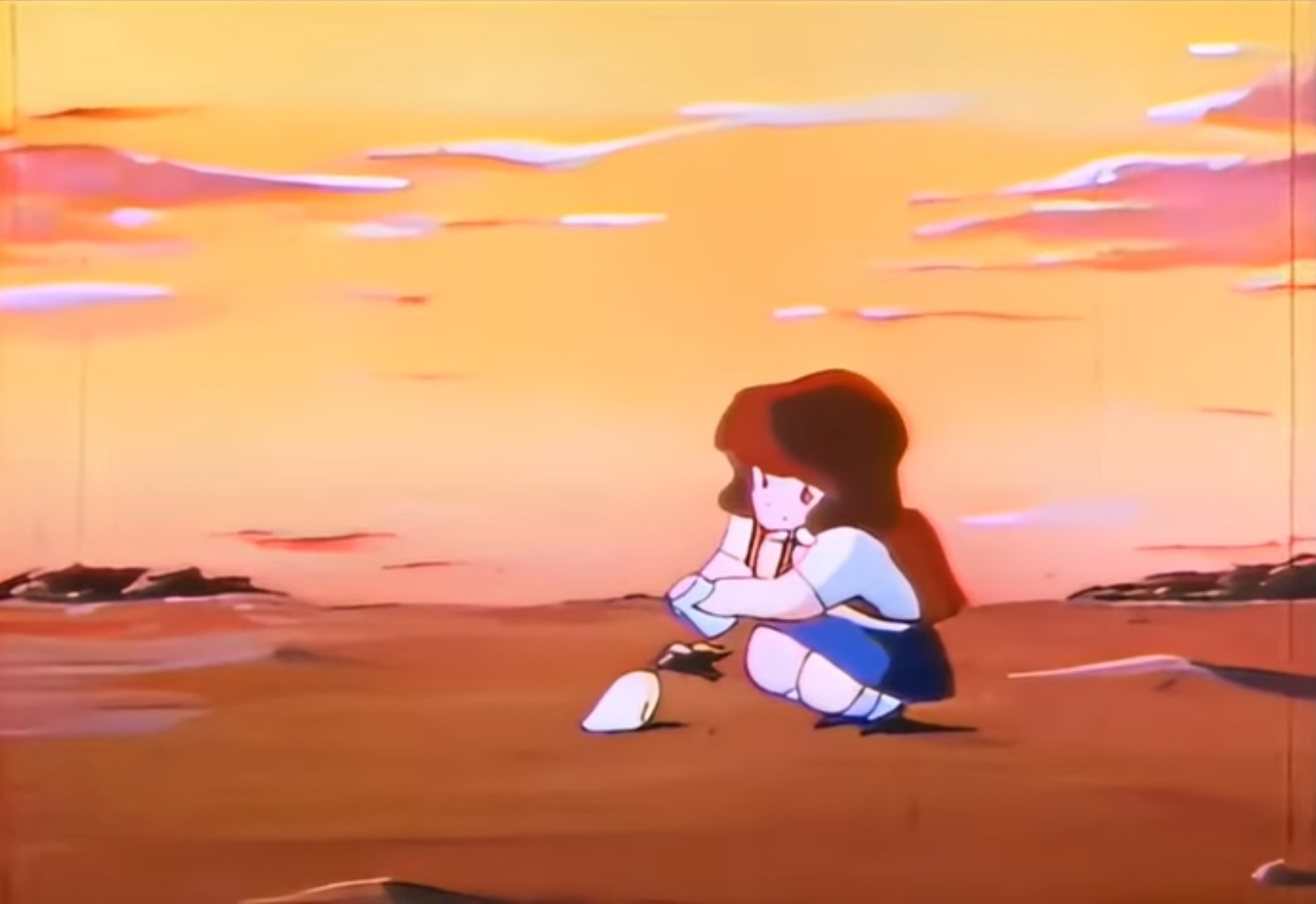
Thoughts on Electric Light Orchestra’s “Twilight” (March 2021)

When I began Medleyana, I thought I would primarily write about music. This article is a bit of a throwback in that it combines a couple of topics and bounces them off each other, but it’s also a good indicator of my increased interest in anime over the last decade as I examine the seminal fan film Daicon IV and its legacy.
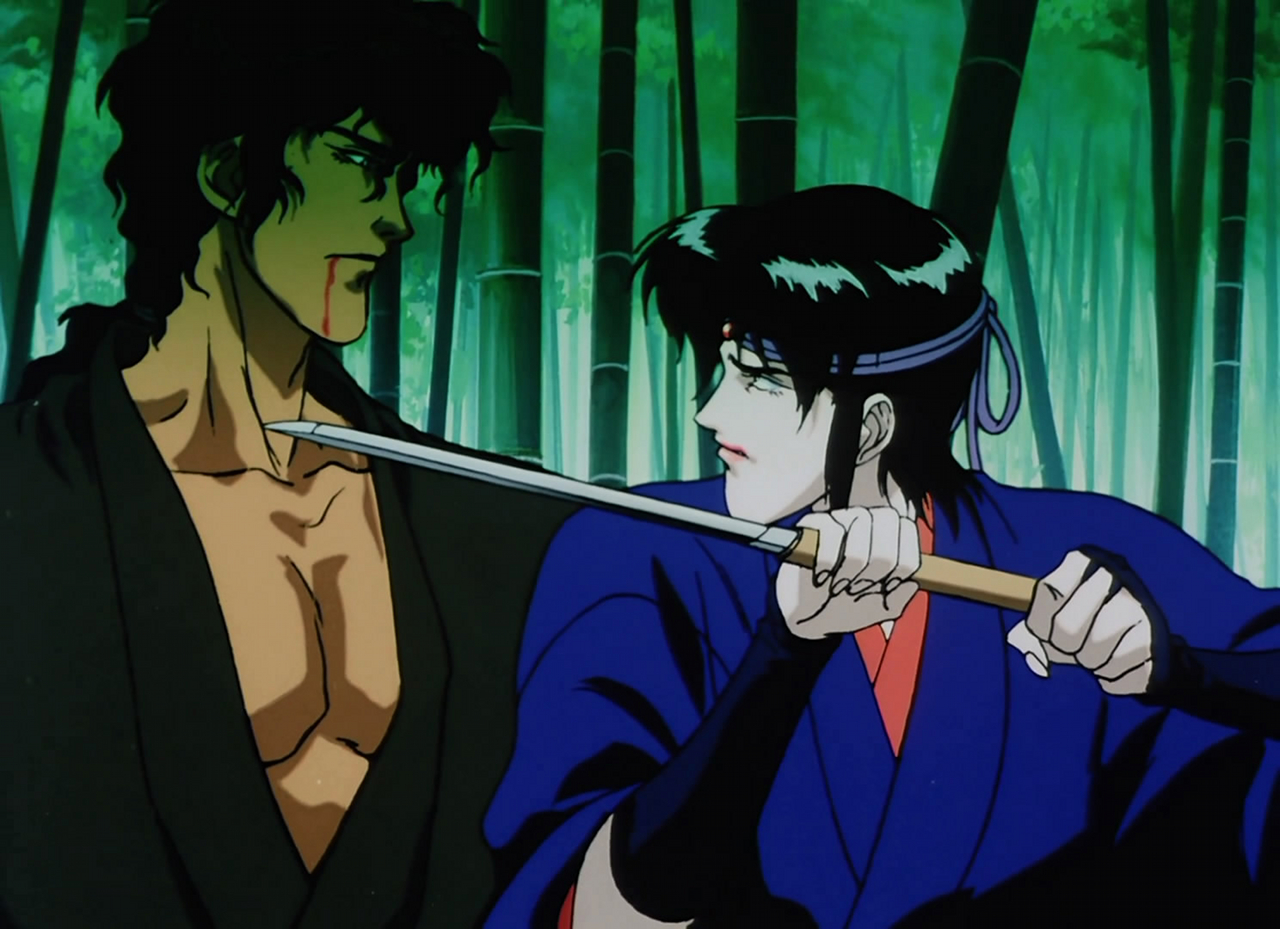
Revenge of the Ninjanuary: Ninja Scroll (January 2022)

Speaking of anime, this review is an example of that interest as well as representing my growing interest in martial arts and ninja media.

Halloween on a Monday: Spooktober 2022 (October 2022)

From the beginning, I’ve celebrated Halloween on the blog, culminating with a month’s-end list of spooky movies I watched and other activities I participated in. Last year’s wrap-up included meditations on the passage of time, mortality, and the reasons we like to scare ourselves, a theme that Medleyana ended up exploring much more than I expected when I began writing. I had just turned 40 when I started this blog, and now I’m 50. (It’s been a year since my wife was treated for the cancer I mention in this post, and she’s doing well, thanks for asking.) The last decade has been one of exploring interests that had been set aside because of school and work, including many new discoveries that hadn’t even been on my radar before I started writing. (It’s a good thing I had such an open-ended format from the beginning.) If I haven’t accomplished everything I set out to do, I’ve had other opportunities and made new friends that I didn’t expect. The very landscape of the internet has changed since I started—it’s mostly worse—but I’m proud of what I’ve created. It’s been a journey. Thank you for coming along with me.

Lego House on the Prairie

I saw The Lego Movie this weekend, and I loved it.  This isn’t a review, and I won’t spoil anything, although I will direct you to Charlie Jane Anders’ review at io9 and its (accurate, in my view) contention that a successful genre spoof must authentically partake of the genre it sends up (in this case, the summer blockbuster and the hackneyed “chosen one” motif).

The_LEGO_Movie_10

Like all the recent movies based on beloved toys, The Lego Movie is at least partly pitched toward the nostalgia center of viewers’ brains.  Sure, I played with Lego bricks as a child, and still enjoy them now that I have my own children to provide cover. If that were all there were to it, however, I doubt I would have reacted so strongly to the film; the other Lego spin-off video games and cartoons I’ve seen are entertaining, but not profound.  No, what I feel compelled to explore is how successful the film is at building an elaborate world out of familiar components, and its connection to the student films and music videos that did the same thing with toys when I was a kid.

The idea of toys (or other inanimate objects) coming to life is hardly new, of course: before the Toy Story movies there was Corduroy and The Velveteen Rabbit and Raggedy Ann, back to the fantasies of E. T. A. Hoffmann and beyond.  In all likelihood we could trace it all the way back to the idea of “household gods” and the pervasive spirits of pantheistic animism, or perhaps the unity of self and environment in earliest infancy.  In any case, that’s not really my point; what connects my memory of playing with Lego bricks to the new movie (and makes it successful at driving its themes home) is the constructive nature of Lego: all imaginative play gives back only what you put into it, but Lego is explicitly open-ended.  Since the first bricks were produced in 1949, every piece is part of a compatible system and can be connected together in some way.  That’s the first prong of the movie: the pleasure of digging up and recombining the different “worlds” Lego has produced over the years (including some “deep cuts” like Fabuland).

The second prong of the movie’s appeal is how this world is set in motion cinematically.  As a kid, I was obsessed with stop motion animation: my first exposure was probably on shows like Sesame Street, which, among its many other virtues, was often a showcase for inventive (and sometimes downright experimental) film.  The Carmen-singing orange was one I remember (although I had forgotten the rubbery ‘70s-era synth soundtrack, another element that connects it to many childhood memories):

Obviously, there’s a lot more where that came from.

What remains captivating about many of these little films is their handmade quality, and their use of everyday objects: toys, food, utensils.  As with furnishing dollhouses, creating dioramas, or assembling Rube Goldberg-like marble slides (think of the game Mousetrap!), there is an obvious pleasure in the handicraft involved in the creation of a tiny world, playing God on a child’s scale.  When given the illusion of movement, it made it easy to imagine the ordinary objects I saw all the time having a secret life when I wasn’t around, both tapping into and feeding that sense of domestic enchantment alluded to above.

It also made it look easy to get into the game: I recently discovered this short Super 8 film, made in 1980, and starring 12-year old Stefano Paganini’s Lego collection:

It’s rough—I know I wouldn’t have been able to do any better at that age—but it has the same sense of play that the makers of The Lego Movie explore on a grand scale.

It’s the limitations of Lego—where they can fit together, the articulation points of the minifigures—that give it character and provide something for the filmmakers—for whom there are practically no limits anymore with the use of computers—to bump against.  As Brian Eno wrote in 1995 (published in A Year with Swollen Appendices),

Whatever you find weird, ugly, uncomfortable and nasty about a new medium will surely become its signature.  CD distortion, the jitteriness of digital video, the crap sound of 8-bit—all these will be cherished and emulated as soon as they can be avoided.

Eno was mostly speaking of audio formats, but his prescient words have also proven true for visual styles.

The aesthetic qualities of Lego—abstracting familiar shapes into a grid, designed as “bricks” but able to approximate all kinds of shapes—are something that every child encounters one way or another.  Although Lego has introduced many angled and curved pieces to its arsenal, it’s the jagged sawtooth of the square pieces arranged in stair-step fashion that is still an essential part of Lego’s “look.”

Eno mentions 8-bit sound; I think the abstraction Lego encouraged was a reason I was similarly fascinated with the blocky graphics of the the video games that emerged in the late 1970s; just as with the stop motion videos that appeared to bring Lego bricks or candy to life, Space Invaders and Pong gave movement—controlled by the player!—to simple, even primal, geometric shapes.  I was so fascinated by this level of abstraction that I would practice breaking down pictures into their component pixels using graph paper.  I even briefly took up cross-stitching because it looked to me like video game graphics; the only tangible proof of that brief flirtation that I left behind was a sample sheet with a few segments of the Centipede from the game of the same name, rendered in cross-stitch.

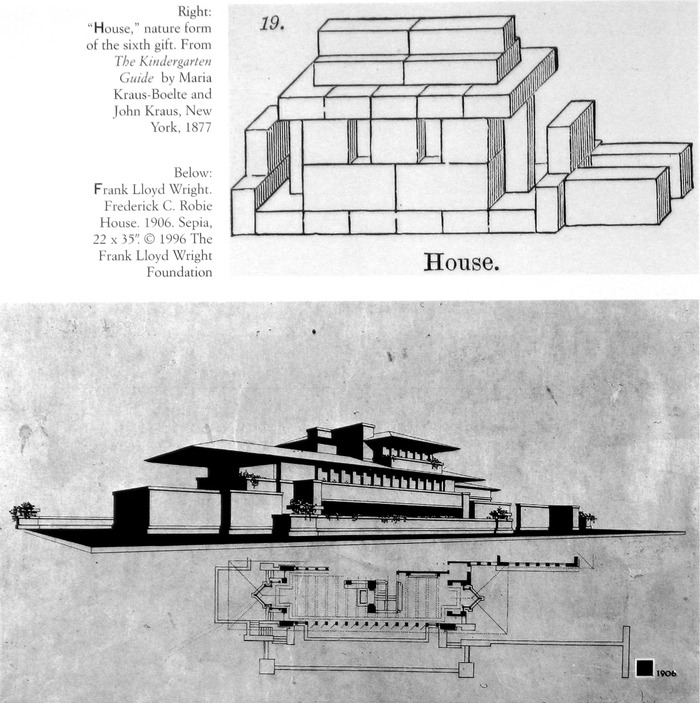
I’m reminded of Norman Brosterman’s book Inventing Kindergarten and its thesis that the first generation of twentieth-century modernists were shaped in early childhood by the highly abstracted geometric play that was a core component of nineteenth-century kindergarten. As developed by founder Friedrich Froebel in the 1830s and ‘40s, the geometric elements of kindergarten were centered around the series of about twenty “gifts,” playthings that were meant to introduce primary forms—the sphere, the cube, the cone, for example—and encourage young children to model aspects of the real world in a progression of graduated complexity.  Architect Frank Lloyd Wright would later credit Froebel’s system for developing his spatial faculties, but he was far from the only one.  According to Brosterman,

During the system’s heyday—roughly the half century before World War I—Frank Lloyd Wright was merely one of millions of people, including most of the so-called “form-givers” of the modern era who were indoctrinated, in effect, programmed, by the spiritual geometry of the early kindergarten.

Brosterman’s book is full of pictures juxtaposing nineteenth-century kindergarten projects made by small children with artwork made by adults of the same generation years later. The comparisons are suggestive, to say the very least.

From Norman Brosterman's Inventing Kindergarten

From Norman Brosterman’s Inventing Kindergarten

In addition to the Froebel gifts, there were also “occupations,” which consisted of paper, string, and clay, media that could be used to create finished projects.  Brosterman quotes American kindergarten leader W. N. Hailmann as describing the distinction between gifts and occupations:

The gift gives the child a new cosmos, the occupation fixes the impressions made by the gift.  The gift invites only arranging activities; the occupation invites also controlling, modifying, transforming, creating activities.  The gift leads to discovery; the occupation, to invention.  The gift gives insight; the occupation, power.

Without wishing to overstate the case, Lego bricks descend from the same progressive concept of early childhood development as a process of discovery and mastery, and lend themselves to a similar kind of abstraction of the real world.

Duplo.house

Interestingly, the debt Wright and other modernists owe to Froebel’s kindergarten, as described by Brosterman, has not been lost on modern educators and toy makers (in this context “toy” may sound dismissive, but it’s relevant: Milton Bradley, for example, was an important U. S. maker of Froebel gifts).  Froebel USA now makes a “Prairie House Block Set” of abstract building blocks, both a tribute to the credit Wright gave to the Froebel system and, in all likelihood, an appeal to parents who might hope for a similar start for their own children.

Wright.Froebel

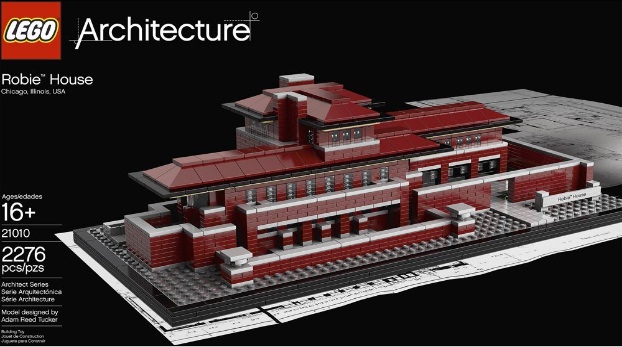
And while Lego has expanded its original system of interlocking blocks to include very young children with its Duplo blocks, it’s also moved in the other direction with its “Architecture” line aimed at teenage and adult model-builders.  Detailed Lego versions of real-life architectural masterpieces, including some by Frank Lloyd Wright, are available as kits.  (Here’s a more detailed description of the Prairie-style Robie House model shown below.)  With the Architecture line, the emphasis is on faithful recreation, but the pieces are just as compatible with the Lego system as any other.  That’s the beauty of it: whether following the instructions or building freely, it’s all up to you.  That’s a core component of Lego that The Lego Movie gets.

LEGO-Architecture-21010-Robie-House