Revisiting Sky Captain at The Solute

SkyCaptain2

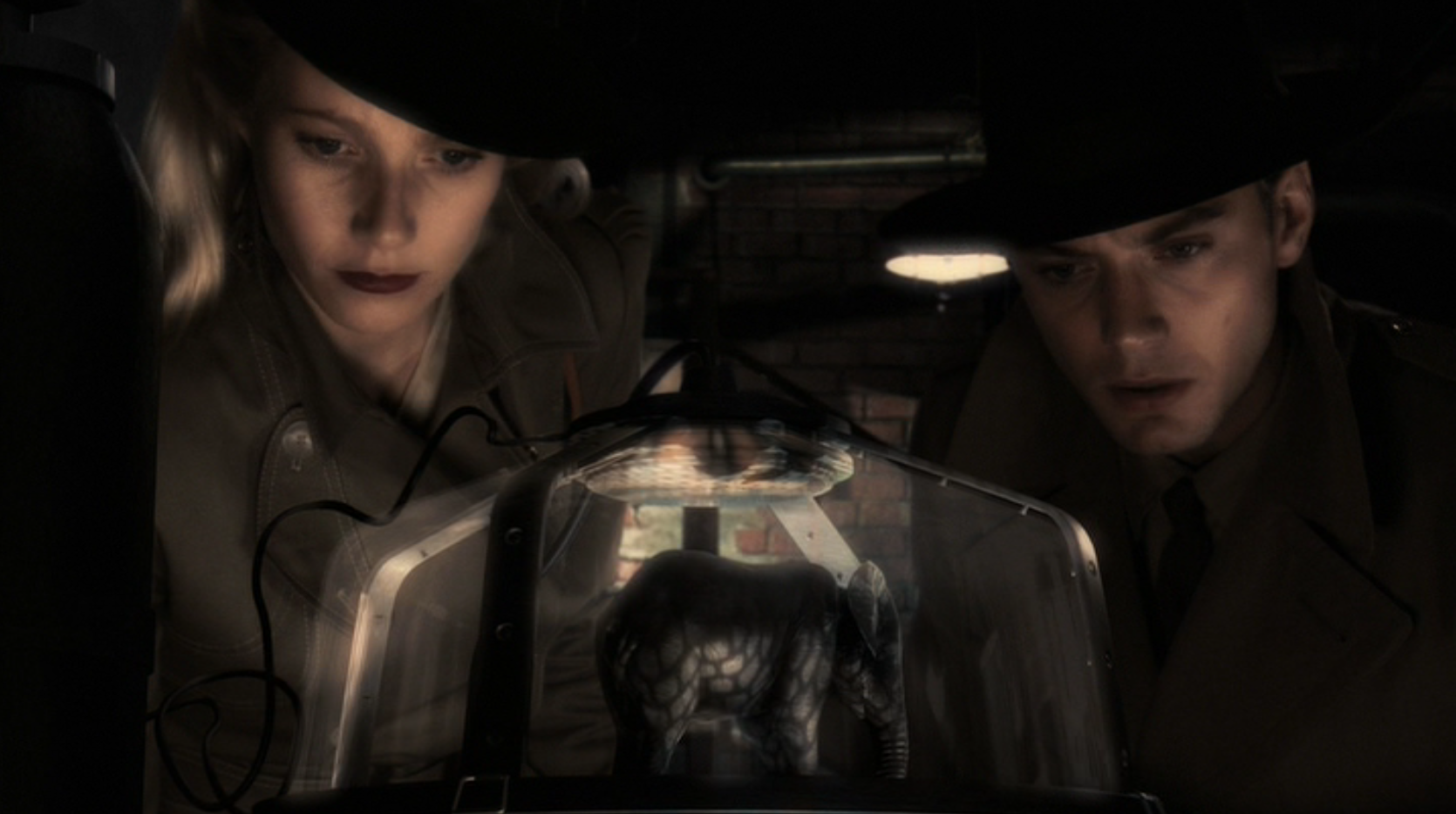
It’s always nice when circumstances converge to provide an opportunity for me to write about things I wanted to write about anyway. Sky Captain and the World of Tomorrow opened ten years ago today, so I wrote a remembrance of it for The Solute. As with Shanghai Surprise, I was interested in revisiting it in light of my recent exploration of serials from the 1930s and ’40s, one of the major sources of Sky Captain‘s plot and visual style. My article for The Solute focuses on the film’s then-groundbreaking combination of live action and CGI backgrounds, but regular readers will recognize many of my usual preoccupations with pastiche and stock character types.

Read it here.

Shanghai Surprise at The Solute

SScouple1

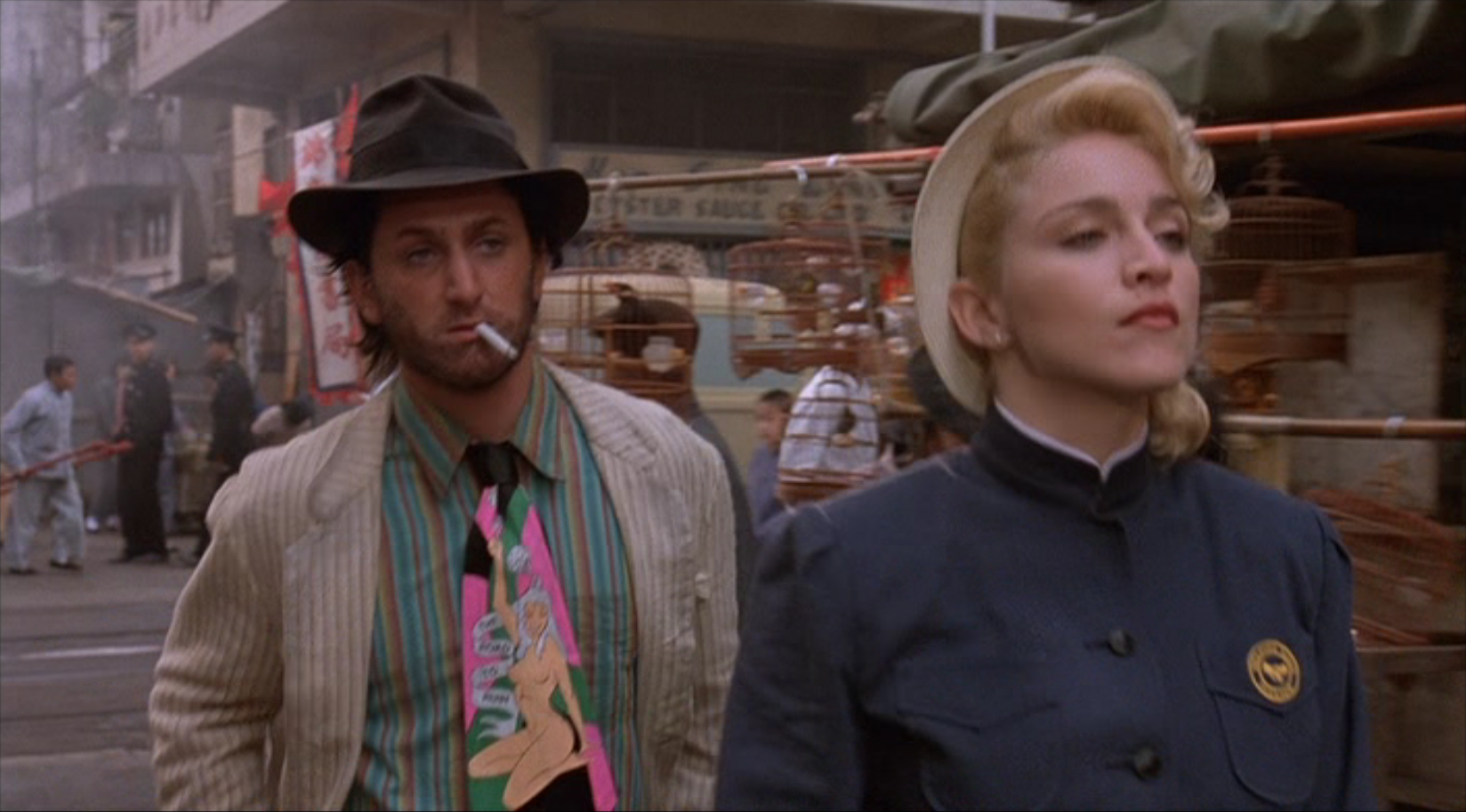
Today I took a look at the 1986 Madonna/Sean Penn vehicle Shanghai Surprise over at The Solute. It’s an auxiliary to Julius Kassendorf’s series examining all of Madonna’s film roles, but readers of my recent Fates Worse Than Death series will find many connections made with both the serials of the 1930s and the post-Raiders of the Lost Ark imitators that flooded theaters in the 1980s. Upon its release, Shanghai Surprise was an enormous flop and the passage of time has done little to rehabilitate it; however, I found some things to enjoy in it, which you can read about right here.

Medleyana: Year One

Apparently, this is who I am.

Apparently, this is who I am.


Wow, it’s been a whole year already! Medleyana became a part of my life so quickly that it’s hard to remember a time when I wasn’t trying to shape my thoughts into blog posts on a regular basis. In a lot of ways, this has been good for me to undertake, even though it’s been a lot of work. I probably should have started blogging a long time ago: there’s a big difference between having a thought and putting it in a form for others to read. There is often research involved, and it’s surprising how many leaps in logic one can make that only come to light when trying to write an idea down or explain it to somebody else. As someone who often reaches conclusions by intuition or lateral thinking, blogging has kept me honest and forced me to support my opinions in a more rigorous way.

The reality of blogging has also been different from my expectations. I at first conceived of Medleyana as mostly an essay series, one entry building on another until I had gotten all of my thoughts out, presenting an overarching argument made from many angles. I quickly realized that most people, including myself, don’t read blogs in that way: the format lends itself to browsing, with the expectation that not all readers will be interested in every subject a writer chooses to explore (especially true for a blog like mine, tackling a variety of subjects), and each entry needs to be able to stand on its own rather than building directly on its predecessor (not that I haven’t had some threads running through). In some cases I’ve responded to current events or arguments, but mostly I don’t consider Medleyana to be a “headline news” kind of blog; perhaps that is something to consider expanding into in its second year.

Overall, although some entries didn’t quite get where I wanted them to go, I’m pleased with the progress I’ve made as a writer, and I’ve proven to myself that I can stay on a schedule (most of the time). I’ve also found it necessary to branch out in search of new subjects to write about, after exhausting most of the things that had been building up inside, the ideas that drove me to start blogging in the first place.

Fates Worse Than Death, for example, my exploration of movie serials, was a product of happy circumstance: I had a few serials on DVD but was having a hard time committing to watch them. So, like so many bloggers before me, I began a series, thinking that the summer would provide the free time to watch them with the side effect of providing a little content for the blog. How wrong I was! It turns out that watching and writing about a four-hour long movie, even on a biweekly basis, is rather time-consuming! As I often tell my wife, I don’t really take on big projects anymore: I just take on projects that I think will be small, and wait for them to expand! It has been an enjoyable process, however, and I’ve even made some friends in researching and discussing this material (and I still have plenty to look at for next summer!).

The most surprising development of the last year is how quickly I have been able to find other outlets for my writing, including The Solute (for which I will have some pieces upcoming, I promise!) and The Wichita Eagle. I’m also still awaiting publication of The Lost Worlds of Power (now expected at the end of October) and I’ve got a few other projects in the works. Some of them are larger in scale (so maybe I exaggerated when I said I never take on big projects) and might demand more of my time. My goal is to keep posting at least once a week here, but after proving I could do it for one year I’m going to be more forgiving of myself if I don’t, and I’ve got an ample backlog of material for anyone who gets impatient for more reading.

Finally, if there is one thing I appreciate from readers, it’s feedback. I have a general idea of readership through the number of “hits” this site gets each day; I can see what search terms are leading readers here (and frankly, some of you should be ashamed of yourselves). I’m aware of which posts are the most popular (for the record, it’s “Instruments of Death” by a long shot), but unless I hear from you, I don’t really know what you think. If you’re reading this, why not consider commenting and letting me know you’re there? If the commenting system is too restrictive or you just prefer to remain private, drop me a line through my Contact page. Criticism is as welcome as praise, as long as it will help me make this a blog that you will want to keep reading.

To all of you, thanks for a great first year.

Fates Worse Than Death: Gang Busters

GBTitle

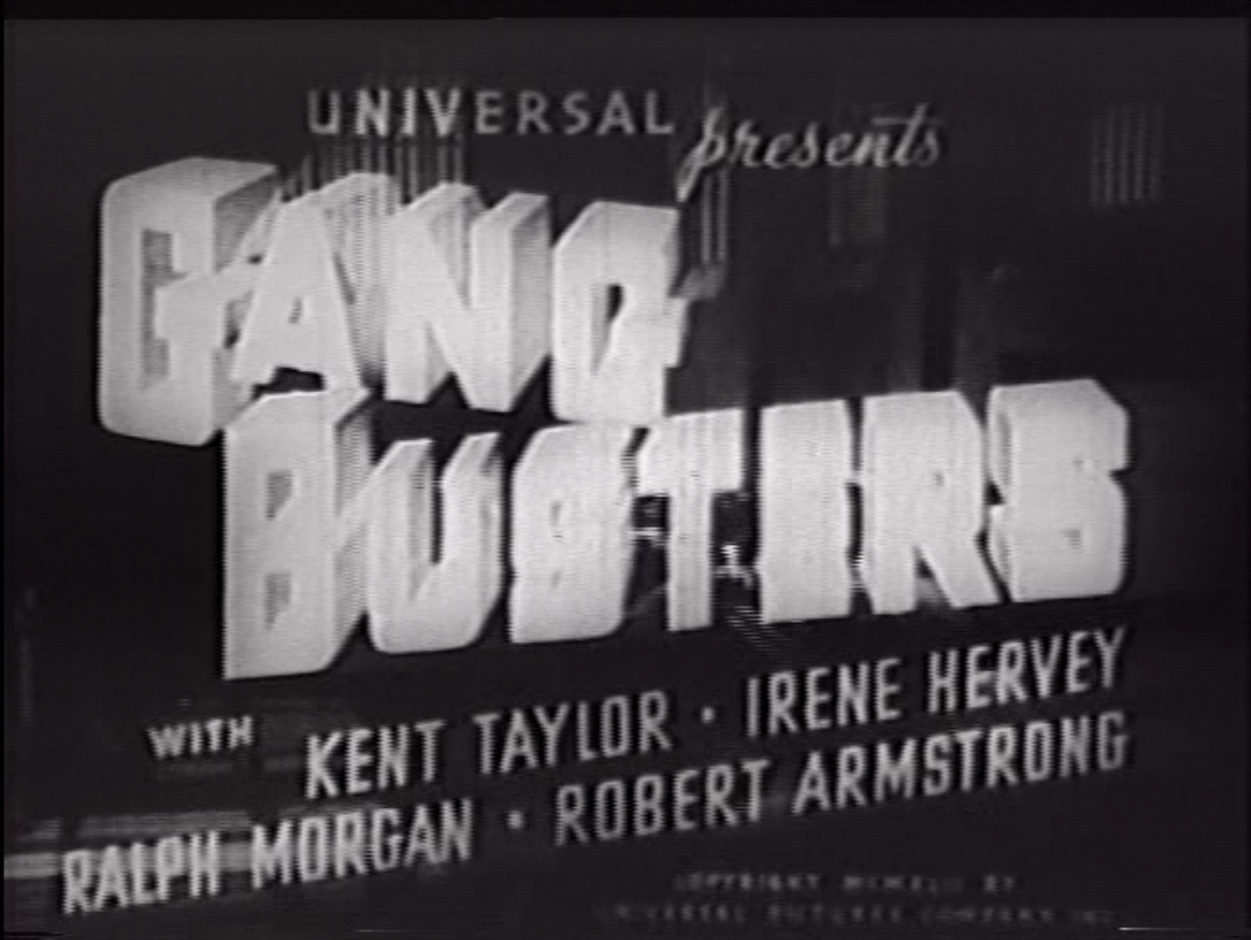
Calling the police. Calling the G-men. Calling all Americans to war on the underworld. Gang Busters, with the cooperation of law enforcement officers of the Unites States, presents a picture of the endless war of the police on the underworld, illustrating the clever operation of law enforcement officers in the work of protecting our citizens: the all-American crusade against crime!
That announcement, combined with the sounds of sirens, gun shots, and tramping chain gangs, opens each chapter of the 1942 serial Gang Busters, based on the popular radio show of the same name.

GBTitle2

For over twenty years, producer-director Phillips H. Lord dramatized stories of true crime with the close cooperation of FBI director J. Edgar Hoover. (In addition to the serial, a television series and a comic book were spun out from the original property.) On the radio, Gang Busters had a similar opening montage of sound effects and voice-over and, while based on true cases, dramatized its stories with broadly drawn characters and zingy, hard-boiled dialogue (“That music sounds pretty. . . . Now let’s have the music of the cash register opening!”). The serial, while fictional, is similar in tone, using voice-overs and newspaper headlines to give each chapter the urgency and documentary quality of a newsreel, at the same time drawing situations and characterizations straight out of contemporary gangster films.

Gang_Busters_Vol_1_2

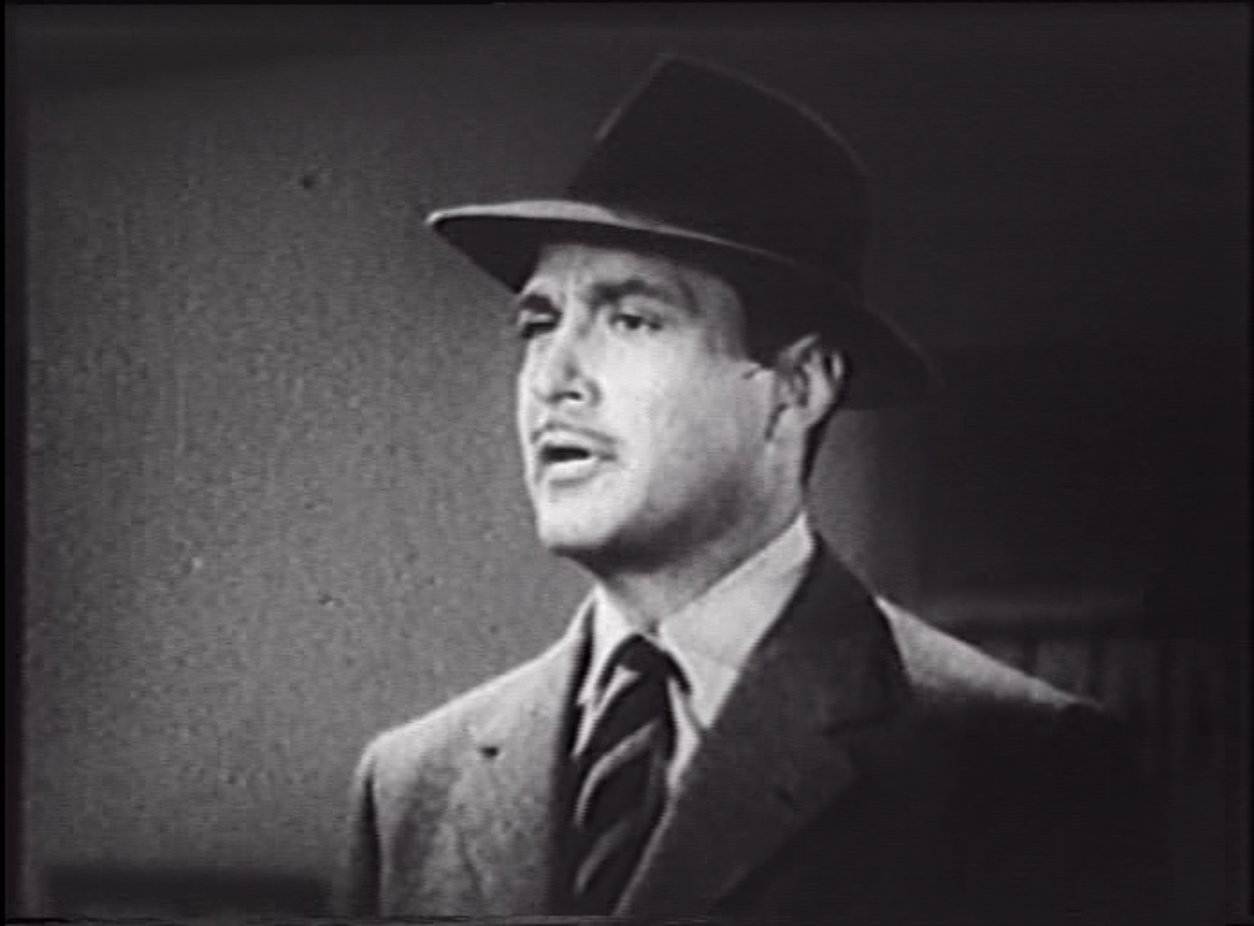
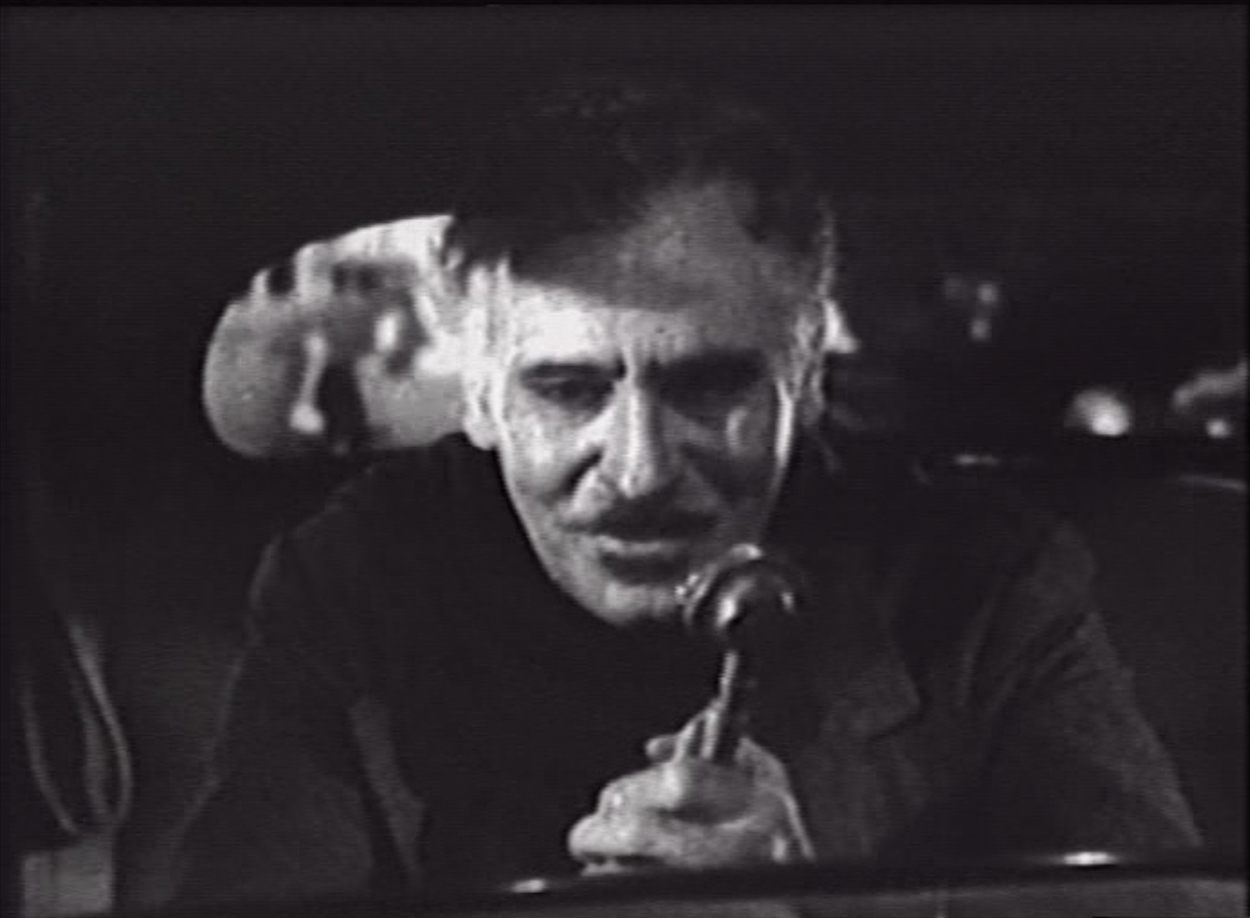
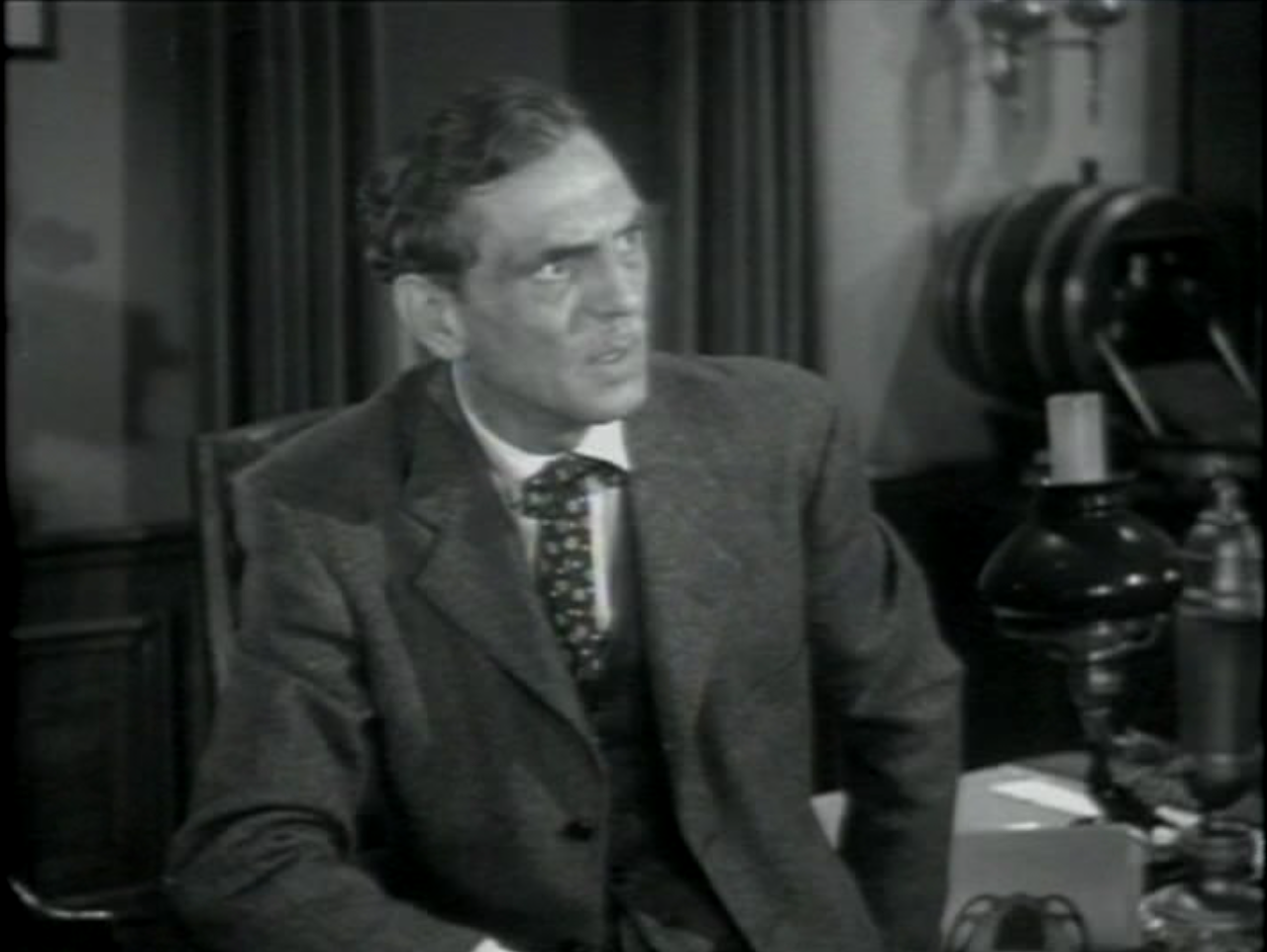
The action begins with a crime wave in progress: seemingly unrelated robberies and destruction are terrorizing the city. Detective Lieutenant Bill Bannister (Kent Taylor) suspects that a single gang is behind the coordinated attacks, but it isn’t until a strange message is broadcast that his suspicions are confirmed. “Hello, citizens. You are listening to the voice of Death,” begins a cool, even-toned voice over the radio (in one of many effective uses of mass media, this scene suggests the chill listeners might have gotten from programs like Suspense). The disembodied voice is that of “Professor Mortis” (Ralph Morgan), whose terroristic attacks are explicitly meant to turn the citizenry against their police and government, demanding their removal.

GBBannister1

Professor Mortis (“probably an assumed name,” Bannister astutely notes) claims to represent “The League of Murdered Men,” all of whom have grudges against the legal system. He promises that the attacks will continue until Mayor Hansen, Police Chief O’Brien, and every other authority is deposed. Mortis’ claim that all the members of his League have died and been brought back to life is too ridiculous to be believed, of course—but how can Bannister explain the fact that fingerprints recovered from the crime scenes match criminals who committed suicide in prison months ago? And how is it that Mortis seems to know what the police are planning at every turn?

GBMortis3

The police are about to get a break: Bannister’s brother, framed for a gangland murder he didn’t commit, is being released from prison, and he claims to have information about the gang and its methods. Two nosy reporters, Vicki Logan (Irene Hervey) and Happy Haskins, talk their way into accompanying Bannister (as they seem to be able to talk their way into the Chief’s office, the lab, and anywhere else they want to go). Speaking to Bannister in private, his brother says he was approached in prison and given a set of instructions for escaping; before he can finish, he is gunned down by a pair of window washers who just happened to be cleaning the windows of Police headquarters.

GBVickiHappy

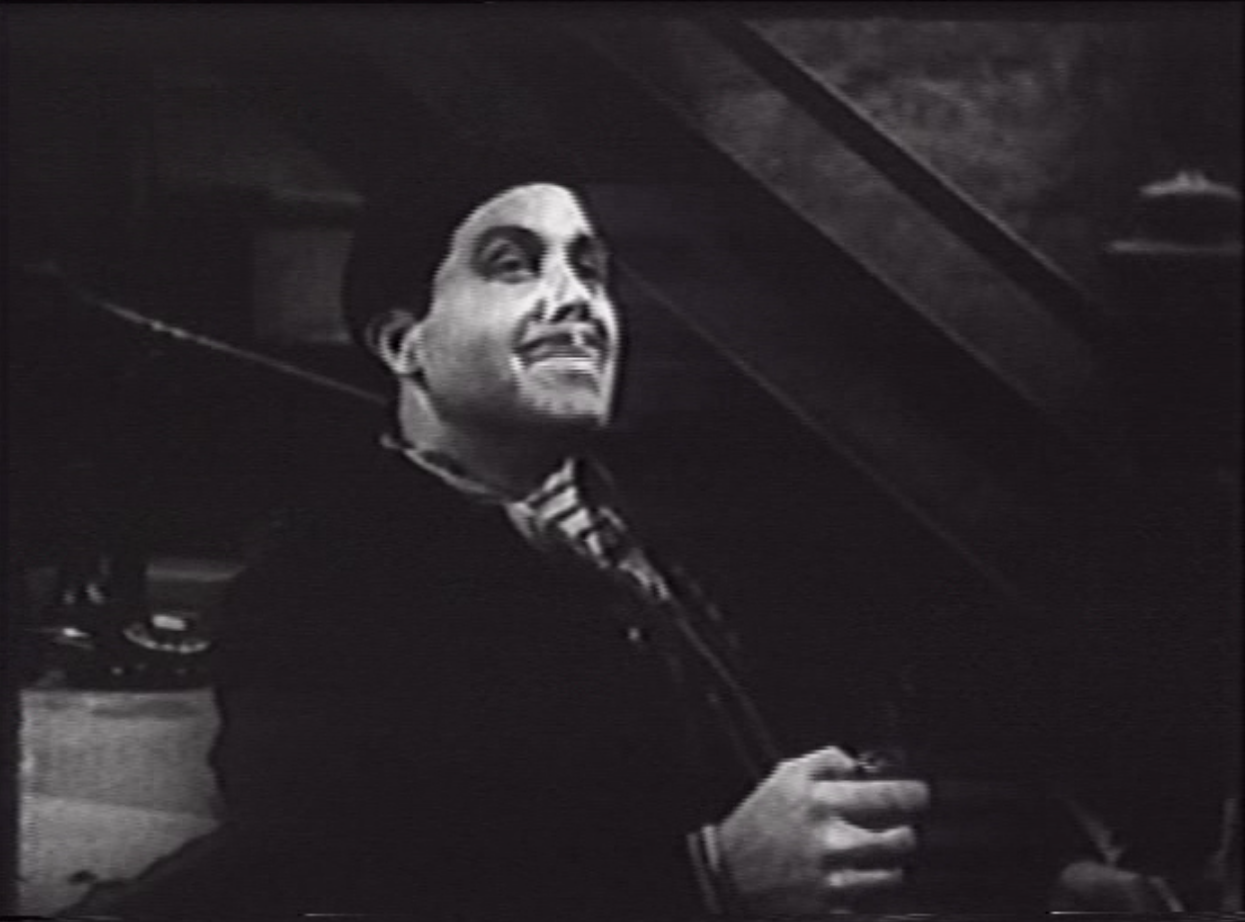
The thirteen chapters that follow are full of action and intrigue: car chases and firefights, kidnapping and fisticuffs, and even the explosive demolition of the still-under-construction City Hall—with Vicki and Bannister still inside! There are twists and turns aplenty as the League of Murdered Men attempts to either draft or eliminate Bannister, and Bannister (with Vicki’s help) attempts to unravel the mystery of Professor Mortis’ identity. (Although his story is not revealed in detail until nearly the end, it’s clear from the beginning that his is a tortured soul, living only to exact revenge on those who wronged him. In comparison to the thugs who do his bidding, Mortis is cultured and intelligent: he demonstrates great scientific expertise, bringing members of his League back from the “death” he chemically induces and performing plastic surgery to hide their identities.)

GBMortis2

True to its subject matter (and in contrast to many serials where every character is exactly what they seem), Gang Busters sets its heroes adrift in a dangerous world where no one can be trusted. Bannister isn’t wrong: someone is leaking information from the police to the League. Is it the Mayor, suspiciously eager to get Bannister taken off the case? Is it Bannister’s assistant, Detective Tim Nolan? Even a humble newspaper seller is more deeply involved than anyone would expect.

GBMayor

Then there are those fascinating characters on the margin, such as Frenchy “the Duck” (Edward Emerson, uncredited), who runs a dockside club catering to criminal types. Frenchy wants nothing more than to avoid police entanglements, but sometimes the money, she is too much to resist, mais non? If Frenchy’s establishment happens to have a water trap installed by the bootlegger who used to own the place, so much the worse for any nosy cops who blunder into it, ne c’est pas? (Yes, he is that broad: imagine Lando Calrissian crossed with Pepé Le Pew.)

GBFrenchy

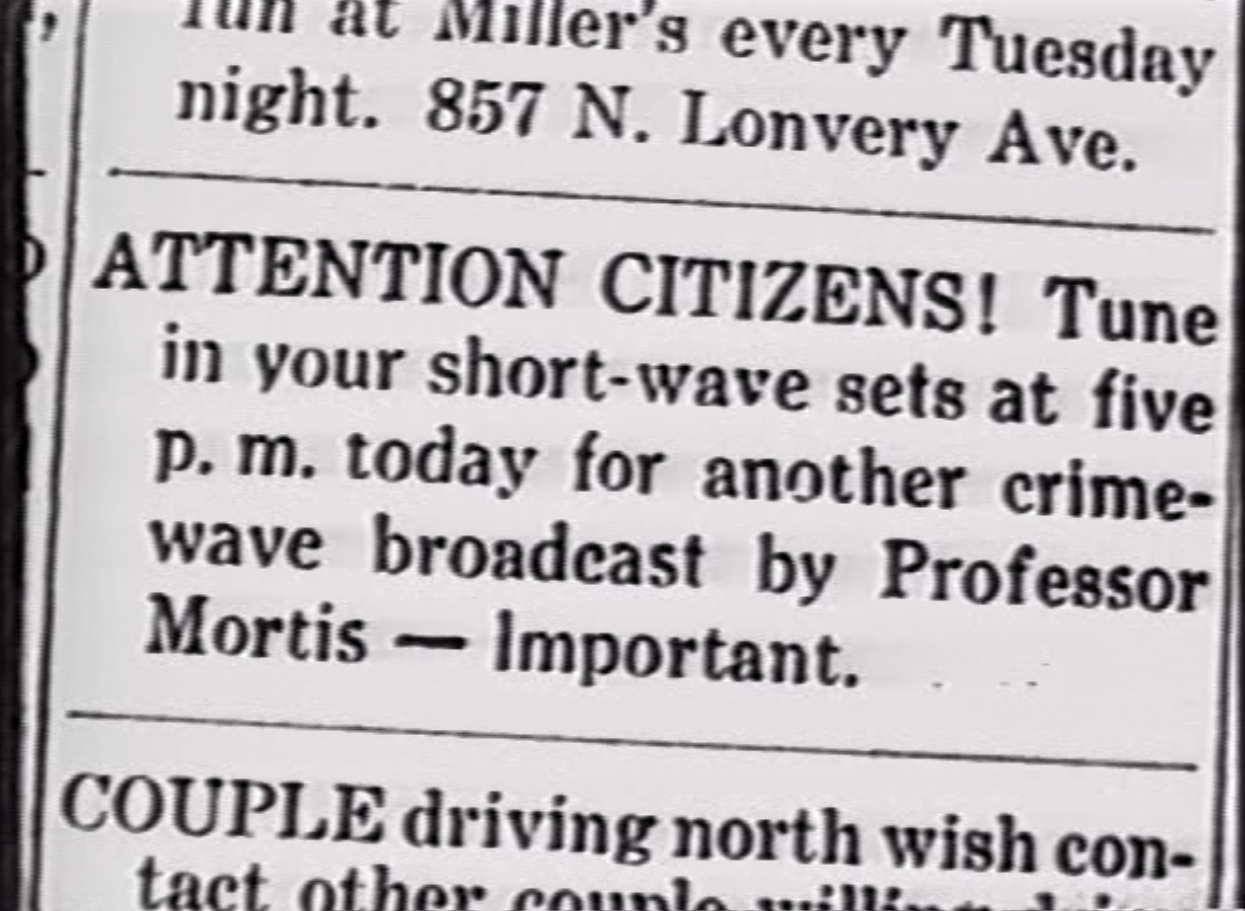
Gang Busters is also a reminder of how vital the newspapers once were as a source of up-to-the-minute information. Even more than the radio, the papers are used by both the League and the police to send messages to each other, through advertisements or headlines; they’re also a convenient way to convey exposition to the audience quickly. (MORTIS’ GANG ABDUCTS GIRL REPORTER is followed up by JOURNAL CAMERA GIRL ESCAPES FROM MURDER CAR; with all the special editions and updates, the printing presses at the Journal must never stop running.)

GBHeadline3

Almost every chapter begins with a blazing headline and a burst of action: instead of simply rewinding to a point before the cliffhanger, as most serials do, Gang Busters stages a vignette about yet another atrocity perpetrated by the League, tying it into the peril in which we last saw our heroes. It’s very effective at catching the audience up without being too repetitive when watching several chapters in one sitting.

GBHeadline2

Finally, Gang Busters is a very satisfying mix of down-to-earth police work and politics with a flamboyant criminal mastermind. The sciences of fingerprinting, ballistics, and radio signal triangulation are balanced with suspended animation, remote control bombs, and a gun hidden in a camera (switched with Vicki’s: the next time she takes a picture of Bannister in action—bang!). Professor Mortis himself is a great theatrical creation, a brilliantly twisted egotist with a personal vendetta against the forces of law and order; cloaked in expressionistic shadows in his lair under an active subway tunnel, performing illegal medical experiments and speaking to a terrified public over the radio “from beyond the grave,” Mortis embodies the “gangland gothic” aesthetic of the production. There’s a lot of Dick Tracy in Gang Busters, but Batman would fit right in, too.

GBVickiMason3

What I Watched: Gang Busters (Universal, 1942)
Where I Watched It: A pair of Alpha Video DVDs, sold separately. Vol. 1 contained chapters 1-6, Vol. 2 contained chapters 7-13; seriously, who watches half a serial? (It can also be seen online.)
No. of Chapters: 13
Best Chapter Title: Murder by Proxy (Chapter Eight)
Best Cliffhanger: True to serial tradition, the chapter titles often point to the peril that awaits the hero at the end of that chapter. Chapter Two, “The Death Plunge,” is one of several cliffhangers in Gang Busters involving a moving vehicle crashing or falling off a bridge or cliff, but in this case a car chase in a parking garage leads to the hero’s car plummeting several floors down an elevator shaft.
Annie Wilkes Award for Blatant Cheat: Alas, when will the producers of serials learn that cheaters never prosper? Gang Busters is mostly guilty of the “hero jumps out of the car/plane just before it plunges over the bridge/canyon” cheat, although most of the cliffhanger resolutions play fair. The most obvious is the cliffhanger to Chapter Ten (“Mob Vengeance”), in which Bannister attempts to redirect a truck full of dynamite (intended to blow up Police headquarters) over a bridge. In the cliffhanger, he’s still hanging on to the side of the truck when it goes over, while the driver rolls out and runs off. In the resolution, not only does Bannister jump in time, the driver—who appeared to be running off—runs headlong into a pylon and kills himself. It’s kind of hard to describe: you really need to see it to believe it.

GBtruckplummet

Sample Dialogue: “The nerve of that guy Mortis! He’ll try anything!” –Detective Tim Nolan, Chapter Seven (“The Water Trap”)
What Others Have Said:Gang Busters has exciting cliffhangers and contains some unexpected twists. The plot takes more than a few extraordinary turns, and the ending is exceptional. This is one of Universal’s most complex serials, with many chases and thrilling scenes skillfully staged in outside locations.” –Matinee Classics

Epilogue: I sought out Gang Busters on the basis of its trailer. I haven’t discussed the trailers for serials much: suffice it to say that they are examples of the “hard sell,” emphasizing the thrills and excitement awaiting audiences. Given that Gang Busters affects a breathless “breaking news” tone, it’s not surprising that the trailer would be even more over-the-top than usual. If the sequence beginning at 2:00, teasing each of the cliffhangers in compressed form, doesn’t get you excited for this film, maybe serials just aren’t for you.

Fates Worse Than Death: The Could-Have-Beens

In watching and researching motion picture serials over the past few months, I’ve run across many based on characters from other media: comics, radio, and literature. Allowing for the vagaries of art and commerce, I’ve been struck by the absence of several characters who one might expect to be adapted as source material. What follows is necessarily speculative, but I’ve compiled a list of characters, popular at the time, who could have appeared in a serial but didn’t, for whatever reason.

Perhaps arbitrarily, I’ve excluded characters who appeared in feature films or cartoons during the “Golden Age” of the serials: Sherlock Holmes and Dracula may not have appeared in serials, but they are well-represented on film. I’m more interested in characters whose film appearances are either limited to the modern era or who haven’t appeared on film at all (yet).

John Carter of Mars

From one perspective, it isn’t surprising that Edgar Rice Burroughs’ interplanetary hero didn’t make the leap to the big screen until 2012’s poorly-received adaptation. Although John Carter set the pattern for the early space heroes, appearing in print in 1912, both Flash Gordon and Buck Rogers were featured in serial adaptations during the Golden Age of science fiction (in 1936 and 1939 respectively). It was Gordon and Rogers who cemented the conventions and story beats of space opera for film audiences and became household names in the process. Later, Star Wars and other science fantasy epics would borrow elements of Carter’s adventures (what is Tatooine but Burroughs’ dying Mars?), further stealing the series’ thunder.

john-carter-poster

On the other hand, clearly there was a market for science fiction adventure, and Burroughs was aware of the power of licensing his creations: his other famous character, Tarzan, was featured in numerous film adaptations in the 1930s and ‘40s (continuing to this day), including one produced by Burroughs himself.

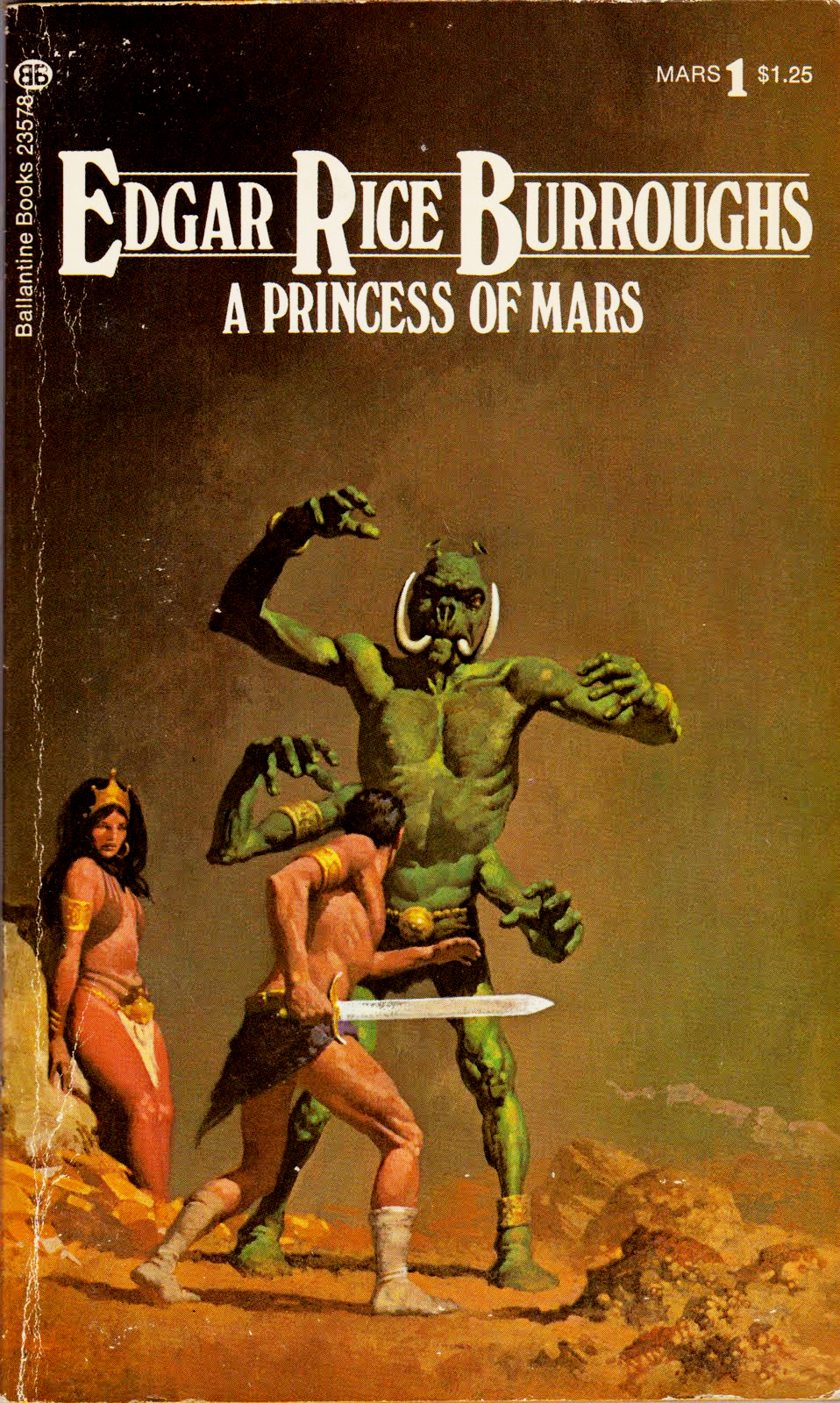
Perhaps it was the extravagant native fauna of Barsoom (the locals’ name for Mars) that made it prohibitive to film: in his adventures, Carter faces the four-armed giant Tharks (Green Martians), rides eight-legged thoats, and encounters other multi-limbed creatures that would have been compromised by the special effects of the 1930s, to say the least. (Flash Gordon tries manfully to create convincing space monsters, and is only intermittently successful.) In a similar vein, the fliers and radium guns of Burroughs’ novels might have seemed like a daunting proposition to film, but other science fiction serials and features found ways to create such effects or work around them.

Book-1-A-Princess-Of-Mars-1

Intriguingly, there was at least one attempt to produce a John Carter film during the Golden Age: in 1935, Warner Brothers animator Bob Clampett approached Burroughs with a proposal to put together an animated John Carter series that, had it been made, would have beaten both Snow White (the first animated feature) and the Flash Gordon serial to theaters. Clampett and Burroughs put together a deal with MGM, but ultimately the project was deemed too weird for audiences. Only a few minutes of test footage remain to show what might have been.


(Thanks to fellow fan Bruce Ross for alerting me to this aborted project, and check out Bruce’s blog to see his impressive custom action figures, including a certain Warlord of Mars.)

Jules de Grandin

The most popular author to appear in Weird Tales magazine wasn’t Robert E. Howard or H. P. Lovecraft: it was Seabury Quinn, a lawyer with a specialty in mortuary law and the funeral business. Quinn’s most popular creation was the feisty French physician Jules de Grandin, a prime example of the “occult detective” character type. With his sidekick/narrator Dr. Trowbridge (clearly modeled after the sturdy Holmes/Watson dynamic), de Grandin defended Harrisonville, New Jersey against supernatural, scientific, and just plain criminal threats in nearly a hundred stories.

DeGrandin

Although less well-remembered now, the de Grandin stories contain plenty of ideas that could have made for excellent serials—killer animals, vampires, cults, mad scientists, and more—and were formulaic and action-packed enough to provide what audiences of the time expected.  De Grandin, with his cod-French exclamations (not only the time-honored “Sacre bleu!”—de Grandin would frequently vary his patter with insertions of “Parbleu!”, “Mordieu!”, “Zut!”, and odd turns of phrase like “Horns of a little blue devil!”, “Name of a gun,” etc.), was likewise a character whose exaggerated national character would be right at home at Republic or Columbia. (His catch-phrases are no sillier than the “inscrutable” Orientalisms of Charlie Chan or the “By Jove!” English of Anthony Tupper in Robinson Crusoe of Clipper Island.) More importantly, like all serial heroes, de Grandin favored the direct approach, and was as likely to defeat the forces of evil with a sword or automatic as with an incantation or clever trap.

WeirdTalesdeGrandin

Conan the Cimmerian, et al

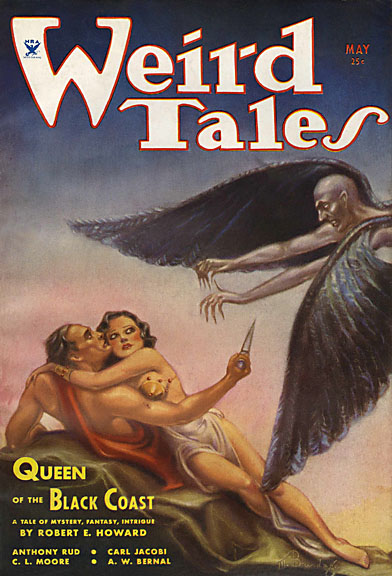
Speaking of Robert E. Howard, it’s unlikely that a serial based on his famous creation Conan would have been anything like the 1982 feature Conan the Barbarian, influenced as it was by the success of special effects blockbusters like Star Wars and Raiders of the Lost Ark and the contributions of later authors (not to mention the Frazetta-esque physique of star Arnold Schwarzenegger). However, the ancient past had been represented in epics like Ben-Hur, and fantastical “lost worlds” were featured in serials such as The Undersea Kingdom and The Phantom Empire, so it wouldn’t have been out of the question. A Conan serial would have probably resembled those starring Tarzan or “jungle girl” Nyoka, with an emphasis on action and the lead’s physicality, toning down Howard’s often pessimistic philosophical digressions.

WeirdTalesConan

It’s worth noting, however, that Howard created several series characters, in a variety of genres, that could have headlined serials (and to this day, not all of them have been adapted for film). “Last king of the Picts” Bran Mak Morn and medieval Irishman Turlogh Dubh O’Brien represent Howard’s interest in the history and people of the British Isles; King Kull of Atlantis and swordswoman Red Sonja represent a strain of sword-and-sorcery similar to the Conan stories. Of all of Howard’s series characters, probably the closest in spirit to the serials is Steve Costigan, a modern-day merchant sailor and boxer whose stories combined action and wry humor. Although Conan remains Howard’s best-known creation, the author left behind a wealth of material yet to be mined for adaptation.

fightstoriesCostigan

The Spirit

thespirit

Cartoonist Will Eisner created the Spirit (the supposedly dead criminologist Denny Colt, going forth from his cemetery hideout to fight crime) in 1940 as the lead character in a series of comic books he produced for inclusion in newspapers owned by the Register and Tribune Syndicate. Ownership of his own character, with little editorial interference, gave Eisner the freedom to explore a variety of story-telling techniques, and due to his innovative approach to composition he is often compared to cinematic masters such as Hitchcock and Welles. (In Michael Chabon’s novel The Amazing Adventures of Kavalier and Clay, the title characters are inspired by Citizen Kane to invigorate their own comic book stories with devices such as achronological narratives, alternating points of view, and dynamic, cinematic compositions applied not just to the panel but to the entire page. Although fictional, this is likely a reference to the leaps forward that Eisner made with The Spirit.)

Sometimes the title character was barely featured in stories, making cameo appearances in the stories of a range of urban characters both poignant and humorous; this approach would have fit perfectly with the serials, which often introduced audiences to original characters who had equal screen time with the licensed characters in the title (such as Linda Page and her uncle in the 1943 Batman serial). Quoted in A Smithsonian Book of Comic-Book Comics, Eisner explained,

I began to realize who I was writing for”—that is, an audience dominated by adults, rather than children—and “I suddenly found an opportunity to do what I had really always wanted to do, which was to write ‘seriously’ or write good material, and at the same time stay within the medium I knew and had developed skills for.

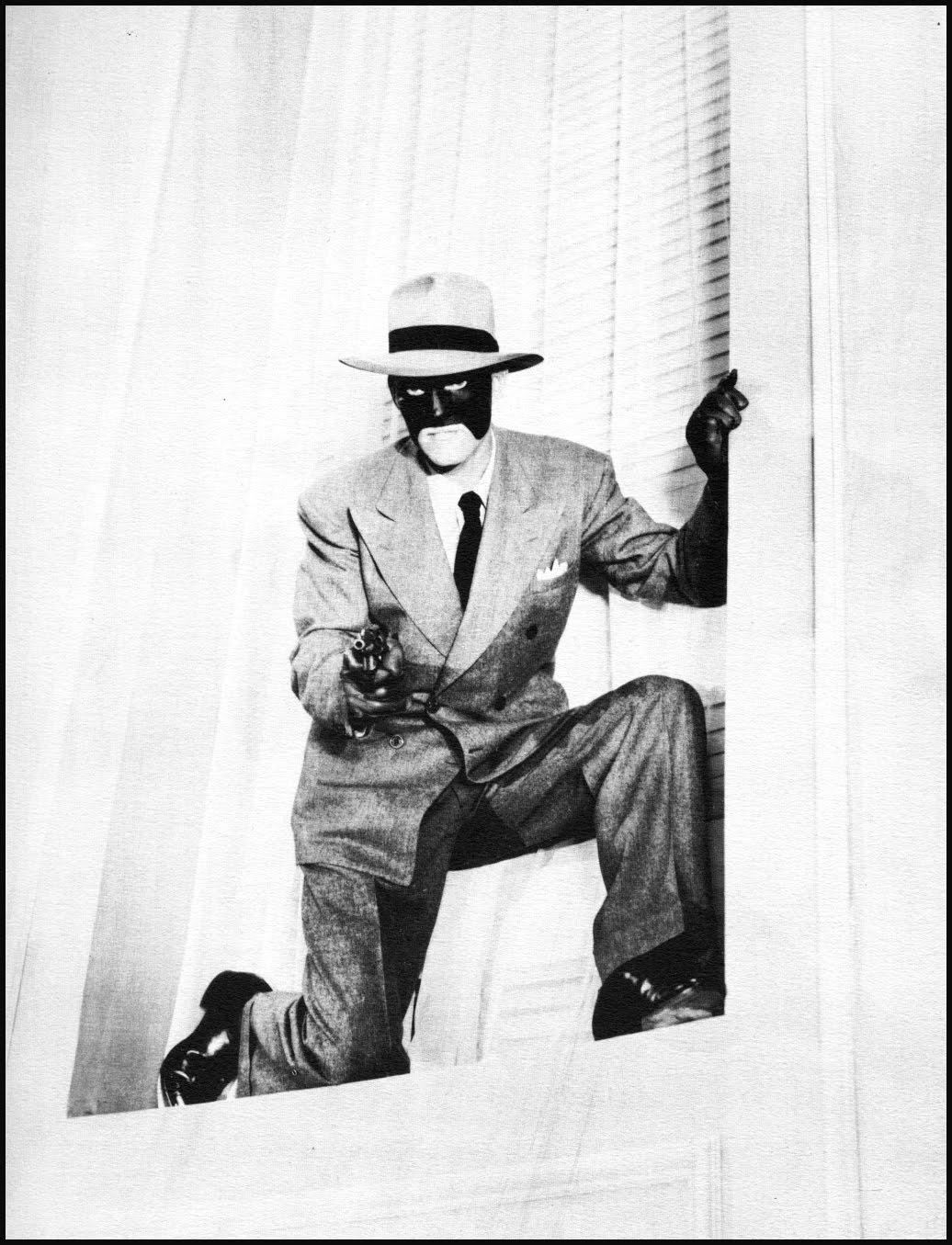
Ironically, as Eisner drew from film to develop his sophisticated visual language, the serials were increasingly geared toward children, dropping the nuances of the 1930s serials in favor of formula and non-stop action. Without Eisner’s ambitious style, the Spirit wasn’t superficially different from other masked pulp heroes like the Spider or the Green Hornet, and it is unlikely a Spirit serial would have been very distinguished. (However, many commentators have pointed out that the title character of the 1943 serial The Masked Marvel bears a strong resemblance to the Spirit; in that serial the central mystery of the story was the true identity of the hero, with four possible candidates.)

Tom Steele as the Masked Marvel

Tom Steele as the Masked Marvel

Wonder Woman

Seriously, what gives? Despite the news that DC’s premier superheroine—the female superhero in the mind of the public—will appear in Batman v Superman: Dawn of Justice, Wonder Woman is severely underrepresented on film. She has yet to headline her own theatrical feature film, and has only a single direct-to-video animated feature to her name. Considering that Wonder Woman spent World War II fighting Nazis alongside Captain Steve Trevor, a serial would seem to be a no-brainer. But it was not to be.

sensation-comics-13

Created in 1941 by psychologist William Moulton Marston, Wonder Woman reflected his desire to create a strong but loving role model for girls, an Amazon princess fighting for equality in “Man’s World;” in his words, she would be “a feminine character with all the strength of Superman plus all the allure of a good and beautiful woman.” Marston modeled his creation on both his wife Elizabeth and a woman named Olive Byrne who lived with the couple in a polyamorous relationship. Although Marston’s unconventional views on the sexes and Wonder Woman’s fetishistic overtones (including the “lasso of truth” and the notion of loving domination) raised eyebrows in later years, they don’t seem to have been considered problematic during the 1940s. (Certainly the serials had their share of questionable material, and anything objectionable would likely have been removed or changed anyway: some of the changes studios made to comic book characters could be quite drastic.)

Consider the screen presence of Wonder Woman’s fellow heroes: Columbia produced serials starring Batman (in 1943 and 1949) and Superman (1948); Republic brought Captain Marvel (1941) and Captain America (1944) to the screen, and there were numerous less-remembered costumed heroes in serials as well. (That’s not even mentioning the animated Superman shorts from Fleischer or the later Superman and Batman TV programs; as of this writing, Lynda Carter’s portrayal of Wonder Woman is still the only prominent, long-running live-action version of the character.)

Female-led serials weren’t unheard of: I’ve reviewed two this summer, The Perils of Pauline and Zorro’s Black Whip. The star of the latter, Linda Stirling, was actively groomed to be the next Pearl White, appearing in several jungle, Western, thriller, and science fiction serials for Republic. (In fact, it was reading about Stirling’s career that brought Wonder Woman to mind and inspired this article.)

Realworlds_Wonder_Woman

(Interestingly, an issue of DC: Realworlds, an out-of-continuity series in which DC’s heroes are expressly fictional but inspire ordinary people to take heroic action, features a hypothetical Wonder Woman serial. The story centers on an actress who finds the courage to stand up to a Red-baiting politician who combines features of Joseph McCarthy and Ronald Reagan. Perhaps in an alternate universe, audiences are thrilling to Wonder Woman vs. the Nazi Baroness or Wonder Woman vs. the Red Menace.)

What’s Next: In one week, I’ll conclude Fates Worse Than Death (for this summer, at least) with a look at Gang Busters. See you then!

Fates Worse Than Death: Zorro’s Black Whip

AKA "Zorro minus Zorro"

AKA “Zorro minus Zorro”

Although movie studios adapted many popular characters from the comics, radio, and literature for serials, they eventually grew tired of paying license fees and squabbling over creative control and came up with thinly-disguised copies of licensed characters, changing (for example) the Phantom to “Captain Africa” or Zorro to “Don Daredevil.” This allowed filmmakers to reuse footage from earlier productions without paying to license the characters again. Studios also created a few original characters, such as Rocket Man/Commando Cody.

ZBW.BlackWhiprides2

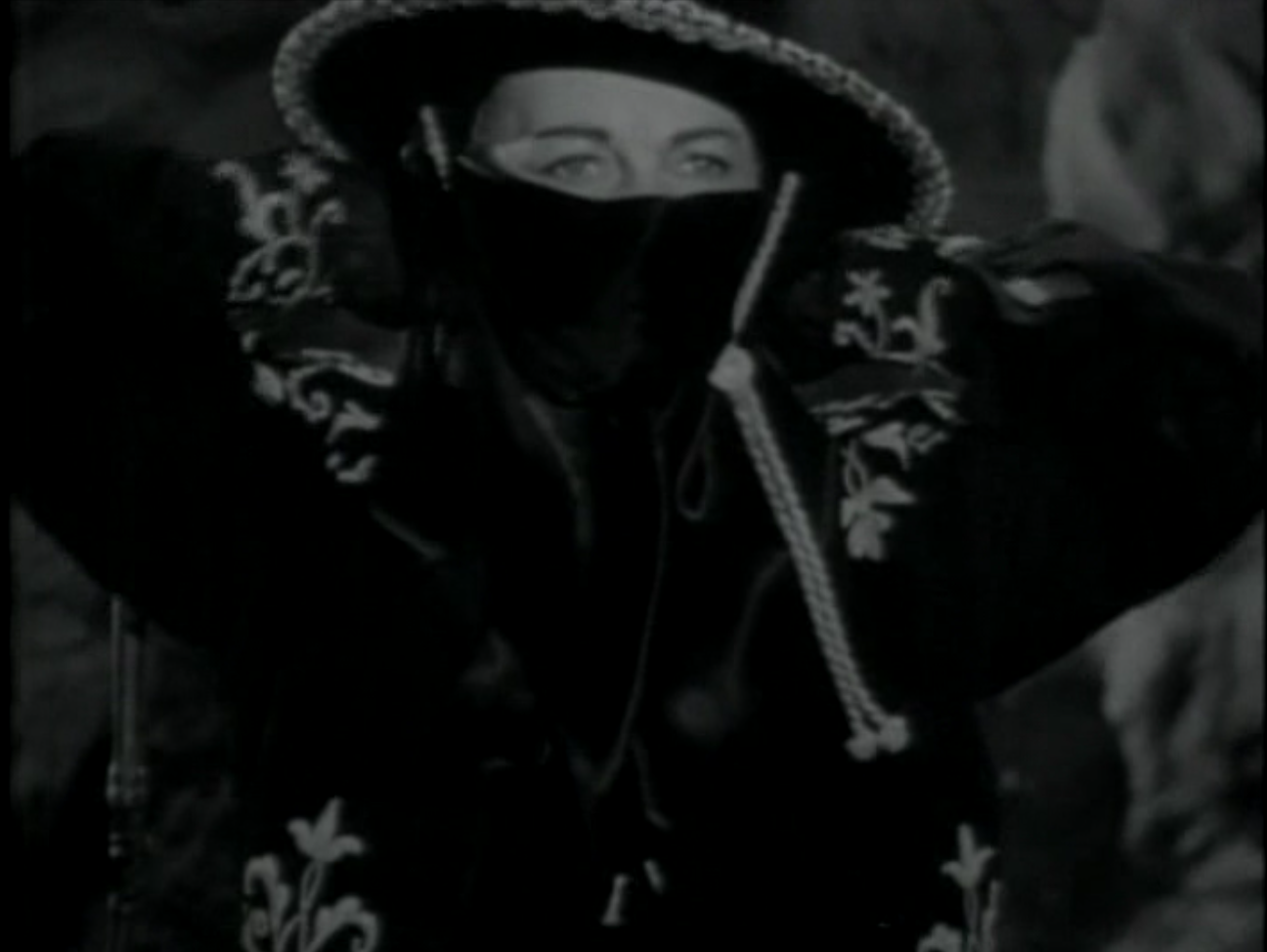
Zorro’s Black Whip, however, is an unusual case, a seemingly superfluous license: aside from the title, the lead character, the “Black Whip,” is never referred to as Zorro at all, and only superficially resembles Johnston McCulley’s masked avenger. Zorro’s Black Whip doesn’t even take place in Mexico or the Southwest: the story is set in the Idaho Territory in 1889, just before elections to determine Idaho’s statehood. However, the use of Zorro’s name in the title undoubtedly sold tickets, and the film’s reputation for being “the female Zorro” has given it a sort of immortality.

So Zorro’s Black Whip, despite its title, is a fairly straightforward Western with a masked hero. It begins with a title card describing rampant lawlessness on the eve of statehood elections:

Law-abiding citizens called for a vote to bring their territory into the Union. But sinister forces, opposed to the coming of law and order, instigated a reign of terror against the lives and property of all who favored statehood.

After a montage of masked horsemen attacking wagon trains, burning settlements, and robbing a bank, the scene changes to a meeting of the “citizens’ committee,” including pro-statehood newspaper editor Randolph Meredith, at the offices of stagecoach operator Dan Hammond. A federal commissioner is arriving in the territory in response to the bank robbery, driven by Meredith’s sister Barbara; he’ll take charge of law and order in the area until the elections.

After the meeting, Hammond confers with his henchmen, Baxter and Harris: it is Hammond who is behind the outlaws’ depredations, and he’ll stop at nothing to prevent statehood from wrecking his plans to control the territory. (Yes, this is the same motive as Kraft’s in Fighting with Kit Carson.) Hammond sends his goons to eliminate the commissioner and capture Barbara in order to force her brother to stop pushing for statehood in his newspaper.

ZBWHammond2

A chance meeting with Vic Gordon, a railroad surveyor, gives Barbara and the commissioner a fighting chance, and when the Black Whip rides in to assist, Baxter and Harris are outmatched and retreat. It’s too late for the commissioner, however, and before he dies of his wounds he reveals that Gordon is an undercover agent working for him, deputizing Barbara to help Gordon “stamp out these evils [and] bring Idaho into the Union.”

ZBWGordon1

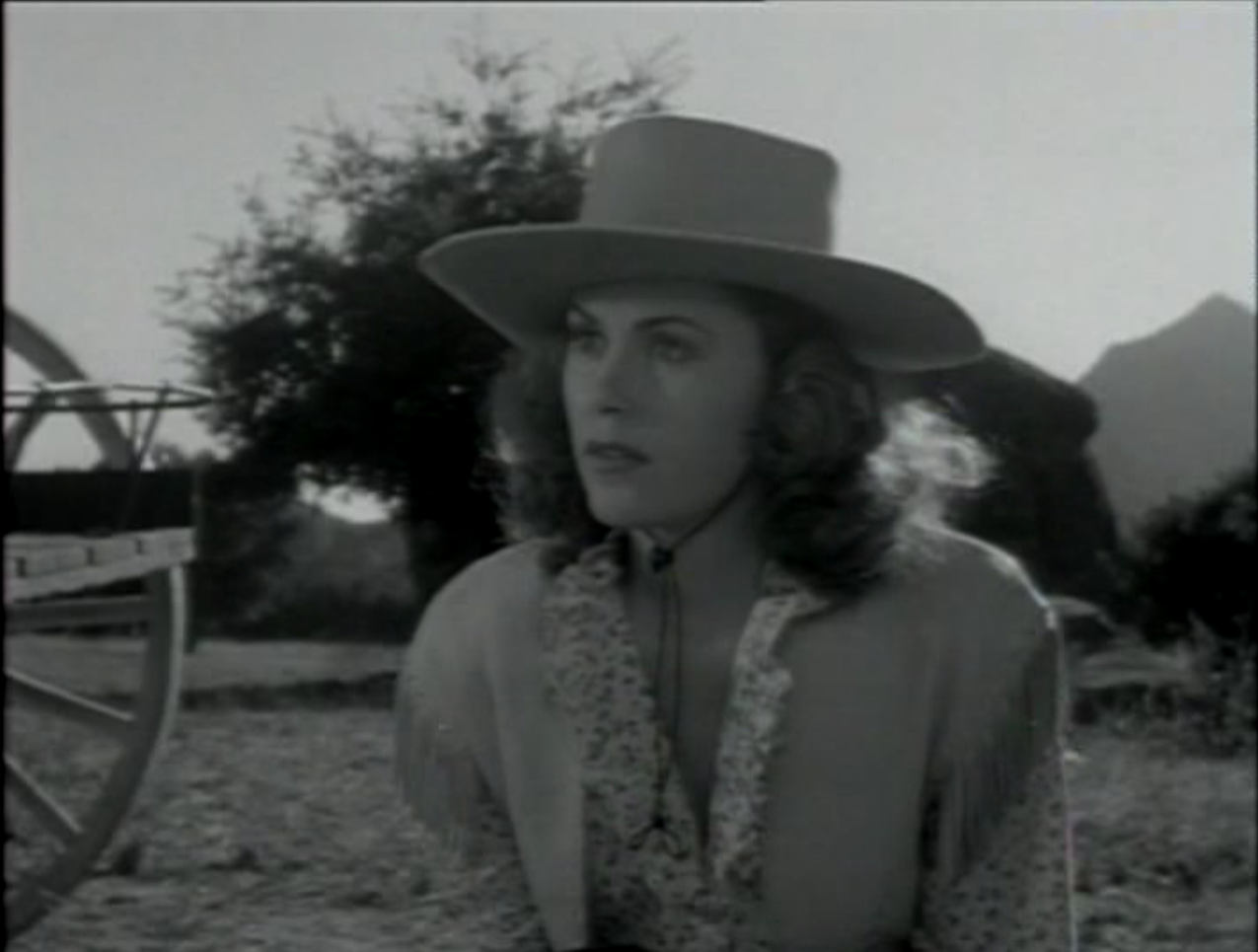
The Black Whip, also injured, returns to his lair behind a waterfall; as he unmasks before dying, we see that it is Randolph Meredith, and the secret entrance connects to his and Barbara’s ranch house. When she returns home, looking for him, she finds his body and learns the truth. From then on, she wears the costume and takes on the responsibilities of the Black Whip, as well as the newspaper, with the aid of Vic Gordon.

ZBW.Barbara.Gordon

There are quite a few complications before Hammond is eventually brought to justice: Gordon is briefly framed for stealing reward money he had collected, and is almost lynched by an angry mob; Barbara is captured with the intention of forcing her to reveal the Black Whip’s identity; Gordon learns the truth and puts on the Black Whip costume to avert suspicion that Barbara is the masked vigilante.

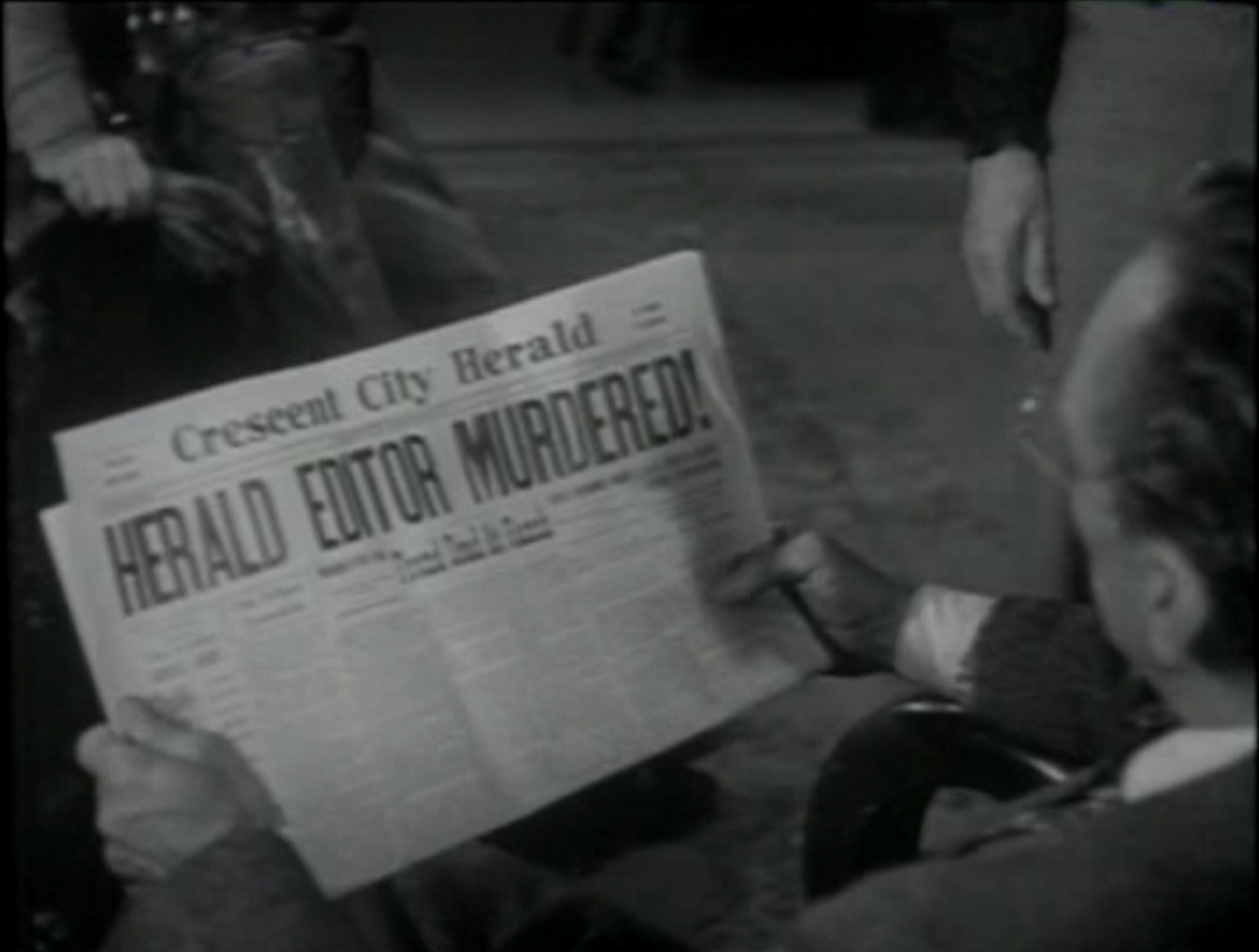
Throughout, Barbara uses the newspaper to pass information along and provide handy visual summaries for the audience: HERALD EDITOR MURDERED; $10,000 REWARD; BIG GOLD STRIKE AT HARPER’S CREEK, etc. At the same time, Hammond secretly uses his position as a businessman and member of the citizens’ committee to shape public opinion and stymie attempts to curb the outlaws. It’s a surprisingly urban approach to the Western, with gangsters using six-shooters instead of tommy guns and getting away on horseback instead of in black sedans.

ZBWHeraldEditorMurdered

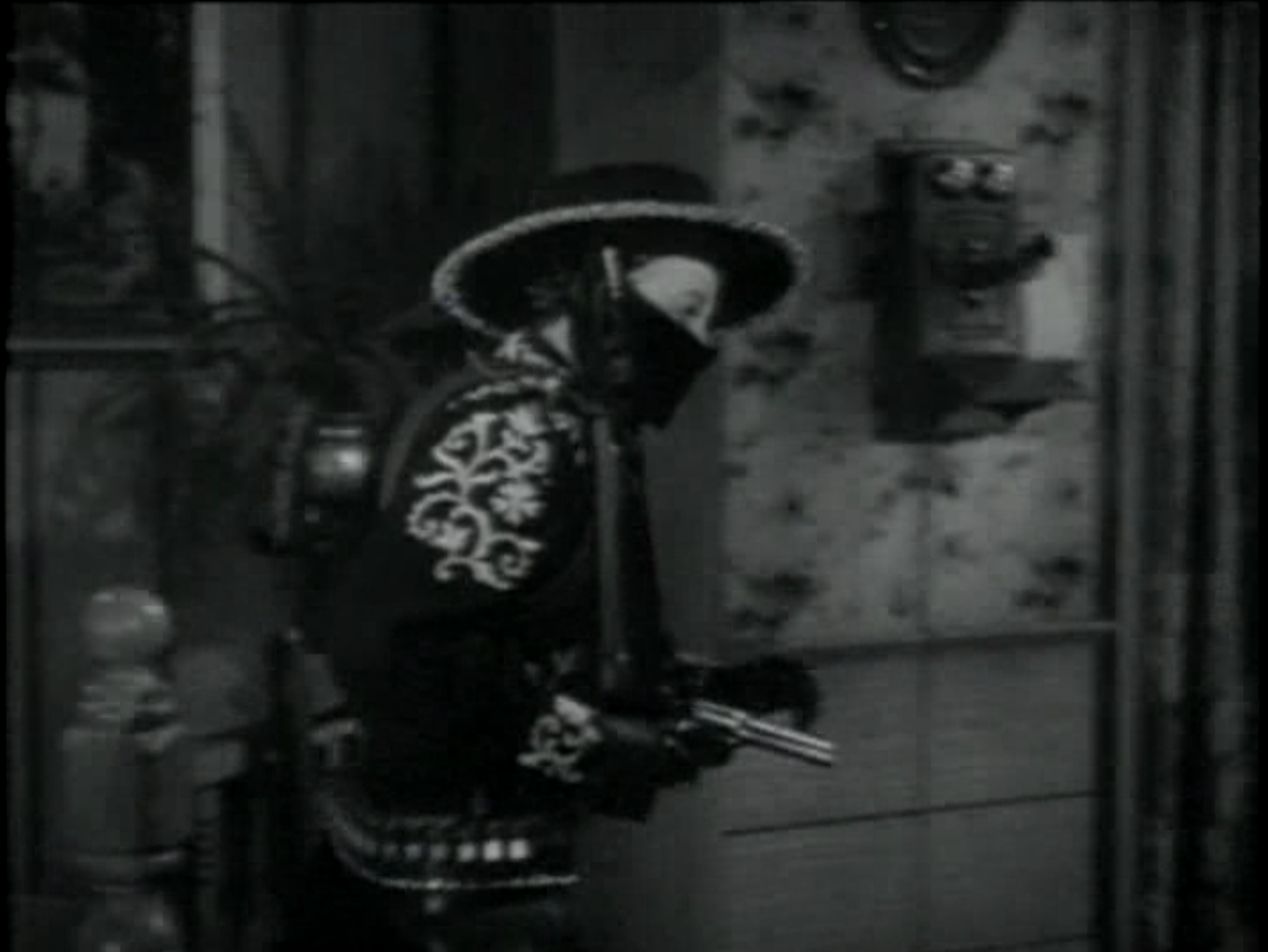
Also contributing to the contemporary feel, I was struck by the fact that everyone has a telephone. At first this seemed anachronistic to me, but reliable sources inform me that the first commercial telephone service in Idaho was established in 1883, so I can now claim the entire four hours of Zorro’s Black Whip as “educational viewing.” In other ways it is a typical Hollywood production: there are no Native Americans or people of color at all, sparing us the usual problematic racial depictions but also whitewashing away any real history. (I know, expecting “real history” was probably too much, but the telephone thing got my hopes up.) In fact, probably the most jarring element from a modern perspective is typesetter “Ten Point” Jackson’s addiction to patent medicines (like a “jitters tonic” helpfully labeled “90% alcohol”), played as comic relief.

(note telephone in background)

(note telephone in background)

The performances are uniformly excellent and, in combination with the writing (credited to four people: Basil Dickey, Jesse Duffy, Grant Nelson, and Joseph Poland), give the characters a lived-in quality. As Vic Gordon, George J. Lewis is the first billed, but Linda Stirling as Barbara/the Black Whip should really be considered the star. (As in most serials, no one person is responsible for moving the entire plot forward, but come on, she’s the title character and was the focus in promotional materials.) Lewis comes off as somewhat glib, flashing a movie-star smile at the end of most of his scenes, whether appropriate to the moment or not.

ZBWBarbara1

Who knows—maybe he really had the hots for Stirling, and who could blame him? Beautiful and self-possessed, Stirling is considered one of the “serial queens” of the era, having previously appeared in The Tiger Woman, a jungle adventure; she here shows both an ability to act and carry a stunt-heavy action picture, riding, shooting, and dispatching bad guys with the long whip from which her alter ego takes its name. (Unlike Pearl White, however, she didn’t do all her own stunts.) On the villains’ side, Francis McDonald gives a wiry intensity to Hammond, and Hal Taliaferro is physically imposing and laconic in the manner of John Wayne as Hammond’s chief henchman Baxter.

ZBW.Barbara.Baxter

From a technical standpoint, this is one of the most tightly assembled serials I’ve watched so far. Directors Spencer Gordon Bennet and Wallace A. Grissell frame the action clearly and keep the pace up, aided by the cast’s game performances. Famed Western stunt coordinator Yakima Canutt serves as second unit director, contributing his expertise to the numerous horseback gunfights, chases and careening wagons that fill the running time. Also present are Tom Steele and Dale Van Sickel, who would typically play a few henchmen or other bit parts while coordinating fistfights and other stunts behind the scenes. Finally, Theodore Lydecker is in charge of special effects, and his miniature work is recognizable in several shots, such as a cabin being flattened by a rockslide (according to imdb, Theodore’s brother Howard did uncredited work as well, which would make sense: they usually worked as a team). Zorro’s Black Whip is a showcase for some of Republic’s production talent at a high point of quality.

ZBWavalanche

The fight scenes are especially prominent and well executed, and Republic must have spent half its budget for this picture on breakaway furniture. Several locations are demolished by fights (including the newspaper office, the stagecoach office, an abandoned mine tunnel, and several barns and shacks), the fighters throwing each other over and through objects, and the furniture and any loose items being turned into impromptu clubs or missiles. When a fight breaks out in Barbara’s sitting room, with its flimsy knick-knack shelves and parlor furniture, it’s as thoroughly trashed as in any juvenile delinquent movie of the 1950s. In another fight scene, everything in the room, up to and including a cast-iron stove, comes crashing down during the brawl. It’s a credit to the choreography that these fights never become dull or repetitive.

ZBWbrawl

In The Great Movie Serials, Jim Harmon and Donald F. Glut highlight the contradictions inherent in the serial heroine: do audiences want to see an avenging she-devil whipping her male oppressors, or a bound victim awaiting rescue? It’s the same question posed by The Perils of Pauline in an updated package.

ZBW.Barbara.bound2

Harmon and Glut even go so far as to draw a connection between Stirling’s tight costume and “man-abusing actions” and “certain forms of underground erotica” (the book was written in 1972). I wonder, however, if through hindsight they were overstating the film’s effect on their younger selves. It’s possible to read the Black Whip as a predecessor of Russ Meyer’s “supervixens”—there’s definitely a lot of whipping in this film, and one can imagine it charging the imagination of some young Russ Meyers in the audience—but Linda Stirling is no Tura Satana, and Zorro’s Black Whip, while entertaining in its own right, will never be mistaken for Faster, Pussycat! Kill! Kill!

ZBW.Black.Whip

In the interest of equal time, Vic Gordon is also captured and tied up.

In the interest of equal time, Vic Gordon is also captured and tied up.

What I Watched: Zorro’s Black Whip (Republic, 1944)
Where I Watched It: A Roan Group Archival Entertainment DVD; it’s also available to watch on YouTube.
No. of Chapters: 12
Best Chapter Title: “Take Off That Mask!” (Chapter Five)
ZBWmasked
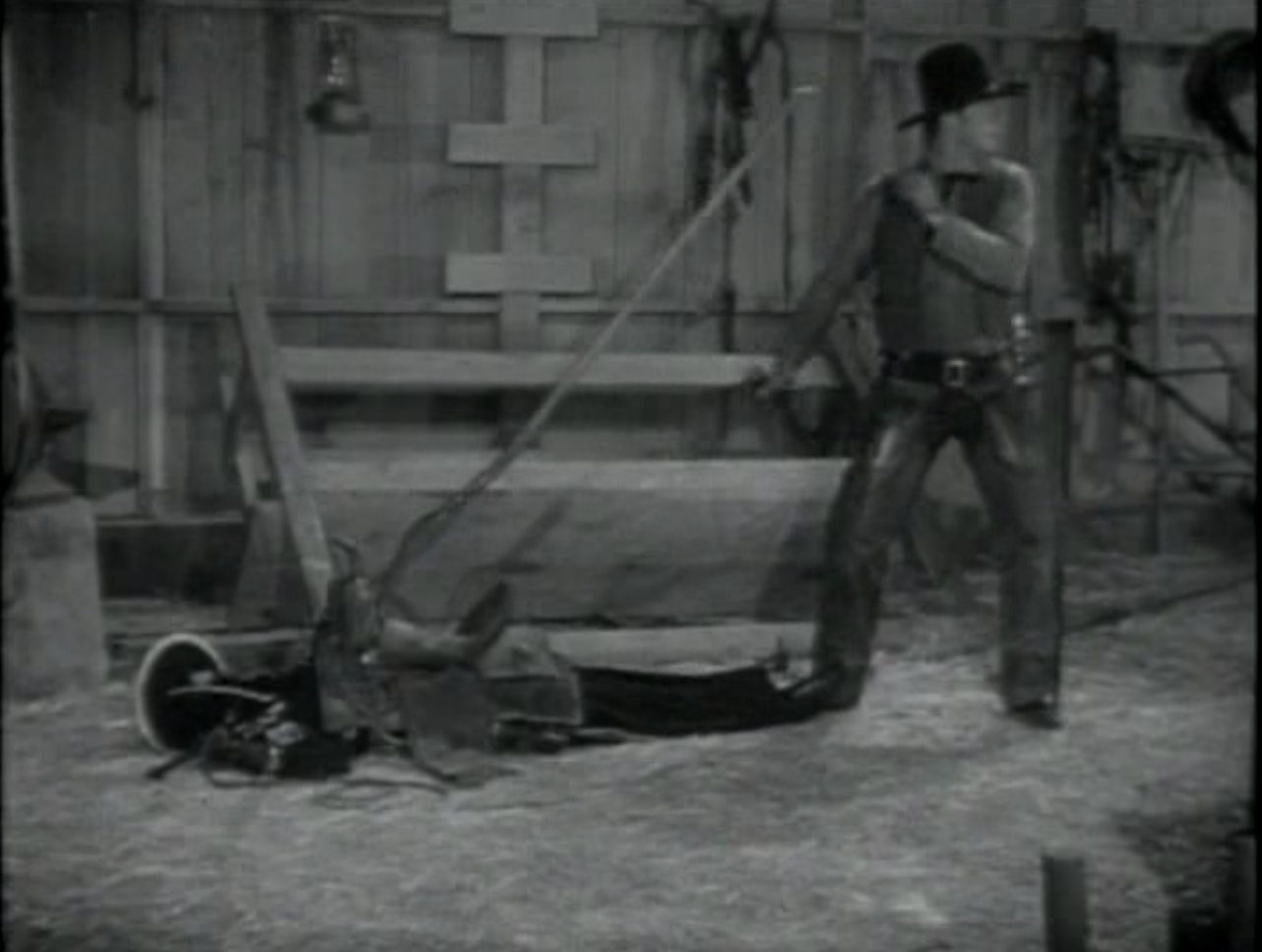
Best Cliffhanger: Fittingly for a serial that places such a premium on action, there are many excellent cliffhangers in Zorro’s Black Whip. There are several falls off of cliffs, of course, in and out of speeding wagons; there are explosions, including a burning barrel of coal oil in a dead-end mine tunnel. There’s quite a bit of violence which is grisly in its implication, if not very graphic in its depiction (and lest you think that whip is just for show, the Black Whip totally whips a guy backwards off the edge of a cliff at one point). I think my favorite cliffhanger is in Chapter Ten, “Fangs of Doom,” the title of which leads me to expect a rattlesnake (or maybe . . . a vampire?). As it happens, during a fight in a barn, in which a variety of riding tack and farm implements are thrown around, the Black Whip is knocked out, and Baxter attempts to finish her off with a pitchfork(!), thrusting it downward with a sickening crunch.
Annie Wilkes Award for Blatant Cheat: But wait! At the last minute, Gordon throws a saddle over the Black Whip’s torso, so the sickening crunch is the sound of the pitchfork driving into the hard leather. Okay, it’s not a cheat, but come on . . . a saddle?
ZBW.saddle
Sample Dialogue: “The Black Whip’s got to be a man! He’s out-shot us, out-rode us, and out-fought us, stopped us at every turn!” –Baxter to Hammond, Chapter Nine (“Avalanche”)
What Others Have Said: “What still remains a mystery to viewers of Zorro’s Black Whip is that those crooks could wrestle around the barn so many times with the avenger without somehow discovering the true sex of the ‘masked man.’” –Harmon and Glut, The Great Movie Serials
What’s Next: Next week I plan to publish a special serial-related article, and then in two weeks I’ll be back with my impression of Gang Busters, the final installment of Fates Worse Than Death until next summer. See you then!

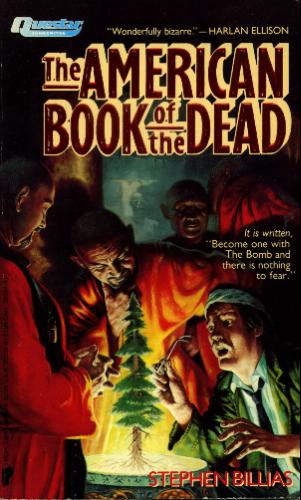
Stephen Billias’ The American Book of the Dead: An Old Favorite Revisited

Nucleomitophobia is an exaggerated fear of being blown to bits by nuclear weapons. Bertie Rupp has it, and it’s driving him crazy. He’s tried meditation, yoga, vegetarianism, and The Society for the Preservation of Mankind. Nothing works, until he hears about The American Book of the Dead, a Zen guide to surviving the nuclear holocaust. Convinced that he must find The Book and learn its secrets if the human race is to endure, Bertie sets out on a desperate search that will take him to Las Vegas and back . . . and involve him in the lives of an ex-nun from Kansas who truly loves him, an old tailor who survived the Nazi holocaust, and a mysterious representative from The Society for the Preservation of Outer Space. It is an odyssey that will lead him through the darkness of impending nuclear war and beyond . . . to Enlightenment.

That back-cover summary (combined with the cover illustration of a slack-jawed hippie gaping at a tiny “bonsai sequoia” tree, surrounded by approving monks) convinced me that I needed to read Stephen Billias’ 1987 novel The American Book of the Dead when I found it in the bookstore at age fourteen. I’ve written about my own nuclear fears, and while they had peaked a few years earlier, I still felt that I could relate to this Bertie Rupp character. I was similarly intrigued by his spiritual search for peace and Enlightenment with a capital E, as I was in the midst of a comparative study of different religions and sorting out many of life’s questions for myself (if I come up with a definitive answer, I’ll let you know).

Popular Library edition, 1987. Cover illustration by Gary Ruddell.

Popular Library edition, 1987. Cover illustration by Gary Ruddell.

At that age, I was reading science fiction and fantasy paperbacks pretty regularly, and I recognized the publisher, Questar (an imprint of Warner’s Popular Library), having read and enjoyed some of their other genre-stretching offerings already. A front-cover blurb from Harlan Ellison describing TABOTD (as I will henceforth abbreviate it) as “wonderfully bizarre” sealed the deal.

It turned out to be the perfect book for me at the moment; I read it and reread it several times. I thrust it into the hands of friends to read; my dad read it; even some of my teachers read it. Everyone I gave it to seemed to enjoy it. Since then, however, I’ve never met anyone else that read or remembered it. It had only a single printing, as far as I know. Twenty-five years later, I doubted myself: perhaps in my youth I overestimated its quality or originality; perhaps it was too timely, predicated as it was on Cold War nuclear anxiety; maybe it simply wasn’t as good as I remembered.

So, this past week I reread it, and while I can’t deny the possibility that my judgment is compromised by nostalgia, I still found it an imaginative, compassionate, and frequently beautiful book. At the same time, it’s now easier for me to put it into a literary context and make some useful comparisons to other books that are likely to be more familiar to readers.

The first thing that might not be clear from the summary above is that, while Bertie’s experiences are framed as a contemporary version of the Buddha’s journey, TABOTD is an often funny book. The Zen koan, or joke which startles and leads to wisdom, is built into the text of The Book within the book, a mixture of spiritual teaching and modern commercial jargon (“CHANGELESS CHANGE, PRIMORDIAL ESSENCE OF THE GREAT PRIMAL BEGINNING: NEW, IMPROVED, LONGER LASTING” reads one aphorism). The story takes detours which are absurd on the surface but feed into the main plot. Billias makes wry observations on the foibles of humanity, both through his characters and as an omniscient narrator. The tone—whimsical, digressive, drily aware of mortal folly—is strongly indebted to Douglas Adams.

However, whereas The Hitchhiker’s Guide to the Galaxy begins with the end of the world, TABOTD builds toward it (it’s not a spoiler to reveal that Bertie’s worst fears come true—they are foreshadowed from the beginning). Adams’ protagonist, Arthur Dent, spends about one page grieving after the earth is blown up by aliens, but it’s clear he didn’t leave much behind and the focus is squarely on his adventures. Bertie Rupp, by contrast, is intensely aware of the suffering of the world, human and non-human alike: it is not only for his own sake that he fears the coming war. It’s somewhat more like Adams’ later work, as enamored with the wonders that can be found on earth as with the spaced-out products of his imagination.

If I had to assign a genre to TABOTD, I’d call it magical realism rather than any kind of science fiction: animals talk, there are signs and premonitions, and eventually the gods of mythology are brought into the mix. (One of the main characters is Monkey—the Monkey from the classic novel Journey to the West—an immortal, talking primate whose goals and prankish sense of humor are often at odds with the seriousness of Bertie’s spiritual undertaking.) There’s some pseudo-scientific rationalization (think Chariots of the Gods), but the result is a narrative world where anything can happen, and as society, racing toward Armageddon, unravels, things get increasingly freaky.

There’s also a strain of hidden history and conspiracy which, combined with the novel’s antic tone, owes something to Robert Shea and Robert Anton Wilson’s Illuminatus! Trilogy. The main antagonist is a corporate mogul described as “a government employee, at the Cabinet level, who had returned to private business after a change of administration.” His name is redacted throughout the book, so he appears as “_______ _______.” Does he represent a real person? I don’t know, but it’s not hard to think of possibilities; such figures are always timely. A grasping, scheming super-capitalist, ______ ______ is one of the few elements of the book that seems even more contemporary now than it did then; he and his fellow businessmen personify what Matt Taibbi memorably described as “a great vampire squid wrapped around the face of humanity, relentlessly jamming its blood funnel into anything that smells like money.”

Early in TABOTD, _______ _______ chooses Bertie, a temp worker, to drive him to “Big Boys Camp,” a top-secret gathering of powerful CEOs and politicians in the manner of a Boy Scout jamboree. Invited to participate, Bertie joins the “campers” for a weekend of canoeing, three-legged races, and weenie roasts under the watchful eye of a camp director. It is at Big Boys Camp that Bertie first encounters Monkey, held captive by _______ _______ and his fellow businessmen and brought out in a cage to terrify them with scary stories.

Bertie let out his breath with a gasp. A monkey was telling the creation story to American capitalists in the fantasy camp of their lost childhoods. Bertie was in dire danger of losing his perspective.

(As sometimes happens, I thought of Big Boys Camp as a surreal invention, of a piece with the talking animals and spacecraft in the rest of the book; it wasn’t until several years later that I heard about the high-powered gatherings at Bohemian Grove and experienced the weird feeling that comes from imagined fiction crashing into reality.)

For a fairly short novel, TABOTD is quite shaggy, with dozens of characters and an episodic form; some elements of it are dated, and not in a good way (Rufus, a black security guard who befriends and protects Bertie, speaks in an exaggerated “sho ‘nuff” dialect that probably wouldn’t get past an editor today). It gets a lot of mileage, however, from the steadily increasing tension of the situation, as Bertie’s travails are intercut with examples of the Strangelove-like madness that leads to war and the mania of a collapsing society. It helps, too, that Billias generates empathy for all the characters, even the villains: _______ _______ isn’t exactly redeemed, but he is a compelling presence, and honest readers will be able to see something of themselves in his self-interested calculations even if they wouldn’t take his actions. (______ ______ is also pretty dynamic: as a character defined by his fear, his will to power, and his aggressive avarice, he balances out the more passive Bertie, who is gradually letting go of all those things.)

According to what little biographical information I’ve found, Billias was in his late 30s when The American Book of the Dead was published; the melancholy tone, the sorrow for the challenges awaiting coming generations, and the sense of how precarious life is speak to me now where they went over my head as a teenager. I don’t doubt that it’s more than a little autobiographical.

If this write-up sounds vague, that’s deliberate: while I usually try to provide some analysis, in this case I’m straight-up promoting, and I don’t want to give too much away. I hope you’ll seek out this book and form your own opinion. After all these years, this is a book that I still believe deserves to be read, to be part of the conversation.

I’m excited to announce that I am contributing to a brand-new website for discussion of film and related topics, The Solute. The Solute is, in the words of founder Julius Kassendorf, “a brainchild collective emerging from the commentariat of The Dissolve,” the same website on which I posted my reassessment of Addicted to Love last spring. Right now, I’m only represented on the site as part of a roundtable discussion on the state of theatergoing in 2014, but I’ll be posting reviews and longer articles as it moves forward. I’ll have a longer post soon that addresses how that will affect Medleyana, and I’ll post links here whenever I publish an article at The Solute. In the mean time, I invite you to check it out and explore the diverse range of writers who will be sharing their thoughts; if it’s anything like the conversations at The Dissolve, I expect it to be fresh, varied, and entertaining.

Fates Worse Than Death: Radar Men from the Moon

RMTitle1
RMTitle2
RMTitle3

A string of mysterious explosions and attacks is crippling America’s defense network. Scientific analysis indicates that atomic weapons caused the destruction, but what power on earth could focus atomic energy into the kind of ray being used? Only one man is equipped to investigate: Commando Cody, inventor and explorer, whose jetpack allows him to soar through the air (and who is also a crack shot with a pistol).

RMCody3

Liberating the atomic ray from the two gangsters wielding it, Cody takes the futuristic weapon back to his lab to analyze it. The two gangsters, Daly and Graber, report to their superior, Krog, who (as Cody will discover) is the leader of an invading force from the moon! Krog orders them to recover the ray and sends his human minions on several criminal assignments to raise funds for his terroristic activities.

RMAtomicRay

Eventually, Cody and his team determine the source of the trouble and launch Cody’s latest invention, an interplanetary rocket ship, to the moon itself. The lunar civilization is dying, as its leader Retik explains, the air too thin and dry to grow food; already the lunarians must wear helmets outside of their pressurized cities in order to breathe. (Needless to say, no more attention is paid to real scientific knowledge of the moon than in the space fantasies of Edgar Rice Burroughs from decades before.) After softening up earth’s defenses, the lunarians plan to invade earth in Radar Men from the Moon.

RMrocket4

In 1949, Republic Pictures, weary of licensing superheroes from the comics and radio, introduced an original character, Rocket Man, in King of the Rocket Men. Three years later, Radar Men from the Moon featured Commando Cody, a repackaging of the Rocket Man concept (essentially a superhero with a jetpack). By all accounts, Radar Men relies heavily on footage of Rocket Man from the earlier serial, as well as reusing props, costumes, and special effects from Republic’s extensive library. (Two sequels followed: Zombies of the Stratosphere and a television series, Sky Marshall of the Universe; Rocket Man/Commando Cody’s influence is also readily seen in Dave Stevens’ comic book hero the Rocketeer, adapted into a 1991 film directed by Joe Johnston.)

RMtank1

Radar Men from the Moon is very much what you would expect from a science fiction adventure from the early 1950s, as much Captain Video as Flash Gordon. With the fishbowl-style space helmets, finned rocket ships, and sweet moon tanks (not to mention Cody’s bullet-headed flying costume), it is, to use a modern term, “toyetic” (although the kind of mass merchandising we’ve come to expect since Star Wars wasn’t in place then, so there don’t seem to be a large number of actual toys based on these designs). On the other hand, the Greco-Roman architecture of the lunar city and the futuristic laboratory of Retik show that styles hadn’t changed that much since the space operas of the ‘30s (and a lot of the running time is spent on earth with perfectly mundane cops-and-robbers business).

RMmooncity2

Normally, I’ve tried to look at examples of a given concept or character in chronological order (covering Flash Gordon instead of one of its sequels, for example), but I had a copy of Radar Men on hand, and since Commando Cody is technically a new character, free of any earlier continuity, I don’t feel too much conflict about covering it before getting to the original Rocket Men. Besides, reused footage and props were a cost-saving feature of the serials almost since the beginning, so Radar Men is exceptional only for its late position in the format’s history and the slickness of its incorporation of previous material.

RMRetik1

For what it’s worth, it wasn’t obvious to this viewer when it cut to older footage, and establishing shots weren’t drawn out as excessively as I’ve observed in the Universal serials I’ve watched. From a technical standpoint, the production of serials was clearly at a high point, and everything moves quickly and looks sharp. However, the same professional application of an established formula that makes everything look polished also drains any spontaneity out of this production: the characters are thinly drawn and their dialogue functions almost exclusively to move the plot forward. There is little room for the weird digressions or surprises that mark the serials of the 1930s.

Star George Wallace leads a cast that includes “heavy” Roy Barcroft as Retik and future Lone Ranger Clayton Moore as the gangster Graber; the performances are fine, but the real stars are special effects wizards Howard “Babe” Lydecker and Theodore Lydecker, brothers whose detailed miniatures of earthly and lunar structures and vehicles are extensively featured. There are also plenty of well-executed fight scenes, courtesy of Tom Steele and Dale Van Sickel, longtime stuntmen and fight coordinators.

RMCody4

So why isn’t Radar Men from the Moon more exciting? There’s a business-as-usual quality to the proceedings: no one seems that surprised that America is under attack by atomic weapons, or that the culprits might be from the moon. What’s that, we need to take our rocket ship to the moon? Sure thing. Oh, we need to go back? No problem. I’ll remember to take my jetpack in case I need to hijack a space tank. The material calls for hyperbole à la Stan Lee, but the execution is more like Dragnet.

That’s not to say that I’d be happier if Radar Men from the Moon stopped in its tracks to marvel at the insanity of its own plot: in general, pulp narratives don’t spend a lot of time questioning their believability. The characters accept that what is happening is real—they don’t have a choice—and the audience follows suit. There is usually, however, a moment or two that acknowledges the overturning of established science (I think of this as the “more in heaven and earth” speech, often delivered by a scientist who admits that there are still mysteries in the universe) or asks the audience to consider what it would really mean for humanity to encounter, say, an invading army of moon men. (Robert E. Howard, to cite one example, often salted his tales of brawny barbarian warriors with thematically-appropriate musings on destiny and masculinity.)

No such philosophical problems trouble Commando Cody or his team. If I had seen Radar Men from the Moon when I was twelve, I expect I would have loved it, but as an adult the prospect of an adventure that is all plot and very little character is less appealing. Rather than revisit it, I’ll probably just rewatch The Rocketeer.

What I Watched: Radar Men from the Moon (Republic, 1952)
Where I Watched It: A Hal Roach Studios DVD; it’s also available to watch on YouTube.
No. of Chapters: 12
Best Chapter Title: “Molten Terror” (Chapter Two)
Best Cliffhanger: At the end of “Molten Terror,” Cody and Ted are trapped in a mountainside cave on the moon. Lunar soldiers aim the atomic ray at the mountain, softening the rock (using the same melting effect seen at the end of The Phantom Empire) and filling the cave with molten lava.
RMmoltenterror
Annie Wilkes Award for Most Blatant Cheat: Several times Cody is in a vehicle that crashes: planes at the end of Chapter Four (“Flight to Destruction”) and Chapter Seven (“Camouflaged Destruction”), a car in Chapter Five (“Murder Car”). In the next week’s episode, intercut footage reveals Cody and his passenger bailing out at the last minute, exactly the kind of cheat Annie Wilkes was complaining about.
Sample Dialogue: “For some time our astronomers have noticed an unusual amount of atomic activity on the moon. Atomic activity on the moon, atomic blasts on the earth: the two known facts fit together.” –Henderson (Don Walters), Cody’s government contact
RMHenderson2
What Others Have Said: “It was my own personal homage to Commando Cody and all the other serial heroes of that era. I’d always been a huge fan of the serials. I loved all those edge-of-your-seat, cliff-hanging chapter plays. . . . I’d always loved the idea of a guy flying like a bird, with just a combustible contraption strapped to his back. The image really appealed to me. But I didn’t want to be stuck doing an exact replication of the serials, with Martians, death-rays, etc. That wasn’t quite the approach I wanted to take. I wanted to do a real period aviation strip, but with one small element of science-fiction added: The rocket-pack!” –Dave Stevens, creator of the Rocketeer, interview with Jon B. Cooke in The Comic Book Artist
What’s Next: I’ll take a look at Zorro’s Black Whip, starring Linda Stirling. Join me in two weeks!

Wonder Twins: Gravity Falls Returns for S2

image

Last week, in my write-up of the 1935 Gene Autry serial The Phantom Empire, I noted that juvenile leads Frankie and Betsy Baxter (played by Frankie Darro and Betsy King Ross) “anticipate[d] the inquisitive child protagonists of Steven Spielberg and other filmmakers of the 1980s.”  By coincidence, another pair of mystery-solving siblings returned to television this weekend after a long hiatus: Dipper and Mabel Pines (voiced by Jason Ritter and Kristen Schaal), the twin brother and sister at the center of Disney’s cult hit Gravity Falls, which began its second season with a new episode on Friday, August 1.
image

It had been more than a year since the last new episode, but “Scary-Oke” contained enough exposition to bring viewers up to speed: twelve-year-old twins Mabel and Dipper are halfway through their summer with great-uncle (“Grunkle”) Stan in the weirdness-drenched town of Gravity Falls, Oregon. In Season One they encountered a slew of bizarre creatures and occurrences as they followed in the footsteps of past paranormal-themed shows such as The X-Files, Twin Peaks, and Eerie, Indiana. With its quirky side characters and witty, wide-ranging humor, it’s drawn comparisons to The Simpsons as well.

Maybe it's the ping-pong ball eyes.

Maybe it’s the ping-pong ball eyes.

Dipper is the Fox Mulder of the two kids, convinced that “the truth is out there” and determined to find it with the aid of an old journal he found in the woods, and which describes many of the area’s secrets.  Mabel isn’t a skeptic like Dana Scully: she’s seen enough to believe in Dipper’s mysteries, she just doesn’t dwell on them like Dipper.  A true optimist and free spirit, Mabel supports her brother but encourages him to lighten up.  Stan Pines, for his part, runs a run-down and obviously phony tourist trap, privately poo-pooing any claims of the supernatural.  It’s been hinted since the first episode of Season One that Stan knew more than he let on, even as he faced off with his Napoleonic rival, the charismatic and twisted Lil’ Gideon.  By the season finale it was clear that Stan was deeply connected to the journal and its two matching volumes, bringing them together to complete some kind of ritual in a secret lab underneath the Mystery Shack.

“Scary-Oke” picks up where last season left off, with Stan activating his journal-powered ritual/machine; we don’t find out exactly what it does, but it does send out signals strong enough to get the attention to two X-Files-like government agents, Powers and Trigger, who are clearly going to be involved as Season Two unfolds.  Although obviously catching up new (or forgetful) viewers and setting the table for Season Two, the episode features a satisfying moment as Grunkle Stan reveals that of course he knows about the strange things going on in Gravity Falls (“I’m not an idiot!”), and his affected skepticism was meant to protect Dipper and Mabel.  Indeed, he is far more aware of the dangers of the supernatural than Dipper, who is so desperate to prove his usefulness to the G-men that he uses the journal to summon a horde of zombies just so they’ll take him seriously.

That’s just one example of the show’s strength: unlike many monster-of-the-week shows (and even many kids’ adventure programs), the paranormal is almost always thematically intertwined with the main characters’ emotional journey, metaphorically highlighting opportunities for growth: it’s more Buffy than Scooby-Doo.  This is especially true when the story dwells on the central relationship between the twins.  Gravity Falls creator Alex Hirsch has stated that Dipper and Mabel are partially based on himself and his own twin sister, and although they are frequently at odds, their essentially supportive relationship is meant to counter the often fractious siblings typically depicted on television.  As Hirsch said in a recent interview with Erik Adams of The A. V. Club,

I remembered myself and my twin sister, when we were in school, we would bicker and fight and get on each other’s nerves and butt heads.  When we were in a familiar situation, we tended to be more distant.  When we were in an unfamiliar situation, and all we had was each other, we became much closer.  We needed each other more, and we actually got along better.

If “Scary-Oke”‘s conclusion is anything to go by, Gravity Falls may go the way of The Simpsons, continually setting up conflicts for which the answer is always “family,” the characters learning the same lessons about love and forgiveness over and over again, but I’m not too worried. Balancing strong characters with complex plotting over the long haul is a challenge, but Gravity Falls showed tremendous poise in its first season; it’s a safe bet that the show’s strong serialization and over-arching mysteries will keep it from becoming static.

Perhaps sibling relationships have been on my mind since I just returned from a family trip where we met up with my sister.  We aren’t twins: she’s four years older than me, and being around her brought back a lot of memories.  When I was very young, she would teach me the latest swear words she had learned from her peers and send me to repeat them to our parents (they knew who had put me up to it).  Then there was the time I was afraid to watch Return of the Jedi because my sister (who had seen it first) told me that Darth Vader takes his helmet off and reveals his naked brain at the end; as mild as that scene was in reality, even the exploding head from Scanners wouldn’t have been able to compete with the images I conjured up myself, and I got so anxious knowing it was coming that I had to leave in the middle the first time I tried to watch it.  That’s not how she remembers things, of course, but she’ll need to start her own blog if she wants to share her side of growing up with an annoying younger brother.

Yes, we had plenty of conflict between us as we grew up, but also moments of togetherness.  By coincidence, my own children are the same distance apart in age as my sister and me, and I see a lot of similarities between them–the older sister and younger brother–and us (similarities strong enough that my dad frequently calls my daughter by my sister’s name).  They struggle with the age difference and don’t always want to do the same things; they compete for their parents’ attention.  I went through this with my sister, too, as I keep reminding myself.  There was a stretch when we didn’t have much to do with each other at all: as we got older, our relationship was something more like that of Sam and Lindsay Weir on Freaks and Geeks, moving apart as we each followed our own trajectory.  Now, as adults, we’re friends. I only see my sister a couple of times a year, but we keep in touch, and when we get together it’s like no time has passed.

Stories about twins (at least those that don’t truck in “evil twin” stereotypes) often have an underlying theme: from the beginning of their lives, twins are as close as two people can possibly be, but the world has ways of getting between them. They have different experiences and perspectives, and in order to become their own people, they must eventually separate. By contrast, siblings born years apart rarely see eye to eye; a gap of a just a few years can be insurmountable in early life.

I’ll never forget the night we brought my son home from the hospital; my daughter, almost four, hadn’t seen her mother in days and wanted to sit on her lap; upon seeing the new baby there, in her place, she burst into tears.  I sympathized: it must have been a shock.  Luckily, such first impressions don’t have to be permanent, and four years later it’s a pleasure to see the two of them playing together, making up games on the spot; just the other night I was treated to “pizza” and “dinosaur steaks” (actually pillows) that they enthusiastically prepared for me in their “restaurant.”

As in friendships and marriages, age differences between siblings dwindle in importance as we grow older, and it’s the common experiences that have more meaning. If we’re lucky, we find that we share our parents with someone who’s actually pretty cool.  But not everyone is as fortunate as my sister.