Stephen Billias’ The American Book of the Dead: An Old Favorite Revisited

Nucleomitophobia is an exaggerated fear of being blown to bits by nuclear weapons. Bertie Rupp has it, and it’s driving him crazy. He’s tried meditation, yoga, vegetarianism, and The Society for the Preservation of Mankind. Nothing works, until he hears about The American Book of the Dead, a Zen guide to surviving the nuclear holocaust. Convinced that he must find The Book and learn its secrets if the human race is to endure, Bertie sets out on a desperate search that will take him to Las Vegas and back . . . and involve him in the lives of an ex-nun from Kansas who truly loves him, an old tailor who survived the Nazi holocaust, and a mysterious representative from The Society for the Preservation of Outer Space. It is an odyssey that will lead him through the darkness of impending nuclear war and beyond . . . to Enlightenment.

That back-cover summary (combined with the cover illustration of a slack-jawed hippie gaping at a tiny “bonsai sequoia” tree, surrounded by approving monks) convinced me that I needed to read Stephen Billias’ 1987 novel The American Book of the Dead when I found it in the bookstore at age fourteen. I’ve written about my own nuclear fears, and while they had peaked a few years earlier, I still felt that I could relate to this Bertie Rupp character. I was similarly intrigued by his spiritual search for peace and Enlightenment with a capital E, as I was in the midst of a comparative study of different religions and sorting out many of life’s questions for myself (if I come up with a definitive answer, I’ll let you know).
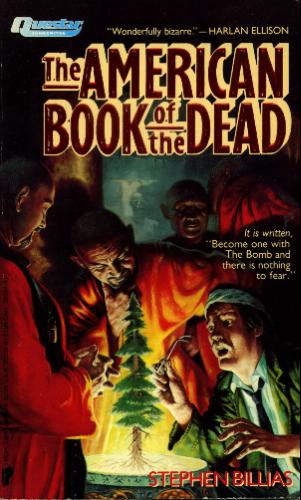
Popular Library edition, 1987. Cover illustration by Gary Ruddell.

Popular Library edition, 1987. Cover illustration by Gary Ruddell.

At that age, I was reading science fiction and fantasy paperbacks pretty regularly, and I recognized the publisher, Questar (an imprint of Warner’s Popular Library), having read and enjoyed some of their other genre-stretching offerings already. A front-cover blurb from Harlan Ellison describing TABOTD (as I will henceforth abbreviate it) as “wonderfully bizarre” sealed the deal.

It turned out to be the perfect book for me at the moment; I read it and reread it several times. I thrust it into the hands of friends to read; my dad read it; even some of my teachers read it. Everyone I gave it to seemed to enjoy it. Since then, however, I’ve never met anyone else that read or remembered it. It had only a single printing, as far as I know. Twenty-five years later, I doubted myself: perhaps in my youth I overestimated its quality or originality; perhaps it was too timely, predicated as it was on Cold War nuclear anxiety; maybe it simply wasn’t as good as I remembered.

So, this past week I reread it, and while I can’t deny the possibility that my judgment is compromised by nostalgia, I still found it an imaginative, compassionate, and frequently beautiful book. At the same time, it’s now easier for me to put it into a literary context and make some useful comparisons to other books that are likely to be more familiar to readers.

The first thing that might not be clear from the summary above is that, while Bertie’s experiences are framed as a contemporary version of the Buddha’s journey, TABOTD is an often funny book. The Zen koan, or joke which startles and leads to wisdom, is built into the text of The Book within the book, a mixture of spiritual teaching and modern commercial jargon (“CHANGELESS CHANGE, PRIMORDIAL ESSENCE OF THE GREAT PRIMAL BEGINNING: NEW, IMPROVED, LONGER LASTING” reads one aphorism). The story takes detours which are absurd on the surface but feed into the main plot. Billias makes wry observations on the foibles of humanity, both through his characters and as an omniscient narrator. The tone—whimsical, digressive, drily aware of mortal folly—is strongly indebted to Douglas Adams.

However, whereas The Hitchhiker’s Guide to the Galaxy begins with the end of the world, TABOTD builds toward it (it’s not a spoiler to reveal that Bertie’s worst fears come true—they are foreshadowed from the beginning). Adams’ protagonist, Arthur Dent, spends about one page grieving after the earth is blown up by aliens, but it’s clear he didn’t leave much behind and the focus is squarely on his adventures. Bertie Rupp, by contrast, is intensely aware of the suffering of the world, human and non-human alike: it is not only for his own sake that he fears the coming war. It’s somewhat more like Adams’ later work, as enamored with the wonders that can be found on earth as with the spaced-out products of his imagination.

If I had to assign a genre to TABOTD, I’d call it magical realism rather than any kind of science fiction: animals talk, there are signs and premonitions, and eventually the gods of mythology are brought into the mix. (One of the main characters is Monkey—the Monkey from the classic novel Journey to the West—an immortal, talking primate whose goals and prankish sense of humor are often at odds with the seriousness of Bertie’s spiritual undertaking.) There’s some pseudo-scientific rationalization (think Chariots of the Gods), but the result is a narrative world where anything can happen, and as society, racing toward Armageddon, unravels, things get increasingly freaky.

There’s also a strain of hidden history and conspiracy which, combined with the novel’s antic tone, owes something to Robert Shea and Robert Anton Wilson’s Illuminatus! Trilogy. The main antagonist is a corporate mogul described as “a government employee, at the Cabinet level, who had returned to private business after a change of administration.” His name is redacted throughout the book, so he appears as “_______ _______.” Does he represent a real person? I don’t know, but it’s not hard to think of possibilities; such figures are always timely. A grasping, scheming super-capitalist, ______ ______ is one of the few elements of the book that seems even more contemporary now than it did then; he and his fellow businessmen personify what Matt Taibbi memorably described as “a great vampire squid wrapped around the face of humanity, relentlessly jamming its blood funnel into anything that smells like money.”

Early in TABOTD, _______ _______ chooses Bertie, a temp worker, to drive him to “Big Boys Camp,” a top-secret gathering of powerful CEOs and politicians in the manner of a Boy Scout jamboree. Invited to participate, Bertie joins the “campers” for a weekend of canoeing, three-legged races, and weenie roasts under the watchful eye of a camp director. It is at Big Boys Camp that Bertie first encounters Monkey, held captive by _______ _______ and his fellow businessmen and brought out in a cage to terrify them with scary stories.

Bertie let out his breath with a gasp. A monkey was telling the creation story to American capitalists in the fantasy camp of their lost childhoods. Bertie was in dire danger of losing his perspective.

(As sometimes happens, I thought of Big Boys Camp as a surreal invention, of a piece with the talking animals and spacecraft in the rest of the book; it wasn’t until several years later that I heard about the high-powered gatherings at Bohemian Grove and experienced the weird feeling that comes from imagined fiction crashing into reality.)

For a fairly short novel, TABOTD is quite shaggy, with dozens of characters and an episodic form; some elements of it are dated, and not in a good way (Rufus, a black security guard who befriends and protects Bertie, speaks in an exaggerated “sho ‘nuff” dialect that probably wouldn’t get past an editor today). It gets a lot of mileage, however, from the steadily increasing tension of the situation, as Bertie’s travails are intercut with examples of the Strangelove-like madness that leads to war and the mania of a collapsing society. It helps, too, that Billias generates empathy for all the characters, even the villains: _______ _______ isn’t exactly redeemed, but he is a compelling presence, and honest readers will be able to see something of themselves in his self-interested calculations even if they wouldn’t take his actions. (______ ______ is also pretty dynamic: as a character defined by his fear, his will to power, and his aggressive avarice, he balances out the more passive Bertie, who is gradually letting go of all those things.)

According to what little biographical information I’ve found, Billias was in his late 30s when The American Book of the Dead was published; the melancholy tone, the sorrow for the challenges awaiting coming generations, and the sense of how precarious life is speak to me now where they went over my head as a teenager. I don’t doubt that it’s more than a little autobiographical.

If this write-up sounds vague, that’s deliberate: while I usually try to provide some analysis, in this case I’m straight-up promoting, and I don’t want to give too much away. I hope you’ll seek out this book and form your own opinion. After all these years, this is a book that I still believe deserves to be read, to be part of the conversation.
My Library, Such As It Is

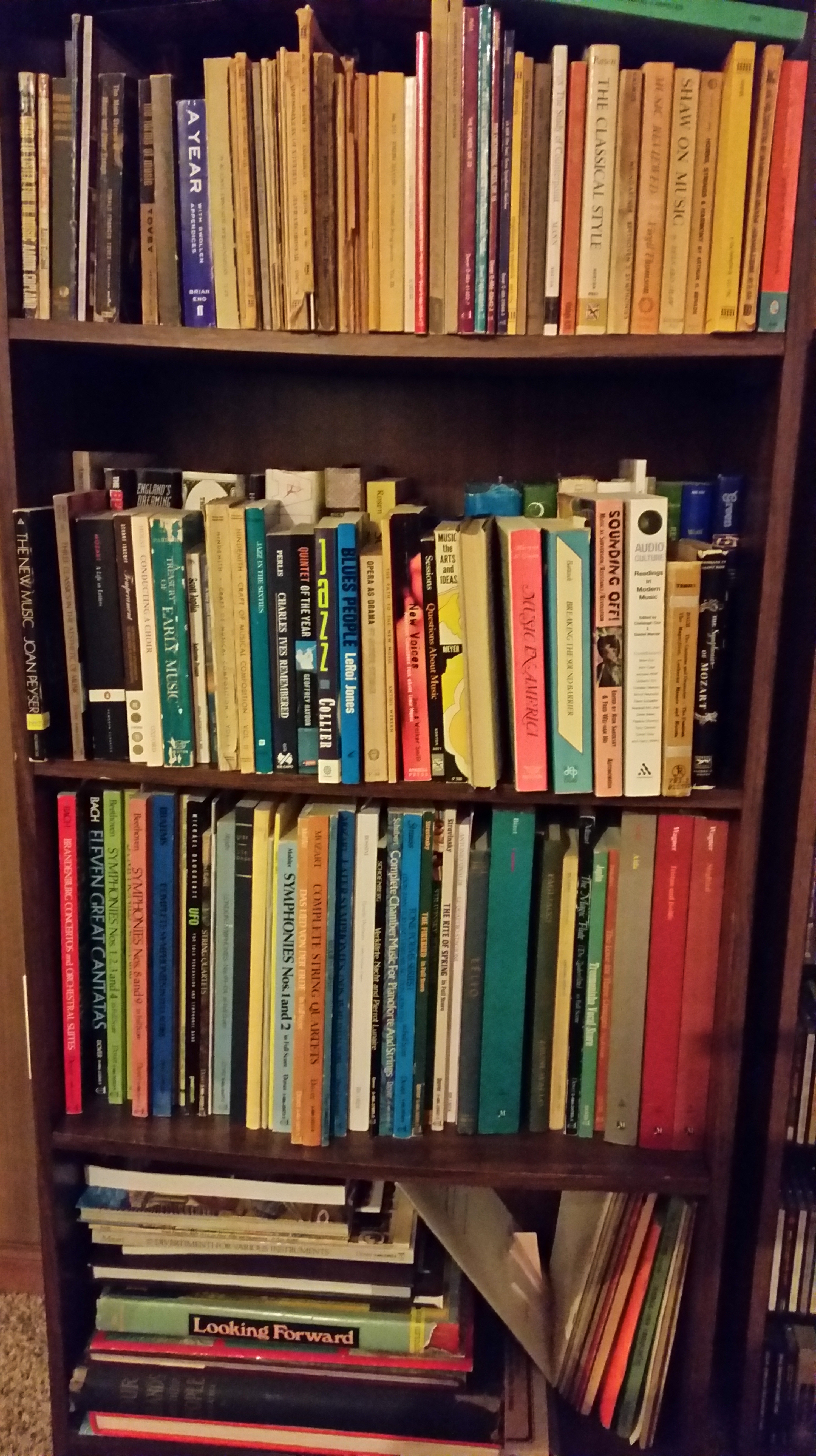
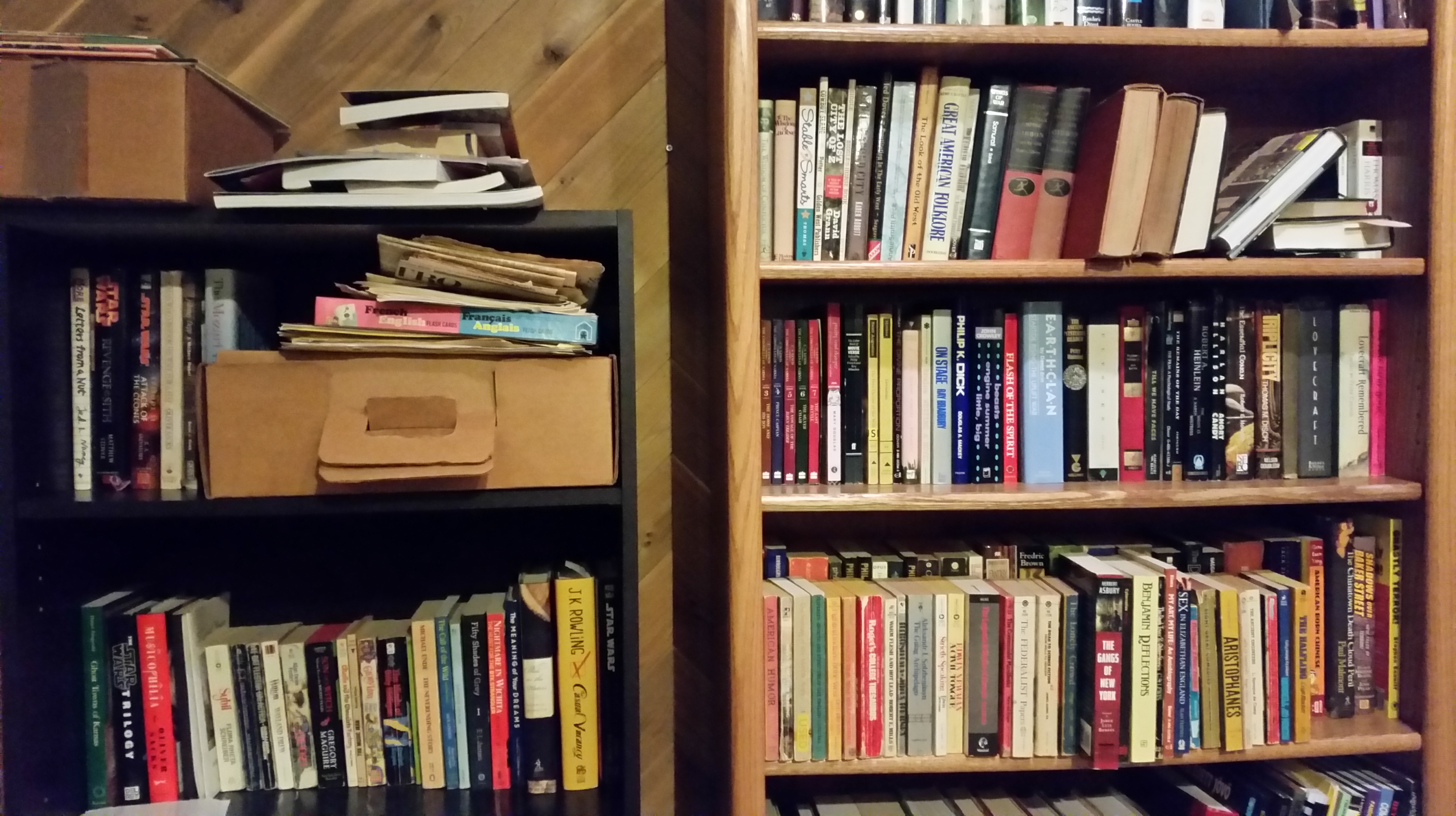
I’m not really the kind of book collector who fusses about rare items or first editions; it’s nice to find those sorts of things, and I can appreciate a beautifully-bound book as a work of art in itself, but I mostly think of collecting books as building a library for reference or enjoyment.  When I was younger, and mostly reading science fiction and other genre material, I would pursue books and authors that connected with one another in some way: the Cthulhu Mythos and the Weird Tales school; or the books listed by Gary Gygax as influences on Dungeons & Dragons; and, later on, steampunk and the nineteenth-century authors who influenced it.  When I became a graduate student and teacher, my library of music books–theory, history, and other kinds of reference–burgeoned. Along the way, I’ve picked up books of art, criticism, and aesthetics that caught my interest.

Space is always an issue, of course, for the private library as much as the public (even if it’s on a smaller scale).  Although my rate of accumulation has slowed a great deal over the last several years–I no longer have the time, space, or funds to simply buy anything of interest that I come across–I still have more books than the shelf space to accommodate them, and choices must be made.  I have tried to prioritize books that I expect to refer to, or which I haven’t read yet but would like to, but one never really knows. That’s part of the point of keeping a library, isn’t it?  (I’ve never been able to keep a strict reading list and stick to it, simply because most of the books I read suggest the next book to me: I don’t know what it will be until I’ve finished the last one.)

In one house I lived in, I had a bookshelf in the living room full of classics, some of which I had read and others I hoped to get to, lumped together by the single commonality of their supposed importance.  In the guest bedroom, however, were the books I really read, the Stephen King and Philip K. Dick, the reprints from the pulp era and the books on UFOs and unexplained mysteries.  The house I’m in now I’ve been in a little more than a year, and while the display of my books is a little less showy and two-faced, it’s still the result of practical compromises, so while much of my library looks like this:

wpid-20140720_141419.jpg

. . . a lot of it looks like this:

wpid-20140720_144254.jpg

. . . and even more of it looks like this:

wpid-20140720_144340.jpg

There are different motivations for collecting, and my motivations have changed over the years.  One of the first impulses is simply to have a collection as a form of mastery: the completist urge, to have a matched set, to have at your fingertips anything you might want to experience or refer to.  This notably affects record collectors in particular, but any kind of collector can fall prey to the need to fill in gaps, to have a satisfyingly whole body of work to dive into or simply stand back and regard.

Not unrelated is what we might call the scholarly impulse: as I’ve been discovering over the last ten months, since I started writing this blog, you can only write off the top of your head for so long before you need to pull in an apposite quote or factoid for support.  In my case, I’m blessed with a decent memory, good enough to recall something I read years or decades ago that bears on my present topic, but cursed in that it isn’t a photographic memory, and if I want to get a quote right I have to remember where I read it and dig up a copy to refresh my memory and ensure accuracy.  The internet and the public and university libraries have all helped, of course, and I’m not too proud to admit that more than once I’ve borrowed a book from the library that I already owned because it was faster to do that than hunt down my own copy.

Lately, I’ve been digging into those boxes more frequently in search of specific books that I know I’ve got, if I can just remember which box I packed it in.  Doing so makes me feel less like a librarian and more like a hoarder, but it’s vindicating when I find what I was looking for, especially when it’s something I remember not by name but by the picture on the cover, or by a general sense of “I’ll know it when I find it.”

Henry Petroski’s absorbing book The Book on the Bookshelf (which, ironically enough, I don’t have at my fingertips right now) goes into both the history and methodology of organizing books and discusses the problems I’ve alluded to here. In addition to such well-known systems as the Dewey Decimal and alphabetization by author’s last name, Petroski points out that there are many other ways of ordering libraries, some of which sound far-fetched but aren’t that crazy, at least for private collections. While we don’t organize public library books by size or color, for example, my own searches indicate those are just as useful for finding half-remembered books as titles or authors (books that are packed in boxes are often packed together based on size and shape rather than complementary subject matter!).

All of this comes to mind after another round of shifting and unpacking boxes to find a few supplementary books for my ongoing series on motion picture serials, but I went through something similar last fall when writing a series on anthologies of different kinds (both are listed on my Series page, for those wanting to catch up).  I’ll probably never have everything I own all out in the open, at least not until such time as I’m able to move into a house with shelves on every wall.  It doesn’t help that I’m not a specialist, limiting my work to a core collection of volumes on a single subject.  For now, at least, I’ll make due with a rotating collection, following my fickle muse.

Fates Worse Than Death: “What an Amazing Escape!”

Introducing the Annie Wilkes Award for Most Blatant Cheat

SceneMissing

Although the serials are nearly synonymous with cliffhangers—in which the tension builds to a high point before the episode ends, with a character in mortal danger or a major revelation left dangling—they didn’t invent them, and cliffhangers continue to be used on television, in comics, and even in film.  In the nineteenth-century, all kinds of writers serialized their work in popular magazines, from the authors of penny dreadfuls to Charles Dickens, and later pulp writers were similarly aware of the cliffhanger’s power to hold the reader’s interest.  Edgar Rice Burroughs not only used them between chapters, but also between books: he ended his second John Carter novel, The Gods of Mars, with Martian princess Dejah Thoris’ fate unknown, only to be revealed in the subsequent The Warlord of Mars.  (There is, of course, a similar narrative connection between The Empire Strikes Back and Return of the Jedi, and indeed it is now common practice for the second book or film of a trilogy to end on an uncertain note.)  Any serialized medium—in which chunks of story are doled out in installments—will sooner or later take advantage of cliffhangers to keep readers or viewers hooked.

As crude a narrative device as they are, however, cliffhangers are popular because they work: already in the short time since I began this project, I’ve sat down more than once with the intention of watching one or two chapters of a serial, only to be drawn forward by curiosity and suspense, and I’ve ended up watching several more than I planned.  I can only imagine what it was like to wait a whole week to find out whether the hero would live or die (and make no mistake, in a very few cases the hero actually did die, only to be resurrected later, or for it to be revealed that someone else had taken his place).  If you were the right age or particularly attached to the characters, it was probably as intense as the wait for a new Harry Potter novel or episode of Breaking Bad in recent years.  For casual viewers, I imagine it was more like my experience of reading daily comic strips or watching soap operas: easy to forget and not think about after the fact, but when reading or watching the next installment it all comes back to me.

Serial chapters always rewound the story to a point before the cliffhanger, both providing context (for anyone who might have missed the previous chapter) and renewing the tension (for new viewers and regulars alike).  Like reading daily comics collected in book form or watching an entire season of television in one sitting, binge-watching a serial makes for an experience with built-in redundancy.  Seeing the cliffhanger and its resolution back-to-back also makes it more obvious when the filmmakers cheat (more on this in a bit).

In Paul Malmont’s The Astounding, the Amazing, and the Unknown, a fictional mystery starring several real-life science fiction and pulp authors set in 1943, there’s an amusing scene in which L. Ron Hubbard is trapped in a forgotten, gaslit aqueduct beneath the Empire State Building with a group that also includes Isaac Asimov, Robert A. Heinlein, L. Sprague de Camp and Walter Gibson (author of the Shadow novels).  A self-styled man of action, Hubbard plans their escape:

Hubbard jerked a thumb back to the bigger hall.  “Why don’t we douse the flame, let the gas fill up, then ignite it with the lighter and blow the lid up there clean off?”

“Are you nuts?” the kid [Asimov] asked.  “Don’t you understand the formula for gas density? . . . It means we’d suffocate before we ever built up enough gas to do anything.”

“And even if we could survive that,” de Camp added, “a basic energy equation shows that the shock wave would kill us even before the roof collapsed on our heads.”

“Well, let’s dam up the stream and just float up and let the water pressure pop the top off!”

“Are you kidding? . . . The hypothermia would kill us.”

“Before we drowned under the ceiling.

The joke isn’t just that Hubbard (then a self-aggrandizing young writer, not yet the father of Scientology) is an ignoramus; rather, he is thinking like the kind of pulp hero he is accustomed to writing about.  Serial heroes, like their magazine counterparts, often relied on the same kind of likely-sounding but scientifically impossible solutions to get them out of jams.  In addition, well-aimed shots, conveniently dangling ropes or vines, and explosions from which the heroes were miraculously thrown clear tended to balance out the contrived death traps that threatened them.

That’s not the kind of cheat that infuriated serial audiences however; as long as the solution played fair and didn’t significantly change the cliffhanger’s setup, it didn’t matter whether it was likely or even possible.  After all, Flash Gordon, the Lone Ranger, and Gene Autry were heroes precisely because they could do things ordinary people couldn’t, and if their array of talents included one-in-a-million strokes of luck, well, that’s what audiences expected from them.

The difference between realistic and fair is explicated as clearly as possible by Annie Wilkes, author Paul Sheldon’s “number one fan” in Stephen King’s Misery. Wilkes (played by Kathy Bates in the 1990 film adaptation) demands that Sheldon, her captive patient, write a novel resurrecting his beloved character Misery Chastain after he had killed her off.  She won’t accept any rewriting cheats to do so, and she uses an example from the serials to explain:

This was a no-brakes chapter.  The bad guys put Rocket Man—only it was Rocket Man in his secret identity—into a car that didn’t have any brakes, and then they welded all the doors shut, and then they started the car rolling down this twisty-turny mountain road. . . .

“And here came the car, with Rocket Man still trying to put on the brakes or bash the door open, and then . . . over it went!  It flew out into space, and then it went down.  It hit the side of the cliff about halfway down and burst into flames, and then it went into the ocean, and then this ending message came up on the screen that said NEXT WEEK CHAPTER 11, THE DRAGON FLIES. . . .

“The new episode always started with the ending of the last one.  They showed him going down the hill, they showed the cliff, they showed him banging on the car door, trying to open it.  Then, just before the car got to the edge, the door banged open and out he flew onto the road!  The car went over the cliff, and all the kids in the theater were cheering because Rocket Man got out, but I wasn’t cheering, Paul. I was mad!  I started yelling, ‘That isn’t what happened last week! . . . Are you all too stupid to remember?  Did you all get amnesia?’ . . .

“He didn’t get out of the cockadoodie car!  It went over the edge and he was still inside!  Do you understand that?

Even allowing for the small number of serials I’ve watched so far, I’ve known that feeling: the hero didn’t get out of the cockadoodie car before it went over the cliff, or out of the building before the cockadoodie bomb went off, or didn’t switch the cockadoodie train to another set of rails before it crashed.  Some cheats were more obvious than others, and some studios were more prone to pull a fast one than others.  Cheats also became more common later in the serial era, when dumbed-down serials were aimed at supposedly gullible kids.  But there’s an Annie Wilkes in every audience, and they’re watching closely.  So I’m proposing the Annie Wilkes Award for Most Blatant Cheat, to be awarded (when deserved) to those moments where the film’s producers don’t quite play fair with the audience, rescuing the hero at the expense of the suspension of disbelief.  I believe I’ll have plenty of candidates.

Our Founder

Our Founder

Art Rules (or, “Freedom! Terrible Freedom!”)

You could say I’m a formalist, both in my work and in how I relate to others’ work.  Formalism has often been a term of abuse, implying a concern only for formula without regard to “content,” as if they could somehow be separated.  But I think my previous posts have made clear my interest in the different ways ideas can be organized and expressed, and the layers of meaning that can be suggested by a smart deployment of familiar elements.  Concern for formal elements doesn’t preclude evaluation of ideas and execution as good or bad, nor need it imply a completely intellectual approach by which quality is an objective truth that can be proven one way or the other.

It does allow for some wiggle room, however.  A symphony, a film, or a comic book can be evaluated on its own terms, asking “What is this work setting out to achieve?” and “Does it succeed?”  Does it work within the established boundaries of the medium and genre or seek to challenge them?  Most people nowadays have varied interests, and are accustomed to engaging works of art or entertainment pitched at different levels, adjusting their expectations based on cues within the work itself (or implied by its marketing or venue, which can lead to disappointment or the occasional pleasant surprise if the work doesn’t match expectations).  In this pluralistic environment, we are all formalists, to a degree.

What does this mean to the process of creation?  Is it just a matter of hitting the right story beats or composing four-bar phrases, of Drawing Comics the Marvel Way?  Obviously not, although those are the starting points of craftsmanship as traditionally understood.  When people dismiss stale or soulless formula, it’s often this kind of basic “how-to-do-it” stuff that they’re referring to: “By the numbers.” “Hackwork.”  Sometimes the contempt is richly deserved, and we’ve all encountered enough impersonal, indifferent work to understand that calling something “merely” professional isn’t meant to be a compliment.  It’s one thing to cling to formula, to imitate, when just starting out; it’s quite another when you feel the artist isn’t trying or thinks you’ll be satisfied with the bare minimum.

The reverse, though, can be a search for “originality” with no foundation of technique or (sometimes) knowledge of what has already been done.  And that contempt for “rules” can lead would-be artists to actively avoid formal training: “You don’t learn what you can do in school, you learn what you can’t do.”  “I don’t want to be made to fit into a box.” “I want to be able to color outside the lines.” Et cetera.  Never mind that any artist worthy of the name should hope to graduate to drawing their own lines to color in (metaphorically or otherwise).

So, yes, I’m on the side of discipline, whether it’s channeled by an established institution or developed individually on one’s own. (The point that is often overlooked in this school vs. autodidact debate is that, when you come down to it, all artistic discipline is self-discipline; no one is going to do it for you, no matter where you are.)

As for rules?  Like any other artistic resource, they can be a help or a hindrance, and this is where the formal approach comes in.  Igor Stravinsky’s Poetics of Music contains a famous passage which nails down the problem with unlimited freedom:

The more art is controlled, limited, worked over, the more it is free. . . .  I experience a sort of terror when, at the moment of setting to work and finding myself before the infinitude of possibilities that present themselves, I have the feeling that everything is permissible to me.  If everything is permissible to me, the best and the worst; if nothing offers me any resistance, then any effort is inconceivable, and I cannot use anything as a basis, and consequently every undertaking becomes futile.

For a long time I considered that my mantra, placing sometimes-arbitrary restrictions on my compositions in the name of “structure,” but frequently alternating this approach with an anything-goes, all-inclusive aesthetic.  Thus did I refute Stravinsky!  My guide at this opposite pole was Frank Zappa, who defined his approach as “Anything, Any Time, Anywhere—for No Reason at All,” and who did as much as he could to upend and undermine what he called the “hateful practices” of music.*  Sometimes I found a happy medium between these two extremes, but I caused myself a great deal of trouble by misunderstanding musical rules and how to apply them.

There are negative rules and affirmative rules: rules that say you can’t do something and others that say you must do something.  Unfortunately, the early years of musical training are often filled with the negative kind: don’t have parallel fifths, don’t use retrograde chord progressions, don’t double the leading tone. There are good reasons for all those rules, but it can be awfully restrictive if you see yourself as a loner working outside the system: save those exercises for the sheeple in Theory I—I’m going to do things my own way.  It gets worse when you get into historical counterpoint (in the styles of Palestrina and J. S. Bach), and even Arnold Schoenberg’s twelve-tone system had quite a few “don’ts,” as he originally intended it to avoid tonal implications.  It’s not hard to see why school sometimes seems to be all about NO.

It can also be easy to carry that mindset into composition: sometimes the “don’ts” are merely pedagogical tools, obstacles put in the student’s way to make them avoid the obvious, or to prevent bad habits, and as such they are useful.  Many composers (and other artists) never get past those rules they’ve internalized, turning a brace that was meant to make them stronger into a crutch they depend on.  I’ve spoken to many mature composers who said they still heard their teacher’s voice in their heads when working, but whether they heed or ignore it is part of the decision-making process.  I remember vividly the first time I included a bass drum roll in a composition, something that my first composition professor had discouraged me from doing.  I had a good reason for using it, but it still gave me an illicit thrill—and I had been out of school for eight years!  Composition education, at least in schools, is still very much a one-on-one teacher-student relationship; I don’t know if my remarks apply fully to other disciplines, but I’d be surprised if writers and studio artists didn’t have similar stories to tell.

I might have made smoother progress if I had kept in mind a passage from a few pages earlier in Stravinsky’s book (emphasis added):

Invention presupposes imagination but should not be confused with it.  For the act of invention implies the necessity of a lucky find and of achieving full realization of this find.  What we imagine does not necessarily take on a concrete form and may remain in a state of virtuality, whereas invention is not conceivable apart from actual working out.

An important principal of form that isn’t always obvious is that very often the “rules” of a given work of art are discovered in the process of the “working out” Stravinsky describes.  Rules set out beforehand are apt to be negative: formal boundaries of the sort described in the first passage from the Poetics, and they may or may not fit the material chosen to elaborate.  Rules discovered in the process of creation are more apt to be both affirmative and organically related to the material, leading to the kind of creative freedom that is the goal of all this discipline.  Sometimes the discovery of internal rules is part of a painstaking process at the writing desk or in the studio, and sometimes it takes place on the fly, as in an improvised jazz solo, but either way it comes across to the audience as freshness and spontaneity, in which developments can seem both surprising and inevitable.

As an example, comics writer Alan Moore is known for the tight formal approach and attention to detail he brings to his work; his discovery of the guiding principles he would apply to Watchmen (in collaboration with artist Dave Gibbons) is worth quoting at length (from an interview with Tasha Robinson):

I was writing the opening pages [of Watchmen No. 3] and, as is my custom, making tiny little thumbnail sketches to actually be able to envisage what the page would finally look like when it was drawn. I had two or three strains of narrative going on in the same page. I had a truculent news vendor giving his fairly uninformed commentary on the political state of the world, the likelihood of a coming war. Across the street, in the background, we have two people fixing a radiation sign to a wall. Sitting with his back to a hydrant near the news vendor, there’s a small boy reading a comic, which is a pirate comic. And I think while I was doodling, I noticed that an extreme close-up of the radiation symbol, if you put the right sort of caption with it, could look almost like the black sail of a ship against a yellow sky. So I dropped in a caption in the comic that the child was reading about a hellbound ship’s black sails against a yellow Indies sky. And I have a word balloon coming from off-panel, which is actually the balloon of the news vendor, which is talking about war. The narrative of the pirate comic is talking about a different sort of war. As we pull back, we realize that we’re looking at a radiation symbol that’s being tacked to the wall of a newly created fallout shelter. And finally, when we pull back into the beginning, into the foreground, we realize that these pirate captions that we’ve been reading are those in the comic that is being read by the small boy. . . . But, like I said, it was purely while I was scribbling, doodling, writing bits of dialogue and crossing them out that I suddenly noticed these possibilities for things that could be done in a comic and nowhere else.

Thus, Moore and Gibbons developed a visual language in which images are paired, never standing for only one thing, but in relationship with other ideas.  The use of mirrors, symmetry, and double meaning became the underlying formal principle.  In another interview, Moore discusses his series The League of Extraordinary Gentlemen, which brought characters from nineteenth-century fiction together in a single narrative continuity:

Round about the second issue, I suddenly thought ‘Hey, what if I did this so that any character that’s mentioned by name had got to be a real character from fiction?’ . . . Well, a genuine character from fiction, someone that has existed in other people’s work. And I think that it was when, possibly in the first issue, where I suddenly got to a bit where I realized that I’d got Emile Zola’s Nana being killed on the Rue Morgue by Mister Hyde, I thought, well, ‘This is great! This is going somewhere!’

The relevant point here is that in both cases the rules Moore set for himself, discovered in the process of creation, are affirmative, opening up possibilities rather than closing them off.  They set up challenges, but ones that require invention and creative thinking to overcome.  In the language of improv theater, such rules are the equivalent of “Yes, and . . . “ rather than the “NO” that often comes to mind when the topic of rules comes up.

To bring it back to the audience, does it help to be aware of such processes when reading, watching, or listening? I think it does, but I’ve already revealed myself as someone who geeks out over these things.  Not everyone wants to dig so deeply into their entertainment, and that’s fine. Despite appearances, I’m actually a strong believer in the “gut reaction:” it’s okay to like or dislike something without preparing a thesis about it or reading volumes of background to appreciate it.  Sometimes things just strike us a certain way, and the surface is as legitimate a layer to interact with as any other.  In some cases all that formal scaffolding is for the benefit of the artist, and a façade is erected to hide it from the public.  There’s something to be said for both the “holistic” and “granular” approaches to art—but I think I’ll leave it for another post.

* It is now widely known that Stravinsky wrote very little, if any, of the Poetics published under his name.  Indeed, as Richard Taruskin notes, Stravinsky had a life-long relationship with ghost-writers, and in any case Stravinsky’s public comments were often deliberately misleading, as if to throw armchair analysts off the scent.  Similarly, Zappa (for whom Stravinsky was an important influence) frequently downplayed the rigorous structure of his own compositions, preferring to be seen as an audacious prankster and provocateur. My struggle to reconcile these contradictory teachings was, in part, the price of reading too much at a young age and taking it all at face value.

Lego House on the Prairie

I saw The Lego Movie this weekend, and I loved it.  This isn’t a review, and I won’t spoil anything, although I will direct you to Charlie Jane Anders’ review at io9 and its (accurate, in my view) contention that a successful genre spoof must authentically partake of the genre it sends up (in this case, the summer blockbuster and the hackneyed “chosen one” motif).

The_LEGO_Movie_10

Like all the recent movies based on beloved toys, The Lego Movie is at least partly pitched toward the nostalgia center of viewers’ brains.  Sure, I played with Lego bricks as a child, and still enjoy them now that I have my own children to provide cover. If that were all there were to it, however, I doubt I would have reacted so strongly to the film; the other Lego spin-off video games and cartoons I’ve seen are entertaining, but not profound.  No, what I feel compelled to explore is how successful the film is at building an elaborate world out of familiar components, and its connection to the student films and music videos that did the same thing with toys when I was a kid.

The idea of toys (or other inanimate objects) coming to life is hardly new, of course: before the Toy Story movies there was Corduroy and The Velveteen Rabbit and Raggedy Ann, back to the fantasies of E. T. A. Hoffmann and beyond.  In all likelihood we could trace it all the way back to the idea of “household gods” and the pervasive spirits of pantheistic animism, or perhaps the unity of self and environment in earliest infancy.  In any case, that’s not really my point; what connects my memory of playing with Lego bricks to the new movie (and makes it successful at driving its themes home) is the constructive nature of Lego: all imaginative play gives back only what you put into it, but Lego is explicitly open-ended.  Since the first bricks were produced in 1949, every piece is part of a compatible system and can be connected together in some way.  That’s the first prong of the movie: the pleasure of digging up and recombining the different “worlds” Lego has produced over the years (including some “deep cuts” like Fabuland).

The second prong of the movie’s appeal is how this world is set in motion cinematically.  As a kid, I was obsessed with stop motion animation: my first exposure was probably on shows like Sesame Street, which, among its many other virtues, was often a showcase for inventive (and sometimes downright experimental) film.  The Carmen-singing orange was one I remember (although I had forgotten the rubbery ‘70s-era synth soundtrack, another element that connects it to many childhood memories):

Obviously, there’s a lot more where that came from.

What remains captivating about many of these little films is their handmade quality, and their use of everyday objects: toys, food, utensils.  As with furnishing dollhouses, creating dioramas, or assembling Rube Goldberg-like marble slides (think of the game Mousetrap!), there is an obvious pleasure in the handicraft involved in the creation of a tiny world, playing God on a child’s scale.  When given the illusion of movement, it made it easy to imagine the ordinary objects I saw all the time having a secret life when I wasn’t around, both tapping into and feeding that sense of domestic enchantment alluded to above.

It also made it look easy to get into the game: I recently discovered this short Super 8 film, made in 1980, and starring 12-year old Stefano Paganini’s Lego collection:

It’s rough—I know I wouldn’t have been able to do any better at that age—but it has the same sense of play that the makers of The Lego Movie explore on a grand scale.

It’s the limitations of Lego—where they can fit together, the articulation points of the minifigures—that give it character and provide something for the filmmakers—for whom there are practically no limits anymore with the use of computers—to bump against.  As Brian Eno wrote in 1995 (published in A Year with Swollen Appendices),

Whatever you find weird, ugly, uncomfortable and nasty about a new medium will surely become its signature.  CD distortion, the jitteriness of digital video, the crap sound of 8-bit—all these will be cherished and emulated as soon as they can be avoided.

Eno was mostly speaking of audio formats, but his prescient words have also proven true for visual styles.

The aesthetic qualities of Lego—abstracting familiar shapes into a grid, designed as “bricks” but able to approximate all kinds of shapes—are something that every child encounters one way or another.  Although Lego has introduced many angled and curved pieces to its arsenal, it’s the jagged sawtooth of the square pieces arranged in stair-step fashion that is still an essential part of Lego’s “look.”

Eno mentions 8-bit sound; I think the abstraction Lego encouraged was a reason I was similarly fascinated with the blocky graphics of the the video games that emerged in the late 1970s; just as with the stop motion videos that appeared to bring Lego bricks or candy to life, Space Invaders and Pong gave movement—controlled by the player!—to simple, even primal, geometric shapes.  I was so fascinated by this level of abstraction that I would practice breaking down pictures into their component pixels using graph paper.  I even briefly took up cross-stitching because it looked to me like video game graphics; the only tangible proof of that brief flirtation that I left behind was a sample sheet with a few segments of the Centipede from the game of the same name, rendered in cross-stitch.

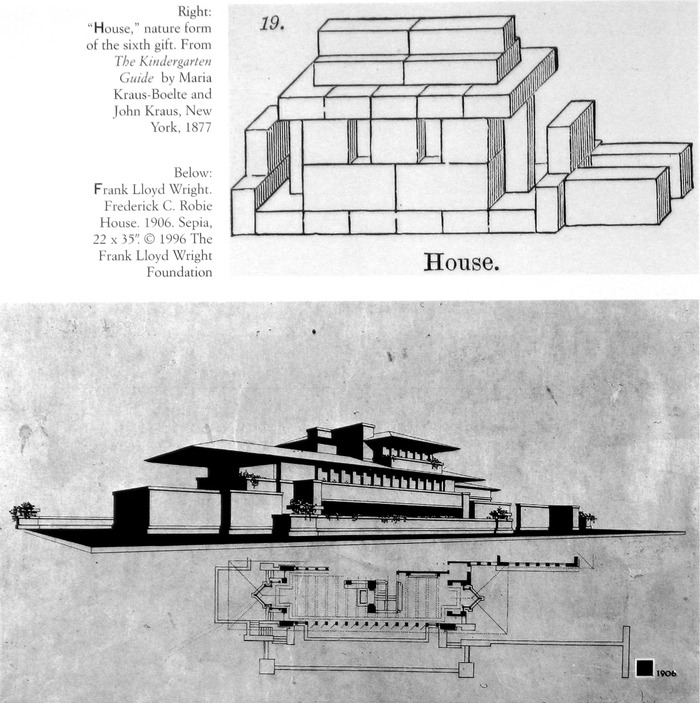
I’m reminded of Norman Brosterman’s book Inventing Kindergarten and its thesis that the first generation of twentieth-century modernists were shaped in early childhood by the highly abstracted geometric play that was a core component of nineteenth-century kindergarten. As developed by founder Friedrich Froebel in the 1830s and ‘40s, the geometric elements of kindergarten were centered around the series of about twenty “gifts,” playthings that were meant to introduce primary forms—the sphere, the cube, the cone, for example—and encourage young children to model aspects of the real world in a progression of graduated complexity.  Architect Frank Lloyd Wright would later credit Froebel’s system for developing his spatial faculties, but he was far from the only one.  According to Brosterman,

During the system’s heyday—roughly the half century before World War I—Frank Lloyd Wright was merely one of millions of people, including most of the so-called “form-givers” of the modern era who were indoctrinated, in effect, programmed, by the spiritual geometry of the early kindergarten.

Brosterman’s book is full of pictures juxtaposing nineteenth-century kindergarten projects made by small children with artwork made by adults of the same generation years later. The comparisons are suggestive, to say the very least.

From Norman Brosterman's Inventing Kindergarten

From Norman Brosterman’s Inventing Kindergarten

In addition to the Froebel gifts, there were also “occupations,” which consisted of paper, string, and clay, media that could be used to create finished projects.  Brosterman quotes American kindergarten leader W. N. Hailmann as describing the distinction between gifts and occupations:

The gift gives the child a new cosmos, the occupation fixes the impressions made by the gift.  The gift invites only arranging activities; the occupation invites also controlling, modifying, transforming, creating activities.  The gift leads to discovery; the occupation, to invention.  The gift gives insight; the occupation, power.

Without wishing to overstate the case, Lego bricks descend from the same progressive concept of early childhood development as a process of discovery and mastery, and lend themselves to a similar kind of abstraction of the real world.

Duplo.house

Interestingly, the debt Wright and other modernists owe to Froebel’s kindergarten, as described by Brosterman, has not been lost on modern educators and toy makers (in this context “toy” may sound dismissive, but it’s relevant: Milton Bradley, for example, was an important U. S. maker of Froebel gifts).  Froebel USA now makes a “Prairie House Block Set” of abstract building blocks, both a tribute to the credit Wright gave to the Froebel system and, in all likelihood, an appeal to parents who might hope for a similar start for their own children.

Wright.Froebel

And while Lego has expanded its original system of interlocking blocks to include very young children with its Duplo blocks, it’s also moved in the other direction with its “Architecture” line aimed at teenage and adult model-builders.  Detailed Lego versions of real-life architectural masterpieces, including some by Frank Lloyd Wright, are available as kits.  (Here’s a more detailed description of the Prairie-style Robie House model shown below.)  With the Architecture line, the emphasis is on faithful recreation, but the pieces are just as compatible with the Lego system as any other.  That’s the beauty of it: whether following the instructions or building freely, it’s all up to you.  That’s a core component of Lego that The Lego Movie gets.

LEGO-Architecture-21010-Robie-House

The Most Annoying Music in the World

“How do they sound? Perfect! They can’t play a lick! But mainly they got the right attitude, which is all rock’n’roll’s ever been about from day one. (I mean, not being able to play is never enough.)”  —Lester Bangs, on The Shaggs

I didn’t set out to become a vinyl collector.  The first couple of records I owned myself as a kid got so scratched up through carelessness and deliberate “misuse”—I wasn’t exactly trying to imitate the DJs who spun hip-hop beats, or “breakdancing music” as my friends and I called it, but I was fascinated by how changes of speed and direction altered the recorded sound—that they were nearly unplayable.  Later on, my dad encouraged me to record my new albums to tape so the vinyl wouldn’t get worn out.  Combine those experiences with a few warped records encountered here and there, and I was left with the impression that vinyl records were a lot more fragile than they really were.

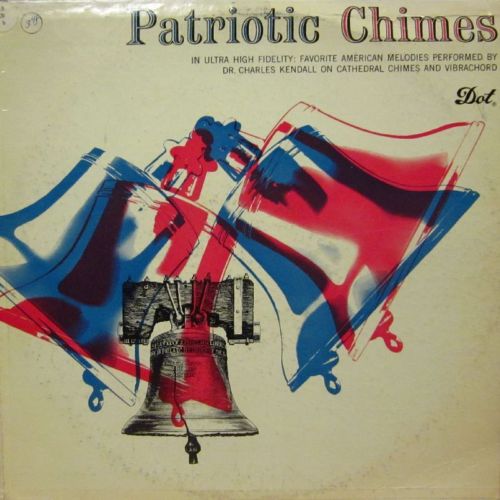
Nevertheless, when I was a teenager records became irresistible to me for a couple of reasons.  The arrival of the compact disc in the late 1980s convinced many people that vinyl was going the way of the vacuum tube, and lots of them dumped their record collections for pennies, or for nothing: it wasn’t an uncommon sight for a box of old records to be left on the curb with the trash, free for the taking.  When I was scouring garage sales and junk shops throughout the 1990s, the number, variety, and sheer strangeness of the records I encountered (not to mention the low prices for which they were selling) made them much more desirable than when I was a kid and they seemed both fragile and overpriced.  Many people were upgrading their collections to the new format (there were recurring jokes along the lines of Dennis Miller’s complaint that he was buying Meet the Beatles for the fourth time), but there was also a generational turnover: among the outlets I frequented were garage sales by downsizing retired couples, as well as estate sales.  In some cases the audience for the first wave of “easy listening” and “mood music” LPs was aging out, and their grown children had no interest in keeping the music that had (undoubtedly) driven them into the waiting arms of rock and roll in their own youth.

PatrioticChimes

Indeed, for a few years, practically any place that sold used goods—antique stores, flea markets, thrift shops, and more—would have records, and I was always, always compelled to look through what they had to offer.  When I was a student at Wichita State University, there was a regular (every three semesters) sale held to raise money for the music department, and I’d spend a good part of the sale week between classes browsing boxes of donated records (along with books, sheet music, and other items).  My collection swelled.

Classical music predominated at the music department sale, but there were always oddball items as well.  Like a lot of teenagers, especially in the “whatever, man” ‘90s, I was driven to search for the tackiest, most ridiculous items I could find in order to mock or celebrate them as “so bad it’s good.” I’ve mentioned following the Dr. Demento radio show; the good Doctor would sometimes feature what he called the “Audio Torture Chamber,” a selection from a truly excruciating (usually deliberately so, but not always) record.  That’s where I first heard snippets of Lou Reed’s infamous Metal Machine Music and “the world’s worst orchestra,” the Portsmouth Sinfonia.  As a collector and aficionado of the weird, I wanted in on that action.  Maybe it says something about me that I loved being able to put on a record that elicited squirms, groans, and protests from my captive audience.  It was at least a more dramatic response than the assumed coolness that would come over them when I tried to play something, you know, good.  (Whether it was any more genuine, or they were just playing up their reaction for my benefit, I couldn’t say at this remove.)

In general, the less specialized the store was, the better: record stores were (generally) staffed by people who had an idea their wares were valuable—although the weird stuff I was looking for was usually in the bargain bin anyway—but thrift stores weren’t picky, and everything might be priced at fifty cents or a dollar apiece, cheap enough that I could gamble on a promising cover.  Years later, when I saw the hip-hop DJ documentary Scratch, I learned about a gizmo some of the crate-diggers used to audition records before they bought them: a motorized toy truck with a needle on the front and a tiny speaker inside.  The truck would “drive” around the record, the needle keeping it in the groove as the sound played through the little speaker.  Brilliant!  As it was, I usually had to rely on the appeal of the cover or my sketchy knowledge of the artists involved.

Yes, I have this in my collection.  Be jealous!

Yes, I have this in my collection. Be jealous!

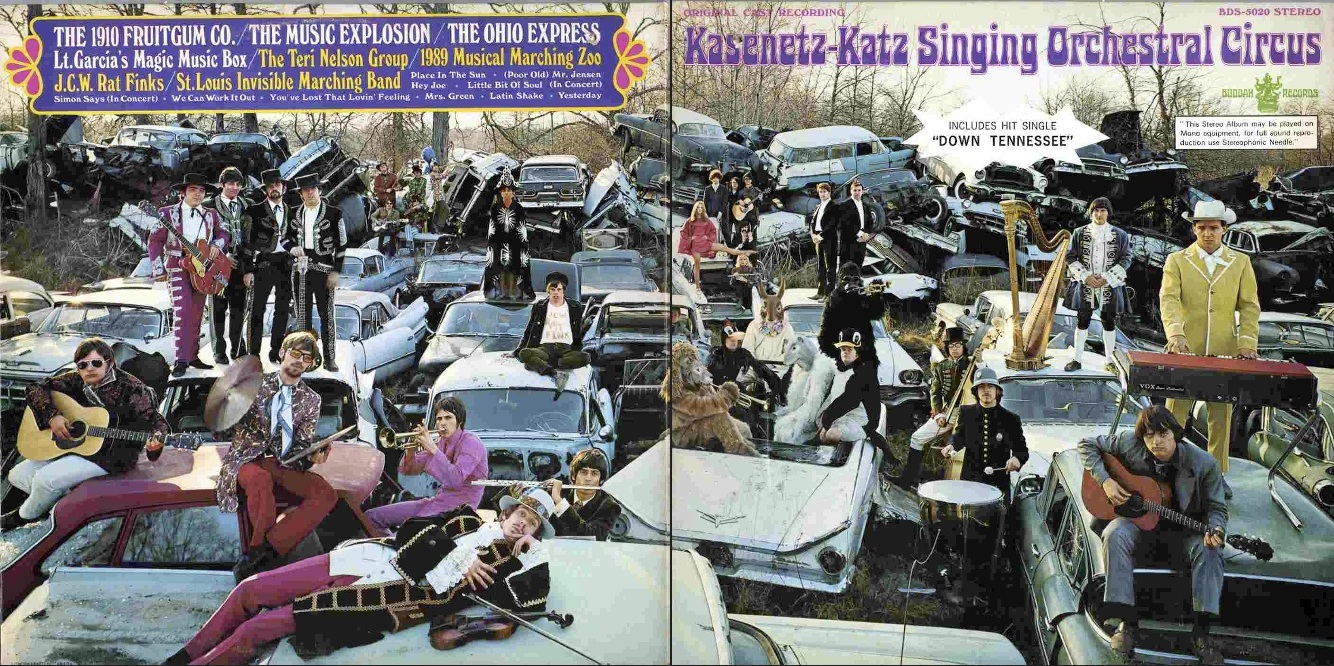
And what covers they were!  The LP was a miracle of packaging and marketing: its twelve-inch square cover was a perfect canvas for beautiful (or at least striking) art, suitable for framing, an advertisement for itself.  If the music inside turned out to be good, that was an added bonus.  Sometimes the contents were merely conventional: with the right cover and some creative liner notes, a collection of military band marches could be sold as Music for Baton Twirlers, and an album of bump-and-grind studio jazz packaged as How to Strip for Your Husband.  In both cases, the music is pretty good, but what sticks are the pop art covers and the impulse toward functionality, toward treating music as an accessory to one’s lifestyle, common enough in the hi-fi ‘50s.

BatonTwirlers

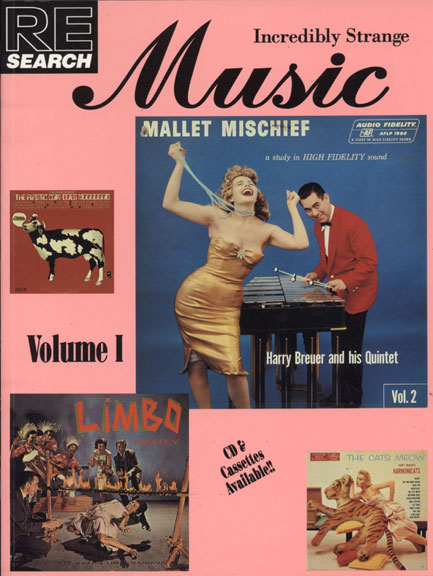
I was already exploring this territory when RE/Search PublicationsIncredibly Strange Music series arrived and handed me a map to make sense of it.  Founded in San Francisco by series editors Andrea Juno and V. Vale, RE/Search began as underground ‘zine Search & Destroy; by the time I encountered them, it had developed into a series of books dedicated to “fringe” topics: freaks, body modification, cult films, and challenging artists such as J. G. Ballard, William S. Burroughs, and Brion Gysin.  Incredibly Strange Music Volumes I and II were Numbers 14 and 15 in the series, published in 1993 and ’94, and the series’ format showed its magazine roots, consisting of interviews with musicians (including the Cramps, Eartha Kitt, and Jean-Jacques Perrey in Vol. I), collectors, and assorted eccentrics, as well as short articles on aspects of the recording industry.  First and foremost, the series was a celebration of the incredible diversity of music recorded on vinyl (especially in the heyday of the LP, from the 1940s to the ‘70s), most of which was in danger of being forgotten.  A theme that runs through many of the interviews is that, in addition to vinyl’s superiority over the CD (a given for many audiophiles at the time), a vital popular heritage was in danger of being swept away because only the established classics were being converted to CD.  People were throwing records away in order to go digital, but many of their vinyl albums might never make that transition!

rs14full

Incredibly Strange Music became, in effect, a guidebook to the kinds of records I might find, and an informal checklist of specific artists and titles to look out for.  Records were about more than just music: for example, Mickey McGowan, proprietor of the “Unknown Museum,” listed such categories as bird recordings, sound effects, promotional, soundtracks, celebrity recordings, outer space (often including electronica), comedy, children’s records, and whistling records, among others, when discussing his collection.  Recovering once well-known artists like Indian organist Korla Pandit or the exotic, multi-octave vocal phenomenon Yma Sumac from obscurity was another goal of many of the collectors interviewed.  A feeling common to many collectors, and reinforced by the interviews in Incredibly Strange Music, was one of cultural archaeology: we were all doing important work, rescuing the cultural flotsam that wasn’t considered significant enough to preserve in libraries or conventional museums.

Music of the hopelessly inept was another “incredibly strange” kind of music discussed, but it was a recurring thread, whether considering the “turn your poems into songs” racket, vanity records that allowed amateurs to put together professional-looking, if not –sounding, projects, or small-time regional acts that didn’t have what it took to crack the big time.  Then there were such unclassifiable acts as The Shaggs (who I think I also first heard on Dr. Demento’s “Audio Torture Chamber”), a group of sisters whose father, Austin Wiggin, Jr., had dreams of turning them into pop stars, despite their lack of musicianship, charisma, or even the ability to keep a steady beat.  Were The Shaggs really “better than the Beatles,” as Frank Zappa reportedly claimed?  Not according to standard definitions of quality, but there is something otherworldly about their spacey, off-key recordings, and there is an endearing charm to their guileless enthusiasm.  For those who seek out this sort of “outsider music,” it’s not uncommon to express wonderment that such a thing exists at all: some of The Shaggs’ recordings are so out there that it’s easy to forget they were conceived of as a pop combo, but their repertoire won’t let us forget, mixing covers of songs by Tom T. Hall and the Carpenters with stream-of-consciousness originals like “My Pal Foot Foot.”

The implication that professional product is too slick to be authentic, and that music like The Shaggs’ comes straight from the heart (or the id, or possibly from another dimension), and is thus more honest, is one that’s been around for a while, and it can be problematic.  Not necessarily wrong, mind you—there is always a point at which the inquisitive listener seeks to go beyond what they’ve grown up with, what they’ve been exposed to by their parents, the radio, and the surrounding culture.  Something like The Shaggs may be just what it takes to start such a listener exploring, and I’ll accept the sincerity of Zappa’s praise of The Shaggs, or that of early Shaggs booster Tom Ardolino (who claimed to hear a resemblance between the Shaggs and early Ornette Coleman), whether or not I agree with it.  Such praise can often be backhanded, though: would notorious perfectionist and technician Zappa have wanted the Wiggin sisters in his band?  I think we know the answer to that.

Any appreciation of outsider art that veers into ironic “so bad it’s good” praise, celebrates a lack of craftsmanship or obscurity for its own sake (especially as a form of one-upmanship: “You probably haven’t heard of it”) can be interpreted, deservedly or not, as either mean-spirited or simply contrary—in either case, inauthentic.  You might even invite the dreaded “hipster” label.  Similarly, the assumption that an outsider artist can be “redeemed” by official recognition or appropriation by someone in the establishment is troubling.  As much as I love Tim Burton’s Ed Wood, for example, its existence doesn’t validate the gonzo creations of its eponymous hero: it doesn’t have to, for they exist on their own and are worthy of consideration as works of art, however naïve.  To treat them any other way is to perpetuate an unfortunate tendency of the fine art world to draw on folk/ethnic/commercial/outsider sources that are conveniently defined as “non-art” in order to be transformed (i.e., exploited) by a “real” artist, or to recognize the occasional genius working outside the system only after they are safely dead.

Still, anyone who feels that the Shaggs are being condescended to should compare their career to that of the Cherry Sisters, who were in some ways the Shaggs of the 1890s.  According to author Irwin Chusid in Songs in the Key of Z, “Effie, Addie, Ella, Jessie, and Elizabeth Cherry of Marion, Iowa, were by contemporary accounts the worst act in showbiz.  Their program, Something Good, Something Sad, was so atrocious it triggered a perverse public hysteria: it played to sold-out New York houses for 10 weeks.”  The Cherry Sisters’ mawkish, humorless performances (“an evening’s worth of hokey, moralistic one-acts, derivative ballads, and awkward ethnic routines,” in Chusid’s words) were greeted with such vitriol that a wire-mesh screen had to be erected across the stage to protect them from vegetables and other missiles thrown by patrons.  Promoters (including Oscar Hammerstein) knew exactly what they were selling, but the sisters at least pretended not to know—they claimed the rowdy crowds were hired by jealous rival actresses to sabotage their performances.  Were the Cherry Sisters playing along or hopelessly naïve?  They never let on, but were able to tour across the Midwest with their show, and earned upwards of $200,000, according to some reports.

A funny thing happened as I explored the world of kitschy, tacky music: I found things I genuinely liked, in an unironic way.  I was already having a good time, of course—I wouldn’t have wasted so much time and money looking for these things if I weren’t enjoying myself—but at some point I crossed the invisible line between “Get a load of this!” and “Hey, this is really good!”  A lot of the music I gravitated to was only “incredibly strange” in the sense of its separation in time, coming as it did from past decades with very different ideas of what was cool.  For example, Lawrence Welk was the epitome of squareness even before I was a kid, but the musical chops of many of his stable of performers were for real.  I was already interested in ragtime and early jazz, so I was receptive to Jo Ann Castle.  Ditto with Myron Floren: I liked the accordion—again, maybe because it was so dorky, associated with performers like “Weird Al” Yankovic, but also because it just sounded cool—and Floren could really play.  There was a whole galaxy of once-popular instrumental virtuosi that I’m still discovering.  My recent column on banjo groups led me to Eddie Peabody, whom I hadn’t encountered before:

Part of the process is simply hearing enough to find what you respond to.  One of my favorite albums that I found in high school was called Dutch Band Organ, and it contained lively, full-sounding arrangements of syncopated pop tunes like “Cuddle Up A Little Closer” and “Did You Ever See A Dream Walking?”  It is the standard by which I have judged other band organ records for twenty years.  Similarly, I have a hard time imagining what the world was like when The Three Suns (a trio of accordion, organ and guitar) were representatives of sophisticated popular music, but I’m glad I found them (their early records, like Cocktail Time, are more impressive to me than the later records where they team up with a full orchestra).  Turntable artist Christian Marclay has commented on his attraction to “deeply unhip” records for his collage-like performances, and I share that interest: I’m always on the lookout for recordings of oddball instruments like the banjo, accordion, or chimes, the seeming underdogs of popular music. They deserve to be heard, too.

Much has changed since Incredibly Strange Music was published.  The entire RE/Search series captures a moment, a transitional period between the underground culture of the 1970s and ‘80s and the internet culture that makes it much easier for like-minded people to find each other and share information.  Many of the recordings featured in the book are easily heard online now; in fact, a great many of the vinyl oddities that were expected to disappear forever have made the transition to CD, however belatedly.  Labels like Collector’s Choice and Sepia specialize in this sort of material.  Even Dutch Band Organ is on CD now, something I never, ever would have expected.  Of course, the CD as a format is now on the wane, replaced by streaming, even as vinyl records have made a comeback, but the older audience that presumably favors these reissues isn’t known for being early adopters, so they may be a better bet for CD manufacturers, for now, anyway.  As for me, I love the options I have now, and I’m glad vinyl has continued to be relevant, but I’m glad I was in a position to explore the LP heritage at a time when it seemed like it might be gone for good.

Everybody’s Looking for Some Action

There were big tables covered with comics standing upright in long rows.  A sign hanging from the ceiling said All Comics 5¢.  We began to flip through the comics.  Alan had a list with the titles and numbers of the comics he wanted.  It was slow work.  The only comic he found that was on his list of wants was a copy of Action Comics Number 1—but he didn’t buy it because there was a corner torn off the cover.  He said he only bought comics that were perfect.

That throwaway line, from Daniel Pinkwater’s young adult fantasy Alan Mendelsohn, the Boy from Mars, is played for irony, of course: even in 1979, when Alan Mendelsohn was first published, a copy of the first issue of Action Comics—the comic book in which Superman made his first appearance—was something the average collector could only dream of finding, in any condition.  It also establishes Mendelsohn’s character: exacting to the point of eccentricity, and confident enough to pass up the find of a lifetime because it’s not exactly what he’s looking for.  Later, Mendelsohn sells his comic book collection to finance the greater adventure he and Leonard (the narrator) are on: Mendelsohn remains cool while his buyer goes increasingly crazy for the rare finds Mendelsohn has.  By the end, Mendelsohn has the buyer eating out of his hand, and he and Leonard get the money they need, and then some:

 “The difference between that man and me,” Alan Mendelsohn said, “is that I am a connoisseur, and he is a fanatic.”

Both scenes play into powerful fantasies for young collectors: finding a holy grail—there have been more expensive comic books, but few that are as recognizable as Action Comics No. 1—and being able to leverage our finds down the road, using our connoisseurship to get one over on the drooling fanatics who’ll pay any price for what we have.

Action-Comics-No-1

Sadly, for most collectors, the fantasies remain just that.  For the past few days, the comics blogosphere has been chewing over an article in Businessweek pointing out that you’re probably not going to be able to retire on the proceeds from your comic book collection.  As an example, columnist Frank Santoro offers an anecdote that stands in for the general trend:

He recently had to break the bad news to a friend’s uncle, who was convinced his comic collection—about 3,000 books—was worth at least $23,000. “I told him it was probably more like $500,” Santoro says. “And a comic book store would probably only offer him $200.”

When I read this, my first reaction was: “Well, duh.”  While auction prices for “key” Golden Age issues have continued to rise, it should be obvious that there is a big difference between Action Comics No. 1 and Secret Wars II No. 1, and the collections owned by the forty-something men in the article are likely to be more laden with the latter than the former.  I know, because I’m one myself, with a collection of bagged and boarded comics in the basement, and I doubt I’ll ever get much out of it in monetary terms.  Sure, it was disillusioning the first time I realized I wouldn’t get what I thought something was worth out of it, but I’m willing to settle on a realistic price for anything; it’s just that “realistic” can look very different depending on whether one is buying or selling. I’ve encountered my share of junk shops, garage sales and Craigslist ads run by deluded souls convinced that they’re sitting on a gold mine.  I’ve seen scratched-up Beatles albums for $40 or $50 (and not the rare ones) and highly-promoted but far from rare comics from the ‘90s with high price tags.  Anyone who has collected anything, or even tried to buy a used car or piece of furniture, could tell similar stories.

The seller may have an inflated idea of the scarcity of their item, or they may have been swept up in the hype of ever-rising prices for collectibles in general; they may even have a price guide to back them up, which only proves that someone was willing to pay a premium for the item (in mint condition, which is usually not the case) at one time.  Still, something is really only “worth” what someone else is willing to pay for it, so I imagine those albums and comics are still sitting on the shelf, or were marked down or put into storage—or found a buyer as gullible as the seller (leading to the description of the back issue market as a “Ponzi scheme” in the Businessweek article).

But clearly, the idea that your old comic book collection would put your kids through college is an old one, an article of faith (or folklore) that predates the speculation boom of the 1990s.  As Alan Mendelsohn shows, it was already alive and well in the 1980s, when I was collecting, and it didn’t only come from the publishers and retailers who had a vested interest in promoting “collectability.”  The belief among collectors that we were stockpiling a monetary investment for the future had a “revenge of the nerds” quality, like the stories we told ourselves that we would all become successful inventors or entrepreneurs, getting the last laugh on the jocks, the bullies, the “normals” who got in our way.  I guess it worked out that way for a few people, but for the majority it was a self-serving myth (and for the record, Alan Mendelsohn got a hundred and eighty-five dollars and a brass potato for his collection; he didn’t become a millionaire).

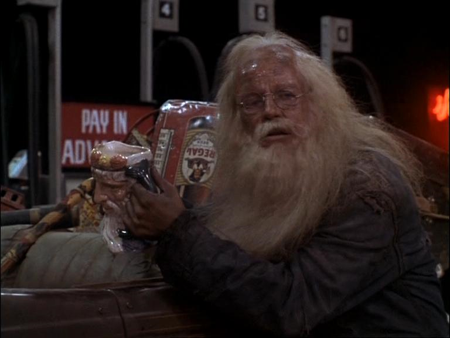
As an extreme example, consider “Gather Ye Acorns,” a 1986 episode of the anthology series Amazing Stories.  In it, Mark Hamill (in one of his few post-Luke Skywalker, pre-voice acting roles) plays Jonathan Quick, a dreamy young man growing up during the 1930s, obsessed with comic books, pulp magazines and toys.  Pushed by his parents, who urge him to “grow up” and cast off his childish belongings, Jonathan is approached by a mysterious, gnome-like figure, a folkloric wild man (played by David Rappaport), who encourages him to keep the things he loves, to hold onto the magic of childhood.  What the world needs, the troll tells him, “is a few more dreamers.”  Over the years, Jonathan turns down the prospect of a normal life, descending into poverty and eventually living in a pitiful shack with his shabby old car and all his old junk; just when he has lost faith, he encounters (at the “Last Chance” gas station!) a knowledgeable (and wealthy) collector.  It turns out that the world has come around, and his belongings, which for so long were precious only to him, are now highly collectible.  The owner of a comic book shop is shown going through his treasures in disbelief: why, that’s Action No. 1, the first appearance of Superman!  The episode ends with an auction of Jonathan Quick’s collection; now wealthy, he encounters the troll one last time, and while trying to thank him, makes the acquaintance of an attractive lady.  Perhaps it’s time for Jonathan Quick to finally settle down.

In the broadest sense, that of allegory, “Gather Ye Acorns” is a story of holding on to the magic of childhood, of not letting others define you or devalue your passions. But I doubt I was the only viewer who took the story’s moral literally, as a vindication of the collecting lifestyle: “See?  All that stuff had value, and he ended up rich!”  It’s probably also a middle finger to the parents of Baby Boomers (like Steven Spielberg, who produced the series, and whose story Stu Krieger’s teleplay is based upon) who threw out all their kids’ baseball cards and comic books, and who, like the overbearing parents in “Gather Ye Acorns,” probably never saw that junk as anything but a waste of money in the first place.

Looking back at actual history, however, there was more than just the ever-present Generation Gap at work: the social upheaval and increased mobility of the Depression and World War II made the maintenance of big collections an unlikely prospect, even for those who might have been so inclined.  It’s hard for us nowadays to imagine how few possessions most families had compared to the present (and forget about renting extra storage space, as so many of us do now!).  Remembering the adage “every move is like a fire,” it’s also likely that in the migrations of the war years (from the Dust Bowl to the West; from the deep South to the factories of the North; from rural areas to cities, and from cities to the suburbs), preserving ephemera like comics was simply not a high priority for most people.  Finally, the war effort included paper and shellac drives that undoubtedly consumed thousands of comics, magazines, and records.

It’s for all the above reasons that the “key” issues from the Golden Age command such high prices, and why, barring a similar national upheaval, later issues probably never will.  Even as a kid, it was obvious to me that if everyone was saving their comics (and baseball cards, and whatever else), they would never become as scarce as material from the 1930s and ‘40s (or ‘50s, when a great number of comics were destroyed as part of the moral panic that led to the creation of the Comics Code).  In some cases, it was now parents who enabled the preservationist instinct, Baby Boomers themselves who didn’t want to repeat the mistakes of their own parents.  And of course, scarcity is only part of the equation: it has to be something people want in the first place, or low supply will do nothing to drive up demand.  Even if all those variant-cover comics from the ‘90s disappeared, it’s unlikely they would ever be as sought-after as historically important issues like the first appearances of Superman or Batman.

Since we don’t know what will be scarce and desirable in the future, should we save everything, just in case? Interestingly, at the midpoint of “Gather Ye Acorns,” when Jonathan Quick is squatting in a shack in the desert, he resembles a figure that has become much more visible since this episode was broadcast: the hoarder.  His anger at the troll, his disgust with the “treasures” he’s spent his life hanging onto, and above all his despair—“I have nothing!” he howls—are the flip side of the usual narrative, and are a frighteningly real moment in a story that otherwise has the broad outlines of a fable.  Even with the happy ending, the story seems to stretch things when it suggests that his years of struggle were worth it, because he lived life on his own terms; this comes awfully close to romanticizing poverty, as if there were no middle ground between his parents’ rigid standards and life as a “bum.”  As writer Noel Murray asked when examining two current portraits of Americans’ relationship with our possessions, the TV shows American Pickers and Hoarders, “So which is it? Are we supposed to hang on to all of our old crap just in case it turns out to be valuable, or is that kind of packrattery the sign of a disordered mind?”

Mark Hamill as you, the reader

Mark Hamill as you, the reader, on Amazing Stories

Of course, you could still read your comics.  When I was a kid, I had a friend, Jason, who often came around to trade comics.  On the one hand, he was always interesting to talk to, and had a knack for digging up unusual books I’d never seen; on the other hand, he’d drive me crazy by going through my stacks, getting things out of order, and wanting to trade for issues that would break up continuous runs.  Condition didn’t matter much to him; it was the stories that were important.  Jason was a throwback, the kind of comic book reader who had supposedly disappeared with Leave it to Beaver: he didn’t bag his comics—he’d even roll them up to stick in his backpack, to my horror.  (In retrospect, I wasn’t much more careful, but I could be an awful snob.)

Despite my efforts to preserve my comics like a good investor, my best memories of being a comics reader in the 1980s are of getting together with friends to read and discuss comics, and even those marathon trading sessions that left me cleaning up and reordering my collection for the rest of the afternoon.  Similarly, some of the comics I most fondly remember finding at garage sales were reprints, some with the covers missing, of no monetary value at all.  I tried valiantly to be a connoisseur, but I guess I was really a fanatic all along.

Instruments of Death

“The Torture Garden: It’s where the Devil calls the tune . . . to play a concerto of fear!”

–Trailer for Torture Garden, 1967

danceofdeath

In honor of Halloween, it’s time to look at the spookier side of musical instruments, specifically the roles some have played in mystery and horror fiction.  On the one hand, the organ has the most sinister reputation of any instrument through its association with the Phantom of the Opera and his fictional descendants: there’s just something about the full organ’s portentous sound and the gloomy atmosphere of the Gothic cathedral that goes hand in hand with cobwebs and candlelight, so expect to hear many renditions of Bach’s Toccata and Fugue in D Minor (or at least the opening bars) during October.  The organ, nicknamed “the king of instruments,” also fits nicely with the popular association of criminal masterminds with classical music: we like our villains to have refined taste, whether played by Vincent Price or Anthony Hopkins.  In the same way, the organist seated at his instrument, surrounded by ranks of keyboards, pedals, and organ stops ready at his command, is a neat visual shorthand for a master manipulator, sitting at the center of a web, controlling everything around him.  (In at least one case, the direct-to-video Disney sequel Beauty and the Beast: The Enchanted Christmas, the organ is the villain, conniving to make others to do its will even though it cannot move from its place.)

Lon Chaney, Sr. in the 1925 film The Phantom of the Opera

Lon Chaney, Sr. in the 1925 film The Phantom of the Opera

Brian De Palma's 1974 update, Phantom of the Paradise

Brian De Palma’s 1974 update, Phantom of the Paradise

The violin, on the other hand, is often associated with the Devil, as in such pieces of music as Danse Macabre, L’Histoire du Soldat, and “The Devil Went Down to Georgia.”  In folk tales, the Devil enjoys wagers, betting his own gold fiddle against the souls of his opponents.  He may also bestow musical talent in exchange for a soul, a prominent part of the myth surrounding Tartini’s “Devil’s Trill” Sonata. Later, the great Italian virtuoso Niccolò Paganini was the subject of lurid rumors that he had sold his soul, and worse: Theosophy founder Madame Helena Blavatsky included Paganini in her story “The Ensouled Violin,” and graphically embroidered on the notion that the strings of Paganini’s violin were made from human intestine, and that his uncanny ability to mimic the human voice with his playing actually came from a spirit trapped within the instrument.

A similar story is part of the mythology of the Blues: Robert Johnson was supposed to have met the Devil at a crossroads at midnight, where he traded his soul for his legendary guitar-playing ability.  The legend formed the basis of the Ralph Macchio film Crossroads and was parodied on Metalocalypse (in the episode “Bluesklok”).  Interestingly, Elijah Wald, in his book Escaping the Delta, has shown that the same story was originally attributed to a Tommy Johnson and then transferred to Robert when his legend outpaced Tommy’s.  Naturally, the whole thing has roots in folklore: Wald points out, “When Harry Middleton Hyatt collected stories of musicians going to the crossroads to gain supernatural skills, as part of a vast study of Southern folk beliefs in the late 1930s, he reported as many banjo players and violinists as guitarists,” as well as an accordionist.

Why is there such a connection between fiddling and death?  In the Middle Ages, instrumental music was considered both profane and frivolous, closely associated with itinerant, always-suspect actors and minstrels and the drunken singers in taverns.  In depictions of Death (usually as a skeleton, the same as now), musical instruments were often a symbol of the sinfulness, vanity, and futility of all human activity, not just music.  (The popular image of Nero “fiddling while Rome burned” probably owes much to this symbolism, as the violin had yet to be invented in Nero’s day; likewise, contrast the supposed indolence of grasshoppers with the industry of ants.)   The image of a grinning skeleton “playing” his victims into the grave may have struck the medieval viewer as cruel irony, a just punishment, or as a warning.

The medieval dance of death.

According to one author, the connection between the violin and mortality was more than just poetic: in 2006, Rohan Kriwaczek published An Incomplete History of The Art of Funerary Violin.  According to Kriwaczek, there had once been a Guild of Funerary Violinists, whose work, repertoire, and indeed their very existence had been suppressed by the Vatican during the Great Funerary Purges of the 1830s and ‘40s.  After 1846, the few remaining members of the Guild went underground, and Kriwaczek, eventually entrusted with their legacy, was able to piece together this secret history and bring it to the public. Kriwaczek describes the Funerary Violinist as playing a potent intercessionary role:

In his tone the violinist must first convey the deep grief that is present in the gathering, and then transform it into a thing of beauty.  By the time he is finished, a deep and plaintive calm should have descended, and the bereaved should be ready to hear the eulogy. . . . The violinist’s is a position of great responsibility, akin in many ways to that of a priest or shaman, and should not be taken lightly.

Alas, the book was a hoax, supposedly concocted by Kriwaczek to increase his bookings as a violinist at—you guessed it—funerals.  Still, I can’t help but feel that Kriwaczek’s story, with its dueling Funerary Violinists, buried secrets, and cameos from outsized characters including composers, Popes, and virtuosi, would make a smashing TV program, a historical saga with more than a touch of gothic intrigue.

Sometimes the instrument is cursed: in the short “Oh, Whistle, and I’ll Come to You, My Lad” by the master of the English ghost story M. R. James, it’s an ancient bronze whistle (proving that another James title, “A Warning to the Curious,” could equally apply to almost all his stories):

He blew tentatively and stopped suddenly, startled and yet pleased at the note he had elicited. It had a quality of infinite distance in it, and, soft as it was, he somehow felt it must be audible for miles round. It was a sound, too, that seemed to have the power (which many scents possess) of forming pictures in the brain. He saw quite clearly for a moment a vision of a wide, dark expanse at night, with a fresh wind blowing, and in the midst a lonely figure–how employed, he could not tell. Perhaps he would have seen more had not the picture been broken by the sudden surge of a gust of wind against his casement, so sudden that it made him look up, just in time to see the white glint of a sea-bird’s wing somewhere outside the dark panes.

Just as frequently it’s a MacGuffin that activates the plot: a Stradivarius is as valuable as a van Gogh, and serves as well as any other objet d’art as the motivation in a murder mystery.  An example is the three-quarter sized Strad, the Piccolino, at the center of Gerald Elias’ mystery Devil’s Trill, the first of a series centered on violinist-sleuth Daniel Jacobus.  And despite its unusual varnish, the titular instrument of the 1998 film The Red Violin is haunted more by tragedy and human foibles than by any supernatural evil.

The weaponized instrument is an infrequent literary device, but there are a few examples: the murder in Dame Ngaio Marsh’s Overture to Death is accomplished by a revolver hidden inside an upright piano, rigged to fire when the pianist plays the third chord of Sergei Rachmaninoff’s Prelude in C-sharp Minor, a Rube Goldberg arrangement that sounds about as practical in real life as this:

Likewise, it doesn’t seem that it would be that hard to escape the vengeance meted out by the grand piano in “Mr. Steinway,” a section of the 1967 anthology film Torture Garden, based on stories by Robert Bloch.  In the story, the piano in question belongs to a prominent virtuoso, a gift from his mother, and his devotion to it is tested when a young lady (played by Barbara Ewing) enters his life.  The black wing shape of the piano is a looming presence in the film version, always in the background or casting its shadow over the doomed couple, and the Oedipal implications of the pianist’s relationship with his mother, never seen but personified by the piano, are left as unspoken subtext.  So far, so good, but by the time the piano lurches into motion and pushes the intruding girl out the window, we’ve entered the realm of delirious high camp.  The lesson: music is a jealous mistress.

Finally, as a bonus, I present one of the most bizarre (and gratuitous) examples of this trope, from the 1976 film The Town That Dreaded Sundown: death by trombone.  Happy Halloween!

The Pleasures of Anthology, Part Two

Read Part One here.

As you can probably tell from the previous examples, my own preferences lean toward science fiction and fantasy.  Of my favorite authors, New England horror writer H. P. Lovecraft (1890-1937) has had by the far the greatest influence on me, and his connections to other writers (by letters and acquaintance, or by the coincidences of publication) have been a constant thread in searching for stories.

Referring to Lovecraft as a “horror” writer can be a bit misleading: although he considered the cultivation of a frightening atmosphere his primary goal, he mostly eschewed “the literature of mere physical fear and the mundanely gruesome.”  Rather, he was a practitioner of “weird fiction,” a catch-all label for nascent science fiction, fantasy, and horror before those genres had clearly defined markets.  Most of Lovecraft’s work cultivated a sense of ancient, alien forces intruding into the present day, and although he borrowed a great many elements from the gothic horror of the previous century—books full of suppressed secrets, crumbling old houses, ominous supernatural signs—he married them to a scientific outlook, in which the most frightening truths were not to be found in the evil actions of men but in the indifference of a hostile, uncaring universe.  As he wrote in his seminal essay Supernatural Horror in Literature, “The true weird tale has something more than secret murder, bloody bones, or a sheeted form clanking chains according to rule.”

I didn’t know much about Lovecraft’s outlook when I started looking for his stories.  All I knew was that his reputed blend of science fiction concepts, ooky tentacled monsters and dreamlike air of mystery appealed strongly to me as a budding reader of fantastic fiction.  As hard as it may be to believe now, Lovecraft’s work wasn’t easy for me to track down when I was young, even though his name (and that of his creation, “Cthulhu”) was known to me.  He was almost mythical, and I think he would have enjoyed the aura surrounding his work, had he still been alive; I knew that his “Cthulhu Mythos” had been included in the first printing of the Advanced Dungeons & Dragons book Deities & Demigods, but was removed from later printings due to a copyright dispute—or is that what they wanted me to think?* Every detail fueled my interest, until I was finally able to read his work for myself; fortunately, he more than lived up to the hype, at least in my experience.  My being at the “golden age” of twelve or thirteen surely didn’t hurt.

My first tastes of his elaborate mythology came from anthologies, a single story by him (or one of his imitators**) included here or there.  For a long time, even after I had read all of Lovecraft’s fiction (down to the dire posthumous “collaborations” by his executor August Derleth), I would search tables of contents for his name, not in hopes of finding something new but as a sign that the editor recognized the good stuff and that the rest of the book might be in the same vein.  Similarly, anything connected to the legendary pulp magazine Weird Tales, in which Lovecraft published most of his work, was a must-have.

That’s how I acquired Weird Tales: 32 Unearthed Terrors, edited by Stefan R. Dziemianowicz, Robert Weinberg and Martin H. Greenberg.  This collection includes one story from each year the magazine was published (in its original incarnation; it has since been revived), from 1923 to 1954.  There are some terrific opportunities for juxtaposition: you can leap from the brooding, necrophilia-themed “The Loved Dead” of C. M. Eddy (1924’s entry) to the sophisticated modern ghost story “Legal Rites” by Isaac Asimov and a pseudonymous Frederik Pohl (1950, the pair’s only publication in Weird Tales), or from space opera (Nictzin Dyalhis’ “When the Green Star Waned,” 1925) to sword and sorcery (Robert E. Howard’s “The Shadow Kingdom,” 1929) to occult detective (Seabury Quinn’s long-running character Jules de Grandin in “Satan’s Stepson,” 1931).  There’s also plenty of the “mundanely gruesome,” to be sure: the pulps were known for their often lurid content, and Weird Tales, Lovecraft’s opinions aside, was no exception.

WeirdTales

In any case, Lovecraft is included, represented by his novel The Case of Charles Dexter Ward, originally published posthumously over two issues in 1941.  Covering, as it does, such a wide range of time and variety of authors (including, in addition to those mentioned above, future luminaries such as Ray Bradbury, Richard Matheson and Robert Bloch) gives it the character of history, sampler and tribute all in one, a sort of “This is Your Life” for a long-gone but fondly remembered magazine.

I’ve returned to many of the authors in this anthology over the years and read more of their work when I could find it.  Some of the stories I enjoyed, however, have effectively been dead ends until recently: for example, Arthur J. Burks’ 1936 story “The Room of Shadows,” a creepy story about a hotel room haunted by its previous occupant, a “Eurasian” vampire whose conquests are turned into vicious miniature “sleeve-dogs.”  It’s the kind of thing that sounds ridiculous when summarized, but that’s true of many fantasy and horror stories, and Burks excels at capturing the main character’s confusion and mounting fear, along with some PG sensuality in the form of a mysterious femme fatale.  The editors cite “The Room of Shadows” as “an example of how a talented author uses staple pulp characters and situations to rise above cliché,” and it left me wanting more.  Burks published a collection of stories, Black Medicine, in 1966, long out-of-print, expensive, and unavailable.  Now, however, a number of his stories are available in e-book editions.  I prefer hard copy, but when it comes to hard-to-find stuff like this, I’ll take it in any form I can find it.

A different animal altogether is H. P. Lovecraft’s Book of Horror; it’s edited by Stephen Jones and Dave Carson, but as the cover states, it’s really Lovecraft’s book, compiling Supernatural Horror in Literature along with a number of the stories Lovecraft cited as examples and influences on his own work.  Both the essay and the stories are in the public domain and are available in multiple formats, but it’s convenient to have them in one place, and the editors provide a smattering of commentary.  Still, it doesn’t hold the place in my heart that 32 Unearthed Terrors does.

Lovecraft

In both books, the diversity of styles and concepts is striking: there is room for all of the genres listed above and more; the very concept of the “weird tale” was nebulous enough to allow a variety of approaches, as long as there was something out of the ordinary.  Weird Tales was billed as “The Unique Magazine,” and as Robert Bloch writes in his introduction to 32 Unearthed Terrors, “There is no such thing as a ‘typical’ Weird Tales writer, nor is there a ‘typical’ Weird Tales story.”  Yet, the stories are often conservative on the individual level, in the sense that there are generally not more than one or two supernatural elements at play, especially in those set in the modern world.  Even those set in the far future, the mythic past, or a “lost world” often feature a single driving narrative to which all the world-building and window-dressing are subordinate.  The stories are short, and economy of means is key: pulp writers were paid by the word, not the idea.

The great thing about this tendency is that, whether reading an issue of the magazine or a latter-day anthology, while the reader may be dazzled with the sheer variety of ideas on display, each story is allowed to be itself, undiluted, and allows the reader to observe many of the building blocks of modern fantasy when they were still emerging.  Just as Lovecraft and his fellow Weird Tales authors influenced modern writers, so did they draw from previous authors, synthesizing their influences into personal styles, a process that still continues today.

In Part Three, I’ll look at anthologies in a different medium: comics!

* My experience with role-playing games and my search for the “Cthulhu Mythos” printing of Deities & Demigods are subjects for another post.

** I believe the first true Mythos stories I was able to find were by “Conan the Barbarian” creator Robert E. Howard.  Lovecraftians will know that the “Cthulhu Mythos” took hold in large part because Lovecraft encouraged his writer friends to make use of his creations in their stories, and he borrowed freely from theirs, creating a “shared world” (at best a collection of themes and premises rather than a tightly-knit continuity) before such things became au courant.

The Pleasures of Anthology, Part One

Maybe it starts with being a bookhound: from a young age I grew up in a house piled high with books, the collection of my college professor father and classical musician mother.  It’s no surprise that the collecting bug bit me early, and books are a natural item to accumulate: they’re mostly cheap; they can be status symbols, external signs of one’s intellectual achievement (unlike, say, comic books, which I have also collected, but which even now seem to demand a certain amount of explanation to the uninitiated); and they provide more entertainment or useful information for their price and weight than almost anything else.  I was accustomed to having old things around from a young age, so that didn’t bother me either.  As much as I enjoy brand new books and the big, luxurious bookstores that have (mostly) disappeared from the landscape, used bookstores and book sales are more interesting to me, because of that chance of being surprised by something rare, weird, or simply new to me.  I like to browse new books to see what’s out there, but I’m rarely moved to buy something I could get anywhere; but for an old, possibly out-of-print book, who knows if I’ll find it again?  I could go on about the smell of old books, or the thrill of the hunt, or the prospect of finding something really valuable, but to tell the truth those aren’t really motivating factors for me. (Seriously: for every old book you find that has that ideal scent of rich, old paper, there’s another one that smells of mildew or cigarette smoke. Gross.)

No, what fascinates me the most when scouring stacks of old books is the chance to fill in gaps in my knowledge, make connections between things I might not expect, and appreciate the many different kinds of publications (the styles of writing, the topics, and genres that were once popular, not to mention trends in printing, binding, and cover art) that can open windows to the past.

In many ways, a good anthology can offer the same pleasures in microcosm.  Reading a collection of stories or articles by a good editor is like being guided through a used book market by an expert hand, someone who knows where the good stuff is hidden, and is ideally a sympathetic soul able to handpick just the sort of thing you’re looking for.  Such a guide can offer a balanced combination of the familiar but well-loved, a few new items that continue in a straight line from where the familiar leaves off, and maybe something really mind-bending or challenging, something you didn’t know you needed to read until you found it.

If you read enough, the name of the editor alone might be enough to pique your interest, and these come in several flavors: many of the editors whose names I learned were publishing-industry lifers like Peter Haining and Martin H. Greenberg (compiler of an astounding 1,298 anthologies!).  Sometimes the editor is a well-known writer in their own right, their choices reflecting their influences, early favorites that inspired their own writing or informed their stylistic choices.  The book might be a chance to promote their friends’ work or expose readers to like-minded authors who are part of the same scene as the editor but not as widely known.  Or it could be an opportunity for the established writer to shine a light on up and coming talent, putting their seal of approval on the young writers’ work.

Sometimes, however, one gets the impression the famous writer’s name is simply on the cover to sell books, as when they are hired to write a short introduction and the name of the actual (less well-known) editor is in smaller type. If the word “presents” is in the title, chances are the famous author is a figurehead (as in L. Ron Hubbard Presents Writers of the Future, a series Hubbard never actually edited and that has carried on under his name long after his death).  I don’t mean to be cynical: it’s the quality of the stories inside that count, and I’ve been known to purchase and keep books with stories I already have copies of for the sake of the insights in the introduction (which are sometimes sizeable essays in their own right).

Image

A subgenre is the anthology of the “best of” the previous year, selections either made from published work (as is the case for Houghton Mifflin Harcourt’s Best American series), contest winners (the aforementioned L. Ron Hubbard Presents), or editorial fiat.  The Best American series has been published continuously since 1915, first as a showcase for short stories, expanded in recent decades to include topics such as mystery stories, sports writing, and even comics (since 2006).  One of the most popular titles in the series has been The Best American Nonrequired Reading, edited since its introduction in 2002 by Dave Eggers.  Filled with lists, humor, and random nuggets culled from real life (“Best American Lawsuits,” for example), it injects the McSweeney’s founder’s “clever . . . too clever” aesthetic into the hoary old “bathroom reader” format, like Harper’s Index on steroids.

In retrospect, these annual volumes can provide perspective on both the individual authors included in them and the genre (whatever it may be) as a whole.  It is interesting, for example, to see the name Stephen Baxter (for the story “Gossamer”) in David G. Hartwell’s Year’s Best SF, a 1996 anthology (and beginning of an ongoing series) published with the goal of supporting actual science fiction (“Not fantasy.  Not science fantasy,” according to Hartwell’s introduction).  Baxter had garnered praise for his 1995 novel The Time Ships, an authorized sequel to H. G. Wells’ classic The Time Machine, but was as yet a new enough name that Hartwell felt the need to introduce him as a writer “in the hard science mode of Hal Clement and Robert L. Forward.”  Since then, he has won numerous awards and collaborated with Arthur C. Clarke; it’s unlikely a science fiction audience would be unfamiliar with him.

In contrast, one can examine volumes of the Best SF series edited by Harry Harrison and Brian Aldiss from 1967 to 1975 to see the rising tide of confrontational, psychedelic “New Wave” science fiction championed by J. G. Ballard and Michael Moorcock.  Even allowing for the difference in time, no one would confuse this series with Hartwell’s!

Image

One finds connections everywhere: one can read Sam Moskowitz’s biographical sketch of editor Alden H. Norton in the latter’s Award Science Fiction Reader, and immediately turn to Norton’s introduction to his own Horror Times Ten, wherein he recounts,

At lunch with an old friend, Sam Moskowitz, I happened to mention my problem [a paucity of decent horror stories for his planned anthology] and said: “Too bad you’re not an authority on the horror and terror tale as you are on science fiction.  If you were, you might be of some help to me.”  He choked a moment, wiped some sauce from eggplant parmigiana from his lips with a napkin, swallowed a glass of water, and finally managed to come up: “Oh, but I am!”

Not only did the authors and editors know each other, they could make their readers feel like one of the club by letting them in on these backstage dramas in introductory notes, in the letters pages of magazines, and in the newsletters and fanzines put together by amateur press associations and fan clubs.  An anthology could be much more than just the stories!

In Part Two, I’ll look more closely at one of my favorite anthologies, and the legacy of the magazine Weird Tales.