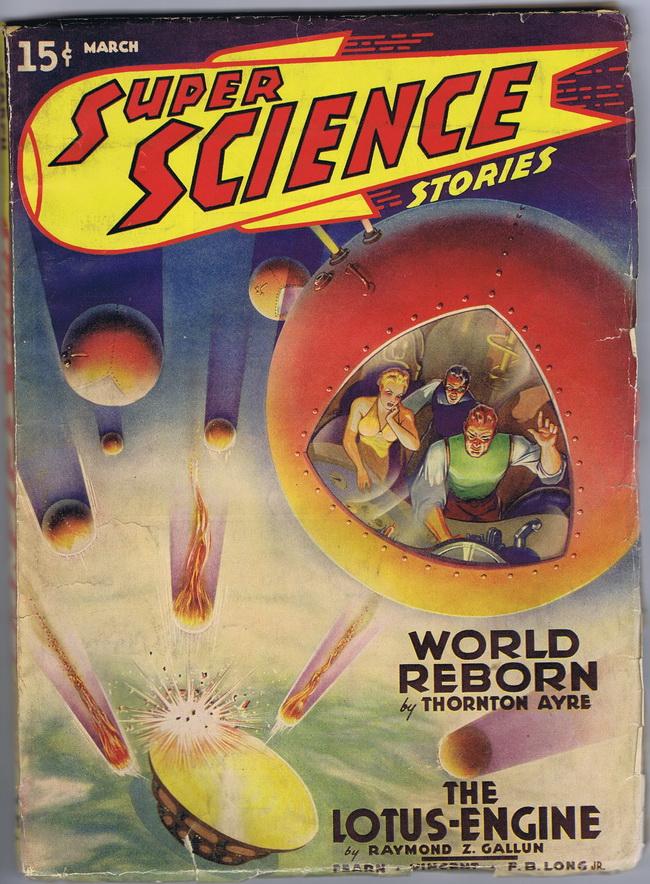
Space Western Comics: A Review

It’s tempting to look at pop culture trends in the 1950s and ‘60s in broad strokes, shaped by after-the-fact simplifications like Toy Story 2. In that film, classic cowboy Westerns were put out to pasture (heh) with the launch of Sputnik and the beginning of the Space Race, and almost overnight children’s imaginations turned to science fiction. In the long run, I suppose that did happen, but over decades rather than months or weeks. Throughout the 1950s and much of the ‘60s, Westerns (and related frontier and outdoorsman stories) remained popular with kids (and adults), and while sci-fi eventually overtook them in relevance, there were multiple attempts to combine the two popular flavors. Gene Roddenberry may have pitched Star Trek as “Wagon Train to the stars” and codified space as “the final frontier,” but he wasn’t the first to make the connection. Craig Yoe, prolific historian and anthologizer of comics, has produced a fun and informative volume in Space Western Comics, reprinting and contextualizing a run of adventure stories combining cowboys and aliens from the 1950s. It’s perfect reading for Vintage Science Fiction Month.

It’s worth noting that the term “space Western” was sometimes used (derogatorily) in sci-fi publishing and fan circles to describe stories that were just the same old formulaic good guys confronting bad guys dressed up in otherworldly verbiage, with rayguns replacing six-shooters and spaceships replacing horses. (Star Wars was attacked in the ‘70s by purists along exactly those lines, but at least Star Wars had considerable artistry on its side; in the ‘50s the white hats vs. black hats approach was strictly the domain of hacks.) But there were some literal space Westerns as well that combined the terminology and iconography of both genres into a single, (mostly) coherent story world. (I wrote about this weird subgenre several years ago and went into detail on the movie Cowboys & Aliens, at the time the most current example.)

Westerns in the first half of the twentieth century weren’t limited to the Old West. Real-life ranches and cowhands were enough of a reality that so-called “modern Westerns” could tell stories of pure-hearted (often singing) cowboys fighting cattle rustlers, land-grabbing oil or radium speculators, and other unscrupulous villains while using up-to-date technologies like automobiles, airplanes, and radio. While fanciful, these modern Westerns ostensibly took place in the “real world” of the 1930s, ‘40s, or ‘50s. Naturally, some of the same futuristic devices that were appearing in contemporary serials and comic books—miraculous rays, rockets, and the compelling but imperfectly-understood “television”—made appearances in the modern Western setting as MacGuffins or mysteries that needed to be unraveled. A cycle of “gadget Westerns” ran its course in the serials of the 1930s, but none of those involved actual space travel or alien visitors. The Phantom Empire, which famously sent Gene Autry underground to confront an ancient, advanced civilization miles beneath his ranch, stands out as an example of the Western exploring inner, not outer space.
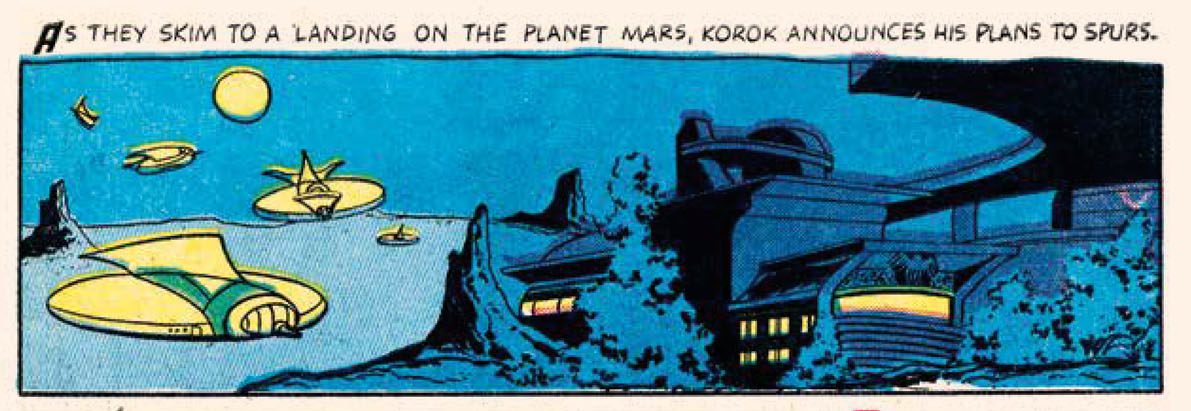
So it is perhaps not surprising that the still-popular Western genre, chasing after trends, would incorporate UFOs, space travel, and alien life in an attempt to hold fickle audiences’ attention. And it is even less surprising that comics—a business with low costs and quick turnaround compared to the movies—would be in a position to take advantage of the brief moment when cowboys and spacemen appeared to be on equal footing (at least with the allowance-spending children of America).

In 1952, based on a suggestion from Charlton co-publisher Ed Levy, the already-extant Cowboy Western Comics changed its title to Space Western Comics (a common practice: instead of starting a new series with issue number one, it was believed that high numbers were more attractive to newsstand buyers, as they suggested a successful track record). Walter P. Gibson, the prolific writer and magician who developed and ghost-wrote The Shadow for Street and Smith, among many other projects, wrote and edited the adventures of “Spurs” Jackson, a rancher and electrical engineer whose ranch becomes the center of zany outer space adventures. (Shades of Gene Autry!) Artists John Belfi and Stanley Glidden Campbell provided the illustrations. The book reverted to Cowboy Western after only six issues, but a couple of stories starring Jackson from later issues are included in Yoe’s volume for the sake of completeness, as are two space-themed stories from Buster Crabbe’s comic book. (Crabbe had, of course, played both Flash Gordon and Buck Rogers in addition to cowboy roles, so this made perfect sense.)
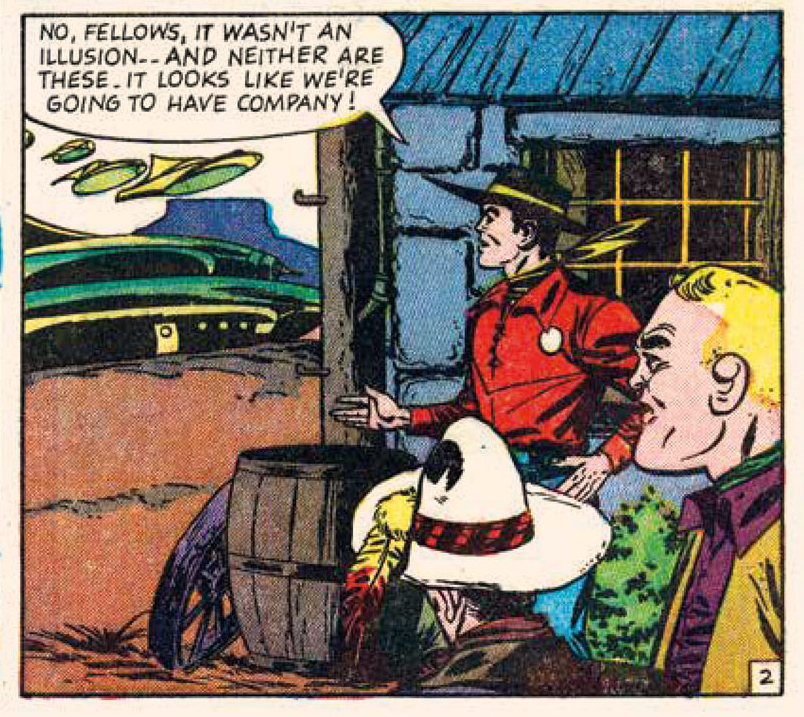
Space Western Comics begins with the Space Age already underway: flights to the moon have become routine, and a space station orbits the earth. “Spurs” Jackson is a character made to have adventures: unmarried and wealthy enough to occupy his free time inventing in his “secret lab,” the rancher-slash-engineer is charged with maintaining a 1000-foot-tall radar tower on his land (a government connection that serves to fuel several later stories), while leaving the day-to-day operations to his foreman, Hank Roper, and the Indian Strong Bow. The radar tower, which helps guide the lunar flights, attracts the attention of spaceships from Mars, who abduct the three men and take them to the red planet. There, they are presented as evidence that the Martians have conquered earth, a pretext that puts the scheming Korok on the throne of Mars instead of the rightful Queen Thula. This is classic space opera material straight out of Edgar Rice Burroughs, but the Western theme eventually pays off: Korok’s throne room is protected by a force field that prevents any metal from penetrating, so Martian weapons and the earthlings’ six-shooters are useless, but Jackson’s whip, Roper’s lariat, and Strong Bow’s bow and arrow, all non-metallic, win the day. For putting things right, Thula offers Jackson a position as her prime minister, but he can’t stay on Mars for long: ranching is an all-day job.

Some of the stories in this volume depend on the romance and exoticism of exploring other worlds, but in many of them the trouble is closer to home. Would-be alien invaders, Communist spies (sometimes disguised as aliens), criminal gangs, and even Nazis threaten the peace of the Bar-Z ranch. The desert makes for a compelling setting, full of isolated canyons and desolate flats, remote enough from civilization that no one in the cities would believe the stories but close to the Army’s testing ranges and bases so there are always plenty of troops and weapons ready to take charge of the surviving villains. As silly as the premises of these stories often are—rock men, plant men, and underground super-moles are among the aliens Jackson encounters—Gibson packs them with twists and clever problem-solving. Like a good engineer, “Spurs” Jackson out-thinks his opponents as much as he out-fights them (although he’s not above setting off an atomic bomb or two if that’s what it takes).

And frequently the twist is kept from the reader until the most dramatic moment, revealing that Jackson had his enemy’s number the whole time. In one of several text pieces, slavers from the planet Letos are foiled by a ship full of humanoid robots supplied by Jackson—“robots” who are actually humans in bullet-proof robot costumes. (Postal regulations required the text pages to secure favorable magazine rates; they were most often filled with editorials or letters columns, but short prose stories were not uncommon. The two-pagers Gibson provided for Space Western Comics are clever pulp miniatures, often written in the folksy voice of characters from around the Bar-Z. I think they would stand up well with the humorous sci-fi of Henry Kuttner and his contemporaries, should anyone think to mine comics’ text pages for anthologizing. Today, Alan Moore seems to be the only comics creator left with much affection for this archaic institution.)

Jackson isn’t the only savvy operator, either: Strong Bow is written as a more sophisticated and educated character than his Tonto-like dialogue might suggest. In more than one story, Indians appear to arrive from space, claiming to be heroes from the past or remnants of lost tribes, inviting the local Indians to overthrow the United States government. Of course, Strong Bow sees right through them, even if he might pretend to go along with the plan. (Although Space Western Comics predates the infamous Comics Code, it’s still as pro-government, pro-American, and pro-law and order as anything produced under the Code. The government and military in these stories are never less than righteous and upstanding, give or take a traitor or two in their midst, so nothing as subversive as suggesting Indian activists might have a point ever enters into the discussion.)

As I’ve alluded to in past articles, comics are a natural medium for the kind of mash-up represented by Space Western Comics: the visual shorthand that is a vital part of comics vocabulary lends itself to mixing and matching. Without attempting to catalog every example of the space Western from later comics, I’ll point to Terra-Man, a cowboy-themed villain from Superman comics. Abducted by space aliens as a child in the Old West, Terra-Man returned to earth with high-tech equivalents of the cowboy’s accessories and an alien winged horse. Current comics have embraced this kind of meta-referentiality with a vengeance, remixing popular iconographies of all kinds with kaleidoscopic variety. Sometimes it’s overwhelming, but I remind myself of being a comics reader in the 1980s, when the Big Two publishers seemed to be embarrassed by anything too “wacky,” and it was left to the independents to publish books like Marc Schultz’s Cadillacs and Dinosaurs (or for that matter, Teenage Mutant Ninja Turtles, as much a mash-up as a parody). I prefer the current acknowledgment of the medium’s silly roots, without the po-faced need to pretend that it’s all serious business.

By now, the proclamation that “comics are supposed to be FUN” is a tradition within comics that is up for grabs, just like every other past genre or practice that is ripe for revival, rehabilitation, or reinvention. Sometimes that means characters like Howard the Duck or Detective Chimp are given equal time with Iron Man or Wonder Woman; sometimes it means weaving disparate, contradictory threads into ambitious multi-layered story arcs that breathe new life into one-off concepts like the Green Team. Signifiers of “comics FUN” include (but are not limited to) ghosts, robots, dinosaurs, gorillas, and, of course, cowboys and rocket ships. Craig Yoe plays up how quaintly ridiculous the stories in Space Western Comics are, and is clear-eyed about the mercenary motives that led to its original creation. But he is equally up-front about how imaginative, breathlessly exciting, and yes, FUN, these stories are, and he has performed a valuable service by putting them together in a handsome and easily accessible package.

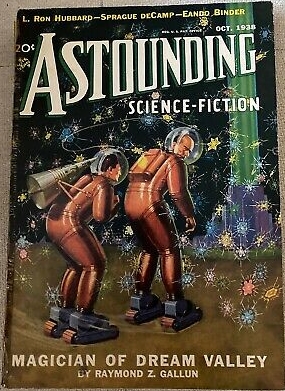
The Martian Chronic: The Best of Raymond Z. Gallun

January is Vintage Science Fiction Month, so join me for a look at a Golden-Age “quiet revolutionary.”

H. R. Van Dongen’s cover art illustrates “The Shadow of the Veil.”

Obscurity isn’t what it used to be: with the internet, there is rarely such thing as a completely new find, and it’s only a matter of a few keystrokes to connect with someone who already knows all about whatever it is that you’ve just discovered. Of course, it’s true that there’s always someone smarter or more informed out there, but it’s easier than ever for hidden gems to rise to the surface where everyone can see them. I’m not sure how hidden Raymond Z. Gallun (rhymes with “balloon”) really was, or is: all I know is that I had never heard of him, or at least didn’t remember reading anything by him before discovering the “Best of” volume edited by J. J. Pierce and published by Del Rey as part of their extensive series of science fiction reprints. But even in 1978, Pierce described Gallun as neglected and underrecognized, even as some of his stories continued to be anthologized, and as Gallun had published a novel, The Eden Cycle, only a few years before. He does not seem to have had a resurgence since his death in 1994.

Nevertheless, Gallun was part of the pioneering generation of science fiction writers in the 1930s and ‘40s who helped to elevate the genre from crude, cliché-ridden pulp to the thoughtful “literature of ideas” we celebrate when looking back, and if many of his stories still have elements of pulp, I’ll hardly complain. The later stories in this book, from the ‘40s and early ‘50s, lean more toward character study, but my favorites balance the demands of the characters’ inner lives with external circumstances that push them toward decisive action. (To be fair, I’m only getting a narrow view of the man’s work—thirteen stories out of more than eighty, and he also produced a few novels which I haven’t read—so I’ll resist the urge to make sweeping judgments, even if I take Pierce’s word that this book really represents Gallun’s best.)

Going by these selections, Gallun was fascinated by the processes of life and death on a long-term cosmic scale. His vision of a dying Mars, with only a thin, cold atmosphere and marked by the ruins of a long-extinct civilization, is one he shared with many other writers of his day, influenced by the ideas of Schiaparelli and Lowell. (Amusingly, Gallun suggests in his afterword that he may have been inspired by a youthful job stoking the furnace at a hemp mill, surrounded by clouds of smoke from burning, cast-off cannabis plants.) However, spread across many of Gallun’s stories is the thought that Mars is only the latest planet in the solar system to approach its appointed end and Earth, too, will one day share such a fate.

Where Gallun stands out is the rigor with which he works out the details of his alien ecologies, whether they be based on other planets or on Earth in some future time or inaccessible place. “Davy Jones’s Ambassador” takes seriously the question of a deep underwater civilization, with Gallun’s solution being the careful breeding of specialized animals to provide food, structures, artifacts, and even electrical currents in an environment without fire. Gallun’s Mars, with its ancient ruins of an extinct, semi-insectoid race, destroyed long ago by war and/or climate change, is superficially similar to other treatments of the planet, but Gallun has little interest in Burroughs-style derring-do or Bradbury’s sense of fable; his is an anthropologist’s and ecologist’s view (the immensely satisfying “The Shadow of the Veil” is almost a sword-and-sorcery tale, told from the perspective of an alien “barbarian,” but its references to magic and gods are those of a pre-scientific being with no concept of astronomy or space travel). “Seeds of the Dusk” describes semi-intelligent plants, evolved to store oxygen in capsules and directing their own evolution for adapting to different environments, including spreading to other worlds.

The notion of intelligent life spreading seeds throughout the universe appears in metaphorical ways as well: “Godson of Almarlu,” the longest story in the book, features a long-dead civilization that once thrived on the planet which became the asteroid belt upon its disintegration. Knowing that the heavy, neutronium-cored comet that destroyed their planet would one day return to the solar system, threatening the life that they had spread to Earth in the prehistoric past, these ancients created a computer-like device to implant in one human’s mind the information necessary to build a sort of astral bridge so a small part of the planet’s population could escape to the moon (again, thought to have a thin atmosphere in those days). But while this 1936 story brings out the biggest guns—planetary destruction, cosmic forces using humanity as pawns—it also shows how Gallun’s science fiction was relatively hard, at least for its time. This is world-wrecking closer to Fred Hoyle than Edmond Hamilton. Based on knowledge of other planets as they were understood at the time, “Godson” even predicted the existence of neutron stars, as Gallun speculated that the newly-discovered element neutronium would, if concentrated, be heavy enough to disrupt the gravitational fields of planets unfortunate enough to be nearby. The mind-altering forces of the ancients and the nature of the energy they use to transport humanity to the moon are, of course, not as easy to explain, but Gallun smartly leaves such issues as mysteries.

Finally, Gallun was an important example in creating alien intelligence that was truly alien, making its different point of view a critical part of the story. His early life as a wanderer, traveling and working all over the world, surely broadened his perspective beyond the typical pulp writer of the ‘30s. Many of his aliens are sympathetic, and even when opposed to humanity, the aliens aren’t all monstrous invaders: in fact, it is often humans, continuing their manifest destiny by spreading through the solar system, that take on the role of colonizers, with the “natives” simply fighting back. (Still, Gallun wasn’t above creating alien antagonists when the story called for it: 1938’s “Hotel Cosmos” includes a particularly nasty one.) Along with Stanley Weinbaum’s “A Martian Odyssey,” Gallun’s “Old Faithful” from 1934 is considered a landmark in logically developing a sympathetic alien. The title character is a Martian astronomer, living in solitude and at odds with his pragmatic, unimaginative people, who communicates with observers on Earth before deciding to take the ultimate risk to cement this long-distance friendship. The story feels like a rebuff to H. G. Wells’s The War of the Worlds: instead of the puffs of smoke on the surface of the red planet being ominous portents of invasion, they are the sign of a kindred intelligence, with which communication, while difficult, is possible.

Speaking of Wells, Gallun’s work can be seen as a continuation of that author’s ideas on the cycles of evolution and extinction. The idea that humans are subject to the same forces as the dinosaurs and must adapt or die is Wells’s great bequest to the authors who followed him, and may in fact be the single greatest insight science fiction has to offer. But as Gallun matured and turned away from simple end-of-the-world scenarios, he realized that individuals face the same choice in microcosm. His 1951 story “The Restless Tide” makes that case directly, with a long-married couple whose lives swing between the indolent comfort of post-scarcity life on earth and the hard rigors of space colonization; neither life is satisfying for long, and it is man’s fate to always alternate between extremes. The futuristic medical and technological advances that increase the characters’ lifespans and make going to space an option mark the story as science fiction, but the central couple could just as easily be a mid-twentieth-century family deciding to leave the cozy suburbs and go back into missionary work. The story’s point is that the motivations and conflicts present are timeless and will continue for as long as there are humans.

Rediscovering Henry Kuttner

January is Vintage Science Fiction Month, so I’m diving into the short stories of the prolific author Ray Bradbury dubbed “a neglected master.”

“Mimsy Were the Borogoves” was adapted into the 2007 film The Last Mimzy.

Henry Kuttner is, for me, one of those authors I saw frequently represented in anthologies of the golden age of science fiction, but whom I rarely had a strong picture of as an individual, someone with a singular set of preoccupations or stylistic tics. One story would be horror, the next social science fiction, and still another might be light fantasy. If Kuttner is today not a household name*, perhaps it is his ability to work in several different veins, and his ability to channel a variety of authorial voices, that keeps the man himself out of focus. (For this article, I read the 1975 collection The Best of Henry Kuttner, but several other stories I consulted were found in scattered multi-author anthologies.)

As an example, I first encountered Kuttner as a younger member of the Weird Tales circle embroidering on H. P. Lovecraft’s growing Cthulhu cycle. “The Salem Horror” (1937) was included in August Derleth’s seminal Tales of the Cthulhu Mythos, and Kuttner’s Weird Tales output also included pastiches of Robert E. Howard’s sword and sorcery stories.

As Kuttner discovered his own voice, a strain of light fantasy emerged, with concepts from folklore or mythology existing in the modern world, often using the incongruity as a source of gentle (or not-so gentle) comedy. In “Masquerade,” from 1942, a honeymooning couple stumbles on a family of degenerates (who may or may not be vampires) living in a former lunatic asylum, wryly commenting on how cliché it all is (“Look, if I started a story like this, any editor would shoot it back,” the narrating husband tells his wife.)

“Masquerade” was adapted in a 1961 episode of Thriller.

Some of these stories are reminiscent of his contemporaries Robert Bloch (with whom Kuttner sometimes collaborated) and L. Sprague de Camp, or even the earlier Thorne Smith (“The Misguided Halo” is one of these), and had a clear influence on the younger Ray Bradbury. Still other stories fit the description of science fiction as “the fiction of ideas,” with theories of social or technological development, and the question of man’s future, front and center, although the dialogue and characterization are often better than that description would suggest: if, like Isaac Asimov and Arthur C. Clarke, Kuttner sometimes wrote stories whose sole purpose seems to be making use of a social theory or scientific factoid, Kuttner’s strength was to humanize that impulse, showing the effects of progress and change from an individual’s perspective. In that sense, there is a continuity between Kuttner’s stories and the early fiction of Philip K. Dick. If Kuttner had lived longer (he died in 1958 at the age of 43), it’s possible that he would have made the leap to the more introspective, experimental science fiction of the 1960s. Instead, he foreshadowed it.

When discussing themes in Kuttner’s work, one must also acknowledge the author’s long collaboration with wife and writing partner C. L. (Catherine) Moore, whom he married in 1940. I’m a big fan of Moore’s writing, especially her “Northwest Smith” and “Jirel of Joiry” series, both of which appeared in Weird Tales. Untangling who contributed what to stories published under Kuttner’s and Moore’s individual names can be tricky, and many of the stories now attributed to one or the other of them originally appeared under the joint pseudonym “Lewis Padgett” or numerous other pen names. The couple shared a single typewriter and bragged that either of them could pick up the thread of a story where the other had left off without a break. The Encyclopedia of Science Fiction holds that all of the stories in The Best of Henry Kuttner were in fact collaborations, so perhaps it would be best to think of “Kuttner and Moore” as a team like “Lennon and McCartney,” with some projects being independent work but always in the context of the ongoing partnership.

Two themes emerge strongly in Kuttner’s mature stories: in one strand, the Lovecraftian concepts Kuttner cut his teeth on are adapted to notions of technological and social evolution. In stories like “Mimsy Were the Borogoves” and “The Twonky,” the intrusions from other worlds are not the work of sinister alien gods and their cults, but are carelessly scattered artifacts from civilizations at a different level of development, either a future state of evolution or from a parallel reality in which “normal” has a very different definition than ours. “Mimsy” centers on a box of unearthly educational toys that gradually condition their users to life in four or more dimensions; in “The Twonky,” a combination radio-phonograph turns out to be an artificial intelligence in disguise, an in-home butler, watchdog . . . and jailer.

In Arch Oboler’s 1953 adaptation of “The Twonky,” the story’s radio-phonograph was replaced by a television.

These unnerving (and prescient) stories broach the idea that futuristic technologies could rewire human brains, turning their users into geniuses, madmen, or passive slaves. As in “Call Him Demon” (one of Kuttner’s finest tales, a story of cosmic horror told through the lens of recollected childhood), it is only children, their minds not yet set into routine patterns, who can truly pick up on these messages from outside. To adults, the signs are either undetectable or incomprehensible. Ray Bradbury, noting the impact these stories had on himself and others, wrote “I very much doubt that ‘Zero Hour,’ or for that matter ‘The Veldt,’ would ever have leaped out of my typewriter if Kuttner’s imagination had not led the way.” (In retrospect, Madeleine L’Engle’s classic A Wrinkle in Time builds on the foundation “Mimsy” established; I would also include C. M. Kornbluth’s “The Little Black Bag” as another tale indebted to Kuttner’s concepts, with that author’s own bitterly ironic twist, of course.)

The other prominent thread relates to mankind’s future evolution and the possibility of beneficial mutation. In the humorous Hogben stories, a family of backwoods mutants with incredible mental powers do their best to live beneath the notice of snooping big-city scientists and other busybodies. These are tall tales for the nuclear age, providing fantastical solutions to common problems, as when Junior Hogben jury-rigs a time machine to make cream sour faster in “Cold War.”

In other stories, the implications of human evolution are much darker, and the prospect of a struggle between homo sapiens and homo superior looms. Some of the new breed wish only to live in peace like the Hogbens, but others seek to dominate their merely human inferiors or bide their time until there are enough others like them, realizing that unmutated humans would hate and fear them if they knew that supermen lived among them. Combining nuclear anxiety, metaphors of societal prejudice, and drawing clear comparisons with early humans’ elimination of Neanderthal competition, these stories are instantly recognizable as an inspiration for Marvel Comics’ X-Men.

In stories like “Absalom,” there is a specifically Oedipal dimension to this struggle, and we’re back around full circle to the notion that children are essentially psychopathic, their minds still malleable, buffeted between conflicting influences. Parenting is tough enough, but in a family of telepaths, where does one draw the line? “The Piper’s Son” (part of the “Baldy” series expanded into the novel Mutant) sensitively asks that question, comparing the balance of power within a family to the uneasy search for a growing Baldy minority’s place in a rebuilding postwar society.

Beyond these major themes, there are plenty of surprises. Judging science fiction by the accuracy of its predictions is a rookie mistake, but in addition to Kuttner’s farsighted critiques of technology as an agent of conditioning, one finds, for example, the suggestion of a viral meme (in the form of a catchy song) used to disrupt an enemy’s organization in the wartime tale “Nothing But Gingerbread Left.” In “The Proud Robot,” one sees subscription-based television services more like Netflix than the radio-license model Kuttner seems to have had in mind. Of course, the predictions that ring true are more likely to jump out at the reader–I’m still waiting for the robotic judge, jury, and executioner described in “Two-Handed Engine,” and I’ll probably continue to wait–and whether a prediction comes true doesn’t say anything about the quality of that story. It’s a truism that every story is really about the time it was written, no matter what year it’s supposed to be set in. Don’t we read old science fiction in part for those glimpses of a world that could have turned out differently? In the case of Henry Kuttner, there is still entertainment–and thoughtful observation of humanity–to be had, if we but look.

* Don’t take my word for it: Robert M. Price wrote in his 1995 introduction to The Book of Iod, a collection of Kuttner’s youthful Lovecraft pastiches, “Henry Kuttner’s star shines neither so brightly nor so high up in the firmament as it once did. . . . Today it is sad but safe to say that just about all of Kuttner’s exceedingly clever fiction is the property of literary nostalgia-lovers and antiquarians.”