Hitch Your Wagon to a Star: The Elusive Hollywood Sci-Fi Western

Despite the title, not a space Western

Despite the title, not a space Western

It seems like it should be easy: “space cowboys” such as Han Solo and Mal Reynolds are essentially Old West gunslingers dropped into the cockpit of a spaceship, so why shouldn’t it work the other way around: a robot on horseback or a space alien on a stagecoach? Despite the longstanding popularity of both Westerns and science fiction, the number of films that successfully bring the two genres together in this way is surprisingly small. To be sure, ghost stories, tall tales, and bloody violence are all established parts of Western lore, and some great movies have been made exploring these themes, but the “weird Western” typically explores the boundaries of fantasy and horror, myth and history, rather than science fiction. It turns out that it’s easier to move the Old West into outer space than vice versa.

Undoubtedly, the cinematic grandfather of all such hybrids is the 1935 serial The Phantom Empire (of which I have written more extensively elsewhere), in which singing cowboy Gene Autry runs up against members of a super-advanced underground civilization. In their book The Great Movie Serials, Jim Harmon and Donald F. Glut characterize The Phantom Empire as the beginning of a cycle of “zap-gun Western” serials. However, the other examples they cite, such as Tom Mix’s final film The Miracle Rider, involve super-science of purely human invention, and lack the sense of weird mystery and contact with alien forces that makes The Phantom Empire so distinctive.

PErobot.disguise

Perhaps the reason there have been so few overt fusions of science fiction and the Western in film is that such a hybrid is redundant: once science fiction (especially in the pulpy, action-adventure mode that has dominated popular film-making) took over the Western’s role as the main arena for playing out America’s myths and fears, it borrowed wholesale many of the plots and character types associated with the older genre, effectively replacing it. Good guys (almost exclusively white in the early years of both genres) and bad guys (sometimes literally alien, sometimes white men whose greed had overcome them); a thirst for exploration and conquest, usually in the name of civilization but often identified with commercial interests; and a sense of isolation, of being separated from the routines and mores of the old world (including meditations on the softening, corrupting influences of civilized society), were all notable features of both the Western and early science fiction, to the point that “horse opera” could be updated to “space opera” without any misunderstanding on the part of audiences. The “edge of civilization” was constantly moving outward: Star Trek’s description of space as “the final frontier” is illustrative.

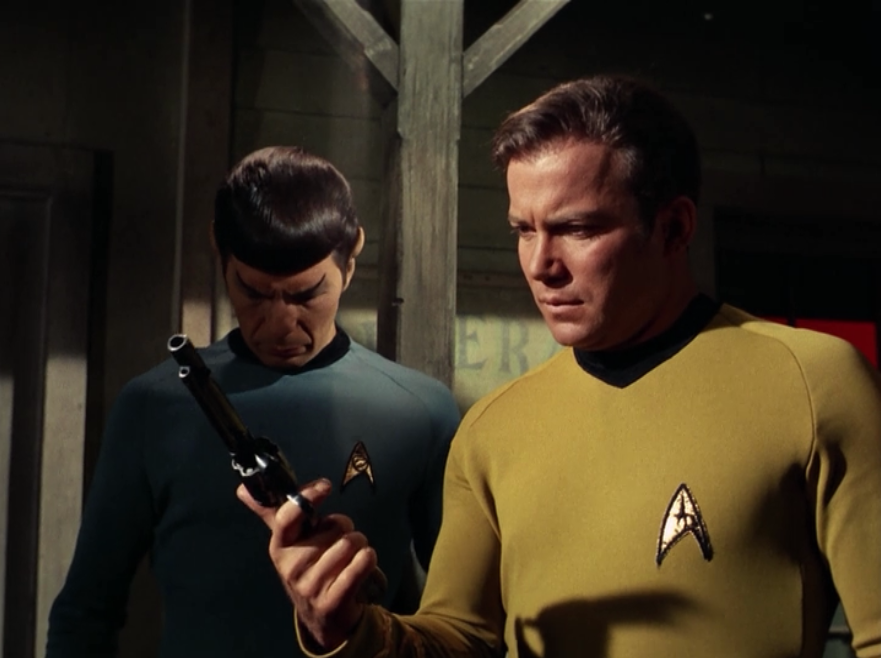
Show creator Gene Roddenberry pitched Star Trek as "Wagon Train to the stars." A few episodes, such as "Spectre of the Gun," made it literal.

Show creator Gene Roddenberry pitched Star Trek as “Wagon Train to the stars.” A few episodes, such as “Spectre of the Gun,” made it literal.

Besides the gunslinger, other characters, such as the alien other, the damsel in distress (or the hooker with a heart of gold in racier manifestations: neither genre had much use for well-developed female characters, as pioneering was considered man’s work), the white man “gone native,” the amoral company man, and the wise tribesman (often the last of his kind, given a tragic nobility once no longer a threat) were translated easily. Science fiction, arriving as it did in a period of both rapid dissemination of ideas and ready access to literature of the past, became a clearinghouse of genre storytelling, absorbing themes and tropes like a sponge. From this point of view, it’s only natural that Terry Gilliam could describe Darth Vader as “the cowboy with the black hat,” that Flash Gordon’s Princess Aura fits the mold of the femme fatale, and that Seven Samurai could be remade as both a Western and as a space adventure. Ultimately, callow, daydreaming farm boys are the same everywhere, whether from Texas or Tatooine.

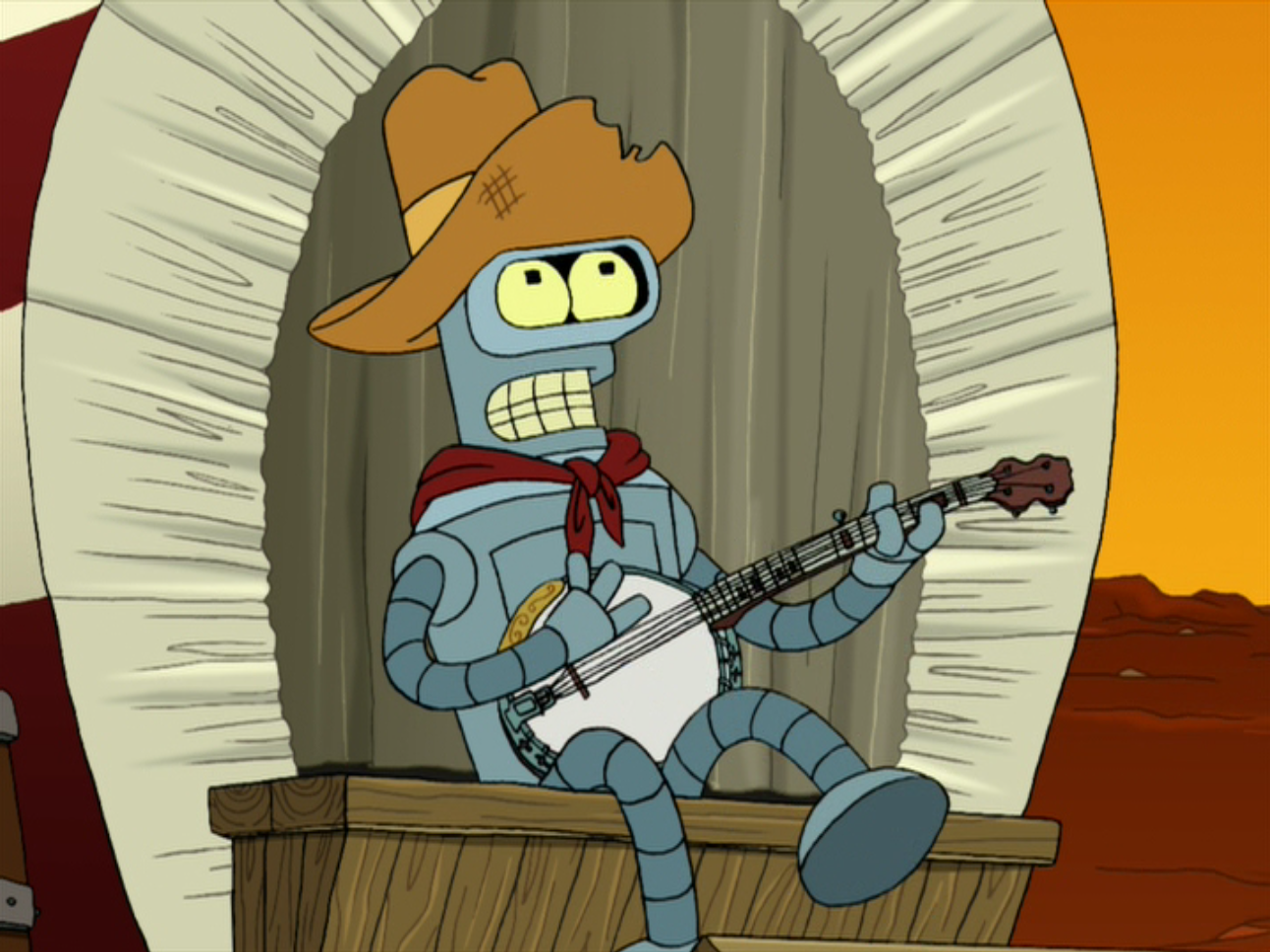
In that case, the distinction between the two genres is one of iconography, and iconography flourishes in visual media: comic books and cartoons have always been friendly to the robot in a cowboy hat, as have the pop surrealism movement and the artists who contribute to sites like DeviantArt. When it comes to mixing and matching, Western and sci-fi are primary colors that can be laid on in broad strokes.

Bender3

Both literary and cinematic science fiction have had to work to absorb Western motifs, however: all but the most fantastic stories attempt to rationalize the mixture of Old West and New Frontier, and here the difference between the two genres is a clear obstacle.* The Western is rooted in a specific time and place, and once that historical moment was over, the Western became a genre about the past (one reflecting contemporary attitudes, to be sure, but almost always focusing through the lens of history); science fiction, especially in the early Space Age, was about the future, and whether focused on the promise of exploration or the horror of nuclear war, it used speculation about the future to examine the current moment. In short, both forms stood in the present, but the Western looked into the past, either searching for some imperialistic original sin or retreating into comforting nostalgia, while science fiction looked into the future, projecting either our hopes or fears.

wild-wild-west-kenneth-branagh

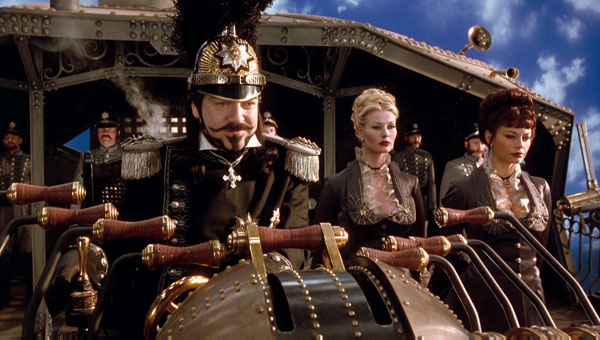
Given that difference in emphasis, science fiction has often chosen to visit the Old West by means of time travel or alternate history. The “steampunk” movement has produced a wide variety of literature, some of it great, but on film it has been too often a faddish visual template that can be applied to the same old pulp storytelling: the result has been ambitious failures like the film version of Wild Wild West or “high concept” dreck like Abraham Lincoln, Vampire Hunter. (Complaints about the perceived hackiness of combining the two genres aren’t new: Wikipedia’s “Space Western” entry notes pulp-era efforts to stamp out lazy updates of Western plots in sci-fi garb, including one magazine’s ad campaign claiming “You’ll never see it in Galaxy.”)

Westworld_ver2

Better are films that find ways to repurpose the trappings of the Western, like Westworld, in which the Western setting is a fiction within the fiction, or Serenity (the belated finale of television series Firefly), which makes explicit both the themes of colonization and post-civil war disillusionment that are a part of the Western. In both cases, the adoption of Western dress and lingo are made to seem not only organic to the setting but essential to the stories being told: both use science fiction to interrogate the Western, and by extension mythmaking in general.

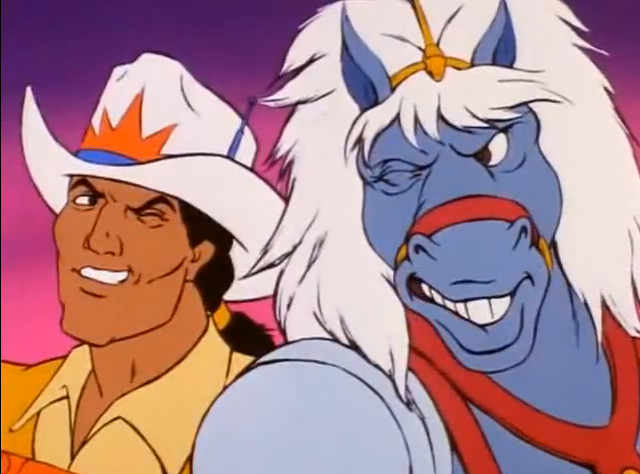
* Even excursions into outright fantasy don’t always pass the laugh test: I invite you to consider the short-lived 1987 cartoon series BraveStarr:

I’ve also just become aware of a 1999 film called Aliens in the Wild, Wild West that doesn’t look too promising; although I haven’t seen it, an imdb reviewer calls it “one of the top ten worst movies I have ever seen.” Tellingly, like The Phantom Empire and like BraveStarr and similar cartoons, Aliens in the Wild, Wild West appears to have been made primarily for children.

BraveStarr

BraveStarr

Next week, I’ll look at a recent example of the genre, 2011’s Cowboys & Aliens.

My 2014 in Television

LetsWatchTV

I didn’t watch a lot of television this year. Oh, I logged plenty of screen time, but I was mostly watching movies rather than TV series. Other than Community’s fifth season (which I wrote about last spring), most of what I did watch was animated, since I watch with my kids, and since I’m not exactly allergic to cartoons myself.

The new series I found most exhilarating this year was Adult Swim’s Rick and Morty, the animated brainchild of Justin Roiland and Community creator Dan Harmon. (It technically began in December of 2013, but the majority of it came out this year.) Rick and Morty starts with a hoary premise—mad scientist Rick Sanchez takes his fourteen-year-old grandson Morty (both voiced by Roiland) on a series of wild adventures, getting them both into and out of jams with his inventions—and then turns it inside out. Rick isn’t just eccentric, he’s seriously damaged, and the show, while comedic, doesn’t shy away from the dangers he exposes Morty and his family to, and doesn’t simply set the reset button at the end of each episode. In just its first short season (eleven episodes), one of Rick’s schemes permanently transforms the world into a monster-filled wasteland, and the only solution is for Rick and Morty to relocate to a parallel universe in which their counterparts have conveniently died, taking their places. (No, this isn’t one I watch with my kids.)

RickandMorty

That points to another of the show’s strengths: like Futurama before it, Rick and Morty assumes that viewers have seen Back to the Future, Doctor Who, Star Trek, The Twilight Zone, Zardoz, The Fly, and the many other shows that are winkingly alluded to, and there’s a minimum of hand-holding. It’s the twenty-first century, and the audience doesn’t need to have genetic modification, virtual reality, or (for that matter) the dangers of unintended consequences explained in long-winded detail. That leaves more time to develop characters (mainly the rest of Morty’s family: sad-sack dad Jerry and frustrated mom Beth, and overlooked big sister Summer) and fill the run-time with off-the-wall humor.

I can’t think of anything I laughed at harder this year than the episode “Rixty Minutes,” in which Rick’s modification of the TV cable box allows the family to view programming from infinite parallel universes (including glimpses of the lives Jerry and Beth could have had if they hadn’t stayed together). The combination of rapid-fire absurdity and referential gags most closely resembles Community’s Season Two episode “Paradigms of Human Memory,” and like that episode, “Rixty Minutes” puts the insanity of its plot in the service of its characters, up to a surprisingly poignant climax.

overthegardenwall

On the non-series front, 2014 was a year in which special events, already making a comeback in recent years, continued to gain ground as networks look for (non-sports-related) ways to keep viewers tuned in at the time of broadcast instead of time-shifting. Even the mini-series, that prestige format of the 1980s, is coming back into vogue (ABC’s upcoming Galavant is definitely on my radar for 2015). I’ve already written at length about Over the Garden Wall, Cartoon Network’s five-night mini-series that aired in November; suffice it to say that upon rewatching it, I still found it greatly enjoyable, and were I to rank it with my favorite films of the year, it would at least be in the top five.

SpecialSpecial

There were some other specials that grabbed my attention this year, as well: I’d like to highlight Lil Bub’s Special Special, which aired on Animal Planet way back in February. At a slight half hour, this celebration of the eponymous cat was as instantly disposable as the cute animal videos and memes of which the special is an extension, but the whole thing (held together by human costars Amy Sedaris and Andrew W. K.) had such a light touch (and just enough self-awareness) that I was charmed by it. It hasn’t been rerun to my knowledge, but it has a permanent home on my DVR (and you can watch it here).

drwhochristmas_bbc

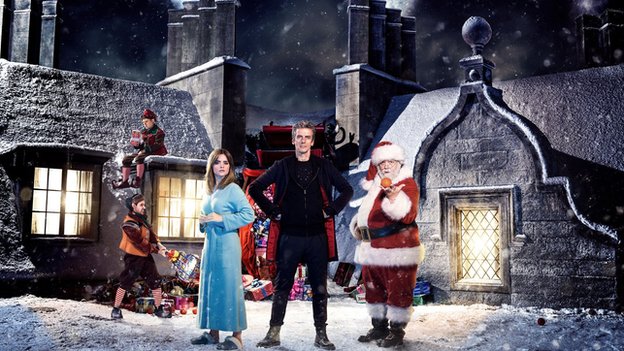
Finally, there were the usual crop of Christmas specials. I could quibble with Doctor Who’s “Last Christmas,” leaning as it does on the revived Who staple of monsters that you can’t look away from, or that you can’t remember, or that (in this case) you can’t even think about without them coming for you. And I’m not as taken by the chemistry of leads Peter Capaldi and Jenna Coleman as some are. However, my personal bar for the annual Doctor Who Christmas special is set pretty low, and as long as it doesn’t involve David Tennant being carried aloft by robotic angels, I’m willing to cut it some slack.

To be fair, “Last Christmas” was actually pretty good, in both spinning out an intriguing menace and lampshading its similarities to both Alien and The Thing, as well as casting Nick Frost as a snarky but ultimately benevolent Santa Claus and making it work. The special is part of a long tradition of Christmas films and stories examining the nature of faith and belief, with Santa as a safely secular football. If Santa Claus weren’t so widely regarded as a fiction for children, would Christmas stories still demand that we believe in him unconditionally? Entertainment that aspires to mainstream appeal can no longer preach with such certainty about Jesus or any other religious figure, but such arguments can be broached in the language of fantasy. Like most such stories, “Last Christmas” ends ambiguously (in more ways than one: a comment I read online accurately described it as “Doctor Who does Inception”), but it is clear on the power of faith, with Santa described as a “dream sent to save us,” a nice summary of the value of both fiction and religious parable.

ElfSpecial

2003’s Elf is similarly engaged with convincing the unbelieving, with Santa (Ed Asner) stating explicitly that belief, not confirmation, is the source of his power: “If I were seen, all would be lost!” As Jesus told his apostle “Doubting” Thomas, “Blessed are they who have not seen, and yet have believed.” This year’s Elf: Buddy’s Musical Christmas, based on the film and the Broadway musical that sprang from it, isn’t quite so explicit, but finds a middle ground between the movie and the Rankin/Bass productions that inspired its story of a human orphan raised by elves at the North Pole. I mentioned this special on Christmas Eve, pointing out that it wasn’t as good as the original movie, but I would be remiss if I didn’t at least mention the stylish, handmade production—the stop-motion figures resemble Rocky & Bullwinkle‘s characters brought to 3-D life—and charming score (by Matthew Sklar and Chad Beguelin). Mostly, I enjoyed it when it wasn’t directly imitating the movie, as the comparison is unflattering to the special; like many shows with familiar subject matter, it was more approachable when doing its own thing.

Tomorrow, look for my thoughts on the books I read in 2014.

Stephen Billias’ The American Book of the Dead: An Old Favorite Revisited

Nucleomitophobia is an exaggerated fear of being blown to bits by nuclear weapons. Bertie Rupp has it, and it’s driving him crazy. He’s tried meditation, yoga, vegetarianism, and The Society for the Preservation of Mankind. Nothing works, until he hears about The American Book of the Dead, a Zen guide to surviving the nuclear holocaust. Convinced that he must find The Book and learn its secrets if the human race is to endure, Bertie sets out on a desperate search that will take him to Las Vegas and back . . . and involve him in the lives of an ex-nun from Kansas who truly loves him, an old tailor who survived the Nazi holocaust, and a mysterious representative from The Society for the Preservation of Outer Space. It is an odyssey that will lead him through the darkness of impending nuclear war and beyond . . . to Enlightenment.

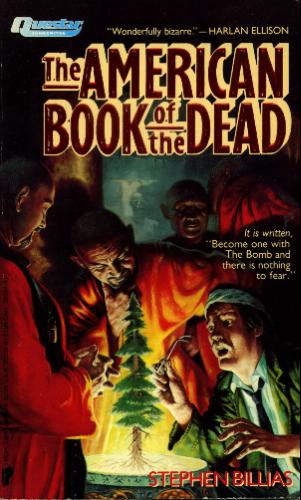
That back-cover summary (combined with the cover illustration of a slack-jawed hippie gaping at a tiny “bonsai sequoia” tree, surrounded by approving monks) convinced me that I needed to read Stephen Billias’ 1987 novel The American Book of the Dead when I found it in the bookstore at age fourteen. I’ve written about my own nuclear fears, and while they had peaked a few years earlier, I still felt that I could relate to this Bertie Rupp character. I was similarly intrigued by his spiritual search for peace and Enlightenment with a capital E, as I was in the midst of a comparative study of different religions and sorting out many of life’s questions for myself (if I come up with a definitive answer, I’ll let you know).

Popular Library edition, 1987. Cover illustration by Gary Ruddell.

Popular Library edition, 1987. Cover illustration by Gary Ruddell.

At that age, I was reading science fiction and fantasy paperbacks pretty regularly, and I recognized the publisher, Questar (an imprint of Warner’s Popular Library), having read and enjoyed some of their other genre-stretching offerings already. A front-cover blurb from Harlan Ellison describing TABOTD (as I will henceforth abbreviate it) as “wonderfully bizarre” sealed the deal.

It turned out to be the perfect book for me at the moment; I read it and reread it several times. I thrust it into the hands of friends to read; my dad read it; even some of my teachers read it. Everyone I gave it to seemed to enjoy it. Since then, however, I’ve never met anyone else that read or remembered it. It had only a single printing, as far as I know. Twenty-five years later, I doubted myself: perhaps in my youth I overestimated its quality or originality; perhaps it was too timely, predicated as it was on Cold War nuclear anxiety; maybe it simply wasn’t as good as I remembered.

So, this past week I reread it, and while I can’t deny the possibility that my judgment is compromised by nostalgia, I still found it an imaginative, compassionate, and frequently beautiful book. At the same time, it’s now easier for me to put it into a literary context and make some useful comparisons to other books that are likely to be more familiar to readers.

The first thing that might not be clear from the summary above is that, while Bertie’s experiences are framed as a contemporary version of the Buddha’s journey, TABOTD is an often funny book. The Zen koan, or joke which startles and leads to wisdom, is built into the text of The Book within the book, a mixture of spiritual teaching and modern commercial jargon (“CHANGELESS CHANGE, PRIMORDIAL ESSENCE OF THE GREAT PRIMAL BEGINNING: NEW, IMPROVED, LONGER LASTING” reads one aphorism). The story takes detours which are absurd on the surface but feed into the main plot. Billias makes wry observations on the foibles of humanity, both through his characters and as an omniscient narrator. The tone—whimsical, digressive, drily aware of mortal folly—is strongly indebted to Douglas Adams.

However, whereas The Hitchhiker’s Guide to the Galaxy begins with the end of the world, TABOTD builds toward it (it’s not a spoiler to reveal that Bertie’s worst fears come true—they are foreshadowed from the beginning). Adams’ protagonist, Arthur Dent, spends about one page grieving after the earth is blown up by aliens, but it’s clear he didn’t leave much behind and the focus is squarely on his adventures. Bertie Rupp, by contrast, is intensely aware of the suffering of the world, human and non-human alike: it is not only for his own sake that he fears the coming war. It’s somewhat more like Adams’ later work, as enamored with the wonders that can be found on earth as with the spaced-out products of his imagination.

If I had to assign a genre to TABOTD, I’d call it magical realism rather than any kind of science fiction: animals talk, there are signs and premonitions, and eventually the gods of mythology are brought into the mix. (One of the main characters is Monkey—the Monkey from the classic novel Journey to the West—an immortal, talking primate whose goals and prankish sense of humor are often at odds with the seriousness of Bertie’s spiritual undertaking.) There’s some pseudo-scientific rationalization (think Chariots of the Gods), but the result is a narrative world where anything can happen, and as society, racing toward Armageddon, unravels, things get increasingly freaky.

There’s also a strain of hidden history and conspiracy which, combined with the novel’s antic tone, owes something to Robert Shea and Robert Anton Wilson’s Illuminatus! Trilogy. The main antagonist is a corporate mogul described as “a government employee, at the Cabinet level, who had returned to private business after a change of administration.” His name is redacted throughout the book, so he appears as “_______ _______.” Does he represent a real person? I don’t know, but it’s not hard to think of possibilities; such figures are always timely. A grasping, scheming super-capitalist, ______ ______ is one of the few elements of the book that seems even more contemporary now than it did then; he and his fellow businessmen personify what Matt Taibbi memorably described as “a great vampire squid wrapped around the face of humanity, relentlessly jamming its blood funnel into anything that smells like money.”

Early in TABOTD, _______ _______ chooses Bertie, a temp worker, to drive him to “Big Boys Camp,” a top-secret gathering of powerful CEOs and politicians in the manner of a Boy Scout jamboree. Invited to participate, Bertie joins the “campers” for a weekend of canoeing, three-legged races, and weenie roasts under the watchful eye of a camp director. It is at Big Boys Camp that Bertie first encounters Monkey, held captive by _______ _______ and his fellow businessmen and brought out in a cage to terrify them with scary stories.

Bertie let out his breath with a gasp. A monkey was telling the creation story to American capitalists in the fantasy camp of their lost childhoods. Bertie was in dire danger of losing his perspective.

(As sometimes happens, I thought of Big Boys Camp as a surreal invention, of a piece with the talking animals and spacecraft in the rest of the book; it wasn’t until several years later that I heard about the high-powered gatherings at Bohemian Grove and experienced the weird feeling that comes from imagined fiction crashing into reality.)

For a fairly short novel, TABOTD is quite shaggy, with dozens of characters and an episodic form; some elements of it are dated, and not in a good way (Rufus, a black security guard who befriends and protects Bertie, speaks in an exaggerated “sho ‘nuff” dialect that probably wouldn’t get past an editor today). It gets a lot of mileage, however, from the steadily increasing tension of the situation, as Bertie’s travails are intercut with examples of the Strangelove-like madness that leads to war and the mania of a collapsing society. It helps, too, that Billias generates empathy for all the characters, even the villains: _______ _______ isn’t exactly redeemed, but he is a compelling presence, and honest readers will be able to see something of themselves in his self-interested calculations even if they wouldn’t take his actions. (______ ______ is also pretty dynamic: as a character defined by his fear, his will to power, and his aggressive avarice, he balances out the more passive Bertie, who is gradually letting go of all those things.)

According to what little biographical information I’ve found, Billias was in his late 30s when The American Book of the Dead was published; the melancholy tone, the sorrow for the challenges awaiting coming generations, and the sense of how precarious life is speak to me now where they went over my head as a teenager. I don’t doubt that it’s more than a little autobiographical.

If this write-up sounds vague, that’s deliberate: while I usually try to provide some analysis, in this case I’m straight-up promoting, and I don’t want to give too much away. I hope you’ll seek out this book and form your own opinion. After all these years, this is a book that I still believe deserves to be read, to be part of the conversation.

Fates Worse Than Death: Radar Men from the Moon

RMTitle1
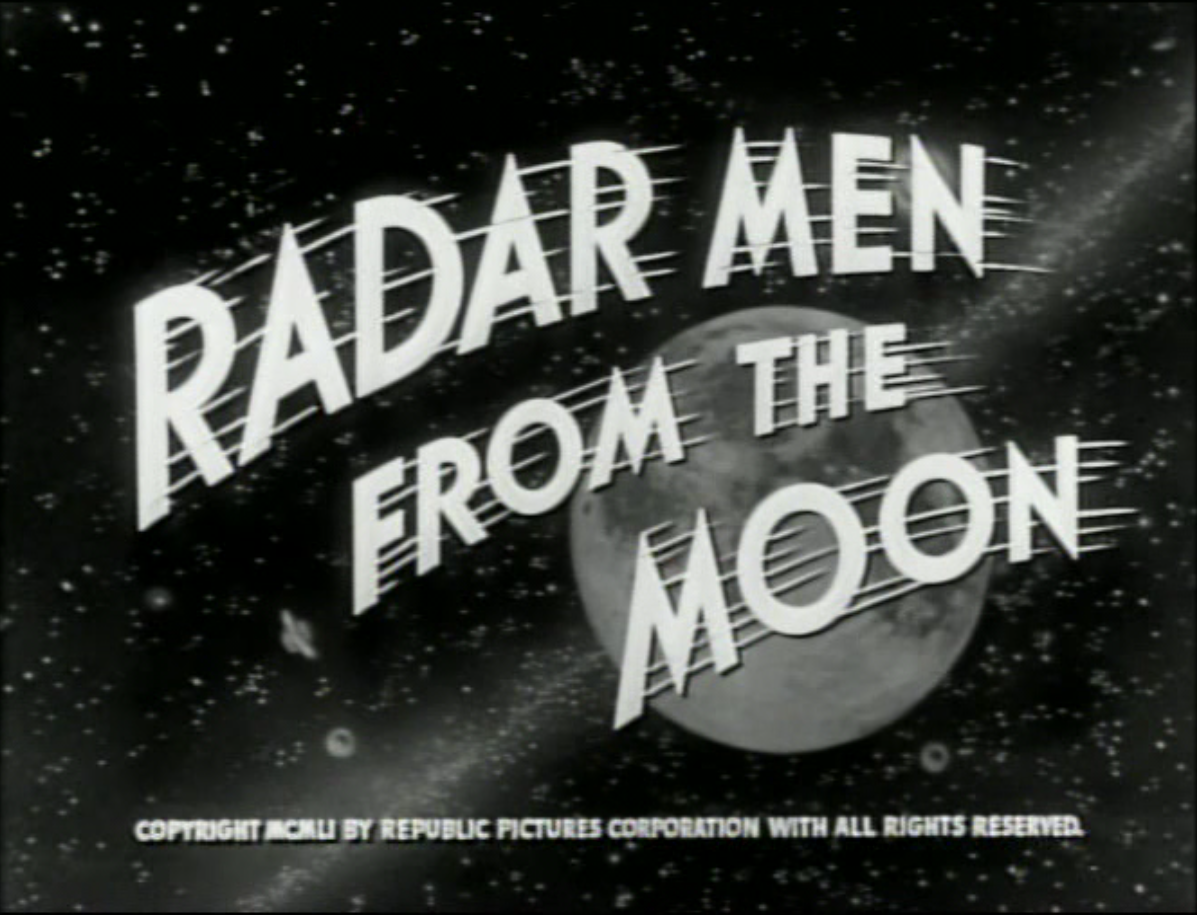
RMTitle2
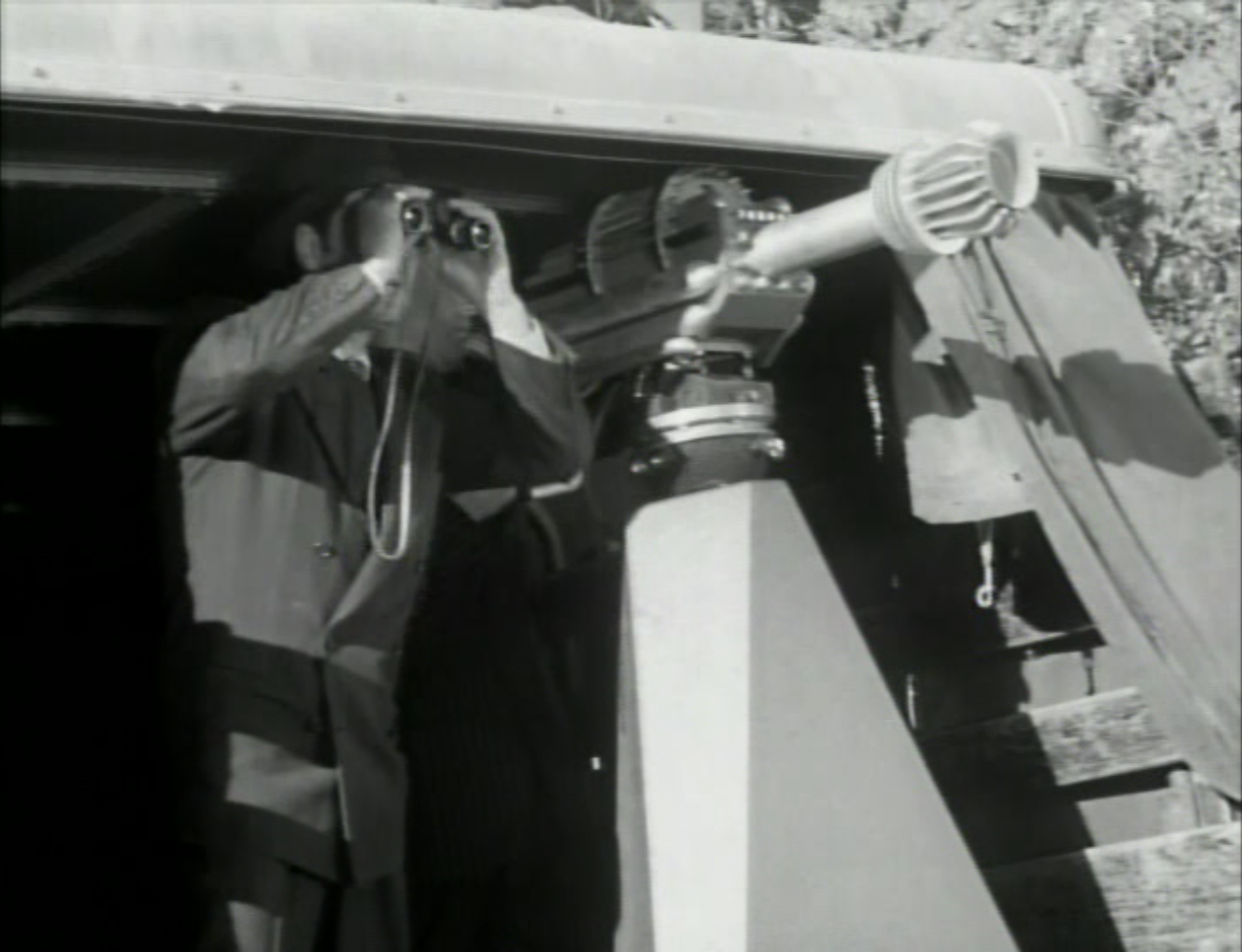
RMTitle3

A string of mysterious explosions and attacks is crippling America’s defense network. Scientific analysis indicates that atomic weapons caused the destruction, but what power on earth could focus atomic energy into the kind of ray being used? Only one man is equipped to investigate: Commando Cody, inventor and explorer, whose jetpack allows him to soar through the air (and who is also a crack shot with a pistol).

RMCody3

Liberating the atomic ray from the two gangsters wielding it, Cody takes the futuristic weapon back to his lab to analyze it. The two gangsters, Daly and Graber, report to their superior, Krog, who (as Cody will discover) is the leader of an invading force from the moon! Krog orders them to recover the ray and sends his human minions on several criminal assignments to raise funds for his terroristic activities.

RMAtomicRay

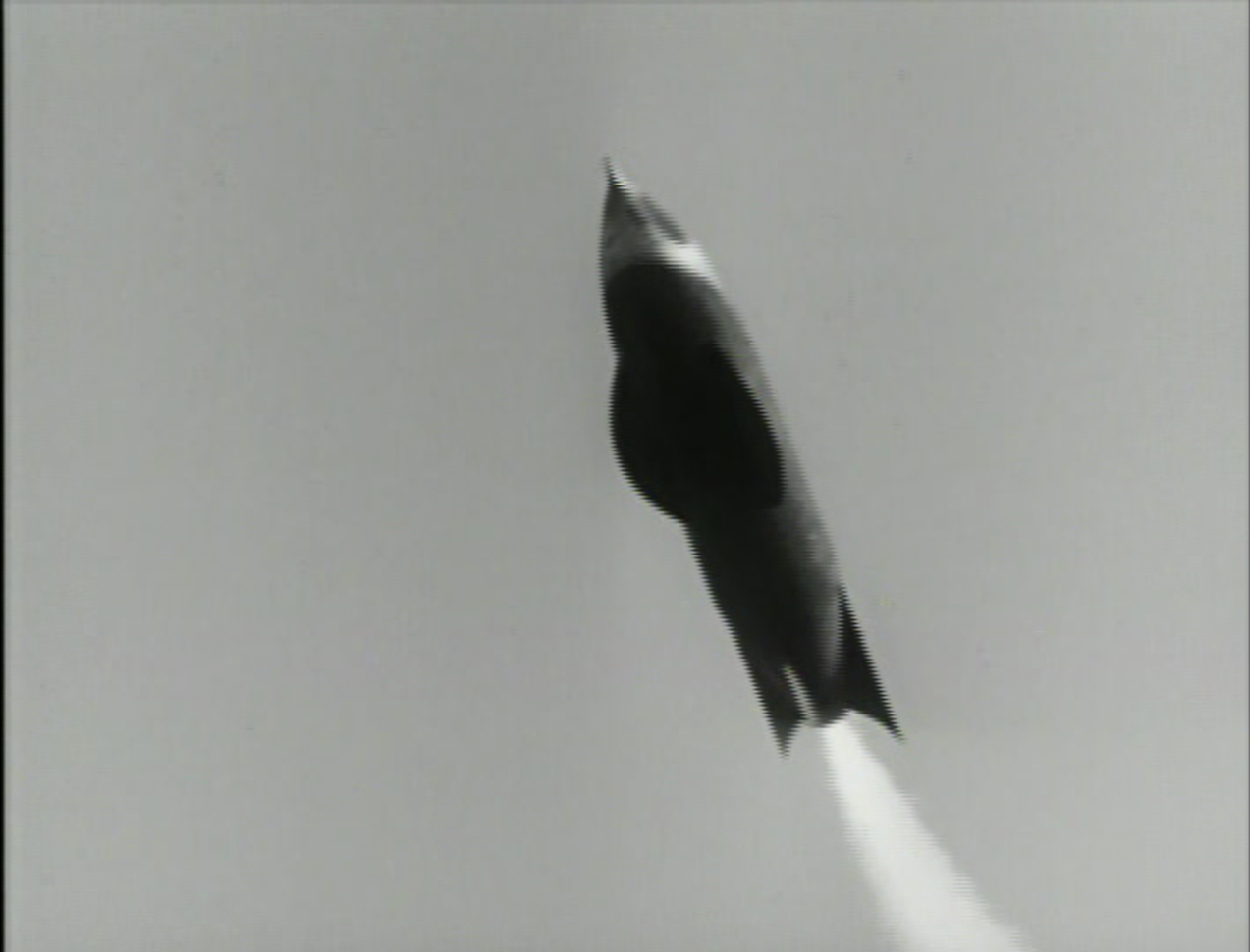
Eventually, Cody and his team determine the source of the trouble and launch Cody’s latest invention, an interplanetary rocket ship, to the moon itself. The lunar civilization is dying, as its leader Retik explains, the air too thin and dry to grow food; already the lunarians must wear helmets outside of their pressurized cities in order to breathe. (Needless to say, no more attention is paid to real scientific knowledge of the moon than in the space fantasies of Edgar Rice Burroughs from decades before.) After softening up earth’s defenses, the lunarians plan to invade earth in Radar Men from the Moon.

RMrocket4

In 1949, Republic Pictures, weary of licensing superheroes from the comics and radio, introduced an original character, Rocket Man, in King of the Rocket Men. Three years later, Radar Men from the Moon featured Commando Cody, a repackaging of the Rocket Man concept (essentially a superhero with a jetpack). By all accounts, Radar Men relies heavily on footage of Rocket Man from the earlier serial, as well as reusing props, costumes, and special effects from Republic’s extensive library. (Two sequels followed: Zombies of the Stratosphere and a television series, Sky Marshall of the Universe; Rocket Man/Commando Cody’s influence is also readily seen in Dave Stevens’ comic book hero the Rocketeer, adapted into a 1991 film directed by Joe Johnston.)

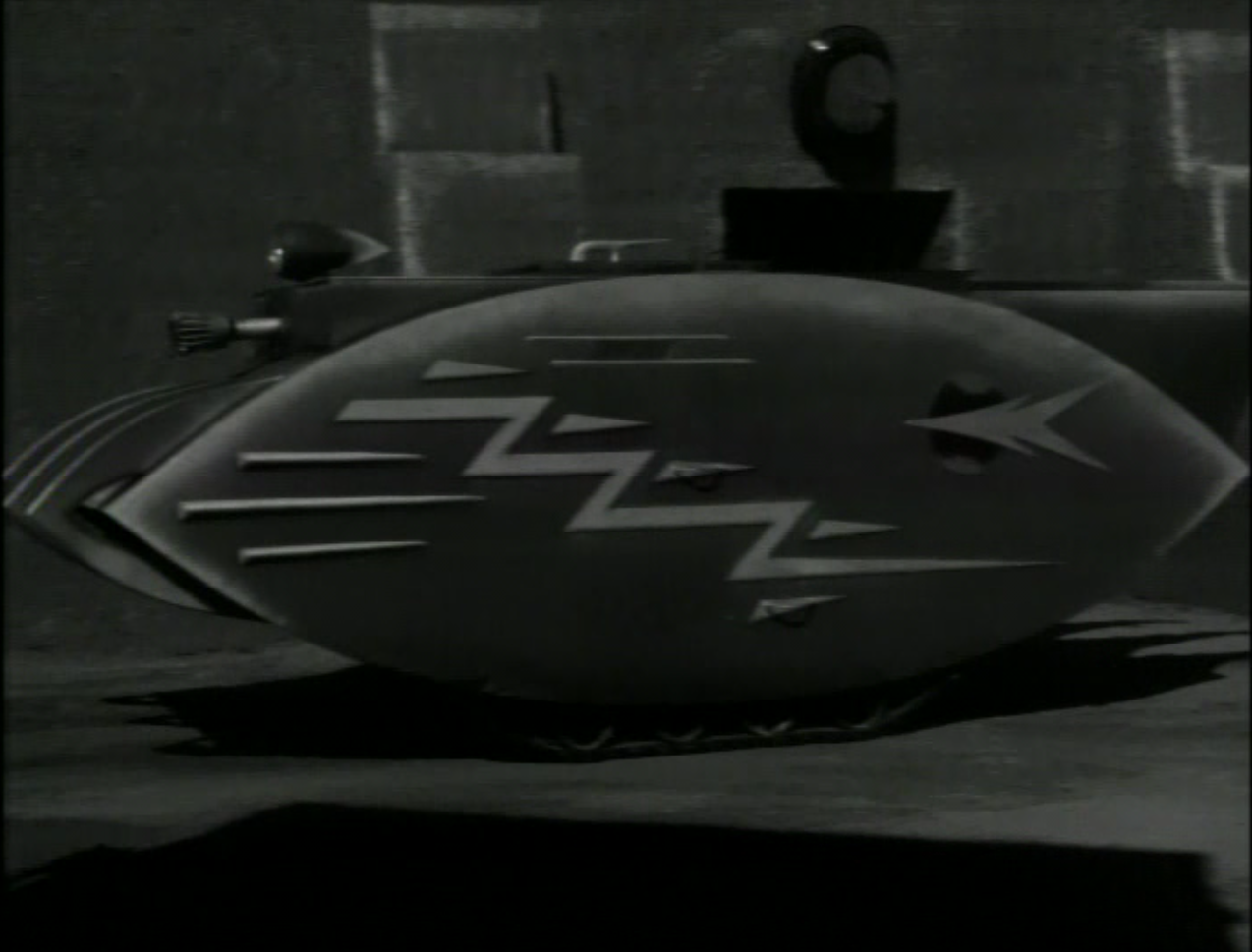
RMtank1

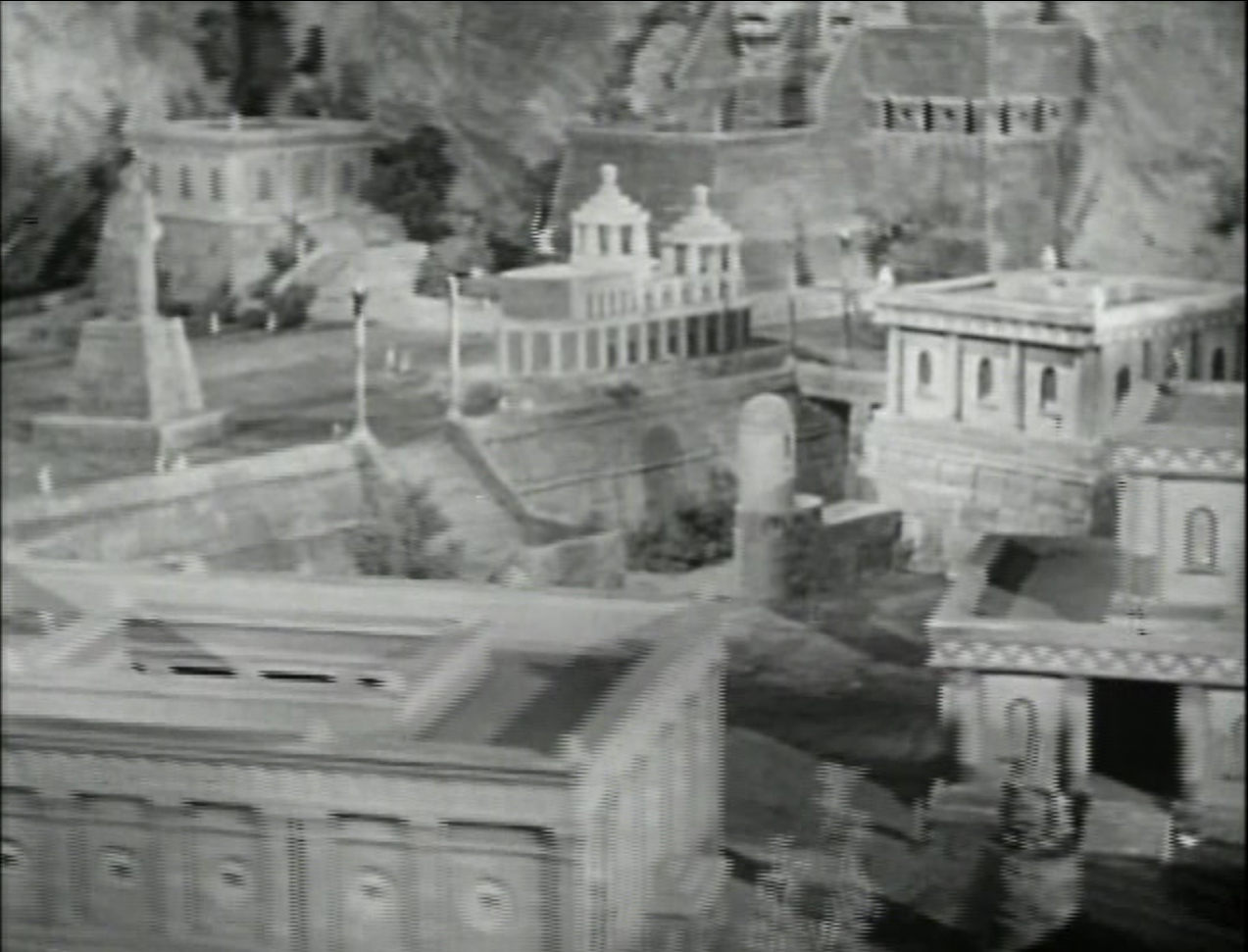
Radar Men from the Moon is very much what you would expect from a science fiction adventure from the early 1950s, as much Captain Video as Flash Gordon. With the fishbowl-style space helmets, finned rocket ships, and sweet moon tanks (not to mention Cody’s bullet-headed flying costume), it is, to use a modern term, “toyetic” (although the kind of mass merchandising we’ve come to expect since Star Wars wasn’t in place then, so there don’t seem to be a large number of actual toys based on these designs). On the other hand, the Greco-Roman architecture of the lunar city and the futuristic laboratory of Retik show that styles hadn’t changed that much since the space operas of the ‘30s (and a lot of the running time is spent on earth with perfectly mundane cops-and-robbers business).

RMmooncity2

Normally, I’ve tried to look at examples of a given concept or character in chronological order (covering Flash Gordon instead of one of its sequels, for example), but I had a copy of Radar Men on hand, and since Commando Cody is technically a new character, free of any earlier continuity, I don’t feel too much conflict about covering it before getting to the original Rocket Men. Besides, reused footage and props were a cost-saving feature of the serials almost since the beginning, so Radar Men is exceptional only for its late position in the format’s history and the slickness of its incorporation of previous material.

RMRetik1

For what it’s worth, it wasn’t obvious to this viewer when it cut to older footage, and establishing shots weren’t drawn out as excessively as I’ve observed in the Universal serials I’ve watched. From a technical standpoint, the production of serials was clearly at a high point, and everything moves quickly and looks sharp. However, the same professional application of an established formula that makes everything look polished also drains any spontaneity out of this production: the characters are thinly drawn and their dialogue functions almost exclusively to move the plot forward. There is little room for the weird digressions or surprises that mark the serials of the 1930s.

Star George Wallace leads a cast that includes “heavy” Roy Barcroft as Retik and future Lone Ranger Clayton Moore as the gangster Graber; the performances are fine, but the real stars are special effects wizards Howard “Babe” Lydecker and Theodore Lydecker, brothers whose detailed miniatures of earthly and lunar structures and vehicles are extensively featured. There are also plenty of well-executed fight scenes, courtesy of Tom Steele and Dale Van Sickel, longtime stuntmen and fight coordinators.

RMCody4

So why isn’t Radar Men from the Moon more exciting? There’s a business-as-usual quality to the proceedings: no one seems that surprised that America is under attack by atomic weapons, or that the culprits might be from the moon. What’s that, we need to take our rocket ship to the moon? Sure thing. Oh, we need to go back? No problem. I’ll remember to take my jetpack in case I need to hijack a space tank. The material calls for hyperbole à la Stan Lee, but the execution is more like Dragnet.

That’s not to say that I’d be happier if Radar Men from the Moon stopped in its tracks to marvel at the insanity of its own plot: in general, pulp narratives don’t spend a lot of time questioning their believability. The characters accept that what is happening is real—they don’t have a choice—and the audience follows suit. There is usually, however, a moment or two that acknowledges the overturning of established science (I think of this as the “more in heaven and earth” speech, often delivered by a scientist who admits that there are still mysteries in the universe) or asks the audience to consider what it would really mean for humanity to encounter, say, an invading army of moon men. (Robert E. Howard, to cite one example, often salted his tales of brawny barbarian warriors with thematically-appropriate musings on destiny and masculinity.)

No such philosophical problems trouble Commando Cody or his team. If I had seen Radar Men from the Moon when I was twelve, I expect I would have loved it, but as an adult the prospect of an adventure that is all plot and very little character is less appealing. Rather than revisit it, I’ll probably just rewatch The Rocketeer.

What I Watched: Radar Men from the Moon (Republic, 1952)
Where I Watched It: A Hal Roach Studios DVD; it’s also available to watch on YouTube.
No. of Chapters: 12
Best Chapter Title: “Molten Terror” (Chapter Two)
Best Cliffhanger: At the end of “Molten Terror,” Cody and Ted are trapped in a mountainside cave on the moon. Lunar soldiers aim the atomic ray at the mountain, softening the rock (using the same melting effect seen at the end of The Phantom Empire) and filling the cave with molten lava.
RMmoltenterror
Annie Wilkes Award for Most Blatant Cheat: Several times Cody is in a vehicle that crashes: planes at the end of Chapter Four (“Flight to Destruction”) and Chapter Seven (“Camouflaged Destruction”), a car in Chapter Five (“Murder Car”). In the next week’s episode, intercut footage reveals Cody and his passenger bailing out at the last minute, exactly the kind of cheat Annie Wilkes was complaining about.
Sample Dialogue: “For some time our astronomers have noticed an unusual amount of atomic activity on the moon. Atomic activity on the moon, atomic blasts on the earth: the two known facts fit together.” –Henderson (Don Walters), Cody’s government contact
RMHenderson2
What Others Have Said: “It was my own personal homage to Commando Cody and all the other serial heroes of that era. I’d always been a huge fan of the serials. I loved all those edge-of-your-seat, cliff-hanging chapter plays. . . . I’d always loved the idea of a guy flying like a bird, with just a combustible contraption strapped to his back. The image really appealed to me. But I didn’t want to be stuck doing an exact replication of the serials, with Martians, death-rays, etc. That wasn’t quite the approach I wanted to take. I wanted to do a real period aviation strip, but with one small element of science-fiction added: The rocket-pack!” –Dave Stevens, creator of the Rocketeer, interview with Jon B. Cooke in The Comic Book Artist
What’s Next: I’ll take a look at Zorro’s Black Whip, starring Linda Stirling. Join me in two weeks!

Fates Worse Than Death: The Phantom Empire

PETitle
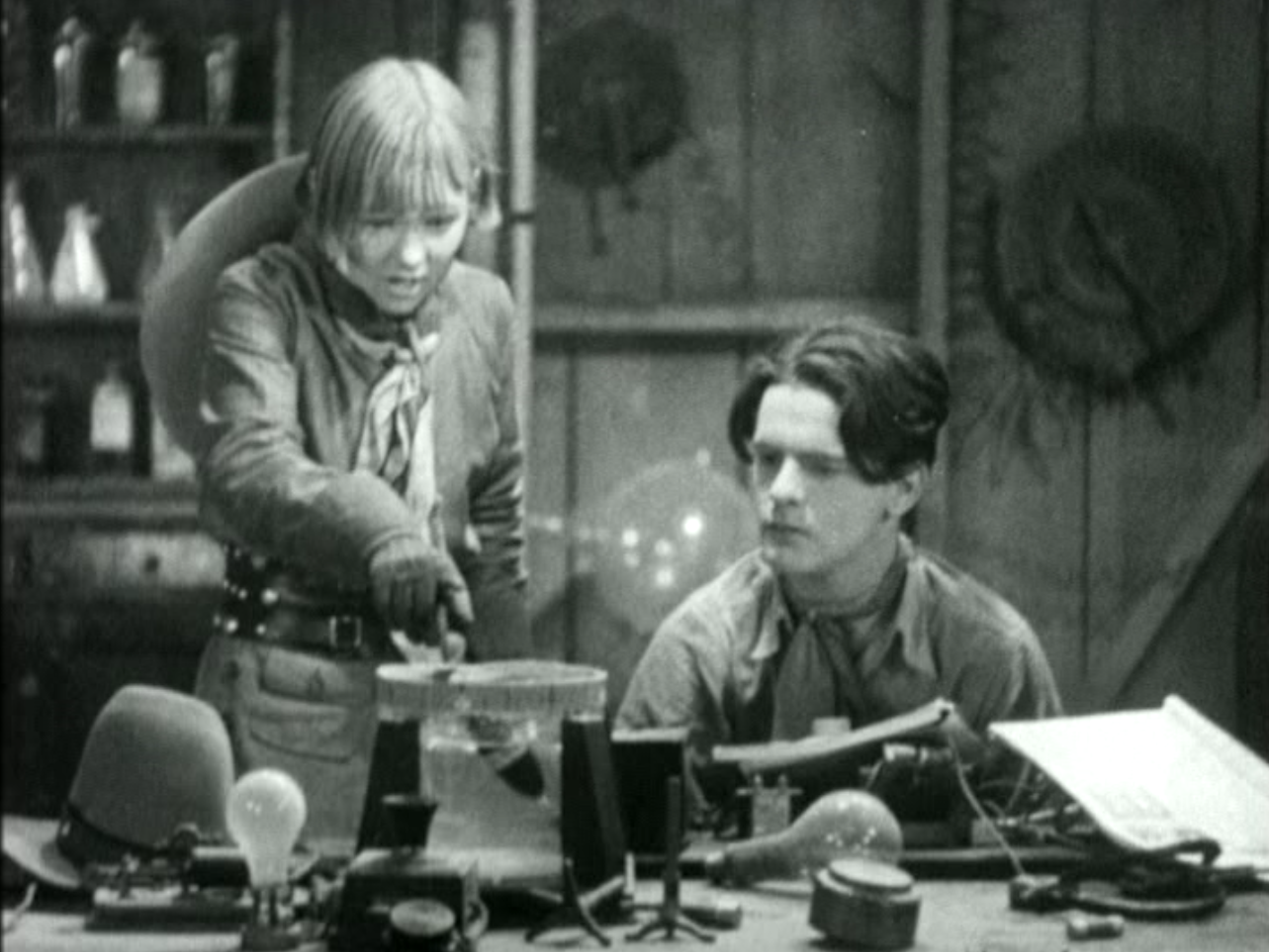
Radio Ranch is a busy place: Frankie and Betsy Baxter’s father Tom co-owns the ranch with “Radio’s Singing Cowboy” Gene Autry, whose daily broadcasts have brought visitors from all over. The Baxter kids also run the “Junior Thunder Riders,” a combination fan club and service organization (after some debate, they settle on “To the rescue!” as their motto) inspired by a mysterious group of riders they once witnessed in nearby Thunder Valley. In addition, Frankie is a tinkerer (with an enviable workshop in the barn loft), assembling electrical gadgets using instructions from Popular Science (and occasionally borrowing parts from the ranch’s radio engineer!).
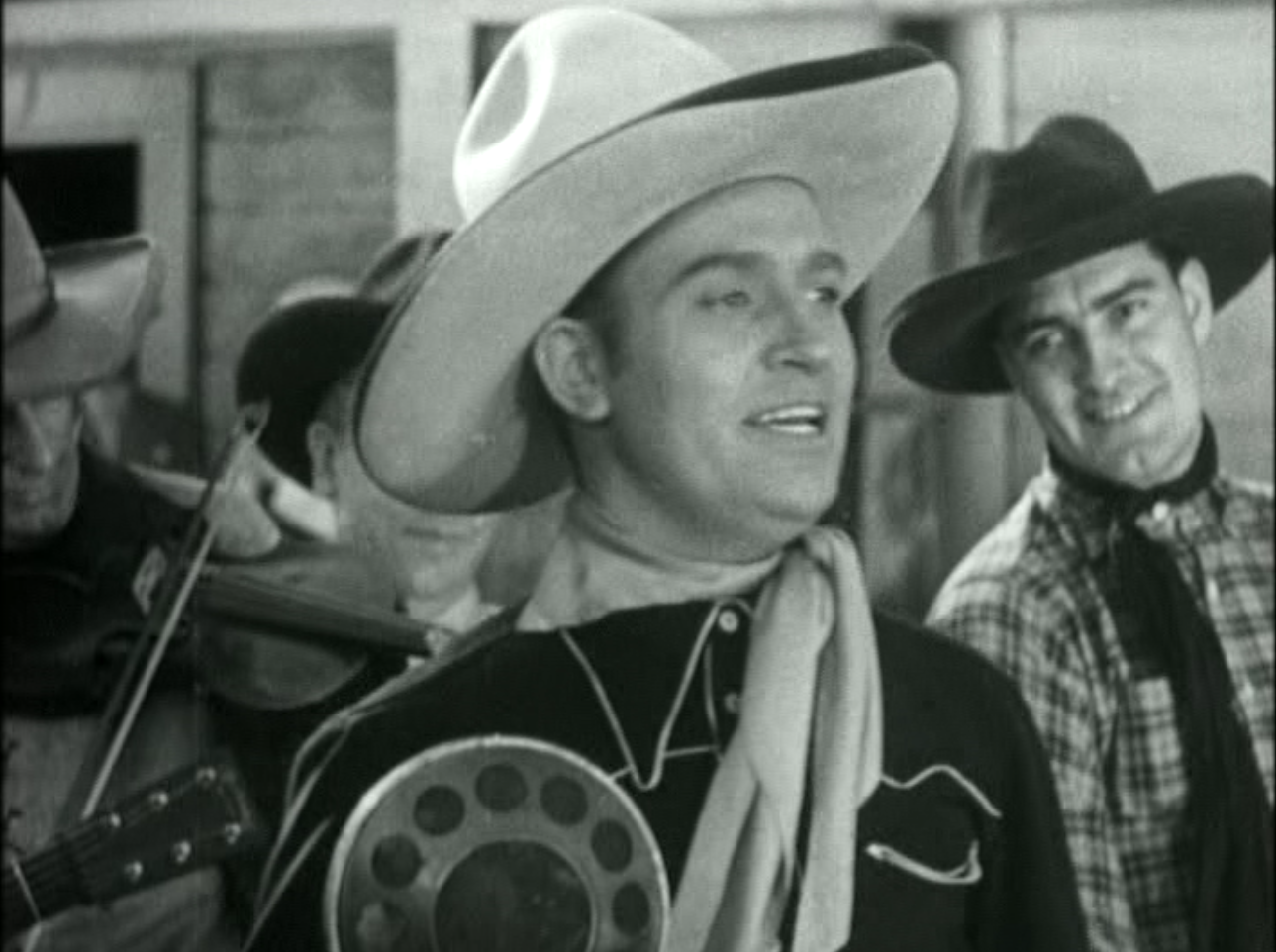
PEAutry1
The action begins with the arrival of Professor Beetson and his crew, secretly in search of a radium deposit Beetson believes to be in the area. At the same time, one of Frankie’s devices, a radio signal “direction finder,” indicates that some scrambled signals he’s been tracking for weeks are coming from straight down, somewhere in the depths of the earth.
PEFrankie.Betsy3
Before the first chapter is over, it is revealed that the mysterious riders, the radium deposit, and the unknown radio signals are all connected to “The Scientific City of Murania” 25,000 feet below the surface, a realm of futuristic marvels ruled by the haughty Queen Tika and whose entrance in Thunder Valley is protected by her royal guard (the “Thunder Riders” the Baxters witnessed, wearing gas mask-like breathing apparatuses while at surface level). It isn’t long before the surface and subterranean worlds collide and the fates of Autry and Tika are entwined!
PEMurania3
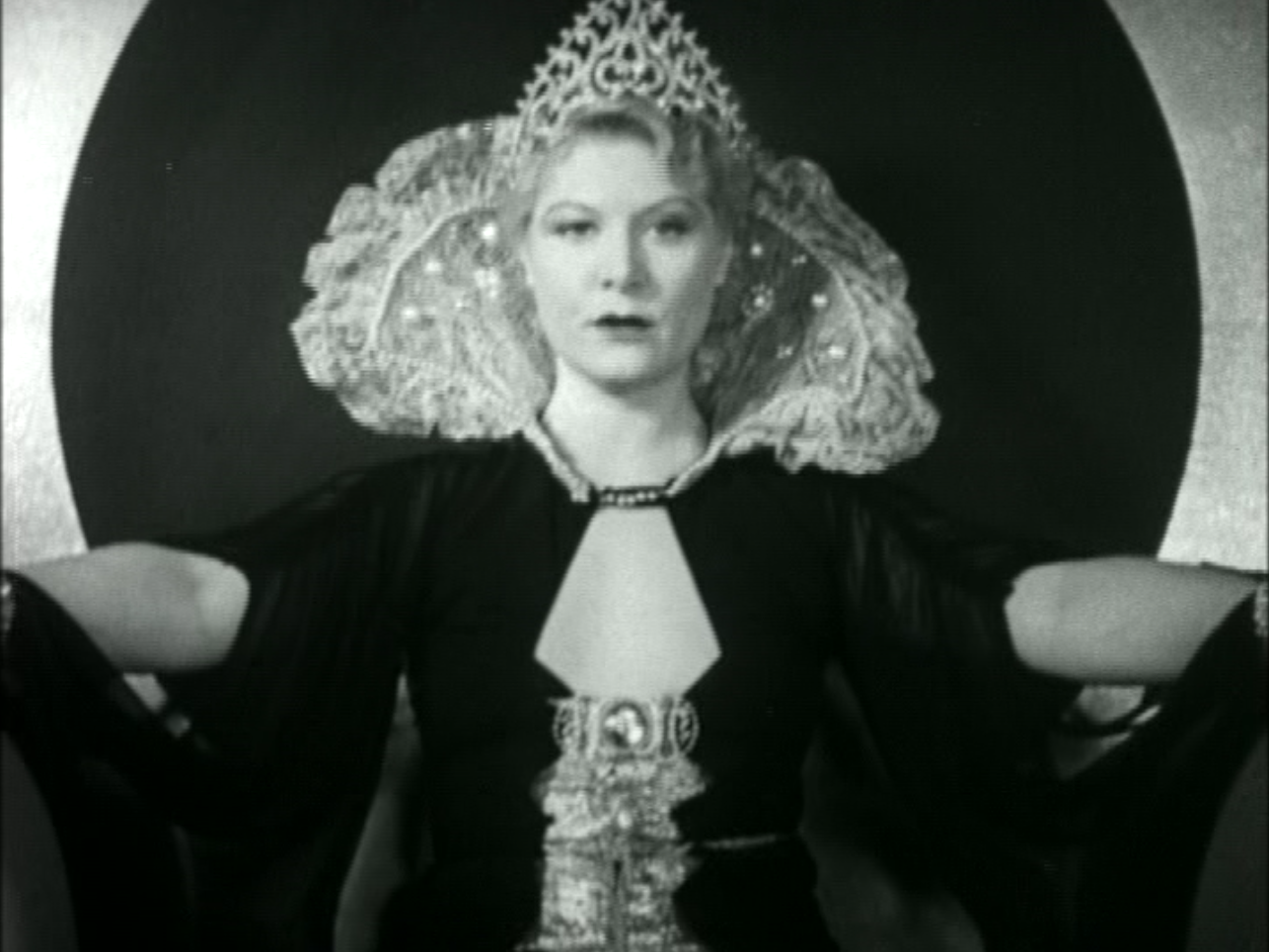
As the story develops, Beetson’s greed (for both radium and scientific acclaim) and the Baxters’ curiosity endanger Murania’s secret. Beetson hopes to get Autry out of the way—if Autry misses a broadcast, he’ll lose his radio contract and the ranch—so that he won’t have any interference in his digging (or have to share any of his finds with the property owners and government). Beetson even goes so far as to kill Tom Baxter and frame Autry for the crime! Queen Tika wants both Autry and Beetson gone for similar reasons: too many visitors to Radio Ranch means risking the discovery of Murania, and their serene kingdom must never be desecrated by the presence of surface people!
PETika2
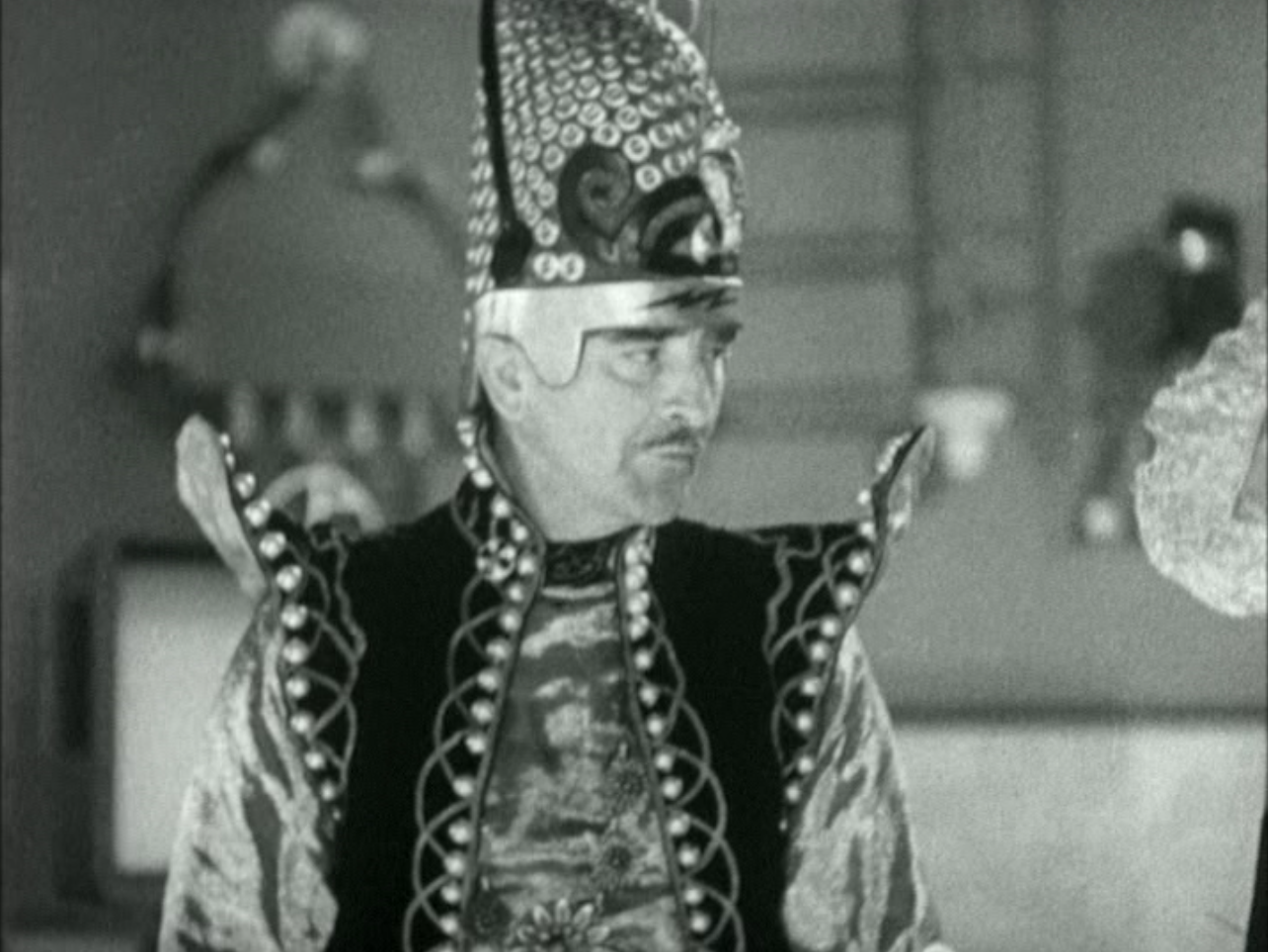
Little does Tika know, however, that there is division in her own kingdom: her Chancellor, Argo, schemes to overthrow her with a band of rebels, men he has saved from death in the “Lightning Chamber.” Will she succeed in keeping her throne? Will Frankie and Betsy discover the secret of the underground city? Will Beetson succeed in keeping Gene Autry away from Radio Ranch, or will Autry make it back to broadcast a performance at two o’clock each day?
PEArgo1
Thus begins the epic twelve-chapter Mascot serial The Phantom Empire, Gene Autry’s debut as a leading man (following his attention-getting appearance in In Old Santa Fe) and one of the strangest examples of the form. This is one I had actually seen before: The Phantom Empire was my introduction to the serials several years ago, and revisiting it in light of my recent exploration has not lessened its curiosity factor.

As even this brief summary indicates, there are numerous characters with competing interests to be accommodated by the story, and while some of them fit the profile of stock serial characters—the juveniles, the imperious monarch, the scientist-explorer—both the energy of the performances and the unusual situations in which they find themselves make them stand out as individuals. Even the comic relief, provided by Autry’s sidemen Oscar and Pete (longtime sidekick Lester “Smiley” Burnett and Peter Potter, credited as “William Moore,” respectively), is more idiosyncratic than the typical examples (for one thing, they actually help advance the plot).


Gene Autry is the star, of course, playing the fictionalized version of himself that would carry him through dozens of features and television episodes, bland but likeable, a good guy and friend to all except for heels like Beetson (even Queen Tika eventually comes to see him as an ally). (Incidentally, there is a perception, given his persona, that Autry sings in every chapter, but this is not so: fewer than half the chapters include musical numbers, and in some cases the film cuts to other action, the song continuing in the background.)


Most pulp heroes are intentionally somewhat blank, more active than reflective, the better for audiences to project themselves onto their characters. In this case, however, the audience identification characters are clearly Frankie and Betsy (played by frequent juvenile leads Frankie Darro and Betsy King Ross, whom we saw in Fighting with Kit Carson): their leadership of the Junior Thunder Riders (whom they address as part of Autry’s radio broadcast) and Frankie’s do-it-yourself projects are clear appeals to the kinds of young viewers who might throw themselves into fandom, who in the following generations might become Futurians, or members of the Merry Marvel Marching Society, or Trekkies, or Whovians. Were they around today, the Junior Thunder Riders would undoubtedly be attending Comic-Con.

PEThunder.Riders1

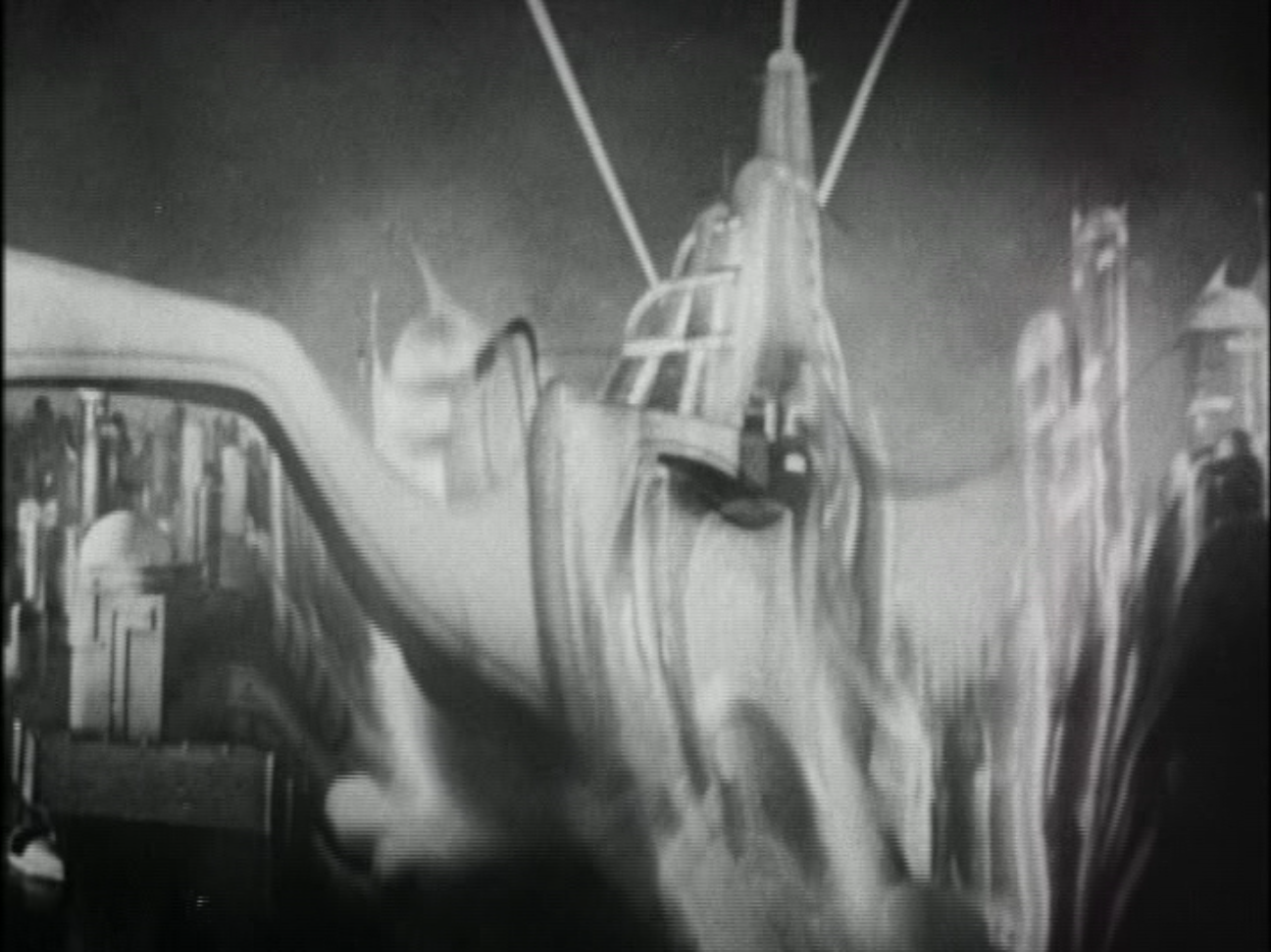
Obviously, the most notable element of The Phantom Empire is its mingling of genres, drawing on the “modern” Western (in which contemporary inventions such as radio, automobiles, and airplanes coexist with horses and six-guns) and space opera (albeit of the inner rather than outer variety). Very little of Murania, with its gleaming art deco spires (reminiscent of both Metropolis and the Emerald City of Oz) and fantastic machinery, including robots and disintegration rays, would be out of place the following year in Flash Gordon. Like the royalty of planet Mongo, the citizens of Murania dress with stagey, pseudo-medieval flair and favor both swords and ray guns for defense. With their flowing cloaks and ornate headgear, it’s no wonder Frankie and Betsy took the Queen’s royal guard as their models for the Junior Thunder Riders.

PEThunder.Riders2

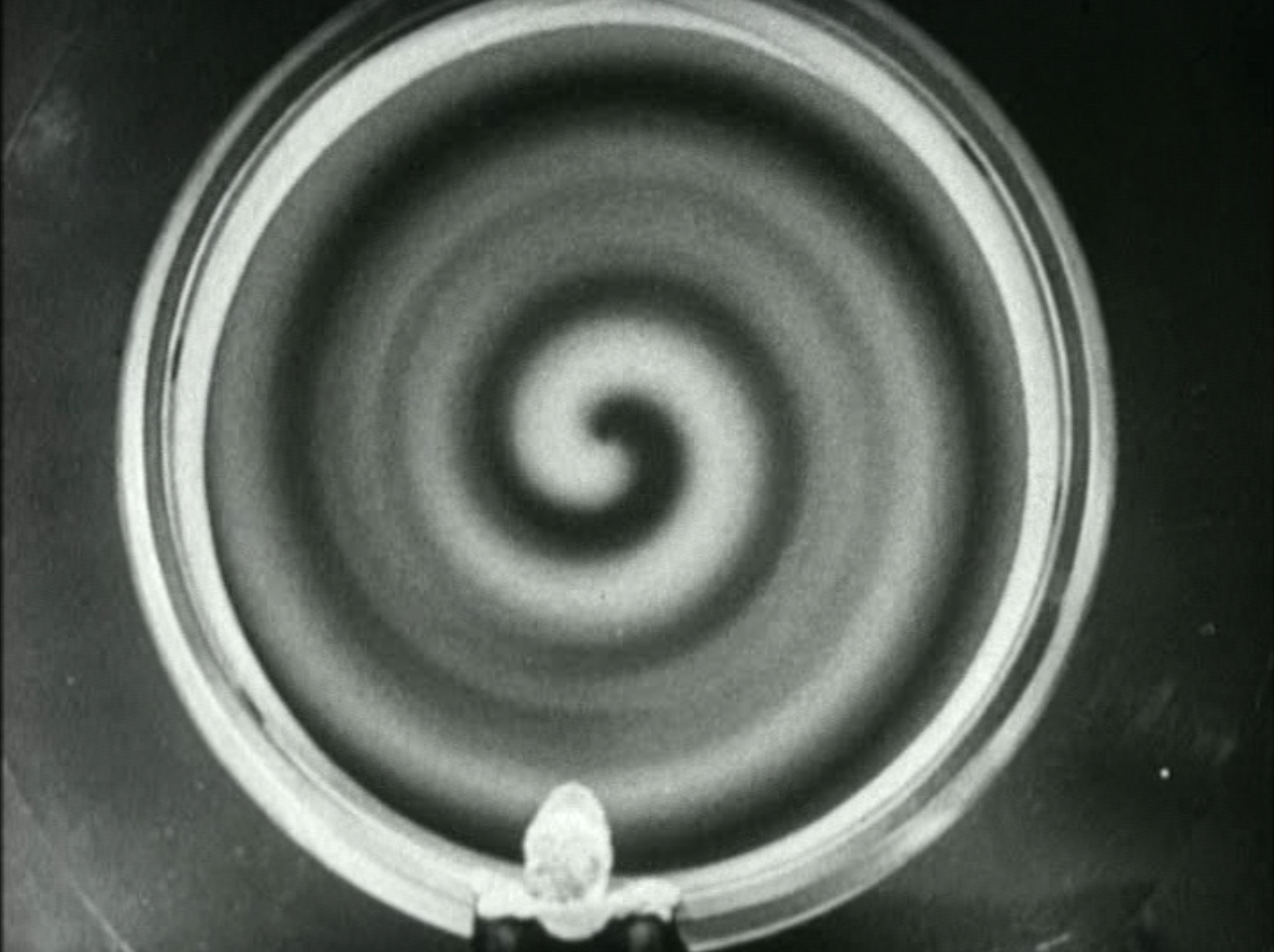
The genre mash-up (which, even at this late date, is still unusual in film*) gives it a quaint appeal. Much of Murania’s technology was on the cusp of becoming real in 1935, but must have seemed as fantastic as the automobile would have been in the Old West: radium is treated as a source of almost magical power, not only powering the weapons and machines of Murania but even bringing people—including Gene Autry—back from the brink of death in a “radium reviving chamber.” The disintegrating ray that (inevitably) dooms Murania must have seemed fanciful indeed until real-life atomic bombs cast all such science fiction premises in a new light ten years later. Television is a particular object of fascination, treated here as a magic mirror, able to direct its user’s view almost anywhere with godlike omniscience. (Queen Tika’s viewer, which gets much use, even takes the form of a spiraling horizontal disc, like an oracle’s scrying pool.)

PEviewer2

There had been fictional treatments of a hollow earth, or at least of subterranean realms, before, by such authors as Jules Verne and Edgar Rice Burroughs, and underground kingdoms continued to be popular in the science fiction and fantasy pulps. The Muranians are identified as descendants of ancient Mu who went underground one hundred thousand years earlier, fleeing the advancing glaciers of the Ice Age. Separate from the “mad world” above, they cultivated an advanced science based on the abundant radium they found.


Even in the 1930s, such beliefs were the territory of fringe science and occultism: I’m sure no one involved thought they were making a documentary, but the backstory indicates that at least one of the writers had been paying close attention to such ideas. In Chapter One, after Frankie’s direction finder has detected the radio signals from underground, Betsy asks Autry, “Say, do you suppose there’s anything to any of those books that Frankie’s been reading, about a world underground, with people and cities and everything?” Without hesitating, Autry replies, “Well, of course there’s something to them,” like a regular reader of Amazing Stories.


Speaking of that esteemed publication, The Phantom Empire anticipates by several years the so-called “Shaver Mystery” that appeared in its pages. Beginning in 1943, Amazing Stories’ editor Ray Palmer began printing letters and stories from Richard S. Shaver, who claimed he could hear voices from reincarnated spirits from the past and decode markings left in stone by the long-ago inhabitants of Atlantis and Lemuria. An important part of Shaver’s increasingly complex cosmology was the present-day survival of the original Lemurians’ descendants, who, subject to harmful rays from our sun, had degenerated into “detrimental robots” or “deros.” The deros continued to live in vast cave and tunnel systems beneath the earth, and, through their mastery of the ray technology left behind by the ancients, wreaked all manner of havoc on the surface. Eventually, Shaver came to believe that all illness, mental distress, war, and other problems of the individual and society were caused by the machinations of the malevolent deros. As his stories became wilder and his memories of the ancient world became more vivid (with extensive rewriting by Palmer), letters poured in from readers claiming they had encountered the deros too, having unknowingly crossed into their realm via caves or mines, or that they were being persecuted by the deros and their surface allies. **


I am not aware of any claim that The Phantom Empire influenced the form of Shaver’s later revelations, but they both share a paranoid, hallucinatory quality that (in the case of The Phantom Empire) goes beyond the novelty value of merging two such disparate genres. I would venture so far as to say that The Phantom Empire is in many places truly surreal, not just in the colloquial sense of “weird” but in the sense of invoking a dream-like acceptance of seemingly unrelated events, making the strange seem normal and vice versa. Through the alchemy of film, obvious artifice becomes more vividly real than reality.


As an example, Autry’s easygoing music, for which he was presumably chosen to headline the production, is often juxtaposed with scenes of mystery or danger, giving it an eerie edge: in Chapter Eight (“Jaws of Jeopardy”) he sings “I’m Getting a Moon’s Eye View of the World” on an airplane while Frankie holds a gun on the unwilling pilot; in Chapter One, his then best-known song “That Silver-Haired Daddy of Mine” is broken up and heard from a distance while Frankie and Betsy use the direction finder in their secret workshop. The moment when they realize the signals are coming from beneath the earth achieves something often reached for but not always grasped in the serials: a sense of wonder, and in that scene The Phantom Empire anticipates the inquisitive child protagonists of Steven Spielberg and other filmmakers of the 1980s.


There is a reflexive quality to much of The Phantom Empire, and the borders between narrative elements are permeable: Autry’s daily broadcasts (at least before he is framed) include full live performances of stagecoach robberies and other dramas, supposedly staged for the live audience at the ranch rather than those listening to the radio show, but in ways that play with audience expectation and blur the boundaries between fantasy and reality. Frankie and Betsy address “Junior Thunder Riders” in the radio audience as a way of speaking directly to the film audience.


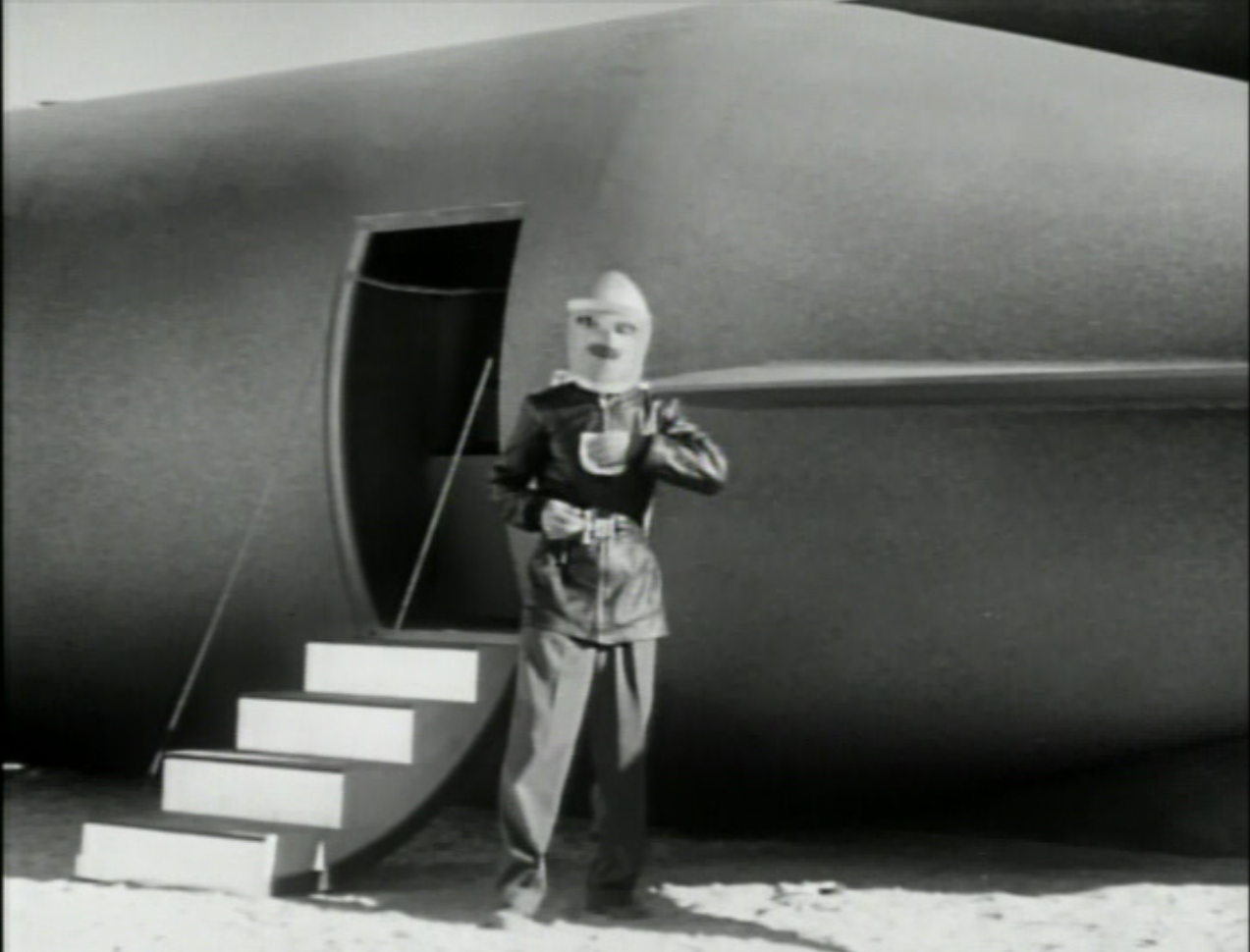
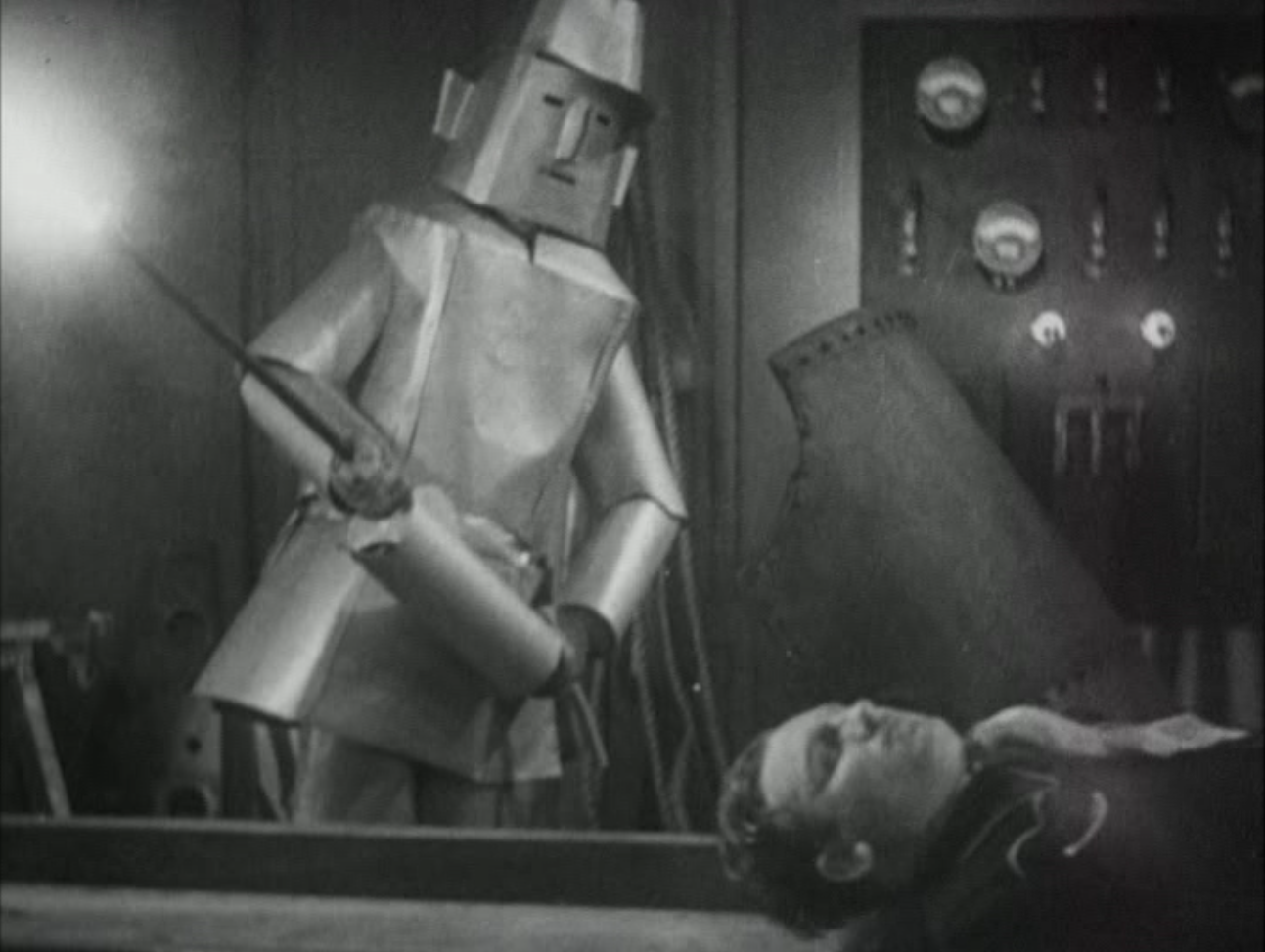
The Queen’s royal guard, nicknamed the “Thunder Riders” by Frankie and Betsy, and taken as the basis of their club, are at first referred to only as the “royal guard;” later as the “thunder guard;” and finally as the “Thunder Riders,” the same as the name given to them by the children. The robots of Murania have what appear to be built-in cowboy hats as part of their design (the logical explanation is that someone in the prop department heard the phrase “science fiction Western” and took it to heart, but I’m more interested in effect than intent); ultimately, two of the robots’ metal bodies are inhabited by Oscar and Pete, real cowboys in disguise.

PErobot.disguise

The constant reuse of key sets above and below ground, made possible in part by Queen Tika’s remote viewing from her control room, gives events a sense of circularity: Flash Gordon moves from one fantastic place to another in sequence, but The Phantom Empire moves up and down as capriciously as the city’s sole elevator, always returning to the same locations.


Queen Tika’s television viewer contributes to this same dream-like scramble of images: several times she views a succession of unconnected scenes from the surface (stock footage of traffic, boxing matches, and car crashes) in order to express her disapproval: “Fools! Surface people are always in a hurry—their world today is a madhouse. We in Murania are indeed fortunate. Death . . . suffering . . . speed . . . accidents. . . .” Almost everything Tika (played by Dorothy Christy) says is delivered in a tone of high dudgeon: “Do I have to witness this insane material because you are unable to find the Garden of Life?” she demands of her assistant, sounding exactly like an annoyed spouse whose husband continues to flip through channels at random.


In one odd scene, Tika takes Autry on a virtual tour of Murania using the viewer, and then contrasts the achievements of her kingdom with a penniless beggar: “Feast your eyes,” she says. “He is from your world; we have none of that here.” Changing the view to Frankie and Betsy, she says, “There are friends of yours. They may become beggars.” In 1935, the depths of the Depression, such a concern was far from academic.

PEbeggar

One moment in the final chapter (“The End of Murania”) says a great deal about the production as a whole: the underground city is melting down under the beam of the rebels’ giant disintegrating ray, now out of control. Queen Tika, resigned to die with her kingdom, remains in her control room and throws the switch which will open the hidden door in Thunder Valley, allowing Autry and his surface friends to escape. Hitching up some of the Thunder Riders’ horses, Autry sees the remaining herd and suddenly says, “We can’t leave those horses here to die!” The group takes an extra moment to free all the horses, as if they knew that the young audience they hoped to grab would say, “Hey, Gene! What about those other horses!?” I admit that, seeing the herd of animals stream out of the hidden door, my heart swelled. Yeah, it’s that kind of movie.

PEMurania4

What I Watched: The Phantom Empire (Mascot, 1935)
Where I Watched It: Timeless Media Group’s 3-DVD set, endorsed by Gene Autry Entertainment and “sourced from Gene Autry’s personal film archive.” There are several versions on YouTube.
No. of Chapters: 12
Best Chapter Title: “Prisoners of the Ray” (Chapter Nine)
Best Cliffhanger: The bound or incapacitated victim on a conveyor belt, inexorably moving toward death in the form of a buzz saw or furnace, is one of the iconic images of the serials, but I haven’t seen it all that much in my admittedly limited viewing. Perhaps it was already a cliché by the 1930s heyday of the form, or perhaps I just haven’t watched the right examples yet. However, Chapter Ten of The Phantom Empire (“The Rebellion”) includes just such a cliffhanger: following Argo’s overthrow of Queen Tika, Autry attempts to fight his way out of Murania. During a fight in a foundry full of laboring robots, he is knocked unconscious and sprawled onto a warhead assembly line. At the end, a robot ceaselessly raises and lowers a welding torch—whether its white-hot fire touches a weld point or Autry’s all-too mortal flesh is of no concern to the mindless automaton.
PEconveyor
Annie Wilkes Award for Most Blatant Cheat: After his experience in the “radium reviving chamber” in Chapter Seven (“From Death to Life”), Autry escapes into the underground city and gets into a sword fight with a group of guards. Overpowered by one of them, he falls over the railing of a suspended catwalk; at the beginning of the next chapter, he climbs over instead of being pushed, and grabs onto a rail underneath. As cheats go, it’s a small one, but there’s no question the footage is different.
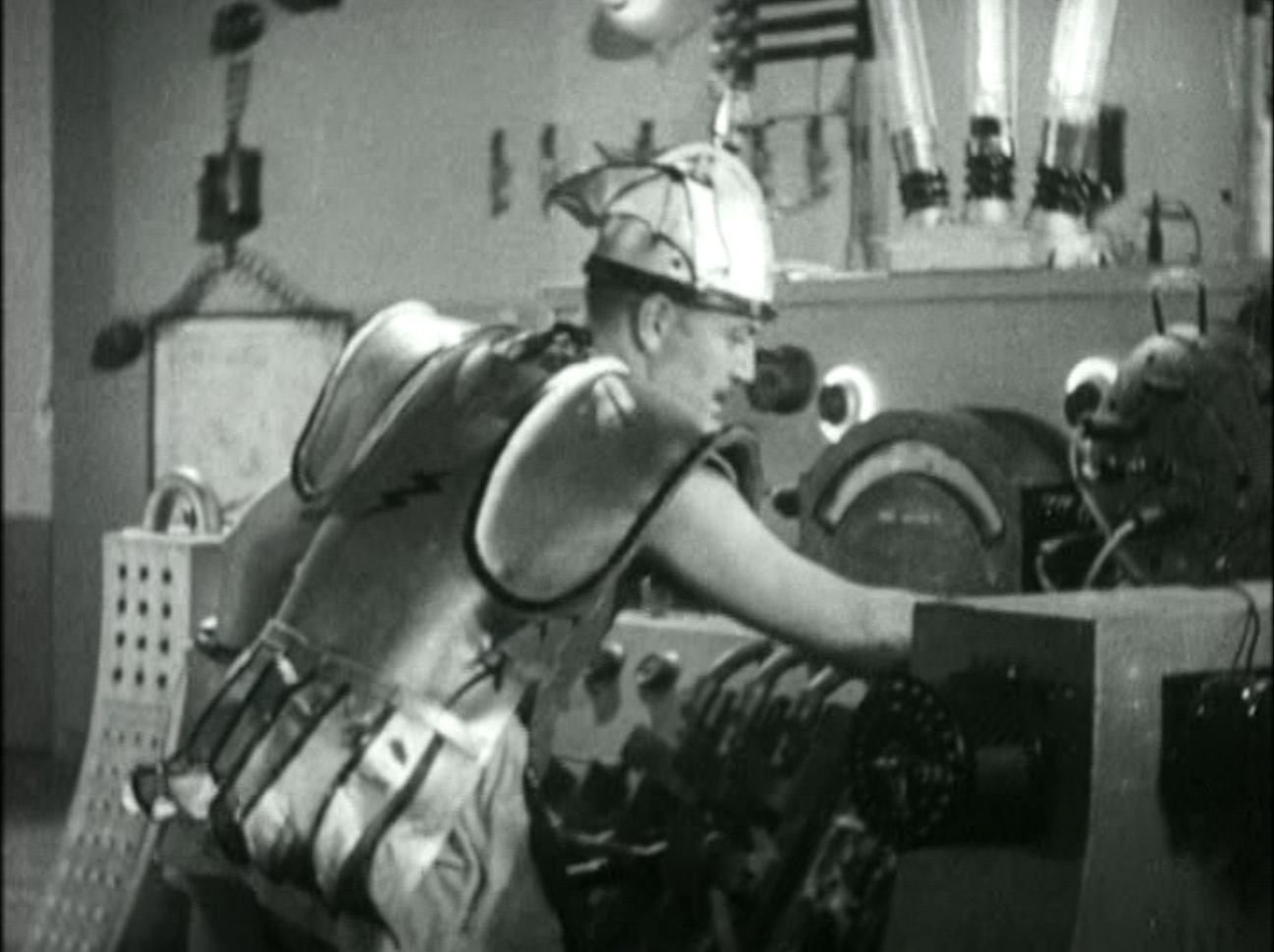
Silliest Costume: The assistant who operates Tika’s television is essentially a glorified remote control, but he does serve the Queen directly so I can’t blame him for putting on airs. The bat wings on his helmet are a little much, though.
PEassistant
Sample Dialogue: “So, you are the sprouts from which surface people spring!” –Queen Tika, upon meeting Frankie and Betsy (Chapter Nine, “Prisoners of the Ray”)
What Others Have Said: “Although the stories written about such central ideas are often vastly entertaining, they remain completely fallacious. The Earth is not hollow. The atom is not a miniature solar system. Mars is very different from Earth and could not support Earth life.” –Isaac Asimov, “Social Science Fiction”
What’s Next: I’ll examine another science fiction adventure, Radar Men from the Moon. Will it be as good as The Phantom Empire? Check back in two weeks to find out!

* The Western with science fiction, supernatural, or “weird” elements has a long history in both the comics and prose, but only spotty success in the medium of film. (2011’s Cowboys & Aliens is only the latest attempt to fuse the two genres, but its rejection by audiences is probably due less to its hybrid nature than its relentlessly dour tone; these days, audiences are more willing to embrace sci-fi Western elements under the mantle of “steampunk.”)

** Although mostly a footnote now, the Shaver Mystery was a sensation in the 1940s. It was overtaken by fascination with UFOs, but as late as the 1960s a vocal minority of UFO researchers claimed that flying saucers came from inside the earth rather than outer space.

Strange Games: Comic Books Confront the Apocalypse

Recently, DC Comics published a trade paperback collection under the unwieldy title Showcase Presents: The Great Disaster Featuring the Atomic Knights. I don’t intend this essay to be a review, but I will say up front that if mid-century visions of nuclear war are your bag, there’s no reason not to pick this up.  If you’ve read any volumes of Showcase (or Marvel’s similar Essential series) before, you know what to expect: more than 500 pages of black-and-white reprints (of stories from the 1960s through the 1980s in this case) on cheap paper at a low price.  They don’t call ‘em “phone books” for nothing.

GreatDisaster.cover

I was eager to get this volume (it had been previously announced several years ago and then delayed) for a few reasons.  First, I was a big fan of post-apocalyptic fiction when I was younger, and comic books were no different from other media in exploring that theme.  Second, although I had read some of the stories included, many were unfamiliar to me, and this would be a good way to fill in some gaps.  Finally, the focus on a central event (and one which had been interpreted many different ways by writers over the course of decades) makes this volume a little different from the typical Showcase that either follows a single character or collects completely unconnected stories (like the anthology title House of Mystery).  Some effort was made to arrange contradictory material into a single chronology, and that kind of editorial undertaking is always of interest to me.

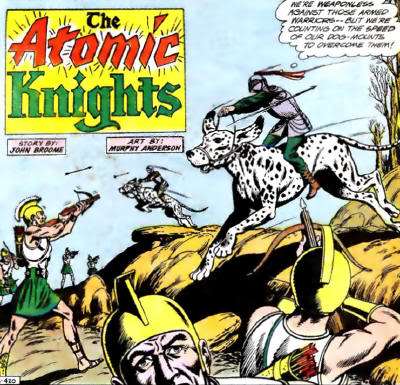
Does it succeed?  Eh, sort of.  On one hand, the title tells you a lot about what’s in the volume: several cycles of stories centered on the destruction of civilization as we know it.  The Atomic Knights, in a series of stories by writer John Broome and artist Murphy Anderson that began in 1960, travel the wastes of post-World War III America, surviving with the help of their suits of medieval armor (discovered in a museum and possessed of miraculous radiation-shielding properties).  The only other continuous series represented in this volume is Hercules Unbound, but there are a number of stand-alone stories (many under the umbrella title “The Day After Doomsday”) as well.
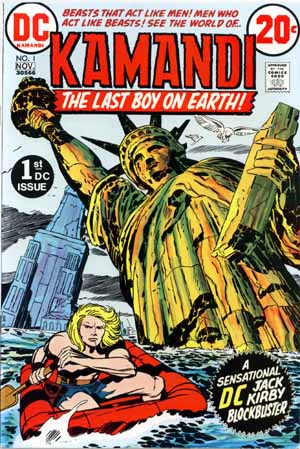
On the other hand, the Great Disaster doesn’t have the instant name recognition of a superhero, nor was it the title of an ongoing book (the Atomic Knights, for example, were found in the pages of Strange Adventures; I wouldn’t be surprised if they were added to the title of this book so that at least some character would be named on the front cover).  In fact, the Great Disaster isn’t even synonymous with World War III in DC continuity, but you have to dig pretty deeply into the book to figure that out.  The Great Disaster is (or was, pre-Crisis) a conveniently vague apocalypse in the background of Jack Kirby’s Kamandi, involving weapons of mass destruction as well as natural disasters, taking place at some point after WWIII.

(Not included in this volume)

(Not included in this volume)

The most distinctive legacy of the Great Disaster in the world “A.D.: After Disaster” was the release of a mind-altering chemical (“cortexin”) that caused ordinary animals to become intelligent, as well as gaining upright posture and opposable thumbs.  In the wake of the Great Disaster, most humans had become mute and animalistic.  Essentially, Kamandi’s world is one of reversed roles like Planet of the Apes, but with anthropomorphic dogs, tigers, and rats in addition to gorillas and other species (not to mention numerous mutant monsters and space aliens that defy categorization), all mixed up together in the ruins of a futuristic civilization.  The last point varied pretty widely: sometimes it seemed like the Great Disaster hit America in the 1970s, but it never stopped Kirby and his successors from throwing in robots, spaceships, and other high-tech devices left behind by the “ancients” if a story called for it.  (Eventually, Kamandi’s world was linked to “The World That’s Coming,” the setting of OMAC, a short-lived—and even weirder, but definitely futuristic—science fiction series Kirby had also created.)

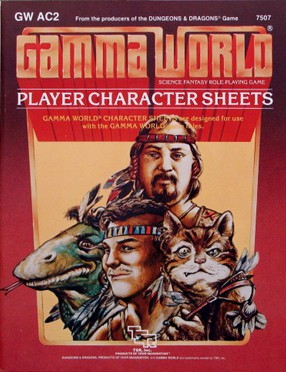
Aside from Planet of the Apes, the world of Kamandi bears a close resemblance to the campaign setting of Gamma World, a role-playing game from TSR, the makers of Dungeons & Dragons.  In transposing the adventuring-party model to a post-apocalyptic science fantasy setting, the game designers gave players the option of playing as a “pure strain” human, (humanoid) mutant, or mutated animal.  From one angle, the title character of Kamandi (“the last boy on Earth”) and his companions, the superhuman Ben Boxer and dog-man Dr. Canus, could be player characters in a Gamma World game, and their travels from one wonder to another, piecing together the fragmented history of their world and facing down monsters and villains, are not unlike an ongoing RPG campaign.

GammaWorld

Alas, Kamandi does not appear in Showcase Presents: The Great Disaster. The material reprinted from Kamandi #43-46 is a backup story focused on Urgall, a gorilla whose liberal ideas (extending respect not only to non-gorillas but to humans, and even female gorillas!) put him at odds with his tribe. (Another “tale of the Great Disaster” that appeared in Weird War Tales #51-52, featuring warring English and Scottish dog-men, is not included, which is too bad, as it is superior to the story of Urgall.)  I’ve gone into detail about Kamandi because I’m a fan, and having collected (I believe) all the pre-Crisis appearances of Kamandi and OMAC, it’s hard for me to not bring that context to the present book.  As of this writing, the only collected reprints of Kamandi are more lavish and expensive than the Showcase series, but the title is worth seeking out and is really more essential than anything in this book (but if you’re reading this, you already knew that, right?).

When I first read the Atomic Knights stories (about fifteen years ago), they struck me as more than a little silly: in addition to the conceit of medieval armor protecting against radiation, the stories were burdened with outdated gender roles (the “littlest knight,” Marene Herald, mostly stays out of the way, awaiting the day that team leader Gardner Grayle will propose to her) and too many convenient “scientific” solutions to problems.  Although the war is said to have occurred in October, 1986, the Atomic Knights’ roots in the early 1960s remain obvious.

Reading them again, however, I’m more sympathetic to the earnest tone: the Knights are at the vanguard of rebuilding democracy, and the stories often end on a didactic note, preaching the need for cooperation, compassion, and emphasizing reason and the rule of law.  Many of the menaces they face will be familiar to readers of post-apocalyptic fiction: problems of supplying food and energy when nothing will grow; human populations regressed to caveman-like savagery; would-be dictators such as the fascist “organizer” Kadey and the self-proclaimed King of New Orleans; and non-human threats either produced by radiation (a Triffid-like strain of mobile, intelligent plants) or opportunistically filling the void left by the collapse of humanity (a race of underground mole people who plan to permanently darken the sky so that they can take over the surface world; scavenging space aliens searching for precious metals).  That the Atomic Knights continue striving and are able to keep their humanity as they do so is, in its own way, optimistic.

strange_adventures#144

In fact, the suits of armor the Atomic Knights wear aren’t an anomalous detail: sometimes the comparison to knights of old is made explicit.  In the first story in Showcase Presents: The Great Disaster, “The Year 700 After the Bomb,” the post-war society resembles feudal Europe, right down to the Robin Hood-style costumes, royal titles, and pseudo-Old English dialect.  One could attribute these details to lazy writing, but it also reflects a view of history with definite evolutionary stages: just as civilization climbs upward over generations, it can also slide downward, and in such stories the image of a new “Dark Ages” is made literal.  (This can probably be laid at the doorstep of H. G. Wells, whose view was long enough to envision a day when humanity, too, is extinct, and whose film Things to Come, directed by William Cameron Menzies, portrayed a post-war English village ruled by a petty medieval warlord.)
It was when the Atomic Knights encountered warriors from the legendary island of Atlantis, time-warped into the future by their own scientific catastrophe, that I was able to put my finger on the story-telling mode. Replace “radiation” with “magic,” and a story in which armored knights battle Romanesque soldiers from an ancient island could be part of any fantasy novel from the last hundred years.  Specifically, the discovery of “Atlantides” (as the islanders are called in this story) fits neatly into the “lost world” genre: as practiced by H. Rider Haggard, A. Merritt, and Edgar Rice Burroughs, among others, there was always the possibility of a remote valley, cave, or island that history and evolution had passed by, leaving a population of dinosaurs, ancient Romans, or other living relics to be discovered.  The lost world genre was mostly finished off by World War II, as the empty, unknown spaces on the map were filled in; wiping the slate clean with a global catastrophe allowed writers to open those spaces up again, and fill them with mystery and adventure.  In these stories, the lost world was our own.

Perhaps that is one reason they continue to be popular: although seemingly pessimistic, this strain of post-apocalyptic fantasy, showing places and objects of the present through the eyes of later generations, provides for a kind of reenchantment of the everyday.  We gain perspective when we imagine a bustling city full of skyscrapers as empty and crumbling; more importantly, we can appreciate how marvelous our technology is when we picture later generations trying to make sense of it.  In the Gamma World game, there was a mechanism for player characters to puzzle out the use and meaning of “artifacts,” meant to prevent players from using out-of-game knowledge to identify, say, a rifle as a weapon rather than an emblem of office.  Similar misinterpretations are a staple of the genre: picture the subterranean mutants of Beneath the Planet of the Apes worshipping a nuclear missile as a god, or a young shaman trying to divine omens with a vinyl record in Mad Max Beyond Thunderdome. Likely inspired by real-life cargo cults, the projection of superstitious beliefs onto modern goods allows writers to remix old and new cultural symbols, comment on our relationship to technology, and—that standby of science fiction—map contemporary political concerns onto fantastical stories.

AtomicKnights

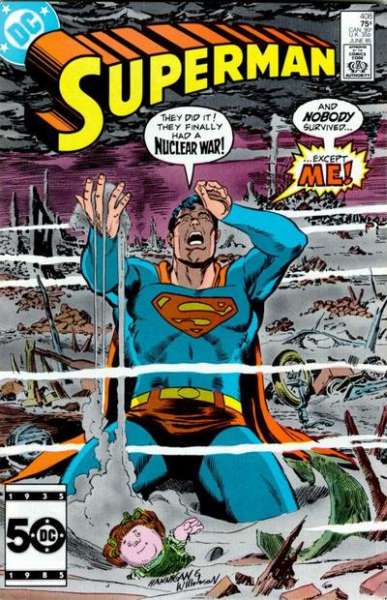
It should go without saying that the stories of Kamandi and the Atomic Knights don’t have anything to do with the likely horrors of a real nuclear war (or whatever the Great Disaster was supposed to be), and the longer their stories continued, the more fantastical and obviously escapist they became.  In the final story included in Showcase Presents: The Great Disaster, no less a DC eminence than Superman himself encounters the Atomic Knights, only to discover that their entire history is the dream of Gardner Grayle, placed in a sensory deprivation tank as part of a military experiment.  Grayle’s unconscious mind has taken over the computers running the simulation and threatens to launch an actual nuclear strike in order to make real the fantasies in which Grayle has played the hero for years.

The premise, and the lesson that Grayle imparts after awakening at the last minute (“The task before mankind isn’t to survive an atomic war! It’s to work in this world we’re living in to make certain such a war can never begin!”), owe much to WarGames and the similar lesson the supercomputer WOPR (“Joshua”) learns in that film (“A strange game: the only winning move is not to play”). “It was all a dream!” is obviously the king of lame cop-outs and, in cases like this, the last refuge of a writer whose story has gotten away from him.  I think it actually works, though: in 1983 the “survivable” nuclear war was an increasingly untenable premise, and the quaint early stories of the Atomic Knights had become hopelessly snarled with the continuity of Hercules and the world of the Great Disaster in the pages of Hercules Unbound.  (I haven’t commented on that series, but suffice to say that even the titular demigod couldn’t bear the burden of reconciling the combined histories of the Atomic Knights, Kamandi, and OMAC and telling his own story in an intelligible manner.)

I think it’s a little much to criticize escapism, however, when the target audience has so little power to change the situation from which they are escaping.  It’s one thing to indict military planners running simulations with potential real world consequences, another to criticize something as obviously fanciful as the Atomic Knights or Gamma World.  Speaking as a cold war baby who was ten years old in 1983 and absolutely terrified of nuclear war, the only other alternative was denial: I could hardly watch the news without having a panic attack, and I had no desire to subject myself to The Day After when it aired (I’m glad I didn’t know anything about the even grimmer Testament and Threads at the time).

Nuclear war was also frequently on Superman’s mind in the 1980s: most fans today remember Superman IV and the Man of Steel’s quest to rid Earth of nuclear weapons, but in the comics Superman often stood aside as an observer, willing to admonish mankind but not make the hard decisions for us.  Visions of humanity’s capacity for self-destruction haunt him: a Superman who does nothing to prevent a holocaust is not super in any way, but were he to take the choice out of our hands he would become a god rather than a man.  This version of Superman as advocate and guardian challenges the view of comic book readers as naïve simpletons waiting to be rescued.

(Also not included in this book)

(Also not included in this volume)

As I said initially, I eventually became an avid consumer of comics, games, books and movies that explored life after the bomb.  If you can’t beat ‘em, join ‘em, right? I don’t recall thinking it was realistic to expect survival in the event of a war, much less high adventure, but it was a comforting daydream. Certainly there was plenty to choose from, and I know there were a lot of guys in my generation who shared the same fantasy.  (One of the most believable details of last year’s The World’s End was that arrested adolescent Gary King would end up as a wandering gunslinger in the wasteland, loving every minute of it: for me it was a striking moment of recognition.)  Just about everything you need to know about this phase of 1980s masculinity can be found in the video for Tom Petty’s song “You Got Lucky.” It’s all there: guns, guitars, cowboy-chic dusters, and a sweet arcade in the middle of the desert.  (Petty obviously liked the milieu enough to make an appearance as himself in the 1997 film adaptation of David Brin’s post-apocalyptic novel The Postman.)

TomPetty

The focus in popular culture changed after the passing of the Cold War; although the apocalypse has never been far from our entertainment, the end of the world can come from almost any direction nowadays: terrorism, climate change, pandemic, just to name the more realistic possibilities.  Free-floating dread has replaced the pointed terror of “Mutually Assured Destruction;” chaos is more feared than ideology, and it’s reflected in the zombie hordes and rampaging kaiju of current film.  Still, the stories I grew up with haven’t been forgotten: perhaps it’s driven by ‘80s nostalgia, but remakes or reboots of Planet of the Apes, Mad Max, and even WarGames have either been made or are in production.  Gamma World has been through seven editions, the last in 2010, although I haven’t played in years.  The intoxicating cocktail of sword-and-sorcery among the ruins of modern civilization is still with us in such programs as Adventure Time.  Earth A. D. is still a place that many of us like to visit, even if we wouldn’t want to live there.

AdventureTime

When Stock Footage Roamed the Earth

“Why, if I had half the chance, I could make an entire movie using this stock footage!” exclaims Johnny Depp as the title character in the 1994 film Ed Wood as he examines film clips of explosions, military maneuvers, and stampeding buffalo.  Although Wood never went quite that far, later filmmakers would take up that challenge, and the scene illustrates just how much movies in the black-and-white era depended on footage of stunts, special effects, and locations culled from other sources in the studios’ extensive libraries to cut costs.  (Even into the 1970s and ‘80s it wasn’t uncommon for low-budget directors to build films and TV episodes around footage of car crashes and stunts, matching the actors’ clothes to the pre-existing clips.) As a kid in the 1980s, I was indirectly exposed to a great deal of older movies and television by the flood of repurposed stock footage on TV at that time.

Certainly it was more common to find old movies, shorts, and black-and-white shows on television as part of cheap daytime syndication packages (I watched Leave it to Beaver, I Love Lucy, and The Little Rascals after school—can you imagine that today?) and the “late late show.”  Sunday afternoon was reserved for the “Creature Feature,” a phrase that in my naiveté I thought the local station managers had come up with themselves.  Creative editing into new formats such as music videos, commercials, and interstitials was just the next step for this material, much of which, before the explosion of cable channels and the revival of TV shows on DVD, was considered nearly worthless.

An appetite for old film clips excerpted from their context began to develop in the 1970s with the emergence of full-length “docutainment.”  The pioneer of the nostalgic clip movie was That’s Entertainment!, a celebratory look at movie musicals made in 1974 to commemorate Metro-Goldwyn-Mayer’s fiftieth anniversary.  In addition to editing together highlights from both classic and obscure MGM musicals, That’s Entertainment! brought together a large number of the stars from Hollywood’s Golden Age to talk about their experiences filming such classics as Singin’ in the Rain and reminisce about the good old days.  (A recurring theme of both the film and its marketing was that this would be the last time so many stars would be gathered in one place—although there would be two sequels—and even the trailer emphasizes its escapist quality in the Watergate era, ending its ballyhoo with a hilariously downbeat “That’s Entertainment! Boy! Do we need it now.” Ah, the 1970s.)

That’s Entertainment! is a film that I’ve returned to several times over the years, but 1982’s It Came from Hollywood was more my speed at the time: comics Dan Aykroyd, John Candy, Gilda Radner, and Cheech and Chong introduced clips from dozens of science fiction, horror, and cult movies, ranging from cheap B movies and serials to the monster classics of the 1950s and focusing on such niche categories as drug panic, juvenile delinquency, and even musicals.  In addition to the skits setting up each category (which also included “Monsters,” “Gorillas,” “The Brain,” and “Aliens,” among others), they offered a running commentary, often razzing the cheapness or tastelessness of the films in a manner that echoed the audience participation of The Rocky Horror Picture Show and the mockery of The Golden Turkey Awards (in fact, Golden Turkey winner Edward D. Wood, Jr. is the subject of his own segment in It Came from Hollywood, the only filmmaker so “honored”) and anticipated the format of Mystery Science Theater 3000.

It Came from Hollywood is doubly nostalgic for me now, hearkening back both to an era of drive-in double features and Saturday matinees I only experienced second-hand, and to the early 1980s heyday of the hip comedians (younger at the time of filming than I am now, and two of them sadly since passed away: seriously, did anyone in 1982 think that of all these comedians, Cheech Marin would have the strongest career in 2014?) I considered the height of cool back then.  Unlike That’s Entertainment!, It Came from Hollywood didn’t bother to name most of the films it excerpted (except in a long list during the end credits), lending a dissociative, dream-like quality to the proceedings (and often leaving me unable to place a particular image for years, until the internet made it easier to find such information, not to mention the films themselves).

Another film that must have had a considerable influence on me was 1977’s Gizmo!, produced and directed by Howard Smith, which, unlike my two previous examples, drew most of its footage from films that purported to be true (or were at least staged for publicity: mostly Depression-era newsreels, from the look of it).  Many of the clips are of gadgets and contraptions made to solve the petty problems of life—a dog-powered washing machine, a self-rocking cradle, and a spaghetti fork mounted on a hand-held drill so as to twirl automatically—in the truest Rube Goldberg spirit.  Gizmo! casts a wide net, however, including many examples of “self-invention” as well, people with strange talents or driven by obsession: human flies and high wire walkers, a “human camel” drinking gallons of water and washing it down with kerosene, feats of strength and endurance.

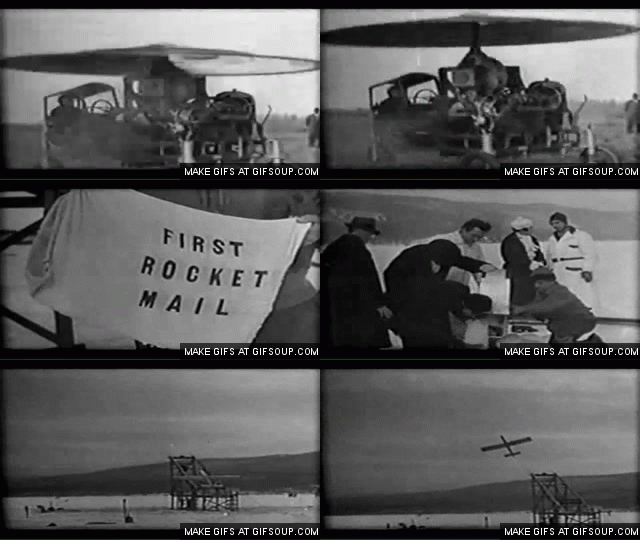
Obsession and invention come together in the numerous doomed-to-fail flying machines, each presentation inevitably preceded by the delusional inventor’s proclamation that “what we are about to see will change the world.”  The succession of disastrous ornithopters, “triphibians,” rocket planes, and bat-winged flying costumes fizzling, burning out, or simply tumbling off the ends of their take-off ramps was probably the inspiration for a similar passage in Airplane! (1980) in which former pilot Ted Striker suffers the most pathetically hilarious flashback in all of film.

failed-flying-machines-o

In fact, the Airplane! sequence is just one of many examples of footage that was insinuated into public consciousness through its reuse: while it may not have been the first film to revive them, Gizmo! contains many images that have become iconic, such as performer Frank “Cannonball” Richards being shot in the belly point blank by a cannon.  If they didn’t see Gizmo!, viewers in the 1980s might have seen this image in numerous other contexts such as commercials or music videos; it was ubiquitous enough that when The Simpsons parodied it in “Homerpalooza” they could assume that the majority of their audience would get the reference.

cannonball

As it happens, I did see Gizmo! several times: in addition to appearing on HBO (like both of the other films I’ve mentioned), it was a favorite of my middle school shop teacher, good old Mr. Lundquist (who would often joke that he couldn’t use a typewriter because he had lost his “typing finger” in a bandsaw accident—he was truly a shop teacher of the old school).  Whenever we had an inactive day (for whatever reason), Mr. Lundquist would pop Gizmo! into the VCR for us to watch, on the pretense that we might glean some insight into mechanical engineering from it: I must have seen the damned thing at least half a dozen times in school.

Although now mostly forgotten, Gizmo! (along with other docutainments) led to such programs as That’s Incredible! and Real People with their mix of weird talents, record-breaking attempts, and magazine-like pieces on strange subjects, kicking off a brief “reality TV” craze twenty years before Survivor.  In a more serious vein, the obsessed oddballs of Gizmo! are the forefathers of Errol Morris’ subjects in the similarly anthology-like Fast, Cheap & Out of Control.

It was on basic cable that stock footage became almost a medium in itself, continually reshaped and recombined by editors, filling in the cracks in programming and propping up commercial messages like the media equivalent of duct tape.  Rick Prelinger, collector and curator of countless educational and industrial films, was one source, financing his more serious preservation projects by supplying film clips to cable channels and other buyers.  Nickelodeon and the Comedy Channel frequently ran old shorts in the late 1980s when their own programming was thin on the ground. And it’s a cliché by now to complain that MTV no longer runs music videos, but what I really miss are the incredible variety of cult films and the kind of sponsored films that Prelinger specialized in: safety, hygiene, and civil defense films from the 1950s and ‘60s, presented uncut but ironically juxtaposed with the rest of the channel’s programming.

Black-and-white footage was especially felicitous for film collage: just as the low-budget filmmakers of the time had reused stunts to cut costs, counting on the consistency of the film stock to hide discrepancies, modern editors could draw on a vast body of film to assemble an original world from spare parts: in It Came from Hollywood, the invaders of Earth vs. the Flying Saucers could share the screen with the alien masterminds of Mars Needs Women and the ape-like Robot Monster could trade places with the gorilla from The Perils of Nyoka, making the visuals as archetypal and interchangeable as the storylines.  Later filmmakers could, and would, go much farther in assembling collages (the work of Craig Baldwin, for example, deserves a write-up of its own, to follow at a later time); the uniformity of black-and-white film bears comparison to the Victorian engravings that Max Ernst turned into the surreal graphic novel La Femme 100 Têtes, the consistency of the illustration style allowing for a greater suspension of disbelief than more typically disjunct visual collage.*

ernst18

In fact, my memory of the 1980s is so colored by the reuse of kaleidoscopic Busby Berkeley routines, death-defying stunts, and proto-steampunk flying machines set to new soundtracks, that they largely run together in my mind.  For example, I had completely forgotten that Gizmo! has a voiceover, yet the announcer talks over the clips almost continuously.  I wonder, too, how much effect this had on other members of my generation: I was beguiled by these hints of an older world, touched by both history and fantasy, and I eventually had the opportunity to dig deeper, to watch complete films.  But the emphasis on dippy inventions and quaint habits of the past might have equally fueled the perception that old movies (and even the world they represented) were uniformly corny, boring, and dumb—an attitude that can be hard to overcome.

Similarly, the use of editing to present only the highlights—a pattern that is already evident in That’s Entertainment!, but which would accelerate with each passing year—both artificially juices the excitement level and misrepresents the more leisurely pacing that was the norm in old films.  (That’s not to say that editors of the 1930s and ‘40s never used quick cutting—they did—but over the length of a feature intense and exciting passages were generally balanced with slower sequences.) From a modern perspective, one of the most interesting sequences in That’s Entertainment! edits together the numerous examples of Mickey Rooney and Judy Garland in the so-called “Backyard Musicals” series, saying “Let’s put on a show!” (or a dance band, or a rodeo) in rapid succession, a predecessor of the supercuts that now thrive on YouTube.

Perhaps like any fad, the use of stock footage on television began to fade; by 1994, Turner Classic Movies was on the air, providing a more respectable home for both feature films and ephemeral short features that could be presented original and uncut.  Likewise, many of the original sources from which features like Gizmo! drew are available online now and can be easily seen; it isn’t as necessary for them to be edited together for general viewers.  What is needed is context, and curators like TCM or Criterion are able to provide that.  With the availability of this footage has come easy-to-use editing software, so that anyone can create the kind of collage that was once trendy on television.  As for the low-budget producers, they are now more likely to lean on the crutch of CGI for their features, which may not be any more believable than stock car crashes or explosions, but can be quickly produced and can be tailored to their specific needs.  And MTV?  Well, everyone knows they don’t show videos any more, anyway.

* In this connection, the most intriguing example of this from the 1980s is Tom Schiller’s 1984 film Nothing Lasts Forever, a black-and-white homage to Golden Age Hollywood that uses stock footage to lend authenticity to the trippy journey of a young would-be artist.  More popular was Carl Reiner’s Dead Men Don’t Wear Plaid (1982), a film noir parody in which Steve Martin played the detective, interacting with characters from classic movies through the magic of intercutting.

The Pleasures of Anthology, Part One

Maybe it starts with being a bookhound: from a young age I grew up in a house piled high with books, the collection of my college professor father and classical musician mother.  It’s no surprise that the collecting bug bit me early, and books are a natural item to accumulate: they’re mostly cheap; they can be status symbols, external signs of one’s intellectual achievement (unlike, say, comic books, which I have also collected, but which even now seem to demand a certain amount of explanation to the uninitiated); and they provide more entertainment or useful information for their price and weight than almost anything else.  I was accustomed to having old things around from a young age, so that didn’t bother me either.  As much as I enjoy brand new books and the big, luxurious bookstores that have (mostly) disappeared from the landscape, used bookstores and book sales are more interesting to me, because of that chance of being surprised by something rare, weird, or simply new to me.  I like to browse new books to see what’s out there, but I’m rarely moved to buy something I could get anywhere; but for an old, possibly out-of-print book, who knows if I’ll find it again?  I could go on about the smell of old books, or the thrill of the hunt, or the prospect of finding something really valuable, but to tell the truth those aren’t really motivating factors for me. (Seriously: for every old book you find that has that ideal scent of rich, old paper, there’s another one that smells of mildew or cigarette smoke. Gross.)

No, what fascinates me the most when scouring stacks of old books is the chance to fill in gaps in my knowledge, make connections between things I might not expect, and appreciate the many different kinds of publications (the styles of writing, the topics, and genres that were once popular, not to mention trends in printing, binding, and cover art) that can open windows to the past.

In many ways, a good anthology can offer the same pleasures in microcosm.  Reading a collection of stories or articles by a good editor is like being guided through a used book market by an expert hand, someone who knows where the good stuff is hidden, and is ideally a sympathetic soul able to handpick just the sort of thing you’re looking for.  Such a guide can offer a balanced combination of the familiar but well-loved, a few new items that continue in a straight line from where the familiar leaves off, and maybe something really mind-bending or challenging, something you didn’t know you needed to read until you found it.

If you read enough, the name of the editor alone might be enough to pique your interest, and these come in several flavors: many of the editors whose names I learned were publishing-industry lifers like Peter Haining and Martin H. Greenberg (compiler of an astounding 1,298 anthologies!).  Sometimes the editor is a well-known writer in their own right, their choices reflecting their influences, early favorites that inspired their own writing or informed their stylistic choices.  The book might be a chance to promote their friends’ work or expose readers to like-minded authors who are part of the same scene as the editor but not as widely known.  Or it could be an opportunity for the established writer to shine a light on up and coming talent, putting their seal of approval on the young writers’ work.

Sometimes, however, one gets the impression the famous writer’s name is simply on the cover to sell books, as when they are hired to write a short introduction and the name of the actual (less well-known) editor is in smaller type. If the word “presents” is in the title, chances are the famous author is a figurehead (as in L. Ron Hubbard Presents Writers of the Future, a series Hubbard never actually edited and that has carried on under his name long after his death).  I don’t mean to be cynical: it’s the quality of the stories inside that count, and I’ve been known to purchase and keep books with stories I already have copies of for the sake of the insights in the introduction (which are sometimes sizeable essays in their own right).

Image

A subgenre is the anthology of the “best of” the previous year, selections either made from published work (as is the case for Houghton Mifflin Harcourt’s Best American series), contest winners (the aforementioned L. Ron Hubbard Presents), or editorial fiat.  The Best American series has been published continuously since 1915, first as a showcase for short stories, expanded in recent decades to include topics such as mystery stories, sports writing, and even comics (since 2006).  One of the most popular titles in the series has been The Best American Nonrequired Reading, edited since its introduction in 2002 by Dave Eggers.  Filled with lists, humor, and random nuggets culled from real life (“Best American Lawsuits,” for example), it injects the McSweeney’s founder’s “clever . . . too clever” aesthetic into the hoary old “bathroom reader” format, like Harper’s Index on steroids.

In retrospect, these annual volumes can provide perspective on both the individual authors included in them and the genre (whatever it may be) as a whole.  It is interesting, for example, to see the name Stephen Baxter (for the story “Gossamer”) in David G. Hartwell’s Year’s Best SF, a 1996 anthology (and beginning of an ongoing series) published with the goal of supporting actual science fiction (“Not fantasy.  Not science fantasy,” according to Hartwell’s introduction).  Baxter had garnered praise for his 1995 novel The Time Ships, an authorized sequel to H. G. Wells’ classic The Time Machine, but was as yet a new enough name that Hartwell felt the need to introduce him as a writer “in the hard science mode of Hal Clement and Robert L. Forward.”  Since then, he has won numerous awards and collaborated with Arthur C. Clarke; it’s unlikely a science fiction audience would be unfamiliar with him.

In contrast, one can examine volumes of the Best SF series edited by Harry Harrison and Brian Aldiss from 1967 to 1975 to see the rising tide of confrontational, psychedelic “New Wave” science fiction championed by J. G. Ballard and Michael Moorcock.  Even allowing for the difference in time, no one would confuse this series with Hartwell’s!

Image

One finds connections everywhere: one can read Sam Moskowitz’s biographical sketch of editor Alden H. Norton in the latter’s Award Science Fiction Reader, and immediately turn to Norton’s introduction to his own Horror Times Ten, wherein he recounts,

At lunch with an old friend, Sam Moskowitz, I happened to mention my problem [a paucity of decent horror stories for his planned anthology] and said: “Too bad you’re not an authority on the horror and terror tale as you are on science fiction.  If you were, you might be of some help to me.”  He choked a moment, wiped some sauce from eggplant parmigiana from his lips with a napkin, swallowed a glass of water, and finally managed to come up: “Oh, but I am!”

Not only did the authors and editors know each other, they could make their readers feel like one of the club by letting them in on these backstage dramas in introductory notes, in the letters pages of magazines, and in the newsletters and fanzines put together by amateur press associations and fan clubs.  An anthology could be much more than just the stories!

In Part Two, I’ll look more closely at one of my favorite anthologies, and the legacy of the magazine Weird Tales.