Space Western Comics: A Review

It’s tempting to look at pop culture trends in the 1950s and ‘60s in broad strokes, shaped by after-the-fact simplifications like Toy Story 2. In that film, classic cowboy Westerns were put out to pasture (heh) with the launch of Sputnik and the beginning of the Space Race, and almost overnight children’s imaginations turned to science fiction. In the long run, I suppose that did happen, but over decades rather than months or weeks. Throughout the 1950s and much of the ‘60s, Westerns (and related frontier and outdoorsman stories) remained popular with kids (and adults), and while sci-fi eventually overtook them in relevance, there were multiple attempts to combine the two popular flavors. Gene Roddenberry may have pitched Star Trek as “Wagon Train to the stars” and codified space as “the final frontier,” but he wasn’t the first to make the connection. Craig Yoe, prolific historian and anthologizer of comics, has produced a fun and informative volume in Space Western Comics, reprinting and contextualizing a run of adventure stories combining cowboys and aliens from the 1950s. It’s perfect reading for Vintage Science Fiction Month.

It’s worth noting that the term “space Western” was sometimes used (derogatorily) in sci-fi publishing and fan circles to describe stories that were just the same old formulaic good guys confronting bad guys dressed up in otherworldly verbiage, with rayguns replacing six-shooters and spaceships replacing horses. (Star Wars was attacked in the ‘70s by purists along exactly those lines, but at least Star Wars had considerable artistry on its side; in the ‘50s the white hats vs. black hats approach was strictly the domain of hacks.) But there were some literal space Westerns as well that combined the terminology and iconography of both genres into a single, (mostly) coherent story world. (I wrote about this weird subgenre several years ago and went into detail on the movie Cowboys & Aliens, at the time the most current example.)

Westerns in the first half of the twentieth century weren’t limited to the Old West. Real-life ranches and cowhands were enough of a reality that so-called “modern Westerns” could tell stories of pure-hearted (often singing) cowboys fighting cattle rustlers, land-grabbing oil or radium speculators, and other unscrupulous villains while using up-to-date technologies like automobiles, airplanes, and radio. While fanciful, these modern Westerns ostensibly took place in the “real world” of the 1930s, ‘40s, or ‘50s. Naturally, some of the same futuristic devices that were appearing in contemporary serials and comic books—miraculous rays, rockets, and the compelling but imperfectly-understood “television”—made appearances in the modern Western setting as MacGuffins or mysteries that needed to be unraveled. A cycle of “gadget Westerns” ran its course in the serials of the 1930s, but none of those involved actual space travel or alien visitors. The Phantom Empire, which famously sent Gene Autry underground to confront an ancient, advanced civilization miles beneath his ranch, stands out as an example of the Western exploring inner, not outer space.
So it is perhaps not surprising that the still-popular Western genre, chasing after trends, would incorporate UFOs, space travel, and alien life in an attempt to hold fickle audiences’ attention. And it is even less surprising that comics—a business with low costs and quick turnaround compared to the movies—would be in a position to take advantage of the brief moment when cowboys and spacemen appeared to be on equal footing (at least with the allowance-spending children of America).

In 1952, based on a suggestion from Charlton co-publisher Ed Levy, the already-extant Cowboy Western Comics changed its title to Space Western Comics (a common practice: instead of starting a new series with issue number one, it was believed that high numbers were more attractive to newsstand buyers, as they suggested a successful track record). Walter P. Gibson, the prolific writer and magician who developed and ghost-wrote The Shadow for Street and Smith, among many other projects, wrote and edited the adventures of “Spurs” Jackson, a rancher and electrical engineer whose ranch becomes the center of zany outer space adventures. (Shades of Gene Autry!) Artists John Belfi and Stanley Glidden Campbell provided the illustrations. The book reverted to Cowboy Western after only six issues, but a couple of stories starring Jackson from later issues are included in Yoe’s volume for the sake of completeness, as are two space-themed stories from Buster Crabbe’s comic book. (Crabbe had, of course, played both Flash Gordon and Buck Rogers in addition to cowboy roles, so this made perfect sense.)
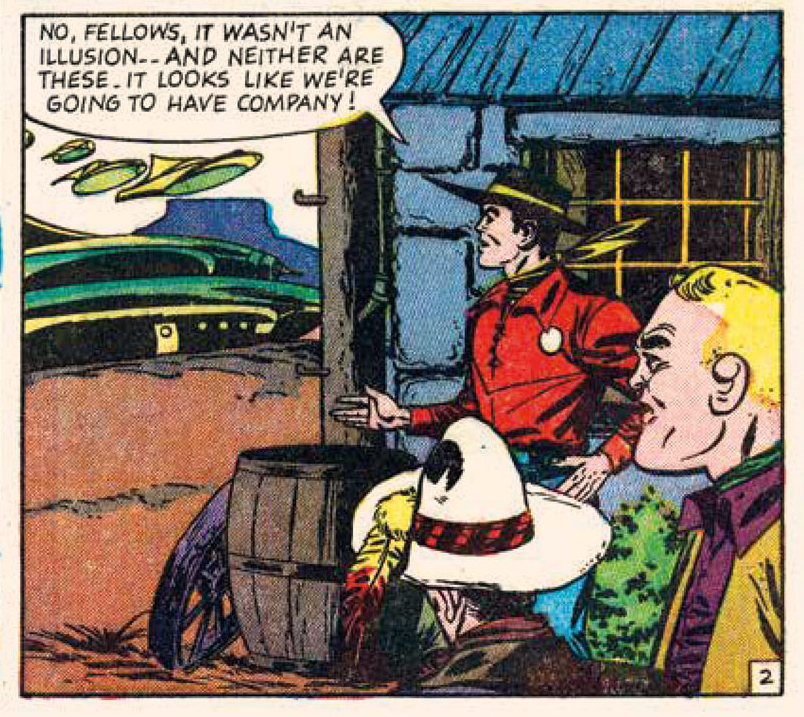
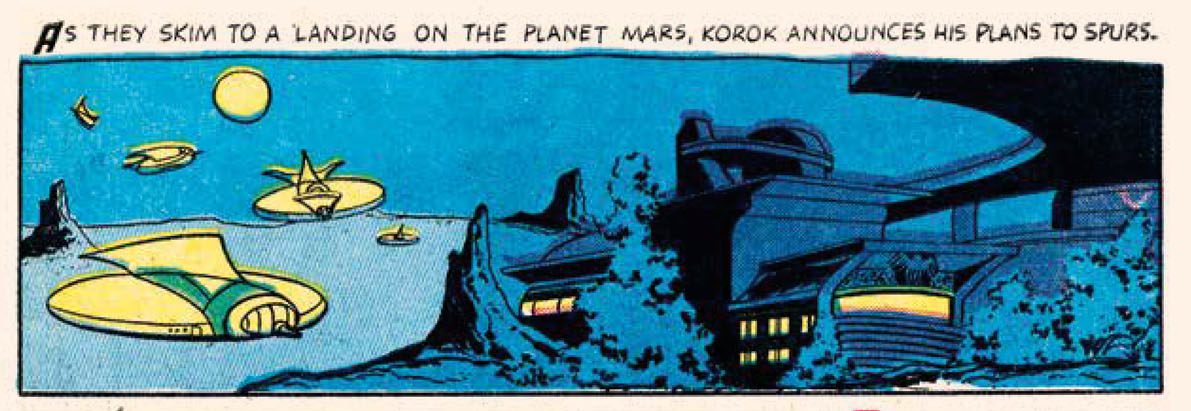
Space Western Comics begins with the Space Age already underway: flights to the moon have become routine, and a space station orbits the earth. “Spurs” Jackson is a character made to have adventures: unmarried and wealthy enough to occupy his free time inventing in his “secret lab,” the rancher-slash-engineer is charged with maintaining a 1000-foot-tall radar tower on his land (a government connection that serves to fuel several later stories), while leaving the day-to-day operations to his foreman, Hank Roper, and the Indian Strong Bow. The radar tower, which helps guide the lunar flights, attracts the attention of spaceships from Mars, who abduct the three men and take them to the red planet. There, they are presented as evidence that the Martians have conquered earth, a pretext that puts the scheming Korok on the throne of Mars instead of the rightful Queen Thula. This is classic space opera material straight out of Edgar Rice Burroughs, but the Western theme eventually pays off: Korok’s throne room is protected by a force field that prevents any metal from penetrating, so Martian weapons and the earthlings’ six-shooters are useless, but Jackson’s whip, Roper’s lariat, and Strong Bow’s bow and arrow, all non-metallic, win the day. For putting things right, Thula offers Jackson a position as her prime minister, but he can’t stay on Mars for long: ranching is an all-day job.

Some of the stories in this volume depend on the romance and exoticism of exploring other worlds, but in many of them the trouble is closer to home. Would-be alien invaders, Communist spies (sometimes disguised as aliens), criminal gangs, and even Nazis threaten the peace of the Bar-Z ranch. The desert makes for a compelling setting, full of isolated canyons and desolate flats, remote enough from civilization that no one in the cities would believe the stories but close to the Army’s testing ranges and bases so there are always plenty of troops and weapons ready to take charge of the surviving villains. As silly as the premises of these stories often are—rock men, plant men, and underground super-moles are among the aliens Jackson encounters—Gibson packs them with twists and clever problem-solving. Like a good engineer, “Spurs” Jackson out-thinks his opponents as much as he out-fights them (although he’s not above setting off an atomic bomb or two if that’s what it takes).

And frequently the twist is kept from the reader until the most dramatic moment, revealing that Jackson had his enemy’s number the whole time. In one of several text pieces, slavers from the planet Letos are foiled by a ship full of humanoid robots supplied by Jackson—“robots” who are actually humans in bullet-proof robot costumes. (Postal regulations required the text pages to secure favorable magazine rates; they were most often filled with editorials or letters columns, but short prose stories were not uncommon. The two-pagers Gibson provided for Space Western Comics are clever pulp miniatures, often written in the folksy voice of characters from around the Bar-Z. I think they would stand up well with the humorous sci-fi of Henry Kuttner and his contemporaries, should anyone think to mine comics’ text pages for anthologizing. Today, Alan Moore seems to be the only comics creator left with much affection for this archaic institution.)

Jackson isn’t the only savvy operator, either: Strong Bow is written as a more sophisticated and educated character than his Tonto-like dialogue might suggest. In more than one story, Indians appear to arrive from space, claiming to be heroes from the past or remnants of lost tribes, inviting the local Indians to overthrow the United States government. Of course, Strong Bow sees right through them, even if he might pretend to go along with the plan. (Although Space Western Comics predates the infamous Comics Code, it’s still as pro-government, pro-American, and pro-law and order as anything produced under the Code. The government and military in these stories are never less than righteous and upstanding, give or take a traitor or two in their midst, so nothing as subversive as suggesting Indian activists might have a point ever enters into the discussion.)

As I’ve alluded to in past articles, comics are a natural medium for the kind of mash-up represented by Space Western Comics: the visual shorthand that is a vital part of comics vocabulary lends itself to mixing and matching. Without attempting to catalog every example of the space Western from later comics, I’ll point to Terra-Man, a cowboy-themed villain from Superman comics. Abducted by space aliens as a child in the Old West, Terra-Man returned to earth with high-tech equivalents of the cowboy’s accessories and an alien winged horse. Current comics have embraced this kind of meta-referentiality with a vengeance, remixing popular iconographies of all kinds with kaleidoscopic variety. Sometimes it’s overwhelming, but I remind myself of being a comics reader in the 1980s, when the Big Two publishers seemed to be embarrassed by anything too “wacky,” and it was left to the independents to publish books like Marc Schultz’s Cadillacs and Dinosaurs (or for that matter, Teenage Mutant Ninja Turtles, as much a mash-up as a parody). I prefer the current acknowledgment of the medium’s silly roots, without the po-faced need to pretend that it’s all serious business.

By now, the proclamation that “comics are supposed to be FUN” is a tradition within comics that is up for grabs, just like every other past genre or practice that is ripe for revival, rehabilitation, or reinvention. Sometimes that means characters like Howard the Duck or Detective Chimp are given equal time with Iron Man or Wonder Woman; sometimes it means weaving disparate, contradictory threads into ambitious multi-layered story arcs that breathe new life into one-off concepts like the Green Team. Signifiers of “comics FUN” include (but are not limited to) ghosts, robots, dinosaurs, gorillas, and, of course, cowboys and rocket ships. Craig Yoe plays up how quaintly ridiculous the stories in Space Western Comics are, and is clear-eyed about the mercenary motives that led to its original creation. But he is equally up-front about how imaginative, breathlessly exciting, and yes, FUN, these stories are, and he has performed a valuable service by putting them together in a handsome and easily accessible package.

F1dget (2022)

(This review contains spoilers.)

Craig Sanders (of Sanders Camper and RV) is back with another self-financed opus, nominally directed by DTV auteur Omi Capek (Vampire Abortion, Vampire Abortion 2: Corona Baby), but as usual it’s Sanders’ vision on display. We last saw Sanders as the MMA-themed superhero Secret Sentinel in the film of the same name, but with F1dget, Sanders dips his toe into horror with this tale of a cursed fidget spinner.

The Sanders clan is blessed with good fortune and a thriving RV dealership, but youngest son Seth (Seth Sanders) is having trouble. He gets a B on a test and, worse yet, says that recreational vehicles are “cringe.” A fidget spinner appears to help him focus, but its cursed nature soon emerges: when Seth is told to put it away, his symptoms becomes worse, and he can’t recover until he follows the spinner’s unspoken suggestions, emphasized by close-ups and eerie music. When a neighborhood bully tries to take it, he ends up with a broken wrist. A sympathetic but misguided therapist (Clint Howard) explains that sometimes children just need to be listened to, but that kind of talk leads to a fidget spinner buried in his skull like a ninja star. Once the bully also turns up dead and the fidget spinner transforms into a rotary saw blade and flies around the house, Phantasm-style, the Sanders family needs a hero. So of course they leave their house to rough it in one of Sanders’ luxurious custom campers. There, in a tearful scene, Craig Sanders confesses that he has been living a double life as a superhero—yes, this is a Secret Sentinel stealth sequel—and promises to un-haunt their home and help Seth reach his full potential.

The last act is a full-on Home Alone homage as multiple fidget spinners get underfoot, attempt to gouge out Sanders’ eyes, and whatever else CGI and/or stagehands throwing them from off-camera can inflict upon the Secret Sentinel. Refreshingly, we never learn what the “curse” is or why they’ve gone bad. My guess is that Sanders was too late to unload a load of fidget spinners he bought before the fad crashed, as there a lot of them in these sequences, and he sure has a grudge against them. But these aren’t Gremlins or Critters or even Small Soldiers—they’re just little plastic doodads with ball bearings in them, and despite Capek’s best attempts to imbue them with personality, Sanders’ “fight scenes” end up looking like Puck Night at an NHL game.

The effects are lousy and the acting is indifferent. Without a character to play, older daughter Kaci (Kaci Sanders) barely makes an impression. At least newcomer Alyssa Gutierrez-Sanders as the kids’ mother provides two good reasons to watch. If you missed out on the Kickstarter campaign or didn’t get the DVD as a giveaway at a Sanders Camper and RV event, look for it on Tubi . . . if you can sit still for it!

Unmasking the Idol

In 2019 I celebrated “Ninjanuary” with several posts about the ninja in popular culture, particularly in films and books from the 1980s, and I occasionally return to that theme. Past entries can be found by clicking on the Ninjanuary tag.

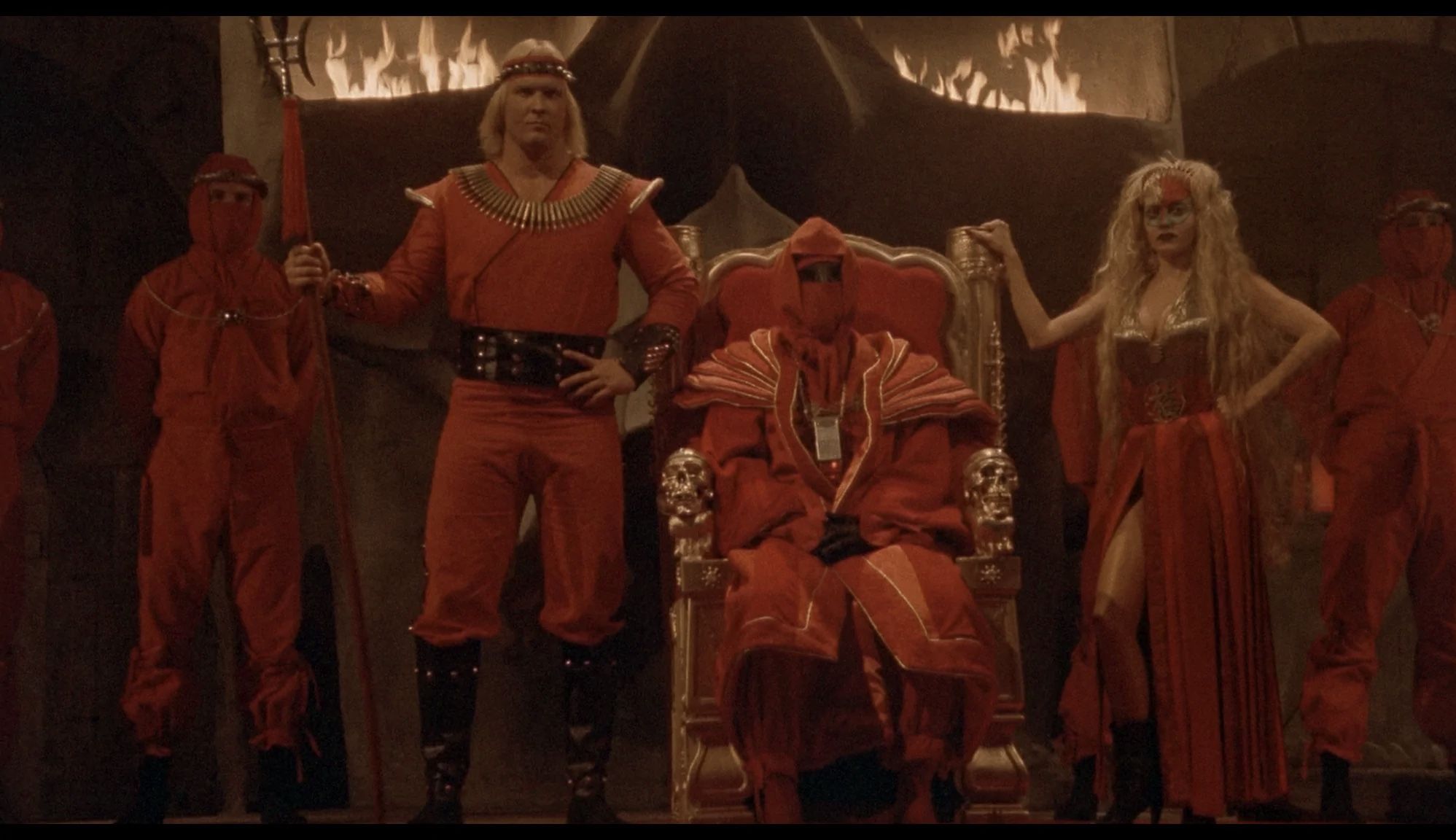
I can’t believe I had never heard of Unmasking the Idol until last month. Not only is it the kind of action-adventure nonsense I always have time for, it also came out in the mid-1980s, when I was a cable-addicted teen, so I think I would have at least seen ads for it. Maybe I did see the title somewhere, but having nothing to attach it to, forgot about it until a critical mass of reappraisal could bring it forcibly to my attention: Vinegar Syndrome recently reissued it on Blu-Ray, and it was also featured on the YouTube channel Bad Movie Bible as an example of a James Bond rip-off (which it definitely is). I watched it on Amazon Prime. Watching the opening credits, in which a soul crooner delivers lines like “Revenge is sweet if you can stand the heat” over footage of ninjas practicing tai chi against glorious sunsets, I wondered if I was falling for a work, and that Unmasking the Idol was really a contemporary pastiche along the lines of Turbo Kid or Kung Fury, or perhaps the Mandela Effect had brought a “newly discovered” lost classic into existence and everyone remembered it but me.

Alas, the main reason Unmasking the Idol isn’t more widely acclaimed is that, while having a lot going for it on paper, it just isn’t very good. (So, the usual reason.) That isn’t to say it’s not worth watching or that it doesn’t have its moments. A movie about a ninja superspy with a sweet Fall Guy truck and a way with the ladies, not to mention a pet baboon who is also a ninja, taking on a masked supervillain with a skull-shaped throne room in his island fortress can’t be a complete waste of time. The cold open, before those ‘80s-tastic opening credits, gets off to a strong start: a black-clad ninja infiltrates a hotel room by night and steals a valuable tape cassette from a wall safe. Upon being discovered and cornered by gunmen, the ninja leaps from the balcony into the swimming pool several floors below. The gunmen surround the pool, waiting for their quarry to emerge, but instead a red rubber ball floats to the surface. When the trigger-happy henchmen open fire, the balloon bursts and releases noxious gas, after which a much larger balloon breaches the water and ascends into the sky, the ninja hanging on below.

After the credits, the ninja lands not far away at the entrance to a casino, where he strips off his outer layer of black clothing to reveal a tuxedo, and we go from ninja action to Bond parody. He introduces himself at the casino as “Jax—Duncan Jax,” and splits his bet at the roulette wheel between “double O” and seven. He banters with a woman named China and they end up in bed together. She meets Jax’s baboon, Boon, and the next morning there’s a short scene establishing Boon’s martial arts bona fides as he beats up some gawking rednecks. All of this is prologue to Jax’s next assignment and the actual plot of the film, so he returns to his futuristic compound and we meet the rest of his team. There’s Sato, the computer guru, who is also presented as some kind of master tactician, nearly taking Jax by surprise with a blowgun to keep him on his toes (and yes, this is basically the same shtick as Cato in the Pink Panther movies, a pattern—let’s call it homage—that recurs throughout this film; there’s hardly a character or plot beat that doesn’t feel like it came off the shelf with no further customization). A number of beautiful women share their ninja training (and hot tub) with Jax, but only one, Gunner, is given a name and she’s the only one who plays a major part in the mission. There’s Star, who issues commands to Jax on the behalf of whatever organization they both serve, and Willie, an older colleague who’s having trouble adjusting to being sidelined. And there are still more characters who must be recruited in heist movie fashion.

Their mission, once they get around to it, is an assault on Devil’s Crown, a fortified island ruled by the Scarlet Leader, an evil ninja: a huge store of gold, all of it stolen, is about to be turned over to the evil Baron Hugo (nicknamed “Goldtooth” for reasons that will become apparent) to buy nuclear warheads and start World War III. The gold, if Jax and his team can steal it first, is the prize, but Jax believes there is something even more valuable hidden on the island. Star further piques Jax’s interest by telling him that the Baron was responsible for Jax’s parents’ death, but we never hear any more about this. (We cut directly to a scene in which the Scarlet Leader throws an old woman in a wheelchair into a pool full of piranhas and alligators while her horrified husband watches, and then kills him, too. The order of the scenes suggests at first that this is a flashback to Jax’s parents’ death, but I think it’s just an illustration of how evil the Scarlet Leader is, and of course it establishes the peril our heroes will later encounter.)

To give the movie credit, the budget is on the screen: while obviously not competing with the likes of the Bond or Indiana Jones franchises, it compares well to other films imitating those flagships. It’s at least as lavish as a well-financed TV movie of the time. The modern architecture of the hero’s home and the medieval barbarism of the villain’s castle make for interesting, well-realized locations. The assault on the island brings together parachutes and hot air balloons (including airdropping Jax’s beloved truck), not to mention three-wheelers, a submarine, a helicopter, and a vintage fighter plane. And bearing the month’s theme in mind, there is more ninja action, with the attacking force relying on stealth, burying themselves in sand and leaves in order to take the Scarlet Leader’s troops by surprise (most of the violence is pretty bloodless, but the ninjas deliver a lot of kicks and neck snaps from behind, sometimes in slow motion). And of course the Scarlet Leader, much more the final boss than the Baron (whom Jax never even confronts face to face), is a villain in the classic mode: along with the obvious similarities to other colorful ninja bad guys, the Leader’s inspirations go all the way back to the hooded masterminds of the serials with more than a little Darth Vader and G. I. Joe’s Cobra Commander mixed in (the electronic voice box the Leader uses not only disguises their voice but gives it a distinctly Vader-like menace). When the Scarlet Leader is eventually unmasked, I actually was surprised at their identity, although I shouldn’t have been. It’s one of those “there are only so many characters in this film” deals.

Forgive me for making all of this sound awesome. It’s not bad, really. It just doesn’t come to life quite like it should. Part of it is how formulaic it is, alluded to above: for every weird detail like a ninja baboon, there are ten lines of dialogue you’ve heard before (shamelessly lifted from better, more famous movies, which is probably supposed to be cheeky). Jax (Ian Hunter) is the worst offender, in that almost everything he says is a one-liner delivered with the impish glee of Roger Moore at his corniest. The twinkle in Hunter’s eyes says “Ain’t I a stinker?”, at least when it’s not giving “cult leader.” It ends up feeling weightless, as no one really reacts to anything. Even the betrayal of one of Jax’s closest allies is just one more obligatory plot beat. For that matter, Jax himself seems to be irresistible to women not because of something in his character or necessary to the plot but because what kind of escapist fantasy hero would he be if he weren’t? Despite the promise of sex and violence, ‘80s-style, this is actually a pretty tame film (the execution of the old couple mentioned above is the most shocking scene, but it’s because it’s so gratuitous, not because it’s especially graphic). Amazon Prime lists it as 7+ (for “older kids,” equivalent to a PG rating); there are plenty of films I’ve explored in this series that have benefited from context and that I can appreciate more now that I’m older, but Unmasking the Idol is one that I probably would have enjoyed a lot more if I had seen it when it was new.

(Well, there’s always the sequel, The Order of the Black Eagle.)

Deconstructing Avengers: Endgame with Trevor and Brett

Earlier this month, I had the opportunity to join Trevor Landreth and Brett Eitzen for an episode of their podcast Deconstructing the MCU. Trevor and Brett have been examining the films of the Marvel Cinematic Universe one by one, starting with 2008’s Iron Man, and I was excited to be invited to join the discussion of the culmination of the series up to that point, 2019’s Avengers: Endgame. We had fun debating what worked and what didn’t, breaking down the plot, revisiting our favorite character moments, and speculating on whether Endgame was too long, or not long enough? We wrapped it up by comparing Endgame‘s position relative to the other MCU installments and the films of 2019 ( here’s my year-end retrospective for comparison). The episode is now edited and available on Apple and Spotify. Thanks to Trevor and Brett for having me on!