Scarefest: The Visitor

“Maybe this just isn’t the right time to bring children into this bad, mixed-up world. Some of them are confused: they think that the forces of evil are stronger than the forces of good.” –Jane Phillips (Shelley Winters), in The Visitor

Vis_Katy1

This article was written as a contribution to Scarefest, a series of pieces by commenters on film website The Dissolve, organized by commenter Miller. The week before it ran, I alerted Miller that I was changing my Scarefest entry to The Visitor, and another commenter asked, “Are you writing about how scary it is that it’s so bugnuts insane?” I assume he was kidding, but my short answer is yes. Yes, I am.

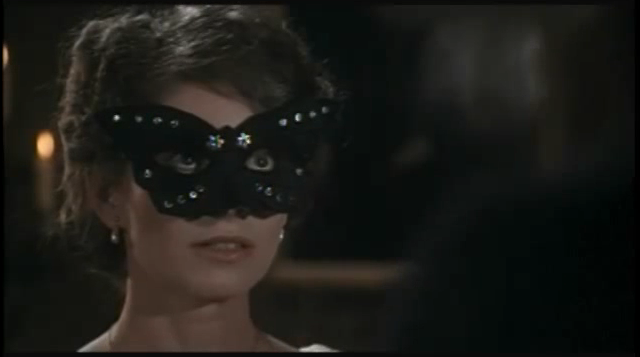
The 1979 film The Visitor, directed by Giulio Paradisi (as “Michael J. Paradise”), has long had a reputation as a hard-to-find cult oddity; after a restoration and rerelease by Drafthouse Films in 2013, it became more widely available on disc and VOD. TCM ran the restored version as part of its “TCM Underground” series last summer, and that’s where I saw it. I didn’t know a lot about it, other than having seen the bizarre trailer Drafthouse put together for it, and knowing that the film was considered extremely weird even among cult horror aficionados. I was prepared to have my mind blown, but I wasn’t prepared for The Visitor to actually be, you know, scary.

The plot isn’t easy to summarize except in broad outlines: businessman Raymond Armstead (Lance Henriksen) has made a deal with a shadowy organization dedicated to perpetuating the bloodline of an evil alien being referred to as Sateen. His girlfriend Barbara (Joanne Nail) has one child, Katy (Paige Conner), now eight, but Barbara is afraid of Katy and reluctant to have another child. Because of this, the organization pressures Raymond behind the scenes—their plans for world domination require that Katy have a brother—and Katy, in whom Sateen’s influence is already strong, alternately wheedles and punishes her mother for her obstinance. In the mean time, Jerzy (John Huston), the “visitor” of the English title, stalks Katy on behalf of Franco Nero’s character, a Christ-like figure who lives somewhere (in outer space? or is it Heaven?) with a congregation of bald children and who is opposed to Sateen. Is the visitor’s mission to kill Katy or save her? A lot of other stuff happens in the margins, but that’s basically it: a blend of New Age contactee mysticism and 1970s devil-child horror. So far, so good.

I: The Sleep of Reason

Vis_prologue2

So why did this movie, much of which is absurd on its surface, freak me out? For one thing, the film’s late-‘70s style took me back to my childhood, and not in a good way. I’m just over 40, so my memory of the 1970s is filtered through the subjective haze of being a young child then. The ‘70s were pretty strange to begin with, and even more so when you have no reference for much of the adult world. Much of what was considered “grown-up” moviemaking (and a lot that was aimed at kids) back then was characterized by, to use President Carter’s infamous term, the “malaise” of the time, and for me that resulted in a lot of free-floating unease, even when watching things that were ostensibly light. You just never knew when things were going to take a dark turn. The gauzy, soft-focus cinematography, cheesy cop show music, and swinging suburban styles of The Visitor were all intimately familiar to me, to the point that I couldn’t be sure I hadn’t seen this movie as a kid (I’m still not sure).

My reaction is a subjective one, but is there anything more subjective than fear? Like laughter or arousal, the fear reaction is fundamentally irrational; it can be controlled on the viewer’s part, and there are techniques filmmakers can use to evoke it, but at a base level it touches something that cannot be reasoned with. In my case, that reaction has always been close to the surface: I could hardly watch scary movies or TV shows as a kid, even tame fare like The Twilight Zone, because being afraid or tense wasn’t a pleasant sensation for me like it is for many kids. I was drawn to fantasy, but even something that wasn’t scary at first could come to haunt me, taking on a life of its own as I lay in bed, waiting for sleep, which in many phases of my childhood had its own terrors in the form of realistic nightmares. The Visitor falls flat as a vehicle for ideas or even as a story: too many things happen without explanation, there are abrupt tonal shifts and weird distortions of sound and image, and it just doesn’t make a lot of sense. But is that not an accurate description of a dream?

In dreams, anything can happen, and ordinary events and objects can be invested with emotional power greater than they have while awake. The very first scene, a (possibly allegorical) confrontation between Katy and Jerzy in a gold-lit field, is overtly surreal, and typical of the over-the-top visual flourishes in the movie’s more fantastic sections. As Katy approaches, thick snowflakes swirl around and stick to her face; eventually, only her eyes are visible. It’s spooky, like something from Altered States or Ridley Scott’s Legend (Scott also came to mind later in the film when the skyscrapers of downtown Atlanta are seen through a smoky haze, like the future Los Angeles of Blade Runner).

But the first scene that really threw me is relatively mundane: at her birthday party, Katy eagerly opens a box which was supposed to contain a mechanical bird purchased by her aunt in an earlier scene. Through Sateen’s power (or something), the box contains a gun, which Katy excitedly waves around and then tosses onto the couch, where it goes off and hits Barbara in the back. Katy shrugs, like, “oops?” Barbara spends the rest of the movie in a wheelchair, paralyzed by a bullet to the spine. It’s a crazy scene, but part of its nightmare power is how casually it occurs, and the mismatch of typical “suspense” build-up with gleefully committed violence that literally comes out of nowhere.

Vis_Katy2

Later, after Barbara has recovered and started getting back to a normal life, she is stranded with Katy while driving at night. A semi truck, of which we can only see the lights, pulls up on the side of the road in front of their car. Barbara is worried, and Katy openly mocks her fear. Barbara is right to be afraid: the truck is a mobile operating room, and after she is rendered unconscious agents of the conspiracy artificially inseminate her to speed up their plan. The imagery is straight out of an alien abduction report: stranded motorists, lost time, the dim memory of an operation (I suspect that it is this sequence, and a few scenes of glowing lights in the sky, that led to criticism of The Visitor as a knock-off of Close Encounters of the Third Kind), and a surprise pregnancy.

Upon discovering her condition, Barbara goes to her ex-husband (played by Sam Peckinpah!) and pleads with him to help her get an abortion. When she returns home from that operation (still in her wheelchair), Katy savagely attacks her. No pretenses now! And again, the sudden eruption of violence, while motivated by character and plot, is surprising in its intensity. Even Damien usually cloaked his actions in the plausible deniability of a “freak accident.”

II. The Sound of Nightmare

Vis_Katy3

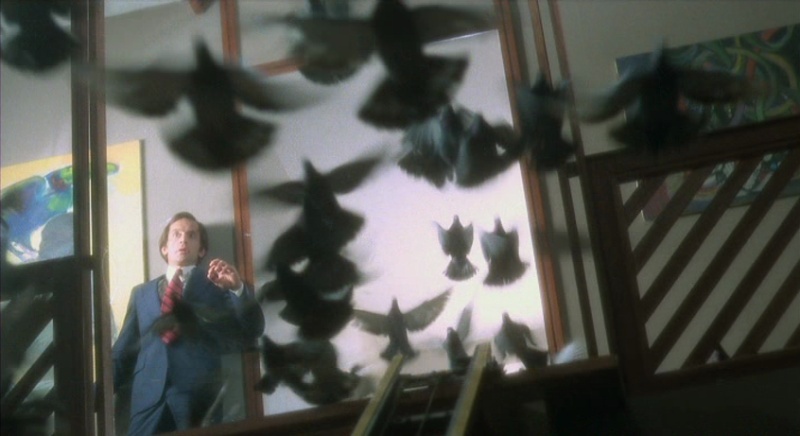
The Visitor’s Italian title, Stridulum, is appropriate: Latin for “whizzing or hissing,” and surviving in English in the word “stridulation,” for the buzzing sound insects make by scraping their legs together, it’s a clue to how important sound is in The Visitor. Both Sateen and his enemy (a spaceship-flying “Commander Yahweh”—shades of Chariots of the Gods!), have birds as an important part of their back story; Katy keeps a hawk called Squeaky who obviously represents her diabolical heritage and with whom she communicates, and the visitor summons a flock of birds during the climax of the film to scourge Katy of Sateen’s influence (I think). I suspect that birds are so important to The Visitor because they’re a convenient artsy symbol for the soul, and also because, post-Hitchcock, birds are creepy. Either way, the soundtrack is full of echoing, distorted screeches and bird calls (in addition to analog synthesizer sounds—another skin-crawling part of my childhood—and the aforementioned funky cop show music). Whenever Katy is about to use her psychic powers (as at the birthday party), we hear the eagle cry, or see a glimpse of Squeaky, or both.

Then there’s the mechanical bird that was supposed to be in the box: it’s a gold and blue knick-knack that says “I’m a pretty bird” in a synthesized drone, followed by a whine of feedback, on a constant loop. Even in the first scene, when Katy’s aunt buys it, I’m not sure how anyone could hear that and think of the bird as anything other than a prop in a horror movie. Later, when a detective (Glenn Ford!) is trying to figure out where the gun at the party came from, he finds the bird and takes it with him in his car. It’s still talking as he drives his car down the freeway with it on the passenger seat. “I’m a pretty bird * wee-ooo * I’m a pretty bird * wee-ooo * I’m a pretty bird * wee-ooo,” et cetera, until Squeaky attacks the detective and he drives the car off the road, where it bursts into flame before he can escape. Squeaky strikes again!

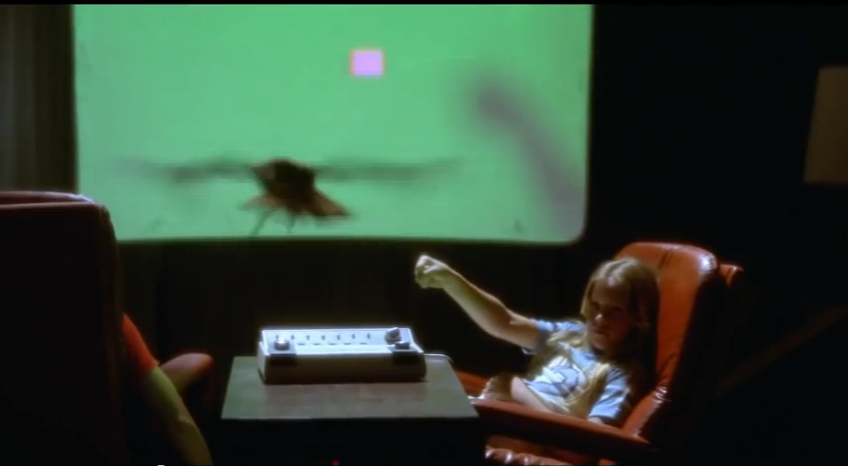
Sound also plays a role in the scariest scene in the film, the scene that I actually had to turn off for a few minutes to get myself together before I could finish watching it: early in the film, Katy is shown playing Pong on a big-screen TV, hidden by the chair in which she is sitting. The electronic blip of the game is the counterpoint to the conversation she has with her mother. Much later in the film, after Katy has been institutionalized for her violent behavior, Barbara returns home to her empty house and hears: blip . . . blip . . . blip. The game is turned on, Katy is in her chair. After Katy’s brutal attacks, just her presence in the house again is scary, but the whole sequence following is . . . well, it scared the hell out of me, but it is also much stranger than anything I’ve described yet, so I won’t spoil it.

III. All in the Family

visitor07__large

Paige Conner doesn’t look like she’s eight years old in this movie: maybe ten. It could be that she’s big for her age or I could just chalk it up to the precocity of child actors. In any case, her Katy Collins is a miniature tyrant, controlling and profane. Her poor mother is constantly put-upon, and her would-be stepfather mostly stays out of her way. Even when Katy’s words are pleading, her tone is commanding or threatening. Only Jerzy and a suspicious housekeeper (Shelley Winters) really see her for what she is, but take opposite approaches to dealing with her.

By coincidence, I had an older sister who would have been about Katy’s age in 1979, and while she wasn’t the holy terror that Katy is in the movie, I’m sure it affected my reception of this movie. The trappings of a late ‘70s girlhood cheek-by-jowl with the freaky events of the movie was unsettlingly close to my childhood nightmares and brought to the surface more anxiety than I realized I still carried with me.

Domestic abuse was an issue that got a lot of attention in the late ‘70s and early ‘80s, as if the lid had finally come off a closely-held secret and now everyone was free to sort it out in public. I’m fortunate that I didn’t grow up with firsthand experience of family violence, but it was something I became aware of thanks to the new openness about it. Nowadays, when I hear about Mommie Dearest at all, it’s as a camp classic: “No more wire hangers, ever!” et cetera. It wasn’t funny to me as a kid, however: Faye Dunaway as Joan Crawford terrified me. I might have chosen that movie for Scarefest, except I haven’t gone back to watch it since then.

The Visitor pushes some of the same buttons for me. I’m not kept up at night by its cosmic battle of good and evil, or the slow-motion mayhem, or even the bird attacks: those are par for the course with science fiction and horror movies. I enjoy that stuff. What really shocked and disturbed me was the sudden eruption of violence in otherwise very mundane settings, worst of all between family members. For such an unreal movie, it feels an awful lot like someone’s issues being laid bare.

Now that I’m an adult, I see my childhood anxieties from the other side: my daughter is eight years old. I love her. She’s a good kid. But even in the best of relationships there are moments: children can be shockingly amoral and single-minded about getting what they want. As a parent, it’s natural to wonder about and be frustrated by those moments, and fearful not of our children but for them. I’m also not proud to admit that there are moments I feel like Shelley Winters’ Jane, just wanting to slap some respect into the “bad” kids. Is that what this genre of horror boils down to? Is that the root of The Bad Seed and The Good Son and “It’s a Good Life” and The Omen and all the rest? Is it simply the recognition that children can be brats, taken to the nth degree?

Possibly. But I think it’s more general than that: even the people closest to us have sides to them that are unknown to us. They share our lives and homes, but their thoughts are no more visible to us than those of strangers halfway around the world. The Visitor taps into the fear that we don’t really know the people around us: the “Visitor” could be a stranger, or someone we’ve known our whole lives.

Afterlife with Archie: “Escape from Riverdale”

“Sometimes dead is better,” witches Hilda and Zelda Spellman tell Jughead Jones after their magic is unable to save his dog Hot Dog from a fatal injury.  If only he had listened!  Struck by his obvious pain, their niece Sabrina (i.e., the Teenage Witch) uses forbidden magic from the Necronomicon to bring Hot Dog back to life.  Like the resurrections in “The Monkey’s Paw” and Pet Sematary, it doesn’t work out as planned: Hot Dog returns, but as a horrible undead monster with a bite that spreads a terrible infection.  Soon, the town of Riverdale (home of Archie, Betty, Veronica, and the rest) is at the center of a zombie epidemic straight out of Night of the Living Dead.

afterlife-archie1_00002

Since last fall, the first comic I read when I get it home from the store has been Afterlife with Archie, an unlikely hit from writer Roberto Aguirre-Sacasa and artist Francesco Francavilla.  The bimonthly book recently finished its first five-issue arc, “Escape from Riverdale,” and with the promise of big changes starting in the next issue, this seemed as good a time as any to examine the series (and encourage anyone who hasn’t tried it to give it a look: the first arc was just released in a collection last week).

As its name implies, Afterlife with Archie is a spin-off of Archie and the series with which it shares a universe (including Sabrina, Josie and the Pussycats, and more), with the familiar kid-friendly characters run through a George Romero- and Stephen King-style wringer.  As I wrote in my series on doppelgangers and copycat characters, writers often use thinly-veiled pastiches of familiar characters when they want to explore their darker sides; however, it is increasingly common for publishers to give writers free rein with out-of-continuity or alternate-universe stories starring their name-brand characters (Marvel has had a Marvel Zombies series for several years now, as an obvious example).

Marvel_Zombies_Vol_1_3

At least since the late 1980s, following the success of the dark, adult-themed comics work of Alan Moore and Frank Miller, it’s been known that “grim and gritty” sell.  Fashions change, but it seems like every few years there’s another round of “Comics aren’t just for kids anymore!” stories and another slew of comic anti-heroes committing rape, murder, or whatever transgression it takes to get the spotlight in a competitive field.  (I don’t have a problem with comics tackling adult themes, of course, but it’s often the titles that loudly insist on their “adult” status that seem the most adolescent.)  Even without resorting to graphic sex or violence, “going dark” is a giant cliché, and obviously zombies have been trendy for years now, so it would be easy to dismiss Afterlife with Archie as just another fad book.  Yet it’s become one of my favorites: what gives?

Why does Afterlife with Archie succeed where others fail?  For one thing, the affection the creators have for both the horror genre and Archie Comics is obvious and infectious.  Aguirre-Sacasa knows the characters of the Archie universe and respects them; the darkness isn’t something laid on top of the characters, it’s an artful drawing out of themes already present in their usual, more cartoonish depiction.  Archie Andrews is still good-hearted and willing to go out on a limb for his friends and family; Reggie Mantle is still a selfish snob; Betty and Veronica still fight over Archie while trying to remain “BFFs.”  Francavilla’s semi-realistic art, filled with expressionistic shadows and dramatic, off-kilter angles, is matched by dialogue that is by turns naturalistic—the teens don’t sound like overly-cool caricatures of high-schoolers—and appropriately heightened for the gothic excess of the book.  (Veronica’s father Hiram Lodge probably wouldn’t call Archie an “insolent whelp” in one of his regular appearances, but the dynamic of overbearing patriarch to a young, unwanted suitor isn’t a stretch.)

Even the more ghoulish elements are incorporated in ways that play with well-known character traits: it might seem like a cheap joke that the voracious Jughead is the first infected and becomes a flesh-devouring zombie, but it’s just as equally the kind of twist associated with the EC Comics that are another point of reference.  His first teen victim: “Big” Ethel Muggs, a character who has always made me cringe in the original comics with her slow-witted “hick” speech pattern and unrequited crush on Jughead.  (Ironically, as horrible as her death is in Afterlife, her brief appearance has more dignity than the regular version of the character has ever had.)

AWA_2-7-610x926

Flashbacks fill in the characters’ history, making them three-dimensional: in issue no. 4, the most emotional of the five, Archie is saved from the undead Hot Dog by his own dog Vegas, and then is confronted by his own father, now an infected zombie.  In both cases, the memories of happier times are intercut with the current struggle. (It’s the rare horror comic for which you’ll need a tissue!) Memory also weighs heavily on Hiram Lodge and his butler Smithers; it’s implied that Hiram was unfaithful to Veronica’s mother, and Smithers, as a second-generation servant of the Lodge family, is a discreet repository of all the town’s secrets.  Along with the incestuous relationship of Jason and Cheryl Blossom and the down-low lesbianism of Ginger Lopez and Nancy Woods (both interpretations that are original to this series, obviously), the constant web of secrets and lies make Afterlife’s version of Riverdale resemble Peyton Place, even before the supernatural elements are introduced.  The tone is very much like a contemporary teen soap opera.

AfterlifeWithArchie_04-7

The “Escape from Riverdale” arc ends with Archie leading the town’s survivors from the dwindling safety of Lodge Manor out of town.  Sabrina, who was banished to another dimension for her actions in the first issue, is scheduled to return to Riverdale in issue 6, presumably introducing a more cosmic angle to the ongoing horror, but who knows what other characters will show up?  Josie and the Pussycats are still out there, somewhere, so far unused, and I wouldn’t be surprised if Aguirre-Sacasa and Francavilla indulge in some deep cuts from the world of Archie: most of the weirdest Archie concepts are technically alternate universes, but so is Afterlife, and it’s clear the creative team know their stuff, so who knows? I’m hoping for Jughead’s Time Police, myself.

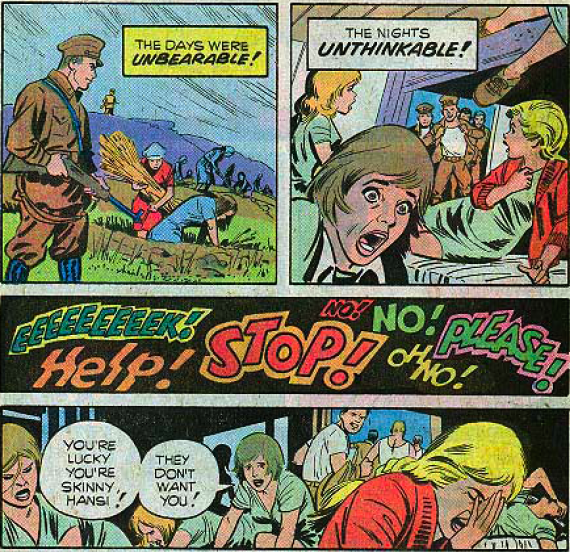
Or maybe they’ll take some inspiration from Spire Christian Comics (which licensed Archie characters to spread the Good News), and we’ll get the gritty reboot of The Gospel Blimp the world has been crying out for.  Or a grown-up Hansi, the Girl Who Loved the Swastika?  After the real-life horrors of that story, zombies should be no problem.

Hansi

All kidding aside, I do give Archie Comics a lot of credit for remaining a comics company first instead of a “media” company: although many of the attention-grabbing developments of recent years, such as Archie’s marriage and impending death in Life with Archie (the series which Afterlife with Archie sprang from, initially as a joke) and the introduction of openly gay character Kevin Keller, could be seen as publicity stunts, they’ve remained dedicated to a medium that the Big Two comics companies have increasingly turned into ancillaries of big budget movies and little else.  On the other hand: an Afterlife with Archie movie?  I can think of less likely properties to adapt for film.  In the mean time, I look forward to seeing what else Aguirre-Sacasa and Francavilla come up with.  (And I just found out that Sabrina will be appearing in another, “much darker” ongoing series following the success of Afterlife; “much darker” than what we’ve seen so far? Wow.)

When Stock Footage Roamed the Earth

“Why, if I had half the chance, I could make an entire movie using this stock footage!” exclaims Johnny Depp as the title character in the 1994 film Ed Wood as he examines film clips of explosions, military maneuvers, and stampeding buffalo.  Although Wood never went quite that far, later filmmakers would take up that challenge, and the scene illustrates just how much movies in the black-and-white era depended on footage of stunts, special effects, and locations culled from other sources in the studios’ extensive libraries to cut costs.  (Even into the 1970s and ‘80s it wasn’t uncommon for low-budget directors to build films and TV episodes around footage of car crashes and stunts, matching the actors’ clothes to the pre-existing clips.) As a kid in the 1980s, I was indirectly exposed to a great deal of older movies and television by the flood of repurposed stock footage on TV at that time.

Certainly it was more common to find old movies, shorts, and black-and-white shows on television as part of cheap daytime syndication packages (I watched Leave it to Beaver, I Love Lucy, and The Little Rascals after school—can you imagine that today?) and the “late late show.”  Sunday afternoon was reserved for the “Creature Feature,” a phrase that in my naiveté I thought the local station managers had come up with themselves.  Creative editing into new formats such as music videos, commercials, and interstitials was just the next step for this material, much of which, before the explosion of cable channels and the revival of TV shows on DVD, was considered nearly worthless.

An appetite for old film clips excerpted from their context began to develop in the 1970s with the emergence of full-length “docutainment.”  The pioneer of the nostalgic clip movie was That’s Entertainment!, a celebratory look at movie musicals made in 1974 to commemorate Metro-Goldwyn-Mayer’s fiftieth anniversary.  In addition to editing together highlights from both classic and obscure MGM musicals, That’s Entertainment! brought together a large number of the stars from Hollywood’s Golden Age to talk about their experiences filming such classics as Singin’ in the Rain and reminisce about the good old days.  (A recurring theme of both the film and its marketing was that this would be the last time so many stars would be gathered in one place—although there would be two sequels—and even the trailer emphasizes its escapist quality in the Watergate era, ending its ballyhoo with a hilariously downbeat “That’s Entertainment! Boy! Do we need it now.” Ah, the 1970s.)

That’s Entertainment! is a film that I’ve returned to several times over the years, but 1982’s It Came from Hollywood was more my speed at the time: comics Dan Aykroyd, John Candy, Gilda Radner, and Cheech and Chong introduced clips from dozens of science fiction, horror, and cult movies, ranging from cheap B movies and serials to the monster classics of the 1950s and focusing on such niche categories as drug panic, juvenile delinquency, and even musicals.  In addition to the skits setting up each category (which also included “Monsters,” “Gorillas,” “The Brain,” and “Aliens,” among others), they offered a running commentary, often razzing the cheapness or tastelessness of the films in a manner that echoed the audience participation of The Rocky Horror Picture Show and the mockery of The Golden Turkey Awards (in fact, Golden Turkey winner Edward D. Wood, Jr. is the subject of his own segment in It Came from Hollywood, the only filmmaker so “honored”) and anticipated the format of Mystery Science Theater 3000.

It Came from Hollywood is doubly nostalgic for me now, hearkening back both to an era of drive-in double features and Saturday matinees I only experienced second-hand, and to the early 1980s heyday of the hip comedians (younger at the time of filming than I am now, and two of them sadly since passed away: seriously, did anyone in 1982 think that of all these comedians, Cheech Marin would have the strongest career in 2014?) I considered the height of cool back then.  Unlike That’s Entertainment!, It Came from Hollywood didn’t bother to name most of the films it excerpted (except in a long list during the end credits), lending a dissociative, dream-like quality to the proceedings (and often leaving me unable to place a particular image for years, until the internet made it easier to find such information, not to mention the films themselves).

Another film that must have had a considerable influence on me was 1977’s Gizmo!, produced and directed by Howard Smith, which, unlike my two previous examples, drew most of its footage from films that purported to be true (or were at least staged for publicity: mostly Depression-era newsreels, from the look of it).  Many of the clips are of gadgets and contraptions made to solve the petty problems of life—a dog-powered washing machine, a self-rocking cradle, and a spaghetti fork mounted on a hand-held drill so as to twirl automatically—in the truest Rube Goldberg spirit.  Gizmo! casts a wide net, however, including many examples of “self-invention” as well, people with strange talents or driven by obsession: human flies and high wire walkers, a “human camel” drinking gallons of water and washing it down with kerosene, feats of strength and endurance.

Obsession and invention come together in the numerous doomed-to-fail flying machines, each presentation inevitably preceded by the delusional inventor’s proclamation that “what we are about to see will change the world.”  The succession of disastrous ornithopters, “triphibians,” rocket planes, and bat-winged flying costumes fizzling, burning out, or simply tumbling off the ends of their take-off ramps was probably the inspiration for a similar passage in Airplane! (1980) in which former pilot Ted Striker suffers the most pathetically hilarious flashback in all of film.

failed-flying-machines-o

In fact, the Airplane! sequence is just one of many examples of footage that was insinuated into public consciousness through its reuse: while it may not have been the first film to revive them, Gizmo! contains many images that have become iconic, such as performer Frank “Cannonball” Richards being shot in the belly point blank by a cannon.  If they didn’t see Gizmo!, viewers in the 1980s might have seen this image in numerous other contexts such as commercials or music videos; it was ubiquitous enough that when The Simpsons parodied it in “Homerpalooza” they could assume that the majority of their audience would get the reference.

cannonball

As it happens, I did see Gizmo! several times: in addition to appearing on HBO (like both of the other films I’ve mentioned), it was a favorite of my middle school shop teacher, good old Mr. Lundquist (who would often joke that he couldn’t use a typewriter because he had lost his “typing finger” in a bandsaw accident—he was truly a shop teacher of the old school).  Whenever we had an inactive day (for whatever reason), Mr. Lundquist would pop Gizmo! into the VCR for us to watch, on the pretense that we might glean some insight into mechanical engineering from it: I must have seen the damned thing at least half a dozen times in school.

Although now mostly forgotten, Gizmo! (along with other docutainments) led to such programs as That’s Incredible! and Real People with their mix of weird talents, record-breaking attempts, and magazine-like pieces on strange subjects, kicking off a brief “reality TV” craze twenty years before Survivor.  In a more serious vein, the obsessed oddballs of Gizmo! are the forefathers of Errol Morris’ subjects in the similarly anthology-like Fast, Cheap & Out of Control.

It was on basic cable that stock footage became almost a medium in itself, continually reshaped and recombined by editors, filling in the cracks in programming and propping up commercial messages like the media equivalent of duct tape.  Rick Prelinger, collector and curator of countless educational and industrial films, was one source, financing his more serious preservation projects by supplying film clips to cable channels and other buyers.  Nickelodeon and the Comedy Channel frequently ran old shorts in the late 1980s when their own programming was thin on the ground. And it’s a cliché by now to complain that MTV no longer runs music videos, but what I really miss are the incredible variety of cult films and the kind of sponsored films that Prelinger specialized in: safety, hygiene, and civil defense films from the 1950s and ‘60s, presented uncut but ironically juxtaposed with the rest of the channel’s programming.

Black-and-white footage was especially felicitous for film collage: just as the low-budget filmmakers of the time had reused stunts to cut costs, counting on the consistency of the film stock to hide discrepancies, modern editors could draw on a vast body of film to assemble an original world from spare parts: in It Came from Hollywood, the invaders of Earth vs. the Flying Saucers could share the screen with the alien masterminds of Mars Needs Women and the ape-like Robot Monster could trade places with the gorilla from The Perils of Nyoka, making the visuals as archetypal and interchangeable as the storylines.  Later filmmakers could, and would, go much farther in assembling collages (the work of Craig Baldwin, for example, deserves a write-up of its own, to follow at a later time); the uniformity of black-and-white film bears comparison to the Victorian engravings that Max Ernst turned into the surreal graphic novel La Femme 100 Têtes, the consistency of the illustration style allowing for a greater suspension of disbelief than more typically disjunct visual collage.*

ernst18

In fact, my memory of the 1980s is so colored by the reuse of kaleidoscopic Busby Berkeley routines, death-defying stunts, and proto-steampunk flying machines set to new soundtracks, that they largely run together in my mind.  For example, I had completely forgotten that Gizmo! has a voiceover, yet the announcer talks over the clips almost continuously.  I wonder, too, how much effect this had on other members of my generation: I was beguiled by these hints of an older world, touched by both history and fantasy, and I eventually had the opportunity to dig deeper, to watch complete films.  But the emphasis on dippy inventions and quaint habits of the past might have equally fueled the perception that old movies (and even the world they represented) were uniformly corny, boring, and dumb—an attitude that can be hard to overcome.

Similarly, the use of editing to present only the highlights—a pattern that is already evident in That’s Entertainment!, but which would accelerate with each passing year—both artificially juices the excitement level and misrepresents the more leisurely pacing that was the norm in old films.  (That’s not to say that editors of the 1930s and ‘40s never used quick cutting—they did—but over the length of a feature intense and exciting passages were generally balanced with slower sequences.) From a modern perspective, one of the most interesting sequences in That’s Entertainment! edits together the numerous examples of Mickey Rooney and Judy Garland in the so-called “Backyard Musicals” series, saying “Let’s put on a show!” (or a dance band, or a rodeo) in rapid succession, a predecessor of the supercuts that now thrive on YouTube.

Perhaps like any fad, the use of stock footage on television began to fade; by 1994, Turner Classic Movies was on the air, providing a more respectable home for both feature films and ephemeral short features that could be presented original and uncut.  Likewise, many of the original sources from which features like Gizmo! drew are available online now and can be easily seen; it isn’t as necessary for them to be edited together for general viewers.  What is needed is context, and curators like TCM or Criterion are able to provide that.  With the availability of this footage has come easy-to-use editing software, so that anyone can create the kind of collage that was once trendy on television.  As for the low-budget producers, they are now more likely to lean on the crutch of CGI for their features, which may not be any more believable than stock car crashes or explosions, but can be quickly produced and can be tailored to their specific needs.  And MTV?  Well, everyone knows they don’t show videos any more, anyway.

* In this connection, the most intriguing example of this from the 1980s is Tom Schiller’s 1984 film Nothing Lasts Forever, a black-and-white homage to Golden Age Hollywood that uses stock footage to lend authenticity to the trippy journey of a young would-be artist.  More popular was Carl Reiner’s Dead Men Don’t Wear Plaid (1982), a film noir parody in which Steve Martin played the detective, interacting with characters from classic movies through the magic of intercutting.

Trigger Warning: Spiders!

Or: How I Relaxed and Learned to Love Tolerate the Spider

Billingsley.tarantula

I.

The above photo was taken by my friend Dan Billingsley in June 2013 near Skiatook Lake in Oklahoma: “Hundreds scurrying across the highway by the lake, about an hour before sunset.  Cutest things ever.”  Not everyone would agree: it’s not hard to find internet message boards (or even articles) that respond to pictures like this with comments like “Kill it with fire!” or “Nightmare fuel,” or similar extreme comments.  I would have been one of them if the internet had been around when I was a kid: I had an intense, visceral fear of spiders, and while I (thankfully) never had a close encounter with anything like the Oklahoma brown tarantula pictured above, even a picture would have made me anxious and haunted my dreams.  Sensationalistic films like Kingdom of the Spiders and Arachnophobia made my skin crawl (as they were intended to), but I forced myself to sit through them, perhaps to test myself.  (However, I could never bring myself to watch Something Wicked This Way Comes, knowing there was a scene in which spiders invade a boy’s bedroom; even seeing a glimpse in the trailer was too much for me. Poking around the internet, I find this regularly listed as one of the scariest spider scenes on film; I’m glad to find it wasn’t just me being oversensitive.)

Clearly, a fear of spiders is culturally widespread: as naturalist J. H. Fabre wrote over a century ago, “The Spider has a bad name: to most of us, she represents an odious, noxious animal, which every one hastens to crush underfoot.”  The spider’s venomous bite is sometimes blamed, but the danger is frequently exaggerated.  To quote Fabre again, “there is a wide difference between killing a Midge and harming a man.  However immediate in its effects upon the insect entangled in the fatal web, the Spider’s poison is not serious for us and causes less inconvenience than a Gnat-bite.”  As Fabre acknowledges, there are a few venomous species harmful to man, but the chances of suffering serious injury, at least in North America and Europe, are quite low.

In recent years, the infamous black widow has given way to the brown recluse as the most feared species, especially here in the Midwest.  Unlike the flashy black widow, the brown recluse is drab and unexceptional in appearance and tends to hide in dark crevices, hence its common name.  The brown recluse is frequently blamed for mysterious lesions and sores, even if no spider is found in the act of biting or afterward (and even in areas without recluse populations).  According to Rod Crawford of the Burke Museum, the “phantom” spider bite is an urban legend, reinforced by physicians misdiagnosing other conditions (I myself have a small scar from a sore which I have long blamed on an unseen spider, but reading about this subject has forced me to reconsider that assumption).  In the words of Rick Vetter of the University of California, Riverside,

One should not call something a spider bite unless a spider was removed from one’s skin in the act of biting, seen biting flesh and then running off, found crushed in the remains of clothing near the bite site or if a person with necrotic wounds lives in a house that is infested with violin spiders [the family to which the brown recluse belongs]. You need to have the “smoking gun”. Otherwise, it is baseless speculation. If the spider was on trial, it would never get convicted with most of the “evidence” that people could produce. But many folks don’t like the answer of “I don’t know” for the cause of their necrotic wound and instead are very determined to pin it on the brown recluse. They want to blame something concrete and the brown recluse is the scapegoat for their desires. Yes, indeed, necrotic wounds are occurring but it probably is not a spider doing it.

Having said that, I wouldn’t go as far as the “dangerous spider handler” who doubts that spider bites occur at all: Crawford and Vetter acknowledge genuine bites in the medical literature, but insist that they are nowhere near as common or dangerous as they are often made out to be.

II.

This is all very reassuring, but it doesn’t answer the question: why do spiders inspire such fear in the first place? It seems very likely that the numerous myths and misconceptions surrounding spiders are triggered by that fear, rather than the other way around.  As a kid, I knew intellectually that tarantulas and other spiders weren’t dangerous, but my reaction against them couldn’t be reasoned with: it was an atavistic revulsion, an intense loathing of the animal’s shape, its way of moving, not just a fear of being bitten.  Even now, as I’ve come to see them as interesting and captivating creatures for study, I have no desire to touch one or to be in close proximity without glass between us.  I’m afraid there are limits to my dispassion.

The source of arachnophobia has been of great interest to both arachnologists (who would like to see the cloud of ignorance and prejudice lifted from their subject) and psychiatrists (who have sought to alleviate their patients’ unreasonable fears through therapy and other treatments).  Theories range widely, from the Freudian (a link between a repressed fear of sexuality and the spider’s hairy legs, for example) to the mundane (a fright during the impressionable period of infancy or early childhood, carried into later life).  Hollywood itself may be partly to blame: as Crawford points out, the tarantula is—despite its intimidating size—both harmless and easily handled, so it is a natural subject whenever a “killer spider” is needed for filming.

Some have posited that the spider threatens the patriarchal view of the natural order, as it is one of the few animals in nature in which the female is significantly larger than the male, and it is well known that the male must approach the female very carefully or else be killed after mating. (This is apparently true of only some spider species, but of course it takes on huge importance in the folklore of spiders, leading back to the fear of sex; note that Fabre refers to the Spider as feminine in the excerpt quoted above!)

Others have taken this idea even further, placing importance on mankind’s own divided mind: researcher Stan Gooch held that the spider was spiritually important to the (matriarchal, left-handed, moon-worshipping) Neanderthals; Gooch was ahead of the scientific curve in his belief that (patriarchal, right-handed, sun-worshipping) Cro-Magnon man, rather than wiping out the Neanderthals, had interbred with them.  Thus human societies, but also each individual, carried conflicting instincts, resulting in both internal and external struggles between the “left hand” and “right hand” paths.  Although the Cro-Magnon outlook came to dominate, the traces of Neanderthal heritage left their mark in the association of spiders with witchcraft and the occult: despised and feared, but heavy with symbolic importance.  For Gooch, the fear of spiders was deeply ingrained but still cultural in essence.

An interesting if unlikely theory was put forward by British zoologist Theodore Savory, whose career over the course of the twentieth century saw the growth of arachnology from a poor relation of entomology (the study of insects) in the observational style of Fabre and other naturalist-collectors to a data-driven and fully scientific discipline.  Despite spending most of his career at smaller colleges (“a zoologist, not attached to a University but living in the isolation of the provinces and working in his own private laboratory,” as Savory described himself in 1935), Savory was a prominent writer whose textbook Arachnida went through three editions (1935, 1964, and 1977).*  Savory’s argument is worth quoting at length (from the 1935 edition):

The tonic reflexes which maintain equilibrium respond to tactile impulses from the soles of the feet, to impulses of pressure from the semicircular canals of the ear and to visual impulses from the retinas of the eyes.  With the last of these alone are we concerned here.  From it there arises a tendency to keep the images of moving bodies on the same place in the retina, a tendency well developed in lower animals.  It results in an orientation and movement of their bodies described as rheotropism.  It is clear that if the body is moved or the eye is turned so as to keep the image of a moving object more or less stationary on the retina, the images of the background and surroundings must at the same time be passing across the retina.  This is exactly what happens during an unexpected fall and the primitive response is a secretion of adrenalin to fit the body to meet the sudden change in circumstances.  This is fear.  Just as, according to the James-Lange theory of emotions, “we feel sorry because we cry,” so do we feel frightened because of the physical changes in blood-pressure and muscle tension.

In this view, it is the rapid motion of spiders (and related arachnids such as scorpions) that induces fear as a by-product of this physical reaction, the eye tricking the body into thinking it is falling.  Still pictures do not produce the same reaction, according to Savory.

As may be expected, not everyone was able to accept this purely mechanistic reasoning.  Although Savory repeated it in subsequent editions, he acknowledged the criticism he received and gave space for other theories, and more importantly spoke with sufferers of arachnophobia, getting their side of things.  “[T]here was unmistakably a general agreement that colour, size and [long-]legginess are all contributory causes, and that most certainly movement cannot be discounted,” he wrote in the 1964 edition.

By 1977, psychiatry had given much greater attention to the problems of phobias in general, and Savory had a wealth of research to draw on (including, it should be said, inquiries and surveys he conducted himself over several years).  Extreme arachnophobia undoubtedly has psychological dimensions and cannot be explained only by reference to physical reactions:

One self-confessed sufferer has written, “I couldn’t even write the word spider.  I daren’t put my handbag on the floor in case a spider crawled over it. . . . I couldn’t go into a room until someone had made sure there were no spiders in it.”  This last limitation is one of the commonest to be reported.

Possible treatments included relaxation techniques and gradual exposure in controlled enviornments; for myself, education and exposure have been helpful.  The answer in 1977 was no more definitive than it is now, but a look at Savory’s changing perspective over three editions of his book reveals fascinating changes, not just within the field of arachnology, but within psychology and psychiatry as well.

III.

From a spider’s perspective, 2013 was a very good year in my area (and presumably in Oklahoma as well): a wet spring followed by a mild summer led to an explosion of mosquitoes and other insects, providing ample support for a booming spider population.  By the end of summer, everyone I know in Wichita had large webs in their yards and gardens and around their houses.  As I said, I’m less freaked out by spiders than I used to be, so I didn’t go out of my way to tear down garden spider webs unless they were blocking paths or otherwise in the way.

I reached my limit, however, when I found a black widow perched right outside my front door, and several more under rocks in my front yard.  They had to go.  Through a discussion on Facebook, I found I wasn’t the only one dealing with them.  Brian Cortus (a former student of mine who still lives in Wichita) said,

There’s been a lot more black widows in the wichita area over the last few yrs. My in-laws have them every summer. As dangerous as they are; they don’t really mess w/ humans too much. I’ve been snapping pics of them left & right, while getting (probably too close), but they definitely seem way more afraid of me than vice versa (in which case, i think i’m maybe 1 in 15 ppl on the entire planet not afraid of spiders!) . . . When my in-laws call me over to “kill” them (both are terrified of spiders), i always tell them that i killed them, but in reality, i round them up w/ toilet paper rolls & dump in the neighbor’s yard! They have a lot of trees & bushes w/ no children or pets. There’s probably a black widow city over there by now! BTW, the neighbor’s don’t know either…sshhh!

Hopefully, they’re not reading this blog.

Thanks to Dan and Brian for allowing me the use of their words and pictures.

* Despite his prominence within arachnology, Savory always considered himself an amateur.  The 1935 edition faced criticism from specialists in the field; later arachnologists often found his lack of detail frustrating.  Nonetheless, Savory’s Arachnida was the first textbook of its kind, and his interest in the subject was lifelong: according to a short biography of Savory published in Scientific American,

His interest was kindled when he was 16 and “contemplating the idea of specializing in some sort of animal.” One day he was reading outdoors when a spider dropped from an oak tree onto his book.  Savory “said to [his] companion, casually, ‘What about spiders?’ ‘Why not?’ replied he, and so it was.”

Instruments of Death

“The Torture Garden: It’s where the Devil calls the tune . . . to play a concerto of fear!”

–Trailer for Torture Garden, 1967

danceofdeath

In honor of Halloween, it’s time to look at the spookier side of musical instruments, specifically the roles some have played in mystery and horror fiction.  On the one hand, the organ has the most sinister reputation of any instrument through its association with the Phantom of the Opera and his fictional descendants: there’s just something about the full organ’s portentous sound and the gloomy atmosphere of the Gothic cathedral that goes hand in hand with cobwebs and candlelight, so expect to hear many renditions of Bach’s Toccata and Fugue in D Minor (or at least the opening bars) during October.  The organ, nicknamed “the king of instruments,” also fits nicely with the popular association of criminal masterminds with classical music: we like our villains to have refined taste, whether played by Vincent Price or Anthony Hopkins.  In the same way, the organist seated at his instrument, surrounded by ranks of keyboards, pedals, and organ stops ready at his command, is a neat visual shorthand for a master manipulator, sitting at the center of a web, controlling everything around him.  (In at least one case, the direct-to-video Disney sequel Beauty and the Beast: The Enchanted Christmas, the organ is the villain, conniving to make others to do its will even though it cannot move from its place.)

Lon Chaney, Sr. in the 1925 film The Phantom of the Opera

Lon Chaney, Sr. in the 1925 film The Phantom of the Opera

Brian De Palma's 1974 update, Phantom of the Paradise

Brian De Palma’s 1974 update, Phantom of the Paradise

The violin, on the other hand, is often associated with the Devil, as in such pieces of music as Danse Macabre, L’Histoire du Soldat, and “The Devil Went Down to Georgia.”  In folk tales, the Devil enjoys wagers, betting his own gold fiddle against the souls of his opponents.  He may also bestow musical talent in exchange for a soul, a prominent part of the myth surrounding Tartini’s “Devil’s Trill” Sonata. Later, the great Italian virtuoso Niccolò Paganini was the subject of lurid rumors that he had sold his soul, and worse: Theosophy founder Madame Helena Blavatsky included Paganini in her story “The Ensouled Violin,” and graphically embroidered on the notion that the strings of Paganini’s violin were made from human intestine, and that his uncanny ability to mimic the human voice with his playing actually came from a spirit trapped within the instrument.

A similar story is part of the mythology of the Blues: Robert Johnson was supposed to have met the Devil at a crossroads at midnight, where he traded his soul for his legendary guitar-playing ability.  The legend formed the basis of the Ralph Macchio film Crossroads and was parodied on Metalocalypse (in the episode “Bluesklok”).  Interestingly, Elijah Wald, in his book Escaping the Delta, has shown that the same story was originally attributed to a Tommy Johnson and then transferred to Robert when his legend outpaced Tommy’s.  Naturally, the whole thing has roots in folklore: Wald points out, “When Harry Middleton Hyatt collected stories of musicians going to the crossroads to gain supernatural skills, as part of a vast study of Southern folk beliefs in the late 1930s, he reported as many banjo players and violinists as guitarists,” as well as an accordionist.

Why is there such a connection between fiddling and death?  In the Middle Ages, instrumental music was considered both profane and frivolous, closely associated with itinerant, always-suspect actors and minstrels and the drunken singers in taverns.  In depictions of Death (usually as a skeleton, the same as now), musical instruments were often a symbol of the sinfulness, vanity, and futility of all human activity, not just music.  (The popular image of Nero “fiddling while Rome burned” probably owes much to this symbolism, as the violin had yet to be invented in Nero’s day; likewise, contrast the supposed indolence of grasshoppers with the industry of ants.)   The image of a grinning skeleton “playing” his victims into the grave may have struck the medieval viewer as cruel irony, a just punishment, or as a warning.

The medieval dance of death.

According to one author, the connection between the violin and mortality was more than just poetic: in 2006, Rohan Kriwaczek published An Incomplete History of The Art of Funerary Violin.  According to Kriwaczek, there had once been a Guild of Funerary Violinists, whose work, repertoire, and indeed their very existence had been suppressed by the Vatican during the Great Funerary Purges of the 1830s and ‘40s.  After 1846, the few remaining members of the Guild went underground, and Kriwaczek, eventually entrusted with their legacy, was able to piece together this secret history and bring it to the public. Kriwaczek describes the Funerary Violinist as playing a potent intercessionary role:

In his tone the violinist must first convey the deep grief that is present in the gathering, and then transform it into a thing of beauty.  By the time he is finished, a deep and plaintive calm should have descended, and the bereaved should be ready to hear the eulogy. . . . The violinist’s is a position of great responsibility, akin in many ways to that of a priest or shaman, and should not be taken lightly.

Alas, the book was a hoax, supposedly concocted by Kriwaczek to increase his bookings as a violinist at—you guessed it—funerals.  Still, I can’t help but feel that Kriwaczek’s story, with its dueling Funerary Violinists, buried secrets, and cameos from outsized characters including composers, Popes, and virtuosi, would make a smashing TV program, a historical saga with more than a touch of gothic intrigue.

Sometimes the instrument is cursed: in the short “Oh, Whistle, and I’ll Come to You, My Lad” by the master of the English ghost story M. R. James, it’s an ancient bronze whistle (proving that another James title, “A Warning to the Curious,” could equally apply to almost all his stories):

He blew tentatively and stopped suddenly, startled and yet pleased at the note he had elicited. It had a quality of infinite distance in it, and, soft as it was, he somehow felt it must be audible for miles round. It was a sound, too, that seemed to have the power (which many scents possess) of forming pictures in the brain. He saw quite clearly for a moment a vision of a wide, dark expanse at night, with a fresh wind blowing, and in the midst a lonely figure–how employed, he could not tell. Perhaps he would have seen more had not the picture been broken by the sudden surge of a gust of wind against his casement, so sudden that it made him look up, just in time to see the white glint of a sea-bird’s wing somewhere outside the dark panes.

Just as frequently it’s a MacGuffin that activates the plot: a Stradivarius is as valuable as a van Gogh, and serves as well as any other objet d’art as the motivation in a murder mystery.  An example is the three-quarter sized Strad, the Piccolino, at the center of Gerald Elias’ mystery Devil’s Trill, the first of a series centered on violinist-sleuth Daniel Jacobus.  And despite its unusual varnish, the titular instrument of the 1998 film The Red Violin is haunted more by tragedy and human foibles than by any supernatural evil.

The weaponized instrument is an infrequent literary device, but there are a few examples: the murder in Dame Ngaio Marsh’s Overture to Death is accomplished by a revolver hidden inside an upright piano, rigged to fire when the pianist plays the third chord of Sergei Rachmaninoff’s Prelude in C-sharp Minor, a Rube Goldberg arrangement that sounds about as practical in real life as this:

Likewise, it doesn’t seem that it would be that hard to escape the vengeance meted out by the grand piano in “Mr. Steinway,” a section of the 1967 anthology film Torture Garden, based on stories by Robert Bloch.  In the story, the piano in question belongs to a prominent virtuoso, a gift from his mother, and his devotion to it is tested when a young lady (played by Barbara Ewing) enters his life.  The black wing shape of the piano is a looming presence in the film version, always in the background or casting its shadow over the doomed couple, and the Oedipal implications of the pianist’s relationship with his mother, never seen but personified by the piano, are left as unspoken subtext.  So far, so good, but by the time the piano lurches into motion and pushes the intruding girl out the window, we’ve entered the realm of delirious high camp.  The lesson: music is a jealous mistress.

Finally, as a bonus, I present one of the most bizarre (and gratuitous) examples of this trope, from the 1976 film The Town That Dreaded Sundown: death by trombone.  Happy Halloween!

The Pleasures of Anthology, Part Two

Read Part One here.

As you can probably tell from the previous examples, my own preferences lean toward science fiction and fantasy.  Of my favorite authors, New England horror writer H. P. Lovecraft (1890-1937) has had by the far the greatest influence on me, and his connections to other writers (by letters and acquaintance, or by the coincidences of publication) have been a constant thread in searching for stories.

Referring to Lovecraft as a “horror” writer can be a bit misleading: although he considered the cultivation of a frightening atmosphere his primary goal, he mostly eschewed “the literature of mere physical fear and the mundanely gruesome.”  Rather, he was a practitioner of “weird fiction,” a catch-all label for nascent science fiction, fantasy, and horror before those genres had clearly defined markets.  Most of Lovecraft’s work cultivated a sense of ancient, alien forces intruding into the present day, and although he borrowed a great many elements from the gothic horror of the previous century—books full of suppressed secrets, crumbling old houses, ominous supernatural signs—he married them to a scientific outlook, in which the most frightening truths were not to be found in the evil actions of men but in the indifference of a hostile, uncaring universe.  As he wrote in his seminal essay Supernatural Horror in Literature, “The true weird tale has something more than secret murder, bloody bones, or a sheeted form clanking chains according to rule.”

I didn’t know much about Lovecraft’s outlook when I started looking for his stories.  All I knew was that his reputed blend of science fiction concepts, ooky tentacled monsters and dreamlike air of mystery appealed strongly to me as a budding reader of fantastic fiction.  As hard as it may be to believe now, Lovecraft’s work wasn’t easy for me to track down when I was young, even though his name (and that of his creation, “Cthulhu”) was known to me.  He was almost mythical, and I think he would have enjoyed the aura surrounding his work, had he still been alive; I knew that his “Cthulhu Mythos” had been included in the first printing of the Advanced Dungeons & Dragons book Deities & Demigods, but was removed from later printings due to a copyright dispute—or is that what they wanted me to think?* Every detail fueled my interest, until I was finally able to read his work for myself; fortunately, he more than lived up to the hype, at least in my experience.  My being at the “golden age” of twelve or thirteen surely didn’t hurt.

My first tastes of his elaborate mythology came from anthologies, a single story by him (or one of his imitators**) included here or there.  For a long time, even after I had read all of Lovecraft’s fiction (down to the dire posthumous “collaborations” by his executor August Derleth), I would search tables of contents for his name, not in hopes of finding something new but as a sign that the editor recognized the good stuff and that the rest of the book might be in the same vein.  Similarly, anything connected to the legendary pulp magazine Weird Tales, in which Lovecraft published most of his work, was a must-have.

That’s how I acquired Weird Tales: 32 Unearthed Terrors, edited by Stefan R. Dziemianowicz, Robert Weinberg and Martin H. Greenberg.  This collection includes one story from each year the magazine was published (in its original incarnation; it has since been revived), from 1923 to 1954.  There are some terrific opportunities for juxtaposition: you can leap from the brooding, necrophilia-themed “The Loved Dead” of C. M. Eddy (1924’s entry) to the sophisticated modern ghost story “Legal Rites” by Isaac Asimov and a pseudonymous Frederik Pohl (1950, the pair’s only publication in Weird Tales), or from space opera (Nictzin Dyalhis’ “When the Green Star Waned,” 1925) to sword and sorcery (Robert E. Howard’s “The Shadow Kingdom,” 1929) to occult detective (Seabury Quinn’s long-running character Jules de Grandin in “Satan’s Stepson,” 1931).  There’s also plenty of the “mundanely gruesome,” to be sure: the pulps were known for their often lurid content, and Weird Tales, Lovecraft’s opinions aside, was no exception.

WeirdTales

In any case, Lovecraft is included, represented by his novel The Case of Charles Dexter Ward, originally published posthumously over two issues in 1941.  Covering, as it does, such a wide range of time and variety of authors (including, in addition to those mentioned above, future luminaries such as Ray Bradbury, Richard Matheson and Robert Bloch) gives it the character of history, sampler and tribute all in one, a sort of “This is Your Life” for a long-gone but fondly remembered magazine.

I’ve returned to many of the authors in this anthology over the years and read more of their work when I could find it.  Some of the stories I enjoyed, however, have effectively been dead ends until recently: for example, Arthur J. Burks’ 1936 story “The Room of Shadows,” a creepy story about a hotel room haunted by its previous occupant, a “Eurasian” vampire whose conquests are turned into vicious miniature “sleeve-dogs.”  It’s the kind of thing that sounds ridiculous when summarized, but that’s true of many fantasy and horror stories, and Burks excels at capturing the main character’s confusion and mounting fear, along with some PG sensuality in the form of a mysterious femme fatale.  The editors cite “The Room of Shadows” as “an example of how a talented author uses staple pulp characters and situations to rise above cliché,” and it left me wanting more.  Burks published a collection of stories, Black Medicine, in 1966, long out-of-print, expensive, and unavailable.  Now, however, a number of his stories are available in e-book editions.  I prefer hard copy, but when it comes to hard-to-find stuff like this, I’ll take it in any form I can find it.

A different animal altogether is H. P. Lovecraft’s Book of Horror; it’s edited by Stephen Jones and Dave Carson, but as the cover states, it’s really Lovecraft’s book, compiling Supernatural Horror in Literature along with a number of the stories Lovecraft cited as examples and influences on his own work.  Both the essay and the stories are in the public domain and are available in multiple formats, but it’s convenient to have them in one place, and the editors provide a smattering of commentary.  Still, it doesn’t hold the place in my heart that 32 Unearthed Terrors does.

Lovecraft

In both books, the diversity of styles and concepts is striking: there is room for all of the genres listed above and more; the very concept of the “weird tale” was nebulous enough to allow a variety of approaches, as long as there was something out of the ordinary.  Weird Tales was billed as “The Unique Magazine,” and as Robert Bloch writes in his introduction to 32 Unearthed Terrors, “There is no such thing as a ‘typical’ Weird Tales writer, nor is there a ‘typical’ Weird Tales story.”  Yet, the stories are often conservative on the individual level, in the sense that there are generally not more than one or two supernatural elements at play, especially in those set in the modern world.  Even those set in the far future, the mythic past, or a “lost world” often feature a single driving narrative to which all the world-building and window-dressing are subordinate.  The stories are short, and economy of means is key: pulp writers were paid by the word, not the idea.

The great thing about this tendency is that, whether reading an issue of the magazine or a latter-day anthology, while the reader may be dazzled with the sheer variety of ideas on display, each story is allowed to be itself, undiluted, and allows the reader to observe many of the building blocks of modern fantasy when they were still emerging.  Just as Lovecraft and his fellow Weird Tales authors influenced modern writers, so did they draw from previous authors, synthesizing their influences into personal styles, a process that still continues today.

In Part Three, I’ll look at anthologies in a different medium: comics!

* My experience with role-playing games and my search for the “Cthulhu Mythos” printing of Deities & Demigods are subjects for another post.

** I believe the first true Mythos stories I was able to find were by “Conan the Barbarian” creator Robert E. Howard.  Lovecraftians will know that the “Cthulhu Mythos” took hold in large part because Lovecraft encouraged his writer friends to make use of his creations in their stories, and he borrowed freely from theirs, creating a “shared world” (at best a collection of themes and premises rather than a tightly-knit continuity) before such things became au courant.