Wichita Symphony Orchestra with Time for Three

Manuel De Falla: Ritual Fire Dance from El Amor Brujo
Jennifer Higdon: Concerto 4-3
Igor Stravinsky: Suite The Firebird (1919 revised version)
Leonard Cohen: Hallelujah
Arturo Márquez: Danzón No. 2
Mumford and Sons: Little Lion Man

On January 31, I attended the Wichita Symphony Orchestra’s Blue Jeans concert, a casual-dress program featuring eclectic string trio Time for Three.
Here’s what I wrote for The Wichita Eagle.

Over the Garden Wall at The Solute

overthegardenwall

Last week, Cartoon Network ran its first animated miniseries, Over the Garden Wall, described as a “five night mystery adventure.” Created by Patrick McHale, previously of CN series Flapjack and Adventure Time, Over the Garden Wall leans on the traditions of fairy tales, classic animated cartoons, and much more, and featured enough star power (including such names as Elijah Wood and Wichita’s own Samuel Ramey) that it fully lived up to its “event” status. Over the Garden Wall also draws on the archaic, mysterious body of song and folklore collected in the Anthology of American Folk Music, described by Greil Marcus as “The Old, Weird America.” I’ve written before about my love for the Anthology, so it will not surprise my regular readers to find that Over the Garden Wall‘s synthesis of influences was catnip to me.

I wrote more about it in my review at The Solute; although television rather than a film, I felt that under two hours total (leaving out commercials, of course), Over the Garden Wall could be considered a ten-part feature, and works well in that format.

Wichita Symphony Orchestra with Karen Gomyo, Violin

Wichita Symphony Orchestra concert: Saturday, October 25, 2014

Daniel Hege, Music Director and Conductor
Karen Gomyo, Violin

Aaron Jay Kernis: New Era Dance
Astor Piazzolla: Las cuatro estaciones porteñas (The Four Seasons of Buenos Aires)
Aaron Copland: Appalachian Spring Suite
Arturo Márquez: Dánzón No. 2

Here’s what I wrote in my review for The Wichita Eagle.

Shanghai Surprise at The Solute

SScouple1

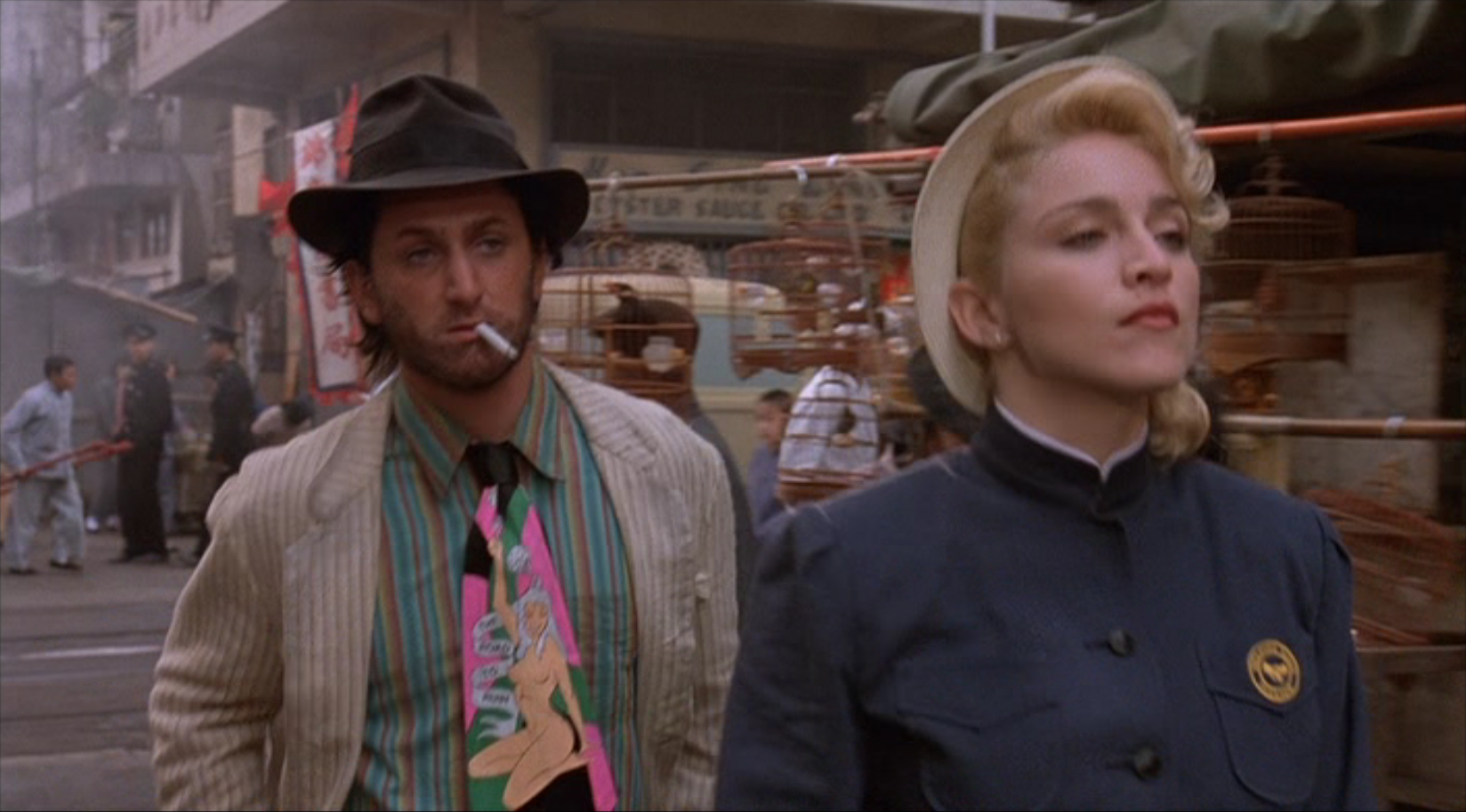
Today I took a look at the 1986 Madonna/Sean Penn vehicle Shanghai Surprise over at The Solute. It’s an auxiliary to Julius Kassendorf’s series examining all of Madonna’s film roles, but readers of my recent Fates Worse Than Death series will find many connections made with both the serials of the 1930s and the post-Raiders of the Lost Ark imitators that flooded theaters in the 1980s. Upon its release, Shanghai Surprise was an enormous flop and the passage of time has done little to rehabilitate it; however, I found some things to enjoy in it, which you can read about right here.

Community Season Five in review

A few months ago, I looked back at my feelings about Community before its fifth season began.  I discussed how intense my infatuation with the show was in the first couple of seasons, and how betrayed I felt when creator and showrunner Dan Harmon was fired before the fourth season, which I ultimately bailed on due to its awfulness.  With Harmon back in the driver’s seat, I thought it was worth checking it out again.

I did stick with the fifth season, and now that it’s over I have a few thoughts.  For the most part, it was pretty good: it had the wry mixture of sweetness and cynicism that was a distinct part of Harmon’s voice, and while the story twists and “gimmick” episodes were as implausible as ever, they mostly felt like things that the characters might actually do or take part in instead of a writer lazily spitballing, “How about an episode that does (insert popular property ripe for parody)?”  And the show was still reliably funny; while there was nothing as hilarious or mind-blowing as Season Two’s fake clip show “Paradigms of Human Memory” (although parts of this season’s “G. I. Jeff” came close), I usually got a good laugh out of at least one or two things even in this season’s weakest episodes.  As I had hoped before the season began, it was mostly just fun to hang out with these familiar characters again.

The season was notably shorter, of course, only thirteen episodes instead of twenty-four, and while I’d always rather have more of something I enjoy, on balance I don’t think it was bad for the show.  In the past, Community’s seasons have followed the pattern of the school year, so a truncated season meant no holiday episodes.  However, considering how bad last season’s Halloween and Thanksgiving episodes were, and how much the writers have had to stretch to come up with new ideas for the holidays, I don’t consider that a great loss.  It was probably better to let them concentrate on a smaller number of episodes as well so that their ideas (and budget) weren’t spread too thin.

On the downside, two members of the core ensemble left the show under different circumstances: Chevy Chase, long known to be dissatisfied with the direction of the show and his character (wealthy non-traditional student Pierce Hawthorne), and after repeated feuding with Harmon, quit the show and didn’t return for this season.  Although Chase was an essential part of the show in the first couple of seasons (as both a would-be mentor to Joel McHale’s Jeff Winger and as a foil to play off the younger characters), behind-the-scenes rancor increasingly crept into his performance and storylines.  The writers didn’t know what to do with him, and his character became nastier and more intractable.  It’s sad, really: although I’d heard Chase had a large (even for Hollywood) ego, I’d enjoyed him in films like National Lampoon’s Vacation since I was a kid, and it was great to see him make a comeback after years in the wilderness. Community was the best project Chase had been involved with in years, and while he was committed to making it work he was great in it.  But apparently he wasn’t satisfied with being part of a terrific ensemble instead of the star, and he reportedly didn’t “get” Harmon’s style of humor, demanding more input on his scenes.  The break was probably inevitable, and with Pierce Hawthorne’s offscreen death early in the season, it appears permanent.

Replacing Chase as the “old man” of the group, Professor Buzz Hickey (Jonathan Banks) proved to be an inspired addition.  The element of generational conflict remained present, but Hickey was quite a different character from Pierce: whereas Pierce wanted to be seen as a wise elder, Hickey was more of a stubborn old coot, a former police officer who now taught criminology (his addition to the group was the most obvious way in which Jeff’s elevation to teacher and the transformation of the study group into the “Save Greendale” committee provided opportunities to tell new stories about the college).

On the other hand, the departure of Troy Barnes (Donald Glover) was left open-ended.  Glover, whose star is rising as both actor and rapper, left to make time for other projects, and his character was given an emotional (and hopefully temporary) farewell, sailing around the world on the yacht Pierce bequeathed to him.  Troy’s last episode, “Geothermal Escapism,” began like the sort of thing Community has done many times, with Abed Nadir (Danny Pudi) putting the school through a campus-wide game of “hot lava” as a way of avoiding the pain of being separated from his best friend.  The “break from reality” has been a common plot device for the show (and would also be used in this season’s “G. I. Jeff”), but “Geothermal Escapism” reached a surprisingly affecting climax as Troy and Abed found an “in-story” way of both explaining and accepting Troy’s departure.  Although Glover was missed, breaking up the pairing of Troy and Abed allowed both Abed and the show to grow and do something different.

Each season finale since at least the third has been in the odd position of providing an ending definitive enough to conclude the series but with enough loose ends that it could plausibly continue, a reflection of Community’s always-uncertain fortunes.  Season Five’s finale, “Basic Sandwich,” was even more meta than usual, with Abed referring to the school’s and characters’ fates in terms of spin-offs and cancellation.  Community has changed in some drastic ways since the first season: Greendale itself has changed, even as it moved to the foreground as the real star of the show.  It’s not the same as it used to be, but it’s still a fun place to visit.

I don’t know if Community will make it to the proverbial “six seasons and a movie,” but if it does I’ll probably continue to watch.  And if it doesn’t, I’ll know it’s because an asteroid has destroyed all human civilization.  Like Abed, I appreciate narrative closure.

Wichita Symphony Orchestra: Music of Vaughan Williams and Beethoven

Ralph Vaughan Williams, Serenade to Music

Ludwig van Beethoven, Symphony No. 9 in D Minor, Op. 125

It’s fitting that during the first Wichita Symphony concert I reviewed for the Eagle last fall, a piece was delayed by a ringing cell phone, and at the last Classics concert of the season, the ending of another piece was interrupted by the same intrusion.  This time I felt the need to mention it in the published article; it’s not usually my practice to review the audience, unless their reaction provides insight into the performance.  In this case, however, it was too obvious to ignore, and a spoiled moment remains spoiled whether it’s the fault of the performers or something external.

I’m also not much interested in the ritual of public shaming that inevitably accompanies this sort of transgression: it could happen to anyone through a moment of forgetfulness, and the individual was (I hope) mortified enough by the experience to avoid it in the future.  I report it as a reminder for future concerts: come on, people.

I should add that I wouldn’t demand total silence during a performance, even if it were within my power.  The occasional burst of applause, the movement of bodies, even the coughing that sometimes comes unbidden during the softest passage: these are human sounds, and they have been with us since the first public concerts.  They are reminders that concertgoing is a communal experience.

Critic Alex Ross has written about the rule of silence, and the transformation of the rowdy public concerts of the eighteenth century into the solemn “Temple of Music” we have now. Of particular interest is his research into the “no applause” rule, under which the audience is expected to remain silent between movements and only show their appreciation at the end (a practice that has taken root only since the early twentieth century; many first-hand reports indicate that composers such as Mozart experienced, and even counted on, applause between–or within!–movements that could be truly described as “crowd-pleasing”). Ross writes:

As a listener, I don’t need total silence to help me to understand the music, even less to register its emotional impact. To the contrary, I find this ponderous silence forced, unsettling, and in places absolutely anti-musical, as after the big movements of concertos. It’s crazy for three thousand people to sit in Carnegie Hall contemplating Tchaikovsky’s First Piano Concerto as if it were some Buddhist monument, rather than a rousing, passionate entertainment.

As it happens, the enthusiasm of Saturday’s audience was such that there was vigorous applause after not only the first, but also the second movement of Beethoven’s Ninth Symphony.  That is a sound that no musician would mind hearing during a performance.

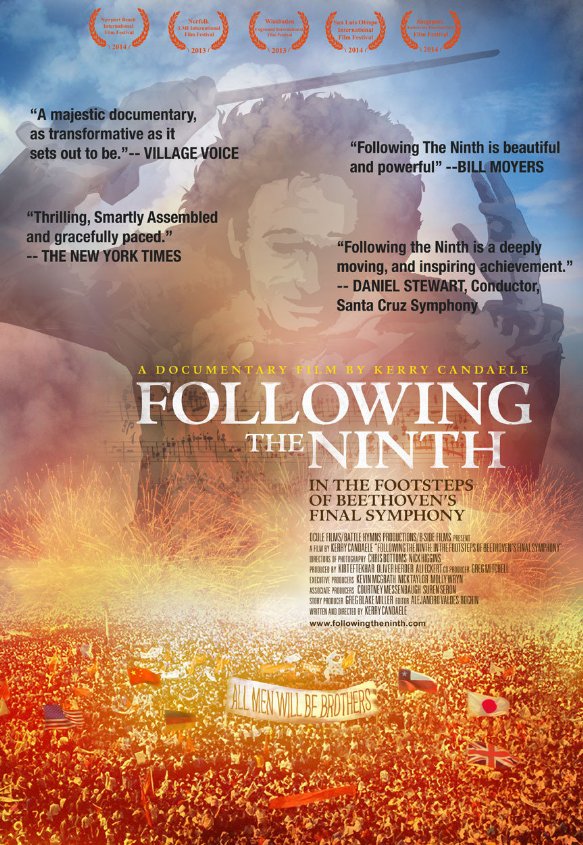
Film Review: Following the Ninth

It’s easy to be desensitized as a defense against hype; all around us we are being sold, told that something is the biggest, the best, the newest. Folding our arms and saying, “Oh, yeah? Prove it!” isn’t just reflexive cynicism, it’s practically a self-defense mechanism, the only way to protect ourselves against the barrage of pitches clamoring for our attention.  Arts advocacy, sadly, isn’t immune to hyperbole, and even well-meaning statements like Mr. Holland’s Opus and The Mozart Effect can overstate their cases, ringing hollow.  I’m as guilty as anyone else: music can be a powerful experience, and difficult to put into words. If we sometimes go overboard when speaking on its behalf, it’s because we have been transported, and words are rarely big enough to explain it.

Kerry Candaele (the director of Wal-Mart: The High Cost of Low Price and other documentaries) described himself in his 20s as full of “angst, existential dread, and spiritual maladies,” before his discovery of the music of Ludwig van Beethoven, specifically a cassette recording of Beethoven’s Ninth Symphony.  The music touched him so deeply that he became a convert, digging into Beethoven’s music and wanting to pound on people’s doors, asking them, “Do you have Beethoven in your life?”  Fortunately, instead of doing that, Candaele wrote and directed Following the Ninth, which takes a different tack (I caught the film at the Wichita Orpheum Theatre Wednesday night, co-presented by the Tallgrass Film Association and Wichita Symphony Orchestra).

Following

Before Wednesday night’s screening of Following the Ninth, Candaele spoke briefly to those brought to the screening “not under their own free will,” seeking to allay their fears by stating up front that his film is not a biopic, and not an academic analysis of the music.  Indeed, as the film proceeded there were relatively few pronouncements from musical experts and almost no references to Beethoven’s biography, other than the fact that by the time he composed the Ninth (his last completed symphony) in 1824, he was completely deaf.  The film focuses squarely on individuals from China, Japan, Chile, and Germany, speaking in their own words (and with the support of copious historical and newly-filmed footage) about what the Ninth Symphony has meant to them.  Candaele makes his case for the power of art by example.

Following the Ninth celebrates the communal nature of Beethoven’s masterpiece, concentrating on times and places in which the complete work (especially the famous “Ode to Joy” of the last movement) gave solace or energy to people desperate for freedom, equality, brother- and sisterhood.  In 1989, mere months apart, demonstrators in Tiananmen Square and crowds celebrating the dismantling of the Berlin Wall adopted the Ninth as anthems under very different circumstances: the Chinese student demonstrators, represented by student leader Feng Congde, hijacked public PA systems and blared the Ninth Symphony to drown out official announcements and threats; in East Berlin, Lene Ford grew up being forced to sing Beethoven’s work in school, taught only that he was a “social revolutionary.”  After the collapse of the Wall (only two months after Lene’s brother had been shot trying to escape to the West!), the Ode to Joy symbolized a moment of sudden openness: for a young woman who had been spied upon by the Stasi simply because she had pen pals in other countries, “who were like fiction to me, because I knew I would never see them,” the experience of freedom was overpowering.

While the Chinese student demonstrations would be crushed by government force, and East Germany would be reunited with the West as the Soviet system crumbled, both Feng and Ford speak to the transformation they underwent during those events: the sense that they could do anything, that both they and the world had changed.  Ford comments that the feelings she experienced, and the welcome she received from West Germans the first day the border was opened, have stayed with her, forming a reserve of strength she has drawn on throughout her life since then.  At a concert after the Wall fell, conductor Leonard Bernstein famously changed a single word in the Ode from freude (joy) to freiheit (freedom)–a change not without some controversy; while both words were appropriate for the moment, it is the sense of utter joy that comes through as Ford recounts her story.  As for Feng, when he describes the plaster statue of a woman holding a torch aloft that the students erected in Tiananmen Square–an iconic image that was interpreted as a Chinese Statue of Liberty in the U. S.–he refers to her as Joy personified.

Feng’s recollections of his role in the protests dwell on the liberation of the students’ artistic impulses during the protests, and emphasize that the restriction of the Communist system was not only physical, but a sort of prison of the mind: while the protesters faced physical violence, they were protesting against a more pervasive “violence of culture,” in which art, music, and dance were all “bourgeois,” forbidden.  A sad irony of totalitarianism is that the same creative outlets were forbidden under the fascist government of Chile under General Augusto Pinochet: in the words of one activist, “there was no culture, because all culture was Left culture.” It was forbidden to sing Chilean folk songs or the “Himno de la Alegria,” as the Ode to Joy is known in Spanish, because of their association with popular socialist movements, or simply because the majority of musicians were known to have leftist sympathies. It is a reminder that, as Czech author Josef Škvorecký pointed out (in “Red Music”),

when the lives of individuals and communities are controlled by powers that themselves remain uncontrolled–slavers, czars, führers, first secretaries, marshals, generals and generalissimos, ideologists of dictatorships at either end of the spectrum–then creative energy becomes a protest. . . .  Totalitarian ideologists don’t like real life (other people’s) because it cannot be totally controlled; they loathe art, the product of a yearning for life, because that too evades control.

Some of the most harrowing passages in the film describe the paranoia and secrecy that marked Pinochet’s Chile, as suspected dissidents were “disappeared,” rounded up by the government for torture and (sometimes) execution.  Indeed, many of the public protests against Pinochet were led by women: so many of the men had been taken that the women left behind became the public voices of dissent, keeping the names and faces of the “disappeared” in the public eye and leading non-violent demonstrations (including singing the forbidden “Himno”).  Although Pinochet is gone, the recollections of the Chilean activists are bittersweet, with a sense of grievous loss that can only be processed through wry humor or simply by moving on.

Unlike the examples of the Ode taking on heightened significance at moments of political crisis, the annual performance of Beethoven’s Ninth has been an established tradition in Japan since World War I: professional orchestras, schools, and Daiku (“great nine”) associations stage hundreds of performances of the symphony every year in December, where it is associated with the New Year, similar to choral societies in the West that perform Handel’s Messiah and other works annually.  Candaele sits in on rehearsals with some of these groups, made up of amateurs who sing for both musical fulfillment and camaraderie; as in the West, Daiku choruses are civic and social as well as artistic in function, with a great emphasis placed on the value of cooperative endeavors.  Following the Ninth was six years in the making; at the outset of filming, Candaele could not have expected the horrific earthquake and tsunami that devastated parts of Japan in March 2011; but in the aftermath, Beethoven’s Daiku was an obvious symbol for the Japanese people to express their resilience and solidarity.

Following the Ninth is not a straight concert film, but it does roughly follow the order of Beethoven’s symphony, with the Ode to Joy as a recurring touchstone, introduced at the very beginning and referred to throughout the film (whereas in the symphony it is heard only in the final movement).  The four countries’ stories are intertwined, cutting back and forth, leaning on the similarities more than the differences (after all, the theme of the Ode is universal brotherhood).  Beethoven’s music is frequently heard in the background under dialogue or in tandem with footage of crucial events, but longer passages are also played over montages of images cut to match the rhythm of the music.  It’s in these sections that Following the Ninth comes closest to being outright manipulative: scenes of children playing, people marching, and breathtaking natural vistas are like cinematic candy–tasty but not very nutritious–and Beethoven’s music doesn’t need the extra juice.  Likewise, the scenes of goose-stepping German soldiers, Chinese tanks rolling over student encampments, and massive walls of water bearing down on the Japanese coast are chilling enough without Beethoven’s timpani or ominous harmonies making the point.

Still, even those scenes contribute to the film’s theme: the unity of mankind in all its diversity, as optimistically celebrated by poet Friedrich Schiller in the Ode that Beethoven would set to music in his monumental symphony; and the ways in which Beethoven’s music has been adopted and given meaning in settings quite different from that which he experienced.  Candaele opens the film with punk/folk singer Billy Bragg telling the story of the time he was invited to rewrite the words to Schiller’s Ode; like Bernstein’s change of a crucial word, that is sacrilege to some people, but it is similar to the way in which each person interviewed in the film has made Beethoven their own, and the way Candaele has used the symphony as a vehicle for telling their stories.  I think that’s the reason so little of Beethoven’s specific history is included in Following the Ninth: it’s already well-known, sure, but more importantly it’s beside the point.  For the Chilean and Chinese protesters, for the suddenly liberated East Germans, and for the Japanese coming together in the face of disaster, Beethoven’s music wasn’t history, or even a convenient symbol: it was alive and it was speaking to them in that moment.  I suspect that’s what we really mean when we say a work of art is “timeless,” and it’s the reason it’s so difficult to put into words after the moment is over.

Wichita Symphony Orchestra with William Wolfram, Piano: Music of Wagner, Liszt, and Bruckner

Wichita Symphony Orchestra

Daniel Hege, Music Director and Conductor

William Wolfram, Piano

“Hail Wichita” (Wichita State University fight song)

Richard Wagner: “Ride of the Valkyries” from Die Walküre

Franz Liszt: Concerto No. 1 in E-flat Major for Piano, S. 124

Anton Bruckner: Symphony No. 4 in E-flat Major, “Romantic”

Here’s what I wrote in my review for The Wichita Eagle.

Wichita Symphony Orchestra with American Brass Quintet

Wichita Symphony Orchestra with Maestro Daniel Hege:

Thunderhead Singers (Drum circle)

John Barry: Concert Suite from Dances With Wolves

Eric Ewazen: Shadowcatcher (concerto featuring American Brass Quintet; accompanied by projected images of Edward Curtis’ photographs of Native Americans)

Antonín Dvořák: Symphony No. 9 in E Minor, “From the New World”

Here’s what I wrote for The Wichita Eagle.

Wichita Symphony Orchestra with Cirque de la Symphonie: Blue Jeans Concert

Friday was the Wichita Symphony’s annual Blue Jeans Concert, an event at which the orchestra dresses down and the atmosphere is less formal than the typical Classics Concert.  This year, the guest artists were members of Cirque de la Symphonie; my review of the concert for The Wichita Eagle can be found here.

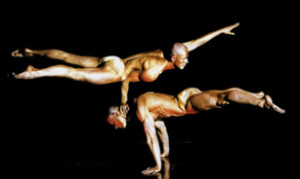
Strongmen Jarek and Darek of Cirque de la Symphonie

Strongmen Jarek and Darek of Cirque de la Symphonie

The complete program, directed by conductor Daniel Hege:

“Hail Wichita” (Wichita State University fight song)

Shostakovich: Festive Overture, Op. 96 (Orchestra)

Saint-Saëns: Danse macabre, Op. 40 (Christine Van Loo, aerial rope)

Bizet: Danse bohème from Carmen: Suite No. 2 (Vladimir Tsarkov, ring juggling)

Tchaikovsky: Valse from Sleeping Beauty: Suite, Op. 66a (Elena Tsarkov, contortion and dance)

Bizet: Les toréadors from Carmen: Suite No. 1 (Vova Tsarkov, spinning cube)

Badelt: Medley from Pirates of the Caribbean (Orchestra)

Rimsky-Korsakov: Scena e canto Gitano and Fandango asturiano from Cappricio espagnol, Op. 34 (Aloysia Gavre, aerial hoop)

Intermission

Tchaikovsky: Dance of the Swans from Swan Lake: Suite, Op. 20a (Vladimir Tsarkov and Elena Tsarkova, magic act)

Glinka: Overture to Ruslan and Lyudmila, Op. 5 (Orchestra)

Kabalevsky: Galop from The Comedians, Op. 26 (Vladimir Tsarkov and Vova Tsarkov, juggling glowing pins on a semi-darkened stage)

Offenbach: Galop (Can-Can) from Orpheus in the Underworld (Elena Tsarkova, ribbon dance)

Rimsky-Korsakov: Dance of the Buffoons from The Snow Maiden: Suite (Alina Sergeeva, hula hoops)

Strauss II: Thunder and Lightning (Polka), Op. 324 (Orchestra)

Tchaikovsky: Valse from Swan Lake: Suite, Op. 20a (Alexander Streltsov and Christine Van Loo, aerial duo on silks)

Sibelius: Finlandia, Op. 26 (Jarek and Darek, strongmen)