Are You a Bad Enough Dude to Be a COMMANDO NINJA?

In 2019 I celebrated “Ninjanuary” with several posts about the ninja in popular culture, particularly in films and books from the 1980s, and I occasionally return to that theme. Past entries can be found by clicking on the Ninjanuary tag.

Can we ever escape the 1980s? In the case of movies with the word “ninja” in the title, probably not (this series is proof of that). Even in 1998, The Wedding Singer conjured up an MTV-era fantasy with a distinct candy-colored look, an exercise in nostalgia for an era not even two decades past, a Grease for Generation X. As we have moved farther in time from that decade, media basking in “’80s-ness” has become more and more baroque: Vaporwave fantasies inspired by movies (of the blockbuster and Blockbuster variety), comics, and video games that were already exaggerated reflections of a complex, fast-changing world.

Commando Ninja (Ben Combes, 2018) wears its influences from the title on down: the ninja action is largely of the Cannon Films/Golan-Globus variety, with some overt homages to Godfrey Ho, and the Commando part acknowledges the Schwarzenegger/Stallone wing of ‘80s action cinema, down to the obsession with the Vietnam War and those who survived it. It’s also apparent that as the generation who were children in the 1980s (or for whom it was before their time) have grown up to create their own art, the “toy commercial” cartoon shows like G.I. Joe and Transformers have turned out to be just as enduring and influential as Back to the Future or Pretty in Pink.

Beyond the passage of time, the internet and meme-ification of pop culture is probably also to blame. Commando Ninja, like Kung Fury, was a Kickstarter-funded project, and like many crowdfunded movies, it feels like it’s deliberately pitched to the Reddit crowd who are most likely to be online to hear about it in the first place. In addition to the obvious, Commando Ninja riffs on such period touchstones as Home Alone, the Mad Max series, the films of Andy Sidaris, 8-bit video games, and Jurassic Park. (Okay, that’s from the ‘90s, but there’s always room for dinosaurs in something like this: what I recently said about “comics FUN” also applies to self-consciously pulpy movies.) I started Commando Ninja feeling that it was at least more grounded than Kung Fury, but by the end I wouldn’t even say that. 

The plot of Commando Ninja flashes back and forth between 1968 and 1986 (always helpfully announcing when and where a scene takes place with title cards). It begins with a platoon of American G.I.s wading through a Vietnam delta, trading wisecracks and wary guesses about what they’re up against. They’re a diverse group, stereotypically so: the black guy is nicknamed “Snow White,” and another soldier is named “Kowalsky,” and there’s a “lovable” racist with a Confederate flag stitched to his camos. We see them from above through thermal imaging as warm red blobs, just like in Predator. When the unseen antagonist is revealed, it is a red-clad ninja with a golden facemask who can literally become invisible (again, much like the Predator). After a surprise attack, black-clad ninja henchmen finish the job of killing some of the soldiers and corralling the survivors, including hero John Hunter (Eric Carlesi).

Flashing forward to 1986, Hunter’s ex-wife is murdered at her front door by a very Terminator-like pizza delivery man, and his tween daughter nearly escapes from a pair of bumbling ninjas by means of homemade booby traps. But she hadn’t counted on the Terminator dude being invulnerable to being hit in the nuts, and he catches her. Hunter, contentedly chopping wood in a remote cabin in Canada, is approached by an Air Force official: Leeroy Hopkins (Philippe Allier), the redneck we last saw getting his arm blown off in Vietnam, now outfitted with a cybernetic replacement. He has good news and bad news: Hunter’s ex-wife is dead, and the bad news is that his daughter has been kidnapped.

It’s hard to tell how invested writer-director Ben Combes is in recreating the nastier edge that was often present in ‘80s action movies, whether he’s reveling in the perceived freedom to not be “politically correct,” or if he’s ironically pointing out the racism and misogyny baked into their premises. Ultimately, it’s not my problem, but Combes was invested enough in the side character Hopkins to give him a Taxi Driver-style prequel short that explains how he went from disabled Vietnam Vet to Air Force cyborg, and it involves slaughtering a ring of murderous Viet Cong guerillas in 1970s New York City.

Or perhaps it is a matter of perspective: although made in English, Commando Ninja was a French production. Kung Fury was made in Sweden. The post-apocalyptic ‘80s pastiche Turbo Kid was made in Canada. That isn’t to say that Americans don’t also tell these stories, but the non-domestic versions are often markedly weird, like a copy of a copy. Is this what the United States, filtered through the media we export, looks like to the rest of the world? I’ll admit that absurd macho posturing is a big part of our national brand, especially now.

In any case, John Hunter, Commando Ninja, springs into action, tracing his daughter’s kidnapper to his old nemesis, Kinsky (Olivier Dobremel), who was working with the Soviets in 1968 but now appears to be an independent crimelord with his own army of ninjas at his disposal. He chills at his luxurious mansion in a fictional Central American country, surrounded by bodyguards and beautiful women in bikinis, and has apparently arranged the kidnapping to extort Hunter into doing his dirty work. Kinsky is pointedly Jewish: make of that what you will. (There are some nice touches in these sequences, like the Garfield phone Kinsky uses to communicate with his henchmen, and the varied uses of the Nintendo Power Glove to represent high-tech gadgets.)

Things don’t go according to Kinsky’s plan, and along the way, Hunter recalls the imprisonment he suffered in Vietnam at Kinsky’s hands, and the means of escape he was given by a sympathetic Chinese Colonel (Thyra Hann Phonephet) who introduced him to martial arts and the path of the Commando Ninja. (Other questions answered by flashbacks include the sad story of Kowalsky, the soldier-turned-Terminator whose brain was replaced with a “powerful four-megahertz processor.”) Of course, Hunter uses the lessons he learned from his sensei to defeat his old enemy the red ninja, and then things really get weird.

The criticisms I have may make it sound like I didn’t enjoy Commando Ninja, but for what it is, I was entertained and even laughed out loud sometimes. Carlesi has the physique and demeanor of an original ‘80s action hero, and while much of the violence is played for laughs, with exaggerated blood squibs and exploding dummies, the hand-to-hand combat sequences are effective. The music convincingly evokes John Carpenter and Kenny Loggins to get the audience pumped up. There are more real location shots than you might expect, with greenscreen and CGI reserved for the really outlandish scenes. It also moves briskly and doesn’t wear out its welcome, coming in at under 70 minutes. But if you’re left wanting more—and the film does end on a cliffhanger—Commando Ninja is just the beginning of a burgeoning franchise: in addition to the aforementioned short Hopkins, a full-length sequel was completed last year and there’s also a prequel comic book. As of this writing, Commando Ninja is available to watch on YouTube.

Space Western Comics: A Review

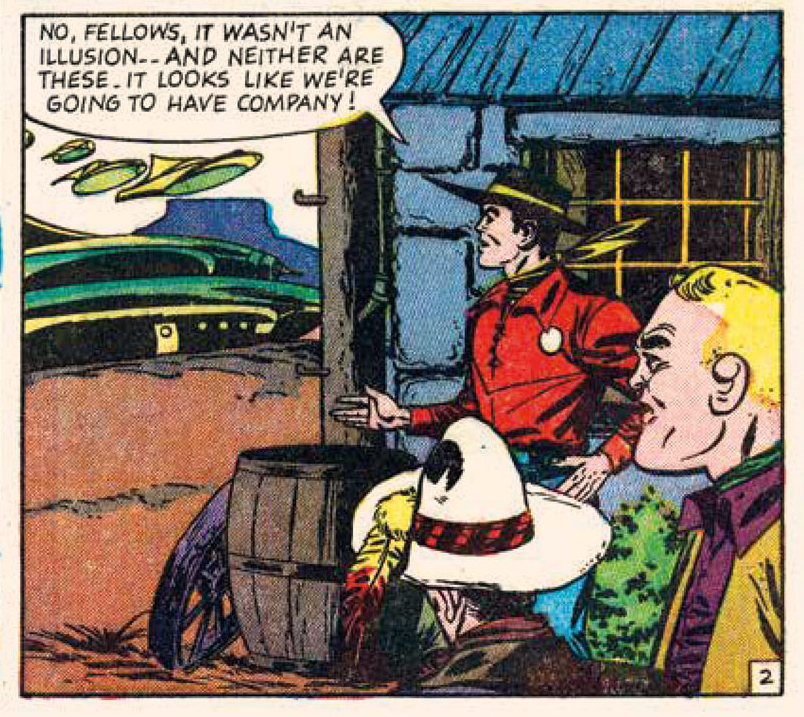
It’s tempting to look at pop culture trends in the 1950s and ‘60s in broad strokes, shaped by after-the-fact simplifications like Toy Story 2. In that film, classic cowboy Westerns were put out to pasture (heh) with the launch of Sputnik and the beginning of the Space Race, and almost overnight children’s imaginations turned to science fiction. In the long run, I suppose that did happen, but over decades rather than months or weeks. Throughout the 1950s and much of the ‘60s, Westerns (and related frontier and outdoorsman stories) remained popular with kids (and adults), and while sci-fi eventually overtook them in relevance, there were multiple attempts to combine the two popular flavors. Gene Roddenberry may have pitched Star Trek as “Wagon Train to the stars” and codified space as “the final frontier,” but he wasn’t the first to make the connection. Craig Yoe, prolific historian and anthologizer of comics, has produced a fun and informative volume in Space Western Comics, reprinting and contextualizing a run of adventure stories combining cowboys and aliens from the 1950s. It’s perfect reading for Vintage Science Fiction Month.

It’s worth noting that the term “space Western” was sometimes used (derogatorily) in sci-fi publishing and fan circles to describe stories that were just the same old formulaic good guys confronting bad guys dressed up in otherworldly verbiage, with rayguns replacing six-shooters and spaceships replacing horses. (Star Wars was attacked in the ‘70s by purists along exactly those lines, but at least Star Wars had considerable artistry on its side; in the ‘50s the white hats vs. black hats approach was strictly the domain of hacks.) But there were some literal space Westerns as well that combined the terminology and iconography of both genres into a single, (mostly) coherent story world. (I wrote about this weird subgenre several years ago and went into detail on the movie Cowboys & Aliens, at the time the most current example.)

Westerns in the first half of the twentieth century weren’t limited to the Old West. Real-life ranches and cowhands were enough of a reality that so-called “modern Westerns” could tell stories of pure-hearted (often singing) cowboys fighting cattle rustlers, land-grabbing oil or radium speculators, and other unscrupulous villains while using up-to-date technologies like automobiles, airplanes, and radio. While fanciful, these modern Westerns ostensibly took place in the “real world” of the 1930s, ‘40s, or ‘50s. Naturally, some of the same futuristic devices that were appearing in contemporary serials and comic books—miraculous rays, rockets, and the compelling but imperfectly-understood “television”—made appearances in the modern Western setting as MacGuffins or mysteries that needed to be unraveled. A cycle of “gadget Westerns” ran its course in the serials of the 1930s, but none of those involved actual space travel or alien visitors. The Phantom Empire, which famously sent Gene Autry underground to confront an ancient, advanced civilization miles beneath his ranch, stands out as an example of the Western exploring inner, not outer space.

So it is perhaps not surprising that the still-popular Western genre, chasing after trends, would incorporate UFOs, space travel, and alien life in an attempt to hold fickle audiences’ attention. And it is even less surprising that comics—a business with low costs and quick turnaround compared to the movies—would be in a position to take advantage of the brief moment when cowboys and spacemen appeared to be on equal footing (at least with the allowance-spending children of America).

In 1952, based on a suggestion from Charlton co-publisher Ed Levy, the already-extant Cowboy Western Comics changed its title to Space Western Comics (a common practice: instead of starting a new series with issue number one, it was believed that high numbers were more attractive to newsstand buyers, as they suggested a successful track record). Walter P. Gibson, the prolific writer and magician who developed and ghost-wrote The Shadow for Street and Smith, among many other projects, wrote and edited the adventures of “Spurs” Jackson, a rancher and electrical engineer whose ranch becomes the center of zany outer space adventures. (Shades of Gene Autry!) Artists John Belfi and Stanley Glidden Campbell provided the illustrations. The book reverted to Cowboy Western after only six issues, but a couple of stories starring Jackson from later issues are included in Yoe’s volume for the sake of completeness, as are two space-themed stories from Buster Crabbe’s comic book. (Crabbe had, of course, played both Flash Gordon and Buck Rogers in addition to cowboy roles, so this made perfect sense.)

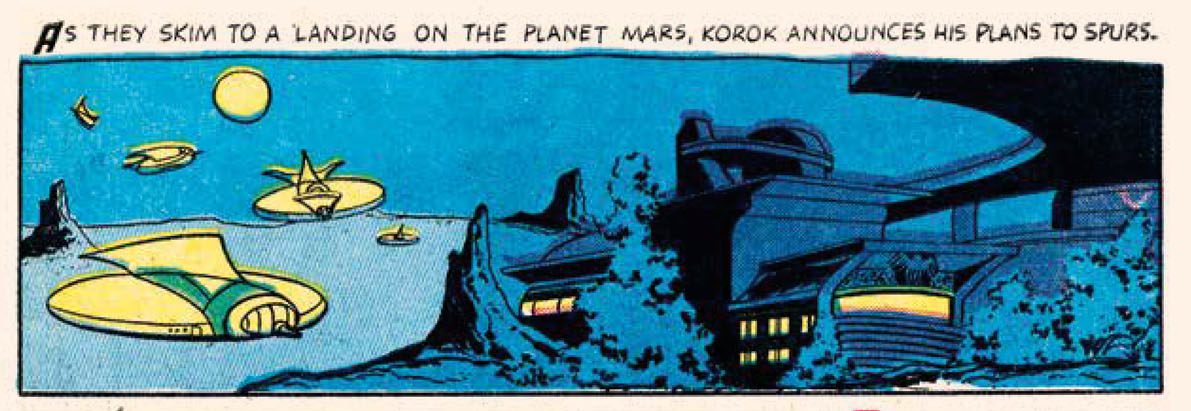
Space Western Comics begins with the Space Age already underway: flights to the moon have become routine, and a space station orbits the earth. “Spurs” Jackson is a character made to have adventures: unmarried and wealthy enough to occupy his free time inventing in his “secret lab,” the rancher-slash-engineer is charged with maintaining a 1000-foot-tall radar tower on his land (a government connection that serves to fuel several later stories), while leaving the day-to-day operations to his foreman, Hank Roper, and the Indian Strong Bow. The radar tower, which helps guide the lunar flights, attracts the attention of spaceships from Mars, who abduct the three men and take them to the red planet. There, they are presented as evidence that the Martians have conquered earth, a pretext that puts the scheming Korok on the throne of Mars instead of the rightful Queen Thula. This is classic space opera material straight out of Edgar Rice Burroughs, but the Western theme eventually pays off: Korok’s throne room is protected by a force field that prevents any metal from penetrating, so Martian weapons and the earthlings’ six-shooters are useless, but Jackson’s whip, Roper’s lariat, and Strong Bow’s bow and arrow, all non-metallic, win the day. For putting things right, Thula offers Jackson a position as her prime minister, but he can’t stay on Mars for long: ranching is an all-day job.

Some of the stories in this volume depend on the romance and exoticism of exploring other worlds, but in many of them the trouble is closer to home. Would-be alien invaders, Communist spies (sometimes disguised as aliens), criminal gangs, and even Nazis threaten the peace of the Bar-Z ranch. The desert makes for a compelling setting, full of isolated canyons and desolate flats, remote enough from civilization that no one in the cities would believe the stories but close to the Army’s testing ranges and bases so there are always plenty of troops and weapons ready to take charge of the surviving villains. As silly as the premises of these stories often are—rock men, plant men, and underground super-moles are among the aliens Jackson encounters—Gibson packs them with twists and clever problem-solving. Like a good engineer, “Spurs” Jackson out-thinks his opponents as much as he out-fights them (although he’s not above setting off an atomic bomb or two if that’s what it takes).

And frequently the twist is kept from the reader until the most dramatic moment, revealing that Jackson had his enemy’s number the whole time. In one of several text pieces, slavers from the planet Letos are foiled by a ship full of humanoid robots supplied by Jackson—“robots” who are actually humans in bullet-proof robot costumes. (Postal regulations required the text pages to secure favorable magazine rates; they were most often filled with editorials or letters columns, but short prose stories were not uncommon. The two-pagers Gibson provided for Space Western Comics are clever pulp miniatures, often written in the folksy voice of characters from around the Bar-Z. I think they would stand up well with the humorous sci-fi of Henry Kuttner and his contemporaries, should anyone think to mine comics’ text pages for anthologizing. Today, Alan Moore seems to be the only comics creator left with much affection for this archaic institution.)

Jackson isn’t the only savvy operator, either: Strong Bow is written as a more sophisticated and educated character than his Tonto-like dialogue might suggest. In more than one story, Indians appear to arrive from space, claiming to be heroes from the past or remnants of lost tribes, inviting the local Indians to overthrow the United States government. Of course, Strong Bow sees right through them, even if he might pretend to go along with the plan. (Although Space Western Comics predates the infamous Comics Code, it’s still as pro-government, pro-American, and pro-law and order as anything produced under the Code. The government and military in these stories are never less than righteous and upstanding, give or take a traitor or two in their midst, so nothing as subversive as suggesting Indian activists might have a point ever enters into the discussion.)

As I’ve alluded to in past articles, comics are a natural medium for the kind of mash-up represented by Space Western Comics: the visual shorthand that is a vital part of comics vocabulary lends itself to mixing and matching. Without attempting to catalog every example of the space Western from later comics, I’ll point to Terra-Man, a cowboy-themed villain from Superman comics. Abducted by space aliens as a child in the Old West, Terra-Man returned to earth with high-tech equivalents of the cowboy’s accessories and an alien winged horse. Current comics have embraced this kind of meta-referentiality with a vengeance, remixing popular iconographies of all kinds with kaleidoscopic variety. Sometimes it’s overwhelming, but I remind myself of being a comics reader in the 1980s, when the Big Two publishers seemed to be embarrassed by anything too “wacky,” and it was left to the independents to publish books like Marc Schultz’s Cadillacs and Dinosaurs (or for that matter, Teenage Mutant Ninja Turtles, as much a mash-up as a parody). I prefer the current acknowledgment of the medium’s silly roots, without the po-faced need to pretend that it’s all serious business.

By now, the proclamation that “comics are supposed to be FUN” is a tradition within comics that is up for grabs, just like every other past genre or practice that is ripe for revival, rehabilitation, or reinvention. Sometimes that means characters like Howard the Duck or Detective Chimp are given equal time with Iron Man or Wonder Woman; sometimes it means weaving disparate, contradictory threads into ambitious multi-layered story arcs that breathe new life into one-off concepts like the Green Team. Signifiers of “comics FUN” include (but are not limited to) ghosts, robots, dinosaurs, gorillas, and, of course, cowboys and rocket ships. Craig Yoe plays up how quaintly ridiculous the stories in Space Western Comics are, and is clear-eyed about the mercenary motives that led to its original creation. But he is equally up-front about how imaginative, breathlessly exciting, and yes, FUN, these stories are, and he has performed a valuable service by putting them together in a handsome and easily accessible package.