Kamandi Challenge no. 3

Cover A by Ben Caldwell

“Bug in Your Ear”
Writer: Jimmy Palmiotti
Artist: Amanda Conner
Colorist: Paul Mounts
Letterer: Clem Robins
Editors: Brittany Holzherr and Dan DiDio

When last we left Kamandi, he had leapt off a cliff into an unknown abyss rather than be captured by Manhunter robots. As Chapter Three begins, Kamandi’s descent is spotted by a hidden watcher, and a pair of bat people, Kreeg and Saparta, is dispatched to catch him; they sort of succeed, but not before Kamandi hits his head and loses consciousness. Upon awakening in a darkened cell, Kamandi is cautioned to be careful by a flying insect. “Yer in danger. They have eyes everywhere,” the bug says.

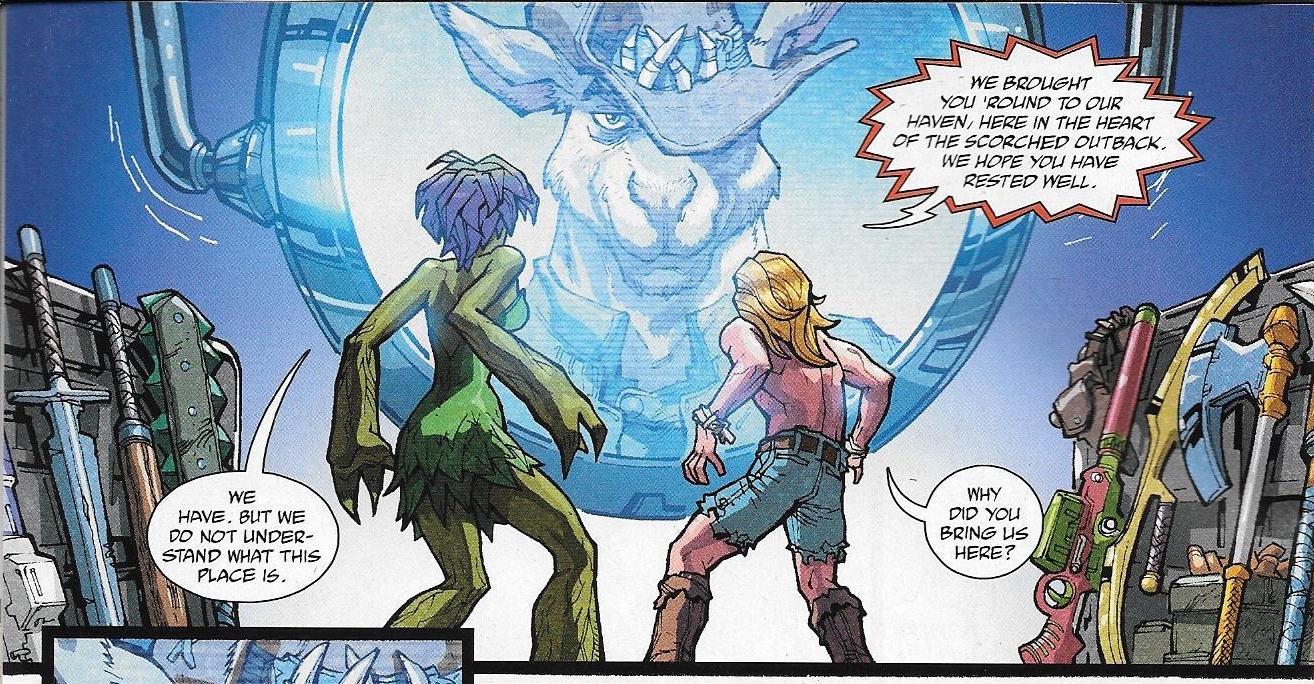
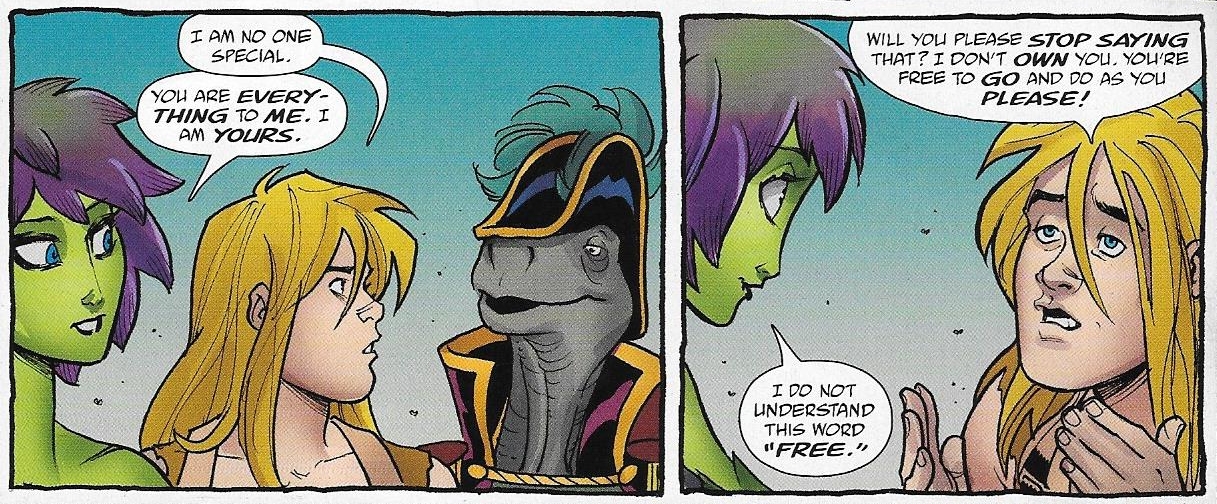
Then an organic pod emerges through the floor of Kamandi’s cell, which upon opening reveals a green-skinned half-vegetable girl who introduces herself as Vila. “I am yours,” she says enticingly, although her offer isn’t quite what we’re at first led to believe.

It turns out that Kamandi is aboard a ship in the clutches of the God Watchers, a crew of various animal types who believe Kamandi to be a messenger of the gods they have been waiting for; they possess a torn photo of Kamandi (or someone who looks like him) as a young boy, seated in front of his parents, the “true gods.” (Remember that Kamandi’s search to find his parents has so far been the one unifying thread in this round-robin series.)

Despite being hosted as a god, Kamandi doesn’t trust the God Watchers or their turtle leader, Fritz, and is deeply unsettled by what he sees of their ways: the bat people who saved Kamandi are slaves, captured in combat, and when he encounters them again they are undergoing punishment for failing to rescue him unharmed. At a feast held in his honor, Kamandi discovers that Vila and others like her are raised as food: he’s horrified to watch the animals bite off strips of the plant people’s “flesh,” even as Vila assures him that it will grow back. And everywhere, Kamandi is being watched by the hovering insects that serve as the God Watchers’ spy network. Despite his protests that he is not a god, he comes to realize that he is in great danger if the God Watchers begin to doubt him.

The crisis arrives when Kamandi draws his own blood in front of the God Watchers to prove that he is mortal, but that revelation is overshadowed by an attack from the bat people as the ship passes near their territory. In the confusion of the attack, Vila is grabbed by one of the attacking bats; Kamandi hangs on to her by one of her arms and rescues her by chewing through the other. The two of them free the still-captive Kreeg and Saparta (they cannot return to their own kind, as they are considered “tainted”), and are about to ride to freedom when Fritz corners them. “Arrest this impostor and kill the other three,” he orders. But then Fritz and his minions are slaughtered by the attacking bats, and Kamandi and Vila escape on Kreeg and Saparta’s backs just before the invaders firebomb the entire ship.

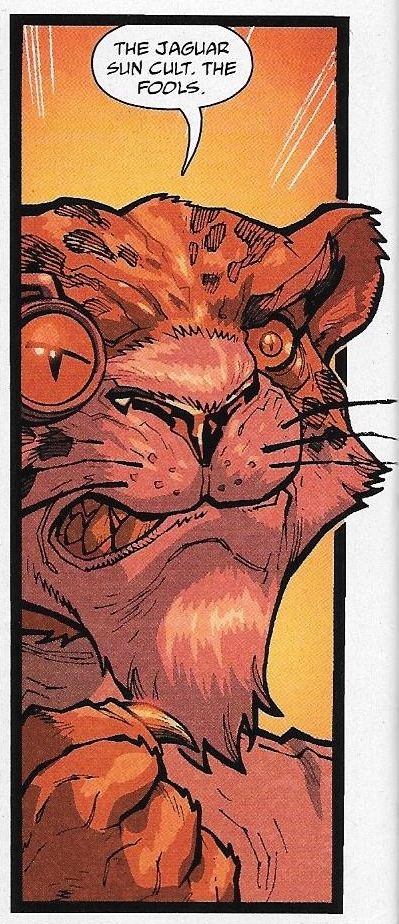
Whew! That would be enough for an episode of any adventure book, but true to the source material, the four protagonists have only escaped from one danger to step into another: the island they land on is reputed to be the home of a Sun Cult, and almost immediately they are ambushed by intelligent jaguars. After a struggle, Kamandi is again knocked out and taken captive. When he awakens, he and Vila are tied to posts on a ceremonial altar. Kreeg and Saparta have already been ritually cooked and eaten, and “sun-haired” Kamandi is next in line to be sacrificed. After being paralyzed with a drug and ritually decorated by attendants, Kamandi finds himself (with Vila thrown in for good measure) in Fay Wray’s position as a gift to the King Kong of jaguars. “Mmm . . . dinner!” the giant cat purrs. To be continued . . .

“Bug in Your Ear” is the contribution of husband-and-wife team Jimmy Palmiotti and Amanda Conner, who have worked together on many projects and who obviously know each others’ strengths. Conner’s art is always attractive, with a clean and slightly cartoony style, and here she leans into that quality with a big-eyed plant girl who resembles a sexy spin on the Jolly Green Giant, and a host of funny animals reminiscent of mid-century Disney productions like Robin Hood. The Disney comparison extends to the flying insects: the first one we see, who warns Kamandi to be careful, suggests something like Tinkerbell or Jiminy Cricket, a voice of wisdom from a tiny, unseen source. But that doesn’t last long, as the bug falls prey to an anteater who can’t resist snacking on the God Watchers’ spies.

In fact, despite how busy this chapter is, a great deal of the interest is in the characterization of the many different non-humans and their various motives as they’re thrown together in different combinations. The cuteness of the art and the humor of the characters offsets the gruesomeness of the plot, which lest we forget includes copious examples of (sort of) cannibalism, dismemberment, and ritual sacrifice. (The role reversal of having Kamandi wind up a body-painted “damsel in distress” at the end gives the story a touch of equal-opportunity sensuality, as well.)

Both the God Watchers and Jaguar Sun Cult were listed on the map of Kamandi’s world that Jack Kirby left behind before handing Kamandi off to other writers. I’d go so far as to say that “Bug in Your Ear” represents an ideal form of at least one facet of Kirby’s creation: funny animal characters and themes viewed through the lens of science fiction: not hard science fiction, but at least giving weight to the behaviors of real animals and by extension satirizing the human societies that the animals parody. As in previous iterations of Kamandi, and indeed a great many funny animal books (including those aimed at children), the animal societies mirror human cultures associated with the geography they inhabit.

Aztec jaguars are a natural, of course, and whether the use of Mesoamerican cultural signifiers like step-pyramids and human sacrifice is meant to suggest that the jaguars have taken over where humans left off, or rather that there is some sort of geographical essentialism involved in culture, is something left for the individual reader to ponder. And could we read Fritz and his multi-species crew of God Watchers as L. Ron Hubbard tooling about on a yacht for years as the head of Scientology’s Sea Org? Or perhaps his ship is an inverted Noah’s Ark, run by animals and searching for humans to save? Probably not, but it is fun to speculate. More importantly, no matter how far-fetched the settings and characters of fantasies like Kamandi may be, they connect because we recognize in them the passions for freedom, compassion, and meaning, as well as the cruelty, lust for power, and religious fanaticism that have always been with us, and have always been part of our fiction. As in the Planet of the Apes series, the most dangerous animal is man, no matter what skin he wears in his stories.

Kamandi Challenge no. 2

Cover by Neal Adams and Tim Shinn

Cover by Neal Adams and Tim Shinn

“Nuclear Roar!”
Story and Words:
Peter J. Tomasi
Artist: Neal Adams
Colorist: Hi-Fi
Letterer: Clem Robbins
Editors: Brittany Holzherr and Dan DiDio

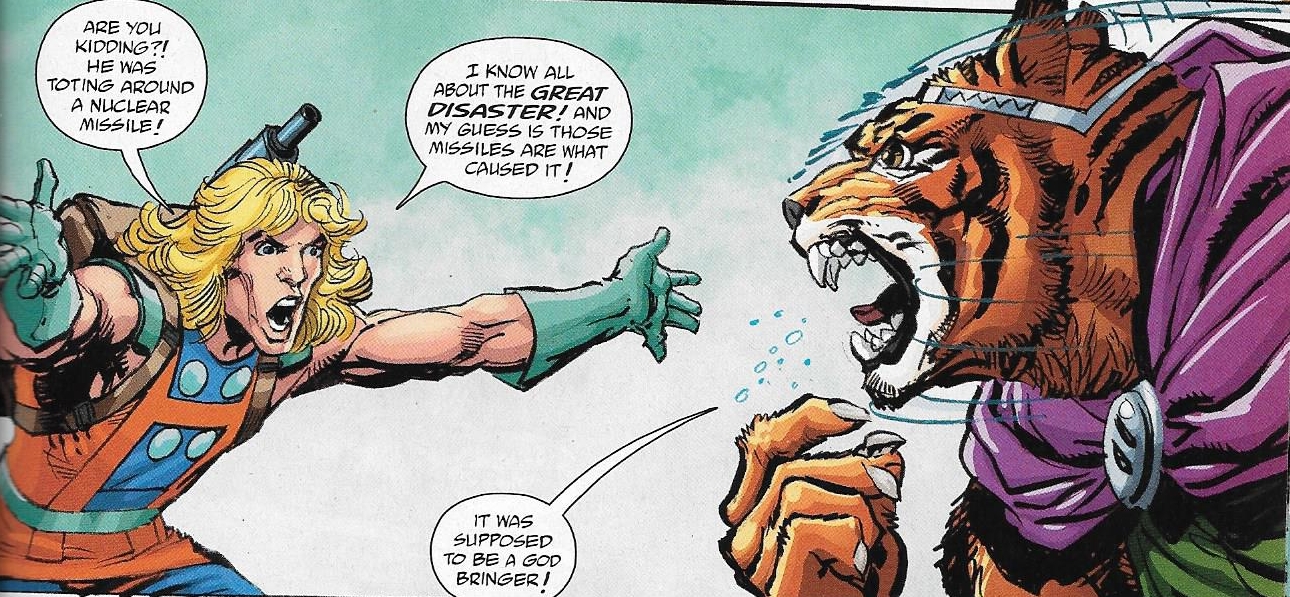
At the end of last month’s “K–is for ‘Kill’!”, King Caesar had triumphantly returned from battle with a “god” that he planned to awaken in order to add its power to that of the Tiger Empire. Only Kamandi, claimed as a “pet” by Prince Tuftan and guarded by Dr. Canus, recognized the “god” as a nuclear missile, left over from the times before the Great Disaster. As Caesar activated the missile’s computer system, it began a countdown, with Kamandi certain that the ancient device was going to blow up the entire city and everyone in it.

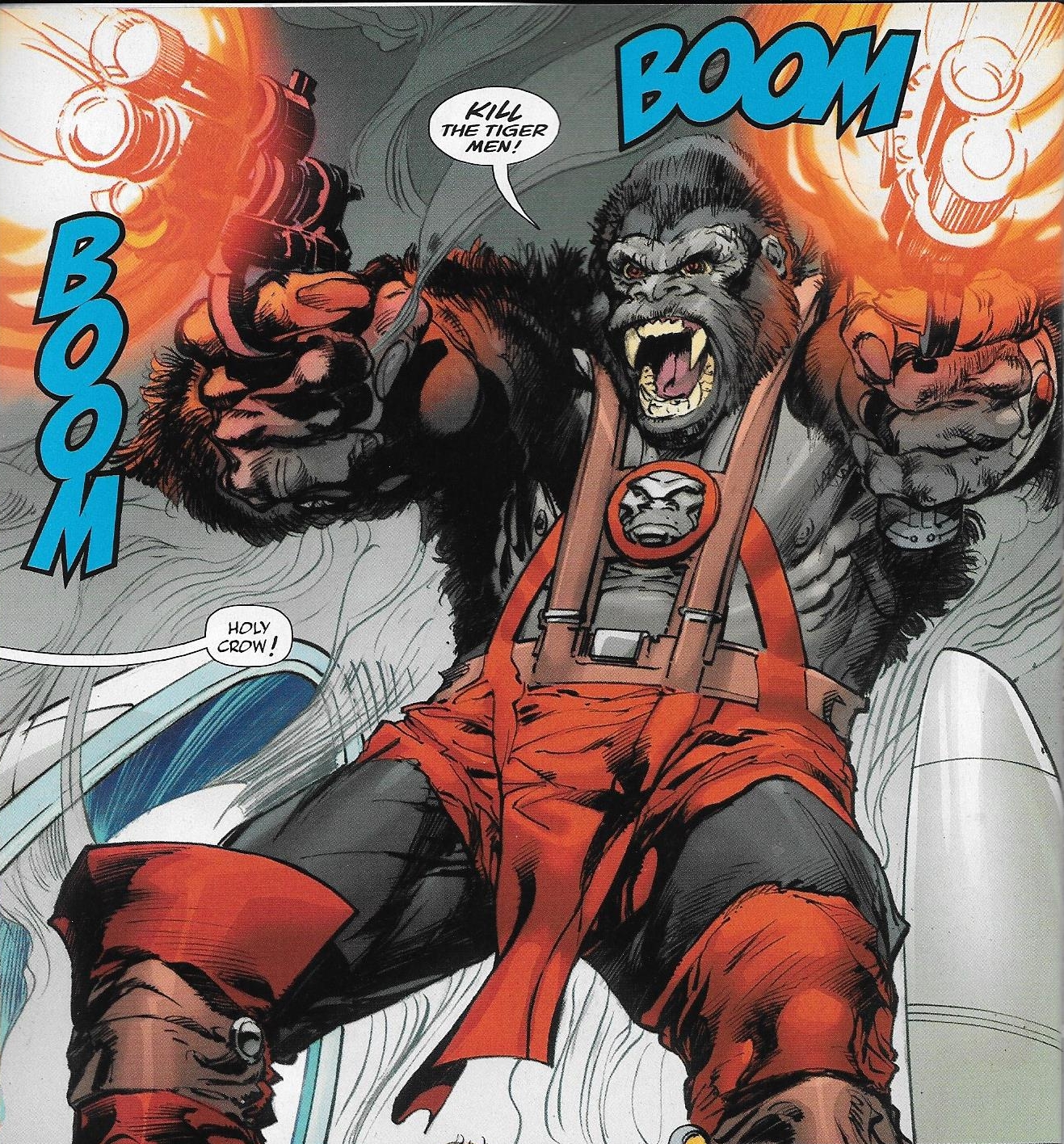
As this month’s continuation, “Nuclear Roar!”, begins, Kamandi struggles against his captor, attempting to reason with the tigers and halt the countdown, or escape, only to be put in his place. The last few seconds tick away, but instead of detonating, the missile opens a hatch, from which emerges a gorilla commando, guns blazing! “A giant ape hiding inside an old nuclear missile like it was a Trojan horse!” Kamandi exclaims, accurately summing up the situation. Indeed, the gorillas were able to track their inside man to the tigers’ hidden city, and a wave of gorilla soldiers begin invading.

kamandichallenge2-gorilla

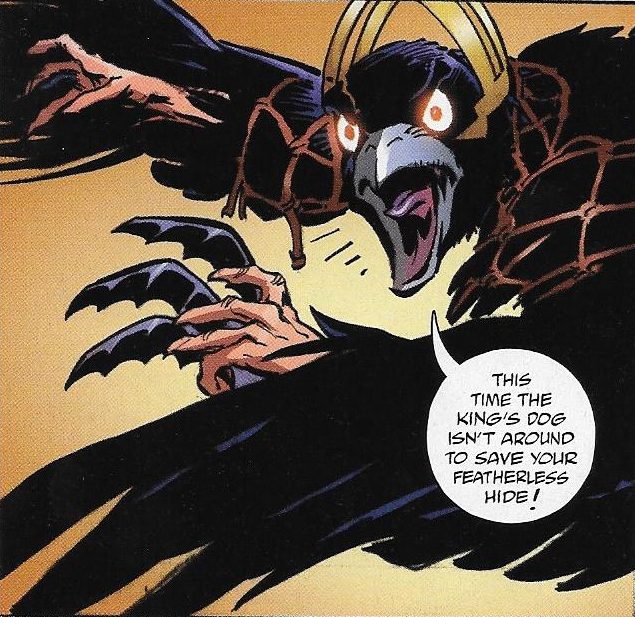
In the confusion, Kamandi escapes and heads back to the Museum of War seen last issue. There, the jackdaw guards that confronted him before are even more bloodthirsty, with one in particular sensing Kamandi’s presence and promising to shred him with his talons, among other graphic threats. After struggling against the jackdaw using the stockpiled weapons, Kamandi comes across a mysterious high-tech chair. Warned away from it, he naturally sits down in it out of spite, just in time for Prince Tuftan and Dr. Canus to arrive and try to pull him out of it (like many of the relics of the past, it is considered sacred, despite–or because of–the tigers’ inability to understand it).

Somehow Kamandi activates the chair, and he, Tuftan, and Canus are teleported a great distance: all the way to the ruins of San Diego, in fact, far outside the Tiger Empire. Canus, frightened, recognizes the place as the site of a “wild human reserve,” but before he can explain what that means to Kamandi, he and Tuftan are struck by robotic “Manhunters” who attempt to capture Kamandi. In a last-ditch effort to escape, even if it means death, Kamandi leaps from the ledge upon which he stands, into the unknown. To be continued . . .

I can’t say I was crazy about “Nuclear Roar!” After the fluid, expressive art of Dale Eaglesham last issue, Neal Adams’ treatment of the same characters looks stiff and, dare I say it, ugly. Adams is of course a giant in the comics world for his work on Batman, but in recent years his style has become stiff and over-rendered, with an emphasis on goggle-eyed, open-mouthed expressions of shock. It’s . . . distinctive, I’ll admit, but not something I care much for. Combined with Peter J. Tomasi’s dialogue (“Your new god’s a mushroom cloud, idiots!” is a typical bon mot), this chapter is functional but not very subtle as storytelling.

kamandichallenge2-kamandi

The biggest development in the ongoing serial is getting the threesome of Kamandi, Tuftan, and Canus out of Tiger City and into a dangerous, remote area that can jumpstart the quest/journey elements central to most of Kamandi’s previous adventures, and will presumably force the three main characters to work together. As yet, we haven’t seen anything to indicate that they will be uneasy allies, much less friends, but I appreciate that the friendship angle is being given time to develop organically: for all of Kamandi’s pugnacious bluntness in Kirby’s original saga, he typically made friends quickly. One of the opportunities of revisiting or retelling this story is in decompressing and smoothing out some of the original story beats, or at least exploring them from a different angle. Or, who knows? Maybe they’ll all kill each other in this version of the story. But somehow I doubt it.

There are some nice touches, however, as well as more clues about the world Kamandi has been dropped into. We don’t learn any more about his search for his parents, but it is mentioned again, just to make sure we (and the next team to take over the story) don’t forget about it. I also got a good laugh out of the reveal of the gorilla hiding inside the missile: if you’re not going for subtlety, then this kind of audacious broad stroke is a good alternative, and saving it for a three-quarter page splash after a page turn maximized the element of surprise.

kamandichallenge2-batarang

There’s also the jackdaw guard who uses what are unmistakably explosive Batarangs against Kamandi during their fight in the Museum: this is obviously a tip of the hat to the artist’s most famous work, but could it be more? In Jack Kirby’s original series, it was established that Superman was a real person in the past, connecting Earth A.D. to DC’s mainstream continuity as an “alternate future.” In Dan DiDio and Keith Giffen’s prologue “The Rules” from issue no. 1, we see a glimpse of Superman and Batman posters on the wall of Kamandi’s bedroom; by itself that doesn’t prove anything, but the connection to other heroes’ continuity remains a tantalizing possibility. Maybe the Batarangs in the Museum were actually the Batman’s, salvaged from one of King Caesar’s excursions into a future Gotham City?

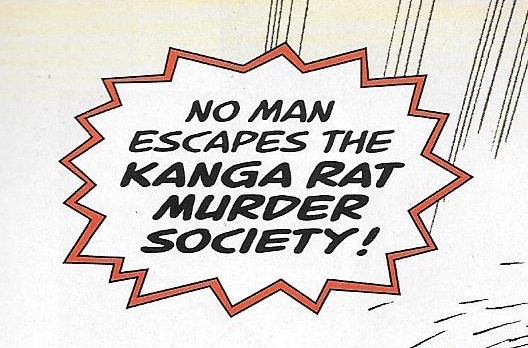
What about the Manhunters who confront our heroes in San Diego? These appear identical to the Manhunters who preceded the Green Lantern Corps as an interplanetary police force in past DC comics, even referencing their catch phrase “No man escapes the Manhunters,” but what their role here is remains to be seen.

kamandichallenge2-teleport-detail

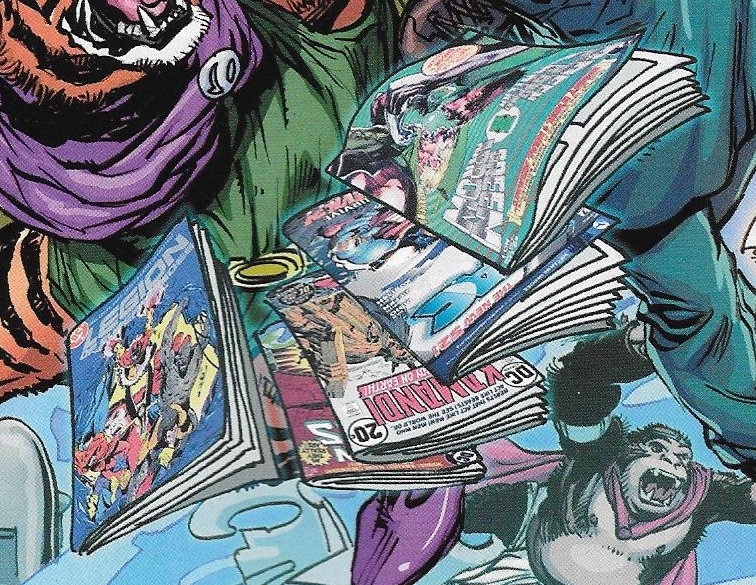
Finally, the most overtly meta moment in the chapter is the full-page illustration of the group in mid-teleportation. In addition to the dramatic image of Kamandi, seated in the chair and struggling to hold onto Tuftan and Canus, there are cameos of Superman, Batman, and Wonder Woman; Gorilla Grodd; the Sandman’s mask; a Mother Box; and most intriguingly, a stack of comic books. And they’re not just any comics: visible covers include Kamandi no. 1, an issue of Kirby’s New Gods, DiDio and Giffen’s New 52 OMAC, an issue of Green Lantern and Green Arrow (another landmark Neal Adams series), and Legion of Superheroes. Fragments of narration or speech dot the panel as well. In the spirit of an ongoing comics jam, these could be inside jokes, referring to some of the creators’ other work, or they could be clues to the mysteries of Kamandi’s parentage and destiny: depending on how future writers pick up on them, they could go either way.

Short Fiction: “Frontier Bride”

frontierbride1

Persephone was alone, surrounded by the vast emptiness of space, its flyby of Neptune years in its past. The ship’s sole inhabitant, Commander Leslie, was likewise alone–Commander, she thought again, such a funny name for a passenger who did everything from piloting the craft to emptying the head–but she wouldn’t be for long. According to the ship’s computer, it was mid-February, but the calendar had no meaning out here. It was the sight of her destination, growing larger and larger as she approached, that filled her with excitement.

Leslie turned on the comms as the dazzling geological formation known as the Heart filled the viewscreen. The metallic claws she used to manipulate the controls were only one of many modifications she had made to her body for this trip: the things we do for those we love, she reflected.

“This is Persephone. I’m one hour from landing. Conditions clear.” She tried and failed to keep the emotion out of her voice; it was hard to be separated from her beloved for so long, but now technology shortened those distances. After nearly ten years–and an entire lifetime before that–there was only one hour left. By the time Mission Control heard her message, hours from now, she would be a citizen of a new world.

Even through the increased body fat that gave Leslie a swollen, grub-like appearance, and the armored exoskeleton grafted over it, the cold on Pluto’s surface was incredible: even nitrogen turned into ice here. Through layers of swaddling and filtration she drew her first breath with her extra lungs, a second pair colonized by methane-eating bacteria. It was blissful.

On the horizon, the Sun was only a pale dot, not much larger than the stars. It was everything she’d hoped for. Finally she was overcome: she sank on her armored knees to the icy surface and caressed her beloved, so long distant. “I’m here,” she cooed. Her hot breath steamed away instantaneously as she kissed the frozen ground.

“You’ll always be a planet to me,” she murmured.

The Bangers n’ Mash Show Announces 2016 Phantom Awards

. . . and I got to come along for the ride! The Bangers n’ Mash Show, a podcast run by Zack Clopton and John Collis, gives out its Phantom Awards for achievements in science fiction, fantasy, and horror films, including the usual categories like Best Picture but also including a genre-specific Best Monster/Creature/Madman/etc. For their most recent awards, I (and some of my colleagues from the Dissolve diaspora) had the opportunity to record introductions for a few of the nominees. You can find the show on YouTube (where it’s like a podcast, but with a broad range of pictures you can look at while you listen–maybe they should call it a “broadcast,” eh?) or watch the embedded video:

If you read my overview of 2016 films, my comments may sound familiar, but I enjoyed hearing what my fellow Dissolvers had to say, and perhaps, like me, you’ll come away with some recommendations for films that weren’t on your radar. Thanks to Zack and John for the chance to participate, and thanks to all you readers for listening!

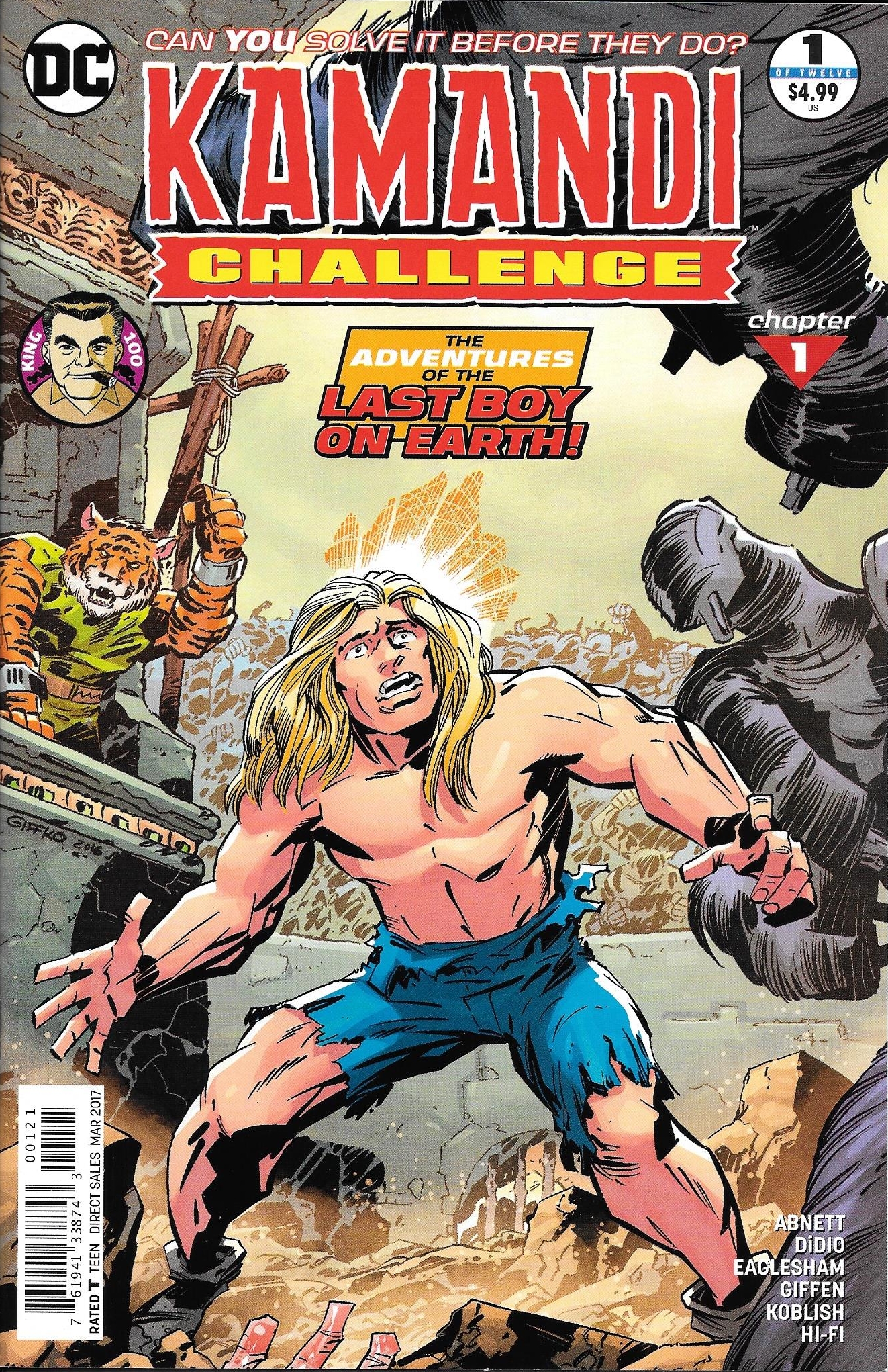
Kamandi Challenge no. 1

Cover B by Keith Giffen and Scott Koblish

Cover B by Keith Giffen and Scott Koblish

“The Rules”
Story and Art: Dan DiDio, Keith Giffen, Scott Koblish
Colors: Hi-Fi
Lettering: Clem Robins
Editor: Brittany Holzherr

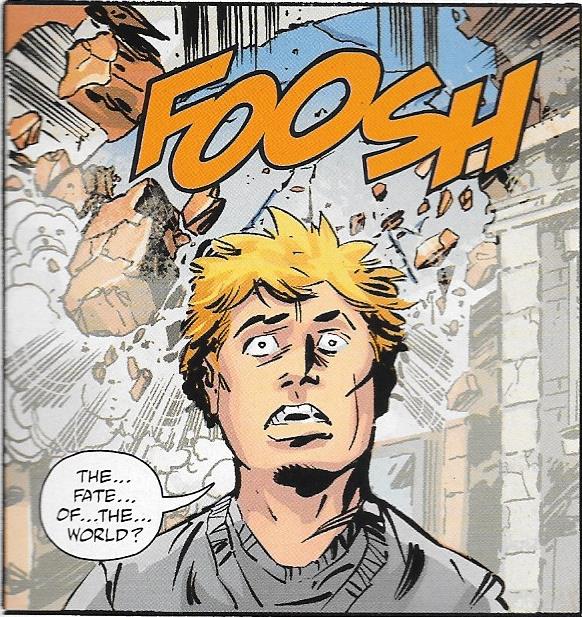
Kamandi Challenge no. 1 begins with a prologue: an ordinary teenage boy (as yet unnamed) is running late for school, gently encouraged by his grandmother. The set-up is classic, reminiscent of Peter Parker and his Aunt May, or any number of fairy tales. Threading his way through an idyllic small town after missing the bus, the boy encounters similarly benevolent townsfolk (including a couple named after Kamandi creator and “king of comics” Jack Kirby, and his longtime inker Mike Royer), all of whom know him and are watching out for him. Their solicitous treatment turns out to be more than mere small-town friendliness, however, when a piece of the sky cracks off and falls to the ground: the boy’s home is actually an enclosed dome, a Truman Show-style simulation of a normal life, and that shelter has finally been pierced by his (unknown, at least to him) enemies.

kc1-02

The friends and neighbors who so recently were encouraging him to get to school are suddenly armed and ready to fight off the threat; they are, in fact, robots, programmed solely to protect the boy! Attacked by one of the invaders, the boy is horrified to come face to face with a humanoid, talking rat. There is so much about the outside world that he did not suspect! At home, “grandmother” shoves him into a mysterious glowing chamber, a sort of stasis capsule, before fighting off the intruders with one final explosion. In his artificial sleep, the boy receives more instruction, including an order to “remember Command D”–not, apparently, the name of the bunker in which he was raised, as in the original Kamandi stories, but perhaps a code or protocol.

After an indeterminate time in suspended animation (but long enough for the boy’s hair to grow long), the chamber is opened and the boy is reawakened by manlike tigers, scouts for the Tiger Empire ruled by King Caesar. The tigers assume that the phrase the boy keeps muttering, “Command D,” is his name, and thus Kamandi is christened, a new name for a new world. Taken for a savage animal, Kamandi is thrown in a paddy wagon and driven to Tiger City where he will fight in Caesar’s gladiatorial arena. His protests are interpreted as the unintelligent parroting of a wild beast who has learned to imitate speech–everyone knows “animals” can’t talk. Thrust into the arena, Kamandi is pitted against “Tiny,” a giant, Kong-like gorilla.

kc1-03

On that cliffhanger the prologue ends, with Kamandi (and the reader) given a crash course in the premise of the series, both its story (Kamandi is referred to as “the last boy on earth” a couple of times, and one of the robot guardians insists that he is to be protected as if the fate of the world depends on it; and we get an introduction to the upside-down “animals ruling over humans” formula that was also essential to the series) and the test of the creators’ inventive powers: “What’s the matter, boy? Afraid of a little challenge?” one of the tigers jeers Kamandi as he throws him into the arena. Those might as well be Dan DiDio’s words to the next team to pick up the story: get him out of this, if you can, guys.

Dan DiDio is both the architect of this series and current Co-Publisher of DC Comics, so his influence is felt far beyond the stories on which he has writing credits, but I personally associate him with the New 52 version of OMAC that he and artist Keith Giffen collaborated on in 2011. OMAC, the “One-Man Army Corps,” was another creation of Jack Kirby’s, and the liberties “The Rules” takes with Kamandi’s origin story has some similarities to the way DiDio and Giffen expanded on OMAC, with an emphasis on mysterious conspiracies and secret identities, not to mention all those robots. Visually, Giffen and Koblish are in similar territory, with an updated Kirby-by-way-of-Kubert style that makes for a good introduction to this new version of the character.

DiDio writes in an afterword to Kamandi Challenge no. 1 that one of the rules of the series is that not only is each writer-artist team to end their chapter on a cliffhanger, leaving it for the next team to resolve, but they must write a note indicating how they would have continued their story, to be included in the letters page. As an example, he states that he would have resolved the cliffhanger at the end of “The Rules” by having Kamandi trick Tiny into throwing him into the audience of the arena, where he would meet and befriend Prince Tuftan. In addition to the window this opens into the writers’ creative process, I imagine it also guarantees that the cliffhangers play fair: there has to be some way out for our heroes. (I also like the implicit invitation to play along: “Can you solve it before they do?” a blurb on the cover asks.)

“K–is for ‘Kill’!”
Writer: Dan Abnett
Artist: Dale Eaglesham
Colorist: Hi-Fi
Lettering: Clem Robbins
Editors: Brittany Holzherr and Dan DiDio

kc1-04

In the next chapter, Tiny attacks Kamandi; the tiger people in the stands cheer on the fighters and assume that the puny human will be no match for the champion ape. Instead of tricking Tiny into throwing him into the stands, as DiDio had suggested, Kamandi lures Tiny into an electrified wall surrounding the arena, knocking him out and proving himself more clever than the tigers had originally thought. Suddenly the “wild animal” has value, and Prince Tuftan turns Kamandi over to Dr. Canus, a humanoid dog, for training as a full-time gladiator.

Canus at first assumes that Kamandi’s speech is just parroting, as before, but he is soon shocked to realize that Kamandi is intelligent and can fully understand him. Kamandi tries to remember his home, but is only able to recall the dreams from his long sleep (a montage of images suggests that his “dream” consisted of events from the original Kamandi series), and the mission his “grandmother” gave him: “find your parents, save the world.”

To Canus, however, Kamandi is still an animal and the boy is kept on a leash as he is shown around the tigers’ city. Kamandi and Canus witness the return of King Caesar, back from a victorious campaign against the leopards, and bearing with him military weapons taken as the spoils of war, including a giant missile. Kamandi breaks away from Canus and investigates the forbidden Hall of War, an enormous stockpile of weapons from the old, human world. (Is the eye-shaped insignia seen above the Hall entrance and elsewhere a reference to OMAC’s Brother Eye, a seed for later writers to pick up on, or just coincidence?) Attacked by flying jackdaw guards, Kamandi almost escapes but is recaptured by Canus, who emphasizes that he’ll pay with his own life if Kamandi escapes on his watch.

They return to the main square to witness King Caesar attempting to “awaken” the recovered nuclear missile, taking it for a god of the ancients. Kamandi recognizes the missile for what it is and tries to warn the tigers about the danger it poses, but he is too late: King Caesar has armed the warhead and set it on a countdown for detonation! Unless Kamandi can halt the countdown, he–and everyone else–has only five minutes to live!

“K–is for ‘Kill’!” (gotta love comic book titles) continues the remix spirit of “The Rules,” hitting the beats of the original classic stories but combining elements in different ways in the interest of telling a new story: “Tiny,” introduced in “The Rules,” appeared in the original series (Kamandi no. 7, where the similarity to King Kong was both more explicit and more tragic); likewise, in the original series Kamandi’s first stop after escaping his bunker was the Tiger Empire, where he was forced to fight as a gladiator (the orange and blue tunic he wears in this chapter is a nod to his costume in that episode), and Dr. Canus was one of the first friends he made in the post-human world.

kamandi_07

In “K–is for ‘Kill’!,” Canus is more skeptical of Kamandi than in the original stories, and the political realities of the Tiger Empire are more explicitly drawn: not only does Canus’ life depend on serving Caesar, he openly admires Caesar’s strength and has wholeheartedly adopted the tigers’ martial ethos. “War is our way of life and our salvation,” he tells Kamandi. Elsewhere it is made clear that the arena serves to keep the people occupied and happy, and that Prince Tuftan, who runs the city in his father’s frequent absence, is eager to prove himself.

This chapter also highlights the series’ similarities (never far from the surface) to the Planet of the Apes movies: examining Kamandi’s backpack, Canus asks, “Why would an animal have books?”, echoing Charlton Heston’s famous question, “Doctor, would an ape make a human doll that talks?” King Caesar’s attempt to commune with the godlike nuclear missile (an element present in Kirby’s original) echoes the underground cult in Beneath the Planet of the Apes. Of course, the motifs of captivity, barbarism ascendant, and the worship of ancient weapons and relics are common in post-apocalyptic stories, so this observation is intended in the spirit of comparison rather than criticism: Prince Tuftan’s assumption that Kamandi simply stole his books illustrates just how far down the evolutionary ladder humanity has fallen, especially for a first-time reader who is exploring Kamandi’s world alongside him.

Finally, Dale Eaglesham’s art in this chapter is particularly appropriate, capturing the classic sense of adventure and exoticism like an old-school Sunday comic strip. Tiger City is a richly-realized environment, full of stone temples, statues, and walkways, thick with vines and palms. The characters, including the animals, are expressively rendered and fluid in a way that’s not very Kirby-like at all but is quite beautiful; it’s a great fit for the material.

Introducing the Kamandi Challenge!

kamandi-challenge-special

I’ve written before about my interest in Kamandi, “The Last Boy on Earth,” the futuristic adventure series Jack Kirby created for DC Comics in 1972. So when I learned about DC’s upcoming Kamandi Challenge, described as a “round-robin, no-holds-barred storytelling extravaganza told in 12 issues,” with a separate writer/artist team picking up the thread in each installment, I knew I would be adding it to my pull list at my local comics store (shout-out to Prairie Dog Comics in Wichita). The book will apparently be more than just a showcase for talent: running up to the 100th anniversary of Kirby’s birth (1917-1994), the teams are invited to make things tough for those who follow them: “Each issue will end with an unimaginable cliffhanger, and it’s up to the next creative team to resolve it before creating their own. It’s a challenge worthy of ‘The King’ himself!” They already had me at “Kamandi,” but when cliffhangers are involved, how could I resist?

kamandi

To recap, Kamandi (named for “Command D,” the military bunker in which he was raised by his grandfather) is the last ordinary human in a post-apocalyptic world that has been taken over by intelligent animals: not just apes, but tigers, dogs, reptiles, and more. Other humans have been reduced to nonverbal animalism or have developed mutant powers themselves. Monstrous creatures roam the earth, and new animal societies have developed in the ruins of the old world, patterned on the Romans, pirates, or Chicago gangsters. Kirby had been tinkering with Kamandi as a concept for several years (his original idea was to be a newspaper strip called “Kamandi of the Caves”), but the final version owes a clear debt to the popular Planet of the Apes movies while remaining pure Kirby. It’s a set-up ripe for adventure and wonder, and after Kirby’s run on the original series it continued to inspire comics creators (not to mention the influence it had on cartoons such as Thundarr the Barbarian, for which Kirby contributed concepts and designs, and more recently Adventure Time).

kamandi-canus

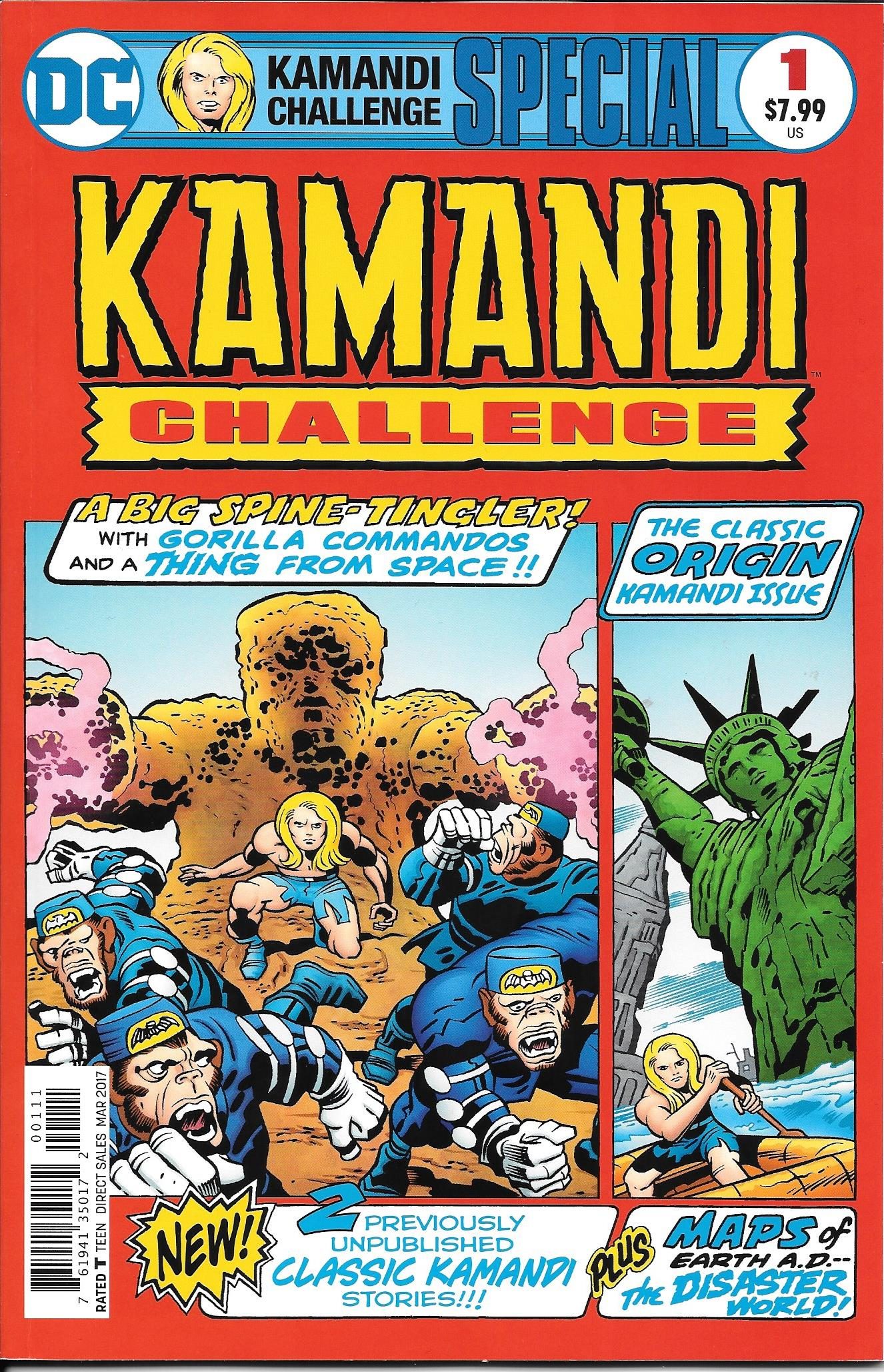
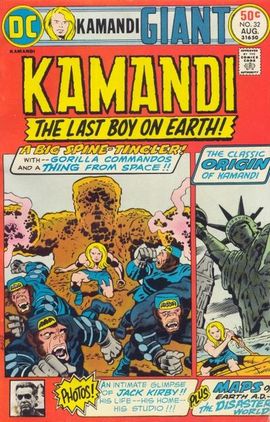
Perhaps to prime the pump for the upcoming series and get new readers caught up on the character and his setting, DC released the Kamandi Challenge Special this week, reprinting the double-sized Kamandi no. 32 (which included a reprint of the series’ first issue) from 1975 and including a pair of “lost” stories. Other than a full-page ad for the Kamandi Challenge, there’s no editorial hand-holding, and even the first issue, which introduces Kamandi and sets his feet on the path of adventure, is printed after the story from Kamandi no. 32, which begins in the middle of the action (just as it was in the original double issue–the reprint is always the backup in such cases). I guess they assume that fans can look up all the context on the internet, or perhaps the real audience is fans like me who’ve ready everything at least once already.

kamandi_32

Of most interest is a pair of stories that were intended for Kamandi nos. 60 and 61, but which were abandoned when Kamandi was a victim of the “DC Implosion,” when rising production costs and a slump in sales led to DC management cutting a third of the publisher’s titles without warning. Finished but unused stories from all the cancelled titles were printed in-house in ashcan editions (low-quality, low-circulation black and white copies); in addition to piecemeal reprints, scans of those stories have circulated online for years, but this is the first time the Kamandi stories have seen print in an official publication.

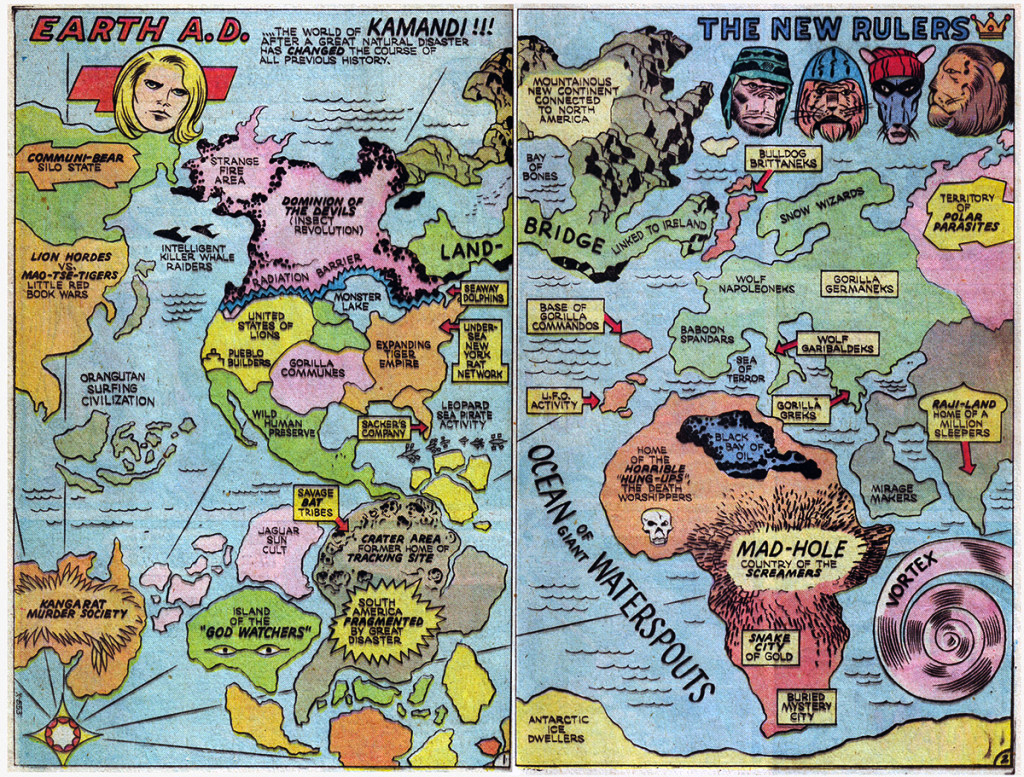
I’m not sure what a new reader will make of these “rediscovered” stories, to be honest: Kirby had left the book he created some time before its cancellation, leaving it in other writers’ and artists’ hands. In typical Kirby fashion, he had breathlessly filled his issues with ideas and characters, leaving many loose threads and never dwelling on any one idea for longer than a few issues. Writers who followed (including Gerry Conway, Dennis O’Neil, and Jack C. Harris) introduced some ideas of their own, but also revisited and fleshed out many of Kirby’s original concepts, using Kirby’s map of “Earth After Disaster” (also included in the Special) and tying the continuity together (for example identifying Kamandi’s grandfather as OMAC, the “One Man Army Corps,” another orphaned Kirby creation) while crafting some longer, less episodic arcs.

kamandimap

The “new” stories form the end of one of those arcs, the quest of Kamandi and his friends to help stranded space alien Pyra (the final form of the energy being encountered in the first story reprinted in the Special) power up her spaceship by opening a “vortex” in a mysterious giant energy field in Australia, guarded by the “Kangarat Murder Club.” Kamandi, sucked into the Vortex by a mysterious voice, witnesses the infinite possibilities of the multiverse, and comes to understand that there are many versions of himself living different lives, including some in worlds that did not suffer the “Great Disaster.”

kamandi-pyra

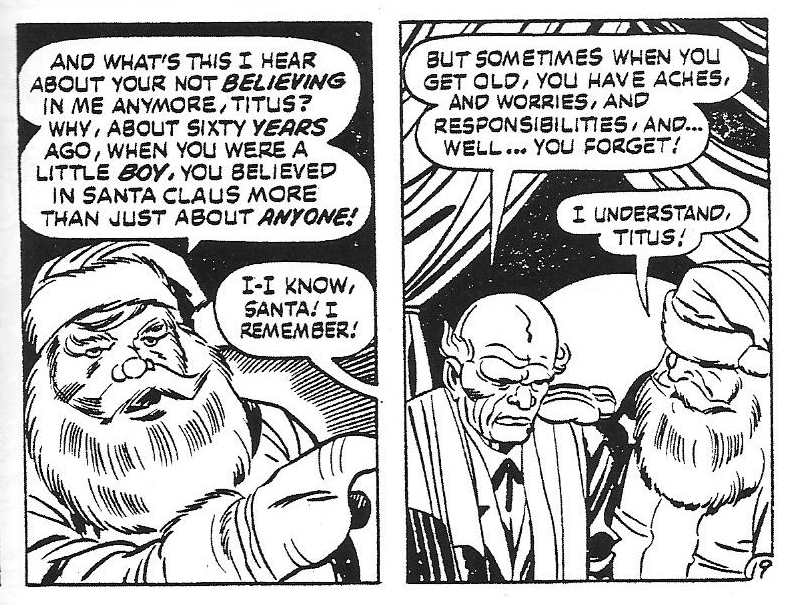
Given a choice, Kamandi ultimately decides that he owes a duty to his friends, still in danger; before coming back, however, he is picked up by servants of the Sandman, the master of dreams, who mistake him for the Sandman’s friend Jed. (You see, Jed is one of the many alternate lives that Kamandi could have lived, had circumstances been different.) Kamandi’s encounter with the Sandman mostly serves to tee up an unused Kirby Sandman story in which Jed enlists the Sandman’s aid in proving to a miser that Santa Claus is real (this involves a trip through dreamland to the North Pole and a battle with a band of “Seal Men” who are unhappy about the Christmas presents they’ve received in the past). No, it doesn’t fit very well in the (admittedly fantastical) world of Kamandi, but the reprint was mostly to buy time as Harris and company geared up to take the book in a new direction, with Kamandi traveling into space and having yet more bizarre encounters. It was never to be. Nevertheless, it isn’t every day that a story sees the light of day (officially) nearly forty years after it was first meant to run.

kamandi-santa

In any case, this is all preamble: the real action starts next week, with the release of Kamandi Challenge no. 1, written by Dan DiDio and Dan Abnett with art by Dale Eaglesham, Keith Giffen, and Scott Koblish. I’m so excited, I’ve decided to accept this challenge: I’m going to review and discuss each issue as it comes out. I’m looking forward to it, and I hope you’ll join me.

Remake, Revisited

tarkin

A couple of years ago, writing about the 2004 sci-fi adventure film Sky Captain and the World of Tomorrow, I commented on the use of repurposed footage of Sir Laurence Olivier, long dead, to represent the film’s villain, Doctor Totenkopf:

At least since 1997, when scenes of the late Fred Astaire from Easter Parade and Royal Wedding were digitally modified to show him dancing with a Dirt Devil vacuum cleaner for a series of commercials, it’s been possible to change the context of an actor’s appearance using the same technology that can put Jude Law in an airplane when he’s actually on a sound stage. The Dirt Devil ads, although licensed by Astaire’s widow, were controversial, and raised questions that have still not been settled: who owns an actor’s image, and are there limits to the uses to which it can be put? More importantly, does legal ownership give someone the right to tinker with a classic film? The battle lines are not always clearly drawn, as colorizing enthusiast Ted Turner became the patron of a classic movie channel that is widely respected for its thoughtful presentation of all kinds of film, and George Lucas, who spoke out against colorization in the 1980s, has defended his right to modify his own Star Wars movies because they’re “his” films.

I’m less offended by the use of Olivier’s image in Sky Captain than by Astaire in the Dirt Devil ads–or by the use of Audrey Hepburn’s image in Dove chocolate commercials just this year–of course: however pulpy it may be, Sky Captain is a work of art, not a commercial. But it is worth noting how far we have come, that such things are not only possible but routine. Connie Willis, in her 1995 novel Remake, depicted a future Hollywood dominated by digital effects, in which hardly any new movies were made, but instead older ones were remade by computer with digital copies of past stars (Back to the Future remade with River Phoenix, for example). We’re not quite to that point, but it hardly seems like science fiction, does it?

Some things have changed since I wrote those words: George Lucas, whom I referenced as the bad guy in ongoing debates about the legacy of his Star Wars films, sold Lucasfilm and his right to tinker with the franchise in 2012, and since then new owner Disney has begun a slate of new Star Wars films. The march of technological progress has also continued, and at the end of last year we saw a full-fledged digital recreation of actor Peter Cushing (dead since 1994) in the Star Wars prequel Rogue One, reprising Cushing’s role as Grand Moff Tarkin in the original 1977 film. Although the filmmakers had their reasons to undertake this effort and appear to have not taken it lightly, I found it garish and disturbing; even a completely undetectable CGI job would raise questions.

Repurposed footage, as in Sky Captain, is one thing: in addition to the CGI Cushing, Rogue One also inserted unused footage of pilots in X-Wing cockpits from Star Wars‘ Death Star battle for its own climactic dogfight (again, Rogue One takes place immediately before A New Hope, so this was just one of many threads meant to connect the two stories). Perhaps I’m a hypocrite, but that didn’t bother me at all, and in fact I found it a clever touch (longtime readers will recall my love of stock footage and my general wonder at the magic of editing, though).

I should clarify that I’m not against computers, either: I love music created on synthesizers, and I enjoy computer-generated animation. I also respect that CGI has made practical filmmaking easier in many cases where the casual viewer wouldn’t even suspect that stray wires or other intrusions have been seamlessly erased.

But I think part of what I love about the art of film is its rearrangement of a tangible reality: I’ve written before about my love of animation for its ability to create a wholly new world through the illusion of movement, but even filmed live action involves quite a bit of assemblage–of cuts, of effects, of performances–in all but the most extreme cases of fly-on-the-wall documentary and avant-garde cinema. The end result is not exactly a mirror held up to the real world but a mosaic in which many facets of it are reflected, an arrangement of fragments that make up a whole picture.

In theory, the current digital toolbox is just an extension of all the image-making that has come before, but in reality it has its limits, and its frequent use as a cost-cutting measure is dispiriting. It’s all so literal: particularly in the case of Rogue One, there’s no real need to include Grand Moff Tarkin except for the desire to position this story right before Star Wars. In addition, it’s somewhat insulting in its implication that viewers wouldn’t accept a different actor in the role. I enjoyed Rogue One, I really did, but my enthusiasm flagged at the very end when it became clear just how closely it was meant to dovetail with the original Star Wars. I felt the same way at the end of Episode III, when George Lucas felt compelled to leave nothing unsaid, dumping information that was already (or would be, depending on the order in which one viewed the saga) revealed elegantly in the original trilogy. Both cases are typical, though, of a tendency to fill in any and all gaps in pop culture mythology, bowing to perceived demands from fans to reveal every detail, even when leaving something to viewers’ imaginations could have a greater impact.

The issue became more than academic in December with the sudden, tragic death of Carrie Fisher, who of course played Princess Leia in the original Star Wars trilogy and who had returned to her iconic role in the new trilogy that began with 2015’s Episode VII. (As it happens, computer imagery had also been used for a brief appearance of “young Leia” at the end of Rogue One.) Reportedly, Fisher had already filmed her scenes for Episode VIII, but her death puts her role in the last film of the trilogy in doubt. Disney issued a statement to calm speculation last week, assuring fans that they had no plans to create a digital Leia for Episode IX. Is the difference simply that Cushing has been dead long enough that no one is likely to be outraged by his digital doppelganger? Is it “too soon” to do the same with Fisher? In fact, isn’t the cyber-Cushing atypical precisely because he’s been gone for so long? In recent years, digital imagery of this sort has largely been used to make up for the loss of a star during filming (most notably Paul Walker in Furious 7). It’s likely that Fisher, aware of the direction technology is headed, had explicit directions in her will regarding the use of her image, but it’s also true that Leia is a more significant character than Tarkin, and she was expected to carry both more scenes and more dramatic moments. There are still practical limitations on how seamlessly an actor can be recreated digitally.

The Star Wars films have always been showcases for the latest in special effects. If Cushing’s appearance in Rogue One was meant to be a test case for a new technology, it wasn’t reassuring, for either this audience member or (I imagine) living actors who now not only have to compete against each other, but against their predecessors.

R.I.P. Peter Cushing, 1913-1994

R.I.P. Carrie Fisher, 1956-2016

The Ten Silliest Giant Movie Monsters

giantclaw1

All this month, I’ve been observing “kaiju month” on the blog, writing about giant monsters in various forms, while at the same time catching up on movies I hadn’t seen yet. The movies show varying degrees of seriousness, ranging from the deadly grimness of the original Godzilla (and the dry wit of this year’s Shin Godzilla) to movies that are all about men in rubber suits waling on each other and stomping model cities to bits, with little regard to characterization or story logic. Whatever your view of the genre or which approach you favor, there’s no question that some of these monsters can be downright goofy. To prove it, here are ten movie monsters that inspire more laughter than awe.

A few ground rules: I’m thinking mainly of movies in which the giant monster is either the main character or central to the plot: that includes most Japanese kaiju eiga and their imitators, as well as many of the American monster movies of the 1950s and later. I’m excluding characters that are deliberately humorous or parodies (sorry, Queen Kong); it’s too easy, and anyway there’s nothing sillier than someone trying too hard to be taken seriously (although I’ve included at least one monster that walks the line between serious and parody–it’s a judgment call). Finally, I’m primarily looking at silly monsters: if the movie around the monster is ridiculous, but there’s nothing particularly funny or silly about the creature itself, that doesn’t fit my requirements for this list. (The reverse is also true: plenty of good movies have laughable creatures at their center, and just because I’ve included a movie here doesn’t mean it’s bad or that I don’t enjoy it. Sometimes the tone is clearly light-hearted, and sometimes the laughs stem from a severe miscalculation or a skimpy budget.)

I’m sure that you’ll think of some that I’ve overlooked, or have a different opinion about something I’ve included; please feel free to add your suggestions or counterpoints in the comments. I haven’t seen every monster movie ever made, and I’d be happy to discover something new to me!

Gamera

gamera1

Now, don’t get me wrong: Gamera is terrific. I have great affection for Gamera. Years before Mystery Science Theater 3000 presented the terrapin terror to a new generation of fans, I was watching his films on Commander USA’s Groovy Movies (probably because they were cheaper to show than Godzilla movies). But there’s no question that a giant fire-breathing turtle who can turn himself into a flying saucer by shooting flames out of the leg-holes in his shell is, well, not exactly serious. In addition, the kid appeal that eventually overtook Toho’s Godzilla series was baked into rival studio Daiei’s Gamera right from the beginning, with Gamera being a “friend to all children” and an emphasis on comic brawling with a series of mostly interchangeable kaiju opponents. Eventually, the Shusuke Kaneko-led Gamera revival from the 1990s would prove that a goofy leading monster could be put into a serious context and yield good, even great results. However, some have argued that Shusuke and company were given free reign in making their trilogy in part because expectations were so low: who thought a serious Gamera movie would actually be good?

gamera2

Giant Killer Rabbits

lepus1

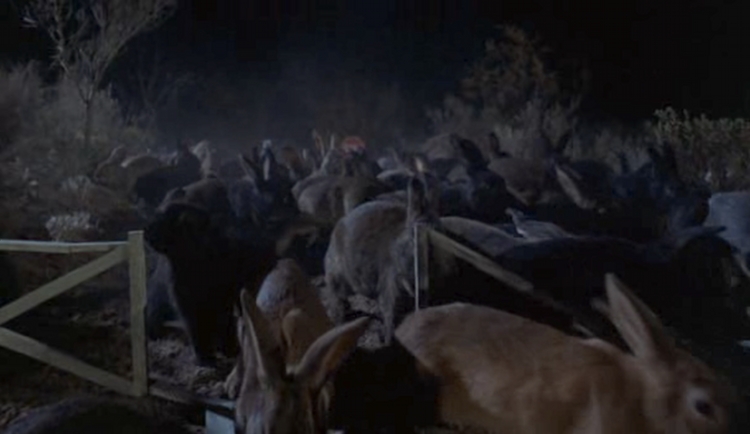
Let this stand in for all of the American “giant animals on the loose” movies that invaded screens from the 1950s to the 1970s. 1972’s Night of the Lepus follows the pattern of many other “eco-horror” pictures of the era, as a scientific experiment meant to curb out-of-control rabbit populations in the American West backfires, resulting in a stampede of vicious bunnies the size of trucks. Never mind that the film (and the novel it was based on) was inspired by real-life rabbit plagues, or that rabbits can be mean as hell. The domestic bunnies, filmed bounding across miniature sets, with slow motion and rumbling sound effects to give the impression of massive size, are just too cute to take seriously. If Night of the Lepus ever acknowledged how preposterous it was, it would just be another Attack of the Killer Tomatoes, a spoof about an unlikely part of the environment turning against humanity. But it’s the film’s utter solemnity and desperation to be taken seriously–including an incredible trailer that bends over backwards to avoid revealing what it’s really about–that make it a camp classic.

Gigan and Megalon

gigan-megalon2

Godzilla fans can be a bit like Batman fans: for years, the public perception of both series was dominated by the corniest iterations: the campy 1966 Batman TV show and the wrestling-influenced Godzilla movies from the 1960s and ’70s. This perception can make fans defensive and apt to reject all but the grimmest, most “adult” portrayals of their heroes. Fortunately, that tide has begun to turn, with greater appreciation of both Batman ’66 and the “fun” Godzilla movies in recent years.

gigan-megalon

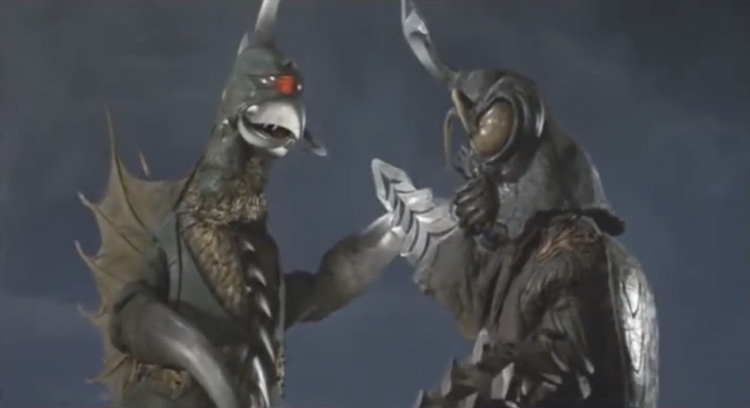
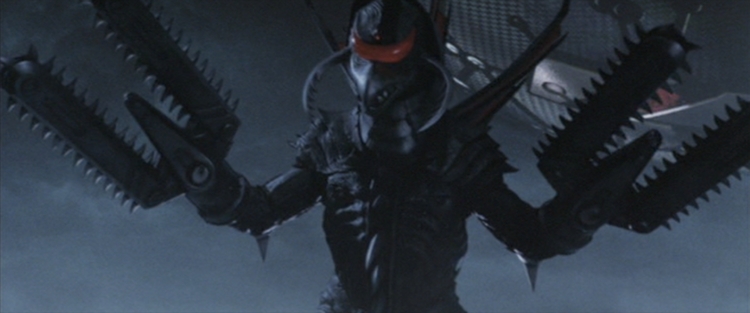
The Bebop and Rocksteady of the Godzilla canon, Gigan and Megalon were introduced as opponents of the Big G in a pair of films in 1972 and 1973 (both directed by Jun Fukuda, the man most responsible for the turn away from the darker tone favored by original Godzilla director Ishiro Honda). Gigan, as revealed in Godzilla vs. Gigan, is a cyborg from Nebula M Spacehunter; Megalon, in Godzilla vs. Megalon, is the insectoid protector deity of the Seatopians, a long-lost underground civilization. Gigan has curved hooks for hands and matching horns and mandibles, as well as a punk-looking Cyclops visor, and most bizarrely a deadly rotary sawblade embedded in his chest; it’s the definition of trying too hard to be edgy (no pun intended). Megalon has giant drills for hands and a single horn-like antenna, and moves about by burrowing and leaping through the air (like a cricket, I guess?). As mentioned, the Godzilla series had already been kid-friendly for years by the time Gigan and Megalon came along, and the saurian designs of previous kaiju were easily turned into toys, but Gigan and Megalon feel like they were designed as toys first and characters second. (On that note, check out Gigan in Godzilla: Final Wars, where he’s outfitted with interchangeable chainsaw hands.) While Gigan is presented in his movie as a scary threat, the monster who might finally defeat Godzilla (he doesn’t), in Godzilla vs. Megalon both monsters join together in a sort of tag team, giving Godzilla (and the robotic Jet Jaguar) “the business.” All that’s missing is the ropes around the wrestling ring.

gigan-finalwars

Minilla and Gabara

minilla

Speaking of Godzilla, it’s unlikely that any character in the series has been more divisive than Minilla (sometimes rendered as “Minira” or “Minya”–don’t call him “Godzookie” unless you want some serious side-eye from G-fans). Introduced in 1967’s Son of Godzilla, the diminutive kaiju was the embodiment of the series’ turn to juvenilia. In his first film appearance, newly hatched from a giant egg, Minilla is disturbing rather than cute: “more-fetus-than-infant” in the words of G-scholar William Tsutsui, Minilla is the kaiju version of the Eraserhead baby. In later appearances, Minilla is an obvious stand-in for Godzilla’s child audiences, learning to control his powers and stand up for himself under the grudging guidance of his single father (some versions of Godzilla have suggested the creature reproduces asexually; in any case, the whereabouts of any other parent of Minilla are unknown). In 1969’s much-maligned All Monsters Attack, the metaphor is made literal as Godzilla, Minilla, and the other denizens of “Monster Island” are treated as daydreams of a young boy, Ichiro, who learns to stand up to a bully named Gabara, inspired by Minilla’s fight against a kaiju also named Gabara. The “son of Godzilla” was later revived as the more saurian “Godzilla Junior” in the 1990s, but it’s Minilla, smoke-ring breath and all, who is remembered, fondly or otherwise.

By the way, here’s Gabara, the “kaiju bully” from All Monsters Attack. For the one-off character, special effects wizard Eiji Tsuburaya and his crew came up with a suitably misfit creature, with a reptilian body, feline facial features, and a shock of red hair. No wonder he had such a bad disposition.

gabara

The Yeti

yeti1

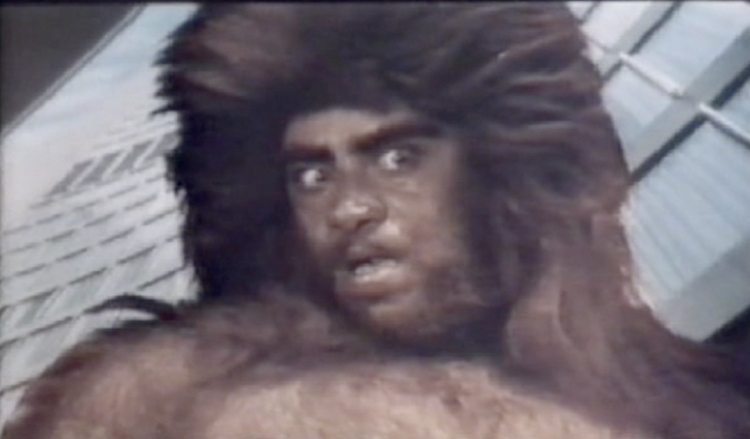
Specifically, the one in Yeti: Giant of the 20th Century, a 1977 Italian knock-off of King Kong. Frozen in a glacier for thousands of years until his body is discovered and thawed out in the northern tundra of Canada, this Yeti is a hominid covered with brown hair, made gigantic through very primitive special effects. Once thawed, the Yeti follows Kong’s trajectory en manqué, falling for the granddaughter of the tycoon financing the expedition and running amok in Toronto. What makes the Yeti, played by Mimmo Crao, so amusing is the emphasis on his romantic nature: even in scenes that don’t seem to call for it, the camera lingers on the Yeti’s bedroom eyes, luxurious, flowing mane, and erect nipples (yes, really), and the film spends almost as much time on the relationship between beast and beauty as Peter Jackson’s 2003 King Kong, in a much shorter running time.

yeti2

Back when Johnny Weissmuller was playing Tarzan, MGM claimed that Tarzan’s iconic call was produced by combining the recorded calls of lions, apes, and elephants. It was pure hooey, of course, but the Italian Yeti appears to have actually done just that, as the Yeti’s sound effects are a mix of animal growls and roars spliced together. Combined with Sante Maria Romitelli’s stately, even majestic score, it makes for an atmospheric soundtrack appropriate for the film’s purely cinematic montages (the sequence of the Yeti carrying Antonella Interlenghi around Toronto, marveling at the skyscrapers, so foreign to his experience, is a favorite). I’m reminded of my friend Craig Stephen Tower’s observation that even the trashiest Italian film is a little bit arty, and even the artiest a little bit trashy. As shameless as this movie is (and it is shameless, hitting the trifecta of putting a woman, a child, and a dog in peril), there’s a lot to like about it, particularly its winning sincerity.

Antimatter Space Buzzard

“It doesn’t make sense. It’s just a bird, a big bird! Guns, cannons, rockets, it’s just a bird!”

“Sure, just a bird. Ten million dollars’ worth of radar can’t track it. Enough fire power to wipe out a regiment can’t even slow it down. Sure . . . just a bird.”

giantclaw2

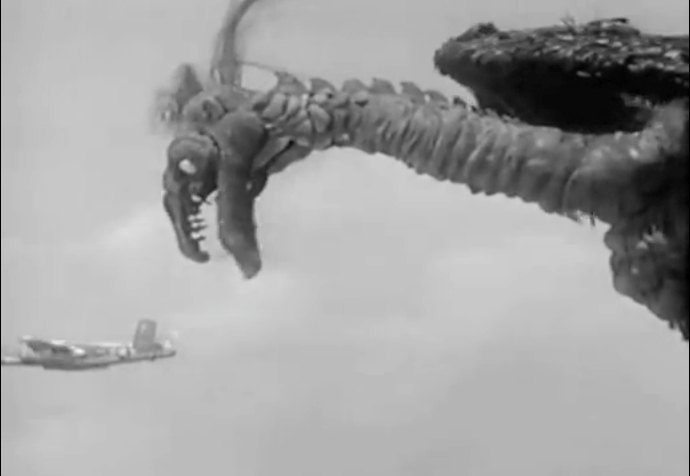
When I was a kid, The Giant Claw was on TV all the time. I guess the TV station had their own print or something, but along with Them! and The Blob, The Giant Claw was the old monster movie I saw more times than any other during childhood. I didn’t give it a lot of thought until recent years, when I noticed this once-forgotten B movie from 1957 gaining a new cult following. It’s a typical monster mystery film, beginning with sightings of a UFO and the unexplained disappearance of planes in the far North. (The combination of Arctic setting, military-civilian conflict, and aggressively hard-boiled dialogue give the impression of a low-budget reworking of Howard Hawks’ classic The Thing From Another World.) Once revealed, the threat is a giant (possibly extraterrestrial) bird with a long neck and googly eyes, “as big as a battleship” and protected by an “antimatter screen.”

Upon rewatching The Giant Claw, I was surprised to see several names from the serials I’ve watched in my Fates Worse Than Death series, including producer Sam Katzman and musical director Mischa Bakaleinikoff. It’s not hard to imagine this story padded out into serial length with the addition of a spy ring or a mine cave-in. By 1957 the serials were dead, replaced by television, but quickly-made thrillers like The Giant Claw took their place in theaters and drive-ins, providing excitement and spectacle without the entanglements of serialization. (The space buzzard still looks ridiculous, though.)

Daigoro

daigoro1

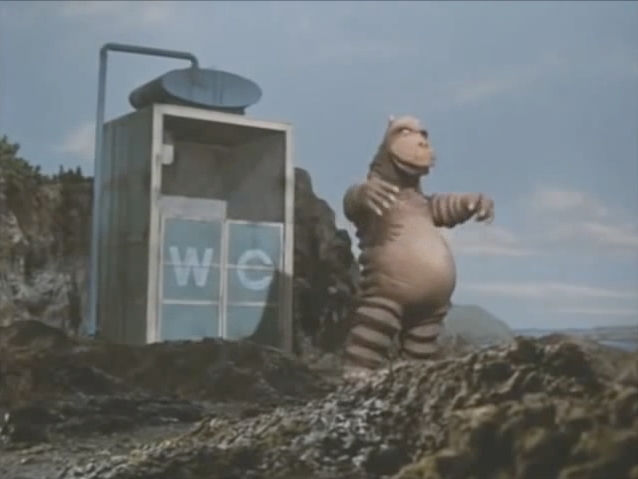
In 1972’s Daigoro vs. Goliath, Daigoro combines the childlike qualities of Minilla with the friendliness of Gamera. Resembling a bidepal hippopotamus with feline whiskers, Daigoro is the orphaned child of a Godzilla-like marauder (seen in flashback), raised on an island (complete with a giant outhouse) by a zookeeper and his staff. As the film begins, the Japanese government struggles to find room in its budget to keep feeding the beloved creature, and hoards of schoolchildren attempt to make up the difference by soliciting donations. An attempt is made to slow Daigoro’s growth with “Anti-Grow,” but when the “Great Stellar Monster” Goliath arrives via meteorite and begins a destructive rampage, Daigoro is called upon to defend his adopted home. The scenes of Daigoro’s training, including learning to roar and breathe fire, will look familiar to anyone who’s seen Son of Godzilla or All Monsters Attack (apparently this film began as a Godzilla concept, so perhaps this similarity isn’t so surprising). Daigoro skews toward a younger audience than even Godzilla vs. Megalon: it reminded me most of the live-action Disney films of the 1960s, and anticipates Miyazaki’s films (particularly My Neighbor Totoro) with its environmental message and big, cuddly monster hero. The tone is relentlessly wacky, with broad slapstick comedy leavening the cloying sentimentality (but so help me, I laughed).

daigoro2

Guilala aka Monster X

guilala1

Guilala, star of the 1967 film The X From Outer Space, is perhaps the silliest monster at least ostensibly meant to be taken seriously. The film is a brisk mix of space-age bachelor pad sci-fi and traditional kaiju action, with the title “X” inadvertently brought back to earth as a spore on the tailfins of a rocket expedition. Once on earth, the mysterious substance quickly grows into a living beast, the giant monster named Guilala (or Girara), which goes on the rampage as it draws energy from power lines and reactors. Guilala’s design is a mixture of a reptilian body, a flat, beak-like head, and “deely-bopper” antennae; it’s been described as a “giant space chicken.” Even if the creature itself were more sober, the film that surrounds it is delightfully lightweight. The X From Outer Space was the Japanese studio Shochiku’s only venture into the kaiju genre, but Guilala made a comeback in 2008 as the star of Minoru Kawasaki’s spoof, Monster X Strikes Back: Attack the G8 Summit. In the film, a sort of Japanese version of Team America, Guilala’s return (including quite a bit of reused footage from the original X) is the subject of endless debate at a G8 summit, with satirical versions of each country’s leaders taking turns trying to stop the monster. Ultimately, Guilala faces off against a local protective deity, brought to life by the collective prayers of the people.

guilala2

So, what have I missed? Let me know in the comments and I’ll check it out!

giantclaw3

Short Fiction: “The Last Aquarian”

At night, the Turbo Fish Cannery became a monolithic wall of shadow. Only a few pinpoints of light on the roof of Processing Facility No. 1 gave away the team’s presence. Ping! The quiet sound of waves gently lapping in the bay was interrupted by Aki’s cell phone. With an apologetic gesture to his fellow Aquarian watchers, he took the call. “Sweetheart! Is something wrong?” His voice always sounded urgent at a low whisper; but did his heart beat faster in anticipation of the evening’s duties or in excitement over hearing from his fiancée?

Sachiko spoke from the other end: “The news reported a sighting, up the coastline near the Canadian border. Are you sure you’re in the right place?”

“The border? That’s miles away.” Aki looked nervously at the huddled watchers; most of them had their attention on the still-dark bay, but Campbell was looking at him expectantly. For a moment, doubt gnawed at him, but he shook it off. “No, it must be something else. My charts haven’t been wrong yet. He’ll be here.”

“But the news said–”

“We’re monitoring the news here,” he lied and immediately regretted the deception. “They’re wrong. Don’t worry–”

An agitated murmur from the watchers drew his attention to the bay; the water was beginning to foam and churn with activity. Distantly, a bell rang as a buoy was rocked by the waves: something was moving through the water.

“Something’s happening. I have to go, dear.”

“Stay safe, Aki. I love y–” Aki ended the call and turned his attention to the churning waters of the bay and the printout unscrolled in front of him. Red, blue and green lines zig-zagged up and down like an EKG readout against black hash-marks keyed to time and location. Relief and pride mingled within him: right on time.

The hushed excitement gave way to a collective gasp as the waves surged forward into the inlet, the whitecaps standing out against the dark water. The surface split as a scaly, reptilian form emerged: first the vane-like dorsal plates, then the spiraling horns that crowned a massive, leonine head, then the towering, erect body: the giant beast code-named Regulus. It roared to announce itself, a thunder like the cry of a prehistoric bird with the resonance of a deep gong that could be heard for miles.

The team sprang into action; as always, Aki’s most serious contribution was made before the beast’s arrival, predicting its path and most likely point of emergence. Other members of the team consulted laptops and tablets and spoke into wireless headsets, turning on klieg lights around the cannery’s power lines. The whir of helicopter blades in the distance preceded the burst of flares, guiding Regulus toward them. The beast slowly but surely changed course, paddling until it reached the shallow part of the bay and its feet made contact with the sandy bottom. Then it lurched forward, displacing mountainous waves before it.

At that moment, the door to the interior stairwell opened and an imposing figure emerged: Mosha, Turbo’s Chief of Security. After a few abrupt words from Mosha, Campbell began shutting down the operation. “Mister Turbo desires to shift the focus of his involvement with Project Aquarius,” Mosha said, an explanation that explained nothing.

“But the power lines–” Aki said, still not understanding. After his predictive work, was the beast now simply going to be let go?

“That’s not your concern,” Mosha said with finality.

At Campbell’s instructions, the lights were turned off and the sound of helicopters faded into the distance; no more flares were lit. In the moonlit shadows of the bay, the Aquarian beast Regulus lost interest in the suddenly dark cannery and made his way back to the open sea.

aquarian1
“I still don’t understand why you’re not out there,” Sachiko said to Aki as they stood on a balcony overlooking the city. It was a good vantage point to observe the convergence of Regulus and Antares; it was an unseasonably warm, sunny day, one of the few the city would have. Only a few wispy clouds floated in the sky.

“I thought you didn’t like me being in the field,” Aki said, scanning the horizon with a pair of binoculars. “We’re safer up here, and I can be with you while we wait.”

“That’s not what I mean,” Sachiko said, squirming. “Of course I like being able to watch with you, but I know how important tracking the Aquarian beasts is to you.”

“Craig is tracking today’s convergence,” Aki said. “He is completely capable.” He continued searching the horizon, looking for telltale signs of activity. It was partly professional interest–he now tracked the Aquarian beasts as part of Roman Turbo’s private operation–but he wouldn’t have missed it anyway.

Sachiko gently lowered the binoculars from Aki’s eyes and turned him toward her. “I hope you haven’t given up tracking in the field for my sake,” she said seriously, looking into his eyes.

“Huh? No, of course not.” He turned back to the view over the city. “Mister Turbo has given me a very good opportunity to be on the ground floor of something new he is building, and I have to take that seriously. Besides,” he added absently, “if everything works out we won’t have to depend on the Aquarian beasts for much longer.”

There they were: Antares was the first to break the surface of the water, near the public beach. The area had been cordoned off. It seemed unfair to block the beach on one of the city’s rare sunny days, but crowds had turned out anyway to watch the spectacle, and as the great four-legged beast trundled forward, the mass of humanity pressed against the barricades to get a good look. The Aquarian beasts were beloved, and their arrival often resulted in impromptu holidays like this: schools and offices were closed, and public safety crews were called into action to control the crowds and help channel the enormous visitors.

“Hmm?” Aki asked, staring at the spiky, domed carapace that made Antares resemble a moving fortification. “Did you say something?”

“I said, why wouldn’t we want to depend on the Aquarian beasts?” Sachiko sounded petulant.

Aki lowered the binoculars again and forced himself to give her his full attention. “I know it is difficult to understand,” he said. He had to remind himself that Sachiko was a civilian. She didn’t see like he did how complex the beasts’ migration patterns were, and how much the economies of the Western Seaboard–the entire Pacific, in fact–had been reshaped around their presence. “Mister Turbo says that the Aquarian beasts won’t be around forever. He thinks we’ve become soft, unable to do things for ourselves. The new project is designed to put humanity back in the driver’s seat.” He caught a glimpse of movement: Regulus emerged and joined Antares in an open space that had been cleared for renewal. A stockpile of industrial runoff sealed in drums sat clustered in the center; beyond that, nothing but weedy vacant lots and expanses of cracked pavement stretched before the two beasts.

Regulus made landfall and saw Antares, already gorging himself on the drums of waste: the beast’s powerful metabolism would convert the toxic chemicals into safe organic compounds. Regulus, approaching, roared in greeting and stood rampant. Antares, finally noticing the new arrival, roared in return and nosed half of the drums toward Regulus. While the Aquarian beasts shared the bounty, workmen rushed into the open area to prepare for the next phase of the convergence.

“I’ve heard what Turbo says. It sounds as if he wants to get rid of the Aquarian beasts because he can’t exploit them himself.”

Aki only half-heard her. He was riveted to the spectacle of Regulus dragging his tail across the open space, guided by workmen who looked like hardhat-wearing ants by comparison: Regulus’s tail left an enormous furrow in the dirt behind him, which would become a new subway tunnel. Meanwhile, Antares dug into the ground, making holes that would become the foundations of skyscrapers. With his plow-like nose Antares pushed the loose soil into embankments, and the hollow conical scales he shed would later be turned into hip coffee shops and independent bookstores. An entire neighborhood would spring up after this convergence.

“An entire city shut down,” Aki said. “Mister Turbo’s earth-moving equipment could do this work in half the time, and with half the manpower it takes to steer these creatures.”

Sachiko put her arms around Aki, who continued watching. “But what would the city do for power?” she said. “Look, Regulus is about to charge the batteries.” Regulus had solar power stored in his belly, which was covered with plates of a translucent, crystalline substance. The crystals glowed from inside, giving the impression that Regulus’s scaly hide was but the rocky rind covering the outside of a geode. Regulus approached the heavy-duty power lines that led to the city’s storage batteries: as the crystals made contact with the lines, stored-up power flooded through them. Regulus appeared to have absorbed even more solar energy than usual during his equatorial season; this would provide electricity to the city for at least the rest of the quarter.

“Just think what Turbo Power and Light could do if they were able to synthesize the material Regulus’s crystals are made from!” Aki said. “Then we could control that power, instead of those mindless animals!”

Sachiko raised an eyebrow and relaxed her grip on Aki. “You used to love the Aquarians. . . . I don’t think I like the influence Roman Turbo is having on you.” She was looking at him in a way she never had before.

Aki laughed lightly. “You’re so sentimental, Sachiko. You should listen to the engineers on my new team; it would really open your eyes.”
aquarian2
While Aki and the rest of the project team stood on the platform in the shadow of their colossal creation, waiting for the ceremony to begin, Aki couldn’t help but wonder if Sachiko was watching, wherever she was. The last few weeks had been such a whirlwind that he had hardly had time to think about her, or to go over their last few conversations in his mind to figure out what had gone wrong. Maybe that was the problem. There was a new woman in his life, at whose feet he stood: two hundred-odd feet of steel and chrome, as beautiful and hardened as an Ayn Rand heroine, and she commanded all of his time and attention.

The crowd began to grow restless; the field on the edge of town that formed the staging area had filled with curious onlookers since early that morning, when the silver and gold colossus had first appeared there. For the moment she was cloaked by banners hung from cranes as tall as she was: on one, a stylized picture of Antares devoured the word JOBS; on the other, Regulus trampled the word FREEDOM.

At zero hour, the PA switched from warm-up music to the voice of an announcer: “Ladies and gentlemen . . . you know him from Turbo Fisheries, the Turbo Financial Network, and the Turbo Museum of Modern Art . . . author of Turbo: The Book . . . a man of the people . . . please welcome . . . Rrrroman Turrrbo!”

The man himself emerged from between the banners, flanked by Mosha and the rest of his security detail. He approached the microphone like an old friend and began speaking off the cuff as if inviting each and every member of the crowd into his confidence. “Thank you, friends, for coming out today,” he began after the cheering and applause had died down. “If we’re lucky the rain’ll hold off a little while longer, but y’know, if we do get a storm, I think you’ll find this little lady–” he jerked his thumb backward to indicate the two-hundred-ton figure that loomed over them–“makes one hell of an umbrella, you know what I mean?”

Chuckling at his own joke, he continued. “You know, when we announced our intentions, a lot of people said it couldn’t be done. A two hundred-foot-tall robot just wasn’t practical, they said. Well, you know Roman Turbo has never stopped at what was practical, and after hand-picking the best people in their fields–” he extended an arm to the mechanical and electrical engineers, computer programmers, and weapons specialists that made up Aki’s team–“we made it happen. No more will we have to schedule our lives around the whims of the Aquarian beasts, cleaning up after them, letting them run our lives. No! Now we can stand up to them. They push us around? We can push back! Ladies and gentlemen . . . I give you . . . MECHANDROMEDA!”

The banners parted like curtains. Spotlights switched on, turning the already-shiny surface of the machine to mirror brightness. Mechandromeda stood so tall that even those in the back of the crowd had to crane their necks to see her in her entirety; she had the sleek curves of a Ferrari, the greaves and breastplate of a Valkyrie, and the coppery, immobile face of Frédéric Bartholdi’s mother. “This new Statue of Liberty,” Turbo said, “will strike the first blow to free us from our complacent dependence on the monsters from the sea.”

Cheers erupted from the crowd; Aki smiled. He was working on the tracking side, but it had still been satisfying to be part of such a large undertaking, and to see the titanic machine gradually take shape before making her public debut. Turbo continued describing the machine’s features in admiring terms: “Mechandromeda is a fully remote-operated defense platform: we can pilot her without putting human lives in danger, and she has state-of-the-art onboard artificial intelligence to maximize efficiency in her movement, or if communications are cut off. She’s so smart she can practically drive herself!”

Aki’s mind drifted as Turbo began describing Mechandromeda’s considerable arsenal–he knew all about the technical specs, having sat through many meetings and presentations going over those details–and he found himself fingering the ring that he still carried in his pocket since Sachiko had returned it to him. Without even being conscious of it, his mind returned to the day he had given it to her.

Spica, another of the Aquarian beasts, had emerged off the coast that day, and Aki had (correctly) predicted that it would remain in place for several days. A gigantic crustacean-like creature, Spica spent all of its time with its back humped above the surface of the water, allowing an ecosystem to form, like a floating island. During the time it had drifted offshore, shedding coral-like scales from its underside that would become the basis of new reef growth, people from the city had visited its back and enjoyed the scenery and pleasures of a tropical island. Aki and Sachiko had climbed the “mountain” that had formed around its main dorsal vent and savored the bananas, pineapples, and other tropical fruit that grew in the verdant soil atop Spica’s shell. As the sun set, casting a golden light over flowers that could never have survived the Northwestern weather all year round, Aki had given Sachiko the ring and asked her to marry him. It was the happiest day of his life.

Until now, that is. He let go of the ring and clenched his fist, shutting out the memory: you can’t live on dreams and pineapples forever, he told himself. Now he was part of something bigger than himself: this was real. He had a purpose, one that would serve all of humanity.

“So you can see,” Turbo finished, “that the next Aquarian beast to breach our borders is going to be in for a surprise!” The crowd, stirred by his anti-Aquarian rhetoric, roared its approval. “In fact, I’m told that one is due to emerge any time. Would you all like to see this gal take care of some business?” The invitation had the desired effect as the gathered throng erupted again.

Without being referred to specifically, Aki felt the thrill of being at the center of the action: it was he who had, in his own way, set the schedule for Mechandromeda’s completion and unveiling. Tracking the Aquarian beasts in their circuitous migrations around the globe, he had predicted that the beast code-named Aldebaran would make landfall this day, most likely in the late afternoon. Moving swiftly to the tracking station next to the stage, he saw that his prediction was about to be confirmed: on a screen displaying a map of the coastline, a blinking light several miles offshore indicated the arrival of something big. It had to be Aldebaran, and it would be there soon.
aquarian4
From his vantage point in front of a bank of monitors, Aki and the rest of the team observed Aldebaran emerge from the sea and crawl into the area where Regulus and Antares had converged months before. Aldebaran resembled a giant slug, its back dotted with innumerable quills, each tipped by a single luminous globe. As it slowly slid forward, it left behind trails of gray slime that quickly hardened into streets and sidewalks. To mark its territory, it plucked its quills with tendril-like pseudopods that lined the perimeter of its vast footprint, and planted them at intervals alongside the trails, where they would become street lights.

“Gentlemen, there is your target,” Turbo said to Mechandromeda’s operators, a pair of technicians in a similar booth next to Aki’s. “You may proceed when ready.”

With practiced control, the techs directed Mechandromeda forward. The huge robot stepped forward into a cleared corridor, to the accompanying oohs and ahs of the people. The ground shook under her tread. When she reached the perimeter of the cleared area, she paused. A synthesized voice, feminine and mellifluous, projected from onboard speakers and was relayed through the PA system for the benefit of the crowd: “Attention Aldebaran. Return to the ocean at once. You are no longer welcome here.”

Aldebaran gave no sign that it understood or even heard the robot’s command. “All right,” Turbo told the operators, “give ‘im a nudge.”

“Shall we use the missiles, sir?”

“Let’s start with the repulsors. They need a good field test.”

The operators nodded and relayed their instructions through their bank of controls. Mechandromeda raised one arm, palm out, in the universal “halt” symbol. And then . . . nothing happened.

“Well?” Roman Turbo folded his arms impatiently. Mechandromeda stood completely still. Meanwhile, Aldebaran continued planting lights along the streets it left behind.

“We’re trying, sir,” one of the operators said, repeatedly tapping the touch-sensitive screens. “She’s not responding.”

“The onboard A.I. is drawing a lot of power,” the other tech said. “She’s locked us out!”

“Well, get back in there. We can’t let her go rogue!”

The synthesized voice spoke through the PA system again. “Mister Turbo?”

Surprised to hear himself addressed by name by the giant robot, Turbo stepped forward and spoke into a microphone. “Er, yes? This is Turbo.”

Her voice still projected to the entire crowd, Mechandromeda said, “Is this really necessary?”

Gobsmacked, Turbo covered the microphone with his hand and said, “She’s been hacked!” Controlling himself, he spoke into the microphone, “What do you mean, ‘necessary’?”

Mechandromeda lowered her arm. “I have calculated that non-violent solutions are 99% more likely to result in optimal results. Shall I stand down in order to minimize loss of life and property?”

Turbo was speechless. It was starting to sink in that the machine was talking back to him. The operators continued to press buttons and mess with the controls, to no avail. Finally, Turbo sputtered, “Stand down!? No, I want you to blast that sucker!”

Another pause. Aldebaran, oblivious to the drama surrounding its presence, began to slink back toward the ocean. One of the techs threw up his hands in exasperation. “It’s not outside interference. The A.I. has taken complete control. We’re totally locked out.”

Mechandromeda hadn’t taken another step. She seemed to be examining herself, for the first time aware of her own nature. She held her golden hands in front of the multi-spectrum camera sensors that were her eyes. “My maintenance history indicates that I was built at great expense, and with many irregular cost overruns,” she observed.

Shut off the PA!” Turbo hissed to his technicians, already scrambling to do something in the face of this rebellion. “Uh, only the best for you, baby,” he said into the microphone.

“My positronic brain is available to calculate a more rational budget,” Mechandromeda continued. “The resulting efficiencies could be directed to improving the wages and working conditions of your employees.”

“Now you listen to me, missy–I built you!” Turbo shouted into the microphone. “Get that PA off!” Turbo bellowed to the flustered techs, “and get her under control!” The crowd began to melt away, muttering, bored and unsatisfied. They were starting to slip away from Turbo’s control.

Mechandromeda continued, oblivious to the tantrum Roman Turbo was throwing in the control room. “According to my calculations, the steel in my construction could have been used to add a light rail component to already-existing public transportation infrastructure. . . . And have you considered the benefits of raising the minimum wage? I would like to discuss the possibility of switching to a single-payer healthcare system. . . .”

Aki sat at his screen, watching the blip that represented Aldebaran moving farther and farther away, long after Roman Turbo had given up trying to coerce or reason with his defiant creation, long after the crowds had left, and long into the night, as Mechandromeda continued exploring aloud the implications of her sudden political awakening.

aquarian3
“She is beautiful, in her own way,” Sachiko admitted. She and Aki stood on the same balcony from which they had once watched the convergence of Regulus and Antares. Now Mechandromeda stood on the beach, gently stroking Regulus’s neck and scratching behind his ears with her metal fingers. The sun was beginning to set, adding a reddish hue to the robot’s brilliant golden skin and casting long shadows over the city. Beyond them stood the skeletons of new skyscrapers, built by Mechandromeda with the cooperation of human crews.

Aki only shook his head and smiled. He wasn’t watching the two giants on the beach; he stared into Sachiko’s deep brown eyes instead, and saw in them everything he wanted. Now that he no longer worked for Roman Turbo, he didn’t know what the future would bring, but he knew whom he wanted to spend it with.

“Do you think he’ll ever come back?” Sachiko said as they both turned to watch the great reptilian beast head back out to sea. The Aquarians had made fewer and fewer visits in recent months, and Aki had extrapolated the data as far out as he could.

“No . . . at least not in our lifetimes,” he said. Mechandromeda stood, as she had since her arrival, looking out to sea and watching with them. “I’ll miss the Aquarians,” he admitted, “but I have hope.” The sun dipped below the horizon as the last of Regulus’s dorsal plates slid under the surface of the water. “The city has a new guardian now.”

aquarian5

Review: Shin Godzilla

shin-godzilla

By now it is commonplace to observe that apocalypse figures so largely in Japanese science fiction because Japan is literally a post-apocalyptic society: the many scenes of civilians evacuating their homes or running from disasters in Japanese cinema are drawn from cultural memory, and frequently add pathos and potency to premises that might seem silly if the focus wasn’t kept so clearly on the people they affect. Shin Godzilla (aka Godzilla Resurgence), the first of a new series starring the venerable monster, keeps the memory of Hiroshima and Nagasaki front and center, along with echoes of 9/11 and the Fukushima meltdown. Written and directed by Hideaki Anno, it’s not quite as somber as Gareth Edwards’ American Godzilla of 2014, but it’s a serious film: there is none of the kid-friendly pro-wrestling action of the Showa series or the overstuffed craziness of the last Japanese Godzilla, 2004’s Final Wars. The only friendly-yet-sinister aliens in Shin Godzilla are the Americans who promise military aid when Godzilla lays waste to Tokyo, but with strings attached; and will their proposed solution be worse than Godzilla himself?

Shin Godzilla‘s tone is dry, sometimes documentary-like, complete with captions identifying speaking characters (almost entirely professionals: politicians, scientists, military, and first responders) and found footage. The approach is fitting for the story, which centers on an aspiring pol named Yaguchi (Hiroki Hasegawa) who fights against both the sclerotic bureaucracy of Japanese government (so concerned with adhering to protocol and passing the buck that little gets done, especially early on) and the machinations of the American and other international forces (whose interest in Godzilla includes the scientific knowledge to be discovered in his unique biology, as well as the economic and military leverage they can exert over Japan).

Yaguchi, young and headstrong, assembles a team of “lone wolves” from all disciplines to stop Godzilla, and their work as a team of equals is an obvious contrast to the hidebound cabinet surrounding the Prime Minister (Ren Ohsugi). Numerous montages of Yaguchi’s team in action borrow the language of low-angle shots, quick cuts, and wicked guitar riffs seen in commercials for businesses that sell “solutions.” The film is thus essentially a procedural, following a combination of political, military, and scientific campaigns, part The War Room and part Apollo 13. The older generation of politicians is represented as well-meaning but too set in their ways to effect much change, and change is what is needed: to stop Godzilla, and to solve the larger problem of Japan’s cultural and economic stagnation. The Americans (including a Japanese-American aide played by Satomi Ishihara) are not portrayed as harshly as, say, the Americans in Joon Ho Bong’s brilliant Korean monster movie The Host, but the Japanese view of America as perpetually occupying or dominating Japan is made quite clear (“The post-war goes on forever,” Yaguchi observes at one point).

Even the naming rights to the monster take on international dimensions: one of the few moments of comic relief involves the difference between the Japanese name “Gojira” and the Americanized “Godzilla,” a sometimes-contentious subject among fans. And speaking of unintentional comedy, Shin Godzilla‘s occasional forays into English dialogue are . . . idiosyncratic, to say the least (one American scientist casually drops “Our nuclear wisdom will be mankind’s savior” into a conversation, which got a few chuckles, from me at least).

That dry tone makes the scenes of destruction all the more shocking when they do occur. Godzilla’s arrival begins with a mysterious eruption in Tokyo Bay that closes down an underwater tunnel and sends geysers of steam skyward. After a series of inconclusive committee meetings, a huge (and supremely weird) amphibious animal appears and waddles on to land, plowing through a river full of boats and streets full of cars, pushing them out of the way as if they were toys. The reassuring evaluation by scientific consultants (as well as the extended treatment of Godzilla’s radioactive metabolism) show the influence of Darren Naish and other “speculative biologists,” if only to tweak their assumptions: the amphibious creature could never support its weight on land . . . until it does. A creature of its size would be unable to metabolize enough oxygen to live . . . unless it were a living nuclear reactor! It’s not even clear at first that the creature is Godzilla: this version of the famous kaiju takes on multiple forms, “evolving” like a Pokémon as it gathers energy.

In his final form, Godzilla has the familiar thick-legged outline (but with tiny, tyrannosaur-like arms and a long tail), but his hide is creased with red lines where he glows from within, giving him a demonic, flayed appearance. Finish the design off with beady, inexpressive eyes (“like a doll’s eyes”) and you have a terrifying (and fantastically huge) take on the character, a perfect update of the original Godzilla‘s vision of the monster as enigmatic, unknowable being and force of nature. Extrapolating on the creature’s radioactive origin and fiery breath, Anno comes up with some truly devastating applications, including focused beams (from Godzilla’s mouth and dorsal spines) that are more like lasers than flame-throwers. The result of Godzilla unleashing this force in the middle of Tokyo at night makes for a tense and unnervingly one-sided battle against military helicopters. The resulting irradiation of parts of the city, and the serious issues of when and how to evacuate civilians, raise echoes of the long displacement that followed the tidal wave and meltdown in Fukushima (like the scenes of evacuating crowds, clips of civilians in long-term shelters strike a deeper chord than they might if they only sprang from the screenwriter’s imagination).

As far as the production goes, Shin Godzilla has the most seamless mixture of CGI and practical effects I have yet seen, comparable only to Edwards’ film (and for the record, Anno isn’t nearly as stingy with footage of the monster as Edwards was); the sound design puts viewers right in the middle of the action (particularly in the theater), and it’s gratifying to hear passages from Akira Ifukube’s original Godzilla music on the soundtrack. Shin Godzilla is a worthy successor to the legacy of the King of the Monsters, balancing its weighty political themes with incredible spectacle and an exciting scientific race against time.