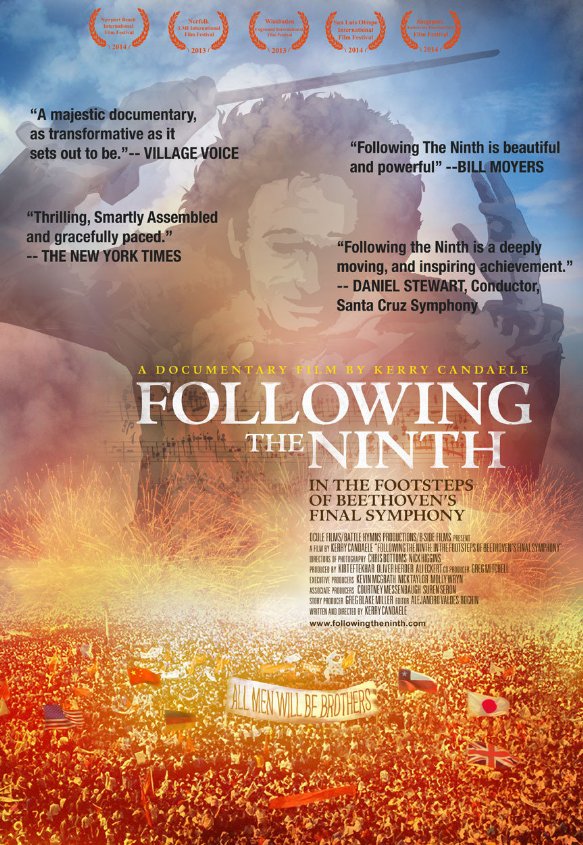
Film Review: Following the Ninth

It’s easy to be desensitized as a defense against hype; all around us we are being sold, told that something is the biggest, the best, the newest. Folding our arms and saying, “Oh, yeah? Prove it!” isn’t just reflexive cynicism, it’s practically a self-defense mechanism, the only way to protect ourselves against the barrage of pitches clamoring for our attention.  Arts advocacy, sadly, isn’t immune to hyperbole, and even well-meaning statements like Mr. Holland’s Opus and The Mozart Effect can overstate their cases, ringing hollow.  I’m as guilty as anyone else: music can be a powerful experience, and difficult to put into words. If we sometimes go overboard when speaking on its behalf, it’s because we have been transported, and words are rarely big enough to explain it.

Kerry Candaele (the director of Wal-Mart: The High Cost of Low Price and other documentaries) described himself in his 20s as full of “angst, existential dread, and spiritual maladies,” before his discovery of the music of Ludwig van Beethoven, specifically a cassette recording of Beethoven’s Ninth Symphony.  The music touched him so deeply that he became a convert, digging into Beethoven’s music and wanting to pound on people’s doors, asking them, “Do you have Beethoven in your life?”  Fortunately, instead of doing that, Candaele wrote and directed Following the Ninth, which takes a different tack (I caught the film at the Wichita Orpheum Theatre Wednesday night, co-presented by the Tallgrass Film Association and Wichita Symphony Orchestra).

Following

Before Wednesday night’s screening of Following the Ninth, Candaele spoke briefly to those brought to the screening “not under their own free will,” seeking to allay their fears by stating up front that his film is not a biopic, and not an academic analysis of the music.  Indeed, as the film proceeded there were relatively few pronouncements from musical experts and almost no references to Beethoven’s biography, other than the fact that by the time he composed the Ninth (his last completed symphony) in 1824, he was completely deaf.  The film focuses squarely on individuals from China, Japan, Chile, and Germany, speaking in their own words (and with the support of copious historical and newly-filmed footage) about what the Ninth Symphony has meant to them.  Candaele makes his case for the power of art by example.

Following the Ninth celebrates the communal nature of Beethoven’s masterpiece, concentrating on times and places in which the complete work (especially the famous “Ode to Joy” of the last movement) gave solace or energy to people desperate for freedom, equality, brother- and sisterhood.  In 1989, mere months apart, demonstrators in Tiananmen Square and crowds celebrating the dismantling of the Berlin Wall adopted the Ninth as anthems under very different circumstances: the Chinese student demonstrators, represented by student leader Feng Congde, hijacked public PA systems and blared the Ninth Symphony to drown out official announcements and threats; in East Berlin, Lene Ford grew up being forced to sing Beethoven’s work in school, taught only that he was a “social revolutionary.”  After the collapse of the Wall (only two months after Lene’s brother had been shot trying to escape to the West!), the Ode to Joy symbolized a moment of sudden openness: for a young woman who had been spied upon by the Stasi simply because she had pen pals in other countries, “who were like fiction to me, because I knew I would never see them,” the experience of freedom was overpowering.

While the Chinese student demonstrations would be crushed by government force, and East Germany would be reunited with the West as the Soviet system crumbled, both Feng and Ford speak to the transformation they underwent during those events: the sense that they could do anything, that both they and the world had changed.  Ford comments that the feelings she experienced, and the welcome she received from West Germans the first day the border was opened, have stayed with her, forming a reserve of strength she has drawn on throughout her life since then.  At a concert after the Wall fell, conductor Leonard Bernstein famously changed a single word in the Ode from freude (joy) to freiheit (freedom)–a change not without some controversy; while both words were appropriate for the moment, it is the sense of utter joy that comes through as Ford recounts her story.  As for Feng, when he describes the plaster statue of a woman holding a torch aloft that the students erected in Tiananmen Square–an iconic image that was interpreted as a Chinese Statue of Liberty in the U. S.–he refers to her as Joy personified.

Feng’s recollections of his role in the protests dwell on the liberation of the students’ artistic impulses during the protests, and emphasize that the restriction of the Communist system was not only physical, but a sort of prison of the mind: while the protesters faced physical violence, they were protesting against a more pervasive “violence of culture,” in which art, music, and dance were all “bourgeois,” forbidden.  A sad irony of totalitarianism is that the same creative outlets were forbidden under the fascist government of Chile under General Augusto Pinochet: in the words of one activist, “there was no culture, because all culture was Left culture.” It was forbidden to sing Chilean folk songs or the “Himno de la Alegria,” as the Ode to Joy is known in Spanish, because of their association with popular socialist movements, or simply because the majority of musicians were known to have leftist sympathies. It is a reminder that, as Czech author Josef Škvorecký pointed out (in “Red Music”),

when the lives of individuals and communities are controlled by powers that themselves remain uncontrolled–slavers, czars, führers, first secretaries, marshals, generals and generalissimos, ideologists of dictatorships at either end of the spectrum–then creative energy becomes a protest. . . .  Totalitarian ideologists don’t like real life (other people’s) because it cannot be totally controlled; they loathe art, the product of a yearning for life, because that too evades control.

Some of the most harrowing passages in the film describe the paranoia and secrecy that marked Pinochet’s Chile, as suspected dissidents were “disappeared,” rounded up by the government for torture and (sometimes) execution.  Indeed, many of the public protests against Pinochet were led by women: so many of the men had been taken that the women left behind became the public voices of dissent, keeping the names and faces of the “disappeared” in the public eye and leading non-violent demonstrations (including singing the forbidden “Himno”).  Although Pinochet is gone, the recollections of the Chilean activists are bittersweet, with a sense of grievous loss that can only be processed through wry humor or simply by moving on.

Unlike the examples of the Ode taking on heightened significance at moments of political crisis, the annual performance of Beethoven’s Ninth has been an established tradition in Japan since World War I: professional orchestras, schools, and Daiku (“great nine”) associations stage hundreds of performances of the symphony every year in December, where it is associated with the New Year, similar to choral societies in the West that perform Handel’s Messiah and other works annually.  Candaele sits in on rehearsals with some of these groups, made up of amateurs who sing for both musical fulfillment and camaraderie; as in the West, Daiku choruses are civic and social as well as artistic in function, with a great emphasis placed on the value of cooperative endeavors.  Following the Ninth was six years in the making; at the outset of filming, Candaele could not have expected the horrific earthquake and tsunami that devastated parts of Japan in March 2011; but in the aftermath, Beethoven’s Daiku was an obvious symbol for the Japanese people to express their resilience and solidarity.

Following the Ninth is not a straight concert film, but it does roughly follow the order of Beethoven’s symphony, with the Ode to Joy as a recurring touchstone, introduced at the very beginning and referred to throughout the film (whereas in the symphony it is heard only in the final movement).  The four countries’ stories are intertwined, cutting back and forth, leaning on the similarities more than the differences (after all, the theme of the Ode is universal brotherhood).  Beethoven’s music is frequently heard in the background under dialogue or in tandem with footage of crucial events, but longer passages are also played over montages of images cut to match the rhythm of the music.  It’s in these sections that Following the Ninth comes closest to being outright manipulative: scenes of children playing, people marching, and breathtaking natural vistas are like cinematic candy–tasty but not very nutritious–and Beethoven’s music doesn’t need the extra juice.  Likewise, the scenes of goose-stepping German soldiers, Chinese tanks rolling over student encampments, and massive walls of water bearing down on the Japanese coast are chilling enough without Beethoven’s timpani or ominous harmonies making the point.

Still, even those scenes contribute to the film’s theme: the unity of mankind in all its diversity, as optimistically celebrated by poet Friedrich Schiller in the Ode that Beethoven would set to music in his monumental symphony; and the ways in which Beethoven’s music has been adopted and given meaning in settings quite different from that which he experienced.  Candaele opens the film with punk/folk singer Billy Bragg telling the story of the time he was invited to rewrite the words to Schiller’s Ode; like Bernstein’s change of a crucial word, that is sacrilege to some people, but it is similar to the way in which each person interviewed in the film has made Beethoven their own, and the way Candaele has used the symphony as a vehicle for telling their stories.  I think that’s the reason so little of Beethoven’s specific history is included in Following the Ninth: it’s already well-known, sure, but more importantly it’s beside the point.  For the Chilean and Chinese protesters, for the suddenly liberated East Germans, and for the Japanese coming together in the face of disaster, Beethoven’s music wasn’t history, or even a convenient symbol: it was alive and it was speaking to them in that moment.  I suspect that’s what we really mean when we say a work of art is “timeless,” and it’s the reason it’s so difficult to put into words after the moment is over.

Who Will Love Me As I Am? Chained for Life, Side Show, and the Cult Movie/Musical Overlap

I recently watched Chained for Life, the 1951 oddity/star vehicle featuring conjoined twins Daisy and Violet Hilton (1908-1969).  In the movie, the sisters star as thinly-disguised versions of themselves, Dorothy and Vivian Hamilton, on trial for the murder of Dorothy’s husband-of-convenience Andre Pariseau (the story unfolds in flashback as the pair tell their side of the affair). In the film, Pariseau (played by Mario Laval) is a marksman performing in the same Vaudeville revue as the Hamilton sisters; when their manager gets the idea of staging a love affair to boost publicity, Pariseau goes along with it for an increased share of the profits, even going so far as to propose marriage (even as he continues to carry on with his assistant).  But Dorothy’s feelings are all too real, leading to conflicts between the sisters who are literally inseparable.

Chained for Life has been called an exploitation film, and if any performers can be described as exploited, surely the Hilton sisters are at the top of the list: born to an unwed mother in Brighton, England, the twins were more or less bought by the delivering midwife, who put them on display from infancy and continued to “manage” them for decades, until the sisters won their independence after a contentious trial.  Even after that, they were unprepared for the difficulties of life on their own and continued to be ill-served by subsequent handlers.  The low point, and the end of their career, came when they were unceremoniously abandoned in Birmingham, Alabama, where they took a job at a grocery store and lived until succumbing to the Hong Kong flu years later.

The term “exploitation film” often brings to mind gratuitous sex or violence, but Chained for Life is quite tame on both fronts, and like many films of the era it at least purports to be instructional; it’s more thought-provoking than edgy.  In reality, it is the audience’s curiosity and desire for titillation that are exploited, and whether through posters that resemble tabloid front pages or trailers that teasingly edit together the most shocking parts of the movie, “exploitation” is often a byword for films that promise more than they deliver.  Although more polished and coherent, Chained for Life reminded me of an Edward D. Wood production, particularly Wood’s attempt at a “message movie,” Glen or Glenda?  Chained even opens with a portentous, Criswell-like monologue from the judge in the murder trial, who invites the audience to ask themselves how they would mete out justice in such a case.  We hear from doctors on the limits of surgery and we witness the legal difficulties in procuring a marriage license (both problems the real-life sisters had experience with).  A kindly reverend makes a case for the dignity of all lives created by God, whatever form they take; and in his closing remarks, the defense attorney alludes to the bigotry, cruelty, and, yes, exploitation that the sisters faced throughout their lives.  Although the central puzzle of the film (how can the court punish the guilty twin without wrongly imprisoning or executing the innocent one?) is left unresolved, there is no question that the audience is meant to conclude that Pariseau (a smooth Latin lover type who is only in it for the money) got what he deserved.

The marriage under false pretenses calls to mind Tod Browning’s 1932 film Freaks, which also turns on the callous exploitation of an outsider’s affection by a pair of “normals” (and in which, incidentally, the Hilton sisters had also appeared, albeit as secondary characters).  The difference between the two films is striking, however: Freaks is a one-of-a-kind blend of horror, pathos and melodrama, an expressionistic fable with long wordless stretches, compelling images, and a genuinely shocking ending.  Despite a few stylistic flourishes (such as a dream sequence in which Dorothy imagines herself separated from her twin, free to dance with her beloved), Chained is content to tell its story in businesslike fashion, consistent with its courtroom setting and air of social uplift (it does, however, include the newspaper headline SIAMESE TWIN TO WED VAUDEVILLIAN, which is in my opinion in the running for Best Headline Ever).  They are essentially films of different eras: the cruelties visited on the Hamilton sisters are less overt than those depicted in the side show world of Freaks, but are no less painful for being covered by a veneer of politeness.  The level of craftsmanship is quite different as well: while the Hilton sisters had a long-running musical act, singing duets in harmony, their acting is stiff and artificial, calling attention to the staginess of their banter (their scenes really do play like something by Ed Wood). In short, Freaks is a classic; Chained for Life is a curiosity.

Having said that, Chained for Life has its rewards.  I always enjoy films that feature genuine acts of performance, whether music, dance, martial arts, or the kind of talents usually filed under “variety,” and Chained for Life’s Vaudeville setting provides numerous opportunities.  In addition to the sisters’ musical act and Pariseau’s marksmanship (including playing a pipe organ activated by rifle shots, in one of the film’s most baroque sequences), we get an accordionist tearing through the William Tell Overture, a juggler, and a clown with a trick bicycle act.

One might accuse the filmmakers of trying to pad out an already brief running time, and it wouldn’t necessarily be wrong (the trick bicyclist is pretty dull, even if you’re into old stage acts), but the performances (and many like them in movies of the era) provide a glimpse of live entertainment as it was experienced in times gone by.  A great deal of surviving footage of entertainers of the past comes from film excerpts, either from features like this or from shorts meant to accompany the longer films.  (The contrivance by which the story halts and a famous artist is invited to perform their signature act is still with us, of course, whenever an appearance by a guest star needs to be justified; staging their performance as a show within the show is an obvious solution, but not the only one.)

Chained for Life is also a cult film, a label often applied to movies so singular that they fascinate a small number of viewers, even as they drive large audiences away.  There are so many types of cult film—from trashy exploitation and low-budget amateur productions to expensive, little-loved flops and insane, auteur-driven visions—that it would be impossible to cover them all, but one thing they all have in common is the perception on the part of the audience that this movie was made for them personally: for those of us on their wavelengths, cult films speak to the weirdness in our souls.

Mulling over the show-biz milieu of Chained for Life, I wondered: are there cult operas?  Cult stage musicals?  After a moment’s thought, the short answer was yes, of course there are, and for many of the same reasons that films develop cults.  There are musicals notorious for their epic failure (like Carrie, based on the Stephen King book, which closed after only a handful of performances) or for their troubled production history (Spider-Man: Turn Off the Dark will surely not soon be forgotten), and until recent years most flops would leave only a cast recording behind, if that.

Of course, many cult films are also musicals; in some cases they are adaptations of stage works, such as the ur-midnight movie The Rocky Horror Picture Show, which was already a phenomenon as The Rocky Horror Show in London before being turned into the long-running film.  Little Shop of Horrors exhibits a complete life cycle, originating as a quickly-filmed Roger Corman horror comedy, being turned into a stage musical, and finally returning to film in a big budget adaptation (which replaced the original film’s and stage musical’s bleak ending with a happy one; if you haven’t seen the original ending that was scrapped after poor audience testing, it’s really something).  But many original movie musicals have cult appeal for their singular vision and the heightened qualities inherent in musical theater.

Just as original cast albums can keep Broadway shows in circulation, motion picture soundtracks can serve as advertisements for the films they come from, or take on lives of their own: to name one example, I was intrigued by the soundtrack to Otto Preminger’s 1968 comedy Skidoo, in which stars from the golden age of Hollywood collided with a druggy flower power satire.  As great as that sounds, when I finally saw the movie, I found it mostly unfunny and, dare I say, square.  (Interestingly, while a straight play or movie can have the air sucked right out by the kind of “Hey, why don’t you sing us your hit song?” interruption I mentioned above, the songs are often the only places where musicals come alive.  I’m sure it’s at least partly a matter of context and expectation: if you’re watching a movie starring Elvis, you just know he’s going to pick up a guitar sooner or later.)

Musicals, like film, are a collaborative medium, and the expense involved in producing one often leads to the rough edges and idiosyncrasies being sanded down, but personal visions can still come through.  For example, the same year Chained for Life was made, E. Y. “Yip” Harburg, lyricist for such hits as The Wizard of Oz and Finian’s Rainbow, collaborated with composer Sammy Fain on Flahooley, a satire of consumerism and conformity inspired by Harburg’s blacklisting in Hollywood (Harburg was never a Communist party member, but for his refusal to name names he was blocked from working in Hollywood from 1950 until 1962, and also had his passport revoked during that time).  Despite numerous changes made to tone down the political references (originally, the talking doll of the title was supposed to say “Dirty Red!” instead of laughing), Flahooley is truly a strange mixture, combining boardroom satire of the kind Stan Freberg specialized in; an Oriental fantasy version of Arabia, including a genie in a lamp and exotica star Yma Sumac as an Arab princess; and marionettes devised by puppeteer Bil Baird (the puppets were the American people—get it?).  Flahooley closed after forty performances on Broadway, but after reading about it, how could I not track down the soundtrack?*

Of course, it wouldn’t be a stretch to call operas and musical theater cult interests to begin with: like cult films, musical stage works attract an intensely devoted fan base that is only a small part of the larger public.  Operagoers are apt to have strong opinions about what they like and what they don’t, taking seemingly small matters very personally.  Both art forms have much in common with the films that draw cult audiences: there are outré scenarios with lurid hooks, exotic locations, larger-than-life characters, and the often-campy artifice of the stage.  How many operas include deceptive lovers or mismatched marriages as plot devices?

Even going back to its origins, opera featured personalities that would be recognizable to modern cineastes.  The divas of seventeenth-century Venetian opera had adoring fans, carefully-managed public images, and behind-the-scenes clout, much like celebrity entertainers today.  (And much like today, opera stars would demand ego-flattering changes to productions: in addition to the common practice of aria substitution, which continued until the nineteenth century, there are examples like castrato Luigi Marchesi, who insisted on entering the stage on horseback, wearing a helmet festooned with multi-colored plumes, regardless of the role.)

In the nineteenth century, Richard Wagner’s operas took on a quasi-spiritual dimension, and the “cult” designation was almost literal: fans of his work were referred to as “Wagnerites,” and if they were at all able they would make the “pilgrimage” to Bayreuth, where Wagner’s work could be performed in a theater custom-built to his specifications.  Before the birth of motion pictures, it was the theatrical stage on which craftsmen perfected the arts of captivating, even manipulating, the moods and desires of audiences.

If there is a cult within the cult of musical fandom, it is probably to be found Off-Broadway, where productions can be a little more transgressive without scaring away the big crowds demanded on Broadway.  In fact there is a consistent pattern of Off-Broadway successes moving into the mainstream, beginning with The Fantasticks and including such shows as Little Shop of Horrors and Urinetown, and in many cases the smaller budgets and narrower appeal of such shows allow their creators the freedom to speak more frankly than was possible in traditional Broadway.  It is intriguing to note the absorption of Off-Broadway talent into both Broadway and Hollywood musicals.  Alan Menken and Howard Ashman moved from Little Shop of Horrors to Disney’s The Little Mermaid, and by all accounts were instrumental in raising the level of ambition for Disney’s animated feature films at the time, leading to the early ‘90s blossoming of Beauty and the Beast and Aladdin before Ashman’s untimely death.  More recently, Robert Lopez has gone from co-creating the musicals Avenue Q and The Book of Mormon to co-writing songs for Disney’s Frozen (another story of a pair of sisters who want very different things from life).

Given the intense identification with outsiders fostered by the last few decades of musical theater (and popular culture in general) and the continued fascination with both freaks and the machinery of the entertainment industry, it should not be surprising that Daisy and Violet Hilton have been the subject of a Broadway musical.  1997’s Side Show, by Bill Russell and Henry Krieger, makes a useful contrast to both Freaks and Chained for Life: moving from the carnival freak show to the Vaudeville circuit, it too includes a staged marriage, but unlike its predecessors there are no clear-cut good guys and bad guys.  Despite the twins’ stage appearances portraying angels, songbirds, and Egyptian princesses, they are simply human, making compromises to get through life as best they can.  There is still glamour and beauty in Side Show, but the tone is one of regret and world-weariness rather than the gothic excess of Freaks or the noir-tinged procedural of Chained for Life.  Naturally, the theme of duality is present, and some characters can be described as two-faced, but the conflict between the outgoing Daisy and retiring Violet is placed front and center.  Side Show also more closely examines the men in the twins’ lives and their difficulty in accepting what a commitment to one of them would really mean, without letting faithless or cowardly lovers off the hook.  In the show, the one man who truly loves Violet, Jake, is African-American, but he knows the world would never accept them together, dramatizing another barrier that could only be considered as subtext in the lily-white Chained for Life.

Other subtexts aren’t hard to find in either the musical or the cult film.  For the most vital, but not only, example, the identification of musical theater and being gay is so ingrained as to be a cliché, but there is truth to it.  A primary convention of the theater is its camaraderie and acceptance of everyone as they are—one of the standard tropes of show business, second only to “The show must go on,” is that the troupe is a family, no matter what—and the distancing, unreal effect of the theater has historically allowed its practitioners to express themselves in coded language, even when their love “dare not speak its name.”  This frequently came through in gay theatergoers’ identification with the divas and the idealized (heterosexual, until very recently) lovers onstage.  Outsiders frequently recognized themselves in cult films as well: whether gay or straight, it seems plausible that while the glamour of the theater may seem preferable to ordinary life for many audiences, there’s a similar identification with the monsters and misfits of the horror and science fiction films that also attract cult audiences.  Outwardly opposite, they appeal to the same impulse, intertwined in such figures as the Bride of Frankenstein and Vampira.

The goal for audiences, just as it was for the real-life Hilton sisters and their fictionalized counterparts, is acceptance: self-acceptance first, and then the acceptance of a partner, if one can be found.  Traditional happy endings often end on the latter, but sometimes the former is enough.  Consider Frozen, radical (at least for a Disney movie) for its embrace of sisterhood as the real true love, and ending without a romantic match for Elsa, the Snow Queen.  Some interpret her anthem “Let It Go” as a metaphorical coming out of the closet; it needn’t be, of course–taken at face value it’s a powerful statement of independence, comparable to singer Idina Menzel’s other big song, “Defying Gravity” from Wicked–but such an interpretation is more than tenable.  Musical theater and film continue to be powerful for the ways in which they give voice to yearnings that cannot (yet) be put into words: as Daisy and Violet sing in Side Show’s most intimate and powerful number, “Who will love me as I am?”


* Those soundtracks can keep the flame alive for underperforming shows: Stephen Sondheim’s Assassins baffled audiences in its initial Broadway run, but it has gone on to be a favorite of college and regional theaters.  Away from the financial pressures of Broadway, Carrie has been revised and revived a few times, and even Flahooley has had at least one revival.
Wichita Symphony Orchestra with William Wolfram, Piano: Music of Wagner, Liszt, and Bruckner

Wichita Symphony Orchestra

Daniel Hege, Music Director and Conductor

William Wolfram, Piano

“Hail Wichita” (Wichita State University fight song)

Richard Wagner: “Ride of the Valkyries” from Die Walküre

Franz Liszt: Concerto No. 1 in E-flat Major for Piano, S. 124

Anton Bruckner: Symphony No. 4 in E-flat Major, “Romantic”

Here’s what I wrote in my review for The Wichita Eagle.

Trigger Warning: Spiders!

Or: How I Relaxed and Learned to Love Tolerate the Spider

Billingsley.tarantula

I.

The above photo was taken by my friend Dan Billingsley in June 2013 near Skiatook Lake in Oklahoma: “Hundreds scurrying across the highway by the lake, about an hour before sunset.  Cutest things ever.”  Not everyone would agree: it’s not hard to find internet message boards (or even articles) that respond to pictures like this with comments like “Kill it with fire!” or “Nightmare fuel,” or similar extreme comments.  I would have been one of them if the internet had been around when I was a kid: I had an intense, visceral fear of spiders, and while I (thankfully) never had a close encounter with anything like the Oklahoma brown tarantula pictured above, even a picture would have made me anxious and haunted my dreams.  Sensationalistic films like Kingdom of the Spiders and Arachnophobia made my skin crawl (as they were intended to), but I forced myself to sit through them, perhaps to test myself.  (However, I could never bring myself to watch Something Wicked This Way Comes, knowing there was a scene in which spiders invade a boy’s bedroom; even seeing a glimpse in the trailer was too much for me. Poking around the internet, I find this regularly listed as one of the scariest spider scenes on film; I’m glad to find it wasn’t just me being oversensitive.)

Clearly, a fear of spiders is culturally widespread: as naturalist J. H. Fabre wrote over a century ago, “The Spider has a bad name: to most of us, she represents an odious, noxious animal, which every one hastens to crush underfoot.”  The spider’s venomous bite is sometimes blamed, but the danger is frequently exaggerated.  To quote Fabre again, “there is a wide difference between killing a Midge and harming a man.  However immediate in its effects upon the insect entangled in the fatal web, the Spider’s poison is not serious for us and causes less inconvenience than a Gnat-bite.”  As Fabre acknowledges, there are a few venomous species harmful to man, but the chances of suffering serious injury, at least in North America and Europe, are quite low.

In recent years, the infamous black widow has given way to the brown recluse as the most feared species, especially here in the Midwest.  Unlike the flashy black widow, the brown recluse is drab and unexceptional in appearance and tends to hide in dark crevices, hence its common name.  The brown recluse is frequently blamed for mysterious lesions and sores, even if no spider is found in the act of biting or afterward (and even in areas without recluse populations).  According to Rod Crawford of the Burke Museum, the “phantom” spider bite is an urban legend, reinforced by physicians misdiagnosing other conditions (I myself have a small scar from a sore which I have long blamed on an unseen spider, but reading about this subject has forced me to reconsider that assumption).  In the words of Rick Vetter of the University of California, Riverside,

One should not call something a spider bite unless a spider was removed from one’s skin in the act of biting, seen biting flesh and then running off, found crushed in the remains of clothing near the bite site or if a person with necrotic wounds lives in a house that is infested with violin spiders [the family to which the brown recluse belongs]. You need to have the “smoking gun”. Otherwise, it is baseless speculation. If the spider was on trial, it would never get convicted with most of the “evidence” that people could produce. But many folks don’t like the answer of “I don’t know” for the cause of their necrotic wound and instead are very determined to pin it on the brown recluse. They want to blame something concrete and the brown recluse is the scapegoat for their desires. Yes, indeed, necrotic wounds are occurring but it probably is not a spider doing it.

Having said that, I wouldn’t go as far as the “dangerous spider handler” who doubts that spider bites occur at all: Crawford and Vetter acknowledge genuine bites in the medical literature, but insist that they are nowhere near as common or dangerous as they are often made out to be.

II.

This is all very reassuring, but it doesn’t answer the question: why do spiders inspire such fear in the first place? It seems very likely that the numerous myths and misconceptions surrounding spiders are triggered by that fear, rather than the other way around.  As a kid, I knew intellectually that tarantulas and other spiders weren’t dangerous, but my reaction against them couldn’t be reasoned with: it was an atavistic revulsion, an intense loathing of the animal’s shape, its way of moving, not just a fear of being bitten.  Even now, as I’ve come to see them as interesting and captivating creatures for study, I have no desire to touch one or to be in close proximity without glass between us.  I’m afraid there are limits to my dispassion.

The source of arachnophobia has been of great interest to both arachnologists (who would like to see the cloud of ignorance and prejudice lifted from their subject) and psychiatrists (who have sought to alleviate their patients’ unreasonable fears through therapy and other treatments).  Theories range widely, from the Freudian (a link between a repressed fear of sexuality and the spider’s hairy legs, for example) to the mundane (a fright during the impressionable period of infancy or early childhood, carried into later life).  Hollywood itself may be partly to blame: as Crawford points out, the tarantula is—despite its intimidating size—both harmless and easily handled, so it is a natural subject whenever a “killer spider” is needed for filming.

Some have posited that the spider threatens the patriarchal view of the natural order, as it is one of the few animals in nature in which the female is significantly larger than the male, and it is well known that the male must approach the female very carefully or else be killed after mating. (This is apparently true of only some spider species, but of course it takes on huge importance in the folklore of spiders, leading back to the fear of sex; note that Fabre refers to the Spider as feminine in the excerpt quoted above!)

Others have taken this idea even further, placing importance on mankind’s own divided mind: researcher Stan Gooch held that the spider was spiritually important to the (matriarchal, left-handed, moon-worshipping) Neanderthals; Gooch was ahead of the scientific curve in his belief that (patriarchal, right-handed, sun-worshipping) Cro-Magnon man, rather than wiping out the Neanderthals, had interbred with them.  Thus human societies, but also each individual, carried conflicting instincts, resulting in both internal and external struggles between the “left hand” and “right hand” paths.  Although the Cro-Magnon outlook came to dominate, the traces of Neanderthal heritage left their mark in the association of spiders with witchcraft and the occult: despised and feared, but heavy with symbolic importance.  For Gooch, the fear of spiders was deeply ingrained but still cultural in essence.

An interesting if unlikely theory was put forward by British zoologist Theodore Savory, whose career over the course of the twentieth century saw the growth of arachnology from a poor relation of entomology (the study of insects) in the observational style of Fabre and other naturalist-collectors to a data-driven and fully scientific discipline.  Despite spending most of his career at smaller colleges (“a zoologist, not attached to a University but living in the isolation of the provinces and working in his own private laboratory,” as Savory described himself in 1935), Savory was a prominent writer whose textbook Arachnida went through three editions (1935, 1964, and 1977).*  Savory’s argument is worth quoting at length (from the 1935 edition):

The tonic reflexes which maintain equilibrium respond to tactile impulses from the soles of the feet, to impulses of pressure from the semicircular canals of the ear and to visual impulses from the retinas of the eyes.  With the last of these alone are we concerned here.  From it there arises a tendency to keep the images of moving bodies on the same place in the retina, a tendency well developed in lower animals.  It results in an orientation and movement of their bodies described as rheotropism.  It is clear that if the body is moved or the eye is turned so as to keep the image of a moving object more or less stationary on the retina, the images of the background and surroundings must at the same time be passing across the retina.  This is exactly what happens during an unexpected fall and the primitive response is a secretion of adrenalin to fit the body to meet the sudden change in circumstances.  This is fear.  Just as, according to the James-Lange theory of emotions, “we feel sorry because we cry,” so do we feel frightened because of the physical changes in blood-pressure and muscle tension.

In this view, it is the rapid motion of spiders (and related arachnids such as scorpions) that induces fear as a by-product of this physical reaction, the eye tricking the body into thinking it is falling.  Still pictures do not produce the same reaction, according to Savory.

As may be expected, not everyone was able to accept this purely mechanistic reasoning.  Although Savory repeated it in subsequent editions, he acknowledged the criticism he received and gave space for other theories, and more importantly spoke with sufferers of arachnophobia, getting their side of things.  “[T]here was unmistakably a general agreement that colour, size and [long-]legginess are all contributory causes, and that most certainly movement cannot be discounted,” he wrote in the 1964 edition.

By 1977, psychiatry had given much greater attention to the problems of phobias in general, and Savory had a wealth of research to draw on (including, it should be said, inquiries and surveys he conducted himself over several years).  Extreme arachnophobia undoubtedly has psychological dimensions and cannot be explained only by reference to physical reactions:

One self-confessed sufferer has written, “I couldn’t even write the word spider.  I daren’t put my handbag on the floor in case a spider crawled over it. . . . I couldn’t go into a room until someone had made sure there were no spiders in it.”  This last limitation is one of the commonest to be reported.

Possible treatments included relaxation techniques and gradual exposure in controlled enviornments; for myself, education and exposure have been helpful.  The answer in 1977 was no more definitive than it is now, but a look at Savory’s changing perspective over three editions of his book reveals fascinating changes, not just within the field of arachnology, but within psychology and psychiatry as well.

III.

From a spider’s perspective, 2013 was a very good year in my area (and presumably in Oklahoma as well): a wet spring followed by a mild summer led to an explosion of mosquitoes and other insects, providing ample support for a booming spider population.  By the end of summer, everyone I know in Wichita had large webs in their yards and gardens and around their houses.  As I said, I’m less freaked out by spiders than I used to be, so I didn’t go out of my way to tear down garden spider webs unless they were blocking paths or otherwise in the way.

I reached my limit, however, when I found a black widow perched right outside my front door, and several more under rocks in my front yard.  They had to go.  Through a discussion on Facebook, I found I wasn’t the only one dealing with them.  Brian Cortus (a former student of mine who still lives in Wichita) said,

There’s been a lot more black widows in the wichita area over the last few yrs. My in-laws have them every summer. As dangerous as they are; they don’t really mess w/ humans too much. I’ve been snapping pics of them left & right, while getting (probably too close), but they definitely seem way more afraid of me than vice versa (in which case, i think i’m maybe 1 in 15 ppl on the entire planet not afraid of spiders!) . . . When my in-laws call me over to “kill” them (both are terrified of spiders), i always tell them that i killed them, but in reality, i round them up w/ toilet paper rolls & dump in the neighbor’s yard! They have a lot of trees & bushes w/ no children or pets. There’s probably a black widow city over there by now! BTW, the neighbor’s don’t know either…sshhh!

Hopefully, they’re not reading this blog.

Thanks to Dan and Brian for allowing me the use of their words and pictures.

* Despite his prominence within arachnology, Savory always considered himself an amateur.  The 1935 edition faced criticism from specialists in the field; later arachnologists often found his lack of detail frustrating.  Nonetheless, Savory’s Arachnida was the first textbook of its kind, and his interest in the subject was lifelong: according to a short biography of Savory published in Scientific American,

His interest was kindled when he was 16 and “contemplating the idea of specializing in some sort of animal.” One day he was reading outdoors when a spider dropped from an oak tree onto his book.  Savory “said to [his] companion, casually, ‘What about spiders?’ ‘Why not?’ replied he, and so it was.”

Art Rules: A Brief Example

In my last post, I described the process of discovering affirmative formal rules during the process of composition. I thought I’d share an example from my own work, a short piece for piano four-hands entitled Odell Lake.

Most of my compositions for piano are in a ragtime style, and while Odell Lake started off that way, it took off in a different direction as I composed it.  Formally, it is not a rag: it doesn’t follow the typical AABBACCDD arrangement of themes, and the themes are not 16 bars long.  It does, however, contain repeated sections, and as I composed it I focused on how to use repetition as a constructive element: was there a way to change the context of a repetition so that it sounded different, or had a different musical function, each time it was played?

The rule that emerged was twofold: first, everything in the piece (except the very beginning and end) would be repeated, sometimes more than once (two sections contain “nested” repetitions, echoes within echoes).  Second, most of the phrase endings don’t correspond to the points of repetition, giving the impression of phrases that end in two different ways, depending on whether the music circles back to a previous point or continues into the next section.

This formal approach led to a piece that is fairly sectional (appropriate, given the ragtime influence), but in which the themes and ideas are continually developing, as if the listener were examining them from every angle.  I didn’t worry too much about thematic consistency (although the initial ideas return at the end in the manner of a recapitulation), given that everything would be repeated.  Because it was a duet, I also gave thought to where the repeat signs would fall on the page, in order to avoid excessive page turns; that was also a contributing factor in the sectional design.

The end result was a piece that had formal integrity without being predictable, and was fun to play.

Art Rules (or, “Freedom! Terrible Freedom!”)

You could say I’m a formalist, both in my work and in how I relate to others’ work.  Formalism has often been a term of abuse, implying a concern only for formula without regard to “content,” as if they could somehow be separated.  But I think my previous posts have made clear my interest in the different ways ideas can be organized and expressed, and the layers of meaning that can be suggested by a smart deployment of familiar elements.  Concern for formal elements doesn’t preclude evaluation of ideas and execution as good or bad, nor need it imply a completely intellectual approach by which quality is an objective truth that can be proven one way or the other.

It does allow for some wiggle room, however.  A symphony, a film, or a comic book can be evaluated on its own terms, asking “What is this work setting out to achieve?” and “Does it succeed?”  Does it work within the established boundaries of the medium and genre or seek to challenge them?  Most people nowadays have varied interests, and are accustomed to engaging works of art or entertainment pitched at different levels, adjusting their expectations based on cues within the work itself (or implied by its marketing or venue, which can lead to disappointment or the occasional pleasant surprise if the work doesn’t match expectations).  In this pluralistic environment, we are all formalists, to a degree.

What does this mean to the process of creation?  Is it just a matter of hitting the right story beats or composing four-bar phrases, of Drawing Comics the Marvel Way?  Obviously not, although those are the starting points of craftsmanship as traditionally understood.  When people dismiss stale or soulless formula, it’s often this kind of basic “how-to-do-it” stuff that they’re referring to: “By the numbers.” “Hackwork.”  Sometimes the contempt is richly deserved, and we’ve all encountered enough impersonal, indifferent work to understand that calling something “merely” professional isn’t meant to be a compliment.  It’s one thing to cling to formula, to imitate, when just starting out; it’s quite another when you feel the artist isn’t trying or thinks you’ll be satisfied with the bare minimum.

The reverse, though, can be a search for “originality” with no foundation of technique or (sometimes) knowledge of what has already been done.  And that contempt for “rules” can lead would-be artists to actively avoid formal training: “You don’t learn what you can do in school, you learn what you can’t do.”  “I don’t want to be made to fit into a box.” “I want to be able to color outside the lines.” Et cetera.  Never mind that any artist worthy of the name should hope to graduate to drawing their own lines to color in (metaphorically or otherwise).

So, yes, I’m on the side of discipline, whether it’s channeled by an established institution or developed individually on one’s own. (The point that is often overlooked in this school vs. autodidact debate is that, when you come down to it, all artistic discipline is self-discipline; no one is going to do it for you, no matter where you are.)

As for rules?  Like any other artistic resource, they can be a help or a hindrance, and this is where the formal approach comes in.  Igor Stravinsky’s Poetics of Music contains a famous passage which nails down the problem with unlimited freedom:

The more art is controlled, limited, worked over, the more it is free. . . .  I experience a sort of terror when, at the moment of setting to work and finding myself before the infinitude of possibilities that present themselves, I have the feeling that everything is permissible to me.  If everything is permissible to me, the best and the worst; if nothing offers me any resistance, then any effort is inconceivable, and I cannot use anything as a basis, and consequently every undertaking becomes futile.

For a long time I considered that my mantra, placing sometimes-arbitrary restrictions on my compositions in the name of “structure,” but frequently alternating this approach with an anything-goes, all-inclusive aesthetic.  Thus did I refute Stravinsky!  My guide at this opposite pole was Frank Zappa, who defined his approach as “Anything, Any Time, Anywhere—for No Reason at All,” and who did as much as he could to upend and undermine what he called the “hateful practices” of music.*  Sometimes I found a happy medium between these two extremes, but I caused myself a great deal of trouble by misunderstanding musical rules and how to apply them.

There are negative rules and affirmative rules: rules that say you can’t do something and others that say you must do something.  Unfortunately, the early years of musical training are often filled with the negative kind: don’t have parallel fifths, don’t use retrograde chord progressions, don’t double the leading tone. There are good reasons for all those rules, but it can be awfully restrictive if you see yourself as a loner working outside the system: save those exercises for the sheeple in Theory I—I’m going to do things my own way.  It gets worse when you get into historical counterpoint (in the styles of Palestrina and J. S. Bach), and even Arnold Schoenberg’s twelve-tone system had quite a few “don’ts,” as he originally intended it to avoid tonal implications.  It’s not hard to see why school sometimes seems to be all about NO.

It can also be easy to carry that mindset into composition: sometimes the “don’ts” are merely pedagogical tools, obstacles put in the student’s way to make them avoid the obvious, or to prevent bad habits, and as such they are useful.  Many composers (and other artists) never get past those rules they’ve internalized, turning a brace that was meant to make them stronger into a crutch they depend on.  I’ve spoken to many mature composers who said they still heard their teacher’s voice in their heads when working, but whether they heed or ignore it is part of the decision-making process.  I remember vividly the first time I included a bass drum roll in a composition, something that my first composition professor had discouraged me from doing.  I had a good reason for using it, but it still gave me an illicit thrill—and I had been out of school for eight years!  Composition education, at least in schools, is still very much a one-on-one teacher-student relationship; I don’t know if my remarks apply fully to other disciplines, but I’d be surprised if writers and studio artists didn’t have similar stories to tell.

I might have made smoother progress if I had kept in mind a passage from a few pages earlier in Stravinsky’s book (emphasis added):

Invention presupposes imagination but should not be confused with it.  For the act of invention implies the necessity of a lucky find and of achieving full realization of this find.  What we imagine does not necessarily take on a concrete form and may remain in a state of virtuality, whereas invention is not conceivable apart from actual working out.

An important principal of form that isn’t always obvious is that very often the “rules” of a given work of art are discovered in the process of the “working out” Stravinsky describes.  Rules set out beforehand are apt to be negative: formal boundaries of the sort described in the first passage from the Poetics, and they may or may not fit the material chosen to elaborate.  Rules discovered in the process of creation are more apt to be both affirmative and organically related to the material, leading to the kind of creative freedom that is the goal of all this discipline.  Sometimes the discovery of internal rules is part of a painstaking process at the writing desk or in the studio, and sometimes it takes place on the fly, as in an improvised jazz solo, but either way it comes across to the audience as freshness and spontaneity, in which developments can seem both surprising and inevitable.

As an example, comics writer Alan Moore is known for the tight formal approach and attention to detail he brings to his work; his discovery of the guiding principles he would apply to Watchmen (in collaboration with artist Dave Gibbons) is worth quoting at length (from an interview with Tasha Robinson):

I was writing the opening pages [of Watchmen No. 3] and, as is my custom, making tiny little thumbnail sketches to actually be able to envisage what the page would finally look like when it was drawn. I had two or three strains of narrative going on in the same page. I had a truculent news vendor giving his fairly uninformed commentary on the political state of the world, the likelihood of a coming war. Across the street, in the background, we have two people fixing a radiation sign to a wall. Sitting with his back to a hydrant near the news vendor, there’s a small boy reading a comic, which is a pirate comic. And I think while I was doodling, I noticed that an extreme close-up of the radiation symbol, if you put the right sort of caption with it, could look almost like the black sail of a ship against a yellow sky. So I dropped in a caption in the comic that the child was reading about a hellbound ship’s black sails against a yellow Indies sky. And I have a word balloon coming from off-panel, which is actually the balloon of the news vendor, which is talking about war. The narrative of the pirate comic is talking about a different sort of war. As we pull back, we realize that we’re looking at a radiation symbol that’s being tacked to the wall of a newly created fallout shelter. And finally, when we pull back into the beginning, into the foreground, we realize that these pirate captions that we’ve been reading are those in the comic that is being read by the small boy. . . . But, like I said, it was purely while I was scribbling, doodling, writing bits of dialogue and crossing them out that I suddenly noticed these possibilities for things that could be done in a comic and nowhere else.

Thus, Moore and Gibbons developed a visual language in which images are paired, never standing for only one thing, but in relationship with other ideas.  The use of mirrors, symmetry, and double meaning became the underlying formal principle.  In another interview, Moore discusses his series The League of Extraordinary Gentlemen, which brought characters from nineteenth-century fiction together in a single narrative continuity:

Round about the second issue, I suddenly thought ‘Hey, what if I did this so that any character that’s mentioned by name had got to be a real character from fiction?’ . . . Well, a genuine character from fiction, someone that has existed in other people’s work. And I think that it was when, possibly in the first issue, where I suddenly got to a bit where I realized that I’d got Emile Zola’s Nana being killed on the Rue Morgue by Mister Hyde, I thought, well, ‘This is great! This is going somewhere!’

The relevant point here is that in both cases the rules Moore set for himself, discovered in the process of creation, are affirmative, opening up possibilities rather than closing them off.  They set up challenges, but ones that require invention and creative thinking to overcome.  In the language of improv theater, such rules are the equivalent of “Yes, and . . . “ rather than the “NO” that often comes to mind when the topic of rules comes up.

To bring it back to the audience, does it help to be aware of such processes when reading, watching, or listening? I think it does, but I’ve already revealed myself as someone who geeks out over these things.  Not everyone wants to dig so deeply into their entertainment, and that’s fine. Despite appearances, I’m actually a strong believer in the “gut reaction:” it’s okay to like or dislike something without preparing a thesis about it or reading volumes of background to appreciate it.  Sometimes things just strike us a certain way, and the surface is as legitimate a layer to interact with as any other.  In some cases all that formal scaffolding is for the benefit of the artist, and a façade is erected to hide it from the public.  There’s something to be said for both the “holistic” and “granular” approaches to art—but I think I’ll leave it for another post.

* It is now widely known that Stravinsky wrote very little, if any, of the Poetics published under his name.  Indeed, as Richard Taruskin notes, Stravinsky had a life-long relationship with ghost-writers, and in any case Stravinsky’s public comments were often deliberately misleading, as if to throw armchair analysts off the scent.  Similarly, Zappa (for whom Stravinsky was an important influence) frequently downplayed the rigorous structure of his own compositions, preferring to be seen as an audacious prankster and provocateur. My struggle to reconcile these contradictory teachings was, in part, the price of reading too much at a young age and taking it all at face value.

Wichita Symphony Orchestra with American Brass Quintet

Wichita Symphony Orchestra with Maestro Daniel Hege:

Thunderhead Singers (Drum circle)

John Barry: Concert Suite from Dances With Wolves

Eric Ewazen: Shadowcatcher (concerto featuring American Brass Quintet; accompanied by projected images of Edward Curtis’ photographs of Native Americans)

Antonín Dvořák: Symphony No. 9 in E Minor, “From the New World”

Here’s what I wrote for The Wichita Eagle.

Stop! In the Name of Motion

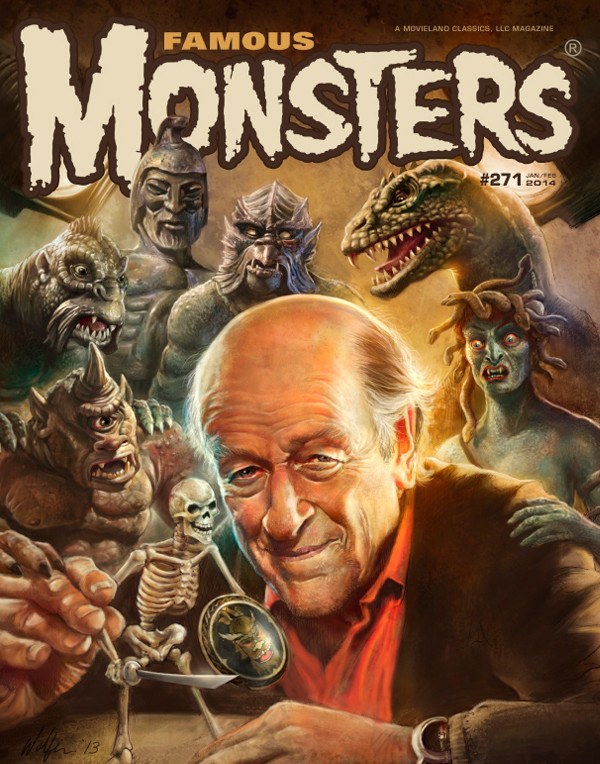
Speaking of stop motion animation, my son, who is three and a half years old, has recently discovered the stop motion masterpieces of the late Ray Harryhausen: Jason and the Argonauts, The Golden Voyage of Sinbad, Clash of the Titans. I had purchased a tribute issue of Famous Monsters with some of Harryhausen’s iconic creations on the cover, and my son started asking about them.  I explained the technique of stop motion animation—taking hundreds, sometimes thousands of successive pictures of slightly adjusted models, creating the illusion of motion when projected in sequence—always being clear that they were models, like toys, not real.  As fascinated as he is by monsters—he’s a boy, after all, and before Harryhausen he was curious about the Godzilla movies I had lying around, and of course we have lots of discussions about dinosaurs—I wanted to make sure he could draw a distinction between creatures of fantasy like the Kraken and real but extinct animals like Tyrannosaurus rex.  Overprotective?  Perhaps, but I remember being kept awake at night by fears of the giant ants from Them!, and at an older age than my son is now.  If I give him nightmares, I’ll hear about it from his mother.

Famous Monsters cover by Terry Wolfinger

Famous Monsters cover by Terry Wolfinger

From my explanation it was a short leap to hunting for clips on YouTube and the excellent documentary Ray Harryhausen: Special Effects Titan on Netflix, which explained Harryhausen’s methods better than I could and held my son’s attention for a good twenty to thirty minutes at a stretch (the documentary is feature-length: we watched it in installments).  For a few weeks after, my son would ask about the “model movies” and we would watch a scene or two from Clash of the Titans, the only Harryhausen movie I have on disc.

Harryhausen is nostalgic to me for a few reasons.  I remember seeing Clash of the Titans when it was new in 1981, at the downtown movie palace that would close a few years later, replaced by the four-screen “multiplex” at the mall.  The mythological references went over my head, but I’ll never forget the terrifying and fascinating Medusa and its gruesome death scene. Even more than that memory, I associate Harryhausen with holidays: most of his movies I saw on television during Thanksgiving or Christmas breaks, probably counterprogrammed against football games in those days when cable TV meant having a few dozen channels instead of hundreds.

Clash-of-the-Titans-Kraken

I’ve previously indicated my obsession with animation and effects as a kid.  Any time there was a behind-the-scenes show about movie special effects, I was there.  The best parts of these shows were often clips of other projects the filmmakers had a hand in, the kind of thing that was unlikely to show up on TV by itself.  For example, I knew who Phil Tippett was because of his involvement with Star Wars and the big special effects movies that followed in the 1980s, but I was never able to get more than a glimpse of personal projects like Prehistoric Beast, from 1984. Unless they were part of a film festival showing or I was lucky enough to catch them on Night Flight or MTV, there wasn’t much I could do to track them down in those days.

A number of speakers in the Special Effects Titan documentary comment on stop motion’s “dreamlike” quality.  That’s a polite way of saying it doesn’t look real, but realism wasn’t exactly the point.  To my knowledge, Harryhausen never proposed replacing human actors with stop motion likenesses in the same way computer graphics have been put forward as a “fix” for aging actors or a replacement for the long-dead.  There is something mysterious about the sometimes-jerky movements of stop motion; even when done by a master like Harryhausen, it has a certain distinctive “look.” Along with other film tricks like rear projection and altered film speed, the ratcheted movements of stop motion are burned into my mind as a filmic style that isn’t “real” but is aesthetically gripping.  As a less obvious example, Dragonslayer’s composite landscapes, with their fast-rushing clouds, heightened lighting, and blend of full-size and miniature models, are just as artificial as the computer-assembled Middle Earth of Peter Jackson’s Lord of the Rings adaptations, but I still cherish them.  Perhaps it’s simply the density of elements that are brought together that grabs me.

I don’t hold that traditional stop motion is superior to computer graphic animation because of its difficult and time-consuming nature: that line of thinking is to my mind a moral rather than an aesthetic argument.  The goal of either technique should be involvement in the story rather than calling attention to itself.   If we accept the premise that film—all film, from The Great Train Robbery forward—contains shifts of viewpoint that were once associated with either dreams or godlike omniscience—the ability to jump from one point in space to another, to cut between views—then CG’s ability to create images purely from light and numbers represents the culmination of cinema’s potential: it is of a piece with all effects work that has come before.  If cinema would continue to be vital, why cut off any avenue of development?

Of course CG is understandably used to save time and money, and sometimes by filmmakers who have more of both than they have imagination.  If anything it’s the low barrier to entry that has given CG such a bad rap; nevertheless, a bad film is a bad film.  I will say I prefer practical effects for their sense of heft and reality in space, and I appreciate the level of craftsmanship and dedication that handmade filmmaking shows off, but I wouldn’t deny that those can be qualities of CG. Perhaps the joy of practical effects work is in the ingenuity with which filmmakers solved problems; it could be the “personal touch,” sensing the involvement of an animator handling a model (like the marks left in King Kong’s fur by Willis O’Brien) or dragging a brush across a cel.

Ultimately the effectiveness of special effects lies not only in their execution but in how they are used—how effects shots are framed, how they are built up to and cut away from through editing, and their function within the story.  Jurassic Park, still a landmark of CG effects after more than twenty years, looks better than many CG films made last year simply because of the care with which Steven Spielberg and his crew combined CG with models and other practical effects, edited seamlessly together to create an illusion of reality.  Conversely, a carelessly executed effect will look crummy and take the viewer out of the film whether it’s CG or practical.

One reason traditional stop motion looks eerie compare to actual moving objects on film is the uncanny clarity of each frame: when live motion is filmed, there’s a slight blur as the actor or object is caught in motion while the shutter is open.  Animators have ways of getting around that (even in hand-drawn animation), introducing more naturalistic blur after the effect (or even in-camera, through a process dubbed “go motion”).  Nowadays, CG can be used to smooth out the inconsistencies and simulate the blur of motion even when models are still animated by hand (such films as Coraline and Paranorman are examples of this hybrid style).

As it happens, The Lego Movie, which I wrote about enthusiastically last time, is animated almost completely in CG rather than stop motion, but the constraints of animating a world made (almost) completely out of Lego bricks lead to some interesting results.  In an interview with fxguide, CG Supervisor Aidan Sarsfield of Animal Logic (the studio that animated The Lego Movie) spoke of the filmmakers’ desire to “stay true to the medium” of Lego, treating it very much as if it were a stop motion film on a real Lego set (albeit one of huge scale and complexity).  The CG bricks were treated as rigid: there was no stretching or distortion, and the only movement was at points of articulation.  Even effects that are generally ephemeral or subject to fading (such as flames, laser beams, smoke, explosions, and moving water) were virtually “built” out of bricks or other Lego pieces, which were “binary”—either there or not there.  Sarsfield describes the process by which colors or brick sizes could be cycled through to give the impression of fading clouds of smoke or moving waves; the effect is unlike anything I’ve seen, and more to the point most of it could by recreated in actual bricks and animated by hand (even though it would probably take forever).

Sarsfield also noted that very little motion blur was used, giving most of the action a staccato feel similar to old-school animation. For extreme fast motion, however, the animators devised a technique for what they called “brick blur:”

Brick blur was created by a little strip of bricks. The colors of the character matched the string of bricks but the silhouette was defined as if someone has structured the motion blur with bricks.

I previously mentioned how much I enjoy the abstraction of animation, especially stop motion.  In this case, the squared-off forms of Lego bricks and minifigures are matched perfectly by the jumpy, ratcheted motion of the animation style. (It’s worth noting that the Lego characters’ faces are smoothly animated—there are limits to abstraction, after all.) Subtleties like “brick blur” and the audacity of (for example) an entire surging sea made of constantly shifting Lego bricks are great examples of filmmakers exploiting the unique aspects of their medium to create something truly novel; and the end result shows how computers can be used without losing the handmade qualities that made the project appealing in the first place.  Aidan Sarsfield mentions that the animators knew they had been successful when the first trailers appeared and audiences couldn’t tell whether stop motion or CG had been used; I wouldn’t be surprised if The Lego Movie inspires another generation of animators and model makers.

GFan

Pictures Prove: Nineteen Bassoons Converge in Concert

As part of Monday night’s Friends University Band concert, nineteen bassoons (including two contrabassoons) were played together on the stage of Sebits Auditorium.  Stix, the performing arm of the Wichita Bassoon Society, was joined by guest artist Nancy Goeres.  They performed Daniel Baldwin’s charming Echo of the Spheres (scored for four bassoon quartets) under the direction of Dr. John Taylor.  What kind of encore could follow such a piece? Leroy Anderson’s Bugler’s Holiday, of course!

UPDATE: Video of the two pieces can be found here and here.

Lego House on the Prairie

I saw The Lego Movie this weekend, and I loved it.  This isn’t a review, and I won’t spoil anything, although I will direct you to Charlie Jane Anders’ review at io9 and its (accurate, in my view) contention that a successful genre spoof must authentically partake of the genre it sends up (in this case, the summer blockbuster and the hackneyed “chosen one” motif).

The_LEGO_Movie_10

Like all the recent movies based on beloved toys, The Lego Movie is at least partly pitched toward the nostalgia center of viewers’ brains.  Sure, I played with Lego bricks as a child, and still enjoy them now that I have my own children to provide cover. If that were all there were to it, however, I doubt I would have reacted so strongly to the film; the other Lego spin-off video games and cartoons I’ve seen are entertaining, but not profound.  No, what I feel compelled to explore is how successful the film is at building an elaborate world out of familiar components, and its connection to the student films and music videos that did the same thing with toys when I was a kid.

The idea of toys (or other inanimate objects) coming to life is hardly new, of course: before the Toy Story movies there was Corduroy and The Velveteen Rabbit and Raggedy Ann, back to the fantasies of E. T. A. Hoffmann and beyond.  In all likelihood we could trace it all the way back to the idea of “household gods” and the pervasive spirits of pantheistic animism, or perhaps the unity of self and environment in earliest infancy.  In any case, that’s not really my point; what connects my memory of playing with Lego bricks to the new movie (and makes it successful at driving its themes home) is the constructive nature of Lego: all imaginative play gives back only what you put into it, but Lego is explicitly open-ended.  Since the first bricks were produced in 1949, every piece is part of a compatible system and can be connected together in some way.  That’s the first prong of the movie: the pleasure of digging up and recombining the different “worlds” Lego has produced over the years (including some “deep cuts” like Fabuland).

The second prong of the movie’s appeal is how this world is set in motion cinematically.  As a kid, I was obsessed with stop motion animation: my first exposure was probably on shows like Sesame Street, which, among its many other virtues, was often a showcase for inventive (and sometimes downright experimental) film.  The Carmen-singing orange was one I remember (although I had forgotten the rubbery ‘70s-era synth soundtrack, another element that connects it to many childhood memories):

Obviously, there’s a lot more where that came from.

What remains captivating about many of these little films is their handmade quality, and their use of everyday objects: toys, food, utensils.  As with furnishing dollhouses, creating dioramas, or assembling Rube Goldberg-like marble slides (think of the game Mousetrap!), there is an obvious pleasure in the handicraft involved in the creation of a tiny world, playing God on a child’s scale.  When given the illusion of movement, it made it easy to imagine the ordinary objects I saw all the time having a secret life when I wasn’t around, both tapping into and feeding that sense of domestic enchantment alluded to above.

It also made it look easy to get into the game: I recently discovered this short Super 8 film, made in 1980, and starring 12-year old Stefano Paganini’s Lego collection:

It’s rough—I know I wouldn’t have been able to do any better at that age—but it has the same sense of play that the makers of The Lego Movie explore on a grand scale.

It’s the limitations of Lego—where they can fit together, the articulation points of the minifigures—that give it character and provide something for the filmmakers—for whom there are practically no limits anymore with the use of computers—to bump against.  As Brian Eno wrote in 1995 (published in A Year with Swollen Appendices),

Whatever you find weird, ugly, uncomfortable and nasty about a new medium will surely become its signature.  CD distortion, the jitteriness of digital video, the crap sound of 8-bit—all these will be cherished and emulated as soon as they can be avoided.

Eno was mostly speaking of audio formats, but his prescient words have also proven true for visual styles.

The aesthetic qualities of Lego—abstracting familiar shapes into a grid, designed as “bricks” but able to approximate all kinds of shapes—are something that every child encounters one way or another.  Although Lego has introduced many angled and curved pieces to its arsenal, it’s the jagged sawtooth of the square pieces arranged in stair-step fashion that is still an essential part of Lego’s “look.”

Eno mentions 8-bit sound; I think the abstraction Lego encouraged was a reason I was similarly fascinated with the blocky graphics of the the video games that emerged in the late 1970s; just as with the stop motion videos that appeared to bring Lego bricks or candy to life, Space Invaders and Pong gave movement—controlled by the player!—to simple, even primal, geometric shapes.  I was so fascinated by this level of abstraction that I would practice breaking down pictures into their component pixels using graph paper.  I even briefly took up cross-stitching because it looked to me like video game graphics; the only tangible proof of that brief flirtation that I left behind was a sample sheet with a few segments of the Centipede from the game of the same name, rendered in cross-stitch.

I’m reminded of Norman Brosterman’s book Inventing Kindergarten and its thesis that the first generation of twentieth-century modernists were shaped in early childhood by the highly abstracted geometric play that was a core component of nineteenth-century kindergarten. As developed by founder Friedrich Froebel in the 1830s and ‘40s, the geometric elements of kindergarten were centered around the series of about twenty “gifts,” playthings that were meant to introduce primary forms—the sphere, the cube, the cone, for example—and encourage young children to model aspects of the real world in a progression of graduated complexity.  Architect Frank Lloyd Wright would later credit Froebel’s system for developing his spatial faculties, but he was far from the only one.  According to Brosterman,

During the system’s heyday—roughly the half century before World War I—Frank Lloyd Wright was merely one of millions of people, including most of the so-called “form-givers” of the modern era who were indoctrinated, in effect, programmed, by the spiritual geometry of the early kindergarten.

Brosterman’s book is full of pictures juxtaposing nineteenth-century kindergarten projects made by small children with artwork made by adults of the same generation years later. The comparisons are suggestive, to say the very least.

From Norman Brosterman's Inventing Kindergarten

From Norman Brosterman’s Inventing Kindergarten

In addition to the Froebel gifts, there were also “occupations,” which consisted of paper, string, and clay, media that could be used to create finished projects.  Brosterman quotes American kindergarten leader W. N. Hailmann as describing the distinction between gifts and occupations:

The gift gives the child a new cosmos, the occupation fixes the impressions made by the gift.  The gift invites only arranging activities; the occupation invites also controlling, modifying, transforming, creating activities.  The gift leads to discovery; the occupation, to invention.  The gift gives insight; the occupation, power.

Without wishing to overstate the case, Lego bricks descend from the same progressive concept of early childhood development as a process of discovery and mastery, and lend themselves to a similar kind of abstraction of the real world.

Duplo.house

Interestingly, the debt Wright and other modernists owe to Froebel’s kindergarten, as described by Brosterman, has not been lost on modern educators and toy makers (in this context “toy” may sound dismissive, but it’s relevant: Milton Bradley, for example, was an important U. S. maker of Froebel gifts).  Froebel USA now makes a “Prairie House Block Set” of abstract building blocks, both a tribute to the credit Wright gave to the Froebel system and, in all likelihood, an appeal to parents who might hope for a similar start for their own children.

Wright.Froebel

And while Lego has expanded its original system of interlocking blocks to include very young children with its Duplo blocks, it’s also moved in the other direction with its “Architecture” line aimed at teenage and adult model-builders.  Detailed Lego versions of real-life architectural masterpieces, including some by Frank Lloyd Wright, are available as kits.  (Here’s a more detailed description of the Prairie-style Robie House model shown below.)  With the Architecture line, the emphasis is on faithful recreation, but the pieces are just as compatible with the Lego system as any other.  That’s the beauty of it: whether following the instructions or building freely, it’s all up to you.  That’s a core component of Lego that The Lego Movie gets.

LEGO-Architecture-21010-Robie-House