Brahms: Hungarian Dances No. 1 and No. 5; Bartok: The Miraculous Mandarin Suite; Rachmaninoff: Concerto No. 3 in D Minor, Joyce Yang, piano
Here’s my review of the Wichita Symphony’s October 27 concert in The Wichita Eagle.
Brahms: Hungarian Dances No. 1 and No. 5; Bartok: The Miraculous Mandarin Suite; Rachmaninoff: Concerto No. 3 in D Minor, Joyce Yang, piano
Here’s my review of the Wichita Symphony’s October 27 concert in The Wichita Eagle.
In 1925, violinist Ernest LaPrade wrote a charming children’s book entitled Alice in Orchestralia, in which a young girl travels to a magical land of talking musical instruments. Although obviously modeled on Alice in Wonderland, the book is in the didactic tradition of Britten’s Young Person’s Guide to the Orchestra and Prokofiev’s Peter and the Wolf, introducing young readers to the standard instruments of the orchestra and their roles. (In fact, one could easily imagine Alice in Orchestralia being turned into a narrative concert piece like Peter, with the only drawback being that the book features even less plot than the similar Tubby the Tuba.)
At one point, Alice encounters a lonely outsider camping at a fork in the road between the villages of the woodwinds and brasses:
“Why do [the brass] turn you out?” she asked.
“They claim I’m a wood-wind instrument, because I’ve got a reed like a clarinet, and they say I ought to go and live in Panopolis.”
“Then why don’t you?”
“Oh, I’ve tried to, time and again, but it’s no use. The wood-wind instruments say I belong in Brassydale, because my body is made of brass. So at last I got this tent and pitched it here, halfway between the two villages. It’s damp and rather lonely, but at least they can’t turn me out of it.”
After a little more discussion, the loner reveals that his name is Saxophone.
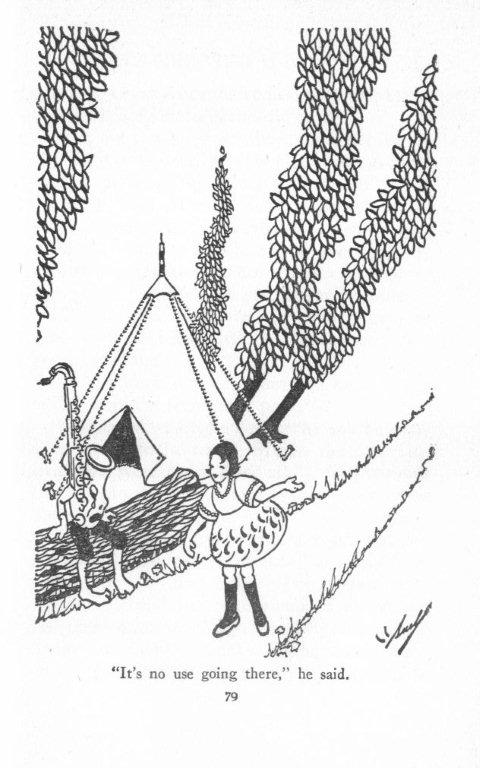
Alice in Orchestralia, illustration by Carroll C. Snell
Nowadays, there is little dispute that the saxophone is a genuine woodwind instrument (using historian Curt Sachs’ terminology, a “single reed aerophone,” like the clarinet), the method of sound production being more important than the material from which the body is made. In fact, if the saxophone’s metal construction were truly disqualifying, one would also have to evict the metal clarinets and oboes that have been experimented with over the years, not to mention the flute.
There is also no question that the saxophone (or rather saxophones, in several sizes) has earned its place as a recognizable and easily available instrument, at least the sizes in common use. Unlike the ophicleide it is hardly obscure, and unlike the harpsichord it has never really gone away since its invention.
Still, the saxophone’s dual nature has been problematic since Adolphe Sax patented it in Paris in 1846. Most texts point out that Sax combined the clarinet’s single reed with the oboe’s conical bore, resulting in an easy-to-blow woodwind with a simplified fingering (the clarinet’s cylindrical bore causes it to overblow at the twelfth rather than the octave, resulting in a more complicated fingering pattern); historian Anthony Baines, however, speculates that Sax may have hit upon this combination by attaching a bass clarinet mouthpiece to an ophicleide—both instruments were specialties of his shop—creating a true woodwind-brass hybrid. Likewise, its brass construction and wide bell give it a powerful tone that blends equally well with brass or woodwinds, so it’s not unreasonable to consider it a bridge between the two groups.
The saxophone was initially developed with the military band in mind, and it was quickly adopted by the French authorities for that use. However, the qualities that made it perfect for bands—its volume, its distinctive timbre—have made it only an occasional visitor to the orchestra as a special color, despite Hector Berlioz’s enthusiastic prediction that it—or rather, an entire section of them—would become a regular part of the orchestra of the future. (It’s often forgotten, in fact, that Sax’s original design included two families: a group in the “band” keys of B-flat and E-flat, and a group in C and F for orchestral use. Of the second group, the C “melody” saxophone, a tenor that allowed sax players to read from scores in concert pitch, survived the longest but was out of production by the middle of the twentieth century.)
One could easily be led to believe that the saxophone’s adoption by jazz bands in the early twentieth century led to its increased popularity, but the opposite appears to be true, at least in the earliest days of jazz. Concurrent with the rise of jazz was a fad for saxophones (and other “novelty” wind instruments) on the Vaudeville stage, led by such groups as the Six Brown Brothers (who were active from about World War I until 1933). The saxophone became (along with the banjo) a symbol of student life, as necessary to depictions of 1920s college students as the raccoon-skin coat and football pennant, and a musical shorthand equivalent to the bongos in the beatnik ‘50s or sitar in the psychedelic ‘60s.

Bringing Up Father, 1936
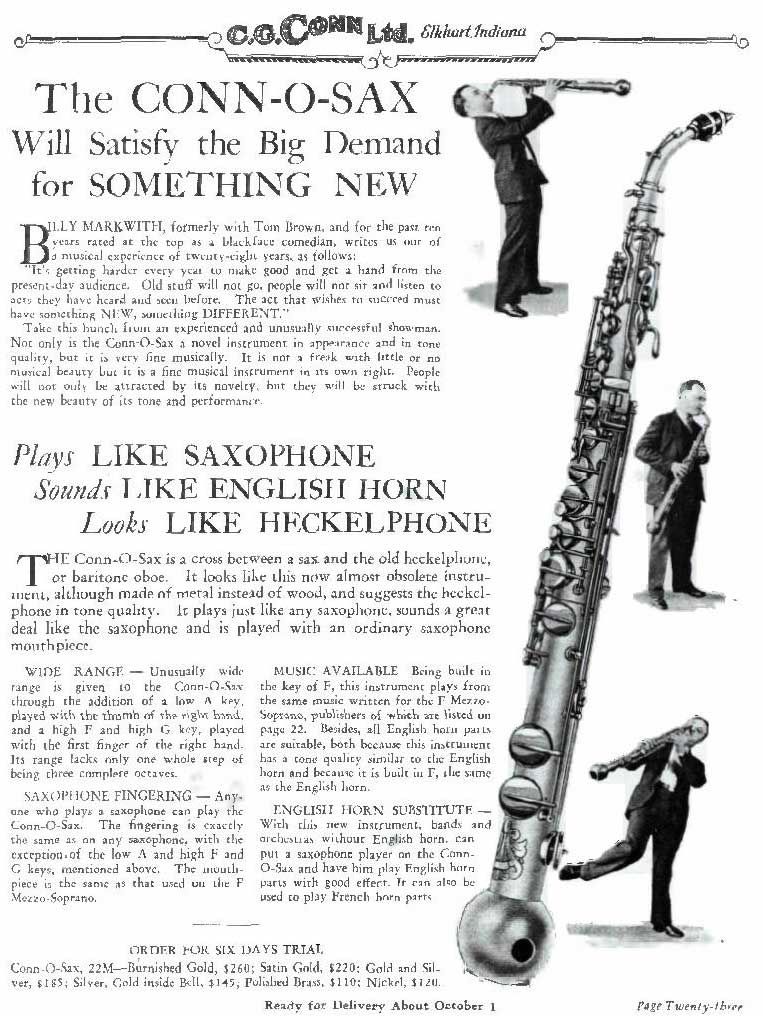
Manufacturers responded to the instrument’s popularity with a number of short-lived saxophone variants, some (like the slide saxophone) little more than novelties and others simply straightened out standard saxes. Of greater interest is the “Conn-O-Sax,” a straight F alto with a resonating bulb on the bell, and clearly positioned as a single-reed alternative to the English horn. The Conn-O-Sax was only made in 1929 and 1930, and examples are now very rare and highly collectible, but it has been adopted by some jazz players and shows like Saxophobia, which specializes in demonstrating a wide variety of old and new saxes. It is a unique instrument, and it seems that there would be a market for a modern reproduction, or perhaps even a revival by the Conn company.
When the saxophone was heard in jazz of the 1920s, it was most frequently a soprano replacing clarinet or cornet, or bass, replacing the tuba or string bass. There just wasn’t room for the alto or tenor to play in the improvisatory New Orleans style without stepping on either the cornet or trombone line. (It is for this reason that the tenor saxophone included in much post-World War II “Dixieland” sounds especially inauthentic.) It wasn’t until jazz migrated to Chicago and New York that a fad for oddball instrumental combinations, at least on record (including such eccentricities as the “goofus,” a kind of melodica*, and even “swing harp”—orchestral harp, that is, not harmonica), made room for the saxophone as a lead instrument.
Exceptions include the larger bands fielded by King Oliver and Fletcher Henderson and the “symphonic jazz” of Paul Whiteman’s orchestra, but in those groups arrangements became more necessary to corral the larger numbers of players. The differentiation between soloist and accompaniment is clearer, foreshadowing the swing style of the 1930s. The saxophone’s presence thus became a dividing line between “hot” and “sweet” players, and between New Orleans purists and fans of the coming swing era: some of the harshest criticisms come from jazz historian Rudi Blesh, who as late as 1946 bemoans the replacement of the trombone with the saxophone in the Chicago style in his New Orleans-centric history Shining Trumpets: “For even an inferior trombone breathes new life into the music which the fashionable foghorn, the saxophone, had murdered.”
The saxophone fad eventually gave way, as all fads must, but not before the association between the saxophone and jazz had become permanent. Even before its versatility and technical fluency made it a natural vehicle for such giants as Coleman Hawkins, Charlie Parker, and John Coltrane, the saxophone became an internationally recognized symbol, embraced by energetic youth and reviled by totalitarian governments. It’s no wonder: the saxophone may have started out with the body of an ophicleide or bass clarinet, but its shape is unique: in profile it makes a perfect logo. As Czech novelist Josef Škvorecký writes in his essay Red Music, both the Nazis and the Soviets sought to root out the saxophone (replacing it with the cello in most cases), but for opposite reasons: to the Nazis the saxophone’s association with an African-American musical form made it musically suspect (even before that, Germany had been one of the few nations to exclude the sax from its military bands); to the Soviets the hybrid nature of the instrument was somehow “bourgeois,” not of the people. Ultimately the saxophone has outlasted both of them.
* A favorite solo instrument of Adrian Rollini, who was also known as the “Wizard of the Bass Sax.” Rollini was truly a renaissance man of offbeat instruments.

Pictured above is an ophicleide, an obsolete wind instrument from the early nineteenth century. It was played with a cup-shaped mouthpiece like a modern brass instrument, its length comparable to that of a trombone or euphonium, but instead of valves it had fingerholes and mechanical keys like a woodwind. The ophicleide was just one of several instruments built along these lines, including the keyed bugle and the picturesque serpent (which predated the ophicleide as the bass member of the family: “ophicleide” actually means “keyed serpent,” in fact). They filled the need for loud brass instruments that could play chromatic pitches instead of the limited range of notes available to “natural” brass like the bugle or hunting horn, especially in outdoor settings. Before the invention of valves in the nineteenth century, only the trombone had such a capability. The keyed brass filled that niche, but imperfectly: when the side-holes were opened, the acoustics of the instrument were compromised, and the sound was something like a tuba springing a leak. Once valves were perfected and widely manufactured, it was all over for the keyed brass: the ophicleide gave way to the tuba, the keyed bugle to the cornet.
The nineteenth century was a period of great upheaval in instrument design. In general, the era was dominated by both invention and improvements to existing instruments, sometimes defined as updating historical instruments to fit the demands of new music and the giant concert halls in which it was performed. Violins dating from the seventeenth century were frequently rebuilt with longer necks and fingerboards to increase the string tension (and thus volume); bridges were raised; the square bow replaced the old curved bow, again in the name of greater focus and projection; gut strings were replaced with more reliable metal wound strings. Changes like that were largely invisible if one were only examining scores; the advance of musical technique on the players’ part would be obvious, but it was still possible to play the music of Bach or Corelli on the updated strings. In the case of Bach, his music had been largely unknown until its revival by Felix Mendelssohn and others in the early nineteenth century, so there was little concern that modern performances wouldn’t sound like they had in his day. In any case, it was common to rationalize that Bach would have taken advantage of modern developments if they had been available to him: it wasn’t called the century of progress for nothing.
Still, as tempting as it was (and often still is) to think of music in evolutionary terms, “survival of the fittest” didn’t always mean what its proponents thought it did. Technological superiority didn’t always lead to success in the marketplace or long-term artistic change. We often describe the sections of the orchestra as instrumental families, and a historical chart of instruments’ development very much resembles a family or evolutionary tree. In the case of music, however, the “environment” to which technological innovations respond include cultural attitudes, aesthetics and in some cases the whims of artists. It can take years for new inventions to find a foothold, or perhaps they never do at all. As with any other technology, the history of musical instruments is one of invention and innovation colliding with social use and craft tradition. Change is often slow, and the repertoire composed for an instrument may be enough to keep it in use despite acknowledged difficulties. Just as some argue that Betamax was superior to VHS, or that the QWERTY keyboard wasn’t necessarily the best arrangement for typewriter keyboards, instruments are adopted and thrive for reasons that sometimes go beyond their utility.

The double chromatic harp, a design that failed to catch on. Source: Metropolitan Museum of Art
This is especially true in the orchestra. New instrumental technology is sometimes rejected for being too radical; I won’t generalize about the conservatism of musicians, but suffice it to say that most classical musicians have a deep, lifelong investment in the traditions of their instrument, as well as the literature and institutions of concert music. Changes in the way those instruments are played do occur, but only after long and careful evaluation, sometimes over generations, and frequently dividing performers over the worth of competing methods.
More importantly, styles change, and sounds that are valued in one era become tiresome or obnoxious to the next. During the middle ages in Europe, for example, double reed instruments and bagpipes were very prominent. Trumpets, their bells decorated to look like dragons or other beasts, often had tongues soldered into the bell that would vibrate when played, giving an extra buzz to the sound. Some of the prominence of double reeds is due to their relative volume—even into the classical period they were among the loudest instruments available, especially for outdoor performance—but there was clearly an aesthetic that favored the bright and nasal, and the use of sympathetic vibration fit well with simple drone-based harmonies.
It’s unwise to count an instrument out too soon: by the end of the nineteenth century, the harpsichord was considered dead, replaced by the piano, and there was nothing unusual about performing the music of J. S. Bach on a twelve-foot grand piano. Gradually, the harpsichord returned to prominence as the “early music” movement took hold, and not only as a vehicle for historically correct performance: new works were composed for it that took advantage of its dry, tinkling sound (a sound which, not coincidentally, now fit the reigning neoclassical sound better than it had fit the sumptuous and overpowering orchestration of the romantic era). Even so, the earliest proponents of the harpsichord carried with them assumptions born of the nineteenth century. Wanda Landowska, a vocal proponent of original intent (“You play Bach your way, and I will play it Bach’s way,” she once said) performed on an iron-frame harpsichord built for her by piano manufacturer Pleyel, and the sound is correspondingly huge, fit for the kind of large concert halls that Bach never knew, but which were standard by the beginning of the twentieth century.
In the end, one of the few composers to use the ophicleide extensively was Hector Berlioz, who included them in his Symphonie Fantastique and other scores. (Berlioz was an early adopter, enthusiastically seizing on new and improved instruments to expand his orchestral palette; perhaps tellingly, Berlioz was one of the few Romantic composers who was not himself a virtuoso with a strong investment in the established order; like Wagner, he made the entire orchestra his instrument.) The parts are generally played on tubas without sacrificing much of Berlioz’s vision. However, hearing the Dies Irae section of the Symphonie played on ophicleides, as in this recording made by John Eliot Gardiner with his Orchestre Révolutionnaire et Romantique, makes it clear that there is still a difference. Such instruments may be historical curiosities, but they need not be forgotten entirely.
In my next installment, I’ll take a look at an instrument that exemplifies many of my above points about invention and tradition: the saxophone.
Ravel: Daphnis and Chloe Suite No. 2; Poulenc: Concerto for Two Pianos; Stravinsky: The Rite of Spring
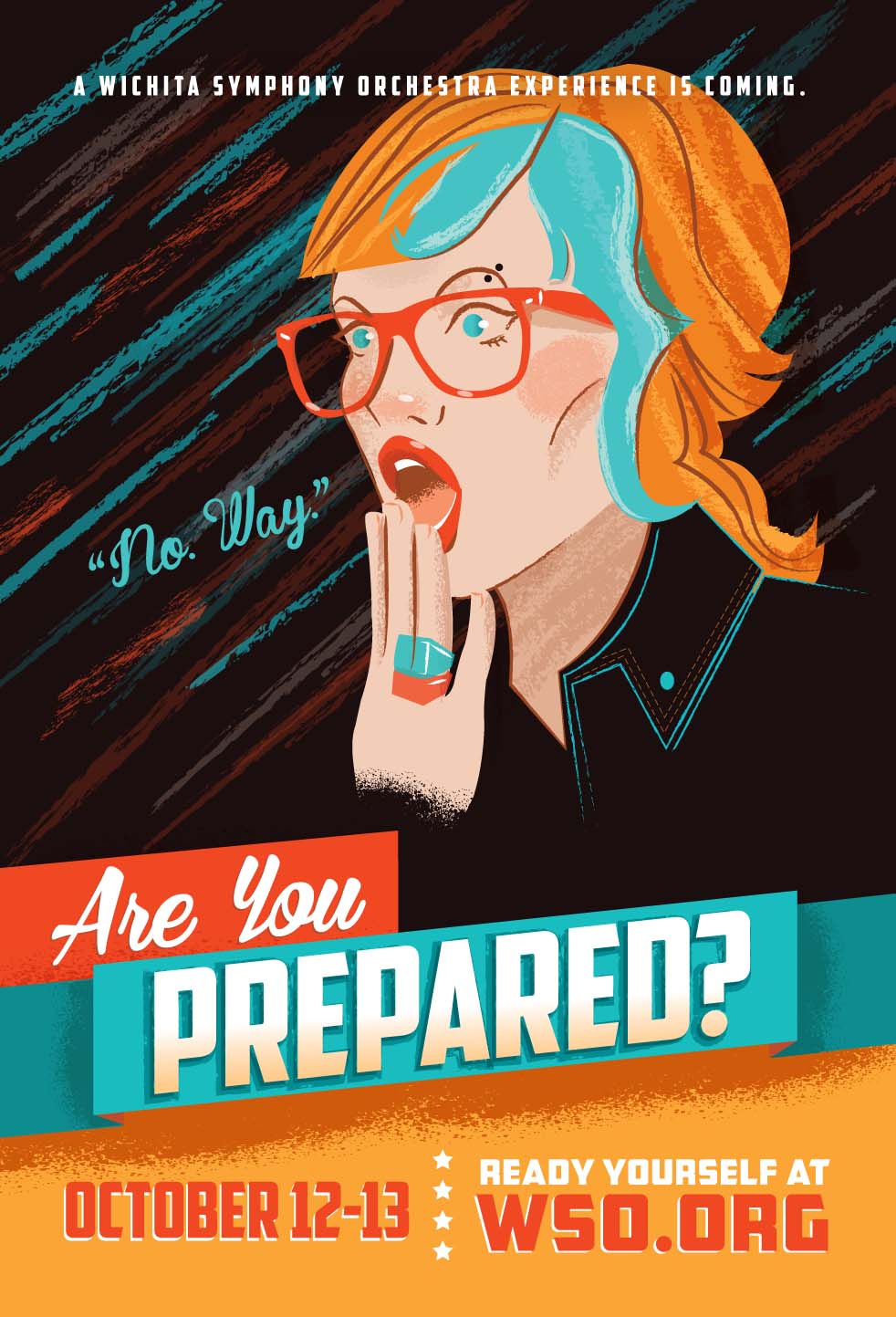
I’m happy to say that there were quite a few younger people at Saturday’s Wichita Symphony Orchestra concert, but there were enough empty seats that there is room for more. Perhaps they were persuaded by the WSO’s aggressive new ad campaign (I’m particularly taken by the suggestion that activities like jai alai will help audiences prepare for the heart-pounding excitement of a symphony concert); I saw several take advantage of the WSO’s $5 student rush tickets (one of the best-kept entertainment secrets in town). Either way, I’m not inclined to blame them for the repeated interruptions from cell phones during the concert; in my experience, older concertgoers are equally likely to forget to turn them down. I don’t believe the concert hall should be a mausoleum: Century II has already made the decision to allow food and drink in the hall during performances, probably in the interest of creating a more welcoming environment, and I’m sure it helps the bottom line. Even so, one could sense the audience’s frustration when Maestro Daniel Hege waited for the ringtones to stop before beginning The Rite of Spring (the concert’s second half), and one still started chirping during the lightly scored woodwind introduction. At best it’s an annoyance to other patrons; it worst it can interfere with the performance itself. It’s not a lack of education, or the influx of newcomers to the Symphony, it’s simple mindfulness: if the Warren Theatres can police cell phone use at the movies for the sake of a better experience, surely a live music venue can do the same.
Anyway, here’s what I wrote for The Wichita Eagle.
It occurs to me that in delving into the history of recorded music, I have somewhat strayed from my stated purpose of looking at influential or personally important anthologies. In this final installment of “The Pleasure of Anthology,” I’ll look at a work that is both: Harry Smith’s Anthology of American Folk Music. Smith is a fascinating figure by himself, and the AAFM, which he put together for Folkways Records in 1952, is only a small part of his artistic output, which included experimental films, paintings, and poetry, as well as ethnographic research on American Indian rituals, string games, and dance (Smith studied anthropology in college, but had begun his studies even younger, visiting an Indian reservation near his boyhood home in Washington state and recording and interviewing members of the tribes there). It is the AAFM, however, that has had the most enduring influence.
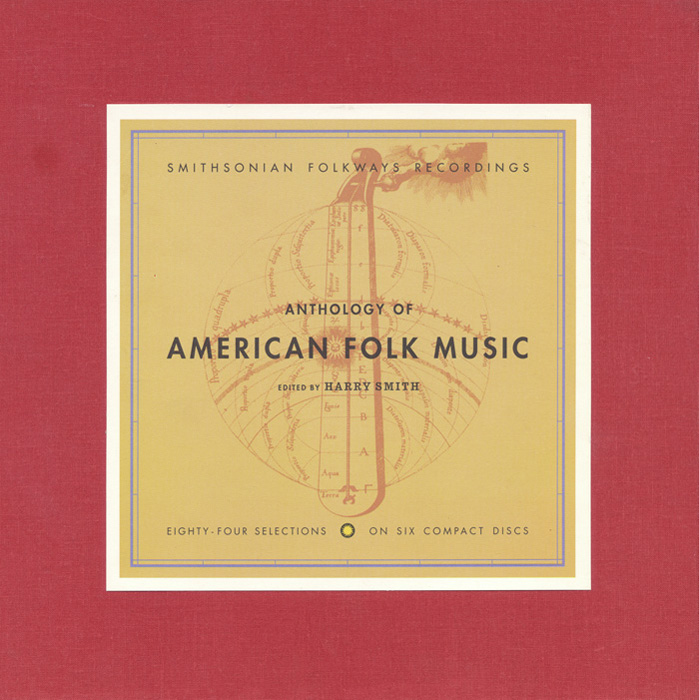
Peripatetic, Bohemian, obsessive Harry Smith has more in common with the anthologists like Bill Blackbeard than might first appear. One of the primary accomplishments of his Anthology was to put an unacknowledged, even disdained, part of history front and center in the popular consciousness: the commercial recordings made by rural Southerners before the Great Depression. Such records were produced by big Northern labels like Columbia and Okeh after they realized that people (both black and white) in isolated small towns would buy records made by people like them. The countless 78s that Smith tracked down, collected, and sorted through held ballads, fiddle tunes, jug band stomps, and quasi-musical sermons, among other genres, either recorded on the spot by traveling recording outfits or in studios in Chicago or New York. Almost all of these were relegated by their original labels to “race” or “hillbilly” lines, for black and white customers, respectively, and as such were promoted only in limited areas and then forgotten. Not for these records would there be red labels or pink-paged catalogs.
Smith was one of many collectors scouring the countryside for old records—there had been a lively community of jazz and blues collectors, united by newsletters and fan-assembled discographies since the 1920s—but Smith was one of very few looking for “folk” music, and he was by far the most knowledgeable, generous with his learning if not with the records themselves. (According to fellow collector Luis Kemnitzer, “He would lend out books that he thought you might want, gave away paintings and collages, but once a record came into his room it never left.” Don’t we all know someone like that?)
Smith’s work was preservative, too: according to Smith’s longtime friend, poet (and founding member of The Fugs) Ed Sanders, “There was a big drive by the government to collect laminated records in order to secure the shellac for the war effort, so the records he was particularly seeking, from the 1920s and ‘30s, were in great danger of being wiped from history, a factor which may have given his collector-obsession an extra energy. On the other hand, the government drive brought millions of records out of the attics of America, making them easy to find.”* As with the science fiction anthologists, passionate collectors like Smith not only chose the best examples of their medium to showcase, they effectively created new fields, new spaces for preserving and discussing cultural artifacts that might otherwise be forgotten.
The songs themselves sound much older than the mere two or three decades that separated them from 1952; listeners who had only been familiar with the music of polished groups like The Weavers were struck by the stark, ghostly quality of many of the voices and the sometimes eccentric quality of the music. Even though many of the recording artists were professional musicians (on a regional level, at least), there is nothing slick or cookie-cutter about them; they have more in common with the rough-hewn, self-taught geniuses of the early jazz era, and in the best of these recordings there is something of the same energy.
The 84 recordings Smith chose are divided into three volumes: Ballads, Social Music, and Songs, each volume originally on two LPs. Smith’s ordering and his brief, even telegraphic, notes are carefully considered to guide the listener through the not-so-distant but disappearing land that Greil Marcus called “The Old, Weird America.” Smith saw the project as half scholarly and half an agent of cultural transformation, but he mostly lets the music speak for itself. If there is an agenda beyond simply making the music more available, it might be found in Smith’s refusal to list or even acknowledge the race of the performers, instead emphasizing the connections that transcend segregation. In Marcus’ words, “Linking one performance to another, he ultimately linked each to all”—an excellent description of what a great anthology can accomplish.
Everyone has their favorite disc in the Anthology; the Ballads and Songs of Volumes One and Three appear to have had the most influence on the contemporary folk movement, but the “Social Music” of Volume Two is mine. Most of the tracks are instrumental, rhythmic fiddle or banjo music for square dancing (on “Georgia Stomp,” the fiddler calls the dance steps out as he plays), as well as what can only be called good-time party music (“Moonshiners Dance,” one of my favorites, sounds like a rural Spike Jones by way of an A&M college bash). All of these dance numbers fit into the two- to three-minute span of a record side, but within that short time they create their own worlds. There is a droning quality (in the literal sense of a repeated pitch or chord) that one easily associates with “primitive” music, to the diddly-bow or the monochord that fascinated Smith, and some of the music is genuinely archaic—pan pipes are represented, made of reeds cut by hand—but mingled with urban trends or Tin Pan Alley standards that show the creeping influence of radio and commercial sheet music.
There are songs on Volume Two, as well—not “Songs” as Smith defined them, but vocal music nonetheless. I sometimes presented Jim Jackson’s heartbreaking “Old Dog Blue” as an example of a “floating couplet” proto-blues song when I taught Music Appreciation, an act of bravery (or foolishness) considering it’s hard for to listen to without getting choked up. Like other songs on the Anthology that have been the focus of intense study, “Old Dog Blue” is at once crystal-clear on the surface—a reminiscence of a faithful hound, now passed away—and deeply mysterious, with seemingly biographical references (like “a little bitty girl with a red dress on”) thrown in, suggesting an entire life in the same way a white tip on the ocean suggests the iceberg beneath the surface. Whether the lyrics are drawn from Jackson’s memory, the common property of rural song, or consciously constructed by Jackson, the result is a song that seems to imply more than it says. The Romantics like Robert Schumann knew how evocative fragments could be, leaving gaps for the listener’s imagination to fill in: Jackson, and many of the other artists present, do the same, whether on purpose, or because of the limitations of recording, or simply because of the cultural gulf that separates us from them.
In the original booklet that came with the AAFM (reproduced for the lavish 1997 CD rerelease), Volumes Four, Five, and Six were promised, but they never arrived. According to knowledgeable sources there were disagreements over the playlist between Smith and Folkways publisher Moses Asch, and Smith, ever temperamental, dropped the project.** Later, Smith seems to have simply lost interest in this kind of anthologizing, moving on to studying quilt patterns and other, more physical, examples of folk life. Within a few years of the original AAFM there was a flood of rereleases of similar material, fueled by the interest Smith had awakened. It didn’t seem as important for him to continue since others had picked up the thread. How short a creative period may turn out to be, especially for one with such diverse interests as Harry Smith: what may appear to be a mercurial temperament may simply be a restless intellect, always searching for new territory to explore.
*A comparable situation prevailed in the mid-1990s, when I was doing my most serious collecting: vinyl was considered dead, doomed to be replaced by CDs, and almost every garage sale or junk store had a crate (or several) of records at bargain prices.
** Following the CD reissue of the AAFM, a fourth volume was released on the Revenant label in cooperation with the Harry Smith Archives, based on a playlist Smith had compiled but with notes written by others. Although it is little more than a footnote to the original AAFM, it’s still a worthwhile sequel, concentrating on music from the 1930s, and it includes songs that would become classics when reissued by others: Robert Johnson’s “Last Fair Deal Gone Down” and The Carter Family’s “No Depression in Heaven,” for example. It is from the liner notes to Volume Four that I have drawn Ed Sanders’ comments.
When I was growing up, there were quite a few format choices if you wanted to buy a recording of a song you liked. 45 rpm singles were the most popular with young listeners like me, and I had quite a few of those; my sister had even more. 45s were so ubiquitous that I remember the local radio station handing them out at parades. There were albums, too, of course, long-playing 33 1/3 rpm records that contained ten songs or so—the hits, and a bunch of other stuff that might be good, but you’d have to buy the album to find out, as they never played the non-single tracks on the radio. The first two albums of my own were Pac-Man Fever and Styx’s Kilroy Was Here, both of which I played non-stop, so that should tell you everything you need to know about me as a child.
Nowadays, the greatest disdain is reserved for the “greatest hits” package: when somebody lists a Greatest Hits as one of their favorite albums, it smacks of dilettantism; the implication is that their knowledge is only surface-deep or defined by songs that someone else decided were “the best.” In short, they have committed the sin described by the record store clerk I mentioned previously, putting someone else’s preferences in place of their own. Worse, the Greatest Hits divorce songs from their context within the album. According to this point of view, the ideal recording artist makes statements at the level of the album, not the individual song, with each song contributing to a greater whole, like movements of a symphony. That’s true of some albums and recording artists, but really only a minority, and even looking back to the “good old days” when albums were king paints a misleading picture. As I recall it, the only albums that everyone agreed on back then were the mega-hits like the Saturday Night Fever soundtrack and Michael Jackson’s Thriller, an album that was so huge that on the last day of school my fourth grade class gathered to watch the full-length music video for the title song as a treat. Albums like that could stay on the charts for months, even years, releasing singles until you had heard so many of the songs that it seemed silly not to give in. The “all killer, no filler” album was a rarity, of course—it was more common for there to be two or three good songs and a bunch of forgettable junk—that was why it was so exciting when one came along.

Histories of the record industry tend to emphasize how revolutionary the long-playing record was when it was introduced in 1948. No longer did listeners have to get up and change the record every few minutes: they could put on an LP (or several, if they had one of the newer phonographs with an automatic record changer) and have uninterrupted background music at home for (potentially) hours at a stretch. Between the LP and radio, music lovers had fewer reasons to go out; once television was introduced, the media cocoon of the second half of the twentieth century was complete.
However, LPs first became popular as a vehicle for Broadway soundtracks, classical music and the emerging genre of “mood” music, i.e. music for grown-ups. The transition to the album format was much slower for youth-oriented music like pop, rhythm and blues, and rock and roll. The single was still king in those genres until the 1960s, and artists were expected to record in both formats: as Elijah Wald describes in How the Beatles Destroyed Rock ‘N’ Roll, artists such as Frank Sinatra and Sarah Vaughan recorded adult-oriented “theme” albums as well as pop singles, effectively for two different audiences:
Although Sinatra placed nine albums in the top two chart positions between 1955 and 1960 and had six top-ten singles in the same period, they included no overlapping tracks. Even a song as iconic as “One for My Baby (and One More for the Road)” was strictly an album track, and though Capitol also released compilations of his singles, those packages never did as well as single-less sets like Come Fly with Me and Only the Lonely. . . . Elvis was the only artist to be equally successful in both formats without specifically tailoring his LPs to the adult market.
Gradually this changed, and in the 1960s the Beatles turned their albums into thought-out, aesthetically unified song cycles, eventually abandoning live performance altogether so they could concentrate on their studio work; Sgt. Pepper’s Lonely Hearts Club Band (released in 1967) is generally cited as the first “concept album,” the term by which such efforts would be differentiated from the more typical collection of unrelated songs, but it was preceded by Sinatra’s albums, the Beach Boys’ Pet Sounds, and the Beatles’ own Revolver, albums whose contents are unified not only by thematic connections but by sonic ones as well: throughout the 1950s, instruments were often added to pop recordings for the novelty value: Mitch Miller’s production of Rosemary Clooney’s singles include harpsichord, marimba, and oboe, for example. For Pet Sounds, Brian Wilson went much further, creating an instrumental pallet that included strings, brass, and free reeds (accordion and bass harmonica), giving the entire album an unprecedented unity. The studio revolution of the psychedelic ‘60s was built on a foundation that included Miller, Sinatra’s arranger Nelson Riddle, and Wilson’s idol Phil Spector, as well as the avant-garde electronic experimentalists (like Karlheinz Stockhausen) cited by the Beatles.
Such aesthetic unity is the real legacy of this fertile period, not the “concept album’s” pretensions of narrative specificity. After the 1960s it would be unusual for a rock or pop album to lack a unified sound: artists might change their approach from album to album (sometimes drastically: think David Bowie), but each album was judged as an artistic statement akin to a Romantic symphony, whether or not it had been conceived as such. As an example, They Might Be Giants’ 2001 album Mink Car, with its mixture of production styles and genre exercises, is often dismissed by fans, and even for its defenders (of which I am one) it feels like a “greatest hits” package, lacking the organic sense of “togetherness” listeners have come to expect from albums.
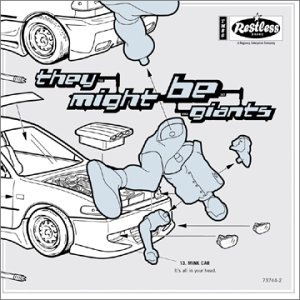
But perhaps it’s not Mink Car that’s out of step: shortly after its release the same year, the iPod popularized “shuffling” as a listening mode. CD players had featured shuffle mode since their introduction in the 1980s, and multi-disc changers allowed listeners to play tracks from several CDs in random order, but the iPod allowed one to randomize a complete library of mp3s, a listening experience that could be disorienting, exciting, and liberating—specifically, liberating songs from their contexts within album playlists. Suddenly, the single was fashionable again.* They Might Be Giants had previously put a set of short (most just a few seconds) songs called “Fingertips” on their album Apollo 18, specifically to take advantage of the shuffle feature. The iPod made it possible to shuffle their entire catalog, for example, and in that context the variety of styles on Mink Car didn’t seem out of place at all.
The term “album,” applied to LPs, was borrowed from previous 78 albums, which had several sleeves bound together to hold multiple discs; the resulting product was much like a book, and comparable to a photo album. Moreover, some albums were sold in the same way as photo albums: empty, with room for listeners to keep their favorite discs in the pockets. In that sense, the album was purely a storage solution. Like iTunes customers today, and like teenagers in the 1950s, 78 buyers often preferred to buy only the songs they wanted, not the complete albums assembled by record producers.
Yet even that is predated by the use of “album” as a collection of music; in the early nineteenth century it became fashionable for composers to sketch short pieces of music in the albums of their friends or patrons, sort of like signing their yearbook. These short pieces were known as Albumblätter, or “album leaves.” Gradually the term came to be applied to any short piece dedicated in such a manner; Beethoven’s famous Albumblatt für Elise was one such. From there it was a short jump to composing sets or cycles of short pieces and designating the entire work as an “album.” Robert Schumann composed sets titled Albumblätter and Album für die Jugend (“Album for the Young”), and other composers followed his example. Schumann, in particular, was interested in cyclical forms that included hidden connections between otherwise quite different movements. When considering the classical forefathers of the “concept album,” in addition to the usual grandiose, totalizing suspects such as Richard Wagner and Gustav Mahler, a nod should also be given to Robert Schumann.
Publishers also assembled “albums,” bound volumes of compositions by particular composers, and of course sheet music is still published in that format today (although, like books, recorded music, and everything else, it is also available in a dizzying array of digital formats). Interestingly, Beck released an album in 2012, Song Reader, that hews to this original definition. Of course it is common for sheet music to popular albums to be published, but in Song Reader’s case there is no audio version, at least not officially: Beck has invited readers of the book to upload their own versions of the songs to the Song Reader website, a case of modern technology putting a new spin on social music-making forms that had mostly been marginalized by that technology decades earlier.
* Moby, an early and vocal advocate of the iPod, was featured on the cover of The New York Times Magazine in 2002; superimposed over his photo was a list of the contents of his iPod. The implication was clear: the iPod hadn’t just changed the way people accessed their music collections—it had given birth to a new aesthetic of musical mixing and matching, embodied by Moby and his output. Interestingly, the article describes how carefully Moby sequenced the songs on his albums, even with the knowledge that the producer no longer has the final say in the listener’s experience, if he ever did. If we don’t see as many of those media think pieces about “remix culture” anymore, it’s largely because the concept has become so commonplace as to be invisible.
(Continue to Part Seven)
A few years back I was browsing a new-and-used record store in Kansas City. It will surprise no one that my affection for old book sales also extends to the crates of old records at music stores, and I used to spend many happy hours browsing their shelves. I drifted down into the basement, where there were quite a few CDs and records, including 78s, of early jazz, one of my passions. I was looking over a CD of guitarist Eddie Lang’s collaborations with violinist Joe Venuti, chatting with the clerk, a guy with a handlebar moustache, horn-rimmed glasses and a Hawaiian shirt (this was about fifteen years ago, before such a combination would be so commonplace as to be a hipster cliché). He was justifiably proud of the store’s selections of 78s, but when I mentioned I didn’t have a 78 player and mostly relied on compilations, he sniffed, “I don’t like to let anyone else tell me what I can and can’t listen to.” The conversation was effectively over.
I didn’t take it too personally. A run-in with a snooty record store clerk is practically as much a rite of passage as throwing away one’s old comic books only to regret it later, and in the broader sense I agree with him. As much as I respect the anthologist’s art, I’m all too aware of how much is out there that won’t be repackaged in modern formats. I have a 78 rpm record player now, but hardly any discs to play on it. I’m grateful for such online institutions as the Cylinder Preservation and Digitization Project, which makes very old and/or rare recordings available, the only filter being the rate at which its curators can acquire and digitize its holdings, but at the time of this conversation that would be a few years in the future.
What strikes me in hindsight is how different the attitude toward compilations is among music fans and readers of short stories. I’ve never heard a sci-fi reader turn up his nose at a Groff Conklin anthology and say, “No thanks, I’ll stick to my issues of Astounding and Unknown Worlds.” Very few will bother to track down a Kurt Vonnegut story in Playboy when it can easily be found between hard covers. True, hardcore record collectors are also a minority, but the concepts of authenticity and authorial voice are different in the two areas.
To a large degree, this is due to the ephemeral nature of print magazines and the vital role anthologies have played in both keeping stories alive and developing a canon of widely-known and –respected work. As anthology expert Bud Webster compellingly argues in his Anthopology 101,
There were paper drives here in the US well into the 1960s, and had been since the war years; thousands of old magazines were recycled in these drives, not counting the ones that were simply tossed out after reading, or the collections “cleared away” by well-meaning mothers when their sons and daughters went off to college. Were it not for the anthologies and their editors and publishers, much of the science fiction we grew up reading and wondering over might never have been reprinted.
It should be obvious that this goes double for comic books and triple for newspapers.
By comparison, there was nothing ephemeral in the way recorded music was packaged and sold. Quite the opposite: before the advent of recording, a performance could be heard only once and was then gone forever. Recording, in the words of David Suisman in Selling Sounds, stopped the flow of time “as a dam holds back the flow of a river,” storing sounds indefinitely in the grooves of a cylinder or disc. The permanence of records didn’t always live up to the hype (records could warp, scratch or crack from mistreatment, or wear out through overplaying; even compact discs weren’t quite as invulnerable as they were originally made out to be), but it represented a huge change, and one that took nearly a decade for both consumers and producers to get their head around.
From about 1890 to 1900, Edison cylinder phonographs and competing disc-based gramophones were known as “talking machines;” Edison predicted that his device would find its greatest utility in business as a dictation aid, and a great deal of the recordings commercially sold were famous speeches, passages from the Bible, and the like. Up until the turn of the century, such machines were little more than a novelty.
Criticisms of “disposable” pop music and novelties are as old as the music industry itself, and that label adhered to both Tin Pan Alley pop songs (which pioneered the kind of built-in obsolescence associated with “one-hit wonders” and prefab stars), most commercial records, and the machines themselves. It was the Victor Talking Machine Company, a competitor of Edison and Columbia, that realized they could sell more machines by creating a musical product with cultural cachet—in modern terms, hardware sales could be driven by providing desirable software—and in 1902 the Victor Red Seal series was born.
The Red Seal records featured respected musical artists (most famously the Italian tenor Enrico Caruso; the Red Seal artists were predominantly European, an important signifier of quality in American culture) performing operatic excerpts and other high-status repertoire, recorded with the best quality possible. Just as important, the Red Seal records were set apart from the regular “Black Seal” series by their packaging (the “Red Seal” refers to the red paper labels on the records) and by a higher price; they were even listed in a separate section of the Victor catalog, printed on pink pages. Their desirability was part of a marketing strategy; even Victor’s executives admitted that the Red Seal records didn’t sell as well as the Black Seals, but they were an effective advertisement for the line as a whole. More to our point, as Suisman says, “the Red Seal records were quintessentially middlebrow; they presented an ad hoc assortment of digestible classics [the length of a record side was only two to four minutes] as a timeless and definitive canon.” They made it psychologically okay to value records as something other than a passing fad, and transformed the fledgling industry.

So we’ve established that records, once they found a foothold and adjusted listeners’ expectations, aspired to a permanence that fiction might only attain when safely preserved in book form. There is also the difference between recorded sound and print media: the words of a story are the same (barring drastic editorial change) whether in a magazine or a book; they can even be translated into another language. In some cases, the book versions of stories are more definitive, removing editorial changes (or misprints) and allowing the author’s original voice to come through more clearly. By contrast, the promise of audio recording is its faithfulness, the idea that you are hearing a piece of music just as it was performed by the artist; what could be more authentic than that? The transfer of music from one format to another has been fraught with controversy among listeners; indeed, Victor and the other record companies had to work very hard to make their limited recording facilities sound as good as they did before the introduction of electrical recording in 1925 (they weren’t necessarily trying to convince listeners that a recording was “just as good” as a live concert; they counted on the fact that for most people, a record would be as close to hearing Caruso as they ever got). In converting monophonic recordings from 78s to LP, producers sometimes introduced “fake stereo,” the aural equivalent of colorizing a black and white movie. The debates over the merits of analog vs. digital sound are well known, and the primary appeal of mp3s has been convenience, not sound quality.
Finally, there is the context of the individual song itself, and I think this is where anthologies become suspect for many purists. In my next installment, I’ll look at the concept of the album, and its rise and fall in importance to recorded music.
Speculative Fiction with a Punch
The Unofficial Repository of All Namco Knowledge
Exploring Contemporary Fiction - New, Speculative, Odd
Movie Serial Reviews and Other Cliffhanging Material
 Medleyana