Where Seldom is Heard: a Sesquicentennial Overture

I’ve previously shared some of my thoughts on medleys, and my interest in them as a genre unto themselves, and the upcoming observation of Kansas Day (January 29) is as good an opportunity as any to share one of my own.  2011 marked the 150th anniversary of Kansas’ statehood, so in advance of that date I suggested to Bill Johnson, director of the Senseney Music Community Band here in Wichita, that I compose a work to honor the anniversary.  Since the band didn’t play during January, the finished work could be performed during the band’s summer season (months after Kansas Day, but still within the anniversary year).  He expressed his interest and I got to work.

Tragic Prelude by John Steuart Curry, a painting representing "Bleeding Kansas" hanging in the Kansas State Capitol

Tragic Prelude by John Steuart Curry, a painting representing “Bleeding Kansas” hanging in the Kansas State Capitol

I’ve been involved with the Senseney Band for many years, and have written for them before.  It is a community band, open to any adult musician without an audition, but standards are high and everybody who plays in the group knows what is expected.  Many in the group are professional musicians, and many more are trained musicians who happened to make their careers outside of music.  Still, to cope with the varying levels of ability, I would compose with an eye toward keeping the most difficulties in the first parts and making section parts easier (early on, we thought we might perform this work with high school or other community bands joining us, which would also be made easier by this practice).

In the year or so leading up to the planned premiere, I did what most composers do: I procrastinated.  Well, I called it “research.”  I read up on Kansas’ aviation history; I learned about the Kanza and Wichita Indians; I read In Cold Blood and listened to “Wichita Vortex Sutra.”  I imagined multi-movement forms, cyclic works, pieces that would take the audience from the prehistoric ocean that once covered the plains through important moments in Kansas history and beyond.  I pondered the essence of Kansan-ness and how best to express it in music.  I gathered far more ideas than I would ever be able to fit into one piece.  I compiled notebooks of clippings and quotations, made a few sketches, and dreamed about it.

But before I was able to really get started on it, I had other things I needed to finish.  I was teaching and conducting.  I had a family.  Mostly, I had to complete a concerto my brass trio was scheduled to premiere in February 2011, and I was scoring the orchestra accompaniment all the way into January, so I had a late start on the community band piece.

Ultimately, the short lead time turned out to be a blessing in disguise.  Whenever I’m asked how long it should take to write a piece of music, I think the best answer is, “long enough to get the details right but not so long that you lose focus.”  In the past, projects I was working on tended to get bigger and bigger, with no end in sight, and while deadlines helped, they didn’t always stop me before things had snowballed out of my control.  I still have that tendency to want to keep adding details, but now I’m more realistic about how much I can get done in a limited amount of time, and perhaps have a better sense of proportion when it comes to works in progress.

On the one hand, I had been thinking a lot about this piece for a year or more before I put pen to paper; I believe that the unconscious mind is often at work on artistic processes, and what seems like inspiration is often the result of mental preparation.  On the other hand, time was short: with just a few months to compose, score, and edit a work for full band (no easy feat, if strictly from an editorial standpoint), I looked for the most direct entry point: Kansas’ Civil War history.  In the decade before Kansas’ statehood and the beginning of the Civil War, the territory was a hotbed of violence between pro- and anti-slavery forces, fighting to determine whether Kansas would enter the Union as a free or slave state; the dispute came to be known as “Bleeding Kansas” and was a prelude to the larger Civil War.  There would be plenty of material for me to use.

The Civil War was a central moment in U. S. history, of course, and it was also an important stage in the development of the wind band: both North and South fielded regimental bands that would establish standards of instrumentation, organization, and repertoire for the many town, school, and shop bands that would spring up in every community in the latter part of the nineteenth century.  The music of the time period was also a fertile source for composers of twentieth century band literature, including such classics as Clare Grundman’s The Blue and the Gray, Jerry Bilik’s American Civil War Fantasy, and Morton Gould’s American Salute (based on the song “When Johnny Comes Marching Home”).  (In addition to those models, I had such “public” works as Tchaikovsky’s 1812 Overture in mind; indeed, many of my influences as a composer–John Philip Sousa, Charles Ives, Gustav Holst–would come through clearly, and not always consciously.  Some pieces are just like that.)

With those connections in mind, I chose three songs that could be shaped into a dramatic arc: first, “Ho! for the Kansas Plains” was written by abolitionist James G. Clark of Boston, Massachusetts in 1856 after the sacking of Lawrence by pro-slavery forces.  His intention was to encourage anti-slavery activists to head to Kansas and lend their voices and arms to the cause.  The lyrics read in part, “Huzza for the prairies wide and free; Ho! for the Kansas plains; Where men shall live in liberty; Free from a tyrant’s chains.”  I found this song through an online search of the Library of Congress; I used only the chorus, freely reharmonizing the melody.  Its 6/8 meter and obvious character as a marching song made it natural to arrange and develop in the style of a military band march (beginning at 2:17 in the audio clip embedded below, after a good deal of mood-setting introductory material).

Ho!_For_the_Kansas_Plains

As it progresses, the song becomes more and more agitated, until it gives way to stylized “battle music” (3:11).  Again, this is a well-established idiom for band music; it allows the brass to ring through with repeated bugle calls and keeps up a driving, percussive rhythm.  The music in this section is original, but will easily be recognized for its family resemblance to “Mars, the Bringer of War” from Gustav Holst’s The Planets, a work that has continued to influence concert and film music.  The final blast (4:30) is written as a series of holds in which the brass and percussion play repeated figures freely, overlapping one another in a chaotic “fog of war.”

The second song I chose was “The Vacant Chair,” a song written by George F. Root in 1861, and a longtime favorite (for singers and instrumentalists, including bands) in North and South in the decades after the war.  The lyrics, from a poem by Henry S. Washburn, lament the absence of a fallen soldier: “When a year ago we gather’d, Joy was in his mild blue eye, But a golden cord is severed, And our hopes in ruin lie.”  In my arrangement, the verse is first played by a solo trumpet (George Naylor) in the aftermath of the noisy battle music.  The refrain (“We shall meet, but we shall miss him, There will be one vacant chair; We shall linger to caress him, When we breathe our evening pray’r.”) is taken up, first by the horns as a ghostly funeral march, then by the rest of the band as a triumphal anthem, leading to the climax of the entire composition.  I first learned this song from an old collection called The Blue Book, but it can also be found in Dover Publications’ The Civil War Songbook, edited by Richard Crawford.

Finally, how could I not include “Home on the Range”?  Kansas’ state song, “Home on the Range,” was written in the 1870s by Dr. Brewster M. Higley and Daniel E. Kelley, and thus looks forward to the space and freedom the plains afforded settlers after the war.  The song is more freely arranged and combined with music from other sections of the piece, representing the resilience and indifference of the prairie, which was there before and continues after the bloody events that accompanied Kansas’ birth as a state.

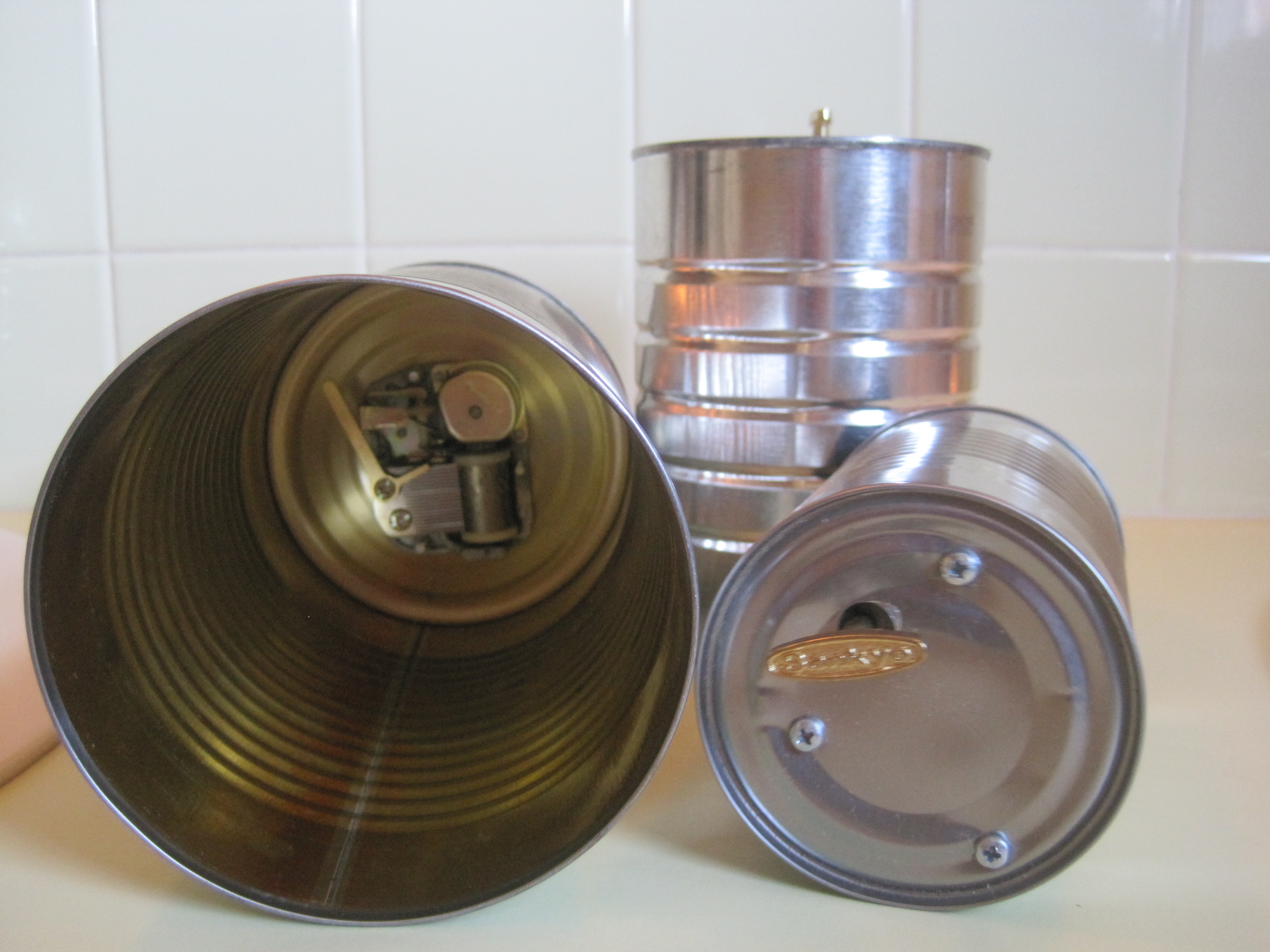
During this section some members of the band play music box movements mounted in tin can resonators; I’m interested in both mechanical musical instruments and ways of introducing handmade craft into the musical experience, so I had been experimenting with these for some time.  The first few I put together were salvaged from music boxes that were otherwise broken, but for this I would need at least two dozen to create the “field” of tinkling, overlapping melodies I had in mind.  (They can be heard starting from about 6:35.) So in the months leading up to the performance, I got several cases of music box movements and screwed them into empty cans in my garage.  Probably even more would be useful in creating the desired effect; it depends on the number of players over all and the dimensions of the performance space.  Combined with the layered statements of “Home on the Range” in the winds and bells, the music boxes are meant to evoke Kansas’ motto, “Ad Astra per Aspera” (“To the Stars through Adversity”).  The ending is hopeful, but tinged with the shadows of the past.

055057

Here’s the entire piece, which I titled Where Seldom is Heard, after the relevant lyric in Home on the Range, of course:

http://soundcloud.com/guy-vollen/where-seldom-is-heard

Finally, a great big thank you goes out to Bill Johnson and all the members of the Senseney Band for the hard work they put into this piece back in 2011.  It is always helpful for a composer to be able to work directly with an ensemble; numerous changes were made during the rehearsal progress, both to clarify my intentions and to get the best results, and everyone in the band was very supportive and helpful in making this project come together.  In the end we performed it three times (another luxury I don’t always get!); the recording here is from the second performance.  Thanks for listening!
Wichita Symphony Orchestra: Ginastera, Saint-Saëns, and Franck; conductor Maximiano Valdés, cellist Julian Schwarz

Alberto Ginastera, Pampaneas No. 3, Op. 24

Camille Saint-Saëns, Cello Concerto No. 1 in A Minor, Op. 33

Julian Schwarz, cello

César Franck, Symphony in D Minor

Guest conductor Maximiano Valdés

My review of January 18’s performance of the Wichita Symphony Orchestra, as it ran in The Wichita Eagle.

The Most Annoying Music in the World

“How do they sound? Perfect! They can’t play a lick! But mainly they got the right attitude, which is all rock’n’roll’s ever been about from day one. (I mean, not being able to play is never enough.)”  —Lester Bangs, on The Shaggs

I didn’t set out to become a vinyl collector.  The first couple of records I owned myself as a kid got so scratched up through carelessness and deliberate “misuse”—I wasn’t exactly trying to imitate the DJs who spun hip-hop beats, or “breakdancing music” as my friends and I called it, but I was fascinated by how changes of speed and direction altered the recorded sound—that they were nearly unplayable.  Later on, my dad encouraged me to record my new albums to tape so the vinyl wouldn’t get worn out.  Combine those experiences with a few warped records encountered here and there, and I was left with the impression that vinyl records were a lot more fragile than they really were.

Nevertheless, when I was a teenager records became irresistible to me for a couple of reasons.  The arrival of the compact disc in the late 1980s convinced many people that vinyl was going the way of the vacuum tube, and lots of them dumped their record collections for pennies, or for nothing: it wasn’t an uncommon sight for a box of old records to be left on the curb with the trash, free for the taking.  When I was scouring garage sales and junk shops throughout the 1990s, the number, variety, and sheer strangeness of the records I encountered (not to mention the low prices for which they were selling) made them much more desirable than when I was a kid and they seemed both fragile and overpriced.  Many people were upgrading their collections to the new format (there were recurring jokes along the lines of Dennis Miller’s complaint that he was buying Meet the Beatles for the fourth time), but there was also a generational turnover: among the outlets I frequented were garage sales by downsizing retired couples, as well as estate sales.  In some cases the audience for the first wave of “easy listening” and “mood music” LPs was aging out, and their grown children had no interest in keeping the music that had (undoubtedly) driven them into the waiting arms of rock and roll in their own youth.

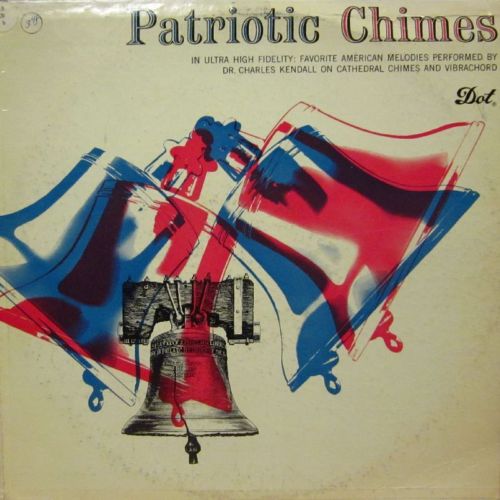
PatrioticChimes

Indeed, for a few years, practically any place that sold used goods—antique stores, flea markets, thrift shops, and more—would have records, and I was always, always compelled to look through what they had to offer.  When I was a student at Wichita State University, there was a regular (every three semesters) sale held to raise money for the music department, and I’d spend a good part of the sale week between classes browsing boxes of donated records (along with books, sheet music, and other items).  My collection swelled.

Classical music predominated at the music department sale, but there were always oddball items as well.  Like a lot of teenagers, especially in the “whatever, man” ‘90s, I was driven to search for the tackiest, most ridiculous items I could find in order to mock or celebrate them as “so bad it’s good.” I’ve mentioned following the Dr. Demento radio show; the good Doctor would sometimes feature what he called the “Audio Torture Chamber,” a selection from a truly excruciating (usually deliberately so, but not always) record.  That’s where I first heard snippets of Lou Reed’s infamous Metal Machine Music and “the world’s worst orchestra,” the Portsmouth Sinfonia.  As a collector and aficionado of the weird, I wanted in on that action.  Maybe it says something about me that I loved being able to put on a record that elicited squirms, groans, and protests from my captive audience.  It was at least a more dramatic response than the assumed coolness that would come over them when I tried to play something, you know, good.  (Whether it was any more genuine, or they were just playing up their reaction for my benefit, I couldn’t say at this remove.)

In general, the less specialized the store was, the better: record stores were (generally) staffed by people who had an idea their wares were valuable—although the weird stuff I was looking for was usually in the bargain bin anyway—but thrift stores weren’t picky, and everything might be priced at fifty cents or a dollar apiece, cheap enough that I could gamble on a promising cover.  Years later, when I saw the hip-hop DJ documentary Scratch, I learned about a gizmo some of the crate-diggers used to audition records before they bought them: a motorized toy truck with a needle on the front and a tiny speaker inside.  The truck would “drive” around the record, the needle keeping it in the groove as the sound played through the little speaker.  Brilliant!  As it was, I usually had to rely on the appeal of the cover or my sketchy knowledge of the artists involved.

Yes, I have this in my collection.  Be jealous!

Yes, I have this in my collection. Be jealous!

And what covers they were!  The LP was a miracle of packaging and marketing: its twelve-inch square cover was a perfect canvas for beautiful (or at least striking) art, suitable for framing, an advertisement for itself.  If the music inside turned out to be good, that was an added bonus.  Sometimes the contents were merely conventional: with the right cover and some creative liner notes, a collection of military band marches could be sold as Music for Baton Twirlers, and an album of bump-and-grind studio jazz packaged as How to Strip for Your Husband.  In both cases, the music is pretty good, but what sticks are the pop art covers and the impulse toward functionality, toward treating music as an accessory to one’s lifestyle, common enough in the hi-fi ‘50s.

BatonTwirlers

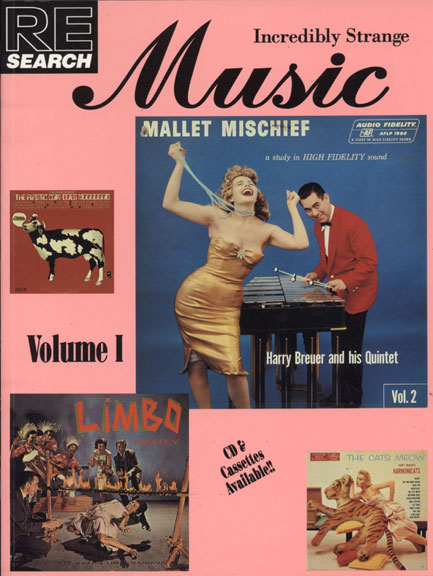
I was already exploring this territory when RE/Search PublicationsIncredibly Strange Music series arrived and handed me a map to make sense of it.  Founded in San Francisco by series editors Andrea Juno and V. Vale, RE/Search began as underground ‘zine Search & Destroy; by the time I encountered them, it had developed into a series of books dedicated to “fringe” topics: freaks, body modification, cult films, and challenging artists such as J. G. Ballard, William S. Burroughs, and Brion Gysin.  Incredibly Strange Music Volumes I and II were Numbers 14 and 15 in the series, published in 1993 and ’94, and the series’ format showed its magazine roots, consisting of interviews with musicians (including the Cramps, Eartha Kitt, and Jean-Jacques Perrey in Vol. I), collectors, and assorted eccentrics, as well as short articles on aspects of the recording industry.  First and foremost, the series was a celebration of the incredible diversity of music recorded on vinyl (especially in the heyday of the LP, from the 1940s to the ‘70s), most of which was in danger of being forgotten.  A theme that runs through many of the interviews is that, in addition to vinyl’s superiority over the CD (a given for many audiophiles at the time), a vital popular heritage was in danger of being swept away because only the established classics were being converted to CD.  People were throwing records away in order to go digital, but many of their vinyl albums might never make that transition!

rs14full

Incredibly Strange Music became, in effect, a guidebook to the kinds of records I might find, and an informal checklist of specific artists and titles to look out for.  Records were about more than just music: for example, Mickey McGowan, proprietor of the “Unknown Museum,” listed such categories as bird recordings, sound effects, promotional, soundtracks, celebrity recordings, outer space (often including electronica), comedy, children’s records, and whistling records, among others, when discussing his collection.  Recovering once well-known artists like Indian organist Korla Pandit or the exotic, multi-octave vocal phenomenon Yma Sumac from obscurity was another goal of many of the collectors interviewed.  A feeling common to many collectors, and reinforced by the interviews in Incredibly Strange Music, was one of cultural archaeology: we were all doing important work, rescuing the cultural flotsam that wasn’t considered significant enough to preserve in libraries or conventional museums.

Music of the hopelessly inept was another “incredibly strange” kind of music discussed, but it was a recurring thread, whether considering the “turn your poems into songs” racket, vanity records that allowed amateurs to put together professional-looking, if not –sounding, projects, or small-time regional acts that didn’t have what it took to crack the big time.  Then there were such unclassifiable acts as The Shaggs (who I think I also first heard on Dr. Demento’s “Audio Torture Chamber”), a group of sisters whose father, Austin Wiggin, Jr., had dreams of turning them into pop stars, despite their lack of musicianship, charisma, or even the ability to keep a steady beat.  Were The Shaggs really “better than the Beatles,” as Frank Zappa reportedly claimed?  Not according to standard definitions of quality, but there is something otherworldly about their spacey, off-key recordings, and there is an endearing charm to their guileless enthusiasm.  For those who seek out this sort of “outsider music,” it’s not uncommon to express wonderment that such a thing exists at all: some of The Shaggs’ recordings are so out there that it’s easy to forget they were conceived of as a pop combo, but their repertoire won’t let us forget, mixing covers of songs by Tom T. Hall and the Carpenters with stream-of-consciousness originals like “My Pal Foot Foot.”

The implication that professional product is too slick to be authentic, and that music like The Shaggs’ comes straight from the heart (or the id, or possibly from another dimension), and is thus more honest, is one that’s been around for a while, and it can be problematic.  Not necessarily wrong, mind you—there is always a point at which the inquisitive listener seeks to go beyond what they’ve grown up with, what they’ve been exposed to by their parents, the radio, and the surrounding culture.  Something like The Shaggs may be just what it takes to start such a listener exploring, and I’ll accept the sincerity of Zappa’s praise of The Shaggs, or that of early Shaggs booster Tom Ardolino (who claimed to hear a resemblance between the Shaggs and early Ornette Coleman), whether or not I agree with it.  Such praise can often be backhanded, though: would notorious perfectionist and technician Zappa have wanted the Wiggin sisters in his band?  I think we know the answer to that.

Any appreciation of outsider art that veers into ironic “so bad it’s good” praise, celebrates a lack of craftsmanship or obscurity for its own sake (especially as a form of one-upmanship: “You probably haven’t heard of it”) can be interpreted, deservedly or not, as either mean-spirited or simply contrary—in either case, inauthentic.  You might even invite the dreaded “hipster” label.  Similarly, the assumption that an outsider artist can be “redeemed” by official recognition or appropriation by someone in the establishment is troubling.  As much as I love Tim Burton’s Ed Wood, for example, its existence doesn’t validate the gonzo creations of its eponymous hero: it doesn’t have to, for they exist on their own and are worthy of consideration as works of art, however naïve.  To treat them any other way is to perpetuate an unfortunate tendency of the fine art world to draw on folk/ethnic/commercial/outsider sources that are conveniently defined as “non-art” in order to be transformed (i.e., exploited) by a “real” artist, or to recognize the occasional genius working outside the system only after they are safely dead.

Still, anyone who feels that the Shaggs are being condescended to should compare their career to that of the Cherry Sisters, who were in some ways the Shaggs of the 1890s.  According to author Irwin Chusid in Songs in the Key of Z, “Effie, Addie, Ella, Jessie, and Elizabeth Cherry of Marion, Iowa, were by contemporary accounts the worst act in showbiz.  Their program, Something Good, Something Sad, was so atrocious it triggered a perverse public hysteria: it played to sold-out New York houses for 10 weeks.”  The Cherry Sisters’ mawkish, humorless performances (“an evening’s worth of hokey, moralistic one-acts, derivative ballads, and awkward ethnic routines,” in Chusid’s words) were greeted with such vitriol that a wire-mesh screen had to be erected across the stage to protect them from vegetables and other missiles thrown by patrons.  Promoters (including Oscar Hammerstein) knew exactly what they were selling, but the sisters at least pretended not to know—they claimed the rowdy crowds were hired by jealous rival actresses to sabotage their performances.  Were the Cherry Sisters playing along or hopelessly naïve?  They never let on, but were able to tour across the Midwest with their show, and earned upwards of $200,000, according to some reports.

A funny thing happened as I explored the world of kitschy, tacky music: I found things I genuinely liked, in an unironic way.  I was already having a good time, of course—I wouldn’t have wasted so much time and money looking for these things if I weren’t enjoying myself—but at some point I crossed the invisible line between “Get a load of this!” and “Hey, this is really good!”  A lot of the music I gravitated to was only “incredibly strange” in the sense of its separation in time, coming as it did from past decades with very different ideas of what was cool.  For example, Lawrence Welk was the epitome of squareness even before I was a kid, but the musical chops of many of his stable of performers were for real.  I was already interested in ragtime and early jazz, so I was receptive to Jo Ann Castle.  Ditto with Myron Floren: I liked the accordion—again, maybe because it was so dorky, associated with performers like “Weird Al” Yankovic, but also because it just sounded cool—and Floren could really play.  There was a whole galaxy of once-popular instrumental virtuosi that I’m still discovering.  My recent column on banjo groups led me to Eddie Peabody, whom I hadn’t encountered before:

Part of the process is simply hearing enough to find what you respond to.  One of my favorite albums that I found in high school was called Dutch Band Organ, and it contained lively, full-sounding arrangements of syncopated pop tunes like “Cuddle Up A Little Closer” and “Did You Ever See A Dream Walking?”  It is the standard by which I have judged other band organ records for twenty years.  Similarly, I have a hard time imagining what the world was like when The Three Suns (a trio of accordion, organ and guitar) were representatives of sophisticated popular music, but I’m glad I found them (their early records, like Cocktail Time, are more impressive to me than the later records where they team up with a full orchestra).  Turntable artist Christian Marclay has commented on his attraction to “deeply unhip” records for his collage-like performances, and I share that interest: I’m always on the lookout for recordings of oddball instruments like the banjo, accordion, or chimes, the seeming underdogs of popular music. They deserve to be heard, too.

Much has changed since Incredibly Strange Music was published.  The entire RE/Search series captures a moment, a transitional period between the underground culture of the 1970s and ‘80s and the internet culture that makes it much easier for like-minded people to find each other and share information.  Many of the recordings featured in the book are easily heard online now; in fact, a great many of the vinyl oddities that were expected to disappear forever have made the transition to CD, however belatedly.  Labels like Collector’s Choice and Sepia specialize in this sort of material.  Even Dutch Band Organ is on CD now, something I never, ever would have expected.  Of course, the CD as a format is now on the wane, replaced by streaming, even as vinyl records have made a comeback, but the older audience that presumably favors these reissues isn’t known for being early adopters, so they may be a better bet for CD manufacturers, for now, anyway.  As for me, I love the options I have now, and I’m glad vinyl has continued to be relevant, but I’m glad I was in a position to explore the LP heritage at a time when it seemed like it might be gone for good.

Get Your Chimes On! (What to do with Christmas leftovers)

So you got a set of chimes (aka “tubular bells”) under the old Christmas tree?  Congratulations!  Perhaps these are your first chimes, or–if you’re Mike Oldfield–you finally wore out your original set and somebody got you replacements.  Either way, you have years of musical enjoyment to look forward to.  If you’re like me, you probably spent the holiday hammering out favorites like “Silent Night” or “Joy to the World;” or maybe you had some friends over for an impromptu sing-along with A Christmas Gift For You From Phil Spector or the Spector-influenced “All I Want For Christmas is You.”  But a few days afterward, you may be saying to yourself, “That was fun, but what am I going to play the other eleven months of the year?”

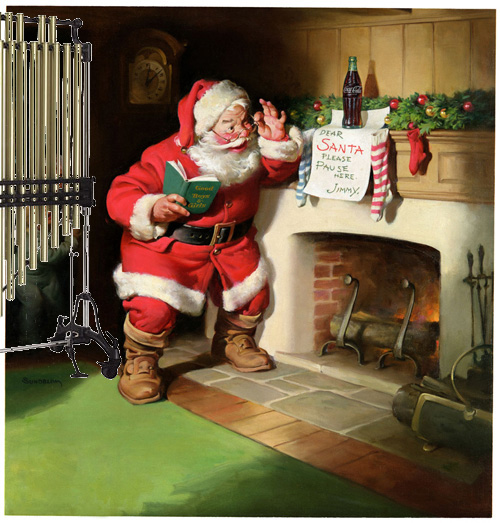
"How am I going to fit this in a stocking?"

“How am I going to fit this in a stocking?”

Fortunately, record producers’ use of chimes isn’t limited to the Christmas season: here are a few pop and rock songs that make use of the instrument to tide you over until next December.  (I’m leaving aside those songs that include the tolling of church bells, such as AC/DC’s “Hell’s Bells”* or Metallica’s “For Whom the Bell Tolls.”  You can imitate church bells on the chimes, of course, but it only takes one pitch.  The songs that follow cover a wider range and sometimes–gasp!–even take the lead.)

Some kids got the deluxe model this year.

Some kids got the deluxe model this year.

If you’re feeling funky and futuristic, there’s electronic music pioneer Pierre Henry’s “Psyché Rock” (with Michel Colombier, 1967) and Jean-Jacques Perrey’s “E.V.A.” (1970).  Both feature chimes prominently amongst the fuzz guitar and space-age sound effects.  Henry’s composition, in particular, was the inspiration for Christopher Tyng’s Futurama theme (which also includes chimes, so learn all three and you can really make a night of it):

These guys know what I’m talking about:

If you still have a rhythm section at your disposal, consider Blondie’s 1981 mega-hit “Rapture,” the first single to contain rap to hit number one on the U.S. pop charts (and one of the first music videos played on fledgling cable outlet MTV that year).  The sound of bells can be exuberant or mournful; in “Rapture” they complement the slinky bass line in creating an otherworldly nocturnal atmosphere.  Along with Perrey’s frequently-sampled “E.V.A.”, “Rapture” can be heard as a spiritual forerunner of trip-hop.

Staying in the early ’80s, the British girl group Dolly Mixture is one of the most unjustly overlooked bands of the post-punk scene, but they are increasingly receiving their due.  Most of their recorded output is from the (unsurprisingly) spare Demonstration Tapes; their single “Everything and More” from 1982 has a fuller sound reminiscent of Phil Spector’s style, including a rocking chime riff:

Working a similar vein of updated ’60s guitar pop were The Housemartins, whose 1986 hit “Happy Hour” prominently features our chosen instrument in the break:

Perhaps your tastes run toward alternative or indy music.  May I suggest Throwing Muses’ “Mexican Women” (1988) or The Flaming Lips’ “The Abandoned Hospital Ship” (1995)?  Both songs save the chimes for the big ending, giving you ample time to make a dramatic entrance.

It’s fitting that we conclude this list with They Might Be Giants, a group that has throughout its history explored varying styles of production, often using the signature sound of an era or artist to frame its songs, as if they came from a slightly off-kilter parallel universe of pop music.  “Destination Moon,” from the 1994 album John Henry, draws on both the “wall of sound” of ’60s pop and the futurism of Henry and Perrey for a vision of outer (and inner) space travel that’s equal parts Heinlein and Dick.

That ought to do it.  Happy chiming!

* Not to be confused with this “Hell’s Bells,” sung by Betty Boop in the 1934 cartoon Red Hot Mamma.  Playing the chime part for this requires two pitches: Betty Boop 1, AC/DC 0.

Orphans of the Orchestra, Part Three

Early in Ernest La Prade’s Alice in Orchestralia (which I discussed in Part Two of this series), the title character is welcomed to Fiddladelphia, home of the stringed instruments, by the Bass Viol.  In promising to introduce Alice to the other members of the orchestra, the Bass Viol offhandedly remarks:

The others don’t live in Fiddladelphia, except a few of the lower-class stringed instruments, such as the guitars and mandolins and those pesky ukuleles, who hang about the outskirts of the village.  By rights they ought not to be here at all; they’re not members of the orchestra.  But it seems impossible to keep out the undesirable elements, even in Orchestralia.

(Previously, Alice finds the Bass Viol locked inside a case by “those naughty Ukulele boys” who are “always up to mischief,” so the antipathy is obviously mutual.)

One might assume this is another skirmish in the never-ending war between classical and popular music, the snooty Bass Viol playing into the stereotype of the uptight classical musician, while the “lower-class” ukes and guitars just want to live it up, “Roll Over, Beethoven”-style.  At the time of Alice’s writing in 1925, however, the jazz age was just getting underway, and rock and roll was decades in the future. Although there were some associations with “cheap” popular music such as ragtime and the songs of Tin Pan Alley, guitars, banjos, and mandolins had a solid presence in middle-class music making before World War I, and much of the repertoire for these instruments would strike even the following generation as quaint.  No, the undesirable element the Bass Viol hoped to escape wasn’t so much one of rebellion, but of amateurism.

Looking back to the mid-sixteenth century Renaissance, bowed and plucked string instruments were on nearly equal footing.  Instrumental music as a whole was not as developed as vocal music, and it was common for parts to be played by whatever instruments were on hand.  This was the “consort system,” a consort being a family of like instruments in different sizes and registers; a single consort, say a matched group of viols or recorders, could perform a multi-part work, or members of different families could be played together as a “mixed” or “broken” consort.  Along with the bowed viols were lutes, theorbos, and citterns, which were plucked with the fingers.

The lute, in particular, enjoyed great popularity as both a solo instrument and as accompaniment for voices; the first instruction book on playing a musical instrument was written for beginning lute players.  Queen Elizabeth I played the lute and included a lutenist as a member of her court.  John Dowland, who desired the position but never attained it (probably for political reasons), left a substantial body of lute songs and instrumentals. This musical activity primarily took place in homes; although music was used in the theater, at church, and for dancing, the public concert of music for its own sake was a later innovation.

Venere Lute Quartet

Venere Lute Quartet

After this high water mark of acceptance, plucked strings gradually split from the mainstream, following a parallel tradition.  The bowed strings gained momentum as the viols were superseded by the violin family; great makers such as Amati, Guarneri and Stradivari contributed to the design and made instruments that are still played and treasured today (although many of these makers also made lutes and mandolins).  The string orchestra as we know it came together in the mid-seventeenth century, both in Italy and in France at the court of Louis XIV.  Composers Arcangelo Corelli and Jean-Baptiste Lully are both credited with the innovation of bowing string ensembles in unison (perhaps a case of independent invention), a key to the rich, pure sound and unified phrasing of the orchestra that is taken for granted today.

The plucked strings were largely left out of this development, except for special uses: the mandolin continued to be a popular solo instrument in Italy, and (for example) there are a number of concerti by Vivaldi for the instrument, but it has never been a regular member of the orchestra.  The lute hung on as a continuo (chording) instrument in the Baroque period for a while, but was eventually replaced by the harpsichord, and fell into almost complete disuse until the “early music” revival of the early twentieth century that also brought the harpsichord back into currency.  The guitar, originally Spanish, became a nearly universal popular instrument in the eighteenth and nineteenth centuries, but within the classical tradition it filled the niche of the earlier lute, playing solo or accompaniment roles but rarely joining the orchestra.  Other plucked string instruments were relegated to folk use, and there they have largely stayed.

Jumping ahead to nineteenth-century America, the growing wealth and education of the middle class, along with the increased production of material goods thanks to the Industrial Revolution, led to the cultivation of an amateur music-making culture comparable to the one that had existed in Elizabethan England.  A piano came to be seen as an essential article of furniture, and in those pre-radio and –television days it was common for families to while away an evening singing or playing.  Sheet music publishers supplied a steady stream of novel but not-too-hard compositions in anticipation of the pop music cycles of the twentieth century.  Outside of the home, choirs and bands were as much civic organizations as musical ones, and were variously sponsored by churches, schools, businesses, and even prisons.

This atmosphere of low-level but pervasive music making, supported as it was by social expectations and commercial interests (primarily but not only publishers and instrument manufacturers), was fertile ground for all kinds of musical fads to spring up and fade away.  One trend was the adaptation of the banjo (adapted from the African banja or banjar,) which had been popularized by minstrel shows as early as the 1840s but which continued to evolve throughout the century, adding the characteristic metal hoop and frets as late as the 1880s.  Banjo clubs became a popular outlet, and instrument makers obliged by creating different-sized instruments to play a full range of parts, consort-style.  (As a group, these were sometimes referred to as “plectral” ensembles, as all the associated instruments were played with a plectrum, or pick.)

I wish this video were longer; it is obviously from a later period than the 1880s and ‘90s, but it features a good look at a bass banjo with (kangaroo?) gut strings.  When I saw a bass banjo at Miles’ Musical Museum in Eureka Springs, Arkansas*, it was strung with wound piano strings, but it was a newer instrument and undoubtedly had a steel rod to reinforce it against the tension of the strings, which wasn’t the case before the turn of the twentieth century; the instrument here appears to be all wood.  The fact that the bandleader feels the need to introduce the bass banjo (and the bemused expressions of his bandmates) indicates that even at the height of the banjo craze the bass member of the family was a rarity at best.  (A number of different banjo groups, some with mixed instrumentation, can be seen here.)

The popularity of the banjo as a parlor instrument dimmed in the US, not to be revived until jazz brought it back in a louder, snappier form.  Overlapping and superseding the banjo fad was the popularity of the mandolin, first sparked by the American tour of the Estudiantina Figaro in 1880, a group of “Spanish students” who may not have played the mandolin at all, but rather the bandurria, a Spanish instrument similar to the mandolin.  Historically, the mandolin had a teardrop-shaped body with a round back, like an egg sliced in half (much like the lute, to which the original mandolin is closely related); the bandurria was more pear-shaped, with a flat back.  Both instruments, however, were strung with double courses and played with a fast tremolo, so the style was immediately recognizable, particularly to Italian-Americans who were among the first to follow the Spanish students’ lead in organizing their own mandolin groups.  (There was already some basis for an ensemble of different sized mandolins in Italy: Norman Del Mar in his Anatomy of the Orchestra mentions an Italian mandolin orchestra arrangement of a Cimarosa overture in his possession, p. 484.  The American mandolin orchestras took off in their own direction, however.)

Orville Gibson undoubtedly had the most influence on the development of the mandolin in America: a violin-maker, he applied the principles of his profession to a new design with a flat back and carved top, lengthening the scale and adding a cutaway to make the high positions more accessible; he also added the ornamental curl and art nouveau curves that are his design’s most distinctive features.  Gibson’s F-4 “Florentine” instrument was both visually striking and projected more loudly than his competition’s, a feature that was actually toned down with gut and wound silk strings.  At the time, the ideal mandolin sound was light and “fairy-like;” in a situation parallel to the banjo’s use in jazz, it wasn’t until the rise of bluegrass that a brassy, projecting sound was considered desirable.  But Gibson’s design could supply it.

Gibson also understood the power of advertising, and sold his instruments’ capacity to bring people together as much as their musical qualities.  Building on the consort principle that had proven successful for band instruments and (to a lesser degree) banjos, he and other makers expanded the mandolin family, adapting the tenor mandola (which had previously existed but wasn’t common) and developing a “mando-cello” and “mando-bass.”  With these four instruments, the mandolin consort could match the bowed string orchestra as its plucked equivalent; with the addition of a guitar or harp, and a few carefully chosen woodwinds, it had the potential to be a real orchestra unto itself.

Quartet of Gibson mandolins. Source: Wikipedia.

Quartet of Gibson mandolins. Source: Wikipedia.

The potential to rival the traditional orchestra, advocated by some**, was undercut by instrument makers’ insistence that learning to play was easy and painless.  A point frequently made in advertisements was the difficulty of playing the bowed (and fretless) orchestral strings: “While the violin pupil is struggling to grasp but one phase of his studies—accurate intonation—the student of the fretted instrument is able to enjoy his instrument in both solo and ensemble playing,” claimed Gibson’s 1921 catalog.

Large groups of mandolins or other plucked strings weren’t limited to the middlebrow approach described here, of course: in the classical realm, Australian composer Percy Grainger wrote for “guitar bands” in his idiosyncratic search for unusual sounds and textures, including a band of forty mandolins and guitars in his accompaniment for the Faeroe Island Dancing Ballad “Father and Daughter***,” along with more traditional instrumentation.  Bandleader James Reese Europe, a key figure in the transition from ragtime to jazz, is reported to have taken numerous mandolins and banjos with him as part of the “Hell Fighters” Band when he led the regimental band of the 369th Infantry in World War I.  The ranks of plucked strings were partly there for volume in those days before electrical amplification made it possible for a single guitarist to comp for an entire band.  Once jazz and swing replaced ragtime and parlor tunes in popularity, gigantic plectral ensembles became strictly the domain of folk festivals; witness the Russian balalaika orchestras that were an official part of Soviet musical culture.

Karl Alex Smyser Banjo Band ca. 1931, from Bluegrass Today.  (Follow the link for audio recordings!) Note the mando-bass on the right.

Karl Alex Smyser Banjo Band ca. 1931, from Bluegrass Today. (Follow the link for audio recordings!) Note the mando-bass on the right.

Ultimately, the mandolin orchestra gave way to jazz and other kinds of popular music after World War I, although a few groups soldiered on (such as the Smyser band shown above), and of course the mandolin itself became an essential voice in the developing bluegrass style.  A few mandolin orchestras stayed active (a list of active groups can be found here) as far afield as Australia, Japan, and Germany, and the last decade has seen a resurgence in large plectral ensembles; the ukulele is the most visible of the currently popular plucked strings, but a quick YouTube search (how I wish it had been that simple back when I first learned about this music!) turns up numerous performances ranging from the traditional “light classic” approach, to jazz, to covers of contemporary pop songs.  Fortunately, both scholarship and popular music have played a role in rescuing this fascinating instrumental genre from obscurity.

* Sadly, this institution is no more; it was truly a magical place.

** For example, William Place, Jr., in his 1917 book The Organization, Direction, and Maintenance of the Mandolin Orchestra, commenting on the practice of bolstering plucked groups with bowed instruments, wrote, “We have a complete string quintet of our own mandolin family, and there is no reason why we should be obliged to ask for outside assistance.”

*** Described and excerpted in Cecil Forsyth, Orchestration, pp. 481-485.

Alliterative Insult: an Operatic Example

When composing his epic, four-installment opera Der Ring des Nibelungen, Richard Wagner wasn’t content just to write the music; as he had done with his previous operas, he wrote the text as well.  Wagner intended his work to be comprehensive.  As a Gesamtkunstwerk (“total art work”), Wagner’s form of theater would encompass music, text, stage direction, and even the design and construction of a new theater, all guided by a single controlling vision: his own.  Although Wagner’s musical innovations are well-known to audiences—his thorough-going chromaticism, his extended forms, the importance of the orchestral accompaniment in spinning out leitmotivs—his text is not always given the same appreciation, especially among non-German speakers.

When introducing students to works in foreign languages, I’ve noticed an assumption on many listeners’ part that the words are completely comprehensible to native speakers, and that their meaning for them is as clear as the translations that often appear as subtitles on video or projections in the theater.  There are many reasons that this is not so, and vary depending on the composer and the language in question; undoubtedly some operas are easier to understand than others.  The musical setting of the text (not to mention individual performance conditions) can emphasize clarity or destroy it, just as the range of English-language music theater runs from the transparent to the obscure.

In the case of the Ring cycle, the challenges go beyond that of translating from one language to another: Wagner borrowed and expanded a technique called Stabreim (“stave rhyme”) from the Icelandic Eddas, the medieval saga that, along with the German Nibelungenlied, provided the basis for his exploration of the Norse gods and their fall.  Stabreim, far from being a rhyme scheme as we might conceive it, is a form of poetic meter based on alliteration, the repetition of initial consonants at key points within the poetic line.  Wagner, believing the Eddas to be a spontaneous (and thus pure) outpouring of unconscious folk creation, sought to channel that supposed primitive force by imitating and expanding upon it.  Thus, his text is both deliberately archaic and in some places obscure; it’s comparable, I think, to English-language writers borrowing “thee” and “thou” from Shakespeare and the King James Bible to channel some of their solemnity and sense of antiquity, but goes even farther.  According to one translator, an anecdote has it that Wagner’s grandson Wieland, when directing productions of the Ring, would have the cast translate their lines into German—that is, modern German—in order to understand their parts.  If true, that certainly puts our difficulties into perspective.

It has proven challenging to translators, as well, and as is often the case, they have sometimes had to prioritize the meaning of the text over Wagner’s alliterative scheme (or his exclusive use of German root words, or the complex use of puns that saturate the text).  Still, there are a few places where the alliteration is too good to resist.  In Scene One of Das Rheingold, the dwarf Alberich, overcome by lust, is taunted by the three Rhine maidens for his ugly appearance (it is, of course, this teasing that leads him to steal the Rhine gold and renounce love, the decision that starts the plot moving).  Wellgunde, one of the maidens, rebukes Alberich by singing (at 8:50 in the embedded video):

Pfui, du haariger,

höck’riger Geck!

Schwarzes, schwieliges

Schwefelgezwerg!

The alliteration in the last two lines paints a detailed (and insulting) portrait of Alberich, calling him a Schwarzes (black), Schwieliges (callous) Schwefelgezwerg (Schwefel meaning sulphur and zwerg meaning dwarf).  Alberich is more than just a little person, however: in Wagner’s interpretation of Teutonic mythology, the Nibelungs were a race of skilled metal workers and miners that toiled in the ground in their own realm (Nibelheim), separate from either men or gods (think of Snow White’s seven dwarfs, or the dwarves** of J. R. R. Tolkien, who drew on many of the same medieval sources for his Lord of the Rings).  When zwerg is used, it is a term of disparagement (as in Scene Three, when Alberich calls his brother Mime a Tückischer zwerg, a shifty or treacherous dwarf).  Elsewhere in the text, Alberich is referred to either as a Nibelung or occasionally as an Alp (elf).  So, right off the bat, Wellgunde’s taunt calls attention to his ugly appearance, darkness*, and his connection to the deep earth (in fact, Alberich appears to have reached the Rhine by climbing out of a cave underneath it).

What have translators made of this? It’s one of the more colorful examples of alliteration in the text, so most translators have tried to preserve it.  In the video (from Robert Lepage’s recent staging at the Metropolitan Opera) the lines are subtitled as “You’re a hairy, horrible thing!  So hideous and spotted!”  It’s safe to say that there have been more ambitious renditions of Wellgunde’s insult.  A 1904 translation by Charles Henry Meltzer has it as

Faugh ! Thou hairy

and  Humpy old oaf!

Swarthy, shuddersome,

Sulphurous dwarf!

The adjective “sulphurous” can be taken literally, but also has a connotation of spitefulness: a poisonous disposition.  The uncredited translator of The Authentic Librettos of the Wagner Operas (Crown Publishers, 1938, although apparently the Rheingold translation also goes back to 1904) renders it as

Faugh!  You hairy

and horrible imp!

Swarthy, stunted,

and shriveled up dwarf!

Note the loss of any reference to sulphur; “shriveled up” could refer to Alberich’s size, old age, or (obliquely) sexual undesirability.

Stewart Spencer, in Wagner’s Ring of the Nibelung: A Companion (Thames & Hudson, 1993) has

Ugh!  You hairy,

hunchbacked fool!

Brimstone-black

and blistered dwarf!

I like this one; it’s a vivid and incisive description of a creature living too close to volcanic fissures underground.  Finally, lest we assume that subtitles, with their bias toward ease of reading and keeping the plot moving, must be devoid of interest, I present the translation used for the 2002 production at the Staatsoper Stuttgart, staged by Joachim Schlömer:

Urgh! You hairy,

misshapen old hog!

You randy, wrinkled,

rheumaticky runt!

It’s as if each translator has tried to do justice to the alliterative excess in Wellgunde’s insult but without repeating their predecessor’s choice of words. Fortunately, while the polyglot heritage of English vocabulary makes it challenging to construct extensive rhyme schemes (by comparison to the Italian terza rima of Dante, for example), the variety of words available provides almost unlimited potential for alliteration.  One could conceive of Alberich as a “miniature, mephitic miscreant,” a “pestilent, pint-sized playboy,” or even a “callous, coal-black Casanova”—none are exactly the same as the original, of course, but what translation ever is?

*The Eddas also mention “dark elves,” which some scholars think may have been dwarfs by another name; in any case the concept has branched into its own category, separate from dwarves, in modern fantasy literature.

** The plural “dwarves” was popularized by Tolkien, and has become standard when discussing them as a fantasy race; I have used the more standard “dwarfs” in this article except for explicit reference to Tolkien’s treatment of them.  Hence the discrepancy.

Christmas with the Doctor (No, not that one!)

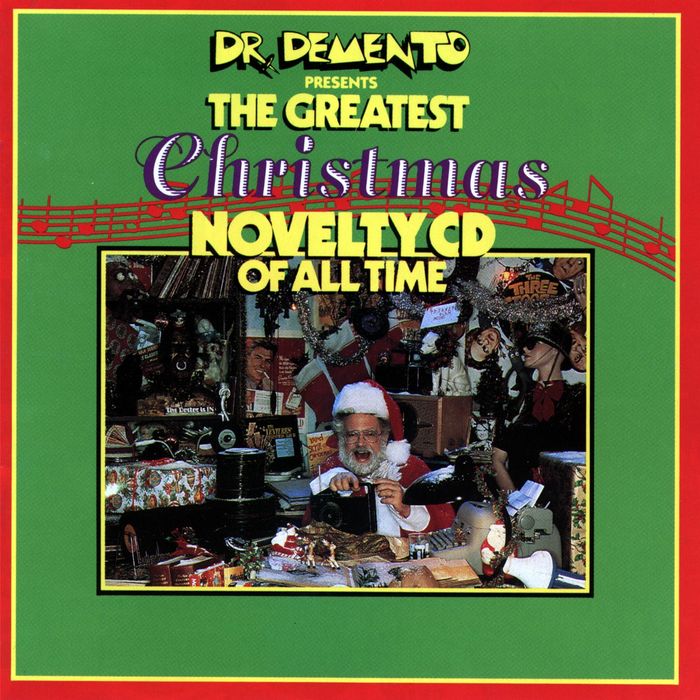
Now that Thanksgiving is past, it’s time for the Christmas decorations to go up, and the Christmas music to come out!  In my family, one of our favorite Christmas albums is Holidays in Dementia, collected by the one and only Dr. Demento.  I’ve been a fan of the good Doctor since I was in middle school, although my interest has waxed and waned over the years as with so many youthful obsessions.  Holidays in Dementia was a gift to my wife on our first Christmas as a married couple (I know, but hear me out), in part because I remembered some of the songs on it, and knowing that she was a fan of “Weird Al” Yankovic and similar “demented” humor.  It’s since been played every year during December and has been the source of a number of inside jokes.  Holidays in Dementia was the 1995 follow-up to 1989’s Dr. Demento Presents The Greatest Christmas Novelty CD of All-Time, both released by Rhino.  The contrast between the two albums is interesting:

DOCTOR DEMENTO XMAS

The Greatest Christmas Novelty CD of All-Time

  1. The Chipmunk Song: The Chipmunks with the Music of David Seville
  2. All I Want for Christmas is My Two Front Teeth: Spike Jones & His City Slickers
  3. Jingle Bells: The Singing Dogs
  4. The Twelve Gifts of Christmas: Allan Sherman
  5. I Want a Hippopotamus for Christmas: Gayla Peevey
  6. Nuttin’ for Christmas: Stan Freberg
  7. A Christmas Carol: Tom Lehrer
  8. Grandma Got Run Over by a Reindeer: Elmo & Patsy
  9. I Yust Go Nuts at Christmas: Yogi Yorgesson
  10. Twelve Days of Christmas: Bob & Doug McKenzie
  11. Green Chri$tma$: Stan Freberg
  12. I’m a Christmas Tree: Wild Man Fischer (Duet with Dr. Demento)
  13. I Saw Daddy Kissing Santa Claus: Kip Addotta
  14. Santa Claus and His Old Lady: Cheech & Chong
  15. Christmas at Ground Zero: Weird Al Yankovic
  16. Christmas Dragnet: Stan Freberg & Daws Butler

demento.holidays

Holidays in Dementia

  1. The Twelve Pains of Christmas: Bob Rivers Comedy Corp
  2. It’s So Chic to be Pregnant at Christmas: Nancy White
  3. Gridlock Christmas: The Hollytones
  4. It’s Christmas and I Wonder Where I Am: The Bob & Tom Band
  5. Santa Claus is Watching You: Ray Stevens with the Merry Melody Singers
  6. Santa’s Lament: Father Guido Sarducci
  7. Rusty Chevrolet: Da Yoopers
  8. Christmas is Coming Twice This Year: The Hollytones
  9. Christmas Wrapping: The Waitresses
  10. Santa Claus is Comin’ to Town: Joseph Spence
  11. A Terrorist Christmas: James & Kling
  12. Stop the Cavalry: Jona Lewie
  13. The Pretty Little Dolly: Mona Abboud
  14. Hanukkah Rocks: Gefilte Joe & The Fish
  15. Hanukkah Homeboy: Doc Mo Shé
  16. Happy New Year: Spike Jones & His City Slickers
  17. New Year’s Resolutions: Scary Gary Alan

There are a few differences between the two discs: whereas Christmas is right in the title of the first collection, Holidays in Dementia also includes songs dedicated to Hannukah and New Year’s Eve (according to his introduction, the Doctor had intended to represent the winter holidays equally, but there weren’t many non-Christmas songs to choose from).  I wouldn’t argue against any of the songs on The Greatest Christmas Novelty CD; most of the songs on it earned their place through years of airplay.  The downside is that you’ve probably heard them all before.  It’s like having a friend whose favorite rock songs are “Stairway to Heaven” and “Hey Jude”: they’re classics, but not very interesting or surprising as choices.  Still, these are all songs you would want in your library of Christmas novelty songs (doesn’t everyone have one of those?), value added by Dr. Demento’s scholarly liner notes (scholarship genuinely arrived at, I might add: in his civilian identity as Barry Hansen, Dr. Demento has a degree in ethnomusicology, as well as being a crate-digging record collector of the first order, much like his predecessor Harry Smith).  It does cover a wide historical range, from songs that predate Dr. Demento and his influence (you can’t go wrong with Tom Lehrer and Spike Jones, for example) to artists like Demento discovery “Weird Al” Yankovic and others whose primary distribution was through the Doctor’s radio show.  (Incidentally, I had no idea the original Singing Dogs record appeared in 1956.)

If it sounds like I’m putting down The Greatest Christmas Novelty CD, I don’t mean to; it just doesn’t have the same personal connection for me as Holidays in Dementia, and the songs it includes are widely known and available, so even though I like them, I don’t think of this album specifically when I listen to them.  Going through the track list for Holidays, however, I’ve realized there are several that I skip when I listen to it (“A Terrorist Christmas,” a flat recitation of “The Twelve Days of Christmas” with weapons replacing the traditional gifts, doesn’t work for me; unlike the equally dark “Christmas at Ground Zero,” there’s neither wit nor musicality).  But the songs I like, I really like: if a novelty song is going to be a perennial, it either has to be as funny on the hundredth listen as the first (a high bar for any comedy record), or it has to work as a song that just happens to have witty lyrics.  Most of the songs on both CDs fit one category or the other, and some fit both; surprisingly, there are few direct song parodies (“Jingle Bells” turns into “Rusty Chevrolet,” for example; Kip Addotta’s “I Saw Daddy Kissing Santa Claus” rewrites a song that was already a novelty to begin with) outside of the numerous takes on “The Twelve Days of Christmas” (four between the two discs, five if you count its inclusion in “Green Chri$tma$”).  Most of the songs are original.

Perhaps what I respond to in Holidays is the specificity of the songs: both CDs prick the commercialism, sanctimony, and hassle of Christmas, but Bob Rivers’ “The Twelve Pains of Christmas” dissects the misery of the season so expertly, and draws such indelible characters with only a few lines, that it feels universal.  Selected lines have become the standard reference when sending cards (“I don’t even know half these people!”) or putting up lights (“One light goes out, and they all go out!”) in our house.

On the flip side, we might not all be able to relate to the expectant mother of Nancy White’s “It’s So Chic to be Pregnant at Christmas,” the harried single girl of The Waitresses’ “Christmas Wrapping,” or the children of divorce from the Hollytones’ “Christmas is Coming Twice This Year,” but they evoke times and places as clearly as a short story.  So many Christmas songs are narratives to begin with, the line between “seasonal” and “novelty” is fuzzy at best.  The Hollytones’ “Gridlock Christmas” is one of my favorites, and one of the songs I sought out when buying Holidays in the first place: it came out in 1988, and must have been new when I first heard it on Dr. Demento’s radio show.  The tale it spins of motorists making the best of it while stuck on the freeway is ironic but with a core of sincerity: “I’m having gridlock Christmas / With people I don’t even know. / Though friends and family can’t be here / We’ll have good old Christmas cheer / With carols on the car radio.” The song combines a laid back, two-beat country accompaniment (complete with slide guitar) with a jazzy clarinet, and singer Floyd Elliot’s crooning delivery (complete with a Johnnie Ray-style catch in his voice) brings together the contrasting musical elements in the same way strangers are drawn into fellowship in the song.  Is it a testament to the resilience of the holiday spirit, of the way we can turn anything, even nuisances and frustrations, into traditions?  Perhaps, but it’s also just a terrific song.

BONUS VIDEO: In case you felt misled by this post’s title, here’s another Dr. Demento favorite from 1988: “Doctorin’ the TARDIS” by The Timelords/KLF, a mash-up of the classic Who theme and Gary Glitter’s “Rock and Roll Part 2,” complete with a music video featuring authentic special effects from the classic series (I kid, I kid):

In Defense of Medleys

As a composer and performer, one aspect of musical composition that has always fascinated me is the mysterious alchemy by which two ideas, which may have little in common (at least superficially), can be joined together simply by their presence in the same piece of music.  This may seem trivial, but the question of why some ideas seem to fit together and others remain stubbornly separate is an important one for composers and songwriters, and the performers and conductors who do their best to interpret their ideas.  It’s taken me a few months to come around to this directly, but I wanted to get some entries under my belt before I tackled the subject.

Although I intend to keep blogging about comics, movies, musical instruments, and anything else that catches my fancy, Medleyana takes its name from an oft-maligned genre of music: the humble medley—you know, the sort of piece that delivers the most exciting or recognizable bits of several songs or pieces in a self-contained arrangement.  It’s not hard to see why the medley form is underappreciated, or not even acknowledged as a legitimate form at all.  Anyone who has played an instrument in a school band or orchestra, or had a child who did, has suffered through watered-down arrangements of movie themes or pop tunes that are too difficult for students to perform in their original form, cementing an association between medleys and amateur music-making.  For the same reason, medleys are considered an essentially “commercial” form, trafficking in the ephemera of songs and movies that are omnipresent for a season and then forgotten.  Even those medleys of evergreen favorites like Christmas carols or patriotic songs are subject to the whims of changing fashion or the vagaries of the publishing business.  (Bob Lowden’s Armed Forces Salute, a well-regarded arrangement of the service songs of the five U. S. armed forces, and one I’ve played countless times, including a half dozen in the last year alone, recently went out of print.)  Nostalgia and pedagogy are not usually respected as serious aesthetic motivation: a form that typically combines both is doomed to be overlooked.

Still, the medley has been surprisingly robust as a genre.  Since the middle ages, dance tunes (at least those that were written down) were often strung together to create longer forms, a practice that has more to do with the necessity of providing accompaniment for an evening of dancing than any overarching compositional philosophy.  In the nineteenth century, possibly the golden age of concertizing, virtuoso performers and conductors would program crowd-pleasing medleys of popular operatic arias, often under the moniker of “fantasy” or “potpourri.”  A savvy self-promoter like Franz Liszt would be sure to have prepared a collection of the appropriate national songs of whatever country he was visiting as a sop to the audience, the equivalent of a rock star’s “Hello, Cleveland!” shout-out.  The concert band developed in this milieu, and its literature has always reflected this populist tendency.  And while ambitious composers have largely left Broadway and popular song medleys to pops concerts and school band publishers, most of the early twentieth century British masterworks that are the foundation of serious band literature—Gustav Holst’s Second Suite in F, Ralph Vaughan Williams’ Folk Song Suite, and Percy Grainger’s Lincolnshire Posey—are essentially medleys, albeit with a great deal more craft and passion than was normally lavished on compositions for the medium at the time.

In short, the typical medley form—one idea following another, like beads on a string, until it ends—may be simple, but a form it is, and one with a long pedigree in both “serious” and popular music.  Its continued presence is like the survival of those turtles and crocodilians that have remained largely unchanged since the days of the dinosaurs: they may be more modest than the giants they once walked among, but they are a surviving link to those days and worthy of our attention.

Personally, I have always preferred forms with a great deal of contrast; multi-strain forms like the march or piano rag, programmatic works, theatrical and film music, and the like.  In our current referential, sample-driven “remix culture,” there has been a renewed focus on issues of appropriation, quotation and recontextualization.  In the kind of medleys I mentioned, appropriation is less of an issue: songs under copyright must be licensed when included in a published arrangement, and as such the medley is an auxiliary to the original product, in effect an advertisement for the original.  The line is fuzzier when it comes to quotations so brief or so transformed that they fly under the radar of copyright niceties, or when the original work is in the public domain and safely available for anyone to use as they like.  Would the original composer approve of their tune’s new setting?  Is it necessary to observe original intent when combining or rearranging old chestnuts?  Will the audience even be aware of the borrowing?  Does it matter?  To be sure, “spot the reference” can be fun when dealing with magpie composers like Charles Ives or Danny Elfman, but even when the sources are unfamiliar I get a lot of pleasure from the sensory overload that comes from rapid-fire changes of musical texture, and there have been plenty of pop songs that I first heard as part of a medley, mash-up or mix tape, that captivated me enough to look up the original.

Perhaps it’s because I grew up in the era of “Hooked on Classics,” what writer Noel Murray calls the “Medley Age.”  Or maybe decades of playing medleys in school and community bands have left me with musical Stockholm Syndrome.  It could just be that I’m a hopeless vulgarian with a short attention span.  In any case, the pleasure of recognition is often only the beginning of what a medley or mash-up has to offer.  Readers of this blog will have noted that I am, at best, ambivalent about totalizing theoretical or aesthetic frameworks, whether in music, literary analysis, or comic book continuity: as seductive as they can be, they can be too constricting when taken as a blueprint for the creative act, and when used as an editor’s guiding principle can cut out much that was fresh and vital in the first place.  In my view, it’s better to “let a thousand flowers bloom,” even knowing that the results may be messy, chaotic, and contradictory.  In that sense, they are much more like life as it is lived than as we would like it to be.

Instruments of Death

“The Torture Garden: It’s where the Devil calls the tune . . . to play a concerto of fear!”

–Trailer for Torture Garden, 1967

danceofdeath

In honor of Halloween, it’s time to look at the spookier side of musical instruments, specifically the roles some have played in mystery and horror fiction.  On the one hand, the organ has the most sinister reputation of any instrument through its association with the Phantom of the Opera and his fictional descendants: there’s just something about the full organ’s portentous sound and the gloomy atmosphere of the Gothic cathedral that goes hand in hand with cobwebs and candlelight, so expect to hear many renditions of Bach’s Toccata and Fugue in D Minor (or at least the opening bars) during October.  The organ, nicknamed “the king of instruments,” also fits nicely with the popular association of criminal masterminds with classical music: we like our villains to have refined taste, whether played by Vincent Price or Anthony Hopkins.  In the same way, the organist seated at his instrument, surrounded by ranks of keyboards, pedals, and organ stops ready at his command, is a neat visual shorthand for a master manipulator, sitting at the center of a web, controlling everything around him.  (In at least one case, the direct-to-video Disney sequel Beauty and the Beast: The Enchanted Christmas, the organ is the villain, conniving to make others to do its will even though it cannot move from its place.)

Lon Chaney, Sr. in the 1925 film The Phantom of the Opera

Lon Chaney, Sr. in the 1925 film The Phantom of the Opera

Brian De Palma's 1974 update, Phantom of the Paradise

Brian De Palma’s 1974 update, Phantom of the Paradise

The violin, on the other hand, is often associated with the Devil, as in such pieces of music as Danse Macabre, L’Histoire du Soldat, and “The Devil Went Down to Georgia.”  In folk tales, the Devil enjoys wagers, betting his own gold fiddle against the souls of his opponents.  He may also bestow musical talent in exchange for a soul, a prominent part of the myth surrounding Tartini’s “Devil’s Trill” Sonata. Later, the great Italian virtuoso Niccolò Paganini was the subject of lurid rumors that he had sold his soul, and worse: Theosophy founder Madame Helena Blavatsky included Paganini in her story “The Ensouled Violin,” and graphically embroidered on the notion that the strings of Paganini’s violin were made from human intestine, and that his uncanny ability to mimic the human voice with his playing actually came from a spirit trapped within the instrument.

A similar story is part of the mythology of the Blues: Robert Johnson was supposed to have met the Devil at a crossroads at midnight, where he traded his soul for his legendary guitar-playing ability.  The legend formed the basis of the Ralph Macchio film Crossroads and was parodied on Metalocalypse (in the episode “Bluesklok”).  Interestingly, Elijah Wald, in his book Escaping the Delta, has shown that the same story was originally attributed to a Tommy Johnson and then transferred to Robert when his legend outpaced Tommy’s.  Naturally, the whole thing has roots in folklore: Wald points out, “When Harry Middleton Hyatt collected stories of musicians going to the crossroads to gain supernatural skills, as part of a vast study of Southern folk beliefs in the late 1930s, he reported as many banjo players and violinists as guitarists,” as well as an accordionist.

Why is there such a connection between fiddling and death?  In the Middle Ages, instrumental music was considered both profane and frivolous, closely associated with itinerant, always-suspect actors and minstrels and the drunken singers in taverns.  In depictions of Death (usually as a skeleton, the same as now), musical instruments were often a symbol of the sinfulness, vanity, and futility of all human activity, not just music.  (The popular image of Nero “fiddling while Rome burned” probably owes much to this symbolism, as the violin had yet to be invented in Nero’s day; likewise, contrast the supposed indolence of grasshoppers with the industry of ants.)   The image of a grinning skeleton “playing” his victims into the grave may have struck the medieval viewer as cruel irony, a just punishment, or as a warning.

The medieval dance of death.

According to one author, the connection between the violin and mortality was more than just poetic: in 2006, Rohan Kriwaczek published An Incomplete History of The Art of Funerary Violin.  According to Kriwaczek, there had once been a Guild of Funerary Violinists, whose work, repertoire, and indeed their very existence had been suppressed by the Vatican during the Great Funerary Purges of the 1830s and ‘40s.  After 1846, the few remaining members of the Guild went underground, and Kriwaczek, eventually entrusted with their legacy, was able to piece together this secret history and bring it to the public. Kriwaczek describes the Funerary Violinist as playing a potent intercessionary role:

In his tone the violinist must first convey the deep grief that is present in the gathering, and then transform it into a thing of beauty.  By the time he is finished, a deep and plaintive calm should have descended, and the bereaved should be ready to hear the eulogy. . . . The violinist’s is a position of great responsibility, akin in many ways to that of a priest or shaman, and should not be taken lightly.

Alas, the book was a hoax, supposedly concocted by Kriwaczek to increase his bookings as a violinist at—you guessed it—funerals.  Still, I can’t help but feel that Kriwaczek’s story, with its dueling Funerary Violinists, buried secrets, and cameos from outsized characters including composers, Popes, and virtuosi, would make a smashing TV program, a historical saga with more than a touch of gothic intrigue.

Sometimes the instrument is cursed: in the short “Oh, Whistle, and I’ll Come to You, My Lad” by the master of the English ghost story M. R. James, it’s an ancient bronze whistle (proving that another James title, “A Warning to the Curious,” could equally apply to almost all his stories):

He blew tentatively and stopped suddenly, startled and yet pleased at the note he had elicited. It had a quality of infinite distance in it, and, soft as it was, he somehow felt it must be audible for miles round. It was a sound, too, that seemed to have the power (which many scents possess) of forming pictures in the brain. He saw quite clearly for a moment a vision of a wide, dark expanse at night, with a fresh wind blowing, and in the midst a lonely figure–how employed, he could not tell. Perhaps he would have seen more had not the picture been broken by the sudden surge of a gust of wind against his casement, so sudden that it made him look up, just in time to see the white glint of a sea-bird’s wing somewhere outside the dark panes.

Just as frequently it’s a MacGuffin that activates the plot: a Stradivarius is as valuable as a van Gogh, and serves as well as any other objet d’art as the motivation in a murder mystery.  An example is the three-quarter sized Strad, the Piccolino, at the center of Gerald Elias’ mystery Devil’s Trill, the first of a series centered on violinist-sleuth Daniel Jacobus.  And despite its unusual varnish, the titular instrument of the 1998 film The Red Violin is haunted more by tragedy and human foibles than by any supernatural evil.

The weaponized instrument is an infrequent literary device, but there are a few examples: the murder in Dame Ngaio Marsh’s Overture to Death is accomplished by a revolver hidden inside an upright piano, rigged to fire when the pianist plays the third chord of Sergei Rachmaninoff’s Prelude in C-sharp Minor, a Rube Goldberg arrangement that sounds about as practical in real life as this:

Likewise, it doesn’t seem that it would be that hard to escape the vengeance meted out by the grand piano in “Mr. Steinway,” a section of the 1967 anthology film Torture Garden, based on stories by Robert Bloch.  In the story, the piano in question belongs to a prominent virtuoso, a gift from his mother, and his devotion to it is tested when a young lady (played by Barbara Ewing) enters his life.  The black wing shape of the piano is a looming presence in the film version, always in the background or casting its shadow over the doomed couple, and the Oedipal implications of the pianist’s relationship with his mother, never seen but personified by the piano, are left as unspoken subtext.  So far, so good, but by the time the piano lurches into motion and pushes the intruding girl out the window, we’ve entered the realm of delirious high camp.  The lesson: music is a jealous mistress.

Finally, as a bonus, I present one of the most bizarre (and gratuitous) examples of this trope, from the 1976 film The Town That Dreaded Sundown: death by trombone.  Happy Halloween!