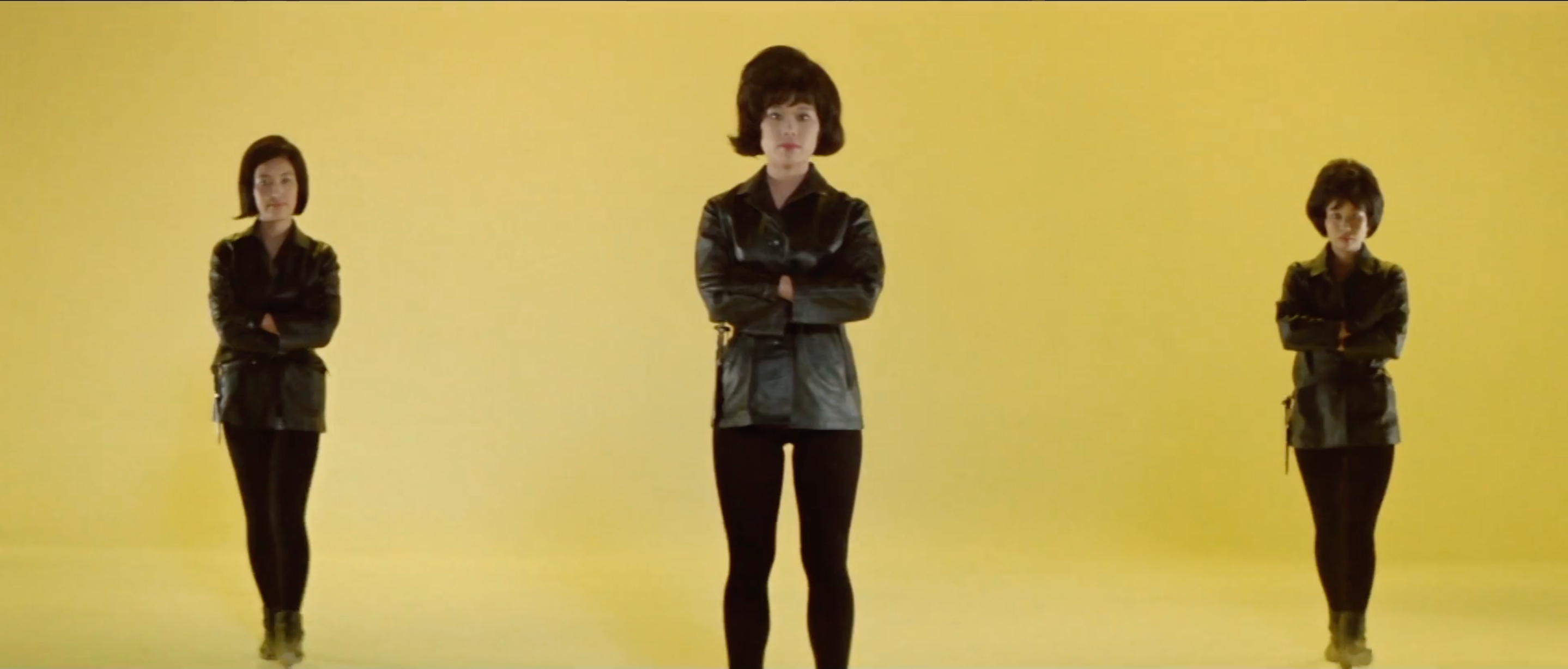
Ninjanuary Review: BLACK TIGHT KILLERS

In 2019 I celebrated “Ninjanuary” with several posts about the ninja in popular culture, particularly in films and books from the 1980s, and I occasionally return to that theme. Past entries can be found by clicking on the Ninjanuary tag.

When I was in eighth grade, my best friend and I came up with an idea for a movie, influenced by the ninja craze of the time. We proposed a convention of the world’s ninjas, meeting in one place and forced by circumstance to come together against some powerful threat (if we got as far as specifying what the threat was, I don’t remember it). Part of the appeal was that every ninja had a gimmick reflecting their occupation or country of origin, so in addition to the obvious black-clad ninjas with the usual weapons, we imagined a ninja yo-yo expert, a Scottish ninja who wore a kilt and fought with ninja bagpipes, and a ninja trombonist whose slide doubled as a deadly weapon (and we hadn’t even seen The Town that Dreaded Sundown!). I don’t remember everything we came up with, but we obviously stole a lot of ideas from superhero comics and professional wrestling in addition to martial arts movies.
I was reminded of this aborted project when I watched Black Tight Killers, a 1966 Japanese film (dir. Yasuharu Hasebe) that does not (at first) advertise its ninja themes; on the surface, it appears to be more of a crime film with a stylish, swinging approach common to the James Bond series and its many “spy-fi” contemporaries. Whereas in the 1980s and later, most attempts to modernize the ninja involved putting him in bulletproof body armor or turning him into a computer hacker, or maybe something with lasers, Black Tight Killers features a go-go-dancing girl gang using vinyl records, golf clubs, and chewing gum, among other mundane objects, as parts of their arsenal of (named) ninja moves, all becoming deadly weapons or means of escape in the right hands. Even though our movie about the ninja convention never made it past the daydreaming stage, it was validating to see that a similar idea had been part of the original cycle of Japanese ninja films (I haven’t dug into these movies very much, but this modern approach was novel compared to the usual historical and mythological treatments of the subject at the time).
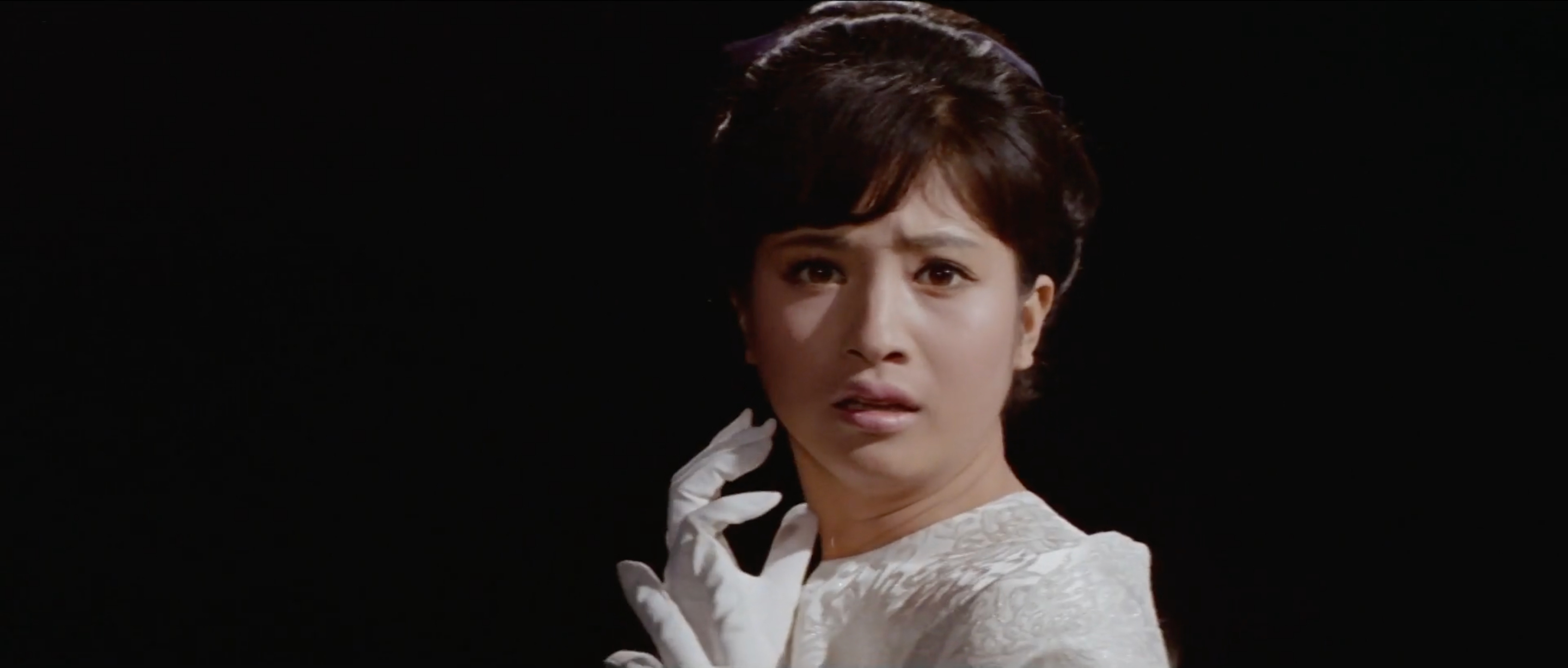
The film begins with Hondo (Akira Kobayashi), a war photographer, flirting with flight attendant Yoriko (Chieko Matsubara) on his return flight to Japan. When they go on a date together, Yoriko is spooked by a strange man who has been watching her; when Hondo looks for the stranger to confront him, he finds the man stabbed to death and is accused of the crime by a pair of onlookers. Then Yoriko is abducted by three women in black tights and leather jackets. Before he can chase after them, he is arrested for murder. The victim, Lopez, was illegally trading U.S. dollars, and everyone who appears ready to help Hondo has their own angle. Thus begins a twisty caper with multiple interested parties and shifting loyalties, all looking for a shipment of Okinawan gold hidden by Yoriko’s late father after the war.
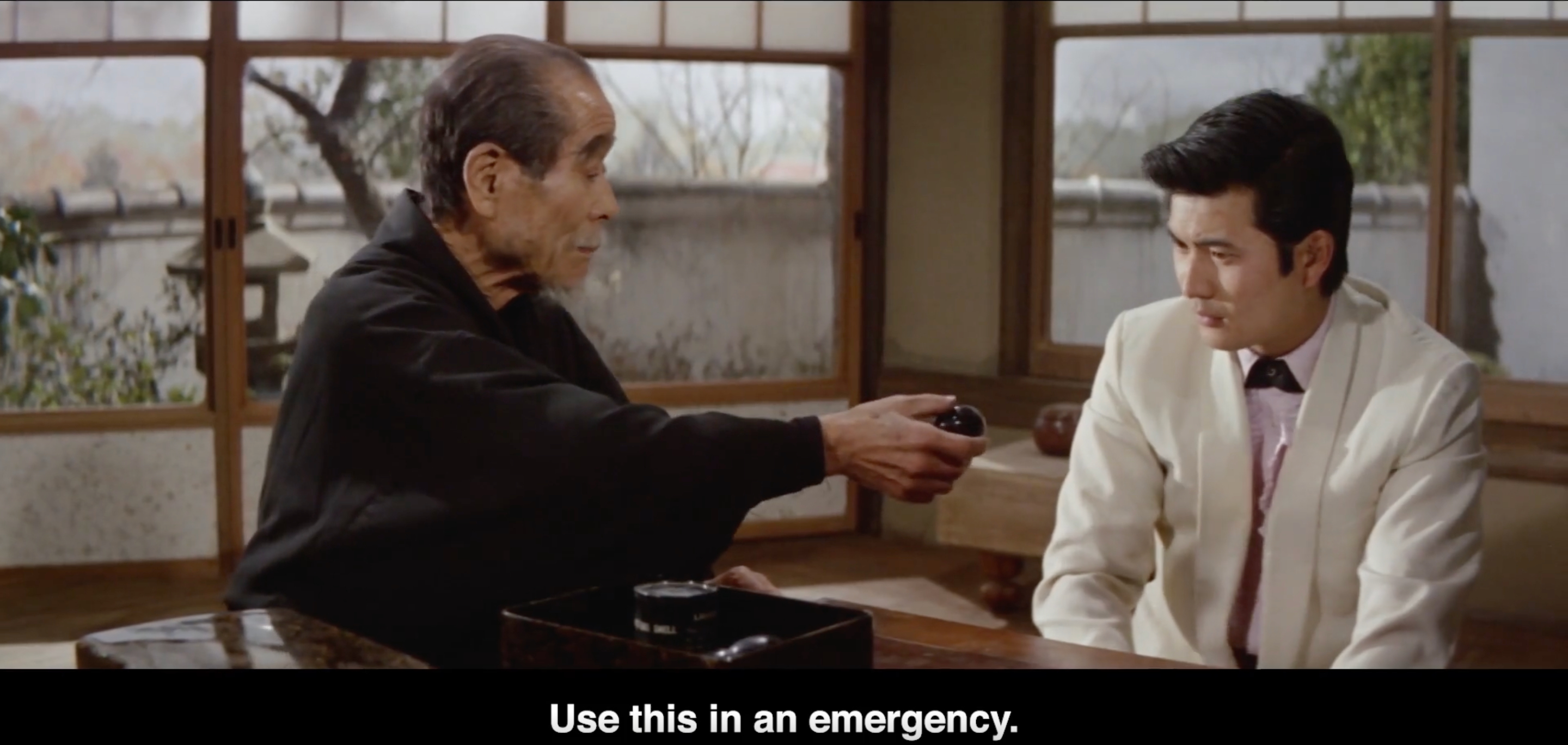
The only allies Hondo has are his friend Bill, an American newspaperman, and Momochi, an elderly “ninja researcher” with whom Hondo lives and trains. I was never quite clear if Momochi is Hondo’s father or sensei, or just a knowledgeable acquaintance, but I don’t think they come right out and say; in any case, Momochi helps Hondo puzzle out some of his problems and plays the same role as 007’s “Q,” giving him gadgets that turn out to be just what Hondo needs in a few sticky situations.
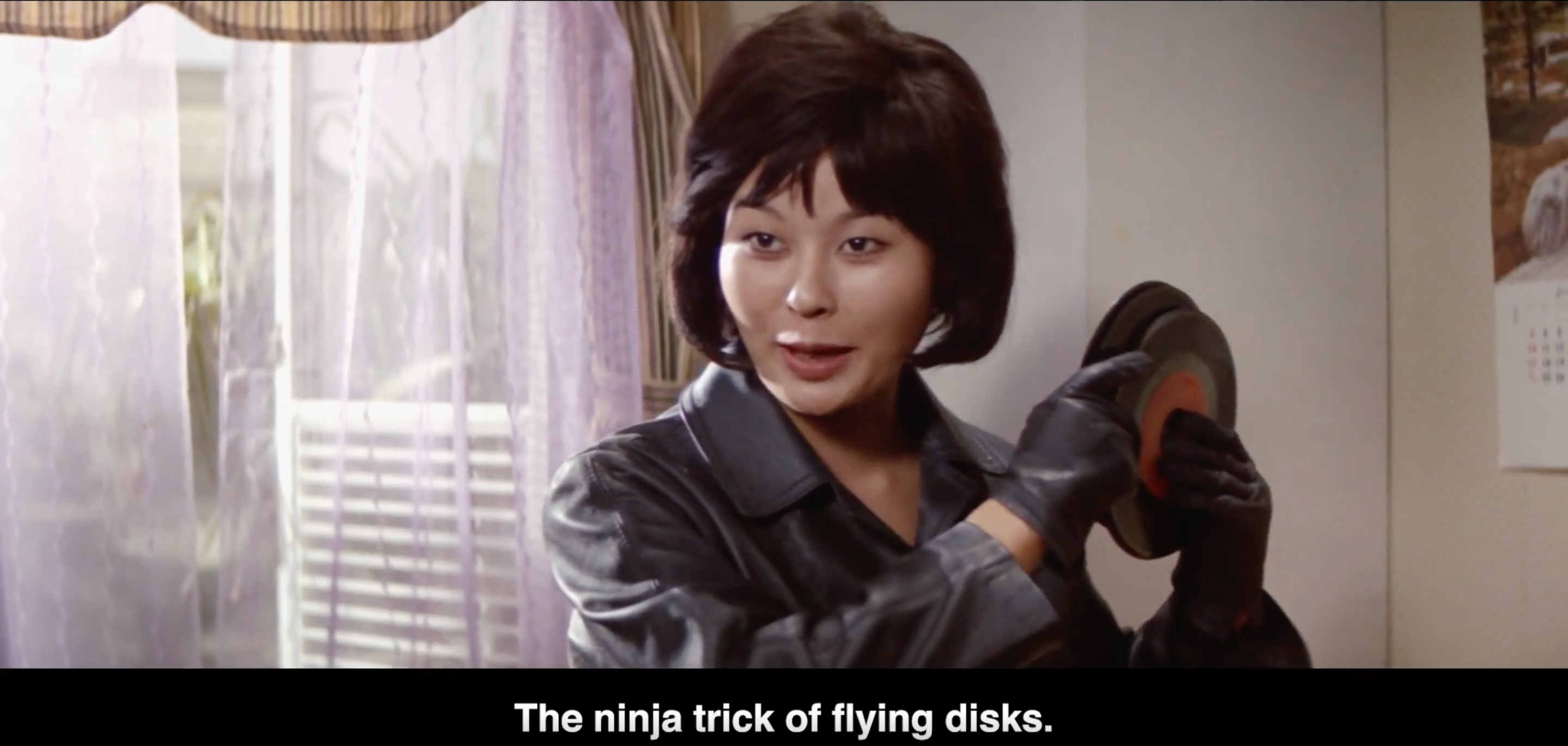
In one interesting bit of dialogue, Momochi shows Hondo a gas cannister used by America’s “ninja soldiers,” referring to the Army Rangers. Already we are expanding the definition of “ninja” beyond notions of clan or pedigree. The girl gang, the “Black Tights” of the title, pose as a traveling dance troupe calling themselves the “Ninjas” (hiding in plain sight, perhaps), but while we learn their background and motivations, we don’t actually find out if they’ve inherited their ninja techniques or learned them out of necessity. In this film, ninja isn’t something you are, it’s something you do.

The blurb on Night Flight Plus, where I watched this, describes Black Tight Killers as a “spy spoof.” The influence of 1964’s Goldfinger is especially obvious, not just in the cache of gold that serves as a MacGuffin but in the mileage the story gets from that film’s famous death by body painting. Still, it’s reductive to see it only as parody. The wave of heightened, Pop-Art-inspired camp that made its way into every corner of the media in the late ‘60s often had it both ways, offering real, visceral death and danger while laughing it off with a quip and a smirk.
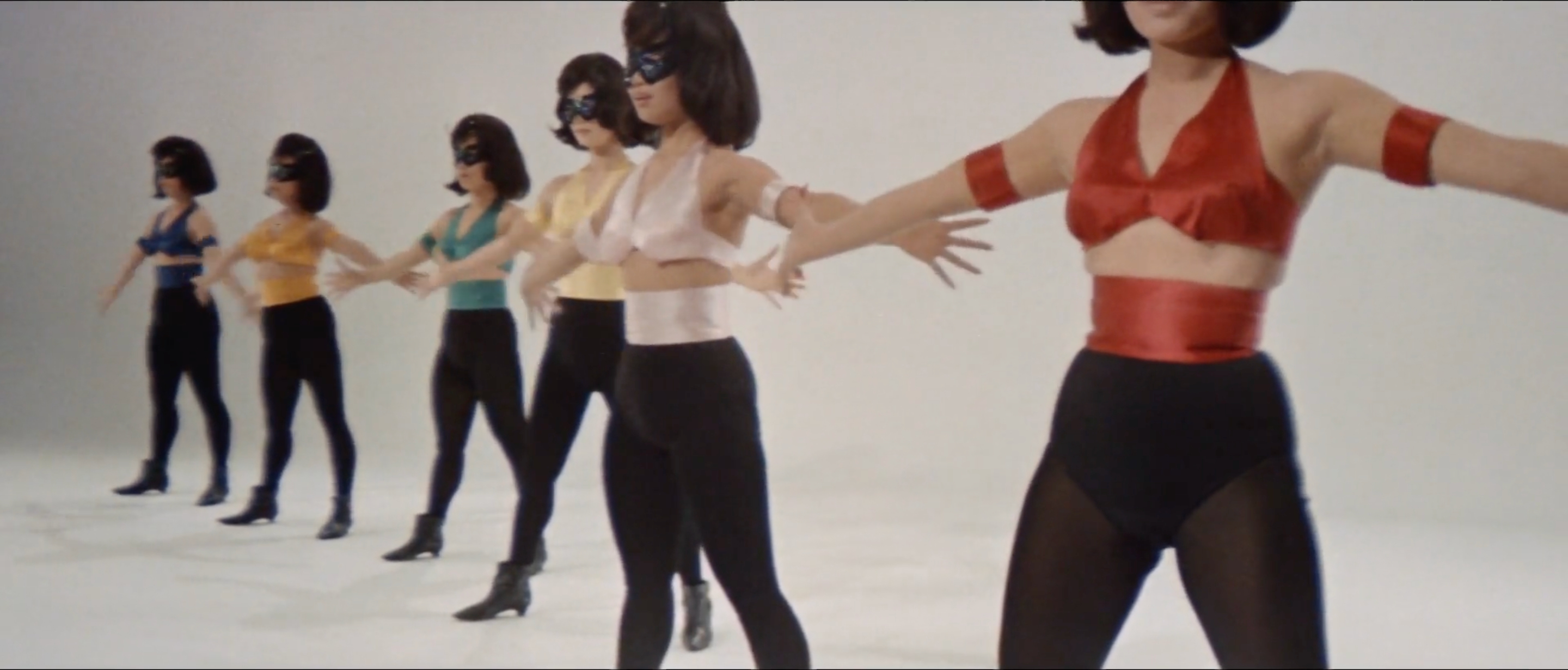
The mixture of high and low style is another source of excitement and tension. Scenes are bathed in solid primary colors, like panels of a comic book, matching the simple, iconic profiles of the characters: detectives in trench coats, gangsters in zoot suits, good girl Yoriko always in white and the Black Tights always in, well, you know. But the film is frequently arty and baroque as well; there’s even a “dream ballet” in which Hondo reimagines Yoriko’s kidnapping by the Black Tights. The red flower of Okinawa, worn as a corsage by all the Black Tights, takes on heavy symbolic freight by the end of the film, even as the continual ironies and reversals of the plot lead to a literal punchline.
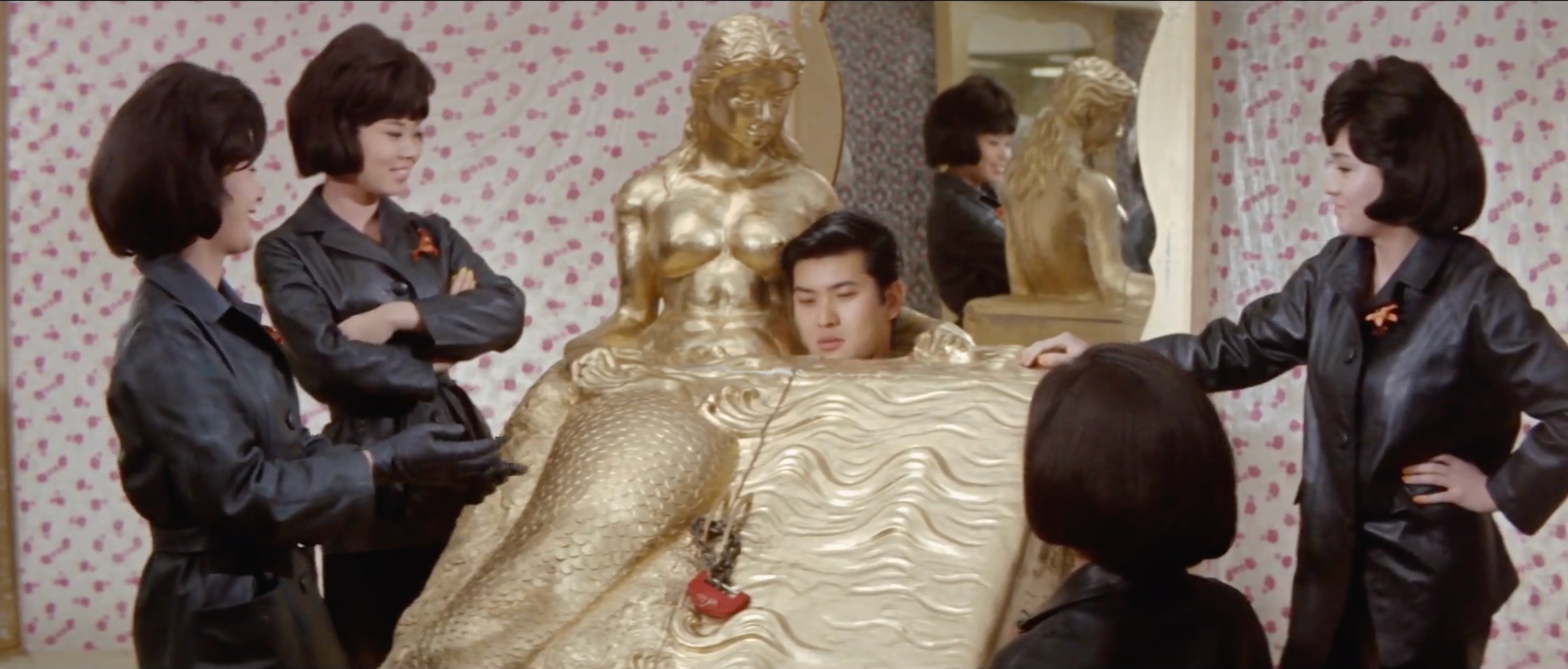
Finally, this is above all an action movie, with characters continually on the move. Other than an island-set climax, the production is relentlessly urban: Hondo’s quest to rescue Yoriko takes him from glamorous clubs to seedy photography studios and bathhouses. There are car chases, shootouts, and explosions, and there is a body count. The hand-to-hand action is about what you’d expect from a hard-boiled noir, with few of the martial arts flourishes you might expect when you hear the word “ninja”—there’s a knock-down-drag-out fight through multiple rooms of an abandoned house near the end of the film that would make Republic’s fight coordinators proud, with plenty of breakaway furniture and collapsing bannisters, all while Yoriko is caught in a literal deathtrap. “Dance! Dance all you want! It’s your last one!” taunts the villain. Yes, that’s the stuff.
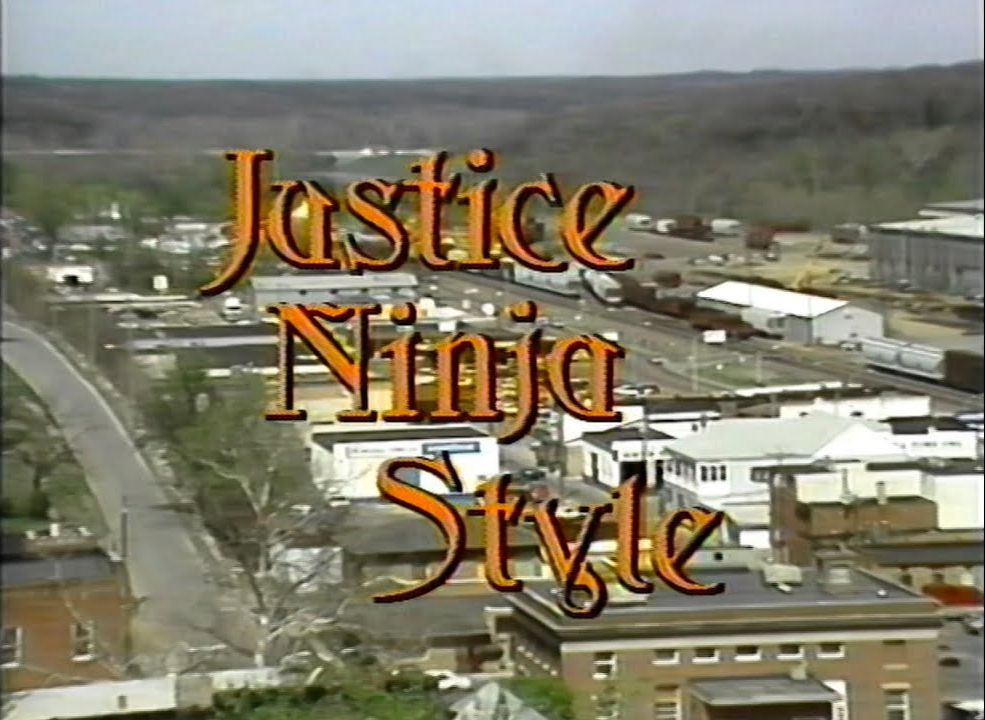

JUSTICE NINJA STYLE (aka NINJA THE ULTIMATE WARRIOR)

In 2019 I celebrated “Ninjanuary” with several posts about the ninja in popular culture, particularly in films and books from the 1980s, and I occasionally return to that theme. Past entries can be found by clicking on the Ninjanuary tag.

When I wrote about Commando Ninja last year, I noted how exaggerated many “retro” 1980s throwbacks are in their treatment of themes and visual styles, parodying or intensifying elements from movies and TV shows that were already larger than life. Justice Ninja Style (John Legens, 1986) is an actual product of the 1980s and a good reminder of how square a lot of that entertainment was. With distance, we’ve remembered the highest points, the most stylish or exciting moments, and forgotten the sea of formula and mediocrity from which those peaks emerged. That’s not to say Justice Ninja Style is bad—for the most part, it’s pretty charming and makes for a diverting 70 minutes or so—but it’s much more prosaic than those latter-day vaporwave creations, or, for that matter, such singular ‘80s oddities as Unmasking the Idol or Ninja III: The Domination.

While Justice Ninja Style was produced by a Hollywood company, it was shot on location in a small town with the enthusiastic participation of locals (including the police and fire departments), giving it the feel of a regional DIY movie. Everyone gets in on the act, from area musicians to kids in the local karate studio; most scenes in public places are sprinkled with extras from around town. (In that regard, Justice Ninja Style most reminded me of King Kung Fu, the 1976 monster/martial arts spoof that doubles as a tour of Wichita, Kansas’ points of civic pride.) It’s a little odd for me, having gotten used to shot-on-video movies as inherently transgressive “outsider” art, exploring themes of horror, sexuality, or (for want of a better term) mindfuckery, and severely constrained by lack of resources, talent, or interest in mainstream appeal, to watch a similarly small-scale movie that seems to aspire to being a TV movie of the week. The violence is mostly bloodless, and while there is an air of sexual menace and implied threat of rape, it’s strictly PG-rated (for the ‘80s). It’s almost wholesome.

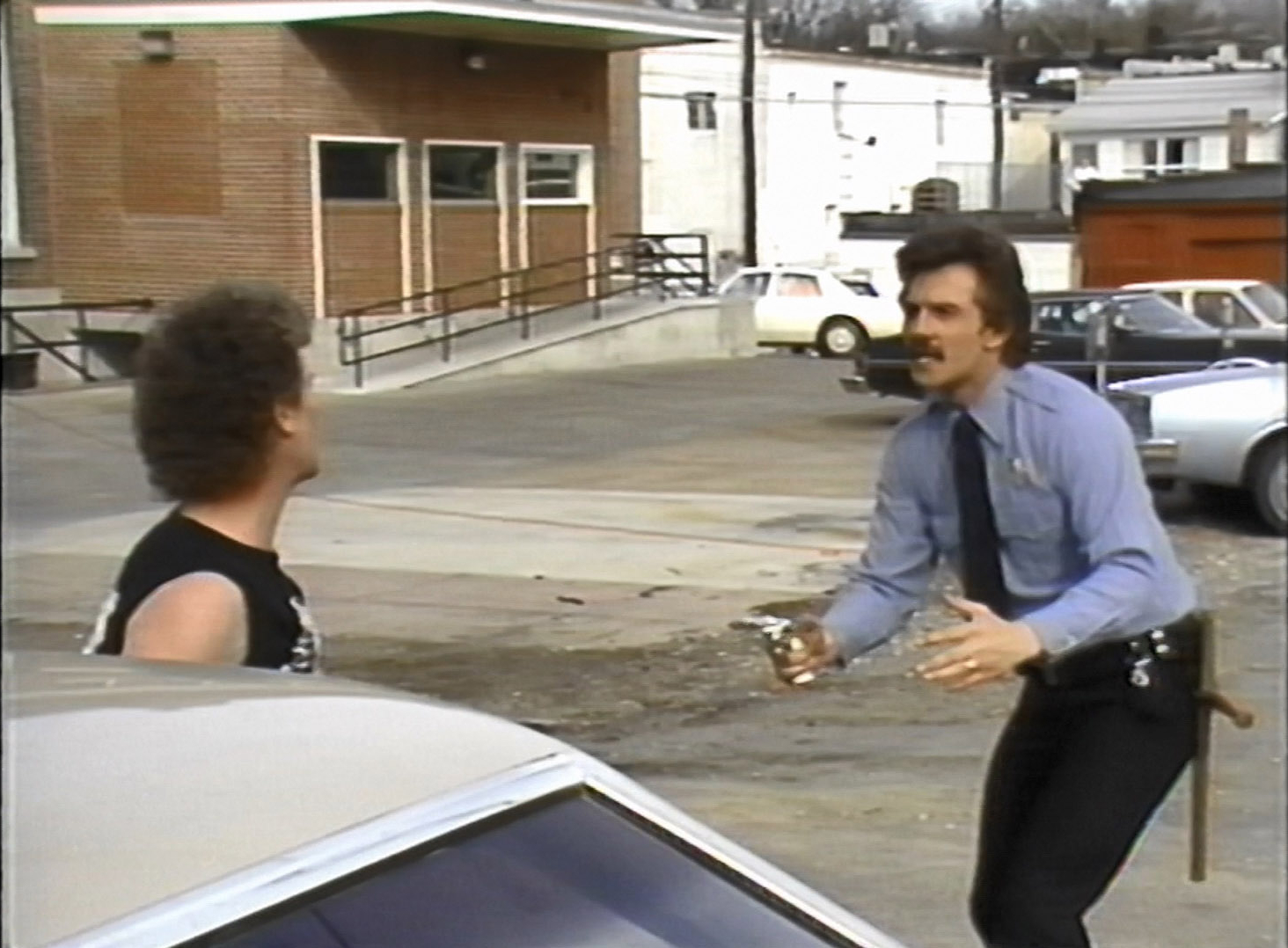
Set in De Soto, Missouri (a small town south of St. Louis), the film begins with two women, Shelly and Carol, driving through the countryside, discussing Shelly’s frustration with the hapless George, a police deputy who keeps pushing for a date. They don’t notice the police cruiser following them at a distance. When their car gets a flat tire, Carol offers to walk to the nearby salvage yard for help (it’s the ‘80s—no cell phones, kids), leaving Shelly alone when George pulls up with his partner, Grady. While George has Grady work on the tire, he makes a move on Shelly; she fights off his aggressive overtures, and in a rage he strikes her, accidentally killing her. Before Grady can decide what to do, George senses the opportunity to frame a patsy, new-to-town karate instructor Brad, who happens to be jogging by. George tricks Brad into showing him some moves with his T-stick, getting his fingerprints all over it, and gives himself a bump on the head so he can claim Brad resisted arrest when George tried to apprehend him after discovering him with the dead woman. He browbeats Grady into going along with this and Brad ends up in a jail cell. The charge: murder.

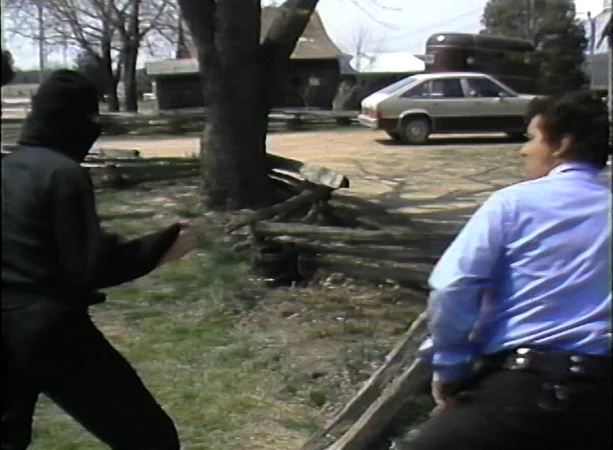
You might expect that this injustice pushes Brad to exact bloody revenge against the corrupt cops, like John Rambo in First Blood, but while he does protest his innocence, he’s much too nice a guy to burn it all down. Brad is the main POV character, but he practices karate, not ninjitsu. No, the film gets its title and theme from the mysterious, black-clad figure who witnessed Shelly’s murder and who later breaks Brad out of jail and wordlessly offers him help along the way to clearing his name. Brad doesn’t expect either his friends (mostly fellow karate instructor Dan) or his enemies to believe that there’s a ninja around—he can barely believe it himself. But through physical evidence like the shuriken (throwing stars) left on the ground and sightings from other people, eventually the truth gets out and George faces a reckoning at the deadly hands of the ninja.

It is amusing that the De Soto police were so cooperative when the Deputy is such an obvious villain. Perhaps they were too star-struck to worry about whether the movie would be copaganda, and it is worth noting that Rick Rykart, who played George, wasn’t local. (Rykart gives the most compelling performance: he starts out as a jerk who goes too far and tries to cover his tracks, but the scenery becomes more tasty as he becomes more desperate, so by the end he’s threatening to murder four people to guarantee their silence and bellowing that he’s not afraid of any ninja.) But there’s another angle: through a dramatic contrivance, George is only in charge while the Chief is away on business, giving him an incentive to wrap the case up before the Chief returns, and with Brad (Brent Bell) and his friends counting on the Chief to recognize the truth when he hears it. Like the absent King Richard, the Chief’s departure leaves a hole that can either be filled by pretenders like George or the Robin Hood-like ninja, operating outside of the law to preserve something more important: justice.

The ninja is played by Grand Master Ron D. White, a 9th Degree Black Belt and Martial Arts Hall of Famer, who also (according to him) rewrote the script to more accurately portray the art and history of the ninja. Although he doesn’t get a lot of screen time, the film was built around White, and after its initial release, producers apparently felt that they needed to beef up his presence as well as provide more backstory explaining his character’s motivation instead of saving that revelation for the end. The expanded film was released as Ninja the Ultimate Warrior; I may be in the minority, but I don’t think it’s an improvement. The ninja is entirely silent and remains masked in Justice Ninja Style, but Ninja the Ultimate Warrior—which reveals that the ninja character is apparently named “Liberty King”—has a prologue in which White woodenly delivers exposition, and another scene establishing that George was a corrupt hothead in St. Louis before he was reduced to being a corrupt hothead in a small town. These scenes don’t add much and only make the later plot turns seem predictable instead of developing organically.

The legitimacy of White’s claim to be a real ninja isn’t something I’m qualified to dispute, but suffice it to say that there are many dubious pedigrees and many self-credentialed figures in the martial arts world. In the documentary The Ninja Speaks (on the Justice Ninja Style Blu-ray from VHShitfest), White doesn’t talk about when or how he became a ninja, other than to say that “some people liked and some people hated” his video How to Be a Ninja, an introduction to ninja weapons and techniques with some hands-on demonstrations. Perhaps it’s all kayfabe, or maybe White’s antics are a smokescreen of disinformation to protect the real secrets of the shadow warriors. It’s not my place to say.

My 2025 in Film: Top Five

According to Letterboxd’s year-end summary, my most-viewed actor in 2025 was Sidney Toler, who played Charlie Chan in a series of B-movie mysteries in the 1940s; my most-watched director was René Cardona, Jr., the subject of a pair of box sets from Vinegar Syndrome that I watched last spring. (Cardona was the son of René Cardona, Sr., who directed some of the installments of the Santo series, which I wrote about in 2024. The films in the Cardona, Jr. sets were primarily adventure and crime pictures.) I suppose those are typical examples of my viewing through much of the year (and, as always, you can look at my complete diary if you like), but neither body of work is particularly noteworthy beyond numerical superiority. I almost decided not to post an end-of-year list: I didn’t see very many new films in 2025, and there are obviously still a lot of movies I haven’t caught up with yet. However, I saw enough that I liked that I thought it would be worth writing at least a Top Five 2025 New Releases. 

5. It would be difficult for the Marvel Cinematic Universe to pull off the conceit of the original Thunderbolts, a series by Kurt Busiek and Mark Bagley in which a new team of heroes shows up, only to be revealed that they are actually old villains operating in disguise under new names. However, in adopting the same name (with a cheeky in-universe explanation) for an ad hoc team of antiheroes, screw-ups, and antagonists from past MCU films, Thunderbolts* (dir. Jake Schreier) gives us an idea of what to expect, at least tonally. When a group of mercenary superhuman operatives is summoned to a remote lab, each with orders to kill each other and destroy the lab, it doesn’t take them long to figure out that someone in the government is trying to clean up after themselves, and they are determined to save their skins and bring the truth to light. Since this is part of the ongoing soap opera of the MCU, it helps to understand the history between White Widow (Florence Pugh) and her father Red Guardian (David Harbour, consistently a delight), and between disgraced former Captain America John Walker (Wyatt Russell) and James “Bucky” Barnes (Sebastian Stan), now a U.S. Senator. But it’s the appearance of the Sentry (Lewis Pullman), a previously unknown character, that really throws a wrench in to the plans of mastermind Valentina (Julia Louis-Dreyfus). In the comics, the Sentry was a character who had supposedly been created alongside the Fantastic Four and other Silver Age Marvel stars, but “erased” himself, forcing everyone to forget him, to protect the world from a danger he himself represented, and only reemerging in the 21st century. I liked the idea of the Sentry more than the execution, most of the time, but the film version (here depicted as a test subject given great power, but whose unresolved personal demons are a literal “dark side”) works very well and complements the theme of confronting and overcoming failure. And, as the asterisk at the end of the film’s title might hint, there is still a Thunderbolts-worthy twist.

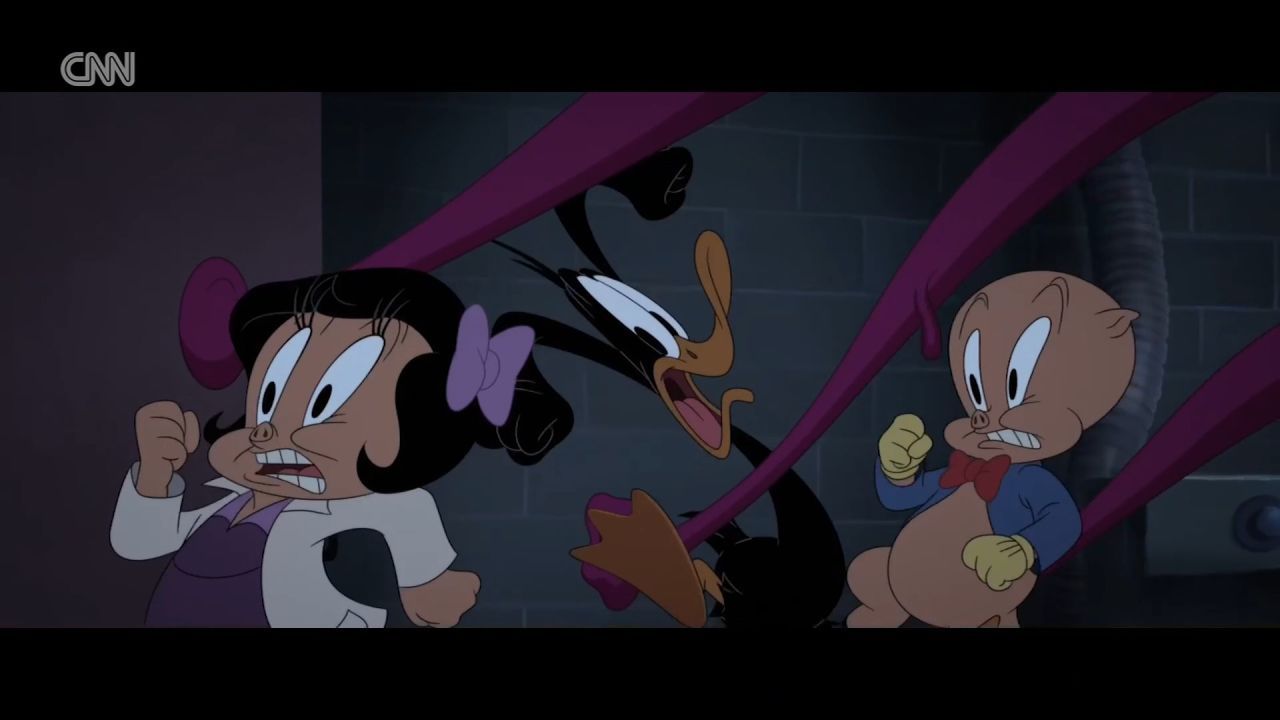
4. I was surprised to learn that The Day the Earth Blew Up: A Looney Tunes Movie (dir. Peter Browngardt) was the first original feature film starring the famous cartoon characters (previous theatrical features were either compilations of existing shorts or live-action/animated hybrids like Space Jam), but if this was a trial balloon, it paid off. (Aside from it being good, it’s worth celebrating The Day the Earth Blew Up’s success for convincing Warner Bros. to release the previously shelved Coyote vs. Acme.) Rather than stuff the screen with characters, this one focuses on Porky Pig and Daffy Duck as adopted brothers struggling to pay off their inherited farmhouse while aliens secretly take over the local chewing gum factory for mysterious (but presumably sinister) reasons. It’s a fun balance of new and old, with plenty of references for the old-school animation heads to catch (there’s a great workplace montage set to Raymond Scott’s “Powerhouse,” the “factory” music incorporated into many classic Looney Tunes scores by Carl Stalling), but without feeling hidebound. It gets a lot of mileage from characterizations of Porky as the hard-working rule-follower, teamed up with Petunia Pig as a sweet-but-tough scientist, and Daffy as the well-meaning but easily distracted screwup. (This is original-flavor “agent of chaos” Daffy, not so much the egotistical foil to Bugs Bunny from later iterations.) The resolution to the alien plot (a spoof on 1950s alien invasion and body-snatcher movies, with nods to modern takes like The Thing and The X-Files) is suitably loony, and explains why an original alien character (voiced by Peter MacNicol) appears instead of Marvin the Martian. 

3. Like a lot of people, I caught the fever for KPop Demon Hunters (dir. Maggie Kang and Chris Appelhans), first watching it on Netflix and later accompanying my wife to a sing-along screening. The film, in which the members of Korean pop trio Huntrix are secretly the heirs to a tradition of musical demon slayers, fighting off incursions from the underworld and keeping the world safe with their voices, wouldn’t work at all if the songs fell flat. But in addition to its memorable musical numbers, it’s often very funny, drawing humor and pathos alike from the characters of the three young women at its center.

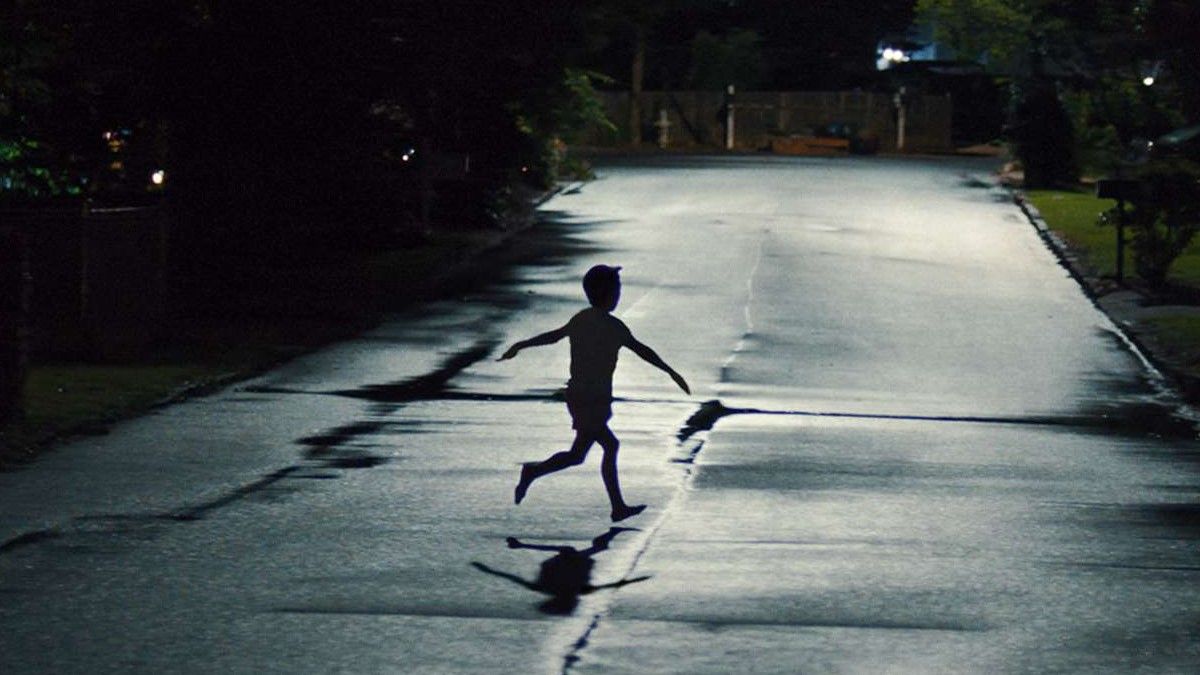
2. Weapons (dir. Zach Cregger) begins with a voiceover, a child describing the night that the kids from an entire third-grade class walked out of their houses and disappeared, setting the tone for an enigmatic urban legend or dark fairy tale. It’s an approach that works surprisingly well for a story set in contemporary suburbia, and like a fairy tale, Weapons can be enjoyed as a story for its surface elements (told in fragments, from the perspectives of alternating characters, each expanding the audience’s view a little more, until finally revealing what’s really going on) or as a symbolic examination of current anxieties. In this case, the title and the specter of an enormous assault rifle that appears in a dream sequence suggest a meaning that is never stated explicitly, but in modern America, what’s the most common explanation for an entire classroom of children vanishing at once?

1. Sinners (dir. Ryan Coogler) contains multitudes: a period piece, a supernatural horror movie, a meditation on community and identity. Michael B. Jordan plays a dual role as twin brothers Smoke and Stack, who return to their small hometown in the Mississippi Delta with the idea of opening a roadhouse after bootlegging in Chicago. Their younger cousin Sammie (Miles Caton), torn between his father’s church and his worldly love of the Blues, begs for an opportunity to play guitar at the roadhouse’s opening. It’s not until Sammie’s playing literally lifts the veils between different times and places (in an audacious scene that demonstrates the “power of music”) that the genre switcheroo takes place, as the music attracts the attention of a band of Irish vampires who want Sammie’s power to revisit their own long-lost home. It’s a movie I will revisit.

Thanks for reading and have a great 2026!