What shape is a trumpet? (and other questions)

The real question is, where I am going to find cases for these things?

mellophone1mellophone2

The instrument at the top is a mellophone, a simplified substitute for the orchestral horn, once commonly used in bands to play the alto part.  (Instruments nowadays called “mellophones” are acoustically similar but wrapped differently, more like a bugle, or as we used to joke in high school marching band, “a pregnant trumpet.”)  The second instrument was once shaped like the one on the left, but was converted to its current bell-front configuration by a family friend.  It belonged to my uncle, a trumpet player, and was passed on to me.

The outward forms of brass instruments can be changed like this because of the simplicity of their construction (compared to the mechanical keywork of a woodwind instrument, for example) and because, acoustically, the tubing can be curved in many different ways without changing the basic sound of the instrument (up to a point: in general, the more bends there are in the tubing, and the tighter they are, the “stuffier” the horn will sound; unless there is a compelling need for a more compact shape, instrument manufacturers try to use an “open wrap” with as few bends as necessary).  The malleability of brass (not a single metal, but an alloy of copper and zinc, usually combined with smaller amounts of other metals such as nickel or gold) also makes it possible to be worked by hand with the right tools.

I’ve known a number of instrument technicians (repairmen), and converting or otherwise customizing horns is something most of them have done.  Like auto mechanics, it’s hard for them to resist the temptation to soup up or experiment on cast-off parts in hopes of building a hot rod.  Boredom can also be a factor: one technician I knew who served in the armed forces told me that a favorite prank on the base was to get the lead trumpeter’s instrument and surreptitiously remove its support braces, then slip it back in to his case.  It wasn’t impossible to play, but much less stable and comfortable, and it was always a memorable break from dull routine, especially if it was before a performance or review!

What really affects the tone of a brass instrument is whether the tube is mostly the same diameter (cylindrical) before expanding into the bell, or widens gradually throughout its length (conical).  This is the “bore profile” of the instrument, and it is the same no matter what shape the tube is bent into.  Brass with a cylindrical bore, like trumpets and trombones, are more penetrating in sound; conical-bore instruments, such as horns and bugles, are mellower.  Cornets, which are partially cylindrical and partially conical, have a sound that falls somewhere in between.  (The width of the bore also plays a role, and is in fact the primary difference between the three B-flat instruments marked “Tenor,” “Baritone,” and “Bass” in the following illustration–they are the same length but sound and play somewhat differently; there is no room for discussion here, but the nomenclature of low brass instruments has always had the potential for confusion.)

Brass available in both configurations, from The Music Men by Margaret Hindle Hazen and Robert M. Hazen

Brass available in both configurations, from The Music Men by Margaret Hindle Hazen and Robert M. Hazen

During the nineteenth century, the “golden age of brass,” a wide variety of different forms were tried out, some born of functional necessity and others out of the search for novelty.  Brass instruments were often designed in “families” that followed the same pattern, from the high E-flat cornet to the BB-flat “monster” bass tuba.  One of the most famous images of Civil War music is the “over the shoulder” brass band, with instruments that literally pointed backward, so that marching soldiers could hear them when the band marched or rode on horseback at the front of a formation.  After the war, over the shoulder horns continued to be used, but were gradually displaced by “bell front” or “bell up” instruments closer to the forms in use today.  (Note the use of rotary valves on the over the shoulder instruments; rotary valves are rarely seen on American instruments nowadays, with the obvious exception of the orchestral horn.)

Another pattern that was once widespread is the “helicon” or circular wrap, which went around the musician’s shoulder or wrapped around their torso like the modern Sousaphone, the only helicon instrument still in common use. (Contrary to popular belief, Sousa’s innovation was not the wrap-around shape, but the decision to enlarge the bell, at first pointing straight up, and later angled to point forward, for a more directed sound.)

One of the more eccentric shapes was conceived by Louis Schreiber of New York, who formed his “Schreiber horn” into a teardrop with an S-shaped bell.  (According to Schreiber’s 1867 patent, he justified his new shape partially on ergonomic grounds, with the weight of the bell resting on the player’s shoulder.)  Again, an entire family of Schreiber horns was created, although it didn’t last long and examples are now quite rare.

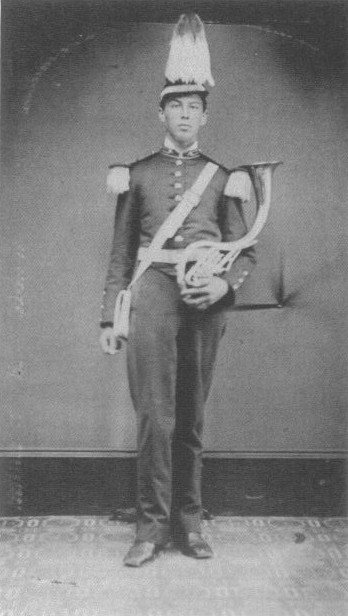
schreiber.alto

Musician with Schreiber horn, ca. 1870, from The Music Men

Musician with Schreiber horn, ca. 1870, from The Music Men

And that’s to say nothing of the famous double-bell euphonium, another innovation that has come and gone.  Such experimentation is now the exception: as far as the big instrument companies go, there is less room for innovation in the basic shapes of the instruments, even as a great deal of research (including computer modeling) and quality control that would have been unimaginable a hundred years ago goes into refining acoustic and mechanical properties.

David G. Monette has been a notable example of the artisanal approach, designing and building custom trumpets (most famously for Wynton Marsalis and other jazz greats) while pouring the fruits of his custom work into his instrument lines, much in the same way innovations in concept cars eventually turn up in the regular models.  Monette’s innovations include the “integral” or built-in mouthpiece and his instruments have an organic, art nouveau-influenced form.  Monette has also continued the nineteenth century tradition of crafting beautiful instruments to honor great musicians, or in the case of the Elysian Trumpet for New Orleans, to memorialize tragedy.  While Monette’s designs are available to a wider market than they once were, even expanding to a student line of mouthpieces, Monette remains a boutique brand when compared to the industry giants.

Elysian Trumpet by David G. Monette and Tami Dean

Elysian Trumpet by David G. Monette and Tami Dean

On the real fringes are the experimentalists who aren’t concerned with perfecting or customizing existing instruments at all, but use them as raw material for art in which the instrument and the performance are one.  As an example, jazz musician and horn sculptor Mark Southerland of Kansas City builds his own instruments (as well as work which is purely sculptural) from scrap parts for use in live performances that include elements of improvisation, ritual, and multimedia.  Southerland is a saxophonist, so his playable sculptures are actually woodwinds, but crossbred with borrowed trumpet and horn bells: they are true hybrids.  He follows in the footsteps of such free jazz pioneers as Rahsaan Roland Kirk, who modified his instruments so that he could play three saxophones at once.  Southerland’s work is qualitatively different from the nineteenth century inventors like Schreiber or modern artisans like Monette, closer in spirit to the found-object transformations of outsider art or the process of discovery undertaken by electronic circuit-benders.

Brass instruments aren’t the easiest article to collect; making them the medium of your art is even more challenging.  But all the examples I’ve given above started with a tactile, manual approach to music-making; even a factory-made instrument involves an enormous amount of assembly and finishing by hand.  For those who combine their musical sensibilities with an urge to tinker, creating a one-of-a-kind instrument can be uniquely satisfying, whether it’s as straightforward as a modified lead pipe or as exotic as a double-belled metallic flower.
The Pleasures of Anthology, Part Seven

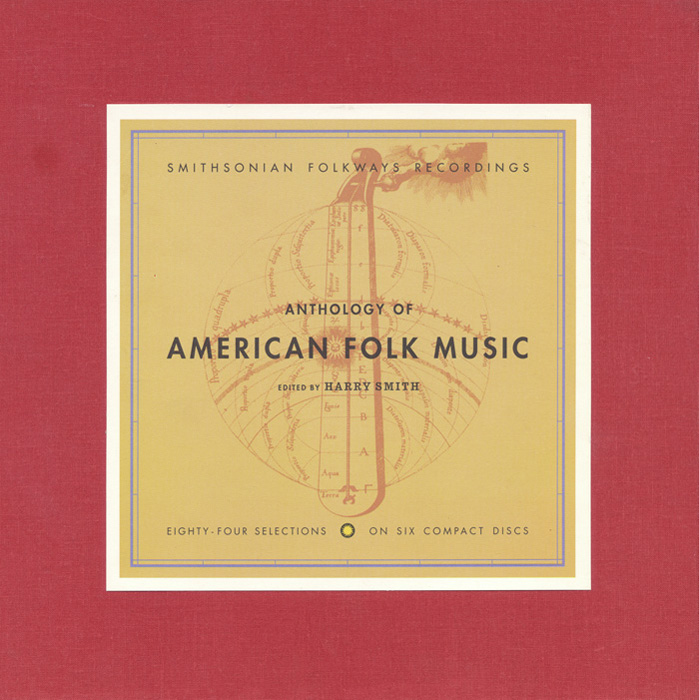
It occurs to me that in delving into the history of recorded music, I have somewhat strayed from my stated purpose of looking at influential or personally important anthologies.  In this final installment of “The Pleasure of Anthology,” I’ll look at a work that is both: Harry Smith’s Anthology of American Folk Music.  Smith is a fascinating figure by himself, and the AAFM, which he put together for Folkways Records in 1952, is only a small part of his artistic output, which included experimental films, paintings, and poetry, as well as ethnographic research on American Indian rituals, string games, and dance (Smith studied anthropology in college, but had begun his studies even younger, visiting an Indian reservation near his boyhood home in Washington state and recording and interviewing members of the tribes there).  It is the AAFM, however, that has had the most enduring influence.

AnthAmerFolkMusic

Peripatetic, Bohemian, obsessive Harry Smith has more in common with the anthologists like Bill Blackbeard than might first appear.  One of the primary accomplishments of his Anthology was to put an unacknowledged, even disdained, part of history front and center in the popular consciousness: the commercial recordings made by rural Southerners before the Great Depression.  Such records were produced by big Northern labels like Columbia and Okeh after they realized that people (both black and white) in isolated small towns would buy records made by people like them.  The countless 78s that Smith tracked down, collected, and sorted through held ballads, fiddle tunes, jug band stomps, and quasi-musical sermons, among other genres, either recorded on the spot by traveling recording outfits or in studios in Chicago or New York.  Almost all of these were relegated by their original labels to “race” or “hillbilly” lines, for black and white customers, respectively, and as such were promoted only in limited areas and then forgotten.  Not for these records would there be red labels or pink-paged catalogs.

Smith was one of many collectors scouring the countryside for old records—there had been a lively community of jazz and blues collectors, united by newsletters and fan-assembled discographies since the 1920s—but Smith was one of very few looking for “folk” music, and he was by far the most knowledgeable, generous with his learning if not with the records themselves.  (According to fellow collector Luis Kemnitzer, “He would lend out books that he thought you might want, gave away paintings and collages, but once a record came into his room it never left.”  Don’t we all know someone like that?)

Smith’s work was preservative, too: according to Smith’s longtime friend, poet (and founding member of The Fugs) Ed Sanders, “There was a big drive by the government to collect laminated records in order to secure the shellac for the war effort, so the records he was particularly seeking, from the 1920s and ‘30s, were in great danger of being wiped from history, a factor which may have given his collector-obsession an extra energy.  On the other hand, the government drive brought millions of records out of the attics of America, making them easy to find.”* As with the science fiction anthologists, passionate collectors like Smith not only chose the best examples of their medium to showcase, they effectively created new fields, new spaces for preserving and discussing cultural artifacts that might otherwise be forgotten.

The songs themselves sound much older than the mere two or three decades that separated them from 1952; listeners who had only been familiar with the music of polished groups like The Weavers were struck by the stark, ghostly quality of many of the voices and the sometimes eccentric quality of the music.  Even though many of the recording artists were professional musicians (on a regional level, at least), there is nothing slick or cookie-cutter about them; they have more in common with the rough-hewn, self-taught geniuses of the early jazz era, and in the best of these recordings there is something of the same energy.

The 84 recordings Smith chose are divided into three volumes: Ballads, Social Music, and Songs, each volume originally on two LPs.  Smith’s ordering and his brief, even telegraphic, notes are carefully considered to guide the listener through the not-so-distant but disappearing land that Greil Marcus called “The Old, Weird America.”  Smith saw the project as half scholarly and half an agent of cultural transformation, but he mostly lets the music speak for itself.  If there is an agenda beyond simply making the music more available, it might be found in Smith’s refusal to list or even acknowledge the race of the performers, instead emphasizing the connections that transcend segregation.  In Marcus’ words, “Linking one performance to another, he ultimately linked each to all”—an excellent description of what a great anthology can accomplish.

Everyone has their favorite disc in the Anthology; the Ballads and Songs of Volumes One and Three appear to have had the most influence on the contemporary folk movement, but the “Social Music” of Volume Two is mine.  Most of the tracks are instrumental, rhythmic fiddle or banjo music for square dancing (on “Georgia Stomp,” the fiddler calls the dance steps out as he plays), as well as what can only be called good-time party music (“Moonshiners Dance,” one of my favorites, sounds like a rural Spike Jones by way of an A&M college bash).  All of these dance numbers fit into the two- to three-minute span of a record side, but within that short time they create their own worlds.  There is a droning quality (in the literal sense of a repeated pitch or chord) that one easily associates with “primitive” music, to the diddly-bow or the monochord that fascinated Smith, and some of the music is genuinely archaic—pan pipes are represented, made of reeds cut by hand—but mingled with urban trends or Tin Pan Alley standards that show the creeping influence of radio and commercial sheet music.

There are songs on Volume Two, as well—not “Songs” as Smith defined them, but vocal music nonetheless.  I sometimes presented Jim Jackson’s heartbreaking “Old Dog Blue” as an example of a “floating couplet” proto-blues song when I taught Music Appreciation, an act of bravery (or foolishness) considering it’s hard for to listen to without getting choked up.  Like other songs on the Anthology that have been the focus of intense study, “Old Dog Blue” is at once crystal-clear on the surface—a reminiscence of a faithful hound, now passed away—and deeply mysterious, with seemingly biographical references (like “a little bitty girl with a red dress on”) thrown in, suggesting an entire life in the same way a white tip on the ocean suggests the iceberg beneath the surface.  Whether the lyrics are drawn from  Jackson’s memory, the common property of rural song, or consciously constructed by Jackson, the result is a song that seems to imply more than it says. The Romantics like Robert Schumann knew how evocative fragments could be, leaving gaps for the listener’s imagination to fill in: Jackson, and many of the other artists present, do the same, whether on purpose, or because of the limitations of recording, or simply because of the cultural gulf that separates us from them.

In the original booklet that came with the AAFM (reproduced for the lavish 1997 CD rerelease), Volumes Four, Five, and Six were promised, but they never arrived.  According to knowledgeable sources there were disagreements over the playlist between Smith and Folkways publisher Moses Asch, and Smith, ever temperamental, dropped the project.**  Later, Smith seems to have simply lost interest in this kind of anthologizing, moving on to studying quilt patterns and other, more physical, examples of folk life.  Within a few years of the original AAFM there was a flood of rereleases of similar material, fueled by the interest Smith had awakened.  It didn’t seem as important for him to continue since others had picked up the thread.  How short a creative period may turn out to be, especially for one with such diverse interests as Harry Smith: what may appear to be a mercurial temperament may simply be a restless intellect, always searching for new territory to explore.

*A comparable situation prevailed in the mid-1990s, when I was doing my most serious collecting: vinyl was considered dead, doomed to be replaced by CDs, and almost every garage sale or junk store had a crate (or several) of records at bargain prices.

** Following the CD reissue of the AAFM, a fourth volume was released on the Revenant label in cooperation with the Harry Smith Archives, based on a playlist Smith had compiled but with notes written by others.  Although it is little more than a footnote to the original AAFM, it’s still a worthwhile sequel, concentrating on music from the 1930s, and it includes songs that would become classics when reissued by others: Robert Johnson’s “Last Fair Deal Gone Down” and The Carter Family’s “No Depression in Heaven,” for example.  It is from the liner notes to Volume Four that I have drawn Ed Sanders’ comments.

The Pleasures of Anthology, Part Six

When I was growing up, there were quite a few format choices if you wanted to buy a recording of a song you liked.  45 rpm singles were the most popular with young listeners like me, and I had quite a few of those; my sister had even more.  45s were so ubiquitous that I remember the local radio station handing them out at parades.  There were albums, too, of course, long-playing 33 1/3 rpm records that contained ten songs or so—the hits, and a bunch of other stuff that might be good, but you’d have to buy the album to find out, as they never played the non-single tracks on the radio.  The first two albums of my own were Pac-Man Fever and Styx’s Kilroy Was Here, both of which I played non-stop, so that should tell you everything you need to know about me as a child.

Nowadays, the greatest disdain is reserved for the “greatest hits” package: when somebody lists a Greatest Hits as one of their favorite albums, it smacks of dilettantism; the implication is that their knowledge is only surface-deep or defined by songs that someone else decided were “the best.”  In short, they have committed the sin described by the record store clerk I mentioned previously, putting someone else’s preferences in place of their own.  Worse, the Greatest Hits divorce songs from their context within the album.  According to this point of view, the ideal recording artist makes statements at the level of the album, not the individual song, with each song contributing to a greater whole, like movements of a symphony.  That’s true of some albums and recording artists, but really only a minority, and even looking back to the “good old days” when albums were king paints a misleading picture.  As I recall it, the only albums that everyone agreed on back then were the mega-hits like the Saturday Night Fever soundtrack and Michael Jackson’s Thriller, an album that was so huge that on the last day of school my fourth grade class gathered to watch the full-length music video for the title song as a treat.  Albums like that could stay on the charts for months, even years, releasing singles until you had heard so many of the songs that it seemed silly not to give in.  The “all killer, no filler” album was a rarity, of course—it was more common for there to be two or three good songs and a bunch of forgettable junk—that was why it was so exciting when one came along.

Michael-Jackson-Thriller-cover1

Histories of the record industry tend to emphasize how revolutionary the long-playing record was when it was introduced in 1948.  No longer did listeners have to get up and change the record every few minutes: they could put on an LP (or several, if they had one of the newer phonographs with an automatic record changer) and have uninterrupted background music at home for (potentially) hours at a stretch.  Between the LP and radio, music lovers had fewer reasons to go out; once television was introduced, the media cocoon of the second half of the twentieth century was complete.

However, LPs first became popular as a vehicle for Broadway soundtracks, classical music and the emerging genre of “mood” music, i.e. music for grown-ups.  The transition to the album format was much slower for youth-oriented music like pop, rhythm and blues, and rock and roll.  The single was still king in those genres until the 1960s, and artists were expected to record in both formats: as Elijah Wald describes in How the Beatles Destroyed Rock ‘N’ Roll, artists such as Frank Sinatra and Sarah Vaughan recorded adult-oriented “theme” albums as well as pop singles, effectively for two different audiences:

Although Sinatra placed nine albums in the top two chart positions between 1955 and 1960 and had six top-ten singles in the same period, they included no overlapping tracks.  Even a song as iconic as “One for My Baby (and One More for the Road)” was strictly an album track, and though Capitol also released compilations of his singles, those packages never did as well as single-less sets like Come Fly with Me and Only the Lonely. . . .  Elvis was the only artist to be equally successful in both formats without specifically tailoring his LPs to the adult market.

Gradually this changed, and in the 1960s the Beatles turned their albums into thought-out, aesthetically unified song cycles, eventually abandoning live performance altogether so they could concentrate on their studio work; Sgt. Pepper’s Lonely Hearts Club Band (released in 1967) is generally cited as the first “concept album,” the term by which such efforts would be differentiated from the more typical collection of unrelated songs, but it was preceded by Sinatra’s albums, the Beach Boys’ Pet Sounds, and the Beatles’ own Revolver, albums whose contents are unified not only by thematic connections but by sonic ones as well: throughout the 1950s, instruments were often added to pop recordings for the novelty value: Mitch Miller’s production of Rosemary Clooney’s singles include harpsichord, marimba, and oboe, for example. For Pet Sounds, Brian Wilson went much further, creating an instrumental pallet that included strings, brass, and free reeds (accordion and bass harmonica), giving the entire album an unprecedented unity.  The studio revolution of the psychedelic ‘60s was built on a foundation that included Miller, Sinatra’s arranger Nelson Riddle, and Wilson’s idol Phil Spector, as well as the avant-garde electronic experimentalists (like Karlheinz Stockhausen) cited by the Beatles.

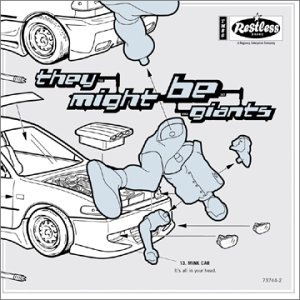
Such aesthetic unity is the real legacy of this fertile period, not the “concept album’s” pretensions of narrative specificity.  After the 1960s it would be unusual for a rock or pop album to lack a unified sound: artists might change their approach from album to album (sometimes drastically: think David Bowie), but each album was judged as an artistic statement akin to a Romantic symphony, whether or not it had been conceived as such.  As an example, They Might Be Giants’ 2001 album Mink Car, with its mixture of production styles and genre exercises, is often dismissed by fans, and even for its defenders (of which I am one) it feels like a “greatest hits” package, lacking the organic sense of “togetherness” listeners have come to expect from albums.

TheyMightBeGiantsMinkCar

But perhaps it’s not Mink Car that’s out of step: shortly after its release the same year, the iPod popularized “shuffling” as a listening mode.  CD players had featured shuffle mode since their introduction in the 1980s, and multi-disc changers allowed listeners to play tracks from several CDs in random order, but the iPod allowed one to randomize a complete library of mp3s, a listening experience that could be disorienting, exciting, and liberating—specifically, liberating songs from their contexts within album playlists.  Suddenly, the single was fashionable again.*   They Might Be Giants had previously put a set of short (most just a few seconds) songs called “Fingertips” on their album Apollo 18, specifically to take advantage of the shuffle feature.  The iPod made it possible to shuffle their entire catalog, for example, and in that context the variety of styles on Mink Car didn’t seem out of place at all.

The term “album,” applied to LPs, was borrowed from previous 78 albums, which had several sleeves bound together to hold multiple discs; the resulting product was much like a book, and comparable to a photo album.  Moreover, some albums were sold in the same way as photo albums: empty, with room for listeners to keep their favorite discs in the pockets.  In that sense, the album was purely a storage solution.  Like iTunes customers today, and like teenagers in the 1950s, 78 buyers often preferred to buy only the songs they wanted, not the complete albums assembled by record producers.

Yet even that is predated by the use of “album” as a collection of music; in the early nineteenth century it became fashionable for composers to sketch short pieces of music in the albums of their friends or patrons, sort of like signing their yearbook.  These short pieces were known as Albumblätter, or “album leaves.”  Gradually the term came to be applied to any short piece dedicated in such a manner; Beethoven’s famous Albumblatt für Elise was one such.  From there it was a short jump to composing sets or cycles of short pieces and designating the entire work as an “album.”  Robert Schumann composed sets titled Albumblätter and Album für die Jugend (“Album for the Young”), and other composers followed his example.  Schumann, in particular, was interested in cyclical forms that included hidden connections between otherwise quite different movements. When considering the classical forefathers of the “concept album,” in addition to the usual grandiose, totalizing suspects such as Richard Wagner and Gustav Mahler, a nod should also be given to Robert Schumann.

Publishers also assembled “albums,” bound volumes of compositions by particular composers, and of course sheet music is still published in that format today (although, like books, recorded music, and everything else, it is also available in a dizzying array of digital formats).  Interestingly, Beck released an album in 2012, Song Reader, that hews to this original definition.  Of course it is common for sheet music to popular albums to be published, but in Song Reader’s case there is no audio version, at least not officially: Beck has invited readers of the book to upload their own versions of the songs to the Song Reader website, a case of modern technology putting a new spin on social music-making forms that had mostly been marginalized by that technology decades earlier.

* Moby, an early and vocal advocate of the iPod, was featured on the cover of The New York Times Magazine in 2002; superimposed over his photo was a list of the contents of his iPod.  The implication was clear: the iPod hadn’t just changed the way people accessed their music collections—it had given birth to a new aesthetic of musical mixing and matching, embodied by Moby and his output.  Interestingly, the article describes how carefully Moby sequenced the songs on his albums, even with the knowledge that the producer no longer has the final say in the listener’s experience, if he ever did.  If we don’t see as many of those media think pieces about “remix culture” anymore, it’s largely because the concept has become so commonplace as to be invisible.

(Continue to Part Seven)

The Pleasures of Anthology, Part Five

A few years back I was browsing a new-and-used record store in Kansas City.  It will surprise no one that my affection for old book sales also extends to the crates of old records at music stores, and I used to spend many happy hours browsing their shelves.  I drifted down into the basement, where there were quite a few CDs and records, including 78s, of early jazz, one of my passions.  I was looking over a CD of guitarist Eddie Lang’s collaborations with violinist Joe Venuti, chatting with the clerk, a guy with a handlebar moustache, horn-rimmed glasses and a Hawaiian shirt (this was about fifteen years ago, before such a combination would be so commonplace as to be a hipster cliché).  He was justifiably proud of the store’s selections of 78s, but when I mentioned I didn’t have a 78 player and mostly relied on compilations, he sniffed, “I don’t like to let anyone else tell me what I can and can’t listen to.”  The conversation was effectively over.

I didn’t take it too personally.  A run-in with a snooty record store clerk is practically as much a rite of passage as throwing away one’s old comic books only to regret it later, and in the broader sense I agree with him.  As much as I respect the anthologist’s art, I’m all too aware of how much is out there that won’t be repackaged in modern formats.  I have a 78 rpm record player now, but hardly any discs to play on it.  I’m grateful for such online institutions as the Cylinder Preservation and Digitization Project, which makes very old and/or rare recordings available, the only filter being the rate at which its curators can acquire and digitize its holdings, but at the time of this conversation that would be a few years in the future.

What strikes me in hindsight is how different the attitude toward compilations is among music fans and readers of short stories.  I’ve never heard a sci-fi reader turn up his nose at a Groff Conklin anthology and say, “No thanks, I’ll stick to my issues of Astounding and Unknown Worlds.”  Very few will bother to track down a Kurt Vonnegut story in Playboy when it can easily be found between hard covers.  True, hardcore record collectors are also a minority, but the concepts of authenticity and authorial voice are different in the two areas.

To a large degree, this is due to the ephemeral nature of print magazines and the vital role anthologies have played in both keeping stories alive and developing a canon of widely-known and –respected work.  As anthology expert Bud Webster compellingly argues in his Anthopology 101,

There were paper drives here in the US well into the 1960s, and had been since the war years; thousands of old magazines were recycled in these drives, not counting the ones that were simply tossed out after reading, or the collections “cleared away” by well-meaning mothers when their sons and daughters went off to college.  Were it not for the anthologies and their editors and publishers, much of the science fiction we grew up reading and wondering over might never have been reprinted.

It should be obvious that this goes double for comic books and triple for newspapers.

By comparison, there was nothing ephemeral in the way recorded music was packaged and sold.  Quite the opposite: before the advent of recording, a performance could be heard only once and was then gone forever.  Recording, in the words of David Suisman in Selling Sounds, stopped the flow of time “as a dam holds back the flow of a river,” storing sounds indefinitely in the grooves of a cylinder or disc.  The permanence of records didn’t always live up to the hype (records could warp, scratch or crack from mistreatment, or wear out through overplaying; even compact discs weren’t quite as invulnerable as they were originally made out to be), but it represented a huge change, and one that took nearly a decade for both consumers and producers to get their head around.

From about 1890 to 1900, Edison cylinder phonographs and competing disc-based gramophones were known as “talking machines;” Edison predicted that his device would find its greatest utility in business as a dictation aid, and a great deal of the recordings commercially sold were famous speeches, passages from the Bible, and the like.  Up until the turn of the century, such machines were little more than a novelty.

Criticisms of “disposable” pop music and novelties are as old as the music industry itself, and that label adhered to both Tin Pan Alley pop songs (which pioneered the kind of built-in obsolescence associated with “one-hit wonders” and prefab stars), most commercial records, and the machines themselves. It was the Victor Talking Machine Company, a competitor of Edison and Columbia, that realized they could sell more machines by creating a musical product with cultural cachet—in modern terms, hardware sales could be driven by providing desirable software—and in 1902 the Victor Red Seal series was born.

The Red Seal records featured respected musical artists (most famously the Italian tenor Enrico Caruso; the Red Seal artists were predominantly European, an important signifier of quality in American culture) performing operatic excerpts and other high-status repertoire, recorded with the best quality possible.  Just as important, the Red Seal records were set apart from the regular “Black Seal” series by their packaging (the “Red Seal” refers to the red paper labels on the records) and by a higher price; they were even listed in a separate section of the Victor catalog, printed on pink pages.  Their desirability was part of a marketing strategy; even Victor’s executives admitted that the Red Seal records didn’t sell as well as the Black Seals, but they were an effective advertisement for the line as a whole. More to our point, as Suisman says, “the Red Seal records were quintessentially middlebrow; they presented an ad hoc assortment of digestible classics [the length of a record side was only two to four minutes] as a timeless and definitive canon.”  They made it psychologically okay to value records as something other than a passing fad, and transformed the fledgling industry.

Feodor_Chaliapin_-_Song_of_the_Flea_-_Victor_14901B

So we’ve established that records, once they found a foothold and adjusted listeners’ expectations, aspired to a permanence that fiction might only attain when safely preserved in book form.  There is also the difference between recorded sound and print media: the words of a story are the same (barring drastic editorial change) whether in a magazine or a book; they can even be translated into another language. In some cases, the book versions of stories are more definitive, removing editorial changes (or misprints) and allowing the author’s original voice to come through more clearly.  By contrast, the promise of audio recording is its faithfulness, the idea that you are hearing a piece of music just as it was performed by the artist; what could be more authentic than that?  The transfer of music from one format to another has been fraught with controversy among listeners; indeed, Victor and the other record companies had to work very hard to make their limited recording facilities sound as good as they did before the introduction of electrical recording in 1925 (they weren’t necessarily trying to convince listeners that a recording was “just as good” as a live concert; they counted on the fact that for most people, a record would be as close to hearing Caruso as they ever got).  In converting monophonic recordings from 78s to LP, producers sometimes introduced “fake stereo,” the aural equivalent of colorizing a black and white movie. The debates over the merits of analog vs. digital sound are well known, and the primary appeal of mp3s has been convenience, not sound quality.

Finally, there is the context of the individual song itself, and I think this is where anthologies become suspect for many purists.  In my next installment, I’ll look at the concept of the album, and its rise and fall in importance to recorded music.

Introduction

Welcome to my blog!  To explain what Medleyana is, it’s probably easier to explain what it isn’t.  Medleyana is not going to be a personal diary.  When I was a young boy I kept a diary, and I did my best to stay true to the “daily” aspect of the root word dies, even going so far as to backtrack and write entries for days I skipped writing, until I was trying to remember what I had been doing on days weeks before to catch up, and the whole thing started to seem ridiculous.  Life sometimes moves too quickly to record everything.

As a teenager, I tried again, this time with a “journal,” which sounded more serious and grown up to me, and which I told myself I wouldn’t feel compelled to write in every day (even though its root word, jour, also implies a daily use).  I would only write in it when I had something to say.  In addition to personal reflection, I wrote about musical or literary projects I was involved with, explored my creative process, and recorded my reactions to books I read and movies I watched.  With that freedom in mind, I was able to keep a journal into my late twenties; I might go weeks or months without writing, but when I did I felt confident I was creating something substantial instead of simply recording mundane details out of a sense of duty (although there were also plenty of mundane details recorded along the way).  The only real restriction I placed upon myself was that I wouldn’t go back and change or erase anything from a previous day: it would be a record of the moment, not an exercise in hindsight.

The end of this journaling phase came one day when my composition professor pointed out that I was spending more time and energy recording my ideas about writing music than actually composing.  At the time, I couldn’t deny the truth of that: I’ve always enjoyed talking shop with other composers and creators, and reading and writing about the process, and when you’re doing that it’s easy to convince yourself that you’re being creative and doing great work without actually finishing anything.  Perhaps that insight should have led me to change my major to journalism or creative writing, but I am nothing if not stubborn, and I put the journal away and committed to pouring that energy into music.

So why blog now?  In part, my life has changed so much since then that I feel more confident I can balance creative work and commentary; a few years ago, I made a conscious decision to focus on finishing smaller projects so that I didn’t have a new piece only once a year, and these short articles fit right into that ethos.  Also, a public blog is quite a different matter than a personal diary: I hope to begin a discussion, and my focus will be on aesthetic issues rather than my personal life or what I had for breakfast.  I won’t deny that shifting my work to the internet age has been awkward for me: I’m not too old to use computers by any means, but just old enough to be uncomfortable with the “share everything” spirit of the twenty-first century.  I can be a perfectionist, which is okay, but it has led me to keep a lot of work under wraps that I should probably just release to the world and accept that some of it will be liked, some disliked, and a great deal ignored.  That is simply the way things are now.

Perhaps more importantly, I am no longer teaching in the classroom.  In addition to teaching music theory and aural skills (ear training), the bread and butter of composers who are otherwise unemployable, I spent several years teaching music appreciation and music literature.  These classes were wonderful arenas for discussion and exploration (on my part, at least, even if students dragging themselves in at 8:30 am didn’t always feel that way), and I now find myself in need of a comparable outlet.  (Don’t worry, I won’t bore you with rhetoric about the internet being the world’s biggest classroom, or anything like that, nor do I mention my teaching experience to claim any special authority: on the internet, I’m just another voice.)

Okay, Medleyana isn’t a diary, or a classroom syllabus.  What is it?  I’ve subtitled it “In Praise of the Eclectic,” which sums up my interest in “inclusive” aesthetics, artistic and musical styles that draw influence and ideas from lots of different sources.  My interest is twofold. First, I’ve always been a sucker for formats that bring a variety of items under one roof: anthologies, omnibuses, samplers, miscellanies, and medleys.  Second, I’m intrigued by artistic styles that do the same thing, but which may appear on the surface to be unified, either transformed by technique or by the strong personality of a single creator.  There will be more on these subjects to come.  And in that grab-bag spirit, I reserve the freedom to throw in whatever else I might feel like writing (convenient, no?), but I’ll use tags to keep things organized as we go.

I’ll leave this thought in conclusion: I try to approach eclecticism, both as an audience member and as a creator, with the kind of attitude attributed to the Zen teacher Shunryu Suzuki in an oft-repeated anecdote (this version of the story is from Sally Wendkos Olds’ A Balcony in Nepal):

 I remember a story I heard about a young monk who saw his teacher in the dining room reading a book while eating his lunch.  The novice stood quietly by the older monk until he raised his head from his book.  “Yes?” “Excuse me, roshi,” the young monk said.  “But in your teaching this morning, did you not tell us, ‘When you eat, eat.  And when you read, read?’” “Yes, of course, I did.” “But, roshi here you are eating and reading!” “Yes, of course,” the elder replied calmly. “When you eat and read, eat and read.”  And he went back to his soup and his book.