“Polkamania!” and Forty Years of “Weird Al” Polka Medleys

Recently, “Weird Al” Yankovic released a new polka medley online to commemorate the ten years (!) that have passed since his last studio album, Mandatory Fun. Since “Weird Al” in 3-D, medleys of current popular songs in polka form have been a feature of each album and something of a signature for the artist. Yankovic has continued to be active since Mandatory Fun, touring, making one-off appearances with other artists, and producing his “biographical” film, Weird, but the new medley, titled “Polkamania!”, was a good answer to the question, “Does Al still have it?” in an era when social media-native novelty artists like Nick Lutsko and Tom Cardy are dominating YouTube.

When I started this blog and called it “Medleyana,” Yankovic’s polka medleys were one of my inspirations, but I never ended up writing much about them except in a general way. I was fascinated by the mechanics of joining together disparate compositions such that they sound like they belong together (at least when Yankovic wasn’t deliberately emphasizing the contrasts between different styles and subject matters). What began as a one-off joke (who even remembers Stars on 45, the studio medleyists Yankovic was originally parodying?) was sustained by the wit and musicianship Yankovic and his band brought to the concept. Having outlived many of the artists he built his career on parodying, it’s not unrealistic to think of Yankovic as a Haydn or Mozart of pop music, supporting the broad, entertaining strokes of his output with a foundation of craft and attention to detail. (While we don’t usually think of Yankovic as a subtle humorist, his original songs written in the style of other artists can be seen as the mirror image of the polka medleys, in which he puts his own stylistic stamp on a broad range of music.)

The delivery of a new medley every few years turned into a “state of popular music” time capsule as he continued the pattern over decades. Almost as soon as “Polkamania!” appeared last week, it was followed by commentary videos cataloging the original songs and by edits incorporating the original vocals or music videos, so clearly there is a following for these that goes beyond affection or loyalty to Yankovic himself.

With a few exceptions, most of Yankovic’s medleys incorporate hit songs (either songs that became chart-toppers or widespread memes, but were somehow inescapable) from the few years since the previous one. “Polkamania!” covers a wider gap of ten years but otherwise follows the same format. Every song referenced has been huge, whether it’s Adele’s “Hello,” “We Don’t Talk About Bruno” from Encanto, or Cardi B’s “WAP.” It ends with a song by the current biggest artist in the world, “Shake It Off” by Taylor Swift. In addition to the adaptation to polka instrumentation (accordion, of course, but also clarinet and/or trumpet, tuba or electric bass, banjo, and a near-constant off-the-beat snare drum pattern), stereotyped polka riffs form the intro and outro as well as interludes between some of the song quotations. (Notably, each medley ends in almost the exact same way, with the final song expanded into a showy farewell chorus with a “shave and a haircut” from the band.)

The humor in this and the other medleys often comes from the contrast between the original songs’ sense of cool, danger, and/or emotional earnestness and the uncool, frantic pace of a polka (not to mention the yodeling). From his nickname on down, “Weird Al” Yankovic has made a virtue out of embracing and embodying the hopelessly dorky, turning a song about lusting after an underage girl into a song about bologna, “Like a Virgin” into “Like a Surgeon,” et cetera. Since Yankovic sings the majority of the vocals in the polka medleys, his exuberantly goofy voice is also front and center; it’s like having your dad sing along when you’re trying to look cool. Sometimes Yankovic leans fully into his Jerry Lewis persona (like his shoutout to the “sexy ladies” of “Gangnam Style” in an earlier medley); his take on the unimpressed, understated “duh” that punctuates Billie Eilish’s “Bad Guy” is so broad you can practically hear the drool. How could he be expected to resist bait like that? On the same spectrum is his replacement of swear words with broadcast-acceptable substitutes, turning “a god-damn vampire” into “a gosh-darn vampire,” or sound effects. A friend of mine pointed out how much Yankovic’s humor relies on laundering some pretty dark humor for younger listeners, much like MAD Magazine did when I was a kid, so while it is easy to roll your eyes at some of these choices, you have to admit Yankovic knows his audience.

Having said that, the medleys often also work alchemy on the original songs, revealing interesting qualities that aren’t only funny. Ballads sound especially colorful when sped up and locked into rigid time. (This goes back to Spike Jones, who burlesqued Henry Mancini’s “Laura” by playing it as a galop, among other musical transformations.) Also, not all the songs are separated by interludes, with Yankovic instead juxtaposing lyrics to make one song “answer” or flow into another as if they were in conversation. Constructing a medley is like being a DJ, leading from song to song and overlapping them to decide just how much of a break the audience should hear between them. In the early ‘00s, when the charts were dominated by hip-hop without much underlying harmony, Yankovic’s arrangements often invented accompaniments out of whole cloth, and the polka-style countermelodies sometimes also bridge more than one song.

From the beginning, Yankovic also broke up the tempo, slowing down for the middle part of the medley, which is probably necessary for variety but is sometimes more effective than others. In “Polkamania!”, the slowdown occurs for Lil Nas X’s “Old Town Road,” but there is another disjunct moment introducing “WAP;” and changes in tempo lead into “Uptown Funk” and “Shake It Off,” so the cumulative effect is of separating the songs into discrete sections rather than feeling like one leads into another. For that reason, while I like parts of “Polkamania!” I don’t consider it the strongest in its overall shape.

I’ve always enjoyed listening to these medleys for their own sake, even when I wasn’t as familiar with the original songs (I know, saying “I like Weird Al’s version better than the original” or “I only know Weird Al’s version of the song” is a cliché, but I guess sometimes it’s true). The amount of attention and scrutiny they get from his audience shows that the musicality continues to engage after the jokes have become familiar.

Now, since this is something I’ve toyed with doing for a long time, and I probably won’t get a good opportunity for another ten years, my personal ranking of “Weird Al” Yankovic’s polka medleys, from least to most favorite. Like all my ratings, it is subject to change at any time. After ten years of blogging, I’ve learned the hard way that no link is forever, but all of these can be found on YouTube, Spotify, et cetera, or maybe you just own all of these already. (“Bohemian Polka,” from 1993’s Alapalooza, while stylistically similar to the medleys, is a polka cover of Queen’s “Bohemian Rhapsody,” so I’m not including it. But I don’t like it and never listen to it anyway.)

13. “The Hamilton Polka” (2018): Some of this kind of works, but overall feels like one established cultural icon welcoming another. No thanks.

Favorite song (in the context of the medley, that is): Gun to my head, “Washington on Your Side”

12. “The Hot Rocks Polka” from UHF Original Soundtrack (1989): An outlier, in that every song in this medley is from the same artist. I’m not a huge Rolling Stones fan, but Yankovic gets as much contrast from the different songs in their catalog as he can. He himself is the anti-Jagger here, draining the cool from these songs in the name of humor. It’s effective, I guess, but I never listen to this one.

Favorite Song: The interlude after “Brown Sugar” is pretty good.

11. “Hooked on Polkas” from Dare to Be Stupid (1985): Solid. Hooked on Classics was a popular medley series, putting famous classical excerpts to a disco beat, so it’s another logical title to riff on. Yankovic does more silly voices on this one (“What’s Love Got to Do with It?,” “The Reflex”), but it has good momentum.

Favorite Song: “Relax”

10. “Polka Party” from Polka Party! (1986): Notable for its constant tempo, there’s no central slower section in this one. The arrangements are getting a little more ambitious.

Favorite Song: “Sussudio,” mostly because of the little accordion riff that answers the chorus 

9. “Polkarama!” from Straight Outta Lynwood (2006): This one’s kind of hard to place. The arrangement is quite good, but overall I don’t like it as much as its contemporaries.

Favorite Song: “Speed of Sound”

8. “Polka Your Eyes Out” from Off the Deep End (1992): This one isn’t my favorite, but it might be the most “Weird Al” of the medleys, the one you could play to show just what this guy is all about. It includes the “drum solo” that has become a staple of Yankovic’s live shows, and I can’t think of “Ice Ice Baby” without recalling the chipper way he says “Word to your mother!” It’s is also a good example of the time capsule effect and shows how dependent the medleys are on the current pop music landscape, as it’s an uneasy mix of Top 40 rock (Warrant’s “Cherry Pie”), hip-hop (“The Humpty Dance” was practically a novelty song in itself), and the incoming college rock/alternative wave (Nirvana is parodied by the album cover and “Smells Like Teen Spirit” was parodied as “Smells Like Nirvana,” but the B-52s and R.E.M., representing an older generation of alternative artists who had hits at this time, are represented with “Love Shack” and “Losing My Religion,” respectively).

Favorite Song: “Enter Sandman”

7. “NOW That’s What I Call Polka!” From Mandatory Fun (2014): Again, there’s a lot to like in this one, but it feels a bit repetitive, as if it spends a little too much time with each song before moving on. I haven’t quantified that or anything, but it does feel like the energy and invention are flagging compared to the earlier medleys. 

Favorite Song: “Thrift Shop”

6. “Polkamania!” (2024) Solid, with the caveats about tempo changes dragging down the momentum, and as with “NOW That’s What I Call Polka!”, some of the songs wear out their welcome, but it’s fun.

Favorite Song: “Vampire”

5. “Polkas on 45” from “Weird Al” Yankovic in 3-D (1984): As mentioned, this is the one that started it all, parodying the then-popular Stars on 45, an act that had topped the charts briefly with studio-recorded medleys of just the good/recognizable bits of pop hits from previous decades. As such, this includes songs from a wider timespan than most of Yankovic’s other medleys, bringing together current New Wave hits like Devo’s “Jocko Homo” and Talking Heads’ “Burning Down the House” with classic rock including the Beatles’ “Hey Jude” and The Rolling Stones’ “Jumpin’ Jack Flash.” It’s fast, funny (including a Lawrence Welk-style “champagne music” interlude, complete with bubbles), and it still holds up.

Favorite song: “Smoke on the Water” segueing into “Sex (I’m A . . .)”

4. “Angry White Boy Polka” from Poodle Hat (2003): Solid, a great sense of transitions. 

Favorite Song: “The Real Slim Shady”

3. “The Alternative Polka” from Bad Hair Day (1996): One of my favorites, really fires on all cylinders and gets a lot of mileage from the interesting chord progressions of this era of songwriting. The opening guitar riff from Beck’s “Loser” segueing into a polka makes for a terrific intro. Yankovic’s at the height of his powers as an arranger and performer.

Favorite Song: “Black Hole Sun”

2. “Polka Power!” From Running with Scissors (1999): This is another favorite, with a great sense of momentum. Hard to decide between this one and “The Alternative Polka.”

Favorite Song: The entire end section from “MMMBop” through “Sex and Candy” and “Closing Time”

1. “Polka Face” from Alpocalypse (2011): My favorite, using Lady Gaga’s “Poker Face” as a frame, starting and ending with it; great transitions, as from “Need You Now” into “Baby.”

Favorite Song: Other than “Poker Face,” “TiK ToK” is used to great effect.

Where Seldom is Heard: a Sesquicentennial Overture

I’ve previously shared some of my thoughts on medleys, and my interest in them as a genre unto themselves, and the upcoming observation of Kansas Day (January 29) is as good an opportunity as any to share one of my own.  2011 marked the 150th anniversary of Kansas’ statehood, so in advance of that date I suggested to Bill Johnson, director of the Senseney Music Community Band here in Wichita, that I compose a work to honor the anniversary.  Since the band didn’t play during January, the finished work could be performed during the band’s summer season (months after Kansas Day, but still within the anniversary year).  He expressed his interest and I got to work.

Tragic Prelude by John Steuart Curry, a painting representing "Bleeding Kansas" hanging in the Kansas State Capitol

Tragic Prelude by John Steuart Curry, a painting representing “Bleeding Kansas” hanging in the Kansas State Capitol

I’ve been involved with the Senseney Band for many years, and have written for them before.  It is a community band, open to any adult musician without an audition, but standards are high and everybody who plays in the group knows what is expected.  Many in the group are professional musicians, and many more are trained musicians who happened to make their careers outside of music.  Still, to cope with the varying levels of ability, I would compose with an eye toward keeping the most difficulties in the first parts and making section parts easier (early on, we thought we might perform this work with high school or other community bands joining us, which would also be made easier by this practice).

In the year or so leading up to the planned premiere, I did what most composers do: I procrastinated.  Well, I called it “research.”  I read up on Kansas’ aviation history; I learned about the Kanza and Wichita Indians; I read In Cold Blood and listened to “Wichita Vortex Sutra.”  I imagined multi-movement forms, cyclic works, pieces that would take the audience from the prehistoric ocean that once covered the plains through important moments in Kansas history and beyond.  I pondered the essence of Kansan-ness and how best to express it in music.  I gathered far more ideas than I would ever be able to fit into one piece.  I compiled notebooks of clippings and quotations, made a few sketches, and dreamed about it.

But before I was able to really get started on it, I had other things I needed to finish.  I was teaching and conducting.  I had a family.  Mostly, I had to complete a concerto my brass trio was scheduled to premiere in February 2011, and I was scoring the orchestra accompaniment all the way into January, so I had a late start on the community band piece.

Ultimately, the short lead time turned out to be a blessing in disguise.  Whenever I’m asked how long it should take to write a piece of music, I think the best answer is, “long enough to get the details right but not so long that you lose focus.”  In the past, projects I was working on tended to get bigger and bigger, with no end in sight, and while deadlines helped, they didn’t always stop me before things had snowballed out of my control.  I still have that tendency to want to keep adding details, but now I’m more realistic about how much I can get done in a limited amount of time, and perhaps have a better sense of proportion when it comes to works in progress.

On the one hand, I had been thinking a lot about this piece for a year or more before I put pen to paper; I believe that the unconscious mind is often at work on artistic processes, and what seems like inspiration is often the result of mental preparation.  On the other hand, time was short: with just a few months to compose, score, and edit a work for full band (no easy feat, if strictly from an editorial standpoint), I looked for the most direct entry point: Kansas’ Civil War history.  In the decade before Kansas’ statehood and the beginning of the Civil War, the territory was a hotbed of violence between pro- and anti-slavery forces, fighting to determine whether Kansas would enter the Union as a free or slave state; the dispute came to be known as “Bleeding Kansas” and was a prelude to the larger Civil War.  There would be plenty of material for me to use.

The Civil War was a central moment in U. S. history, of course, and it was also an important stage in the development of the wind band: both North and South fielded regimental bands that would establish standards of instrumentation, organization, and repertoire for the many town, school, and shop bands that would spring up in every community in the latter part of the nineteenth century.  The music of the time period was also a fertile source for composers of twentieth century band literature, including such classics as Clare Grundman’s The Blue and the Gray, Jerry Bilik’s American Civil War Fantasy, and Morton Gould’s American Salute (based on the song “When Johnny Comes Marching Home”).  (In addition to those models, I had such “public” works as Tchaikovsky’s 1812 Overture in mind; indeed, many of my influences as a composer–John Philip Sousa, Charles Ives, Gustav Holst–would come through clearly, and not always consciously.  Some pieces are just like that.)

With those connections in mind, I chose three songs that could be shaped into a dramatic arc: first, “Ho! for the Kansas Plains” was written by abolitionist James G. Clark of Boston, Massachusetts in 1856 after the sacking of Lawrence by pro-slavery forces.  His intention was to encourage anti-slavery activists to head to Kansas and lend their voices and arms to the cause.  The lyrics read in part, “Huzza for the prairies wide and free; Ho! for the Kansas plains; Where men shall live in liberty; Free from a tyrant’s chains.”  I found this song through an online search of the Library of Congress; I used only the chorus, freely reharmonizing the melody.  Its 6/8 meter and obvious character as a marching song made it natural to arrange and develop in the style of a military band march (beginning at 2:17 in the audio clip embedded below, after a good deal of mood-setting introductory material).

Ho!_For_the_Kansas_Plains

As it progresses, the song becomes more and more agitated, until it gives way to stylized “battle music” (3:11).  Again, this is a well-established idiom for band music; it allows the brass to ring through with repeated bugle calls and keeps up a driving, percussive rhythm.  The music in this section is original, but will easily be recognized for its family resemblance to “Mars, the Bringer of War” from Gustav Holst’s The Planets, a work that has continued to influence concert and film music.  The final blast (4:30) is written as a series of holds in which the brass and percussion play repeated figures freely, overlapping one another in a chaotic “fog of war.”

The second song I chose was “The Vacant Chair,” a song written by George F. Root in 1861, and a longtime favorite (for singers and instrumentalists, including bands) in North and South in the decades after the war.  The lyrics, from a poem by Henry S. Washburn, lament the absence of a fallen soldier: “When a year ago we gather’d, Joy was in his mild blue eye, But a golden cord is severed, And our hopes in ruin lie.”  In my arrangement, the verse is first played by a solo trumpet (George Naylor) in the aftermath of the noisy battle music.  The refrain (“We shall meet, but we shall miss him, There will be one vacant chair; We shall linger to caress him, When we breathe our evening pray’r.”) is taken up, first by the horns as a ghostly funeral march, then by the rest of the band as a triumphal anthem, leading to the climax of the entire composition.  I first learned this song from an old collection called The Blue Book, but it can also be found in Dover Publications’ The Civil War Songbook, edited by Richard Crawford.

Finally, how could I not include “Home on the Range”?  Kansas’ state song, “Home on the Range,” was written in the 1870s by Dr. Brewster M. Higley and Daniel E. Kelley, and thus looks forward to the space and freedom the plains afforded settlers after the war.  The song is more freely arranged and combined with music from other sections of the piece, representing the resilience and indifference of the prairie, which was there before and continues after the bloody events that accompanied Kansas’ birth as a state.

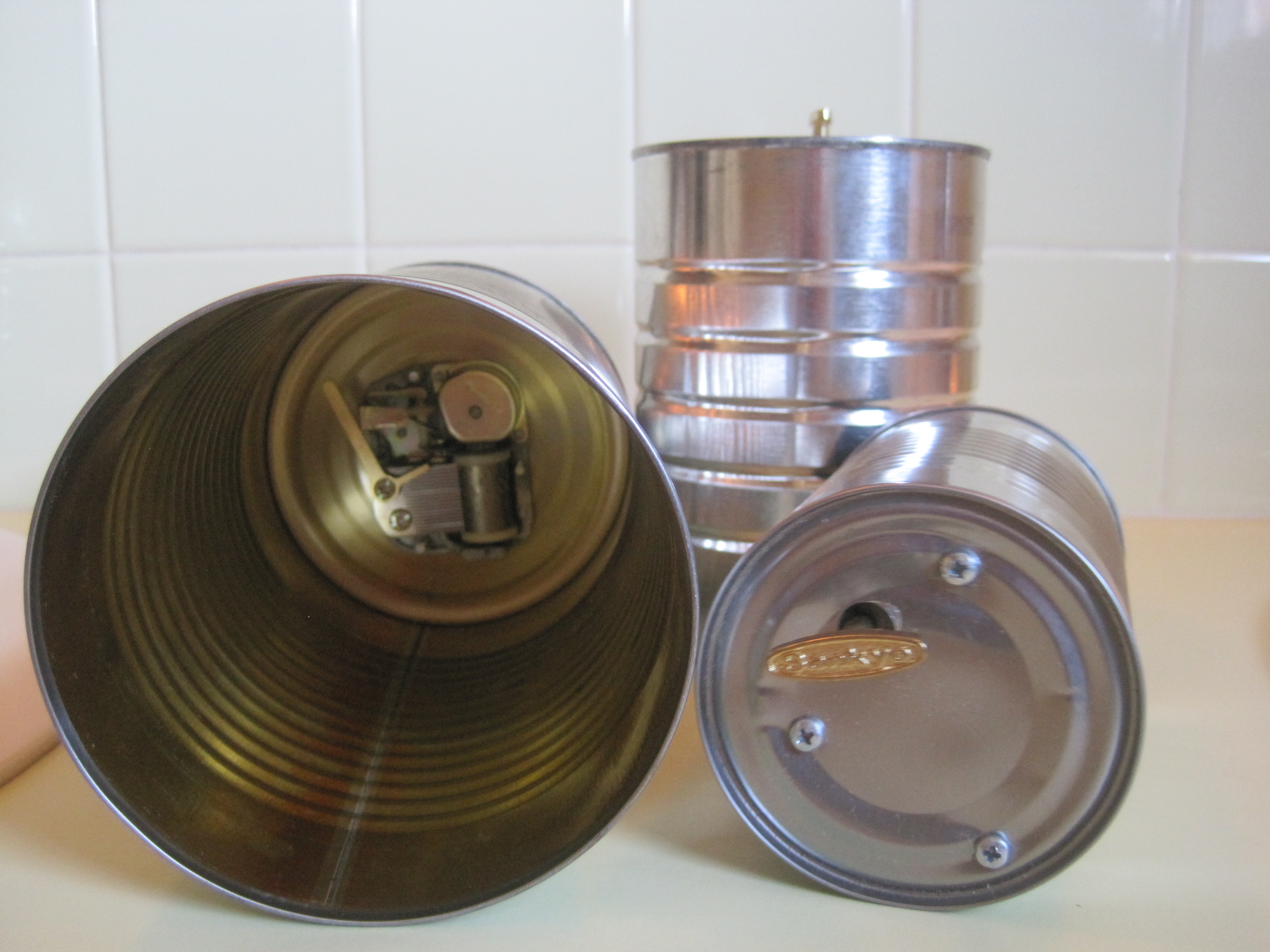
During this section some members of the band play music box movements mounted in tin can resonators; I’m interested in both mechanical musical instruments and ways of introducing handmade craft into the musical experience, so I had been experimenting with these for some time.  The first few I put together were salvaged from music boxes that were otherwise broken, but for this I would need at least two dozen to create the “field” of tinkling, overlapping melodies I had in mind.  (They can be heard starting from about 6:35.) So in the months leading up to the performance, I got several cases of music box movements and screwed them into empty cans in my garage.  Probably even more would be useful in creating the desired effect; it depends on the number of players over all and the dimensions of the performance space.  Combined with the layered statements of “Home on the Range” in the winds and bells, the music boxes are meant to evoke Kansas’ motto, “Ad Astra per Aspera” (“To the Stars through Adversity”).  The ending is hopeful, but tinged with the shadows of the past.

055057

Here’s the entire piece, which I titled Where Seldom is Heard, after the relevant lyric in Home on the Range, of course:

http://soundcloud.com/guy-vollen/where-seldom-is-heard

Finally, a great big thank you goes out to Bill Johnson and all the members of the Senseney Band for the hard work they put into this piece back in 2011.  It is always helpful for a composer to be able to work directly with an ensemble; numerous changes were made during the rehearsal progress, both to clarify my intentions and to get the best results, and everyone in the band was very supportive and helpful in making this project come together.  In the end we performed it three times (another luxury I don’t always get!); the recording here is from the second performance.  Thanks for listening!

In Defense of Medleys

As a composer and performer, one aspect of musical composition that has always fascinated me is the mysterious alchemy by which two ideas, which may have little in common (at least superficially), can be joined together simply by their presence in the same piece of music.  This may seem trivial, but the question of why some ideas seem to fit together and others remain stubbornly separate is an important one for composers and songwriters, and the performers and conductors who do their best to interpret their ideas.  It’s taken me a few months to come around to this directly, but I wanted to get some entries under my belt before I tackled the subject.

Although I intend to keep blogging about comics, movies, musical instruments, and anything else that catches my fancy, Medleyana takes its name from an oft-maligned genre of music: the humble medley—you know, the sort of piece that delivers the most exciting or recognizable bits of several songs or pieces in a self-contained arrangement.  It’s not hard to see why the medley form is underappreciated, or not even acknowledged as a legitimate form at all.  Anyone who has played an instrument in a school band or orchestra, or had a child who did, has suffered through watered-down arrangements of movie themes or pop tunes that are too difficult for students to perform in their original form, cementing an association between medleys and amateur music-making.  For the same reason, medleys are considered an essentially “commercial” form, trafficking in the ephemera of songs and movies that are omnipresent for a season and then forgotten.  Even those medleys of evergreen favorites like Christmas carols or patriotic songs are subject to the whims of changing fashion or the vagaries of the publishing business.  (Bob Lowden’s Armed Forces Salute, a well-regarded arrangement of the service songs of the five U. S. armed forces, and one I’ve played countless times, including a half dozen in the last year alone, recently went out of print.)  Nostalgia and pedagogy are not usually respected as serious aesthetic motivation: a form that typically combines both is doomed to be overlooked.

Still, the medley has been surprisingly robust as a genre.  Since the middle ages, dance tunes (at least those that were written down) were often strung together to create longer forms, a practice that has more to do with the necessity of providing accompaniment for an evening of dancing than any overarching compositional philosophy.  In the nineteenth century, possibly the golden age of concertizing, virtuoso performers and conductors would program crowd-pleasing medleys of popular operatic arias, often under the moniker of “fantasy” or “potpourri.”  A savvy self-promoter like Franz Liszt would be sure to have prepared a collection of the appropriate national songs of whatever country he was visiting as a sop to the audience, the equivalent of a rock star’s “Hello, Cleveland!” shout-out.  The concert band developed in this milieu, and its literature has always reflected this populist tendency.  And while ambitious composers have largely left Broadway and popular song medleys to pops concerts and school band publishers, most of the early twentieth century British masterworks that are the foundation of serious band literature—Gustav Holst’s Second Suite in F, Ralph Vaughan Williams’ Folk Song Suite, and Percy Grainger’s Lincolnshire Posey—are essentially medleys, albeit with a great deal more craft and passion than was normally lavished on compositions for the medium at the time.

In short, the typical medley form—one idea following another, like beads on a string, until it ends—may be simple, but a form it is, and one with a long pedigree in both “serious” and popular music.  Its continued presence is like the survival of those turtles and crocodilians that have remained largely unchanged since the days of the dinosaurs: they may be more modest than the giants they once walked among, but they are a surviving link to those days and worthy of our attention.

Personally, I have always preferred forms with a great deal of contrast; multi-strain forms like the march or piano rag, programmatic works, theatrical and film music, and the like.  In our current referential, sample-driven “remix culture,” there has been a renewed focus on issues of appropriation, quotation and recontextualization.  In the kind of medleys I mentioned, appropriation is less of an issue: songs under copyright must be licensed when included in a published arrangement, and as such the medley is an auxiliary to the original product, in effect an advertisement for the original.  The line is fuzzier when it comes to quotations so brief or so transformed that they fly under the radar of copyright niceties, or when the original work is in the public domain and safely available for anyone to use as they like.  Would the original composer approve of their tune’s new setting?  Is it necessary to observe original intent when combining or rearranging old chestnuts?  Will the audience even be aware of the borrowing?  Does it matter?  To be sure, “spot the reference” can be fun when dealing with magpie composers like Charles Ives or Danny Elfman, but even when the sources are unfamiliar I get a lot of pleasure from the sensory overload that comes from rapid-fire changes of musical texture, and there have been plenty of pop songs that I first heard as part of a medley, mash-up or mix tape, that captivated me enough to look up the original.

Perhaps it’s because I grew up in the era of “Hooked on Classics,” what writer Noel Murray calls the “Medley Age.”  Or maybe decades of playing medleys in school and community bands have left me with musical Stockholm Syndrome.  It could just be that I’m a hopeless vulgarian with a short attention span.  In any case, the pleasure of recognition is often only the beginning of what a medley or mash-up has to offer.  Readers of this blog will have noted that I am, at best, ambivalent about totalizing theoretical or aesthetic frameworks, whether in music, literary analysis, or comic book continuity: as seductive as they can be, they can be too constricting when taken as a blueprint for the creative act, and when used as an editor’s guiding principle can cut out much that was fresh and vital in the first place.  In my view, it’s better to “let a thousand flowers bloom,” even knowing that the results may be messy, chaotic, and contradictory.  In that sense, they are much more like life as it is lived than as we would like it to be.