There were big tables covered with comics standing upright in long rows. A sign hanging from the ceiling said All Comics 5¢. We began to flip through the comics. Alan had a list with the titles and numbers of the comics he wanted. It was slow work. The only comic he found that was on his list of wants was a copy of Action Comics Number 1—but he didn’t buy it because there was a corner torn off the cover. He said he only bought comics that were perfect.
That throwaway line, from Daniel Pinkwater’s young adult fantasy Alan Mendelsohn, the Boy from Mars, is played for irony, of course: even in 1979, when Alan Mendelsohn was first published, a copy of the first issue of Action Comics—the comic book in which Superman made his first appearance—was something the average collector could only dream of finding, in any condition. It also establishes Mendelsohn’s character: exacting to the point of eccentricity, and confident enough to pass up the find of a lifetime because it’s not exactly what he’s looking for. Later, Mendelsohn sells his comic book collection to finance the greater adventure he and Leonard (the narrator) are on: Mendelsohn remains cool while his buyer goes increasingly crazy for the rare finds Mendelsohn has. By the end, Mendelsohn has the buyer eating out of his hand, and he and Leonard get the money they need, and then some:
“The difference between that man and me,” Alan Mendelsohn said, “is that I am a connoisseur, and he is a fanatic.”
Both scenes play into powerful fantasies for young collectors: finding a holy grail—there have been more expensive comic books, but few that are as recognizable as Action Comics No. 1—and being able to leverage our finds down the road, using our connoisseurship to get one over on the drooling fanatics who’ll pay any price for what we have.

Sadly, for most collectors, the fantasies remain just that. For the past few days, the comics blogosphere has been chewing over an article in Businessweek pointing out that you’re probably not going to be able to retire on the proceeds from your comic book collection. As an example, columnist Frank Santoro offers an anecdote that stands in for the general trend:
He recently had to break the bad news to a friend’s uncle, who was convinced his comic collection—about 3,000 books—was worth at least $23,000. “I told him it was probably more like $500,” Santoro says. “And a comic book store would probably only offer him $200.”
When I read this, my first reaction was: “Well, duh.” While auction prices for “key” Golden Age issues have continued to rise, it should be obvious that there is a big difference between Action Comics No. 1 and Secret Wars II No. 1, and the collections owned by the forty-something men in the article are likely to be more laden with the latter than the former. I know, because I’m one myself, with a collection of bagged and boarded comics in the basement, and I doubt I’ll ever get much out of it in monetary terms. Sure, it was disillusioning the first time I realized I wouldn’t get what I thought something was worth out of it, but I’m willing to settle on a realistic price for anything; it’s just that “realistic” can look very different depending on whether one is buying or selling. I’ve encountered my share of junk shops, garage sales and Craigslist ads run by deluded souls convinced that they’re sitting on a gold mine. I’ve seen scratched-up Beatles albums for $40 or $50 (and not the rare ones) and highly-promoted but far from rare comics from the ‘90s with high price tags. Anyone who has collected anything, or even tried to buy a used car or piece of furniture, could tell similar stories.
The seller may have an inflated idea of the scarcity of their item, or they may have been swept up in the hype of ever-rising prices for collectibles in general; they may even have a price guide to back them up, which only proves that someone was willing to pay a premium for the item (in mint condition, which is usually not the case) at one time. Still, something is really only “worth” what someone else is willing to pay for it, so I imagine those albums and comics are still sitting on the shelf, or were marked down or put into storage—or found a buyer as gullible as the seller (leading to the description of the back issue market as a “Ponzi scheme” in the Businessweek article).
But clearly, the idea that your old comic book collection would put your kids through college is an old one, an article of faith (or folklore) that predates the speculation boom of the 1990s. As Alan Mendelsohn shows, it was already alive and well in the 1980s, when I was collecting, and it didn’t only come from the publishers and retailers who had a vested interest in promoting “collectability.” The belief among collectors that we were stockpiling a monetary investment for the future had a “revenge of the nerds” quality, like the stories we told ourselves that we would all become successful inventors or entrepreneurs, getting the last laugh on the jocks, the bullies, the “normals” who got in our way. I guess it worked out that way for a few people, but for the majority it was a self-serving myth (and for the record, Alan Mendelsohn got a hundred and eighty-five dollars and a brass potato for his collection; he didn’t become a millionaire).
As an extreme example, consider “Gather Ye Acorns,” a 1986 episode of the anthology series Amazing Stories. In it, Mark Hamill (in one of his few post-Luke Skywalker, pre-voice acting roles) plays Jonathan Quick, a dreamy young man growing up during the 1930s, obsessed with comic books, pulp magazines and toys. Pushed by his parents, who urge him to “grow up” and cast off his childish belongings, Jonathan is approached by a mysterious, gnome-like figure, a folkloric wild man (played by David Rappaport), who encourages him to keep the things he loves, to hold onto the magic of childhood. What the world needs, the troll tells him, “is a few more dreamers.” Over the years, Jonathan turns down the prospect of a normal life, descending into poverty and eventually living in a pitiful shack with his shabby old car and all his old junk; just when he has lost faith, he encounters (at the “Last Chance” gas station!) a knowledgeable (and wealthy) collector. It turns out that the world has come around, and his belongings, which for so long were precious only to him, are now highly collectible. The owner of a comic book shop is shown going through his treasures in disbelief: why, that’s Action No. 1, the first appearance of Superman! The episode ends with an auction of Jonathan Quick’s collection; now wealthy, he encounters the troll one last time, and while trying to thank him, makes the acquaintance of an attractive lady. Perhaps it’s time for Jonathan Quick to finally settle down.
In the broadest sense, that of allegory, “Gather Ye Acorns” is a story of holding on to the magic of childhood, of not letting others define you or devalue your passions. But I doubt I was the only viewer who took the story’s moral literally, as a vindication of the collecting lifestyle: “See? All that stuff had value, and he ended up rich!” It’s probably also a middle finger to the parents of Baby Boomers (like Steven Spielberg, who produced the series, and whose story Stu Krieger’s teleplay is based upon) who threw out all their kids’ baseball cards and comic books, and who, like the overbearing parents in “Gather Ye Acorns,” probably never saw that junk as anything but a waste of money in the first place.
Looking back at actual history, however, there was more than just the ever-present Generation Gap at work: the social upheaval and increased mobility of the Depression and World War II made the maintenance of big collections an unlikely prospect, even for those who might have been so inclined. It’s hard for us nowadays to imagine how few possessions most families had compared to the present (and forget about renting extra storage space, as so many of us do now!). Remembering the adage “every move is like a fire,” it’s also likely that in the migrations of the war years (from the Dust Bowl to the West; from the deep South to the factories of the North; from rural areas to cities, and from cities to the suburbs), preserving ephemera like comics was simply not a high priority for most people. Finally, the war effort included paper and shellac drives that undoubtedly consumed thousands of comics, magazines, and records.
It’s for all the above reasons that the “key” issues from the Golden Age command such high prices, and why, barring a similar national upheaval, later issues probably never will. Even as a kid, it was obvious to me that if everyone was saving their comics (and baseball cards, and whatever else), they would never become as scarce as material from the 1930s and ‘40s (or ‘50s, when a great number of comics were destroyed as part of the moral panic that led to the creation of the Comics Code). In some cases, it was now parents who enabled the preservationist instinct, Baby Boomers themselves who didn’t want to repeat the mistakes of their own parents. And of course, scarcity is only part of the equation: it has to be something people want in the first place, or low supply will do nothing to drive up demand. Even if all those variant-cover comics from the ‘90s disappeared, it’s unlikely they would ever be as sought-after as historically important issues like the first appearances of Superman or Batman.
Since we don’t know what will be scarce and desirable in the future, should we save everything, just in case? Interestingly, at the midpoint of “Gather Ye Acorns,” when Jonathan Quick is squatting in a shack in the desert, he resembles a figure that has become much more visible since this episode was broadcast: the hoarder. His anger at the troll, his disgust with the “treasures” he’s spent his life hanging onto, and above all his despair—“I have nothing!” he howls—are the flip side of the usual narrative, and are a frighteningly real moment in a story that otherwise has the broad outlines of a fable. Even with the happy ending, the story seems to stretch things when it suggests that his years of struggle were worth it, because he lived life on his own terms; this comes awfully close to romanticizing poverty, as if there were no middle ground between his parents’ rigid standards and life as a “bum.” As writer Noel Murray asked when examining two current portraits of Americans’ relationship with our possessions, the TV shows American Pickers and Hoarders, “So which is it? Are we supposed to hang on to all of our old crap just in case it turns out to be valuable, or is that kind of packrattery the sign of a disordered mind?”
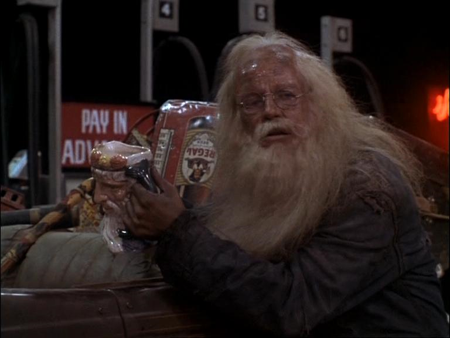
Mark Hamill as you, the reader, on Amazing Stories
Of course, you could still read your comics. When I was a kid, I had a friend, Jason, who often came around to trade comics. On the one hand, he was always interesting to talk to, and had a knack for digging up unusual books I’d never seen; on the other hand, he’d drive me crazy by going through my stacks, getting things out of order, and wanting to trade for issues that would break up continuous runs. Condition didn’t matter much to him; it was the stories that were important. Jason was a throwback, the kind of comic book reader who had supposedly disappeared with Leave it to Beaver: he didn’t bag his comics—he’d even roll them up to stick in his backpack, to my horror. (In retrospect, I wasn’t much more careful, but I could be an awful snob.)
Despite my efforts to preserve my comics like a good investor, my best memories of being a comics reader in the 1980s are of getting together with friends to read and discuss comics, and even those marathon trading sessions that left me cleaning up and reordering my collection for the rest of the afternoon. Similarly, some of the comics I most fondly remember finding at garage sales were reprints, some with the covers missing, of no monetary value at all. I tried valiantly to be a connoisseur, but I guess I was really a fanatic all along.


 Medleyana