In 2019 I celebrated “Ninjanuary” with several posts about the ninja in popular culture, particularly in films and books from the 1980s, and I occasionally return to that theme. Past entries can be found by clicking on the Ninjanuary tag.
When I wrote about Commando Ninja last year, I noted how exaggerated many “retro” 1980s throwbacks are in their treatment of themes and visual styles, parodying or intensifying elements from movies and TV shows that were already larger than life. Justice Ninja Style (John Legens, 1986) is an actual product of the 1980s and a good reminder of how square a lot of that entertainment was. With distance, we’ve remembered the highest points, the most stylish or exciting moments, and forgotten the sea of formula and mediocrity from which those peaks emerged. That’s not to say Justice Ninja Style is bad—for the most part, it’s pretty charming and makes for a diverting 70 minutes or so—but it’s much more prosaic than those latter-day vaporwave creations, or, for that matter, such singular ‘80s oddities as Unmasking the Idol or Ninja III: The Domination.
While Justice Ninja Style was produced by a Hollywood company, it was shot on location in a small town with the enthusiastic participation of locals (including the police and fire departments), giving it the feel of a regional DIY movie. Everyone gets in on the act, from area musicians to kids in the local karate studio; most scenes in public places are sprinkled with extras from around town. (In that regard, Justice Ninja Style most reminded me of King Kung Fu, the 1976 monster/martial arts spoof that doubles as a tour of Wichita, Kansas’ points of civic pride.) It’s a little odd for me, having gotten used to shot-on-video movies as inherently transgressive “outsider” art, exploring themes of horror, sexuality, or (for want of a better term) mindfuckery, and severely constrained by lack of resources, talent, or interest in mainstream appeal, to watch a similarly small-scale movie that seems to aspire to being a TV movie of the week. The violence is mostly bloodless, and while there is an air of sexual menace and implied threat of rape, it’s strictly PG-rated (for the ‘80s). It’s almost wholesome.
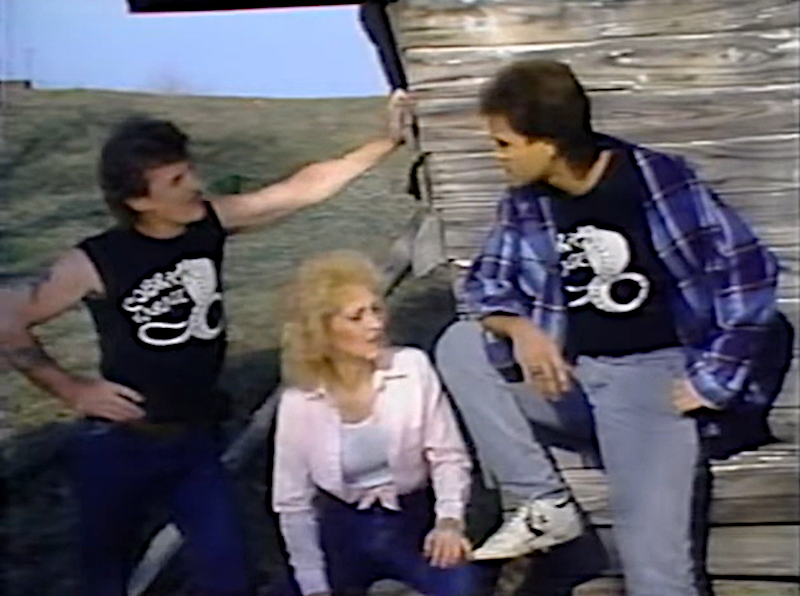
Set in De Soto, Missouri (a small town south of St. Louis), the film begins with two women, Shelly and Carol, driving through the countryside, discussing Shelly’s frustration with the hapless George, a police deputy who keeps pushing for a date. They don’t notice the police cruiser following them at a distance. When their car gets a flat tire, Carol offers to walk to the nearby salvage yard for help (it’s the ‘80s—no cell phones, kids), leaving Shelly alone when George pulls up with his partner, Grady. While George has Grady work on the tire, he makes a move on Shelly; she fights off his aggressive overtures, and in a rage he strikes her, accidentally killing her. Before Grady can decide what to do, George senses the opportunity to frame a patsy, new-to-town karate instructor Brad, who happens to be jogging by. George tricks Brad into showing him some moves with his T-stick, getting his fingerprints all over it, and gives himself a bump on the head so he can claim Brad resisted arrest when George tried to apprehend him after discovering him with the dead woman. He browbeats Grady into going along with this and Brad ends up in a jail cell. The charge: murder.
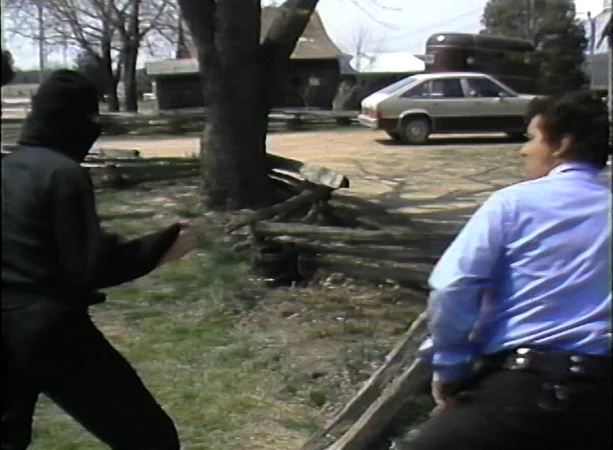
You might expect that this injustice pushes Brad to exact bloody revenge against the corrupt cops, like John Rambo in First Blood, but while he does protest his innocence, he’s much too nice a guy to burn it all down. Brad is the main POV character, but he practices karate, not ninjitsu. No, the film gets its title and theme from the mysterious, black-clad figure who witnessed Shelly’s murder and who later breaks Brad out of jail and wordlessly offers him help along the way to clearing his name. Brad doesn’t expect either his friends (mostly fellow karate instructor Dan) or his enemies to believe that there’s a ninja around—he can barely believe it himself. But through physical evidence like the shuriken (throwing stars) left on the ground and sightings from other people, eventually the truth gets out and George faces a reckoning at the deadly hands of the ninja.
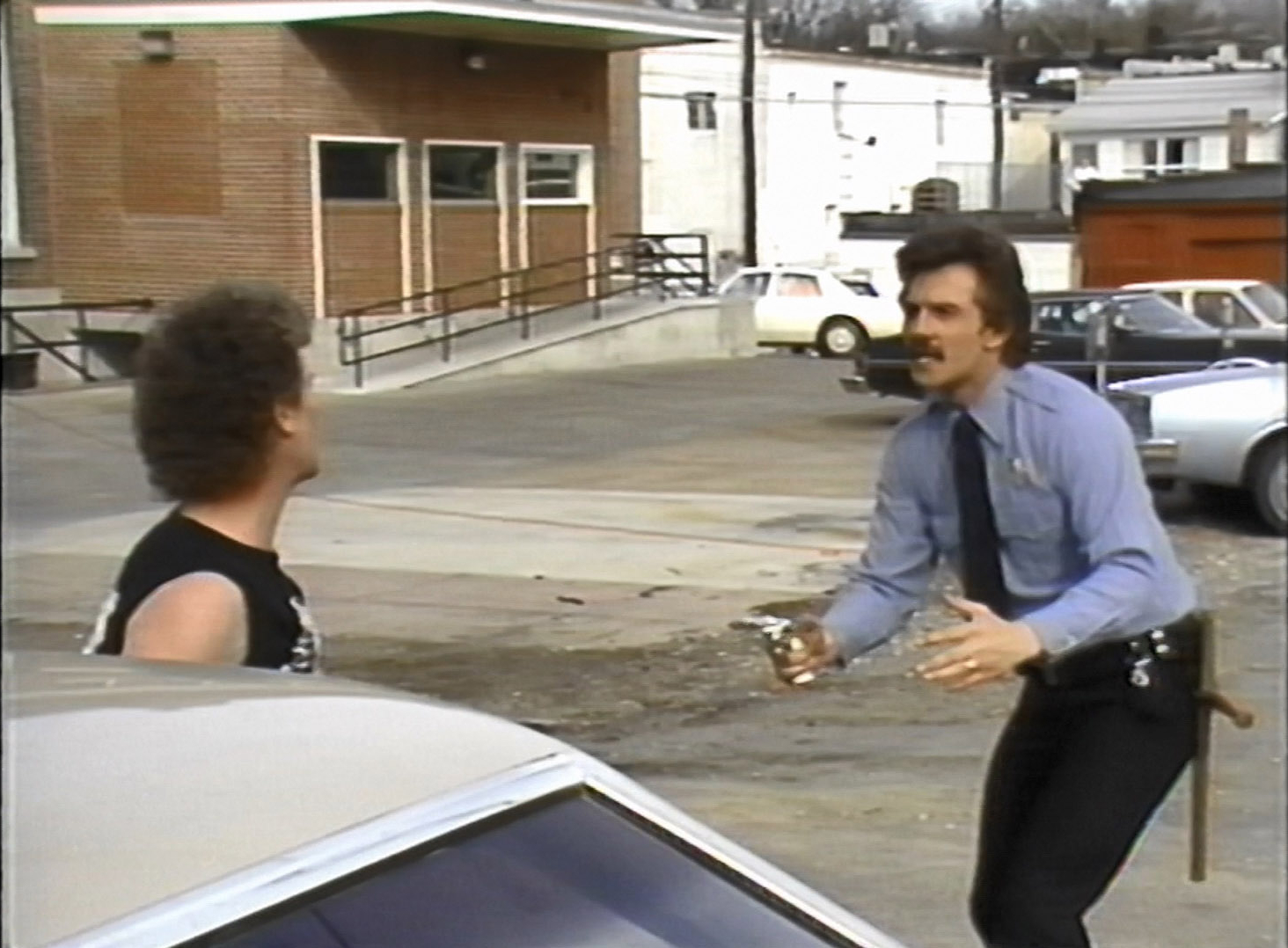
It is amusing that the De Soto police were so cooperative when the Deputy is such an obvious villain. Perhaps they were too star-struck to worry about whether the movie would be copaganda, and it is worth noting that Rick Rykart, who played George, wasn’t local. (Rykart gives the most compelling performance: he starts out as a jerk who goes too far and tries to cover his tracks, but the scenery becomes more tasty as he becomes more desperate, so by the end he’s threatening to murder four people to guarantee their silence and bellowing that he’s not afraid of any ninja.) But there’s another angle: through a dramatic contrivance, George is only in charge while the Chief is away on business, giving him an incentive to wrap the case up before the Chief returns, and with Brad (Brent Bell) and his friends counting on the Chief to recognize the truth when he hears it. Like the absent King Richard, the Chief’s departure leaves a hole that can either be filled by pretenders like George or the Robin Hood-like ninja, operating outside of the law to preserve something more important: justice.
The ninja is played by Grand Master Ron D. White, a 9th Degree Black Belt and Martial Arts Hall of Famer, who also (according to him) rewrote the script to more accurately portray the art and history of the ninja. Although he doesn’t get a lot of screen time, the film was built around White, and after its initial release, producers apparently felt that they needed to beef up his presence as well as provide more backstory explaining his character’s motivation instead of saving that revelation for the end. The expanded film was released as Ninja the Ultimate Warrior; I may be in the minority, but I don’t think it’s an improvement. The ninja is entirely silent and remains masked in Justice Ninja Style, but Ninja the Ultimate Warrior—which reveals that the ninja character is apparently named “Liberty King”—has a prologue in which White woodenly delivers exposition, and another scene establishing that George was a corrupt hothead in St. Louis before he was reduced to being a corrupt hothead in a small town. These scenes don’t add much and only make the later plot turns seem predictable instead of developing organically.
The legitimacy of White’s claim to be a real ninja isn’t something I’m qualified to dispute, but suffice it to say that there are many dubious pedigrees and many self-credentialed figures in the martial arts world. In the documentary The Ninja Speaks (on the Justice Ninja Style Blu-ray from VHShitfest), White doesn’t talk about when or how he became a ninja, other than to say that “some people liked and some people hated” his video How to Be a Ninja, an introduction to ninja weapons and techniques with some hands-on demonstrations. Perhaps it’s all kayfabe, or maybe White’s antics are a smokescreen of disinformation to protect the real secrets of the shadow warriors. It’s not my place to say.
 Medleyana